Podcast
Change Starts Here
Hosted by Franklin Covey Education · EN
Change Starts Here, presented by FranklinCovey Education, is the podcast for K–12 school and district leaders who are shaping—or ready to lead—meaningful change in their schools and communities. Through interviews with innovative educators and research-backed insights, each episode explores how to build leadership at all levels, foster high-trust school cultures, and achieve breakthrough results around what matters most. This podcast offers practical ideas and bold thinking to help you create lasting impact in your school community. Explore the episodes and dive into real stories, proven strategies, and the leadership mindset that transforms schools. This is your space for inspiration, clarity, and action. Real change starts here.
31episodes
Episodes
Newest firstAll episodes
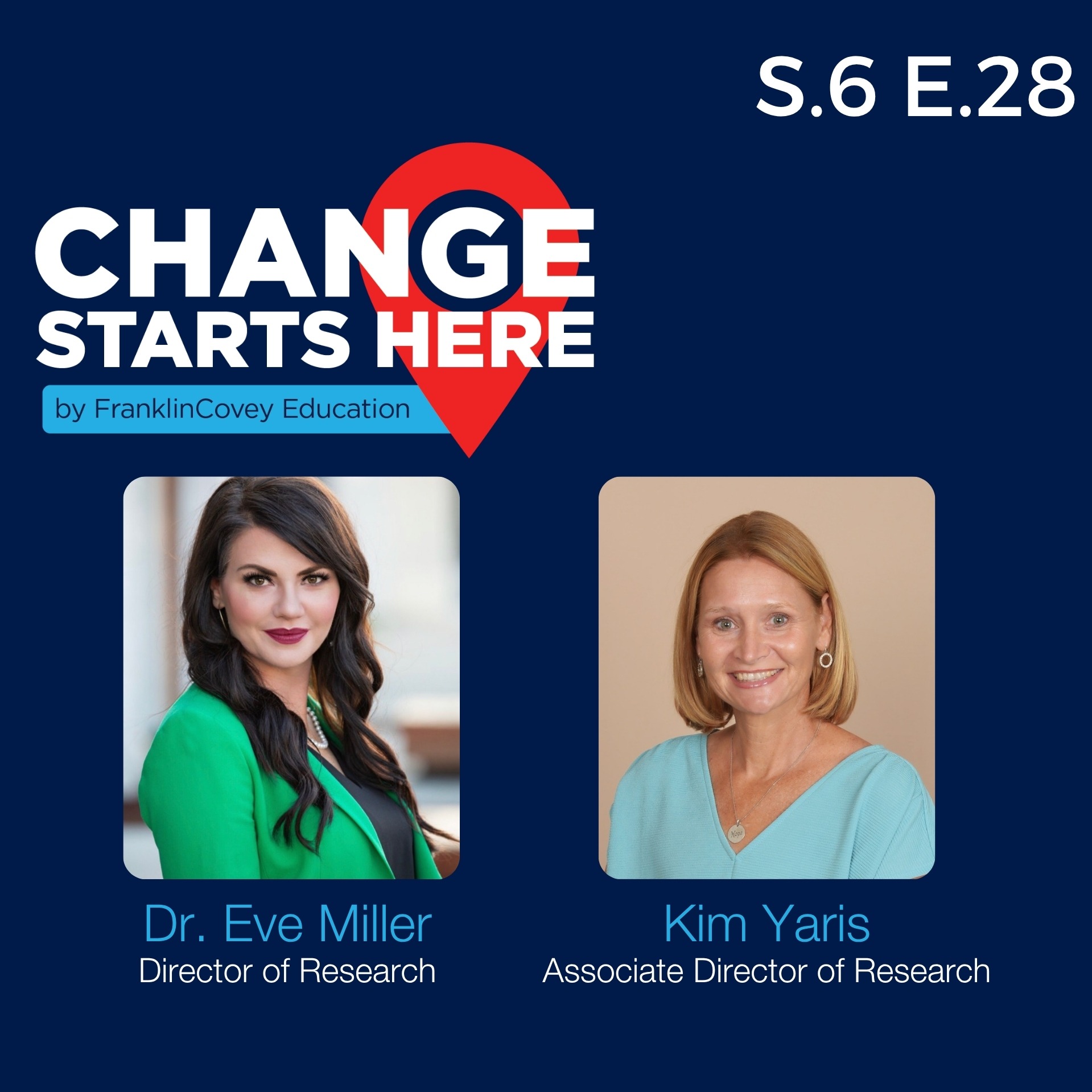
Permission to Play: Why Joy is a Leadership Skill
Mar 2400:24:45Tap to summarizeIn this episode of Change Starts Here, Kim Yaris and Dr. Eve Miller challenge the way we view joy and play in education, especially during the heavy, high-stress stretch of testing season. Too often, joy is treated as a "garnish" in schools—a funny video at a staff meeting or a smoothie bar during Teacher Appreciation Week—and categorized as a mood rather than a vital capacity. However, Dr. Miller shares that joy actually has a biological architecture that fundamentally changes what the brain can do.Drawing on Barbara Fredrickson’s "broaden-and-build theory" and Dr. Stuart Brown's research on play histories, the hosts reveal that play is not a reward for finished work; it is a biological drive as essential as sleep and nutrition. The conversation unpacks how the demands of leadership train the brain to constantly scan for problems, which can trigger "foreboding joy" and shut down our access to playfulness. Listeners will walk away with three highly intentional, small practices to rebuild this capacity: training your "delight muscle," going first with vulnerability, and protecting one entirely unproductive ritual.Download the free episode assets:Handout: https://resources.franklincovey.com/c/CSH-handout-e27?x=D1cEjaStaff Booster: https://resources.franklincovey.com/c/csh_staffbooster_ep27?x=D1cEjaHost:Kim Yaris, M.Ed. (Associate Director of Research with FranklinCovey Education) Dr. Eve Miller (Director of Research with FranklinCovey Education)Timestamps: (00:00 - 01:15) Podcast intro(01:15 - 03:28) The delight muscle(03:28 - 06:30) Joy as a capacity(06:30 - 08:34) Broaden and build theory(08:34 - 10:14) Play is a biological drive(10:14 - 12:39) Brain mechanisms of play(12:39 - 15:46) Foreboding joy in leadership(15:46 - 17:40) Realistic, adaptable leadership(17:40 - 19:56) Practice 1: Delight muscle(19:56 - 21:34) Practice 2: Go real(21:34 - 24:43) Practice 3: Unproductive ritual
Transcribe →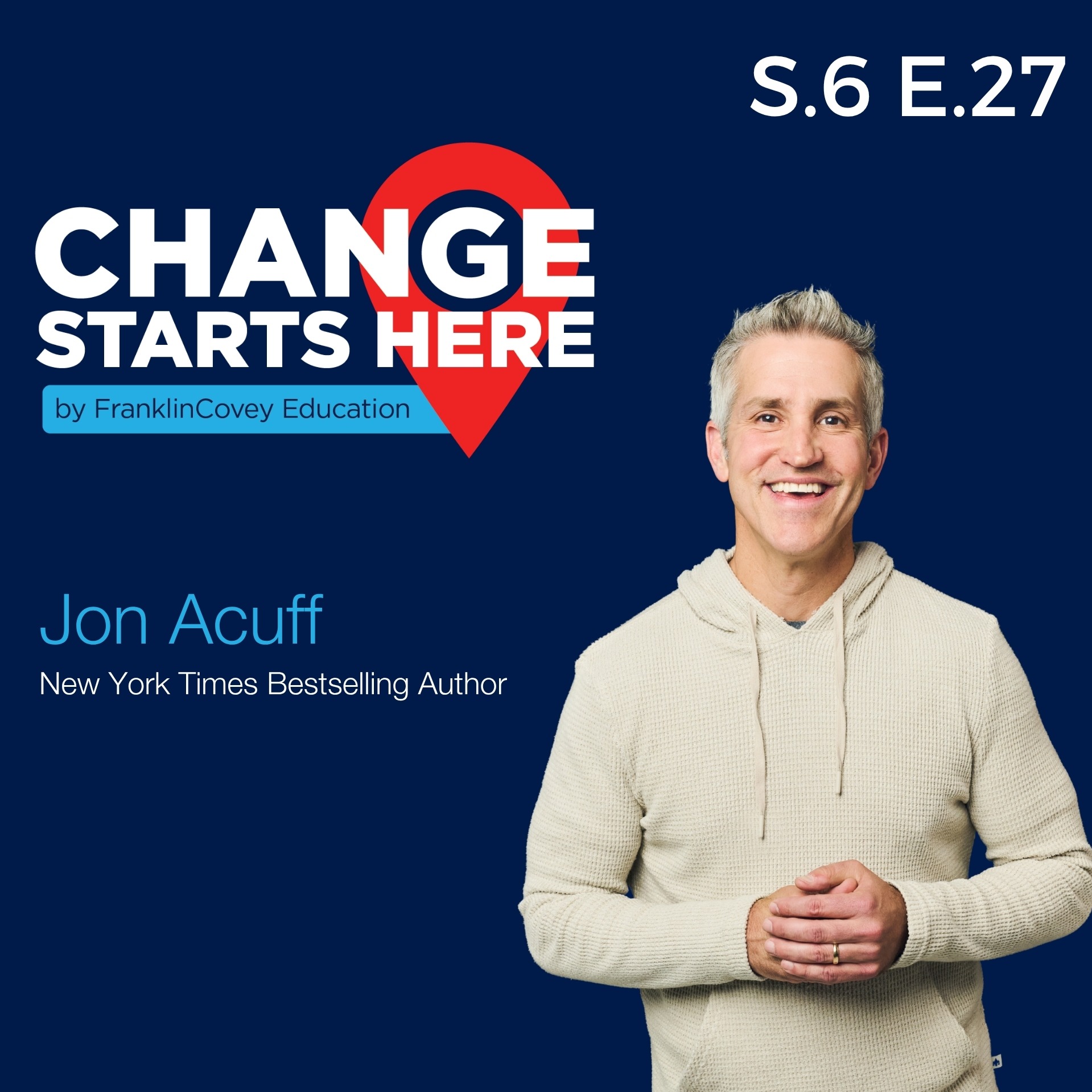
How Educators Can Help Students Rewrite Their “Broken Soundtracks” | Lessons on Mindset With Jon Acuff
Mar 1700:37:42Tap to summarizeIn this episode of Change Starts Here, Dustin Odham sits down with New York Times bestselling author Jon Acuff to explore the profound impact of mindset on both students and educators. Jon unpacks his concept of "broken soundtracks"—the negative, repetitive thoughts that hold us back—and explains why issues like procrastination, perfectionism, and imposter syndrome are not physical hurdles, but mindset challenges.Jon shares practical strategies for identifying and replacing these broken soundtracks, starting with a simple two-step exercise that educators can use in the classroom to uncover limiting beliefs. He also challenges adults to lead by example, arguing that we must be as brave as we ask our students to be. Whether you are an educator trying to inspire a classroom or a leader trying to silence your own inner critic, this conversation offers actionable advice on how to practice positivity and turn overthinking into a superpower.Visit Jon’s Website to learn more: https://store.jonacuff.com/ Purchase your copy of Jon’s best-selling book, Soundtracks: The Surprising Solution to Overthinkinghttps://store.jonacuff.com/soundtracks Host: Dustin Odham (FranklinCovey Education)Guest: Jon Acuff (New York Times Bestselling Author)Timestamps: (00:00 - 02:37) Intro(02:37 - 07:10) Solving the overthinking problem(07:10 - 09:46) Mindset as a multiplier(09:46 - 12:43) The lifecycle of a broken soundtrack(12:43 - 15:16) A classroom mindset exercise(15:16 - 18:49) Leading by example(18:49 - 23:39) Practicing positivity(23:39 - 28:53) Betting on yourself(28:53 - 30:47) Idea bankruptcy(30:47 - 33:17) Empowering the next generation(33:17 - 35:01) Lean into your one verse(35:01 - 37:42) Closing
Transcribe →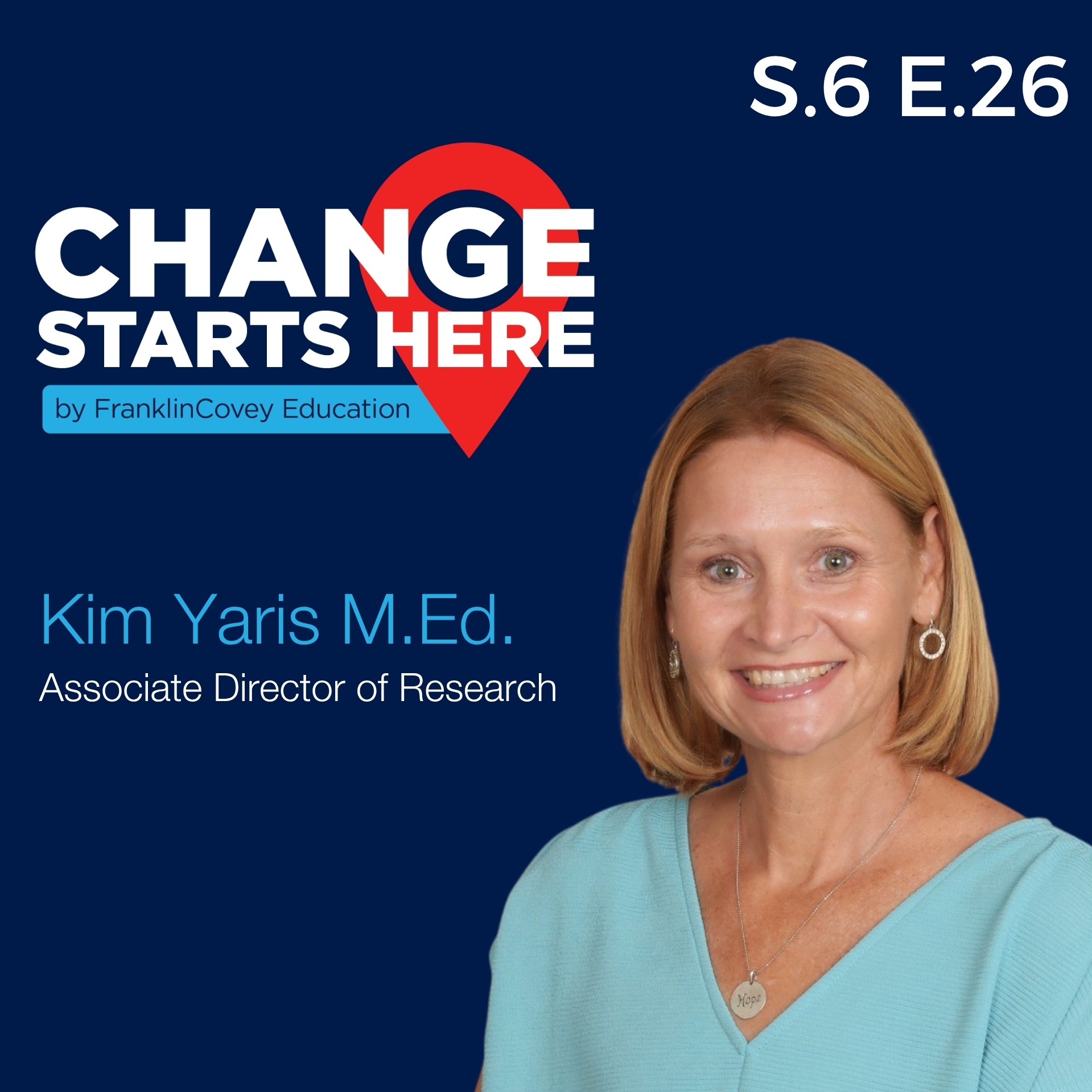
How Curiosity Drives Deeper Learning
Mar 1000:12:28Tap to summarizeIn this episode of Change Starts Here, Kim Yaris explores a pressing question in education: are students and adults less curious than they used to be? In a fast-paced world, the space for wondering is often crowded out by the demand for immediate answers. Yet, workforce research continuously identifies curiosity as a critical, durable skill essential for problem-solving, adaptability, and long-term learning.Kim dismantles the conventional myth that curiosity is simply a fixed personality trait. Instead, she shares five research insights proving it is highly responsive to its environment. Listeners will learn the neuroscience behind why curiosity emerges when uncertainty feels manageable, and how true engagement often looks more like productive struggle than cheerful exploration. Finally, Kim offers three practical moves for leaders to nurture curiosity in their teams and classrooms: building tiny moments of prediction, normalizing uncertainty, and ensuring questions don't hit a dead end.Download the Handout: https://resources.franklincovey.com/c/podcast_handout_ep25?x=I8LeICHosts: Kim Yaris, M.Ed. (Associate Director of Research with FranklinCovey Education)Timestamps: (00:00 - 01:29) The curiosity question (01:29 - 02:58) A durable, essential skill (02:58 - 04:19) The conventional curiosity(04:19 - 06:19) Five research insights (06:19 - 08:13) The neuroscience of uncertainty (08:13 - 09:30) Practice 1: Tiny predictions (09:30 - 10:28) Practice 2: Normalize uncertainty (10:28 - 11:20) Practice 3: Avoid dead ends(11:20 - 12:27) Outro
Transcribe →
Break the Burnout Cycle. Reclaim Your Agency
Mar 300:11:40Tap to summarizeIn this episode of Change Starts Here, Dustin Odham addresses the subtle burnout that often creeps into schools during the spring semester. He explains that burnout often stems not from the workload itself, but from the negative stories and expectations we attach to that workload.Through a personal story of a chaotic morning, Dustin illustrates how shifting our internal question to "What does leadership require of me right now?" can change our entire posture and response. Listeners will learn three practical shifts to reclaim their agency: separating fatigue from frustration, reclaiming their circle of control, and upgrading the meaning assigned to their challenges. By moving from victim language to ownership language, educators can transform an exhausting season into a refining one.Host: Dustin Odham (FranklinCovey Education)Timestamps: (00:00 - 01:08) Intro (01:08 - 01:38) Subtle burnout (01:38 - 03:18) A chaotic morning (03:18 - 04:46) What leadership requires now (04:46 - 06:26) Interpretation drives your energy (06:26 - 07:48) Circumstance versus your identity (07:48 - 08:00) Separate fatigue from frustration (08:00 - 08:30) Reclaim circle of control (08:30 - 09:03) Upgrade your assigned meaning (09:03 - 09:39) Choose ownership and growth (09:39 - 10:59) Challenge yourself (10:59 - 11:40) Outro
Transcribe →
High Expectations: Belief, Behavior, or Both?
Feb 2400:23:02Tap to summarizeIn this episode of Change Starts Here, Kim Yaris and Dr. Eve Miller dive into the pervasive and often misunderstood topic of "high expectations." While most leaders strive to raise the bar, they often see the same patterns repeat: the same students doing the thinking and the same staff carrying the load. Kim and Eve explore the research behind why this happens, revealing that high expectations are not just a mindset, but a visible environment created by thousands of micro-decisions.Listeners will be guided through a visualization exercise to understand how belief shifts behavior, from the feedback we give to the opportunities we offer. The hosts unpack four research-backed practices to disrupt low-expectation cycles: conducting an "Opportunity Audit," separating a student's "snapshot" from their potential "pathway," utilizing "Wise Feedback," and pairing challenge with structural support. This episode challenges educators to examine their default settings and intentionally design cultures where growth is the norm, not the exception.Our Staff Booster: https://resources.franklincovey.com/c/lim_staffbooster_episode23?x=63yTZlDownload the Handout: https://resources.franklincovey.com/c/podcast_handout_epis-23?x=63yTZlHosts: Kim Yaris, M.Ed. Associate Director of Research with FranklinCovey EducationDr. Eve Miller, Director of Research with FranklinCovey EducationTimestamps:(00:00 - 00:42) Podcast intro (00:42 - 01:49) The expectation gap (01:49 - 04:24) Visualizing belief versus doubt (04:24 - 06:28) Expectations as environments (06:28 - 08:46) How expectations leak out (08:46 - 10:45) Cycles of expectations (10:45 - 13:21) Balancing efficiency and expectation (13:21 - 16:21) Labels and self-perception(16:21 - 18:24) Practice 1: Opportunity Audit (18:24 - 19:35) Practice 2: Snapshot vs Pathway (19:35 - 20:30) Practice 3: Wise Feedback (20:30 - 21:54) Practice 4: Challenge and Support (21:54 - 23:00) Closing thoughts
Transcribe →
Burnout to Breakthrough: Better Choices for Busy Leaders
Feb 1800:43:18Tap to summarizeIn this episode of Change Starts Here, host Dustin Odham is joined by Kory Kogon, FranklinCovey’s Global Practice Leader for Content Development and co-author of The 5 Choices: The Path to Extraordinary Productivity. Together, they address the mounting pressure on educators to "do it all" and the burnout that inevitably follows. Kory explains why the old "work 'til you drop" mentality is no longer sustainable in an age of constant digital distraction and generational shifts.Kory breaks down the framework of The 5 Choices, explaining how it complements the 7 Habits of Highly Effective People by offering a practical system for decision, attention, and energy management. Listeners will learn how to identify their "extraordinary roles," avoid "accidental energy drainers" that demoralize teams, and why physical renewal is a biological necessity for brain function, not just a luxury. This conversation is a roadmap for high performers to move from feeling buried by the whirlwind to achieving meaningful results without sacrificing their well-being.Get your copy of The 5 Choices:https://www.amazon.com/Choices-Path-Extraordinary-Productivity/dp/1476711712/ref=sr_1_2?s=books&ie=UTF8&qid=1413483143&sr=1-2&keywords=the+five+choices+to+extraordinary+productivityHost: Dustin Odham, FranklinCovey EducationGuest: Kory Kogon, Co-author, The 5 Choices: The Path to Extraordinary ProductivityTimestamps: (00:00 - 02:07) Introduction and Context (02:07 - 04:39) Meet Kory Kogon (04:39 - 06:23) Rethinking Productivity (06:23 - 08:56) 5 Choices and 7 Habits (08:56 - 12:02) Decision Management (12:02 - 13:04) Attention Management (13:04 - 18:08) Real-World Impact Stories (18:08 - 22:56) Fuel Your Fire (22:56 - 28:50) Managing Overwhelm (28:50 - 35:14) Modeling Energy Leadership (35:14 - 37:15) Practical First Steps (37:15 - 40:04) 5 Choices and 4DX (40:04 - 42:17) Accidental Energy Drainers (42:17 - 43:15) Conclusion
Transcribe →
The Truth About Reflection — And Why It Often Fails
Feb 1000:18:07Tap to summarizeIn this episode of Change Starts Here, Kim Yaris and Dr. Eve Miller tackle a practice that is ubiquitous in education yet often misunderstood: reflection. While educators and students are constantly asked to reflect, it frequently feels shallow, performative, or exhausting. Kim and Dr. Miller explore the neuroscience behind why reflection works, revealing that without it, experience simply hardens habits rather than creating learning.Listeners will learn the critical neurological distinction between reflection and rumination, and how leaders often unintentionally trigger the latter. The conversation highlights that reflection is not a passive review of the past, but an active state of inquiry that requires psychological safety to engage the prefrontal cortex. By shifting from "why" questions to "what" questions and treating reflection as a learned skill, leaders can turn this practice into a powerful engine for self-regulation and capacity building.Download the Handout: https://resources.franklincovey.com/c/CSH-Truth-reflection?x=fmnfWPHosts: Kim Yaris, M.Ed. (Associate Director of Research with FranklinCovey Education) Dr. Eve Miller (Director of Research with FranklinCovey Education)Timestamps: (00:00 - 00:55) Podcast intro and topic (00:55 - 02:44) The tension of reflection (02:44 - 04:23) Experience versus learning (04:23 - 05:15) The cycle of inquiry (05:15 - 07:25) Why reflection drives growth (07:25 - 09:53) Neuroscience of the brain (09:53 - 12:33) Reflection versus rumination (12:33 - 14:20) Common reflection misconceptions (14:20 - 15:41) Practical leadership strategies (15:41 - 18:05) Closing thoughts
Transcribe →
Treat Behavior as Feedback, Not Failure
Feb 300:09:54Tap to summarizeIn this episode of Change Starts Here, host Dustin Odham addresses the unique challenges of the "February slump", a time when fresh start energy has faded and end-of-year milestones are still out of sight. Dustin explores why behavior problems from both students and adults often spike during this period, arguing that these are rarely character issues but rather energy issues fueled by fatigue and disconnection.Listeners will learn three practical leadership moves to navigate this difficult stretch without burning out: regulating yourself before redirecting others, narrowing the focus to essential behaviors, and catching engagement before correcting behavior. By viewing behavior as feedback rather than failure, leaders can shift from reacting to responding, rebuilding trust and momentum when it is needed most.Host: Dustin OdhamTimestamps: (00:00 - 01:45) Introduction(01:45 - 02:49) Fatigue impacts behavior(02:49 - 03:50) Energy versus character issues(03:50 - 05:02) Behavior is information(05:02 - 06:05) Connection over consequences(06:05 - 06:39) Regulate yourself first(06:39 - 07:06) Narrow the focus(07:06 - 07:58) Catch engagement early(07:58 - 09:24) Leading from the middle(09:24 - 09:53) Outro
Transcribe →
What Truly Drives Motivation?
Jan 2700:19:38Tap to summarizeIn this episode of Change Starts Here, Kim Yaris and Dr. Eve Miller tackle the dreaded "mid-year slump", that time when energy dips and motivation becomes scarce for both staff and students. Rather than pushing harder, they explore the neurobiology behind what actually drives us to take action. Dr. Miller breaks down the science of the "motivation switch" in the brain, the nucleus accumbens, and explains why choice, relevance, and connection are biological necessities, not just nice-to-haves.Listeners will discover why motivation is not a fixed personality trait but a response to environmental conditions. The conversation unpacks Self-Determination Theory and offers leaders practical strategies to shift their teams from compliance to contribution. By learning how to offer authentic choices and co-create paths forward, educators can reignite agency and engagement even during the toughest stretches of the school year.Download the Handout:https://resources.franklincovey.com/c/CSH_handout_S6E19?x=OcaUHVHosts:Kim Yaris, M.Ed. (Associate Director of Research with FranklinCovey Education) Dr. Eve Miller (Director of Research with FranklinCovey Education)Timestamps: 00:00 Introduction: Mid-Year Slump 01:48 Neurobiology of Motivation 02:46 Visualizing Motivation Triggers 05:17 The Nucleus Accumbens 07:20 Autonomy and Choice 10:14 Self-Determination Theory 12:38 Biology Over Personality 15:24 Practice: Offering Meaningful Choice 17:37 Practice: Co-Creating Paths
Transcribe →
Why Trust Isn’t Soft—and Control Isn’t Working
Jan 2000:50:04Tap to summarizeWhat if the leadership practices that once kept schools running are now holding them back? In this episode of Change Starts Here, host Dustin Odham sits down with David Kasperson, co-author of the Wall Street Journal bestseller Trust & Inspire and Director of Speaking & Business Development at FranklinCovey, to challenge the deeply rooted belief that control drives results.Together, they explore why traditional, compliance-driven leadership is reaching its breaking point in today’s schools—and how shifting to a Trust & Inspire model can unlock the latent potential of educators and students alike. Kasperson reframes trust not as a “soft” idea, but as rocket fuel for innovation, engagement, and performance.Listeners will gain practical insights into the three stewardships of leadership—modeling, trusting, and inspiring—and learn how to rebuild trust, even after it’s been damaged. This conversation is a call to action for K–12 leaders ready to move beyond managing tasks and start leading people with belief, purpose, and stewardship.Get Your Copy of Trust & Inspire:https://store.leaderinme.com/products/trust-and-inspire-book-hardcover Host:Dustin Odham, Managing Director with FranklinCovey EducationGuest:David Kasperson, Co-author of Trust & Inspire and Director of Speaking & Business Development at FranklinCoveyTimestamps: (00:00 - 01:18) Episode introduction (01:18 - 03:04) David’s leadership journey (03:04 - 04:47) Why trust matters now (04:47 - 07:19) Measuring trust vs. engagement (07:19 - 09:11) Speed as a differentiator (09:11 - 11:07) Management vs. leadership paradigms (11:07 - 14:13) Moving beyond compliance (14:13 - 17:09) Barriers to trust (17:09 - 19:56) Tapping into inspiration (19:56 - 24:11) High expectations, not micromanagement (24:11 - 30:37) Steps to rebuild trust (30:37 - 36:23) Stewardship for the person (36:23 - 42:38) Love in the classroom (42:38 - 44:13) Leading through potential (44:13 - 46:05) Overcoming leadership frustration (46:05 - 50:00) Outro and resources
Transcribe →