Podcast
Circularity.fm
Hosted by Patrick Hypscher · EN
Circularity.fm is the podcast about understanding, building and managing circular business models.
Most episode showcase one specific organisation that runs a circular business model or a business model in the circular economy. This can be a startup, an established SME or a business field of a corporate. Hence, interviews are both about founding and funding a circular business as well as transforming an existing linear business to a circular one, be it in Europe, North America, South America, Asia, Africa or Australia. The podcast focuses on experiences made in this build-up and transformation phase.
22episodes
Episodes
Newest firstAll episodes
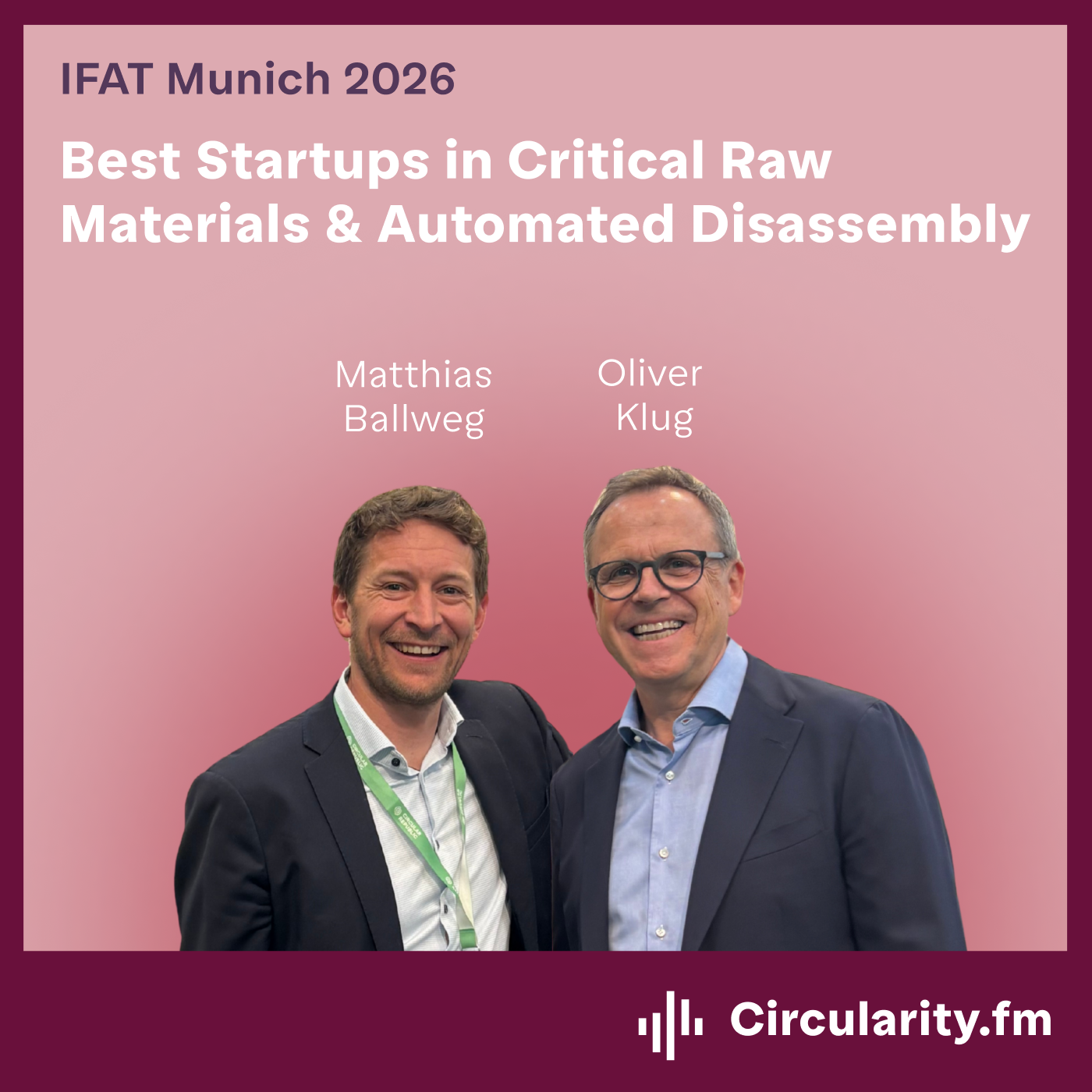
Best Startups in Critical Raw Materials & Automated Disassembly
3w ago00:26:48Tap to summarizeIFAT Munich 2026 Which startups are solving Europe’s two key circular economy challenges: automated disassembly and critical raw materials recovery? This episode covers the Circular Technology Award, launched by Circular Republic and Knorr-Bremse, to back startups working in both fields. Matthias Ballweg, co-founder of Circular Republic, and Oliver Klug, Chief Strategy and Transformation Officer at Knorr-Bremse, explain why they created the award, what they learned from the applicants, and why they paired prize money with proof-of-concept partnerships instead of funding alone. What you’ll hear in this episode: • Why automated disassembly is finally viable, and what the robots can now do that they couldn’t five years ago. • How two very different approaches recover critical raw materials in Europe: hydrogen to reclaim rare earth magnets, and low-temperature salts to pull metals from electronic scrap. • What corporates like Knorr-Bremse look for before adopting a startup’s technology. The four winning startups then present what they’ve built: Xavier Kohll from R3 Robotics and Tomaso Manca from Hiro Robotics winners in automated disassembly, Carlo Burkhardt from HyProMag and Fred White from DEScycle winners in critical raw materials recovery. This is the final episode of the IFAT Munich 2026 series, recorded live at the fair. People Matthias Ballweg, Co-Founder, Circular Republic https://www.linkedin.com/in/matthias-ballweg/ Oliver Klug, Chief Strategy & Transformation Officer, Knorr-Bremse https://www.linkedin.com/in/oliver-klug-932650148/ Patrick Hypscher, Circular Business Strategist, PaaS Expert https://www.linkedin.com/in/hypscher/ Chapters 00:00 Introduction 01:22 The Circular Technology Award 02:03 Why automated disassembly and critical raw materials 03:56 What the applicant pool showed 05:52 Who is Knorr-Bremse 06:39 Why Knorr-Bremse joined the award 08:07 A proof-of-concept, not just prize money 10:51 R3 Robotics: robotic disassembly 14:09 Hiro Robotics: rethinking electronics disassembly 18:16 Descycle: recovering metals from e-waste 21:53 HyProMag: recycling rare-earth magnets 25:51 Closing and what is next About IFAT is the world’s leading trade fair network for environmental technologies. It focuses on water, wastewater, waste, recycling and circularity, bringing together companies, innovators and industry professionals to present solutions for resource efficiency and sustainable infrastructure. IFAT Munich is the flagship event of that network and the most important meeting place for the sector. It takes place every two years in Munich and showcases technologies and services for water, wastewater, waste and raw materials management, with the 2026 edition featuring around 3,400 exhibitors from about 60 countries. Further Links Knorr-Bremse Circular Technology Award: https://www.circular-republic.org/award/ IFAT: https://ifat.de/en/ Circular Republic: https://www.circular-republic.org UnternehmerTUM: https://www.unternehmertum.de Knorr-Bremse: https://www.knorr-bremse.com/en/ One-page Summary Sign-up for the Circularity.fm Newsletter and get a summary with the take-aways of this episode. Register here: https://circularity.fm/episode/best-startups-in-critical-raw-materials-automated-disassembly/
Transcribe →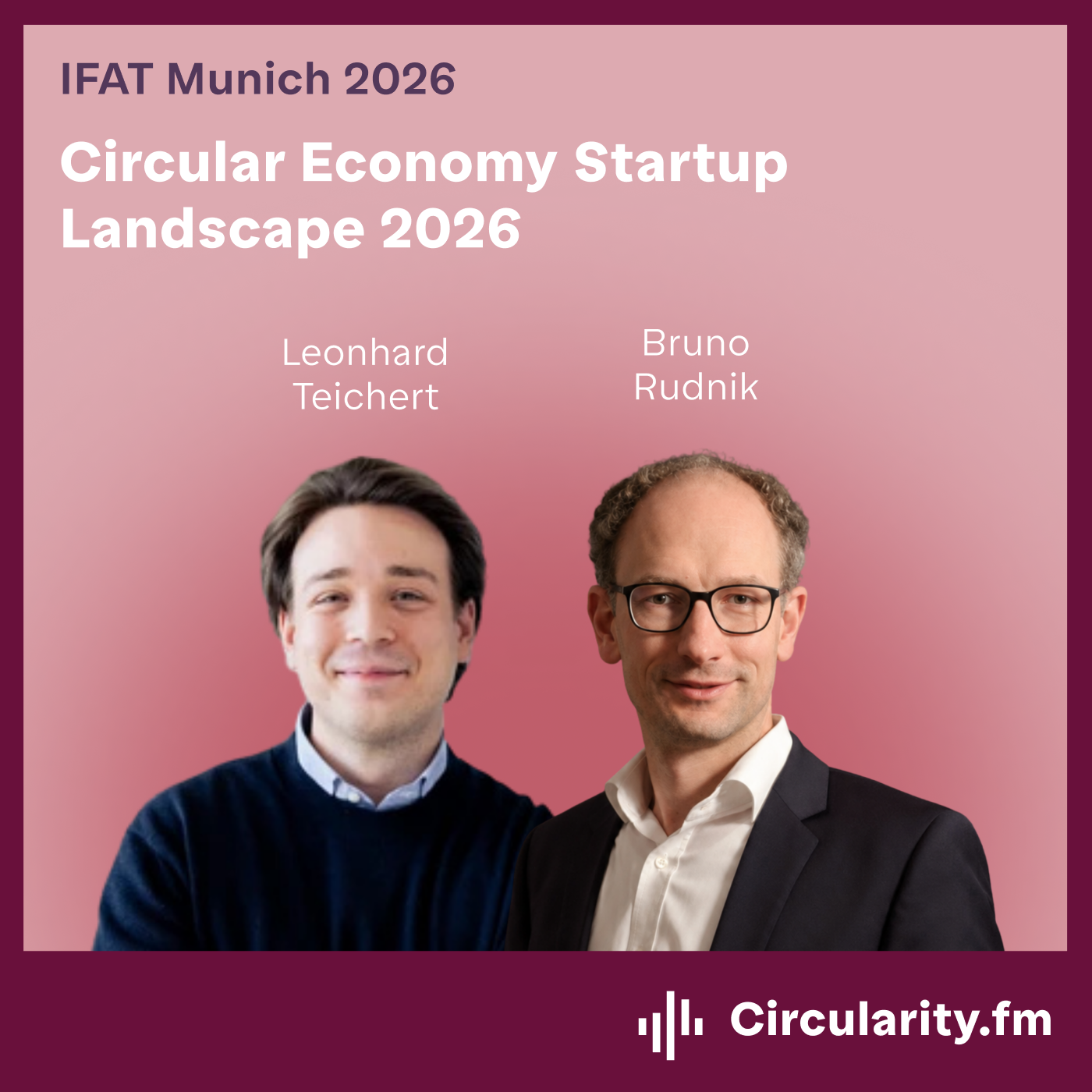
Circular Economy Startup Landscape 2026
4w ago00:22:51Tap to summarizeIFAT Munich 2026 Which areas of circular economy are attracting the most startup activity in Europe, and which ones are being left behind? Leonhard Teichert, Program Lead at Circular Republic, presents the findings of the Circular Economy Startup Landscape 2026. Bruno Rudnick, Managing Partner at SEF Ventures and host of the startup area at IFAT, adds the investor's view on financing and scaling hardware startups in this space. What you'll hear in this episode: • Where European circular startup activity is concentrated and where the map is almost empty: the sectors that are overcrowded and the ones nobody is building in yet. • What drives corporate adoption of new technology. • What founders building hardware-based circular solutions should know: when to talk to an investor, capital structure, customer sequencing, and how corporates actually make adoption decisions. This is the third episode in the IFAT Special series, recorded live at the IFAT Munich 2026 People Bruno Rudnik, Managing Partner, SEF Ventures https://www.linkedin.com/in/brunorudnik/ Leonhard Teichert, Programme Lead, Circular Republic https://www.linkedin.com/in/leonhard-teichert-436a2b16a/ Patrick Hypscher, Circular Business Strategist, PaaS Expert https://www.linkedin.com/in/hypscher/ About IFAT is the world’s leading trade fair network for environmental technologies. It focuses on water, wastewater, waste, recycling and circularity, bringing together companies, innovators and industry professionals to present solutions for resource efficiency and sustainable infrastructure. IFAT Munich is the flagship event of that network and the most important meeting place for the sector. It takes place every two years in Munich and showcases technologies and services for water, wastewater, waste and raw materials management, with the 2026 edition featuring around 3,400 exhibitors from about 60 countries. Further Links Find the study here: https://bdi.eu/de/specials/industry-spotlight-circular-economy-studie IFAT: https://ifat.de/en/ Circular Republic: https://www.circular-republic.org UnternehmerTUM: https://www.unternehmertum.de SEF Ventures: https://sef.ventures/ One-page Summary Sign-up for the Circularity.fm Newsletter and get a summary with the take-aways of this episode. Register here: https://circularity.fm/episode/circular-economy-startup-landscape-2026/
Transcribe →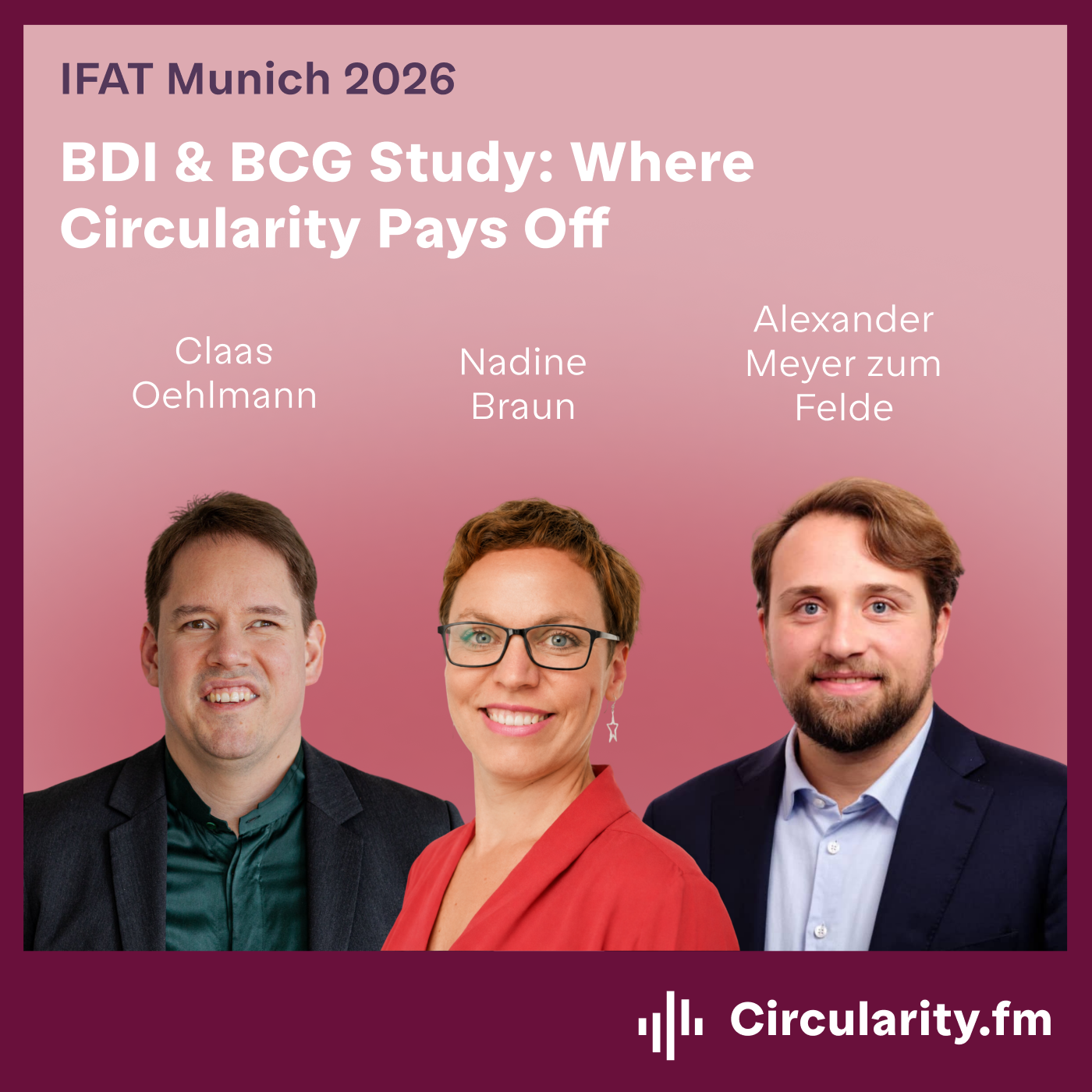
BDI & BCG Study: Where Circularity Pays Off
Jun 2300:37:41Tap to summarizeIFAT Munich 2026 What is the economic potential of circularity? The Federal Association of the German Industries (BDI) asked Boston Consulting Group (BCG) to answer that for German industry. The report's authors, Claas Oehlmann of the BDI's Circular Economy Initiative and Alexander Meyer zum Felde of BCG, walk through the findings, with Nadine Braun of E.ON bringing the view from a company perspective. What you'll hear in this episode: • What the report found: in five sectors covering most of German industry, circular business models could double annual value creation, from 60 to 125 billion euros, by 2045. • Whether that number survives cannibalisation. If a car gets refurbished, that's one new car not sold, so does the potential still hold once you subtract the lost sales? • What companies can do today, without waiting for new regulation, and what still holds them back. Besides exploring the macroeconomic impact of the circular economy, the episode also looks at where circularity pays off for a company. This is the second episode of the IFAT Munich 2026 series, recorded live at the fair. People Claas Oehlmann, Managing Director of the Circular Economy Initiative, Bundesverband der Deutschen Industrie https://www.linkedin.com/in/dr-claas-oehlmann-83355853/ Nadine Braun, Head of Circularity and Environment, E.ON https://www.linkedin.com/in/nadine-braun-eon/ Alexander Meyer zum Felde, Global Director of Circular Economy, Boston Consulting Group https://www.linkedin.com/in/alexander-meyer-zum-felde-b10703164/ Patrick Hypscher, Circular Business Strategist, PaaS Expert https://www.linkedin.com/in/hypscher/ Chapters 0:00 Intro: the BDI and BCG study 1:57 Claas Oehlmann (BDI): doubling value to 125 billion 3:40 The policy gap: EU vs national 9:43 Alexander Meyer zum Felde (BCG): the economic case 13:54 The five sectors, and who leads 15:54 Levers companies can use now 24:55 What is holding companies back 27:50 Nadine Braun (E.ON): the energy sector 33:26 Wait for regulation, or start now? 36:12 Outro About IFAT is the world’s leading trade fair network for environmental technologies. It focuses on water, wastewater, waste, recycling and circularity, bringing together companies, innovators and industry professionals to present solutions for resource efficiency and sustainable infrastructure. IFAT Munich is the flagship event of that network and the most important meeting place for the sector. It takes place every two years in Munich and showcases technologies and services for water, wastewater, waste and raw materials management, with the 2026 edition featuring around 3,400 exhibitors from about 60 countries. Further Links Link to the study “Wachstum, Wettbewerbsfähigkeit und Resilienz” from BDI and BCG: https://bdi.eu/de/specials/industry-spotlight-circular-economy-studie IFAT: https://ifat.de/en/ One-page Summary Sign-up for the Circularity.fm Newsletter and get a summary with the take-aways of this episode. Register here: https://circularity.fm/episode/bdi-bcg-study-where-circularity-pays-off/
Transcribe →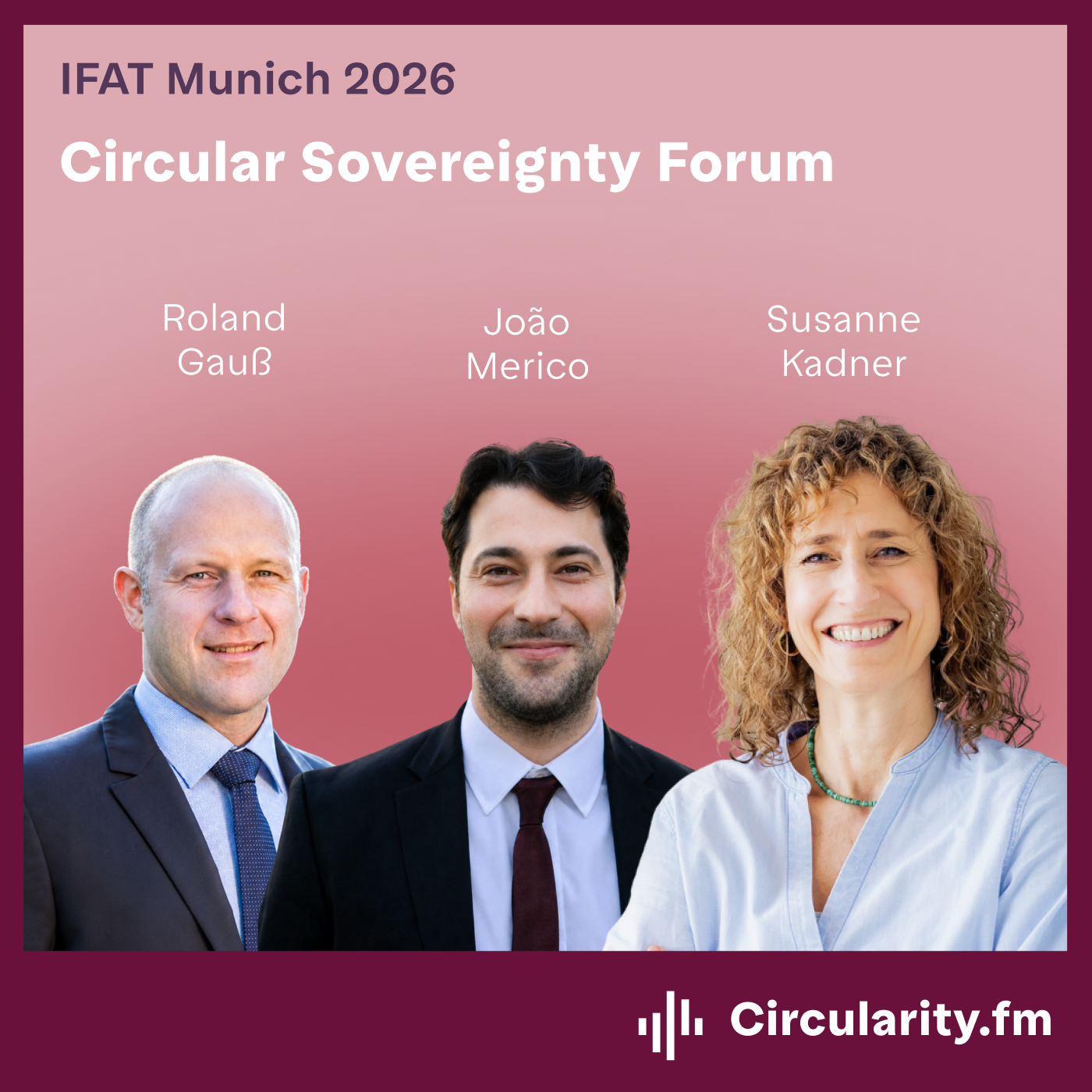
Circular Sovereignty Forum
Jun 1600:19:27Tap to summarizeIFAT Munich 2026 Can Europe secure the critical raw materials it needs without stepping back from global trade? Recorded at the Circular Sovereignty Forum at IFAT Munich, with Susanne Kadner of Circular Republic, João Merico of the Ellen MacArthur Foundation, and Roland Gauß of EIT Raw Materials, on the link between circularity, geopolitics, and supply security. What you'll hear in this episode: • What companies actually want from EU regulation: predictability above all. First movers need to know the rules they invested in will not be reversed by the next reform. • Why recycling alone will not close the gap. Reuse, leasing, and product as a service have to scale alongside it, even when fast innovation cycles make reusing yesterday's components harder. • Why venture money is shifting toward Europe as US green subsidies are rolled back, and where Europe still loses ground on a level playing field. The episode also covers Europe's urban mines and the secondary raw materials in them, and the case for diversifying supply rather than concentrating it on single suppliers. This is the first episode in the Circularity.fm IFAT special, recorded at IFAT. People Susanne Kadner, Co-Founder, Circular Republic (UnternehmerTUM) https://www.linkedin.com/in/susanne-kadner/ João Merico, Senior Strategy Associate, Critical Minerals & Energy Transition, Ellen MacArthur Foundation https://www.linkedin.com/in/jo%C3%A3o-murilo-silva-merico-a88633202/ Roland Gauß, Innovation and Product Development Director, EIT RawMaterials https://www.linkedin.com/in/roland-gau%C3%9F-52108b126/ Patrick Hypscher, Circular Business Strategist, PaaS Expert https://www.linkedin.com/in/hypscher/ Chapters 00:00 Intro 02:22 Why a Sovereignty Forum at IFAT 03:11 What companies want from Brussels: clarity and predictability 04:37 How US finance pulls startups out of Europe 05:46 Front runners vs companies waiting on Brussels 07:52 Why sovereignty needs collaboration 08:37 João Merico: why critical minerals matter 09:15 Beyond recycling: other circular business models 09:57 Reuse and fast innovation cycles 11:12 Global vs regional circular economy 12:27 Circularity and climate goals 13:45 Roland Gauß: Europe's raw materials and urban mines 14:50 The level playing field and US incentives 16:55 Winning the hesitant majority to diversify 18:42 Outro About IFAT is the world’s leading trade fair network for environmental technologies. It focuses on water, wastewater, waste, recycling and circularity, bringing together companies, innovators and industry professionals to present solutions for resource efficiency and sustainable infrastructure. IFAT Munich is the flagship event of that network and the most important meeting place for the sector. It takes place every two years in Munich and showcases technologies and services for water, wastewater, waste and raw materials management, with the 2026 edition featuring around 3,400 exhibitors from about 60 countries. Further Links IFAT: https://ifat.de/en/ Circular Republic: https://www.circular-republic.org UnternehmerTUM: https://www.unternehmertum.de Ellen MacArthur Foundation: https://www.ellenmacarthurfoundation.org EIT RawMaterials: https://eitrawmaterials.eu One-page Summary Sign-up for the Circularity.fm Newsletter and get a summary with the take-aways of this episode. Register here: https://circularity.fm/episode/circular-sovereignty-forum/
Transcribe →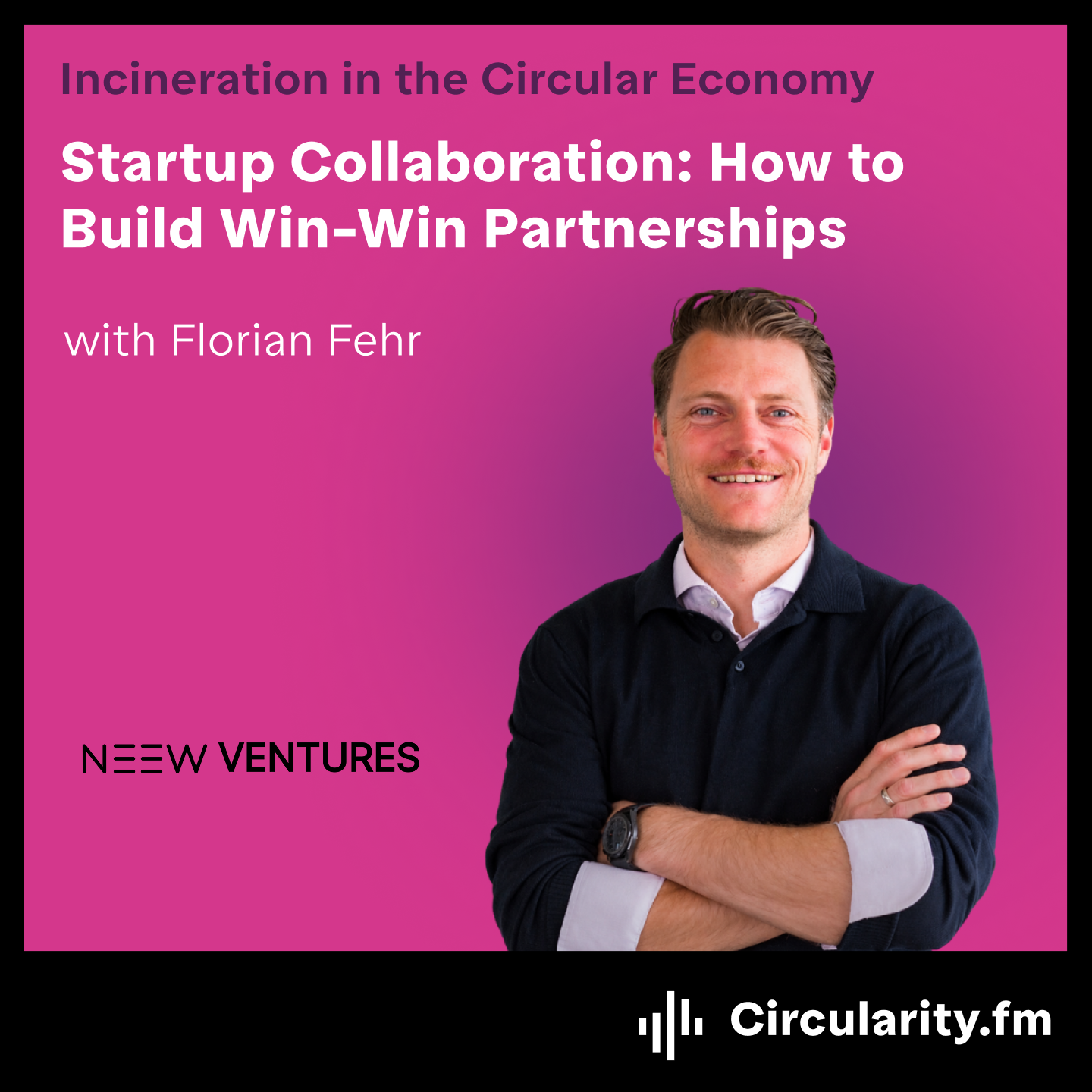
Startup Collaboration: How to Build Win-Win Partnerships
Jun 200:24:58Tap to summarizeIncineration in the Circular Economy Why do startups and corporates need each other, and what makes the partnership work? Florian Fehr, Managing Director of NEEW Ventures, joins Patrick at IFAT and interviews three founders: Rajiv Singhal from Grensol, Stefan Delinde from Minimise, and Gary Lewis from Resourcify about their businesses and what makes a startup-corporate partnership work. What you'll hear in this episode: • Why startups and corporates operate at different speeds, and why that difference is the point of the collaboration • Three founders, three completely different business models built around partnering with corporates • What Florian calls the "secret sauce" of a partnership that works The episode also covers how NEEW Ventures operates as both venture builder and bridge maker for EEW. This is the final episode of the series Incineration in the Circular Economy, produced in sponsoring partnership with NEEW Ventures. People Florian Fehr, Managing Director at NEEW Ventures https://www.linkedin.com/in/florianfehr/ Startup Founders: Rajiv Singhal, Grensol Group https://www.linkedin.com/in/rajiv-singhal-008b1b/ Gary Lewis, Resourcify https://www.linkedin.com/in/circular-gary/ Stefan De Linde, Minimise https://www.linkedin.com/in/s-de-linde/ Patrick Hypscher, Circular Business Strategist, PaaS Expert https://www.linkedin.com/in/hypscher/ Chapters 0:00 Intro 0:25 Series recap and episode plan 1:39 Meet Florian and NEEW Ventures 3:28 Why corporates need startups 5:17 Founder spotlight Grensol 12:06 Founder spotlight Minimize 17:15 Founder spotlight Resourcify 20:31 What makes collaborations succeed 23:55 Outro About NEEW Ventures is a venture builder and subsidiary of EEW Energy from Waste, one of the market leaders for thermal waste treatment in Germany. Founded in 2021 in Berlin, NEEW Ventures builds startups that use data, AI, and digital tools to create value from waste. Its portfolio includes Wasteer, which uses AI-based waste composition analysis to cut emissions and operating costs at incineration plants, and Minimise, a digital traceability platform for e-waste recycling. NEEW Ventures also runs the Circularity Hub for startups, researchers, and industry professionals, and the Waste & AI Hub (WAIH), connecting AI experts with waste industry operators. Find out more at: neew-ventures.com Further Links https://www.neew-ventures.com/ https://www.eew-energyfromwaste.com/ Startups: Grensol: grensolgroup.com Minimise: registry.minimise.today Resourcify: resourcify.com One-page Summary Sign-up for the Circularity.fm Newsletter and get a summary with the take-aways of this episode. Register here: https://circularity.fm/episode/startup-collaboration-how-to-build-win-win-partnerships/
Transcribe →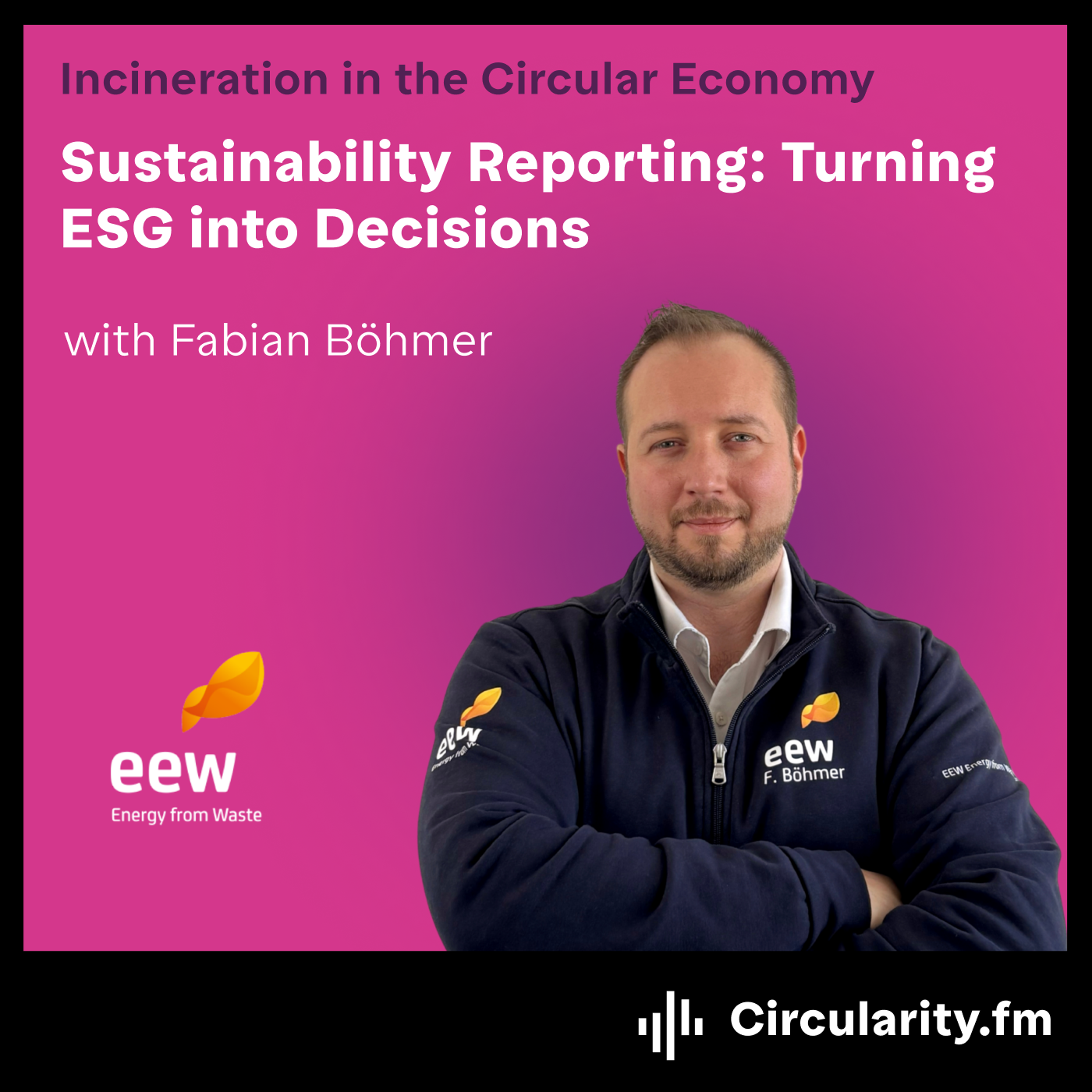
Sustainability Reporting: Turning ESG into Decisions
May 2600:55:16Tap to summarizeIncineration in the Circular Economy heading textHow does ESG reporting influence how a company is financed, run, and perceived? in this episode, Fabian Böhmer, Head of Sustainability at EEW, joins Patrick to discuss how ESG reporting can serve bankability, reputation, and internal decision-making. What you'll hear: • Why the business case matters in sustainability, and what happens when ecological, social, and economic dimensions are treated as one balanced system rather than competing priorities • What CSRD, ESRS, and the EU taxonomy actually require, and the difference between treating them as a reporting burden and using them as a strategic tool • How to make sustainability work land internally with different functions: the language that gets operations, finance, and the board on board The episode also covers how green bonds and ESG-linked credit conditions are reshaping the cost of capital, and why focus matters more than completeness when reporting to multiple stakeholders. This is the fifth episode of the series Incineration in the Circular Economy, sponsored by NEEW Ventures. People Fabian Böhmer, Head of Sustainability at EEW https://www.linkedin.com/in/fabian-b%C3%B6hmer/ Patrick Hypscher, Circular Business Strategist, PaaS Expert https://www.linkedin.com/in/hypscher/ Chapters 00:00 Intro 01:26 A sustainability report for your private life? 04:44 The triangle of sustainability 10:23 Landfilling vs waste-to-energy 14:29 Why landfilling still wins on cost 19:21 What happens to the residues 23:09 The waste hierarchy 25:09 Bringing the three dimensions together 31:22 The sustainability report under new regulation 38:16 Communicating with all stakeholders 43:38 The financial value of a good report 48:54 Hacks for bringing colleagues onboard 52:48 Closing About EEW Energy from Waste GmbH (EEW) is one of Europe’s leading companies in the field of thermal waste and sewage sludge recovery. Today, EEW makes an important contribution to climate and resource protection and is therefore an essential part of the circular economy. At the company’s 17 current sites, around 5 million tonnes of waste per year can be used for energy recovery. More than 1,400 employees take responsibility for using the energy in waste, reducing waste volumes, safely and harmlessly eliminating hazards from waste, and recycling scrap metal and composite materials. In addition, the energy contained in waste is used efficiently to generate process steam for industrial plants, district heating for residential areas and electricity produced in an environmentally friendly way. Further Links https://www.neew-ventures.com/ https://www.eew-energyfromwaste.com/ One-page Summary Sign-up for the Circularity.fm Newsletter and get a summary with the take-aways of this episode. Register here: https://circularity.fm/episode/sustainability-reporting-turning-esg-into-decisions/
Transcribe →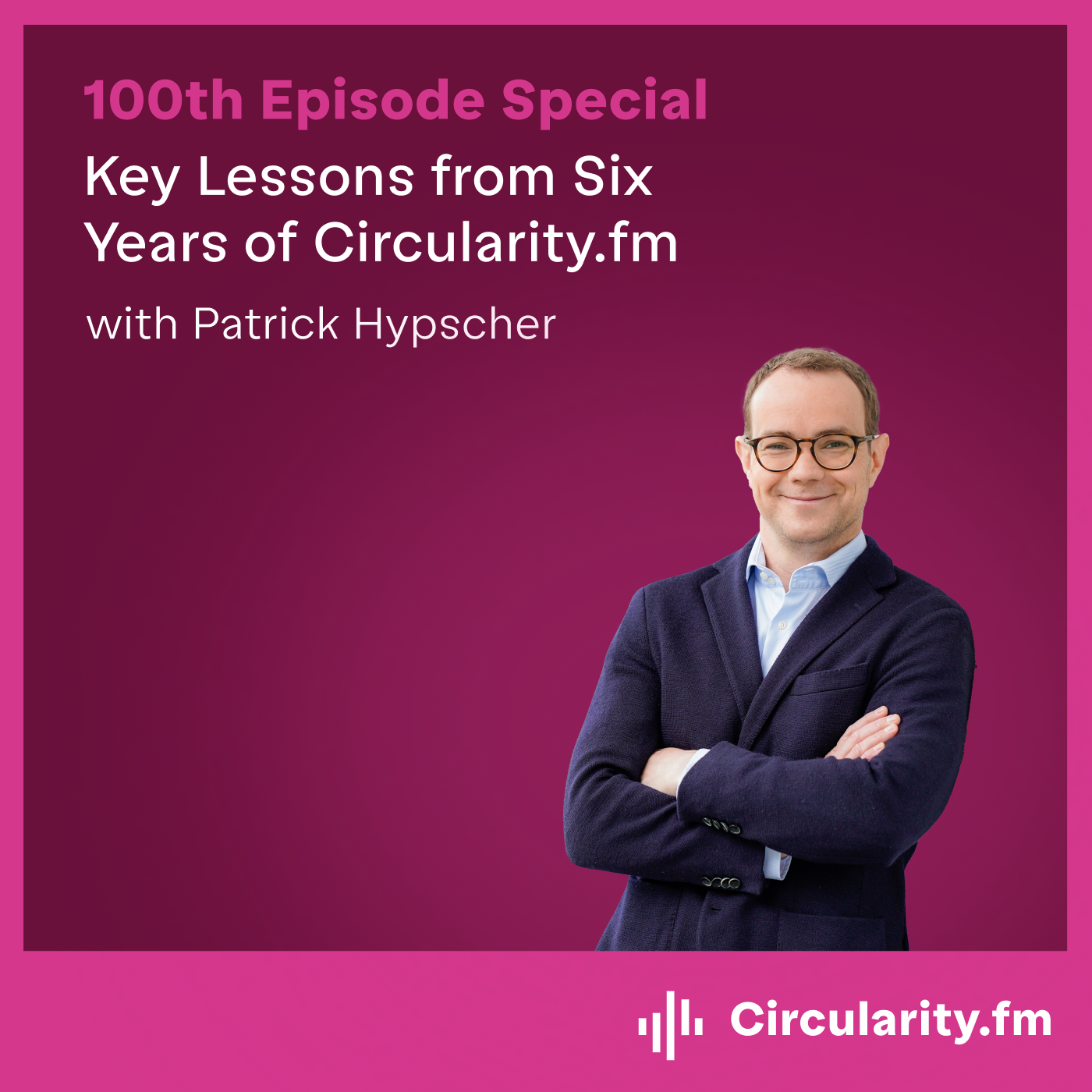
100th Episode: Key Lessons from Six Years of Circularity.fm
May 2200:19:13Tap to summarizeWhat are the learnings after 100+ conversations with circular economy experts? For our 100th Episode Special, Celinne de Paula from the Circularity.fm team takes over as host and interviews Patrick Hypscher on what six years of conversations with founders, investors, and professionals has taught him. What you'll hear in this episode: • The skills needed to make circular projects succeed • The overlooked levers within the circular economy • How the circular landscape has evolved since 2020 This special also covers what led Patrick to start the podcast, and what's next for Circularity.fm. Dear listeners, thanks for listening to the show! People Patrick Hypscher, Circularity.fm Founder, Circular Business Strategist, PaaS Expert https://www.linkedin.com/in/hypscher/ Celinne de Paula, Circularity.fm Team https://www.linkedin.com/in/celinnedepaula/ Chapters 00:00 Intro 03:05 The Start of Circularity.fm 06:09 Patterns and Insights from 100 Conversations 09:02 Barriers and Levers for Circularity 11:55 The Evolution of Circular Economy 14:58 Personal Reflections and Future Aspirations About Circularity.fm is the podcast about understanding, building and managing circular business models. Each episode features candid conversations with managers, founders and investors, unpacking the numbers, trade-offs, and playbooks behind scalable circular models. Produced in partnership with top-tier circularity events worldwide, we bring you fresh strategies, case studies, and deal-room insights from the global stage. If you're building the next generation of resilient, low-resource businesses, tune in to Circularity.fm - where circularity meets profitability. One-page Summary Sign-up for the Circularity.fm Newsletter and get a summary with the take-aways of this episode. Register here: https://circularity.fm/episode/100th-episode-key-lessons-from-six-years-of-circularity-fm/
Transcribe →
Carbon Capture: How Waste-to-Energy Cuts CO2
May 1900:28:31Tap to summarizeIncineration in the Circular Economy How does carbon capture actually work, and what does it take to make it commercial? Jörn Jakob, Director Innovation at EEW, and Eike Diedecke, who oversees the carbon capture pilot at the Delfzijl site, share what they are learning from the pilot project. What you'll hear in this episode: • Where the CO2 in waste actually comes from, and the impact of different waste compositions • How the capture process works step by step • What needs to fall into place for carbon capture to scale The episode also covers why EEW chose the Netherlands as the first pilot site, and where the team is looking for partners on capture technology and CO2 utilisation. This is the fourth episode in "Incineration in the Circular Economy," a series sponsored by NEEW Ventures. People Jörn Jakob, Director Innovation at EEW https://www.linkedin.com/in/j%C3%B6rn-jakob-124192214/ Eike Diedecke, Carbon Capture Project Leader at EEW https://www.linkedin.com/in/eike-diedecke-365703221/ Patrick Hypscher, Circular Business Strategist, PaaS Expert https://www.linkedin.com/in/hypscher/ Chapters 0:00 Intro 1:35 Meet Jörn Jakob 2:52 Why incineration plants emit CO2 4:48 EEW's approach: amine scrubbing 5:32 The CC Mobile pilot at Delfzijl 6:46 Meet Eike Diedecke: inside the Delfzijl plant 8:36 How amine scrubbing works 11:38 Why carbon capture needs so much energy 12:35 The pilot's real success criteria 15:02 What captured CO2 looks like 16:57 Back to Jörn: storage and pipelines 22:49 Why the Netherlands, not Germany 23:19 Regulation and partner search 27:23 Outro About EEW Energy from Waste GmbH (EEW) is one of Europe’s leading companies in the field of thermal waste and sewage sludge recovery. Today, EEW makes an important contribution to climate and resource protection and is therefore an essential part of the circular economy. At the company’s 17 current sites, around 5 million tonnes of waste per year can be used for energy recovery. More than 1,400 employees take responsibility for using the energy in waste, reducing waste volumes, safely and harmlessly eliminating hazards from waste, and recycling scrap metal and composite materials. In addition, the energy contained in waste is used efficiently to generate process steam for industrial plants, district heating for residential areas and electricity produced in an environmentally friendly way. Further Links https://www.neew-ventures.com/ https://www.eew-energyfromwaste.com/ One-page Summary Sign-up for the Circularity.fm Newsletter and get a summary with the take-aways of this episode. Register here: https://circularity.fm/episode/carbon-capture-how-waste-to-energy-cuts-co2/
Transcribe →
Waste as a Resource: How Data and AI Cut Recycling Costs
May 1200:29:36Tap to summarizeIncineration in the Circular Economy What is the value of knowing what's in your waste stream? Wasteer founder Benedict von Spankeren talks about how data and AI improve profitability and prevent dangerous accidents for waste management companies. What you'll hear in this episode: • The economic gap between recycling and waste-to-energy margins, and what this means for market entry and finding customers. • How dynamic pricing changes the business: moving away from flat fees and charging suppliers based on the actual energy value of their waste. • The difficulty of passing on carbon taxes, and why plants now need proof of exactly which supplier delivered what. The episode also discusses the challenge of getting experienced crane operators to actually use new technology on the floor. This is the third episode in "Incineration in the Circular Economy," a series sponsored by NEEW Ventures. People Benedict von Spankeren, Founder at Wasteer https://www.linkedin.com/in/benedict-von-spankeren/ Patrick Hypscher, Circular Business Strategist, PaaS Expert https://www.linkedin.com/in/hypscher/ Chapters 00:00 Intro 01:46 The Rest of the Rest 02:43 Founding Wasteer at New Ventures 05:57 Where Wasteer Stands Today 07:07 Waste Analysis and Steering 09:40 Waste as a Resource 11:07 Waste-to-Energy vs Recycling 13:34 Cultural Resistance and the 99% Myth 17:40 Transparency Down the Value Chain 19:26 Pricing, Gate Fees, and CO2 Taxation 24:35 Calculating the ROI 28:35 Outro About WASTEER is a Berlin-based AI software company that helps waste treatment and energy-from-waste plants analyse incoming waste streams in real time. It uses camera and sensor data to detect contaminants, calculate waste composition and improve operational decisions so plants can run more safely and efficiently. Its platform is built around digital tools for waste analysis, stream control and documentation, with the goal of reducing downtime, lowering costs and improving sustainability. WASTEER presents itself as a circular economy enabler by turning waste data into better material recovery, cleaner processes and more profitable plant operations. Further Links https://www.neew-ventures.com/ https://www.eew-energyfromwaste.com/ https://www.wasteer.com/ One-page Summary Sign-up for the Circularity.fm Newsletter and get a summary with the take-aways of this episode. Register here: https://circularity.fm/episode/waste-as-a-resource-how-data-and-ai-cut-recycling-costs/
Transcribe →
Waste Incineration: Its Role in Circular Economy
May 500:34:26Tap to summarizeIncineration in the Circular Economy What role does waste incineration play in the circular economy and in the transition away from fossil fuels? Sebastian Siewers, Head of Energy at EEW, talks about the contribution of waste-to-energy plants to the circular economy, and the energy system. What you'll hear in this episode: • The business model behind waste to energy: where the revenue comes from, what drives costs, and why CO2 is becoming a major factor. • What grid flexibility means, why it has become more important than total energy supply, and how negative pricing hours in Germany have more than doubled since 2023. • Why heat and steam are local infrastructure products and how German municipalities are starting to plan around them. This is the second episode in "Incineration in the Circular Economy," a series sponsored by NEEW Ventures. People Sebastian Siewers, Head of Energy at EEW https://www.linkedin.com/in/sebastian-siewers-2494731b4/ Patrick Hypscher, Circular Business Strategist, PaaS Expert https://www.linkedin.com/in/hypscher/ Chapters 0:00 Intro 1:43 Role of Waste Incineration in Circular Economy 4:36 Business Model Behind Waste-to-Energy 7:40 Costs and Carbon Regulation 10:29 Energy Transition Impacts 14:02 Steam and Heat Infrastructure 20:25 Flexibility Needs 23:34 Flexibility Infrastructure 28:28 What Consumers Can Do 30:52 Outro About EEW Energy from Waste GmbH (EEW) is one of Europe’s leading companies in the field of thermal waste and sewage sludge recovery. Today, EEW makes an important contribution to climate and resource protection and is therefore an essential part of the circular economy. At the company’s 17 current sites, around 5 million tonnes of waste per year can be used for energy recovery. More than 1,400 employees take responsibility for using the energy in waste, reducing waste volumes, safely and harmlessly eliminating hazards from waste, and recycling scrap metal and composite materials. In addition, the energy contained in waste is used efficiently to generate process steam for industrial plants, district heating for residential areas and electricity produced in an environmentally friendly way. Further Links https://www.neew-ventures.com/ https://www.eew-energyfromwaste.com/ One-page Summary Sign-up for the Circularity.fm Newsletter and get a summary with the take-aways of this episode. Register here: https://circularity.fm/episode/waste-incineration-its-role-in-circular-economy/
Transcribe →