← CODE Conscious Conversations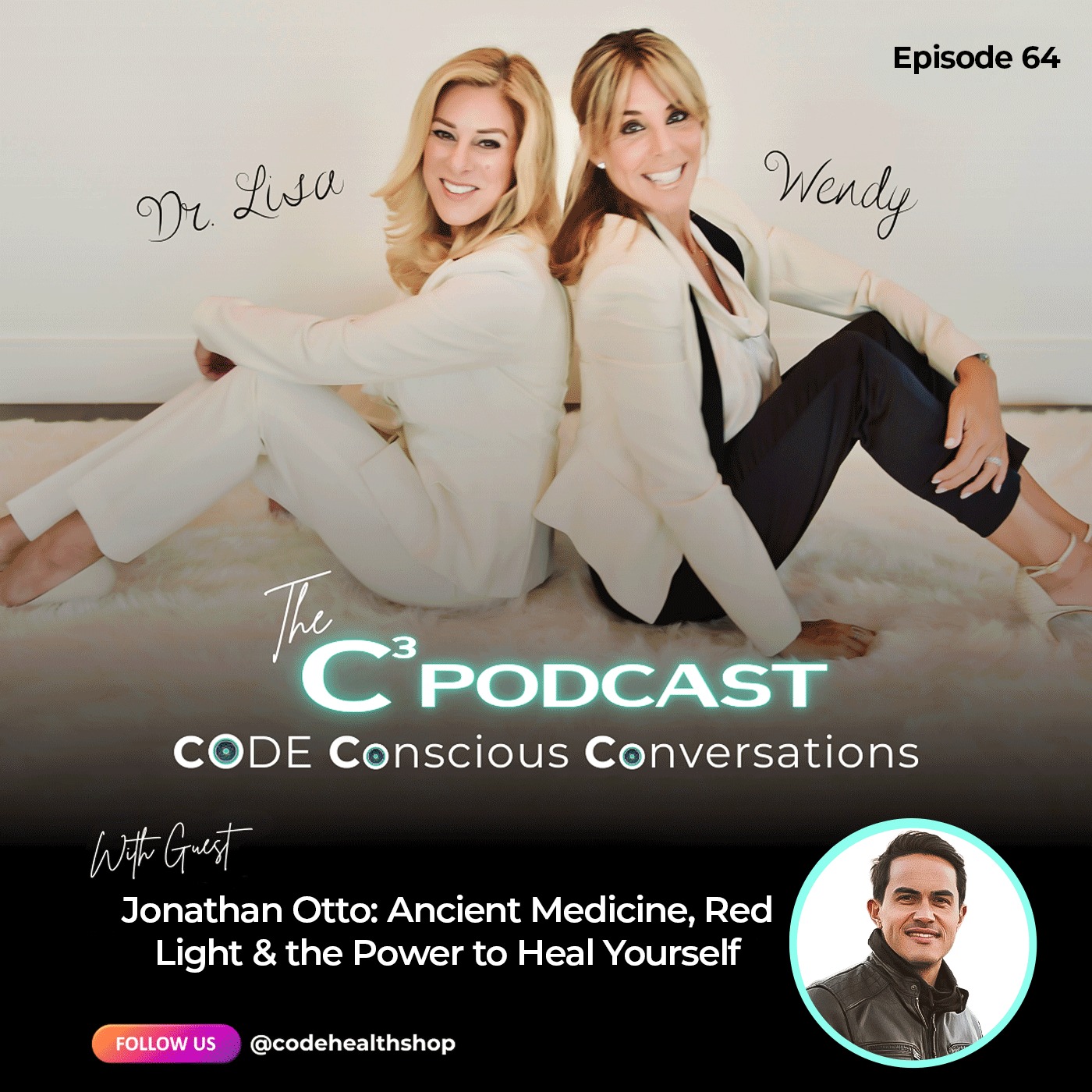
CODE Conscious Conversations
Jonathan Otto: Ancient Medicine, Red Light & the Power to Heal Yourself
Loading summary
Transcript51 lines
- [00:00]
Jonathan Otto
Foreign.
- [00:09]
Wendy Cohn Osborne
Hello and welcome to the C3 podcast, Code Conscious Conversations. I'm Dr. Lisa Piper here with Wendy Cohn Osborne. We are the founders of Code Health.
- [00:22]
Narrator/Poet
Unlocking the energy that flows within Transforming health Where true care begins for people and creatures. A touch so divine cold holds the key to a brighter design.
- [00:43]
Dr. Lisa Piper
Hi everyone and welcome to the C3 podcast. Jonathan Otto is our guest today. He is an award winning journalist, documentary filmmaker and health educator who has traveled the globe uncovering untold stories of healing. He is also the of the cancer off switch. Through his investigative films, he has spotlighted alternative and integrative approaches to chronic disease, often challenging conventional medical narratives. He is also the founder of Red Life, a company dedicated to making red light therapy accessible and effective for everyday people. Known for pushing boundaries, Jonathan has sparked global conversations on taboo healing practices such as urine therapy, while championing ancestral wisdom and modern biohacks alike. His mission is to empower people with tools and knowledge to reclaim their health, energy and resilience outside the mainstream system. Welcome to the C3 podcast, Jonathan. So good to have you today on the show.
- [01:49]
Jonathan Otto
Thanks so much Wendy and Dr. Lisa.
- [01:52]
Dr. Lisa Piper
We are really excited to have you. We met you about almost a year ago in Las Vegas. We were both at the Biohack Yourself premiere. It was just, you know, really great to finally sit down next to you, have you talk to us about the things that you're doing and we thought it would be great for you to come and talk to our audience about subjects like urine. Everybody that we hear talk about urine. It's really controversial, right? It's something that people are really like. It's either they think it's gross or they think it's like woo, woo. But it really is scientific. So can you just talk about it a little bit and let us know how it's utilized and how you do it?
- [02:39]
Jonathan Otto
Absolutely. Well, it's, it's very interesting that it is obviously disregarded as just a waste product. And whether that's by the medical community or just lay people, people generally have not associated urine with medicine. But that wasn't the case for forebears, people, societies, entire civilizations, not, not, not the odd one or two. But almost universally, whether it was Egyptian, Roman, Greek, Chinese, Japanese, Ayurvedic with Indian, these were, these were widespread practices, both topical and internal use. And then in modern medicine, it became a subject of much study from the 1700s, which would, wouldn't necessarily be considered modern medicine. 1800s. Now we're getting closer. Early 1900s, all through the medical textbooks, the Oxford Medical School, the British Medical journal, the science magazine, these sources all were quoting and referencing major studies that were happening in urine. Which makes sense. Then why Fast forward to today. The thing that people don't regard as the medicine yet so many medications are based upon it. Some examples of those would be murine for ear infections, which is a synthetic form of urine called carbamide mixed with hydrogen peroxide, which is also naturally from urine itself. And then you've got your kinase, which is the clot busting drug and used for cancer as well, as is urea, also from urine. Your kinase is the enzyme from urine. Urea is, is because urine is filtered blood. Urea is, is the aspect of urine that is highly absorbable. What that means is that you're able to moisturize skin and so hence why people are using it on their skin. And then you Fast forward to 2022. The Wake Forest University took an NIH grant, funded a urine derived stem cell study, which you wouldn't even associate stem cells with urine, but it makes a lot of sense considering that's where stem cells are coming from. Amniotic fluid, which is actually baby urine is, is the major source for stem cells which are getting injected directly into people's knees or through IV or localized to put new stem cells into the body. In this study from the Wake forest, they found 100 million stem cells in a 24 year, 24 hour urine sample. Originally it was only 140 stem cells, but when it was left to age for three weeks, it proliferated at a rate of 1 times 10 to the power of 8, which equated to a hundred million over the course of three weeks. So there are stem cells in urine, there are enzymes, there are hormones, there are natural, various antigens and peptides. All these are natural substances and versus synthetic. And they have tremendous medicinal benefit, as was cited in the clinical studies where it was being used for tuberculosis or malaria or used for the rabies. Actually rabies, that was a common usage, cancer. It shows up in a lot of clinical studies for cancer in the early 1930s, 40s, 50s, tremendous success with these compounds taken straight from urine and in other cases just the straight form of urine being used ingested or injected or used rectally. So anyway, then now just open another can of worms. But yes, that's urine therapy in a nutshell.
- [06:06]
Dr. Lisa Piper
So so basically you know, you, you urinate in a cup.
- [06:12]
Jonathan Otto
Yeah.
- [06:12]
Dr. Lisa Piper
And then you let it wait and go on the shelf and then you drink it.
- [06:19]
Jonathan Otto
Oh yeah, sure. Okay. So now, yeah, you're basically Here. Yeah. Well, basically you, you're just schooling people in the most advanced and difficult side of urine therapy. Right? So. So, okay, yes, you can do that. Now, there are other ways to do that because when, when you're in ages, it actually becomes more alkaline. And so it'll go up to a 12 plus ph versus and it will initially be a very neutral ph, like a 6.5. So, so it's not acidic, but, but the, that strong alkalinity and the, you know, mild fermentation process can mean that it is strong but, but very effective. So smaller dosages with this type of thing, it's very easy to do that, something like that, as a rectal suppository of only 20 mils and you could just put that rectally and so that you would get all these benefits of aged urine. There was a clinical study that was done from some colleagues of mine that found that everyone that did it had a dramatic elevation in liver function. So that was one marker that there was only the one marker that they were looking for in that study. And it, it scored extraordinarily high for every participant, not just some. But then. Now let's come to the, to the real practice of urine therapy. That makes it a lot more easy, which is just drinking fresh urine, which would be taking any urine and, and just drinking it. The easiest way to do that would be a clear urine. So when you're super hydrated, then it won't taste very weird. It'll just kind of taste like water. If you ate a lot of salty processed foods, it's not going to taste great. So it's what, what you're, you're, you're drinking what you just ate and you're showing signs that your body, it's not really great what you should just ate, because your body's kind of giving you a pretty pretty, not so nice flavor profile. But urine will actually just taste very much like water if you have a great diet or if you're fasting. Hence why the first morning urine is the typical practice of urine therapy, which is, and then that's still on a fasted state. It is a little darker or yellow in color, but it is. I know that people are like cringing, but other people are just like, hey, look, I, I kind of want to know if I, and, and just case in point, babies are drinking urine constantly in the womb. 600 mils, up to a liter of urine per day in the womb. So let's get real here, guys. This is something that literally got robbed from you when, the day you were born. But you were previously doing that every day.
- [08:48]
Dr. Lisa Piper
You know, it's amazing when you think about it that way. You know that this is when we were in the womb. That's what was giving us our, I guess nutrition or our, our vitamins, minerals, whatever the, whatever the urine holds in it, you know, through the amniotic fluid. But the other thing that I just wanted to ask is you can drink it, but also you put it on your face as well and your skin. So just same thing, Jonathan, you just put it on.
- [09:20]
Jonathan Otto
Yeah, exactly. Look, if you want to, if you want to be really, you know, doing it exactly the best way, you would exfoliate so that you could then make sure that it's getting absorbed to the highest capacity. That being said, it was still going to work. No, no matter how you do it. And then if you want to, if you want to get that, that those stem cells and all the concentrations of the enzymes and all, everything supercharges when you age it. So you could then take the aged urine, which would be like the study, a three week old urine from the first morning urine, and apply that to the face or a wound or something that's not healing the scalp for. I just did that, for example. I had some bad dandruff over the last couple of days and it's, it's gone. Right. So, you know, so amazing.
- [10:04]
Wendy Cohn Osborne
But anyway, what about something like acne or things like that?
- [10:08]
Jonathan Otto
It's amazing for acne. I've seen people reverse lifelong acne in days on urine therapy and that could still simply be with first morning urine, fresh urine just applied to the face because it's giving all the antibodies to whatever the poisons are that are causing this. And because of the meridians as well, by even putting something on the face, you're interfacing with the whole body. And they are peptides. So really the whole science of peptides that's going on now, the only real place you see this in nature is actually in urine because urine is peptides and polypeptides. It's, it's signaling molecules and that's why it's, it's such an effective practice to signal the body to remove certain toxins and to cause the upregulation of certain systems in the body, the immune system, et cetera.
- [10:54]
Wendy Cohn Osborne
So what about the toxicity? Because you usually, you know, we filter different things that we eliminate through our organs and a lot of times part of that elimination process is to remove toxins from the body. So yes, while we are eliminating healthy things too, like what you're discussing here. What about any toxins in your urine? Like if someone has acne, for example. We'll just stick with this, you know, example. If someone has acne, they're probably not eating the best diet. They probably have some kind of a toxic load. And it would only make sense that if they are eliminating that no matter what they're eliminating, that it would have some toxicity to it. But then you take that and you rub it on your skin. So can you discuss how the toxins in what you're eliminating are not influencing the urine that you're putting on your skin?
- [11:50]
Jonathan Otto
Yeah, sure. So. So I'm going to say something kind of shocking. There are no toxins in urine. And so somebody that's a functional medicine doctor would say, no, I could see this in urinalysis. I can see the toxins in the urine. And so. And this is the problem with, with people thinking that they know everything. And I'll show you clearly that it's not. So firstly, which is more sterile, the blood or the urine? And the answer is the urine is more sterile. And so. And which has less? If we were to say there were any toxins, which has less. And the answer is urine. So now it. The problem is that if the urine is toxic, then the blood is toxic and therefore how do you even live? And. And you start going in some pretty weird circles that start making no sense. So the kidneys are filtering on average, typically about 180 liters of blood per day. Of that filtration that goes through the kidneys, 99 of that, which is actually what we call urine. So your body is producing this urine. 99% of it gets reabsorbed straight back into the bloodstream. You could use chat, GBT and just ask it these questions. It'll tell you exactly what I'm saying to you. One percent goes to the bladder and you eliminate that. So now you think that that's waste, but that's what you got taught. But think about big Pharma and think about how you've intentionally been weaponized against your own body. And it created the need for certain medications, including ones that get injected into people. It created the need for that because you didn't understand how your system works and how your body concentrates antibodies in urine. And so firstly, people mistake antibodies for toxins. That's number one. Number two, the. You need something to identify what's in the body. And that's the concept of, well, it's the concept of vaccinology but it's the concept of basically homeopathy where you take a fragment of that and in a form that is non harmful, which is what urine does. And this is why you see this in the womb where babies are drinking like up to a liter. The kidneys, their, their organ function is the same from the day that they enter into life out of the womb as they were the, the moment before. And, and they, you know, so, you know, the moments before they were drinking their urine, it was safe. And now suddenly it's not. Doesn't make any sense considering of the 400 chemicals that the environmental Working group tested for, they found 287 of those 180 are proven to cause cancer, birth defects and brain deformations. How do the babies survive when they eliminate? They urinate every one to three hours and they can constantly drinking their urine in the womb. Well, the answer is that's how they actually remove the poisons. They're giving small concentrations of those toxins in a form that is non harmful and doesn't bind to the body, which signals the removal of those poisons. If you even get the urine of someone that is mercury poisoned, the amount of mercury that's actually in their urine is infinitesimal. More importantly, it is an unharmful form. So therefore, that is why urine therapy is safe and why it's the best form in which to get your antibodies. And I saw this happen live in around this time last year in Kenya. A girl was envenomated by a large scorpion, which the locals said was deadly. She's 14, she's working at the hotel. We were going to do famine distribution and we stopped. I got out, I told the girl what to do, I supported her. She came right out of that like nothing happened to it. This is an example of. And she, she was looking like she was. Yeah, she didn't, she looked really bad. She couldn't walk, she, her eyes were rolling back. She looked really bad. So I would say, you know, if there's ever going to be a time when your urine is really toxic, it's when you're envenomated. But in this case, you could see it was non harmful for her, as people find anecdotally. You know, people are very familiar with the jellyfish sting, you know, peeing on it. And in the same way, even though you've just been stung, your urine is, no, no, it's not harmful now just because you've been stung, it's actually giving you antibodies. The filtration system is perfect. And that's why babies thrive in the womb. And they come out like, like they just were in a stem cell bath, which they were.
- [15:36]
Wendy Cohn Osborne
So it is true. Yeah, yeah. Because we always heard that. We live in Florida, so we've always heard that if you get stung by a jellyfish, just urinate on it. But then all this naysayer, you know, came out. No, there's too much bacteria in your urine. If you urinate on a jellyfish sting, it's going to cause it to get infected and all these other things. And it's just, it's contradictory definitely to what you're saying.
- [16:01]
Jonathan Otto
Exactly. Yeah. No, yeah, people are just, they're saying as well, if you're dehydrated out in the desert, don't drink your urine. You, you need to actually start drinking your urine right away. And people last for on record, you know, over 100 days just on their urine. But it's the reason why Bear Grylls teaches the celebrities to drink their urine in survival on the show. But he says, I don't do this for health reasons. I know some people do that. But you. We're seeing the most remarkable turnarounds in all kinds of conditions. I've seen literally people on their deathbeds. And in fact, there is no one therapy that I think is more beneficial if someone's on their deathbed because they, they need something to, you know, signal their body and, and, and give them the ability to gently get the unique prescription their body is trying to give them. And this upregulates oxygenation in the body. There's a lot of different mechanisms and yeah, that's just one.
- [16:55]
Wendy Cohn Osborne
So what is the proper daily dosage for someone that's doing regular urine therapy?
- [17:01]
Jonathan Otto
Sure. Well, firstly, it could be everything. Everything, you know, urinate, you could drink. And biologically, it would appear that we are actually designed that way. You know, plastic bottles, glass bottles, they're not in nature, they don't exist. But you, and if you're out in it, if you lived in the wild, you'd start realizing, okay, well, I need to drink constantly. My body keeps giving me this. And it's not actually just supposed to go on the ground. And if it does go on the ground and it goes onto plants that you want to eat, it's going to give them what is actually used as a fertilizer, urea, and work as a pesticide as well. So it's going to do so many different functions. But the daily usage for most folks is just the first morning urine because it has the highest concentration of nutrients, stem cells, peptides. Because you are fasting while you're sleeping, you are. You're producing such a powerful prescription that first thing in the morning, and then if you do drink everything, you will have to go to the restroom to urinate quite frequently. But it can be great to do it. I've done it where for six days, I ate nothing, almost drank no water, just was on my urine, and it was incredibly beneficial. My urine ended up tasting like I couldn't tell the difference between urine and water at all. So it becomes more and more purified. And when people actually do this, they'll see this. I have no benefit in lying to people about this or pontificating because it maybe gets me some great attention. It doesn't give me any benefit to tell people something misleading about this. And on the. So you could just do the first morning urine, which would be as little as a single ounce, 5 ounces, 3 ounces, 6 ounces, the total morning output. But that would be a great pathway. And. And then there's these other applications putting it in the eyes. I've seen people get. Have really severe myopia, farsightedness, nearsightedness, and restore their eyesight completely, completely. So they had perfect vision with urine just in their eyes without even ingesting it, just putting urine directly in their eyes. And as much as people laugh at me about that, you have to understand urine is the only thing that's ever been in your eyes in the womb. You open your eyes constantly in the womb, and that's how your eyes were formed. And you're. And then a lot of really great eye doctors will prescribe amniotic fluid to their patients for dry eyes. And it's because amniotic fluid is urine, and you could just get it from your own body.
- [19:13]
Dr. Lisa Piper
Okay, so this is my question. You're talking about your own urine that you're taking, but what about taking someone else's urine? Is it dangerous or is it still helpful? Or, you know.
- [19:27]
Jonathan Otto
Yeah, no, it's good. It's not. Yeah, it's not unsafe. What was that, Lisa?
- [19:34]
Wendy Cohn Osborne
Or even like a pet or an animal? I mean, what's the difference? Is there one. Is there a difference?
- [19:38]
Jonathan Otto
Drink their urine? Yeah, like a lot of animal studies, you could, You. You could. You could. I don't know anything so about dog urine, but I know a lot about camel urine and about a few other animals like sheep and goats, because they're in clinical studies and they're amazing results. And there's a lot of great studies on Gut healing from Crohn's and IBS with animal urine. And, and you can look that up. And part of the reason why urine from camels was studied because they can, they don't have to drink as much water. And so their, their urine is, you know, become a, a medical phenomenon. So anyway, fun facts, but like more directly from humans, there isn't an ability for others people's urine to balance another person. In, in the case of the Tibetans, they would use urine between couples, they would drink each other's urine and that would balance their hormones or whatever they understood was happening. They would cause them to call fall pregnant. And there was a study, no, this actually wasn't a study. This was a full blown company. They created a, what was known as a drug called Pogonal, but it was actually just from postmenopausal women's urine. And they were donating this to women trying to fall pregnant. And as a result it was working so well that that, that company, Air Serono made a, a killing. $855 million in a single calendar year in 1992. And it's changed names now and they're using synthetic forms. But yeah, you can use the urine from a post menop woman to help a woman that's trying to fall pregnant fall pregnant. That's one example.
- [21:09]
Dr. Lisa Piper
Oh, that's great.
- [21:10]
Jonathan Otto
Wow.
- [21:10]
Wendy Cohn Osborne
Wow. Well, all right. Yeah, yeah, yeah. And talk about red light therapy, because that's another one of the things that you really focus on and for a lot of people it might feel futuristic and you know, let's talk about it. Tell us about red light therapy, the benefits and how you use it.
- [21:32]
Jonathan Otto
Yeah, absolutely. So red light therapy is incredible for so many different conditions. And I would, you know, look at red light therapy if you were wanting to improve your eyesight or if you're wanting to reduce inflammation, if you've got low back pain, if you've got an autoimmune condition, if you've got a thyroid condition, there is nothing better than red light therapy in clinical studies. And I could tell you like, like, let's talk about thyroid conditions, for example. In just 10 sessions over five weeks. This is chronic autoimmune thyroiditis patients, 15 of them, half of the group, 47% exactly, don't need levothyroxine T4 supplementation at all anymore after just five weeks on red light therapy over their thyroid. That's remarkable considering that it was a nine month study that they only use red light for, for the first five weeks and for eight months, you know, Basically almost an entire eight months after they started treatment and they've stopped now. Treatment. They've been off it for eight months and their thyroid is producing T4 by itself naturally, even though they, they've been offered live for, you know, more than half a year. It's remarkable the lasting changes that will happen to eyesight. You're talking about three minutes with your eyes open looking into red light. You could expect a 17% improvement in your eyesight immediately as a result of looking into red light. So it's truly miraculous. And then it's being used for cancer. It's used in a therapy called photodynamic therapy. Methylene blue could be used before using the red light to help accelerate the apoptosis program, cell death of cancer cells. Uh, so it is a, a really amazing cutting edge therapy.
- [23:22]
Wendy Cohn Osborne
What about using it in conjunction with the urine therapy? Have you seen any studies showing any enhanced efficacy combining those two, uh, red light and urine?
- [23:34]
Jonathan Otto
Yes, I know there's no studies on that, but I've done it and I haven't. I know a lot of people that are doing it and getting amazing results. Uh, so that's all I can tell you about that. There's lots of studies on urine and there's lots of double blind placebos on urine, but they're derivatives of urine like uricinase and urea and all these different drugs that have been made from the urine. But the whole form of urine has a lot of data because of it being the most ancient medicine. But yeah, combining these therapies makes a lot of sense. Urine has phosphorus, which is, translates bringer of light. So urine has a lot of phosphorus in it, like you know, 750 milligrams, which is a lot per like daily output of, of urine. So it is a very light based substance. So which is really interesting.
- [24:24]
Wendy Cohn Osborne
Yeah, that's very interesting.
- [24:26]
Dr. Lisa Piper
Is it really is. So you know, you talk about urine as ancient wisdom and healing and then you have the red light therapy.
- [24:35]
Jonathan Otto
Yeah.
- [24:36]
Dr. Lisa Piper
Tell us a little bit about the PEMF and about what that is.
- [24:41]
Jonathan Otto
Awesome. So PEMF is pulsed electromagnetic field therapy. And if you go out into nature and if you were to get the rays of the sun, you would be replicating red light therapy. Especially if it was the mornings and evenings, that's when you see particularly red. So there's a higher amount of the sunlight is going into the, these near infrared and red waves of light wavelengths of light. So the same way with the earth, you're getting the earth's magnetic field by using pmf. And the reason why you one should get out into nature and get that full spectrum, get the earth's frequencies in your body grounding, put your feet on the ground, get your body out, get your body and bathed in the sun. The reason why you'd still use devices is because the intensity is so much greater. It may be 10, 20, 50 times more intense. And that's why these studies are so profound. Everyone goes out into the sun. Why didn't you see everyone already reverse their thyroid conditions? And the thyroid is one of the areas that most people don't wear turtlenecks. You know, we've all got our necks exposed right now during this interview. So there is an intensity that, that is so great. But PEMF will help balance electromagnetic signals in the body so it'll overwhelm and reprogram the body with the damaging effects of emf. It will help produce more stem cells in the skeleton skeleton and it's going to help with all types of autoimmune conditions. It's used against cancer. It's damaging cancer cells while strengthening healthy cells. Lots of incredible studies on pulse electromagnetic field therapy. And is is a perfect therapy to help people with deepening their sleep. There's probably no therapy that's better for deepening the sleep. I just had a, yesterday I sent a PMF mat out to a friend on a show and he said my wife had the best sleep of her life and said, you know, that's amazing. Did I continue? It says like yeah, every night since and it's only been a week. So these are really great ways to get like a really great sleep and to reprogram the body.
- [26:32]
Dr. Lisa Piper
So with pemf for people that really don't know about it, it's actually. Can you describe it? We know what it is but as a mat, is it big, is it small? Can you, is it mobile?
- [26:45]
Jonathan Otto
Yeah, it is. It is mobile. It's something that you can roll up, you plug it into the wall. The ones that we have are full body so you just roll it out, lie down on it. Really affordable as well. Like it ends up becoming cheaper than anything else. Same with the red light. They end up becoming the cheapest therapies that you do because you don't have to reorder them. Supplements, you re month. You need another bottle for every family member. In this case, one device for the whole family. It's such an amazing way to break through the noise and kind of get above the, the damaging, you know, costs. The, the almost life threatening costs that exist in the both the holistic field and the conventional medical field. So yeah, that's how it works. It can our red light, sorry, our PMF combines fire, infrared, heat and red light all in the one device. So that's a way to do all in one. But the reason why we do separate red light devices is because we have like let's say you know, 700 because they're dual LEDs, lights, light emitting diodes, non harmful, no flickers. All the studies are on either lasers or LEDs. The LEDs are the best because they're the cheapest. Like you pay 20, 30 times the cost for lasers and then they're very hard to use because of overheating issues. The studies are very, very much in favor of LEDs. But yeah, you'd still look at combining these and you could really use it for asset like a proverbial med be by by combining those therapies. And I, my apologies guys, this, I'll probably have to like leave us on, on this cliffhanger, but I, because of timeline and same with you guys as well. But I think that this is perfect to really give people the keys of what they need.
- [28:18]
Dr. Lisa Piper
Yeah, I mean this is what we try and do. We try and bring the experts into the world of people that are just learning about different things, modalities, devices and even just going back to nature. So everything that you talked about in this very short period of time, I know even for us, we learned something very new about this and it's very intriguing and it's always going to ask.
- [28:48]
Wendy Cohn Osborne
I'm sorry, I was going to say I do want to ask one more question and it's a real simple question. We ask this to all of our guests, but what are your daily rituals that are non negotiable?
- [29:00]
Jonathan Otto
Sure. Okay. So almost for the last three years I've drank my urine every day. So that, that's great for me. Not ever. You don't have to do this, right? You can maybe you do if you're in. You know, that's just something your body really needs. I, I don't know but I, I like there's so many great options. Red light therapy is either a daily or bi daily like every other day for me and then PMF and even sauna. And we've got sauna as part of our offering as well. Which is we made it super affordable, like less the cost, which is really cool than competitors. But sauna a couple of times a week and then PMF either daily or every other day. These are the Big hitters for me. And then obviously great hydration, reverse osmosis, hydrogen water. You know, these are all really great tools. Exercise, pretty moderate exercise, but, you know, getting the body moving and keeping it moving throughout the day. Lots of great tools like that.
- [29:58]
Dr. Lisa Piper
Thank you. Well, if somebody wants to learn more or go onto your website, how can they find you?
- [30:06]
Jonathan Otto
Great. Yeah, absolutely. So I would go to myred light.com so myredlight.com and when you're there as well, we've got a code for you guys, which actually is code. So use the code, code C O, D, E and you'll activate the discounts that you can see there on the page. And so that's activated with the discount, which is awesome. And you got a lot of free gifts there, like free stands and free belts and things like that come with your device with pemf, if specifically you just want the pmf, which also has the fire, infrared and red light in it. My PMF mat.comm a t.com and that code is code 25 for individual units for 25% off. And for the bundle of both the sauna blanket and the PMF mat, it's code 30. And that, that's a 30% off discount, which is a saving of close to $800. And we've made it super affordable there. You've got payment plans, like I said, you know, one supplement, $50 a month for the year would be close to $600. You would, then you would, you know, over the. For four people in a family like mine is, that would be $2,400. Over the course of the next 10 years, that'll be $24,000 for one supplement that arguably can't really do anything for me. One supplement. To my knowledge, I have a supplement company. I've never seen one supplement really do much for anyone. Hence why people, like jump around from one thing to the next. And now we're talking about for, you know, less than a tenth of that, having a therapy that not only lasts ten years, but, but the rest of your life that you can use then for the whole family and get much better results, like unbelievable results. And set yourself up for life.
- [31:44]
Dr. Lisa Piper
And the urine is free.
- [31:47]
Jonathan Otto
Yes. And I love that about you.
- [31:49]
Dr. Lisa Piper
Absolutely. Well, thank you so much for joining us. We loved every bit of the conversation. Thank you.
- [31:57]
Jonathan Otto
Thanks so much, Wendy. Thanks so much, Dr. Lisa. God bless you guys.
- [32:00]
Wendy Cohn Osborne
You as well.
- [32:11]
Narrator/Poet
Two visionaries with hearts so wide Dreaming of a world where love can guide with hands that heal and minds that create they forge new paths to elevate Unlocking the energy that flows within Transforming health Where true care begins for people and creatures of touch so divine code Will Holds the key to a brighter
- [32:45]
Jonathan Otto
design
- [32:49]
Narrator/Poet
Fueled by purpose Bold and strong Innovation driving them all along Merging wisdom with science and new they bring to light a powerful truth Unlocking the energy that flows within Transforming health Where true care begins for people and creatures A touch so divine Code holds the key to a brighter design beyond convention they dare to explore Breaking barriers Opening doors with every step they light the way Pioneers of a brand new day Their mission a beacon steady and bright Shaping a future with love as their light science and soul in harmony stand Healing the world with a helping hand Unlocking the energy that flows within Transforming health Where true care begins for people and creatures A touch so divine Cold holds the key to a brighter design 2 hearts 1 mission lighting the way Transforming the future with love Every day With science and spirit Their journey unfolds Restoring balance as the future unfolds. Sam.