Loading summary
Transcript103 lines
- [00:00]
Depop Advertiser
Last night you spent two hours deciding what to wear to the party this morning. It'll take you two minutes to list it on Depop and make your money back. Just grab your phone, snap a few photos and we'll take care of the rest. The sheer dress and platform heels you'll never wear again? There's a birthday girl searching for them right now. Your one and done look is about to pay for your next night out, or at least the ride home. Your style can make you cash Start selling on Depop where taste recognizes taste.
- [00:31]
Thomas Small
Some follow the noise. Bloomberg follows the money. Whether it's the funds fueling AI or crypto's trillion dollar swings, there's a money side to every story. Get the money side of the story. Subscribe now@bloomberg.com Ryan Reynolds here from Mint Mobile. I don't know if you knew this, but anyone can get the same Premium Wireless for $15 a month plan that I've been enjoying. It's not just for celebrities. So do like I did and have one of your assistant's assistants you to Mint Mobile today. I'm told it's super easy to do@mintmobile.com
- [01:06]
Depop Advertiser
Switch upfront payment of $45 for 3 month plan equivalent to $15 per month
- [01:12]
Jason Burke
required intro rate first 3 months only,
- [01:14]
Thomas Small
then full price plan options available, taxes
- [01:16]
Jason Burke
and fees, extra fee full terms@mintmobile.com.
- [01:26]
Thomas Small
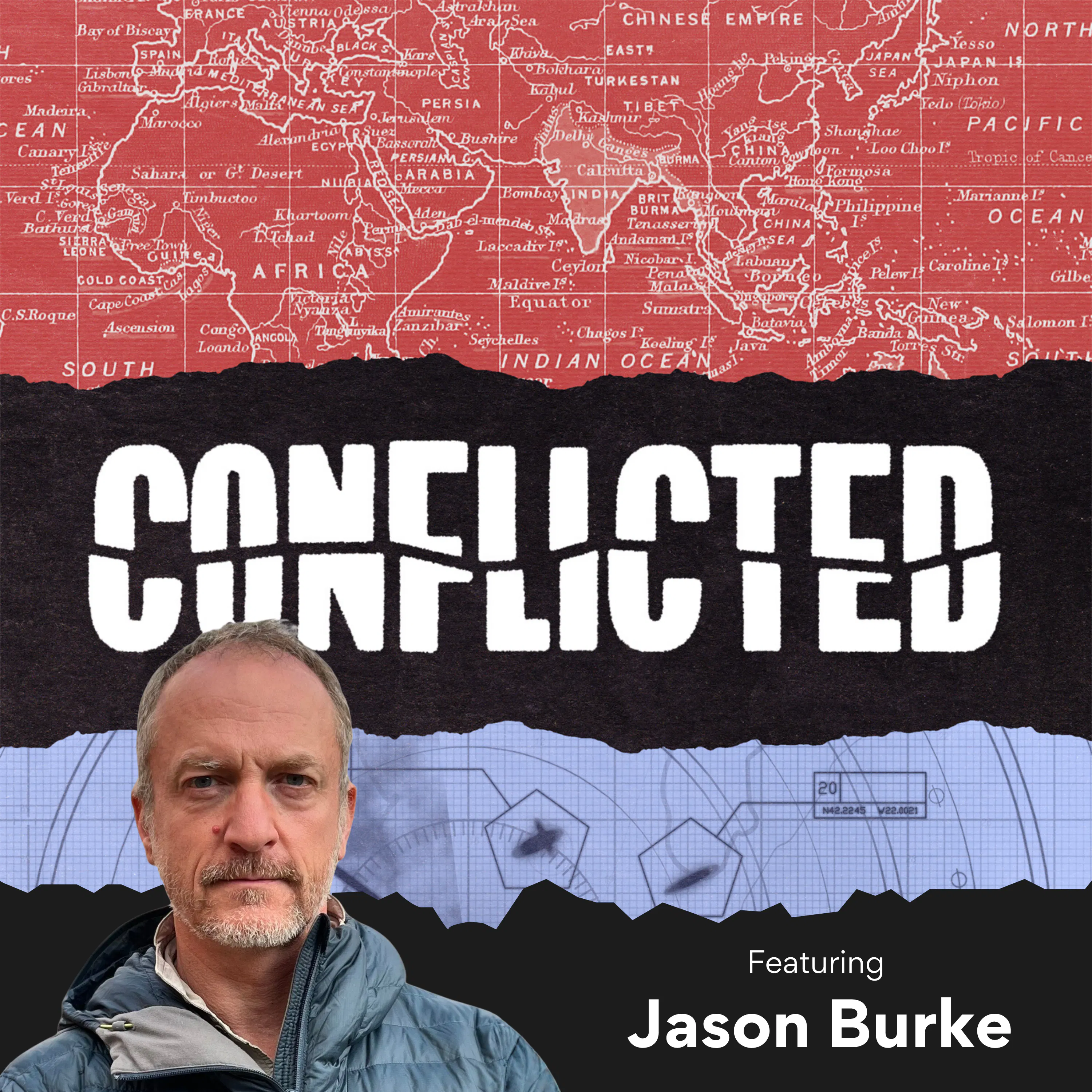
Terrorism these days terrorism is most often linked to radical Islam and jihadist aspirations, and we tend to trace its origins back to the anti Soviet Afghan jihad of the 1980s. However, that familiar story obscures a deeper one, one that starts much earlier when terrorism was the political tool of choice not of Islam, but of radical leftists. Jason Burke is one of the most experienced journalists covering terrorism and extremism and is the author of a new book, the Revolutionists the Story of the Extremists who hijacked the 1970s. Burke starts his story in the late 60s when secular left wing militants everywhere developed a new media driven form of violence, one that was often more theatrical than lethal, but which would then evolve in unexpected and explosive ways. That earlier wave of secular revolutionary militancy connects to the later rise of Islamist terror, the true story that goes a long way to explain the world we live in today. I'm Thomas Small, this is my conflicted conversation with Jason Burke. Hello Jason, nice to see you. Thank you for coming on the show.
- [03:12]
Jason Burke
Well, thanks very much for the invitation. I'm a big fan of the podcast and it is great to be here.
- [03:16]
Thomas Small
Now Jason, I've known of you for literally, like, 25 years now, because you were one of the earliest and certainly one of the best journalists to cover the war on terror era and all of its many dimensions. So your name routinely pops up in my reading list and has done since I was studying Arabic, you know, back in the early 90s in London. So it's a real pleasure to meet you. Tell us a little bit about yourself, you know, here on Conflicted. We'd like to introduce our guests to the listeners. So you're. You're an Englishman. Are you from London?
- [03:49]
Jason Burke
Yeah, I'm from North London. I was born, raised in North London, and I've been a reporter doing foreign affairs for pretty much 30 years now about that. And that was what I wanted to do when I was a teenager. So I'm very, very lucky, and I've been able to do what I always wanted to do, and that my work as a reporter has taken me all over the world. Clearly I've specialized in conflicts, as you say, very early on. I started to get interested in Islamic extremism, actually in the mid-90s when I was in London, when it was the, you know, the high point of what was called Long Danistan, rather hyperbolically. I mean, it was much more complicated than that, obviously. Always more complicated, always more complicated. But then I went off to freelance as a very young reporter in Pakistan and Afghanistan in the late 90s. I'd always been interested in the region. I'd traveled there a fair amount, and I went there and was working on, again, Islamic extremism and Al Qaeda died there, and all these groups and people that nobody really cared about at all at the time, and then they suddenly did in quite a big way.
- [05:08]
Thomas Small
They sure did. Yeah.
- [05:09]
Jason Burke
Yeah. So, and. And since then, I mean, I've done all sorts of journalism and reporting in all sorts of places, all sorts of different conflicts. But a lot of it, as you said, you know, the main theme that I've worked on has been Islamic extremism, political and religious extremism of all strands, if you like, and the broader conflicts that produce them.
- [05:34]
Thomas Small
Well, it must be as surreal for you as it is for me to think that we're rapidly approaching the 25th anniversary of 9 11, the real event that for our generation, you know, I think we're in the same generation, our generation that was like, you know, a turning point, the turning point of all turning points. It's kind of surreal to think that the younger generation now and a lot of our listeners, I think, are under, you know, under 25 and for them, 911 is just a kind of vague thing that happened before they were born or something. But for us it was a real watershed. And I cannot believe it's been nearly a quarter of a century and you've been reporting on all the downstream consequences of that event, you know, pretty much your whole career.
- [06:17]
Jason Burke
Yeah, absolutely. I mean, it completely shaped my career. It was epochal as an event. I mean, it really was one of those historical moments where the world turns and it's quite difficult to think of events since which had that kind of impact. Single event. And I suppose, you know, I've always been interested in history. I studied history, I've read masses of history, still do. And that was an event which was genuinely historic. And it was basically a very small number of individuals who carried it out. And that, I think, really, really struck me at the time and has framed the way I report and think and read and write ever since.
- [07:08]
Thomas Small
Well, you're not here to talk about 911 or really anything that's happened in the last 25 years. You're here to talk about your new book, the Revolutionists, the story of the extremists who hijacked the 1970s. A great title. When I saw that title, that's when I thought, we've got to get Jason on the podcast. And in the book you take the story back well before this century even, and tell the story of the era, roughly late 60s to the early 80s, when a new style of transnational political violence first sort of arose, initially mainly secular leftist and anti imperialist, then increasingly Islamist. And as your book demonstrates and dear listeners, it is a fantastic book. If you listen to Conflicted, and there are lots of you who do, and you haven't read the Revolutionists by Jason Burke, then I don't know what you're doing. This is right up your street. You must read it. It tells the whole story very dramatically, as only Jason Burke can. And you show in the book, Jason, that the two wor worlds, the earlier secular leftist strain of militant radicalism and then the later more Islamist strain, are not separate. They really overlap. And to some extent they overlap over Palestine, but they also overlap tactically and strategically.
- [08:40]
Jason Burke
Yeah, they overlap over lots of things. They don't. One doesn't produce the other. As some people have said, having read my book, some of the reviews and so forth, as ever with books, people take from them what they want often, even if it's not always to what the. What the author intended. But I, I mean, one really important thing about looking at that period is that it does link directly to today. I mean it, you can't understand what's going on today in the Gulf, in the Middle east more generally, in fact.
- [09:10]
Thomas Small
Well, not least with the Iran war that's, that's, you know, raging quite.
- [09:14]
Jason Burke
We're in the middle of a war that involves the regime that came to power in 79 and whose original ideology was deeply shaped by the 70s and, and the 60s too. So I mean this in, in a fact, in a way. I mean the book, it was the prequel to, to all my work previously. I mean, I was interested in kind of going back that much further because I've written it. Actually the book came out of a, another book that I was meant to be writing. I did in the end, right in the. About ISIS in the 2000 and tens. And I was commissioned to write a book then about isis. And I, I was kind of trying to work out how I was going to approach it and ended up writing a, a draft which was more or less a kind of short history of Islamic militancy in the last 20, 30, 40 years. And it didn't really work as a book and I ended up writing something different. But it took me as a process back to the 60s. And that really surprised me because in my head I was thinking Islamic militancy that really, in its contemporary Sunni manifestation, particularly Al Qaeda and ISIS and so forth that goes back to the 80s and the war against the Soviets in Afghanistan and much else that was happening in that moment. And actually I found that I was not just back in the 70s looking at its emergence as a serious phenomenon, but, but going further back to, to the 60s. And that's where I started to get much more interested in the parallels, if you like, with non religious, the secular nationalist ideologies and activism of the time. Because what struck me was, yeah, there are some kind of, there's some big divergences, sure.
- [11:05]
Thomas Small
Secularism, religious nationalist, Marxist stroke, kind of globalist Islam. There are obviously divergences, but there's some deep genealogical similarities.
- [11:16]
Jason Burke
Yeah. And the obvious points about kind of progressive social values and so forth too. But what both are a revolutionary project from the leftist side and from the Islamist socially conservative side. And what really struck me was they both seemed to me to have their origins in their contemporary form in a moment in the, the mid to late 60s where there was this huge surge of revolutionary, if you like, energy, certainly mobilization for change, radical, transformative, total societal change across the world, particularly among young people. And they both start there, they go in different directions clearly, but that Original impulse to change things dramatically was a common one. And the timing was shared as well in that moment in the late 60s.
- [12:14]
Thomas Small
So, you know, it's interesting thinking now, 60 years later about the 60s. I grew up in the suburbs of San Francisco, so you can imagine what the 60s meant for me and for all the kind of young Gen Xers who came of age in the early 90s during the kind of grunge movement when the 60s had a kind of revival and pot was back in a big way. And we were all looking back at the 60s as this kind of kind of high water period for hippies and free love and peace and all that. And I think Americans have been encouraged through, I don't know, the culture to think of the 60s as primarily that hippies preaching no war, preaching love and peace. But in fact, the story of the 60s and the political radicalism of the 60s is much, much less straightforwardly righteous than that. I mean, these movements that were born out of various traumatic event, obviously in the Middle east, things like the Suez War, things like the rise of Arab nationalism, the clash with Israel over Zionism and things, and then climaxing there in 1967 and the war which the Arabs lost so disastrously in their own minds, it's different. Militant groups carrying Kalashnikovs dedicated to truly radical and revolutionary change began to proliferate. And that's where you're beginning your story?
- [13:39]
Jason Burke
Yeah, I mean, for me, the hippies are the kind of media archetype of the 60s, early 70s, but actually really pretty limited. A kind of big cultural presence, but pretty limited in terms of the real extent, even in the US actually. I mean, what's much more prevalent everywhere is a real spirit of radical social, political and cultural too. Activism, sometimes involving violence ranging from throwing bricks at policemen to blowing things up and killing people. And that's something you see across the entire developed world and much of the developing world too. So a lot of Latin America is in absolute, not necessarily chaos, but huge struggle between the right and the left, often generational too. Same in parts of Europe, particularly in West Germany. In Japan there's a similar situation to West Germany. In the US you have civil rights movement, it's just peaking past its peak. And you have radical offshoots like the Black Panthers coming out of the civil rights movement. You have the Weather Underground forming in the us. That to me is much more what was happening in the 60s, particularly because it's coming against a background of mass protests in Paris. This is the real energy in the non Islamic world, but also in the Islamic world, where there are the shocks of the sort of 67 war, the clear failings of pan Arab ideologies, socialist leaning, kind of statist, authoritarian ideologies in so called revolutionary states, Egypt, elsewhere. And that moment gives us the roots of the very modern manifestation of extremist Islamism at that time. And it's part, I would argue, of this global ferment, albeit with a different vocabulary.
- [15:39]
Thomas Small
Before we talk about the history, let's talk about terrorism in general or as a topic. I mean, I like that in the book you really adopt quite a realist sort of framing of terrorism. You're not so interested in taking a moral perspective particularly. I mean, you don't frame terrorists as primarily evil. I mean, they might be evil, but you frame them as really what they are. Political actors who have adopted a particular tool to achieve their aims. So, you know, if we start in the late 60s, why did certain movements decide that plane hijackings, taking people hostage, bombings, assassinations, and then in the 80s, eventually suicide attacks? Why did they feel that these were useful political tools?
- [16:31]
Jason Burke
So you have two different trajectories here. One is the sort of secular nationalist, Western European hardline, ultra radical left wing violence. So let's take for example the Red army faction in West Germany, who I look at a lot in the book, and then you also have another very good example, which I spend a lot of time looking at in the book too, is the Palestinian armed factions, the more radical Palestinian armed factions post 1967. So in the west, what you're seeing is basically the radical fringe that comes out of the mass movements, the mass mobilization of the late 60s which achieves some of what it set out to achieve. Certainly by the end of the decade, the end of the 70s, it's achieved quite a lot. But that wave of energy and mobilization fades quite quickly. It was never quite as wide as it looked, or people have described it as subsequently. And it was, you know, it was largely middle class, lots of educated young activists who never really made inroads in terms of constituency with the working classes and others, not their level of education aspirations. And so you had a radical fringe that came out of that movement that looked to continue the struggle, so to speak, to it, to achieve more maximalist aims through violence. And they were a minority of a minority of a minority. But they got a lot of attention because terrorism gets you a lot of attention. And that would be like the Red Army Faction and others of that nature in Europe. And basically, certainly by the end of the decade they'd faded away. So there was never a transition to anything much more extreme. They were pretty much extinct by the late 70s. You have lots of terrorism in Western Europe and America and Latin America, but is taking different forms ideologically, tactically. It's more or less the same in the Middle east and in the Islamic world. You start off with this wave of extremism involving groups like the Popular Front for the Liberation of Palestine and others who are doing these hijackings and variety of other attacks, most of which are pretty much non. Lethal. They don't kill a lot of people. In fact, as commentators at the time said very perceptively, the aim is not to have a lot of people dead, but to have a lot of people watching. And they very much do. All these hijackings and so forth, the attack on the Munich Olympics of 72, much else, in order to gain prominence for their cause. And you can see that in how they describe it, in the way they talk about it and the way the people I spoke to had been involved in it, described it to me. Now that doesn't achieve a great deal. And by the end of the decade, certainly by the beginning of the 80s, you have a big shift. So there are fewer of the kind of spectacular operations that we saw previously that are just aimed at getting media attention. And you have something else which involves, particularly in Lebanon in 82, 83, against Israelis and the US and the French. You have suicide attacks, big truck bombs, mass casualties, sometimes civilian targets. And you, you were in a completely different world in terms of terrorist practice and one that's much closer to where we are now. And in a sense, a lot of what I was doing with the book, as you mentioned at the top, was charting that shift and trying to explain it.
- [20:15]
Thomas Small
You also kind of characterized that transformation as involving a sort of a kind of three pronged or three stage or three dimensional system like that, you know, a radical system that is intermeshed. So you have, on the one hand, you have the militant networks like these Palestinian groups, German and Japanese radical groups, some freelancers like the notorious Carlos the Jackal, who you tell the whole story of in your book. It's great. It's so dramatic and interesting. What a character. And then eventually Islamist militants. So that's sort of the first dimension. And then you have state patrons and intelligence services. So these are governments like the Libyan government, eventually the Iranian government, who sponsor, manipulate and, you know, sort of shelter these people or kill them as, you know, in a case by case basis. So that's, as I say, Libya, maybe Cuba, eventually after its revolution, you know, always overshadowing it all. The Soviet Union, Israel and the United States at times. So you have the state as well. And then you have a counterterrorism system that we identify more with the established, let's say, responsible state actors in the world. And the counterterrorism system is growing in response to the growing radicalism. So there's a kind of dialectic that involves where the militants are innovating new terroristic means. The states adapt to these, becoming themselves more capable, but also more draconian. The militants then adapt, become more dangerous, rinse, repeat. This is something that is happening as your story unfolds.
- [21:55]
Jason Burke
Yeah, that's certainly an element. And you see very clearly in the early 70s, so you know, when you have the September 1970 multiple simultaneous hijacking that was executed by the, the PFLP, a very famous event.
- [22:12]
Thomas Small
So the PFLP is the Popular Front for the Liberation of Palestine. This is a very famous, very, very influential Palestinian militant group.
- [22:21]
Jason Burke
That is correct. Leyla Khalid, now icon of the Palestinian nationalist cause, was involved. She actually failed to take an El Al plane and ended up in a London police station. Yeah, the PFLP pioneered that long range spectacular hijacking tactic. And they were among the more extreme of the Palestinian armed factions post 1967 and were strongly leftist, strongly Marxist. They managed to pull off this extraordinary event where they got three hijacked planes on a makeshift airstrip in Jordan. They were demanding release of prisoners from Israel primarily, but elsewhere around Europe, and a whole series of demands. But the point being that they had hundreds of passengers as hostages, they had three planes, they actually hijacked more, destroyed one, a huge thing. And Western governments had almost no response. I mean, they had basically nothing they could do. They didn't even have a vocabulary to describe what was happening. Was it skyjacking, was it air piracy? I mean, nobody knew. They had no laws. The only thing they could hold Leila Khalid for and charge her with, they didn't in them do, but was immigration offenses. I mean, she just tried to hijack a plane. And they were very weak in that perspective. And the militants, those using the terrorism had as a tactic, had the initiative. And over the next five years this shifts. So lots of legislation comes in much better cooperation between governments and, and armed police or military units which have the capability to storm a plane or a building, ideally kill the hijackers, kidnappers, whoever they are, and free the hostages. Pretty risky business. But they do do it successfully. The Israelis do it in 72, pioneer it in Israel, they then do again in 76, very famously in Uganda. The Germans do it in 77 in Mogadishu, Somalia. So it shows that it can be done. And that means that they don't just cave into the demands in the negotiations, which is what had happened previously. And at that point, certainly you get many groups among the Palestinians and others ditch the tactic because it's just not worth doing any longer. A couple carry on for a while with very mitigated results. But it's at that point, within a couple of years that you get this other form of terrorism coming through, which is suicide attacks, mass casualty attacks, no press conferences, barely any press statements. I mean, you know, Leila Halid and others are desperate to explain to the passengers why they've been hijacked. So they're handing out pamphlets, you know, giving them lectures, making speeches, talking about the Palestinian cause, et cetera, et cetera. Later on. No, nothing.
- [25:25]
Thomas Small
These are the sort of, sort of terrorist actors that are satirized so successfully by like the Life of Brian. So these are very, very, very morally self righteous people who really believe in their cause and don't actually want to kill. They're not bloodthirsty. They're just trying to take advantage of the new media of the modern mass media to communicate their message. And they know that these rather, you know, fantastical acts will generate the controversy they're looking for. Who is the first kind of ideologue or the first person to theorize this form of radical militant action. Because, you know, I think of, you know, terrorism has deep roots, let's say the anarchists of the 19th century. And we have the kind of idea of the mustachioed guy in the trench coat with a one of those classic cartoon bombs that have the fuse throwing it at the Tsar or something. So it's not like states didn't know how to counteract terrorism. But it was the rise, I suppose, of television and the mass media that changed things. And some actors took advantage of it. But who was the first to really think about this and come up with the idea?
- [26:37]
Jason Burke
Well, there's a really good line from Wadi Haddad, who was deputy or one of the senior operational commanders in the Popular Front for the Liberation of Palestine. He ends up breaking away from the mainstream group. But you know, we won't go down that Life of Brian path. And I can get into the Alphabet soup and which is just crazy numbers of different, you know, acronyms and everything else. But he said, and this is really interesting, he said that what he thought his group and the broader Palestinian movement should do was take the struggle from the forests to the skies. And what he was referring to was the forests was the sort of guerrilla struggle of the Viet Cong, of Che Guevara and Castro and so forth in Latin America of those kind of, as he would call them, liberation fighters. But he recognized that that wasn't going to work in the environment of the Middle east, particularly not the Israeli Palestinian conflict in the late 60s. But there was an opportunity that had been created by, yes, the media, which was, had a much greater reach now, you know, you're talking about television in nine out of 10American homes. You're talking about live feeds for the first time by the early 70s, that kind of technology which enables a much greater impact. But you're also talking about a new terrain that's opened up which is completely free of any interference and security at that moment, which is aviation. So you know, all these airports, all these new flights, all these jumbo jets, all of this which is, you know, the security is non existent. It's like boarding a train, basically.
- [28:26]
Thomas Small
I mean, young people can't imagine what it was like to fly. I mean really, we think before 9 11, but certainly, you know, before the 70s when these hijackings first took off, you know, people would just waltz on the plane. You know, it's crazy, it's kind of amazing.
- [28:41]
Jason Burke
There's this lovely line, it made me laugh reading it in after one of the hijackings when everybody's scratching their head about what to do. And there's one of the journalists writing in one of the British papers suggests that maybe people should take all their baggage out of their bags and show it to a security agent before they get on the plane. And the response of letters writing, you know, breeders is of horror. It's like, oh come on, nobody would allow that. That's a ridiculous idea. Look where we are now. So I mean it was just, just, it was completely different world from that perspective. And again, so, so, but, but somebody's got to see that. And so Wado had Wadi Adad, who was very, very flawed as a strategist in many ways, but in this, had this moment of insight and he saw that there was a whole space there that was undefended and that wasn't even understood by Western governments that would allow his group with a relatively small number of people to have massive oversized impact and that, I mean, we were talking about 911 at the top of the program and they were obviously huge differences. I mean, 911 was a kind of deliberately highly lethal event.
- [29:55]
Thomas Small
But also highly telegraphic. I mean photographic, televisual, I mean they really knew what they were doing.
- [30:01]
Jason Burke
Exactly. And again, it's in the 70s that you get a commentator saying, in fact it's Brian Jenkins who's still working and really made some absolutely fantastic, had some fantastic insights in that period, who said that terrorism is theater. And at that moment it really was. And it's coming out of the sort of 60s performance art and all this stuff. I mean, I can go down a big rabbit hole on all of that.
- [30:27]
Thomas Small
Well, it's true because there's a cultural dimension, an artistic literary dimension, as there has always been with revolutionary activity going back to the Romantic poets. You know, I think of someone like Bertolt Brecht reinventing the. As an in your face experiential thing that was meant to shame the bourgeoisie so that they would be radicalized and join the revolution. So there is an overlap between theatricality and artistic production and political militants which
- [30:55]
Jason Burke
is, and I found again and again in the first wave, I'm talking about in the west particularly, but not exclusively militants, terrorists who had been very involved in theater. So one of the key people killed by Mossad in Paris in 73 is a guy called Mohammed, Mohammed Budia. Now he's really amazing and has been dismissed really by successive books on the Mossad and da, da, da, you know, the normal stuff, as a terrorist and a womanizer. Now he was both.
- [31:29]
Thomas Small
It's possible to be both, Jason, it's
- [31:31]
Jason Burke
possible to be both. But he was a logistician, basically a sort of supreme organizer in Europe. A one man logistics hub for, for the pflp, Popular Front of Liberation Palestine, for Black September, which was an offshoot of Fatah, which was. I'm going down that rabbit hole now. But anyway, that was Yasser Arafat's primary organization. And he did an awful lot of stuff in that period. Involved in lots and lots of attacks, mainly non lethal ones. But he was also, in addition to being a terrible womanizer who exploited a lot of young and impressionable women and used them in these operations. They all ended up in prison and stu. But he was the director of an avant garde theater in western Paris. He translated Moliere when he was in prison in France, he translated Moliere into Arabic. He was one of the first directors of the state theater in Algeria. Another guy who's killed at Entebbe in 1976 by Israeli commandos was one of the founders of a German revolutionary cells organization. He's called Wilfrid Burze and he incorporated Dramatic arts, street theater and stuff into his extremist activities early on, his protest activities, as he'd call them, resistance activities. And so again and again I came across this very, as you pointed out, very performative theatrical element in the early part of the. And I'd say one thing, though. So I'm talking about at the moment, we're talking about leftists and their involvement with dramatic arts. You can see traces of it in the Islamists as well, in the later religious element.
- [33:15]
Thomas Small
Well, I mean, we've talked on conflicted about Sayyid Qutb, the great theoretician of Islamist radicalism. You know, he started his life as a member of the Egyptian literati and he wanted to be a man of letters in that way. And he was a poet and his imagination was a very active one. Eventually he poured those talents into a different stream. But he comes out of a literary movement as well. Is that what you were referring to?
- [33:45]
Jason Burke
You're absolutely right. And I really enjoyed the conflicted double parter on Qutb where you make this really, really important point about that kind of very literary romantic with a kind of European tradition almost vision that Qutb had and how he brings that into the otherwise rather Aryan ideology of Islamism to that point. But you certainly see it in the kind of poetic traditions in much later on like Abdul Azzam and people talking about Afghanistan and martyrdom. You see it in the Iranian revolution and subsequently. I was thinking actually specifically about the 1979 takeover of the main mosque in the Grand Mosque in. In Mecca.
- [34:29]
Thomas Small
Yeah, yeah.
- [34:30]
Jason Burke
By Juhaan Al Taiba. I mean, he's a marginal figure in some ways, and I go into it in the book, but he's motivated by a kind of messianic, almost eschatological vision of what his extremism will be and bring. But the takeover of the mosque is effectively performative. I mean, this is the center of the Islamic world. It's also got cameras, you know, all over the place. Live streams go out of it, as we'd call them now for prayer time. I mean, everybody knows it. I mean, it's a stage. And the Saudi royal family have used it as a stage to foreground their authority as protectors of the holy places and so on and so forth. And he takes it over. And that stage is now in the hands of radicals. Another good example would be Ayman Al Zawahiri goes on to lead Al Qaeda who after, when he's imprisoned after the killing of Anwar Sadat in Egypt. You know, now a couple of years later, a few years later than the, the 79 takeover.
- [35:40]
Thomas Small
That's 1981.
- [35:41]
Jason Burke
Yeah, he, he, he turns the courtroom into a stage and again he makes these speeches. It's incredible. You can find them on YouTube, full of vitriol and violence, but he makes them in English. So he's clearly, you know, using the courtroom. He's behind bars. It's very dramatic as a platform to speak to as many people as possible to an audience that's theatrical.
- [36:10]
Thomas Small
Well, you know, we could have a whole conversation about the overlap between politics, religion and the art of theater because they really have always been, you know, related. I mean, we're approaching Easter now and if you think of, you know, I don't know, a text like the Gospels where at the end, the climax, Christ is standing before Pontius Pilate and you know, that is pure drama, which is then recreated every year in churches as a piece of religious theater which downstream had huge political, you know, transformative effects. So this is definitely true. We could also talk about the weird overlap to this day. At times it was called the Red Black alliance. Now it's often known as the Green Islamist Alliance. But in the past, in the 60s already, you know, when, when Tom Wolfe satirized the bourgeoisies, the cultural elite's flirtation with radical politics in his hilarious piece, you know, Radical Chic, you know, from, from a. For a very long time, there's a weird overlap between culture making and political radicalism and militant violence. Where you have like, like a soiree in Manhattan where the composer Leonard Bernstein is rubbing shoulders with the Black Panthers. It is very weird to think, but it still exists today and we see it, it's often mocked widely, especially by people on the political right or just like cranky old conservatives like me. And it seems weird, but it's there.
- [37:40]
Jason Burke
But why wouldn't it be? It would be my question. I mean, you know, that's why I have in the book, I have references to, to, you know, popular culture at the time, music, books. I read a lot of books from the period and not, you know, not just about what I. The fact that kind of non fiction accounts, journalist accounts, what's going on or memoirs or whatever, but you know, the novels that are being written at the time, whether it's by Nagib Mahfuz in Egypt or whether it's, you know, Heinrichbola in Germany or whatever. I mean, just to get that sense of how people are feeling and thinking. Because obviously as a historical phenomenon, terrorism is very historically specific. It is a product, it's a social activity. Terrorism is a social activity. And it's therefore going to be inflected with all that you find in any one society, cultural, political, ideological, whatever it is. And so in a way, it should be no surprise that you find all of these things embodied in the terrorist activity, of militant extremist activity, of the violence, full stop, of any one period.
- [38:53]
Thomas Small
That dynamic I laid out before about terrorism adopting a certain means, the state responding, adapting to counter it, and then the terrorists adapting themselves, becoming a little bit more brutal or a little bit more. More sinister. You know, I think one example of this is the PLO Fatah, you know, Yasser Arafat's organization in Jordan. Eventually its activities just anger the Jordanian state. To the extent that the Jordanian state cracks down hard, they leave out of the middle of that, you know, in the midst of this movement, Black September emerges as a kind of more extreme version of what FETA had been doing. It's one of these splinter groups. They carry out the munich massacre of 1972. A little bit more shocking, a little bit more lethal. And which is followed by the Mossad's notorious assassination campaign across Europe. So we see this tit for tat, but the Munich massacre allows me to pivot to Europe and to Germany and to groups like the Baader Meinhof Gang. People kind of know vaguely about groups like Baader Meinhof, West German radicals, but you know, who were Bader Meinhof and how were they linked to Palestinian networks and Middle Eastern training camps? Because we can silo these movements, but actually there was a globalization or an internationalization of radicalism.
- [40:30]
Jason Burke
Yeah, this goes to my point of how you have this moment of very broad internationalist sense of change. Revolutionary, violent energy, extremist energy, terrorist energy, whatever you want to call it in this period. So the Bada Meinhof Gang, as they were known, is a misnomer. I mean, actually they called themselves the Red Army Faction. Bada was Andreas Bada, who was a kind of art school dropout in his late 20s.
- [40:56]
Thomas Small
Art school dropout. There you go.
- [40:59]
Jason Burke
Basically, I mean, petty criminal. He loved fast cars, less keen on insurance and licenses, you know, that sort of thing. Been hanging around bohemian circles through the 60s. And Meinhof is Ulrike Meinhoff is a much more impressive figure. She was older, she was in her mid-30s. Two young, very young kids, twin daughters, had been married to a well known publisher. She was a very prominent left wing journalist, writer, filmmaker, highly articulate, intelligent woman. Often on talk shows late at night arguing with conservative men, usually almost exclusively smoking Like a chimney, you know, for about an hour and a half, which apparently got watched, possibly because nothing else was on or possibly because she was a really kind of captivating speaker and writer.
- [41:50]
Thomas Small
Well, let me just interrupt because, you know, you mentioned before Layla Khalid and now you're talking about Ulrike Meinhof. And one important, important fact about the 60s, 70s radical movements is the prevalence of women in their ranks. They played a big role in this shift towards performative, you know, kind of media spectaculars in terms of terrorism. Maybe at the time just having a woman there was part of the spectacular cause. People didn't associate radical violence with women,
- [42:19]
Jason Burke
certainly for the Palestinians. And really it's only the PFLP who do it, and they only do it once or twice. And Leyla Khalid was selected specifically to a couple of other women, did something similar, but with the group. But she was. She's again, I've spoken to her. I spent hours talking to her. She is again, highly articulate, intelligent woman, very striking, masses of charisma, basically. I mean, masses of kind of presence. And senior people in the PFLP recognized her as just really useful to talk to the west, either through her acts, violent acts, or just be interviewed. So she, after she does her first hijacking in 69, she gets sent on this tour of the Middle East. She is put up for loads of interviews. When she decides she's had enough interviews and skips one, she gets a call from George Habash, the founder of the PFLP and a really very major figure, very senior figure in Palestinian nationalism at the time, who says, what are you doing? Get on the tv. And she's very much so that with the Germans, I'd say it's different. I mean, these are intelligent, committed women who are allowed to move into this space partly because it's the 60s and, you know, there's a big. Much more freedom of action for them. Has to be said they still come up against a lot of sexism from their male.
- [43:44]
Thomas Small
Absolutely.
- [43:45]
Jason Burke
Supposed comrades in arms.
- [43:46]
Thomas Small
Sexism in the political left is a strange but prevalent phenomenon. It continues to this day.
- [43:51]
Jason Burke
Absolutely. But someone like Meinhof or in fact Gudrun Enslin, who is Andreas Barda's girlfriend, and to describe her as that is just completely wrong. I mean, Bard is her boyfriend. He's pretty useless. She is again, you know, PhD in English literature, very well read, very bright, totally binary thinker, you know, no nuance whatsoever, but is the prime mover of the group and the organizer and the logistician and. And really the Driving force. So the two main forces are women. And about 50% or more of the group actually end up being women. And they are hard left. I mean, New left, so not Marxist left. But they believe in the idea that they, through violent actions, can effectively eventually spark a revolution or certainly help a revolution on its way, weaken the imperialist centers of Europe. Europe and therefore help the global south in its battle. I mean, there's all sorts of different nuances to their thinking, but they set out on this violent campaign that does kill people, causes a lot of damage, really shakes the West German state. They last a couple of years and then they're all picked up. But in that couple of years, they kind of flirt with real internationalism. They never really get it going. They travel to a. The Palestinian fatah run, actually PLO camp near Jordan in 1970. They spent a few weeks there. It's not very successful afterwards. There isn't really very much proper coordination, even with the later generations of the Red Army Faction, the Germans through the 70s. And the reason it isn't very successful is because basically they all hate Zionism as a representation of imperialism and capitalism, which are the two other great enemies and fact, the biggest enemies. And they all admire Che Guevara and various others, major thinkers and the Viet Cong and the Algerians and, you know, all sorts of people. So they share that kind of broad vocabulary. But actually, you know, you're talking about what the Palestinians have got a nationalist course set within an internationalist context. The Germans are looking at international revolution. They don't really know very much about the Middle east and they don't really care very much about the Middle East. So it doesn't actually, in practical terms, operational terms, ever come together as an alliance. And there's some ludicrous incidents in the camp which reveal the kind of vast cultural gap which, you know, there's a
- [46:27]
Thomas Small
reason why Monty Python satirized these people. I mean, really, they can be quite ridiculous.
- [46:32]
Jason Burke
Yeah. I mean, Barda refusing to go on assault courses or trying to go on assault courses. Refusing to, you know, wear combat fatigues and preferring his, like, purple flare and stuff. I mean, it was tight purple trousers.
- [46:43]
Thomas Small
I mean, imagine what the PLO gorillas thought about this damn dirty hippie, you know?
- [46:49]
Jason Burke
Yeah, yeah. I mean, all of that. So that's going on and one of them sends a letter home saying, wow, this is like being in the Arabian Nights. You know, a kind of Orientalist trope, paradigmatic. But. So that never quite gets going in terms of real combination. The Japanese do. The Japanese Radical faction of a faction.
- [47:12]
Thomas Small
Yeah, yeah, let's talk about the Japanese because I'm ashamed to say, like the Japanese Red army, you know, I never really heard about them before reading your book. So, you know, tell, tell the listeners about them. These were far left revolutionaries from Japan, obviously like everyone else, deeply influenced by this sort of Marxist anti imperialist global liberation rhetoric and narrative and ideology. But they didn't really operate in Japan and embedded themselves in the Middle east of all places. What's their story?
- [47:42]
Jason Burke
They started in Japan, people who ended up in the Middle east, it has to be said, a very small number of them, a few dozen. But they start off as most of these groups did, as part of a much broader protest movement, student protest movement. And they basically are the radical international bit of the radical, bit of a very extreme bit of the broader movement. So I mean, that's why there are only a dozen of them. But they end up based in Beirut and they collaborate with the Palestinians. One particular faction in the early 70s, it again doesn't last very long, but that actually is operational. They then go their own way, partly because it's quite difficult to match the ideological and practical aims of both groups. But they then got to go their own way. They're pretty much defunct by the mid-70s. I mean, they hang around for a bit long. They're very much. Part of. What I'm saying is that that kind of wave of the 60s, the extremist fringe of that wave again, like so many of these other groups, they run out of steam by the mid-70s.
- [48:49]
Thomas Small
They do run out of steam, but before they run out of steam, as you say, they do go operational and they participate in the Laud airport attack of 1972. This is now Ben Gurion Airport in Israel. And three Japanese Red army members arrive at the airport disguised as passengers and suddenly open fire with automatic weapons that they're carrying. They throw grenades, killing 26 people. You know, pretty nutty, pretty surprising and shocking. It is a turning point, I think, in the story.
- [49:20]
Jason Burke
Yeah, I mean, we still don't quite know what they were trying to achieve and what happened with that firefight and why they opened fire. Then it seems that actually their aim was to take over the control tower or possibly see some planes on the tarmac. But it went wrong and they ended up in this firefight with security forces in the terminal itself. And as you say, a lot of people died. One of the interesting things about that is when I was reading, and I didn't know much about it either until I started researching it, And I was reading kind of accounts of it at the time, and there was this quote from a security official which said. It was a British security official who said, yeah, we knew immediately it wasn't an attack by Arabs because it was a suicide attack and only the Japanese do that.
- [50:04]
Thomas Small
Wow. Foreshadowing, huh? That's amazing.
- [50:07]
Jason Burke
This was really interesting because this was. It was one of those moments sort of, you know, where you're. If you've got your historian head on, you're like, oh, wow, that is an insight to a way of thinking that was totally different from the way we think now. And that's how they thought then.
- [50:22]
Thomas Small
They're having kamikaze pilots in their minds, not jihadist terrorists, because that didn't exist yet.
- [50:27]
Jason Burke
Exactly. And that's partly why I wrote the book. I read that and I thought, that is really interesting. And that speaks to the idea that we now is so common, that suicide terrorism is sort of almost essential to Islam and that there is something prone within Islam that will create people as suicide terrorists. That is a new idea, relatively. And then in the early 70s, this is 72 people would say that Arabs died suicide. No. And in fact, even a couple years after that. And I look at this, this in the book, you know, you've got attacks which are quite close to being suicide attacks or certainly the chances of survival are virtually nothing. Some of them are almost explicitly attacks where those involved are told they're going to die and to sell their lives. There's even a possibility one was wearing. One of the attackers was wearing a kind of suicide belt. These are attacks in Israel in 73 and 74 by Palestinian groups. And. And at the time, Moshe Dayan, former defense minister and one of the great figures of the Israeli security establishment and politics. Very maverick, controversial figure. But nonetheless, he says, this is completely new. We can't really. Even before this started happening, he's got people coming to him saying, Israeli defense officials saying, we're a bit worried about this emerging trend. And he's like, nah, you know, Arabs don't do that. They're cowards in inverted commas. That's his view. They won't fight to the death.
- [52:00]
Thomas Small
Well, also, they're, quote, unquote, religious. I mean, they're Muslim or whatever. So they. They don't believe in suicide, as, you know, they think it's bad and it'll send them to hell or whatever.
- [52:08]
Jason Burke
He doesn't say that.
- [52:09]
Thomas Small
All right?
- [52:10]
Jason Burke
He just says that Arabs don't fight to the death. They run away. You know, that's because whatever. And that, that's his view. So, so, you know, the conventional wisdom at the time is the, among kind of Western and Israeli security officials is, is that suicide attacks are just certainly not a threat. This is. Until you start to see something. This is mid, late early mid 70s. So within seven years. So within six years you get in 82, seven years, 10 years after. Lord, but a bit less after this period. You get a big attack, a massive truck bomb of car bomb actually in Tyr in Lebanon, where the attacker, who is a Shia Muslim from the south of Lebanon and probably sent by the precursors of Hezbollah, blows up a Israeli base and kills a lot of people.
- [53:07]
Thomas Small
Yeah, yeah, yeah, absolutely.
- [53:08]
Jason Burke
And the Israelis can't really get their heads around what this is because the guy died. You know, how was he meant to escape? He drove the car into the base and blew it up. This just doesn't kind of make sense. And that's as late as, that's November 82. So you're still in this world where suicide attacks are just seen as the
- [53:32]
Thomas Small
state has to catch up. As you, you know, as we said with the, with this evolving militancy. I want to talk, you mentioned about, you mentioned it earlier. I want to talk about the Entebbe hijacking of 1976 a bit because it casts a big shadow to the present. In 1976, Palestinian militants and some German left wing radicals, you know, together they hijack an Air France flight from Tel Aviv to Paris and it is diverted to Entebbe airport in Ugand where IDI Amin, the dictator, very bloodthirsty man, he allows the hijackers to land and to operate there. Now there's a kind of turning point here because once the plane lands, the hostages are sorted and separated. So Israeli and Jewish passengers are held and the rest are released?
- [54:21]
Jason Burke
Effectively, yes. You know, this very controversial episode, there are lots of arguments about it, but that's pretty much what happens. And, and it's a quandary for Yitzhak Rabin, who is the prime minister of Israel at the time and who it says, we haven't really got a plan to do anything and how are we going to get people out of Uganda? I mean, it's furthest possible range we could ever fly to, if we could fly to it at all. And the Israeli defense establishment and Shimon Peres, actually the then defense bureaucrat and politician and so forth, come up with this plan to, you fly the Sayeret Matkal, so very specialized commandos down there with a bunch of paratroopers. As well, a lot land on the C120s. They're going to fly down from Israel, land killer hijackers, who are, as you say, a mixed bag of Palestinians and a couple of Germans, and free their hostages, who are largely Jewish and predominantly Israeli citizens. I mean, there are a few. The flight crew are down there and stuff like that, and they do it. Now, what really interests me about this episode, which is one of the kind of hugely celebrated special forces operations of all time, and there's no doubt that it was very audacious and it was at the outer limits of what anybody had done. In fact, totally unprecedented in many ways.
- [55:44]
Thomas Small
Yeah. And over 100 hostages were rescued, although several were killed in the crossfire. So, you know, it was a real hairy episode.
- [55:52]
Jason Burke
Yeah, a couple. But the main casualty we can talk about is obviously.
- [55:56]
Thomas Small
Well, yeah, let's talk about it. So Yonatan Netanyahu, the mission commander, was killed in the course of the operation. Now, you know, the name might alert the listeners that this is the older brother of Benjamin Netanyahu, the Israeli Prime Minister today. And I think the Entebbe hijacking and Operation Thunderbolt, which the Israelis launched, launched to rescue the hostages, looms very largely in Prime Minister Netanyahu's mind and shaped his understanding and I think a lot of Israelis understanding of that generation, of the way in which their enemies, the Palestinian liberation people, were moving.
- [56:40]
Jason Burke
Yeah. And that underpins much of his political career afterwards, which was obviously launched in the aftermath of. Of the death of his brother. And for Netanyahu, it was absolutely transformative event. He had to drive eight hours across the US where he was living at the time, to find his parents, tell them the news of their eldest son's death. He absolutely idolized Yoni Netanyahu, and he went on Benjamin to be a lobbyist, organizing conferences on terrorism in Jerusalem, which were very influential, and then very quickly up the diplomatic ladder and then political career, all launched within, you know, less than a decade from the death in 76 of his brother. So hugely consequential.
- [57:27]
Thomas Small
And his story, and that story overlaps or is really the coterminous with the rise of a new Israeli right that grows and grows and grows in power and which controls Israel today with all of the consequences for the Middle east
- [57:40]
Jason Burke
of that, which, you know, one of the things I found in doing the book was how many people, you know, you see at early stages of their career or mid stages of their career in the 70s. So there's these kind of cameo roles, and they kind of come in and out or you know, just off stage like Benjamin Netanyahu or George Bush the first, who is very involved as US Ambassador to the UN in a really important and interesting debate about the nature and the definition of terrorism in that takes place in 72 and goes very badly for the US incidentally. And you know, and. And the Assad dynasty and Saddam Hussein and you know, all sorts of other people are there and involved and important.
- [58:26]
Thomas Small
Yeah, it's a great story. Listeners buy the book.
- [58:29]
Jason Burke
It was just that it kept coming at me that all these. And the Iranian regime, I mean, you know, Khamenei, Ali Khamenei, supreme leader who was just killed on February 28th by the surprises ready strike. The start of the war begins in the late 60s as an activist, a religious activist, quite involved in some of the literary circles at one point or another, as we were speaking about these
- [58:54]
Thomas Small
people translating Sayed Qutb, listening to Ali Shariati, absorbing some of that Marxist Islamist sort of fusion, having already been very much influenced by Nawab Safavi, the sort of grandfather of Iranian militancy. It's all there. It's not just a prequel to your previous book or whatever, your previous work. It's a prequel to our lives. This explains so much.
- [59:20]
Jason Burke
It was really eye opening to me as I kind of went through this to go Back to the 76 Entebbe thing we were talking about. One of the things that I think is absolutely crucial, crucial is that, yeah, it's this incredibly audacious special Forces raid and they pull it off. I mean, it's incredible. And it becomes the gold standard. And I was reading all the kind of responses to it from other. From leaders around the world. In the developing world, it's seen as a gross infringement of sovereignty of Uganda and an attack by the imperialists on a sovereignty of an African nation and all this sort of thing. And that's the response who. Much of the developing world, which has been completely hidden or forgotten in the west. But in the west, in the U.S. i mean, you know, Reagan, who is on his way up challenging at the time, writes to Yitzhak Rabin saying it's fantastic. The CIA say, oh, look, you know, we. This is the way to deal with a thing. You know, there's. There's songs being written in the US about it. I mean, country ballads and things. I mean, it's huge. And they were these films.
- [60:19]
Thomas Small
Well, you know, I imagine that the CIA or, you know, the American security establishment has had Operation Thunderbolt in mind when they conceived of Operation Eagle Claw. To free the American hostages in Tehran being held at the US Embassy there. We did a whole episode on Operation Eagle Claw, which did not end up so successful, certainly not as successfully as Operation Thunderbolt. But that, you know, allows me to make a final pivot, because we must sort of bring this conversation or at least ease it towards a close, which is towards Iran and the Iranian revolution. When the Shah was becoming increasingly aware that there was a movement that was going to, as it turned out, unseat him from power. He called it the unholy alliance of the Red and the black. And they coalesced in this revolutionary movement. And the Shah ended up abdicating and leaving Iran in 1979. So. So it's the Iranian Revolution. And we know right now a war is going on which is directly linked to the Iranian revolution, because the revolution never ended. The trauma of that revolution for both sides never stopped. The objectives of the revolutionaries and their enemies or rivals never ended. So we're seeing another chapter unfold before us right now. And I think a lot of the media commentary about the current war, war, because it doesn't take in this larger historical view, which your book lays out so well, is not really getting this point that this is not just some kind of surprising war. Oh, this has come out of nowhere. No, no. It has a long prehistory, and part of that is what happened in 1978 and 1979. So what would you say, having told the story of the slow shift away from the left, secular terrorism, to the religious, more socially conservative, but still radical Islamist terrorism, what are the most common misconceptions about the revolutionary movement that led to the Shah's abdication?
- [62:25]
Jason Burke
The biggest probably, is that the Ayatollah Khomeini took power and the radical clerics took power, having led the opposition movement through the 60s and 70s almost exclusively, and then took power immediately and became the leaders of Iran, imposing their regime, whereas, first of all, they had to struggle to impose it, certainly in the initial months, but really for the first couple of years, and eventually succeeded in doing so by eliminating brutally all other forms of potential government and therefore opposition to them. So it was an ongoing process of consolidation of the regime afterwards. And even Khomeini never thought, I don't think that he would get to that place of supreme power with the system wholly Islamicized that they eventually ended up with. And the other really important point is necessarily part of what I've just said is that previously it was not even the religion, right. That was seen as the primary threat to the Regime of the Shah of Iran. It was the left.
- [63:42]
Thomas Small
Yeah, I think we can see it as inevitable that this almighty theocratic power was going to rise in Iran. But in the 70s that is not what people thought would happen. They saw a very well organized and strong and international leftist anti shah movement as the primary threat. Threat.
- [64:01]
Jason Burke
The Shah himself saw the left as the primary threat. I mean he saw, he didn't. The clerics were clearly a threat, but people like Khomeini were the fringe of the clerical religious establishment in Iran and he didn't like these reactionary clerics. And as you pointed out, there's been a long term problem with radical clerics demanding radical change and different forms of government and Islamic government government in Iran. Khomeini was exiled after his activism in the early and mid-60s. Eventually gets to ends up in Najaf. He is seen as a fringe figure.
- [64:41]
Thomas Small
The people of Savak, Iranian secret police,
- [64:44]
Jason Burke
infamous security services of the Iranian regime in the 70s focus on in that period are the left, the Fedayeen I Khalq particularly who are that Marxist Leninist left, also the Mujahideen who are trying to mix Islam and Marxism, varying degrees of success and sundry other kind of smaller groups. The communists have been eliminated much earlier. But these are the people who are mainly filling the prisons that have become so infamous in recent months in Iran. And for me that's really important because. Because what you get in Iran is almost like a case study for my general argument, which is you have a lot of people who in the 76, 77, 78 period are increasingly dissatisfied for a whole series of economic and political reasons. There is massive discontent and unrest. The left has been destroyed, both the radical and the more centrist moderate parts of the left. There is no real effective way to gain redress of grievances, to raise problems, to have a discussion with those in power. Particularly not if you're stuck in a shanty town in southern Tehran. There is a vacuum ideologically as a result. And it is filled by what is basically a kind of populist, highly politicized, folksy almost, but ideologically coherent form of Islamism, interestingly quite influenced by leftism, international leftism. And that is what Khomeini manages to push out. He does it through a whole series of really interesting ways with modern media and so forth that we can about talk about. But that's the message and it has huge impact. And one of the reasons it has huge impact is because there's nothing else he's offering change. I mean, even when the revolution comes, there's still a big coalition out on the streets. There's some moderates, there's some nationalists, all sorts of people. The left are there.
- [66:57]
Thomas Small
Well, also, there are also like by this point, hundreds of thousands, even millions of normal Iranians, some of them middle class, maybe a lot of them middle class, not necessarily, though, who, you know, in the course of the 60s and 70s, 70s, largely because they have been westernized to some extent through education, through travel abroad, maybe they studied in America or in Western Europe. They have themselves in that more garden variety bourgeois way, absorbed, a light radical, light revolutionary way of framing the world. And so they're out there, they're like the hippies. They're like the soft side of a larger radical moment that they might not have understood the full implications of, but could be used, used by the left wing radicals, but eventually by these theocratic religious radicals. And that's part of your story because it's not just small numbers of militant networks. It's also a larger cultural kind of ripple effect of this radicalism, I think that ends up penetrating kind of everything. I mean, I don't know even if in America I'm growing up watching Star wars and growing up, and I'm a big Star wars fan to this day, but I didn't know until I was much older that George Lucas had in his mind a parable about how the Viet Cong were the good guys in the Vietnam War and the Rebel alliance are the Viet Cong and Darth Vader and the Empire are America. That was in George Lucas's mind. So this is, you can see how radicalism is just kind of absorbed. I'm not criticizing it necessarily, but it happened.
- [68:41]
Jason Burke
I think basically when the revolution comes in Iran and it's a sort of rolling process over 18 months or so, you do have a lot of those people. They tend to be people who are educated, possibly liberal, but also not connected to the regime. They're not benefiting from what is a corrupt regime that has looked after a fairly small but, but powerful segment of, you know, the upper reaches of Iranian society for, for a long time and, and made a lot of people very wealthy, among other things, or powerful. And those, they tend to be the people who are sort of outside that, but educated. Often they come from backgrounds where there's been some left wing activism so far. I don't think that they are hugely important to the revolution. I, I say what, what is important one is the bazaar, so the business community and particularly the smaller businessmen and the masses in a kind of Marxist sense, I mean, and then you're talking about these huge blocks of physically and kind of politically poor, badly educated Iranians often coming who've come in from the villages and small towns into Tehran and the bigger cities over the previous 15 years. Years. They are an absolute archetype across the Middle east in this period and they are the fundamental building blocks of radical change because they are often disorientated culturally so they miss the certainties and the traditions of the villages and the Islam of the villages.
- [70:18]
Thomas Small
And Khomeini can appeal to this nostalgia
- [70:21]
Jason Burke
almost, who talks with a rural accent, with a provincial accent and uses these kind of lapidary statements that are easy to understand and couches what is a political message in the language of popular Shia Islam using all the parables about Hussain and Ali and Martym and suffering
- [70:44]
Thomas Small
and as we've covered on conflicted a lot, these eschatological expectations of the end of the world and the coming of the Mahdi and things. Things.
- [70:51]
Jason Burke
Absolutely. And he, he's suddenly called the Imam by many followers, which is actually pretty controversial, very controversial at the time. And but along with that he, he supplements it, complements it with a lot of borrowing from left wing thought and ideas, partly because it's just the zeitgeist at the time. It comes to him through students who visit him him in Najaf where he's in exile. They talk about ideas from people like Ali Shariati. He knows of Ali Shariati's writing and he doesn't like it because he doesn't like the anti clericalism but he knows of it. And so he takes from these thinkers, key left wing ideas. So he takes from Shariati who in fact has himself borrowed it from Frantz Fanon, the absolutely iconic and hugely influential or anti colonial third worldist ideologue. He takes a word for the oppressed which on the miserable of the earth, in the wretched of the earth, in Fanon's formulation and he turns it into Mustafin. And which are the again the oppressed, the miserable, the exploited and it's the Mustakbirin who oppress them, the arrogant and basically the exploiter, I.e. capital and proletariat and it's a straight kind of binary split. And he imports all of this. He does take stuff explicitly from the left. Like he translates various words that come from leftist thinkers like Frantz Fanon that get translated and you can see them, you can kind of trace the movement into his, his speeches and so forth. Like how he describes the oppressed and the exploiters and these republics and revolutions and things, these all get drafted into his language. And it wasn't necessarily there earlier. And that, I think is really interesting.
- [72:53]
Thomas Small
And that's what makes the Iranian revolution not only, gosh, like the most interesting and fascinating and wonderfully symbolic historical event of the last 60 years, maybe it never ceases to pay dividends for contemplation. It has all of these factors in it. It's incredible what a romantic story it is really. But it also is, in a way it summarizes the story you're telling in your book of this transition from secular left to right wing Islamist in terms of political violence. You also see now why most, most accounts of jihadism, Sunni jihadism, as a modern terrorist phenomenon are wrong. They root Al Qaeda and other such groups in the Afghan jihad, as you said at the beginning of this conversation. But thanks to your research in your book, we can see that the roots are actually much earlier in the 60s. I mean, obviously you can take the story back as far as you like, but certainly very powerful in the 60s and 70s.
- [73:56]
Jason Burke
Yeah. One of the things that struck me as I was researching it was that Osama bin Laden was a child of the 70s. He was born in 57, you know, he was a teenager in this period and quite exposed to influences, regional influences, even international influences. And a lot of his worldview is formed by these ideas and the events of the time. You know, the 73 war, the 79 Iranian revolution, everything, this Lebanese civil war, everything else that's going on in the period. And you know, we started with 9 11, so we could finish with 9 11, that epochal moment. Moment, you know, it goes. The roots of it lie for me in the 60s and 70s. And we are now living in the world that 911 created.
- [74:43]
Thomas Small
Well, we're living in the world, Jason, that the 60s and 70s created. In a way, all of us are children of the 60s and 70s, though we don't often know it. And books like yours helps to shine a big light on our past, to make sense of the present in a big way and, you know, a valuable way. So, Jason Burke, thank you very much for coming on Conflicted. What a wonderful conversation. I feel we could talk for another hour. There's so much, so much in your book that we didn't even touch on. Dear listeners, buy it. It's called the the Story of the Extremists who hijacked the 1970s. Thank you, Jason, so much for coming on.
- [75:21]
Jason Burke
Thank you. It's been a great conversation. Thanks, Thomas.
- [75:26]
Thomas Small
That was Jason Burke, author of the the Story of the Extremists who hijacked the 1970s. And remember, for deeper dives into the ideas we explore on this show, including extended conversations and Q&As with my CO host, Eamon Dean. Check the show notes for details on how to join the conflicted community. I'm Thomas Small. Conflicted is a Message Heard Production Our executive producers are Jake Warren and Max Warren. This episode was produced by Thomas Small and edited by Lizzie Andrews.