
Podcast
Contrast and Clarity with the JACR
Hosted by Maddi Wulfeck · EN
Welcome to "Contrast & Clarity with the JACR," where we dive into the latest trends in the world of radiology. Join hosts Maddi Wulfeck and Jeff Waltz as they discuss current radiology topics and innovations that are shaping the future of healthcare. Topics will span the hottest trends in radiology such as artificial intelligence, expert perspectives, and what the future holds for the field.
Whether you're a seasoned radiologist, resident, medical student, or simply curious about the field, this podcast sets the stage for an exciting journey into the world of medical imaging.
25episodes
Episodes
Newest firstAll episodes
50. TLDR July 2026 Issue
1w ago00:30:29Tap to summarizeWhat do radiology turnaround times, AI-powered software development, MRI helium shortages, and the future of academic radiology all have in common? They are all shaping the future of our specialty - and they are all in this month's JACR issue! This TLDR episode highlights the newest articles that will make you think, challenge your assumptions, and may even change your practice. Skip the stack of journal article and get insights that matter the most - in about the time it takes to finish your commute. Find the entire July JACR issue here: https://www.jacr.org/issue/S1546-1440(26)X2005-1
Transcribe →
49. Signal vs. Noise: Navigating the Radiology Match
2w ago00:25:16Tap to summarizeThink matching into diagnostic radiology is all about Step 2 scores and publications? Think again. Behind every successful applicant is something far less obvious: strategy. The rules have changed: preference signaling, virtual interviews, and application inflation. Every cycle brings a new layer to the game - and many applicants are still playing by last year's rules.In this episode, Maddi and Jeff pull back the curtain on what actually separates applicants who match from those left wondering what went wrong. Using three recent JACR articles, they reveal the hidden incentives and strategic decisions:🎯Should you apply to 70+ programs?🎯How should you use Gold and Silver signals?🎯Is there a point where more interviews stop helping?If you're applying to radiology, this episode isn't just another discussion about the Match. It's your scouting report. Because every applicant has the same goal and not everyone understands the game. Find the JACR articles here:https://www.jacr.org/article/S1546-1440(22)00261-7/fulltexthttps://www.jacr.org/article/S1546-1440(24)00896-2/abstracthttps://www.jacr.org/article/S1546-1440(25)00579-4/fulltext
Transcribe →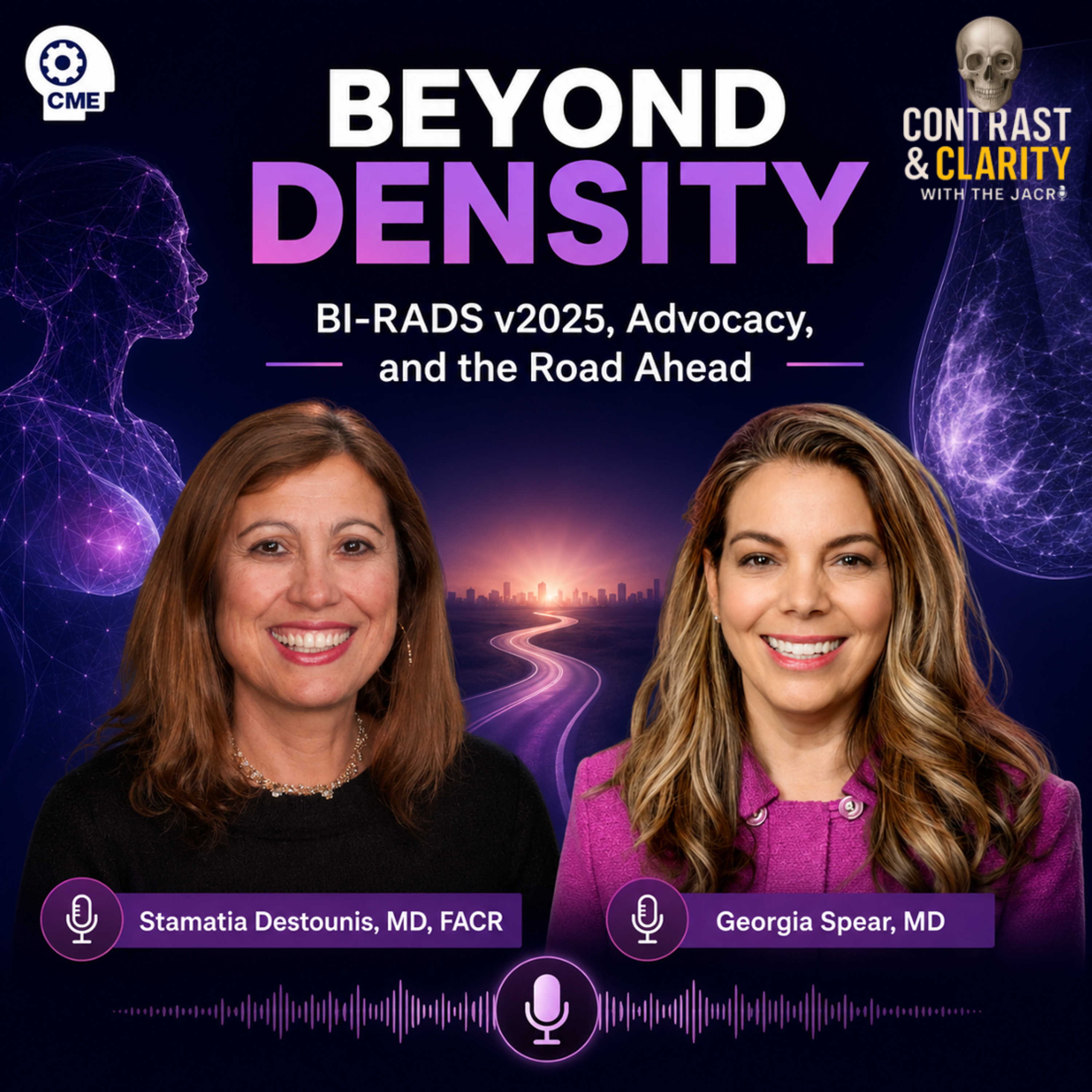
48. Beyond Density: BI-RADS v2025, Advocacy, and the Road Ahead *CME*
4w ago00:50:56Tap to summarizeBI-RADS isn't just getting an update -it's setting up a new foundation for the future of breast imaging. The first major BI-RADS update in more than a decade has arrived - and it's much more than a terminology refresh. BI-RADS v2025 reflects how breast imaging has evolved, bringing greater consistency across modalities while supporting a future for more personalized breast cancer screening and care.In this episode, Maddi and Fatima Elahi, DO sit down with Stamatia Destounis, MD, FACR, Chair of the ACR Commission on Breast Imaging, and Georgia Spear, MD, Chair of Government Relations for the ACR Breast Commission, to unpack the biggest changes in BI-RADS v2025, the spirited debates behind the new lexicon, and what these updates mean for radiologists in everyday practice. But the conversation goes far beyond reporting terminology, exploring the shift toward personalized, risk-based screening, the growing role of breast density, and why advocacy efforts like the Find It Early Act may shape the future of breast cancer detection just as much as the imaging itself. Link for claiming CME: (further instructions below) https://cmetracker.net/EVMS/Publisher?page=pubOpen#/getCertificate/31901Accreditation InformationContributorsMadison Wulfeck, MD, MBA, CIIPFatima Elahi, DOGeorgia Spear, MDStamatia Destounis, MD, FACR, FSBI, FAIUMReviewersMadison Wulfeck, MD, MBAFatima Elahi, DORelease DateJuly 2026Expiration DateJuly 2029Disclosure StatementThe planners and contributors have no financial relationships with ineligible companies to disclose.Accreditation StatementThis activity has been planned and implemented in accordance with the accreditation requirements and policies of the Accreditation Council for Continuing Medical Education (ACCME) through the joint providership of Macon and Joan Brock Virginia Health Science at Old Dominion University and Contrast & Clarity Podcast. Macon and Joan Brock Virginia Health Sciences at Old Dominion University is accredited by the ACCME to provide continuing medical education for physicians.Credit DesignationMacon and Joan Brock Virginia Health Sciences at Old Dominion University designates this enduring material activity for a maximum of 1.0 AMA PRA Category 1 CreditsTM. Physicians should claim only the credit commensurate with the extent of their participation in the activity.If you have any questions regarding CME, please email CME@ODU.edu or call 757-446-6140. Instructions for claiming CME: 1. Click on the link above and then "Sign in to Generate Certificate."2. To create an account, an email address and password will need to be entered into the respective fields before the system will allow you to proceed. 3. After creating an account and signing in, the "Activity Code" will be prepopulated for you, so just click on the red "Submit" button. 4. A brief survey will pop up for you to complete. Once you have completed the survey, enter the credits you are seeking and click "Submit." Do not hit the back button on your computer. 5. Your certificate will pop up and then you can select the print certificate button. 6. For assistance with any of these steps, please contact the CME office via email cme@odu.edu with screenshots of the specific problem you are facing for the quickest assistance or you may also call the CME office at (757)446-6140.
Transcribe →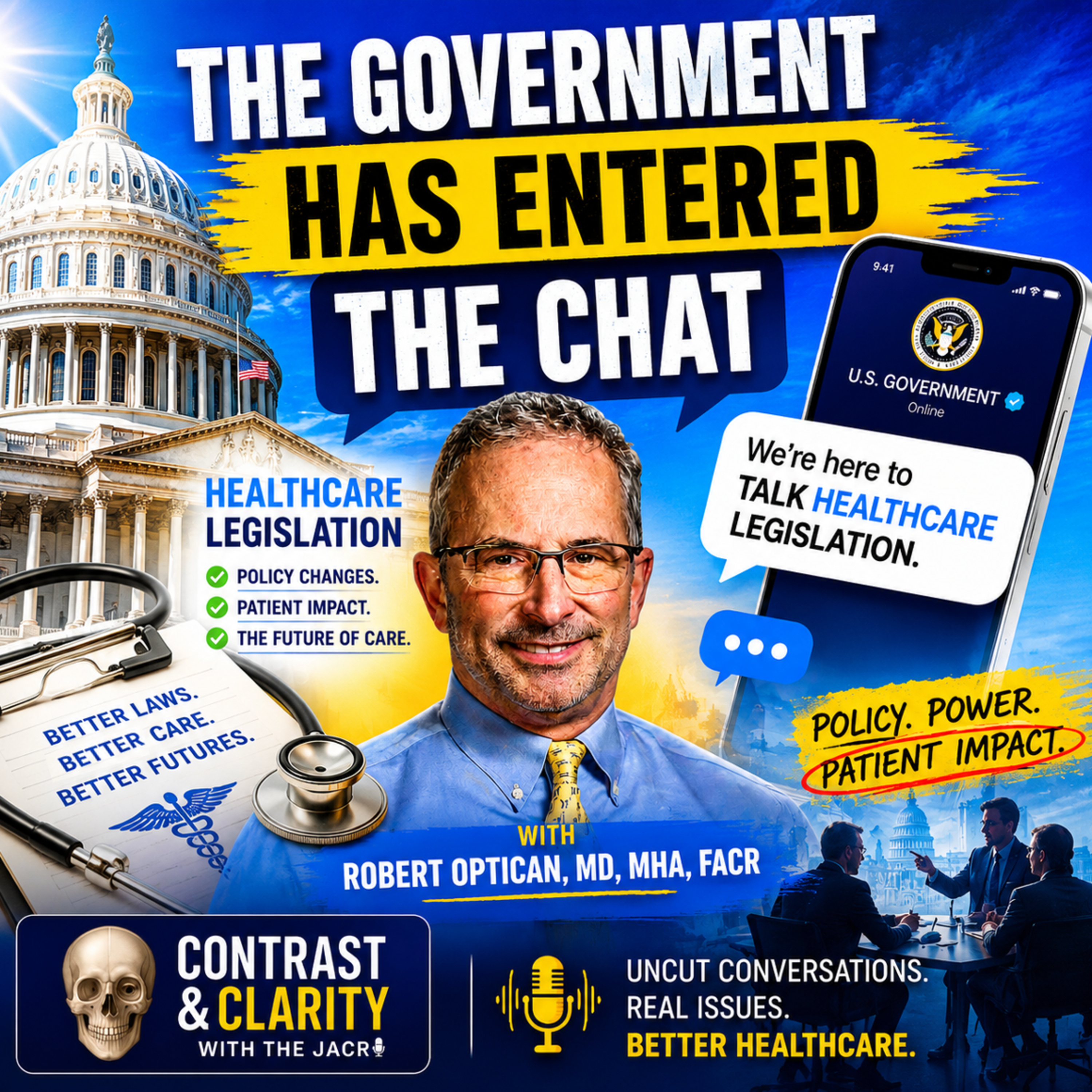
47. The Government Has Entered the Chat *CME*
Jun 2800:44:23Tap to summarizeHealthcare policy doesn't have to be boring - and it definitely isn't when it shapes the future of radiology.In this episode, Maddi and Jeff are joined by Robert Optican, MD, FACR to break down the six legislative and regulatory issues every radiologist should know, from AI reimbursement and Medicare payment reform to the ROOT Act, the No Surprises Act, and the growing wave of AI regulation. Discover how today's policy decisions will influence tomorrow's workflow, compensation, and patient care - and why radiologists can't afford to sit this conversation out. Link for claiming CME: (further instructions below) https://cmetracker.net/EVMS/Publisher?page=pubOpen#/getCertificate/31900RLI Summit information: https://www.acr.org/Education-and-CME/Radiology-Leadership-Institute/Leadership-SummitDr. Dana Smetherman's prepared remarks during a House Energy and Commerce Subcommittee meeting on May 20, 2026: https://edge.sitecorecloud.io/americancoldf5f-acrorgf92a-productioncb02-3650/media/ACR/Files/Medicare-Medicaid/Coverage/MACRA-PFS-Reform-Testimony.pdfAccreditation InformationContributors & ReviewersRobert Optican, MD, MHA, FACRMadison Wulfeck, MD, MBAJeffrey Waltz, MDRelease DateJune 2026Expiration DateJune 2029Disclosure StatementThe planners and contributors have no financial relationships with ineligible companies to disclose.Accreditation StatementThis activity has been planned and implemented in accordance with the accreditation requirements and policies of the Accreditation Council for Continuing Medical Education (ACCME) through the joint providership of Macon and Joan Brock Virginia Health Science at Old Dominion University and Contrast & Clarity Podcast. Macon and Joan Brock Virginia Health Sciences at Old Dominion University is accredited by the ACCME to provide continuing medical education for physicians.Credit DesignationMacon and Joan Brock Virginia Health Sciences at Old Dominion University designates this enduring material activity for a maximum of 1.0 AMA PRA Category 1 CreditsTM. Physicians should claim only the credit commensurate with the extent of their participation in the activity.If you have any questions regarding CME, please email CME@ODU.edu or call 757-446-6140. Instructions for claiming CME: 1. Click on the link above and then "Sign in to Generate Certificate."2. To create an account, an email address and password will need to be entered into the respective fields before the system will allow you to proceed. 3. After creating an account and signing in, the "Activity Code" will be prepopulated for you, so just click on the red "Submit" button. 4. A brief survey will pop up for you to complete. Once you have completed the survey, enter the credits you are seeking and click "Submit." Do not hit the back button on your computer. 5. Your certificate will pop up and then you can select the print certificate button. 6. For assistance with any of these steps, please contact the CME office via email cme@odu.edu with screenshots of the specific problem you are facing for the quickest assistance or you may also call the CME office at (757)446-6140.
Transcribe →
46. TLDR June 2026 Issue
Jun 2100:53:06Tap to summarizeJune TLDR: What actually matters this month?Welcome back to TLDR (Too Long Didn't Read) - the monthly series from Contrast & Clarity where we break down the entire monthly JACR issue into the insights that actually matter. This month's episode includes: AI that helps (and where it falls short) in lung and breast cancer screeningPatient preference of lay-friendly report summariesVenture capital in radiologyWorkforce and turnover trendsMuch more!This month's JACR is packed with insights that go far beyond the reading room. Take a listen to separate the signal from the noise, highlight the studies most likely to impact your practice, and explore what these findings mean for patients, radiologists, and the future of healthcare. Find the entire June JACR issue here: https://www.jacr.org/issue/S1546-1440(26)X2004-X
Transcribe →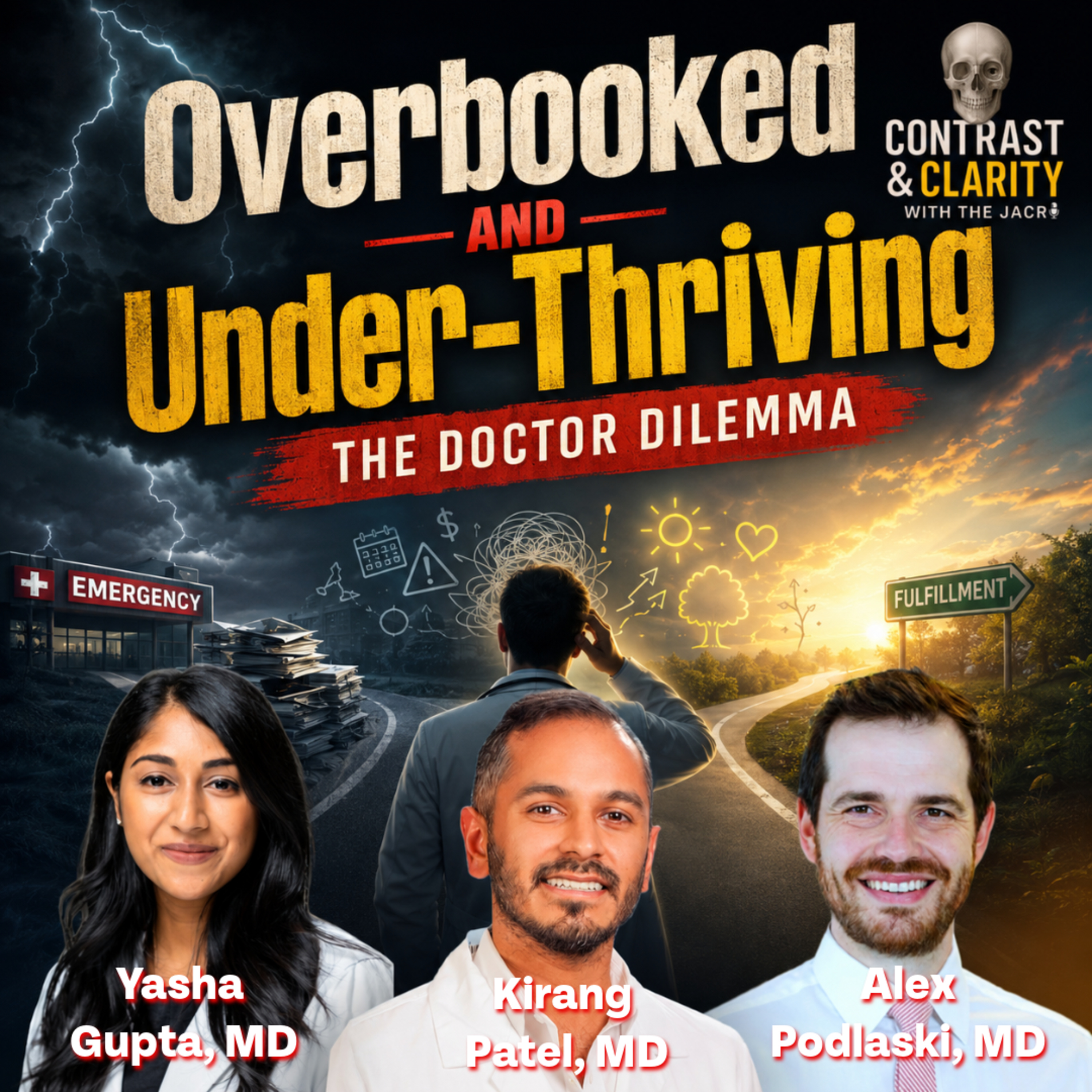
45. Overbooked and Under-Thriving
Jun 1400:41:19Tap to summarizeWhat if one of the most valuable skills in medicine is being able to say the simple two-letter word: no? For many radiologists, saying no can feel harder than taking overnight call, joining another committee, or agreeing to "just one more project." Somewhere along the way, medicine has turned being busy into a badge of honor - and many of us have become experts at overcommitting ourselves. In this episode, Maddi and Jeff discuss the JACR article "Dr. No: The Art of Saying No and Feeling Good About it" with the authors Alex Podlaski MD, Kirang Patel MD, and Yasha Gupta MD. Together, they explore why early-career physicians are especially vulnerable to "yes syndrome," the hidden tradeoffs of chronic overcommitment, and how strategic decision-making may be one of the most important leadership skills in medicine. Whether you're juggling committees, research projects, leadership roles, or simply trying to protect time for your family and yourself, this conversation offers practical insight on building a career that reflects your priorities - not everyone else's. Find the full JACR article here: https://www.jacr.org/article/S1546-1440(26)00038-4/abstract
Transcribe →
44. TLDR May 2026 Issue (Better Late Than Never)
Jun 700:29:28Tap to summarizeIt can be difficult to find the time to read an entire JACR issue cover to cover!Welcome back to TLDR (Too Long Didn't Read) - the monthly series from Contrast & Clarity where we break down the entire monthly JACR issue into the insights that actually matter. In this month's TLDR episode, Maddi and Jeff tackle questions like:Are we overreacting to pediatric CT use?Should radiologists be meeting patients over video?Are we recommending too many follow-up chest CTs based on incidental findings?What does successful AI deployment actually look like?And can medicine survive if physicians occasionally decline another committee assignment? This is your shortcut to the most important takeaways from the May issue of the JACR. Find the entire May JACR issue here: https://www.jacr.org/issue/S1546-1440(26)X2003-8
Transcribe →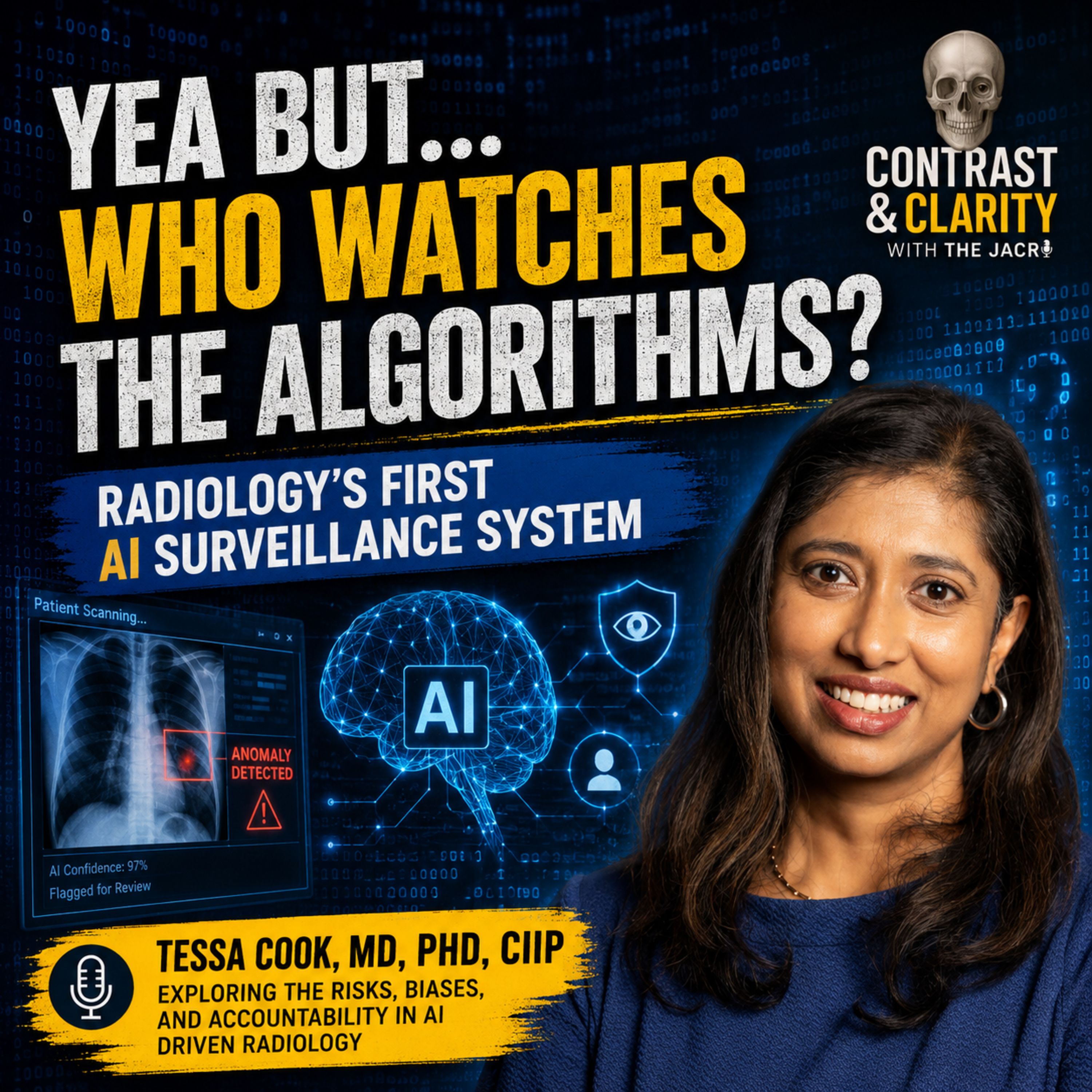
43. Yea But...Who Watches the Algorithms?
May 3100:34:33Tap to summarizeFor years, the AI conversation in radiology has focused on one question: Will AI replace radiologists? But what if we've been asking the wrong question this whole time?In this episode of Contrast & Clarity with the JACR, Maddi and Jeff sit down with Tessa Cook, MD, PhD to explore one of the biggest unsolved challenges in healthcare AI:Who watches the algorithms after they are deployed? AI models don't behave like CT scanners or medications. They can drift, degrade, and encounter new populations, protocols, and real-world conditions long after FDA clearance. That's where Assess-AI, the ACR Data Science Institute's fist national AI monitoring initiative, comes in. Using large language models to extract findings from radiology reports, Assess-AI creates a scalable way to compare AI predictions against what radiologists actually report. In other words: Radiologists read the scans. AI reads the scans. And now AI is reading the radiologists. Join us as we discuss AI governance, post-deployment monitoring, model drift, and why radiology may be uniquely positioned to become healthcare's AI control tower. Because building AI is one thing. Building systems we can trust is another. Find the full JACR article here: https://www.jacr.org/article/S1546-1440(26)00231-0/fulltextLink to the 2026 SIIM-ACR Data Science Summit: https://www.acr.org/Data-Science-and-Informatics/SIIM-DSI-Summit
Transcribe →
42. Artifacts of the Mind Part 4: Emotional Intelligence as the Antidote
May 1801:14:51Tap to summarizeMedicine has a fascinating business model: Take a group of high-achieving perfectionists, lock them in a dark reading room, make every decision high stakes, and then act surprised when everyone develops imposter syndrome. So for the final installment of Artifacts of the Mind series, Maddi and Jeff decided it was time to stop simply identifying the problem...and finally ask the question every healthcare worker is secretly thinking: "How do we make our brains calm down for like...five minutes?"To help answer that, they called in an expert. Joined by emotional intelligence specialist, educator, and bestselling author Dr. Jeffrey Frey, this episode gets down and dirty with the actual mechanics behind imposter syndrome: the thinking traps, the perfectionism, the hypervigilance, the "if I miss one finding my career is over" spiral, and why high performers are often the absolute worst at extending grace to themselves. But this episode isn't just existential group therapy for exhausted healthcare workers. It's practical. Dr. Frey breaks down emotional intelligence in a way that actually makes sense for medicine and offers concrete strategies to regulate anxiety, build resilience, reframe failure, and stop letting fear masquerade as professionalism. Because maybe the goal was never to eliminate self-doubt entirely. Maybe the goal is learning how to open the next case without your nervous system acting like it's being hunted for sport. The Artifacts of the Mind finale is here - and for once, the differential diagnosis is your own internal monologue. Find Dr. Frey's book on Amazon: https://shorturl.at/hQ26G
Transcribe →
41. Artifacts of the Mind Part 3: The F-Word
May 300:41:00Tap to summarizeWhat's the one word that medicine avoids at all costs?Failure. In Part 3 of the Artifacts of the Mind series, we stop whispering about imposter syndrome...and start confronting the culture that fuels it: perfectionism. This episode widens the lens. Maddi and Jeff talk with David Fessell, MD and Frank J. Lexa, MD MBA about perfection culture and how the illusion of infallibility doesn't protect us - it holds us back. Because in medicine, perfection culture amplifies self-doubt...while mistakes, near misses, and discomfort are the reps that actually build expertise. You don't want a fair-weather pilot when the plane hits turbulence. You want the one who's been through it - and knows how to respond. So don't fear the F-word. Use it. Find the JACR articles here: https://shorturl.at/tU3mX
Transcribe →