
Podcast
Contrast and Clarity with the JACR
Hosted by Maddi Wulfeck · EN
Welcome to "Contrast & Clarity with the JACR," where we dive into the latest trends in the world of radiology. Join hosts Maddi Wulfeck and Jeff Waltz as they discuss current radiology topics and innovations that are shaping the future of healthcare. Topics will span the hottest trends in radiology such as artificial intelligence, expert perspectives, and what the future holds for the field.
Whether you're a seasoned radiologist, resident, medical student, or simply curious about the field, this podcast sets the stage for an exciting journey into the world of medical imaging.
25episodes
Episodes
Newest firstAll episodes
40. TLDR April 2026 Issue: The Carbon Cost of Imaging
Apr 2600:38:35Tap to summarizeIt can difficult to find the time to read an entire JACR issue cover to cover!Welcome to TLDR (Too Long Didn't Read) - a new monthly series from Contrast & Clarity where we break down the entire monthly JACR issue into the insights that actually matter. This month: Sustainability in Radiology.Because here's the reality - imaging isn't exactly carbon-neutral. Between energy-hungry scanners, contrast waste, and high-throughput workflows, radiology has a footprint...and it's bigger than most of us realize. In this episode, we cut through the academic clutter and get to the good stuff:Guest editor Florence Doo, MD MA gives us special insight into the issueWhere radiology is unexpectedly contributing to healthcare emissionsThe tension between quality, cost, and sustainabilityPractical insight that doesn't tank workflowsAnd what all this means for the future of imagingNo fluff. Just the contrast that highlights the problem - and the clarity on what to do next. Think of this as your unfair advantage walking into your next board meeting, lecture, or Twitter debate. Find the entire JACR April Focus Issue here: https://www.jacr.org/issue/S1546-1440(26)X2002-6
Transcribe →
39. Artifacts of the Mind Part 2: Imposter Syndrome - Bug or Feature? *CME*
Apr 1900:40:06Tap to summarizeIn part 2 of Artifacts of the Mind, we flip the script: what if imposter syndrome isn't a flaw...but a signal for growth? Maddi and Jeff are joined by Hanna Zafar, MD MHS to explore the idea of "failing up" - rethinking failure not as something to hide, but something to use. Because while residency makes learning loud, post-training culture often makes it silent - and that's exactly where doubt thrives. We get into why failure is not just inevitable, but essential for progress - and how embracing it can reshape both mindset and culture. This isn't about "coping" with imposter syndrome. It's about redefining it and owning it. So don't avoid failure - use it. Claim your CME here: https://shorturl.at/afPquFind the JACR articles here: https://shorturl.at/tU3mX
Transcribe →
38. Artifacts of the Mind Part 1: Paging Dr. Imposter *CME*
Apr 500:35:52Tap to summarizeRadiology has a dirty little secret.The people who look the most confident...often feel like they're faking it. In this episode, Maddi and Jeff talk with Sherry Wang, MBBS about one of the most pervasive - and least talked about - realities in radiology: imposter syndrome. Why does it hit hardest when you're succeeding?Why does guilt follow you from the reading room...straight home?And why do so many high-achieving radiologists feel like they're one mistake away from being "found out"? This episode is raw, honest, and uncomfortably relatable - in the best way. Because the truth is: imposter syndrome isn't a personal failure...it's a shared experience. And once you see it clearly, you can start to take your power back. Find the JACR article here: https://shorturl.at/MPCqiClaim your CME here: https://shorturl.at/XfRIi
Transcribe →
37. Modern Medicine is Image-Driven. Why isn’t medical education?
Mar 2200:42:45Tap to summarizeRadiology runs medicine.So why are we teaching it like a side quest? In this episode of Contrast & Clarity, Maddi and Jeff talk with Scott Simpson, DO, MSEd and Daniel DePietro, MD about the uncomfortable truth: we’re graduating physicians who rely on imaging every day…but were barely taught how to use it.We get into:Why radiology education shows up too late (and too inconsistently)The hidden cost of not teaching imaging earlyAnd why fixing this isn't about adding content - it's about redesigning the systemBecause imaging isn’t a consult anymore.It’s the operating system. Find the full JACR article here: https://shorturl.at/z9W1A
Transcribe →
36. Flip it, Click it, and Send it: How we Should be Teaching Residents in 2026
Mar 800:51:39Tap to summarizeAre we training radiology residents for yesterday’s world?Because the traditional model of workstation teaching + didactic conferences? It may not be sustainable anymore.In this week's episode, Maddi and Jeff sit down with the authors of “Alternative Approaches to Resident Education” to unpack what the future of radiology training could — and maybe should — look like:· Social media as a legitimate educational tool· AI-powered feedback platforms and “precision education”· Peer learning models reshaping safety culture· Flipped classrooms and spaced-repetition learningBut this isn’t just about shiny new tools. It’s about economics. Opportunity cost. Faculty time. Educational ROI. And is there a smarter, more sustainable way to train the next generation? If we want better-trained radiologists in a high-volume, AI-augmented future...we may need to rethink how we teach – and what we are willing to invest. Because the real question isn’t whether education needs to evolve. It’s whether we’re willing to redesign it.Find the full JACR article here: https://shorturl.at/0ASDg
Transcribe →
35. Radiology Workload is Up 90% Please Send Snacks *CME*
Feb 2200:21:57Tap to summarizeImaging volumes are "down."Radiologist workload is "up."Length is stay is longer.Wait. What?In this episode of Contrast & Clarity with the JACR, Maddi and Jeff sat down with Tina Shiang, MD to unpack her recent analysis of inpatient imaging utilization and radiology workload over the past decade. Here is the twist: when imaging is adjusted for disease severity, overall inpatient imaging utilization actually decreased. But CT and MRI utilization rose sharply - and the professional workload tied to those studies skyrocketed. Translation? There may be fewer studies per patient overall - but we are reading far more complex studies. If you care about imaging value, radiologist well-being, operational strategy, or the future of hospital-based radiology - this conversation and the underlying data are essential. Because the real question isn't just how much imaging we are doing, it's what kind of imaging we are doing - and who is carrying the weight. Find the full JACR article here: https://www.jacr.org/article/S1546-1440(25)00278-9/abstractClaim your CME credit here: https://shorturl.at/m2OyY
Transcribe →
34. AI Roadblocks Part 3: The Way Forward
Feb 700:59:54Tap to summarizeThat “black box” AI algorithm your practice just bought might look sleek on a demo screen—but when something goes wrong, it won’t be the software company signing the report. It’ll be you. In this episode of Contrast & Clarity, Maddi and Jeff interview Ken Davis, Senior Counsel in Healthcare at Katten Law Firm, for a no-fluff conversation about the intersection of radiology, contract law, and the use of artificial intelligence. Together, we dive into the legal realities of AI implementation – and the due diligence that radiologists can’t afford to ignore. We explore questions like:· What kind of due diligence should practices perform before deploying AI?· How do clinical vs. nonclinical AI tools differ from a liability standpoint?· Why is it important to try to see beyond the black box nature of an algorithm?· What should new radiologists know about the AI their group uses? If your practice is using AI – or considering it – this episode is your legal reality check. Find the prior relevant JACR articles here:https://www.jacr.org/article/S1546-1440(25)00444-2/abstracthttps://www.jacr.org/article/S1546-1440(25)00438-7/abstractFind Ken Davis’ article “Top Ten Legal Considerations forUse and/or Development of Artificial Intelligence in Healthcare”: https://shorturl.at/0CrE5Find the additional article mentioned on patients’ views on the use of AI in healthcare: https://shorturl.at/iJ7ia
Transcribe →
33. AI Roadblocks Part 2: Legal Lag
Jan 2500:38:09Tap to summarizeWhat happens when AI gets it wrong – and who’s actually on the hook? In this episode of Contrast & Clarity with the JACR, we sit down with Tanya E. Karwaki, JD, PhD, author of the JACR opinion piece “Balancing Artificial Intelligence Risks and Benefits in an Evolving Legal Environment,” to unpack one of the most uncomfortable – but unavoidable topics in radiology AI: legal risk. AI adoption in radiology is accelerating, with more than a thousand FDA-approved tools already in circulation. But the legal framework governing their use? Still very much under construction. Dr. Karwaki walks us through why increasing lawsuits may be inevitable, how malpractice standards evolve alongside new technologies, and what radiologists should understand about liability when AI recommendations are followed—or ignored.From informed consent and data privacy to emerging state-level legislation and disclosure requirements, this conversation provides critical context for anyone navigating AI implementation in clinical practice today.If you’re using AI, thinking about using AI, or wondering where the legal guardrails actually are—this is an episode you don’t want to miss.Find the JACR article here: https://www.jacr.org/article/S1546-1440(25)00438-7/abstract
Transcribe →
32. AI Roadblocks Part 1: The Infrastructure Problem *CME*
Jan 1100:42:18Tap to summarizeArtificial intelligence isn’t failing radiology. Our healthcareinfrastructure just isn’t ready for it. In this episode of Contrast & Clarity with the JACR, we cut through the hype to tackle the real reason artificial intelligence hasn’t transformed radiology yet—and it’s not because the algorithms aren’t good enough.Joined by Michael Bruno, MD, MS and drawing from insightshighlighted at the 2024 Intersociety Summer Conference, Maddi and Jeff unpack the systemic barriers holding AI back: legacy IT systems, fragmented data pipelines, regulatory uncertainty, and workflows that force humans and AI to coexist rather than collaborate. We discuss:• Why AI keeps getting treated as a “bolt-on” instead of afoundational tool• The mismatch between AI’s potential and real-world clinicalworkflows• Why ROI, governance, and trust—not accuracy—are stalling adoption• What actually needs to change for AI to move from demo todeployment This isn’t a conversation about shiny tools or futuristic promises.It’s about systems, incentives, and the uncomfortable reality that AI won’t fix radiology until we fix the environment it’s deployed into.If you’ve ever wondered why AI feels simultaneously inevitable and underwhelming—this episode is for you.Find the JACR article here: https://www.jacr.org/article/S1546-1440(25)00444-2/abstractClaim your CME credit here: https://shorturl.at/u6Hcj
Transcribe →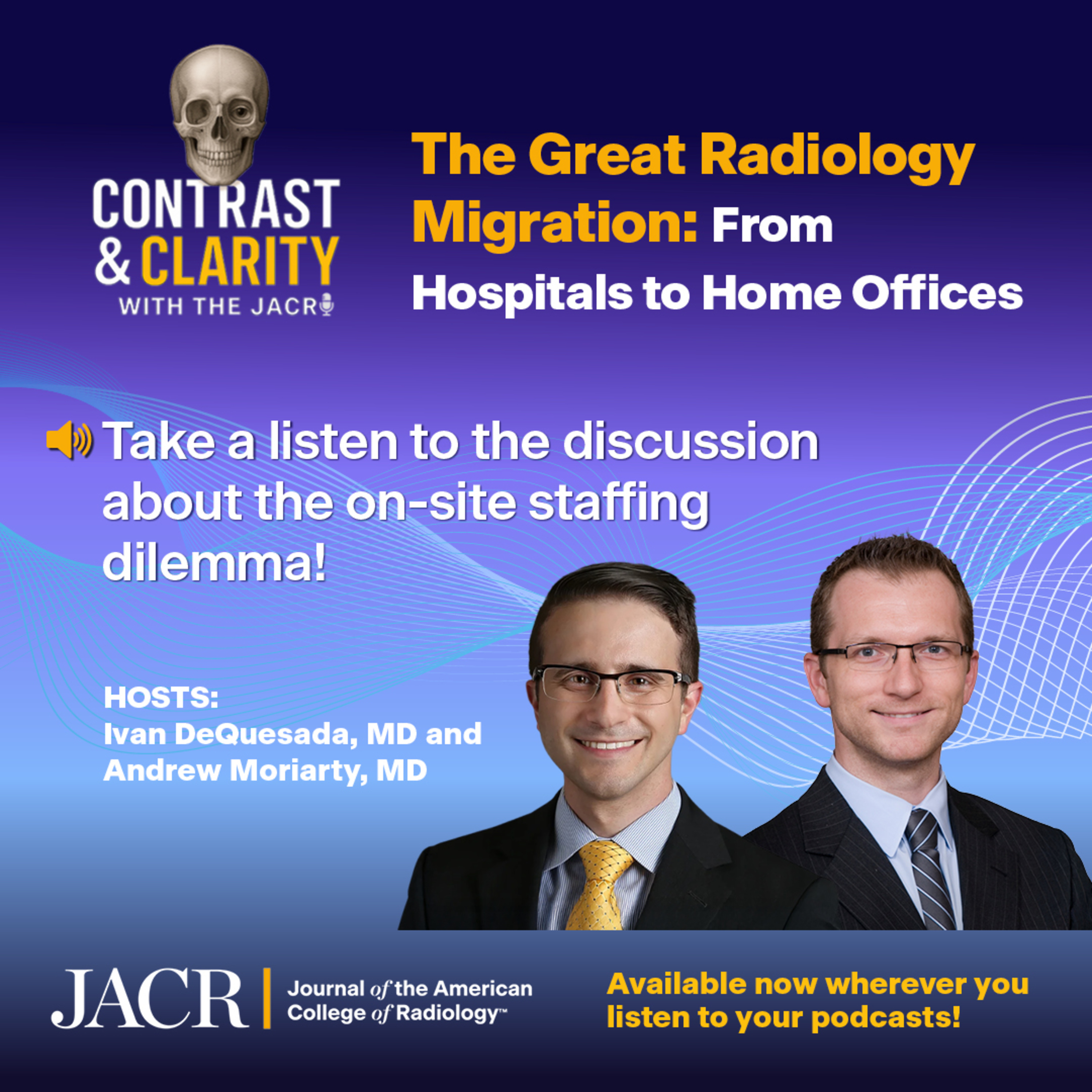
31. The Great Radiology Migration: From Hospitals to Home Offices
Nov 3000:54:34Tap to summarizeWhat happens when the dream of remote radiology becomes a nightmare for practice culture? Tune in as Maddi and Jeff are joined by Ivan DeQuesada, MD and Andrew Moriarty, MD to discuss onsite staffing concerns and the tensions between productivity, patient care, and the modern radiologist's desire for flexibility. From empathetic accountability to equitable hybrid scheduling and strategic work-from-home incentives, this discussion reveals why balancing autonomy and presence is crucial for private practice radiology. Find the JACR article here: https://shorturl.at/0J0gI
Transcribe →