← Culture Apothecary with Alex Clark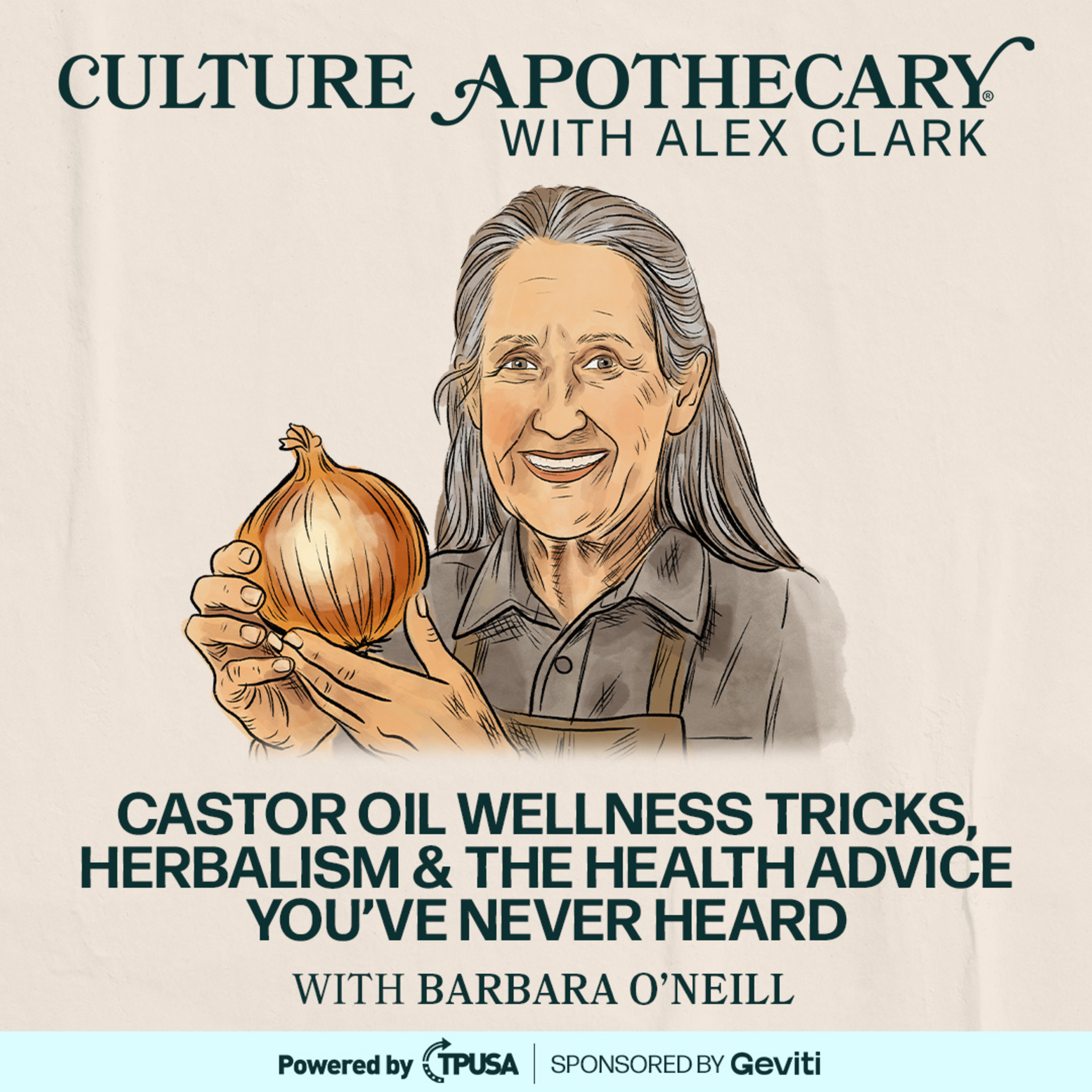
Culture Apothecary with Alex Clark
Castor Oil Wellness Tricks, Herbalism & The Health Advice You’ve Never Heard | Barbara O’Neill
01:09:15
Loading summary
Transcript233 lines
- [00:00]
A
We should be using castor oil over C section scars.
- [00:03]
B
Yes, very good for that. Castor oil penetrates deeper than any other oil and it can break up lumps, bumps, congestion. It breaks up scar tissue. And I've met ladies who've been able to break up cataracts with castor oil. There is a time to drink water. There's a time not to drink water. Well, when would there be a time not to drink water? When you've just eaten your meal. You need a nice acid stomach to break down your protein. But if you drink a big glass of water with your meal, you're diluting your gastric juices, so you're not going to be able to break down or digest your protein properly. Marriage is hard. Divorce is hard. Saving every cent is hard. Being in debt is hard. Exercising every day is hard. Being obese is hard. Life is hard. But thank God we can choose our heart.
- [01:13]
A
She says your body was designed to heal itself and she's been proving it for over 50 years. Today on Culture Apothecary, I'm sitting down with legendary herbalist Barbara o', Neill, Australian health educator, natural therapy expert, global speaker and author of Self heal by design, who has spent five decades teaching people how to take their health back using food, herbs, lifestyle, and what she believes is God's original blueprint for the body. We talk about the ear infection that changed the trajectory of her life, her Christian testimony, and why she believes physical health and spiritual health are inseparable. And then we go there. Can herbs actually reverse chronic disease? What herbs should you put in your kitchen and have at all times when. What does she say about cancer? Why does she think some women should reconsider routine pap smears? Her take on colonoscopies, ultrasounds in pregnancy, modern bread, essential oils, and why six hours of sleep is actually incredibly dangerous. Watch this episode on the real Alex Clark YouTube channel or culture Apothecary on Spotify. I know that Barbara o' Neill has been a highly requested guest. You guys have wanted her on for years, so have I. Please leave us a five star review if you love her. Please welcome herbalist, author and speaker Barbara o' Neill to Culture Apothecary. You got into natural medicine when your first child was having recurrent ear infections, right? Can you talk about that and how that led to getting into herbalism?
- [02:33]
B
Well, I. I grew up with, if you get sick, you go to the doctor. We never doubted it, we never thought of it. And, and even my mum, she had rheumatoid arthritis. She was in A wheelchair. And, you know, over six years, she went from, as I am now, to just a cripple in a wheelchair. But you know what? We thought they did the best they could. Still not doubting it. So after four courses of antibiotics and the earache comes back, I just thought, nah, nah, I don't want this. And I'm so glad that I had that feeling, actually. The feeling of not wanting to give my child any more drugs, not wanting to hurt my child, but not knowing what else to do. And that really is what triggered me on a journey, a journey of discovery that there is something else.
- [03:23]
A
How did you figure out how to treat your child's ear infection?
- [03:26]
B
When I said to the doctor, is my daughter gonna be on this for the rest of her life? He was challenged. And he sent me to an ear, nose, and throat specialist who looked in her mouth, looked in her ears, and said, she's teething. Give her these drops to keep these Eustachian tubes clear. That was it. So when my next child got an earache, I didn't go to the doctor. I didn't tell anyone. Cause you get pressure. But I went to the old lady next door. So I'm 25, she's 85. I said, what did your mother do when you had an earache? Cause I thought, this is before antibiotics. She said, mum would steam up an onion on the stove, steamed up the onion, put it on his ear, you know, wrapped in a cloth. He slept for two hours. That was it.
- [04:08]
A
Isn't that fascinating?
- [04:09]
B
No more.
- [04:10]
A
This woman, this older woman, had no idea that her giving you this advice would spearhead you for decades and decades, teaching millions of women around the world about herbalism.
- [04:23]
B
That's right. That's right. Because she'd be long gone now. That was over 40 years ago.
- [04:29]
A
And so that really spawned this entire interest to you, kind of getting into natural and holistic medicine. What I think is also interesting is that you also became a Christian in. In the midst of all of this. So can you kind of share your testimony?
- [04:42]
B
Well, what was interesting, it was probably not long. I got herb books. I read about herbs. You know, any old person, I would ask them. And some didn't know, but some did know. And I started to read the Bible. And I came face to face with, there is a God in heaven. And I read about him through the. Through the life of Jesus Christ. And I surrendered my heart to him. And then I thought, okay, now how does God view medicine? How does God view sickness? And I was pleasantly surprised to find that in The Bible, there are lots of verses that are talking about the body. Look after your body. Herbs for the service of man. And I also began to look at the history of the Seventh Day Adventist Church where they have Dr. Kellogg, you know, Dr. Kellogg had this health retreat in Battle Creek Sanitarium with a thousand beds and people from all over the world. It was a very famous health. So I started to look at history, history in America, history in Europe, the American Red Indians. And I found that in just about every culture, you'll find there was natural medicine.
- [05:56]
A
How does physical health support spiritual health?
- [05:59]
B
Well, the same blood that goes through the whole body goes to the brain, and the same nervous system is also connected. And it is estimated that some of our nerve cells are almost a meter long. So starting here and going long down, and then you've got your vagus nerve called the wanderer, that has its roots in the brain through the neck and down into our gut and through there. It's all connected. And when I was. I was probably 19, 20, 21, 22, about those ages, I worked as a psychiatric nurse. And I didn't see people get better. I saw the same people come back, more drugs. And I remember thinking, well, this isn't working. But I put that on hold until probably about maybe 20 years later, where I attended a lecture by Dr. Neil Nedley. He was an American doctor who was a gp, and he was noticing that a lot of his patients were on antidepressants. And this really surprised him. So he implemented lifestyle changes. So dietary changes, exercise, drinking more water, gained a bit earlier. And he said if he could get equal to what medication does, he'd be happy. He said, far exceeded. Now, when I heard him say, far exceeded, I'm on the edge of my seat. I thought, well, I've learned that you give the body the right conditions, it works well, and there are simple natural treatments. But what about the mind? So that took me on another journey in another direction, looking at the effect of what happens in our body on our mind.
- [07:40]
A
Are there herbs that work better than pharmaceuticals?
- [07:42]
B
There's something that works far better than any pharmaceutical. It's called the body, the human body. My sister's a senior science teacher, and when she teaches her students about immunology, she says to them, see, the body can heal itself. And I don't think they get many teachers saying that she's a Christian too, that we've got an incredible immune system. It's like when I got Covid, a double vax man brought it in and gave it to half Our guests and half our staff. And I realized I had it. I had high fevers. And people said, what'd you do? I said, nothing. I did nothing. Cause I live in a body that can do it. And when I got the high fever, how did I know I was hot? Do I take my temperature? No, I never take my temperature. There's no need. I'm hot. But I just slept a lot. You know, when you sleep, you put your body on nature's operating table. I drank a lot of water. Cause water puts the fire out. And I also knew that this high fever would burn out any harmful pathogens. I knew this high fever would stimulate my bone marrow to make more red and white blood cells. So I slept a lot. I drank a lot. I hardly ate anything. I let my body do it.
- [08:56]
A
So you do believe that herbs can help reverse chronic disease?
- [09:00]
B
I believe that when the body's given the right conditions, it can. And herbs can come in to give an added boost. In Psalm 104:14, the Bible says, God gave her for the service of man. I love that verse. They come. They're just. They're just. They're there to serve you. They say, when they come into your body, where would you like me? What would you like me to do? That's the service. Whereas drugs, they're like robots. They just say, get out of my way. I got a job to do, whether you need it or not.
- [09:31]
A
What's your view on herbs for cancer?
- [09:33]
B
We found them very, very effective. But number one is giving the body the right conditions. And we found, not in every single case, but in many cases, there's a L between cancer and fungus. When you realize. And Professor Otto Warburg, he discovered this in 1946, got a Nobel prize for it. That cancer cells consume 15 times the glucose of any other cell. And cancer cells thrive where there's no oxygen. And cancer cells also thrive in an acid environment. So that's what we aim to do. We aim to alkalize the body by more water, alkaline foods. We aim to oxygenate the people to breathe through their nose, not their mouth, exercise, even hyperbaric chambers. And also getting the glucose levels right down. And at the same time, there are herbs that can come in to certainly help.
- [10:28]
A
What are some of the most common things you've seen people be able to use herbs to replace medication for?
- [10:35]
B
It's like with, let's say, depression. I find that the person must be well hydrated. The brain can't. Can't think properly unless you're getting enough water. And one of the problems with medication is it dehydrates you.
- [10:50]
A
Yeah.
- [10:50]
B
So get in this vicious cycle. There are herbs that act as mild tranquilizers like skullcap passionflower. There's also St. John's Wort, which is also a mild tranquilizer. So they can come in and help.
- [11:08]
A
What common household plants are secretly medicinal that could actually save someone's life?
- [11:14]
B
Okay, well, a really, really good one is aloe vera. I think every home should have an aloe vera plant. And if there's a burn, you split that leaf, open it up, and just place that gel straight on. Because one of the problems with burns is the person dehydrates very, very quickly and the air getting to that burn is very painful. So covering it. Cover is very important. And in the aloe vera, God put a growth stimulant, and so it stimulates rapid healing in the cells. I've even seen people with third degree burns down to the tissue. That medicine would say, there needs to be a skin graft on that. I've seen it grow from just applying the aloe vera.
- [12:02]
A
Okay, so what other plants do you keep in your house to use?
- [12:05]
B
I always have cayenne pepper.
- [12:06]
A
Cayenne pepper?
- [12:07]
B
Yes. I thought I'd get a response when I said.
- [12:12]
A
Because when you say it with your accent, it sounds like cayenne pepper. So what do you like about cayenne pepper?
- [12:16]
B
Cayenne. What I love about cayenne pepper is it's a blood stimulant. And Leviticus 17:11, the Bible says the life of the flesh is in the blood. So what cayenne pepper does, it moves blood. And the reason why the blood is the life. It carries the oxygen, the nutrients, the water carries away waste. But it also contains our immune system, which is our white blood cell. So anything that moves blood is going to boost healing anywhere in the body. And cayenne pepper does that. It'll do it externally. For instance, peripheral neuropathy is when someone loses the feeling in their feet. And if you Google that, it'll say, no known cure. Well, there is. It's cayenne pepper compresses on the bottom of the feet by morning, pins and needles often come. How long should someone do it for? Well, try it every second night. If your feet get too hot, maybe stop for a while. Your feet are starting to feel well, there's probably no need to do it anymore. So this is one thing that I teach that's very difficult to get people to do, and that is listen, listen, Try this and see what Your body
- [13:24]
A
says, is getting into herbalism hard or complicated? Because there's a lot of young moms that are wanting to get into this or homeopathy, and they feel like it's might be overwhelming or difficult.
- [13:39]
B
What I say is just start where you're at. Get a herb book. There's some excellent herb books. And when there's a problem, go to your herb book. Go to your herb book. For instance, my son Peter had asthma, and I thought, what am I gonna give him? What herb can I find that will help his lungs? And I found plantain, and I love that because it's growing everywhere. It's like a weed. And I. I used to pick it, pour boiling water on it, put a squeeze of lemon in it and a bit of honey, and, oh, he would drink and drink and drink that. And he conquered his asthma by the age of two and a half. My father conquered it by the age of 50. My sister conquered it by the age of 40. And they had both been through drug medication, but we conquered Peter's at a very young age. And I think it was the plantain that made a big difference.
- [14:31]
A
How many kids do you have?
- [14:32]
B
Six. Well, I gave birth to six. Michael and I married 28 years ago. He had two, I had six. So we have eight.
- [14:39]
A
Wow. Okay. And how many grandkids?
- [14:40]
B
26 and a half.
- [14:41]
A
Are your kids raising your grandkids on all the natural remedies as well?
- [14:47]
B
They are. They are. It just surprises me. It's like my son William, he's 38. A Stanley knife. You know what a Stanley knife is? That really sharp knife that they cut things with in building. It actually somehow went into his calf.
- [15:04]
A
Oh, my gosh.
- [15:04]
B
He said, mom, I think it went about 2 inches. And there's bits of muscle. Muscle hanging out. Because he text me and said, mom,
- [15:13]
A
I've cut my leg just a little bit.
- [15:17]
B
So I said, send me a picture. And I could see little bits of muscle coming out. It was about an inch long. I said, oh, if there's bits of muscle coming out, you might need a few stitches. He said, no, I'm not going there. I haven't got time to sit in emergency. He said, I'm going to put super glue on it.
- [15:34]
A
Super glue.
- [15:35]
B
Okay.
- [15:35]
A
So how did everything turn out?
- [15:37]
B
Well, I don't think he could find some super glue. So he just taped it.
- [15:41]
A
And did it work?
- [15:42]
B
Yeah.
- [15:43]
A
So your kids are very much like, you know, unless it is an absolute life or death emergency, we are not going to the hospital.
- [15:50]
B
Yeah.
- [15:54]
A
I saw a leprechaun living in a van down by the river. True story. He lost his job after St. Patrick's Day. Seasonal employment, tough market. One minute you're the face of a global holiday, next minute you're updating LinkedIn. Experienced pot of gold managers seeking new opportunities. Now he's surviving on expired shamrock shakes and memories. His van is a bumper sticker that says Kiss me I was relevant. He's running a side hustle, selling authentic Irish crypto. It's just green monopoly money in a Ziploc bag. Well, that's most of you. Every March, instead of going to McDonald's and getting a sugar loaded, nasty green milkshake that's made with God knows what, you could make an adult decision that tastes just as good with crazy health benefits. Taylor Duke's Wellness Mint Chocolate Chip Protein Powder Taylor Dix Wellness Protein Powder is my number one daily ritual. I use it constantly, every day actually. It's made from 100 grass fed bone broth protein. No dairy, no added sugar, no artificial junk, just real organic food ingredients that actually nourish you. Each Scoop gives you 20 grams of collagen rich protein. It supports hair, skin, nails, joints, gut health and it tastes like dessert without the bad stuff. No bone broth flavor. It's just made from it. Just creamy mint chocolate chip deliciousness. Blend it with ice, almond milk, raw milk, extra cacao. It's basically the Shamrock shake. If it had standards, paid taxes and didn't ruin your afternoon, don't end up in a van down by the river. Go to Taylor Dukes Wellness.com use code Alex Clark for 10% off. That's Taylor Dukes Wellness.com code Alex Clark for 10 percent off. A friend told me recently her dad had normal labs until suddenly he didn't. And by the time they found out what was wrong, it was advanced. We call a lot of disease unexpected, but most of it builds quietly for years. That's why Jevy was created. The co founder lost his father to what he believes was a largely preventable disease and built a system focused on proactive health optimization. For $129 a month you get comprehensive blood work. Testing biomarkers twice a year, not 20 like most primary care panels, 90. Then you're going to meet virtually with a provider routinely who builds a total personalized care plan around your biomarkers and your goals. Custom supplements based on your blood work, hormone balancing therapies, peptides to support your energy metabolism, longevity if appropriate. If you want deeper answers, they've also got like every test under the sun that you could want dutch test, a GI map, gut microbiome test, nutrient panels and much, much more. MTHFR testing coming soon. In their marketpl just raised my progesterone by 4,000% in six months with help from Jevy. Everything is tracked inside the Jevy app. They've got your labs in there, your care team, your progress. It's not reactive medicine, it's strategic longevity. Use code alex to get 20% off your first purchase at govity.com don't wait for suddenly go to gody.com use code ALEX for 20% off your first purchase. What are the basics to getting started and learning besides getting an herb book? Are there different things that you think people should always have hand in their cabinets?
- [18:50]
B
In my book Sustain Me, it's a handbook on natural remedies. And I've got a section there on poultices. And poultices are made out of potato. If you've got tissue, inflammation, ingrown, toenail or splinter, ginger, you can make a ginger poultice for inflamed joints. See, these are things I think most people have in their houses. But I suggest people start with a poultice box. Get a box and put some fine cotton cloths in. There has to be natural fiber, some bandages so that if someone, you know, falls over and sprains their ankle or something, then you've got things like that ready. But a lot of what people would use under my advice, they've almost already got in their kitchen. It's like the onion. When the lady said, steam up an onion, well, I had onions. I just had to go home and steam.
- [19:46]
A
So somebody in your family gets a bad cold, what are you giving them?
- [19:49]
B
Bad cold. We always advise that they stop eating. They just have a lot of water and even go to bed and rest for the day. Lemon and honey. I've got a very complicated lemon and honey that's really powerful. It's got a bit of ginger, a bit of crushed garlic in there, drop of eucalyptus, all cayenne pepper, so it packs a punch.
- [20:10]
A
Okay, so how do you get a kid to eat that?
- [20:12]
B
Well, I was surprised how my children would. I'd only put a tiny bit of garlic in. And when it would tingle in the throat, I'd say, whoa, there's the soldiers with their swords fighting the enemy. Their faces lit up. Mum, this one's really stinging. I said, well, those soldiers are working. That's smart.
- [20:34]
A
If we eat raw garlic when we're well, can that prevent us from getting sick?
- [20:39]
B
Now, what prevents mostly is keeping well Hydrated.
- [20:42]
A
Okay.
- [20:42]
B
Going to bed early. It doesn't hurt to have garlic. I was reading one paper that said it's six times more potent than tetracycline, which is a fairly common antibiotic.
- [20:53]
A
I've got a lot of first time moms that listen to this show. What would you recommend for mastitis while breastfeeding?
- [20:59]
B
With mastitis, you gotta move that little blockage. And so alternating hot and cold. You could do it in the shower, hot water and then cold water. Or you could put, put even a hot water bottle on it for a few minutes, take it off and get a bowl of ice water and wipe that over and then back on the hot. And that gets like a momentum that helps to clear that blockage. And in the shower, get the soap and massage, massage, massage the area. Even sleep with a castor. Or compress over that area and keep that baby sucking so you keep that milk moving.
- [21:38]
A
Castor oil is interesting for that.
- [21:40]
B
Yeah.
- [21:40]
A
Why do you say that?
- [21:41]
B
I say that because castor oil penetrates deeper than any other oil and it can break up lumps, bumps, congestion. It breaks up scar tissue.
- [21:50]
A
We should be using castor oil over C section scars.
- [21:53]
B
Yes. Very good for that. In fact, a lady only told me last week that she's had about four operations to her abdomen for various reasons. And she went to have an operation recently. And the doctor said it's really interesting. This is your fifth surgery, but there's no scar tissue. She's been wearing castor oil compresses.
- [22:13]
A
What other things are castor oil good for? Like, why should everybody have castor oil in their home?
- [22:18]
B
Castor oil, because it penetrates very deep. It can break up scar tissue. Yes. It can break up fibroids, it can break up cysts, it can break up tumors, it can even break up a bone spur. And one lady told me that she had a really bad. Had bunion on her foot. You know, the toe, the bone underneath the big toe sort of protrudes out. She said she wore castor oil compresses every night for three months. And it went.
- [22:47]
A
That's insane.
- [22:48]
B
So consistency is the key. God's surgery is gentle surgery, so you have to keep at it. Also, castor oil can put on the eye. I met an old bushman, he said, I've always got castor oil. If something goes in my eye, I'll put castor oil in the eye. I met a lady also last week. We were in Georgia last week at a conference there, and she said that the castor oil's keeping her glaucoma at a reasonable level. And I've met ladies who've been able to break up cataracts with castor oil.
- [23:22]
A
So putting drops in your eye, so
- [23:24]
B
you can put the drop in the eye, you can put a drop on your finger and wipe it over your eye. It'll penetrate deep.
- [23:30]
A
Why do you think that women should stop getting Pap smears?
- [23:33]
B
Well, I was talking to Dr. Sherry Tempani.
- [23:36]
A
Love her. She was just on the show.
- [23:37]
B
Love her. And she shows, I tell you, she's strong on this. She shows that when a woman is even told stage four abnormal cells, they're told to have a biopsy. And then it usually says, now a cone biopsy. She said this HPV virus, she said it's a scam. Because she said if HPV viruses picked up, is probably gone in a week. Cause we have an immune system that can deal with that. And even though Pap smears today are just a little scrape, I don't want to scrape my cervix.
- [24:11]
A
So what is your answer for preventing cervical cancer if you don't do Pap smears?
- [24:17]
B
For preventing cervical cancer, we need to go with God's plan. That means, ladies, just one partner. You see, sperm has an immune suppressant property. And if a woman has multiple partners, it really knocks back her immune system. And also, it's very important for a lady to keep well hydrated, to go to bed early, give her body nourishing food, and that will enable her body to function well. But a very important part is balancing the hormones. And there are so many women today with a hormonal imbalance because of the contraceptive pill, because of wearing too much nylon polyester, especially in their underwear. Do you know that in some African countries they're giving out polyester underwear because it acts as birth control?
- [25:05]
A
I have never heard that.
- [25:07]
B
Oh, yes. I only heard that one last week from a man who'd been in Africa. Eh? So we've got to get. You see, polyester, nylon and acrylic. They were created in a chemical laboratory. I don't want anything on my body that's chemical because the skin is like millions of little pores. But also be cautious if you're vegetarian. But everyone really should eat vegetables. Go for organic. Because the glyphosate that they spray on so many vegetables today, especially potatoes, to kill them so they can harvest it, they kill the weeds by interfering with the hormones in the plant. But also growth stimulants, given to cattle, given to chickens. And even if you've got 50%. Well, I'm afraid it's nearly 80% of women now on. On some sort of birth control or hormone replacement therapy. The urine goes out to sea. The fish feed on that. We're even getting fish today with reproductive problems.
- [26:10]
A
How do you feel about colonoscopies?
- [26:12]
B
I don't advise them at all. I used to work in the operating theater, and I used to assist in colonoscopies. The mixture that they give you to clean out the colon almost causes irritable bowel. It is so irritating to the colon. I had a lady that told me she had a colonoscopy. They saw a polyp, they cut it, they perforated her colon. So then they opened her right up and washed the whole of the inside of her abdomen with antibacterial fluid. Then they sewed her up. And then six months later, big tumors started to appear. She only lasted another five months. She was a flight attendant in her 50s. Just went in for a colonoscopy. So I say it as much as possible. You know, don't go there, obviously in a crisis, but I believe the body was designed to heal itself.
- [27:11]
A
You know, my dad has passed away now, but he had a heart attack after a routine colonoscopy. Have you heard of that correlation with heart attacks and colonoscopies?
- [27:21]
B
Yes, I have. And a lot of it's got to do with the anesthesia that they're. And so do you know, as much as possible, handle it yourself.
- [27:30]
A
Is there anything that you recommend people do at home instead of doing a colonoscopy?
- [27:35]
B
Yes. Make sure that you're evacuating every day. Dr. Kellon said three intakes of food should equal three evacuations. And you'll notice that our colon has a mind of its own. If it's going once a day and you're eating three meals a day and you tell it to go more, it won't. So it's a matter of giving the colon the right conditions so that it begins to evacuate more regularly. And that. That can happen by drinking more water. It can happen by doing Pilates exercises to strengthen the abdominal muscles and eating fiber.
- [28:06]
A
Yeah, because a lot of people think I poop every day, so I'm good. But you actually don't think that that's good enough.
- [28:11]
B
Well, Dr. Kellogg said once a day is constipation. I'm just quoting from the good doctor. And in my book Sustain Me, I have a chapter on the colon, and it shows everything that you can do to ensure that your colon starts working better. And we've had people come to us who used to evacuate once a week. And after implementing the herbs, the lifestyle changes, the dietary changes, they're going regularly now. That's the best prevention against problems happening in the colon.
- [28:42]
A
What type of water should we be drinking, how often should we be drinking it and how much?
- [28:48]
B
Well, we lose approximately two and a half liters a day. That's two and a half quarts. We lose approximately ten eight ounce glasses a day. The good news is you only have to replace eight because the other two glasses, they can come in through herb teas, fruits and vegetables. But those eight must be replaced. And there is a time to drink water. There's a time not to drink water. Well, when would there be a time not to drink water? When you've just eaten your meal because you need a nice acid stomach to break down your protein. But if you drink a big glass of water with your meal, you're diluting your gastric juices so you're not going to be able to break down or digest your protein properly. The most dehydrated time of the whole day is when you wake up in the morning. I always go to bed with a big glass of water next to my bed. And this is how I do it. Let's say it's an eight ounce glass. I drink four ounces, I go to the bathroom, I come back, I drink another 4 ounces. I pray, then I drink another 4 ounces. I spread it out, I spread it out. And your body can access it, it can get into the cells better when we have it little by little by little. So I advise stopping about half an hour before the meal and resuming about an hour and a half to two hours after the meal. If someone's thirsty with the meal, by all means have a mouthful. A mouthful's not going to do a great amount. But if a person aims to be drinking between meals and before meals, they won't usually want to drink with their meals cause they're well hydrated.
- [30:23]
A
So when your family is sitting down for dinner, at the dinner table, there's no glasses at the place settings.
- [30:28]
B
No. See so many people. Fast, fast, fast, fast. Forget to drink, forget to drink, sit to eat, ah, drink. So it's a matter of just having your water ever by you. I have it always with me on the plane, in the car, when I go to bed, when I'm in the kitchen, wherever I'm working, I have the water with me.
- [30:47]
A
What kind of water do you think we should be drinking? Drinking.
- [30:49]
B
We should be drinking ideally spring water. If you're living in the town, getting a good water filter and the reverse osmosis, that gets out the fluoride, that's a nasty. And the chlorine. So accessing the best you can. And when you get good water, it tastes nice. And when it tastes nice, people are more likely to drink it.
- [31:13]
A
But with ro, we do need to be adding minerals, Right? Right.
- [31:16]
B
There's not a lot of minerals in water to start with, but most people are mineral deficient today. Most people drink too much tea, too much coffee and eat too much sugar and they all leach minerals out. So my suggestion is before each glass of water you have a little crystal of Baja or Celtic Salt. It has 82 minerals in it, so that's a good way to replace the minerals.
- [31:40]
A
And how much of the salt should you add?
- [31:42]
B
Well, you put it in your mouth and you crunch it.
- [31:45]
A
Okay.
- [31:45]
B
And when you crunch the crystals, you release the mineral gases.
- [31:49]
A
Interesting. So do you not do electrolytes?
- [31:51]
B
That's electrolytes.
- [31:52]
A
Then you don't even need it. That's it. Just the Celtic salt.
- [31:55]
B
Yeah. Or the Baja salt. They're both hand harvested sea salts, both in really pristine areas on the planet. And they're harvested in the ancient Celtic way, which retains the minerals.
- [32:08]
A
For people who have trouble sleeping, what is your number one hack for deeper, better, longer?
- [32:12]
B
Sleep. Sleep. Ah, one is hard. I'll just give you a few. One is being well hydrated. But of course, if I drink five, if, well, we're in America, not 500 mils, 15 ounce before I go to bed, I'm going to be awake in another couple of hours to release it. So I drink most of my water in the early part of the day. So well, high, being well hydrated helps. Also if you're a tea or coffee drinker, you know, make sure you're not having that four or five hours before you go to bed. Eat breakfast like a king, lunch like a queen. And if you eat at night, make it the lightest meal of the day. When that stomach's full at night, you can have trouble sleeping because the stomach wants to sleep, but it's gotta keep working. Have that window open so you've got fresh air. Make sure you're not sleeping anywhere near nylon, acrylic or polyester. Have cotton or linen shoes, sheets, have cotton beddings or wools or feathers. All of this can help. And really you should be turning technology off several hours before you go to bed.
- [33:20]
A
You also said something once that I thought was fascinating. You said that people that have Pain should go to sleep earlier.
- [33:27]
B
That's right. That's right. Because between the hours of 9am and 2pm our arginine vesatocin is released. Now, arginine vesatocin is our natural painkiller,
- [33:41]
A
so we should all be going to bed earlier.
- [33:43]
B
Ideally.
- [33:44]
A
Even if you don't have chronic pain issues.
- [33:46]
B
Ideally.
- [33:46]
A
So what time do you go to bed?
- [33:47]
B
Nine.
- [33:48]
A
You know what I think, Barbara? I think people who claim to be night owls and say it's impossible for me to go to bed before midnight, their circadian rhythm is just whacked. It is whacked and it's possible to fix it. Don't you think that's right?
- [34:01]
B
One of the first things they've got to do is stop saying it that because the brain and the body's listening. And I married a night owl 28 years ago and I used to go into the office at 8 o' clock at 9 and I'd say, I have claims, you're mine. He'd say, okay. And I'd say it so nicely that he would of course come to bed. And about once every two months he'd say, look, I'm behind. I just got to get on top. And of course, course he did. But you know what? He discovered that it got so that he just found it hard to function in the day if he didn't go to bed till 1am in the morning. And he discovered that if he was behind, he'd go to bed at 8:30, wake at 4:30, and he would power in those early, you know what, that's five, six o' clock in the morning. He used to say, no one rings you at midnight. Well, no one rings you at 5:00am that's right. And so my husband, who they say was a night owl, is not a night owl anymore. You can train yourself out of it. But he has a friend who's a night owl, always been a night owl, 1am in the morning. He now has the first stages of dementia.
- [35:19]
A
And you think that's correlated?
- [35:20]
B
It is correlated. Because in the early hours of the night, there's a cleaning system. It cleans the brain. And if you're not getting your nightly house clean, little plaques can build up, especially on the front part of your brain. Right.
- [35:37]
A
See if you can guess what movies these famous quotes are from. Here's to looking at you, kid. You can't handle the truth. May the force be with you. You like jazz? If you guessed Casablanca, A Few Good Men, Star wars, and unfortunately, B Movie. Congratulations. You were raised by cinema and cable television. I question your taste on that last one, but it fits because we're talking bees. I've been swapping out the chemical warfare section of my medicine cabinet for Beekeepers Naturals, which is a health and wellness company reinventing the pharmacy aisle without the neon dyes and mystery lab ingredients. Their Propolis Throat spray. I use it daily even when I'm not sick and one sells in the US every 12 seconds. It's one of the most popular wellness products of all time for a reason. Propolis is what bees use to protect their hive from germs. For us, it supports the immune system with over 300 antioxidants and bioactive compounds and defends against germs on the spot. When my throat feels natural, even slightly scratchy, I reach for that Propolis throat soother. It's got slippery elm and menthol so it cools instantly. Immediate relief. It is the best throat lozenge. Way better for me than my summer of smoking Camel menthol number nines my sophomore year because I thought that was cool.
- [36:44]
B
Yikes.
- [36:45]
A
We've all had a journey of how we ended up here, don't we? I'm also taking the Beekeepers Naturals Propolis Vitamin C liposomal packets. They have 1000mg of bioavailable vitamin C plus propolis for supercharged immune support. Best thing to take before traveling or if you start to feel sleep sickness. Also, my skin looks really good. These are real, non toxic and completely all natural health solutions that work. Go to beekeepers naturals.com and use code Alex Clark for 20 off your order. That's beekeepers naturals.com code Alex Clark for 20 off. They also have cough medicine made with honey. Oh my gosh. Their products are incredible. It's why they are one of the best selling wellness brands of all time. You can find them at Target, Whole Foods, Walmart, Amazon, CVS and Walgreens. But you can only get a discount on their website beekeepersnaturals.com code@alex clark I was at my friend's house the other night and his cat would not stop farting. I'm not exaggerating. This thing is committing chemical warfare in a 900ft apartment. You walk in, it smells like the fall of Rome. The poor guy's lighting random gas station candles, trying to cover it up, which is basically like spraying cologne on a tire fire. I told him, stop poisoning yourself and get something actually clean. That's why I like natural sloth Beeswax candles. First of all, they're made safe, certified, which means they're rigorously tested to be free from harmful chemicals. No mystery lab fumes, no hormone disrupting synthetic fragrances. They're scented only with pure essential oils. That's it. If you can't pronounce it, it's not in there. They're made with real beeswax and wooden wick so you get that clean, long lasting burn with a subtle crackle like a tiny fireplace instead of a toxic smoke show. And they're handmade in Texas, small batches, veteran owned, honest about every ingredient. Now they also make soaps and room sprays which are also super good. All non toxic organic ingredients. Perfect if you've got kids, sensitive people, a gassy cat, cat a guest room, bathroom. Go to natural sloth.com use code Alex for 15% off. Clean house, clean air, fewer war crimes from your friend's cat. Natural sloth.com code Alex for 15% off. How do you fix a broken circadian rhythm?
- [38:46]
B
A broken circadian rhythm can be fixed by allowing the sun to to come to the eyes first hour of light in the day. So letting the eye see the first day of light in the day. We walked at 6:30 this morning. Great time to walk, just getting dawn and by the time we finished it was seven o' clock and our eyes are getting that first hour of light that resets your circadian rhythm. Unfortunately, if people go to bed late and get up late, they're not getting those early hours.
- [39:18]
A
What is dangerous about getting only six hours of sleep a night on average?
- [39:23]
B
In my book Sustain Me I have a whole chapter on sleep and I read a book book called why We Sleep by Dr. Matthew Walker and it's a fascinating book. He goes into great detail all the processes that happen in the night and one is the house cleaning system they have found in people with Alzheimer's dementia. When they do a post mortem they've got amyloid plaques, calcified deposits built up in the front part of their brain. That's where our reason, intellect and judgment is. And people with Alzheimer's dementia, they're reasonable intellect and Alzheimer's gone. What we say lights are on, no one's home. And so that is very important and we need eight hours. Dr. Matthew Walker said when he did all his research he was not happy with the conclusion. He was hoping the research would say six hours is enough. But he said it doesn't, it must be eight. So I've come up with go God's perfect mathematical formula. Eight hours to work, eight hours to Play eight hours to sleep.
- [40:31]
A
I think that most of us on average are getting only six hours of sleep.
- [40:35]
B
Yes, that is true. And it's almost like buy now, pay later.
- [40:40]
A
Yeah. And we think it's enough. Cause we're like, I can function. If I get six hours. I can function. But what's your answer to that?
- [40:45]
B
It's a deception. It's a total deception because you have not had the full house clean. And another hormone that's released between 9pm and 2am is melatonin. That's the fix and rejuvenate nighttime hormone. Another one is epithalamine that increases learning capacity. So there's all these incredible processes that are happening while we sleep now, the odd six hours, not a big deal. And that happens to me sometimes with jet lag or traveling. But I aim for that eight hours. If you're not getting eight hours, I've got some good news. You can rewire your brain and train it back into eight hours hours. It's just getting out of the chat room. See, I'm a problem solver. I wake at 4 in the morning, I start solving all the problems in the world. I'm going to do this and I'll go here and I've got to stand there and I'll never sleep if I do that. I call it the chat room. You have to get out of that chat room. And problem solvers are the worst. They go straight into that chat room. So what I do to get out of the chat room, I love memorizing. I've memorized whole chapters out of the book Bible. Wow. So I start to go through that. In fact, that's what I did this morning. Psalm 34. I went through every verse in Psalm 34. I think there's about 22 verses in that. And by the end of it, I wasn't asleep. And I thought, oh, well, right o. I'm gonna be awake now. And I'm still, you know, so I've just come from Georgia. So, yeah, you know, there's a time difference there. That's all right. I'll aim for it more tonight. And people often say to me, barbara, how do you do it? This is my sixth year of traveling, nine months of the year. And I say to them, I found a formula. It's called Sustain Me. I've put it in the acronym. It's sunshine, use of water, Sleep. That's a big one. Sleep, trust in divine power. Abstain from anything harmful. Inhale through the nose. Nutrition, high fiber, generous protein, great fats, moderation in all the good things and daily exercise. If I adhere to that formula, I. I have the energy and I'm able to do what I do.
- [42:53]
A
You have a huge breakfast when you wake up in the morning, you talk about this. Eat breakfast like a king, lunch like a queen. Right. What about the people that say, well, I'm not a breakfast person. I'm not hungry when I wake up?
- [43:03]
B
Oh, well, you can train yourself into it.
- [43:05]
A
How do you train yourself to be hungry?
- [43:06]
B
If someone's not hungry in the morning, it's usually because they ate too late at night. Night, if your main meal is, say, two or three in the afternoon, or four and five and you leave a few hours before bed, you wake up with an empty stomach. And when you have that little bit of salt and have that water over the next few hours and then climb a little mountain or a little hill you find here in Phoenix, you work up an appetite. And a lot of people wake up and the first thing they do is reach for a cup of tea, you. A cup of coffee. And that'll block the appetite.
- [43:39]
A
So you should never have coffee on an empty stomach.
- [43:42]
B
Ideally not.
- [43:43]
A
Right.
- [43:43]
B
And what caffeine does is it disrupts the neurotransmitters in the brain, so it creates a mini crisis. And that's why people like it. They go, oh, makes me feel better, gets my brain working. Yeah, that's because your. Your body's just gone through a little bit of a crisis.
- [43:59]
A
If somebody were diagnosed with an autoimmune condition like Hashimoto's, for example, what is the first thing you would advise that person to do?
- [44:06]
B
The first thing I advise is reject that person title. Reject it. Because Newton's third law of motion states to every action, there's an equal and an opposite reaction. There's a cause, there's a reason. And we've seen people totally conquer Hashimoto's. We've seen people totally conquer rheumatoid arthritis. We've seen people totally conquer Crohn's disease. They're all considered autoimmune diseases. I don't like that name. I never use it. Start giving the body the right conditions and. And your body will tell you where to start, is where the problem is. And if there's a growth on the thyroid, apply castor oil compressors. It'll take that growth down. I have to tell you a funny story. I was in Tanzania, and they brought a lady to me, she's 65. She said, 20 years ago, they cut my thyroid out. I said, I'm so sorry to hear that. So you must be on thyroxine now. She said, no, no. I said, didn't the doctor put you on thyroxine? She said I wasn't going to go back to him.
- [45:08]
A
So what's she been doing?
- [45:09]
B
She's just been living, you know, that shows that many might be. Well, if only they thought so.
- [45:14]
A
What is your brazil nut tip?
- [45:16]
B
Brazil nuts are phenomenally high in selenium. And selenium is a mineral that the body uses to convert iodine into thyroxine. And mercury filling fillings gobble up selenium. So anyone with mercury fillings, they should be having at least five brazil nuts a day to maintain their selenium levels. Yep.
- [45:38]
A
If a woman has hormones that are out of balance, how do you balance them?
- [45:43]
B
Psalm 104, 14. The Bible says God gave herbs for the service of man. There are some herbs that will balance hormones and one of them is the wild yam, the Mexican wild yam yam. Here in America, I've come across four or five different brands. As long as they've got that wild yam in them. And when it's applied to the skin, the fat cells take it up. It stimulates the biochemical pathway that your body uses to make hormones. And little by little, it'll restore balance.
- [46:12]
A
That's so simple.
- [46:14]
B
It's so simple. It's just applying the cream inside of arms one time, thighs another. Time, time, twice a day, three weeks, a month. The lady stops when she's menstruating. We've seen so many women turn their thyroid problems around, turn their sleeping patterns around, turn their weight gain around, turn their fibroid problem around, turn their breast cancer problem around. I could go on, but we'll be here for another five minutes. If I keep listing all the problems,
- [46:45]
A
what do you think about essential oils?
- [46:46]
B
I think essential oils are great. Okay, but they're essential. So you don't need very much.
- [46:51]
A
Just a little bit.
- [46:52]
B
Just a little tiny bit. Yeah.
- [46:54]
A
What are some signs that your liver may not be working properly? And how can you fix it?
- [46:58]
B
One sign that your liver cannot be working properly. Is nausea not the only cause, but it is one sign. If the stools are pale, that's another sign. If the urine goes dark, that's another sign. The good news is the livers are recoverable organ. And once you start giving it the right conditions and so what the person does is they must listen. And if there's a food that makes them feel nausea, don't eat that food. Try, start Simple. Just start with a plate of steamed vegetables. Liver should be happy with that. Nausea should ease with that. And then there's some herbs, Milk thistle, dandelion, they're two very simple ones. Gentian, which is another bitter herb, herb ginger, called the sweet bitter. They are all herbs that when you take them little by little, they strengthen the liver.
- [47:52]
A
If somebody claims I eat all organic, I don't eat any ultra processed food and yet I still have weight that I cannot lose, what do you suggest
- [48:01]
B
I find that the missing link with weight loss. Because most people know you gotta get the carbs down. Most people know you gotta exercise, you gotta eat most of your food, breakfast and lunch much. It's the hormones you see, the imbalance that we're seeing too much of today is estrogen dominance and progesterone deficiency. Now estrogen is a cell proliferator. It causes massive cell growth. That's why it causes the fibroids to grow and the breast cancer to grow. But it also causes weight gain. You can have 50 women with a hormonal imbalance and they'll have different symptoms, but weight gain is a common one. So balancing the hormones is important part.
- [48:38]
A
What is the issue with modern bread?
- [48:40]
B
One issue is they've changed the wheat. So in the 1950s, the wheat went through intensive cross breeding to produce a plant with a high yield of grain. Now, I guess the thought was noble, but you can't improve on God. And they rushed this through with no safety studies. And only now we're seeing the problem. You see, the new wheat, Instead of growing 6 foot high, grows 2 foot high, it's got a thick stem and it can produce six to eight times more grain per acre. Now, Dr. Norman Bourlag got a Nobel Prize in 1976 for this wheat. Look at the timeframe. By the end of the 70s, it's gone worldwide. By the 1990s, every bread, every pasta, it's all out of this hybridized wheat. And it was around that time we started to see problems with glue. Gluten, celiacs started to appear. Gluten intolerance started to appear. That was not before the wheat was hybridized. We started to see another problem, and that is diabetes just skyrocketed. Because when they hybridize the wheat, they change the starch structure and it gets the blood sugar level up higher than sugar. So all of these different problems started to arise. You can get ancient grains like Ekenhorn, spelt, kamut, they're called ancient grains because they haven't gone through the intensive cross breeding that's one problem. Now before the industrial revolution, all bread was either unleavened or made with the sourdough method. Now the sourdough method breaks down the protein or the gluten in the grain, making it very easy to digest. Today, unfortunately a lot of bread, it's just rise with yeast, it's almost indigestible. And most wheat today is grown with superphosphate, which means it hasn't got all the minerals in it. And the fields are sprayed with Roundup, which is glyphosate. There's another problem too. Most people just overdo the wheat. Cereal and toast for breakfast, sandwiches for lunch, pasta for tea, cookies, donuts, mid morning pretzels.
- [51:00]
A
Is that a very much an American thing to have that many carbs and Australian?
- [51:05]
B
I have to, I have to tell you that no matter where I go, I'm seeing it. And in Fiji, hot bread shops open till 11 o' clock at night.
- [51:15]
A
You got to tell them about your bedtime rules. Everything you think you know about grass fed pacheres meet at the big grocery store stores. Toss it. Labels are marketing lipstick on an industrial farm pig. When supermarkets supply hundreds of stores with grass fed beef, well who the heck knows what that cow actually ate. I mean how the heck do they have enough for all these stores? That's why I get my meat from Wild Pastures. Their beef is 100% grass fed and grass finished. American Grass Fed association certified with flavor so rich you're going to wonder if you accidentally time traveled in 1952. We're talking deep beefy melt in your mouth goodness. The kind of steak that makes your ludal face bearable. If you know, you know their pasture race, pork is juicy, perfectly balanced fat, a natural sweetness. The kind of chops that make you go non verbal at the dinner table. And the chicken, it's not dry or rubbery. These birds spend their lives roaming grass, eating bugs and forage. And it shows crispy skin, tender meat flavor you didn't know chicken could have. I am addicted to making lemon pepper wings in the oven right now with my Wild Pastures chicken. Wild Pastures delivers it to your door. With wild pastures pastures plus you can get 20 off for life. Free shipping for life, a 15 bonus credit. You can choose your own schedule and there's no hidden fees. Real regenerative farms, Real Pastures. The grocery stores have been lying to you for years. But here's hope. You can go to wildpastures.com Alex and eat meat that actually tastes like meat. The way nature intended. That's wildpastures.com Alex I am so picky about my food. I trust wild pastures. You should should do. My mom has struggled with arthritis and joint pain for years. Some mornings her hands are so stiff she can barely open a jar. So I got her a juve mini 3.0 so she can place it directly in front of any problem area. Her hands, knees, shoulders, wherever she needs it most. And it's been such a gift. Red and near infrared light therapy has been studied for their ability to support cellular energy production by stimulating mitochondrial function and increasing ATP. That matters for arthritis because joint pain and stiffness are often tied to inflammation and reduce cellular repair. Research shows that red and near infrared wavelengths can help support circulation, reduce oxidative stress and promote a healthy inflammatory response, which helps ease joint discomfort and improve mobility over time. What I love about JUV specifically is that they use clinically proven wavelengths and deliver a safe, effective dose of light. These are true medical grade panels that are independently safety tested and certified. That's huge because not all red light devices are created equal. They also have a wide variety of options from small targeted devices like the Mini 3.0 to full body systems. For my mom, 10 minutes per area makes it simple and realistic. If you want to try it for yourself or someone you love, go to Joovv.com Alex that's J O V.com Alex for an exclusive discount. Some exclusions will apply. The women in my audience, they're having families for the first time. They're 25 to 35 years old on average. They're obsessed with you. You're probably one of the most highly requested guests I've ever had on this show. And one thing I have not talked about, and I know you talk about, is ultrasounds while pregnant. Why do you not like that? Women are routinely, monthly when they're pregnant, going and getting ultrasounds.
- [54:25]
B
I'll tell you a few reasons and I'm so glad you asked. Lady texted, she emailed me. She said, Barbara, I'm 32 weeks pregnant. I've just had an ultrasound. They said that the baby's not growing properly, that the placenta's starting to break down. They want to take my baby at 35 weeks. So I wrote back and said, no, I would not. I can't tell people what to do, but I tell them what I would do. I said, your baby's moving. She said, yeah, you feel good? She said, yeah, Well, I said to her, I'd like to suggest that everything's perfectly fine. I said, if I were you, I would not go Back. I would not have another ultrasound. And I would just wait until you go into labor. Natural, naturally. And she did.
- [55:10]
A
And how was the baby?
- [55:11]
B
Perfect. And also, the placenta was not breaking down. The placenta was perfect. Do you know what ultrasound is? Sounds. Sound waves coming off. It's not always correct. And the amount of women, that one lady, she cried for two days. Cause they said they found an abnormality in her baby. She had another ultrasound a month later. There was no abnormality seen in the second. Second one. And when her baby was born, the baby was perfect.
- [55:41]
A
It seems like the ultrasounds can kind of start the cascade of interventions.
- [55:45]
B
That's right. If the ultrasound finds something, you know what I say? What are you gonna do?
- [55:51]
A
Because let's say they say there's a deformity or something else like that. I mean, my audience knows I'm pro life. I'm having that baby anyway.
- [55:59]
B
That's right.
- [56:00]
A
So what's the difference?
- [56:01]
B
That's right. And you know what I have found? Found in a lot of cases, if there is a major deformity, the woman will miscarriage. And the other is they still don't know the full effect of those ultrasounds on the baby. And some mothers have testified that after the ultrasound, the baby's moving a lot. I don't advise. I read a book called the Midwife of Oswych. This is a midwife who was with the resistance court put in Osw. She's in her 50s. In two years, she delivered 3,000 babies. 3,000 live babies. No ultrasounds, no cesarean sections, no nothing. And these women were living in the most horrific circumstances. Physically, emotionally, mentally, suffering from severe malnutrition, nutrition. She never lost a baby.
- [56:57]
A
No C sections.
- [56:58]
B
So you know what I say, what's happening in our hospitals?
- [57:01]
A
You're on to something on this. I think we're gonna see in the next 10 years. I think people will catch on. This won't be so taboo. I think we will see a lot of women saying, I don't want, you know, one ultrasound. In the beginning, maybe. Maybe you would say even know that and no others.
- [57:16]
B
You know, sometimes I wouldn't go and be checked out till I was 5 months pregnant. Why not? Pregnancy is not an illness. Pregnancy is a very natural occurrence. And if there's a problem, your body will let you know.
- [57:33]
A
Speaking of pregnancy, what can women do for chronic haemorrhoids?
- [57:37]
B
Squatting, to go to the bathroom, to do their daily evacuation. And by the way, that squatting prepares for birth. It gets the whole pelvic Area ready. But for hemorrhoids it takes all pressure off the anus. And you can also, I know official barbaronill.com if you go there, there's a shop and there's something called Peace Please. That's the name of it. It's a little essential oil mix called Peace Please. And that is incredibly relieving with hemorrhoids and will help to heal.
- [58:13]
A
What do you think of American rules for pregnant women and what they eat? Like no sushi, no raw fish allowed, raw cheese, raw milk, deli meat.
- [58:21]
B
Oh, it sounds a bit crazy to me.
- [58:24]
A
I mean you travel the world, you see pregnant women in all these different countries and continents eating all sorts of different things.
- [58:31]
B
That's right, that's right. Women have eaten all manner of foods for centuries. What is dangerous for a pregnant woman to eat is high sugar, high carbohydrate, high caffeinated diet. But you know who'll suffer the most is the woman. Her teeth will start to break down, her hair. The baby gets the cream. But I was pregnant, all breastfeeding non stop for 14 years. I breastfed three months into every pregnancy. I've still got all my teeth and I've still got all my hair.
- [59:05]
A
Can diet alone reflect reverse plaque in arteries?
- [59:09]
B
Diet contributes, but there's also hydration, there's also cayenne pepper, there's also exercise. But one of the worst things for plaque is a high sugar, high carbohydrate diet. I'll tell you something fascinating. This has only been known for the last six years. They have discovered lining our vascular system are tiny little filaments called glycocation. And those glycocalyx are there to protect the cells that line the artery. But on a high carbohydrate, high sugar diet, that glycocalyx gets wiped out. And that glycocalyx, those little filaments, they protect the endothelium cells which are the cells that line the arterial wall from damage. And what damages them? Cheap seed oils, chemicals. Ladies, get the chemicals out of your home, out of your laundry, out of your clothes. Go to natural fiber. I have my linen pants on, I have my silk blouse on, I have my linen coat on.
- [60:11]
A
You look very nice in a crochet flower.
- [60:13]
B
Oh yes, a present.
- [60:15]
A
Well, that's so cute. You always look nice.
- [60:17]
B
And it's wool.
- [60:18]
A
That's so cute. Well, somebody knows you very well. Is there anything that can be done internally for extreme dress, dry skin, being well hydrated?
- [60:27]
B
I've got a friend who's A dentist on Harley Street. And the secretary said to him one day, ellie's here. And he said, I have no time for anyone else. She said, Ellen McPherson. He said, I'll see her, the famous model. And when she walked in, she's very beautiful. She drinks a lot of water. A lot of water. You see our hair, our skin, our teeth? They're all an illustration of not only how much water we're drinking, but also what we're eating we should be eating. Great fats. I love olive oil. I sprinkle it on my lentils. I did this morning. Avocados, coconuts, nuts and seeds. I aim to eat nuts every single meal. That's not hard.
- [61:12]
A
What kind of nuts?
- [61:14]
B
Well, this morning I had almonds. And I usually have Brazils, but that. They didn't have Brazils, they had pecans, I think you call them pecans? Yes. I love them all. I love macadamia. I love the variety.
- [61:29]
A
When you're on the go, are you going to grocery stores when you're in a new town or packing food or what do you do?
- [61:35]
B
A lot of places that we go, the people know how I eat. I think it's in my contract, the sort of foods I eat.
- [61:42]
A
Oh, yeah. The people that take care of you. But if you're not traveling for work, let's say you're on your own. Let's say, like somebody listening to my show that, you know, doesn't travel for a living, but they are traveling well.
- [61:51]
B
I always think ahead. I always start with a really good breakfast. And I've been traveling with Emirates a bit. They have very nice food, a lot of Middle Eastern food, which is great. And what we travel with is little miso soups that can be great. You can get a cup of hot water and put your miso soup into there. Because. Because, you know, you're not usually traveling that much. I mean, my longest flight might be 15 hours. So I'll travel with a bit of fruits, maybe some dried fruits, some nuts. But there's always a little bit of something you can eat. And it doesn't matter if you don't eat much for a day or two.
- [62:29]
A
You're a Seventh Day Adventist, right? And so you don't eat any meat?
- [62:33]
B
No.
- [62:33]
A
So how do you reconcile the nutrient limitations of the diet, like with B12?
- [62:39]
B
Well, B12 is a very interesting subject because B12 is found in organically grown root vegetables. If I ate an apple off a tree, I'm eating it. So it's an airborne bacteria. Most people that suffer from B12 deficiency, it's because they don't have enough hydrochloric acid. What's also released where hydrochloric acid is released from in the parietal glands in the stomach is the intrinsic phase factor. And for B12 to be absorbed, it needs the intrinsic factor. So I find most people that are B12 deficient, it's because they've got low hydrochloric acid, low intrinsic factor. Why? Because they're eating all day long, because they're drinking with their meals, because they're stressed, because they're having their largest meal at the end of the day. So change all that and start having the juice of a lemon just before the meal, or a little bit of hot ginger tea, the sweet, bitter or third of a teaspoon of cayenne pepper in a little water just before the meal. And that can boost your glands in your stomach to start releasing more hydrochloric acid and more intrinsic factor so you can absorb your B12.
- [63:49]
A
Do you have any suggestions for low iron?
- [63:51]
B
It's usually low hydrochloric acid because iron is bound up in food and you need acid to free it or liberate from the food. So if your hydrochloric acid is low, that can be one cause for anemia. Another cause from anemia can be heavy periods. A lot of ladies that have heavy periods also have anemia. So my suggestion is go on the wild yam cream, balance the hormones, and then the heavy periods will start to ease or boost your hydrochloric acid so that you can absorb your iron.
- [64:27]
A
What is your advice for people who have a doctor telling them that they should get their gallbladder removed?
- [64:31]
B
Well, I say that to them. When you're in the doctor's surgery and he's saying that what you say is, thank you so much for your opinion. I'll seriously consider this. And you leave.
- [64:43]
A
Why is it important to keep our gallbladder?
- [64:45]
B
Because it's there for a reason and it's the reservoir for the bile. And you if. If there are stones in it? Well, in my book Sustain Me, there's a chapter on the liver that shows a simple liver cleanse to help break down and eliminate the stones.
- [65:02]
A
Any tips for people with type 1 diabetes?
- [65:05]
B
We've seen people conquer type 1 diabetes.
- [65:07]
A
Really?
- [65:07]
B
And in my book, Sustain Me, I have a chapter on diabetes. I mentioned before what they've done to the wheat. You gotta stop all wheat because it just causes that boost in blood sugar level levels. Going for a high fiber diet, great proteins, legumes, legumes are great for diabetics because they deliver a steady, consistent, sure, delivery of fuel. That's what your pancreas wants. So changing the diet, drinking more water, exercise, we found that you can turn it around.
- [65:42]
A
How long do you think parents should ideally wait to give their children any refined sugar?
- [65:47]
B
Sugar? Never.
- [65:48]
A
They're gonna say, that's impossible.
- [65:50]
B
Wasn't impossible for me. But you know what I used to do? I used to make my children dessert a couple of times a week. We'd have apple pie, we'd have date balls, we'd have lemon pies. But I fed them very well. We had a high fiber diet, great proteins, good fats, so they had no desire for it. But we did grow up out in a rainforest, of course. But you know, I took my children to the dentist. The youngest was about 4. The oldest is 15. And the dentist said, you children's teeth astonish me. There's no cavities. Have you heard the poem choose your heart? It might be hard to make those simple natural sweets for your children and feed them well, but it's also hard for a child to have to sit through extracting and drillings in the dentist. And the money you save on the dentist, you can buy great organic apples and make beautiful apple pies for them. So choose your hard. Here's the poem. Marriage is hard. Divorce is hard. Choose your hard. Saving every cent is hard. Being in debt is hard. Choose your hard. Exercising every day is hard. Being obese is hard. Life is hard. But thank God we can choose our hard.
- [67:07]
A
RFK Jr says ideally, parents should wait till their kids are doubled digits before introducing refined sugar. So he's like, wait till they're 10.
- [67:15]
B
Well, I never did. I thought, why? When you've got date sugar, you've got honey, you've got maple syrup.
- [67:21]
A
What'd you do for birthday parties?
- [67:23]
B
Oh, I made the most beautiful foods.
- [67:25]
A
But what if they go to someone else's house?
- [67:26]
B
Yes, that's a problem.
- [67:29]
A
So did your kids just know I'm not allowed to have this?
- [67:32]
B
Well, I know my kids would come back and they'd be ill. Yeah, because they're not used to this poison. Do you know when he's book. Pure white and deadly. Dr. Yatkin claims it should be banned. It's so dangerous.
- [67:45]
A
Sugar.
- [67:45]
B
Yes, refined sugar and this need. I've just come from the Middle East. They've got beautiful date sugars and date syrups and honey.
- [67:53]
A
Yeah, you can use honey.
- [67:54]
B
And that's a natural need for refined sugar.
- [67:56]
A
How can people learn more from you.
- [67:58]
B
They can go to my website, official Barbara Neal.com and they can download my lectures. They can get my books, which you can get through official barbaraniel.com. sustain me is a handbook on natural remedies, and my other book, Self Heal by Design, talks about the true role of microorganisms in disease.
- [68:19]
A
If you could offer one remedy to heal a sick culture, physically, emotionally or spiritually, what would that remedy be?
- [68:27]
B
Go to bed earlier.
- [68:31]
A
Ms. Barbara, thank you for coming on Culture Apothecary.
- [68:33]
B
It's my pleasure.
- [68:38]
A
I really want to know what you think about her take on ultrasounds. Did that persuade you to go without them at all? Leave comments on the episode in a five star review or the Cute Servitors Facebook group. You've got to let our team know how important the work is that they're doing. New episodes come out every Monday and Thursday at 6pm Pacific, 9pm Eastern, anywhere you get your podcast. This content is for informational purposes only and is not intended to be taken as medical advice. Always consult with a qualified healthcare professional regarding any questions or decisions related to your health or medical care. I'm Alex Clark and this is Culture Apothecary.