← Culture Apothecary with Alex Clark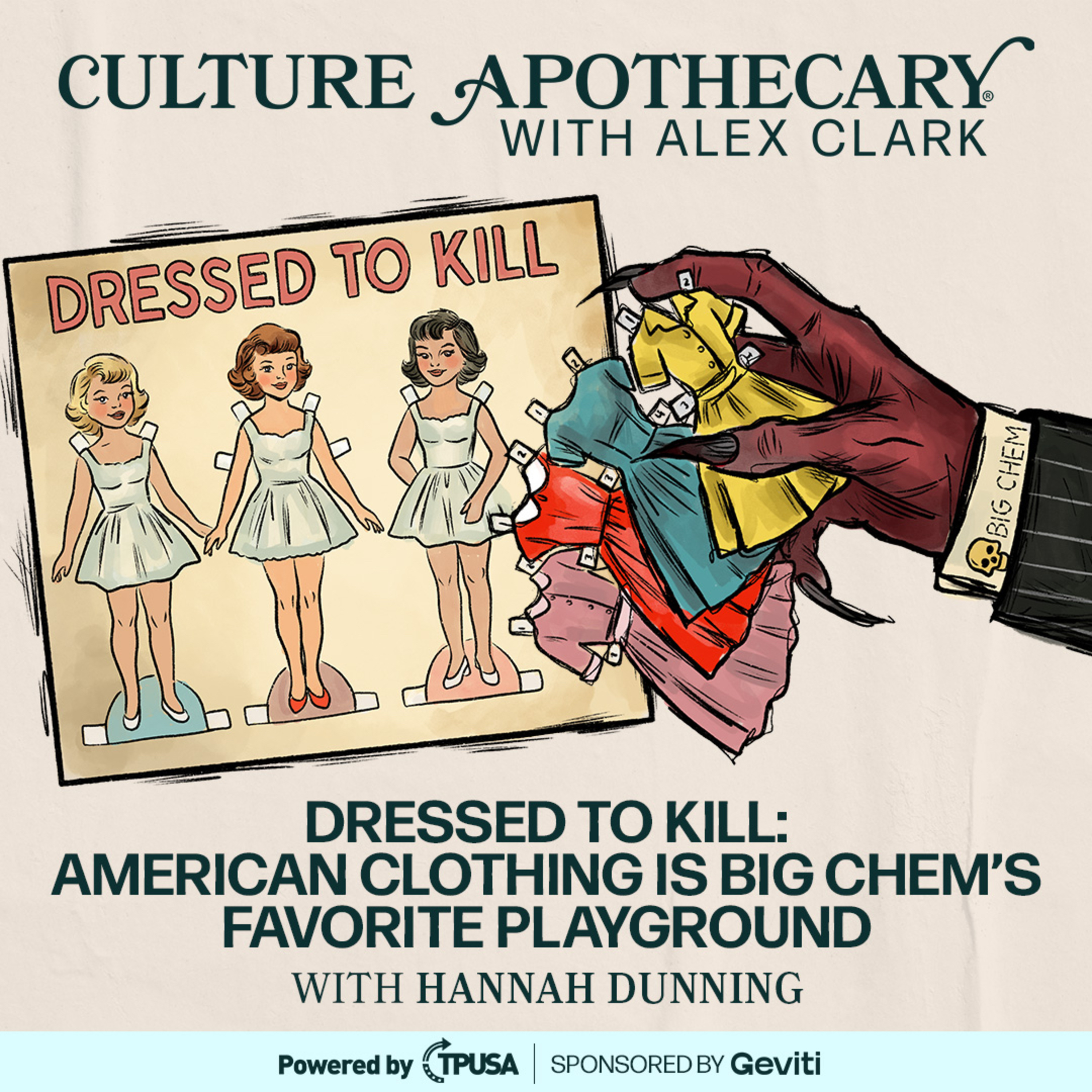
Culture Apothecary with Alex Clark
Dressed to Kill: American Clothing Is Big Chem’s Favorite Playground | Hannah Dunning
01:39:23
Loading summary
Transcript305 lines
- [00:00]
Alex Clark
The longer I keep the chemical laden clothing and I'm washing and drying it, I'm actually getting worse and worse exposure.
- [00:07]
Hannah Dunning
As time goes on, those plastics wear down into microplastics or nanoplastics. Even nanoplastics have been shown across the blood brain barrier. We've been conditioned to think that every kind of material needs to have the same capabilities that plastic has. Like sweat, wicking, waterproof, odor resistant. All of those are just code words for different chemical concoctions. We have virtually no laws around the chemicals in our clothing. Talking about this matters because we need regulation. Because you shouldn't have to be a wealthy detective to go find a baby onesie that's not full of life altering chemicals.
- [01:07]
Alex Clark
The clothing industry is one of the least regulated industries in America. We're operating under laws from the 1940s. With infertility rising 1% every year, it's time we take a closer look at what's going on our bodies. We're demanding better regulations for what's allowed in our food, our water and air. But what about clothing? Formaldehyde, lead forever chemicals, BPAs, plastic are just a few of the things that Hannah Dunning discovered was allowed in our clothes. The clothes sitting directly on your reproductive organs for 12 plus hours a day. Almost no modern federal oversight. Hannah Dunning, known to many as the clean clothing chick, is a clothing safety advocate and policy reform leader who has spent years digging into what's actually in modern apparel. From fertility concerns to toxic school uniforms to the multi million dollar flight attendant lawsuit over chemical exposure. She's connecting dots that most of us didn't even know were there. We're going to get into it in this episode and give you the complete truth about what is in our clothes. And then give you helpful tips do about it. What brands we trust. How to strategically make changes that will make your skin, fertility and budget happier. A couple weeks ago I got my annual pre Nouvo scan. It's an advanced radiation free MRI to proactively scan your entire body detecting stage one solid tumors and hundreds of other conditions, brain aneurysms, you name it, often before you have a single symptom. Now on average 1 in 20 people get alerted to something potentially life saving by getting a pruvo scan. My friend found out that she had a brain tumor before she had any symptoms which saved her life. I even had my mom this year go get her first pre novo scan. Thank God everything turned out great. I'm bringing this up to you because in this episode I mentioned that no major Health. Things change, thank God. But I talk in this episode about how I did find out that I have extremely dense breast tissue, which we discuss how toxic clothing can be particularly problematic if you have dense breast tissue. The tech that they use in this MRI is insanely advanced. There's no radiation, there's over a billion data points in under an hour. But the experience is super calm. It's spa like, it's a wide open machine. Really cozy vibes. I watched Sex in the City during my scan in this one hour appointment. It's so fast. You can go really early too before work if you want in select cities around the country. So if you're going to book, you do need to use my full link for the discount to apply automatically at checkout. I do have a discount for you if you've been wanting to get a full body Pre Nouveau preventative scan. There is nowhere to enter a code on the site so you have to use pre nouveau.com Alex Clark that's pre nouveau.com alex clark. Watch this episode on the real Alex Clark YouTube channel or culture Apothecary on Spotify. You guys have been begging for a clothing education episode. This is a jam packed one at what, almost two hours long. So make sure you leave a five star review on Apple or Spotify. We flew Hannah in and we went crazy. Please welcome the clean clothing chick, Hannah Dunning to Culture Apothecary. If you were to grab a tag in somebody's shirt that is listening right now, what chemicals would you find listed that are allowed in our clothes that are not allowed in our food and water?
- [04:12]
Hannah Dunning
Well, first and foremost, you wouldn't find any chemicals listed because you don't have to list the chemicals in your clothing. The manufacturers don't actually even have to hand over the chemicals that they use. So there's the first problem. Most of the chemicals that are allowed in clothing are not allowed in anything else because we have virtually no laws around the chemicals in our clothing. I can list the laws we do have if you want to know. It's very easy to do. It's a very short list. Okay, so first you have to have the fiber percentage on a tag. It's like virtually the only thing when you're shopping for clothing. That's the only thing you'll see when you look at the tag. Legally you have to have the correct fiber percentage. So 100% cotton or 95% polyester, 5% cotton, whatever, that's that for tax. Now the other law is you can only have a certain amount of Lead in children's clothing. So there's lead limits, adult clothing, any amount of lead, totally fine, but not for kids. Now, that's also partly thanks to the massive lead movement we saw. Right? You saw a bunch of hubbub about lead and getting it out. And it's proof that consumer awareness matters. We were able to take lead out of a lot of things. So that's why we have the lead law. Now, the third one, believe it or not, is about flame retardants. So in the 70s, this is a whole story, this is actually very interesting. So in the 70s, they passed a law that said if you make children's PJS that loose fitted, you have to add flame retardants to them. Now, flame retardants, we now know are extremely carcinogenic. It's something you do not want on your kids. But by law, you must put them in children's loose fitted PJs. Now, the reason being is because in the 40s, they had a bunch of cases of children being burned by their PJs because they were cooking with open fire and heating their home with open fire. And that's why 30 years later, they passed that law. And why we still have that law today is because of open flame. Do you have open flame in your house?
- [06:11]
Alex Clark
No.
- [06:12]
Hannah Dunning
Neither does anyone. But that is one of the only laws we have protecting us.
- [06:16]
Alex Clark
I'm still sat on. There's a certain amount of lead allowed in our clothing.
- [06:21]
Hannah Dunning
All the health risk you could imagine are in our clothes right now. In fact, are you ready to go in deep right now?
- [06:27]
Alex Clark
I would.
- [06:27]
Hannah Dunning
I want to go in deep.
- [06:28]
Alex Clark
Okay.
- [06:28]
Hannah Dunning
The whole time I am on the
- [06:30]
Alex Clark
edge of my seat, I'm so high.
- [06:31]
Hannah Dunning
The main chemicals, in my opinion, that you really need to look out out for in anything, food, water, clothing, cosmetics, are xenoestrogens. Have you heard of xenoestrogens?
- [06:43]
Alex Clark
Yes, but explain what that is.
- [06:45]
Hannah Dunning
They are fake estrogen, essentially. That's the easiest way to say it. They mimic estrogen. So unfortunately for us, most of the harmful chemicals they use in things like clothing, thanks to plastic, happen to be xenoestrogens. Parabens, phthalates, bpa, they all mimic estrogen. And when you place them on your skin, a lot of people think your skin is a barrier. It's actually more like a brain than a barrier. It's super smart. And your skin can recognize what it wants to let in and what it doesn't want to let in. And when it sees a xenoestrogen, it says, oh, I'm going to let that in. And unfortunately, xenoestrogens love fat and they love oil, which, what is our skin made of? Fat and oil. So these estrogens or xenoestrogens basically have a passport into our bloodstream. And what do they do? They circulate, looking for estrogen receptors, which our cells are full of. And that's why women, by the way, are more impacted by our clothing than men, thanks to the amount of estrogen receptors we have.
- [07:49]
Alex Clark
What percentage is actually able to absorb
- [07:51]
Hannah Dunning
through the skin totally depends. We have studies that says up to 60%. But what I'm going to tell you is that you can't just think of what can be absorbed because there's a huge difference between even just classes of chemicals. The crazy part about what we're talking about is xenoestrogens are literally made to love fat and oil. They bind better to things that way. Right. That's why manufacturers add it to plastic, because it'll bind the color better or it will bind the waterproof capabilities better. And these things again, move right into your skin at levels we've really never seen elsewhere.
- [08:28]
Alex Clark
What happened to you that woke you up and shook you to your core about what's going on in clothing in America?
- [08:36]
Hannah Dunning
Every moment of my life led up to like I met. I feel like I meant to be here to talk about this and do this, but there were two things that really turned the lights on for me. And the first was I was raised by a single mom till I was like 10, and then she met an amazing man. But up Until I was 10, I was partially raised by my grandmother. And my grandmother, when I was 16, ended up dying of estrogen positive or estrogen sensitive breast cancer. And so at the time, I didn't know how I would do it, but I knew that I was going to do something about that disease. I had to do something again, didn't know what it was going to be. I grew up, I go to school, I meet my husband, we get pregnant with our first son. And around 35 weeks of pregnancy, I started itching really, really badly, specifically on the palms of my hands and the bottom of my feet. And I went to my midwife. Keep in mind, this is during COVID so just a crazy time in general. And I told her about my symptoms and she said, I've been a midwife for 35 years and I've only seen this sort of thing happen once in a patient. But I'm going to do your blood work because I suspect that it could be something specific. And the next day, I got a phone call back from her, and she said, you need to go to the hospital right now. Your liver is shutting down. Whoa. It's called icp. It's called cholestasis of pregnancy. And apparently, or allegedly, less than 1% of women get it. But I. I have reason to believe that that number is much, much larger. And it's getting larger of women who are completely healthy, completely normal livers, and then during pregnancy, their livers shut down. So I ended up having to give birth virtually immediately. And my son had a long NICU stay. He's totally healthy now, but when you have this disease of pregnancy, it's no joke. They take the baby out fast.
- [10:30]
Alex Clark
And how far along were you again?
- [10:32]
Hannah Dunning
35 weeks.
- [10:32]
Alex Clark
Okay.
- [10:33]
Hannah Dunning
Actually, when I delivered, technically, 36.
- [10:35]
Alex Clark
Wow.
- [10:36]
Hannah Dunning
My question to my doctor was, what did I do? Right? That's. That's the human nature. What did I do to. To. To do to get this. And her answer was, nothing. It's totally random and genetic, of course. Yeah. And it didn't sit right with me. But I'm dealing. I'm navigating Covid and a nicu. I couldn't even go into the NICU with my husband because you could only have one person. We're navigating so much. Right. And I didn't really think much about it, believe it or not. I also wasn't asked much about it either. My doctor never asked me what kind of lifestyle habits did I have, or, you know, what was I eating? And nothing. So I didn't really think much about it until I got pregnant again shortly after. I have Irish twins. And again I asked, what can I do to prevent this from happening? Because when you get ICP or cholestasis, they'll tell you that with each subsequent pregnancy, you have a 90% chance of getting it once you've already had it. And the doctors will literally tell you there's nothing you can do. You're just going to get it. And I believed them because at the time, I had a lot of faith in. In the medical system. And then my liver shut down again, and the same thing happened. And it got to a point at the end of my pregnancy where I said, I don't believe this. There is no way that I, a healthy young woman with no other health problems, just randomly have a liver that doesn't work. And furthermore, if my liver doesn't work during pregnancy, you're telling me that I'm completely healthy outside of pregnancy. That doesn't make sense to me either. Clearly, my liver's not functioning the way it needs to function, and something happened to make it shut down, right? So I did a deep dive, Alex. And I mean, like, deep in the weeds. And that's really hard to do with this specific pregnancy disease because it's. It's almost completely unstudied, literally. The studies will tell you we need more information. But what I did find out, and this is the crazy part, when I was recovering from my second pregnancy, or rather my second birth, they put these wild birthing underpants on you afterwards, like big granny panties to help you recover or what have you. Well, I put them on, and a couple hours later, I broke out in complete hives, a whole rash. I've never, ever, ever broken out before that way. And I realized I took the underwear off and I smelled them, and there was this nasty chemical smell, and I was like, oh, my gosh. Like, what. What is in this? What did I just put on my body? This is also while investigating everything in my life that I'm putting into my body, and I realized what's in our clothes? And I'm telling you, Alex, my mind, when I found out that the same chemicals, xenoestrogens, that have been shown to, I have to say, potentially contribute to breast cancer, the specific kind my grandmother had, are the same chemicals that slow down bile acid function in your liver, which was the exact thing that I had in my pregnancy.
- [13:28]
Alex Clark
You are kidding.
- [13:29]
Hannah Dunning
No. I feel like I was meant to discover that through both of those instances. So we can talk about the chemicals in our clothing.
- [13:37]
Alex Clark
Did you start testing your clothing or. Or what did you start doing after that?
- [13:42]
Hannah Dunning
I didn't have to. Because you can look at the research globally and see that in every test they run most of the clothes, and I mean most, a large portion of the clothes, and sometimes all of them have at least one dangerous chemical for humans.
- [13:59]
Alex Clark
Did you overnight, completely overhaul every piece of clothing you had? Was this a gradual process? How did you do this?
- [14:05]
Hannah Dunning
I went completely extreme, which I don't recommend.
- [14:08]
Alex Clark
This is me. You and me are. Are like kindred spirits.
- [14:10]
Hannah Dunning
There's no halfway anything for me. For better or for worse. I have a video of me sitting in front of my closet and going through every piece of clothing and the pile of the clothes I'm getting rid of. Massive. The pile of the clothes I'm keeping. I kid you not. Two shirts. I knew I was gonna say it's like two things.
- [14:27]
Alex Clark
What brand shocked you the most when you were digging in all of Them,
- [14:32]
Hannah Dunning
all of them, shocked me because I was shocked. In general, however, activewear, if you really want to get spicy, we can talk about activewear, because I have a lot of feelings about that and specifically what's in our activewear.
- [14:46]
Alex Clark
Let me first ask you, is skin really impermeable like we've been told?
- [14:50]
Hannah Dunning
No, not at all. Why do we use patches for nicotine? Why do we use topical chemotherapy medicines? Our skin is not just a barrier. Again, our bodies are incredible and it's meant to keep certain things out. But like I said, it's not just a barrier. It's actually more like a brain. And it determines what it wants to let in and what it wants to keep out. And we made Frankenstein of creations when we created these chemicals that have essentially a easy path directly into our bloodstream.
- [15:24]
Alex Clark
How does the skin absorption of what's in our clothes actually work? I mean, is it going into our bloodstreams or what?
- [15:29]
Hannah Dunning
Correct. It ends up in your bloodstream. And now, of course, it's dependent on the chemical. It's dependent on how much of the chemical. It's dependent on if you have cuts or abrasions, or if you're sweating and your pores open up, or if it's hot saunas, which we can talk about. Right. There's all kinds of conditions that can increase your risk, but generally speaking, yes, they have the propensity to enter into your bloodstream. And not only that, but they are actively searching for estrogen receptors. That's a huge problem for women because of the estrogen receptors.
- [16:02]
Alex Clark
Is there a difference in where the clothing is manufactured? Like, if it's made in the usa, does that make it less chemically contaminated?
- [16:10]
Hannah Dunning
No. Almost every manufacturer is using the same kind of chemicals to give clothing certain aspects.
- [16:17]
Alex Clark
Right.
- [16:17]
Hannah Dunning
We've been conditioned, thanks to us, getting used to plastic, to think that every kind of material needs to have the same capabilities that plastic has, like sweat wicking, waterproof, odor resistant. All of those are just code words for different chemical concoctions.
- [16:33]
Alex Clark
Is heat and sweat making chemical exposure worse?
- [16:36]
Hannah Dunning
Yes, We've even found that oxidization is one of the greatest risk factors for these chemicals. I'll give you an example. We're all familiar at this point, likely with pfos. PFAS are really dangerous. Polyfluoro alkyl substances forever.
- [16:52]
Alex Clark
Chemicals forever.
- [16:54]
Hannah Dunning
Well, actually, what's really interesting is that long chain PFAs, over time, thanks to sun exposure, heat exposure, friction, can actually turn into what we call PFAAs. So polyfluoro alkyl Acids. That is the forever part of the chemical. That's when we're talking about the people in Dalton, Georgia or other people across the United States who are being poisoned by pfas. That's what really worried about is that acid, and it happens when a PFA is worn down, turns into again sort of like a, a mutant, almost like a mutant chemical.
- [17:28]
Alex Clark
I know some about this subject. You are teaching me so much. I've loved following you on Instagram because there's so much that you talk about that's blowing my mind. And I, and I feel as if you are the start of my clean clothing journey. Like, I just, I know myself and I'm like, oh man, here you go. I was sent this girl to radicalize me when you said that it kind of warps the PFAs and it turns this chemic into kind of a mutant or whatever. In my mind I'm thinking, okay, sure, I have a pair of chemical leggings that is an ideal, but I've had them for years. They've been washed and dried a million times. Surely all of that's kind of worn off and it's been, it's, it's gone down the drain at this point. But are you telling me that actually the longer I keep the chemical laden clothing and I'm washing and drying it, I'm actually getting worse and worse exposure?
- [18:17]
Hannah Dunning
Yeah, correct. It depends on the chemical and it depends on the material. If we're talking about plastic, which 90% of your wardrobe and all of our wardrobe wardrobes, except for me and some people who have made the switch is plastic.
- [18:31]
Alex Clark
And when you say plastic, what is the fabric that we're looking for? That means it's plastic.
- [18:37]
Hannah Dunning
I have lists on my Instagram that are really helpful because it can be confusing because what's happening is we're collectively waking up. And so these companies say, oh shoot, we need to rename are plastic. But the most common ones are going to be elastane, lycra, nylon, polyester. There's a bunch of them and they'll. Acrylic is a huge one too. Acrylic's really gnarly. So those are the ones to watch out for. But the reason this is complicated, it gets complicated. And people don't like me for this because it would be really easy for me to say, just avoid plastic and choose natural fibers. But you can put chemicals on anything and they do. We have studies showing that baby clothing has the highest amount of phthalates in it, and it's usually in cotton so phthalates are primarily in baby clothes and cotton over plastic.
- [19:29]
Alex Clark
So how do you shop for organic cotton baby clothes? How do you know that it doesn't have the chemicals?
- [19:34]
Hannah Dunning
You want to look for certifications. So gots Global Organic Textile Standard. That's the certification you should look for. That's the best in my opinion of what we have today. You'd also look for Echo Tex, which reduces chemical exposure. It's not my favorite because you can slap an Echo Tex label on plastic too. Goths, you have to be an organic natural fiber. So they won't even put GOTS on bamboo, for example, because it's not a natural fiber after it's processed.
- [20:01]
Alex Clark
For the clothing brand options that we have that have the GOT label certification, do we have very many options?
- [20:08]
Hannah Dunning
The panic in your face asking that question. Yeah. So it's growing, it's growing and they're there if you look for them. But that is why talking about this, it's. Someone said a problem well stated is a problem half solved. Right? Talking about this matters because we need regulation. Because you shouldn't have to be a wealthy detective to go find a baby onesie that's not full of life altering chemicals. And I mean that exactly how it sounds when we're talking about do my clothes get worse over time? Always, yes. If it's plastic, no matter what.
- [20:40]
Alex Clark
Oh my gosh, yeah.
- [20:41]
Hannah Dunning
Because as time goes on, those plastics wear down into microplastics or nanoplastics. Even nanoplastics have been shown to cross the blood brain barrier. And if you think about it, plastic actually takes 10 to 14,000 different chemicals just to make it. So many of those chemicals have never been studied long term on humans. That's why scientists in all fields are freaking out about microplastics. Right? Because we don't actually understand the implications yet. The picture that's being painted isn't a good one. We're just really, truly at the tip of the iceberg there. So no matter what, your plastic over time gets worse. Now with natural fibers, you can make an argument for certain chemicals that over time they get better. For example, formaldehyde is one that easily washes out, or I should say more easily washes out over time. So if you have a cotton shirt and there's formaldehyde all over it, wash it a few times, it's much better. But if you have a cotton shirt with peas in it, for example, the opposite is true. It gets worse over time.
- [21:43]
Alex Clark
You have no way of knowing if that's on correct unless you're taking it to some lab and getting it tested if it doesn't have that GOTS certification.
- [21:50]
Hannah Dunning
Correct. And I will also add, there was a study done. This is where I get really fired up. I'm a mom of two boys. One's in preschool, one's newly, freshly in kindergarten, and both of them wear uniforms. This is crazy. They did a study of United States and Canadian preschool uniforms that were labeled waterproof or stain resistant, which is virtually all kids clothes. Because that's what people want. They want reduction in stains. 100% of them tested positive for PFAS, actually. And the highest amounts were in the 100% cotton once. Now, if you think about it, the reason is because cotton absorbs everything. Right? And so if you're gonna sell a mom who doesn't know better, just like me a few years ago, when, before I started this whole journey, I didn't know better. If you had said, do you want this cotton T shirt for your child with the ability to reduce stains? I would have said, yes, of course, and I'll pay more for it. Right. So it makes sense. People buy it because to get cotton to be stain resistant and waterproof, you have to douse it in chemicals. It's not naturally that way.
- [22:57]
Alex Clark
So what'd you do for your kids school uniform?
- [22:59]
Hannah Dunning
The trick is this. If you email your school and tell them that your child has an allergic reaction to the uniforms, you can get a medical exemption form or you can medically opt out, which is exactly what I did. I found sort of comparable polos. Right. They looked similar, but they were organic cotton. And then I literally went on Etsy and I had somebody make my kids school logo and I sewed it on. Actually, that would be lying. I had my grandma sew it on and that's how we got around it. And you can do that, and you should do that because most kids uniforms have at least some form of harmful chemicals in them from the studies that we've done.
- [23:38]
Alex Clark
Okay, kind of an aside, but what do you use for laundry detergent? I'm just curious.
- [23:41]
Hannah Dunning
Wonderful question. And I will give you a list for your show notes.
- [23:43]
Alex Clark
Okay.
- [23:44]
Hannah Dunning
But what I'm using right now is called Molly suds. And that's actually a really important point because people ask all the time, can you wash off chemicals? And again, for some chemicals, yes, you can reduce it in the wash, for others, no. But what really matters is your laundry detergent. Because if you're trying to get rid of these harmful chemicals, don't add the harmful chemicals to the clothes. There's going to be a theme here with your food, with your cosmetics, with your laundry detergent, with your clothes. Xenoestrogens. There's a lot of xenoestrogens added to laundry detergent. And really interestingly, xenoestrogens are what we call hydrophobic. They hate water. So when you put them in the wash, they're actively looking for a way to get out of the water. Where do they go? The fibers? It's the easiest place to go. And they attach to the fibers themselves.
- [24:29]
Alex Clark
Most American moms are putting their kids in the car wearing their leggings. They're, they're, they're traveling in their leggings. They're grocery shopping in their leggings. They're taking their kids to the park in their leggings. They in their leggings for ten plus hours a day. What should that mom know?
- [24:46]
Hannah Dunning
So was I first and foremost, Most I feel American women, and not so much in Europe because they wear leggings less, but generally most American women are in the same position and they need to know that the chemicals inside of their clothes, the worst area you could possibly put them on are your breasts and your vagina. That is the worst area. Why? Because we have mucous membranes. Anything you put up there is going in there. End story. We've actually, this is really crazy. They did a study and in uterine tumors they did a comparison between the cancerous ones and the non cancerous ones. The cancerous ones had much higher levels of parabens than the non cancerous ones. Anything you put up there is going to end up in your body and it's true for your breasts as well. Bras are a huge, huge problem and we are about a hundred years behind with our bras right now.
- [25:42]
Alex Clark
Have you noticed this Gen Z trend where guys wear one dangly earring? Have you seen that, Simon? Not two. It's not a set. A guy just has one mysterious little pirate accessory. You'll see a guy ordering an ice matcha latte and he's got the single earring gently swaying like he just returned from a voyage across the Atlantic. I always want to ask them, you know, if you're that committed to a sea aesthetics, are you at least committed to clean personal care products? Because a lot of the stuff people use every day, deodorant, toothpaste, floss, it's full of weird ingredients that you probably wouldn't voluntarily rub on your body if you knew what they were. So I like zebra. They make really clean everyday essentials that really work. Their deodorant is aluminum free, paraben free, fragrance free. It goes on clear, it doesn't go on chunky. It holds up in real life heat. I live in Arizona, so I'm basically like the ultimate guinea pig for that. Plus they offer two formulas, with or without baking soda, for sensitive skin. Their floss is made from real silk with peppermint oil and xylitol, not polyester like most floss, meaning you're not dragging microplastics across your gums. And their toothpaste tablets are simple chew brush done. No messy powders, no junk ingredients. So whether you wear one dangly earring, Simon, or none, at least upgrade your daily routine. Go to yayzebra.com use code Alex for
- [26:55]
Hannah Dunning
10 off your order.
- [26:56]
Alex Clark
That's yay zebra.com code Alex for 10 off. Are bras more concerning because of being so close to lymphatic tissue?
- [27:06]
Hannah Dunning
It's more about your estrogen receptors. Yes. I don't believe under wires are necessarily good because of lymphatic flow, but we're really concerned about estrogen receptors, which most. The most densely populated place in a woman's body for estrogen receptors are your breasts. They rely deeply, heavily on estrogen. Basically, think about it like this. Your estrogen receptors are little satellites inside of your cell, and they are actively searching to bind to estrogen. Estrogen gives those cells a message. It'll say, go to this place, maybe you're pregnant. Go make milk here for this amount of time. Right? We need that. But unfortunately, these xenoestrogens tell the receptors, hey, I'm estrogen. And our receptors actively go looking for it, bind to it. But the problem is they then give them the wrong signal. They say, go to the wrong place for the wrong amount of time, and they stay on. So when we're talking about disease, it's typically when cells mutate, they keep creating bad cells, or the wrong cells, they mutate. That's what causes a lot of disease. And that is what xenoestrogens can do. BPA specifically has been found to cause denser breast tissue. But here's the trick. It's on pregnant mothers, it's on their offspring. So in other words, they did a test on rats and they dosed the pregnant mother's bpa. And what they found was that the children, the daughters of those rats, had denser breast tissue. And that, they found, can actually increase your odds of breast cancer. Why? Because it can cause pressure on things like milk ducts, which can cause inflammation, which can Then cause disease.
- [28:47]
Alex Clark
Ooh. This is good to know because I just did one of those pre nouveau scans.
- [28:51]
Hannah Dunning
Yeah.
- [28:52]
Alex Clark
And that was something that came up. I. It said I have extremely dense breast tissue.
- [28:56]
Hannah Dunning
Okay. So you are at a much higher risk. And I don't say this to scare you because there's a lot of things you can do to mitigate that risk. It's just important to know, like, knowing is everything.
- [29:03]
Alex Clark
Yeah.
- [29:04]
Hannah Dunning
You have a much higher risk of breast cancer statistically with dense breast tissue.
- [29:09]
Alex Clark
Here's my thing with the bras and natural fibers is it just seems like the options are like a little piece of cloth and they're just hanging. We're just hanging and banging. That's all we're doing. And. And I like a lift and I like padding. Does that exist at all?
- [29:25]
Hannah Dunning
No. Well, almost, because I'm making one. Okay. I got to the literally the same point.
- [29:30]
Alex Clark
Just certain types of clothing and outfits I cannot be having. Just like nothing.
- [29:34]
Hannah Dunning
Totally understandable. I have a couple things to help you. So first and foremost, and this is a huge issue, especially for larger chested women, is there's nothing that's supportive that's also clean. That's true. There's. There's not you. There is not one bra on the market with a cup that is completely plastic or chemical free. It does not exist. That's because making the cup is really hard without plastic.
- [29:55]
Alex Clark
Yeah. What do you use?
- [29:56]
Hannah Dunning
We're formulating that. It's hard, but I think we have it. So we'll see if it works. Then I will not patent it because I. I want people to use it. Women deserve options. But let me get back to you and make sure it works first.
- [30:08]
Alex Clark
Okay.
- [30:09]
Hannah Dunning
But one thing you can do, and this is going to sound crazy. It is crazy. And it's wrong that we have to do this as women, which is why it's important that we're having this conversation. Because hopefully we can make leaps and bounds of progress. But you should be wearing some barrier between yourself and your bra right now. So an organic cotton cami or a bralette underneath your bra.
- [30:31]
Alex Clark
What?
- [30:32]
Hannah Dunning
Right. To provide some kind of barrier between the toxic bra and your breasts.
- [30:38]
Alex Clark
That's gonna be hot. What about breastfeeding? You got hard.
- [30:42]
Hannah Dunning
Well, maternity bras are a huge issue too. Why? Because. Well, most of them are stain resistant or waterproof because of milk. So they add chemicals. We're finding these chemicals in mother's milk, Also the placenta, also the umbilical cords, but in mother's milk. And it makes its way into the baby. So it's a huge problem. And that is why it's imperative for you to look for certifications when looking at maternity bras.
- [31:06]
Alex Clark
Okay, what brands for maternity bras do you like?
- [31:08]
Hannah Dunning
I'll give you all. I have a whole list on it. This is all I do, really. My Instagram is. I just give people companies to go look for and look for better. There's one very clean brand that I don't love them aesthetically, but it's called Cottonique. Okay, Cottonique. They make a clean bra. There's. It's called the very good bra. They make clean bras. They have a clean maternity bra. That's probably the. Those two are the cleanest you can get. I want them to be cuter for all categories. What is packed? I don't think packed makes a maternity bra specifically. I think they only make camis or bralettes. I'd have to check, but I don't think they do maternity.
- [31:45]
Alex Clark
But do you trust them as a brand for underwear and bras?
- [31:46]
Hannah Dunning
I do, yeah. I think that. Listen, we could be a purist here and say that clothing, even for dyes, they should be using like natural botanical dyes. That's true. It's not functional. And you can make much safer dyes using non toxic ones, which a company like Pact does. So they use non toxic dyes. Ideally. Would they be natural? Yeah, but I mean, come on, that's so much better. And they are. They have certifications, they use tons of organic cotton.
- [32:13]
Alex Clark
So yes, that's what I use for underwear.
- [32:15]
Hannah Dunning
That's a good option.
- [32:16]
Alex Clark
Okay, talk about this a lot. Infertility rates in the US are just exploding. We're seeing infertility rise 1% every single year. Do you believe that clothing is a major contributor to this?
- [32:28]
Hannah Dunning
100%. 100. And the studies prove it.
- [32:31]
Alex Clark
Is clothing the biggest loophole in consumer protection?
- [32:35]
Hannah Dunning
I believe so. I believe it is the largest loophole in American regulation today.
- [32:42]
Alex Clark
Some people have tried to draw attention to how bad our rules on cosmetics and beauty products are. I mean, is clothing worse? They about the same?
- [32:49]
Hannah Dunning
Imagine if we didn't have the FDA at all. Even with how messed up our regulatory system is. Imagine if it didn't exist. Imagine what these companies would be trying to get away with. That is what is going on with our clothing. There are no gatekeepers.
- [33:06]
Alex Clark
Why do you call clothing in America big chemicals, favorite playground?
- [33:11]
Hannah Dunning
Because they have virtually no restrictions around it. They can make any kind of chemical concoction and sell it for clothing. And they don't have to worry about, really, any regulation. In theory, giant asterisks. In theory, we would be being protected through the Toxic Substances Control Act. However, that's a whole thing we can get into in terms of enforcement or lack thereof.
- [33:38]
Alex Clark
Tisca is how, like we talk about it.
- [33:40]
Hannah Dunning
Yeah.
- [33:41]
Alex Clark
Tsca, what is going on with that?
- [33:44]
Hannah Dunning
Tisco was passed in the 70s, and the Lautenberg act, the Frank Lautenberg act, was passed in 2016. And what happened when Tisco was passed was 62, 000 chemicals that were already on the market were essentially grandfathered in because they said, oh, we have a chemical problem. People are getting obviously sick and hurt. We have to have. Have some kind of safeguard. What a concept. And we got to do something. So they created it. Then in 2016, they passed the Lautenberg act because those chemicals got grandfathered in. And people were like, well, that's 62,000 of the most harmful chemicals are just grandfathered in and they're forever. Okay, that doesn't make sense. So the Lautenberg act basically said if the risk is high enough, essentially, or there's enough red flags, we can address that chemical, even if it was already sort of technically grandfathered in. So it's supposed to help, right? Supposed to. And they just reviewed formaldehyde, for example, and found that it posed unreasonable risk. And in May, they're supposed to have some kind of restrictions around formaldehyde. But I'd be willing to bet it will have nothing to do with clothing, because in our country, we consider clothing an industrial tool, essentially. And we're not thinking of it as something that interacts with your body. The way that we think of food or drugs or cosmetics. We just think of it as this thing that you put on your body, and it's just a thing, a tool, when it's not. So clothing, the chemicals in it should technically be regulated under tisca, but they're not. I mean, we have mass amounts of people in Georgia being poisoned through pfas. And what are they doing? Did they pass a federal ban on PFAS and consumer products? No, no. And they're not going to unless people absolutely take it to them and demand that that happens, which I believe we can do. But here's the problem, Alex, with clothing specifically or with anything in the United States of America, we regulate chemical by chemical. That's not sustainable, and that's, in my opinion, very purposeful on behalf of big chemical.
- [35:45]
Alex Clark
What do you mean?
- [35:46]
Hannah Dunning
I mean, we could ban PFAs and they'll just use short chain PFAS instead. Or we could ban BPA and they'll just put BPs and stuff instead. Which, by the way, we're seeing that most BPA free things, including like food packaging, just have BPs in them.
- [36:03]
Alex Clark
What is BPA? For somebody that has no idea what
- [36:05]
Hannah Dunning
we're talking about, it is one of the worst xenoestrogens you could possibly have. It makes plastic clear. That's usually why they add it. Bisonols is they're typically added to make the plastic stretchier or clearer so you can see through the plastic. Right. And in clothing, it's primarily for the stretchy effect. But bps, we're finding, is actually worse than bpa. So this is why. And I just want to be really clear. It's overwhelming. People go after me online all the time because I am popping their bubble.
- [36:36]
Alex Clark
Oh, you're bursting mine right now.
- [36:38]
Hannah Dunning
It's not fun.
- [36:39]
Alex Clark
But I will say we will get into a point of this interview. 100 solutions.
- [36:42]
Hannah Dunning
That's exactly what I want to make clear is like, there is a path forward.
- [36:45]
Alex Clark
Who created the first synthetic clothes and why?
- [36:48]
Hannah Dunning
Dupont. I mean, dupont was the first one to manufacture them at mass, especially in the United States. They were located in the US they were a chemistry company first. Then they, I think they started with gunpowder, actually. And then they decided we should make more things because we're moving away from gunpowder. We don't really need gunpowder anymore because technology's advancing. What else can we make? So they started making applications for the military. So think of like parachutes or even like the clothes soldiers would wear to keep them dry. Right. And they would experiment with these chemical concoctions. How can we make this piece of clothing better for soldiers? Well, the wars end and all of a sudden they're not making money the way they were. And they were worried about going out of business. So they said, how can we use these chemical concoctions that we were using in wartime to sell to the average consumer?
- [37:37]
Alex Clark
So they come up with nonstick pans
- [37:40]
Hannah Dunning
and chemical clothing and nylon pantyhose. That was the first piece of synthetic clothing that was introduced to housewives. Nonetheless, really, nylon pantyhose was where it all began. And this was a time where it's post war. So people are really happy. People are going back to work. Right. We're boosting the economy. Women are going back to work. And so what do they say? They say, I think we need wrinkle resistant stuff. Let's make a woman's life easier because they don't have time to go home and iron their husband's. Clothes anymore. What can we do to make it wrinkle resistant? Right. So essentially a race to come up with the next best chemical to give clothing the next best thing to sell. And that race has never stopped.
- [38:21]
Alex Clark
You know what I think is interesting is that when seed oils were, were introduced into the market, they did it through Crisco and wanted women to. Yep. Housewives to bake with that. When they wanted to create synthetic clothing, they did it through nylon pantyhose. They wanted housewives to use that. They wanted us to use non stick pants. Everything was marketed to women. We are the guinea pig. They know that we make the day to day consumer decisions.
- [38:45]
Hannah Dunning
Correct.
- [38:45]
Alex Clark
When Rockefeller is trying to put oil byproducts and things, what does doing okay, pharmaceutical drugs, who's going to the doctor's office? Who's planning those visits? It's the women. It's always us. And so that is why we are the most powerful consumers is because if we all of a sudden decide to, to get together and step up and say no more, we literally screw them in such a delicious way and we have so much power, we influence everything. That's why the chemical companies hate my guts right now because I'm, I'm getting my entire audience to stand up and call their senators and stuff about chemical liability shields in their states. They absolutely loathe me right now. So I think that really says something that it's women, women, women, women.
- [39:29]
Hannah Dunning
Absolutely. Well, what? Statistically speaking, we make over 80% of purchasing decisions period when it comes to our household.
- [39:36]
Alex Clark
And so if we start making informed different consumer decisions, we literally change America.
- [39:42]
Hannah Dunning
Correct. But the thing I love talking about with Big Chemical, they can add me to their list too. Alex, I'll stand next to you on that one. In terms of who after we can
- [39:49]
Alex Clark
share our room at the Gulag.
- [39:51]
Hannah Dunning
Great. We can be bunk mates. Love it. Let's do it. But here's the thing. They've sold to women for so long because we make the purchasing decisions, but what they didn't account for. And I actually made a post about this the other day. Got really fired up watching. I think you actually had a post about Aaron Brockovich. Like you used her meme and you were like me whenever. Okay, well the thing that they do not or have not accounted for, when they do something as egregious as getting in the ear of the President of the United States and getting him to grant them immunity, that's wild props to them for that kind of power. However, what they don't account for clearly by doing something so crazy. Because that was a slap in the face to Maha. And moms across America is they don't account for the power and the anger that a mother has. Women in general, yes, but have babies and then have someone try to poison them and see what a mom will do to make that stop. So if I were Big Chemical, thank God I'm not. If I were, I would have been a lot more subtle with my strategy. I think they made a huge mistake. And one thing I said too is I wonder what they're going to do with the millions of Aaron Brockovich's that are about to pop up. Up.
- [41:09]
Alex Clark
Oo, I got goosebumps.
- [41:10]
Hannah Dunning
Okay. Big Chemical can try to take any one person down. They can try to cancel you, silence you. If they did that to me, if they try to cancel me or silence me, 100 more of me will pop right back up because the toothpaste is out of the tube. People have woken up. We have the data, we have the research. And in fact that research is catching up with our technology and we know better.
- [41:33]
Alex Clark
Is toxic clothing actually a national security threat?
- [41:36]
Hannah Dunning
I think so. Is it making us sick? Absolutely. The studies say so. Imagine not protecting your own people from the very stuff that's making them sick. I think health is the center of a country's strategy in every category. If your people are sick, your country is sick, you are weak. So when you are completely liable or completely vulnerable to something that is so pervasive. Absolutely, it's a national security problem.
- [42:07]
Alex Clark
Is dependency on synthetic petroleum based textiles part of that?
- [42:12]
Hannah Dunning
100%. But I think it's bigger than that. I think it's more of a chemical problem. I think plastic itself is inherently something that should never be on a human body. End story. We went through this huge thing where of course, you know, don't throw the plastic away, throw it on people's bodies. How does that make sense?
- [42:30]
Alex Clark
Right, right.
- [42:31]
Hannah Dunning
It's a terrible idea.
- [42:32]
Alex Clark
Is there a supply chain vulnerability? If we were to stop making clothing with some of these chemicals, it's expensive.
- [42:37]
Hannah Dunning
But I think that it mostly starts with the consumer awareness. Right. Because if, if people think that they want water resistant or waterproof things, or if people think they have to wear Lululemon leggings to work out and they don't buy your stuff, that's yeah, you're going to take huge losses. But when women decide, not only do I not want to work out in that anymore, but I'm like actively looking for better stuff, I want something else and I'm willing to pay for do. It's actually an opportunity for businesses. That's. I coach businesses all the time. Like, you have no idea how much money you could make if you actually started addressing the women's health problem.
- [43:11]
Alex Clark
Especially, how do you feel about clothing from Amazon and sheen?
- [43:14]
Hannah Dunning
No, don't do it. It's too much of a liability. I can't think of really anything worse to put on your body.
- [43:22]
Alex Clark
Wasn't there a crazy study that found that the sheen clothing was filled to the broom with lead, especially their children's clothing crack.
- [43:29]
Hannah Dunning
And. And that's illegal in the United States as well. But honestly, I think lead is sort of the least of our worries now, thanks to the work we've done around lead. Right. It's obviously a very dangerous thing and it shouldn't be added. But there's enough awareness and enough legislation where manufacturers have been forced to address it. The other chemicals are just. Not only. It's not only a free for all, it's encouraged. Like, people are paying more for these chemicals. The companies are paying more to have chemists. Chemists come up with new chemicals. So it's. Yeah, it's a huge problem.
- [43:59]
Alex Clark
So what do you think is, like, the absolute worst material? Like, if your shirt or your pants says this, run, don't walk.
- [44:07]
Hannah Dunning
Well, statistically speaking, polyester is the worst. When we're talking about degradation, microplastics, and leaching of chemicals, polyester is typically full of bpi.
- [44:16]
Alex Clark
There goes my Aritzia work pants.
- [44:18]
Hannah Dunning
For real. Don't wear them. Okay, but here's the deal. I get lit up online about this. Trust me, if you. For fun, you can go look at a post I just made about regular cotton. Skims just launched a new natural fibers. I think they call it everyday cotton line. Right. And that's because they see people waking up. Kim Kardashian. Actually, the words natural fibers came out of her mouth in their promo. And they're positioning themselves, as they should, as the hero in terms of it makes sense to move towards natural fibers. People want it, you better do it now. The train sort of already left the station, and you're kind of already too late to be honest, but. But at least they're, you know, starting to think about it. But here's the problem. That cotton could theoretically be, and probably is just as toxic as a lot of plastic. People don't like when I talk about that because they think, oh, I'm at the store. I see 100% cotton shirt better than plastic. That's good to go. It's not true because of the chemicals added. Again, you can add these harmful chemicals to. To any material, Right? And we're finding, again, that cotton is typically full of chemicals because, yeah, people want cotton, but they don't want it to get stained or something like that, so they add chemicals. So my point is, if skims actually wanted to make a difference, if they actually wanted to do something for women, which they should, because they're marketing to women, then they should actually focus on chemicals, not just natural fibers. Let's have the chemical conversation.
- [45:47]
Alex Clark
How's Victoria's Secret doing with all of this?
- [45:49]
Hannah Dunning
I don't like them at all for more reasons than one. Let me tell you what made me really angry. We have the Victoria's Secret fashion show happening. The last one. Right. Oh, so groundbreaking. They sent a pregnant woman down the Runway. Maybe a man. Oh, old woman. Okay, wonderful. You must love women. Except for not at all. And we all know it. Women aren't stupid. On the contrary, if you cared about women, you would be having a chemical conversation. How about 100 organic cotton bra with no chemicals? It's not that crazy. It's not, and it's what we deserve.
- [46:25]
Alex Clark
They also went through a massive lawsuit not too long within the last, I don't know, 10, 15 years with chemicals in their underwear. Right?
- [46:32]
Hannah Dunning
Yeah. I have people in the industry, like, fighting for sustainability and whatever, who defend Victoria's Secret because they're B Corp certified, which, if you're in the fashion world, B Corp certification should be table stakes to sell something. It's basically saying we are ethical in terms of who we're hiring. You know, who we're using. Right. Like no child sweat shops. That kind of deal. That's not groundbreaking. That should be table stakes. So we have people defending Victoria's Secret because of that. But let me be very, very clear. Based on the data based what is in most bras tested, and I don't want to fear Monger. Not all bras out there have, you know, high levels of PFAs or whatever, but most of them have at least one harmful chemical. And if there are pads inside of them, 100% they do, because those pads, those bra pads are made up of completely plastic, full of chemicals. Okay? So I think most people need to understand that these bras are full of plastic, which is inherently dangerous. If you are wearing a plastic bra, you are putting yourself at risk. So Victoria's Secret is a great example of companies using women. Not just selling to women, but using them to sell some things. Talking about female empowerment. What really made me angry was skims collab with Nike. They had Serena Williams on there, which I don't know what Serena Williams is doing. She's promoting GLP1s. And yeah, there's a whole, whole other. I'm like, I, I, why? But anyways, the companies who are putting these, like, amazing female athletes out there, working out, no less, talking about female empowerment and you're making the clothes that are making us sick. How does that make sense?
- [48:16]
Alex Clark
It's dark.
- [48:17]
Hannah Dunning
It's predatory, in my opinion, when it comes to selling something that's making women sick and then using women at the same time to sell it. Like, nothing gets more messed up, in my opinion, than that.
- [48:28]
Alex Clark
What other chemicals are we finding in women's underwear?
- [48:32]
Hannah Dunning
Well, there was a wild study out of China that tested, I think it was like 132 different pairs of women's underwear and BPA was found in 100% of them. Women's underwear has really the same chemicals as anything else, including our bras. It's just that it's more dangerous when it's on those two parts. So the same chemical concoctions are used for, for most things, it's just, you know, typically more of some depending on different capabilities or characteristics you want during manufacturing.
- [49:01]
Alex Clark
I did see, just researching for this episode, I did see in, in tons and tons of studies, routine, the brands that came up as one of the worst culprits is thin underwear. I think it's like period underwear or something. A lot of these period undergarments that we're supposed to be using to be able to like, bleed without having to wear tampons or pads are incredibly toxic. Right. So what are we finding in period underwear?
- [49:23]
Hannah Dunning
All of the craziest things you can think of. PFAs, Bisphenols, you've seen parabens, phthalates, formaldehyde. Formaldehyde, I'm sure. But again, formaldehyde, as awful as it is, and it is awful, I'm not downgrading how terrible. Formaldehyde is awful. I can, you can walk, wash a lot of it out, but the other chemicals, it's a very different story.
- [49:45]
Alex Clark
I think a lot of us walk around feeling tired, foggy, or just off, and we kind of shrug and say, well, I guess I just might be getting older. Your body is not a mystery, okay? It's constantly giving you signals through your hormones, nutrient levels, inflammation markers, metabolism, stress hormones. The problem is most of us just aren't testing enough to actually see what those signals are telling us. Most primary care Doctors run maybe 20 basic markers when they do blood work. It's the bare minimum. Minimum. Jevity looks at over 90 biomarkers and they do it twice a year. So instead of guessing why your energy is low, why your sleep is off, or why your metabolism feels like it hit a wall, you actually get real data about what's happening inside your body. Jev's process starts with at home blood work. They send a phlebotomist to your house. Then you have a virtual consultation where their team will build a personalized health plan for you based on the results from your blood work. And they'll explain what those results were. That can include nutrition guidelines, kinds targeted supplements, hormone support, or additional testing like the Dutch hormone test or a GI map if needed. You know, that's a little poop test to see what's going on in your tummy. All those custom supplements or therapies are delivered directly to your door. They continue monitoring your biomarkers over time. So your plan evolves with you. It's proactive personalized healthcare designed to help you feel your best at every stage of life. Go to gojevity.com use code Alex for 20 off your first purchase. That's gojevity.com code Alex for 20% off your first purchase. Jevy Je he needs a golden calculator to survive.
- [51:11]
Hannah Dunning
To survive.
- [51:13]
Alex Clark
I got a DM on Instagram from a listener the other day and honestly it stopped me in my track. She said, alex, I bought the Jasper air scrubber after hearing you talk about it. And within a week my husband stopped snoring and my kid's chronic congestion disappeared. And she goes, I didn't even realize how bad the air in our house was until it wasn't bad anymore. Which honestly makes sense because most homes today have something called sick building syndrome. Our houses are sealed up with modern materials, synthetic products, cleaning chemicals, cooking smoke, dust, pollen, mold spores, and we just sit in it, breathing it all day. That's why Jasper is so interesting. It's actually the first air scrubber designed specifically for homes. Normally these machines are used in wildfire cleanup, mold remediation and disaster zones. Well, Jasper basically took that commercial grade power and then made it sleek enough to live in your house. It detects and captures ultra fine particles like dust, smoke, pollen and mold spores. It also removes VOCs from things like paint, cleaning products and household chemicals. So it's tackling multiple threats at once. Pet dander odors, wildfire smoke, mold spores, all the stuff floating around your house that you don't think about and it's designed as a lifetime investment backed by Jasper's lifetime warranty. If you want to breathe actually clean air, go to Jasper Co J and use code Alex for $300 off. That's J A S P R. Code Alex for 300 doll. What is your opinion on Lola Blankets and Minky Couture?
- [52:41]
Hannah Dunning
I'm so against them.
- [52:44]
Alex Clark
I'm so against them, too. So first of all, Minky Couture and Lola blankets 100 polyester. And it's this furry blanket that, you know, the fur just. Just toughs off and floats around your home and is being ingested by your babies and you're your pets and getting on everything and anything.
- [53:04]
Hannah Dunning
Well, in any case, anything to do with polyester is a no. If it's plastic, it's a no. Especially when you're sleeping in it or spending a lot of time in it when you sleep. That is one of the times that your body detoxes the most at it's critical for detoxing. Sleep is critical for that time, for your liver, for your brain, for your blood. It cleanses during certain hours of the night.
- [53:25]
Alex Clark
Well, when I have posted about Lola Blankets before and I've been just. I. All I've said is, you know who is a great person to gift. You know who you should gift a Lola blanket or a Minky Couture blanket to your number one worst enemy.
- [53:39]
Hannah Dunning
That's so funny.
- [53:40]
Alex Clark
And then they've got Pookie, who I love. I love Pookie.
- [53:42]
Hannah Dunning
Who is Pookie?
- [53:43]
Alex Clark
The famous influencer girl that's, you know, fire right now. Okay. They have Pookie, who just created her own. Her own line with Lola blankets to do the Pooky blanket.
- [53:53]
Hannah Dunning
Pookie doesn't know better. Poor Pookie.
- [53:55]
Alex Clark
I know. God bless Pooky. Save her. We have to save Pookie to save America. Like, now. It's all crystal clear.
- [54:00]
Hannah Dunning
It's all coming together on. Honestly, I have a lot of really great blanket companies that could send poopy.
- [54:05]
Alex Clark
Okay, great. Who are they? Just tell us.
- [54:07]
Hannah Dunning
Tell us.
- [54:07]
Alex Clark
The swimsuits, the blanks.
- [54:09]
Hannah Dunning
I will give you a full master list of all of the companies. Give me a couple for blankets specifically. Yeah, and swimsuits, I think. Oh, swimsuits are so hard. We're at a point in time where our technology hasn't fully caught up with some of the characteristic plastics. Give, for example, even if you find clean workout gear, you're still going to have a little bit of plastic in it to give it any kind of stress Stretch. We're close. We're really close to having really functional alternatives. Right. However, on market today, you're still going to have to have a little bit of plastic. But there's ways to do it better. You can get ecotech certified plastic. You can make sure your plastic doesn't have, you know, a certain amount of chemicals in it. There are ways to do it. However, with bathing suits. There's no real option that provides stretch on the market that I've found today. That's not like 100% plastic, which is like all bathing suits are. There's a really interesting company called Beach Candy Beach Candy Organics. And the founder actually started a regular swimsuit company, went on her own health journey, realized that all the products she was making were contributing to making humans sick. And like the amazing person she is, she decided she couldn't ethically do that anymore. And so she transitioned to natural fiber swimsuits. Okay, so I'm a beach girl. I'm at the beach all the time. You cannot surf, you know, you cannot dive, you cannot whatever in a natural fiber bathing suit. It's not functional. You're going to give a lot of people a show.
- [55:40]
Alex Clark
So this is an exception for you and your family.
- [55:42]
Hannah Dunning
It is, however, what I do. And this might sound crazy, but I put my little boys in organic cotton underwear and I make them wear that under their bathing suit. And guess what? They don't even know any different. They think it's normal. But for women and for little girls, harder. Because what are you, you know, what are you going to do? So I would. Would. That's hard. Beach Candy Organics makes great ones. If you're just gonna lay on the beach or you're in a place like Arizona and you're going to the pool, you're gonna lay by the side of the pool, you could totally wear a bathing suit like that from them. There is a company for kids bathing suits. I think they may make adult ones now. I think it's called Pure Earth. This is why I'm gonna have to give you a list so I can like double check all of these names because they're new. These are all companies, like just on the scene.
- [56:23]
Alex Clark
We'll put it in the show notes.
- [56:24]
Hannah Dunning
They make make clean kids bathing suits, which are epic. And they're made out of organic cotton. And the thing about cotton is it dries really fast.
- [56:33]
Alex Clark
Well, listen, any of these clothing. You know what, I don't have a clothing sponsor. So if any of these people love the show and love what we're talking about and want to be a part of the show, then you should contact me.
- [56:42]
Hannah Dunning
There's lots of little companies doing really good stuff. There are smaller options. It's just that they cost more.
- [56:47]
Alex Clark
So let's talk about blankets and sheets and stuff.
- [56:49]
Hannah Dunning
Actually, sheets are. There's a company who's really incredible. Their name's Izomi, A I Z O M E. They. I mean, they just go to the ends of the earth to make the cleanest possible fabrics. They use like real indigo. That's literally alive from Japan, and it can literally interact with your skin. Biome. You were saying send, you know, your biggest enemy, Minky or Lola blankets. Well, the person you love the most, your mom or whoever, you should send them Iomi sheets, and they should pay me for that. They make organic cotton bed sheets with real indigo. And they actually got it certified as a medical device through the fda.
- [57:24]
Alex Clark
What do you mean, medical device?
- [57:25]
Hannah Dunning
Because it interacts with your skin and because clothing and what you put in it historically has always been used as a medical device. Linen, for example, is literally speeds up healing, which is why we call bed sheets historically linens, because we would use them in hospitals and it would actually intensify the healing process. So fabrics hold. Not only can they be really dangerous when you just completely obliterate them with terrible chemicals, they can actually be healthy for you. If you use the right things, you can use them as to tools which humans have been doing up until the 20th century when we started mass producing plastic.
- [57:58]
Alex Clark
Are teenagers going through puberty especially vulnerable to chemicals and clothing?
- [58:02]
Hannah Dunning
Yes, teenagers. Also pregnant women, babies. Anyone who's going through hormonal changes. Yes, because your body is literally writing code at that time, new code. What's really interesting is even when you're pregnant, let's say, like myself, I was pregnant. I was wearing Lord knows what off of Amazon at the time. I was working for Amazon at the time. Fun fact. During COVID I'm literally ordering all my clothes online, putting them on. And what can happen with some of these chemicals is when baby is exposed in utero while the baby's code is being written. Right. It's growing. It can actually cause issues down the line later when that genetic code is read at a different age of theirs. So this is a really fascinating topic we're getting into called epigenetics. And epigenetics, we're seeing these chemicals probably play a huge role in them. I mean, we found. There's a study, they. They put rats in a cage, which, by the way, just Fun fact. Big chemical will tell you that animal studies are irrelevant because humans are different. That's one of the tools that they use in their tool belt to invalidate, you know, the studies we're talking about. About. Never mind the fact that you can't do human studies because that's unethical. Unethical, which is why they don't like animal studies either. They'd rather the studies not be done. Right, of course. But they did a study on mice and the mice accidentally started eating the inside of their cage. The, the, they didn't even mean for them to do that. And they were being exposed to BPA as a result. Well, interestingly enough, the babies of those mice started having fertility issues because likely epigenetics, because these chemicals can actually basically lay dormant, or it's not even lay dormant. They're on, they're impacting these bodies. It's just that certain functions that come on later in life can be impacted by early exposure during prenatal times. And same thing's true with teenagers during puberty.
- [59:52]
Alex Clark
What does polyester do to progesterone? There was a study where female dogs wearing polyester had fertility issues. What happened?
- [59:59]
Hannah Dunning
So this study went really, really viral. It was actually done with male dogs and female dogs. Dogs. But most people get this study completely wrong. This blew my mind when I actually read the study. So in the 90s, they took a big group of dogs and they split them into. These ones were the male ones. A group wearing polyester underpants, a group wearing cotton underpants. They kept them in there for six months. And what they found is the ones wearing polyester underwear had reduced sperm motility, reduced sperm function, and reduced sperm in general. And that caused obvious fertility problems. Right. Well, the cotton group, they didn't see any of those impacts. Here's the part people get wrong. They actually made the underpants themselves. The researchers did. And, and by the way, this is an observational study, so we need more research on this specifically. But these researchers made the underpants themselves. In other words, they weren't adding chemicals for like sweat resistant capabilities or stain resistant capabilities. They were just using pure polyester and pure cloth. Cotton. Right. Whatever was in the cotton. And what they found is because of this, it wasn't a chemical issue, it was an electrostatic issue. Which is fascinating because what that means is that when you rub this polyester together, it actually creates an electrostatic field that interferes with the cells in places around friction. So think about the male dogs where the polyester underpants are rubbing. It's their privates. And it is creating, basically, you can think of a little force field and it's inhibiting. Inhibiting the cells, sending messages. Because our cells function oftentimes on electrical signals. Our bodies are made up of tons of electrical signals. Polyester interferes with that. So what's fascinating about that, and the reason I say that it's. It's different than most people think, is because there weren't even chemicals in that equation. So imagine if there had been chemicals in normal underwear, the kind we see in everyday normal underwear, the kind that's in virtually every single pair of polyester underwear that men are wearing. Mirroring. It's the electrostatic problem and the chemical function problem. It's. It's a huge issue. Now, the study you were talking about was with the female ones. They redid the study in the early 2000s, did the same study, virtually the same with female dogs. And they saw the same thing with progesterone with. Also, they weren't. They weren't ovulating. Is essentially what happened is the polyester electrostatic function caused them to not ovulate again. If they had added the chemicals, I would hypothesize that that study would have been even more mind blowing going.
- [62:22]
Alex Clark
Is there increased risk of miscarriage when you wear clothing with BPAs?
- [62:26]
Hannah Dunning
Yeah, statistically speaking, yes. And there's a lot of research to back that up. BPA can inhibit proper implantation, which can cause, of course, miscarriage. It can cause chromosomal abnormalities or contribute to chromosomal abnormalities. Again, a huge number of miscarriages are due to that. And it can also cause an immune response. A lot of miscarriages are because of immune responses. Your body attacks something it doesn't recognize. So, yes, here's the thing about research in our country, Alex. And this is the same thing with food, as you know a lot about that. It's the same thing with water. It's the same thing with virtually anything where chemicals are in the equation. The studies in the United States, clinical studies and otherwise, are way different than the ones around the world.
- [63:13]
Alex Clark
Why?
- [63:13]
Hannah Dunning
Because Big Chemical has bought science and research. They pay for the studies. They pay for certain studies to be done to highlight benefits of their products.
- [63:28]
Alex Clark
But isn't this sort of corruption exactly what we were supposed to be getting out of our government with Baja?
- [63:33]
Hannah Dunning
I thought so.
- [63:34]
Alex Clark
And how do you personally feel about how we're doing on that front as far as chemicals?
- [63:38]
Hannah Dunning
I feel like we've been slapped in the face. I feel like every other mother in America right now. Who just found out that our government not only doesn't care, but actually opened us up to even more exposure. I feel disrespected.
- [63:51]
Alex Clark
What do you mean by that?
- [63:52]
Hannah Dunning
I mean giving these companies immunity, giving these chemical companies immunity, the very ones making us sick, is not a protection policy for the American people. I think they think we're dumb because I don't see any other reason how they could have used that language specifically to do something like shield these chemical companies, which impacts more than our food. This is a press precedent. When you set a precedent like that for chemical companies, it has a ripple effect on every industry. So I find it interesting. I think they're trying to do damage control and I think that they're going to try to do whatever they can to try to win back Maha. But what they have done through that executive order was a massive slap in the face. And I was surprised, however, shouldn't really have been surprised because, you know, we appoint people like the American Chemical Council is the largest lobbying group for our chemical companies in this country. They represent all the biggest ones you can think of. One of the leaders at the ACC was appointed to be one of the leaders at the epa.
- [64:49]
Alex Clark
Who?
- [64:49]
Hannah Dunning
Nancy Beck. Her name's Nancy Beck. I don't like her. I don't like what Nancy's doing, especially as a woman.
- [64:54]
Alex Clark
What is she in charge of?
- [64:55]
Hannah Dunning
Chemical policy at the epa.
- [64:57]
Alex Clark
And she worked for the chemical companies.
- [64:58]
Hannah Dunning
You're saying she was in leadership at the acc? The American Chemical Council. You can go on their website. Website. They proudly boast all of the worst chemicals you can think of. It's like a selling point for them. If you click on bpa, it literally on their website says something along the lines of, we help to, you know, create essential tools for the health and well being of American people through bpa. Go on their website, they have a. You can click on. They literally say, phalates parabens, BPS day.
- [65:30]
Alex Clark
You've got to be testifying a Congress. I think I'd love to. Have you ever confronted a major brand directly?
- [65:35]
Hannah Dunning
You know, I do all of the time on social media.
- [65:39]
Alex Clark
How's that gone?
- [65:40]
Hannah Dunning
Wonderful. Because they what are you gonna do? Try to sue me? It's true.
- [65:44]
Alex Clark
What's been their response? Has anyone actually made strides to change or acknowledge, like, hey, you're right, we need to do better.
- [65:50]
Hannah Dunning
Listen, I will say this. When I first started talking about this on social media, because I felt like it was my only option, I said, I, I don't know what else to do. I'm one person. But I know that people deserve a choice. And in order to have a choice, you have to know what's going on. You can decide that this is silly to you or you don't care. Okay. Wherever there's people, they're going to choose that, right? That's why fast food still exists. That's why soda still exists. But you have a right to know and a right to choose. And so the only thing I could think to do is to talk about it and get on social media and say something. And actually my whole social media journey started because I was on a walk talk just like obsessing over this crazy problem that we have and how can no one talk about this? I've literally at the time had never heard about anyone talking about this. Right. And I walk past this group of like probably 12 to 13 year old girls and they're every single one of them wearing Lululemon. Every single one. And I did too, through like my most vulnerable hormonal teenage years, right. And I just got on my phone and I just was like, why are we still buying Lululemon? Like we are paying them to make us sick. This material makes people sick. It's plastic, it's not meant for human bodies and they're charging you more for it.
- [67:05]
Alex Clark
So what leggings, what workout wear do you like?
- [67:08]
Hannah Dunning
I really like right now there's a company called Reprise. They're made out of Tencel Lyocell, which is a whole thing. So I don't know how into the weeds you want to get, but it's basically a cellulose fiber. They use one non toxic chemical and it's a closed loop process. So it's a probably the future of stretchy clothing. You still have a tiny bit of plastic in it that's usually added to like a pair of leggings. That's Tensil Lyocil. It'll usually have like 5% plastic or something, but it's certified plastic. I really like what they're doing. I have like a zip up sweatshirt that I work out in that looks like my old Lulu.
- [67:39]
Alex Clark
What does that mean? Certified plastic? Why is that better?
- [67:41]
Hannah Dunning
Well, just getting a certification, like an echo text, it's not perfect, but it's better because they set thresholds for hundreds of the most popular chemo struggles.
- [67:49]
Alex Clark
Okay.
- [67:49]
Hannah Dunning
So you're basically ensuring you're not over a level of these chemicals.
- [67:53]
Alex Clark
So that company's called what?
- [67:54]
Hannah Dunning
Reprise.
- [67:55]
Alex Clark
Okay.
- [67:55]
Hannah Dunning
There's Sports Organic. I've really liked them. They're brand spanking new they're gonna love me for saying their name on this podcast. When I started the Instagram and I was talking about Lululemon, I actually pinned this post to the top of my page for me so I could look back. Because you look at the comments and it is just like, you are a dumb. You know what? Like, what are you eating your life leggings? You're a fear monger. You're an awful person. I've gone a death threat, by the way, over that Lululemon post. I mean, people are crazy because people
- [68:22]
Alex Clark
just absolutely do not want to have to change, correct?
- [68:25]
Hannah Dunning
But here's the thing. Now when I post a video, I don't even have to say anything in the video anymore. I just posted a video. Just like when they say they care about women's health in the cat and the like words. And then I just flashed these companies and the ingredients they have goes viral. Because people know, know. It's a good problem. It's a really good problem for us to have is people knowing too much right now. Because although it's overwhelming, it means that the day has come for these companies to change or else.
- [68:51]
Alex Clark
What freaky thing did you find out about baby socks?
- [68:53]
Hannah Dunning
Almost 90% of all of the baby socks that they tested in amongst several studies had BPA in them.
- [69:01]
Alex Clark
Tell us about the multi million dollar lawsuit with flight attendants.
- [69:04]
Hannah Dunning
Back to what I was saying about. About how big chemical doesn't want animal studies done, right? Because that would be bad because it would prove that this stuff makes people really, really sick. They also, of course, you can't ethically do human studies. But what we can do is we can look at certain events in controlled environments that made people sick. And what the. I think both American Airlines and United Airlines flight attendants sued and they ended up winning because was the uniform manufacturers that gave them their uniforms had tons of chemicals that were making them sick. I think one of them was formaldehyde. I'd have to check. But basically all of them started wearing these new uniforms at the same time. Nothing about their life changed other than the uniforms. They started getting ridiculously sick. We're talking headaches. Even one of them alleges her cancer is from this time frame of having to wear these uniforms. But that was a separate lawsuit. So they got really sick. They sued the uniform manufacturer and they won because they put harmful chemicals in there and they proved in court that it made them sick. So what we should be doing is we should be taking that as precedent and saying, hey, groups like this, which is the same thing that's happening in Dalton, Georgia. People are getting really, really sick off of one chemical. And you can prove it because we have this cluster. We need to take these instances and run with them. Is really the only ammo we have against them if they're discrediting animal studies.
- [70:33]
Alex Clark
Well, speaking of uniforms and how toxic they are for, for school children or for flight attendants, surely medical scrubs in the United States would be free of toxins when you're dealing with the sickest people in our country. Right.
- [70:45]
Hannah Dunning
This makes me so angry. You should check my blood pressure right now. I know. It just skyrocketed. So the month of October is breast cancer awareness month, as most of us know now. Right. And that month makes me the angriest of any month out of the year because talk about greenwashing. I've newly dubbed it like health washing because you have all of these companies claiming to give a rip about breast cancer awareness. They have these massive breast cancer campaigns. I did a little digging. They donate barely anything, first of all, off their profit. But here's the deal. They do align, or at least last October they did a line. They better not this October, October of hot pink scrubs for breast cancer awareness. And, and all these women get excited because they're like, oh my gosh, we can get behind this. They have like breast cancer. They have the audacity to put like breast cancer survivors on their website with their story next to like the pink scrubs. These scrubs are 100% plastic. And guess what the descriptions are waterproof, stain repellent or stain resistant. And you don't legally have to put the chemicals you're using. So I can't say that their stuff is full of the chemicals that it takes to get waterproof stain resistant capabilities. But I'm wondering if we test their scrubs, what's going to come back?
- [71:59]
Alex Clark
This is one of the freakiest things I've ever heard. Like it is. This is creepy.
- [72:04]
Hannah Dunning
Yeah. These are our medical professionals, by the way, who are wearing this toxic junk. And they have the audacity to say that they're doing something for women by putting them in this toxic crap.
- [72:15]
Alex Clark
If a child has eczema, we know know that that's. It's basically internal.
- [72:19]
Hannah Dunning
Correct.
- [72:20]
Alex Clark
But also externally, could the clothing that a child is wearing be. Be irritating the eczema Worse?
- [72:26]
Hannah Dunning
Absolutely. Chronic exposure to inflammatory items in general can do that, much less these chemicals that have extreme interactions with our skin. You know, an interesting thing that happens a lot to people when they make the transition. This happened to Me, I went cold turkey, which most people can't. And I don't even recommend that. I don't want people to, like, panic and get rid of all of their clothes. Like, there are things they can do to like, slowly build up to that. But I'm just an extre. Extreme person. I also had an extreme medical thing happen. So, you know, I'm in a different frame of mind. But I put a band aid on like, three months after I stopped wearing any plastic. And I had. And I still get these now. I never had this before. I had welts in the shape of a band aid where I put the band aid because my body was no longer used to having to put up a defense to these things.
- [73:13]
Alex Clark
Wow.
- [73:14]
Hannah Dunning
When you give your body an inch inch, it can go fix way bigger things. Right. Versus holding some kind of, like, barrier to, like, protect you from all the junk you're put. Like, you can actually start fixing other chronic issues when you give it a chance to do so.
- [73:29]
Alex Clark
Well, it makes sense because when I went without fragrance, synthetic, artificial fragrance, all of a sudden I became so sensitive and sick and got headaches if I was around somebody on a plane or just, you know, walking past them in a grocery store or whatever, or a co worker at work. When my assistant first started, she loved perfume. And I had. I had to say, I, hey, I am so sorry, you cannot wear that at work anymore. We. We work in a very small space. And I was like, it is making me so sick. And so she got rid of perfume. She was very upset. She is such a perfume girl. But you know what? After a couple like a month of no not wearing perfume, she's like, alex, I gotta tell you something. On the weekend, I wanted to wear my perfume going out, I got so sick. I was like, yeah, because your body is starting to reject it. It's the same thing with ultra processed food. You stop eating this junk and your body will start to recognize it's not even food. Get this out of me.
- [74:15]
Hannah Dunning
Totally.
- [74:16]
Alex Clark
It is just it a lot faster than you think.
- [74:19]
Hannah Dunning
Yep. And something really interesting on that point too is I get the argument a lot. Like, well, obviously, you know, we're not eating the leggings like I said. Right. That I get that comment a lot. Well, here's the thing is we actually have new research suggesting that putting on. On your skin can be more dangerous than even eating certain chemicals. Now, it depends on what chemical and it depends on the dose, of course. Right? Like, if you eat a bunch of bpa, it's worse than having A little bit on your skin.
- [74:45]
Alex Clark
Well, your vagina is more absorbent than your mouth.
- [74:48]
Hannah Dunning
True. And also when you're. You eat something, it goes through the digestive process and therefore detoxification methods too. It's going into your bowels and it's not perfect. Some still it's not good for you. We know that. We have obviously. However, we have research suggesting that when it's on the skin, it bypasses those detox methods and it's straight into your bloodstream. So not only does it matter in some cases, it could potentially have a greater impact depending on the chemical in the dose.
- [75:17]
Alex Clark
I need to talk about something that has turned me into a completely unstable person. And that is the blue Tanzy lotion from Primally Pure. I smelled this lotion for the first time and immediately had the thought I could ruin my life over this. You know when dogs smell a rotisserie chicken and they lose all sense of dignity? That's me with this lotion. It smells like this deep herbal blue tany and lavender blend that's calming but also kind of mysterious. Like if a spa existed in a forest where monks go to emotionally recover. And the formula is actually insane because it's made with grass fed beef tallow, shea butter and nourishing botanical oils. It actually supports your skin barrier instead of coating you in weird chemicals. Which is why I now apply it with the intensity of someone guarding national secrets. Also, if you're about to need sunscreen for the year, their lavender scented sunscreen at Primly Pure is the best I have ever used. It is 100% non toxic. Primly Pure is a female founded company that makes skin care intentional in small batches using clean ingredients that really do work. I love their natural deodorant. It somehow works in real life heat without aluminum or synthetic fragrance. If you're looking for gifts that don't feel like you're panic buying something at the mall, their skin skincare bundles are incredible. It's toxin free, beautiful, actually useful. Use code Alex Clark to get 15% off your primary Pure purchase at primlypure.com that's primarily pure.com use code Alex Clark at checkout for 15% off. The first time I ever visited a farm, I was about 7 years old. And if you think I'm a diva now, you should have met child Alex. I showed up in white sneakers like I was attending a garden party in Versailles. Within five minutes, a chicken walked toward me and I reacted like someone had released a small dinosaur. I was screaming, screaming my mom was like, it's a chicken. And I'm like, this environment is hostile. Mom, why don't you love me? Unfortunately, I didn't appreciate then what I do now about regenerative farming. I order all my regeneratively farmed meat from wild pastures. They deliver 100 grass fed, pasture raised meat from American family farms directly to your door. And it's 25 to 40% cheaper than most meat delivery services. Their beef is American Grass Fed association certified, which means the cattle are grass fed and finish their entire life lives. Never grain fed GMO feed, never in feedlots and raised rotationally on pasture so the land stays healthy. Their pork is truly pasture raised, not just heritage breed marketing. Their pigs actually live outdoors and forage naturally instead of being stuck in confinement barns. And their chicken is pasture raised too. Meaning the birds spend their days on grass eating bugs and forage and worms. They're not just free range chickens with access to a tiny door in a warehouse. Everything is non GMO antibiotic free and sourced from small farms right here in the United States. United States with their wild pastures plus subscription you get 20 off for life, free shipping for life and flexible delivery so you can choose your order schedule. So if you want real meat from real farms without personally being chased by poultry like I was, wild pastures is the move. Go to wildpastures.com Alex that's wildpastures.com Alex to get your really good beyond organic grass fed grass fetish, pasture raised regenerative farmed meat. So if someone happens to be listening who is like you and me and they're like cold turkey, I'm this weekend, I know what I'm doing. I'm going through my whole closet. We're going shopping. If, if somebody is listening like that or maybe they want to work their way up to this and so they can come back to this part later. But if they are wanting to just go crazy and they want to redo their whole wardrobe and they want to detox, what is the best place to set your body up to just totally recalibrate and detox the all the crap?
- [78:38]
Hannah Dunning
Well, I'm going to give sort of like two different categories here. One is going to be what can you do independent of your clothes to support your body? And then the other is going to be how can you reduce the bad stuff and increase the good stuff? Right. So reducing the bad stuff, let's start there because that's where people's brain goes first. Start with your underwear and your bras. You have to start with your underwear. And your bras. From an underwear standpoint, that's an easy transition to make. We have lots of way better options on the market because it's fairly easy to create a pair of underwear without, you know, too much detailed work. Okay. When it comes to the bra, trickier. Wear a bralette, an organic cotton bralette or cami, as much as you can and rock it as much as you can. Knowing that some women with bigger breasts or, you know, if you're doing high intensity workouts, I am acknowledging that that's going to be really hard for someone. That's wrong and we need to work on that. We need to fix that. But. But as much as you can reduce exposure to toxic bras and underwear, please do it. Quick note on that. Are you familiar with Dr. Keneally?
- [79:34]
Alex Clark
Yeah, she's been on the show. She's a great friend.
- [79:36]
Hannah Dunning
Oh, I didn't know that. Amazing. One of her statistics that blew my mind was that young women are 82% more likely to get cancer than men. So something is making us sick. And the same again. The same or many of the same chemicals that are making us sick from our food are in our clothes. Xenoestrogens is the same thing. So it's please, please consider what is in your bra and your underwear. Moving forward, I would say then move to kind of tied for working out and sleeping. But I'd say probably start with sleeping because it's just easier to get cleaner sheets. By the way, you asked me for sheet recommendations. I gave you Izomi. Izomi is really expensive. That's cream of the crop. Okay, there is an option. I found it on Costco's app. You can buy on Costco. Costco's app. I think it's purely organic. And I bought 100 organic cotton goths certified bed sheets for like $35.
- [80:32]
Alex Clark
Great.
- [80:33]
Hannah Dunning
That's the beauty of corporations offering better options. Costco. That's the beauty of them making it accessible. Right. Like they have the power to be able to do that and give people options that they can hopefully afford. So bed sheets, athletic wear, that's your next category. That's a massive issue. They did a study and they saw that for pfas specific, specifically with sweat on the body, it increased the dermal absorption by over 3,000% when you sweat, lifting the oil out of your skin. And again, what do things like xenoestrogens and even endocrine disruptors like pfa love oil. So sweating's huge. Get out of your toxic activewear. That's what I would say definitely do not wear it in the sauna.
- [81:14]
Alex Clark
So it'd be better to just be naked in the sauna with, like, your organic towel around you or something. Sure.
- [81:20]
Hannah Dunning
I wear organic cotton underwear in an organic. Organic cotton cami, and I have a pure wool little hat in there, and then I have an organic cotton towel. And when you sweat, wipe that stuff off immediately. Get it off your body, because that's your body's way of getting rid of this stuff.
- [81:35]
Alex Clark
Oh, interesting.
- [81:36]
Hannah Dunning
So get it off. And what's really interesting is that xenoestrogens love fat, Alex. They love fat, and they will stay in your fat. So the best thing, arguably, you could do across the board from protecting yourself from your food, from your clothes, from your makeup products, is get rid of excess fat. That's where a lot of it is living. And when these xenoestrogens go into your cells, they flip an on switch on to wreak havoc, and it doesn't turn off until it makes its way out of the body. So when we're talking about fat, that's a huge reason why fat kind of becomes another organ, and it starts messing up with your hormones, starts sending its own hormonal signals. It's a huge reason. And as fat in our country has increased as well. Well, as, you know, sperm function and fertility has decreased, guess what's increased? Xenoestrogens in food, in clothing, in everything.
- [82:28]
Alex Clark
So how do we support our. Our bodies and actually detox this stuff out of us?
- [82:31]
Hannah Dunning
Well, we actually have a lot of emerging research on saunas, which I wish people had more access to them. If you have access to a sauna, get in it and get out of plastic.
- [82:40]
Alex Clark
They're pricey. But there are some, like, little tents and things that you can put up in your house. House, Right. Sit on a little stool.
- [82:47]
Hannah Dunning
It makes me nervous. I would love to say yes, but. But what is the tent made out of? And are you heating it up? Okay, so we just have to look into. Well, right. And so again, baby steps. If you have access to a sauna, do it at least three times a week. If you have access to one, maybe at, like, a gym, a local gym or something. They're becoming more prevalent. It's a great business idea if you want to get into the sauna business, but I think the other things you can do are just common sense things. Reduce plastic in every area as much as you can. Easier said than done.
- [83:15]
Alex Clark
Done.
- [83:15]
Hannah Dunning
But like food storage, let's use glass if you can, water bottles, let's use stainless Steel. Right. We're trying to reduce xenoestrogens, primarily drink tons of good water, get that stuff out. Anything you can do to help your body function better is going to inherently help you get this bad stuff out or help your body function despite the bad stuff that's inevitably going to be there in some levels. Right. So good water, as good a food as you can get, as little plastic in every category as you can.
- [83:44]
Alex Clark
Sauna, sweating, pooping, peeing, sweating.
- [83:46]
Hannah Dunning
Yeah, but like do it smart. Let's use our brain. Like, let's think critically. If I'm, if I'm trying to detox, I don't want to be wearing the very thing I'm trying to detox from. Same with laundry detergent. That's like we talked about. It's a huge category you want to fix too.
- [83:59]
Alex Clark
Best fabrics to look for.
- [84:01]
Hannah Dunning
Again, chemicals are everything, right? So doesn't matter the fabric. Let's make sure there's not chemicals. Organic cotton is one of my favorites. It's functional, really breathable. You can make it really versatile and cute. Like, right. Fashion wise, we can turn organic cotton into really anything. So organic cotton is number one for me. If you can find got certified organic cotton, probably the best thing you could buy. Next, I would have to say wool is incredible. Non super washed wool. So if you're unsure if you see wool, you want to ask the company, this is my big thing. Anytime you're unsure at all about anything, talk to the company. And you should be doing that anyways because you should be slowing down how much you're buying for more reasons than one.
- [84:40]
Alex Clark
What is the question?
- [84:41]
Hannah Dunning
You ask what chemicals do you use during your manufacturing process? Okay. And if it's a company doing better, they will have a very easy answer for you.
- [84:51]
Alex Clark
But what if they say, oh, this is like a proprietary secret or something? Not good enough.
- [84:55]
Hannah Dunning
No.
- [84:55]
Alex Clark
Cashmere.
- [84:56]
Hannah Dunning
Yeah. You can add chemicals to anything. So ask. You know what chemicals are added to this? Cashmere?
- [85:01]
Alex Clark
Silk.
- [85:02]
Hannah Dunning
Same thing.
- [85:02]
Alex Clark
Satin. What do you want? What is this little suit?
- [85:05]
Hannah Dunning
Oh, this is like one of my favorite companies. My friend Katie owns it. It's called silk laundry. It's 100 real silk and they use harmful chemicals. Epic. This is like high fashion. So it's expensive, right? So it's not accessible. Love them. Love them. And that. And by the way, other luxury companies in the fashion world should be taking notes. That's real luxury. And people are waking up. Right? You can see this everywhere. Why am I paying $2,000 for a plastic bag? Right? Like consumers have woken up. There's lots of companies out there doing good. You just gotta look for them. And we have to acknowledge that a lot of people cannot afford to do bad better. That's why we fight. Okay, so to be clear, I get a lot of feedback. They're like, this is a privilege to care. This is, you know, we can't. We're just trying to focus on what to put on the table, like what food to feed our children. Like we're overwhelmed and stressed. 100 get it. There's usually three categories of people that I run into. One category doesn't care. Again, they have the right to know. But that's fine. Two, the second category is people who want to do what they can and just have to like give the rest to God because it's so overwhelming. Sure. That's most people and I fully support that because ultimately, like your mental health is critical to everything you do. So if that's you, that's okay. Just do what you can with what you have and make the change slowly.
- [86:16]
Alex Clark
I know the people that are kind of balling on a budget are really like freaking out right now and they're like, what can I do? You know, when I talk to people about swapping to eat real food and they're really concerned about how expensive grass fed grass finished beef is or, or certified organic, I'm like, okay, if it's at least a real food item that's still better than ultra processed food. So e, ground beef, even if it isn't grass fed, even if it isn't organic, is still better than Jolly Ranchers, obviously. So like, would you say that shopping for 100% organic clothing is still going to be better than polyester even if we don't know what chemicals are being used?
- [86:51]
Hannah Dunning
Yeah. Yes. Okay. Yeah. The first thing is just ditch plastic. That's a great step forward.
- [86:56]
Alex Clark
Right.
- [86:56]
Hannah Dunning
Like, let's not get into semantics here with what's worse. You know, like ditch the plastic. There's nothing good about plastic and inherently it will get worse over time. No. What matter. Matter what. Get rid of it. Then moving forward. Right. Then start slowly adding better options into your closet. And I, I list them on my Instagram. I give helpful tips how to do it. Because literally all I want to do is two things. Help people protect themselves and then change the freaking law. Or rather get laws.
- [87:22]
Alex Clark
Let me ask you about a couple brands. Reformation.
- [87:25]
Hannah Dunning
I think Reformation is a really interesting case study. I think that they've shown that you can be really successful by using better materials themselves, like organic cotton. You still make, obviously they're doing great. They've actually done exponentially better since using better materials. So great case study there. I think that they could do better in terms of chemical certifications. Again, remember, like, you can have an organic cotton T shirt, but like, what chemicals are you using? What dyes are you using? So there's still room to be better. But again, I think that baby steps are critical for companies in the corporate space like them. So other companies should take note. Lululemon is like they lost the plot a long time ago. But if they had stayed with their core consumer, who was a health conscious woman, woman in her 30s, making over 100k that they named Ocean, like they knew her down to the te. When they tried to grow and scale as fast as possible, they lost sight of her and they started trying to sell to everyone or anyone. And as a result, they lost sight of what women in the health space care about, which is of course, their health. And now talk to any one of your friends about Lululemon. I guarantee you at least one of them are going to say, God, I love my Lululemon, but I know that they're bad. Yeah. Which means that they've already lost because she's actively looking to break up with them. Lululemon is like a bad, toxic ex.
- [88:42]
Alex Clark
What about Christy Dawn?
- [88:43]
Hannah Dunning
They do incredible stuff, actually. They do like a ton of work with regenerative cotton. And they've really shown that they you can turn a great profit by doing the right things. All of their items aren't perfect like any business, but they have amazing organic cotton options with some certifications and they're doing a lot better. And they've proven that you can make, make cute aesthetic fashion the right way. Like why it doesn't shouldn't have to be ugly. You shouldn't have to look like you're wearing a potato sack in order to protect your health. Right. Like, there are ways to do it.
- [89:14]
Alex Clark
Here's my biggest hang up with the natural fiber thing is it just seems like everybody just wears brown. And I'm gonna tell you right now, I'm a true winter. Brown looks terrible on me. And I'm like, I like color, I like black, I like white. And everybody, everybody's just in tan or yellow, cream or brown.
- [89:32]
Hannah Dunning
Well, it's because historically speaking, consumer demand for those products has been more in like the eco friendly sustainability world.
- [89:39]
Alex Clark
I'm somebody that will spend a lot of money on clothes. I'm will, I'm willing.
- [89:41]
Hannah Dunning
I'm in the same boat with you. So here's the deal. This is the really cool part about where we're headed. And this is why I talk so much about like, hope. And in all the work that I do and all the consulting that I do, I actually have a really hopeful outlook on the future of fashion. I really do. Because the consumer, consumers want something. And when the consumers want something, it makes business sense to do it. Consumers want companies to do the right things. Now they didn't used to care because it used to be a big sustainability issue. Right. You used to have to use like Save the Turtles or Save the Whales for people to, you know, pay more for some eco friendly thing that was. Yeah. Brown and looked terrible. We're not gonna do it. Or at least a small number of people will.
- [90:20]
Alex Clark
Here's what's funny and I'm just gonna, I'm just gonna say it is that the, the Save the whale plastic, those. That person was a crunchy granola liberal. And the pendulum is swung. And now the people with the money who are wanting to shop and who are health conscious are conservative moms.
- [90:39]
Hannah Dunning
Well, I actually think this is one of the greatest bridges we've ever seen. This moment in time with the health conversation. We have people of all political spectrums, all religions, all creeds, needs, ethnicities caring about health because it's relevant to every single person. Yep. So it's interesting because I work in the fashion world, so, you know, most people lean more liberal in that world. Right. And so historically speaking, yes, that has been the predominant type of person who's cared about what we're doing with our environment. But interestingly enough, a lot of people that I talk to every day are super conservative. It's a real mix. And it's because people are waking up to the fact that what is bad for bodies is bad for the environment and vice versa.
- [91:28]
Alex Clark
Yes.
- [91:29]
Hannah Dunning
It's not always been that way.
- [91:30]
Alex Clark
That's right. How can we be pushing for federal regulation at home?
- [91:33]
Hannah Dunning
That's exactly what Big Chemical and others want, is for people to feel helpless and to feel like, like it's too big. Let's. I'm not going to think about it. Right. We are creating petitions. I have a website you can go to and there are petitions there to get this stuff changed. Changed. And you can sign the petition and you can join the movement. But ultimately the greatest thing you can do is at home. You have to start thinking differently and teaching your kids to think differently. And inevitably change happens. But both things have to be true. You have to use your voice. You can just be quiet. About it for real change to happen. But again, raising your kids a certain way is the number one thing you can do. Or talking to your mom about it, talking to your friends about it. That's how real change happens. But, yes, we have petitions going on right now on our website where you can sign up for us to get in front of our lawmakers and ask for the correct designation.
- [92:27]
Alex Clark
There have been certain individual states who have risen up and said, all right, in this state, you're not allowed to use these ingredients in food or. Or what have you. And then what ends up happening is like, you know, with one state requiring that the food companies are like, okay, well, now we have to overhaul everything, because we can't just make a separate batch only for West Virginia or whatever it is. If one individual state, a large state like Texas, for example, were to say, hey, it's now going to be required in Texas that all clothing. Yes. You're. You're having to disclose on the label what material it's made out of, but also the chemicals.
- [93:02]
Hannah Dunning
Yeah.
- [93:03]
Alex Clark
Would that be impactful?
- [93:04]
Hannah Dunning
Yeah, I think so. I mean, again, to your point, we see it in the food battle in states like Louisiana, where they basically give them hell. They do everything possible to make it as hard as they can to sell something. We're seeing that in the clothing area area with certain chemicals like pfas. Certain states have implemented bans. So California is one. Minnesota, I think Colorado, there's a few others. Yes. I think death by a thousand cuts is a strategy. And I think that anything we can do to make the chemical companies lives harder and for it to be just frankly, easier for companies to just be like, let's just try to get rid of this stuff. Like, we don't want to deal with this. Right. That's good. And the beautiful part about the country we live in is we have seen states rights, and that can be the easiest way for us to actually get real change. And that's very purposeful.
- [93:48]
Alex Clark
We do. Unless the chemical liability shields passed, which is what these poor people in Georgia are dealing with, with the carpet manufacturers there, which I guess they're making all the carpet for, like, the whole world there. And they're dumping, or they were dumping forever chemicals into the environment. The people that live in that area are having deformed babies, being born with all kinds of issues. Cancer rates are through the roof, thyroid issues through the roof, infertility, animals dying on farm arms. I mean, the whole place is just thrashed. And they can't sue. They can't sue because Georgia passed a chemical liability shield. So this again, like I keep talking about this on Instagram or whatever, because I. I really believe this is going to be the defining Maha issue of these four years that we have. God willing, we'll have more than just these four years, but we might only have just right now.
- [94:37]
Hannah Dunning
Never underestimate what the people can do, ever, throughout all of history. Okay? So even as dark as it seems, and it does feel dark, and that's why I said I feel like I've been slapped in the face, a lot of people feel that way. Never underestimate what the people can do. That is the beauty of living in the country we live in. Regardless of what you think or where you feel like we're at, we still have power. We cannot just rely on, again, a chemical by chemical, like state initiative, because what are they going to do? They're just going to create. Create a slight variation. But there's one way around that, which is you can ban classes of chemicals, which we don't typically do. So that's what really we need to push for, is for states to ban classes of the most harmful chemicals on the market. It's one way, but the other is we, in my opinion, have to push for the FDA to see clothing as a consumer product that interacts with our bodies instead of an industrial application. Like, I really believe the FDA should be over clothing as well, because it can have. Clothing products can have just in some cases, as much as an impact as the other categories too. So that's a hard battle, but it's certainly possible. It doesn't have to be the fda, but I think that that makes the most sense. And that would be the federal push. I think we need a federal push and a state push.
- [95:53]
Alex Clark
What is your Instagram for people to keep up with you and learn everything there is to know about all this.
- [95:58]
Hannah Dunning
My Instagram is Hannah Dunning, 11, which is my name. My Instagram is primarily Dunn, devoted to giving people tools at home in order to make better shopping decisions or, you know, help keep their kids safer from their products. It's full of that. And then even better is I have my website linked on there. And my website has all the petitions we have up right now to actually get real change. And on top of it, I was really frustrated, like sifting through research, trying to find research on clothing specific specifically. And so I created a research library specific to textiles. You can go. And I even I segmented out into the different chemicals. You can click on the chemical and read research on how they interact with your body and textiles. And it's all peer reviewed, it's all real research because education is the other tool we have too. And also just keep in mind too, that conversations like this are about a really serious, pervasive issue. And it can seem really overwhelming because frankly, it is. They've gotten away with something that should have been illegal. Legal, from the conception of chemicals like this is not okay. It will never be okay. It needs to change. So that's what most of the airtime is going to be on because we have to push for change and people need to wake up in order to do that. So Hannah Dunning 11 and then my website, which is the cleanclothing tick.com if
- [97:19]
Alex Clark
you could offer one remedy to heal a sick culture, physically, emotionally or spiritually, what would it be?
- [97:24]
Hannah Dunning
Choose Hope. Would choose Hope. I think Hope is the greatest tool we have. And frankly, I think it's the thing that scares, you know, evil or Big Kim or whoever it is the most is people choosing Hope. Because I really believe that there's nothing more powerful than choosing hope. And I mean that exactly how it sounds. Even after having, you know, a hard, heavy conversation, there is absolutely still hope. And it is way more powerful than anything else, including executive orders.
- [97:52]
Alex Clark
By the way, loved this interview. Absolutely one of my new favorites. I hope everybody listens to this, shares this. It rocks their world. There's a few episodes a year that I end up doing and I'm like, okay, that one just knocked me off my feet. I really learned something new. This was that. So kudos to you. You are killing it. I admire you so much. Everybody should follow you and then you're gonna give me this list of brands I'll get.
- [98:16]
Hannah Dunning
I will inundate you with options. That's the thing is like we have options for almost everything.
- [98:20]
Alex Clark
So we'll put that in the show notes and then of course her website and all that. Hannah, thank you for coming on Culture Apothecary.
- [98:26]
Hannah Dunning
Thank you for having me.
- [98:30]
Alex Clark
If you loved this episode, you're also going to love the episode with the founders of Masa Chips from last spring where we also got into this topic as well. Leave comments on the episode in a five star review or the cute Servitors Facebook group. Share your favorite natural fiber clothing and home brands. I know that's going to be super helpful. New episodes come out every Monday and Thursday at 6pm Pacific, 9pm Eastern anywhere you get your podcast. Follow the show on Instagram at Culture Apothecary or me at RA Real Alex Clark this content is for informational purposes only. It is not intended to be taken as medical advice. Always consult with a qualified healthc care professional regarding any questions or decisions related to your health or medical care. Also, if there is a brand that we mention in this show, we encourage you to email or DM or contact the brand in some fashion and ask them about the chemicals used in their manufacturing process to get clarity. I'm Alex Clark and this is Culture Apothecary.