← Culture Apothecary with Alex Clark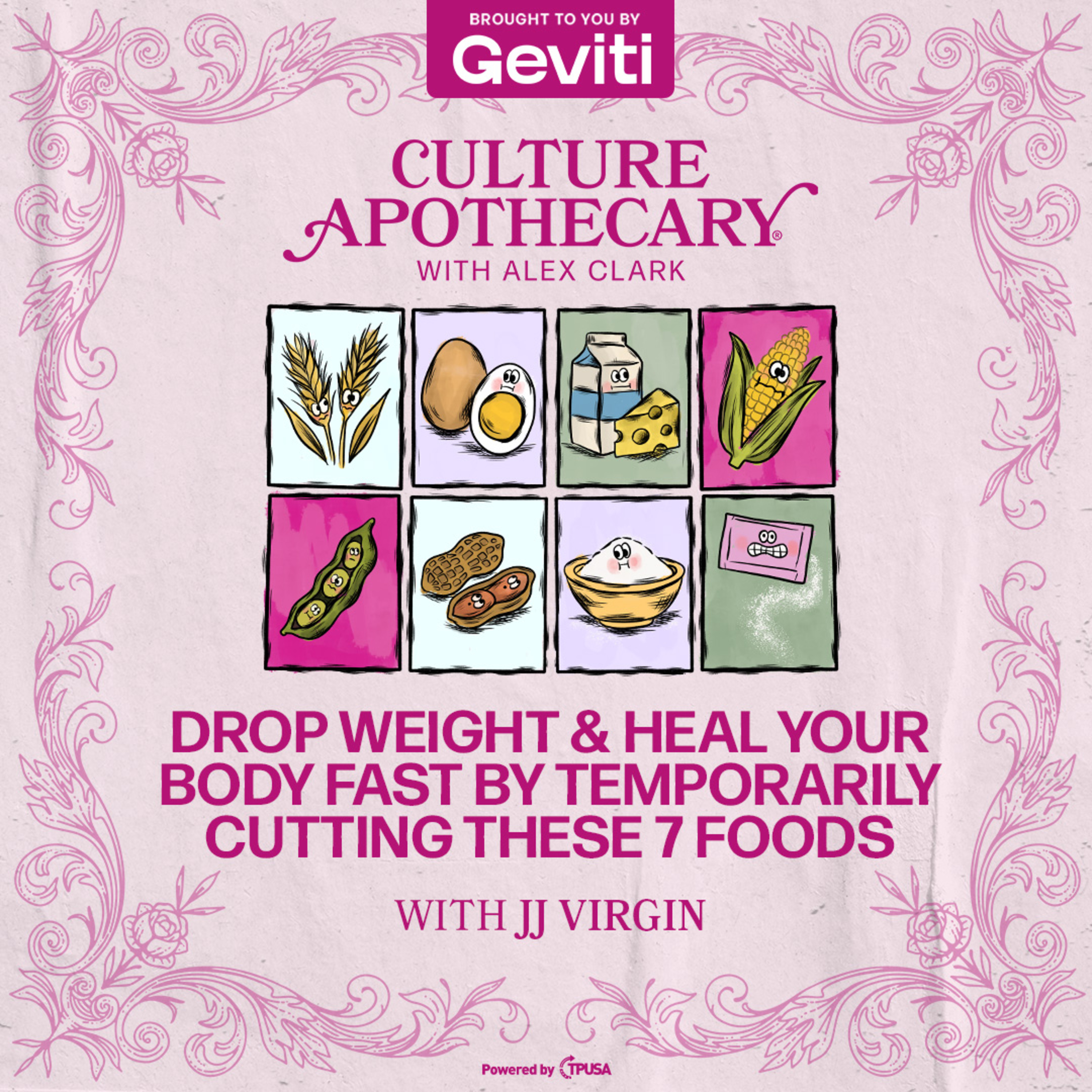
Culture Apothecary with Alex Clark
Drop Weight & Heal Your Body Fast By Temporarily Cutting These 7 Foods | JJ Virgin
01:05:34
Loading summary
Transcript195 lines
- [00:00]
A
What is the most underrated health metric, especially for women?
- [00:04]
B
We have been looking at the wrong metric and I'm talking about the scale. They've been stepping on a scale trying to control their weight and be smaller instead of looking at what that weight is made up of. We should actually never try to lose fat until we first focused on taking a muscle first approach and putting on muscle. If you're trying to lose body fat and you don't have your detoxification pathways going well, you are going to put yourself in a whole world of hurt.
- [00:30]
A
Is calories in versus calories out a lie?
- [00:33]
B
Your body's a bank account, Your body's a chemistry lab, and your body is a history book. I mean, you could lose weight on a Twinkie diet. What's your metabolic health look like? What's your skin look like? That's not looking very good. It's what we eat and how we move. If you want to be powerful in your life, with your family, if you're in your work, show up powerfully in your body. The way you do one thing is the way you do everything.
- [01:17]
A
What if just taking a break from seven everyday foods could help you drop stubborn weight, calm inflammation, clear your skin, and even reboot your energy in just a few weeks? That is the bold promise of today's guest, JJ Virgin, a celebrity nutrition expert, four time New York Times bestselling author, and the powerhouse behind the Virgin diet. JJ has helped hundreds of thousands of people uncover hidden food intolerances that sabotage weight loss, wreck gut health and drain energy, often without them even realizing it. She's been featured on Dr. Phil, the Today Show, PBS and more. And she's here today to break down her controversial drop seven foods method. Why it works, how to do it without losing your mind, and what really happens when you re introduce those foods. Watch this interview on the Real Alex Clark YouTube channel or culture Apothecary on Spotify. Before we start though, please pause, leave a five star review to support the show and tell everyone which episode is your favorite. Shop merch@tpusamerch.com code Alex Clark will get you 10% off. Follow the show at Culture Apothecary and find me at real Alex Clark. Please welcome celebrity nutrition expert and New York times bestselling author J.J. virgin to culture Apothecary. You figured out that there are six, seven food types that are really causing issues with inflammation, your inability to lose weight, fatigue, mentally. What are these seven foods?
- [02:34]
B
I know. Don't you want to know that when we put that on the COVID When I see them in the bookstore pulling it open just to find the seven foods. The reality is, I never planned to do that book. That book sort of found me because I was teaching how to use food sensitivity testing in doctor's offices. And I noticed that the same foods kept showing up on these food sensitivity tests. And they were very key ones. And it was interesting because what would happen is we'd send someone out after they took a test, and while we were waiting for the test results to come back, I just started pulling these foods out and they'd come back and they'd feel so much better. And then I'd have them just trial them anyway. And I thought, we don't even need the tests. So these seven foods first showed up in these tests, and then I verified it by doing it using your own body's testing lab. And so here they are. And there's one that was an add on for a reason. The first one is gluten. Now, this is tested a different way, but gluten actually makes your gut more permeable. And part of it is when I was looking at this later. Cause this was when I first started doing this was 14 years ago. Now I'm questioning, is it the gluten? Because we hybridize our wheat here, we genetically engineer it to make it more gluteny, as if it wasn't enough, right, to be able to farm more of it. But we also spray it with glyphosate. So you wonder what really is damaging the gut. But we know gluten does make your gut more permeable, which sets the stage for these other foods to have problems. The next one is dairy, and then it is eggs. And this was really a bummer to me because I think eggs are one of the greatest foods. But there's a little caveat to this. So. So eggs and dairy, and then corn, soy, and peanuts. Of course, we know these are highly sprayed crops too, and peanuts are one of the ones that tend to be moldy. The seventh food I added the food group was sugar and artificial sweeteners for two reasons. First, because I started pulling all those foods out. And you know what, if you pull those foods out and you don't give people great swaps, do you know what they do? What they eat? Sugar. Who would have sunk it? I mean, I never would have thought it because I don't have a sweet tooth. But then also, sugar and artificial sweeteners can disrupt the gut microbiome, which we now know. So we know that artificial sweeteners can Kind of wreak havoc on the gut microbiome. And it turns out that fructose can also make the gut wall more permeable. And a lot of what's happening when we're reacting to these foods is because of our gut immune layer, that one layer between your gut lining and your immune system. When it gets leaky, these foods, if they're not well digested and you're eating the same foods all the time, come onto that, into that immune system, and your body launches an immune attack.
- [05:11]
A
Well, here's my question. How do you distinguish between a true food sensitivity or a food allergy, especially in those seven foods? And then when is medical testing necessary?
- [05:22]
B
Right. So a food allergy is different. There's something called an IGE and an igg. This is a very different type of reaction. And when we were working on this, we're like, what shall we call it? Shall we call it an intolerance? Shall we call it a sensitivity? Because everyone knew allergies, but they didn't know about this. The reality is allergies are rare. Sensitivities are very common because of that issue with leaky gut. And if you think about all the things that can make your gut more permeable, leakier, I mean, I talked gluten and sugar. We know a lot of the different types of pain medications do it. But the biggest culprit is stress.
- [05:59]
A
How do you know if you have leaky gut? What is that?
- [06:02]
B
So there's actually a way you can test for it. You can look at something, something in a lab test called zonulin. So it just, it's seeing if your gut's more permeable. But here's the reality. If you tend to react to foods, if you're gassy, bloating, joint pain, headaches, fatigue, it's a sign that this could be an issue for you. So the other way that you test is you do one of these food sense to be tested and different than, you know, when they do the pricks all over your back to see what, what you're reacting to for an allergy, this is different than that. This isn't, oh, you open the peanuts on the plane and the poor kid's got to have an EpiPen. And this is a delayed reaction. And that's the problem. You eat something and an hour later, up to a day later, you might have a reaction. So you don't connect the dots between what you're eating and how you feel. So it's very different. So you can either do a food Sensitivity test, which can tell you if you're highly reactive to something. And that was what I was doing. I was teaching doctors how to put this into their practice. And I'm going, we had an elimination dye that had been used for 40 years in nutrition. I'm like, why are we making it complicated? We've got like strawberries and citrus and all the things. When the reality is it's these most common seven. And then you think about ultra processed food. What are ultra processed foods made out of? And likely it's been over the last couple decades when we've really gone fat free and started to really like lean into all these ultra processed foods that we ate. More corn, more soy, more dairy, more eggs. And it isn't saying that there aren't some great foods out there. Like if you were eating like a really great organic miso or pasture raised eggs. But generally you need to heal your gut first and pull out those offenders before you start to reintroduce them. So you could either do a test or I think the easiest way to start because it's going to be shorter than waiting for the test to come back and it doesn't cost any money, is just to pull the foods out. Give yourself at least three weeks, heal your gut while you're doing that with things like bone broth, and then go in and start trialing the foods one by one.
- [08:07]
A
See, and this is what I always say, and you can tell me, you're the expert, if, if I'm right or wrong. But when people ask me, well, how do I know if I have a leaky gut? What should I do? I mean, I feel like the majority of Americans have leaky gut. Because the, the fact of the matter is you're getting that from ultra processed food. And 70% of the standard American diet is ultra processed food. So I'm like, almost all of us have leaky gut, some worse than others.
- [08:26]
B
And stress, come on.
- [08:27]
A
And so why is leaky gut such a problematic thing? Like when you have that, what is going on when you're eating these foods to your body?
- [08:34]
B
All right, so what happens is, remember you have that, that single layer. So you have your gut and your immune system. You're eating these foods. Now ideally, you're eating these foods, they're getting digested well and then they're getting absorbed and they're going to where they need to go. What happens this way is they're, they're first of all not getting digested well. Most of us aren't chewing well. We might have low Stomach acid. We're not digesting our proteins. Well, now they're going to go into the immune system where the immune system thinks that they are foreign invaders. And so what it does is it launches an immune attack on them. And you create these immune complexes from the food plus the immune system. If you just ate a little bit, your body could get rid of those. But if you eat more of it or all the time, your body has to deal with it and can't get rid of it enough. So it will end up in your joints, it will end up giving you gas and bloating. And so the most common things, again, joint pain, gas and bloating, fatigue, headaches, skin issues. But the big thing that's the issue is the chronic low grade inflammation.
- [09:37]
A
Yeah, right. And what is that? What is inflammation? I know these are basic questions, but I always try to give info for the beginners.
- [09:44]
B
Here's the thing, because I think everyone says I feel inflamed. I'm like, know how you. I have one way that I can tell if I feel a little inflamed and if I eat gluten, I will have, I can feel it in my fingers the next day. And that's a very overt. But it's just that low grade achiness that you might feel in your body. And the challenge is it's kind of like the crabs in the boiling water. It happens so gradually, you're not even aware of it.
- [10:09]
A
To me, it's like I'm just not operating on all cylinders and I don't even think you notice it until you are eliminating these things and then you're like, oh, whoa. Like I feel sharper, I feel less tired. I didn't know that you were supposed to feel so sick and tired all the time. You know, I think that's where you notice that you had inflammation and things you were struggling with is when you finally get rid of it and you don't have it.
- [10:32]
B
Exactly.
- [10:33]
A
Because when we live with this every single day for years and years and years, right. You just think it's normal because you're used to it, but it's not normal.
- [10:40]
B
Don't you think most people have no, no idea what feeling good really feels like? Because if they knew what feeling good really feels like, they wouldn't be doing those things because go, I don't want to feel like this.
- [10:50]
A
Oh yeah. And in America especially, I feel like we have this problem more than anybody else. I mean, it's so crazy. We're spending more on healthcare than anyone else. And yet we're sicker than everybody else.
- [11:01]
B
Yeah, it still blows my mind. Now here's the interesting thing, because when I wrote the Virgin Diet, it's crazy to think this, that it was just what, 14 years ago, 15 years ago, I really started to work on it and then published it in 2012. But there wasn't the big spotlight on ultra processed foods back then. Like, we had them, but it wasn't as much in the zeitgeist of like, wow, we're, you know, 70% of the US population and I don't know if the stat is that 70% of our diet is ultra processed food or I.
- [11:35]
A
Think that's right under it. It's like 67.
- [11:37]
B
Yeah. Where you go to the to. I think we were in Spain last summer and they said it's about 20 to 30% in Spain.
- [11:43]
A
Yep.
- [11:44]
B
So. And you can just see the difference physically in people.
- [11:47]
A
And do you think also, I mean, with Spain being the example, that they have more access to their local farmers and, and it's just more culturally acceptable to do farmers markets and things like that. And in, you know, in France, for example, it's like daily or every other day you're going out to get your bread fresh. Like in America we have, we have prioritized convenience over everything else. And it's like we have to have everything in these big box grocery stores. Things have to be sprayed with certain stuff and everything to, you know, and shelf stable and things like that to last in these trucks going multiple days across the country. I mean, in other countries I feel like they're not waiting so long to get their fresh food. It's just better quality when you're able to eat locally and in and get it quicker straight from the vine.
- [12:28]
B
You know, I know we feel like we progress so much and actually we've regressed here. I had a great nutrition mentor early on who said, you want competition for your food. If you can set it out and the bugs don't want it, there's a problem.
- [12:40]
A
Wow.
- [12:41]
B
Right? We've done, done so much to extend shelf life. You do actually don't want foods that have big shelf life. But I think back we were in London last year and we walked into a grocery store and Tim said, are you seeing this? And I'm like, what? You know, what am I supposed to be seeing here? What he was seeing was what was missing. We're in the grocery store and we'd go way back into the corner to see where they'd put all the ultra processed foods.
- [13:06]
A
Yeah.
- [13:06]
B
Everything was fresh. There was all the refrigerators, all the producers. So I love going to different countries and seeing how they do all their groceries. I think it's even bigger than just okay, they've got better access. What it also is is they actually take time for meals.
- [13:23]
A
Does that really make a difference? Taking longer to sit and enjoy a meal? What does that do for our physical health?
- [13:29]
B
Way back in the day, I was a personal trainer and I literally would have like, my first client would start at 5:30am and I was like going in between clients all day long and then rushing to grad school and rushing back. And so I just had a cooler in my car and I would stuff my face in between clients. I mean, the worst possible thing that you could do and under stress and in traffic, well, think about just if you were under stress and eating fast. And we know one thing that you can do just to improve weight loss is to chew more. That simple act. I had to unlearn the habit of the speed eating habit that I'd acquired from being a personal trainer and eating in between. In between clients. It was craziness. But yeah, think about it. You sit down, you would, you know, say grace, do whatever you need to do to bring it down and then eat your meal. You're calm, your cortisol is balanced, you're not. It's like ah, where you can't really digest. Well, it would make a big difference.
- [14:29]
A
I used to wear deodorant for a major brand. It had aluminum in it and I thought maybe that's fine. But then I read that aluminum is also used to build airplanes and I don't think my armpits should have the same structural integrity as a Boeing 747. So I switched to Zebra. Their deodorant is clean. It actually works. It smells amazing and it doesn't go on like you're rubbing drywall spackle into your sweat glands. And you can choose a version with or without baking soda depending on how emotionally fragile your armpits are, which I respect. They also make toothpaste tablets, which are tiny, chewable, foamy things that kids really love. I tried one and now I brush my teeth willingly. That's good news. Also, no fluoride, no hydroxy appetite, no powders that make your bathroom look like a cocaine scene and Breaking Bad. So if you want to smell good, brush your teeth and not absorb plain parts into your body. Go to yay zebra.com use code Alex at checkout for 10% off. That's yay zebra.com code Alex. Here's the deal. If you're over 30, your body's already filing retirement paperwork behind your back. But with Jevity, you can actually fight back. We're talking advanced testing like the GI map, Dutch test, nutrient panels, hormone balancing peptides, the kind of stuff that they don't offer at your local strip mall med spa. You're not just slowing aging, you're outsmarting it. You're optimizing energy metabolism, skin, hair, brain, everything. You're turning your body into a finely tuned machine, or at least one that doesn't crash after walking upstairs. And you can order everything through their online marketplace like a very bougie Amazon. But for not dying, go to go, use Code alex to save 20% on your entire first purchase. Again, that's gonna code Alex to save 20% on your first purchase. To get blood work tested from home, over 90 biomarkers looked at in a personalized health plan with a personalized health team. What is the most underrated health metric, especially for women?
- [16:21]
B
Here's where we got it all wrong. We have been looking at the wrong metric. This is the thing that drives me crazy. And it is, it has hurt women's self esteem, self worth, but it's also just put them into a place where they're following the wrong set of rules. And I'm talking about the scale. I think one of the most important things we can do is ditch the traditional scale. So where women have really got it wrong, it's they've been stepping on a scale, trying to control their weight and be smaller. Instead of looking at what that weight is made up of, if we could flip it over to using a bioimpedance scale, and I did this early on in graduate school. One of the classes that we took was all body composition. We had to do underwater weighing, which is the most awful thing ever, and skin folds and all of these different things so that we could really get clear on how to identify what someone's weight's made up of. We have so many better tools now. I mean, back then I had to drag all this stuff around and do skin folds and all that. Now you can do this at home for like a hundred bucks. But if you could every day identify and use a trend line, you would never use one day's weight as an indicator. But if every day you're looking at a bioimpedance scale and you're looking at your total body water and your fat free mass, and once a week you take the trend of that and you also look at your Waist to hip measurement, you could get a very clear picture of what's going on with my muscle mass. We should actually never try to lose fat until we first focused on taking a muscle first approach and putting on muscle and also knowing this is like this missing piece here. If you're trying to lose body fat and you don't have your detoxification pathways going well, you are going to put yourself in a whole world of hurt because you store all of your toxins in your fat. And if you free up fat and you don't have a good way to get that those toxins out, you're making yourself worse.
- [18:14]
A
So to just. I want to make sure I know what you're talking about and that the audience understands. Are you talking about making sure that you're pooping and peeing, that you're sauna, like making sure you're sweating, that you're. If you're talking about making sure your detox pathways are working, like making sure all that stuff is going on.
- [18:30]
B
So that's a good part of it. So yes, poop, pee, sweat, super important. I love sauna. And if someone can't get a sauna and they have those saunas now that you can just get the zip up.
- [18:40]
A
Ones, oh my gosh, I'm obsessed with those. They're fantastic. I have that and they're not sponsor but I have the higher dose sauna blanket or whatever. You can just get in, in your living room or on top of your bed or whatever. And people are like, ew. Won't let get all sweaty and nasty in there. Not at all. And it doesn't come out and it's super hygienic.
- [18:56]
B
Yeah. So there's those options. There's also a hot bath that works too. A hot bath with Epsom salts. So really you can do this at any budget. And I think that's important too because I always want to take out the excuse the. So I don't have to. I can't afford a sauna, so I don't have to. It's like you need to sweat, you can dry brush. But a lot of it is also making sure that you're eating fiber rich foods, you're getting polyphenols, all the different colors from the plants and that you're also eating protein because we need to free up the toxins, which is some of that's like caloric restriction. And you know, because you've got to do stuff to burn, get the fat going. Right. But then you have to get it out and you actually need protein to help you eliminate toxins.
- [19:38]
A
So people think, I want to lose weight, that means I have to start eating less. And really, are you saying you need to be eating more? Specifically, more protein.
- [19:47]
B
All right, let's do the algorithm for if you wanted to lose fat. And let's really distinguish, like, do you want to lose weight or do you want to lose fat? Because when we talk about how the scale is hurting people and this actually happened, I was on the Dr. Phil show for two years as their weight loss challenger nutritionist, and we had a contest. And I saw this play out in real life. It was the greatest thing to see because then I was like, now I can talk about this and teach this. So we had a contest and we divided them into two groups. And the group that lost the most weight over that month, they all got to go to Canyon Ranch. And so there was this battle. Well, the day before the weigh in. Now I was using a bioimpedance scale that looks at total body water. Total body water is a proxy for your fat free mass. And fat free mass is everything but fat. The biggest modifiable piece there, of course, is going to be putting on muscle. Right? But if you're dehydrated, it actually looks like you've got more. More body fat. If you're super hydrated, it looks like you've got more muscle. So if you're dehydrated, I can tell. Right, okay. So the day before the weigh in, they all go, they do not eat, they do not drink, they're on the treadmills in the hotel gym all day, just walking. And then they go into their bathrooms at night, they crank up their showers, they put towels under the bathroom doors and they sweat. They come in the next morning. It's like a boxer weigh in. Right? And they do this weigh in. And I'm looking and I'm like, oh my gosh. Like, they are all so super dehydrated because you can see it in the total body water on the scale. They all lost weight. But here's the crazy thing between the two groups. Their group won the Canyon Ranch challenge by one half pound total. The other group actually had won.
- [21:33]
A
Right, Right.
- [21:34]
B
But they, we hadn't said they couldn't do it because I never was, I never thought so sneakily that, like, you know, who would have thought that? But it's important to think about that because why I brought that up is if someone is trying to lose weight, well, the best thing you could do is just do a bunch of low grade cardio Starve yourself, right? And you know you'll lose weight, but it'll probably be more muscle than fat. And that's what's happening a lot with. If someone doses a GLP one incorrectly and then doesn't have someone lifting weights and eating protein, they'll lose weight, but it'll be a higher percentage of muscle which devastates your metabolism, devastates it. It gets you on that yo yo where you can never come off because once you, once you get off of the diet, your body wants that muscle back on. You're hungrier than you were before, but the weight gain generally is more fat. So now you've shifted your metabolism in the wrong direction. So I always want to say we want to lose fat, right? We don't want to lose weight. You actually our goal really should be especially as women to hold on to or build as much muscle mass as possible. Because it's a really, really hard thing to do. Do your body composition, not your weight, know what your weight's made up of. That's step one, then step two. I always believe in diet we're better to add before we take away. Like the first thing I like to do is optimize protein intake. So I optimize protein intake based on what you want your body weight to be. So if you said I want my body weight to be 120, I would make your protein intake somewhere in the 0.7 to 1 gram per pound of that. So at the max would be around 120 grams. I'm not really worried about someone eating too much protein because we tend to undereat it. The reason I have someone do that first is if all you did was start to increase your protein, you'll actually start to eat less overall because it's more thermic, it's more satisfying, it's more satiating, right? And so that's the first step. Then the next step is to really focus on getting in that fiber from all of the, the different fruits and vegetables, like 2 servings of fruit a day, lots of non starchy vegetables and a little bit of slow low carbs. Well, hydrating. Do you know that if you are just even mildly dehydrated, it actually makes you take the carbohydrates stored in your liver, free them up, convert them to fructose and store them as fat.
- [23:58]
A
So really some people that are struggling with not being able to lose weight, it could be you're dehydrated, it could.
- [24:03]
B
Just be your mildly so mild dehydration. We're not talking much. And that's why it's also great to use a bioimpedance scale for total body water. But we tend to under under hydrate as well. And I Learned this from Dr. Rick Johnson, who's this amazing scientist, a nephrologist. He wrote the book Nature wants us to be fat. And that's where I got this from. He's like, yeah, just mild dehydration. Now I knew that mild dehydration will raise cortisol. And the big challenge is we don't have a great thirst thermostat. Like we have a great one for hunger. It's overworking. And the thirst one is underworking. Quite often we're not even hungry, we're just thirsty. So that's the next place I want to make sure we're getting that fluid in. Especially water. Everything counts. We used to think that if you drank coffee it undid the water. It's like that's old wives tale. Everything counts. But making sure you're well hydrated and then also adding in lots of walking and non exercise activity. Thermogenesis. So lots of movement tracking with some kind of a tracker. And I have someone do that before they start to focus on their exercise. Because if you have someone start the exercise before they're really dialed in their neat, they'll steal from it. They'll tend to move less, they'll go to the gym and then sit the rest of the day.
- [25:20]
A
That makes sense actually to me I feel like I do that.
- [25:24]
B
We all do that. I had a long term client who has worked out her whole life. She does resistance training, she does hiit training. And then I brought her through one of my new programs and had her start tracking. She goes, oh my Gosh, I'm getting 4,000 to 6,000 steps a day. Like I go to the gym and then I sit the whole rest of the day. And we now know that you'd be better off doing small bursts of exercise. There was a study that came out that showed that people who do four and a half to ten minutes total of this little vigorous intermittent lifestyle physical activity, it would be like us doing, you know, a minute or two of air squats. Right now they have 30 to 40% lower cardiovascular disease risk, lower all cause mortality risk just from doing that. Like let's say if you just went, okay, I'm super busy so I can't work out. Which is a. So I don't have to excuse. Let's call it what it is. You went instead of that. I'LL do air squats after breakfast, I'll do some push ups or jumping jacks after lunch. You know, you just figured out what you could do. One to two minute bursts throughout the day. That alone would have such an impact on your blood sugar and your metabolism. So I always start with neat. It's the biggest modifiable thing we can do for our overall metabolism. Everyone wants to speed up their metabolism. I'm like just move more.
- [26:35]
A
That is so fascinating and helpful and I've not heard anyone give that advice on this show. So I really like that. What was your rock bottom moment that really made you question everything in regards to nutrition and health?
- [26:45]
B
Health. I've had so many questioning ones along the way. You know, it was interesting. I. I've grown up in so many different diet trends. When I was in my teens, I'm trying to think of which, which one really devastated me. The one that was the hardest for us, I would say and for me was when the whole world went fat free.
- [27:05]
A
Yeah.
- [27:06]
B
I was like, I think you're a little young for the fat free movement.
- [27:09]
A
No, I mean I know it because it was 90s so I was little. But yeah, I remember, you know, the older women in my life being like buying boxes that said fat free and all that.
- [27:17]
B
Snack balls. Yes. Fat free cookies. Oh my gosh. So I was in LA during that time. So I, I was in LA in the 80s and 90s and in the 90s everything flipped to fat free stopped the insanity. There was this gal Susan Powder who was out, you know, super fit. No one was eating any fat. And I take things to extremes usually. So I was having about 10 grams of fat a day. Plus I was a vegan.
- [27:42]
A
Oh my gosh. Were you so sick?
- [27:45]
B
I was like I, I. Thankfully someone intercepted before I totally went down.
- [27:49]
A
Yeah.
- [27:49]
B
Because here I am. So. Because I was also training people at this place called the Pritikin Center. And the Pritikin center had these amazing results for people who had major cardiovascular disease. They would bring em in for a month. They'd actually live there. They'd put them on a low fat, high carb diet and they'd have them do loads of cardio.
- [28:09]
A
Geez.
- [28:10]
B
And they'd give them fish once or twice a week but the diet was 10% fat. Lots of cardio. They had this amazing weight room. That's where I was taking everyone. But no one used it. They only used the cardio equipment. They'd have all these treadmill classes and they'd flip them around in a month. But I think the important lesson there is a diet that might turn you around is not the diet you need to be on forever. The diet that heals you, saves you, might not be the diet that's going to sustain you. And these were people coming in who'd had, like heart attacks, but they'd been eating complete garbage, you know, the standard American diet. So anything was an improvement from what they were doing. And now people think that this was what had saved them. Well, here I'm seeing all this. I'm like, all right. And I was in graduate school for exercise science, not nutrition. It's always been crazy to me that you have the exercise science department and the nutrition department. They're like completely opposite worlds. So I start taking this on. I'm like, totally doing the vegan thing and the low fat thing. So what's left? All you're eating are carbs, right? Like, and do you know what the craziest thing? I was starving all day long, which is why I said I was a personal trainer with this cooler in the car, because I was literally dragging food with me all day long. But it was things like fat free bagels, fat free muffins, still carbs, total carbs, fat free frozen yogurt, maybe I got a smidge of protein there, you know. But then, because they had the soy one, right? Because I was vegan too. And I remember one of my clients was a doctor. And I just kept going, getting worse and worse. Cystic acne, my body fat, which I am one of those people who's just a kind of a genetic freak of leanness. Like, generally all through my 20s, I was 10. Body fat, normal periods, it just, it's more my normal. I was then in graduate school. We were doing all the body composition testing, 25% body fat, and I gained like 10 pounds. I hadn't gained something excessive. I'm losing muscle. So that's what that's telling you. Losing muscle, gaining fat and cystic acne. I feel horrible. And one of my clients, the doctor goes, you can either go get a chicken or I'm going to put you in the hospital because you ran my last. Good for him. I remember I drove immediately over to like the convenience store chicken. But it took a while to get back from that.
- [30:33]
A
So then you had to start looking into everything and basically relearning everything.
- [30:37]
B
Yeah, well, then realizing, wait a minute, what if everything that I've been reading, seeing, hearing is not true? Like, I remember going to a workshop during that time where they literally taught us that we could get all of the nutrition that we needed from a potato. From a potato. And I remember the woman teaching it, she was a registered dietitian, and she kind of looked like a potato. And I'm like, you know, I was like, what is this? We're all kind of scratching our head going, this couldn't be right.
- [31:03]
A
I. I'm concerned when, like, the people giving the health advice do not look healthy.
- [31:07]
B
Oh, I know.
- [31:08]
A
Are there any of the seven foods that are more sneaky, like, hidden in food in ways that people wouldn't expect?
- [31:14]
B
So it was interesting. When I first wrote that book, there really wasn't the gluten free craze that there is now. I wrote that book and then wheat belly, that book, and grain brain all started, all came out around, you know, in the first year or two, and all of a sudden there's all this stuff. So I think there's two pieces to that. Question number one, just because something says gluten free doesn't mean it's a health food.
- [31:36]
A
Yes.
- [31:36]
B
Like, the reality is it shouldn't have to have a gluten free label. It shouldn't actually have to have a label. Right, Right. So there's the caveat there it is wild where they sneak in things like gluten and soy that have no business being there. Putting wheat flour on steak, putting wheat flour on french fries. I mean, french fries are just little, you know, oil sponges anyway. But things like that, that you wouldn't think about where they'll use it to stabilize, to thicken, to make things crunchy and taste better. And then you have to really watch the labels because we wouldn't want to have, you know, MSG anyway or, but like autolyzed yeast extract. A lot of time has soy or gluten in it. So I think the bigger answer is there. We really need to unprocess our diet.
- [32:24]
A
Right.
- [32:24]
B
That's the key takeaway. When I wrote that book, what I found was everyone started to try to find processed foods that were healthy. I go, that's not the point. And that's when I started to work on what we call lateral shifts. Like, here are some other things that you can do. Like instead of having a burger on a gluten free bunch, just have a burger in a lettuce wrap.
- [32:40]
A
Right, right.
- [32:41]
B
You know, instead of having pasta, I mean, cauliflower rice is like the greatest thing that's ever happened.
- [32:49]
A
Imagine marrying someone, years of dating, shared dreams, family vacations, and then one day you roll over in bed and feel crumbs not metaphorical ones. Real crumbs from chips. Because your soulmate eats snacks in bed like a wild raccoon. Now imagine those crumbs weren't even worth it. They were seed oil soaked sadness crisps made from ingredients that they don't allow in certain countries. That is why I'll only allow masa chips in my bed. These chips are the gold standard of snacking. Made with three ingredients. Organic corn, sea salt and 100 grass fed beef tallow. No seed oils, no mystery chemicals, just delicious crunchy anti inflammatory greatness that won't destroy your metabolism or your marriage. And because they're made with tallow, they're actually satiating. You eat a few and you feel great. You're not sitting in bed at 2am like some chip goblin with orange fingers. Tens of thousands of customers are hooked, including actual health experts like Ben Greenfield and Gary breca. Go to masachips.com and use code real Alex Clark for 25 off your first order. That's masachips.com code real Alex Clark for 25 off YOUR first order. Okay, here's what happened. I sprayed primally pure sleep spray on my stomach and I swear I time traveled. I rubbed it in like the Pillsbury Doughboy and then boom. Asleep, gone, spiritually evacuated. I even did that little laugh. I woke up nine hours later in the exact same position I fell asleep in. Arms crossed like a vampire. No drool, no 3am existential dread, no spirals about taxes or microplastics. No, actually, my arms weren't crossed like a vampire. I lied about that. I was just on my side like a little kitten. This is not normal sleep, people. This is primally pure sleep. Powered by actual lavender blue, tanzy in ancient calming. No chemicals, no synthetic garbage made in a factory where they also make car wax and antidepressants. Bethany, the founder, she's a mom of three who used to rub acid on her face like the rest of us and said, hey, maybe I should try something that doesn't make my skin look like a haunted doll. Now she's glowing, thriving, probably getting 12 hours of uninterrupted REM like it's her full time job. Primally pure is the real deal. Thousands of five star reviews, ingredients that you can pronounce. So if you're ready to sleep deeper, calmer, and possibly have visions of your ancestors herding elk. Just kidding. Visions and dreams are not normal. Okay, go to primarilypure.com that's P R-I-M A L L Y P-U-R-E.com use code Alex Clark for 15 off again. That's primally pure.com code Alex Clark. Rub the sleep spray on your tummy and put it on the bottoms of your feet. Do the laugh and float into another dimension of sleep. When people start eliminating these seven foods, how long should they eliminate them for?
- [35:31]
B
So when you go to pull these seven foods out, this is really important. And I want you to think of if you were sitting on 7 tax right now, how would that feel?
- [35:38]
A
Uncomfortable.
- [35:39]
B
Uncomfortable. Now, what if we said, okay, you know what, stand up, I'll pull six tacks away, sit back down, still would hurt. So the important thing is you don't get to choose. You don't get to say, you know, I'm going to pull out everything but dairy. And usually whatever food you say, I'm not going to pull out. That's the food you actually need to pull out. It's the one you go, I'm not giving that one up. Right. And even if it's just a little bit every day, that can wreak the havoc. It's like a little bit of gas on a forest fire. So the first thing is you really need to pull them all out. And you want to do that for at least three weeks. That's important. I have a little quiz in the virgin diet that tells you, like, how likely this food intolerance is. And the higher the score is, the more you feel things like gas and bloating and joint pain and headaches and fatigue, the more likely it is. This is really an issue. And the longer it would be. It would be good for you to heal your gut. And so in a perfect world, I'd say, hey, if we could go forward six weeks, even better. What I found is once someone pulls these foods out at some point, three, four weeks, eight weeks, I want them to go back and do the food trials to connect the dots, to see how they feel, to see if this should be worked into their diet or not. What I found with the virgin diet, because it was really meant to be a discovery process, not a diet, right? But people are like, I feel so good. I just kept them out. That's actually not the point because I want you to know how you feel if you eat them. So if you do happen to eat them when you're out, you don't end up going down. So I was in Las Vegas to speak for a 4M and I went and had sushi with some friends. Well, I didn't even think about it. Someone ordered a spicy Sushi, something. It had mayonnaise on it. And I had pulled eggs out and I hadn't retested them. And I ate this little thing with mayonnaise on it. And it was like I was having, you know, Sigourney Weaver and Alien, like the things. It was so painful. And quite often now that you don't have those antibodies around to protect you, you will have a very fierce reaction if it's not working for you.
- [37:44]
A
Okay. Yeah.
- [37:44]
B
So you have to give yourself. When you're retesting food and you only do one at a time because otherwise you don't know what just happened. Right. You can't go have a pizza.
- [37:51]
A
Right.
- [37:52]
B
It's important to go one by one. And you want to give yourself four days because it may take a day or two or three to build up. Remember, you're eating the food it's going in, and then your body will either create these immune complexes, these antibodies to it, or not. If it does. Sometimes it takes a little bit for these immune complexes to build up. That's the food and the antibody together. But generally you'll feel it right away. But maybe it's a couple hours. You're all of a sudden tired. I had a girlfriend who said, I eat eggs and. And they just knock me out in an hour. So if I'm going to do a long flight.
- [38:27]
A
Yeah.
- [38:28]
B
She uses eggs. They're her ambient. Right. It works great. So you do them one by one and it's. You do four days. So do three days. If you feel fine, wash it out for a day, go to the next food. I think we're better off not really eating gluten. Someone might be able to eat some organic sourdough because it's fermented.
- [38:48]
A
Do you feel any type of way about freshly milled flour?
- [38:52]
B
Freshly milled gluten flour?
- [38:54]
A
Yeah. Like taking wheat berries and. And freshly milling them with the flour.
- [38:58]
B
I would love to see it fermented.
- [39:00]
A
Okay.
- [39:00]
B
I think that would be better.
- [39:01]
A
Okay.
- [39:02]
B
And you also have to see, is this organic? Where was it farmed? I mean, the bigger challenge with the organic farming in the States now is, is can it really even be organic anymore with the water and the. It's. That's the challenge that I worry about.
- [39:15]
A
I feel like the absolute like if you can afford it and do it, is. Would be a regenerative organic farm would.
- [39:21]
B
Probably be the greatest.
- [39:22]
A
Yeah. That would be the best way.
- [39:23]
B
Someone fermenting for you, like learning how to ferment and do incredible yogurts and things like that so you know, if you can get great grass fed dairy and fermented yogurts, Greek style yogurt can be incredible. It just depends on how you feel with these things. I've found people can handle pastured eggs or sometimes it's a duck egg versus our factory eggs. Our factory eggs are a disaster. Think about what you are, what you eat eight. So it's not just enough that you're eating something, it's like if you're eating an egg from a chicken who's been cooped up, fed wrong, shot up with things, then you're getting what's in that egg.
- [40:03]
A
Should some people wait longer than 21 days to start adding in these seven foods back?
- [40:08]
B
If you are someone who's really struggled with GI issues, skin issues, it's not gonna hurt to wait longer.
- [40:16]
A
Okay.
- [40:16]
B
With the fat loss piece of it once neat's set. Because again, I've worked with clients who, when I start them tracking, they're getting three to 4,000 steps a day in. So we get em up to eight and then you add in resistance training. Once you've got resistance training going and that can be two days a week of 30 minutes, it actually doesn't take much, especially when you're not, if you haven't done it before, then you can start caloric restriction which could help you with that detox we talked about, right? Cause you're freeing up fat and then it'll help you hold onto that muscle because we've got resistance training and protein on board.
- [40:50]
A
Once you eliminate these things for 21 days, what is the next step?
- [40:54]
B
Okay, so at the 21 day mark, what I like you to do is get clear on those symptoms again. So in the book we have a little symptoms checklist and then at the end of 21 days, check in again. If you haven't seen a dramatic shift, maybe give it another week or two, then you're gonna start one food at a time. Now when I wrote the virgin diet, I had this order. I'm not so concerned about the order, I'm just concerned that you give yourself enough time for each one.
- [41:22]
A
Makes sense.
- [41:23]
B
Let's say you start with dairy and you do it and you feel something right away, you feel either bloated, your skin breaks out, you're tired, you get a headache, you're done. So the minute you feel anything, you stop. Now I had someone who pinged me and they go, well I, I tried dairy for three days. And you're not just adding it in, you're, you're taking Something else out. So you're still saying calorie neutral, right? She said, I added in dairy for three days and I felt fine. I didn't notice anything. My weight went up five pounds, and I'm like, yeah, okay, come on. Weight doesn't just go up. You didn't gain five pounds. You have some fluid retention. Something's going on here.
- [42:05]
A
So that's a sign. Something's off.
- [42:06]
B
That's a sign. If your weight goes up a pound or two and it holds, there's an issue here. So watch your weight, watch your energy level. Watch all the GI stuff. Watch your joint pain. Joint pain is a huge one. I had someone with chronic ankle tendonitis for a year. She'd been going to the physical therapist three times a week for a year. It went away in a matter of a week when she stopped gluten.
- [42:31]
A
Unbelievable.
- [42:32]
B
I know. It shocked me. I had someone with psoriatic arthritis who was on the horrible medications that were lowering her immune system. And she couldn't go. She couldn't do her job, which was. She was working at a school with little kids and reversed this. Like, come on. Like, no longer has to be on the medications. Not an issue anymore.
- [42:50]
A
Some people say, you know, I don't know that this list of 7 things goes far enough. Like, what about nightshades or legumes or something? Or other reactive foods.
- [42:59]
B
Right.
- [42:59]
A
Is there room for people to expand or customize this list further?
- [43:03]
B
Oh, sure. But here's the thing. I think that we just start with the biggest rocks.
- [43:07]
A
Okay.
- [43:07]
B
Yeah. So, yes, you might have something going on with histamines. You might have something going on with oxalates. It might be something entirely different that's going on with your gut. This is one thing to look at that's pretty easy to look at. And then if this doesn't get you to where you want to be, then you can do some advanced testing. I think stool testing is, like, one of the greatest things that everyone should be doing.
- [43:29]
A
The worst process ever, because you have.
- [43:31]
B
To dig through, which is why people don't want to do it. But you know what? There's now new stool tests that are simple as a little swab on a. On. On the toilet.
- [43:39]
A
Oh, nice.
- [43:40]
B
Yes.
- [43:40]
A
Well, that's the one I'd like. I need to see.
- [43:41]
B
Right. I know. Way easier.
- [43:43]
A
How long should somebody wait between reintroducing one challenge food and the next?
- [43:49]
B
Okay, Perfect world. Perfect here. Well, this is the way you absolutely must do it. And then there's. You can go a little longer.
- [43:54]
A
Okay.
- [43:55]
B
You start the food, you're going to do it for three days or until you feel something. So if you notice a symptom, right away, stop. But if you don't notice anything, you do it for three days. That woman I told you about who's like, I don't notice anything, but of course, like, day four, her weight's gone up like that. I'm like, yes, you didn't notice anything, but you've got some inflammation going on. Right? Because you didn't gain. You didn't gain five pounds by adding a little Greek style yogurt into the mix.
- [44:27]
A
Right?
- [44:27]
B
Now, here's the interesting thing, though. You can go deeper into all of this. So if you find that you react to cow's milk, you may not react to sheep's milk or goat's milk.
- [44:38]
A
I react to chicken eggs. I don't react duck eggs.
- [44:40]
B
Right. So this is really, really common. The other thing is, if you go through all of this and you're not getting your symptoms resolved, I would do an expanded IGG panel. What I see with people with leaky gut is sometimes it could be something like mold toxicity, right? Yeah.
- [44:56]
A
How do you know if it's the food versus something in your environment?
- [44:59]
B
You might fix the food and still have the issue. And that's where it's great to do some other testing. So a total tox test, stool test, so you can look and see what else is going on.
- [45:11]
A
Because you could have a parasite. Who knows?
- [45:12]
B
You know, it's nice to do these things to clear this out, because then you're like, all right, I know I've handled this piece of it, but, yeah, parasites. We work with a doctor who sends off your live blood and stool to a medical school in Africa and looks at all of this and then uses specific African plant juices to get rid of these different parasites. I mean, it is one of those things when you think about it, like, we should be really looking at all this as an annual. Would be great.
- [45:40]
A
If you reintroduce a food and you have a very, very mild reaction, but since you've gone without it, you can kind of notice a little bit of something. Is that okay, or should there be absolutely no negative reactions, period?
- [45:53]
B
See, I think that's where you get to make a choice.
- [45:56]
A
Okay.
- [45:56]
B
And that's.
- [45:57]
A
You have some agency here.
- [45:58]
B
Like, use some agency. So. So here's the reality. Like, I grew up right outside of San Francisco. My favorite food on the planet is San Francisco sourdough. Love it.
- [46:07]
A
Oh, are they known for. I've Never been there is that they're known for sourdough bread.
- [46:11]
B
That is right next to France. That is really. San Francisco is known for sourdough bread.
- [46:16]
A
Okay, well, I think I might be trying to go there to speak at one of our chapters or something in the new year. So if that's the case, you must have it now. I'm gonna do it.
- [46:23]
B
You must have it.
- [46:23]
A
Okay, so what bakery do I need to go to?
- [46:25]
B
Bodine.
- [46:26]
A
Okay.
- [46:26]
B
Literally every day after school growing up, we would stop by the store, my girlfriend and I, and buy a loaf of sourdough bread. She liked the inside, I like the outside. I eat that a loaf every single day. I love sourdough bread. Sourdough bread makes my fingers swell up. I can feel it when I do it. However, is that life threatening? It lasts a couple hours. It doesn't take me out for weeks. So if I'm going to San Francisco, you better believe that I'm going to go have some sourdough bread. I just know what I'm going to deal with. And I think we all know that, like if we went and ate, say, birthday cake or something, you're like, yeah, I'm not going to feel so great. It's a choice. Doesn't mean I actually worry more about people who've created so much. Like they've made themselves so precious that they can never have these things.
- [47:16]
A
Yeah, like you're in a prison.
- [47:17]
B
Like, I think we should go for a. If you were not feeling well, you need to go for an A on your diet. But once you're feeling great, get a B.
- [47:24]
A
How do you decide if something in the seven is something that you need to permanently get rid of long term or something that you can bring back?
- [47:33]
B
It's actually never permanent. Okay, so for me, when I was in Las Vegas and had the Sigourney Weaver experience with the, you know, the sushi and the mayonnaise, I was like, darn it. Cuz eggs are such a great, easy thing to travel with to get those little, you know, pastured hard boiled eggs. Anyhow, I didn't eat them for six months. It took me a long time to get back to them and heal my gut. And now I'm fine with them. I don't eat them every day, but they don't hurt me whatsoever. But I only eat pastured eggs. Same with dairy. It used to be that I would put a little bit of foamed up milk in my coffee. I loved it. And when I pulled it out, it's like skin went perfect. Lost a little bloat. I'm like, all right, but now. It took me a while, but now I can do Greek style yogurt, no problem. So if you heal your gut and then you keep it healed now you might have a situation you go through that creates a lot of stress that could cause some issues with your gut. And then you might notice that you're reacting again. It's not like you fix it and it's done. We're never done, right. Things can shift. And so it's a tool in your toolbox for if you go, I'm not feeling great.
- [48:41]
A
Yeah. So really the overarching thing is you're advising people. Learn your body and know how to pay attention to your body and read your own signs.
- [48:49]
B
It is a connect the dots between what you're eating and how you feel. Whether it's this, whether it's histamine, whether it's oxalates, whether it's nightshades, whatever it is. This is a tool that helps you start to pay attention to, oh, when I eat this, this happens. If it's extreme, I don't want to touch that. Maybe I'll test it back in six or 12 months. And in the meanwhile, like, we have so many great things to heal the gut, but the easiest things are things like bone broth, collagen, you know, just collagen powder. These things can be enormously helpful for healing the gut. So meanwhile, you're healing the gut if it was a stress contributor, because some stressful situation could happen anytime that could then take your gut out again. And I think the bigger message there is we are always going to be facing stressful situations. And if you look at the people who are the most successful, they've learned how to build resiliency to be able to handle higher levels of stress, because it just gets to be more so as we do bigger things in life.
- [49:53]
A
You ever get one mosquito bite so itchy, it becomes your entire personality for like 48 hours. People are talking about world events and you're just in the corner scratching your arm like you've been cursed. That was me until I used active skin repair. It's this spray with hypochlorous acid, which sounds like something the government made and they kind of did. But it actually mimics your body's natural healing process. It cleans, it calms, it fixes your skin without you looking like you just survived a poison IV obstacle course. It's all natural, non toxic, medical grade. And you can use it on literally everything. Bites, cuts, rashes, sunburns, breakouts. It's like the Swiss army knife of skin care. So if your skin hates the outdoors as much as I do, this stuff is a game changer. I'm joking. You know what? I'm actually getting a lot better about liking the outdoors. I really am. I used to not when I was younger, but now I really do appreciate it. Anyway, keep active skin repair in your purse or your diaper bag at all times. Trust me. Go to activeskinrepair.com use code Alex for 20 off again. That's activeskinrepair.com promo code Alex. Did you try that tick tock after midnight cheese challenge where you eat an entire block of cheddar at 3am Bet your skin paid the price the next morning, didn't it Jessica? Well, whether you have breakouts from stress or cheese binges, Adele Natural Cosmetics is here to soothe family run handcrafted toxin free skincare and makeup made in the usa. Adele is about clean beauty for every skin type. No weird long name chemicals, no nanoparticles, no patrol based additives, only safe natural transparent formulas. After the sun, salt, sweat or regretful snacks, you deserve a skin reset. Their ultra gentle cleansers, calming creams and lightweight moisturizers feel spa level luxurious. Adele is also known as for completely non toxic makeup low hazard products like eyeshadow and lipstick with stellar EWG ratings. Score 1. I am loving the lotion bar, perfect for dry irritated patches. And my best friend is obsessed currently with the facial stick which calms acne or eczema prone skin and restores balance naturally. Results speak fewer flare ups, less redness, calmer skin. Use code Alex at Adele Natural Cosmetics.com to get 25% off your first order. That's Adele Natural Cosmetics.com code Alex for 25% off your first order. Is calories in versus calories out. A lie.
- [52:05]
B
So I used to think that it was absolutely ridiculous and and you know the big thing I said was your body isn't a bank account, it's a chemistry lab. I have shifted it a bit.
- [52:17]
A
We love a queen who is open to changing her mind.
- [52:21]
B
I have changed my mind a lot. Think back to the vegan low fat days. The one thing I never changed my mind on was all the resistance training. I've always been doing that since 16. But I used to believe it was really that we were looking at it all wrong. That it was the hormonal impact it had on our body. What was it doing to insulin? What was going on with cortisol? Those matter there's obviously a difference between eating, say, boiled potatoes and potato chips or French fries. There's gonna be a metabolic difference there for sure. However, what I say now is your body is a bank account. Calories do count. I believe where they come from counts more, but they do count you too much. Healthy foods, unhealthy, you can gain weight and fat overeating. Now, if you overeat on protein, it'll be less.
- [53:12]
A
So, see, what I see that people get wrong, it seems to me, is that they're, like, counting calories and they'll be within their goal or whatever, but, like, they got every meal at McDonald's, right? That one versus eating real food, you know, within your calories. I feel like that's what you mean, where it matters, where the calories are coming from. Right.
- [53:31]
B
So your body's a bank account, your body's a chemistry lab, and your body is a history book. So calories count. Where they come from counts more. And it's a history book in that anything from stored trauma, right, to toxins, to mold, you know, toxins in the food, toxins in the air, all of that will matter, too. So all of these things come together and matter. And yes, you know, we all know there is such thing. You could lose weight on the Twinkie diet. I don't think there's Twinkies around anymore, though, right? I mean.
- [54:10]
A
Oh, yeah. Oh, you can get them at, like, a gas station.
- [54:12]
B
So they came back.
- [54:13]
A
I mean, they never been there.
- [54:14]
B
They never go. They never expire. So it doesn't matter. I think Twink. Twinkies live forever.
- [54:18]
A
Yeah, they've probably been there since the 80s.
- [54:20]
B
I mean, you could lose weight on a Twinkie diet. But what I'd love. And that's what people will talk about, oh, you can lose weight on that, but what's your metabolic health look like? What's your muscle mass look like? What's your insulin looks like? What's your cortisol looks like? You know, what do you look like inside? What's your skin look like? That's not looking very good. So it's not about weight. If we look at what your weight's made up of and the fact that we have got less than 7% of the population now that's metabolically healthy. I mean, if you look at the biggest shifts that have happened over this last several decades, it's what we eat. It's what we eat and how we move.
- [54:52]
A
What should the ideal weight training schedule look like? And what is the science on how, you know, Weight training for women affects and impacts inflammation and immunity and brain function.
- [55:03]
B
I just did a lecture at an integrative mental health conference on this. I was so excited that they were literally having me talk about muscle and exercise at a mental health conference. And what is in the research there is, it is the single most effective thing that you can do, both for mental illness and brain health. It's massive. So the reason that I like to have people do that non exercise activity first get it so that that's just part of what they do, like flossing their teeth. It's what they do. You sleep this many hours, you move this many hours. The next step is to do resistance training. That's the biggest focus. Women will tend to go, I'm going to go do cardio because I want to lose weight or I'm going to do Pilates. No resistance training. Why? Number one muscle is your metabolic spanx. So muscle holds everything in tighter and it's not huge, but it's significant. Over time it boosts your metabolism. So we have our resting metabolic rate and the only way we can really shift that is by having more muscle on. If you put on 10 pounds of muscle, it might be like 75 more calories a day. It's not significant. But we also had to work to get the muscle on right. We have to work to get it on, we have to work to keep it on. But also that muscle being on holds everything in tighter. Everyone says, I don't want big muscles, I want tone. I go, when you build muscle, that creates tone. That's what tone is. Right. Second thing that it is is it's a sugar sponge. So muscle gives carbohydrates a place to go because muscle has these glycogen stores in it. That's carbohydrate plus water. And that means that the carbohydrate didn't get converted to fat and get stored on your body. So it's a sugar sponge. Wow. It also is the fastest way for us to become more insulin sensitive. If we have elevated insulin, we have elevated inflammation. It's a big cardiovascular risk factor. And this is a way to quickly start to improve that insulin sensitivity. People will do a walk after dinner to lower their blood sugar response to the meal. I think it's fantastic. Helps with digestion. But if you want to quickly do that, that 60 air squats has the same metabolic effect as going for a walk. Hugely effective for that. And then the third thing that it is, and this is what I was talking about at that mental Health conference is. It is a multitasking messenger. And so what I mean by that is every time your muscles contract with force, they release this pharmacy, it's like this feel good pharmacy. You've heard of endorphins, it helps lower your inflammation, it helps boost your immune system, it helps raise bdnf. It's like miracle grow for your brain. All these amazing things happen. We know that exercise is more effective. Like it's as effective as an ssri. Same outcomes, SSRI therapy or exercise. Except it's more effective because the results last and it has no side effects.
- [57:55]
A
Yep. What is the minimum amount of time that a woman has to dedicate weekly to weightlifting or resistance training to see results?
- [58:02]
B
It's so not much. It's so not much. And this is what's so exciting. And you could do it at home. So that's what's great. It's not hours and hours and hours in the gym. It's doing the right things. And so if you had 30 minutes twice a week, or even if you took that and divided it to 10 minutes, six days a week, you could make a difference in your body.
- [58:25]
A
Wow.
- [58:25]
B
So your body, I divide it into four parts. I focus on three. It's upper body pushing. So that would be things like a push up. You can do a push up anywhere. If you're deconditioned, you can do it against the wall, you can do it against a bureau. Right. You can do it on your hands and knees. So push up, overhead press. Those are upper body pushing, a dip out of a chair. And I like all of these types of exercises because they mimic normal life. I always say you train to get better at life. You're not training to get better at training in life. I have to throw stuff up into the overhead, right?
- [58:55]
A
Yep.
- [58:56]
B
And sometimes husband is there, but he's not always there. And I don't know about you, but I like the queen of how much weight can I pack into my carry on?
- [59:03]
A
Oh, of course, of course.
- [59:05]
B
You're hoisting like £70. You're like so upper body pushing. This hits your chest, your shoulders, your triceps. So people who want better arms. I never do arm exercises. I do these compound exercises because you're going to work your triceps when you do a push. Upper body pulling exercises would be things like a bent over row. Well, you can do that at home with some dumbbells or a band. And we have to pick stuff up all the time. A bent over row, an upright row, a pull up where you can use a band to help you to do an assisted. That's also going to help that grip strength. Grip strength is one of the easiest ways to start to really correlate between your cognitive health. Because low grip strength highly correlated with poor cognitive cognitive health and cognitive decline. You can get a little grip strength tester for home. They're like 30 bucks on Amazon. And if your grip strength's in lower quartile, like time to really get moving on it. And if your grip strength isn't even between your hands, it's a sign of early cognitive decline too. And then hips and thighs and hip and thigh hinging. So something like a squat, step up, a lunge, a deadlift. I think if I had to pick, I'd have every woman doing push up and an overhead press. An overhead press because we're loading our spine good for our bone density. I'd have them doing a bent over row or a pull up. I especially love a pull up because of grip strength. And I'd have them doing a squat because we have to get off the toilet out of the car. We have to. Because people say I have bad knees. That's the reason why not. The reason why not. You know, you need one. You want everything really strong if you have any weakness in a joint. So the third piece, I add to that because you could literally do squats Monday, Wednesday, Friday, right? You could do overhead presses and push ups Tuesday, Thursday, Saturday, you know, you could do, let's say squats and pull ups Monday, Wednesday, Friday. The other one's Tuesday and be done. And that would be it. And the reason I didn't put core in there, which is the other one, is if you're squatting, you're using your core. If you're doing push ups, you're using your core. So and that's how our core works. Like, never in my life am I doing something where I have to lie on the floor in a little ball and squeeze in. Like that's just not an activity, a daily activity, right. So I like to really mimic what we have to do in life. The one thing I would add in there because it's so important for women, is to add some jumping in.
- [61:26]
A
Why jumping for women?
- [61:28]
B
If we had this correct, we would have girls focus on all the things can help their bone mineral density in their teens when they're laying down. Peak weak bone. We'd focus on that from teens all the way up into their early twenties. Instead, we don't even talk about this until a woman's like postmenopausal. And then we have them do a DEXA scan. You lose up to 10% of your bone marrow density just going through menopause. Right. It is very hard to get this back. Just a little bit of impact. When I was growing up as an aerobics instructor, we taught high impact aerobics. And then one day it was gone. They go, this is dangerous. It's dangerous to jump. I think I was like, this is so ridiculous. I mean, granted, some of us used to teach it on cement floors, you know?
- [62:15]
A
Right.
- [62:15]
B
That was not so good. But jumping every other day puts great loading on your spine and on your joints. So it's going to help you build bone.
- [62:24]
A
If somebody was going to do one rule from your protocol to age powerfully, what would it be?
- [62:30]
B
I'm trying to cheat. So I'm just being honest with you. I'm trying to cheat and go, I'm gonna do a mindset thing. Because then it will incorporate swoop in all the rest of it.
- [62:37]
A
There you go.
- [62:38]
B
And I think the mindset shift is this. I feel like women 25 to 35 are in a better place. Hopefully we are setting the tone for them now that they will not fall into the trap that we all had of trying to be skinny and small and, you know, and not build muscle. And because that's not. Not feminine. What I would focus on is you really want to be powerful. You want to show up powerfully. If you want to be powerful in your life, with your family, if you're in your work, show up powerfully in your body. The way you do one thing is the way you do everything.
- [63:12]
A
Okay, Obsessed with that. That was so good.
- [63:14]
B
That was my sneaky way to say, I want you to eat protein first, lift heavy things and make sure that you focus on prioritizing sleep. Because especially if people are saying to have kids, oh, my gosh. I know how challenging that can be.
- [63:26]
A
Right?
- [63:27]
B
Sleep is super important. Don't steal from it.
- [63:30]
A
What book should people start with of yours, you think? For my audience, 25 to 35 on average, I know there's a lot of other ages that listen, but on average.
- [63:38]
B
25 to 35, I would say the Virgin Diet. I'm a simplifier by nature. I took this test and they're like, you're a simplifier. I love to take all this stuff and go, what's the simplest way to pull this off?
- [63:48]
A
And that's what they love. That's what everyone that listens to the show, we love that the most. So that's why I thought you would be the perfect guest. Where can people find you on social media?
- [63:55]
B
JJ Virgin on Instagram, YouTube. JJ Virgin. I'm pretty much JJ Virgin or JJ Virgin official everywhere. But I focus the most on Instagram and YouTube. Plus I have a podcast well beyond 40.
- [64:07]
A
Oh, perfect.
- [64:08]
B
But it still applies to everybody.
- [64:10]
A
If you could offer one remedy to heal a sick culture, it could be physically, emotionally or spiritually, what would that remedy be?
- [64:17]
B
I asked my community this years ago. I said, if. If you aren't happy about your health and your weight, why not now? I expected them to say because of gluten or cheese or sugar. Right. And the biggest thing they said is I'm not where I want to be in my health because I don't feel worthy. The first way we heal a sick culture is we start by knowing that we are good enough, that we're here, that we need to heal ourselves first. It starts. It's an inner job.
- [64:47]
A
Incredible. Jj, it was an honor to have you on. You are a legend. So thank you for coming on Culture Apothecary.
- [64:53]
B
Thank you. I appreciate it.
- [64:57]
A
I feel like this episode did such a great job breaking down how to totally reset your metabolism, whether to lose weight or just figure out what's causing a chronic issue. I'd love to hear what you thought in the Keith Servative Facebook group. Please leave a five star review. Tell others why they should listen to Culture Apothecary. We're on a mission to heal AIT culture. Twice a week, Mondays and Thursdays, 6pm on Pacific, 9pM Eastern, new guests bring their own unique remedy to do just that. Subscribe to Real Alex Clark on YouTube. Find me on Instagram at Real Alex Clark. You can find merch tpusamerch. Com code Alex Clark will get you 10% off. I'm Alex Clark and this is Culture Apothecary.