← Culture Apothecary with Alex Clark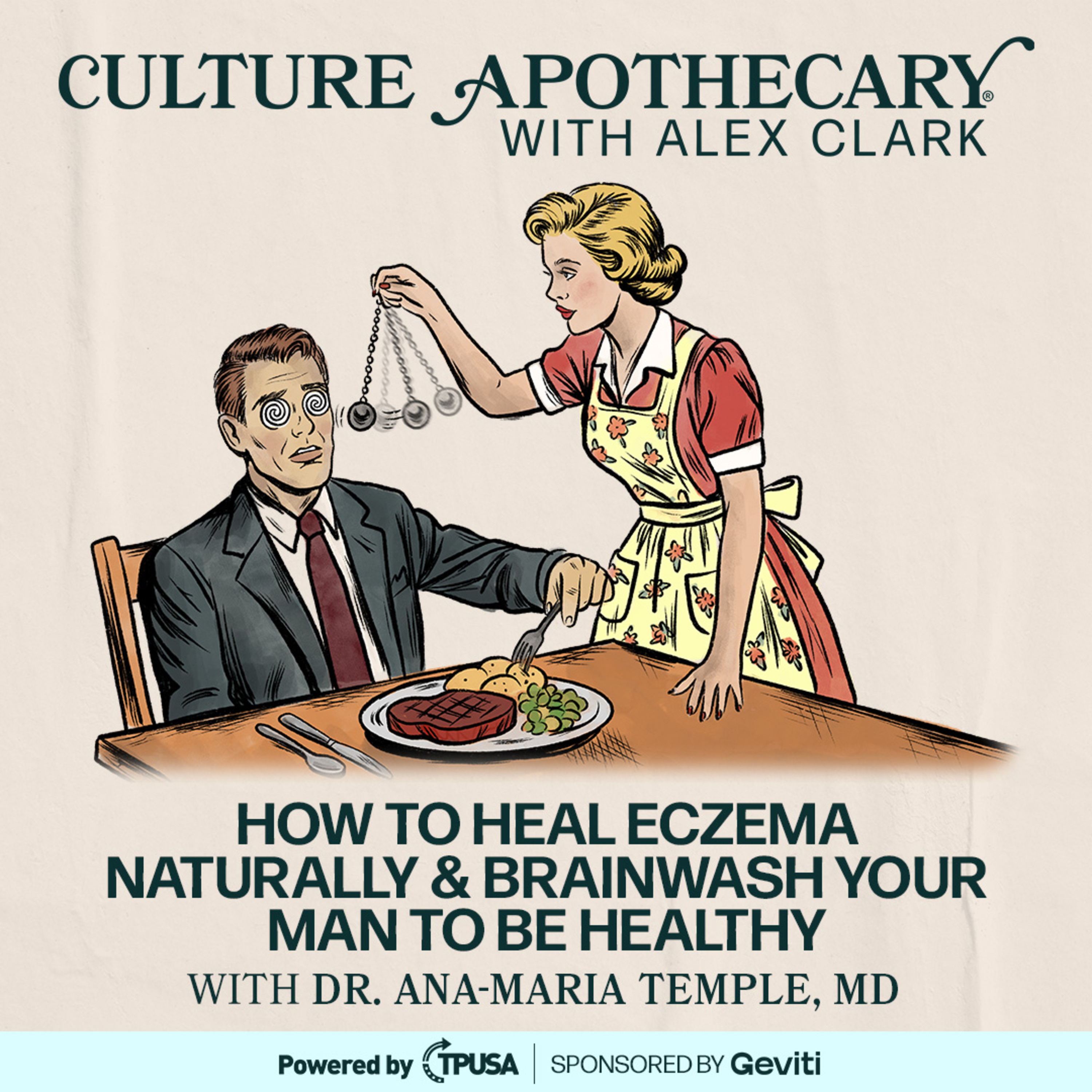
Culture Apothecary with Alex Clark
How to Heal Eczema Naturally & Brainwash Your Man to Be Healthy | Dr. Ana-Maria Temple, MD
01:41:45
Loading summary
Transcript333 lines
- [00:00]
A
What is the disturbing warning that parents are not being given about eczema drugs like Dupixent?
- [00:05]
B
You're trying to get my blood to boil. Number one thing is that it's called the biologic, when in fact it is a massive immunosuppressant. It knocks off a branch of the immune system from working.
- [00:16]
A
What do you tell new moms who are wanting to do no vaccines, but then they're starting to get worried about RSV and so they're wondering, well, should I at least get the RSV vaccine?
- [00:26]
B
Okay, if we're going to say no to a vaccine, the RSV vaccine is a solid. No. Here's a fact that is going to just upset everybody. 90% of children under the age of one get an antibiotic in their lifetime and most often it's your infections. And the number one antibiotic for ear infections is amoxicillin. And what is an amoxicillin? Guys, red 40.
- [01:09]
A
Have you been wondering how do I brainwash my husband? I mean, not just on any topic, but specifically on how to turn him into a Maha king. This episode is for you. It's also going to expose why eczema is not a skill skin problem. It is a warning sign and most parents are being told to silence it instead of heal it. My guest teaching us how to brainwash our husbands in a good way for the betterment of the health of them and our family. And also heal your child's eczema as well as chronic ear infections. What they mean how to heal them naturally. What about peptides for children? Did you know that children can be taking peptides as well? Why sound machines are detrimental to your baby's well being. The problem with most wet wipes on the market today and what to use instead and so much more. By the way, you are going to love this episode is with Dr. Annamaria Temple, a holistic pediatrician from Charlotte, North Carolina. She's on the show. You are going to love her personality. She is so funny and easy to listen to. It's going to be your new favorite episode. If I'm a betting person, this is going to be that episode. Watch this episode on the real Alex Clark YouTube channel or culture Apothecary on Spotify. Please take a second to leave a five star review for the show. Tell me the episode that you still can't stop thinking about. Please welcome Doc Dr. Anamaria Temple to culture apothecary. Are parents being misled by standard of care advice that's actually outdated?
- [02:40]
B
I would say yes because there's so much data out there on eczema, for example, on vitamin D and the relationship between vitamin D and eczema, and no doctors are talking about it. And when that's brought up by parents, hey, are there any labs that we can do for eczema? The overarching answer from traditional physicians in Western medicine is no know, and that's simply not true.
- [03:02]
A
I've never heard that. What's the connection between vitamin D and eczema?
- [03:05]
B
Right, so vitamin D is an important nutrient that we have in our body. And our body actually uses sunlight to convert vitamin D from one form to another, which is a usable form for the body. And the body uses vitamin D to build strong bones, strong skin, strong brain, many other organ systems. And when the vitamin D levels are too low, the skin can become inflamed.
- [03:27]
A
Wait, so, okay, does this impact other things besides eczema as well? In the skin?
- [03:31]
B
Absolutely. Your brain, your immune system. I mean, during COVID there was tons of studies done on how do we prevent Covid, what vitamins can we take during co, Vitamin D came up over and over again as the powerhouse to prevent getting a viral infection. We've shown that in, in influenza, in rsv, in the common cold and flu, that vitamin D levels, when they're adequate in the body, helps helps the immune system prevent major infections.
- [03:58]
A
What are the biggest changes in pediatric medicine that you've witnessed since you first became a doctor?
- [04:03]
B
Oh, gosh. Well, you. When I first became a doctor, that was like, 2003.
- [04:10]
A
We don't have to tell people.
- [04:12]
B
And then I had a massive life shift. In 2016. My family and I, we quit our jobs and we moved to New Zealand. And we lived in New Zealand for a year and a half, where I decided that I was going to practice medicine differently. I was like, I'm no more. We're going to do it different. And they gave me one hour patient appointments at Wellington Children's Hospital, where in an hour appointment, I was able to really dig deep into the root, root cause of kids illnesses. And we are really getting to the matter at hand. And so by the time that I came back into the US I was doing it differently. So by then I came with a different, complete different mindset and different shift in what how I was doing. So, yeah, medicine has changed significantly.
- [04:53]
A
So you ended up kind of falling into this more holistic mindset by accident just because at the hospital you were working at New Zealand, they did medicine differently. So you just learned on the job.
- [05:02]
B
Well, actually, I learned differently because My children were covered in eczema, and they dealt with seasonal allergies and asthma and. And chronic constipation and recurrent ear infections. And that was 2007. And I was tired of the same answer, which was more meds. Like, for my son who couldn't go out for an Easter egg hunt because his eyes would swell shut and his tears would stream down his face and his body was covered in hives and he would scrip his skin off so we couldn't go outside. When I took him to the doctor, the answer was, we've run out of medications. He was on five allergy medicines at that time, and they said the only next option is allergy sh. But he was two years old. Geez. And for my daughter, for her asthma, they're like, well, she can just continue her inhale steroids, because those are working. For eczema, they're like, well, the topical steroids for her allergies or a Zyrtec. And for constipation, they were like, miralax daily is working fine, and don't worry, she's going to outgrow her chronic ear infections. By the time we got to my kid with ADHD and chronic sinus infections, I stopped paying attention. That's when I became shifting my thought into what I'm going to do. I just got to put it in practice in New Zealand about Now, you know, 19 years later, into how I can do it differently for other families.
- [06:17]
A
So what was the shift that you made with your own kids and your family when they're dealing with all of these issues that you noticed the biggest difference?
- [06:24]
B
Well, you know, and probably a lot of people can relate to this is after I went to that doctor visit with my three little ducklings on a doctor's table, and I was like, why are my children all having so many chronic meds? What is happening? And the answer was, you know, more meds. And so I felt unheard. I felt dismissed. I felt like a crazy person because there was no other answer, and I didn't know what the answer was. I was five years into my medical practice at that time. I walked out of that doctor's office, and I was speechless. I was like, this is how people walk in and they walk out with no answers. But the mama warrior took over, and she was like, oh, no. Oh, no, no. This is not the rest of these children's story. I don't know how this story is going to go, but I know the ending, and the ending is, we're going to figure this out. These kids are not going to need medicines and they one day are going to be the examp by which other families are going to heal their children. So a week later, with this new mindset, I went to my kids elementary school where the nutritionist was giving a talk. And you know, I walked in, I was like, I'm the pediatrician and I know what she's going to talk about, right? And it was there on a Tuesday morning, 7:30 in the morning, freezing my butt off in a first grader's classroom, that the fog lifted and I realized the root cause of my children's chronic disease. All that the lady talked about was sugar. And I had no idea how much added sugar was in my children's breakfast, lunch and dinner. I was giving them strawberries at lunch and I was giving broccoli at dinner. So I felt I was giving a whole rounded meals. I did not realize the impact of added sugar. And so that night I came home after my clinic in my stilettos and walked into the pantry and I threw out the Cinnamon toast crunch, the Lucky Charms, the pop Tarts, Toaster Strud, the chicken nuggets, chocolate milk, you name a garbage, we were eating it. And that is when the big change happened. Unfortunately, I became an outcast in my own family because my husband, who is an orthopedic surgeon, and I fought over food over the next five years.
- [08:28]
A
Whoa, hold on.
- [08:30]
B
Five years?
- [08:31]
A
Okay, wait. I need to know how this ends and then I want to get into it. So is he now, has he come around?
- [08:37]
B
He is a convert. He is now an apostle. He calls it. He calls it complete brainwashing.
- [08:42]
A
Okay, so this is. Honestly, I feel like I could do a whole episode with you on this because so many of the women in my audience are struggling with this. They have seen the light. They're all into Maha. They are wanting to change the grocery list. They're wanting to spend more on groceries, so they're spending less at the doctor's offices. And their husbands are like, what the heck are you doing? I hate this. I'm not on board. And so what did you do to get them on board?
- [09:06]
B
Most of them people are like, oh, my kids are picky. I'm like, I bet your husband's pickier and more annoying. I will tell everyone this to make everyone like, because, you know, when they see me coming and if they see my social like, oh my God, she's just eating like this. And everyone eats like this. And it's amazing. I'm like, yeah, that's because I Didn't have Instagram in 2007 for you guys to see at the dinner table. And I'm not making this up. I would make this meal, and there would be a box of Cheez its on the ground next to my husband, who's 6 foot 5, he's a big dude, and he would lean over and grab crackers and then, like, eat them in between his bites of food. And then the kids would be like, well, we want crackers. And he's like, well, no one can see me. I'm like, they're not blind, okay? We could all see you that you're eating crackers that you're holding next to your chair under the table. This is what I had to work with. And he was like, you know, I have. I can eat whatever I want to. You know, the food has nothing to do with it. I work hard for the money. I can eat whatever. And then it was like, why is our grocery bill going high? So, but here's my approach. I knew that going hardcore was not gonna end well because. Right. He always. Let me tell you something about an orthopedic surgeon, man. There's a lot of ego at play. And he is right all the time in his mind, right? So I was like, well, if I come in hot, it's not gonna go. So I. You know, I was like, jedi mind tricks. And I'm a patient, perseverant woman. I will sit and wait, and I know I will outlast everyone's willpower. And so I was like, okay, you know what? I'm gonna go with the kids. And the kids were like, hey, guys, we're gonna have smoothies. And our smoothies are going to be ice cream. Literally vanilla ice cream, strawberries and milk. And who wants a ice cream strawberry shake for breakfast? And they were like, well, that's amazing. Mom's lost her mind. I'm like, perfect. But what happened is I got him to buy into the smoothie for the husband. I was like, we're gonna do smoothies, and I want the Vitamix. But by the way, we fought over the Vitamix. He's like, it's just a blender. I'm like, sir, it is not just a blender. Anyway, finally convince them to get the blender. That was like, year one of change. Get the Vitamix from Costco. And so I'm making smoothies, and then the kids are eating, drinking the smoothies. And then over time, I started, like, removing the ice cream and replacing it with yogurt. And then I started replacing it with Greek yogurt instead of the vanilla yogurt and all the added sugar, maybe a little raw honey that's unfiltered, maybe some dates. And then the milk became oat milk, and then it was like mangoes and then it was vegetables. And, you know, the smoothie took this shape. And over time, my husband started going like, okay, well, that's not so, so bad. But I didn't ask him to have a smoothie. I didn't give him a smoothie. The kids and I were eating a smoothie, and he's like, I mean, it won't kill me to have a smoothie. So then he's drinking a smoothie and he was still eating the cereal as a kid, started not eating cereal because I was making the smoothies more protein rich and more nutritiously dense. So then. And I. But I didn't say don't eat Lucky Charms.
- [12:00]
A
Yep.
- [12:01]
B
That was just for the intro story. I said, we'll just eat the smoothie, and when you're done with the smoothie, you can eat the Lucky Charms. But I knew they would become filled on nutritionally least eaten nutritionally dense food, and they're gonna not want to eat that. So it wasn't. I was not a no culture. I was like, sure, but first do this.
- [12:18]
A
This is genius, right?
- [12:20]
B
And it was just this small thing. And then I was like, I started replacing the crackers. Hey, guys, instead of cheez its, how about was it back to nature at that time? These are real ingredients. We're just, if you can't eat it, don't eat it. We're gonna working on these ingredients for my patience. Guys, I need you to taste these crackers. Well, over time, we had all these crackers. So my husband would be like, oh, let me. Let me try that cracker, you know, to see how bad that cracker is. And then the kids and I would watch a documentary. It was Food Inc. Oh, my gosh.
- [12:49]
A
So funny you bring this up. This was the documentary that radicalized me.
- [12:52]
B
Really?
- [12:52]
A
Yes.
- [12:53]
B
Stop.
- [12:53]
A
Food Inc. Is right. Yeah.
- [12:55]
B
I mean, I just was like, hey, guys. Fed up.
- [12:56]
A
Food Inc. That was our next one.
- [12:59]
B
This is why we're like, see each other.
- [13:00]
A
I know.
- [13:02]
B
And so we did Food Inc. Again. It was just the kids and I. He was not invited to the show. But then he comes lurking. He's like, what are you guys watching?
- [13:08]
A
It's always the dad. The dad is always like, what is this crap you're watching? Then they'll sit there and they're like, but they're watching it, they're judging it, but they're. They won't leave.
- [13:16]
B
Correct, Correct. It's a documentary, so it's very. It's a lot of learning. And John is all about facts and learning. And he's like, very cerebral. He's like, I wonder what this is? But, you know, approaching with, like a skeptical eye. And then he was like, oh, grass fed. Okay. And so all of a sudden, he starts thinking, just a little tiny different. Maybe we have a little less fight over the meat that I'm purchasing. And then we do fed up. And the. The kids have a. They were like, appalled. We can'. Believe you let us eat that much added sugar. Like, what kind of mother. Lester kids eat this much sugar? I was like, okay, I'll take it. That's fine. No problem. And so, because they're talking now, he's thinking. But it wasn't like he changed. But I'll tell you the change that happened. It was five years into this whole thing. He got so sick. So sick. We were going to France and he is coughing. He's a disaster. He's coughing a blood. I'm putting his pants on. He's a 6 foot 5 man. Did I mention that it's really hard to put pants on this giant man. And I was like, we're going to urgent care because tomorrow we're going to Paris. Yeah. So you either stay home. And I'm no joke. I'm like, we're not gonna. Oh, we're all gonna stay. Oh, sorry, dude. Yeah, you're staying home. Yeah. And so we take him to urgent care that he has double pneumonia. His oxygen level is down. He puts on antibiotics. Yep. He comes to France. He literally, I think almost died on the plane there because he felt so sick. But he's like, well, I'm gone. I'm like, okay, no mercy. We walked nine miles. I'm like, that's your problem, D. And he came back and he's like, okay, why is no one else sick? Why am I the only one that's sick?
- [14:50]
A
Wow. Yes.
- [14:51]
B
And I was just like, I had no idea. I don't know. It's weird. So I didn't go into a lecture. So this whole journey, there was no lecturing. There was no, you should do this.
- [15:02]
A
It's living by example.
- [15:03]
B
You gotta live by example. I just shut it. I talk to the kids. They're my little apostles. They're my little learners. They don't have a choice on this. Right? Yep. I'm changing their diet. We're doing our thing. You do your thing, guy. You're good. But he started changing. All of a sudden, he's reading Men's Health and, like, sending me photos of what they recommend for breakfast, which is tons of vegetables and good protein, you know? Then he listens to In Defense of Food by Michael Poland because he loves audiobooks. Then he gets onto a podcast that's a dude talking about dude things about nutrition. And all of a sudden, he's like, did you know that cereal was not the same?
- [15:41]
A
So he becomes a huberman, bro.
- [15:42]
B
Yeah. Yeah. Oh, totally, totally. He goes on. He's like, do you know alcohol is bad for you? I'm like, really?
- [15:49]
A
Wow.
- [15:49]
B
No, I had no idea. So it was kind of like. And when I talk to my mamas, I'm like, do not lecture. Do not talk at them. Do not try to convince them of anything. It has to become their idea. It's like, guys, in my biggest Big Fat Greek Wedding, literally, that's the mom's quote. She's like, we have to make sure it becomes his idea. And then he's on board.
- [16:11]
A
Yes.
- [16:12]
B
Truer words were never spoken. And so it was just. I kind of dropped things. Like, you watch pot. You watch documentaries with your kids. You listen to a podcast in the car with the kids. You talk to your kids. You just do not involve. You don't. You know, with teenagers, I always go. I'm like, you act like teenagers are feral cats. You don't go at a teenager. You don't go try to hug them. You don't go, like, what'd you do at school? What's going on? How things going? Because they hate that you act aloof, and then they come seek you. They're like, wait, do you want to know about my school day? That's so interesting. Tell me more. You know, and same thing with husbands. Just leave them alone. And you do you. You work out. You do your water. You do your skin. My husband has made fun of me and my skin for the longest time. Guess who was putting products? And he's like, wait, what are you doing? So should I retin a? You think retin a is. I'm like, oh,
- [17:02]
A
this is great. So this is an amazing success story. I love that you don't become a culture of. No, yes, that's really important, I think.
- [17:11]
B
Yes. Because otherwise it becomes so negative, and it becomes contentious, and it becomes you versus the children or you versus the husband. So another example, when we went to change the diet to snacks small. And I'm all About small changes. You cannot change everything in one day. It's not sustainable. You lose your mind, everyone's upset. But when, when we did in the snack phase, I was like, sure, you guys can eat your Cheetos and Doritos, but before you do that, you have to eat a fruit or a vegetable. And they're like, oh, I'm like, that's fine. You don't need to. Then you're not hungry. You don't need anything because no one needs snacks. Only Americans need snacks. Turns out the rest of the world doesn't need snacks. I don't know what's with us, but apparently we're all gonna die if we don't have snacks. And so the kids were like, fine, I'll eat an apple, I'll eat a banana, you know, and then they would eat their Cheetos and Cheerios and whatever. And then over time, then I started changing out out those snacks and got rid of food coloring, whatever. But it was very gradual and very slow. And so then when they would come home from school, they'd be like, we're so hungry. And if I was home from work, I would have a charcuterie platter ready to go on the counter. Because it doesn't matter what you tell me how picky your children are, how much they complain when food is cut up for them right in front of them with a nice presentation, they will eat it so good. But if it's not there and they have to open the silver box known as the refrigerator, they can't. They become blind. They don't, they don't see it. You know, you could have the strawberries cut up in the fridge and they will mold. They cannot see it. It is. This is blinding object. I'm always like. It's this phenomenon that happens with children, especially with teenagers. And kids are going to go to the pantry because it's easier to grab a snack that's already in a package. But if they're intercepted by a delicious food sitting on the pan, like on the counter when they walk in. Yeah, yeah, they'll eat it 90% of the time.
- [19:00]
A
Husbands too, I think.
- [19:01]
B
And the husbands will eat it. Cuz you know what? What? Dudes like things that are easy and already made for them.
- [19:06]
A
I have not had anybody break down how to brainwash your husband so well on this show, I'm an expert.
- [19:14]
B
I'm making a shirt.
- [19:16]
A
Everybody's talking about peptides for adults. Are you on Peptides?
- [19:19]
B
I'm on peptides, actually.
- [19:20]
A
Okay, so I haven't started this yet. I really want to. What are you taking and why? Why?
- [19:24]
B
Okay, so I tried the injectable ones and my body was said, no thanks, oh my God, all these bruises and like fat thickening and I'm a thin person and it was like, I mean I look like a disaster. Look like I was like shooting myself up with like all kinds of weird needles. So my, my body was like, no thanks. So I do capsules and I do BC157 and TA1 and I do them for hand arthritis. I'm 52 years old and arthritis is runs in my family. Despite all the anti inflammatory things that I do in my life, there's still a component to inflammation. So I've been using peptides and you know what, I've used those two for a couple months. I ran out and then I was off of them for like a month or two because I'm like, ah, by the time I order them, do they do anything? And my hand pain came back.
- [20:10]
A
Okay, I need to get those for my mom because she's struggling with arthritis pains right now with her hands.
- [20:15]
B
Yeah. So I restarted them. Arthritis pain gone.
- [20:17]
A
Interesting.
- [20:18]
B
Yeah. Again, right? You can be just one thing. It's a combination of things. We got to do the anti inflammatory diet, we got to watch our stress, we got to sleep, we got to deal with our stress with all, all the different things. And then you add peptides to the whole thing.
- [20:31]
A
So people are raving about peptides for adults, but you are the first person I've ever seen talking about peptides for your kids. What peptides should we be giving our kids? What do they do? What are they for? How do you do it?
- [20:44]
B
I'll tell you. Peptides, it's like when you're in the AP course, peptides are for the folks that already done the foundations because the
- [20:52]
A
problem is they've been listening to culture apothecary for a while.
- [20:54]
B
They're good, they've implemented nutrition.
- [20:56]
A
They're my star students.
- [20:57]
B
The star students who've done the nutrition. The kids are outside, their screen times are limited. The kids are sleeping, they're pooping every day, they're exercising, they're moving. I just, I cannot reiterate enough because we're a culture that has supplement fomo and so I will sit and talk about nutrition and people are like, so what vitamin? You know, I'll talk about sardines. Yeah, like sardines, omega 3s and vitamin D. And people are like, cool, so what supplement should I take? I'm like, sardines People, they're like, right, that's gross. What supplement should I take? So when it comes to peptides, the peptides are not going to work if the foundation is weak or broken. So for my kids with eczema, I will do the BC, BCP157 and KVP. And it's a fabulous combination. I only use one place where I will get the powders or the capsules. It's integrative peptides that I've talked to three different peptide gurus. Like, the gurus, this is what they do, this is what they speak on. And I'm like, what can I do? And this is the company that they all use. So. And then they have a powder that's really great to decrease inflammation for kiddos, and then the Thymogen 1ta1, that's for global inflammation for kids as well.
- [22:10]
A
So when you say a powder, is it like a flavored thing you put in water or something?
- [22:12]
B
Yes. So it's got like the 2, the BCP157 and KPV. It's got Akkermansia, it's got inulin, it's got a couple different things that work on the gut microbiome and on the amino acids that we need to decrease inflammation.
- [22:26]
A
Do you need a prescription?
- [22:27]
B
Nope.
- [22:27]
A
So where do you order it?
- [22:28]
B
Integrative peptides.
- [22:29]
A
Okay.
- [22:30]
B
Not affiliated in just telling you.
- [22:35]
A
Most people don't actually know anything about their health. They know what Tik Tok told them to take last week, but they don't know what's happening inside their body. And that's really not your fault. The system doesn't test deeply. You get basic blood work done at the doctor. If you ask 20 markers, maybe someone says, well, everything looks normal to me. And then you're sent home to manage chronic fatigue, mood swings, weight gain, or inflammation on your own. Jevity exists because that's not good enough.
- [22:58]
B
Enough.
- [22:58]
A
They run one of the most comprehensive biomarker panels available. Over 90 biomarkers tested twice a year. So they can actually see what's happening with your hormones, nutrients, metabolism and inflammation. Real data, no guessing. They'll send a phlebotomist to your house. You don't have to leave and go anywhere. You meet virtually with a whole care team to go over your results and what they mean going forward. And then you get a personalized protocol, supplements, nutrition guidance, hormone optimization, advanced testing if you need more. Everything is delivered straight to your door and refined over time as your body changes. This is proactive health optimization. You're not waiting to Find out something devastating and then trying to figure out how to manage it. It's all included for 129amonth with 40 off personalized supplements and prescriptions. Use code ALEX for 20 off your first purchase at gojevity.com G-E-V-I-T-I go jevity.com Code ALEX for 20 off your first Purchase. There's that saying you can put lipstick on a pig. And honestly a conventional farmed pig would probably say slathered on me, big boy. I've already eaten corn syrup and chemicals my whole life. What's a little more but a regeneratively farm pig. That pig pauses, that pig squints, that pig says, excuse me, is this non toxic? And that's the difference between most makeup and Adele Natural cosmetics. Most beauty brands are out here selling hormone disrupting sludge and pretty packaging. Adele Natural Cosmetics is a Christian founded family owned company making clean, non toxic handcrafted makeup in small batches in central Texas using ingredients sourced from sustainable farms because they actually care about what goes on your skin. Winter, I know is actively trying to destroy your face, especially if you live in the midwest or even the east coast right now. Which is why why the Adele Natural cosmetics moisturizing foundation feels like nothing you've ever used before. The lip conditioner has hyaluronic acid, makes your lips really soft. The glow highlighter gives you a very well rested, hydrated glow that is so gorgeous. I really do not like highlighter. I like the Adele Natural Cosmetics 1. They will also color match you for free for their foundation and if it is wrong, they will fix it because you know, they're nice people. So yes, put lipstick on a pig. Just make sure it's Adele Natural Cosmetics. Use Code Alex for 25% off your first order at Adele Natural Cosmetics.com that's Code Alex for 25% off your first Order at Adele Natural Cosmetics.Com what your parents know about doing parasite testing on kids?
- [25:16]
B
Yeah. So when it comes to parasites, that is also the rave, that is the rage. Everyone is like, let's talk parasites. And I'm like, are we eating processed foods? Because if we're eating processed foods, we are not a parasites. Again, this is extra credit. We've done all the things. If we go back into evolution and how we used to live, we used to live on farms. On farms you live with the animals and the poop and the cow poop of the dogs and the sheep and you play in the dirt and you kind of wash your hands, but kind of never really wash your hands and then you eat. So we're filled with parasites. When we live on a farm and you have parasites and you have bacteria and you have fungi. The human body is made to work in harmony with all of these things. It's in our modern world where things are off balance. We can never get rid of all the parasites. We can never get rid of all the bacteria or all the candida if anybody goes. And then we're going to get rid of everything. That's not true. All you're trying to do is decrease the bad guys. So the good guys are. There's more good guys and less bad guys. But parasites are not all bad in some things. So I treat autism, I treat alopecia totalis, which is when the kids lose all their hair. I treat pandas. And we will use parasites for that. It's the egg of the rat tapeworm. It's called helminthic therapy. And where we have the children ingest parasite parasites.
- [26:33]
A
Oh, really? Yep.
- [26:34]
B
And so because parasites and bad bacteria. Well, in quotes on a podcast, you know, I'm doing quotes, guys. Bad bacteria and candida and all stuff. The reason they're in our microbiome is in order to exercise and work the good guys, the good guys need to be stimulated. So they're on guard. So we're not falling asleep. They're not bored. They're like always protecting us. But they need the bad players in order to stay vigilant and protect and create antibodies and know what's up. And so not all parasites are bad. So some people are, you know, because they're like. And then I did this cleanse and look what was in the toilet. Sometimes what they see on the toilet is actually the lining of the intestine because the lining of the intestine is a long, slimy goop that looks like a worm.
- [27:20]
A
So we want that we don't want
- [27:22]
B
to remove the lining of our intestine. I'm saying some people are doing such aggressive things to their kids bodies. Yeah, that. And they think they're successful, but they're just stripping the lining of the intestine.
- [27:32]
A
Well, how do you know? How do you know if it's really a parasite or if it's intestinal lining.
- [27:35]
B
Exactly. Most parasites move.
- [27:37]
A
So are you against doing parasite cleanses?
- [27:40]
B
No, I'm, I am pro. Doing all the basics. And we're, and we're not getting where we need to. The body is not able to rebalance itself when we do the basics, such as, you know, eczema whatever chronic illness we're dealing with. Nutrition is going to be micronutrient repletion. We start talked about vitamin D, but there's Zinc, there's Omega 3. Threes. We got to do the gut microbiome. Are we on digestive enzymes if we need to. Are we doing some herbal supplementation? Are we using the proper probiotics for whatever the issue is? And are we dealing with stress? Are we pooping every day? Are we exercising? Are we outside doing all the things we talked about? That normally fixes the body. You don't need to go to the peptides. You don't need to go to the parasites. If that doesn't fix the body. Okay, now we might need a little extra help. And then we do specific parasite cleanses. And there's got to be specific symptoms. Symptoms to it. It's not like. Well, they're just not talking. Okay. That's not. That doesn't give me an idea of this is a parasite or not. I'll give you an example. One of my patients. We're doing great. Everything was coming right. Neurological inflammation during the day, her behavior. She was throwing air, doctor. She's like ripping curtains off the wall when she's going into an episode. All that has amazing.
- [28:56]
A
This is like a child with autism.
- [28:57]
B
Child with pandas. Oh, neurological inflammation, okay. And the child's doing great. Nighttime, we just can't get hold on the symptoms. And at nighttime, she wakes up and has fits where she has to be taken on a car ride. She's four on a car ride to fall asleep. Otherwise she loses her mind. That gives me the impression, oh, my gosh, after everything we've done, everything has gotten better. We just can't fix that. That sounds like parasites. And so we're working on that. And we started parasite cleanse. A kid lost her mind, unfortunately. Sounds bad. It's good. That means we. We are where we need to be. When we have that, we've basically triggered the body because we are now killing the parasites. So now we have to. I'm creating now a protocol to do that. A little gentler.
- [29:39]
A
Okay.
- [29:39]
B
So it's called the Herxheimer reaction. When you actually give a supplement or a medication to treat something and the opposite happens. So, for example, I will treat kids with eczema with fluconazole, and their eczema gets worse. And the parents are like, oh, my God. I'm like, no, that's good. We're killing the yeast. When the yeast dies off, it irritates the skin more. We are where we need to be. Now we just got to be prudent about all the other things we do to support the system. So we kill the yeast without triggering too many flares.
- [30:05]
A
So when this kid with pandas freaked out with the parasite cleanse, what did you tell the parents?
- [30:10]
B
Well, we stopped and we're going to go on a low histamine diet, because again, it's a long story and how, you know, but the child reacts to histamine. So we're going to go on a low histamine diet.
- [30:20]
A
Which low histamine diet? What does that look like?
- [30:21]
B
That is a very restrictive diet. And I always tell people, I'm like, before you do any restrictive diets, please work with functional nutritionist. When people do restrictive diets on their own, most of the time they end up with orthorexia, which is fear food. And the children end up eating such few foods. That is actually becoming. You're doing the opposite. You can't heal when you're eating, like, three foods.
- [30:42]
A
Yeah.
- [30:42]
B
So low histamine diet is going to be, you know, if you think of a charcuterie board, everything on a charcuterie board is high histamines, cold cuts, smoked cheeses, nuts, red wine. Okay. I hope the children are not drinking red wine. But. But the highest histamine food on earth is red wine. For all my adults who drink red wine and turn red, I have so many adults that drink wine, and they're like, I get blotchy. I was like, cause you're having a histamine reaction. Whoa. To the red wine. That's not a good sign. And so those things, Leftovers are high histamine foods. Spinach, strawberries, avocados, bananas. So whenever we want to remove a food out of a diet, we always have to have a replacement. So my families, my patients, my clients, when they're like, I think that spinach is causing an issue, I'm like, cool, what are you going to replace it with? You can't be just, I'm not going to give them spinach. The right answer in that case would be kale. Kale is a low histamine food.
- [31:38]
A
So.
- [31:39]
B
But you have to be cognizant. When you've removed dairy, what are you replacing it with? When you remove gluten, because that has fiber, that has a lot of good nutrients, what are you replacing it with? You can't be like, I'm just not going to eat dairy. I'm not eating gluten, I'm not eating eggs, I'm not eating nuts. I'm not eating soy. I'm not eating corn. Then we're gonna need four foods.
- [31:57]
A
That's. Yeah.
- [31:58]
B
And it's usually processed foods that are horrible.
- [32:00]
A
For an adult who's struggling with pandas, what are like the first three things you would tell them to do?
- [32:04]
B
Number one is going to be stress. I tell you, if it's pandas, if we're dealing with eczema in adults, name a condition, a cancer. Number one, two, and three, Stress. Stress. Stress. In the American culture, stress is the most under recognized toxin. The number one, skip chapter in my eczema program, the stress and anxiety chapter. We've had to rename it Overwhelm because everyone's like, we're not stressed. I'm like, wait, your children are scratching themselves to bloody messes at night and you're not stressed? Get out of here. Yeah, folks with pandas, the people are screaming, they're losing their mind. They're having these horrible tics. You're not stressed? Get out of here. So stress number one, two, three for my adults. Number two, not going to be anyone's fan. Alcohol. Got to go like zero alcohol. If you're dealing with pandas, alcohol cannot be in your life. And number three, processed foods. Well, I would say nutrition, because we got to do processed foods, lower sugar, and eat whole foods, but that's a big one.
- [33:03]
A
Number three, are we breaking a child's immune system every time we pop a fever?
- [33:08]
B
So, right. Doctors and nurses, we have created a fever phobia. And because every time that the child has a fever, if you call your doctor's office, the first thing they'll tell you, give them Tylenol Motrin. If you take them to the er, the first thing they give you, Tylenol Motrin. And we have become just not educated or I don't even know the right word about the human body. Right. The human body creates. Creates fever because it's under attack. And when we have fever, the body mounts an immune response. It's more efficient, more effective. When we're doing fever, an example I like to use is, okay, let's say your child is exposed to influenza. Here comes flu. The flu virus cannot live on its own. It has to live in the human body. And it uses the human body to replicate itself. It uses us as a photocopy machine. So the flu virus and his 50 friends come into your child's body, and you starting to use the virus body as a photocopy machine to make more copies of itself so it could live the human Body doesn't like that. So it says, what? What's up? Hold on. We're under invasion. Let's raise the thermostat. When it raises a thermostat, the child gets shivery and starts shaking. They turn pale. Their hands and feet are a little bluish. They're like, I'm just so cold. I'm so cold. That's the body trying to make the muscles move really fast to raise the temperature. The body raises temperature 103. The parent panics. 103. Oh, my gosh. This is horrible. But the body is like, no. At 103, I'm turning the photocopy machine off. Now the flu virus cannot replicate itself anymore. And now I'm making a ton of antibodies. And now the. The 50 guys that came in to invade, maybe it's 200 now, but now at 103, the body's made a million antibodies, and now it's kicking the flu virus's booty.
- [34:52]
A
So when you've got a new mom and I know you get these people and their new baby, they've never had a kid before, has a high fever, and they're calling you Dr. Temple. Yeah, there's a fever. Fever. I mean, what is the number? You're like, okay, that's worth calling your doctor. Everything else, don't even bother calling me. Like, what's the number?
- [35:10]
B
105.
- [35:10]
A
Okay.
- [35:11]
B
I don't want to give a number, but no one. They're like, I didn't need. I just need a number. I'm like, fine, 105.
- [35:15]
A
Okay.
- [35:16]
B
105. You're like, okay, let's do a fever reducer. Not because of brain damage, not because of organ damage, because the parents can't deal anymore.
- [35:24]
A
If your kids had 105, what would you do?
- [35:27]
B
They did, and I didn't do anything. Anything.
- [35:29]
A
So just comfort them.
- [35:31]
B
I took my. One of my kids, and he was laying on me. He was a hot potato, and I took him to the doctor's office just to make sure I don't treat my own kids. And just to make sure there was nothing else going on. Hey, listen, I'm cool. Just look at him. Make sure with an objective eye. Because I tend to be like, they're fine. Make sure nothing's going on. They wouldn't let me leave the office until I gave them Tylenol. Oh, stop it. I got bullied in my own private practices office office to give my child Tylenol. I was like, he's fine. He's like, he's so febrile. He's hot. I'm like well of course he's hot because his immune system is kicking booty right now anyway. But I want to go back to the example with the flu virus because what happens when we give kids Tylenol and Motrin or any fever reducer, whatever homeopath things you want to do. When you lower the temperature, the body's immune system slows down, the photocopy machine gets turned back on. The flu virus is like sweet as and is like replicating itself. Now you have a million million flu particles. The you only made a thousand antibodies. Now your child is sick for two weeks and now you're annoyed because you have. If you let the fever do its thing, the kids are going to be sicker for less time.
- [36:38]
A
What are your opinions as a pediatrician on the changes made to the childhood vaccine schedule?
- [36:43]
B
Fun fact, I've already made most of the changes eight years ago. So I am on board one of the the first thing that the CD the CDC changes were that the Hepatitis B B vaccination at birth should be a discussion rather than auto like an automatic thing. And forever and ever I was like listen this, the Hepatitis B vaccine was started in the 1996 when we had a massive epidemic of Hepatitis B and hepatitis B leads to liver cancer. So in my book it's one of the first vaccines for anti cancer and we had and they couldn't get it under control. There's so many people infected with their chronic hepatitis B carriers, you can never get rid of it. Blah blah blah. They to the, they gave it to the babies newborns because as they were able to decrease the, the rates.
- [37:26]
A
Cool.
- [37:27]
B
Also in the 80s the rates of getting hepatitis B from a blood transfusion was like 1 in 3. 1 in 3. If you had a blood transfusion now it's 1 in 65,000. Right. Wow, huge changes. Now we're screening moms for Hepatitis B when they come in, when they're pregnant or when they're coming to the hospital. So we know the mom's Hepatitis B status generally speaking. And I was like I don't, I don't understand if the mom has antibodies if the rates of blood transfusion, because that was the thing. If your child needs a heart something or a blood transfusion in the neonatal intensive care unit or car accident, you don't wanna be in that spot where you're gonna get Hepatitis B from a transfusion. Cool. Got it. Now we don't have that anymore. Right. That is like so incredibly rare. And I was Like, I don't understand why we have not changed those recommendations. Now, if you come into the newborn nursery and you have not had prenatal care, we don't know your hepatitis B status. That's a different story. And that should be approached very differently than a mom who's had prenatal care. We know hepatitis B status. That's a different conversation. And we're not having different conversations. We're just doing one size fits all. So I really excited that the CDC has brought up to that, to the attention where we're having conversations that we need to question this and really have a more individualized approach rather than a one size fits all.
- [38:44]
A
What do you tell new moms who are wanting to do no vaccines, but then they're starting to get worried about rsv, and so they're wondering, well, should I at least get the RSV vaccine? Okay.
- [38:54]
B
If we're going to say no to a vaccine, the RSV vaccine is a solid no.
- [38:59]
A
Why?
- [39:00]
B
It is fast tracked. I called Sanofi, like, when I saw it come on the market, I called them and I said, hey, so I see that this vaccine is fast tracked. And that never sits well with me, you know, fast track a vaccine. And then I was like, well, so how many times have we given this vaccine with other vaccines? Vaccines? The answer was, so not a vaccine. That's a monoclonal antibody. And I'm like, okay, all right, let me say that one more time. How many times have we given it with other vaccines? And they only. They. Only a few times that they actually studied it with other vaccines, even though it's recommended to be given with other vaccines. I'm like, okay, that's no. And they show that there are side effects when you give it with other vaccines. The kids get sicker more often when you combine the vaccines than when you give it alone. I. I was like, well, can I have the raw data? Oh, they're like, oh, absolutely. Uh, that was two years ago.
- [39:50]
A
You still haven't gotten it.
- [39:51]
B
They're never going to send you the raw data. So that is a no. That is a no.
- [39:55]
A
What if that's the only vaccine you get on the whole childhood schedule? How do you feel about it?
- [39:58]
B
No, it's not needed.
- [39:59]
A
Okay.
- [39:59]
B
It's not. Need a vaccine. I'm all pro. Listen, I'm pro the hepatitis B vaccine, okay? Eventually, I don't want to have a. A child that has a chronic hepatitis B carrier, because the more people that don't get the hepatitis B vaccine in 10 years from now, we're probably going to have the hepatitis B carriers come like it going to come around the block again. But the, the RSV vaccine. And by the way, I'm speaking as a mom who, my second born was hospitalized with influenza in 2006 on Christmas Day with RSV, New Year's Day, home oxygen from RSV. So I'm not taking it lightly. I'm not saying RSV is nothing, but even knowing what I know now, with what I had gone through, I still wouldn't have given RSV vaccine to my third born.
- [40:40]
A
If your child gets rsv, you know the word first? Is that what you're on? You're in the hospital for a couple
- [40:46]
B
days, it's a respiratory stuff and you're on oxygen. The treatment for RSV is a lot of time and oxygen. Okay.
- [40:52]
A
And then the worst thing that could happen if the, if you have a vaccine injury from RSV is what.
- [40:56]
B
I've not administered the RSV vaccine, so I don't know.
- [41:00]
A
Yeah.
- [41:00]
B
Because I don't, I refuse to carry it in my clinic.
- [41:03]
A
So it's just, I mean, I don't. Injury can look like a lot of different things.
- [41:05]
B
It could look a lot of things. It could look like neurological issues, it can look, certainly can look like autism, it could look like horrible reflux, it can look like recurrent headaches, like recurrent rashes, it could look like eczema, many different things. It's just I don't have, you know, when you look at a lot of the research, I've been practicing medicine for 30 years and I'm very big into my clinical observations because I, I'm like, you can take data and you can flip data and you can statistically change data to make it do whatever you want it to do. My clinic, what I see in my clinical practice is like right in front of me, you know, and so that, but when it comes to the RSV vaccine, because I've not given it now the synergist, which is the RSV vaccine. That was long ago in babies in the NICU who are born very early with major heart issues, major lung issues. I'm not, that's not what I'm talking about. We are talking about the RSV vaccine in a healthy 4 month old who has no chronic issues. Issues. That's what we're talking about.
- [42:04]
A
What if a baby was born prematurely?
- [42:06]
B
The very premature babies that are very fragile. And that's a conversation that you need to have with your doctor on it. What are the other things that are happening with the baby? What Is their neurological status. It's not as simple as like, okay, well, they're preemie. So we're going to do the. The RSV vaccine. Yeah, I'm very big into. I need to talk to each one of my families. What are, what are their expectations? What are their fears? What are their out expected outcomes? Outcomes. And what are their risk benefit? Everything has a risk benefit. Tylenol has risk benefit. RSV vaccine has a risk benefit. It needs to be discussed, not a blanket statement.
- [42:39]
A
Why should parents not be afraid of measles?
- [42:41]
B
The number one side effect of measles, just like any other virus, ear infections. Second side effect of measles, like any viral infection, pneumonia. Third, dehydration. What we hear in the news is brain inflammation. Yes, that can happen. Absolutely. But that's very rare death. That can happen. Very rare.
- [43:05]
A
Also, you know what's giving your kids brain inflammation?
- [43:08]
B
Cheetos soda.
- [43:10]
A
But they're never talking about any of that in the news.
- [43:13]
B
No, we're not. You know what else people die. More children die Most of car accidents. How about drownings in our backyard pool? That doesn't make the news. That does not make the news. You know, because people are so afraid of measles. I did a little number research because whenever we get paranoid about it, an illness, I'm always like, but we get the numbers. Like, let's get numbers instead of fear, let's look at the numbers. So I might misquote by a couple of, you know, digits, so bear with me. But in 2025, there are 2,256 cases of measles in the United States. About 285 hospitalizations. Out of those, a majority was for pneumonia, respiratory stuff. The second was dehydration, and the third was isolation or quarantine. Three people died out of that in 2025. Out of all those two kids, 1 6, 18 and one adult. And I don't have information on because I always want to know, what were their conditions, what were. There's nutrition, like, what? I need more details. And it's just like, we're all going to die. So those are the numbers that we're dealing with. And when the media is coming in, they're coming in hot, scaring everybody. I'm like, right? And so now we're having a conversation. Now we're having an actual conversation. Are you okay with me measles or you okay with the vaccine? And as a parent, neither answer is wrong. I am tired of people shaming other parents who are. I have parents who cannot walk out of their house. They're not going to go on a plane because they're so terrified of measles.
- [44:36]
A
That's unbelievable. You're crippling your kid in other ways when you're doing that.
- [44:39]
B
Correct. But I need people out of the house. I need people traveling, I need people to live in the world. And I'm like. And also, if we look at the side effect, the measles vaccine, when it's given on its own without other vaccines, in a child who doesn't have any chronic, chronic issues, side of the side effects are very minimal when we look at people that are having side effects to vaccine. Because I go to a lot of the conferences with a lot of people that are vaccine injured, I'm always asking, tell me more about that story. Not because I want to not believe them, because I want to learn as a doctor, what could I be missing? How many vaccines were they given at that time? What were the symptoms beforehand? Did they have any other symptoms with any other vaccines? How were they before that? Because a lot of people will just say they were verbal, they were talking, they had the MMR vaccines. They're not talking. And that's very valid. I'm not saying no, but most of the time, I would say 90% of the time that MMR was given with other vaccines, that child had other reactions to vaccines previous to that. The body was already suggesting that there's a situation underhand, there were other developmental things, or there are other recurrent ear infections. Maybe the child was always irritable. They were always. Maybe they had symptoms of pandas, maybe they had eczema and no one paid attention. They're like, it's not a big deal. You can just get vaccines. What were the other circumstances? So, you know, that's why I pay attention to what else is happening to the child before doing a vaccine. And what is our expectation of this?
- [46:06]
A
How many childhood illnesses are really just nutrient deficiencies?
- [46:10]
B
I think majority of them are nutritional deficiencies. Deficiencies. We are overfed and undernourished in the United States. Our children are chubby and they're malnourished,
- [46:19]
A
they're fat, and they're actually starving.
- [46:21]
B
Exactly. Their immune system is starving, their skin is starving, their brains are starving. And the chronic issue, in, like, 15 years ago, the rates of chronic disease were 1 in 20. As of last year, they're 1 in 2. According to the CDC, that's 50%. And a lot of parents are like, oh, no, we're not dealing with chronic disease. I'm like um, okay, if your child has cause, you know there are these things, like major things like we don't have cancer or we don't have like a. If your child has eczema, seasonal allergies, food allergies, adhd, anxiety, your child has a chronic disease. If you are using an over the counter medications on a daily basis on your child, they have a chronic disease.
- [46:59]
A
Yeah.
- [47:00]
B
The abnormal has become normal and we're like, you know, it's just normal for kids to have eczema. It's just normal for kids who have seasonal allergies. It's kind of like adults, you know. I'm 45, so of course I have blood pressure issue. I'm. It's not normal to have blood pressure issues at 45. You know I have cholesterol issues cuz, you know, I'm 50. It is not normal to have cholesterol issues.
- [47:20]
A
It's common in America.
- [47:22]
B
Yes. But is not normal. Yep.
- [47:27]
A
You know how I know I love a skincare brand? I go through it and then I restock it and I don't have bottles that are three years old sitting in my cabinet judging me. I use it because I love it and, and it works and I am always restocking my Primally pure, actually Primally Pure Bethany, that's the owner's name. If you are listening. I really need my fancy face serum. I use my last pump today. Primly Pure is female founded, small batch and actually clean. Not green wash, not synthetic fragrance pretending to be natural. Primly Pure formulas are intentional and you can tell their Fancy face serum is my go to day and night. This is what makes my skin look so alive and flawless even without makeup up. It is this orangey color too, which sounds kind of freaky, but it's not. It adds like a little bit of color to your face. It really wakes your skin up. I find that I don't look like such a pale vampire and now every time I'm bare faced people tell me like wow, your skin looks incredible. I've been posting on my Instagram stories not wearing makeup and people are like, what are you using on your skin? It is the Primally Pure Fancy Face Serum. It is this vitamin rich, nutrient dense blend of some of the most potent healing plant oils out there. It helps diminish fine lines, scarring, discoloration, acne. It really brightens, smooths. It's deeply nourishing and reparative. It supports healthy skin cell regeneration, brightens, calms redness. I mean it is so good and the scent is kind of earthy, slightly spicy. I. I wasn't like super crazy about it at first to be transparent with you because it is really earthy. But I'm so used to it and like the results are so good I do not even care. It could smell like poo poo, but it doesn't and I would still use it. Another must try from Primly pure is the bergamont eucalyptus body wash. I will not shut up about it. This is body wash but it feels like lotion. So it is low suds. It's microbiome friendly. It protects your skin barrier, it doesn't strip it. It is by far the most hydrating, non toxic body wash I've used. And I have gone through the ring around body wash. It is really hard for me to find a good one because I live in Arizona. It is a desert. I'm a lizard, okay? So I love that. Another thing, I just got to you tell you another thing. I love the soothing spirulina face mask. I keep that in rotation. Primally Pure is known for their face masks for a reason. It detoxifies, calms, visibly reduces redness. If I'm restocking it, that is your sign. Use code Alex Clark for 15% off anything on Primally Pure dot com. That's 15% off with code Alex Clark@primally pure dot com. All right, listen. If you're still eating that sugar coated garbage they call healthy cereal, we need to have a serious talk. Your breakfast is supposed to fuel your life, not give big food another excuse to buy another yacht while you're insulin and spikes. Enter love birds. Grass fed high protein cereal 2 pack. This stuff is so good. Grass fed whey protein, organic coconut sugar, crunchy, satisfying. Actually tastes freaking amazing. I'm not kidding. You get cinnamon and cocoa flavors, gluten free, non GMO and third party tested. So you know it's legit. No heavy metals. Here's the kicker. 11g of protein per serving. Guys, this is what you need to switch your kids to. That is not just a breakfast. This is a meal. You eat this in the morning, you don't need need a second breakfast. You don't collapse at your desk at 10am and you don't feel like garbage by lunch. Simon, my editor is salivating right now. This is high protein cereal done right. Made with real organic ingredients, no refined sugar, no lab made nonsense. It's like your regular cereal went to a yoga retreat, got a green juice, kissed Simon and came back actually useful for your body. So do Yourself a favor. Try the two pack today. Cinnamon and cocoa. Oh, I love the cinnamon. While supplies last, use code ALEX20 for 20 off. That's alex20lovebirdfoods.com for 20 off. Code ALEX20 for 20 off@lovebirdfoods.com get your breakfast in line. Your cells are gonna thank you. And big food will hate it. And we love that. What is the blind spot that conventional pediatricians have on zinc?
- [51:12]
B
The blind spot on a lot of the micronutrients is, is that we were never taught that in school. It was not until I started digging, like, what else could there be? And I was like, hold on. I was in New Zealand and I didn't. I was waiting for my visa so I could start working. And I was like, studying. Starting to study functional medicine. And I realized that I was searching things with the. I was giving the wrong. I was asking the wrong questions. I would go, what are the common things about eczema? And it's like genetics, your dog, the environment, you know. And I was like, like, okay, I'm not asking the right question. I was like, okay, is there a link between vitamin D deficiency and eczema?
- [51:54]
A
Boom.
- [51:55]
B
The PubMed search just like blew up on stuff, you know, is there a relation between constipation and eczema? Boom. PubMed blows up. It's how we ask the question. So all of a sudden, as I was like, well, then let me keep asking questions, and I went vitamin D, then I went zinc, then I went iron, B12, you know, vitamin C, magnesium. I was like, all these nutrients that I'm hearing about all the time that, that we should have enough in our food, but we don't because our processed food is garbage. It's an embarrassment that we even call it food. And so because we have this deficiencies, but because we weren't taught, and when the kids get referred to a dermatologist and the specialist says there's no labs, the pediatrician then says, ah, there's no labs. If the specialist says there's no labs, obviously they would know, oh, they went to Hopkins or they went to Mayo Clinic or they studied at Boston Children Children's. They say there are no labs. Therefore me, the pediatrician is going to say there's no labs. That was what the blind side is. And it's not until I've started digging and going, wait a minute, look at the data. Look at the data of the kids that are deficient. And look at the data when you replenish and what happens with the children's score AD score. AD is a, a number system that we use globally to, to give a number to the symptoms that children, children have. The higher the score at the more severe eczema, the lower the score at the less severe at the eczema.
- [53:20]
A
So if your child has a zinc deficiency, how could that maybe be showing up in their health? Like what symptoms?
- [53:26]
B
For a lot of kids, it shows up in the little white lines on their nails. Oh, yeah.
- [53:30]
A
And that would be adults too, right?
- [53:32]
B
And that's adults too. So white, white lines on the nails indicates a zinc deficiency. Brittle nails, brittle hair, eczema and. Or skin. Like inflamed skin would be my top things for zinc.
- [53:47]
A
What is causing chronic ear infections in your child and how can you treat it naturally?
- [53:51]
B
Here's a fact that is gonna just upset everybody. 90% of children under the age of one get an antibiotic in their lifetime. 90%. And most often it's ear infections. And the number one antibiotic for ear infections is amoxicillin. And what is an amoxicillin? Guys? Red 40.
- [54:12]
A
Oh my gosh.
- [54:13]
B
I know, I know. I told you I was going to upset everybody.
- [54:16]
A
So wait a minute, so when we're getting all of these food dies out of the food supply or whatever, is that going to apply to medicine?
- [54:21]
B
Not necessarily.
- [54:22]
A
Okay. That is a huge issue for parents that they need to be aware of.
- [54:26]
B
I know. So yeah. So the pink, when your medicine is colored pink that you have to give to a four month old, you're just giving red dye to a four month old. Not. Okay, what do parents do? Request for your antibiotic to be compound compounded. They can compound amoxicillin. No, it's not going to be covered by insurance, but you can get it compounded without food dyes.
- [54:44]
A
And how much does that cost?
- [54:45]
B
Like if you had to guess, 25 bucks.
- [54:47]
A
So it's not like crazy.
- [54:48]
B
No, it's not like 500 bucks or anything. Yeah.
- [54:50]
A
What is the way to treat it naturally then? If you've got a little newborn baby with an ear infection?
- [54:53]
B
So first we have anatomy. So babies are small and there's a tube from our inner ear that goes to our nose called the Eustachian tube. And in babies it's very small compared to adults. It's also flat as compared to adults. As our head grows, that tube starts pointing downward. So now you have gravity and they open up. So now it pulls down. So that's one of the huge reasons anatomically babies have smaller faces, smaller airway. One little booger gets them all Congested versus us adults. We have, like, more room in our face. Smoking is a huge issue. Pacifiers are a major issues to ear infection. I know.
- [55:30]
A
What are you talking about?
- [55:31]
B
Pacifiers. And as people are like, oh, but I'm using, like a silicone. I'm like, it doesn't matter if it's a silicone. It is. The pacifiers change the way the baby breathes and the way the baby, like, anatomy and the way the pressure in the eustachian tubes. So chronic pacifier use is a risk factor for recurrent ear infections.
- [55:51]
A
Oh, my gosh.
- [55:52]
B
Daycare tendons. It is. Mama's got to do what mama's got to do. I'm just saying. I'm just putting a fact out there that daycare. Just because they get a lot of recurrent infection. Right? Okay. But also dairy. What? Processed foods. So now the mamas are going to go, but I'm nursing my baby so they're not eating processed foods. Right. The mama who's nursing the baby cannot eat the processed foods. The mama's got to eat whole foods, added sugar. So in mamas who are nursing their babies and they have recurrent ear infection, the mama has to have zero grams of added sugar. And I know that includes honey and maple syrup. I'm sorry to be the bear. I'm just a messenger. Fruits do not count because that's always. Everyone goes after the fruits. I'm like, no.
- [56:34]
A
People I know, they're freaking out about their Starbucks or their Duncan or whatever.
- [56:38]
B
Yeah. Like me, One Starbucks is 26 grams of added sugar.
- [56:41]
A
Gross.
- [56:41]
B
So that is going to go through the breast milk to the baby. Boom. Recurrent ear infections. Dairy is next. Dairy is just an inflammatory. Even yes. Mamas that are drinking dairy or doing creamers, even if it's raw, even if it's organic, even if you know the cow personally and you've petted it. The dairy. The dairy. Protein is what the problem is. That can affect and cause recur issues with the immune system. And the problem about dairy, because people get bent out of shape, especially my mamas. They're like, but it's cheap. And I know the goat and whatever. I'm like, okay, cool. The problem is we have so much dairy in our diet. Diet. And people are like, I don't eat that much dairy. I'm like, really? Okay, great. So at the next family function, be dairy free. Tell me how many foods you can eat. And everybody's like, oh. I'm like, that's right. Can't have cookies, can't have an appetizer. You can't have the main. Can't have the mashed potatoes. You can't have the turkey because it's buttered up. Right. Like, when you start really looking how much dairy we eat, you know what? People are not intolerant to Brussels sprouts because we don't eat brussels sprouts. Morning, breakfast, lunch, dinner, snacks, snack. No, but we eat a cheese stick, creamer, butter, ice cream, yogurt. Delicious. So dairy is a huge. And by the way, grandmas across the world are like, we do it. We've said this forever. When a kid has congestion, just remove the dairy because it makes the snot thicker and it impedes the immune system from working properly. So those would be my top things.
- [58:08]
A
Can mold in your environment also cause chronic ear infections in your child?
- [58:12]
B
Oh, my gosh. Yeah. Let's open up that can of worms. Of course. Yeah, absolutely. And people think that they don't have mold. I mean, that's just. They're like, well, when was your house built? They're like, 1935. I'm like, okay, until it's tested for mold. You have mold, right? My office is.
- [58:28]
A
Even the new builds.
- [58:29]
B
Well, that was my next one. Parents are like, yeah, but my house is only four years old. It's $1 million home. I'm like, fun fact. Mold doesn't care about your income and how much you spend on your house. Mo likes humidity. And. And as the mold experts like to say, in the past, our houses were very drafty and leaky, and we were like, and now our homes are built so well. Except now we trap mold. Now they've become mold boxes, because when they're drafty, the mold goes in and out like leaves. When it's built so great that there's no drafts, the mold stays. And so I have parents who are like, we don't have mold. And I make them test. I test a child. The child has high mold levels. They test a home, and they're like, omg. When they connected the H VAC unit, they connected wrong. So their humidity, indoor humidity, was 70% for four years. Guess what? They have mold.
- [59:22]
A
You have mold and bad hair.
- [59:24]
B
Yes. Especially in the south, like, Southeast. Yeah. So it's. So we have. So that. Then we have. I had a mom, like, in the multimillion dollar home, blah, blah, blah. And I'm like, there's mold. Your child did not have eczema until 18 months old when you moved into the this house.
- [59:40]
A
Yeah.
- [59:41]
B
And they opened the wall, and it was black mold. In the child's bedroom wall.
- [59:46]
A
Oh, my gosh.
- [59:47]
B
Not anywhere else. And oftentimes I have kids with asthma, like hospitalized every month for asthma in the icu. And I'm like, mold. And they're like, no. I'm like, yes, they look and mold. And often it's in the vent and in, in the vent that is blowing on the child's bed. This has happened numerous times in my clinic. And once we get that the symptoms significantly improve. We got to do some other stuff, too. But yes, you're. To answer your question, yes, mold, again, very hidden. People deny it. Kind of like stress.
- [60:16]
A
Well, and I, I understand why you really want to be denial about mold, because if that is true, you have to move or you have to spend tens of thousands of dollars, you know, sometimes fixing damage. Also getting rid of everything that has open pores or whatever in your home, which is like the majority of your. Your things.
- [60:37]
B
Right. So that's why I have people working with mold specialists. We're never going to get rid of mold 100%. We're always going to be. We're going to have some mold. It's a matter of decreasing the mold significantly that your immune system takes over. So a lot of times. So I don't, I mean, depends how bad it is, obviously. But you don't necessarily need to move out of every home. You don't have to throw everything that has to be pretty bad.
- [61:00]
A
Right.
- [61:01]
B
But it is very daunting. Daunting. And it is very expensive, for sure.
- [61:06]
A
So with chronic ear infections, how are you? How are you healing naturally?
- [61:10]
B
Okay. So first, if you're 80% of children's ear infection, 80% do not need antibiotics. It's a really great fact to keep in mind. If your child has 104 fever, they're puking. They won't keep anything down out of an ear infection. They're going to need treatment. They're super sick. But if your child is 100, 100, 101, 102, they're maybe a little fussy, but not too bad. We can wait. Or my favorite, they don't even have fever. You don't even know they have an ear infection. You just go for a checkup and there's an ear infection. We do not need to treat that. First thing is if they're in pain. There's several things for pain. Warm packs, garlic oil, ear drops. There's ear massages. It's called craniosacral therapy. You can do, look, check it out on YouTube. Super simple. You Pull down on the earlobe down, like, about 30 seconds. You push the middle bumpy thing. It's called the tragus. And, like, where you. You would pierce it. You push that for about 30 seconds. And you lift the ear, like, by where you'd pierce the cartilage at the top of the ear. You pull that for about 30 seconds. You do that. And I usually do it on both ears. The kids love it. I have, like, rambunctious toddlers who just hate me because they're toddlers, and I'll put them in my lap, and I'll do these maneuvers, and they're like putty. They're like, oh, we love Dr. Temple. I'm like, you love me now, but not when I check your heart. So there's like, cranial sacral therapy. You can YouTube it, and that helps declog the eustachian tubes. You can use ibuprofen, and I'll use ibuprofen, because three nights of ibuprofen is way better than 10 days of antibiotics over six months of age. I prefer ibuprofen to acetaminophen or Tylenol because Tylenol has been associated with eczema and other chronic conditions. When he's used regularly or even just a few times. And then I actually use. Use Afrin, which is. Or Cyx, which is an Afrin nose spray. And I have people that are like. It's so upset that I say that. And I'm like, but that opens up the nose and the eustachian tubes and gets everything cleared up. And again, three nights of Afrin outperforms 10 days of antibiotics.
- [63:19]
A
A chiropractor, too, can do an aluminum.
- [63:22]
B
Love a chiropractor. Ozone. There's, like, ozone syringes that they can put in. In the ear. I'm not. I don't have ozone in my clinic, but I have a nurse practitioner that has been phenomenal with ozone. So I referred to her because she will do ozone therapy for ear infections.
- [63:35]
A
My assistant Adeline, she had a really bad ear infection. I said, go to my chiropractor. And she went. And he did a little adjustment to open up her tubes. And her. She was like, better the next day. And she had been battling it for many days. And I said, go to the chiropractor right now.
- [63:51]
B
Oh, yeah.
- [63:51]
A
So I made her go.
- [63:52]
B
Yeah. I refused to do antibiotics. I mean, I had a horrible sinus infection. I did chiropractor. I did acupuncture, craniosacral therapy. My husband was like, it's enough. Just take the antibiotics. I'm like, under no circumstances. And, and yeah, my body, my, my body did it. It just needed a couple rounds of all that stuff.
- [64:09]
A
If you do have to give your child antibiotics, what is the best protocol
- [64:13]
B
to heal their gut after antibiotics happen to good people? And we're not like, last year, literally, I think everyone had walking pneumonia. I'm not even kidding. I think everyone had walking pneumonia. The amount of antibiotics I prescribed last year for walking pneumonia, because all my holistic natural remedies, we were getting nowhere. So sometimes antibiotics happen to good people. And we, by the way, antibiotics have saved many lives. So we don't want to knock on those. When you take an antibiotic, if you can get a diet number one dye free, if possible. We already discussed that amoxicillin has red dye. Just ask your pharmacist if your antibiotic has artificial food dyes. One, two. You can do pectin recipe. No, not a supplement. This is where people come in with a supplement. Pectin recipe is basically apples in a little bit, a quarter apples, peel them, core them, put them in a little bit of water with some raisins, a little bit of cinnamon. You, you boil, simmer them for about 20 minutes. You make applesauce. You take that with your antibiotic. The pectin protects your gut from antibiotic damage. And it's called pectin. It's a pectin apple pectin recipe. You can go chatgpt it.
- [65:19]
A
Okay.
- [65:19]
B
Chat will give you a great recipe. And it's no sugar added, so that helps protect. I usually often say doing a probation probiotic that you take. So let's. A lot of times antibiotics are two times a day. So take your antibiotics in the morning and at night, do a probiotic in the middle of, of taking the antibiotics.
- [65:36]
A
Okay.
- [65:36]
B
I'll often say depending how long the antibiotics, adding a probiotic and also maybe sac B, that's another type of probiotic that prevents yeast from coming. Because a lot of times after having antibiotics, the yeast the candida likes to rare. It's ugly head.
- [65:50]
A
As a pediatrician, what is wrong with the majority of baby wipes on the market?
- [65:56]
B
So many chemicals. I mean, it's too many chemicals on the diaper, so many chemicals on the wipes. And I mean, we're using it on the most sensitive area. And you know, people often don't realize that the skin is a living, breathing organism, is our largest organ. And whatever we put on the skin gets absorbed. Whatever we put on the vagina gets absorbed whatever we put on the penis. Those are, like, really delicate areas. So we want to use stuff that is just wet water and, you know, maybe grapefruit seed extract.
- [66:24]
A
You're recommending parents buy dry baby wipes and add water.
- [66:28]
B
You could do that. Or there's what they're literally water wipes. Oh, there's water with grapefruit seed extract. That's it. Fantastic.
- [66:34]
A
Should we be saying no to steroid creams for eczema?
- [66:38]
B
So I use steroid creams as part of a treatment plan. And here's why. Because a lot of people got, oh, you're a natural doctor. Here's I'm a holistic doctor. Holistic is very different than natural. Holistic means I'm looking at the. The. The skin, the person wearing that skin, the people surrounding the person with the skin, their culture, their environment, all the things. Looking at everything that we need to do for the skin. Steroids have a role and a place, but here's how they. We do that. The problem is we have used an acute care medication. You have poison ivy, right? Poison iv. You put steroids on it, and the poison IV goes away because it's from a plant. That is a skin issue. Eczema, it's an internal issue. Comes from the gut, it comes from deep within, but it shows a plant on the skin. When the skin is open to nature and it's raw and it's bleedy and it's cracked, well, that increases the risk of food allergies and risk of environmental allergies. So if natural approaches don't help close the skin sometimes I always use steroids in the form of Dr. Aaron in a very specific protocol to close the skin. So I get the immune system away from the skin and to the center. Because if your child is a rat raw wound, their antibodies are at the. They're in the periphery. The antibodies are over here on the outskirts, waiting for the pollen, the dog hair, the peanut, the egg, because they're always under attack. So when we close the skin, the immune system calms down. And now we can heal from within. Now the immune system's like, okay, you are saying. Because otherwise it's too distracted.
- [68:05]
A
So eczema is an internal.
- [68:07]
B
Internal gut issue. Yes, it is.
- [68:10]
A
Is not something that your child is using on their skin is causing it.
- [68:13]
B
Correct.
- [68:13]
A
Okay.
- [68:14]
B
I mean, can you use an alcohol sanitizer and cause inflammation of the skin and then you stop and your skin is better? Yes. That's not what we're talking about. We're talking about the People that are doing all the things they've tried. A thousand lotions. This is what I say. I'm like, listen, if you spend between 2 and $4,000 on lotions, you have chronic eczema. And it's. The issue is not a lotion deficiency. It's from within. If your medicine cabinet looks like Sephora, you have chronic eczema and you need to heal from within.
- [68:44]
A
In your practice, what are you finding is typically the root cause of severe eczema?
- [68:50]
B
I usually refer to our bodies as a cup of inflammation or giant cup. And in that cup, when you get in, like the cup gets full, that's when we see eczema. We'll start with genetics. Genetics load the the gun, the environment pulls the trigger. So we may be given those genetics, but it doesn't necessarily mean that we're going to get eczema. It's not like 100% of the time that you get those genes that they're going to turn into eczema. So we have genetics, mold, we already touched upon. Then we talked about nutrition, food additives, preservatives, food coloring, processed foods, added sugar, dairy, gluten, sometimes eggs, sometimes peanuts. We have food allergies, stress, environment, mental toxins, dust, Microsoft mites. Dust mites are one of the highest environmental pollutants and 60 to 80% of people suffering from eczema have a dust mite allergy. That we need to discuss and we need to remediate.
- [69:38]
A
How do you remediate that?
- [69:39]
B
On Amazon, the Aller is my favorite company. That is a pillow cover and a mattress cover. It can be one that's just elastic. It has to be a full zippy thing. It's got to zip the whole way around because dust mites live in our mattresses and our pillowcases. That's disgusting. And guess what? Dust mites eat skin. Yep. And what happens when you have eczema? You shed skin all day. And so the dust mites are like, yay, Thanksgiving peace.
- [70:06]
A
Right?
- [70:07]
B
And you can't get rid of them. So you got to encase the pillowcases and the mattresses in. That will reduce the amount of dust mites. If the kids have lovies, have them sleep with only one lovey, not 100 lovies. Because all those stuff animals collect dust. If you have wall to wall carpet, consider doing hardwood floors with a throw rug or vacuum on a regular basis, including under the bed dust mites.
- [70:29]
A
And the walls.
- [70:30]
B
And the walls, if you can wipe them down. But if you can vacuum under the bed because a Lot of people will vacuum around the bed, cuz, you know. Yeah, but I want to talk about steroids. One more thing. The misconception is that steroids are the answer to eczema. Steroids have help us in the immediate time to help decrease the inflammation so we could retrain the immune system and then we're done. Steroids are not a long term solution. It is an acute care medication. I just wanted to say that because I didn't, I don't want people, oh, now we're going to use Nana you. That is a time and a place and then we're done with it.
- [71:06]
A
When you've got somebody that has a chronic case of eczema in your office, how are you working backwards to find the root cause? Like what are the first foods you're telling them to eliminate for from their child's diet and things like that?
- [71:17]
B
So we start with, you know, a lot of people try a bunch of different things, but they go in different ways. I call it eczema. Whack a mole and they'll do like remove dairy for two weeks and then they're like, ah, that didn't work. So then now we're off to a lotion that we heard on a podcast and then that didn't work. So then we're off to zinc. We heard about zinc, Zinc, she said zinc. So they'll do zinc. But their skin got worse so they'll stop that. So we go eczema. Whack a mole. Okay, so the way things work for the body in order to heal, we got to start from the top with nutrition to your point. And we can't start and stop. We got to keep going. So removing processed foods, get rid of artificial food, dice food preservatives you. If you can't read it, don't eat it. Then we're going to do added sugar. Less than two years old, zero gram of added sugar over two years old. You have a sugar sugar budget, 24 grams of added sugar. So it's not like, no, you can never have a cookie. You just can't have six cookies or cookies and Gatorade and a birthday cake. You have to delegate, designate your sugar budget. Dairy has to be replaced, not removed. Gluten replaced, not removed. Then blood work. What are micronutrients? Vitamin D, zinc, RBC, a CBC. What is our iron levels? What is our total IGE numbers? What is is our B12? What is vitamin A? What is vitamin E? So we got to look at our micronutrients. We do lab work for Most other illnesses, we need to also do them for our skin. So we got to look at the micronutrients because I do use vitamin D, omega 3s, zinc, etc. In my protocol, a micronutrient that is not talked about is called L. Histidine. L Histidine is an amino acid that the body which is a skin moisturizing factor. The phylactic is. Is a protein that lives in our skin. Flagrin uses L Histidine to make skin moisturizing factor to make. To make moisturize the skin. So we can actually because our skin is able to moisturize itself from. From within. So L. Histidine is a fabulous one that a lot of people overlook. We have to be on probiotics, we got to work on gut healing, digestive enzymes. If we have dysbiosis, which means too many bad guys, grapefruit seed extract, uva, Ursi, herbals that are are going to balance the our inner gut bacteria and yeast. We need a topical protocol. Yes. No. Eczema is not a lotion deficiency. But we have a microbiome on our skin. What are we doing for the microbiome on our skin? 90% of people with eczema are over colonized by staph aureus. Staph aureus is annoying. It like vomits this enzyme on the skin which breaks the skin and opens up the skin. So we want to get rid of that guy. A great thing to use is hypochlorous acid. I use active skin repair, but there's many formulations.
- [74:05]
A
You are on the best show for that. I preach about active skin repair. I'm like, I. You could literally come up with almost anything. I'm like active skin repair for that. Like it is like a miracle product.
- [74:17]
B
It is, it is. Okay, back to my big fright Greek wedding because we're going to, you know, bring it full circle in that movie. They always use Windex for everything. So in my online eczema program we refer to. Hypochlorous acid is like the Windex.
- [74:31]
A
Yes.
- [74:31]
B
Of the. You have a little scrape. Hypochlorous acid. You need a great hand sanitizer. Hypochlorous acid. People have diarrhea and norovirus in your house. Spray hypochlorous acid over everything. I'm 100% with you.
- [74:44]
A
It literally does it all for you.
- [74:45]
B
Put in your eye. Yes. And you can put in your eye. You put on your hands, you can put on your fruits, you can put on your vegetables. It's great on vaginas put on penises that matter. It's totally fine.
- [74:54]
A
It's totally fine. Let me ask you something. When was the last time you got real sunlight on purpose? Not through your windshield, not through Instagram, actual light. Simon Weeks, editor Simon says it's been weeks since he's had actual sunlight. Guys, Simon is not an anomaly. This is what's happening to the majority of Americans. We live indoors and then we stare at blue light all day and then we wonder why. We're tired, sore, not sleeping well, we're getting sick all the time, our skin looks terrible. This is why you've got to get a Juve red light and near infrared light therapy device to use every single morning for 10 minutes. Okay? That's all. Red and near infrared light have been studied for their ability to support mitochondrial function, that is your cellular energy production. This is why when you were sick in the Victorian era, they said, let's go by the seaside. Your cells make energy more efficiently and you see see benefits in skin health, muscle recovery, joint comfort, sleep quality and overall daily energy with red light, infrared light. It is foundational, but it's, you know, not always easy for people. I understand a busy American everyday life, modern life, it's just kind of not in the cards, unfortunately for many of us. I like to use my Juve in the morning, 10 minutes. I use it to check emails, to do my devotional. It helps with recovery after workouts, supports my skin. I notice better sleep whenever I I am consistent with it. Again, 10 minutes every day. There's a little timer on it. What sets Juve apart is the quality. So Juve uses clinically proven wavelengths. They deliver a safe and effective dose of light. Their panels are true medical grade devices that are independently safety tested and certified. So you don't want to fall for random knockoffs with fake specs. You buy all this stuff on Amazon and then you're like, well, I don't really feel a difference. Oh, I wonder why. Because you're cheapening out on crappy red light devices. Devices. Juve has options for you too. If you want to not spend too much money. You can just get a small little travel device or targeted device to use on just certain areas. I got my mom that so she can hold it above, you know, her knees if they're hurting her or whatever. They also have total full body panels if you want to spend a little bit more for like the whole shebang. So it really will fit your own space, your own routine, your own budget. If you want to support your health at the Cellular level. Simon go to juve.com Alex that's ju j o o v.com Alex my coworker sister was denied coverage twice for the exact same preventative genetic test, the one her doctor said was critical to understanding her cancer risk. She was left holding a $12,000 bill. Insurance said, oh, that's not covered. Even though it was required by law in her state. She had to fight for months just to get a fraction of the cost covered. People are supposed to trust these companies, and instead, they're left in debt and stress. That frustration is exactly what we talked about with Andy on this show, the CEO of crowd health. Since that interview that we did last spring, so many of you have reached out saying that crowd health has changed your family's life. Listen up. If you're planning ahead, especially around pregnancy, traditional insurance can leave you in the dark when you need clarity most. When you're bringing a new little life into the world, Crowd health treats your entire pregnancy as one global health event. They cover prenatal care, delivery and postpartum all together with one predictable $3,000 member commitment. No hidden pieces, no surprise denials. And you choose how you want to bring your baby into the world. But crowd health doesn't stop with birth. No, they allow eligible funding for things insurance won't like. Certified doulas, licensed midwives, pelvic floor therapy, lactation support, breast pumps, even supplies for home birth care, personal control, and flexibility. Something insurance promises, but they never deliver. If you want clarity, choice, and care that feels human instead of corporate, Join crowd health to get started today for $99 for your first three months using code culture at join crowd health.com Crowd health is not insurance. Opt out. Take your power back. This is how we win. Join Crowd Health.com CODE Culture what is the disturbing warning that parents are not being given about eczema drugs like dupixent?
- [78:51]
B
Okay, you're trying to get my blood to boil, all right? So do pick number one thing is that it's called the biological logic, and it's not called an immunosuppressant, when in fact, it is a massive immunosuppressant. It knocks off a branch of the immune system from working. And if you listen to the 10,000 warning signs on your TV when they talk about dupixent, parasites and viral illnesses are a side effect because you cannot defend your body from those things when you're on dupixent.
- [79:22]
A
Oh, my God.
- [79:23]
B
Exactly. And the studies on DUPIXENT were 109 children in one study. And maybe another 90. In another. Another study, we're talking less than 200 children studied on dupixent. The longest study on children for Dupixent was one year, 54 weeks. But we put children on dupixent for years to come, and we tell parents it's no big deal.
- [79:48]
A
And they're always sick.
- [79:49]
B
Yes. It just upsets me because the parents don't hear. We only have data for a year long term, so we only know that it's safe for a year. We don't know if you're going to get transcutaneous lymphoma, which, by the way, that's what's happening in adults. That there's a significant rise in transcutaneous. Transcutaneous T cell lymphoma in adults, which is not a genetic cancer. That's a cancer that adults on Depict are getting. And they're. They're like, it's blown off. Like, it's not a big deal. It is used. And again, if you have to be on Depict, you're not a bad parent. My request to you, you is, what other things are we doing for the immune system with a goal to get off to Pixin?
- [80:29]
A
Well, yeah, it sounds like a terrible drug to be on.
- [80:32]
B
Right?
- [80:32]
A
Big pharma is going to come for our heads. That's fine.
- [80:34]
B
Correct.
- [80:34]
A
Why are those parents on it? Because it's just severe eczema.
- [80:37]
B
Well, so when they go to the dermatologist, I mean, I literally had a dumb.
- [80:40]
A
These are parents that are going to the dermatologist. They're not going to a pediatrician for eczema because they say skin. They think skin. I have to go to a dermatologist.
- [80:46]
B
Correct. But even when they go to the pediatrician, the pediatrician is like, I don't understand why you not on Dupixent. And the parents are like, is there anything else? They're like, no, because this big pharma drug has been put out there as, like, the savior. Savior. And the doctors have no further thought process than dupixent.
- [81:07]
A
Okay.
- [81:08]
B
I send a patient to an integrative dermatologist in my town, and we have worked for four years, and we've come such a. A long way, but we still have work to do. And the parents were like, we would like to see an integrated dermatologist in the town for a second opinion. Wonderful. Yes. Let's go. They went. They walked in. The first thing they said, why isn't your child on dupixent? Oh, my God. Are you kidding me? They're like, Why I would never let my child walk out of the house with his face looking like this.
- [81:36]
A
Oh, my God. First of all, rude.
- [81:39]
B
I made the referral. So guess who looks like a doo doo head? That's. I'm a pediatrician. That's how I do it.
- [81:44]
A
Did you call that office and rail them?
- [81:46]
B
No, I will tell you that there's no further referrals happening. I was like, what did you say to my family? So the parents. So when they go to the derms, generally speaking, not all derms, but majority or allergists, they're just looked. They. They're just made feel like insignificant, crazy parents, inadequate parents, bad parents. Because they're not giving their child a massive immunosuppressant and that. They're asking other questions. Questions. Could it be mold? Could it be parasites?
- [82:14]
A
Could it be pesticides being sprayed on the lawn?
- [82:17]
B
Could it be all the stuff sprayed on our food and our lawn? Could it be my house? Could it be the water? Could it be the food that I'm giving my children? Could it be all the stuff that is in my child's school environment? And it's like, no, that's not been shown. When in fact it has been shown to be a root cause of eczema.
- [82:37]
A
What are sleep machines doing to baby's brains?
- [82:41]
B
Another good one. It's like, you're in my head.
- [82:43]
A
Well, that's my job. I gotta. I gotta get in the guest's head.
- [82:47]
B
Okay. So they drive me nuts. And I'll tell you why. We are raising very delicate humans. We're raising very fragile humans. And before we get into the neurological things with sound machines, we are raising humans that are just. They can't sleep unless we have blackout curtains, a sound machine. It's gotta be floofy this and floofy that. And in my own home, we used
- [83:15]
A
to send our kids to war.
- [83:16]
B
Yeah. I'm like, what is happening? I was like, when my daughter, like, I remember when she would fall asleep, I'm like, time to vacuum. And then everyone talk loud. I was like, what? Because what you don't realize is then whenever you go anywhere, they can't sleep without a sound machine and the blackout curtains and whatever. Or the snoo thing. Oh, my God. God, don't get me started on the snoo thing. It's this. This m. This thing that vibrates the kids so they sleep. So now you're shaking the dooo out of these kids when they sleep. And then they're like, have sleep issues, and then they have Neurological issues later on. Oh, I can go on. Anyway, my point to the, we're on the sound machines, okay? So when sound machines can have a beneficial effect when they're used at low decibels and not next to the kid's head. Cuz what parents will do is they'll put the sound machine, it's really loud, I have to look back. How many decibels is that? You have to be under, but there's a specific number of decibels to be under and three feet away from the kid. Cuz they usually put them on a car seat, like on the kid's face. And they're like, why do you need that?
- [84:16]
A
You have literal car noise. Like you have road noise that's soothing, like airplane. You know what I mean?
- [84:21]
B
Right? But because it's like, okay, well we need to make sure that they sleep. I'm like, okay, well sometimes they don't sleep. So what, I'm just a warning.
- [84:29]
A
Do this show before I have kids.
- [84:30]
B
Let me tell you, it's a warning warning out there. Warning, warning. I'm seeing a lot of fragile kids. My goal when I raise my children is to raise resilient children. And when people are like, you don't know what you're talking about. Like, I don't know. My kids are 24, 22 and 19 and they're kicking butt. I, I, you know, aside from being in practice for 30 years, I'm like, I've raised resilient humans and I've seen how that works and I see it in my practice and I'm like, we're just enabling too many things in our children and they're just fragile.
- [84:57]
A
So we need more noise during naps, not less.
- [84:59]
B
We need more noise, we need to talk, they need to nap, they need to be in the middle of where you are. If you want to put them in a bedroom for them to sleep, great. But then you talk and you carry on with your day. They're taking the nap. They, they can't be in a quiet, silent. If you have dogs, let the dogs bark. Like that's when the kids sleep. And then they'll sleep anywhere. And then it's fantastic. When I travel with my kids, when they were little, they slept anywhere, through any party, at anyone's house. I didn't have to carry any of the, I mean you have to carry the car seat in the pack and play. That's annoying enough. On top of all the other stuff
- [85:29]
A
that parents carry now what is it telling you if your baby is constantly
- [85:32]
B
spitting up could the baby be eating too much too fast? So when a baby is nursed, if the mama has a lot of breast milk and has a strong let down reflex, the baby just guzzles from like a fire hose. And so, and their stomach is like a little tiny ball and they get like 2 ounces, like in 3 seconds. So then they're like spitters because they got so much breast milk. And one time then I have the Piggly Wigglies that just gorge themselves on breast milk or on formula and they overheat and so they're just too much food. And then I have parents who are like, every time the baby cries, they either put them on the boob or they give them formula. So they overfeed them and the baby's puking because they're getting too much food. So I would say the number one reason is like the letdown reflex or they're overfed. And, and then, then the next thing is a baby's sphincter gets weaker. So we have a sphincter between our esophagus to the top of the stomach. There's a sphincter. And babies are born neurologically young and the nervous system is very raw, if you will. And it has to mature. As it matures, the sphincter above the belly gets loose in the first four to six months and then it tightens up. So sometimes it's just simply the, they ate enough, not too much enough, but you lay them down and that sphincter's loose. So then they're just like puke it back up because they need, they need a little more time to be in a upright position. So gravity helps them pull them down.
- [86:56]
A
Okay.
- [86:56]
B
But it's not necessarily bad and it's not horrible reflux. We know it's reflux when they puke and they're upset, they're losing weight, they can't sleep. When they eat, they're arching, they're, they're like stiff as a board. Like, eating is uncomfortable, living is uncomfortable, sleeping is uncomfortable. Comfortable. That's when we're really discussing reflux. And then that there's many things that we can do for that. But before we go to that, there's a lot of other things that, that can be, we can do with some breastfeeding adjustments, not feeding them as much, keeping them upright. And then if they were dealing with reflux, the first thing is dairy is a number one irritant for baby guts that if you are dealing with true reflux, dairy in the mom's diet can absorb upset the baby's belly.
- [87:40]
A
Is it a good thing or a bad thing if a baby that's a couple months old is routinely sleeping through the night and not waking up to eat?
- [87:47]
B
Usually it's not because they need nutrients and so they just can't eat. Get as many enough calories and nutrition in the day. Could there be that one or two babies out there that are, that can do that? Yes. That's very rare. What I found is that they will do that and then they wait up at four months and then they're like a nightmare and the parents like they slept at two months.
- [88:09]
A
How do you prevent that sleep regression in, in four months?
- [88:12]
B
Having them on a sleep schedule. I'm a sleep nazi and I keep my kids. When they came from the hospital we were on a schedule. Yeah, they did the cluster feeding etc but then we, I, I did a cluster feeding before bed and then we worked on making it a few hours without nursing so then we can get used to their bellies being full and, and they, it's a learning, learning how to eat. And at four and if you are do things on a relative schedule, you don't have to be like ridiculous, but someone on a schedule, you can get them in a rhythm because a baby will follow your lead. And then at four months is when babies start producing melatonin in enough quantities that they can get longer periods of sleep. Right around four months and we can start seeing about five hours of sleep. Six, six hours of sleep. Etc.
- [88:59]
A
So then why are they saying there's a four month regression? Sounds like you would sleep better.
- [89:04]
B
Right? But at four months you're also going through a growth spurt.
- [89:07]
A
Okay.
- [89:07]
B
And as you go through a growth spurt, you get hungrier. And when you get hungry, you start wanting to eat in the middle of the night. And then you nurse the baby and the growth spurt or regression is like a few days. But what happens is the baby doesn't know that it's a gross spurt. The baby just knows they got fed. And then after they're done with their growth spurt, now they're like, you know what was cool? Waking up every four hours. Cuz you know what happens? There's a boob in my mouth.
- [89:32]
A
Wait, so how do you prevent this?
- [89:34]
B
So I usually will go, it's like if you do it for a couple of nights and it's legit that they're like super starving after a few nights you're like all right, okay, now we got to go back to where we are. You don't need to eat. And especially the super chunky one. So if your baby is like on the 90th percent off or their growth charts, they don't need to eat every time. Two hours in the middle of the night. I mean, I have these babies that are just like Michelin. Babies are square.
- [89:57]
A
Yeah.
- [89:57]
B
And the mom's like, they need to eat. Nurse every couple hours. At nine months old, I'm like, get out of here. This kid is totally working the system. They do not need to eat that much. They need to get their calories during the day. And at night time, we work on sleeping, and we gotta train sleeping, and that's hard.
- [90:14]
A
So you're pro sleep train, not co sleep.
- [90:16]
B
No, no. You could co sleep.
- [90:17]
A
Okay.
- [90:17]
B
You could co. But still, I'm not a co sleeper. I don't. For me, that was not a thing that worked. I was like, you need to be in your space. I need to be in my space. And then I was so terrified of, like, rolling over them to begin with. So that was. That wasn't going to work. But at the same time, I was like, I need you to be in your space. So the two hours I get asleep are solid hours, and you get your solid hours, and then we nurse and then we're back sleeping. But I am a sleep trainer kind of girl. And at four months is because that's when the baby. Babies may start producing melatonin. We work on learning how to fall asleep on our own. I do tolerate crying because here's the thing. Learning how to sleep is hard. Learning how to eat is hard. Learning how to poop is hard. Learning how to walk is hard. It's all hard. Life is hard. And our job as parents is not to make their life easier, is to guide them to become resilient humans. And so I don't let them cry for like seven hours. But it's when we start sleep training, we're like, all right, I nursed you, I love mama loved you, hugged you. But you going to bed awake, and that's going to cause a little bit of upsetness in the human. And they cry for like 10 minutes. And then we go pat their butt. And then, I mean, I usually just let them cry for 15 minutes and they go to sleep. But I. But I'll tell you, I start from the beginning. When I come from. It's going to be controversial and some moms are going to be upset by this, but I begin training of me and the human right when I came home from the hospital. So I know that they're so cute and cuddly. And they're going to look at me and they're just going to run my life. And I was like, it's me versus you, buddy. And so what I would do right from the hospital when they would start crying, I would set a timer. Two minutes. So I gather myself. They can gather themselves. Okay, is this really a cry or did you just give gas? Did I finish peeing? Did I finish whatever I was doing? And then I would go up the whole time talking, I hear you, you're safe, you're good. Mama's coming. I'm just need to finish peeing, you know, or whatever, whatever I'm doing. And then I go hold them. And then what? But I started training myself so I don't jump at every time that they cry. Because sometimes as and as they get older, right when it's a two month old, it was like five minutes. It was like four month olds, like six minutes. It was just so I would just gradually. And six minutes was the most that I would do because a lot of times it'll be like, oh, squirrel. You know, like, oh, bright lights. Or they had a gas or they just need it. Sometimes the nervous system just needs to let out a yelp.
- [92:41]
A
Yeah.
- [92:41]
B
And then we jump. And so I have mamas who are like carrying their baby all the time. Oh, they cry. I'm like, well, some. It's okay for you to finish pooping and then getting them. It's. It's okay. It's okay that if you're getting your tea, get your tea, relax, get yourself situated. And they cry for a few minutes. And the mamas, you know, the mom guilt is like this massive overpowerings. Oh my God. They're so. We're not gonna have a bond. I'm like, baby, just because you let them cry for a little bit doesn't mean that the bond is broken. As long as you're talking to them, you ign if you leave them in their room and you let them cry and you go clubbing. Yes, we have a problem. Yeah, we're talking about two minutes. So you can gather yourself and the baby gathers themselves. But that transit. But what that does, when you get ready for sleep training, the baby knows that you're going to come after a few minutes and they feel safe. You're not just like, I'm always holding you. I'm never letting you cry. And at four months you're like, good luck.
- [93:35]
A
You know those puffs snacks for chocolate toddlers?
- [93:38]
B
Yes.
- [93:38]
A
They're like air.
- [93:38]
B
Yes.
- [93:39]
A
Should we never give toddlers that there's
- [93:42]
B
a role for them. We, but we do need to be aware of snacks. So the puffs, there's specific puffs companies that come up Yummy and serenity kids. Yeah. Puffs that have really good ingredients, really cerebrally sourced and all this stuff that they check on it. The problem is that when the children cry or are annoying and fun for fact, guys, kids are annoying. I mean, it's okay. Yeah. But doesn't mean we love them less. They're annoying and you're trying to do something and so they're annoying. So what we do is we give them food because when they eat, they stop being annoying. But what we don't realize then we create a snack culture in our house and now they expect a snack every time.
- [94:19]
A
Right, Right. That's the thing. I almost feel like I lean towards like no snacks allowed in my house. And when I say that, I mean they can be hungry and then it's like offering, okay, let's, let's, let's do a protein or a healthy fat.
- [94:31]
B
Agreed.
- [94:32]
A
Or you know, nuts or something like that's what I'm giving as a snack, but I'm not giving like little bars and puffs and crackers.
- [94:38]
B
Agreed. Totally agree. And the children, toddlers should be able to make it three hours without needing food. You know, but in, in our culture, like people come into my office and they're like the, the appointments are an hour and the kids start crying and the mamas were not anymore more. Because they've sent a lot of emails about this. They would, they'll pick out a food, a snack to get. And literally I'm like, that's a no. And I look at the toddler and I'm like, hey baby, it's not a restaurant, it's a doctor's office. We don't eat in doctor's offices. Like what, when did we just start feeding kids in the doctor's offices? You know what I mean? And, and I happen to also have kids with massive food allergies. So that's actually a life threatening thing if the food gets dropped on it. But besides for that, that one hour, the child should be able to make it one hour without food. They shouldn't be able to make it three hours. And if they can't, back to your point, are there snacks, puffs or are there snacks full of protein and fat? Because if a food, a meal or a snack, whatever you want to call it, has protein, carbs and fats, they should be able to make it for three hours?
- [95:43]
A
Yeah.
- [95:43]
B
If it's just empty calories, like puffy puffs with air. Yeah. 30 minutes. They're. They're hungry again. And you're like, well, they're hungry. I'm like, well, yeah, because they didn't have enough adequate food.
- [95:53]
A
Can people hire you to be their pediatrician in Charlotte?
- [95:56]
B
Yes.
- [95:56]
A
You're taking patients?
- [95:57]
B
I am taking patients.
- [95:58]
A
And are you within insurance or out of insurance?
- [96:01]
B
I do not take insurance. Let me tell you why A lot of people get really upset to for an hour visit, where we dip, dig into the root cause of your child's eczema, autism. Right. It's going to take some time. The insurance will pay me $25. And people go, but I pay my insurance. But on my thing, it says that you charge the insurance 300. I can charge the insurance whatever I want to. They're going to pay me $25. My plumber coming to my house to unclog, to naughty unclog to see what the problem is. Is over $300. And when they come back with whatever, it's 400 and $500 for me as a pediatrician to dig into your child's root cause under insurance is $25. That is offensive. So, no, I don't take insurance.
- [96:47]
A
So is that why in the traditional insurance. Insurance model with conventional doctors, you're trying to get as many people through the door as possible and you're shilling out prescriptions, like, just take this. Just take this. Get. Get me the next person the door. Because you're. That's how you're making money.
- [97:00]
B
Yes.
- [97:00]
A
Is by people. You're. That's right.
- [97:02]
B
That's right. Oh, here's a fun fact. So when I was in. And I was in traditional pediatrics for 10 years. So not only is it that they're trying to get you out, like they try to. The. The suits and the hospital. It's not the doctors, it's suits that are like, okay, well, you need to see as many patients as possible, like 28, 30 patients a day. Because insurance only pays us pennies. So we got. They also make you refer. So if you have somebody with chronic abdominal pain, they make you refer to gastroenterology because gastroenterology charges more. Insurance pays them more. Thus the hospital makes more. When the gastroenterologist does an endoscopy or colonoscopy, that's thousands of dollars that the hospital makes off of them. So they don't want pd, they don't care about pd. Pediatricians, they're like give them a prescription for amoxicillin for ear infections and if you can't figure it out, send them to a specialist immediately because that's where the money is. That's how the hospital gets paid. Absolutely. It is disgusting.
- [97:55]
A
What kind of kickback? If you were a regular pediatrician prescribing vaccines and doing vaccines, what kind of kickback do you get for vaccines?
- [98:02]
B
So when I first started working for the practice, the vaccines were state the funded, there was no money. And then the state stopped funding vaccines. I don't know why that is. So then they became private. So then we had to buy the me, we, the clinic had to buy the vaccines. So you have to buy the vaccines which is a massive amount of money. And then you sell like you buy a wholesale and then you sell it at cost. So like if you like, like anything else. So that's how it was. It was a productivity kind of thing. So the more vaccines, right, you made money off the vaccines. But it wasn't, you were just selling a product. It wasn't like, like pediatricians are not taught, okay, well the more hepatitis B vaccines and MMR you have, the more money you make that it would you just give vaccines. That's not a pediatrician thing. And then now most of the practices are salaried. So you don't, you're just salary based. That's it. You don't get like you can give 20 vaccines or 30 vaccines or one vaccines or no vaccines. Yeah, you're salaried. That's nothing to do with it.
- [99:04]
A
If somebody's experiencing pressure from their pediatrician, they're threatening that they're not going to be allowed to be a patient anymore because the doctor doesn't like their parenting choices for their child. What should that parent know that there's
- [99:15]
B
so many options out there. You know, oftentimes we go to the doctor that the insurance company says on our card and you go, and then you don't jive and then they make you feel bad or you're not connecting on this stuff. I'm like when we remodel our basement we get like three opinions or four. When we for children's healthcare, you just go that pediatrician, go look at other practices, go interview other practices. There's now direct primary care options that are now no longer under the umbrella the hospital. The re when you go to a hospital owned practice, the hospital dictates about the vaccines and the hospital says if you don't do the vaccines, they got to get kicked out of the the practice. When you go to an privately owned practice, whether they take insurance or not insurance or direct primary care, they're not answering to the hospital anymore. So you have much more flexibility.
- [100:08]
A
What's your Instagram?
- [100:09]
B
D Maria Temple if you could offer
- [100:12]
A
one remedy to heal a sick culture, physically, emotionally or spiritually, what would it be?
- [100:16]
B
A change in mindset. We have to do things differently. What we've been doing over and over again has led to our children being sicker and more fragile and worse than they ever been. Until we change our mindset, we start questioning food, medicine, herbals, all kinds of practices, our children are going to continue to suffer.
- [100:36]
A
Dr. Temple, thanks for coming on Culture
- [100:38]
B
Apothecary this been great.
- [100:43]
A
What is the biggest thing you learned from this episode? For me, I'm thinking the sound machines were huge. That was super helpful. Everything about eczema was super helpful. What to do if you've taken an ab Biotics the best way to handle a high fever. I mean all of that plus just how to create a culture in your home where it is easy to transition from being an ultra processed food family to a Culture Apothecary family. Please talk about this episode. What did you learn? What did you agree with? What did you disagree with? Discuss it in the Conservatives Facebook group. New episodes come out every Monday and Thursday at 6pm Pacific, 9pm Eastern with new expert guests Anywhere you get your podcast, you can find the show on Instagram at Culture Apothecary and me at Real Alex Clark this content is for informational purposes only and is not intended to be taken as medical advice. Always consult with a qualified health care professional regarding any questions or decisions related to your health or medical care. I'm Alex Clark and this is Culture Apothecary.