← Culture Apothecary with Alex Clark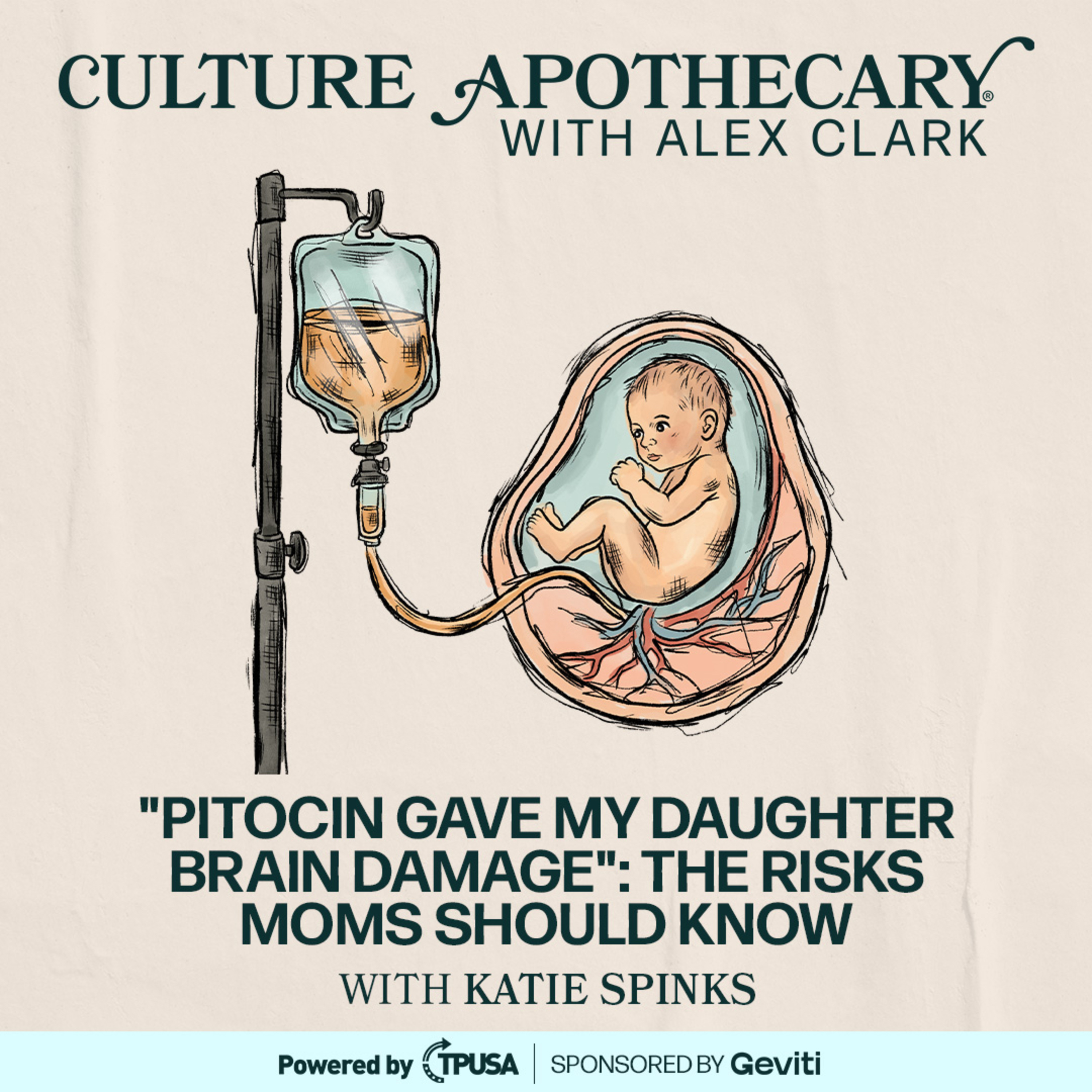
Culture Apothecary with Alex Clark
"Pitocin Gave My Daughter Brain Damage": The Risks Moms Should Know | Katie Spinks
00:57:55
Loading summary
Transcript211 lines
- [00:00]
Alex Clark
You walked into that hospital expecting a healthy baby and ended up with a baby who was severely brain damaged. What were you given during that labor that you blamed for this?
- [00:10]
Katie Spinks
Pitocin. My dose was entirely too high, and there was no reason for it. Most women are not told about the risks. For the mom, there's a risk of postpartum hemorrhage, uterine rupture, contractions that are too close together, too frequent, too strong for the baby, seizures. The biggest risk is the contractions. The uterus is on overload, just contracting, contracting, contracting, strong, strong, strong. And the baby goes into distress because they're being cut and cut and cut and cut, and they just, they can't take it anymore. I felt a literal explosion in my abdomen. She said, you're being dramatic. You're going to scare the other women down the hall because you are screaming so.
- [01:11]
Alex Clark
Pitocin is one of the most commonly used drugs in American labor rooms, given to nearly half of birthing mothers. And yet many women are never fully told that it's a powerful synthetic hormone designed to intensify contractions beyond what the body might naturally do. When those contractions become too strong or too frequent, they can reduce oxygen to a baby, trigger fetal distress, and in devastating cases, lead to permanent brain injury. This is what happened to Katie Spinks. While Pitocin can be life saving when carefully managed, true informed consent means understanding not just the benefits, but the real risks of uterine hyperstimulation. 30% of inductions leading to C sections, oxygen deprivation, and the narrow margin for error when the monitoring fails. Most of the time it's managed safely, but when it's not, the consequences can be permanent. We're talking about what happens when an elective induction turns into a cat cascade of interventions in a life that will never be the same. Watch this episode on the real Alex Clark YouTube channel or culture Apothecary on Spotify. Make sure you leave a five star review for this mom who is bravely sharing her story. Please welcome Katie Spinks to Culture Apothecary. Before Jolene, how many children did you have?
- [02:22]
Katie Spinks
I had three children.
- [02:23]
Alex Clark
Okay, so you had three kids, and what were their ages?
- [02:25]
Katie Spinks
One was 10, I think one was 8 and one was 2. Okay. I am not good with it. That's fine.
- [02:35]
Alex Clark
I know it's been a while when
- [02:37]
Katie Spinks
they were born, but I'm like, hold on. What? How old were they in that year?
- [02:40]
Alex Clark
Yes. What were those pregnancies like? Were there any complications? Were there any risks? Or were they pretty typical births? Very smooth.
- [02:47]
Katie Spinks
They Were great. I had beautiful pregnancies, great births. They were all vaginal births. I never had any issues at all.
- [02:55]
Alex Clark
And they were hospital births?
- [02:56]
Katie Spinks
Yes.
- [02:57]
Alex Clark
And so when you had Jolene, did you go to the same hospital?
- [03:00]
Katie Spinks
Went to the same hospital that I had my third and second child in.
- [03:05]
Alex Clark
Was it the same doctor, nurses?
- [03:07]
Katie Spinks
No, everybody was completely different.
- [03:09]
Alex Clark
Okay, Everybody was different. How many children did you picture yourself having before Jolene?
- [03:14]
Katie Spinks
Six or seven.
- [03:15]
Alex Clark
So you wanted a big family?
- [03:17]
Katie Spinks
Yes, I did.
- [03:18]
Alex Clark
This was always your dream?
- [03:19]
Katie Spinks
Yes, ever since I was a kid.
- [03:21]
Alex Clark
Where was your husband on this, this idea of having like a lot of kids?
- [03:23]
Katie Spinks
Oh, he just does whatever I want to do. He'll pretend like he doesn't. But if I say, hey, let's do this, let's. I want that, he's like, okay.
- [03:31]
Alex Clark
Had you guys ever talked about, you know, what would happen if we ever had a special needs child? Did you ever walk through anything like that?
- [03:37]
Katie Spinks
No, never. I never would have ever imagined this would ever happen. I would have never pictured myself having one because I was healthy. My family line was pretty healthy, so I never expected anything to happen.
- [03:48]
Alex Clark
Jolene was not going to complete your family. Like, you weren't going to stop after her. You had plans to have more children after her?
- [03:54]
Katie Spinks
Yes.
- [03:54]
Alex Clark
During your pregnancy with Jolene, were you told that you were high risk at all?
- [03:58]
Katie Spinks
No. Her pregnancy was beautiful. I worked out into the day I had her. Like it was enjoyable. I loved it. I loved every second of it. I was low risk. I missed like half my doctor appointments in the second and third trimester. Cuz I was just so healthy that I was like, I. I don't really need to go, you know, like, I never had any issues.
- [04:15]
Alex Clark
There were no concerns. Doctor didn't have concerns?
- [04:17]
Katie Spinks
None. Absolutely none.
- [04:19]
Alex Clark
Looking back, were there any red flags, medical complications, anything before the birth?
- [04:25]
Katie Spinks
No. I did have some really strong intuitions on the way to the hospital. Like, it's hard to explain. I felt like a really dark energy. I just didn't. Right. But everybody kept saying, well, you're getting ready to have your fourth child. That's a lot to adjust to. You know, you have a little one at home. It's. It's just nerves. And I just kept feeling like something just doesn't feel right today. I just. I don't feel right. But I never. You know what I mean? Like, I was healthy. We were all healthy. She was healthy. So I figured, okay, they're right. It's just nerves.
- [04:52]
Alex Clark
Were you voicing these concerns to your husband on the way to the hospital.
- [04:55]
Katie Spinks
He said he felt the exact same way.
- [04:57]
Alex Clark
Really?
- [04:57]
Katie Spinks
Yeah. It was very strange. We both. We woke up late because I was being induced. So it was scheduled. I was late to the induction. Um, we just. Neither of us wanted to go, which was weird because when we had our third child, we were like, yes, I can't wait. It was a family affair. Everybody was there. Like, it was literally a family affair. Whereas when I had Jolene, it was just me and him. And it just. It just didn't feel right. Didn't feel right at all.
- [05:20]
Alex Clark
You walked into that hospital expecting a healthy baby and ended up with a baby who was severely brain damaged. What were you given during that labor that you blame for this?
- [05:30]
Katie Spinks
Pitocin.
- [05:31]
Alex Clark
Isn't that a routine drug that almost every single mother in America is given when she's induced?
- [05:37]
Katie Spinks
You know, it is, but so is oxycontin and morphine and all that. After surgeries, there's a lot of routine meds, but the difference is how the doctors use them. Are they using them per standards and protocol, or are they going above and beyond just trying to, you know, in and out, in and out. And that's where the issue felt with me, is my dose was entirely too high and there was no reason for it. If I had had like preeclampsia or seizures or significantly high blood pressure, then the dose I had was probably appropriate, but it just. It just wasn't appropriate for me. It was way too high.
- [06:08]
Alex Clark
And maybe I'm getting ahead of myself. But why did they give you such a high dose? Did they give you a reason?
- [06:12]
Katie Spinks
No, they never, never told me anything. But I just trusted them because they're doctors and nurses. You know, like we're bred and born to just trust these people who have a degree. So I did just that. I didn't question anything. I was like, okay, if you say so, then that's fine.
- [06:26]
Alex Clark
Why was induction originally suggested for this birth?
- [06:30]
Katie Spinks
There's such thing as called elective induction. That's where a mother will be induced just because she wants to. There's no medical reason behind it. So 39 week inductions are encouraged in the US just because they say based off of a flawed. A flawed study called the ARRIVE trial. The trial proved that 39 week inductions were safer for the mom and the baby than to go past term and have a baby. The thing is, with this study, it was flawed. Most of the hospitals that were asked to participate did not participate. The moms who were actually in the study said the doctors went above and beyond to make sure that their inductions went smoothly and ended in vaginal birth. And that just doesn't happen in the real world. Doctors aren't at your, your feet the entire time you're there. They're usually, you know, off seeing other patients or wherever. So it's this study that was done, I think I want to say it was 2019 that proved that. So doctors are encouraging these elective inductions to keep you and your baby safe, but they're not explaining it thoroughly, like, oh, this is what the study found. But it also, it wasn't the only study. You know, there's a lot of studies for everything. And it really depends on which study you're pulling that can back your narrative. Because I could pull other studies right now that shows that inductions are not safe. Whereas if you look at the arrive trial, it says inductions are safer than post dates or term deliveries.
- [07:52]
Alex Clark
What is the reasoning that they say that 39 week inductions are supposed to be so much better than just taking your baby to terminate?
- [07:58]
Katie Spinks
Because they say that it's full term, the placenta starts to die after 39 weeks, and your baby has a significant risk of stillbirth.
- [08:05]
Alex Clark
And there's no science to back that
- [08:06]
Katie Spinks
up, actually, just the studies that, that they did. Yeah, that were flawed, that had a lot of misinformation in it.
- [08:12]
Alex Clark
So they were just telling you, hey, 39 weeks, if you haven't had that baby yet, we should just go ahead and induce. And you just trusted them. And so that's kind of how you got to this point.
- [08:20]
Katie Spinks
I went with it because I had had inductions prior that that were fine. I never, you know, I mean, I never thought twice. I was just like, okay, if you say so. If you think this is safe and you're thinking about me and my baby, then okay, let's do it.
- [08:33]
Alex Clark
What were the reasons for the other inductions with your other children?
- [08:35]
Katie Spinks
For my first daughter, I was past due and I was in school, so they did it so I could be on break from school and then go back at the time when she could go to daycare. And my son, who is my second child, I was working. So, you know, the culture is you have your baby and you have to go right back to work. So I had to schedule my birth birth so I could plan when to go back to work. And then my third one, I'd already had some. So I was like, you know, why not, why not just do it? They went, fine, let's just do it again. I've got Other kids at home. That way I can plan for a babysitter. You know, I won't be going into labor when my husband is at work. We can just plan this all out.
- [09:14]
Alex Clark
Did you feel like you had a real choice with this induction with Jolene?
- [09:17]
Katie Spinks
That's hard to say because I was so. For the induction, I never asked for anything else. I wasn't like, oh, what happens if I don't? If I say no, what's going to happen if I wait till this date? What's going to happen? I was just very. I've done before, so why not? You know, I was very. I just trusted them, everything they said and did. Like, everything.
- [09:34]
Alex Clark
Did anyone at any point ever explain the difference between waiting and inducing?
- [09:38]
Katie Spinks
Never. I had never been explained the difference between waiting and induction until I started digging. And when I became a doula and a childbirth educator, I learned the difference in how much a week or even two weeks really does make and what inductions really can do to not only your body, but your baby's body.
- [09:56]
Alex Clark
What did you find out? Like, what happens in those couple weeks?
- [09:59]
Katie Spinks
Nothing. You give your baby more time to grow. They make it seem like everybody's baby dies after 39 weeks, but it's just giving your baby more time to grow and to nourish the baby and to get healthy. You know, like where the baby needs to be in order to be born, rather than just forcing the mom's body into labor. And same with the mom's body. If the body isn't ready, it's not going to go good. But if the body is ready, the cervix is dilated and nice and soft and, you know, maybe even contractions have already started. Then it's a little bit safer than just forcing the body into labor when it's just not ready. Yeah.
- [10:29]
Alex Clark
It almost seems like labor and delivery in the United States is treated like everything is always an emergency. And it's something that's unnatural. Right. We, like, over it seems to me like we over medicalize it and we act like women's bodies don't instinctually know what to do.
- [10:47]
Katie Spinks
Yes. Yes, absolutely. You're right. Doctors are convincing women their bodies don't know how to go into labor and that if they wait past 40 or even 41 weeks, their babies will die. Die. There are so many women who truly believe that they think that their baby will die. And it's just like, this is. This is sad. This is what doctors are convincing women that's going on with their bodies. They're convincing them Their babies are going to die. When really your baby's just getting an extra week or two of nutrients. Like you want your baby's lungs to be nice and healthy, the brain to be nice and healthy, the skin, all the organs. And the more time you give them, the better it is, you know, for a healthy woman. If a woman has like preeclampsia or high blood pressure, you know, anything like that, obviously then it turns a little bit, because then induction is probably safer for her, but it's still not. Let's just give her all this Pitocin and walk away and leave her for 12 hours. You know, like there, there's a difference between having an induction with a good team and having an induction with a bad team.
- [11:42]
Alex Clark
And you had a bad team?
- [11:43]
Katie Spinks
Oh, absolutely. Bad isn't even the way to describe them. Like, I have never seen a nurse behave in such a manner that my nurse did. And it just. As soon as we started going and as soon as my rupture happened and she reacted like she had no clue what she was doing, I knew that things were not going to go good from there forward.
- [12:03]
Alex Clark
When you were told that you were going to be inducing, did you know that Pitocin was going to be involved?
- [12:07]
Katie Spinks
Yes.
- [12:08]
Alex Clark
And what sorts of risks or side effects or things did they walk you through?
- [12:12]
Katie Spinks
Absolutely none.
- [12:13]
Alex Clark
Is that typical?
- [12:14]
Katie Spinks
From my experience, from my clients and my friends and everything, absolutely yes. Most women are not told about the risks. There was a study done, like a cohort study that found, I want to say it was. Between 40 and 60% of women are not informed. They don't feel like they are part of their child's birth in regard to decision making. They feel like their doctors just did things, didn't explain anything, and they just sat there like a guinea pig.
- [12:41]
Alex Clark
That's really scary.
- [12:42]
Katie Spinks
It's terrifying. It's terrifying.
- [12:46]
Alex Clark
You ever notice how you're drinking water all day and somehow you still feel like a raisin Help water flooding. You've got the Stanley cup, the filtered water, the reverse osmosis system. That sounds like NASA installed it. And you're still tired, headachy, craving salt like you're lost at sea. Here's why. Our water is basically stripped of everything. Most purified water has zero minerals. Our soil is depleted, our food has fewer electrolytes. So you're chugging clean. I'm saying that in quotes. Water that has nothing in it. It's like pouring blank liquid into your body and hoping for a mir miracle.
- [13:22]
Katie Spinks
One moment, I need a drink of my electrolytes so good.
- [13:30]
Alex Clark
That's why I use Taylor Duke's electrolytes. Obsessed with the grapefruit and the strawberry lemonade flavor. This is not neon gas station powder. There's no added sugar. There's no food dives. There's no natural flavors that were invented in a lab. You don't even know what the heck a natural flavor is because they're hiding all kinds of chemicals. It's made with unrefined sea salt, organic coconut water powder, and real fruit juice powder. And it has magnesium, more than most electrolytes mixes, which is huge because most of us are deficient in magnesium. Magnesium supports energy, brain power, helps reduce headaches, cuts, cravings. It's for everybody. Pregnant moms, nursing moms, kids, athletes, travelers, people recovering from late nights. All of us. Water alone is not enough anymore. You need minerals. Go to Taylor Dukes wellness.com use code Alex Clark for 10 off. That's Taylor Dukes wellness.com code Alex Clark for 10 off. You got to hydrate like you live in the 1800s, you know, when water had nutrients. What risks or side effects are associated with Pitocin?
- [14:27]
Katie Spinks
Okay, so these risks you can find right on a pitocin label. For the mom, there's a risk of postpartum hemorrhage, uterine rupture, nausea, contractions that are too close together, too frequent, too strong for the baby. In small cases, women have had seizures. The biggest risk is the contractions. It makes contractions way too strong, too close together too frequently. And then when a woman contracts normally, like naturally, they don't get as much oxygen while the woman is contracting. But with a normal contraction, it's not enough to affect them. But when you have oxytocin, which is what our bodies naturally produce, ampatocin going at the exact same time, the uterus is on overload, just contracting, contracting, contracting, strong, strong, strong. And the baby goes into distress because they're being cut and cut and cut and cut, and they just. They can't take it anymore. So the uterine patterns are the biggest risk for mom into the baby. It's the fetal distress because of the contractions.
- [15:25]
Alex Clark
So when you're in labor, when does it shift from routine to really dangerous?
- [15:33]
Katie Spinks
So for me, everything was really routine. I want to say the first, like, eight hours, everything was totally fine. And then towards the end, my uterus ruptured, and I felt a literal explosion in my abdomen. Like, it felt like something went off inside of me. And I was telling my nurse, like, this isn't right. This isn't Right. Like, I'm not having contractions anymore. Something is wrong inside of me. Like, I kept begging her and pleading with her to just check me, to call somebody to do something, and she kept saying, well, our doctors are doing C sections right now. Like, I'm the only person here that can help you, and I don't know how to deliver a baby. You're just having pain because you're fully dilated. And I'm like, that is. I'm telling you, that's not what it is. Is. So it shifted probably about eight, nine hours in.
- [16:19]
Alex Clark
Were your contractions different once pitocin started?
- [16:23]
Katie Spinks
So I wasn't contracting when I walked in. I. My body was not ready yet. I was only a finger dilated, so a centimeter dilated, and I just wasn't ready. So. But when they did start the pitocin, you know, like, I could feel the contractions. I felt them coming and going. They felt normal, like I had felt before. But then when the rupture happened, I stopped feeling them, and I felt this constant, horrific pain in my abdomen.
- [16:45]
Alex Clark
So on a scale of 1 to 10, 10 being the worst pain you've
- [16:48]
Katie Spinks
ever felt, what was this, like, in a million? It was the worst pain I've ever felt in my life.
- [16:52]
Alex Clark
And they were dismissing you, saying, you're just having normal contractions.
- [16:55]
Katie Spinks
She used the word dramatic. She said, you're being dramatic. You're gonna scare the other women down the hall because you are screaming so loud. I'm like, yes, I'm screaming this loud because I. I'm in agony. Like, at this point, I. I can't sit still. I'm just sobbing. Like, my husband's trying to walk in and out. He's like, can somebod. Didn't happen last time we were here. Like, she. You know, she was upset because the contractions hurt, but she was not like this. And it just. Nobody cared.
- [17:22]
Alex Clark
What is it like in that moment when you know something medically is so wrong, as you're in the middle of labor and the nurses and. And the. And the medical staff around you are gaslighting you and telling you that you're being dramatic?
- [17:35]
Katie Spinks
It was the worst feeling I've ever felt in my life. The. The absolute worst. I was terrified because that dark feeling that I had going to the hospital, it came back. And this time I felt like I was gonna die. Like, I kept telling my husband. I was like, if I die, please just make sure you. The kids know that. Like, I love them. Like, I'm pleading all my last words. Because I felt like I was gonna die. I literally felt it. It was terrifying. Sitting there in a hospital bed with doctors and nurses, and you're like, please help. And they keep saying, you're dramatic. It's fine. It's. It's a horrible feeling. Horrible.
- [18:06]
Alex Clark
Did anyone explain how the dosage was being increased with the Pitocin?
- [18:10]
Katie Spinks
No, nobody explained it. They didn't tell me how it's supposed to happen, how it should happen, why it's happening at that rate. They just. They just did it.
- [18:18]
Alex Clark
What is this word? Tashicital.
- [18:23]
Katie Spinks
What is it? I think it's tachycystole. It's where the uterus is contracting too. Too strong, too close together. The contractions are not normal. They're not natural. They're just like. Like, bam, bam, bam, one right after the next, and they're really strong. They're lasting a long time. They're not letting up. And then when you do get a break, it goes right back into it. So.
- [18:41]
Alex Clark
Did anyone use that word with you?
- [18:42]
Katie Spinks
No.
- [18:43]
Alex Clark
Were you told? Hey, you know, when you take Pitocin, contractions can become really strong. They can. They can get too close together.
- [18:51]
Katie Spinks
They did say it could make the contractions more painful. That's. That's it. That it could just make contractions more painful. I was never given any risks or told really anything bad that can happen because I was so low risk. You know, the doctors were like, you're. You're so healthy. Like, this is going to go great. You're going to be in and out in, like, less than 12 hours. And I'm thinking, hey, I like. You know, I like that I've got three other kids at home. Like, I just. I just want to go back home. So I was totally fine with it. I never thought. Let me ask, what are the risks? How often do they happen? What happens if you don't do that? Are there any other options? What happens if we just wait? You know, like, I didn't ask anything. Like, all these questions that pop in my head now. Think I should have done all these things. I should have asked all these questions. But then, on the other hand, they're doctors and nurses. We're supposed to trust them to do the right thing. I never in a million years would have thought that this could happen ever.
- [19:42]
Alex Clark
Did they give you an epidural when you were screaming in pain?
- [19:44]
Katie Spinks
No, I was getting IV pain medicine because I didn't want the epidural. I'd had one last time, and the last time, and it just didn't work. So I just. I just didn't want to do it. They kept saying, let's just. Let's give you an epidural. Let's do this, let's do that. But I'm in so much agony. There's. I know there's no way I can sit still for the epidural, because you have to be still for the epidural. And I knew I couldn't. Like, I was just wiggling everywhere because I was in so much pain.
- [20:07]
Alex Clark
So at. At any point did they stop and say, okay, something is wrong. We can tell this is not going normally. Maybe we need to look into what's going on here.
- [20:15]
Katie Spinks
No, they never did. Not once. I begged for them to. I. I begged for somebody to do something. I even sat there and telling the nurse, I was like, just give me a C section. Like, if you give me instruments, I will just cut this baby out right now. Like, I was in so much pain. I felt like I could have done it at that point. Nobo. Nobody thought to ask or to do anything, no matter what. They just kept saying, this is normal. This is normal.
- [20:36]
Alex Clark
Well, the baby's in you. So then what happens next for her?
- [20:39]
Katie Spinks
My rupture started small, so she was okay. Because once the uterus ruptures, it cuts the oncoming oxygen to the baby. All they have is what's in the cord. But there is a difference in ruptures. You can have, like, a small spot, starts real small, and then it grows if it's not taken care of in enough time. And that's what mine was. Mine started real small, one little localized spot, and then it grew because it went on for so long. So at first she was okay, you know, didn't really bother her. You see her heart rate fluctuate a little bit, but nothing to be concerned about. It wasn't until the doctor came in and made me start to push. But you cannot push with a uterine rupture. It's. You just can't. It's not. It's not going to happen. But she decided I needed to push anyway. And at that moment is when it went from a small hole to a complete tear. And then that's when her oxygen was cut. And all she had was just what was in her cord. And it wasn't long. It was like. Like 12, 13 minutes maybe before she was okay. And then she went down to 40s and 60s, and that's deadly. At that rate, most babies don't survive. So at that point, they tried to use the vacuum three times. To pull her out of me. And each time the vacuum would pop off her head, and then she would just go, like, flying back into me, and I was passing out in between each time they would use this vacuum. And the third time I passed out, I just didn't wake back up. They were, like, sticking the salts up my nose and trying so hard to wake me up, but I wouldn't because
- [22:01]
Alex Clark
the pain was so bad.
- [22:02]
Katie Spinks
No, I was internally bleeding as well because of Jolene's position. It was blocking everything, so it didn't expel out of me. It just backed up into my abdomen. So I had lost so much blood that I passed out. And at that point, my husband said they still, like, they weren't rushing. Like, there is a difference between a stat C section and an emergency one. I should have been, like, stat running right now. He said that they were just like, casually collecting everything and just wheeling back. They got him dressed in the bunny suit. They thought this was going to be a normal C section, mind you, after I'd already passed out and her heart rate was between 40 and 60. But I guess once they decided that when, you know, they opened me up and the blood just started pouring out was. It's not normal at this point, the
- [22:44]
Alex Clark
blood was pouring out of you?
- [22:45]
Katie Spinks
Yes, because once they opened me up, since she was closer down in my pelvis and the blood was backing up in me and they cut me open, it just went. Went over like a waterfall.
- [22:55]
Alex Clark
So then what were they saying at that point?
- [22:56]
Katie Spinks
I don't know. I was out. I was under general anesthesia, and they wouldn't let him in.
- [22:59]
Alex Clark
Oh, your husband wasn't in there?
- [23:00]
Katie Spinks
They wouldn't allow him in. I guess once they realized how serious it was and the fact that I had to. Had to go under general anesthesia, they knew at that point, you know, maybe I wasn't lying. Something a little bit more serious is probably happening.
- [23:11]
Alex Clark
So then do you think at that point, they were thinking, okay, this is like a fetal distress scenario?
- [23:15]
Katie Spinks
I don't know what they were thinking. I still wonder to this day, what were you guys thinking? Like, did you just not care? Because if you look like I have my fetal strips, you know, the little line that prints off that shows the contractions and the baby's heart rate. If you look at it, you can see the moment my contractions change from the normal, beautiful little hills to really wonky patterns that align with my high blood pressure. And the fact that I said something was wrong.
- [23:38]
Alex Clark
When they got the baby out of you, what did they notice about Jolene.
- [23:43]
Katie Spinks
She had no pulse. She wasn't breathing like she was born. She wasn't alive. So the NICU doctor in there did a bunch of rounds of cpr, epinephrine, umbilical lines, and started cooling her because therapeutic hypothermia is shown to significantly decrease the spread of brain damage in babies. So he had to work on her while my team was working on me. So I guess it was somewhere in that room at that point. Somebody had to have realized it. It. They just didn't tell us anything. We were told nothing.
- [24:16]
Alex Clark
Do you believe that this was preventable?
- [24:19]
Katie Spinks
Oh, absolutely. It was 100% preventable. If they were going to use Pitocin, they could have kept my dose at six or eight. That's a totally healthy rate. It gives the mom time to relax. It's. It's not a crazy dose, but they had me at 15, and the max dose is supposed to be 20. So at almost 20, something, she should have clicked with their head, you know? So it was. Was. First of all, the rupture could have been preventable had they not given me high doses of Pitocin, and my daughter could have walked away without brain damage. Had they listened to me the first time I said, something doesn't feel right. Had they listened then and just an ultrasound, they would have been like, oh, wow, like, she's internally bleeding. We gotta go. And she could have been saved.
- [24:55]
Alex Clark
Do you think if somebody would have said to you, hey, this medication can cause permanent injury if mismanaged, do you think that you would have still, like, been like, okay, I'm glad you told me. I'm still gonna agree. Or do you think you would have been like, oh, no, I'm the kind
- [25:07]
Katie Spinks
of person that would have not done it. I would have have been like, you know what? I'm going to wait a little bit longer. I just have to assume that's what I would say. Thinking back now, if somebody had told me, your baby could suffer severe brain damage or have seizures or die, or you could die, your uterus could rupture, anything, I would have been like, no, you know, it's not necessary. My induction was elective. It wasn't necessary. So I could have been like, let's just push it off another week and give me more time to look it up and. And to read about it before I say yes.
- [25:33]
Alex Clark
What did Jolene end up getting diagnosed with?
- [25:35]
Katie Spinks
Okay, so there's a long list. Her main diagnosis is hie, which stands for hypoxic ischemic encephalopathy and from that she has cerebral palsy. She has epilepsy. She cannot suck or swallow. She's strictly G tube fed. G tube is a feeding tube that goes into the stomach. She has a cvi, which is just a vision impairment. She doesn't see much out of her left eye. Her right eye is her stronger eye. She has hypertonia and hypotonia, so she can't crawl or walk. And doing any sort of exercises, like sitting, being on her belly, having to lift her head, things like that. And it's. It's really hard for her because her muscles are working against each other. So whereas, like, if we stand, our whole body's gonna work for us. Her top half will be much looser and her bottom half will be a lot tighter, so it's harder for her. So she has, like, all the main characteristics and diagnoses of a child with hie.
- [26:31]
Alex Clark
Can I say something mildly unsettling? There are thousands of unregulated chemicals in our environment. In the air, in our food, in our water, in receiving seats. Some of it we can't control. Unless you want to live in a cave and turn your own butter, which, honestly, tempting. But here's what we can control. What we spray all over our kitchen counters, what we mop our floors with, what we wash our clothes and dishes with. That's why I switched to Branch Basics. And I'm not being dramatic. It has replaced everything under my sink. One product, everything replaced. Their premium starter kit uses one plant and mineral based concentrate that replaces dozens of toxic cleaners. I use it on my counters, my bathroom, my windshield wiper fluid. I clean the inside of my car with it. Laundry, dishes, makeup, brushes. I even wash produce with it. One formula. No synthetic fragrances, no harsh chemicals. And the wild part is, it really works just as good as all those other chemical problematic things I was fully prepared for. Clean girl aesthetic. But doesn't remove stains. Nope. It removes the stains. Let me tell you something, Mochi. My Pekinese dog, he loves to eat pumpkin puree. I give it to him with every meal. And he came over and he had his little bib on. Because, yes, I put my dog in a bib. Don't ask questions, just enjoy. And he comes over to my white couch and he pops up and it's got it on the bib and it gets it on the couch. And I literally almost was in tears. I was like, you've got to be kidding me. This is my 100% organic white couch. I'm screwed. This Is so expensive. I'll never be able to get this stain out. What do I do? And I used my branch basics on it and the stain came right out. That was like the scariest moment of my life. That was like a hardcore thing to see if branch basics would work. It worked. It was bright orange on a white couch. One concentrate, it equals 13 refills. Each bottle ends up costing like two bucks. Okay, you're not paying more to be healthier, you' paying less. If I can't control the outside world, I know that I'm at least making sure that my house isn't marinating in mystery fumes. This is the year that you've got to say goodbye to toxic cleaning products. Get 15% off with Alex 15@ branch basics.com on the premium starter kit. That's code Alex 15 on the premium starter kit@ branch basics.com Quick Public Service announcement. Collagen and colostrum are not the same thing. Okay? Collagen is basically structural protein. Think skin, hair, nails, joints. Great for scaffolding. Colostrum, that's all that fat plus immune intelligence. It's the first milking within four to six hours after a cow gives birth. It's loaded with bioactive ingredients like immunoglobulins and natural growth factors that support immunity, gut health, radiant skin recovery and athletic performance. Cowboy colostrum does it differently. They collect exclusively first milking colostrum from grass fed us raised cows. Which matters because the closer to birth, the higher the concentrate of those bioactives. A lot of competitors mix first, second, even third milkings. That's like saying fresh squeezed juice is the same as whatever's left after you, you know. Three pores later, theirs is whole colostrum. It's not stripped, it's not skimmed. You can see the difference. Cowboy colostrum is fluffy. It's slightly yellow. It's whole milk, okay? Not white. And like electrolyte powder, that's how you know they're stripping all the good stuff out of it with some of those other popular brands. Now they also prioritize calf welfare compared to other brands. The babies always get their fair share. Only the surplus is collected, which I really respect. Their serving size is 3 grams. They actually encourage 6 to 9 grams. If you're training hard or you want extra immune import, you can froth it into coffee or throw it in a smoothie. The vanilla tastes like a child of vanilla milkshake. The strawberry one tastes really good by itself in a glass of raw or whole milk. The matcha flavor Is for you matcha freaks. I prefer the unflavored in my tropical fruit smoothie every morning. Use Code Alex for 25 off at cowboy colostrum.com that's code Alex for 25 off at cowboy coloStrum.com. have you met other moms who have seen similar stories to you?
- [30:15]
Katie Spinks
Not in person, but I have online. There's. There's a lot of them. A lot.
- [30:19]
Alex Clark
What are some of the things that you've heard?
- [30:21]
Katie Spinks
The main thing that we all have in common was that we had a negligent medical team. That is the main thing. And then the second main thing that I see is it was an induction that was mismanaged and went wrong. That is probably about 80% of the stories that I find.
- [30:37]
Alex Clark
Can a woman revoke consent once labor has started?
- [30:40]
Katie Spinks
That's a tricky question because, because yes, it's your body, your baby, you technically can do whatever you want. If you want to take out your IV and go home because you don't want to be there anymore, you can. It becomes tricky because if your water is broken, then you do have an increased risk for infection. It's not like immediate. So if they break your water and they're doing this induction, you decide, I don't want to do this anymore. And you go home. And then you just never contract or go into labor on your own. You're putting yourself and your baby at risk. So it's, it's kind of tricky. If you get there, sign in, they start the pitocin, and then you decide, you know what? I don't want to do this anymore. My water's still intact. I want to go home. That you absolutely can. They cannot hold that against you.
- [31:17]
Alex Clark
Do you think that women feel pressure, like they have to comply in labor?
- [31:21]
Katie Spinks
Yes. Doctors, I have seen it quite a few times, will threaten the mom with their own baby. If you don't do this, your baby will die. If you don't do this, you'll harm your baby. Do you really want to put your baby in danger? Like it's like gaslighting and manipulation to a point. Because there's no sit down conversations like this. Like, hey, this is the drug I would like to use. This is what happens if we don't. Don't. These are the risks. These are the other options. This is what's going to happen if we don't do anything. Nobody's really sat down and given a conversation. The doctor comes in, hey, what's up, Mrs. Smith? Your, your pitocin starting right now. I'll Be back when the nurse calls me. Nobody's humble anymore. Nobody wants to explain anything anymore. And it's just. It's why it's ending in so many birth trauma or traumatic births. Even if, like, what I had happen doesn't happen, women can still have a. Like, a vaginal birth and say that they felt traumatized from their birth because doctors are not informing them. There's no informed consent, and they just don't feel like they're in charge of their birth. Like, you're at their mercy almost.
- [32:20]
Alex Clark
So what ended up happening? I mean, Jolene is born. She's severely brain damaged. She has this list of issues that you just shared. What ends up happening with the hospital? I mean, did they. Did they fess up and admit, we. We've made a terrible mistake? We're so sorry.
- [32:34]
Katie Spinks
Did you.
- [32:34]
Alex Clark
Did you win a huge settlement?
- [32:35]
Katie Spinks
What happened, happened after this happened, I was very out of it. They had me on a really strong morphine drip, and I didn't. I didn't know what was going on. When I woke up from the C section back in the room, I. She was already in the transport cart, literally at the foot of my bed. And they were like, if we don't leave now, your baby is. Is going to die. Basically, your baby needs treatment right now. And the closest hospital that could do that was about 45 minutes to an hour north. So, you know, I couldn't sit there and, like, wake up and be like, oh, give me a few minutes. They were just like, you can touch her foot. And then we are leaving. We are leaving in five seconds. So it was very confusing and all that for me. Nobody explained anything to me until the next day after I'd woken up and they lowered my drugs and all that. And they're like, oh, you had a uterine rupture. Don't know why it happened. It never happens. Super rare. You're like one in a million. Sorry we didn't catch it sooner. Like, they were so cold.
- [33:24]
Alex Clark
Did the nurse who said that you were dramatic when you had a uterine rupture, but she was just saying that you're dramatic. Did she come back and apologize and say, you were right? I'm so sorry. Sorry.
- [33:34]
Katie Spinks
She had her own little way, I guess. She came in, she sat on my bed, and she was laughing because she said, it's so funny that I didn't catch Leo to rupture because I teach about them in school. She teaches nursing students about ruptures, and she can't even notice one. She didn't Even notice one. I had all the tall tale signs. She didn't even notice.
- [33:50]
Alex Clark
And that was you explaining, I felt an explosion and what else?
- [33:54]
Katie Spinks
And my blood pressure went up. I had shoulder discomfort. My contractions went from, like, you know, the nice, pretty, hilly contractions to these real jagged, like, not letting up contractions. Everything changed. And if something like that happens, they're supposed to be like, we have to get somebody else in here. This mom was perfectly fine, and now all of a sudden, she is screaming as loud as she can in agony, like, this isn't right. It was almost like she didn't care. Like, they were both very, very cold. They're like, I'm sorry for your daughter. Hope she. Hope she recovers. And that was pretty much it.
- [34:26]
Alex Clark
Meanwhile, your life just completely changed.
- [34:28]
Katie Spinks
Yeah, meanwhile my life. I didn't even know what was going on. I was, like, so disassociated because I was like, this can't. This can't be true. Like, this cannot be a thing. And they're just like, la dee da. Move on to the next person.
- [34:39]
Alex Clark
When did you finally get to spend time with your daughter?
- [34:41]
Katie Spinks
She was three days old because we were in two separate hospitals because I couldn't leave. My injuries were pretty severe, too. But I did sign myself out on the third day because when a baby gets cooling, they're cooled for three days. On the third day, they reverse them, they warm them back up and do a brain mri. And that's when you learn what's going to happen. Like, how bad is the damage. And at that point, the doctors up there, they weren't expecting her to live. So I just. I just went up there. I was like, I don't. I don't really care at this point if she's going to die. I want to be there with her. I don't want her to be alone. So I didn't meet her until she was three days old.
- [35:13]
Alex Clark
And when you got there, what did they tell you about her condition?
- [35:16]
Katie Spinks
They had just got done with the mri. They said that it was done and that there was really. They couldn't explain it to me because they needed to, like, get together with a team and all that. They did say that she was in, like, a comatose state because of all the drugs that they had to give her to. To keep her comfortable, because I guess when you go into hypothermia, it's extremely uncomfortable. So they did that. They didn't really explain much until she was about five days old. They showed me her mri and they were like, this is. This is really bad. This is a severe, severe case. You know, we'll try to lower the doses of the meds to see if she can come off of them. We don't know she's ever going to wake up. We went on for, like, two weeks thinking that this was it. She's not going to wake up. Every time they'd lower her dose, I'd be sitting there, like, just praying to anybody and everything, like, just let her wake up. And she never woke up. It was probably about two weeks after she was born. She finally woke up, but nobody said anything except for the NICU doctors. They were like, you know, this is bad. More than likely she's gonna have cerebral palsy and epilepsy. You know, you're gonna be a caregiver for the rest of your life. Now, kids like her don't live to see six months to a year old, so we need to start talking about these things. You know, you just have a baby, all these things happen, and then they're like, we need to do this, that and the other. Other. It's. It's a lot there. I spent most of the time in the NICU just completely disassociated at this point.
- [36:33]
Alex Clark
Had you put the puzzle pieces together and kind of figured out, okay, this is the hospital's fault. She was supposed to be a totally normal, healthy baby. There were no issues until they, you know, malpractice, basically.
- [36:44]
Katie Spinks
I would say she was about a month old and a nurse I'd gotten, like, really closely. She said that she was going through, like, all my records and. And everything, and she pieced the puzzles together for me. She was like, I want you to know that this was preventable and you should go see a lawyer. You know, like, she sat me down. She was like, you need to know this because they're not going to tell you. You're going to go on your whole life thinking that you did something wrong, but you did nothing wrong.
- [37:06]
Alex Clark
So did you end up doing a lawsuit?
- [37:08]
Katie Spinks
We tried. We tried really hard for five years, five and a half years. We went to different lawyers, different states, different everything. But my records are not. They don't reflect what happened in real life life. Like, I'll give you a couple examples. The doctor used the vacuum three times. In the notes, it says they only used it twice. Another part in there was that they put. I was comfortable with IV narcotics. I was not complaining of pain. I was smooth sailing my whole labor, but I was not, you know, like, I was screaming in agony. I was literally Screaming that I was in so much ungodly pain. And they put in there that it was normal, that my labor was totally normal. They had nothing to suspect that things went wrong until the very end. Like, you know, when her heart rate started to dip. And then they said it was probably just because of the pitocin. You know, the mom's body was just stressed out.
- [37:56]
Alex Clark
So what happens when a hospital lies in the notes about what happened in a case like this?
- [38:00]
Katie Spinks
They get away with it. There's nothing we can do. I had no evidence. Nobody was there with us. It was just me and my husband. We just wanted to be like a nice intimate birth, not a family affair. Nobody was recording, there were no pictures, there was nothing. We thought we were going to go in, have her and then I could just leave a few hours later. So we weren't like we had no, we have nothing.
- [38:20]
Alex Clark
This makes me feel like if a woman does opt for a hospital birth, she needs to have cameras rolling the entire time. Would you agree with that?
- [38:27]
Katie Spinks
Absolutely. Not only just a camera, but a third party person. That's what I tell women all the time. Get a doula. If you can't get a doula, find somebody in your family that can act on behalf as a doula. Because if something goes wrong and they're telling you it's fine, like somebody there is going to have to advocate, they're going to have to be taking pictures and videos and taking notes and saying this happened at this time. Women going into the hospitals now with no plan except I just want to live. Women are going to the hospitals now saying my birth plan is just to live. And that's just, that's not good enough. That's not good enough because then you're giving them the power to own your birth and you have nothing. You're giving up power. So absolutely, I feel like, you know, police wear body cam footage. Why, why shouldn't doctors, why shouldn't they?
- [39:11]
Alex Clark
What does daily life look like now?
- [39:13]
Katie Spinks
It's very different, very different than what it was. It's. She needs 24, seven supervision, you know, because she can roll now. She's a little bit more mobile. So she can roll. She could roll and hurt herself. She doesn't swallow, so she needs to be suctioned constantly. She's fed through a G tube so I have to feed her. She needs medicine. She has therapies in the house and out of the house. Some of them are like two hours away. Day people come into the house all the time. It's just, it's just very different, you know? Like, it is the typical life of a caregiver. Like, I am no longer existent. I'm just a robot there to make sure she lives and has a good life.
- [39:52]
Alex Clark
Plus, you've got other kids.
- [39:53]
Katie Spinks
Yeah.
- [39:54]
Alex Clark
That you've got to take care of and spend quality time with and pour into. Does Jolene experience feelings like joy and happiness?
- [40:00]
Katie Spinks
Oh, absolutely. Yeah. She loves her siblings. They could do anything. They could just be sitting there, like, drinking a bottle of water, and she'll just laugh at them. She thinks they're hilarious and they love her. Like, they're always playing with her. She definitely has emotion. And the older she gets, I can tell that she's in there, you know, like, she understands things. She'll answer questions with, like, babbling or shaking her head. Just the day before I left, she was holding the TV remote, and I said, hey, Jolene, can I have the remote? And she put it, like, right in my hand. Like, she knows things. It's almost like locked in syndrome, where they're in there and they can hear and understand. They can't communicate.
- [40:36]
Alex Clark
And she's how old now?
- [40:37]
Katie Spinks
She's 6.
- [40:37]
Alex Clark
That's right. 20. 20, man. So you had to then go through the whole pandemic, navigating, having this severely special needs child and not being able to go many places or get out of the house.
- [40:48]
Katie Spinks
Yeah, it was. It was rough.
- [40:49]
Alex Clark
That's a lot of trauma compounded on top of one another.
- [40:52]
Katie Spinks
Yeah, it was. And a lot for my other kids, too, because, you know, know I have to. While I'm healing and grieving, I have to help them heal and grieve, too. I can't just leave them in the dust and. And all that because they. They definitely were affected as well. They still are because they'll still, till today, say. It's so frustrating. Jolene can't walk. Like, we can't do this. We can't do that. I wish Jolene could do this. Like, when is somebody ever going to be able to heal her brain damage? Like, they're always. They're so hopeful, and they really do think that one day she'll just get up and walk and do all these things. Things. But I try not to, like, dim their light, you know, but be realistic. I don't want them to be like, I don't want to be like, oh, no, she's never going to walk. Don't. Don't think about that, you know, Like, I don't want to be negative because I know that they're grieving. Too. So it's hard because I'm on my own healing grief journey and also trying to help them through theirs. So it's hard. But I am thankful they do treat her so well. Like, they are so good to her. They're so protective. Like they love her and they're so understanding. Like, if we can't go do something spur of the moment, they're like, it's fine. Let's clean up the living room, put the blankets down and watch a movie. Like, they're. They're so good. They're so good.
- [41:56]
Alex Clark
You ended up getting pregnant again after Jolene. What happened in that pregnancy?
- [42:00]
Katie Spinks
I lost her in the second trimester because my uterus was so damaged that my body just couldn't hold a baby anymore. As soon as I would get to the halfway point because we tried again after that loss and after that second loss, my doctor was like, we can't do this anymore. Like, you, you have to have your uterus removed because if you get pregnant again at this point, you're putting your own life at risk. Risk. So that was. That was rough too. I would say they definitely took that a lot better. We all did. Than what happened to Jolene. I don't know why. I can't explain it, but it's just. Maybe it's just easier because they're not here. You know, they never were born. They were. They never got a chance to live, so we didn't get a chance to make memories with them and bomb with them. So I feel like maybe that's just why it's easier. You know, we miss them. We still talk about them and we talk about what we could be doing if they were here. But they don't sit around and cry all the time anymore. None of us do.
- [42:51]
Alex Clark
What did medical professionals tell you that you needed to do after that pregnancy ended?
- [42:56]
Katie Spinks
Just have regular follow ups.
- [42:57]
Alex Clark
So are you wanting to get pregnant again?
- [43:00]
Katie Spinks
I can't anymore. So they said to just have regular follow ups. But I went and saw a specialist because I was like, I need somebody, somebody different to tell me, you know, what their opinion is. And this doctor was like, your insides are. They don't look good at all. Know you, you. You really should just get your uterus out because if you don't, it's going to cause you more issues down the road. So I did. In 2020, I want to say 2021, I did get my uterus taken out.
- [43:24]
Alex Clark
Was that a. Is that a hysterectomy?
- [43:26]
Katie Spinks
It was a partial.
- [43:27]
Alex Clark
Okay.
- [43:27]
Katie Spinks
Because I was left with Both of my ovaries. Wow. But since then, I've lost one because I still have so much scar tissue in my abdomen. So it's like ongoing issues for. For both of us.
- [43:42]
Alex Clark
There is nothing more expensive than guessing about your health, guessing which supplements to take, guessing why you're tired, guessing if your hormones are fine because you feel okay. That is not data. I use Jevy to know exactly what is happening with my body, what is going well and what isn't the root of any problems that may arise with my health. Jevy runs over 90 biomarkers twice a year. For context, most Doctors run about 20 once a year. If that. That's like checking taking one tire on your car and saying, oh, this seems fine. That's like what I do whenever I have no man in my life helping me out. They use your actual numbers to build personalized protocols, custom supplements, hormone balancing therapies, peptides for longevity, metabolism recovery. And if you want to go deeper, members can access Dutch testing for hormones, which I really recommend. That's like the one test every single person should take. GI map for gut health, nutrient panels. You can find out if you've got the MTHFR gene. You can find out if you've got environmental toxins. You can get these extra tests through their marketplace. Everything lives inside the Jevity app. Your historical labs, your care team, ongoing support, all for 129amonth, comprehensive blood work included. Do not wait until something catastrophic happens. Then you're like, oh no, what do I do? Well, I guess I have to just go to my conventional doctor who has no idea how to get to the root cause. Nope. Stay ahead. Save money and precious time with your family by being proactive about your health. Use code Alex to get 20 off your first purchase at gojevity.com code alex@govity.com everybody says I don't have time in the morning. No time to eat breakfast, no time to read my bible, no time for red light therapy. But what if you could stack all three? One of my favorite morning habits is sitting in front of my juve red light for 10 minutes while I eat a bowl of sprouted glyphosate free brown sugar cinnamon oatmeal, and I do my devotions. That's it. 10 minutes. I eat my breakfast, I have spiritual grounding and infrared light all at the same time. It is so easy. Healthy light exposure is foundational red and your infrared light have been studied for supporting cellular production, muscle recovery, skin health, and a balanced inflammatory response. Especially in seasons where we're indoors more Getting intentional light exposure makes a difference. Joov is my go to because they use clinically proven wavelengths, deliver a safe and effective dosage and their devices are true medical grade panels that are independently safety tested and certified. That peace of mind matters when something becomes part of your daily routine. They also offer a wide variety of options. So if you want a targeted treatment, you want to spend less money, you can do that with like a little device. You can also get a full body coverage. For me it's become non negotiable, stable because it is simple and consistent. If you want to stack your habits and support your health at the cellular level, go to juve.comalex for an exclusive discount. You've got to use that whole URL to get the discount. Joov j o v.com Alex Some exclusions will apply. Do you now think elective induction is problematic?
- [46:40]
Katie Spinks
Yes, yes, absolutely. I think it's problematic because, because like you said, you know, we're just, we're at their mercy. So many people just walk in there. The doctors are like just Pitocin, Pitocin, Pitocin. Get em in and get em out. So the next person come in, it's like a, like a meat factory, like a revolving meat factory. They're just, nobody is treating birth like it should be anymore. They're treating birth like a race. Everybody's like, I don't wanna be pregnant anymore. I'm done, I'm done. Like impulsively acting where you should be thinking, well, what is the safest route? What is the safest route right now? Not what could I do the quickest, they're just. And Pitocin is being used way too much on women's bodies who aren't ready.
- [47:17]
Alex Clark
So when you look back now at your entire birth experience, even before labor, do you see this like domino effect of a cascade of interventions that started happening even before you were in labor?
- [47:27]
Katie Spinks
Yes. So there is such thing as called a cascade of intervention in obstetrics. It's one intervention leads to the next, that one leads to the next, that one leads to the next. So usually in inductions it's okay, the mom comes in and she gets Pitocin. The Pitocin is causing her horrific pain. So she gets an epidural. So then the mom gets the epidural. But then everything slows down, labor stops progressing, her water's already broken. The doctors are like, oh, now we need to do a C section because you're out of time. It's like one right after the next, whereas it Just shouldn't be that way. Women shouldn't have to tell their birth stories like that. They should be like, oh, I felt really respected. My doctor doctor explained things to me. I understood the risks and, and I made these choices because I was educated, not because, oh, my doctor said.
- [48:09]
Alex Clark
My doctor said, what should true informed consent during labor actually look like?
- [48:14]
Katie Spinks
It should happen at the appointment before. If a mom still chooses induction, it should still happen at the appointment before. The doctor should sit down and be like, these are the risks to you. These are the risks to your baby. These are the other options. This is what's going to happen if we do nothing. This is my professional recommendation. I need to examine you and see how ready your cervix is. Like, we, we need to fully prep to make sure. Because if the cervix is not soft or dilated, it is hard and thick and just not ready, then when you force these contractions, the body is not going to handle it well. Whereas if you're already like 6cm and your cervix is nice and thin, your baby's already head down, some Pitocin could really just encourage, encourage contractions to come, and it could end in a healthy, safe vaginal birth. But at 39 weeks, most women's bodies are not ready. That's barely full term. Barely.
- [49:07]
Alex Clark
Is there an alternative that you like to Pitocin or no?
- [49:10]
Katie Spinks
It depends. You know, like, I don't say Pitocin is bad all the time. It's a good tool to have in your toolbox. The reason it becomes problematic is because it's just overused and misused doctors become jaded how powerful it is. They like it because. Because if a mom is having problems and she says, no more, I don't want it, they can just shut it off and it leaves your bloodstream really fast. Whereas there are other methods. There are cervical ripeners, and usually it's done. It looks like a pill that they insert into your cervix, and it's supposed to help thin and dilate your cervix or a Foley balloon, which is like this device that they put in the mother's vagina up into her cervix, and it dilates the cervix with like a water balloon type thing. And then once the mom hits 5 cm, it'll fall, fall out. And then usually doctors go on to get Pitocin because Once you're at 5cm, your body is a little bit more ready. So I don't know if there's one that I Like, better than the other. I think it depends on the mom. What does her cervix look like? Where is her baby? How has her pregnancy been up to this point? We shouldn't just choose an option because it's easier. We should choose it based off what her body is saying. So I like all of them on certain people, and then I don't think they're to going good on others. Like, it's just very individualized. Women in America who are offered Ptocin should know all the risks. Every single one of them, even the ones that are rare, they should know the risks to not only them, but their baby as well. And they should know that there are alternatives.
- [50:35]
Alex Clark
What is a Bishop score and why should women ask for it?
- [50:38]
Katie Spinks
So this is the score that's going to determine if your body is ready or not. It's basically just a cervical exam and there's a scoring system. I want to say a score or higher, your body is favorable. Your, your body is probably ready for an induction, for labor, to give birth. But anything before that, you. There's something more that's going to have to happen. If you are at like a two, you, you need cervical ripeners, you need a Foley bulb. No Pitocin. So it really just tells the doctor, if we start right now, how is this going to end? With this drug, this drug, or this mechanism?
- [51:10]
Alex Clark
What should a woman ask before agreeing to induction?
- [51:12]
Katie Spinks
The main question is, is this necessary? Necessary? What's going to happen if I don't do this? What are my other options? How do you guys do it? Do you run everybody on the exact same system or do you create individualized care plans? Like, I need to know the risks and what my options are, and I need you to tell me with evidence in hand too. I want you to show me studies and literature that backs it up, because it's there, it exists.
- [51:36]
Alex Clark
Would you also say they should be asking for the C section rate of that individual hospital?
- [51:41]
Katie Spinks
For the hospital and the doctor.
- [51:43]
Alex Clark
And why is that?
- [51:43]
Katie Spinks
Because if your doctor has a high C section rate, then that means the majority of his births or her births are C sections. And that's alarming because nobody wants to have a C section. That's major abdominal surgery. They want a vaginal birth. That way they can get up and walk home the next day. If your doctor has a high C section rate, that means something is going on there. And that's a red flag because why are you doing so many C sections? What is the reason?
- [52:05]
Alex Clark
What is one sentence that every woman should practice Saying before she goes into
- [52:09]
Katie Spinks
labor, I'm an independent. This is my birth and my baby. My body and my baby. Don't mimic my neighbors. I don't have to do what somebody else did just because they did it. This is. This is my body and my baby, and I'm going to do what I think is best for us.
- [52:22]
Alex Clark
If a woman is watching this interview right now and she is 39 weeks pregnant, what do you want to say to her?
- [52:29]
Katie Spinks
Just keep going. I know the end of pregnancy. It's. It's hard. Keep going for at least another week or two. Pregnancy at the end, it's painful. But the alternative is to agree to an induction that could end in trauma and a C section. Knowledge really is power. It is so powerful. The more you know, the better choices you can make, and the more informed you can stay. You will know what to do, what the risks are, what side effects are. Just the more you know, the better. Going into a birth and just being like, I just want to live. I trust my doctors. That's. That's not safe. We all want a healthy body baby, which is why we should take steps to make sure that happens. Like, why do women research vaccines and formula, car seats, bottles, pacifiers, toys, paint color for the baby's rooms, but nobody looks up any of the childbirth information and studies and stats. Like, that's where. That's where life begins. That's really where it all starts. So start there, start researching, start. Start reading, Ask questions.
- [53:26]
Alex Clark
What does all of this cost your family, emotionally and financially?
- [53:30]
Katie Spinks
Everything, really. Everything. I can't even give you one thing. It's. It's everything. Our lives are just completely turned upside down. You know, everything is really revolved around Jolene. What can we do that she can. What if she's sick? This could cause her a seizure if we do this. Like, it's just. I don't even know the words to describe it. It's just very different. We just live each day, day by day. Whereas before we were spontaneous and we did this and that, that, like, we're really carefree. Whereas now we can't do that. We don't even plan for three days ahead, because three days ahead may never happen.
- [54:02]
Alex Clark
This is like an anomaly. Like, you've never been able to leave your kids and go on a trip like you did to come show.
- [54:07]
Katie Spinks
Never. This is the first. The first.
- [54:10]
Alex Clark
Well, I hope that this was a fun couple days for you to come out, and we're so happy to host you, and I'm so proud of you for being Such an advocate for other moms. I think you sharing your story is so important. You obviously easily. And there wouldn't have been anything wrong with that either. Just decided, you know, this is a private thing. I'm not going to talk about this. But you talking about it is so crucial, just from so many different angles. What has been the biggest blessing? Being a special needs parent.
- [54:37]
Katie Spinks
You really experience a different kind of love, you know, because they can't talk, she can't tell me I love you. So she shows it by, like, cuddling me. And when I'm, like, sitting up, like, answering emails and stuff, she'll scoot next to me and, like, put her hand on my leg or put her arm around me. It's just such a deeper love because you really have to be connected to your child when they don't speak to really know them and be able to help them. So it's just such a deep love. It's such an amazing connection.
- [55:04]
Alex Clark
What needs to change in American labor and delivery rooms?
- [55:07]
Katie Spinks
Everything. The whole system needs to be torn down and rebuilt and built around women being individuals. If doctors would just start informing women, giving them options and telling us the risks it really takes could make a difference. They just need to be more vocal, even if that means the woman decides, hey, you know what? I don't want to do this anymore. I want to go home. It might put a wrench in their plans, but who cares? Because if you are respecting the woman and her baby and her decisions, then it shouldn't matter. It should be built around what that woman needs and what she wants, not what you want, what she wants.
- [55:39]
Alex Clark
If you were able to get pregnant now, what would you want for your birth experience?
- [55:45]
Katie Spinks
I think I would definitely, definitely have a baby at home. I would want that calming environment without all the bright lights and the people walking in and out, constantly touching me and doing this and that. I would have a practicing midwife and a doula, and I would just want to do it at home.
- [55:59]
Alex Clark
Where can people follow your story with you and Jolene?
- [56:01]
Katie Spinks
So I'm on Tick Tock, Facebook and Instagram. But I'm more active on Facebook and Instagram. Tick Tock is. I know, I know. Yeah, it's just. I don't like to just sit there and, like, record videos. I used to like it. I just don't like it. I anymore. I used. I like doing the, like, Facebook and Instagram.
- [56:15]
Alex Clark
What's your Instagram handle?
- [56:16]
Katie Spinks
That's a good question.
- [56:17]
Alex Clark
You want to look really quick.
- [56:18]
Katie Spinks
I don't know. Okay, so it's Katie Spinksore is my Instagram and my Facebook is literally just Katie Spinks and it's a picture of me and Jolene.
- [56:31]
Alex Clark
If you could offer one remedy to heal a sick culture, it could be physically, emotionally or spiritually. What would it be?
- [56:37]
Katie Spinks
Information. Information. Knowledge is power. The more you know, the healthier you can be, the better decisions you can make. You can be more in control. It just really puts you at the top. When you know more. When you know more, you can do better. So information. Read everything.
- [56:53]
Alex Clark
Thank you so much for coming on.
- [56:54]
Katie Spinks
Culture Apothecary of course,
- [56:59]
Alex Clark
if you want to learn more about informed consent during birth, the cascade of interventions, what your rights are during labor, and how American birth has become so medicalized, go back. Listen to my episode with OBGYN Dr. Stu Fishbein where we discuss home birth versus hospital birth. It was when the show was called the Spillover. It was before I rebranded. So if you type in Dr. Stew, the spillover that episode will come up. Leave comments on the episode in a five star review or the cute servitus Facebook group. If you had a traumatic birth experience, that is a safe place to share your story. Don't forget that a five star review celebrates the important work done by my team and lets them know how appreciated they are. New episodes come out every Monday and Thursday, Thursday at 6pm Pacific, 9pm Eastern, anywhere you get your podcast. This content is for informational purposes only and is not intended to be taken as medical advice. Always consult with a qualified healthcare professional regarding any questions or decisions related to your health or medical care. I'm Alex Clark and this is Culture Apothecary.