← Culture Apothecary with Alex Clark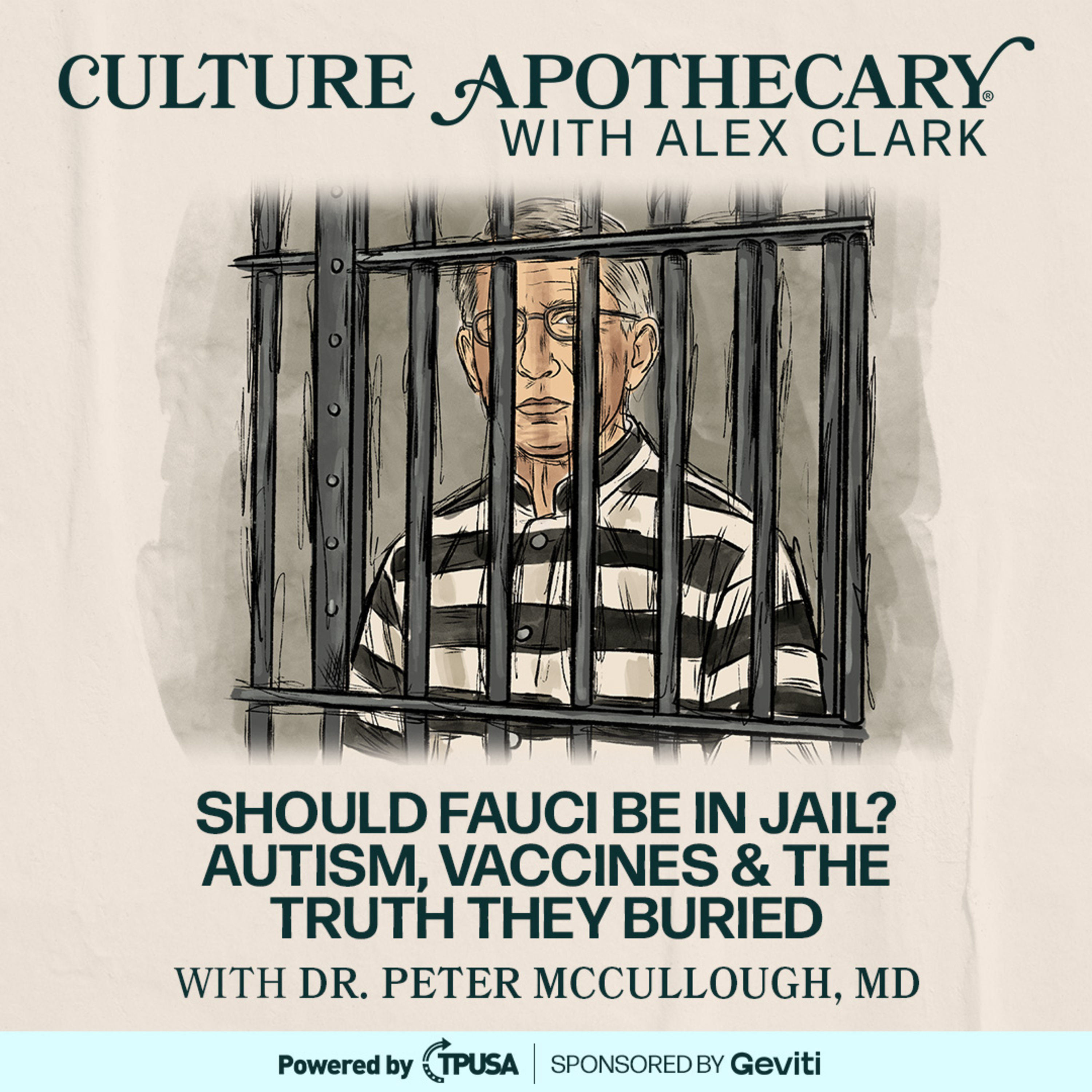
Culture Apothecary with Alex Clark
Should Fauci Be In Jail? Autism, Vaccines & The Truth They Buried | Dr. Peter McCullough, MD
01:21:17
Loading summary
Transcript161 lines
- [00:00]
A
Is your prediction that we're going to see another full blown 2020 all over again with this hantavirus thing? Or do you think this is going to go away?
- [00:06]
B
We're going to see several people get sick in the United States and elsewhere. There may be one or two more deaths. We're going to see no mention of early treatment protocols. Nothing else we can do. And then we're going to be told there's a vaccine.
- [00:16]
A
Why hasn't Tony Fauci been indicted?
- [00:18]
B
According to Rand Paul, Fauci approaches Biden in his advanced state of cognitive decline And Fauci requests 10 years of clemency. Virginia vaccines are just so problematic. We found the bundle of vaccines, which is steadily growing, is the trigger for the development of Autism Spectrum disorder. Foreign.
- [01:02]
A
The next pandemic panic? Or are Americans being primed for another scamdemic? And after everything we learned from COVID the lockdowns, the mandates, the censorship, does the Department of Justice finally have enough evidence to indict Dr. Anthony Fauci for what critics say were lies told to the American people? In this episode we also get into what should parents actually do about the childhood vaccine schedule? Should they follow it exactly as recommended? Should they space vaccines out or avoid vaccines altogether? Today's guest is one of the most controversial and heavily censored doctors in America. Dr. Peter McCullough is an internist, cardiologist, and epidemiologist with degrees from Baylor University, University of Texas, Southwestern Medical School, University of Michigan, and Southern Methodist University. He's published more than a thousand scientific papers with over 700 citations in the National Library of Medicine and became one of the most recognized medical voices during the COVID era for challenging the mainstream public health narrative. Since this episode discusses controversial opinions on vaccines that are contrary to mainstream medical advice, this episode is only available to listen to and watch on Spotify and Apple podcasts and not on YouTube. Please leave a five star review for this podcast as we continually take risks making sure that you get information challenging the status quo of conventional medical advice. This interview is interesting and entertaining because I disagree with Dr. Mola on some things, but not everything. There's a lot that we do agree on, but as always, I love being able to host differing opinions on the show so that you can decide what you believe for yourself. Please welcome Dr. Peter McCullough to Culture Apothecary. Should we be complying with the latest narratives on hantavirus?
- [02:43]
B
No.
- [02:43]
A
Why?
- [02:44]
B
It looks like the World Health Organization and the CDC have grasped yet another false narrative. Remember, in Covid we had one falsehood after another that was put out to the public. Six foot distancing. How about sterilizing your pizza boxes for delivery? Do you remember all those false narratives? Turns out none of them were true. And here we are with hantavirus, a virus that transmits from rodent to human. The virus is alive in the rodents and through rat and mice pellets and urine. It gets aerosolized into dust and then we breathe it in. The virus only lives outside the animals for about two to three days. A paper was published by Martinez and colleagues in 2020, and it was a paper that had a fantastic title. Now, this is early on in the COVID pandemic. This paper comes from Argentina. And in the title of the paper is Hantavirus Super Spreaders. What? Who's the super spreader? And in this paper by Martinez, coming from a little town in Argentina, 2,400 people in this town loaded with the rodents that carry the virus. These authors speculate that people transmit this virus to other people. Yet the virus has never been found in a cough or sneeze in all the history of hantavirus. It's never been passed person to person. And this paper is published in the New England Journal of Medicine with this scary title about hantavirus super spreaders. They didn't check the houses or the places where people communally got together. In 2020, it was a birthday party and said, oh, they spread it. At this birthday party. There were probably rodents behind the walls in these houses down there in Patagonia. So this false narrative gets in the literature in 2020. In 2022, a responsible paper from the Infectious Disease Society of America by Toledo and colleagues concludes wrong. It does not transmit person to person. You can't find it in people. The only time the virus has ever been found on a person is in oral secretions in people ICU when they're on a mechanical ventilator and the oral solution fluids can be sampled. It doesn't transmit person to person. You can't even do a PCR test in the nose and mouth and find it. The PCR test that people are undergoing is blood. So here we go. This is the fact pattern for hantavirus. This is stunning. This ship, which has been largely in South America and around Antarctica for, you know, a year and a half. The MV Hondias loads up in Argentina, 200 people roughly, aboard about 30 crew, and they take off by April 11. The first man is dead from hantavirus. Now, this is unbelievable. His body is on the ship. The Dead body's on the ship, probably with these oral secretions welling up. Have you ever seen a dead body? And I have. When the human body dies, all of the secretions in the GI tract tend to well up in the mouth. In fact, you have to kind of empty it. So the dead body's on board from April 11 to April 24. Now it's taken off. When they get to St. Helena, his wife, about that time, very ill. She dies shortly afterwards. At that point in time, the captain tells everybody, listen, something terrible happened on board. A man died. Now a woman is very sick. And smartly, about 30 people get off the ship. I said, listen, we've had enough. Something's going on. They get off at St. Helena. Of the people who get off the ship, a woman is hospitalized. She survives. A man is hospitalized and survives. A doctor from the United States from Bend, Oregon, he gets off. He's going on cnn. He's back in Oregon. And the ship sails on. A man from Germany then gets sick. And this is now May 2nd. They're at Cape Verde. This is the archipelagos in the Atlantic. He dies on board. This is two deaths on board. He dies on board. And on May 2nd, one of the people who got off on the 24th, they've isolated the virus is hantavirus, Andy's strain, the strain that purportedly could transmit from human to human, which I don't think is the case. The WHO gets involved. What they should have done is they should have right then and there evacuated the ship. They only had 150 people on at that time and sterilized the ship. It takes about a week to sterilize it, get the rodents, all the droppings out. I mean, it's really a deep clean. It's a big deal. What does the WHO do? This is astounding. They essentially land two of their epidemiologists on board and they lock down the ship. They lock people in their cabins and allow them to breathe the recirculated rat dust air. This is stunning. They don't even let them up on deck to get fresh air. You know, fresh air would be the solution to this, right? You don't want to be stuck in your cabin. They lock them down for another eight days until they get to Tenerife in the Canary Islands. They get to the Canary Islands, and then Tedros Cabresus comes. He has his official jacket on. What they do is these poor, desperate people who are in their cabins. When they come out of their cabins, then they make them put on hazmat Suits. Then they start hosing them down in hazmat suits. And of interest, there's some other people walking by who don't have any suits on. They put the people, the poor people who don't need hazmat suits and they certainly don't need to be hosed off outside. They take these people and they should have given them like an outside shower with a hibiclens shower. That would have been fine. They put them on a bus and there's a picture of the bus driver. He doesn't have any hazmat suit on. So the theater is unbelievable. Now, sadly, a French woman gets off and she goes, I don't feel too good. They airlift her to Paris and she's currently the person fighting for her life. She's on full ICU support, including ecmo, which is extracorporeal membrane oxidation. That's the highest level of support. She's probably going to die.
- [08:53]
A
You and I are on the same wavelength because we start hearing this story, which I thought was weird from the get go, that patient zero was this guy who was obsessed with birds. He was like a bird scientist and he was rummaging through trash trying to get to some exotic bird in a landfill or something. And I knew immediately, I was like, no, there's rats on the ship and the cruise line doesn't want the marketing that there were rats on the ship.
- [09:15]
B
You got it. So already there's a false narrative that he brought it on the ship?
- [09:19]
A
Yes.
- [09:20]
B
This really, this plot is unbelievable that he brought it on the ship and he's the super spreader. Well, it's possible. When he was a corpse, he actually could have been a nidus of infection. But the first man is dead on board, and the German man is dead on board. The bodies are ultimately removed, but the total duration that a dead body was on board the ship is, is 21 days with a corpse from hantavirus on the ship.
- [09:42]
A
So here's what I want to know. Every few years you've got, you know, some new panic virus. How do regular people tell the difference between a real threat and a manufactured fear cycle?
- [09:52]
B
Well, they have to again examine the fact pattern as we're, we're doing ourselves. What happens next is even more mind boggling. People start to be dispersed. Government planes fly the passengers off. They are now believed to be super infectious. We've got more than two dozen Americans locked down in an Omaha biosecurity center right now for the next month and a half. Okay? One patient who went to the Netherlands because, and again this doesn't transmit person to person who came in contact with some other healthcare workers that didn't have hazmat suits on. They've gathered up the other healthcare workers and they've put them into a month and a half of quarantine. This is stupendous. And now the mainstream media and experts are going on saying this is really grave. There's a mortality rate of 40% true for impoverished people down in South America, where a lot of people die with no medical care at all. I don't think the real mortality rate with early treatment and good care is going to be nearly that high. What they're saying is this is highly contagious. It's past person to person that rodents were not involved. The whole on May 10th when it lands in the Canary Islands, they say, well, we don't see any rodents here. They don't do any inspections, no sampling of the dust, nothing. They take the 30 crew member and say, listen, you guys are good. Get on. You guys can get on and then go ahead and sail to Rotterdam. They have a couple medical personnel on. They are acting like the passengers are radioactive contagious and the crew member are fine.
- [11:28]
A
This is crazy.
- [11:29]
B
And they've had the same exposures. Even if you believe that it passes person to person through the air, the people on the ship right now are just as at risk as the people in the Omaha Biosecurity center. And yet the WHO is viewing them completely differently. The CDC is bought on. No one has mentioned that the current test, a PCR test, is done with blood. You can't even find it in the nose and mouth. And that they're doing blood tests and you know, as PCR tests are, they're, you know, tend to be false positive. We've already had a couple false positives through this entire endeavor. It's been fully sequenced. It's a natural virus. It hasn't mutated all of these cases right now they haven't found the virus in any secretions. It's only been found in the blood. The WHO almost certainly will do no search for the rodent source of the illness. They have constructed a false narrative that somebody tracked it in on their shoes from a garbage dump.
- [12:25]
A
Is your prediction that we're gonna see another full blown 2020 all over again with this hantavirus thing? Or do you think this is a going to go away?
- [12:31]
B
We are going to see several more cases. I predict some will come off the crew on the ship unless they've done enough cloroxine down to Stop this. We're going to see several people get sick in the United States and elsewhere. There may be one or two more deaths, probably the woman in France. And there's going to be no mention of treatment, even though favipiravir, which is av again in Japan, Russia and India, looks very good. Hydroxychloroquine, ivermectin, probably not so good. We. We're gonna see no mention of early treatment protocols. Nothing else we can do. And then we're gonna be told there's a vaccine.
- [13:05]
A
This is what I was thinking, Dr. Peter. I was thinking that when it's time to get your flu test, that people are gonna have the option to also get a hantavirus test. And then what we're gonna see is enough people are wanting the hantavirus test. So then magically we're gonna be told, well, there's a vaccine you can take for this.
- [13:21]
B
Well, it's gonna first start saying, listen, if you live in places where there's dusty barns and potentially rodents, or if you're going on a cruise, you should get a hantavirus vaccine. And guess who makes the lead vaccine. Moderna. Now this story gets even more fantastic because today, the time we're filming a British ship that has 1,700 passengers, a cruise ship is locked down because there a common cruise ship cause of diarrhea is called the norovirus, used to be called the Norwalk virus. There's a Norwalk virus outbreak on the ship and someone has died, an older man has died, probably of dehydration. But because there's a death now there is all of this fear, and they've locked down the ship. So cruisegoers beware, because Tedros Cabresus in the who, when he landed in the Canary Islands, he said, this is a new test of our global power.
- [14:22]
A
I'm gonna tell you something right now. You can pay me to go on a cruise. First we had the poop cruise. You know, the poop cruise story. Okay. And then now you've got this hantavirus fiasco. No, thanks.
- [14:32]
B
Listen, you can't make this up. Do you remember the Princess Cruise where people had Covid early on and they were locked on and they got more Covid? Do you remember that?
- [14:39]
A
No.
- [14:39]
B
Yes. It was a cruise boat that was one of the earliest Covid outbreaks on a cruise boat. And they were locked in, so they passed it to each other. One of the men on the COVID Princess cruise, he was one on the MV Hondia Quarantine, historically played a Role. It's in our book Vaccines, Mythology, ideology and reality. When we had no other answer. Let's say for yellow fever, it was the right thing to quarantine. And if people died on the ship, it was better for them to die on the ship as opposed to infect the whole town. That was. And quarantine comes from Quantico. It basically means 45 days. But nowadays with modern evacuation, sanitation, decontamination, early treatment, I think quarantine of these ships, we've seen it with COVID and now hantavirus and now normal virus, I think it's going to lead to more harm.
- [15:26]
A
Why hasn't Tony Fauci been indicted?
- [15:28]
B
According to a personal conversation I had with Senator Rand Paul, who's probably the farthest on the investigation of this. And by the way, his book Deception is excellent. According to Rand Paul, Fauci approaches Biden in his advanced state of cognitive decline. And Fauci requests 10 years of clemency. It wasn't thought up by the Biden administration or the White House. Fauci requests. So why would a doctor who's head of the National Immunology, Allergy and Infectious Disease branch of the NIH for decades and the lead coronavirus advisor, why would he ask for 10 years of clemency? That's the real question.
- [16:06]
A
What do you think that he knew?
- [16:07]
B
He must know. That he's committed grave crimes. He must know.
- [16:12]
A
And does that mean President Biden would have signed off on this with auto pen?
- [16:15]
B
Could have. But this idea of requesting clemency is very important. It means he believes he committed a crime. And do I believe he committed a crime? Yes.
- [16:25]
A
What crime do you believe Fauci committed?
- [16:27]
B
The first. And this came out in Senate hearings again today. CIA whistleblower came out and there's been. The House Select Committee has reviewed this extensively. Is Fauci was involved in the creation of the virus that got us sick? SARS COV 2. Did you get Covid?
- [16:45]
A
I did once.
- [16:45]
B
Yeah, me too. So you can thank him. Fauci was part of the creation of the virus. Fauci, Dr. Ralph Baric at UNC Chapel Hill, who at the time of this shooting has just immediately retired at the same day the CIA whistleblower is testifying in the Senate. You can't make this up. Peter Desic, who's now debarred from the NIH at the EcoHealth alliance, and the Bat lady in China, Xing Ling Li, they all conspired to create a virus that can get the whole world sick for the purposes of creating a vaccine that the whole world would have to take. So his first crime is fraudulent concealment. So as soon as this got out of the lab, he worked feverishly to cover this up for as long as he could. Fraudulent publications. And the group of conspiring individuals is large. His understudy, David Morens. He's already been indicted. Okay, he was indicted by the doj. We have Jeremy Farrar at the Wellcome Trust. He's actually been promoted. He's the chief scientist of the WHO right now. Christian Andersen at Scripps, Edwin Holmes at Sydney. All of them were on papers that said, you know, even though this institute of Virology is in Wuhan and it's working on deadly pathogens, this one came from somewhere we don't know, but it wasn't the lab. Peter Daszek was the courier. He carried the plans there from Ralph Barrick and how to create the virus. The papers that Ralph Barrick published. The first author is Menache. Notice on this interview, I'm going to cite dozens of authors. No one will do this in the US Senate or the House of Representatives. No one. I'm the only one who can do this. Menache is a first authority. Nature medicine in December 2015. Proceedings in the National Academy of Sciences in January of 2016. These papers in the title says, a SARS like Wuhan Institute of Virology Virus poised for human Emergence. They said, we're working on a coronavirus. It's a human coronavirus with a bat spike protein. We're working on this. We're able to get it to invade human respiratory epithelial cells and kill cells and kill the organism and for the purposes of making a vaccine. And here's our rudimentary vaccine in the same paper.
- [19:03]
A
I'm at a point in my life where I fully turned on Airbnbs. You know what? I'm done. I don't want a six page checkout list and a massive passive aggressive note from a woman named Brynn telling me where to place the decorative hand towels before I leave. I want a hotel. I want crisp sheets. I want blackout curtains. I want room service. I want a person downstairs whose entire job is just solving my problems. I that is civilization. And part of surviving travel without feeling like a haunted Victorian child is electrolytes. When I board the plane, the first thing I do is reach for Taylor Duke's Wellness Electrolytes, put it in my water bottle, shake it up, bada bing, bada boom. Taylor Duke's Wellness uses clean ingredients only real fruit juice powder Organic coconut water powder, unrefined sea salt, no added sugar, no dyes, no fake natural flavors. They help with energy, headaches, cravings, brain fog. All the things that happen when your body is depleted and you're pretending one coffee can fix your life. What I love is they're for everyone. Electrolytes can can be taken by adults, kids, pregnant moms, nursing moms. Just simple, clean hydration. So if you're trying to reset this spring, whether it's after travel, spring break workouts, or just life being chaotic, this is such an easy win. Go to Taylor Dukes wellness.com use code Alex Clark for 10% off that's Taylor Dukes wellness.com code Alex Clark for 10% off one of the biggest health lessons I've learned is that consistency beats complexity every single time. You do not need a hundred wellness hacks. You need a few things that actually work and that you'll actually use. So for me, one of those non negotiables is my Juve red light therapy. I love using Juve at night because it's become such an easy way to wind down and support recovery. Red and your infrared light are incredible for supporting your body at the cellular level. They can impact muscle recovery, joint pain, inflammation, skin sleep quality and overall resilience after a long day. Even 10 minutes in front of my juve feels like the reset for my body that I really needed. It's one of those things that helps me feel like I'm really supporting my body instead of just reacting when I feel run down. And what makes Juve different is the quality their devices use clinically. Prov in wavelengths deliver a safe and effective dose of light. And they're true medical grade panels that are independently safety tested. That peace of mind matters when it's something that you're using regularly. I also love that they have so many device options depending on your space and your needs and your budget. So it feels realistic whether you want targeted support or full body benefits or something to travel with. If you've been curious about red light therapy, Joov is the one that I have used for years, way before I was even podcasting doing culture apothecary. Go to juve.com Alex that's com.jov.com Alex, you ever notice how we all just agreed to microwave our brains and called it convenience? Like yeah, sure your phone can order sushi, track your ex, ruin your attention span in under 30 seconds, but it's also basically a tiny radio tower pressed directly against your school. Totally normal, right? Not. And these AirPods oh yeah. Bluetooth beaming signals straight into your head like you're trying to contact aliens. Even when you're not using Bluetooth, they're just searching. What are they searching for? A better life. A signal. God, emfs or are real. Your phone is like a dozen antennas in it. Not one, not two. A team. Now I'm not saying go live in the woods and turn butter, but maybe, just maybe, we stop raw dogging wireless signals directly into our brain tissue. That's where tech wellness comes in with these EMF free air tube headphones. This is all I use when I'm traveling. No radiation shooting up a wire into your head. Sound travels through air tubes. You still get your podcast or your work calls, just without frying your nervous system. System like a McNugget. Because here's the truth. Distance is your friend. So you want to put the phone over there. Keep your brain over here. Revolutionary. I know. Use code Alex for 15 off at air tube headphones tech wellness.com that's code Alex for 15 off air tube headphones tech wellness.com you've got this group of people that are like, I want to, to create a virus so terrible that we can convince the entire world to take a vaccine. Why is it important to them for the whole world to take a vaccine? Because they're all going to get rich.
- [22:48]
B
Think about the power. Peter Desic, when he testified under oath in the House Select Committee, he says, I have dozens more of these samples in Wuhan. And when I went on Fox News one night and I was on one side of Laura Ingraham and then the other side was the committee chair for the US House of Representatives, I said we should investigate the Wuhan lab. And then the answer was, well, Dr. McCullough, if we did that, someone would get killed. And you know, in 2023, I believe the U.S. house of Representatives, I think in the last 10 years had its only unanimous vote. All Democrats, all Republicans, over 400 people unanimously voted on one thing, to release all the documents on the Wuhan lab. And they're all held by the Office of National Intelligence. And our director at the time was Avril Haines. Avril Haynes was actually at event 201. That was the video planning event for COVID 19. That was in November of 2019. She's there, she's there with George Gao, the CDC director from China. And they're part of event 201 is, you know, coronavirus is coming. It's coming out of a Chinese lab. How do we suppress this? So what does Avril Haynes do? She goes, I'm not releasing the documents. And Josh Howley in the Senate says, listen, you're overdue. We need to see the entire dossier. Nothing. We get some very, very light summary. Well, here's kind of summarizing the documents. Tulsi Gabri comes in. Where's Tulsi? She won't release the Wuhan documents. This is astounding.
- [24:27]
A
Here's what I don't understand. We're releasing all these documents about jfk. We're releasing all these documents about aliens. Why isn't the Trump administration releasing documents on the COVID vaccine pandemic situation?
- [24:40]
B
We're told it's a national security issue.
- [24:44]
A
Okay, and what do you actually think it could be?
- [24:47]
B
That's the scary thing. If somebody thinks it's a national security issue, that the US and Chinese worked on a deadly virus, it probably is.
- [24:57]
A
I don't understand. Why is that bad for the public to know?
- [24:59]
B
Because they may have the plans for something truly catastrophic. It's possible. Now, Ralph Barrick in 2021, the one who recently was suspended at UNC, and now he's the most expert person on coronavirus in the world. Now he's just immediately retired. Ralph Barrack in 2021 said when he was asked, why don't you release the genetic code from your papers? This is a federally funded project. In your papers you say it's gain of function research. You thank Anthony Fauci and the nih. You, you thanked Peter Dasick and you said you took the project to China because of Obama's suspension of gain of function research in the United States. And you did, and you thanked the Chinese. Why don't you release the genetic code for what you found, Dr. Baric? He goes, I checked with the NIH and they said, don't do it. It's a national security risk. Chances are what Baric was working on exactly matched or nearly exactly matched what came out of the lab. And that would tie everything together. The way I look at it, Fauci fraudulently concealed the source of the virus, put us way behind on early treatment in our response. And people's lives were lost. Actually, people's lives were lost with the creation of the virus. Some people really died of COVID It was grossly over exaggerated, but some really died. His second crime is he actively worked to suppress treatment of all type. And his third crime was he relentlessly pushed genetic grossly unsafe vaccines.
- [26:29]
A
So would the DOJ have a solid case against Fauci?
- [26:32]
B
Rand Paul thinks they do. Now, recently a Statute of limitation date went by and we saw that in the media. And people have asked me, what do you think? Is Fauci free and clear? Well, listen, when attorney generals are going after Trump, they didn't seem to care about statutes of limitations at all.
- [26:50]
A
Right.
- [26:51]
B
Why would it suddenly matter for Fauci? I don't think it does. I think this 10 year pardon should be very carefully examined. And if I was running the show, this is what I would do. I said, listen, there's enough here. Special prosecutor. Let's assign a special prosecutor. I mean, come on. We assigned a special prosecutor for Russiagate. Yeah, come on.
- [27:10]
A
Yeah.
- [27:10]
B
I mean, this is. People's lives were lost here.
- [27:13]
A
And are you thinking that Dr. Fauci is just hoping that he's dead before anything comes out?
- [27:17]
B
He's hoping he can outlive this. Now, recall, he's in his 80s, he's at Georgetown, he's very highly on a lot of committees at the who. He's very well taken care of and he's probably hoping he can skate out of this and his boss, Francis Collins. But this has been the greatest catastrophe of all time. You know what's interesting about Fauci's goodbye memoir that he posted on the NIH website when he decided to retire, he highlighted the things in his career and HIV and other advances. No mention of COVID the biggest thing he ever faced. And there's no mention of this on his career summary.
- [27:58]
A
So do you think that Anthony Fauci genuinely believed that he was helping people, or do you believe that this was conscious deception?
- [28:04]
B
I believe this all started with this aspiration that we can get ahead of nature, that the governments had enormous interest in genetic vaccines. And, you know, DARPA, a research unit of the military, in 2012 announced a program. It was called the ADEPT P3 program, Pandemic Preparedness Action Program. And it said, we will use messenger RNA genetic vaccines to end pandemics in 60 days. That's in 2012. Why would the military have an aspiration of ending pandemics? This is stunning. It's on the website. So when Trump came out in 2020 and said, well, we got a vaccine, somebody should have briefed him and said, listen, our military has been obviously working on this for a long time.
- [28:47]
A
Okay, speaking of the military, have you heard these rumors that Dr. Fauci suppressed information about vitamin D benefits to push vaccines to the military?
- [28:57]
B
I think globally, he suppressed all forms of treatment. I'm the most published person on how to treat COVID 19 as an outpatient to reduce hospitalization, death, McCulloch protocols copyrighted, the most widely used approach. I never got a single call from Fauci. I appeared on Fox News, primetime and other primetime news stations hundreds of times during the pandemic. They'd bring up Fauci and they'd bring up, well, Dr. McCullough, what's your view on this? And invariably, I have a different view. I can tell you from the very beginning, after probably thousands of media appearances, I never told people that masks were going to save them. I never told them that six foot distancing was going to save them. I never told them that we should lock down the schools. Never. I said, listen, it appears to me that everybody's going to get it. I was right. So if everybody's going to get it, it's useless to do contact tracing, it's useless to do lockdowns and social distancing because we're all going to get it. So if we're all going to get it, there's just two bad outcomes to avoid hospitalization and death. So if we can devise a strategy to avoid hospitalization and death, and that is risk stratifying people, treating high risk patients at home to prevent the serious illness, then we get through it. That was the only way. And do you know, Trump, Biden and all the coronavirus task force, they could not outline the problem. The problem was people were getting sick with this virus and there were two bad outcomes, hospitalization and death. We must do something before the hospital to prevent these bad outcomes.
- [30:23]
A
Which was what, in your opinion, the
- [30:25]
B
McCullough Protocol was the answer?
- [30:26]
A
What is the McCullough Protocol for those that don't know?
- [30:29]
B
Risk stratification. You know, young people like you, no severe symptoms, no treatments needed, end of story. That was a vast majority of people, high risk people, people in senior homes, bad medical problems. The first thing they needed, fresh air. What did the nursing homes do? They closed the windows. So fresh air. Nasal sprays and gargles, never mentioned by Anthony Fauci. There were dozens of studies. All of them worked. Saline, iodine, xylitol, they dramatically reduced the reinoculation of the virus, the viru here in the nose and mouth. So we advised nasal sprays and gargles, then nutraceuticals and supplements. Every study of vitamin D was positive. It prevented the illness. Vitamin D reduced the severity of illness. People with higher vitamin D levels were more likely to survive. So everybody should have had vitamin D. And then there was positive data for zinc, for quercetin, vitamin C, even an over the counter Antihistamine, antacid drug, famotidine, big University of Virginia studies show that. So we said, listen, all the over the counter stuff, for sure, for sure. Then the antivirals and everyone got, you know, all wadded up about antivirals. And antivirals were neither necessary nor sufficient, though they were useful. Hydroxychloroquine in the first year was partially effective. Ivermectin the second year and forward, I think very effective. Paxlovid, it came in in 2022. I think it was modestly effective. And then molnupiravir was the Merck drug, modestly effective. I think the next layer was secondary antibiotics. And there were autopsy studies showing people are dying because if they get a virus long enough, then there's a bacterial bronchitis and they're not being treated. So antibiotics played a role and they weren't getting them. Then after that, corticosteroids and in the hospital, Decadron was used, which was an odd choice for pulmonary situations. We typically use Medrol or methylprednisolone. And then very importantly, blood thinners. So people are dying of blood clots. So aspirin, low dose, and then high risk elderly people. I put them on enoxaparin, which is basically injectable blood thinners. My dad got severe Covid, I put them on enoxaparin. That's what saved people's lives. So McCullough protocol was more extensive than what people were getting in the hospital. We were doing that at home. We added home oxygen. We showed that even people with low oxygen saturations, we could treat them at home. When people went into the hospital, it was a death sentence. They immediately got put on ventilators. They got secondary pneumonias. They couldn't advocate for themselves. Their families were locked out and it was horrible.
- [32:58]
A
Would you like to see individual states start making it legal to sell Ivermectin over the counter?
- [33:05]
B
Well, I think it's problematic. The FDA would have to basically convert at the federal level to say, listen, it's an over the counter drug.
- [33:14]
A
So you can't do it on the state level.
- [33:16]
B
No, no. So what's going to happen is, you know, no company is going to offer it because they're going to, you say, you know, listen, we need the FDA to. You actually have to have an over the counter label to go with it and safety. Do I think it's safe enough to be over the counter? Yes, I think lots of drugs should be over the counter, to be honest with you. For instance, statin Drugs, cholesterol lowering drugs, they're over the counter in many countries. Why not in the United States? That way we don't have to have, you know, so much tension about statins. Many drugs should be over the counter. I mean, prescription wise, these drugs are only three to ten dollars a month. Why can't they be over the counter? I think drugs with serious safety problems, you know, opioids, and they need to be prescription. But if we had, if we were more liberal with our over the counter drugs, life would be easier.
- [34:02]
A
Why haven't we pulled the MMR vaccine?
- [34:04]
B
Well, I tell you, boy, vaccines are just so problematic. So at the time of this filming, McCullough foundation has just published the most extensive report on the determinants of autism in the history of medicine. And determinants, an important word. I'm an epidemiologist and in medicine we actually never know what causes something. Believe it or not, we use inferential thinking and we approximate causation through what's called determinants or risk factors. And for autism, as we review the literature, we got a big grant and, and far and away this influenced HHS. Within 19 days, the CDC changed their stance on their website. It was because of our work. Autism is an epidemic. I want you to understand this. When I was a kid, no autistic kids. It's now, as of 2022, it's 3.2% of kids, some states even higher, heavily vaccinated states like California, it's over 5%.
- [35:07]
A
Yeah. 1 in 12 boys in California being diagnosed with autism.
- [35:10]
B
And it's not just increase diagnosis. 27% of the spectrum is profound. Autism means the kids can't speak, they can't communicate with their parents. Repetitive head banging behavior. Cannot toilet alone, cannot navigate alone. They need 24 by 7 care. 27% of this. The CDC has an autism spectrum network. For decades now they've been tracking this and it gets worse and worse with every report and their conclusions at the end of every paper, we should just get ready for more special needs care. No inquiry into what's behind this, no call for treatment strategies or reversal strategies. Well, what we found with the McCullough foundation briefly, this is very, very important. It's been published in the Journal of the Independent Medical Association. There'll be a press release you can view. If you go to mcculloughfnd.org or go to the Independent Medical association, you'll find this, that there are risk factors that explain this kind of secular change. 1 in 10,000. When I was a kid, 1 in 31 right now, they are the older parents. So a man over 40, a woman over 35, predisposing factor, premature babies, babies born before 37 weeks, siblings with autism. Common genetic variants. There are some genetic variants that are in 25 to 50% of the population that do lend a child to.
- [36:32]
A
Are you talking about the MTHFR gene?
- [36:34]
B
Yeah, sure. So Irish people like me, we have mthfr, Methylene tetrahydrofolic acid reductase. Have you ever met anybody who actually knows what that means?
- [36:41]
A
No.
- [36:42]
B
There you go. Sure. Common genetic variants. Here's one that's important. Environmental exposures. So the mother. It turns out that if the mother for nine months takes a heavy kind of neuropsychiatric drug. So I'll give an example. A psychiatric drug like Seroquel Quetipine, or takes a seizure drug like Keppra or Lamictal, or a heavy SNRI drug, Serotonin, norepinephrine, reuptake inhibitor like Cymbalta, that can predispose. But these are just predisposing factors, by the way. Not Tylenol. That's been ruled out. That's been completely ruled out. A woman who takes. Has a headache and takes a capsule of Tylenol, that is not a risk factor for autism. Is not. Is not. And we were greatly misled on the September 22, 2025 press conference when HHS came out with Trump and said, well, we're gonna point the finger at Tylenol.
- [37:43]
A
So you disagree with Bobby Kennedy on the Tylenol scan?
- [37:45]
B
Completely wrong. Completely wrong.
- [37:47]
A
You don't believe anything with it contributing to preventing glutathione and all those sorts of things?
- [37:52]
B
No, no, no, no, no, no. This had been around for about 20 years and there was concerns. So the Swedish conducted a nationwide 20 year study of 2 million deliveries. They captured every capsule of Tylenol these women took. They even had sibling analysis. This is very important. Where a mother during one pregnancy took some Tylenol and another pregnancy she didn't. Same mother, same genetics. Same zero independent relationship with autism. Zero. Now, it turns out women who do take Tylenol during pregnancy tend to have other medical problems. Migraine headaches. Believe it or not, in the Alquist study in JAMA 2024, 7 to 9% of these women who take Tylenol also take opioids. So it's not the Tylenol. The Tylenol has been ruled out. American Academy of Pediatrics is correct. And all the other associations. Marion College of the correct. Tylenol's ruled out. Good news, because when a woman gets a fever, we need to control it with Tylenol because if it's uncontrolled, she can lose the baby. And we can't turn around and use Motrin because that's going to actually cause placental disruption. So we need Tylenol. Tylenol is super important. And that's the reason why our report's so important, because it's setting things straight based on the data. And I'm a doctor with medical authority, more authority than anybody in Washington, so I can tell you right now, Tylenol is out. What did we find? We found the bundle of vaccines, which is steadily growing, is the trigger for the development of Autism Spectrum Disorder. No doubt about it. And the case series are very clear. The babies are born normal. They're born out of this predisposing milieu. They get a big battery of vaccines. They get sick that night or the next night. Sadly, what can happen is Sudden Infant Death Syndrome, which is strongly linked to battery of vaccines. And it's been shown in the hospital. If they get a battery vaccines, they can have apnea. The nurses have to revive them. What happens at home if they get apnea? The parents aren't there. It's sudden infant death. So the big bundle of vaccines, sudden infant death, febrile seizures. The CDC has published this and said, yes, the vaccine causes febrile seizures. There's a paper from Sweden showing if a febrile seizure happens of whatever cause, there's a 40% conversion rate to a neuropsychiatric disorder, which includes attention deficit disorder, autism, tics and seizures. So to highlight this, and in our book, we have a whole chapter on this. Our book highlights the history of vaccines and how this happened. Jonathan Pulling, who's a neurologist at Johns Hopkins, has his baby, Hannah. She's perfectly normal, and this guy knows what normal is. She gets behind her vaccines in 19 months. She takes a big bundle of vaccines, gets sick that night, and converts to an autistic child. He chronicles all this. He even does muscle biopsies. He shows that she has some alteration in mitochondrial metabolism. Not a genetic problem, but probably a predisposing factor. He publishes the case report, and guess what? His daughter is in the US Court of Claims. Of the thousands of parents who came forward with autistic kids to the vaccine compensation program. And do you know what the US Court of Claims did? This is astounding. It's in our book. They examine her case. They examine his case report. They pull him aside they said, you know what? We've got a settlement with you. A confidential settlement, which he accepted. He leaves Johns Hopkins, he goes to Athens, Georgia. We don't hear from him again, and then they take the rest of the cases and they say, dismissed. So I'm telling you, our U.S. court of Claims agrees the vaccines cause autism. Hmm. So vaccines are a risk factor. Is it possible for a child to not take vaccines and end up with autism? It's very rare, but it can happen. A severe strep throat, a febrile seizure. Sure. That's the reason why fever control is very important. There can be siblings with autism, no vaccine exposure and have it happen. But vaccines appear to be a trigger. Twenty vaccines have in their package insert encephalitis, or brain inflammation as a side effect. Well, brain inflammation, when it occurs, can result in seizures or chronic neuropsychiatric changes. And by the way, when we had rubella infections before we had the rubella vaccine, some of the children with congenital rubella syndrome, they had autistic features. So believe it or not, these vaccines, measles, mumps, rubella, they're live, attenuated vaccines. You actually get a dose of the virus, but it's weakened. So the measles vaccine can directly result in death. And there's a paper from Stanford where a baby comes in and gets an MMR vaccine. And little does anybody know that the baby has incipient acute myelogenous leukemia. And so the baby gets sick with leukemia. The attenuated virus mutates which, it can invades the brain and kills the baby. They do an autopsy and it's clear the measles vaccine killed the baby. It's published by Stanford in the peer reviewed literature. So if anybody gets up at Washington and said, well, is the MMR vaccine perfectly safe? Of course it's not. McCullough foundation has published an analysis because measles are so infrequent now that believe it or not, there's more deaths after measles vaccination than there is with measles illness. I think with our early treatment of measles nowadays that there should never be a death with measles. What made all these infectious diseases become far less frequent? Remember, we don't have scarlet fever anymore. There's no vaccine for that is improved sanitation, nutrition and personal hygiene. That's what won the day.
- [43:42]
A
I need to say something because I see this in my DMs every single day. Alex, I want to get my health together, but I just don't know where to Start or I'll do it later when I have more money. You know, I've heard every version of this, and I get it. The system is confusing on purpose. You go to a doctor, they check like five things, they tell you you're fine, they send you home. Meanwhile, you're still feeling exhausted, inflamed, just off. So then you do nothing. You wait. And waiting becomes your health plan. This is why I'm really excited about what Jev just did. They launched a complete, completely free tier, not a trial free. You go to gojevity.com upload blood work that you already have from any lab, and they give you a personalized longevity blueprint that analyzes over 90 biomarkers and actually shows you what's going on. When I saw my blueprint, I didn't just want to know. I mean, I saw all that info and I wanted to fix it. And if that's you after finding out about what's going on with you, you can do the Jevy plus membership. You get an actual functional clinician who walks through your results and builds a plan around you, not a template. They build you a plan, and they don't stop at just testing. You get access to supplements, peptides, hormone optimization, nutrition help, real protocols based on your labs. They test over 90 biomarkers, retest every six months, adjust your plan, and you have a care team you can actually message. Go to gojevity.com use code alex. Again, go to goevity.com use code Alex. You ever notice how every detox product sounds like your body is one bad decision away from being condemned by the fda? Like your system is overloaded, your toxins have toxins. Frankly, we're shocked you're still standing. Relax. You had pasta, not uranium. That's why I actually like utsinaturals. Gly NaC plus, because it doesn't treat your body like a crime scene. It treats it like something that already knows what it's doing, which is rare in wellness. Everyone's talking about glutathione right now. And yeah, it matters. It's one of your body's main antioxidants and huge for detox. But when you're taking glutathione directly, it's expensive and it's not always absorbed super well. So if you do Gly Nac plus, that gives you the building blocks glycine and nac, so your body can make its own glutathione like it was designed to. So this isn't some Drink this and disappear for 48 hours detox tea. This is actually support for your body's natural detox systems. It's like your body's the chef. Gly Nac plus brings the ingredients. No drama, no cleanse, no life crisis. If you want to try it, go to Etsy.com Alex to learn more and save and use code Alex. That's ay.com Alex. Code Alex. So if vaccines are a risk factor for autism, what do you advise parents to do as a doctor?
- [46:16]
B
Well, they're clearly modifiable, right? So a lot of things for autism genetics, like if you have. If you decide to have family later or you have a premature child, you can't do much about it. But vaccines, parents can make a choice. This is very important. So we found 12 studies, and it's in the McCullough foundation report published today in the Journal of the Independent Medical association, that a healthy child born today remains healthier if they take no vaccines whatsoever, at least for the early part of life. And we cite multiple studies here. That means actually lesser rates of allergic diseases like asthma, allergic dermatitis, fatigue, food allergies, and then lower rates of the neuropsychiatric disorders, adhd, autism, tics and seizures. Every study shows this in the modern day. So, you know, Mennonites and Amish, they don't take vaccines. Now, do they risk getting measles? Well, sure they do. And measles is very treatable. We have vitamin A protocol, secondary antibiotics, measles, encephalitis and pneumonitis, corticosteroids, so measles can be treated. And so all of these illnesses, people say, wait a minute, Dr. McCullough, what about polio? What about polio? And even Anderson Cooper pulled out the old iron lung machine. Now, even if someone needed a mechanical ventilator, we wouldn't dust off the iron lung machine in the hospital, I can tell you. But polio largely went away with water sanitation. And when the Salk field trials were done for polio vaccination, 1.8 million people were tested. Do you know that the polio vaccine was only 60 to 70% effective?
- [47:54]
A
Yeah. I mean, polio was on its way out when we introduced the vaccine.
- [47:56]
B
Correct. And polio hasn't been in the Western hemisphere, not natural polio, for a couple decades now. So I don't think we've ever encountered it. There was a challenge, by the way, 1979 in Sarajevo, where polio got into the community. And guess what? The vaccine failed. It didn't protect people.
- [48:13]
A
I think what's interesting is your Generation in particular loves the polio vaccine. Like even the President, he is very critical about the childhood vaccine schedule. He has a lot of concerns about the MMR vaccine. He's spoken in depth about this, but he always comes back to you. But the polio vaccine was a miracle. Like, we needed that polio vaccine.
- [48:32]
B
It's viewed that way. But I have to tell you, even Mitch McConnell. Did you hear of a Mitch McConnell story? It's in our book. Mitch McConnell says, you know, if there was a polio vaccine, I wouldn't be crippled on one side. We researched his hometown in the time that he would have gotten polio as a little kid. Guess what? No reported cases.
- [48:55]
A
What does that tell us?
- [48:57]
B
People imagined various neurologic problems were in fact polio, various dystocias, transverse myelitis, other forms of encephalitis. So a very important Neuroscience Michigan study was done of 1,200 kids in the hospital with polio. When they finally had diagnostic tests to sort it out, it turns out only a quarter of them really had polio. So it was grossly overdiagnosed. The point I'm making, though, at the height of the polio outbreak in the United States, it never was an epidemic. Mid 1950s, the number of kids paralyzed or died with polio is far smaller than the number of kids with profound autism today.
- [49:39]
A
There is a risk to everything. There is a risk to getting measles, There is a risk to taking the vaccine. Right. And so as a parent, you have to decide what risks you are comfortable with. For me, you know, and I, and I don't have kids yet, but when I do have kids, I'm choosing not to vaccinate. And that is because for me, I am more comfortable with the risk of, okay, my kid is hospitalized for a couple days, but with measles symptoms then potentially becoming non verbal flinging poop for
- [50:07]
B
the next 50 years.
- [50:08]
A
Exactly. Yes, exactly. So to me, that's more of a risk that I'm comfortable with. And maybe you're a parent that says, nope, I'd rather take the autism chance. And that is your right as a parent.
- [50:18]
B
There you go.
- [50:18]
A
The problem is that when you go to your conventional pediatrician and you say, can you tell me all of the ingredients in this vaccine? Can you tell me what happens to my child when we're doing multiple of these vaccines at once? They can't answer that question. So then I might. Next I'm going to find a doctor that can answer it or my kid is not getting this.
- [50:36]
B
Well, there you go. But the problem is that whatever the Advisory Committee for Immunization Practices, acip, which is a commissioned committee by the CDC and hhs, whatever they decide, as the schedule gets written into state law. And so in some states, once it's written to law, children must receive these to go to school. And in several states, there's almost no way to get out of it. California, New York, Connecticut.
- [51:04]
A
Yeah, this is what I would like to see this administration work on is taking away this mandatory rule that you have to be vaccinated to attend school.
- [51:12]
B
There should be no mandates. You know, the association of American Physician and Surgeons, which I'm a member in the year 2000, saw this coming and they passed a resolution. There should be no mandates for any vaccine or medicine. None. Complete freedom of choice. They saw this over 25 years ago. Give them credit where we are today. I live in Texas. We have medical, religious and philosophical exemptions now for public schools. So that means a parent goes to the website, downloads a form, fills it out and say philosophically, I don't want my kids vaccinated. Go to a notary, get it notarized, put it on file. No vaccinees needed for that child. What's the problem? Parochial schools. So you want to go to a private school? No, sorry. We can require the vaccines. When you get to the level of professional schools, paramedics, police, doctors, nurses, now there's very little wiggle room. And so vaccines become more and more, in a sense, a burden and a risk that people must face. I would say if I was a young parent today and I had a perfectly healthy child in no unusual circumstances, I would go unvaccinated at least to age 4, because almost all the critical neurologic developments in a 4. And if I was in a state that I absolutely. Then I could try to meter them out. Now, by the way, probably the safest vaccine out there is the polio vaccine, is given as a single injectable vaccine. Honestly, I've looked at the safety profile. I think it's one of the safest. But we don't have a polio risk. But it's one of the safest ones. But vaccines are far safer if they're given later in life and if they're metered out. I think if there was a completely free hand here, what I would say is that we should do risk stratification. So a child born with congenitally absent spleen or some problem like that, they need the pneumococcal haemophilus and meningococcal vaccines for sure. In fact, my brother in law doesn't have his spleen. And I told him, listen, you better get these vaccines because you get one of these infections, it's fatal. So it depends on the condition. A child with cystic fibrosis who's dependent on oxygen, what have you, if they get RSV or they get influenza, it can be fatal. So if there's severe baseline conditions where the theoretical benefits start to rise to be high enough, it's worth the risk. So I think in a future world, just like any drug, vaccines ought to be based on risks and theoretical benefits.
- [53:41]
A
Now, this baby with the missing spleen or whatever that you're talking about as an example, would you still say wait till 4 years old or that child needs it?
- [53:48]
B
No, we go early.
- [53:49]
A
Okay.
- [53:50]
B
The most egregious overuse of a vaccine is the hepatitis B vaccine. This is very important for people to understand. When a child is born to a healthy set of parents, the mother is tested for hepatitis B. So we know she doesn't have hepatitis B. There's zero chance she can give that to the baby. 0. The baby grows up. And maybe if the child becomes a gay and bisexual man later on, or an IV drug abuser or something along those lines, hepatitis B can be a risk later on in life, teenage years or beyond, or become a doctor, paramedic, firefighter, and we're dealing with IV drug abusers. These people, we can actually get it from needle sticks. So 3.3 million American babies are born. They don't need the hepatitis B vaccine at all. At all. However, 20,000 babies are born to mothers who have hepatitis B. Now, the majority of these are immigrants who come from outside the United States. The mother has to be treated with an antiviral and the hepatitis B vaccine, and the baby has to be treated with a hepatitis B immunoglobulin. And the vaccine on the first day of life, that's 20,000, and that's very effective. That's 90% reduction in transmitting the infection to the baby. So if we applied vaccines like drugs, intelligently, they would be used infrequently but appropriately. But this idea that everybody has to take this. And so the ACIP committee under Robert F. Kennedy said, listen, let's drop the hepatitis B vaccine, let's relook at things. They started to make some very minimal progress. And then the American Academy of Pediatrics, American College of Physicians, and a whole like a dozen or more class of plaintiffs, and you'd be interested, you know, who else is in that class? You'd Be stunned. The autism advocacy networks are in a plaintiff class to overturn aip, and essentially a liberal judge came in and said, you know what? Take it right back to the beginning. It's full steam hepatitis B for everybody, full vaccine schedule for everybody.
- [55:48]
A
Yeah. So the Trump admin tried to do this. Bobby Kennedy has tried to do this, but then they got blocked in the court.
- [55:53]
B
So we're back to square one.
- [55:54]
A
So we're back to square one. So this updated childhood vaccine schedule that we got, it isn't actually being implemented yet? Like, you can't see it on the CDC website, correct?
- [56:01]
B
No, it's gone. It was implemented for a month or two. Now it's reversed.
- [56:05]
A
And so this is what President Trump wants us to take it to, like, a court in Alabama or something so that somebody will let it happen.
- [56:10]
B
Trump came in and just said, listen, look at Denmark.
- [56:14]
A
Right?
- [56:14]
B
Look at Denmark. They have better control over infectious diseases than we do. I've been to Denmark. It looks kind of like the United States. And he said, trim it down. And, you know, we don't have to have every child get all these vaccines. And just to reduce the burden probably would help. Now, the big ticket ones that I think are most concerning are measles, mumps, and rubella. You asked about this. And diphtheria, tetanus, and pertussis. Why? Because they're mandatory combinations. They can't be given separately. And when those got loaded up, and there's a paper by Dean Long and colleagues that started to look at this when they got loaded up together, boy, the autism rates skyrocketed.
- [56:50]
A
Yeah. So the President feels extremely strongly about MMR being grouped together. He doesn't like that. He is so passionate about that. With him on that, he wants to see it separated. I know that for a fact. Let's talk about the Trump admin and some different moves that they've made. Okay, so how do you feel about this Surgeon General nominee, Dr. Nicole Sapier or Sapphire? I don't know how you pronounce her last name.
- [57:11]
B
Well, you know, she's in my group at Fox. I'm a frequent contributor on Fox, so people, you know, see me on. Nicole is a radiologist who is limited in her scope of practice to mammograms. I mean, that's pretty narrow.
- [57:26]
A
She also has kind of a controversial take on mammograms. A lot of people are changing their minds on that.
- [57:30]
B
Well, you ask me, Surgeon General. Can a Surgeon General be a surgeon? Yes, but most commonly, the Surgeon General is a very knowledgeable Medical doctor who can offer an independent opinion and who has leadership experience over large numbers of doctors, typically because they're going to lead the Public Health Service. So she kind of doesn't fit that.
- [57:50]
A
Well, I will say this. She agrees with you on your Tylenol stance. She definitely disagrees on vaccines and Covid. She loves the COVID vaccine.
- [57:58]
B
I know, but what I'm saying is just her background's not a good fit.
- [58:01]
A
Totally.
- [58:01]
B
Do you see what I mean? So a good fit would be someone who's well respected by Public Health Service, hundreds of publications, broad medical knowledge, you know, good communicate. No, Nicole's a good communicator. But you know, everybody. Listen, Macri, myself, Bhattachara, Scott, Atlas, Nicole, everybody who's in the media group, we're good communicators. Right. We're doing fine communicating, so that's not a problem. I think the surgeon general ought to be somebody who really ought to have that national stature among other physicians, let's say a really good surgeon Generalist. Luther Terry, 1964. He saw what was going on with smoking. And believe me, all the doctors were smoking. The nurses were smoking. Everyone was smoking. They're smoking in the clinic, they're smoking in the operating room. And what does he do? He puts together the surgeon's general report on smoking, calls all the smoking doctors to Washington and said, listen, I got bad news. Smoking is bad for you.
- [58:54]
A
He had this alternative opinion which really challenged the status quo.
- [58:57]
B
Look what CFRA Koop did. Sierra Koop said, listen, this is horrible. We got kids paralyzed. We've got all kinds of horrible things going on. We do not have child safety protection measures in place. Let's get after it and do things to protect kids in auto accidents. Let's have pediatric ICUs, let's have advanced trauma life systems. Surgeons, generals can do great things. The question on the table is, do we. Do we have in this time where we need, you know, a thorough safety review of what's happened with the COVID pandemic, the COVID vaccines, commentary on these emerging infectious diseases, giant issues with the childhood vaccine schedule. You know, 57% of children have a chronic disease. Now, we better have a surgeon general who can, you know, direct the Public Health service towards all these new initiatives.
- [59:46]
A
So everything that you're describing, independent thinker, challenging the status quo. Great communicator, love for children, not afraid to say what's unpopular. To me, that person was Dr. Casey Means. And so I have been so bummed out about everything that happened with that.
- [60:00]
B
Well, I Have a different view. I mean, a part of this is to be very senior and be respected by others. That means easily 20, 30 years into your career and hundreds of peer reviewed publications where someone can say, listen, here are my bona fide contributions to the field. You can't take someone like means. You just wasn't even out of her residency. It just isn't going to again, respect by others and having a track record of leading thousands of other physicians and there are plenty of people out there, by the way, with those credentials and the Trump administration just ought to, I think, honestly find better choices.
- [60:38]
A
Thoughts on the recent resignation of Dr. Marty Makary from the FDA?
- [60:41]
B
Well, I think he's an example of another bad fit. So, you know, he was the first surgeon. He's not a medical doctor, he's a surgeon assigned to this role as FDA commissioner. He has no experience with drugs or development, no major scientific contributions, no experience in regulation, drug regulation. And he's going to go in. And no leadership experience directing thousands of others. It just was a bad fit. And these agencies, listen, I've testified the FDA panels, I've been on major NIH committees. It can take months to even get a meeting. And when you have these huge agencies and you have somebody who people believe is not a good fit in that role, they're probably not even responding.
- [61:25]
A
Okay, I totally disagree with you on Marty and I'll tell you why. I think what's interesting about Marty's resignation is, and the New York Times reported on this this morning as we're recording this is you have this stronghold, which I've been dealing with this a lot with the pesticide companies and Big Ag and Big Chemical. I still believe there is a stronghold of these corporations making moves. And what the New York Times reported is that President Trump was golfing with a bunch of people from Big Tobacco. And they were like, why isn't the FDA approving these, you know, flavorful, colorful vapes or whatever?
- [62:01]
B
Oh, good grief.
- [62:02]
A
And was, they were very angry about that. You know, Big Tobacco, these big corporations, they just, they have a lot of pull with this admin. And I think President Trump called up Marty, called up Bobby and was like, what's going on here? Why are we not approving these flavored vapes? I think that Marty and several others at the fda, I think there was another resignation this morning from the fda. There were people or from hhs. There were several people that just felt like, I don't feel comfortable approving this because this is going to appeal to children. And again, this is these are big corporations who are coming in and they're lobbying and controlling decisions that are being made. And I think that people just were. I think Marty was probably tired of it. I can't speak for Marty. This is my opinion, by the way.
- [62:49]
B
I just think he was a bad fit. There was no important new FDA guidance under his direction, no major new drug approvals or advances.
- [62:58]
A
Didn't we speed up the approval process for getting drugs approved to like two months?
- [63:02]
B
There's actually been no bona fide progress in a year and a half. I would say this, that for these positions, the key is to be a very strong doctor who has medical authority. So in that scenario that you just outlined, a strong medical doctor would tell Trump and all of the influencers say, no, this isn't happening and here's the reason why. And we're moving on, period. And you stay in office and you go to work the next day. You have to be that strong. And if we don't have strong leaders in Washington and they feel like they're going to be fired or they don't feel like they feel too weak, they're going to resign. It takes a doctor of medical authority. Now, if you had A doctor in FDA said, Listen, I've been a doctor for 40 years, I've let thousands of people. There's only fresh air should come in the lungs, not colored vapes. Okay, Period. I'm laying down the law. This is not the President's call. This is the FDA commissioner's call. You have to be that strong. I don't see strength in leadership in Washington. I really don't.
- [64:07]
A
Yeah, but don't you think that's why he resigned?
- [64:09]
B
I mean, I just. Yeah, maybe that's it.
- [64:10]
A
Let's say he did. Let's say he defied the President. I mean, the president's just going to fire you.
- [64:15]
B
You have to be strong enough to say, listen, go ahead and try. This isn't a dictatorship. You go ahead and try. This is a medical issue. You have to be that strong.
- [64:27]
A
Remember when people thought Beanie Babies were going to pay for college? People were out here hoarding plush frogs in airtight bins like they were blue chip assets. Entire suburban basements looked like low level hostage situations for stuffed animals. And then one day everyone woke up and realized, oh, this is just fabric filled with pellets. That's kind of how I feel about a lot of the food fear. We've all been sold for years. We've been told meat is bad and fat is evil. And then when you actually look into it and you realize no, real food is not the problem. The problem is how badly most of our food system is broken. This is why I love Wild pastures. You guys are like, alex, where do you get your meat? I get it from Wild pastures. They're delivering 100 grass fed and finished beef. Truly pasture raised chicken and pasture raised pork, all sourced from American regenerative family farms. They're using those regenerative farming practices that are top tier, the best of the best. Their animals are rotationally grazed, they're never pumped with antibiotics or hormones and raised the way that food is supposed to be raised, which means better quality, better taste and food you can actually feel good about eating. Cows are allowed to be cows, pigs are allowed to be pigs, Alex is allowed to be a worm. And they've got a deal for you. Wild pastures plus this makes it easy. 20 off for life for free shipping for life and a bonus $15 and you can choose your delivery schedule. This is crazy. You're saving money getting better meat than what's sitting under fluorescent lights at the grocery store. Go to wildpastures.com, check out wild pastures plus regenerative meat you will love that is in budget. I saw a story about how somebody got charged $600 for a single band aid at a hospital. A band aid, at that point, just let me bleed out financially. I think it's the more responsible choice. And this is the system that we're TR with our entire health, where you're like, hey, I need care. And they're like, amazing. That's $47,000 unless the moon is in retrograde and your doctor was pre approved by a wizard. It's freaking nuts. People are waking up to this. Okay, you're realizing, wait, I don't actually want to fight an insurance company while dealing with a health issue. Because here's the truth. When you pay cash for care, prices can drop 50, even up to 95%. So yeah, tell your husband that the small stuff becomes way more manageable. Okay, fine, Alex, I'm fine with paying cash for like little things, but what about the big stuff? What if I get in a car accident? Well, big insurance promises to be there, but in reality, one of every five claims gets denied. And hundreds of thousands of families still end up in medical bankruptcy even with insurance. So this is why I recommend crowd health for those big, big issues. Okay, I talked to Andy, the founder, because I was like, well, how do we get out of this system? And the answer is actually simple. Crowd health is a community of people Helping each other cover major medical expenses. You pay a monthly contribution. And when something big happens like a serious diagnosis or emergency, the community helps fund it. No networks, no guessing, no fighting a corporation. And then you get to choose your doctor, explore the care you actually want, including functional medicine. And you even get support negotiating your bills down. So a lot of you are like, well, I wish I could see a functional medicine doctor, but I can't. My insurance doesn't support it. Why are you paying for this insurance? You've got to use crowd health. It makes sense. You have the power to take control of your health. Join Crowd Health to get started today for $99 for your full first three months using code culture@joincrowd health.com that's joincrowd health.com code culture. Crowd health is not insurance. Opt out. Take your power back. This is how we win. What did you want to say about the pesticides?
- [67:53]
B
I've been following you and I'm not an expert in this, but I wanted to tell you that, you know, I had a chance to give a chautauqua lecture, which is probably one of the most greatest honors of my life, that Roosevelts had lectured there. This is in western New York. And I discussed three great times of controversy to open people's minds up to historically what's gone on. And it fits into your interest of activism and potential environmental threats 1860-1920. And I called that section the first great cocaine epidemic. Virtually every drug that was used, every drug provided by Merck and Sanofi and Bristol Myers Squibb were cocaine derivatives. Cocaine was in Coca Cola, you know, soft drinks, it was in Chianti wine. The entire country got hooked on cocaine. If you were to open up New England Journal Medicine or jama, it was all self experimentation, doctors and nurses and experimenting with cocaine. And if you were to have a medical problem, chances are your doctor would give you a derivative of cocaine. It got so bad Sigmund Freud became a cocaine addict during that 60 year period of time in JAMA. New England Journal lesson in the big journals. There was one paper of concern, one by an Irish anesthesiologist who said, you know, I'm worried we're going to get hooked on cocaine. Second great controversy, what I called Smokefest. Smokefest was 1920 to 1978. We got to a point where virtually everyone smoked. Doctors smoked, they had cigarettes offered in their offices. There were physician and nurse marketing campaign by RJR Reynolds and American Tobacco Company and Philip Morris. And doctors claimed the virtues of smoking. One was Better than the other doctors recommend. Camels. This kept going and going and going and going. And DeBakey and Ochsner in 1939 published a paper, 79 cases. They were taking out lung cancers. And they concluded, listen, this is probably from people smoking. The smoking is kind of grayish black. The tumors look black as we take them out. And nobody paid attention. Then Sir Austin Bradford Hill and Richard Dahl in the UK said, listen, this is bad. Smoking is causing lung problems. They do a cross sectional study. They go to the Medical Research Council in the uk. No, you can't be right on this. There's no way smoking is bad for you. Smoking is safe. Go do some more research. Does this sound familiar? So they go do the British physicians smoking study. They come back in 1954 and say, listen, doctors are themselves are dying of cigarettes. This keeps going and going and going. I'd mentioned Luther Terry steps in, said, listen, this has got to stop. They still don't listen. Doctors and nurses don't listen. The public doesn't listen. And it wasn't until 1978 when the American Medical association has its very first pamphlet comes out saying the harms of smoking. And we didn't get to 1990s before the tobacco settlement. To this day, cigarettes are still on the market.
- [70:49]
A
Right.
- [70:50]
B
If I was FDA commissioner, they'd be off the market.
- [70:52]
A
So is your prediction that the ruckus that we've been raising on pesticides, that we're at the beginning of this fight and that eventually we're gonna find out that Alex Clark told the truth.
- [71:04]
B
You picked up on this. So, you know, the last controversy is vaccines. In our book, which is a New York Times bestseller, Vaccines. This has been going on for 300 years. People have adopted vaccines as an article of faith. It's a religious belief. They're not scientifically supported. To the extent that people have the zeal for them, our research suggests they are contributing to harm in the population. Just like cocaine did and just like smoking did. There's harm here, there's now chronic harm, and it's really leveraged at the children. And that brings this issue about environmental exposures. So in preparing for this today, I asked the question, how long did we have lead in the water supply and lead pipes and lead in paint before there was enough concern of kids with environmental, you know, developmental delays and anemia and all these other problems? Well over 100 years. What about asbestos? Well over 100 years. So let's take modern herbicide, glyphosate. I mean, it becomes widely used around 1996 or so. So we've had about 25 years, maybe 35 years of this, this stuff. You know, several separate agencies have indicated it's a carcinogen.
- [72:23]
A
Yeah.
- [72:23]
B
It's measurable in almost all of us. If we were to do a urine test. If you and I would do a urine test.
- [72:29]
A
Oh, I did one. And, and I have a lot of levels of glyphosate and I am somebody that eats organic and all of that, which tells you, I mean there, to a certain extent you cann from.
- [72:38]
B
There you go.
- [72:38]
A
Yeah.
- [72:39]
B
Okay, so you got it. It's so compelling. There is a settlement. The Bear Monsanto settlement, $7.9 million is going to be focused on non Hodgkin's lymphoma. The final decision I think is July 9th. If tomorrow on a dime, we decided, you know what, we're going to get glyphosate out of the food and water supply. We're going to stop making this stuff. It would be the most rapid correction of any of these great controversies I've mentioned. If it happened, it would be like a miracle. Even the petroleum based food dice, if tomorrow there were none of these. It would be the most rapid correction of something by which there's no good in these food diets. There's no good for human health in glyphosate. My point is, when it comes to health and nutrition and, and water, things don't happen quickly, but in other areas it does. Do you know how quick airport security changed after the shoe bomber?
- [73:38]
A
Oh, I know. Right, right.
- [73:40]
B
So a single shoe bomber changes policy. Or how about this? Do you know when Obama said, listen, I want the auto industry to improve gas mileage, to improve the efficiency of cars. Do you know, a couple years they on a dime they did it.
- [73:55]
A
So why is it so slow when it comes to these things?
- [73:58]
B
I don't know. I don't know. It's like, why did it take so long? We still don't have cigarettes off the shelves. I mean, think about this. Why does it take so long when it's something injurious like this? When things are harmful and they're in the area of foods and medicine and other parts of the environment, there's not a quick turn. I would say rapid would be 20 years. We can't rapidly determine something is on the wrong course and correct action.
- [74:30]
A
I mean, we have to be paying attention to those anecdotal stories. What's happening in your own family, with your own body, with your own kids, and then making those informed Decisions you can't always wait on the government to say, hey, glyphosate isn't safe. Hey, this COVID vaccine may cause harm because they might be so, so far behind on, on announcing those things. Right? So this really, it boils down to you are your own best advocate for your health. You need to protect yourself and not rely on anybody else and protect your family and be informed and, and, and make those decisions to the best of your ability.
- [75:04]
B
I think that's a very good summary. I, I would say that, you know, judgment, especially parents, you really appeal to young parents. So parents judgment always supersedes everything else. This is throughout time. The judgment that parents apply should be absolutely paramount in what happens to that child. There shouldn't be an exterior force to say, no, this should happen to your child against your will. The other thing is it looks like when someone is healthy, it looks like less is more. If you're healthy, less is more. Right? That applies to vaccines and generally it applies to medications. Less. When you're healthy, less is more. Remember, doctors don't make you well. Doctors are problem solvers. People come to me with problems. Most doctors offices like mine have incredible waiting lists. We're overwhelmed with people with problems we're trying to solve. People make themselves well, and the holy trinity of diet and exercise and sleep, you know, that's our responsibility to really marshal that forward. You know, we have to be the guardians of this, that, you know, health is very much an art form. And my great concern now is that there's been an encroachment. We've seen with the history of vaccines for sure now through the pandemic, this encroachment on civil liberties where we can't make our own choices.
- [76:35]
A
Remind everybody the name of your two books.
- [76:36]
B
So the first one is the courage to face COVID 19. Preventing hospitalization and death while battling the biopharmaceutical complex. That is the historical accounting of the genesis of the McCullough Protocol, the most widely used protocol to treat COVID 19 prevent hospitalizations and deaths. It has everything in it. How did Tucker Carlson get activated on this? How did Joe Rogan get involved? I kind of touched all these people and they went off in these directions. Senator Ron Johnson is featured at ends in my U.S. senior Senate testimony, which really was historic. That was November 19, 2020. Bringing the world the announcement that we can treat this illness. We don't have to sit in lockdowns and wait for a vaccine. And then vaccines, mythology, ideology, reality. That came out in the summer of 2020. Five in a month that became a New York Times bestseller. It's a gripping historical account of what happened early in the experimentation of vaccines and how did they develop into these government military interests in terms of of biowarfare that we've covered. John Leake is the first author. He's a brilliant author. John is considered the world's most prominent historian right now. He just testified in European parliament yesterday as we speak. So very proud of John's accomplishments. And his next book out I'm not involved with but it's called mind viruses and it's how do thoughts become infectious from one person to another. And we see this and in mass crowds.
- [77:57]
A
Yeah. Like Candace Owens fans.
- [77:58]
B
Yeah, I'll say it mind viruses. I'll say it mind viruses.
- [78:03]
A
And then what is this that you brought?
- [78:04]
B
Oh, this is very important. I'm the chief scientific officer of the Wellness Company and the leading approach for people who've had COVID 19 taking one or more of the vaccines is detoxification and we have multiple peer reviewed publications on this. The vaccine and the infection. Install the spike protein, the spine on the surface of the virus. It gets stuck in the body. It's probably in yours. It's been in mine. The only way to get it out of the body is to cleanse the bodies with these natural products. Nattokinase, bromoin and curcumin. Four minor ingredients. These are high grade medicinal dose. But this is needed.
- [78:37]
A
Does it matter like how long ago you had Covid to take this?
- [78:40]
B
It doesn't matter. Actually a blood test, you can measure your spike antibodies. Anything over a thousand, you probably are concerned. You can go to LabCorp. Go to LabCorp labs on demand. Infectious disease antibody. Click on this. Pay $69. Go in yourself. Don't you need a doctor? Get your own test if you're over 1000. Ultimate Spike detox from the Wellness Company. Follow the labels. Probably needed for a year. I've never had a cardiac arrest or a new blood clot or a disaster on the detoxification program but boy have I seen so many where people say doc, I just didn't know if you
- [79:11]
A
could offer one remedy to heal a sick culture and that could be physically, emotionally or spiritually. What would that remedy be?
- [79:19]
B
I would say the remedy is to understand that we have a higher power, that we do have the ultimate stewardship over our body. Our body is our temple and boy, take care of it. Make health a hobby. Make it a hobby.
- [79:37]
A
I love that.
- [79:38]
B
What's your hobby? What are you most interested in? You can't read enough about it. The human body is miraculous. I've studied it my whole career. Every day I'm amazed at something new I learned. And the remedy, though, is for for people to actually have that understanding that health is not something external that's injected into you.
- [79:58]
A
That's right.
- [79:58]
B
It's not something that someone tells you to do. Now granted, we are all going to, at some point in time, need help, and medicines, when we apply them appropriately, are miraculous. But at the wellness company in my practice, we say natural first, drugs last.
- [80:13]
A
Dr. Mercola, you're a legend. Thank you for coming on Culture Apothecary.
- [80:16]
B
Thank you.
- [80:20]
A
Whether you agree with Dr. Mercola or think this entire conversation is dangerous, one thing is undeniable. Millions of Americans no longer blindly trust the medical system the way they once did. And honestly, after the last six years, can you blame them? The questions around vaccines, chronic illness, censorship, pharmaceutical influence, and who profits from fear are not going away, no matter how badly certain institutions want them to. So the real question becomes who actually deserves your trust now? Thank you to Dr. Mercola for coming on Culture Apothecary. If this episode challenged you, pissed you off, or made you rethink something that you thought was settled science, send it to somebody else who needs to hear it and leave us a five star review. New episodes come out every Monday and Thursday at 6pm Pacific, 9pm Eastern, anywhere you get your podcast. This content is for informational purposes only and is not intended to be taken as medical advice. Always consult with a qualified healthcare professional regarding any questions or decisions related to your health or medical care. I'm Alex Clark and this is Culture Apothecary.