← Culture Apothecary with Alex Clark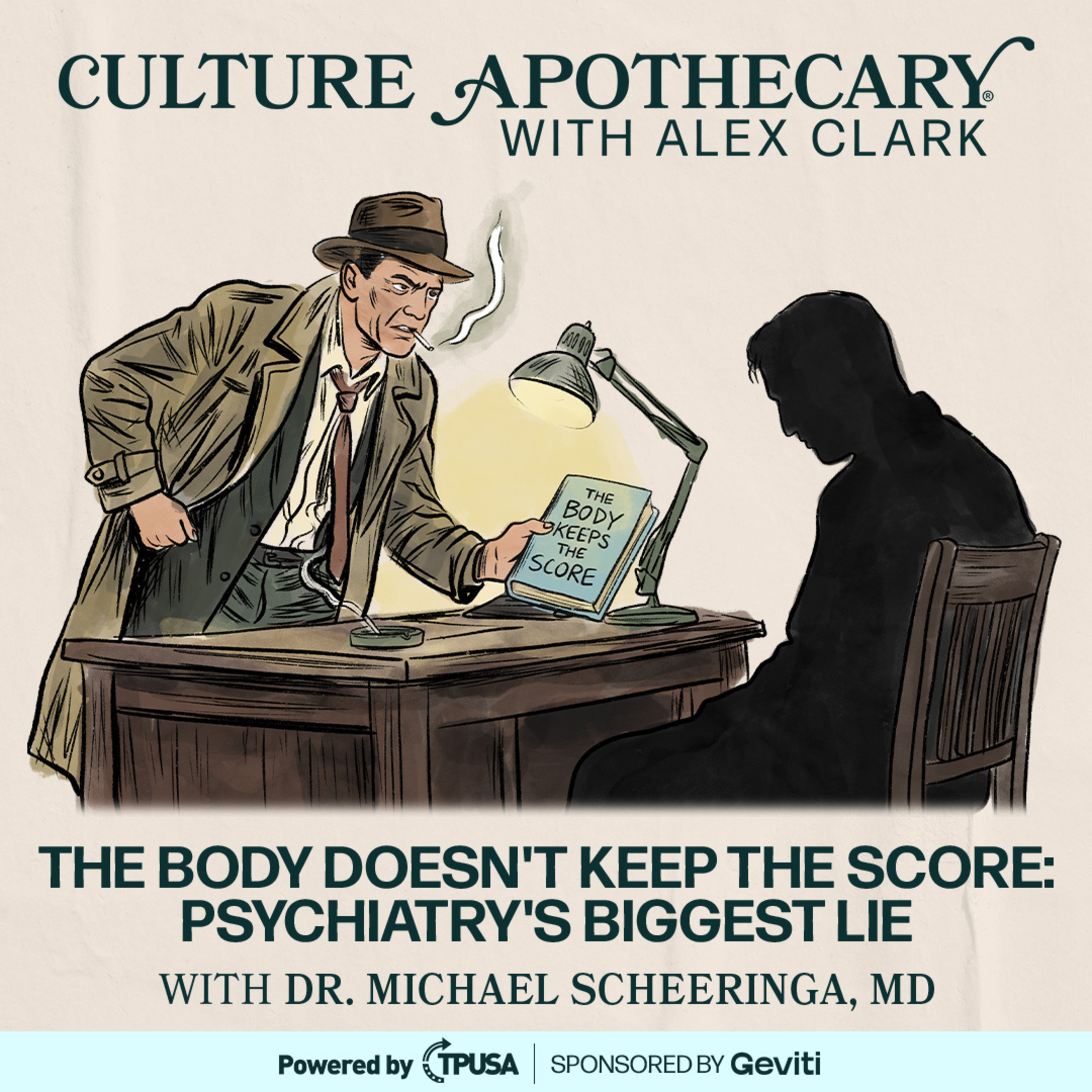
Culture Apothecary with Alex Clark
The Body DOESN'T Keep The Score: Psychiatry's Biggest Lie | Dr. Michael Scheeringa, MD
00:50:28
Loading summary
Transcript99 lines
- [00:00]
A
This book, the Body Keeps the Score, almost certainly would have had a massive episode on Oprah of her having to say to her audience, I'm so sorry, this entire thing was fake.
- [00:08]
B
It would be if that's the way truth works.
- [00:10]
A
Bessel Van Der Kolk, who wrote the New York Times bestseller the Body Keeps the Score, just got offered a $10 million deal for a sequel. He's the world's most famous living psychiatrist and you say that the entire idea that trauma is stored in the body is a scam.
- [00:27]
B
The body does not keep the score. Bessel Van Kolk wants people to think he just looked at the science and then came up with the conclusion. He followed the data. It's backwards. He had a conclusion that he started with, I believe, and then cherry picked the data to fit it.
- [01:06]
A
For years, one book, the Body Keeps the Score by Bessel Van Der Kolk, has dominated the conversation on trauma with more than 4 million copies sold. It's recommended by therapists, taught in classrooms, and revered as gospel. Van Der Kolk is the most famous living psychiatrist. His message, your body remembers everything. There's just one problem. It's all complete BS made up fake science. This should be one of the biggest news headlines dominating right now. Except nobody wants to touch it. That is no one except my guest today. Dr. Michael Scha has spent nearly three decades researching PTSD and he believes that the idea that trauma is literally stored in the body, an idea that has reshaped modern psychology, may be built on evidence that doesn't actually prove what people think it proves. He's a child psychiatrist and has been doing this for decade. This is an episode that you need to share with anyone who has uttered the phrase the body keeps score, claims to be suffering from trauma or is in an endless therapy loop. Watch on the real Alex Clark YouTube channel or culture Apothecary on Spotify. Please leave us a five star review to support the show. Please welcome psychiatrist Dr. Skringa to Culture apothecary. Bessel Van Der Kolk, who wrote the New York Times bestseller the Body Keeps the Score, just got offered a 10 million dollar deal for a sequel to that. He's the world's most famous living psychiatrist. But you're also a psychiatrist and you say that the entire idea that trauma is stored in the body is a scam.
- [02:44]
B
Yeah, I wrote a whole book to debunk the Body Keeps the Score. It's called the Body Does Not Keep the Score. And in that I went through 122 claims from his book and debunked them. Based on the research, 49 of those claims are about the neuroscience. There's another, like 59 claims about his treatment ideas and then another 30 or so claims about other things he gets into, like child development. So it's a pretty thorough investigation of that popular book.
- [03:10]
A
Every single headline out there says that there is this unprecedented mental health epidemic in crisis. But you actually don't think that the evidence supports that?
- [03:20]
B
I do not. In fact, I'm writing a review paper on it right now. The issue is they're saying, Dr. Jonathan Hate mainly is saying, and a lot of other people are saying it, that it social media has caused a mental health disorder crisis. And what I'm saying is it's not disorder. And when you look at the evidence that they use to support that, they're using self report surveys that kids fill out mostly, as opposed to an interview, which is like the gold standard in psychiatry for validity. And when you just look at the self report interviews, which is like 99.9% of the data, they're filled with false positives, rates on those self report questionnaires have gone up. But it's not disorders, it's kids who are unhappy or discontented. He talks about, you can get disorder just by kind of like hanging around social media like it's a virus or something that you catch. And mental disorders don't happen that way.
- [04:13]
A
If you ask a hundred Americans today whether trauma permanently changes the brain, how many do you think would say yes?
- [04:21]
B
99.
- [04:22]
A
Probably 99.
- [04:24]
B
I mean, everybody I've worked with clinically and where I used to work, they. They believe the body keeps the score. Or at least they think it's possible it does not work that way.
- [04:35]
A
And why do you say it doesn't work that way?
- [04:37]
B
Well, let's back up and say what. What is in body keeps the score is saying things like parts of your brain have shrunk, like the hippocampus or the amygdala, or they've been rewired so that they're less active or more active. Like neurons have actually physically rewired due to trauma. Due to trauma.
- [04:53]
A
And how does he define trauma in the body keeps the score?
- [04:56]
B
Well, that's another can of worms is broader than the way psychiatry defines it. In the definition of post traumatic stress disorder. Trauma is life threat. And that's not a gray thing. That's pretty black and white. And people have tried to expand that concept to things like stress. My parents got divorced. Other things that are not life threat, and that's. That's kind of an ideological reason behind all that. It's an important to keep that distinction because they're trying to expand the concept of trauma for other purposes that have to do with their view of human nature and ideology. The idea of brain centers being shrunk or rewired, their data they cite comes from cross sectional studies where you look at a person one point in time, which is always after trauma. So you can find that people with PTSD or trauma have differences in their brain compared to people who don't have ptsd. But you do not know from a cross sectional study which came first. It may be that people had these differences and that's what made them vulnerable to develop ptsd. Now there's a different type of study which is much harder to do, called prospective pre trauma studies, where you measure somebody's brain before they were traumatized and then follow them. They go through trauma and then you look at them again on a brain imaging scanner, look at their physiology. And I wrote a review about this in 2021 when there was about 25 of these studies. There's now about three dozen of these studies. And they do not support the idea that the body keeps the score. They do not show that brain centers change following trauma. They show that the brain centers were different or the physiology was different before they had trauma.
- [06:33]
A
When you look at this book, the Body keeps the Score, there's all these different scientific evidence claims that support this idea that trauma is stored in the body and that it's causing all these sorts of issues for people. But when you look at the individual studies cited, a lot of these are completely made up. Like you, you, you look up the study, it has nothing to do with what he's using to cite. Or he picks and chooses things from the study that don't actually mean what he says they mean. Or he links to a study that was done decades and decades and decades earlier to support his claim, even though there are tons of other studies that have been done more recently that would debunk his claim. And so people are reading this book and it's become so popular. I mean it's, it's more popular than the Game of Thrones. He's got a $10 million, you know, due to this popularity, and nobody is looking into how almost all of the scientific evidence, I'm saying in quotes, is fake. And I'm thinking, okay, if Oprah Winfrey still had her show, he is most certainly the exact type of guest that she would have had on and fond over. But with this book and Then he would have been the exact guest. Just like the, the Good Earth book and what was it, a million little pieces, These different authors that had these massive popular books that ended up being total shams that she had to walk back. This book, the Body Keeps the Score, almost certainly would have had a massive episode on Oprah of her having to say to her audience, I'm so sorry, this entire thing was fake.
- [07:59]
B
It would be if that's the way truth worked. Yes. She's a convert to that whole body keeps the score thing. She's had Bruce Perry on her show. That's, that's actually her, like, frequent guest. And she wrote a book with Bruce Perry which is along the same lines. It's called what happened to you? She did a 60 Minutes episode supporting this idea that trauma damages people's brains. And she called it one of the most enlightening things of her entire life. And that's pretty amazing for someone like Oprah who spent her whole life trying to find inspiration in life. Trauma was her biggest one.
- [08:27]
A
Let's talk about what you believe is true trauma and what isn't. Because I think when people hear trauma doesn't damage the brain, they're immediately thinking of things like PTSD and war veterans and, and how they act different. And they're thinking, well, that, that can't be true. I've seen that in my own family. So how do you explain that people are resilient?
- [08:45]
B
If you look at people who've been through trauma, 100% will have some kind of symptoms in that first few weeks or a month, but they go away. The people who develop PTSD need to have their symptoms for at least a month by the criteria. And that's a pretty good thing. Based on research, 70% of people are resilient to trauma, and it's only about 20, 30% that will develop PTSD and are vulnerable trauma. So the question is, what makes them vulnerable to trauma? And it's those pre existing things probably that we can identify in their brains or their personalities or their physical physiology. And that's probably just there because of genetics. You know, just the luck of the draw and the randomness of the way genetics works. Most people are very resilient. And if you think about it, that makes sense. We've lived for millions of years or thousands of years, however you look at it, as humans gone through more stress and trauma than we probably did in modern civilization. And our brains don't seem to have gotten turned into mush over all that time from worse trauma. We're Wired to handle adversity and trauma.
- [09:45]
A
You argue that many of the brain scan studies cited in trauma literature cannot prove that trauma caused the brain differences. So can you explain that like we're all in fifth grade.
- [09:54]
B
It goes back to that idea of it's how you do the study. You have to look at people, their brains and their physiology before they went through trauma and then kind of wait for trauma to happen and then reexamine them. That's the only way to know if it's the chicken or the egg. You can imagine those are very hard studies to do, but they've done a bunch of them with things like firefighters, police, recruits, soldier getting deployed. So they know who's going to go through these things. So that's how we know the evidence. And what you described earlier of all, there are tons of studies that, that would support the idea of the body keeps the score, but they're cross sectional. And in the book, the Vander Kolkright we call that cherry picking. You just pick the studies that fit with what you already believe and it sounds convincing.
- [10:37]
A
What parts of the body keeps the
- [10:39]
B
score are correct, that PTSD is a real thing. I mean, I think that was a great accomplishment of psychiatry when it was kind of officially created in around 1980 based on, you know, when Vietnam war veterans coming back. And that has given us a language that we can talk about trauma with, with patients and researchers can talk apples to apples in different labs. And we know we're talking about the same thing. So one half of the book is the neurobiology story. The body keeps the score. There's a whole nother half of that book about treatment and his, his ideas that follow that treatment has to be body based. Somatic treatments maybe. What another name for them? Somatic treatments do work for a lot of people, but so does placebo. Astrology helps a lot of people. There's different people are complicated and heterogeneous. Traditional therapy, biblical counseling, it was different things work for different people. There are people who benefit from somatic treatments. The problem in his book is that he says that's the only way you can fully heal yourself and your soul.
- [11:40]
A
There's a cited study in his book that says that people with trauma are 50 times more likely to have asthma. But the study itself says nothing about breathing or asthma. When you look at the study he's citing to prove this claim, why did he put that in the book?
- [11:56]
B
You think I did find things where you. Not just cherry picking, but he just said things that are wrong. That talks about studies that don't exist or loads up citations in the text. And you look up the citations and realize there's nothing about what it's talking about.
- [12:11]
A
You've written a book. How does a book publisher not fact check these things and say, this is completely made up. You know what I'm saying? How does this happen? And then. And how do you have a book that is basically running the world of psychiatry that is garbage. And nobody is calling it out and saying, hey, we shouldn't be using this as a basis on how to treat patients.
- [12:32]
B
Well, it's a lot of work to check all that on that line. You know, this book came out in 2014, and when I first noticed it on the best seller list, I thought, oh, it's just gonna fade away. You know, it's just another fad. And it's. And it didn't. And I thought, okay, somebody's gonna debunk this. Somebody older than me is gonna write a letter to the editor or a review, and then we're gonna find out it's all a hoax. Nobody ever did. So I finally said, I guess I gotta write it. I didn't want to write it. It's not what I want to do with my career. I call it like my die hard moment. The terrorists in the building, and you're the only one there who can fight them. So I guess you gotta do it. So I finally, reluctantly wrote a book because it's a lot of work. It took me a long time to go through all those studies. And publishers don't typically do that.
- [13:21]
A
These blood work companies are often lying about the price. I keep seeing people say, oh, it's only 30amonth. No, that is not actually what you're going to pay. Here's what happens. You sign up. Great. Then you need your blood drawn. Well, that's extra. You want to talk to a human about your results, that's another fee. You need supplements. Separate purchase. You need real treatment, like hormones or peptides. Sorry, not available. Go find another doctor and then pay again. So that cheap membership that you guys are thinking about doing for getting your biomarkers tested and all of your blood work actually turns into this expensive scavenger hunt where nothing connects. So this is why I switched to Jev. Unlike a lot of these other testing companies like Function Health or other ones that are super popular, Jev is not only going to give you all of the answers in your blood work, they have an entire team to go through your blood work with you and then come up with plans, right? Like, okay, Based on your blood work, what supplements would we recommend? What nutrition goals should we set? What lifestyle goals should we set? Nobody else is doing that. So with Jevy, the price is the price. You get comprehensive blood work, over 90 biomarkers tested, a personalized longevity blueprint that actually explains what's going on. You get provider visits included, a care team that you can message supplements, peptides, hormone support, all managed in one place based on your labs. And they retest every six months to actually adjust your plan. That's the difference. It's not just testing. It is testing explanation and actual action. And if you've already wasted money somewhere else and you're sitting on labs that you don't understand, Jevy just launched a free year. Now, this is important. Listen to me. You can upload your results from previous blood work that you've gotten done that you have no idea how to understand without paying anything on gojevity.com and they will tell you what it means. Gojevity.com this is all free. You can use code Alex. Okay. Gojevity.com code Alex. You ever notice we're living like we're in a sci fi movie and nobody acts like it's weird? I mean, we carry around these little glowing bricks that know where we are, who we texted, what we ordered at 1am and somehow they're always listening. We've accepted it. And if somebody from 19855 saw us walking around with Bluetooth earbuds permanently welded into our schools, they'd be like, oh, so the government won. You know, that's why I've been making some really simple swaps, and one of my favorites is the anti radiation air tube headphones from Tech Wellness. This is what I use. Instead of sticking wireless earbuds in my ears, I use these when I'm taking calls, when I'm listening to podcasts, or watching videos, when I'm on a flight, when I'm working out. If you're just getting started with reducing your EMF exposure, they also have an EMF protection starter pack. Every pack comes with the ear tube headphones, plus a WI fi kill switch so you can shut off your WI fi with one click while you sleep. And then you can upgrade to include things like a phone stand, a stylus, or even an EMF meter so that you can actually see what's happening in your home. And if privacy is your thing, my code also works on their Faraday bags, which completely block wireless signals when your phone's inside of them. Go to tech wellness.com use code Alex Clark for 15% off the air tube headphones, the EMF protection starter pack and the Faraday bag. That's Alex Clark for 15% off@tech wellness.com how did you prove in your book that the body does not keep score
- [16:27]
B
with those prospective pre trauma studies? That's the hard evidence. It just does not show that brain centers shrink or activity changes. That's the main thing. But I think it's also just a lot of common sense of knowing people clinically and how things work, that most of the problems we deal with in psychiatry have a genetic basis to them. People are vulnerable or resilient. And it just, I mean this, the idea that they had pre existing vulnerables, we call that the diathesis stress theory, that they had a diathesis profile of some sort before they ever had trauma. And that's just what makes sense for most things in life. People are, are born vulnerable for some reason, unfortunately.
- [17:10]
A
And you see that clinically, basically every single therapist, psychiatrist and podcaster is repeating this mantra that, you know, whatever the disease is that you're struggling with, from Parkinson's to autoimmune, it's coming from stored trau in the body. Is there any scientific evidence to prove that?
- [17:28]
B
Not really. Not to the level of certainty that they're talking about. The mechanism of how that is supposed to work is usually they rely on cortisol, saying your stress hormone is excessively produced from trauma and in excess cortisol is damaging to the body. The Cushing's disease is a, is a disease of excess cortisol. That's where that's really, really in excess trauma. Maybe your cortisol goes up, up temporarily, but it's, it's not at the level of a Cushing's disease. If they wanted to prove it, they could say, let's just do a study with one person where we're gonna follow a bunch of people hopefully, and then wait for one of them to get through trauma. And we're gonna measure their cortisol an hour after their trauma, a day after, a week after, a month after. And we'll prove it. We'll show you the cortisol really ramped up and caused these problems. Nobody's ever done that study and it's pretty simple thing to do. They're just not doing the right kind of work.
- [18:21]
A
Yeah, so I have an autoimmune disease. And I mean, there's definitely been people in the wellness space that have told me, well, you need to go back and figure out in your childhood what caused trauma for you. Because that's probably sitting in you and causing this autoimmune disease. And I'm just like, I did not have a traumatic childhood. My parents, I had a very traumatic last year with Charlie Kirk dying, my boss, you know, being murdered. My. My dad died of cancer. I had a traumatic breakup that was all really bad in one year. But my childhood, I don't have. I have nothing. My parents were married for over 30 years, you know, so it's just interesting to me that there are so many well respected doctors that are claiming this.
- [19:05]
B
And what you just described is unfortunately what happens a lot in the counselor's office. People come in at the age of 35 or so, they got problems, their life and their interpersonal relationships. And they finally say, I'm gonna go get some counseling. And eventually they want to know why. Or maybe the therapist is trying to find a why. And they ask, you know, did you have any childhood trauma? Implying pretty strongly that that could have caused your problems. That's the harm clinically of this body keeps the score phenomena is it interferes with counseling like that because it just takes them down the wrong track, gets to the wrong treatments, makes them think of the wrong things to help themselves.
- [19:43]
A
Is trauma used as an excuse to justify bad behavior? This idea that hurt people, hurt people, yes.
- [19:49]
B
In the courts, there are examples of judges talking about wanting to give lighter sentences to criminals because they had childhood trauma. Defense attorneys try to use that as a defense. Sometimes schools use this concept of restorative justice where they think, if somebody acts up in a school, we're not going to punish them, we're not going to kick them out, we're going to have a restorative justice meeting and talk to this person and help them work through their feelings and apologize and things. And it's harmful things there too.
- [20:28]
A
Why is that harmful? Why is that wrong? Like, why does that not work? To say, well, hurt people, hurt people. Why is that just false?
- [20:34]
B
It's harmful because it doesn't work. It doesn't help rehabilitate anybody. People don't commit crimes because they had childhood trauma. They commit crimes because they lack empathy. Or they have problems with aggression and violence. And you can talk to them all you want and give them therapy, but it's not going to change them from having those problems. Same thing with punishment in schools. It's. Restorative justice has its proponents. They say it works, but it doesn't. The evidence isn't there. It doesn't change discipline. It doesn't change the atmosphere of schools.
- [21:04]
A
So somebody is Lacking empathy or has anger issues. If it's not going back and figuring out what childhood trauma you had, what does help change that behavior?
- [21:14]
B
Punishment, incarceration, Knowing that there's consequences for your actions.
- [21:21]
A
I like you. I like you a lot.
- [21:24]
B
You know, the old things that we've always done, those radical.
- [21:28]
A
But why is this radical thinking to say somebody commits a crime, we should punish them? We're seeing this a lot in the news lately that, you know, these people, you know, they stab somebody or there's a school shooting or whatever. Well, they had, they had a hard childhood. When. Joe Jurors are faced with a case like this and they're, they're, they're, you know, facing jury duty and they're used to hearing this mantra that the body keeps the score and childhood trauma and all this, I mean, what should they
- [21:51]
B
be knowing that's not true, that that's not what makes criminals? You can do all the feel good stuff you want. It's not going to change things, you know, as far as a jury is concerned. But what bigger policymakers need to understand is you can't use government to change people's behavior. It doesn't work that way. You need two parent families, you need strong communities. Parents looking after their children in government. That's not their role.
- [22:22]
A
Explain to me how we've never been safer as a country, we've never been more prosperous as a country, and somehow everybody claims to be more traumatized than ever.
- [22:31]
B
I think that's, that's part of a bigger picture that we've all seen in America. I call it this trauma hype, DEI 2.0. It's a worldview about human nature that has infected America a lot in the last six years. But it's a process that's been going on for 120 years or more. We're in an ideology war between people who believe human nature is fragile, leftist progressive of ideology, and people who understand that humans are resilient. The fragile human nature ideology is fundamental to the leftist progressive worldviews ever since Karl Marx. I mean, if you think of the Communist Manifesto, which was that capitalism destroys people and it alienates them from their soul. It's an economic story to most people, but it fundamentally is about oppressor and oppressed. And the Communist Manifesto only works if people are fragile. And that's just gotten modernized into all sorts of things like dei, social justice, especially in the last six years, where things have really gotten out of control around that.
- [23:50]
A
I mean, when you're talking about, you know, correcting behaviors in schools and things like that. You have a lot of school systems who are even saying things like, well, well, because of this child's race, we don't want to kick them out of school, or we don't, we don't want to punish this behavior because they've already endured so much racial trauma, or I don't even know, you know, things like that, right? Have, have you heard about this?
- [24:14]
B
That's a common trend also in the literature. People are making careers out of saying they're studying the trauma of things like racial discrimination. And they'll measure that by just giving somebody a questionnaire, asking them if they've faced discrimination. It doesn't have to be racial. It can be sexual. It can be other kinds of minority issues. If they've perceived discrimination, not that anything's actually ever happened, but just perceived it, that counts as trauma. To a lot of scholars in academia
- [24:46]
A
today, to the psychiatrist who wrote the Body Keeps the Score, I mean, does he consider something as trivial as somebody called me a mean name once, could that be considered trauma?
- [24:55]
B
That wasn't in his book. But I, I think if you made a case of that happening a lot, I think that might be agreeable to people like him. And that's part of that research of you. If you feel discriminated or perceive negative social interactions, they, they think that's causes chronic stress reactions. And that gets into the. Another area of that called adverse childhood experiences, or the ACEs, which is very popular too, that those kinds of chronic negative stress experiences add up and cause asthma, cancer, heart disease. That's a whole nother can of worms.
- [25:33]
A
Why do you think this trauma narrative exploded and what caused it? This idea that everybody says, oh, I have trauma, I'm working through my trauma, I have childhood trauma. Do you have childhood trauma? Let's take the ACE test together. You know, know, where did this come from? Why, why did this start really becoming a movement in psychiatry?
- [25:50]
B
One way I tried to describe it in one of my books, the trouble with trauma is people are good, intentioned, humanitarian. They want to help disadvantaged people, children, women, victims of violence. And we did a lot of things in our country for 100 years. We passed national law, state laws, there's a whole bunch of protections, but it only goes so far. So you get into around 2,000 or so. And we realize we've done all this as a country, but there's still a lot of physical abuse, there's still a lot of domestic violence. We hit a wall. That's the way I describe it. And they needed to Find something to get past that wall. They needed a snake in the grass. They needed an Iraq to go invaders. They needed somebody to blame. And trauma was the magic answer. There's a group that invented this term toxic stress out of thin air. And that's kind of been like the, the magic snake in the grass that gets all sorts of attention to get funding, get legislation, to get policy changes, to try to move a social justice agenda
- [27:01]
A
back to school. Season is almost here. I know know horrible news. When I was growing up, I loved back to school because I got to reinvent myself every August. You know, this is the year I'm gonna be emo. This is the year I'm gonna be athletic. That didn't pan out. Emo panned out more than, than athletic. I think that would surprise a lot of people. This is the year that people are going to realize I'm just effortlessly cool. Still waiting on that. You know, hasn't happened by Labor Day. Usually when I was still in school, you know, I was the exact same person eating goldfish during study hall. Nothing changed. I was still not athletic. I was a, a wannabe emo. And I still wasn't effortlessly cool. This was pre Maha Alex, obviously. But maybe this is your reinvention era. Not by becoming somebody else, but by finally getting rid of the expensive makeup products that are full of ingredients that you don't fully feel good about and they break you out or they just sit in a drawer collecting dust. Anyway, what if instead you invested in products that you're actually using from Adele Natural Cosmetics. They are a Christian conservative owned company that makes thoughtfully formulated makeup and skin care designed to work together that is non toxic. I love their lip tints because they give a beautif natural color without feeling like you're wearing heavy lipstick that's drying. It is perfect for every day, especially during the summer. Beauty doesn't have to be complicated. You know, I like products that make me feel polished and healthy and confident and that's Adele Natural Cosmetics. Go to Adele naturalcosmetics.com use code ALEX for 25 off your first order. That's Adele natural cosmetics.com code ALEX for 25 off your 1st order. Have you noticed that every food company in America has collectively decided that your dessert should taste like drywall? They're like, here's our new protein cookie. It's gluten free, dairy free, joy free, and it tastes like the inside of a home Home Depot. No, if I'm eating something called cookies and cream, I want it to taste like cookies and Cream, not punishment. That's why I'm obsessed with Cowboy Colostrum's brand new cookies and cream flavor. Somehow they made first milking Colostrum from grass fed American cows taste like dessert without turning it into junk. And yes, before anyone asks, the baby calves get their share first. Now I'm just gonna say there is a very famous fast food restaurant that's. Restaurants close on Sundays. Ring a bell? They're known for their cookies and cream milkshake. Ring a bell? The Cowboy Colostrum cookies and cream flavor tastes exactly like that if you put it in a glass of milk, literally exact, you would not tell the difference. And you could add some ice, I guess, if you wanted to thicken it up. But it is literally the same product. So this is not the skim milk version of Colostrum either, which is what a lot of brands are doing. You're not even getting the best product. Cowboy uses whole first milking Colostrum collected within the first four to six hours after birth, which means it's naturally packed with immunoglobulins and other bioactive compounds to support immunity, gut, healthy skin and hair and recovery after training. It is fluffy, it is creamy. It froths into coffee. You can throw it in a smoothie, mix it into water, a milkshake, like I said, or just stare lovingly at the container like I do. Seriously, the cookies and cream flavor is unbelievable. Go to cowboy colostrum.com use code ALEX25 for 25% off. What does colostrum do? It helps your immune system. Okay? You're going to have stronger immune system. It's going to fix gut issues. It's going to help your hair, skin and nails. That's Cowboy Colostrum.com use code ALEX25Five for 25% off. Okay, so in Abigail Shrier's book Bad Therapy and she's a friend of the show, she tells a story about her grandma and how she suffered neglect and I, I think tuberculosis. She also lost her parents very young and she still became a judge. She lived a great, meaningful, super impactful life. How do you explain how older generations who've empirically gone through much harder, harder trials have virtually trauma, while Gen Z and millennials who have been called me name ones, have tons.
- [30:41]
B
Maybe an explanation is that our lives are really so rich now that we forget how bad things can be and so people kind of recalibrated. Like we don't have a World War II, but, but we've got. Let's blame social media. You know, we Got. We, we got to blame something. So it's, it seems like maybe it's just kind of shifted.
- [31:03]
A
We're really in a place of privilege that we have to make up trauma. I like the scandal that just happened with the splc. There's not this growing movement of neo Nazi groups and all these things that they've been telling us for years. It was all made up. In fact, the boss of the SPLC I saw this morning was, was in a relationship with one of these so called Nazi leaders. I mean, so the whole thing was fabricated so they could get donations and they could, you know, come up with this data about how, how horrible and dangerous the United States was and isn't so scary and everybody's so racist. And it was all, it was also all made up garbage.
- [31:32]
B
Right.
- [31:32]
A
And you can only make up such horrific racial discrimination. All these things in a country that is so unbeliev. You think a lot of this trauma stuff is just like we're reaching for something, to have something because we really do have it. So great.
- [31:45]
B
I think that could be one explanation. Yeah. There is just a shortage of hate and racism. So they had to fabricate some. And I don't know that I totally understand the younger generation since I'm not in that. I understand there's a big divide in how they view the world from the way we view it. My generation at least, and I'm trying to wrap my head around that I don't totally understand it.
- [32:08]
A
What happens psychologically when somebody spends years viewing themselves primarily through the lens of what happened to them.
- [32:14]
B
They're focusing on the wrong things. Like if you're a person, you want to do self improvement, go to counseling or something and you got to make a choice. What am I going to work on? Am I going to think it's all due to my parents and my childhood and I have to confront my parents or I have to understand why. Maybe I think I'm triggered because I go into a store and somebody's mean to me because that's what my mother was mean to me. That's working on the wrong things. The right things would be maybe looking at yourself and understand maybe there's things I bring to it. Maybe I have some, some issues of intolerance or hostility or anger or poor interpersonal skills. And I can work on those. Maybe I can't change myself, but I can recalibrate and say maybe I need to change my expectations of how I deal with other people or what should I expect from other people. And that makes all the difference? When you got the right diagnosis, you get the right remedy.
- [33:15]
A
What do you say to people that have experienced true traumatic events? You know, the kids who were front row when Charlie Kirk was assassinated, a woman who has endured a horrific sexual assault, somebody who's witnessed a suicide. What do you say to those people?
- [33:31]
B
You're going to be different if you developed ptsd, that does change you. You may have things that trigger you. You may have symptoms of PTSD and that is treatable with counseling. People do get better most of the time with counseling. So. And there's certain types of counseling. You're going to have a rough patch, but it's it. But it's not going to change you fundamentally as a person. You just need to deal with the problems you got. I wrote a movie review once of a movie called thank you for your service is about some guys who came back from the Iraq war. And the movie was that, you know, they, they had a rough time, their friends died, they got hurt, they got ptsd, but they dealt with it, that it didn't change them as human beings. Like Vander Kolk wants to say in the body keeps the score. It didn't alienate them from their soul or turn them into damaged goods. As opposed to most of the other Hollywood movies which say, I had child abuse, I became the joker, now I want to kill people. It doesn't work that way.
- [34:39]
A
What does PTSD actually look like in a child?
- [34:42]
B
It looks pretty similar to what it looks like in adults. And in fact, I did most of the. The lot of the pioneering work on preschool children down to three years of age. That was actually my specialty area, six and under. And it looks a lot the same, at least down to 3. You can't get PTSD under 3. I wrote a review paper about that. You get these triggered reminders of things that scare you even though they're not scary. Like if you were in a car accident and now when you ride in a car, you get scared. That's a triggered reminder that happens in children just like it does in adults. They get problems with hyper vigilance, like startle response, difficulty concentrating, difficulty sleeping. The main difference is maybe they're developmentally manifested differently. Like maybe a child's not going to speak about things like an adult would. You have to know how to talk with them. The reminders may be different kinds of things than an adult. Because children are smaller, bigger things would frighten them that don't frighten adults. Things kind of develop obvious developmental things like that. But it looks pretty much the same.
- [35:52]
A
What's something that parents commonly do after a traumatic event that backfires?
- [35:56]
B
Not talking about the trauma is. Is a bad thing.
- [36:00]
A
Maybe you could give an example of a reason a child came to see you, needed to see you under 6 years old for trauma, and then how you advise the parents to deal with it. Maybe this child was abused by someone else. And so what do you tell the parents to do to walk them through that?
- [36:17]
B
Let the child know that they're there to talk. When they're ready to talk, you bring it up. But you don't have to push it. If the child's not ready to talk, then back off, and the child gets the message that you have their back, you're there if they need them, and do that off and on. You know, just let the child remember that you are there to talk about it. When you've gone through a trauma, you kind of feel like the world abandoned you a little bit. People just need to know that the loved ones still have their back, and it can just be supportive. I wrote a whole book, a parent guide for that too.
- [36:50]
A
Oh, really? What's that called?
- [36:51]
B
They'll Never Be the Same. It's a parent guide for kids with ptsd.
- [36:55]
A
If a child experiences something genuinely awful, what should parents say in the first 24 hours?
- [37:00]
B
I'm here for you. We'll get you through this. I got your back. It's gonna. It's gonna take a while, and we'll get whatever help you need. We don't have to figure out all the details right now. You just need to, you know, prioritize safety first and get your injuries fixed, and then, you know, we'll be with you for the long road.
- [37:22]
A
How do you help a child without teaching them that they're permanently wounded?
- [37:26]
B
I don't think. Think most people believe they're personally wounded. That's an idea that came from the body keeps the score, and it has gotten attraction of its own life. Most people understand they're not personally damaged. I got contacted by a woman once who's a victim of domestic violence, and she was critical of the Body Keeps the Score. And she told me she hates that book because she doesn't consider herself damaged. Good. She went through domestic violence, but she's still the same person, which is complete opposite the message of Vander Kolk's book that says you're. You're. You're damaged goods. And that offends a lot of people.
- [38:14]
A
Oh, it's been a minute since I got to talk about this brand, and if anybody is an og. You're gonna be like, wait. I remember when Alex talked about them. They went away for a minute and they are back. And I am so excited. One of the biggest blessings of my single season was that I had time to become complet unhinged researching things that I absolutely did not need yet. Okay, I'm talking about baby mattresses, car seats, first foods, bottles. I was basically preparing for children that don't exist yet. Right? But one thing I'm really thankful that I researched early was prenatal vitamins. Because whether you're trying to conceive, you're already pregnant, or you're just planning ahead like I have been, I think it matters what you're putting into your body. For the past three years, the prenatal that I've trusted is bloom from birthright. What makes bloom different is that it is a whole food prenatal. Instead of relying on synthetic nutrients, it's grass fed beef liver, hokey fish roe, oyster, bone marrow, colostrum like. These are the foods that naturally provide nutrients like heme, iron, folate, choline, and DHA in forms that your body recognizes. It is one complete formula designed to nourish you from preconception through postpartum. It is gentle on digestion. It is trusted by more than 10, 000 mothers, and it's endorsed by Dr. Olivia Lesler. Visit Birthright co. That's Birthright co. Use code ALEX for 15 off. That's Birthright co with code AL. ALEX for the prenatals that I trust. Again, go to Birthright co. That's Birthright co. Use code ALEX for 15 off. Your first order. Do you ever think about how a medieval farmer probably ate fewer ingredients than a guy walking through an airport today? I mean, we've got protein bars with 17 emulsifiers, four gums, three things invented by a chemical engineer in New Jersey. But somehow we're the advanced civilization. Nah. That's why the only protein bar that I actually eat is Prima. It's the first ancestral protein bar, which basically means it's built around real food instead of a science experiment. You get 21 grams of grass fed whey protein. That is a complete protein with all the amino acids that your body really needs. There's no mystery protein isolate that sounds like it came from a military contractor. Okay. They've also got grass fed collagen, raw organic honey for sweetness, no seed oils. And Prima is Glyphus glyphosate free certified. This is huge. If you guys have been following me at all in the past year how passionate I am about the glyphosate problem in this country and how sick it is making us and it is wrecking our gut health. Every ingredient in a Prima protein bar actually has a job and you don't need Google Translate to read the label. Everybody's arguing about keto and carnivore and paleo and poo poo doopoo. Honestly, I don't have the energy anymore. My philosophy is simple. Eat food your great grandparents would recognize. That is why Prima is the only protein bar that works for me. Go to Eat Prima. Eat P R I M A.com use code Alex Clark 20 for 20% off your first order. That is Alex Clark 20 for 20% off at Eat Prima. Eat P R I M A dot com. You can also find Prima bars at Sprouts, Kroger, King Supers and Ralph's Nationwide. Do you know the story from the seventies about a woman named Mary Vincent?
- [41:27]
B
No.
- [41:27]
A
She was a teenager, maybe 15 years old. She was hitchhiking. A guy picks her up, abuses her all night long, cuts both of her arms off. It's like a horrific story. She survives by crawling up on her stump, arms up a ravine, walking until she finds this couple, I think on their honeymoon. Picks her up in their car, her, their car takes her to the police or something. She ends up testifying against this guy and just totally rebuilds her life. She has no arms. You know, she was very, very horrifically sexually abused for hours and hours and hours. Just went through absolute hell. But I think about people like that, right? This is pre. The body keeps the score with somebody. Like in Mary Vincent's situation in today's culture. I feel like they would be telling her, you have to live with this forever. It's going to be so hard for you. And you know, when you're dealing with somebody who has endured significant trauma and you're putting that in their mind about how everything's really going to be hard. Now what does that do psychologically to somebody's mindset?
- [42:29]
B
It can give them the wrong idea of how to get better. That's, that's a great story of how most people are resilient. They'll. They'll find a way to bounce back. They went through very horrible thing, but it doesn't change the rest of the of them as a person. That's a great example.
- [42:48]
A
Do you think that it's possible that a book like the Body keeps the score, which is more popular, like I said, than the Game of Thrones, is causing a self diagnosed Trauma epidemic. Like, could this book that came out in 2014 be fueling this idea that everybody has trauma?
- [43:03]
B
It's likely that it's had a huge influence. Training programs use this for social worker counselors, like licensed professional counselors. They get, they get trained in this model. So it's hard to know, you know, exactly how influential it is. But it, it probably has been pretty strong because it seems to have permeated. Everybody seems to know about it.
- [43:26]
A
So if there's somebody who's going through school right now to become a psychiatrist and they're listening to this and they've, they've just received the Body Keeps the Score that they're supposed to be reading this material or learning this material, what is your advice to them on what they should do? How should they talk to their professor about this?
- [43:43]
B
They can bring up my book, they could bring up other articles in a Socratic way. Like, what about this other idea that maybe this isn't true? There's this, this other book, there's these other papers. And challenge that professor just a little bit.
- [43:55]
A
What is the difference between sadness, loneliness, stress, and then a psychiatric disorder?
- [44:02]
B
Great question. Because that is, I think, at the heart part of this current idea that there's a youth mental health crisis in Western countries in Europe. The evidence that's being used by the people who say there's a youth mental health crisis is based on self report questionnaires that children take. Those are full of false positives. There's papers, I've published one of them that show that self reports are mostly false positives. So the rates on those questionnaires that are being given out have gone up over the years. But it's not mental disorders. Mental disorders are a completely different thing than being unhappy or discontented. It involves functional impairment. It's more serious. It's usually more genetically based and lifelong than just popping out of nowhere. They need to be handled very differently. You need people with clinical problems need clinical treatment, and people unhappy need other lifestyle kinds of changes.
- [45:05]
A
If everything that you're saying is true, that millions of people have been told a story that their trauma permanently changed them, damaged them, rewired them, what is the message that you would give to those people now?
- [45:18]
B
I would say don't believe it. And you have to understand where it's coming from. Like Bessel, van der Kolk wants people to think he just looked at the science and then came up with the conclusion. He followed the data and it's backwards. He had a conclusion that he started with, I believe, and then Cherry picked the data to fit it. And when, if you ever hear people saying this is the one thing that works, this is the only thing that works that should set off a red flag in your head head that they're starting off with an ideology of a worldview of human nature, that they are trying to find data to help convince themselves that they're right. They're not interested in the truth.
- [46:01]
A
So if somebody is struggling in their relationships, holding a job, just, just having self esteem issues etc, and they've been told that it's because of some sort of trauma that they had in their childhood or in their life, what should they be looking at instead of. And then, and then how do they improve? How do they get better? How do they, how do they leave this mental prison that they're in?
- [46:22]
B
That's a complicated question. Because people are complicated and human brain is complicated and, and that's why psychotherapy takes months, maybe years to work. I wish there was just one thing to tell them or a couple things to tell them and they'd have it figured out. So that's one is just understand it is complicated. It takes time. Time. But some things to look for are self esteem. Like are you allowing yourself to believe you deserve the best things in life or are you the one sabotaging and self defeating yourself? Are you good interpersonally with other people or do you maybe have some deficits in how you deal with people, in your interpersonal skills? Are you overly sarcastic? Are you overly hostile? These are personality traits. I say in general, that's the answer is look at your own personality and maybe, and you know, everybody has strengths and weaknesses and maybe you've got some weaknesses that you need to recalibrate on.
- [47:24]
A
What is the name of your book called and what does it cover that the Body Keeps Score Does Not.
- [47:29]
B
My book is called the Body Does Not Keep the Score and it covers 122 claims from, from the Body Keeps the Score. And half of those 49 of those are about the neuroscience. And it goes through the research that van der Kolk ignored basically or looks at the studies that he cited and talks about how they're cherry picked or fake or misinterpreted. And so it gives a more a fuller picture of the evidence and, and then another half of claims is about the treatment and does the same things. If he says a treatment worked. I look at actually the studies that were done or that the fact that there aren't really any good randomized controlled trials. And so it fleshes out the evidence that he omitted or didn't know about.
- [48:21]
A
Where can people find you on social media?
- [48:22]
B
Michaelskaringa.com, on X just use my name to find me. I have a YouTube channel too.
- [48:30]
A
You should have a substack.
- [48:31]
B
I've thought about that.
- [48:32]
A
You'd be good for that. I think. If you could offer one remedy to heal a sick culture, it could be physically, emotionally or spiritually. What would your remedy be?
- [48:43]
B
Remedy is based on having the right diagnosis and being able to see what the real problems are in life. So I would say say in a word, vision. You have to be able to see what are the topics that are important, whether it's health, trauma, immigration, politics, well being. And that's where your show is great. You're helping people sort out the topics that they need to be thinking about. And then within each topic you have to be able to see which mountain to die on, what are the battles you need to fight, what are the most important ones and which ones you can't do every battle. Most of life is being trying to see how to play this game. We need people doing more of what you're doing to help people find which of the battles they need to fight and why.
- [49:42]
A
Dr. Scheringa, thank you for coming on Culture Apothecary.
- [49:45]
B
Thank you for having me.
- [49:49]
A
If this episode challenged your assumptions, send it to a friend and leave us a five star review. New episodes come out every Monday and Thursday at 6pm Pacific, 9pm Eastern. Anywhere you get your podcast, you can continue the conversation in the Keep Servatives Facebook group. Please leave us a five star review on Apple or Spotify. If you never have before, or maybe it's just been a really long time, let me know which episode lately has been your favorite. This content is for informational purposes only and is not intended to be taken as medical advice. Always consult with a qualified healthcare professional regarding any questions or decisions related to your health or medical care. I'm Alex Clark and this is Culture Apothecary.