← Culture Apothecary with Alex Clark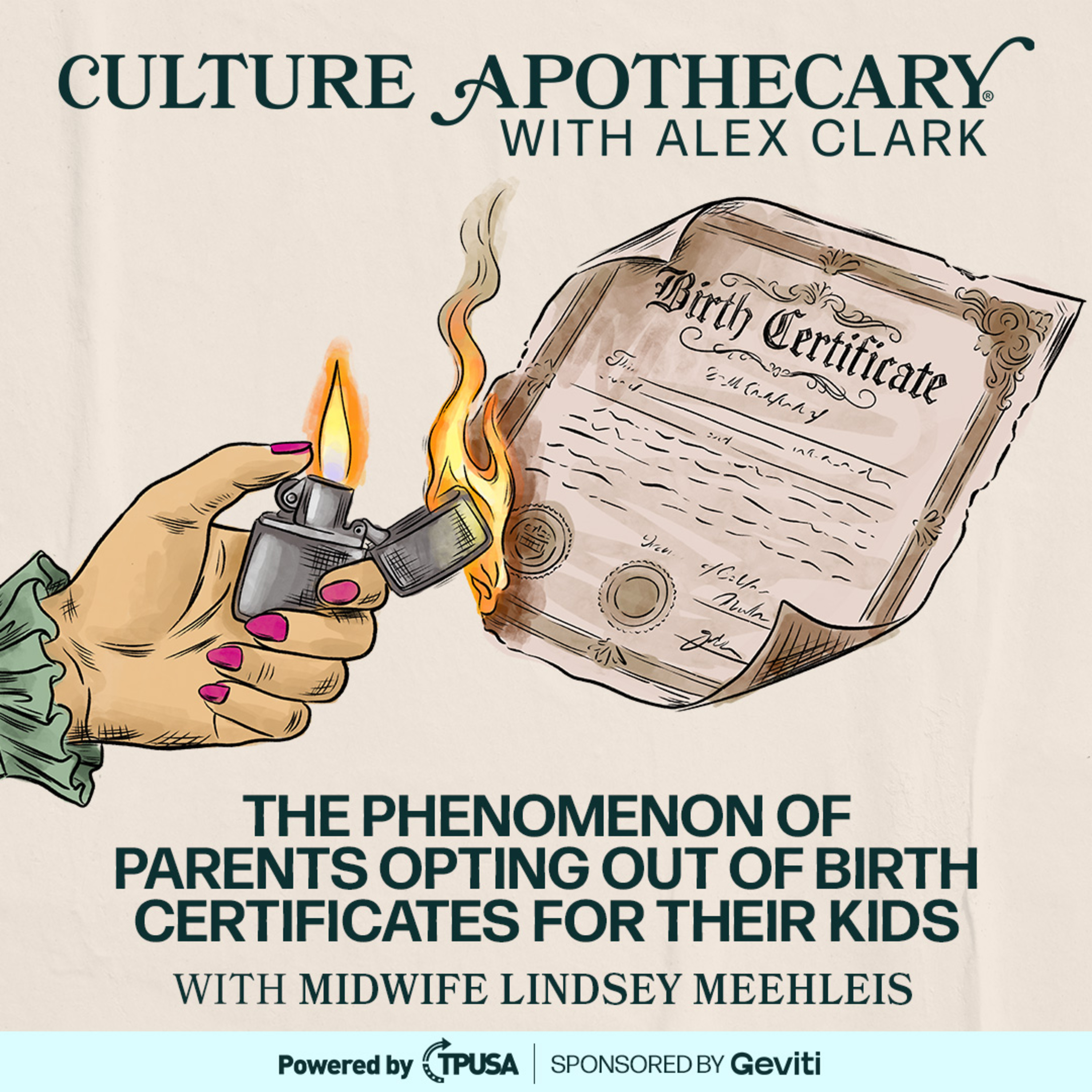
Culture Apothecary with Alex Clark
The Phenomenon Of Parents Opting Out Of Birth Certificates For Their Kids | Midwife Lindsey Meehleis
01:07:10
Loading summary
Transcript133 lines
- [00:00]
A
In your experience as a midwife, when did you start noticing this slow uptick of parents saying, hey, actually I want to opt out of a birth certificate for my child?
- [00:09]
B
It's definitely becoming more of a trend. There's more people that are talking about it, I'm hearing more podcasts about it. There is an alternative, like we don't have to register our child in a database that makes them essentially an entity of the corporation of the United States of America.
- [00:26]
A
Why is it better to not have a Social Security number or a birth.
- [00:29]
B
Certificate, that they are the ones that have full sovereignty of their child? Their child is not owned by the state. Their child is a independent person operating within the United States, not an entity of the United States. They want to avoid having the state be able to take a child away when there's crazy rules that the state knows better than the parent.
- [01:02]
A
Foreign. There is a contemporary phenomenon of parents refusing to register birth certificates for their children and I wanted to learn more about the beliefs driving it, the groups involved, the arguments they make, and any potential real world consequences. Lindsay Milus is one of the most sought after midwives in Orange County, California with over 22 years of hands on experience and supporting families through pregnancy and birth, who has been getting more and more of these requests. I wanted to get her take on why so many parents feel that not getting a birth certificate or Social Security number is what is best for their baby. We also cover some shocking info on alleged emergency C section births in America and what is at risk when you elect for an induction. If you want to watch this episode, you can by subscribing to real Alex Clark on YouTube or Culture Apothecary on Spotify. If you're new here, we release two episodes a week where we bring on experts doing their best to heal a sick culture. So physically, emotionally or spiritually, whether you're a first time listener or long time, please leave us a five star review before we get started. And by the way, if you love this episode, go back. Listen to my episode of the Spillover that I did with Lindsay Milus because it was fantastic. Please welcome midwife Lindsay Milus to Culture Apothecary. In your experience as a midwife, when did you start noticing this slow uptick of parents saying hey, actually I want to opt out of a birth certificate for my child.
- [02:34]
B
So there's two different ways to look at this, right post 2020, everybody started questioning everything. Now there was always people that were questioning things before 2020. I was one of them. I feel like what happened is Once we were like stuck inside our houses for, you know, however long we decided to stay in our houses, everybody started doing a little bit more research. So I have like the OG people that are like, off the grid and they like, come to you. And sometimes you're like, it's not necessarily like the greatest thing where you're like, you're like, well, why? Why don't you want to have anything on record? And then you have these well educated. The people that are having home births in general, if you look at the statistics, are very high educated, very high income. You know, they're doing their research. The amount of doctors and nurses and firefighters and, you know, people of service that are coming to me to have these home births are now saying, like, there, there's an alternative. Like, we don't have to register our child in a database that makes them essentially an entity of the corporation of the United States of America. So it's not like somebody comes to me and sits in my office and I'm like, like, you need to not register your baby. Like, it's fully prompted by the parents. It's nothing that I'm promoting. I don't know enough about it. I feel like I could spend my entire life researching the private sector of the United States. But when people are coming to do this, they come with me, come at me with the paperwork and they say, hey, like, I want to do this. I want to make my child a United States national, not a United States citizen. When they're a national, they operate within the private sector of the United States, not the entity of the corporation of the United States. And when you do that, there's a lot of different things. You know, people think, oh, like, how can they get insurance, how can they go to school, how can they open a bank account? But there's ways around all of it. And, you know, if you're, if it's, if you're somebody that's going to do this, you have to make sure you've done your research on it. Because it's not like, it's just like something that we can just easily breeze through. But even getting a passport, it doesn't take that much work.
- [04:36]
A
I am floored by you saying that the type of parent who is asking for their kid to not have a birth certificate. I'm picturing flannel shirts, hasn't shaved in 20 years. You know, really low educated. You're saying these are top of the top, highly educated, well to do Orange county parents who are asking for their kids to be off the Grid.
- [04:59]
B
Yes. I mean, it's. And that's my client base. That is. That is the majority of clients that I serve. I mean, it's where I live. So it's. It's something that is very interesting. It's definitely becoming more of a trend. There's more people that are talking about it. I'm hearing more podcasts about it. There's more Instagram that are popping up, accounts that are talking about these things. There's classes that are popping up. There's classes on how to relinquish your citizenship and become a national, not a citizen. There's. There's classes about family shields. You think about back in the old days when there was a shield on a castle and it had, you know, like maybe a lion and a couple initials.
- [05:35]
A
Yeah, the crest.
- [05:36]
B
The. The family crest. So there's all of these different things that are coming about, which are levels of protection. And I, you know, most people that have money, most people that have, like, legacy money, like, from multiple generations of family, have all of these things in place. They have all their family. Private family trusts. They have multiple trusts. They have the crests and the shields. They have all these different things. And it's, you know, once you start learning about it, a lot of people became really intrigued with it and start to do their own research, to do the same.
- [06:11]
A
So are parents usually bringing this up proactively or is it coming up later in the process?
- [06:17]
B
Usually I'm getting the talks prenatally. I, you know, like, have you heard of this? Have you filled out paperwork? Have you, you know, do you have other parents that are doing this? And then typically you have a year, and every state's going to be different, but within California, you have a year to file the paperwork within the county. So it says in the writing that it should be within 10 days, but. But if you do it within the first year, you don't have to go through the state. So if someone's doing research on it, then they'll usually take that full year before they have to move from the county birth registrar to the state birth register, and they'll, you know, make the decision if they're going to do that or not. And, and where I'm seeing it the most, like, you know, there's all the paperwork for everybody to get their birth certificates and paperwork for people to file for Social Security. You have to verify that they are pregnant. You have to verify that you saw them throughout the pregnancy. You have to verify that you witnessed the birth and that that baby came out of that mom and I also put in there, you know, the father of the baby, the partner of the baby. And now I'm seeing a lot of people starting to ask me, and I say a lot. It's really not that much, but it's an. It's enough to take notice. It's definitely drastically different than it was five years ago, for sure. And there's a form within the passport called a DS10 form, and that form is an attendant. So I'm an attendant. An ob GYN would be an attendant. And it's. And whoever witnessed that birth gets that form. I go to get it notarized. I, you know, verify everything that I would do for a normal birth certificate and a Social Security number. And then they take that paperwork, fill out a passport application, put all zeros where the Social Security number would be, and they're getting their children United States national passports. And it's. I mean, I'm seeing them. It's not like it's this taboo thing where it's against the law. Like, you just have to know a little bit more about it in order to do it.
- [08:16]
A
What are the reasons parents are giving you for why they don't want their kids to have a birth certificate?
- [08:21]
B
At first, I want to back up and say, you. Like, there's still like a census. Like, it's not like the, you know, United States doesn't know that that baby wasn't born. You still have some sort of documentation that certifies that that birth happened. So within the county, like, they're still knowing that there was X amount of babies that were born. X amount of babies that were born at home. X amount of babies that were born at home with me. But when parents are doing their research on this, they're. They're starting to realize that there's benefit to not having their child in the system of that corporation of the United States of America. So what that means is if there was something along the lines of, gosh, even like, cps, like, if the child isn't registered, then it makes it a little bit harder for the system. Now, a lot of people can fight with us and say, like, that's horrible. What if their parents are abusing the children? And then CPS has a harder time to get to those children. Yes, I agree. Great. But if it's something along the lines of, like, medical kidnapping, which I'm sure you heard of before, like a parent refuses a vitamin K injection at the hospital, the doctor that's on call doesn't like it that a parent's refusing some sort of medical treatment that doctor calls cps. I've had several clients that CPS have been called on, many of them with previous pregnancies. And then they choose to have a home birth to stay out of the system completely because of how much trauma was incurred. When there's a CPS agent at their door questioning reasonable parenting choices that have been based in research for what they want to do for their own child, they're creating layers. I think that's the best way to describe it. They're creating layers of protection. Now, again, these are my well educated clients that are making these decisions and not clients that I would ever be concerned about hiding from the system, so to speak, but more of a layer of protection of making sure that their child is taken care of better.
- [10:16]
A
Would you say that these, these parents are framing this as more of a philosophical belief, a political stance, a spiritual choice or something else?
- [10:25]
B
I would say that it's a political choice and a philosophical choice. I think that, I think all veils are being lifted right now. I think that the corruption within all governmental systems. We're seeing Venezuela collapse, we're seeing potentially Iran collapse. We're seeing so many different things changing so much in the world right now. It's constantly in our face, especially if we're on social media, that I think it's making us question everything. And I think that when we just talk about even the difference of the administration, you know, during COVID well, post Covid, but the Biden administration compared to the Trump administration, I think that it's made people question everything. When we were told to wear a mask and have social distancing and not hug our family and not gather at Thanksgiving and Christmas time, and then seeing now on the flip side of it that, you know, he was. Fauci was granted immunity and basically everything that they said was just a guess. And then people are like, well, why? Why did we change our entire lives for those things? So it's just, you know, like that's one little layer and that's one little veil that's being pulled back and it's waking people up. And then there's this whole other level of other people speaking out against it or about it, not even against it. And it's, it's just like, you know, causing these little like lights to go on in people's heads thinking that like, maybe we do something different than what we've just been told, like against the herd mentality, so to speak.
- [11:55]
A
Do these parents think that life is going to be easier for their kids without a birth certificate. Do they think that it actually will be the same, there won't be any difference, or do they acknowledge and believe it will be harder, but it will be worth it?
- [12:05]
B
I think that most people will go between thinking it's going to be the same and maybe a little bit harder, but once they continue to do the research, they realize that it's just a little bit of extra work to get different, you know, identification numbers and different ways of getting passports. But they, there's ways around all of it and they know that it's possible.
- [12:22]
A
Have you heard parents talk about ideas like sovereignty and being off the grid or stay control when they're making these decisions?
- [12:29]
B
I feel like off the grid is kind of like a hit word right now. You know, like there's so many people that are trying to move to several acres of land and be, you know, completely off the grid with electricity. But also in terms of like there's, they're raising their own animals and they're making sure that, you know, if something were to happen that they would be self sustainable. So for sure, sure. People that are thinking along those lines are also thinking about ways to keep the sovereignty of their children away from that, you know, corporate stance of the United States government.
- [12:59]
A
What do you think their long term plans are for things like schooling, health care or employment?
- [13:04]
B
I think that once you do the research on it and there's several people that are teaching classes on this, there's ways to go to school, there's ways to, you know, get employer identification numbers, maybe not a Social Security number, but employer identification numbers to be employed. There's ways to get all of these identification numbers to open up bank accounts back when, gosh, I think it was maybe 2016 when marijuana became legalized here in California for medicinal uses. One of the ways, and I'm not, I actually am very against marijuana. Like, it's not like I was going to these dispensaries, but what I was seeing is that they, all of these dispensaries were entering into this realm in a sense of having private associations. So one of my really good friends opened up this co op that would sell raw milk and would sell bone broth. And it was, it's called Fermentation Farm is absolutely amazing.
- [14:02]
A
Oh my gosh, I'm obsessed with Fermentation Farm every time I'm here. We tried to go there this morning. Yeah. But it was too far from where we, we were filming because we're here in California filming this and I go there every time. Yeah.
- [14:15]
B
So love them. Great people. But when they first started, they were doing the same thing that the medical marijuana dispensaries were doing. You had to pay a fee, an annual fee to join, joined their co op, which was a private member association. So it's a pma. And what the PMA is, is it's operating outside of the public sector of the world. It's operating in a private sector. And you assume the responsibility and the liability that if you were to get sick from raw milk, that it wouldn't be something that you would go take them to a court and sue them for because you were agreeing to the co op membership rules. Same thing with the medical marijuana stuff. And so like, people are kind of easing into the birth certificate stuff in that private sector too. And it's, there's ways around, there's ways around all of it.
- [15:03]
A
Okay, but here's, here's what I still don't understand. What are the benefits of being off the grid in this way? What, what. Why is it better to not have a Social Security number or a birth certificate?
- [15:14]
B
So again, this isn't my opinion. It's just what I'm noticing and what I'm seeing is that these, it's a philosophical reasoning that they are the ones that have full sovereignty of their child. Their child is not own by the state. Their child is a independent person operating within the United States, not an entity of the United States. And you know, I remember, you know, you even look at Newsom, you look at Clinton, Hillary Clinton, like, like they'll, they'll say pretty creepy things. Like, you know, like it's. Right now there's a situation that we're dealing with with a Ukrainian family that came here from Ukraine. They were war refugees and they came to the state of California. And the state of California has passed a law that says that if the child wants gender affirming care, it can be taken away. That child can be taken away from its family and get the gender affirming care. So now we're talking about war refugees from another country that were granted immunity here in the United States and then their child is now taken away from them because the state thinks, the state of California thinks that gender affirming care is better than women. What the parents belief system is what, you know, what they're doing with their own child. So that's, that's the things that people are thinking, like they want to avoid having the state be able to take a child away when there's crazy rules that the state knows better than the parent.
- [16:39]
A
I tried this little Diddy called the Blue Beauty drink the other day, and I swear it made me feel like a Disney mermaid who also does her taxes on time. Like, my skin was glowing, my hair wasn't trying to escape my head. My nails. My nails look like they could murder somebody. Softly and elegantly. This isn't just some Instagram snake oil. It's anti aging from the inside out with blue spirulina, bovine collagen, biotin, and amla, all of which are basically just superfoods that scream, your cells will finally behave, Jessica. It hydrates, nourishes, and actually does something for your gut. Hair, nails, and skin. Botox. Toss it. Injectables? Forget it. This is liquid, functional beauty that you can drink and feel morally superior with while doing it. It's also refreshingly sweet with a hint of citrus, so it doubles for mocktail. For dry January, you can sip it and feel like you're sophisticated while your liver takes a break. Go to taylor du wellness.com use code Alex Clark for 10% off. That's Taylor wellness.com code Alex Clark for 10% off the blue beauty Drink. So do these parents, are they operating and doing this under the assumption that, you know, if we want to fix this later, we can, or do they feel like, no, this is a permanent choice?
- [17:47]
B
I don't think anything's permanent in life. I think that we can always rectify things and change things. The only thing that's permanent about life is that we're born and that we die. Everything in between, we can fill in the pieces. So, you know, at any point, anybody could go and get a birth certificate or a Social Security number. I have a really good friend who was raised in a cult, and they were always off the grid. They never registered anything. And when she decided to run away from the cult when she was an adult, they had nothing. They didn't have a credit score, they didn't have a Social Security number. They didn't have any of these things. And they were able to very easily go and obtain those things. So it's not like it's a forever choice if that's what somebody chooses to fix it or rectify it later on. But it's definitely something that I think that most people that are doing enough research would probably keep it as a permanent choice just because the more layers that you peel off and the further down the rabbit hole that you go, there's more and more information that makes you want to stay outside of that public sector.
- [18:44]
A
What is your role legally and Ethically, when parents make these requests, I believe.
- [18:49]
B
And one of the first things I'll say to anybody that comes into my office when they sit down in front of me, I always say that you are the authority of yourself. Like, you know your body better than anybody else. You know how to take care of your baby better than anybody else. Like, I will always default to you being the expert. And so as a licensed medical provider in the state of California, licensed through the medical board, I have to uphold a certain legality around reporting the births, because I have to, like, if I'm witnessing a birth, I'm licensed underneath the stay. I have to at least know that the consensus is there that people are being reported. So it's different than a birth certificate. So there's a certain paperwork that I fill out, certain forms I have to fill out. There's the newborn screening test that I have to. You know, if a parent wants to do it, I offer that. If they want to refuse it, we offer that. That paperwork goes to the state. And then if they're deciding to not actually register the birth, then I will, you know, verify that I've witnessed a birth, and I'll do that under oath with, you know, with notary saying that I've witnessed that baby be born and they have the appropriate documentation they need to. To move and get the right steps for what. If it's a passport or if it's anything else, I'll give them that paperwork.
- [20:07]
A
Do you ever worry that a child will grow up and resent a decision like this that was made on their behalf?
- [20:14]
B
It's interesting. Now I have older children, right? Like, I. I had children very young, and my kids are teenagers, and I. They were born at home, and they, you know, they had different things than, like, what status quo is. But, like, I think that when you're raised in a way where are always listening to your parents question everything and you start to see how that impacts, in a good way, the quality of your family life, the quality of your own health, the quality of everything around you that you. I don't want to say you're brainwashed into. I mean, really, if you think about it, most people will grow up in the same ideology as what their parents teach them. Some will rebel and go against it, and some will actually see, like, oh, this is working for me, or it's not working for me. Some. So it.
- [21:02]
A
I.
- [21:03]
B
It's a possibility, sure. I mean, rebellious teens do funny things, right? But. But if they're able to get a job and they're able to function in society and they're able to go to school, and if they want to go to college, they're able to get into the colleges of their choice based on the decisions that the parents made with the birth certificate. It really doesn't impact them.
- [21:20]
A
I know this is going to be one of the most controversial things I've ever discussed on this show. That's why I think it's interesting is because Lindsay is. Is one of the most sought after midwives in the country, let alone, I mean, of course, the state of California. But everyone knows you and, like, wants their baby and you're dealing with this and you are. I'd never even heard of this before. You kind of brought it to my attention, like, this is happening. And I thought it was so interesting. So, I mean, if you guys listening to this are like, I'd love to listen to an expert explain, how can parents do this? What are the benefits? I can have that person on the.
- [21:49]
B
Show, but she has somebody. I've given her.
- [21:51]
A
Yeah, I want to get into, like, midwifery, nitty gritty. And. And for those who are new, I mean, I had a podcast of a different name for three years before I rebranded to Culture Apothecary. And in that time I had Lindsay on and so kind of went through these things. But it's been a while and there's so much new audience now because of the rebrand that I want to kind of get into, like, midwifery things Again with you. Here's something that you told me also. And it's funny because you sent me this on text and I thought it said 29,000, because I. It's just incomprehensible to me that there are 29 million C sections being done worldwide yearly. And I read that and I was like, okay, 29,000 C sections. I mean, a lot, but like. And you were like, no, no, no, Alex, 29 million in all caps.
- [22:41]
B
Million. Because I was like, this is huge. Like, people don't realize we're talking about healthy women that have nothing wrong with them. Birth is the most physiological event in any person's. Any woman's life. Right. If we look at farm animals, birth is the most physiological event in a farm animal's life. Like any male mammal. Any mammal is designed to give birth. And I am so grateful that we have the technology that if we need a C section, that it's available to us. I am not anti C section. I had a C section with my first child. Like, I am the person that's going to Say like, thank goodness we live in a day and age because, you know, hundreds of years ago, if there was issues for true like medical necessary reasons, C section would save a mom and a baby's life.
- [23:29]
A
But here's what's weird.
- [23:30]
B
Tell me.
- [23:31]
A
Me, every woman I feel like that's getting a C section, almost all of them are being told it's an emergency.
- [23:36]
B
Yes.
- [23:37]
A
How many of these C sections that were given out are actual true emergencies?
- [23:41]
B
So if you look at the World Health Organization. The World Health Organization, and trust me, I don't like the three letter organizations. Like it's not, it doesn't mean much to me that the World Health Organization is saying this, but I like the statistic. 10 to 15% is what's recommended for the cesarean respond rate. Okay. 10 to 15% of women that are giving birth, high risk. Now remember, we have lots of IVF moms happening now because our fertility rates have just plummeted and are in a disastrous state.
- [24:08]
A
Does that lend itself to C sections?
- [24:09]
B
Absolutely. Oh, I didn't know that. Absolutely. Because what's happening is that these are more medically fragile pregnancies. They're premium pregnancies. A woman is paid sometimes 50,000 plus dollars to get pregnant and stay pregnant. They're more high risk because of that. And then when they're more moving into that high risk category, they're going to be increased risk of having a cesarean. So there, that's going to come into this as well. But I'm talking in terms of the whole entire world that the World Health Organization is saying that it's 10 to 15% of women that should be having a cesarean that's appropriate. Okay. That would save 10 to 15% of could be catastrophic issues with moms or babies. Okay. When we're looking at 29 million women per year that are having major abdominal surgery in order to give birth, that is way too many. So that's on average in the United States, we're looking about 33. 1 in 3. 33%. 1 in 3 women that are having a C section. Okay, that's way too much some places. I mean even where I'm at in Orange county, some of those hospitals are 50 to 60%. You want to look at Brazil, it's like 90% of women are having C sections and they're just scheduling them. Like it's, it's, it's like not even any problem. And then you look at places that are midwifery based. So let's look at the Scandinavian countries. So let's look at Norway. Let's look at Sweden. Let's look at Denmark. Let's look at the Netherlands. The Netherlands has a huge study about the impact of how good midwives are for maternal care. When we're looking at our maternal mortality rates in the United States, it's abysmal. There's women that are dying in childbirth that should not be dying. Why? Is it our nutrition? Yeah. Is it our way of looking at birth, that birth is a emergency waiting to be rescued, or is it a combination of everything? You look right now at Norway, their maternal mortality rate is almost non existent.
- [26:06]
A
Why?
- [26:07]
B
Why? It's because midwives are at the base of care. They're looking at this as a whole person. We're looking at this mom coming in. We're looking at her spiritual sense, we're looking at her psychological sense, we're looking at her family sense. We're asking her questions about how she, her relationship is with her partner, how everything is at home if they have kids. How are, how's everything with your kids? We're coming in and we' having like hour long appointments with these women and we're literally encompassing their whole body, not just a belly, not just a baby that we're getting a measurement on. And do I think that translates over to having much better care? Do I think that the continuity of care of me knowing a woman throughout her entire pregnancy and then moving into the labor and birth experience and knowing what's normal for her and knowing what's normal for her baby makes a difference and how her outcome is going to be? Yes, because I know them. If they walk into a hospital and it's a laborist that's on call, that's never met them before. This is an OB that's there on call in the house and labor and delivery nurse that they've never met, they have no idea what's normal for their bodies. They're looking at a screen determining if that's something that's, that's, you know, within normal limits. New York Times just released an article a couple months ago saying that one of the biggest contributing factors to our increased cesarean rate is continuous electronic fetal monitoring. Continuous electron fetal monitoring is when a mom is hooked up to a machine that looks at the baby's heart rate. The entire labor at all also measures the strength and intensity of duration of the contractions. Sometimes we use internal monitors. One of those monitors actually kind of screws into the top of baby's head. It's called a fetal scalp electrode. And those babies are on the monitor the whole time. So now what we're looking at is a court document, right? If something were to happen to that baby, they're going to look back at every single strip of paper of 13 hours, of 23 hours, whatever it is that that baby was in the hospital. And if something happens to that baby and those pain parents sue the hospital, then that hospital is going to be held accountable. If there was one little blip that a witness could say should have been a C section. So now there's all these doctors that are looking at that strip saying, could I be held liable if I didn't do a C section during this time? Now what we know with continuous fetal monitoring is that it hasn't improved outcomes for infants at all. There's no change in the outcomes of infants compared to when we were recommending intermittent in fetal monitoring, which is what midwives do. That's we're just monitoring the baby throughout the labor, but in a certain pattern, like every 30 minutes and as we get closer to baby being born, every 15 minutes or so. And so we look at our C section rates, like my C section rate, and I'm, I have a busy practice. My C section rate within my practice at the most on any given year is about 6%. Tell me how that's different than the 33, on average percent of C sections that are here here in the United states and the 29 million that are being done worldwide. That's a lot of, that's a lot of surgery.
- [29:10]
A
How does entering pregnancy, metabolically stressed or nutrient depleted, change how labor could unfold later?
- [29:18]
B
So I think we need to take it back to conception because if we're metabolically unsound, it's going to mess with our fertility right off the bat. We're going to have an increased risk of missing miscarriage. We know that the fertility rates. We're saying that one in six women, one in six families worldwide are having fertility issues. That's one out of six of your friends are going to have fertility issues. Most people would say it's more at this point, we know that the father's nutrition and metabolic status also have to do with the big picture of continuing through the pregnancy. See healthy the baby's health. We are. There was a research that was done that the father's sperm really forms the placenta. And if that placenta isn't in good health, and it's not that it forms a hundred percent of it, because of course maternal nutrition can contribute to that for sure. But if father is in poor health now, men regenerate their sperm every three months. Okay? So if, if you're consciously trying to conceive, you're like, both of you guys need to be entering into this in a very healthy manner. Just looking at IVF research, what it shows is that women that reduce their insulin resistance. So let's like a hemoglobin A1C is the best way to test this. A hemoglobin A1C is a test that can be done. Standard blood draw gives you an average of your blood sugars over a three month period of time. It gives you a percentage. If you have insulin resistance or blood sugar issues, your chance of getting pregnant with IVF, it reduces by 40% with the success rate. So tell me that if you, we, let's not get to the IVF step. Let's just talk about getting pregnant. Being in good metabolic health, not being insulin resistant is going to change everything that's going to be so helpful in order to conceive. So it's, it's like building blocks, right? So once you're pregnant now we have to keep you healthy throughout the pregnancy and then once we keep you healthy throughout the pregnancy, that's going to go into the birth. So, you know, the basis of good prenatal care is, is multifaceted. But nutrition is definitely one of those huge things. Mental health is really important too. Making sure joy is one of the best things that you can have. Vitamin joy is what I call it. You want to make sure that you're staying in that good mental space for sure because everything that you're feeling is impacting the baby. If you're in a state of stress, that amniotic fluid is turning into a stress soup, so to speak. So we try to make sure that those things are talked about and monitored and measured as much as we can can. But it's everything. Metabolic health is everything which, you know, me and you both are so passionate about, the Maha movement and it's, you know, we've experienced a couple things together with that and the reason is, is because if we want to change the foundation of our country, we can't just look at McDonald's, we have to look at the roots of the nation. And to me, there's no better way to look at the roots than to look at our preconception, to look at our fertility rates, to look at that, the way that moms are treated, you know, prenatally throughout the birth process, during the birth, breastfeeding. Tell me that's not the, the root of health, you know, like, that's.
- [32:35]
A
That's where it all begins. Literally.
- [32:37]
B
It's literally where it all begins.
- [32:42]
A
At one point, I was watching a dust bunny crawl across my countertop like it had stock options. And I was like, I've been spraying my home with chemicals so toxic, I'm pretty sure spiders are dying in protest. That is why I switched to Branches Basics. Here's the ugly truth. Most cleaners on the market release hundreds of volatile organic compounds. Tiny chemicals that literally pollute your indoor air. Worse than outdoors. They trigger asthma, headaches and long term lung issues. You've got chronic migraines. When was the last time you switched out your cleaning products? Oh, you didn't think about that, huh? Ah, Alex Clark is right again. In some studies, VOCs from cleaning products were found at levels 2 to 10 times higher inside homes than outside air in synthetic fragrances. They're not just flowery smells. They're loaded with phthalates and endocrine disruptors that can interfere with hormones, metabolism, stress response in appetite. Long story short, synthetic fragrance which is found in your cleaning products is making you fat. I started using Branch Basics because it's actually made safe. Certified plant and mineral based fragrance, free and biodegradable. Made from ingredients that I can pronounce and trust. It cleans everything, floors, counters, laundry, even produce without humping. Oh, without dumping harmful crap into my air. I don't have to muffle my own cough every time I spray the bathroom. Switching to Branch Basics has actually made my home feel safe again. Like I'm not living inside a chemical weapons lab next to my couch. Right now, my listeners get 15% off the premium starter kit at branch basics.com with code ALEX15. That's 15 off at branch basics.com with code ALEX15. Make 2026 your cleanest, healthiest year yet with Branch Basics. Whether you're dumping dinner humping. So what happens when a tuba player, a school teacher and a naked horse dentist walk into a bar? I have no idea. I wasn't there. But I do know what happens when you eat masa chips. Everything in life suddenly makes slightly more sense. Masa chips are crispy, crunchy, totally addicting. Made from high quality masa that actually takes like corn, not chemicals like those other chips. And the flavor. Oh my word. Perfect for salsa, guac, queso nachos, or just shoving into your face while scrolling x angrily. At 2am 100gr fed beef tallow organic corn in real salt. They're the most satiating chip on the market. A snack that's actually Brain food, if you will. Life is weird. Your bar stories are weirder. But your snack game shouldn't be a disappointment. Masa chips are authentic, flavorful and made for people who appreciate actual corn craftsmanship. Go grab a bag of masa chips. Your tuba playing friends, your school teaching friends, your naked horse dentist friends. They're going to understand or they won't, but you're going to have chips that actually slap. Go to masachips.com use code real Alex Clark for 25% off your first order. That's masachips.com code real Alex Clark for 25% OFF your first order or buy in any store at any sprouts nationwide. When people hear of a cascade of interventions, can you explain what that looks like in real life? Like what is a common example of what a cascade of interventions during the birth process would look like for the average American woman?
- [35:38]
B
Yeah. So the cascade of intervention. Such a good question. Because usually what happens is you are seeing if you're in standard obstetrical care, you're seeing your ob. And uh, the second you have anything that makes you higher risk, not even high risk, you start to do what's called biophysical profiles and non stress tests. So this is going in every 72 hours to monitor the quote unquote health of your baby. Now this is also a legal parameter. We know that within the 72 hour parameter that, that ensures fetal wellbeing of that baby. Now insures is kind of a funny word, right? Because anything can happen at any time. Nobody's God. We don't know what happens. It's some things can always happen in a legal sense that kind of gives the liability threshold safety net that the doctor is doing their due diligence and that baby's good for 72 hours. So every time that you're going into a hospital to look for a problem. Now they can do these sometimes in doctor's offices as well. But anytime that you're looking for a problem, what happens? Usually find one. Right. We don't typically monitor, we've never monitored babies for all of time until the last 50 years with all of these new technologies that, that we have. Again, when you look at the data, nothing has changed in terms of improving fetal outcome. Wow. So now we're looking at all of these different things. We're finding reasons to induce women could be low amniotic fluid, it could be a little D cell that baby has. It could be, there's a variety of different things. Anybody that's listening that's been induced is like yeah, yeah, yeah, of course, this is what happens. So then they make recommendations to induce. You go over your due date. So an average pregnancy length is anywhere from 38 to 42. The due date is 40 weeks. The same amount of women that give birth at 38 weeks give birth at 42 weeks. An average pregnancy for a first time mom is 41 weeks in one day, eight days late. If you go over 40 weeks, they are pushing induction like you wouldn't believe.
- [37:32]
A
Why can't you let them cook?
- [37:33]
B
I mean so midwifery care does that to a certain extent. We always want to make sure that baby's safe. Our number one priority is the safety of baby and the safety of mom. However, there was a study that was published, I don't even know even know maybe 10 years ago that said that babies have an increased risk of stillbirth rate after 39 weeks. So here we're going to come in and we're going to swoop in and we're going to rescue every single baby at 39 weeks. Now tell me what if that mom's due date was off? We're talking when we do an ultrasound that due dates can be off plus or minus two weeks. So if I go in and I take a 39 week baby that's actually 37 weeks and that baby is a near term infant that needs more care, that ends up in the Nicole nicu. Breastfeeding rates are going to decline. That important bonding is going to take a back seat until baby gets discharged from the nicu. There's so many things that we create. So you know, right off the bat we're, we're inducing women more. We back in 2023 there was data that was saying that on average 33% of women were being induced with labor. Now induced is one word. Induced is when you go in, they give you either or a cervical ripening gel. They give you a medication called Cytotec which is actually used off label. There's a black label warning box on the box that says do not use in pregnancy. It can cause amniotic embolisms, but we use it all the time. It's commonly given in the United States. So they'll give these drugs to induce, make sure the cervix is ripe. Sometimes they stick a Foley bulb up into the cervix. They'll put water into the bulb medical device and try to force the cervix open and then they'll put you on a drip of Pitocin. Pitocin can be increased. It's on a machine. We're monitoring babies. So right away, if we're using Pitocin, what the recommendation is, is continuous fetal monitoring. Right off the bat, we're getting the recommendation that this baby needs to be on continuous fetal monitoring. Do I think it's appropriate when using Pitocin? Yes, because we are making the uterus contract in an abnormal way, which can cause strong contractions and cause more fetal distress. Okay. Now when that's happening and we're having these increased contractions and these increased strength of contractions, contractions don't do their normal ebb and flow. They're usually back to back. When you're in a normal physiological birth, they're every three to four minutes. These are back to back to back. Moms have an increased need for pain medication. So then we throw the epidural in there. The epidural also requires continuous fetal monitoring. We know that sometimes that having an epidural, if the mom doesn't have enough fluid on board, can cause blood pressure to drop, can cause baby's heart rate rate to drop. So now we're dealing with. Are the contractions too strong? Has the epidural caused the baby's heart rate to go down? Is the Pitocin causing the baby's heart rate to go down? Next, intervention. Let's break your water. If we're going to. If we're going to continue alongside of this induction. Let's keep it going. Let's break your water. Increased risk of infection every time they're doing a vaginal exam. Increased risk of infection. So you're going down this road. Now. We can't tell if the Pitocin is making these contractions strong enough. So let's do an internal fetal monitor monitor. Let's use the fetal scalp electrode that we're going to put into your baby's head. Let's place an inner uterine pressure catheter into the mom's side of the uterus, the side of the cervix, in order to see how strong these contractions are. You have a line that's going from inside of a mom's vagina to her leg in a dirty hospital. Tell me how that doesn't increase the risk of infection. Then. We're on a time clock. We want babies to be born within 24 hours after the water's broken. That's not something that I do within my practice. But what the research shows is that 85% of women whose water water breaks have a baby within 24 hours after their water's broken. So there's all these time clocks. Now we've been ruptured 18 hours and we need to do antibiotics. So let's go in and prophylactically give antibiotics just in case there's a risk of infection. Now, we don't ever want an infection, but if we're prophylactically giving every single woman these antibiotics, we're going to wipe out baby's gut biome before they're even born. So it's like step after step. So it's this cascade, this waterfall fall. And then you look at our C section, right? And you're wondering, I mean, tell me that doesn't coincide. That 33% of the United States are getting women are getting induced, and that we have on average a 33% cesarean.
- [41:42]
A
Right?
- [41:43]
B
Yeah. Yeah, right. Tell me that's not, you know, coincidental.
- [41:46]
A
I want to know something. Do we really need to be as afraid as we are about a cord being wrapped around a baby's neck?
- [41:54]
B
So it's a very good scale. I see babies that are born with their cords around their neck all the time. So the beautiful thing about the cord is that it has three vessels. There is two arteries and one vein. Around those arteries and veins, there's something that's called Wharton's jelly. It's probably Dr. Wharton that came up with that.
- [42:13]
A
I mean, I love it. On my toast.
- [42:17]
B
And. And this Wharton's jelly protects the cord. So are there cord incidents and accidents? Yes. If you've lost a baby because a doctor has told you that you had a cord accident, I so sorry. But do I think that it's a common skate go? Yes, 100%. Because what happens is that Morton's jelly puts this level of protection around those two arteries in the vein where compression is really hard. If you've ever physically felt an umbilic cord, which I have thousands of times, in order to squeeze it so tight where it would cut off blood flow to the baby is really, really, really hard to do. I've had cords that have been knotted like in a true knot. And those babies, they. Most of them, most of them, I don't have a statistic, but most of those babies do just fine with true knots in their cords. When people say, oh, it was an emergency C section, cause the cord was around the neck, first of all, we don't know if the cord was around the neck. When they're in there prenatally, we can maybe try to guess by ultrasound, but we also don't know then how the baby's gonna move down the birth canal if there's a true compression of the cord. Usually what happens in a normal physiological, correct birth is that there's the ebb and flow of the contraction pattern. So there might be a little bit of a decrease in the heart rate. And then the baby gets a break because the mom has a break in the contraction, and then the baby gets all of its oxygenation and recovers from that. If we're having pitocin and it's back to back to back to back to back, is the baby getting a chance to recover? So what came first, the chicken or the egg? Was it the cord or was it the interventions that we're doing that are causing the baby to not have. Have a chance to recover from situations like that? But I've seen a baby. The most I've ever seen a baby wrapped in a cord was eight times. And the baby came out and I was like, oh. I was like, around the neck, around the neck, around the arm, around the leg, around the foot. And in my opinion, like Tarzan, he's like bungee jumping, Right? But I find, like, you'll always hear me say that baby is just as much an active participant in this experience. Babies are conscious. Anything that we're doing to the babies they are aware of, we should be including them in every single conversation.
- [44:18]
A
An epidural.
- [44:18]
B
Including an epidural, all of it. They're conscious of everything that's happening.
- [44:22]
A
Any.
- [44:22]
B
Anything that's happening, they're conscious of. And so in my opinion, when I look at babies that are wrapped in the cords, you can have a really short umbilical cord. So the umbilical cord attaches the baby's belly button, which then attaches to the placenta. The placenta, if it's a really short one, there's really no chance for them to get wrapped in it because there's not enough space in there. But if you have a really long cord and there's nothing that determines this, it's not genetic. But I've also had moms that have had five short cords and five long cords, you know, but we don't know the actual reasoning of what grows a short or a long cord with these really long cords, I think it's protective. If they're wrapped in them, there's no chance to have what's called cord prolapse. That's when the water breaks and the cord comes out before the baby, which is a true medical emergency. So if they're wrapped in it some way, not that they're consciously thinking, like, I Don't want to have, you know, a cord prolapse. But I think it's their way of protection of making sure stuff like that doesn't happen.
- [45:14]
A
I can't remember. I'm racking my brain. I can't remember if it was when I interviewed you the first time or when I interviewed Dr. Stu Fishbein. Yeah, but one of you had talked about how when you get an epidural, it's like lights out for the baby. As in they're like disconnected from mom, like, where's my mom? Like, to them it's like you've disappeared. And so that is really stressful for a baby in the birth process. But I've never had more obs complaining and spurging out in my comments than when one of you made. Made that claim. So can you talk about just the, the pros and cons associated with an epidural that most women are not told?
- [45:50]
B
Yeah, I mean, this, it's, it's something that I could go, we could have an entire episode on epidurals. Right. But what happens is when you get an epidural, you go numb from, we call it nipples to toes. And so mom's numb. So there's not the feedback system in place. Like, mom's not feeling baby move inside of her like she was throughout her whole entire pregnancy. She's not in a place where she's getting that dynamic feedback. And so it completely changes things. And we could say on a spiritual level for sure, like, you know, like, we're not going to jump into this. Nobody's studied this. Nobody's like, babies are, you know, completely cut off.
- [46:26]
A
It's.
- [46:27]
B
No, they're cut off because moms don't have the sensation of feeling them. And so they're going through this process where moms are medicated. They're not feeling pain, but babies are still getting squeezed continuously during the process and feeling, going through the birth canal, feeling the birth itself. And so it's just this dynamic loss of, you know, communication feedback, if you will, between mom and baby.
- [46:52]
A
How can an elective induction shape risks.
- [46:56]
B
In every future pregnancy after it increases the cesarean rate? So we know that each subsequent cesarean actually has an increased risk. You can look at it in, like, you know, celebrity world, like Tori Spelling. She had severe complications from having multiple cesareans. She, she had placenta problems where she was bleeding continuously. Like, we, we know that there's definitely an increased risk. And they don't really recommend having more than three C sections, although people do it. And so that's the biggest thing right off the bat, you know, if you have a vaginal birth, it's definitely helpful for ensuring future healthy pregnancies. But I think the biggest fear for me is women that sign up for elective inductions end up with more susceptible cesareans.
- [47:42]
A
Why is it important to be honest that a cesarean birth is a major abdominal surgery? It's not just another way to give birth.
- [47:51]
B
I mean, I just don't think that we talk about the risks of it. You know, you have an increased risk of death. There's some data that says you're three to four times more likely to die from a cesarean than you are from a normal vaginal birth. We know that just alone, the difference of what's normal for blood loss compared from a vaginal birth compared to a cesarean is. Is almost double. They're constantly changing what's normal for blood loss. But, you know, anytime you have surgery, there's going to be risk they can nick an artery. They can, you know, substantial damage can be done during. During that time. Now, also, let's talk about recovery. You know, you have a major incision in your abdomen, and you're trying to take care of a newborn. Sometimes taking care of a toddler at the same time or older children, that's hard. So what is. Is that like, emotionally? How is that impacting our society? Just with that alone? Like, there's not the carry on, which is why I love midwifery so much, is because when an obgyn delivers you, they see you at the birth, they see you to discharge you. And most, not all. There's some really good OBGYNs out there, but most will see you again at six weeks for maybe five to seven minutes in an office appointment. Do you think there's any time to see what's happened over that last six weeks with how the recovery is? There's a disconnect. They don't know how hard it is for women in those situations to recover from the surgeries. You know, and. And like I said, the implications of surgery itself are huge. You don't sign up for it. Well, some people do sign up for elective surgery, but most people try to avoid the risks of signing up for elective surgery.
- [49:26]
A
One moment, I'm 6, 16, staring at a plate of chicken nuggets like it's the last supper. And then, wham. I'm 30, and someone tells me I need to start eating liver. Life comes at you fast. Let's be real. Eating organs raw sounds like a dare. Your barbarian cousin make you do at a camping trip. But a bottle of Paleo Valley grass fed organ complex. They freeze dry real grass fed beef liver, heart and kidney. So you get a spectrum of nutrients your ancestors literally counted on for energy, hormone balance and immune support without having to gnaw on animal organs in your own back bathroom. It's real ancestral nutrition, but civilized in a little capsule that you swallow. Most organ products only have one organ and are spray dried like sad veggie chips. Paleo Valley uses three gently freeze dried to preserve fragile vitamins and enzymes. This is the best organ supplement out there. You're not buying mystery dust. You're getting the real deal. People with sensitive digestion love that it doesn't make them feel gross or bloated. And many repeat buy because they actually feel a difference in energy and over overall wellness. Head to paleo valley.com use code Alex for 15 off. That's paleoval.com for 15 off their organ complex. Try it. Let yourselves have a dance party without the organ casserole. Buying foundation online is insane. You're basically guessing your skin tone like you're betting on a horse you've never seen. I'll take warm natural beige. Sounds trustworthy. And also, can I get some peanuts and a mint julep? That's why Adele offers a complimentary color matching service. You email tell them real humans look at your info and your pictures and they help you find your shade. And if it's not right, they'll send you a new one for free. No interrogation, no spiritual journey, and definitely not betting on horses. Adele's products are clean, nourishing and handcrafted because the founder Arlene went through her own health journey and realized a lot of cosmetic ingredients were actually really making her sick. So she started Adele in 2014 to make makeup that doesn't betray you. Their moisturizing foundation is legendary. Their lip conditioner with hyaluronic acid. Acid is so great. I keep that by my bed. People hoard these things. I'm taking one in every bag like it's currency. Okay, Use code Alex for 25% off your first order. Let professionals match your face at Adele Natural Cosmetics.com that's code Alex for 25% off your first Order at Adele Natural Cosmetics.Com why is placenta aceta becoming so common now?
- [51:36]
B
It's because of the increased Cesarian rate. So placenta accreta. This is really interesting. So when you conceive, when you get pregnant, your body has this egg that's floating around that's going to implant, which will then create the placenta in your body. Now, what research shows is that the placenta will never attach to the same place in your uterus ever. So any pregnancy you have, your placenta is going to attach into a different location. I really would love to know who is sitting and studying this, because it's fascinating to, to me, when you've had a cesarean, it's not 100% of cesarean cases, but one of the biggest reasons for placenta accreta is that the placenta attaches to the uterine incision scar from the previous cesarean. And so what that does is it's growing into scar tissue and it's growing into where they would then perform another cesarean. If they don't perform another cesarean, say the mom goes for a vbac and we don't know, know that there's placenta accreta. Now if you're doing an ultrasound and you've had a previous C section, they're looking to see that the location of the placenta is away from the abdominal scar. But if you haven't had that and there's placenta accreta, then it can be catastrophic. I mean, a placenta that's attached and grown into scar tissue can. A mom could die from a hemorrhage. And so, and that's like, you know, they would rush her back into the operating room and they'd have to do a dnc. And sometimes that involves a hysterectomy. And there's, there's a lot of things that can happen from placenta accreta, but it just makes it such a high risk pregnancy because it's not, not healthy tissue in the uterus that it's growing into. And, you know, the, the complications at birth can be significant. What are the options for a mom.
- [53:21]
A
Right now who has a scheduled C section? What questions can she ask her doctor to find out if this C section that is planned is actually medically necessary. And if you do have a planned induction or C section, can you reverse out of it? Like, can you be like, never mind, I don't want to do this, or now are you stuck?
- [53:40]
B
You have to make sure that you're finding a care provider that is aligned with your way of thinking. If you are wanting to have a normal physiological process of birth and you're with a doctor that has a 55 to 60% C section, right. The odds are that you're going to have a C section.
- [53:56]
A
So when you're doctor shopping, if you are doing the traditional Hospital journey. Yeah, you should be asking what the C section rate is at the hospital.
- [54:05]
B
Well, and specifically that doctor. Okay, that doctor and that doctor. So, yeah, there's. There's. There's ways around all this. Like, there's. There's ways a true emergency is going to be much different than something that's planned.
- [54:17]
A
Right.
- [54:17]
B
So one of the main reasons that women are scheduling a cesarean in the United States is because of breach babies. So what they say is that it's not safe to deliver a breach baby. And the reason is, is because it's been taken out, the training has been taken out of medical school. So doctors that are upcoming don't have any training in breech birth. And yes, it is more dangerous if you don't know how to deliver a breech baby because you don't have the techniques to get the baby out. Now, funny enough, I'm teaching a breech workshop with Dr. Stu tomorrow and this weekend, which is a mission of ours, to normal. Normalize something like breech birth because it's increasing our cesarean rate so much. But you have to make decisions that are right for you and your family. If somebody's scaring you into having a C section, you have the right to have a second opinion. You have the right. I had a mom that gave birth yesterday, Perfect example, at a vaginal birth. Her first baby, first baby was 8 pounds, 10 ounces. She was induced with her second. She was told by her OB at the hospital that the baby just was too big. She could never have a baby that big, and she needed to have a C section. Out of fear, she listened. She had a C section. She gave birth yesterday with me at home. That baby was 2 pounds bigger than the baby that was told that would never fit through her pelvis. So it's people's opinions, it's people's liability, it's people's malpractice insurance. What is, what are. What are they most worried about are going to be the recommendations that are being made? If not, if it doesn't feel right to you, seek a second opinion.
- [55:54]
A
So if you live in a state that allows home birth. I know some states don't.
- [55:58]
B
There's 13 states that are illegal. So there's no fight for that in Maha. Oh, trust me, that's one of my biggest things.
- [56:04]
A
Yeah, we should. It should be legal in every state. It should be up to the mom. But. But beyond that, if you're living in a state where it's legal, does it also have to say, and you can do breach like, could it be a home birth legal state, but you're not allowed to do breach at home.
- [56:16]
B
So State of California and 10, 2014, we had this funny little quirk in our licensure that said that we needed to have physician supervision. What that meant is that as physician had to sign off that they were supervising over us. What malpractice companies did is they said, if you supervise a midwife, we're going to pull your malpractice insurance. So there was, there was no way for us to have legal, true physician supervision. So we were basically practicing, all of us were practicing illegally. The state said, okay, that's not fair. So what we're going to do is we're going to do a review of your licensure. Here's what we're going to give you, but here's what we're going to take. So they took away our physician supervision, and then. Which is good. We didn't need that. And then they took away our breeches, they took away our twins, and they took away our babies born after 42 weeks. Parents would not be legally allowed to make a decision to go past 42 weeks of pregnancy with a licensed midwife. They would have to be either go on with care with no licensed midwife there, or they would be turned over to the hospital. I know midwives. The second that clock hits 42 weeks at midnight, they send their clients to the hospital. It's bonkers. How would you feel as a mom going through a whole pregnancy with a midwife that you usually love and adore you have a good relationship with? And then there's this expiration date. And by 42 weeks, if you don't have a baby by, like, how horrible is that? It's. It's crazy what they did. So every state's going to have their own little nuance.
- [57:47]
A
So you can't deliver breech babies in California?
- [57:50]
B
The state of California says that we cannot deliver breech babies.
- [57:53]
A
What, states allow it?
- [57:55]
B
Utah allows it. I think Arizona allows it. Texas allows it. There's. There's a few that allow it.
- [58:00]
A
And.
- [58:00]
B
But there's different licensures. So there's licensed midwives, there's certified nurse midwives. There's, you know, different nuances within each licensure.
- [58:08]
A
Oh, my gosh.
- [58:08]
B
Yeah.
- [58:09]
A
Why did it, like, was it always, like this complicated to use a midwife at home?
- [58:14]
B
I think it's because it's becoming more popular that it's more like we're starting to see these things with, like, us having restrictions and guidelines. So It's. It's funny you say, like, let's fix that in with Maha. Like, but a lot of the midwives in states that there's no licensure, they're like, no, keep it this way. Like, we don't want the government involved in making decisions because they don't want us to pull our breeches and twins and, you know, 42 weekers. So it's really. It's really interesting. There should be really a national way of looking at this where all of us have the ability to have our patients, I call them clients, make decisions autonomously for their body that is right for themselves, and that's right for their families with, you know, benefits, risks, and alternatives based on current research.
- [58:56]
A
So if you were sitting down with Bobby Kennedy tomorrow and you're saying, here's what I want HHS to focus. Focus on when it comes to birth in America. What do you think?
- [59:05]
B
I think the first thing that we need to start with is our fertility crisis. That's huge. Because if we. If we don't fix that, then we're not even gonna have birth. You know, we. We look at our sperm rates. We know in the last 20 years, they plummeted 50%. We. We know that if we keep going at the trajectory that we're on, by estimated by 2045, we're gonna have a sperm rate of zero.
- [59:23]
A
What do you think is contributing to that in, like, five seconds?
- [59:26]
B
I think it's a lot of environmental stuff. I think we could look at the glycophates and the atrazines and all the plastics. And, you know, most of the time, if we test and build good cords, there's so many chemicals and so many microplastics that are in our umbilical cords. And these are. These are also samples from healthy moms. It's not like these are samples from moms that are eating McDonald's every day. You know, this is a huge problem. If we're spraying all over our foods, even if we're eating organic, it's still in our water supply. You know, bless Bobby for just cutting out fluoride. We know that fluoride can break down placental tissue, but there's so many aspects of all the chemicals that have come into our society over the last 50 years, 60 years plus, that have completely wiped out our fertility rates. And so we have to address that first.
- [60:09]
A
Yeah. And I think for my. My audience in particular, and. And I know so many different moms with different beliefs and everything follow you, but for this show, my audience is primarily pro life. And so my call to action to you listening that are pro life is that the pesticide water war that we are in in the United States is a pro life issue. This is a pro life issue. And a lot, a lot of people have not connected. That, that needs to be part of that conversation. And that's something I could talk about on another show with someone else too. But I don't know.
- [60:41]
B
There's.
- [60:41]
A
Yeah, there's so many things. Okay, so you want to talk about. We need to get to the. What's causing infertility, what else?
- [60:46]
B
I think that, that we need to come into a place where we know that the birth is a normal physiological event. Like we need to restructure the process programming. We have such a shortage of midwives. I mean even the World Health Organization recognizes that. They're, they're saying that it's, you know, millions of midwives that are missing from the world that would provide care for women all over the world that would completely improve outcomes.
- [61:11]
A
There's so many young women that are deciding their careers that listen to my show.
- [61:14]
B
Yes.
- [61:14]
A
Can you give a ballpark salary range, like average around the country? You can make between this and this, like low end, high end.
- [61:20]
B
If you became. I would. I mean there's so there's two different entry routes. There's the direct entry and then there's the certified nurse midwife. Certified nurse midwives you're looking at working in a hospital based setting. You're looking at 401ks and insurance benefits and regular schedules. Direct entry midwives. And that's not to say that certified nurse midwives don't do home births. But the, the home birth midwives usually are self employed or they're working for somebody else. They're on call 24 7. You have to actually make time in your schedule to take a break. I post something every single year that says I'm taking two months off. If you want me as your midwife, don't get pregnant during these months. And it's true. It's funny. You should see the flux of births I get before and the flux of births I get after. You can be a really slow midwife. That takes one client a month and on average. Okay. I'm going to give you averages of Los Angeles. Okay. Usually we're looking at about $10,000 for all of the prenatal care. So the prenatal care, the labor and birth and the postpartum care. If we go to Nebraska, maybe 4,500. So it depends. $4,500. It depends on where you're living with in the country. But then your cost of living is also different in those places as well. So in, if you, if you're going to be a busy midwife and you're going to, you know, take on lots of clients, then you could make good money, really good money. If you're going to be a midwife, that takes one or two clients a month.
- [62:37]
A
You know, a little tiny supplemental income if you're a, if you're a stay at home mom yourself and it will.
- [62:41]
B
For sure support, support your family.
- [62:43]
A
Okay, cool. So we're going to, we're going to get a influx of midwives that listen.
- [62:47]
B
To the show, which would be absolutely amazing. I mean truly. And, and the way that you look at, at even the schooling. I went to a state accredited midwifery school and it's not even in business anymore because they just didn't have the numbers of people going to it. Like that is a travesty. So that's what another thing, if I was sitting across from Bobby right now, I'd be like, we need to get midwives in. We need to get the proper training in. It's actually cheaper for healthcare. Right. A midwife would be cheaper in a hospital based setting. If we're going to talk about medi cal, which the majority of the United States is on, it's going to be cheaper to pay a midwife than it would to be, you know, paying an OB GYN to treat a woman throughout the pregnancy. As long as they're low risk, we can encompass everything we can do. I do labs at my office, I do ultrasounds at my office. I mean we're a one stop shop. It's very rare that I have to actually do what's collaborative care or risk somebody out of care because I can't actually fulfill everything that I need to. I have amazing collaborative care doctors, one of which being Stu. But you know, it's it, we, we could do so much in this country if we changed just having midwives available to two moms.
- [63:50]
A
What does somebody have to do to get you to be their midwife?
- [63:54]
B
Let me know the second you get pregnant and live in Orange County. Yeah, usually it's hard because with licensure I can't go into other states because you have to have.
- [64:03]
A
I know I'm going to beat like camping in your front yard.
- [64:05]
B
I know.
- [64:05]
A
One day.
- [64:05]
B
You know, it's interesting. I have a lot of clients that fly in. So the furthest I've had is from Africa. I'VE had. I've had somebody flying from Greece. I've had Puerto Rico. They come in typically around like 37 weeks, and they get an Airbnb or stay with family and they do their prenatal care. We sometimes will do telehealth throughout the pregnancy.
- [64:24]
A
I told you, she's worldwide, man.
- [64:25]
B
Worldwide.
- [64:26]
A
Everyone wants her. Including me.
- [64:29]
B
Yes.
- [64:29]
A
Okay, so do they go to your website or what?
- [64:31]
B
Yeah. Best place to find me is theremembering.com we have the Maha Mom Coalition, which is a big part of who I am and what I'm doing. And I find it to be one of the most important things that I can do in this world is to push forward and get loud, even though they tell us to be quiet. And it's people like you that allow us to have the platforms to do this. And I love you.
- [64:51]
A
I love you.
- [64:52]
B
And it's just so special to sit across from you and just talk about truth. Where women can wake up and actually realize that they have options and choices.
- [64:59]
A
Yeah. Where can people find you on social media?
- [65:02]
B
My name, Lindsay Melas is. And I know you'll put that under show notes because it's a really hard one to spell.
- [65:07]
A
Yep, we will. If you could offer one remedy to heal a sick culture, physically, emotionally, or spiritually, what would it be?
- [65:13]
B
I'm going to go with Vitamin Joy with this one. It's. I think it's one of the most important things that we can do as humans. We are impacted every single day by so many different things on social media, on EMFs, on the chemicals in our food. And one thing that we can do to really protect our ourselves in a spiritual sense is make sure that we continue to incorporate joy into everything that we do.
- [65:35]
A
Lindsay, thank you for blessing us on Culture Apothecary. You were on the spillover, but thank you for coming on Culture Apothecary.
- [65:41]
B
Such a pleasure to be here again. Thank you.
- [65:46]
A
So glad to have my friend Lindsay back. This episode really floored me. I had never heard this stuff. I never came across it in my algorithm. She was the first person to text me about it and say, you should really have somebody on to talk about this. I'm getting so many parents that are asking and I'm like, well, why don't you come on and tell us what you're hearing? So, Lindsay, thank you so much for coming on Culture Apothecary. I know that this episode is either going to really pique your interest. Interest or it's just pissed everybody off. So whether you are mad or you are really genuinely interested. Like hey, maybe this is like a really cool idea that I haven't thought about. I need to know if you think that I should do a second episode on this topic with the birth certificates and if I should interview somebody who teaches parents how to do this. So if you are interested, I want you to leave a five star review. Tell me. I want the second birth certificate episode or DM me on Instagram at Real Alex Clark or talk about it in the cute servitus Facebook group. Because man, this is just like the wildest thing I've ever heard of. I I, I genuinely thought it would be illegal to do this actually. So just really crazy cool stuff. Even if you disagree, I think it's interesting to know that parents want to do it, don't you? Don't forget to subscribe to YouTube at Real Alex Clark. I always post additional content there as well. We release new episodes every Monday and Thursday, 6pm Pacific, 9pm Eastern. We're just trying to heal a sick culture physically, emotionally and spiritually. Hope we're making a difference in your life. I'm Alex Clark and this is Culture Apothecary.