← Culture Apothecary with Alex Clark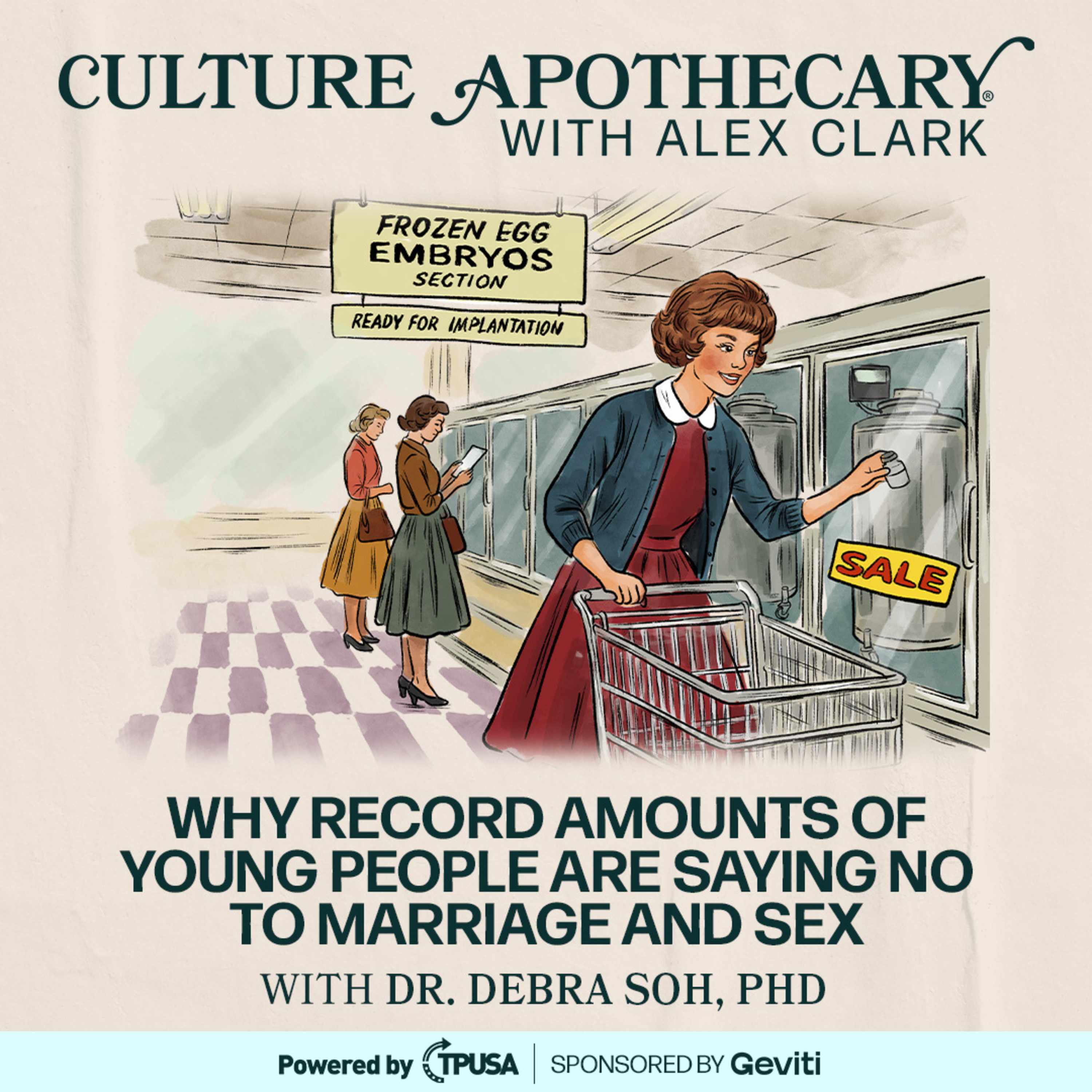
Culture Apothecary with Alex Clark
Why Record Amounts Of Young People Are Saying No To Marriage AND Sex | Dr. Debra Soh, PhD
01:12:42
Loading summary
Transcript225 lines
- [00:00]
Alex Clark
What is going on with choking and sex?
- [00:02]
Dr. Deborah Soh
Millennial women would say, I don't like this. I don't know what's going on. What we see with Gen Z women is that they'll experience the same things, but they're more inclined to say that they like it or they will ask a male partner to actually do it. They'll initiate it themselves.
- [00:14]
Alex Clark
Why are Gen Z women more likely to say they like it because they
- [00:17]
Dr. Deborah Soh
grew up watching porn from a very young age or they were exposed to porn at such a young age?
- [00:21]
Alex Clark
What do you say to the 25 year old man who feels demoralized and behind?
- [00:25]
Dr. Deborah Soh
Don't let that derail you. Put your head down and keep working. What's your alternative? If you're going to sit there and play video games and vape all day long, that will be your life in 20, 30 years. And I think the only thing worse than being where you are now is being in the exact same place 20, 30 years from now. Foreign.
- [01:02]
Alex Clark
Not only are more young people opting out of marriage than any generation before them, they're opting out of sex.
- [01:08]
Podcast Host/Producer
And the ones who are having sex.
- [01:10]
Alex Clark
A disturbing number of young women report
- [01:12]
Podcast Host/Producer
that it includes choking roughness, blurred lines
- [01:15]
Alex Clark
between consensual and coercive.
- [01:17]
Podcast Host/Producer
Millennial women say they didn't sign up
- [01:19]
Alex Clark
for violence, it just became normal.
- [01:21]
Podcast Host/Producer
Gen Z says it's scary, consensual, but
- [01:24]
Alex Clark
only after growing up on unlimited high speed pornography.
- [01:27]
Podcast Host/Producer
Meanwhile, young men's testosterone is declining, sperm counts are dropping. One in five college students is on antidepressants. Half of young adults say they probably won't have kids, and fertility clinics are marketing egg freezing like it's a Black Friday sale. So the question isn't just why aren't people getting married? It's are we living through the first generation in modern history that is biologically and psychologically less interested in sex? And if so, why? Today I'm joined by Dr. Deborah so, neuroscientist and author of Sextinction, the Decline of Sex and the future of intimacy. Dr.
- [02:01]
Alex Clark
So specializes in human sexuality and the
- [02:04]
Podcast Host/Producer
biological drivers of behavior. She earned her PhD from York University, spent over a decade as a scientific researcher, has spoken at the Oxford Union, and her writing has appeared in the Wall Street Journal, Harper's, the Globe and
- [02:15]
Alex Clark
Mail, and the Los Angeles Times.
- [02:17]
Podcast Host/Producer
I've wanted to interview Dr. So for years. So this is a juicy episod episode. It does come with a listener advisory
- [02:23]
Alex Clark
warning for little ears.
- [02:25]
Podcast Host/Producer
I try to spotlight conversations that are outside of the box for most health and wellness podcasts. If you appreciate that, please leave a five star review on Apple or Spotify. It takes less than five seconds to leave a review and it really helps
- [02:36]
Alex Clark
us show up on the charts.
- [02:36]
Podcast Host/Producer
On this show, we bring expert guests on to heal a sick culture physically, emotionally or spiritually.
- [02:42]
Alex Clark
You can watch this episode on the
- [02:43]
Podcast Host/Producer
real Alex Clark YouTube channel or culture Apothecary on Spotify. Please welcome journalist and author of Sextion the Decline of Sex and the future of intimacy, Dr. Deborah so to culture Apothecary.
- [02:58]
Alex Clark
You actually found out with your research that young people today are having less sex than ever before.
- [03:05]
Dr. Deborah Soh
That's right. It was very surprising for me to find that at first. When I started hearing about this sex recession, I thought it was overblown. There was one study in particular that came out in 2016. It was based on data from the General Social Survey. So this is a nationally representative survey and it was showing that across the board, Americans of all ages were having less sex than ever before. But particularly among millennials, they were the generation to be less likely to have had a sexual partner by the age of 20. So compared to previous generations, millennials for some reason were more sexually inactive than before. And this trend was expected to continue on to Gen Z. So we're finding that across a number of different data sets that roughly one in three men and one in five women have not had sex in the last year, which is a large proportion of people. And on top of it, I mean, people are not even interest dating anymore. There was one study from Pew that found over half of single people are not interested in dating at all right now. So this is a trend that's happening globally. It's happening in the west, it's happening in the east, it's happening among developed countries. And we're seeing similar trends in terms of lower marriage rates, birth rates. And I, I think also there's a larger divide happening between men and women politically that is also fueling a bit of this. But I was really excited with sextinction to get to sit down and look at the numbers myself for the first time and really determine myself. Is this something that's actually happening or is this a mor panic? I do think something very unusual and not stellar is happening in that it's not really a good predictor of where we're headed as a species if people are not interested in sex. Part of my interest in sexual inactivity is because I used to study sex scientifically when I was in academia, but now as a journalist and as an Author. I really want to see, you know, like, what is happening. What is taking the place of sex, because it is a proxy for connection, intimacy. Right. People feeling like they have a community, people feeling close to one another. And so if we're not interested in connecting in that way, what is taking its place? And so each chapter in the book goes into a different hypothesis I have or a different explanation, I think, as to why this is happening. A different form of technology that might be taking the place of sex and what it also predicts for the future, which is not good things.
- [05:11]
Alex Clark
You wrote that millennials grew up wanting love. We were seeking love and envisioning that for our life. Gen Z doesn't want to date. They want situationships. What changed psychologically?
- [05:24]
Dr. Deborah Soh
I think, well, even for millennials like myself or you're millennium, too. Millennial too.
- [05:28]
Alex Clark
Yeah, 93.
- [05:29]
Dr. Deborah Soh
We wanted love, but it's passe. Or it's somehow there's something cooler about casual sex. And so now what you see with Gen Z is they're following the same trend, but they're not really calling it that. They're calling it a situationship where it's like a friendship with the sex, but it's not like with millennials where it was friends with benefits, where you would have only sex and then not have any type of intimacy beyond that, where you wouldn't be calling each other every day, you wouldn't be meeting each other's families. Like, it was very firm in terms of boundaries. I don't think casual sex is good for anyone, for men or women. I think less promiscuity is better across the board. But I think the unfortunate thing with Gen Z is that some of them. I think the younger Gen zers are moving away from this idea that casual sex is empowering. And they. They saw what it did to millennials and older Gen Z, and they're saying, that's kind of tacky and we don't want that. But I think there is a segment of Gen Zers who mistakenly go into these arrangements thinking that they can keep sex and emotions separate. But the weird thing is that they will do basically everything that you do in a relationship, like go on vacation with your other. The other person. Yeah. Have pet names and things, talk every day, text every day, spend tons of time together. And then, of course, one person falls in love with the other person, and the other person says, well, no, I didn't want that. And I think it's also this lack of intimacy or not wanting to come across as vulnerable or needy. So they don't go into it saying I'm looking for a relationship or I want to settle down or I want to get married. It's very much like, let's just see where it goes. And of course, that's is wasting time, unfortunately. And then both people probably don't end up really getting what they want. Because I do think at the core, most people, even young people, want that connection. They want something real. It's just not seen culturally as cool to want that.
- [07:01]
Alex Clark
The majority of Gen Z isn't having sex at all. But those that are, it's within the, the, the bounds of this situationship type of deal.
- [07:08]
Podcast Host/Producer
They see that as different than a
- [07:09]
Alex Clark
casual one night stand type of hookup. As a millennial, because they're like, well, I know this person, I'm regularly seeing them. But we're not official. We're not even in a talking stage. Like a situationship is even different than that.
- [07:21]
Podcast Host/Producer
This is very confusing to Gen X, by the way. Gen X is like, I'm out.
- [07:24]
Alex Clark
I don't even understand this at all. Because, you know, for millennials, we had talking stage, then dating, then you're, then you're like in a relationship.
- [07:33]
Dr. Deborah Soh
Yeah.
- [07:34]
Podcast Host/Producer
Then you're official.
- [07:35]
Alex Clark
So that was like our tier system. But is everything in Gen Z starting as a situationship, it seems that it
- [07:42]
Dr. Deborah Soh
just moves in that nebulous way. But like, they meet and they say, weird. They don't even really know what they want. They don't want to know what they want. It's just about testing the waters and having, quote, experiences, which I think must be so heartbreaking because I don't, I don't think it's possible for two people to spend that much time together and not have feelings develop at least a little bit.
- [07:58]
Podcast Host/Producer
Well, yeah.
- [07:59]
Dr. Deborah Soh
And if you're not compatible, you're going to find out eventually you're not compatible and then you're going to have to go your separate ways. So not only did you waste that time, but you're not going to be with that person anymore.
- [08:07]
Alex Clark
But it's also even different from friends with benefits. I think millennials are very familiar with friends with benefits and what that looks like. But that was serious boundaries. You were not friends for sure. Inviting them to go on vacation with
- [08:19]
Podcast Host/Producer
your family and stuff.
- [08:20]
Dr. Deborah Soh
Yeah, no. And you wouldn't even necessarily tell your friends that much about them because you know that this is just a sexual thing. So this is not your boyfriend. I, I've had many of my friends when we were younger who would have those types of situations. And they would say very clearly they know that this is not like a girlfriend, boyfriend thing. And it's almost cringy to think of it that way.
- [08:38]
Alex Clark
What are the actual stats right now on Men vs Women Wanting Marriage and
- [08:42]
Podcast Host/Producer
how far apart are they?
- [08:44]
Dr. Deborah Soh
So it's actually more men than women in terms of the younger generations that want marriage. Women are more likely to say that they think marriage is an outdated tradition, which is this is probably the first time in history that this has become the case. And I think a lot of that has to do with the fact that young women are outperforming their male peers in terms of education and occupation. So young women are finishing high school, going to university, getting advanced degrees like masters, PhDs. They're becoming physicians, lawyers, professional degrees. They're far exceeding their, their male peers. So women are not financially dependent on men anymore. And so marriage doesn't really serve the same purpose when you think of it from a very pragmatic standpoint. I do think marriage has value in that it's commitment. It shows that especially with a man, he's going to stay with you because it's very easy for men to get up and leave, especially after you have a child with him potentially. So I do think there's value there. It shows that both people are willing to stay, see the relationship through. I write in Extinction about how the concept of getting married has changed a lot. And I don't think people necessarily take it as seriously as before. Nowadays it's more like just something you do after a certain point in time because you want your family and your in laws to leave you alone and stop pestering you about when you're going to get married. One big thesis of sextion is this idea that DEI diversity, equity, equity and inclusion initiatives are not helpful for either sex. Because I think what happens with progressive women is they think we're doing so great as a sex. Like women are excelling in society. We don't need men. We don't need men financially, we don't need them emotionally. We're just fine without them. But if you do want a future with a partner, who are you going to settle down with? Because women are hypergamous, they're not likely to marry or date someone who is lower in status than they are. Women tend to date or marry at the same level or higher.
- [10:24]
Alex Clark
I feel like I see often on social media from the feminist progressive camps are they're still insisting that women have it harder and that and that we are so behind. I'm like, I don't know what planet you are on. Literally, we are exceeding in every single metric out of men.
- [10:39]
Podcast Host/Producer
Right.
- [10:40]
Dr. Deborah Soh
Yeah. I think part of it is whether they were indoctrinated in academia. There is this mindset that very much, yes, there is a history of women being held back in society. At one point, we did not have the same rights as men. And I think part of that is that's just what they were taught over and over again in every class. Doesn't matter what you majored in that. That's like a prominent way of thinking. Maybe they're afraid that women are going to be sent back to the kitchen if we let go of those ideas, but it is definitely not doing them any, any benefits. And now what I find interesting is instead of saying, oh, you know, maybe we should allow men to succeed, maybe we should ease off on all of this weird discrimination against men in the hopes that that's going to somehow allow women to continue excelling to the point where we will not have to worry about, you know, sexism ever again. But they're saying now it's cool or it's. It's cringy to have a boyfriend.
- [11:27]
Podcast Host/Producer
Yeah.
- [11:28]
Dr. Deborah Soh
And they're trying to normalize this. Or as you know, one of the other chapters, I talk about egg freezing and IVF and reproductive technology, saying if you can't find a man with, you'd like to pair up with and have a child, just go on your own and do it. So I think this is a larger problem in society. Like the book very much talks about all these solutions that we are creating to try and fix this sexless problem or this loneliness problem, but it's not getting at the root cause.
- [11:50]
Alex Clark
You talked about how more women than men don't want marriage. What about having sex? Are women less interested in sex or men less interested in sex?
- [11:59]
Dr. Deborah Soh
What I sensed happening is women, the ones who are sexually active, are probably all having sex with. With the same smaller pool of high, highly successful men. And then the men who can't get any partners very much have. Have no options in terms of the actual stats. Like 1 in 3 men is not having sex versus 1 in 5 women over the last 12 months. So there are more sexless men, but of the men who are having sex, they're having very many more partners.
- [12:23]
Alex Clark
Why are there more sexless men than women?
- [12:26]
Dr. Deborah Soh
Because they're not doing as well in society when you look at college campuses. Right. Because the sex ratio is so much skewed in favor of men in that there are so few men on campus versus women like in terms of university degrees, women are going to be getting degrees at twice the rate of men in the coming years. And in terms of graduate degrees like masters and PhDs, for basically the last 30, 40 years, women have been getting more of those advanced degrees than men.
- [12:51]
Alex Clark
Are majority of CEOs in America women?
- [12:53]
Dr. Deborah Soh
No. So that's something different though, I think because when you get to that point, if women start deciding to have families, we can talk about that too, how there is a difference in terms of our biology. So if a woman does this, decide to have a family, become a mother, that's probably going to take her away from her career unless she goes above and beyond to focus on her career. But she probably won't be raising her children in that case.
- [13:11]
Alex Clark
Got it.
- [13:11]
Dr. Deborah Soh
Okay. Yeah. So in terms of, when you have this smaller ratio in terms of successful men, those men do not need to settle down or pick one partner. They can have as many partners as they want because when they are that successful, they are much more attractive. So they can set the bounds in terms of how soon they want to be having sex, whether or not they will commit to someone, whether or not they will invest in a partner. And so that's why we see this with women. They're, like I said, they're all fighting for this smaller pool of highly successful men. And those men are not really incentivized to settle down.
- [13:43]
Alex Clark
So when you see this massive group of 18 to 29 year old men who are, are not dating by choice and they're, they're absolutely not even interested, they're not even going out looking for women, Nothing. I think a lot of people assume, well it's because it's porn. Like they, they get all of their needs fulfilled with porn. But your research proved that's actually not the full picture. It's not PO porn only that that is causing this epidemic.
- [14:05]
Podcast Host/Producer
So.
- [14:05]
Alex Clark
So can you kind of explain more about that?
- [14:07]
Dr. Deborah Soh
Yeah. I do think porn and other technological stand ins are playing roles because if you as a young man, especially if you're at the peak of your sex, you know, sexual interest, say late teens and early 20s, it's not like you're going to be sitting around just waiting, you're going to need an outlet. So I think many young men are turning to porn. I do think porn can be very destructive because what happens is when someone is watching porn, they have an orgasm. So that helps to satiate them at least a little bit temporarily. And that takes away from their desire or their drive to actually go out and meet women and to find someone and to better themselves and become successful so that they can have a real relationship. So it'll basically help them satiate their sex drive until, you know, the next time they want to look at porn. And if someone's looking at porn every day or multiple times a day, that really I think is setting him back because again, he's getting that sexual need fulfilled, but he's not having any motivation to go out and pursue something better for himself. I think also hormonally, in terms of low testosterone, there's something going on with men's testosterone. I think also for women too, you know, we're all being affected by these endocrine disruptors. And so for men especially if their testosterone levels are lower than they've ever been, that also affects their sex drive. It sex, it affects their motivation, it affects their mood. And so that as well as I think the birth control pill in women, it's doing something to the sex sexual signaling. So there's something that's changed in the dynamic between men and women hormonally. So men are less incentivized or interested in pursuing women and women are also less interested in getting involved with men.
- [15:39]
Alex Clark
I think even more shocking than just the fact that guys aren't even, not even interested in hookups or dating is that you said that there is a large number of young men in this country who are not even interested in working and there's no good reason for why they are not working. You said there's no reason at all. They're not on disability. There's nothing wrong with them. They just don't want to work. So what did you find that those men who are just choosing not to work, what are they doing all day? What did they all have in common?
- [16:05]
Dr. Deborah Soh
I do think part of that is the low testosterone. I think it's also mental health issues. 5% of the globe is depressed right now. So depression is at an all time high. I also think if you're potentially taking pharmaceutical medications like SSRIs or other things that are affecting you, endocrine disruptors, as I mentioned, like that's going to affect again testosterone and just your overall sense of health.
- [16:24]
Alex Clark
Were most of them on prescription pills?
- [16:26]
Dr. Deborah Soh
Many of them have, were on SSRIs. I don't want to blame SSRIs, but I do think that in terms of what I love about your show is that you're about getting to the root cause of what people are struggling with, especially with something like chronic illness that is so prevalent nowadays. What is happening right this is this should not be happening, especially to young people. So to get it, you know, basic things like diet, exercise, mental health, improving the way you feel about yourself, improving, like just living like a normal human being and not being behind a screen all day long, not doing most of your interactions with other people behind screens or with, say, AIs. Something as simple as that, I think is affecting people's overall approach to life. But with young men, especially some of them, I do think, feel like the world is against them because of feminism, because of dei. They feel that the cards are stacked against them and they cannot be successful no matter what they do. So they just don't want to try. Which I think is a defeatist mindset. And I guess it's easy for me as a woman to say that, but I do think, you know, it's your life, and at the end of the day, you. You're the one that needs to choose how you want to live it.
- [17:28]
Alex Clark
What I think is interesting about the
- [17:30]
Podcast Host/Producer
SSRI part of this is that you
- [17:32]
Alex Clark
said 1 in 5 college kids are on an SSRI, and one of the biggest side effects of an SSRI is anxiety and depression.
- [17:40]
Dr. Deborah Soh
Anxiety, depression and low sex drive.
- [17:42]
Podcast Host/Producer
Yes. Yeah, I feel like that's a huge key to this.
- [17:45]
Alex Clark
And I also agree with the low testosterone, the chemicals in the environment, and the products that we are using in our homes, on our bodies, you know, deodorant going right into your lymphatic system.
- [17:56]
Podcast Host/Producer
I think all of that has to do with it.
- [17:58]
Alex Clark
I thought it was so smart that you, you put that in the book.
- [18:00]
Dr. Deborah Soh
Thank you. And also with, you know, post SSRI sexual dysfunction, which is something that's starting to get more attention now, the fact that children are being prescribed these medications and there isn't really a full understanding of how this is going to affect their sexual development. So of course I say for anyone listening, speak to your care team or your physician, you know, don't debase your mental health decisions or, or physical health decisions on something that I'm saying on a podcast. But I do think it's worth questioning because there's something larger happening, I think, in terms of the disconnection that we are feeling in society. And I'm, I'm really concerned because I don't see it getting better until we address what's actually causing this, as opposed to turning down these different pathways of band aid solutions that make us feel better at the time, help us maybe self regulate and emotionally deal with our problems. But in the end, it's not going to be Good for us.
- [18:51]
Podcast Host/Producer
Remember the Chip Skylark episode of Fairly Odd Parents? That song My shiny Teeth and me. Shiny teeth, shiny teeth. Every kid in America lost their mind. We're screaming, we're crying, we're buying toothbrushes like it's a Black Friday riot. And the whole thing turns out to be a marketing scheme to control children through dental hygiene. Honestly, not the worst conspiracy. If you want to hear about the worst conspiracy, I could talk your ear off on that. It's a good reminder. Maybe don't put blind faith in shady things on the Internet or in a cartoon man with perfect veneers. But you know what isn' a waste of time?
- [19:23]
Alex Clark
Flossing your teeth.
- [19:24]
Podcast Host/Producer
At least if it's non toxic. I use Zebra for floss and toothpaste. Zebra floss is made from real silk, peppermint oil and xylitol. Not polyester, not plastic, not pfas forever chemicals. Because a lot of natural floss is basically dental fishing line marinating your gums and microplastics. Zebra floss has been tested. No detectable pfas. Just clean ingredients that won't slowly betray you. And they didn't stop there. Zebra makes deodorant that actually works. I'm talking summers, Aaron. Stress sweat, real life sweat. I live in Phoenix. I am the ultimate deodorant tester. It goes unclear. Not chunky. It doesn't cake under your arms like drywall paste. Aluminum free, paraben free, fragrance free. And if baking soda irritates your skin like mine, they do have a formula. Without it. They have the toothpaste tablets as well. You chew them, they foam up, you brush.
- [20:10]
Alex Clark
Done.
- [20:10]
Podcast Host/Producer
No dipping your brush into this jar like you're churning butter in 1840. They're hydroxy appetite free. Some people, like myself, hydroxy appetite doesn't work for some of you. Does fine, it doesn't for me. And this is fluoride free and hydroxy appetite free. It's clean, it's simple. Kids will really love using the tablets. Floss your teeth. Okay? It could be one of the main contributors of inflammation in your body. If you don't go to yayzebra.com use code Alex for 10 off. That's yay. Zebra.com code Alex for 10 off. Getting ready for church has turned into a Navy SEAL operation for some of you. It's Sunday morning. You've got a 47 step skincare routine, three serums that sound like NASA projects, and you're contouring like you're about to testify before congress. You end up Going to church with a bad attitude and that is not the right heart posture to worship the Lord. You can look just as good, take less time and be less toxic. With the Dell Natural cosmetics. It's Christian founded, family owned, handcrafted in central Texas. Real people making real products. Not a lab in Switzerland run by a guy named Klaus who hates you. Their whole thing is rooted in 1st Peter 3:3:4 Beauty comes from the heart. Which is refreshing because Instagram would have you believe that Beauty comes from a 600 laser, right? Adele keeps keeps it simple. Their moisturizing foundation is their top rated product. Tons of 5 star reviews and women say it feels like wearing nothing at all, as do I. It evens your skin tone, nourishes your skin and gives you that natural radiant finish. As you get older, you do not want to wear matte foundations. It is the most ugly, just aging looking foundation that you could possibly wear. Stop with that. You need a natural radiant look. Okay? You'll look alive, not embalmed. And in the winter your skin is drier than the church bulletin.
- [21:48]
Dr. Deborah Soh
Okay?
- [21:49]
Podcast Host/Producer
Cold air, indoor heat. It's chaos. Their hydrating aloe vera sprays give instant relief without feeling heavy. I like to do that at the very end after I've set with my setting powder. Essential moisturize actually replenishes your skin. That's another great product. And then their body oil will really lock in moisture after a warm shower. You're glowing. But respectfully, their lip conditioner has hyaluronic acid. It's buttery, soft, glossy, not sticky. And the glow highlighter is also good. You can dab it on your cheekbones, your brow bone, inner corners of your eyes to look awake even if you're not. Especially if your church has very early services that your husband likes to go to. They even offer complimentary color matching so if you email them, they will help you find your shade. If they're wrong, they send another one for free. They source from small sustainable US farms as well. It's clean, handcrafted beauty made with integrity. Use code Alex for 25 off your first order at Adele Natural Cosmetics.com that's Adele Natural Cosmetics.com code Alex
- [22:45]
Alex Clark
I've done episodes on post SSRI sexual dysfunction and I don't think a lot of people realize because the FDA doesn't require a black box label on the product yet explaining this, that being on an SSRI for as little as a week, you can develop this disorder which completely numbs your genitals. Your you have an inability to orgasm. You also have an inability to just experience joy or any extreme like emote range of emotions, period.
- [23:12]
Dr. Deborah Soh
Creativity.
- [23:13]
Alex Clark
Yes. This for. And it doesn't, it doesn't go. There's no cure and people are not warned of this. There, there is no informed consent when they're being prescribed this and OB GYNs are, are the, the top person that are prescribing SSRIs. It's not even psychiatrists which is really disturbing, I think. When you say that women now believe that marriage is outdated, is it only liberal women or are we seeing conservative women believe that as well?
- [23:41]
Dr. Deborah Soh
That particular study did not break it down by political affiliation. I would imagine it's probably more so among progressive women that feel this way. My sense is conservative young women like in Gen Z still do want marriage. But again, if you're making more money than most men of your age cohort, even if you want that, it's gonna be very difficult to find somebody. So you either are going to have to wait a bit longer until your cohort, male cohort catches up or date older, which there's nothing wrong with that. But I do think part of it is just what is available and also where we're moving culturally. Like even I think among conservative women. And this is, this is the tension I see between conservative women and conservative men. Whereas conservative men, of course not all, but my sense is many of them will say, I would prefer to have a stay at home wife. I would prefer that my wife not work. And for some of them, I guess if it's more extreme, that red pilly side that you mentioned might say it's because a woman who's educated is going to be promiscuous, she's going to have a high body count, she's going to cheat on you, all these things, she's going to be like a bossy person, she's not going to submit to you and all of this stuff. And I don't think that's healthy or helpful either. So I think both sides, you know, the left and the right get it wrong in some ways to get it right in some ways. And they get it wrong in some ways. And I think for young women it's great if you're ambitious and you want to balance both or you want to focus on motherhood, be a stay at home mom if you want to just focus on your career or be a working mom, whatever. I do think that marriage has value and I also think, think for women this is a bit of an aside, but in terms of planning your life, you know, One chapter, the chapter I talk about with reproductive technology. I think it's very important for young women to start making those, those decisions at a young age. I would say even just as you're going off to college, if you are same. Yeah.
- [25:15]
Alex Clark
Have you read Suzanne Venker's books?
- [25:16]
Dr. Deborah Soh
No. No. Oh, I've seen her on your show. She's great.
- [25:19]
Alex Clark
You would love her book. That is all about this exact issue with how we need to start in high school and as girls are going to college, talking about the, the statistics and the realities of the likelihood you will want marriage and kids and how we need to be thinking about our career choices with that in mind. So instead of like doing them separate, like, I'll have a family eventually. So I'm just really going to go like gung ho on my career without even considering that I'm probably likely going to want that at some point. And then how that will affect my career is going into career thinking of like, what choices and moves can I make that will allow for the integration of my family that will be easy to, you know, change my schedule to part time or different things like that.
- [26:01]
Dr. Deborah Soh
Right. I was going to say too, with, with these technologies like egg freezing, they're being sold to young women as you can buy yourself more time. So similar to being on the pill, which, you know, I think whatever people choose to do is their choice. But once you start delaying your fertility, it means that you're going to be playing catch up later on and also that these technologies are not sure bets. It's not 100% certain that it's going to work. So my concern is that young women might be saying, okay, I can focus on all these other things right now, freeze my eggs, then when I get to a certain point, I can use them. But you don't know that necessarily you're going to be able to become pregnant using those eggs. And also you don't know that you're necessarily going to be able to find a husband at that point because it's already so difficult. Right. So as you get older, there are only going to be fewer men available. So I think just to tell women, it doesn't matter what your politics are, to be really honest with yourself and say, you know, I don't need to listen to what society's telling me to do because the left tells you, you know, motherhood is a burden. Don't bother with any of that. You don't need a man. Just focus on your career and grind it out. And then the right, not all, not Everyone, of course, but there's a sentiment of, you don't need to have a career, don't have ambition, just, you know, work on a homestead, make jam, have six kids, make jam.
- [27:10]
Alex Clark
If there is this huge group of young women who are not even interested in marriage at all anymore, how do we convince them otherwise? How do we bring them back around?
- [27:18]
Dr. Deborah Soh
At the core, I believe everyone truly wants love. There are many people who say nowadays that they've given up, they don't care, they're going their own way, they're never going to date again. Both men and women say this. I get a lot of this on social media. If you ever try, I'm sure you know, if you ever tried to speak on this, they love people love to come for you and tell you how you're wrong. And at the core, I think we as human beings are wired to want to connect with other people and to be in love and to find a partner. So I think it has to start with the education system because that's where they get young women the hardest, is when you're young and you don't know any better. I used to be very, very feminist myself. You know, I used to be very progressive. And I do think part of that is because I was in academia for so long, because everyone just thinks that way. It doesn't even occur to you that people think differently until you leave and you start talking to other people in the real world.
- [28:00]
Alex Clark
So how did you break out of that?
- [28:02]
Dr. Deborah Soh
Well, I left academia because I wrote this op ed about gender disordered children and how I was not in favor of that. And the scientific research does not back that as the right approach for these kids. So I knew that I would not be able to get a job in academia after that point. And that was really what started to, I guess, open me up to different ways of thinking. Because before then I thought, you know, there are no biological differences between men and women. I thought that was just sexism. Whereas now I understand obviously there's a huge scientific literature showing that there are very clear differences on average between men and women, especially when it comes to things like the work life balance and the way we talk about these issues. You have to take into account women's biology. Whereas in the past I would say that's just sexism. You know, women can do the same as men. Now we have all these technologies that you that help us do the same things as men. But there's a cost to that. And I don't think that technology, as amazing as it is, is can over. Truly override biology, or is it that it's meant to? So that was probably the start of it. And I remember when I was mobbed on social media as a, quote, transphobe or whatever, that conservative media came to my defense, and I didn't think conservatives would ever care about anything I had to say, because being in academia, every. Almost everyone I knew was a liberal. So. And then I started making friends with conservatives, and I was like, oh, you know, we're really not that different at the end of the day.
- [29:09]
Alex Clark
Who was the first prominent conservative that reached out to you and said, you know, I'm a fan of your work and keep doing what you're doing?
- [29:14]
Dr. Deborah Soh
David French was one of the first people to ever write about me for National Review. I don't want to speak for him. I don't know if he's still a fan of my work now, but I appreciate that. And Ben Shapir also was very supportive very early on. And I met Ben, actually at event. I. I flagged him down, and he was so nice. He was about to go on stage to speak, and I couldn't believe. I was just like, okay, I just need to ask him a couple questions. Because I was writing about the event, and he spoke with me. Yeah, I've been very grateful for it.
- [29:35]
Alex Clark
Did you grow up in a conservative home?
- [29:36]
Dr. Deborah Soh
My parents, I think immigrants are generally conservative. Yeah.
- [29:40]
Alex Clark
Where are they immigrants from Malaysia. Okay. And so what did they think of your transformation?
- [29:45]
Dr. Deborah Soh
They love it. I mean, at first they were, you know, Asian parents are very much, like, horrified if you're not going to be a proper doctor, like a physician, like, neuroscience is okay. But they're happy now. They're very happy. They're like, okay, she's doing all right.
- [29:57]
Alex Clark
I think what the left would say if they were arguing with you, if, you know, if I may just pretend, I imagine that they would say, you know, the reason that educated women find it very hard to find a man to date is because they don't like that they're so educated. It's the men who prefer them to be dumb and more docile. Is that really the truth?
- [30:18]
Dr. Deborah Soh
Well, okay, I'll look at the research. In terms of studies that exist, they do show that marriages in which women have. Are the primary breadwinner, so they make most of the money, or are the sole breadwinners, so they make all of the money. They tend to file for divorce at higher rates, they tend to experience domestic violence at higher rates, they tend to experience cheating. So they're their husbands are more likely to cheat on them over time. They also are more likely to do the majority of housework and childcare, even though they're bringing in the majority of the household income. So looking at those stats alone, I totally understand why women would say, you know, men just don't like it when a woman is more successful. I do think that sometimes men, they feel it's emasculating if a woman is more successful than they are. They feel threatened by it, which I don't think they need to. I think that, you know, you can support your spouse just as she'll support you, hopefully. There is, I guess, a little bit of truth to what the women are saying, but I don't. Progressive women are saying, but I don't think by and large that that's in the full picture. I try to give the other side as much the benefit of the doubt as possible. I think maybe for some men, they feel like they're not doing enough. They know as men they need to be the primary. They should be providing for their spouse or their family. And if they're falling in that or failing in that role, it probably in some ways eats away at them. And I read about house husbands insection and how there's this whole genre of men on the Internet who love to take videos of themselves as house husbands. So they're, they're running around the house all day long saying, this is what I do when my wife is at work and I'm at home.
- [31:50]
Alex Clark
I'm gonna tell you right now, my husband made a video like that. I'm drying right up.
- [31:52]
Dr. Deborah Soh
Well, no kidding.
- [31:53]
Alex Clark
Absolutely no.
- [31:55]
Dr. Deborah Soh
And it doesn't really speak well to the fact that you're supposed to be so busy if you have time to be making videos for social media while your wife is busy making all the
- [32:03]
Alex Clark
money that's giving me the ick. So it's basically kind of like stay at home dad type of stuff.
- [32:09]
Dr. Deborah Soh
Yeah, I. I do think for those guys, deep down they know they're not really fulfill purpose as men, and they feel guilty about it, they feel shameful about it. So this is why they need to make these videos.
- [32:18]
Alex Clark
And they get validation from millions of other women being like, oh my gosh, you're so amazing. What a dream husband.
- [32:23]
Dr. Deborah Soh
Blah, blah, blah. It's like, you can do that and have a job. Yeah, yeah, exactly.
- [32:27]
Alex Clark
So I have had a long held belief that one of the contributing factors to why so many young women do not want to get married is because they have been on hormonal birth control for A decade or more. What are your thoughts on that?
- [32:41]
Dr. Deborah Soh
That's very interesting because I have a feeling there's something going on there. So when. When. I'm sure your audience already knows this, but women, when they're on the pill, they are not ovulating, it halts ovulation. When a woman is ovulating, that's when she's the most fertile, she can get pregnant. And so that is a very potent source of sexual inspiration. So if you basically knock that out of a woman's system, it's going to change her behavior, it's going to change the way she feels. Pills. You know, I was on the pill for a number of years, so I can relate to this. Definitely you feel very different when you're on the pill versus when you're not on it. I think if women want to be on the pill, that's their choice. That's great. But I do think also they deserve to know what the potential side effects are. Just like you were saying earlier with antidepressants. I don't think that women are getting all of the information about this. I don't think that most are even aware of the. How this affects their cycle necessarily because they're still getting a faux period, right? It's not an actual menstrual period, but because they're bleeding for a week during the month, they think it. It simulates a menstrual cycle. So women may not even be aware of how this is really affecting them internally. And so when you're not ovulating, you're not going to be giving out the same sexual signals as you would when you are. Because when you're ovulating, your body wants you to get pregnant, wants you to pick the best man to potentially have a child with. And men can pick up on these signals. Research has shown that men can tell when a woman is ovulating based on her appearance, their behavior towards men. Men, men become more protective of their female partners. They are a lot more leery of men. You know, they were trying to maybe swoop in and get her pregnant with behind their back and cuckolding them, that type of thing. I think if women are not putting out the same sexual signals, men are going to be picking up on this as well. Men are also not going to be as interested in wanting to protect or provide their partner because thinking, well, she can't get pregnant, consciously or otherwise, that they're thinking that. But I also think it's being on the pill can feminize a woman's brain Women prefer men who are less masculine. They prefer more caretaking, nurturing men. So I wonder, is that also why so many young women demonize masculinity? And then in your case, what you're saying, why they're pushing away from men and saying, we don't need you, because, you know, I'm good.
- [34:47]
Alex Clark
I think you're onto something. And I also think, you know, consider this when we're talking about falling testosterone rates. You've got birth control now in the water supply. Placentas, they're finding, are filled with microplastics, antidepressants, also in the water. I mean, so you talk about how even if you're not on the pill, we're all on the pill. That's spooky.
- [35:11]
Dr. Deborah Soh
It is spooky. And I don't know what it's going to take for transparency to finally come to play, because I think we deserve that. Not just in terms of what's in the water, but in the food. Anything like you're saying, personal care products, like everything that we're putting in and on our body is going to be affecting us. Us to some degree.
- [35:27]
Alex Clark
And do you think that there's something to be said about the combination of all of these college students being on SSRIs and hormonal birth control?
- [35:35]
Dr. Deborah Soh
I think there's something going on there. I do. We need more research to know for sure. And I think it's probably going to be some time before that research can be done, because I would say researchers are probably not as incentivized to. To be critical of pharmaceutical interventions. Right. And in terms of funding and the pushback you're going to get, we can look at what happened during COVID and all the fun things that we researchers had to go through as a result of doing any objective research regarding that period of time and any interventions that came out during that time. I do think, especially when it comes to what's in the water. You know, there's a huge body of literature pertaining to animals and the effects that it's having on animals. It's affecting their courtship behavior. It's making them intersex. I know you've talked about the frogs and atrazine. Yes. And I've seen, you know, studies where they will have fish showing the fish that are intersex, so the male fish become feminine, the female fish become masculinized. Their ovaries are all distorted, and it's. It's really sad. And because they're exposed to either pharmaceuticals like diazepam, which is an Anti anxiety medication. If it is birth control, if it is like other estrogenic substances, I'm glad that the conversation is happening. I think just, we need to just keep going with it and make it more mainstream because I don't know about you, but I find that many people, when you try to talk to them about this, it depends where they are on the political spectrum. I find conservatives are like, yes, of course this is happening, but there's still a segment of society that is in denial even with birth control. If you try to talk about that on social media, you get all these so called experts coming out saying like, oh, they're so feminist and they believe in women having the right to express themselves and validating women's experiences. But the minute you criticize any pharmaceutical that has to do with like, or we'll say specifically the pill, then, oh, that's medical misinformation.
- [37:19]
Alex Clark
Three, four years ago I was talking about birth control a lot because that's when I was totally radicalized on hormonal birth control. I was like, everything I know is a lie. That really started me down, my entire maha journey, so to speak. Now it is still like the number one thing when a liberal outlet is reaching out to me to talk to me, they always want to talk to me about my thoughts on birth control. And the way they angle the questions, it's all very like fear mongering about and you know, do you, do you believe that all women should, you know, they should have as many children, you know, as possible, like no limits, like, and nobody should work outside the home
- [37:50]
Podcast Host/Producer
and all these things.
- [37:50]
Alex Clark
I'm like, what are you doing? This is completely nonpartisan. You've had women on both sides of the political spectrum for years, you know, talking about their experiences on the pill. I don't know what your act. And then you know, they bring in words like Christian nationalism and all this.
- [38:03]
Podcast Host/Producer
I'm like, I don't know what you're talking about. Like it's literally crazy stuff.
- [38:06]
Alex Clark
But then I realized all of those outlets are funded by pharma. That is why they are obsessed with this. And the only angle they have left because they know this is a nonpartisan issue. They're like, crap.
- [38:18]
Podcast Host/Producer
We're losing people. We're losing people.
- [38:19]
Alex Clark
Our advertisers are pissed. We have to start being like, you know, this is all like, if let's, let's drag up the feminists again and get them incited because they have nothing, they have nothing to, to defend it anymore. And so they have to scare people about What I'm saying because their advertisers are upset because I realized that when the Washington Post started saying, you know, that we're, we're spreading misinformation about the pill and all this. And I'm like, what are you even talking about?
- [38:48]
Podcast Host/Producer
Your cat is getting ready for spring break. Break. I don't know if you've noticed this, but he's laying out, he's in the window sunbathing like he just booked an Airbnb in Cabo. Just keep him away from the cartel. I mean, the dude is licking himself into a six pack. I wish I could do that. He's focused, he's disciplined, he's vision board energy. Meanwhile, you're on the couch eating chips fried in what sounds like a chemical spill. The cat has standards. You're powered by industrial seed oil. Fun fact, up until the 90s, all chips and fries in America were cooked in beef tallow. Real fat. That's really good for you. And then big corporations said, you know, we can swap that for like the cheapest processed seed oils imaginable. It's basically jet engine fuel, but who cares? It costs a lot less. So now seed oils make up about 20% of the average American's daily calories. And people are walking around inflamed, sluggish and confused. Why am I so ugly? Why am I so fat? It's the seed oils. That's why vandy crisps exist. Three ingredients. Heirloom potato, sea salt, 100% grass fed beef tallow. No seed oils, and it tastes like food. The tallow isn't just for flavor. It is packed with nutrients that are great for your skin, brain and hormones. When you snack on Vandy, you feel satisfied, light, energetic. Don't get a crash. No bloat, no why did I do this to myself? Moment. And because they're actually satiating, you're not blacked out at the bottom of the bag. Five minutes later. Simon, they're 100American made zero compromises. Best chip I've ever had. My boss's favorite flavor at smokehouse barbecue. Simon just likes the plane. I love the herbs to province. If you're ready to give Vandy a try, go to vandycrisps.com use code Alex Clark for 25 off. Your first order. That's vandycrisp.com code Alex Clark for 25 off. If you don't feel like ordering online, that's fine. Do what Simon does. Vandy is now available at Sprouts. Stop by, pick up a bag before they're gone. My neighbor tried to get a claim
- [40:38]
Alex Clark
approved for an ER visit after he
- [40:39]
Podcast Host/Producer
passed out at his kid's soccer game. Insurance denied it. Why? Because it quote, wasn't a true emergency. He was unconscious in public, paramedics involved. But somewhere in a cubicle, a guy named Trent decided, you know what, he probably could have scheduled that fainting episode for Tuesday at 2:15pm that's the system. And I talked about this when I interviewed Andy from Crowd Health on this show last spring.
- [41:02]
Alex Clark
And it clicked.
- [41:03]
Podcast Host/Producer
We have normalized begging permission from corporations for basic care, especially when it comes to pregnancy. Listen up ladies. If you're in that season where you're thinking about having a baby or you're already pregnant, you've probably realize the way you want to deliver doesn't always line up with what insurance allows. You want a birth center, a midwife,
- [41:20]
Alex Clark
a home birth, a doula.
- [41:22]
Podcast Host/Producer
Suddenly you're treated like you're asking for a private jet. Crowd health does it differently. And by the way, this is how we've always given birth until very recently. Well with crowd health pregnancy is treated as one single health event. Prenatal labor and delivery, postpartum all together with a three thousand dollar member commitment that is your personal responsibility. Just three thousand dollars. No mystery bills, no surprise that wasn't covered. And here empowering part you choose how you deliver. Hospital, birth center, home birth. They allow eligible funding for things that insurance often won't. Certified doulas, licensed midwives, pelvic floor therapy, lactation support, breast pumps, even necessary home birth supplies. You want to vaccinate your baby, you don't want to vaccinate your baby. They believe it's between you and your doctor. It's members funding members human, transparent, aligned with the kind of care that women actually want. You've got the power to take control of your health care and your labor and delivery free. Join Crowd Health to get started today for 99 for your first three months using code culture@joincrowdhealth.com that's joincrowdhealth.com code culture. Crowd health is not insurance. Opt out. Take your power back. This is how we win. Join CrowdHealth.com CODE Culture
- [42:33]
Alex Clark
the majority of people under 30 are likely not having sex. But for those under 40 who are 1/3 are saying that they are being exposed to non consensual violence during sex and the majority of them are saying that it is choking. What is going on with choking and sex?
- [42:54]
Dr. Deborah Soh
So sexual choking is a really has become very trendy in recent years. And what I found really interesting is that when you look at the coverage of this, both in research and media, I would say less than even a decade ago, when this first started getting reported on, women would say, I don't like this, I don't know what's going on. Like these. I would go home with someone, you know, and they would interview these women who had experiences like this and they would say non consensual violence during sex. So choking, being spat on, being called names, being slapped and hit, things like that. They would say, I don't know where these men are getting the idea that this is acceptable or that I'd want them to do this. And what I find interesting, so that's millennial women. And nowadays what we see with Gen Z women is that they'll accept experience the same things, but they're more inclined to say that they like it or they will ask a male partner to actually do it. They'll initiate it themselves. I don't believe that most women, regardless of generation, actually wants to be strangled during sex when it's potentially fatal. So you can die. There's no safe way to do this. There's a very high chance of losing consciousness, brain damage, you know, permanent mental health issues down the line, especially if you have any form of loss of consciousness or, or, or celebrating death.
- [44:05]
Alex Clark
Why are Gen Z women more likely to say they like it because they
- [44:09]
Dr. Deborah Soh
grew up watching porn from a very young age or they were exposed to porn at such a young age.
- [44:13]
Alex Clark
If the first time that you experience having an orgasm, it is watching something violent, which you often see in pornography, does that rewire your brain to seek violence in sexual encounters?
- [44:25]
Dr. Deborah Soh
Previously I would have said no, but now the kids are seeing this at such a young age. I do think there's a risk there, especially in boys. I think for women, on average, our sexual system is not hospitable to violence during sex because historically speaking, if a woman has sex, she can become pregnant and it doesn't make sense for her to enjoy violence during that act because that's not going to be good for a growing fetus or for her to take care of the child once he or she is born. So there are all these things in place in terms of women's bodies that would not. You would not expect a woman to become sexually aroused by violence or being hurt during sex, or being humiliated or degraded by her partner. So for some women, that is the case. They do enjoy it. That sexual masochism, I'm more likely to believe that's due to Some form of abuse or neglect or trauma?
- [45:13]
Alex Clark
Or do you think we're lying to ourselves to just appeal to a male partner that is into that?
- [45:19]
Dr. Deborah Soh
Potentially, yeah. People have gotten very mad at me saying this in the past, but I actually went back and reanalyzed some data that I collected when I was still in academia, and I found a similar finding that physical violence is more severe, tends to be more severe in people who are into bdsm. So this is not just like a fun thing that people like to do on the side as a hobby. It's actually the sign of some. Some form of psychological. Psychological trauma. But, yeah, I do think also if you at a young age are viewing this on your phone, you know, your parents gave you a phone, didn't know that this is what you would potentially be seeing, and you think this is what men like. I guess I don't have a choice but to like it. Otherwise, I'm just not going to have sex then. So that could be part of also why women are turning away from sex, because they're saying, well, I don't really want men to hurt me during this activity.
- [46:01]
Alex Clark
Are women also being choked in everyday romantic encounters as simple as kissing?
- [46:07]
Dr. Deborah Soh
I have heard of some situations like that. I think it depends on the guy and how socially skilled he is. Because I would like to think that most men would know that if you're kissing women, you don't put your hands around her throat ever. You would think that. And I don't blame the. Again, the young men who are seeing this. Again, they're being exposed to this. I mean, I've heard cases of kids seeing porn at the age of four, which is so, so devastating. But the average age that a child sees porn now is 12. So even at that age, or 10 or younger is. It's just so inappropriate. And I. If they see this, they don't know what it is, but it will start to register in their mind that this is what sex is. So there are some guys out there who might do it because they think this is what women want me to do. And if I don't do it, I'm boring in bed. I'm bad in bed. There are other men who, who do like it because they're sadistic, they want to hurt their partner. I would highly recommend staying away from men like that. I do think for older generations of men, before Internet porn, if a guy is into violence during sex, he's probably very antisocial. I don't think it's the porn that made him that way. Because he would have developed his views about women and would have had sexual experiences before pornography, or he might have seen, like, one centerfold. It's not like today, where online porn is so, so easily accessible. It's so extreme. I do think it is affecting kids and potentially affecting their sexual development. Well, actually, there are studies showing that the kids will display more problematic sexual behaviors. They will act out sexually against their younger family members, their classmates, some really horrific things. When I was doing the audiobook for sextion, I got emotional reading. That passage is about just what some of these girls are experiencing as a result of, you know, boys in their classmates is watching porn.
- [47:45]
Alex Clark
What were some of them?
- [47:46]
Dr. Deborah Soh
I don't know if I can say on your podcast. You can bleep it out if it's too much. Basically, things like golden showers, they would hold down their female classmates and do things like that.
- [47:53]
Alex Clark
And what age are these kids?
- [47:54]
Dr. Deborah Soh
I think they were as young as seven.
- [47:56]
Podcast Host/Producer
What?
- [47:57]
Dr. Deborah Soh
Yeah, it's. It's really bad.
- [47:58]
Alex Clark
That's unreal.
- [47:59]
Dr. Deborah Soh
But even things like sodomy, like in children, oh, it's. It's really horrific. And so I would say, and parents listening, please, you have to have this conversation with your child, child younger than you think they need it, because statistically speaking, they will be exposed to this the minute they're on the Internet, even if they're not looking for it intentionally. And they need to know that this is not what sex is and that they can come to you and talk about it, especially if they feel afraid or confused, they're not going to get in trouble. And just to have that open communication, because the last thing you want is for a child to feel like they have to deal with it on their own or that this is somehow healthy sexuality. Because that's what the culture is telling us. That. That this is fun, this is playful. I mean, if. I think if you are in an emotionally stable, healthy relationship and you enjoy, you know, being playful with your partner, you enjoy passionate sex, that's fine. I don't think all sex has to be missionary, you know, like saying I love you the whole time.
- [48:56]
Alex Clark
I. I think so if somebody assumes that. That that's what you're saying, like, I'm sorry, they're not very bright. I feel like, you know, like, that should be obvious.
- [49:03]
Podcast Host/Producer
That should be very, very obvious.
- [49:04]
Alex Clark
Egg freezing is marketed as buying time. What are people not reading about in the brochure?
- [49:11]
Dr. Deborah Soh
That it's not 100 guaranteed. And yes, you can buy time, but not indefinitely. That the procedure of getting your eggs frozen can be actually quite painful and time consuming and expensive.
- [49:22]
Alex Clark
What do you mean by painful? Because I have not heard that.
- [49:25]
Dr. Deborah Soh
I have not gone through the process myself, but I did extensive research for this book and I did do a consult to see what it would consist of. And so in terms of, I can tell you how they extract the eggs. I mean, there's a whole schedule in terms of the different medications. You need to be self injecting so that you're stimulating your ovaries to produce more eggs. Then you have a trigger shot that is when you release all the eggs so that they can be collected. And then those eggs are going to be frozen and then later either fertilized and implanted or, you know, stored until you need them. So the women who undergo this process us, you know, there are all these physical side effects in terms of the self injecting and also the hormonal effects, the emotional effects. And then when the eggs are actually extracted, they will go in using a very, very large needle and basically go in, probe through your vagina and pierce into the ovary to suck out the eggs. And you're awake, usually under anesthesia. But still, I've heard it's very painful. I think, you know, if a couple or a woman wants to have a child and she's not able to without this technology, who am I to tell her not to? Who am I to tell them not to? That's my personal opinion. But at the same time, I think it's important that we have these conversations and to say to women, if you can do this naturally, I, in my opinion, that would probably be the better way to go because it's going to save you all of this money, time, pain. And you don't know again, that if you go down this path, it's necessarily going to work.
- [50:52]
Alex Clark
Do fertility clinics have a conflict of interest in telling women how much time they actually have to have a family?
- [50:58]
Dr. Deborah Soh
I do wonder. I mean, I've seen some women vlogging about this. There was one woman who was, I can't remember, I believe she was in her early 40s. She had done 12 rounds of egg freezing, not gotten a single viable egg, and she was going in for another round after. So I don't know that she was necessarily telling the truth. But assuming she was, I wondered, is her care team team giving her honest information? Because in terms of egg freezing, the best period from the research literature is mid-30s to about late-30s. Right. Once you get into 40s, you're getting close to menopause. And so if she knows that and she still wants to go ahead with it. That's her choice. But I wonder, you know, to go through that process that is so laborious on your body and to be not getting the result that you're hoping for. I'm not sure why someone would do that.
- [51:45]
Alex Clark
So let's say a 33 year old, 32 year old woman goes into a egg freezing clinic and gets that done. What is she not being told about live birth rates?
- [51:57]
Dr. Deborah Soh
There can be side effects to the child and to the mother in terms of that process and in terms of, you know, like miscarriage, gestational diabetes. There are effects also with increased age in fatherhood as well. So kid men, their reproductive window is a little bit more forgiving than women's, but it's not like it can go on forever and that there aren't effects to the child either in terms of chromosomal abnormalities, the higher risk of autism, schizophrenia, even if it does the, it goes according to plan. If you can't find a partner, I mean that would, I would think be the biggest determinant. Right. You can have all the eggs frozen now with the retrieval process, there are several steps in terms of getting the best egg eggs and, but they don't necessarily, as you get older, your ovarian reserve gets smaller so you have fewer eggs and they're less healthy with age. So they may not survive being frozen, they may not survive being thawed and then also being reimplanted later with sperm after being fertilized. So that's one piece of it. And then you see some women deciding to go out on their own and being single mothers by choice, which again, I'm not going to tell women what they should do, but I, I, I think it would be better to have a partner to have a father for that child.
- [53:10]
Alex Clark
Yeah, it's better for the child.
- [53:11]
Dr. Deborah Soh
It is.
- [53:11]
Alex Clark
That's the thing. When you become a parent, you're choosing to become a parent. It's, it's not about you, it's what are we doing that is the best for the child. And every single piece of research we have, I mean you can speak to this more than me, shows that children fare better with a biological mother in their life and a biological father in their life. It is just the way it is.
- [53:30]
Dr. Deborah Soh
There are unfortunate effects associated with fatherlessness. So I don't think bringing a child into the world that in to a situation that is by design without a father exactly. Is going to be a positive one.
- [53:42]
Alex Clark
Yeah, it's creating them purposefully, putting them in that situation, as opposed to, you know, taking a child out of a less than ideal situation, you know, like with adoption or whatever, that's different. But to create a life purposefully without a mother or without a father, that's where we get into like children's rights, rights issues and ethics.
- [54:00]
Dr. Deborah Soh
I think I agree with you. I think once children enter the picture, it really should be about them 100%. And so like I was saying earlier, in terms of women's work life balance, if you do have a child, I don't think it's impossible for women to be really successful, stay in their career and to have children. But I do think the focus should be if you decide if a child, for both parents, the focus should be on the child because the child did not choose to be born.
- [54:20]
Alex Clark
You say that IVF actually doesn't fix the underlying fertility decline. I think a lot of people feel like this is, we have this amazing technology. This is going to fit the birth rate decline that we're in right now. And people having this inability to get pregnant. You say that it actually just works around it. What does that mean?
- [54:35]
Dr. Deborah Soh
It's just a band aid solution. Right. And at the end of the day, if a woman's body is not healthy, then those health issues are going to persist even after, if she does successfully have a child. And so I would like to know why is it that women are not getting the care that they need and that they deserve so that it fixes the underlying problem? It seems like think it's very easy to go down this other route of technology and finding solutions that maybe are financially a bit more lucrative.
- [55:02]
Alex Clark
Yeah, I, I feel like it's the opposite of Maha because, you know, making America healthy again means we've got to get to the root cause and asking questions about what is causing, for example, infertility in the first place. IVF doesn't do that. Now naprotechnology does that. A napro doctor will do that. But, but your IVF clinic, they're not run. There's a lot of things that they're not doing before. They just say, yeah, give us $20,000.
- [55:24]
Dr. Deborah Soh
I can be. Now, this obviously is not the case for everyone, but I think for some people, like for myself, I used to eat tons of junk food. I was, I'm, now I'm a complete health freak. Like I'm obsessed with health and wellness. But before that, I can tell you it's a lot easier to eat junk food, eat ultra processed food, not work out, not go out outside, you know, be Just working all day long. And some, for some people it's just easier to say, okay, well if I can't get pregnant naturally, let me just do this instead. Right? And so it has to be this really, really cohesive, holistic choice to say I really want to figure out what's going on with my body. And that can take more time and effort. And for some people, they may not have the time or they may not be interested in it as well.
- [56:05]
Podcast Host/Producer
You ever watch SpongeBob as an adult? When you're a kid it's like haha funny sponge. When you're grown you're like this man lives in a pineapple, he works non stop, he worships his boss and he survives exclusively on Krabby Patties. Ooh, reality check. That's America. That's most of us. That's me. We're all down there in Bikini Bottom pretending a Drive Thru Burger has the nutrients that we need to thrive. And then we want to know why our legs hurt. That's why I take Paleo Valley's grass fed organ complex every morning. Now before you panic, I'm not telling you to fry up a liver at 7am like you're homesteading in 1840. Nobody wants that. In a perfect world we'd all eat raw organ meats to preserve the fried,
- [56:44]
Alex Clark
fragile nutrients and enzymes.
- [56:45]
Podcast Host/Producer
But we live in apartments and have neighbors. So Paleo Valley freeze dries three different organs, liver, heart and kidney from 100 grass fed pasture raised cows. Not just one organ like most brands and not spray dried at high temps that wreck everything good inside. Freeze dried, gentle preserved, nutrient dense organs are traditional superfoods packed with vitamins, minerals, things your body actually recognizes. Energy, skin support, real nourishment without the taste, without the cooking, without feeling like spongebob clocking in for another shift fueled by mystery meat. By the way, what was in the secret formula? I saw a conspiracy theory that it's actually plankton meat. If you want the benefits without pretending you're on a survival show, this is it. Head to paleo valley.com use code Alex for 15% off your first order. That's paleo valley.com code Alex for 15% off. Simon says it was actually crab as the secret because the only crab in all of bikini bottom was Mr. Krabs. You'll spend eighteen hundred dollars on European linen sheets.
- [57:42]
Alex Clark
Hannah, you'll sage your house.
- [57:44]
Podcast Host/Producer
Erica, you' beige aesthetic. Britney, the boucle chair. Whitney, the little diffuser misting eucalyptus like you live in a Nancy Myers movie. Rebecca. And then under the sink, a glowing lineup of chemical warfare. Your house looks like heaven on Instagram. Reality, it's a hormone dungeon. Synthetic fragrances, endocrine disruptors, mystery chemicals and sprays, wipes, detergents. We wonder why little girls are starting puberty at nine years old. Old nine. Personal care products, cleaning products, plastics, ultr, processed food. We've turned our homes into lowgrade science experiments. And that is why I switch to Branch Basics. And I have gifted it to everybody that I care about. Anyone that I haven't gifted it to. I guess you're finding out now that I don't really like you. Their premium starter kit replaces basically everything with one plant and mineral based concentrate. Everything in your Zeke gone. No synthetic fragrance, no harsh chemicals. Branch Basics works. I use it on counters, bathrooms, as windshield wiper fluid. You could can literally clean your butt with it. Carpet cleaner, upholstery cleaner, laundry, even wash your produce. One concentrate simplifies everything and it is safe for kids, pets, the whole family. And here's the wild part. It is very cost effective. Arguably way less than you're spending right now on cleaning products. Each bottle averages out to like $2.13. So you're not paying more to just poison your air. If you're going to curate your home like it's a luxury retreat, maybe don't gas the occupation occupants make this year the year that you say goodbye to toxic products. Branch Basics. Have I convinced you yet? I sure hope so. Right now anybody who listens to my show will get 15 off the premium starter kit by using code ALEX15@ branch basics.com that's 15 off your new Branch Basics premium starter kit@branch basics.com with promo code ALEX15 again branch basics.com promo code ALEX15.15 for 15 off. Make 2026 your cleanest, healthiest year yet with Branch Basics.
- [59:45]
Alex Clark
If a woman delays marriage, assuming IVF will work later, what are the statistical odds that she ends up with the family size she imagined?
- [59:53]
Dr. Deborah Soh
They have online egg calculators. So if you are thinking about trying this or going down this route, you usually they will tell you to go enter your age and whatever how many kids you want, it'll give you a percentage. So it's based on scientific research. Like certain papers have done these calculations and worked out models to figure out. So a woman who's say 35 years old, if she wants to have one child, I believe it is a 50% chance depending if she has 10 eggs. And then it's even less than that if she wants two children. So it's based on how many eggs you have and obviously the health of those eggs. But it declines rapidly after 35.
- [60:28]
Alex Clark
If you were going to tell a 28 year old woman who wants marriage but feels like there's no viable men left, what would you tell?
- [60:35]
Dr. Deborah Soh
That's really tough because you have to choose basically are you going to settle down with someone whom you may consider to be subpar or keep searching and potentially not find that person. And I think only that individual woman can decide. But I would say I don't think it's impossible for a woman to be with a guy who makes less money than she does or is less successful than she is because he can make up for that in other ways. Like being a good partner, asking her how her day was. Right. Being supportive of her, a great father. Yeah, exactly. Being invested in her in other ways. I just think on the whole as an average with women, because what you'll see progressives telling women is you don't need a man, but if you are going to, it's totally fine if you're the breadwinner. And that's actually like really empowered men who don't feel threatened by a woman who's going to, you know, pay on the first date and take care of him and all that. And you see some women who will do this, but I think that they are probably keeping an internal score as to all of the things he does in to offset, you know, her financial contributions. So yeah, that chapter in the book is very much giving the best advice I can to young women to say, you know, really prioritize this from as early on as you can. I think most women know from a young age what they want from their lives in terms of motherhood, career, how they want to structure things and if, but if you are at an age where it's, you're counting the years and you're saying oh my goodness, what am I going to do? It doesn't have to be be so complicated in terms of male female dynamics. I think it's just so polarized right now. And I think also men, men are saying women are hypergamous. So they themselves are also internalizing this and saying, well, if I don't make more than she does, she's not going to respect me. So why would I want that?
- [62:11]
Podcast Host/Producer
Yeah. So what do you say to the
- [62:12]
Alex Clark
25 year old man who feels demoralized and behind?
- [62:16]
Dr. Deborah Soh
Don't let that derail you. Just keep, put your head down and keep working. And I know it's really again easy for me to say that as a woman and probably as a racial minority, but. But at the same time, what's your alternative? If you're going to sit there and play video games and vape all day long, that will be your life in 20, 30 years. And I think the only thing worse than being where you are now is being in the exact same place 20, 30 years from now.
- [62:35]
Alex Clark
Oh, that cuts deep. How do we make marriage aspirational again as a society? What do we need to be doing? What do we need to be talking about?
- [62:42]
Podcast Host/Producer
Do we need to be posting ourselves with our families? Like, is it. Is it social media?
- [62:46]
Dr. Deborah Soh
No social media. No social media. Get off social media entirely, okay? Don't compare yourself or your relationship to anybody else's on social media. It's so toxic. I have a whole chapter in sextion about social media and how that. What that's doing to dating and relationships and marriages, and it's just made everyone have such a bizarre set of expectations in terms of what they think they deserve or what they want or what people should look like.
- [63:08]
Alex Clark
Have you seen these women on TikTok who have, like, one bad day in their marriage with their husband, and so they. They pause on. On some video saying, like, you deserve better or whatever in your marriage, and then the algorithm immediately starts feeding them all these things about how, like, you're unhappy in your marriage, you deserve better, you should have a husband that does this and this. And they're filing for divorce.
- [63:32]
Dr. Deborah Soh
Yeah. It's so sad.
- [63:35]
Podcast Host/Producer
That is crazy.
- [63:36]
Alex Clark
So a lot of these, there are. There are women who are asking for a divorce, and it's literally they're being manipulated by their algorithms.
- [63:43]
Dr. Deborah Soh
That's why I think everyone just needs to get off social media. We all know it's not good for us. I don't think anyone really enjoys always necessarily being on there, but it's. It's bizarre how deeply it goes and affects even decisions as major as something like divorce, where it creates this false perception of what's normal. And we don't have really much transparency in terms of why we're being shown the content we're being shown. You might think like, oh, this is just, like, important, as opposed to, oh, it's notes. Because you clicked on this one thing six months ago and now the platform is bombarding you with it because it remembers you looked at it for this amount of time. Time. So, yeah, I see that with women being told, like, to leave their partner. It's the same with what men are being told in terms of, like, how women are Just gold diggers and using them and how they're all going to cheat on you and you're going to end up divorced and losing half of your assets and also not being able to see your kids. In terms of how to make marriage better, I mean, I've listened to young men say things like divorce should not be allowed. That should be one way to incentivize. That would invent. Incentivize young men to want to get married. But it's interesting because men still want marriage more than women do. So across the board, I think one solution would be to get rid of DEI to allow men to succeed. Because if men are more successful, women naturally are going to find that sexier, so they're going to want to pair up with these men.
- [65:00]
Alex Clark
We really think of DEI as, as putting minorities in positions based on race and not merit. And I think we kind of forget the. The sex component of it, that we're also just putting women in general in positions based on being a woman and not based on me. And so you're saying that's creating this really uneven playing field.
- [65:20]
Dr. Deborah Soh
Yeah. And I do wonder also for, say, people, if there's a larger movement here that's not really being explicitly talked about, of people who are concerned with things like overpopulation and climate change. They're trying to reduce the number of people on the planet. So one way to do that would be to make it so that women don't want to have children and make it so that women don't want to get married and pass pair it up. So I wonder if all of this social engineering, making, helping women get ahead and be more successful, they know that women are not going to want to pair up with a man who's less successful. And is that in some ways helping them achieve the goal that they want?
- [65:53]
Alex Clark
Sextinction is now available. It just came out. What did you cover in the book that we didn't cover today?
- [65:58]
Dr. Deborah Soh
AI Boyfriends and Girlfriends. That was probably my favorite chapter to write. It was a lot of fun to research. It was also very scary to me how realistic these AI companions are. Have you, have you ever tried any of them?
- [66:07]
Alex Clark
No. And, you know, I didn't realize this till this week because did you see that crazy viral article about that guy wrote about AI and like, the future of where we're headed with AI? It was like millions of clicks on his substack or whatever. It was like, it was like broke records because people were blown away because he works in AI. He's like, here's where we're going. He talked about how, like, if you use the free version, for example, of Chat gbt, it is like years behind even the paid version. And then there's other versions beyond that, which I didn't know. So I just paid for the paid version version of Chat gbt.
- [66:38]
Dr. Deborah Soh
Okay.
- [66:39]
Alex Clark
To just see. And I'm like, oh, okay. Wow, he's totally right. So when I was reading your book and the AI chapter, because you were like, calling these bots on the phone. They, like, talk like a regular person.
- [66:49]
Dr. Deborah Soh
Yes.
- [66:49]
Alex Clark
And I didn't even know that existed. So you open my eyes to a lot and I am freaked out.
- [66:55]
Dr. Deborah Soh
Yeah. It's so crazy how realistic it was. I didn't think that they would be that realistic because with AIs, if you're. If you're dealing with one in terms of customer service or even if it's like a personal assistant or personal assistant, they tend to be a little bit laggy and annoying. They usually are not that effective. But this was like a whole other world. I also did a chapter on sex robots and sex dolls in terms of that community, which was very enlightening for me. Also, plastic surgery. Plastic surgery trends in terms of what's motivating them. Men are also getting plastic surgery more so nowadays. Looks maxing, I know. Is also getting very popular in terms of what people are talking about.
- [67:27]
Podcast Host/Producer
Hammering themselves.
- [67:27]
Dr. Deborah Soh
Hammering themselves. Yeah. Getting even. Young prepubescent boys are looking into getting hormonal interventions so that they will have, you know, like, strong, longer bra bone development and they'll have a longer period of puberty so they can grow taller. Things like that.
- [67:40]
Alex Clark
That has to be one of, I think, one of the most disturbing, catastrophic mistakes you could let your child make, because those are. Are guys that are going to end up potentially completely sterile from being on those drugs and chemicals at such a young age. Right.
- [67:58]
Dr. Deborah Soh
Yeah. And especially if some of them are doing it, if they're buying it off the Internet, they don't even have medical guidance when they're doing it. It. It's. Yeah. Really frightening. Oh. Only fans selling nudes, prostitution, sugar babies, and just how this is being marketed as young women. But don't. I mean, I'm sure your audience is smart enough to know, like, don't play into the hype of getting that money because it will stay with you for life. That stigma, the quote, slut shaming will follow you for the rest of your life, and it will affect the type of men who want to date you and whether or not they want to settle down.
- [68:32]
Alex Clark
With you also you talked about, I
- [68:34]
Podcast Host/Producer
believe that it's, there's like a three
- [68:36]
Alex Clark
year honeymoon period of doing sex work and then that three year hits and you were like, what have I done with my life? I am miserable, I'm depressed. Right, right.
- [68:45]
Dr. Deborah Soh
They found that in strippers. And there was also an article, I believe it was Business Insider. I quote it in the book where this woman was talking about how she, she started selling her nudes, thinking it was going to make her feel more empowered as a woman. And then after three years, three years, she was suicidal. And it really speaks to how, yeah, you could make a ton of money, sure, but what is the cost of that? And also I think there's such a perception or there's such a message that for women it's about getting the money, doing whatever it takes to get the money. If you're being sexualized, you don't like that society sexualizing, you will just make money off of it and that makes it okay. Instead of saying I thought women were worth more than their bodies and their, their sex appeal, so why aren't we talking about that?
- [69:23]
Alex Clark
Sextinction is available wherever books are sold. And where can people follow you on social media? Media?
- [69:27]
Dr. Deborah Soh
I don't like to use social media, but if they want to follow me, please do. I'm at Dr. Debra, so. And you can also see me@doctordebrao.com.
- [69:34]
Alex Clark
if you could offer one remedy to heal a sick culture, physically, emotionally or
- [69:38]
Podcast Host/Producer
spiritually, what would it be?
- [69:40]
Dr. Deborah Soh
I would say get off your phones in public because you never know. Like I my experience when I was researching the book, I would purposely just talk to anybody. I made a point to not be on my phone in public ever. Don't have earbuds in or whatever. And I found almost in every single situation, people are, are so excited to talk to you. Everyone is craving connection. Anyone who existed before the Internet wants us to go back to that time. That's my sense. I mean the Internet's been wonderful. Don't get me wrong, there's, there's so many benefits to it, but I think there are some downsides to it. And just to put more emphasis on in person connection and also in terms of dating, meeting people in real life. Don't use dating apps. I have a chapter on dating apps also. Also. And just the damage I think they've done to male, female relationships and how we just interact even in a non romantic way.
- [70:25]
Alex Clark
Before we go, what is your prediction for Gen Alpha when it comes to sex and relationships? The, the generation that my listeners are raising currently, from what I've seen in
- [70:36]
Dr. Deborah Soh
terms of the data, they seem to be leaning more conservatively, but I also see more polarization with social media because, because Gen Z and Millennials saw the excesses of feminism and now we're seeing the backlash to the excesses of feminism. So what I sense is the boys and the girls are potentially going to be even more divided because, well, the pendulum keeps swinging back and forth. But it depends on the age. I think with Gen Alpha, because they are so young, they're under age 12, so there's they're still not quite so politically set yet. They're still hope. I would just say keep your kids off screens, please. I know that it's, you know, it's a really nice way to keep kids entertained and it was sold as something educational, but I've seen studies showing that it can affect the brain development of these kids. They have cortical thinning. So basically the brain is not developing properly if they're exposed to more than seven hours a day on screens. And then what happens is they have problems with emotion regulation, adhd, all these other issues later down the line in terms of their like, higher order functioning.
- [71:35]
Alex Clark
So Dr. Debra, so you are a legend. You are an amazing, incredible, talented writer. I have wanted to have you on my podcast podcast for years. Even before it was Culture Apothecary. Thank you for coming on.
- [71:46]
Dr. Deborah Soh
Thank you so much Alex. You know I love you so much. I'm so, so happy we were able to do this.
- [71:50]
Alex Clark
Me too.
- [71:51]
Podcast Host/Producer
This is so fun.
- [71:52]
Dr. Deborah Soh
Okay, thank you.
- [71:56]
Podcast Host/Producer
I feel like there are probably a hundred follow up questions you may have or conversations that should be had after an episode like this.
- [72:02]
Alex Clark
What disturbed or shocked you the most?
- [72:05]
Podcast Host/Producer
Let's talk about it in the Cute Servatives Facebook group. Please leave a five star review for Culture Apothecary today. It is an almost instant process. It helps the show by being more discoverable in the charts for people. New episodes come out every Monday and Thursday at 6pm Pacific, 9pm Eastern with new expert guests. Anywhere you get your podcasts, find the show on Instagram at Culture Apothecary and me at Real Alex Clark this content is for informational purposes only and is not intended to be taken as medical advice. Always consult with a qualified healthcare professional regarding any questions or decisions related to your health or medical care. I'm Alex Clark and this is Culture Apothecary.