← Culture Apothecary with Alex Clark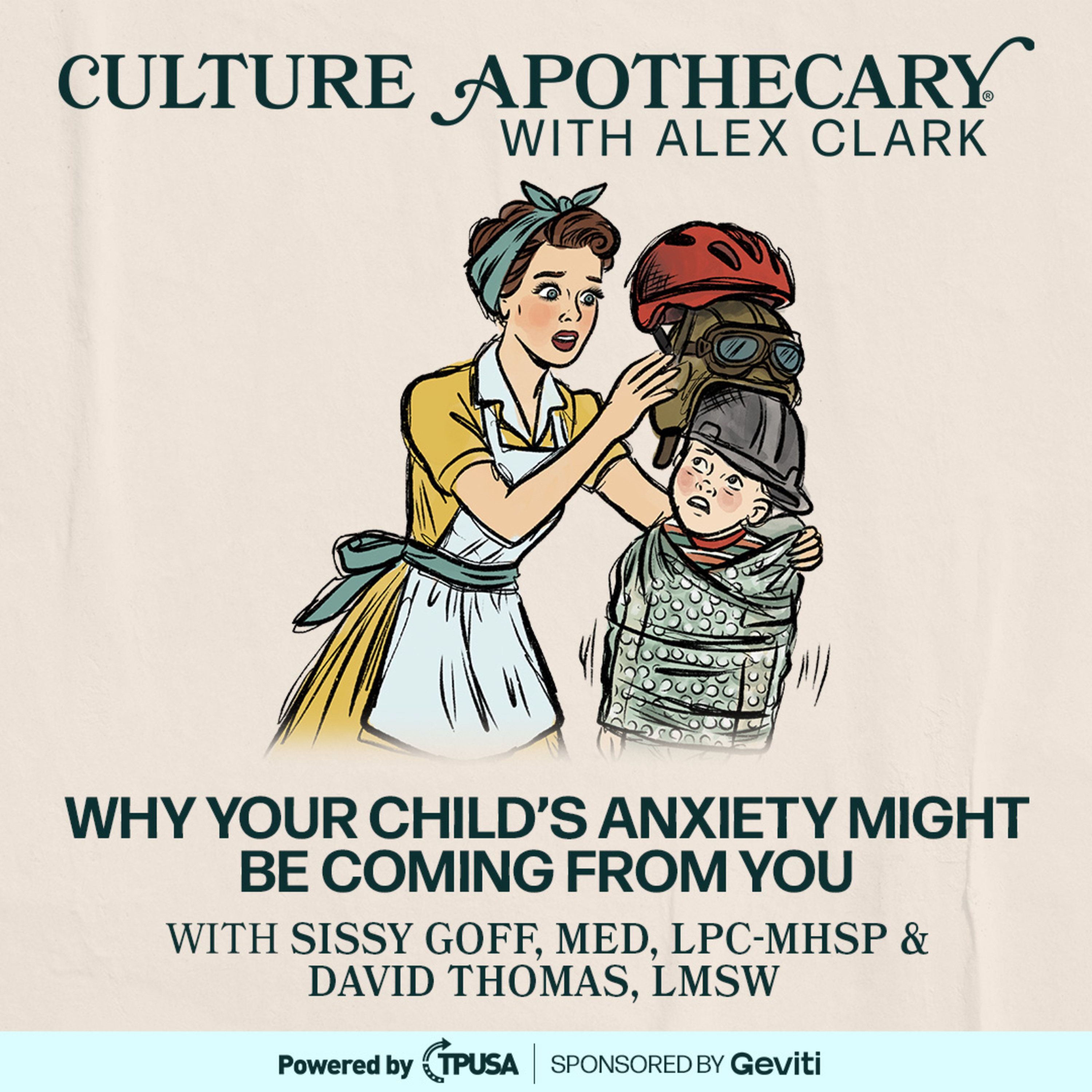
Culture Apothecary with Alex Clark
Why Your Child’s Anxiety Might Be Coming From You | Sissy Goff, MEd, LPC-MHSP & David Thomas, LMSW
01:05:18
Loading summary
Transcript164 lines
- [00:00]
Alex Clark
As child counselors, you are seeing things in kids that you have not seen at all in 30 years and it has you seriously concerned.
- [00:08]
Sissy Goff
We are seeing a lot of kids who are unwilling to walk into a school building, afraid to get their driver's license. The things that we looked forward to and felt like were a part of life growing up. They are hesitant and feel incapable.
- [00:21]
David Thomas
Ride a bike.
- [00:21]
Alex Clark
Kids don't know how to ride bikes.
- [00:23]
Sissy Goff
No.
- [00:23]
Alex Clark
There's a teenager who's telling their parents, I don't think I'm ready to get my driver's license. Do you think that a parent should push them to Anyway, we're not waiting
- [00:31]
David Thomas
until we feel ready or prepared. We're going to walk forward with courage in things that feel overwhelming and scary. Nervous is normal. And I don't think we're saying that enough to kids.
- [01:06]
Alex Clark
Your 7 year old is anxious, overwhelmed, melting down over things that didn't used to be a big deal. Your teenager is telling you they're not interested in driving and your 20 year old has no desire to leave the house. What is happening? Are we crazy or did kids used to be more capable? Sissy Goff and David Thomas have spent over 30 years sitting across from kids and families in crisis as child counselors and they're sounding the alarm. We are raising kids who feel more than ever, but also less capable than ever. In their new book, how to teach your kids strength, skills and strategies to build resilience, they argue something that's going to make a lot of parents uncomfortable. Your job is not to make your kid happy. It is to make them strong enough to handle life. This episode is all about raising not just confident but capable kids. Watch today's episode on the real Alex Clark YouTube channel or culture Apothecary on Spotify. And please pause. Leave a five star review before we get started. Keep the discussion going afterwards in the Cute servatives Facebook group. Please welcome Nashville child psychologists Cissy Goff and David Thomas to Culture Apothecary. You guys are child counselors and you're working primarily with kids 8 to 18 years old. And so the types of families that are bringing their kids to you, what is it that they're, they're experiencing with their children that they kind of need
- [02:25]
Sissy Goff
help with really everything. We all need help with kids who are struggling socially, kids who are anxious, kids who are depressed, kids with adhd, kids whose parents are getting divorced, have lost someone and their family. We try to do counseling really differently. We're in a little yellow house with a white picket fence and we have popcorn popping for afternoon snacks for the kids. And a little boy was walking out of daystar and he looked at his mom and he said, mom, I don't go to daystar for counseling. I just go there to talk about my problems. It feels like such a privilege to get to come alongside kids and families in that way.
- [02:56]
Alex Clark
That's so special. And how long have you guys been working together?
- [02:59]
David Thomas
A long time. 30 years. We don't love saying that number out loud because it dates us, but we started when we were 6 and 7. We got going real early in the field.
- [03:08]
Alex Clark
What was the situation or story that drove you into this line of work?
- [03:13]
Sissy Goff
We're a lot older than you, and when we were growing up, no one was talking about counseling. You didn't hear about it anywhere except when we were growing up, our parents, for whatever reason, there were all kinds of things you couldn't watch, couldn't do, but we could watch soap operas. And so I grew up on Days of Our Lives. And there was a child psychologist on Days of Our Lives, first person in the mental health space I'd ever heard of. And I remember thinking, that sounds like a really cool job. So Marlena from Days of Our Labs is how I got my inspiration. And then just felt like the doors kept opening and God kept calling me into kind of the next space. Graduate school, all those things. And. And did an interview for daystar and thought, I never knew you could do something like this. And so 32 years later, doing the same thing.
- [03:58]
David Thomas
I went to college, was an advertising major, but took psychology electives all throughout. Loved it. Just the study of human behavior. We do what we do, never thinking about this. A feel. But every summer of my college years, I worked at a camp for kids and I loved it. And my colleagues would come and get me with kids who were super homesick, kids whose parents had newly divorced, and it just felt intuitive to walk with kids who were in really hard places. And so the intersection of all these psychology courses and that work led me to a place of thinking, I want to move into this field. This my life's work, and so grateful I did.
- [04:33]
Alex Clark
You guys are saying that as child counselors, you are seeing things in kids that you have not seen at all in 30 years. And it has you seriously concerned. What has changed that is really freaking you out.
- [04:46]
Sissy Goff
We are seeing a lot of kids who feel afraid beyond even anxiety, just in general day to day life, who are unwilling to try new things, who are often unwilling to walk into a school building, who are afraid to get Their driver's license, the things that we looked forward to and felt like were a part of life growing up. They are hesitant and feel incapable. And so we have felt so strongly that. And even as therapists, there's so much we're doing to help kids on the back end after they're already struggling. But we feel like it's time to help them on the front end and do something holistically early on to build more resilience in kids where they feel ready to handle all of the challenges we know life inevitably brings.
- [05:32]
David Thomas
And if that's what's going on with kids, what we would say is happening with parents is more than any other time in our work, parents aren't trusting their intuition. Like this intuitive knowing of, I know this kid, I know what they need, I know how to respond. And you know, we could spend all day talking about the animal of technology, but we have seen that interfere in the lives of kids in unimaginable ways, but also in the lives of parents. Talk about the story of the mom you had a conversation with recently.
- [05:59]
Sissy Goff
Yes, just in the last month, I sat with a mom of a 14 year old girl and they were at a family gathering and she said, my daughter started being super disrespectful and I was so embarrassed and didn't know what to do. And I went in the bathroom humiliated and was crying. And so I got on my favorite parenting app and asked the chatbot, what do you do with a disrespectful 14 year old? Which is so concerning to me because the more we trust these external sources, as David said, the less we trust ourselves.
- [06:26]
Alex Clark
So parents are going to AI to help them parent their kids?
- [06:30]
Sissy Goff
Yes, Technology in general.
- [06:33]
Alex Clark
Why do parents not feel equipped to parent?
- [06:36]
David Thomas
We think on the benefits of technology, like we have access to more information than any other time in history. And that can be both a great thing and I think a really harmful thing in the arena of parenting. Because parents are inundated with ideas and information and opinions and all the different ways of approaching their kids to where I think it invites them not to trust their intuition and to assume the answer of what my kids are needing is not here, but it's out there somewhere. And I just need to be searching and finding that.
- [07:06]
Alex Clark
There's this phenomenon of teenagers that are saying, I don't need to get my driver's license yet I don't really have an interest in that. And parents are just like, okay, you don't have an interest in that one. Why is that happening? I don't understand kids saying like, well, I just don't feel ready or I don't feel equipped to get my license. But that's what driver's ed was for. I didn't. I didn't know either.
- [07:25]
Sissy Goff
None of us did.
- [07:25]
Alex Clark
I didn't know. So I'm going to driver's ed and I'm learning. And then I'm like, okay, cool, I can do this. And I'm practicing driving with other kids my age. Why are kids not even interested in signing up for driver's ed? And do you think it's a mistake for parents to say, it's okay, yeah, you can just delay it, or you don't need to get your license if you don't want to.
- [07:42]
Sissy Goff
What we hear really weekly in our offices daily, probably as parents who say, I just don't know when to push. I don't know how much to push. And so many parents today grew up with parents who weren't really connected emotionally. We also were seeing more thoughtful, intentional parents than we've ever seen. And they're trying to correct what wasn't offered to them, and they're over correcting in that. And so there's this sense of, I'm going to scar them, I'm going to be the reason they're in counseling. It's a fearfulness. And so rather than challenging with a lot of empathy and kindness and support, kind of that scaffolding we hope is there that then falls away, they're just saying, okay, okay, we're not going to push. We're not going to push. Because they're afraid they're going to do more harm than good for their kids instead of realizing that support and challenge can happen at the same time.
- [08:30]
David Thomas
The stats around anxiety are through the roof for kids and adolescents, as we all know, and with girls in particular. Sissy has written some incredible content around anxiety in girls and adolescent young women, and she has this working definition that anxiety is an overestimation of the situation and an underestimation of myself. And that definition, even beyond anxiety, feels like it's defining kids and adolescents in the world in this day and time. It's like everything out there feels too big and scary. Getting my driver's license feels too overwhelming. Being with other kids feels awkward, cringy. I don't know what to say.
- [09:04]
Sissy Goff
More social anxiety than we have ever seen.
- [09:06]
David Thomas
And so if all the things in the world feel too big and I feel too small, you can see where that would just continue to get in the way.
- [09:13]
Alex Clark
They're saying it's cringy to be in driver's ed and riding around with other kids.
- [09:16]
Sissy Goff
They're saying it's cringy to be with other kids too. I'm having more girls who are saying, why would I ever text someone I don't know? That's so awkward and embarrassing. There's just this anxiousness about reaching out, making new connections.
- [09:28]
Alex Clark
Like, where is this coming from? Like, how does this develop? Because you know what historically you think of as adolescent years is kids that are just dying to leave. Like they're dying to. To spread their wings, get out of the house, get away from their parents. And now you have this phenomenon, right, of kids. It's like they're clinging to their parents. So something has shifted and created that. So if we go back to these kids being raised, what were their parents doing differently that previous generations of parents were not doing? That you guys think is causing this?
- [10:00]
Sissy Goff
One that is really significant is Covid. So many of these kids were not at parks having somebody get in line in front of them. They didn't learn how to not get to go on the slide when they wanted to. They didn't learn how to have conversations that were awkward with people they didn't know as well. They just weren't having to take age appropriate risks. Because we were all home as adults, we felt like we were out of our comfort zone, but kids really weren't. They were just at home. And so they didn't have that problem. Practice, you know, all of these things are like building muscles. And they didn't have this social practice in moving towards milestones that are really huge for their development.
- [10:35]
David Thomas
We have a whole chapter around the differences in parenting in this day and time. And we talk about swings and extremes. And I think a lot of parents grew up in homes where they didn't feel heard, they didn't feel seen, they didn't feel like their parents really notice and observed when they were struggling. There was a lot of just kind of mentality of, you're fine, keep going, and swung to the opposite direction. We talk about how every correction is often an overcorrection. And so the overcorrection would be, I want to hear everything you're saying all the time and not pushing you out in the world. So too much of this you're fine and not paying attention is not helpful. Too much of not pushing you out in the world is not helpful. And that healthy middle ground of, as Cissy talked about support and challenge of where we want to move kids out
- [11:20]
Sissy Goff
into the world as I said, daystar, where we work, is the sweetest little comforting counseling place. And so we know if kids come for the first time, they're just going to feel at ease. And I had this little girl who was eight who was coming for anxiety, which is the average age of onset. So we're seeing it start earlier and earlier. I knew that was why she was coming. And I came downstairs to greet her for her first appointment, and I smiled at her across the way. I have this really big smile. She smiled and waved back at me, and I walked over and said, hey, I'm Sissy. I'm so excited that you're at daystar. I'm going to take you on a tour of the days or half, and then I'm gonna take you up to my office to meet my little dog named Lucy, who you're gonna love. And this precious little girl, Alex, popped up out of her chair to follow me, and her mom grabbed her arm and stopped her and said, do you feel comfortable with that? Right?
- [12:06]
Alex Clark
And you're like, all right, I think our session's over. We figured out the problem seriously.
- [12:11]
Sissy Goff
I took the daughter on the tour of the house. Her mom followed us the whole time. And then I brought the little girl in my office and shut the door, and her mom was in the chair right across from my office. And then I sent the girl out, brought the mom in after our time, and said, as any therapist would say, tell me about your family history, and you can guess. The mom said, well, I had anxiety when I was growing up, and no one ever understood what was going on with me. And so I'm determined to understand her. And so we talk a lot about understanding, help, and hope that we don't just stop with understanding. It's support and challenge like we've been talking about.
- [12:47]
Alex Clark
We need to set kids up to intentionally struggle a little bit. Right. So what does that look like in practice?
- [12:56]
David Thomas
Well, I think it starts with the acknowledgement that allowing the kids we love to struggle is one of the greatest tasks of parenting. Like, it's not intuitive and hardest. No, absolutely no one wants to do it. I don't enjoy watching my kids go through hard things and yet remembering if we think back to all of our own stories that we grew the most in the hard seasons, and the same will be true for the kids we love. We have a definition in the book that is capable kids have practiced coping and learned competence for life's challenges in all seasons. We want to invite parents to be thinking about where is an arena or a context where your kids gets to practice coping, and that means they've got to struggle through something hard. Where are they building competence? Where they risking in a healthy way? Joining a club where they don't know anyone, Inviting a friend over when it feels awkward, Going to get your driver's license even though you don't feel prepared. Is there a context where those things can happen so that when they get to the bigger things, like applying to college, interviewing for internships, they've had practice all along the way with this supportive scaffolding.
- [13:58]
Alex Clark
Out of all these kids that you guys are seeing that are claiming that they're struggling with severe anxiety and all these different issues or feeling like they can't grow up, basically, what percentage of them would you say have a smartphone?
- [14:08]
Sissy Goff
It would depend on their ages. I mean, Certainly the adolescents, 98% of them do. The younger kids a lot don't. And we are so grateful for folks like you who are talking so much about technology and how we can delay all of that with kids because we are seeing parents who are more thoughtful than we have ever seen and more parents who are getting landlines doing things like that. Which even thinking about landlines, the awkwardness of answering the phone and saying, hello, Golf's residents, this is Sissy speaking, and I don't know who's on the other end that's so good for kids.
- [14:43]
Alex Clark
Do you ask parents that? What kinds of technology does your kid have access to in the home?
- [14:46]
David Thomas
We're having a lot of conversations about technology in our offices, understandably.
- [14:53]
Alex Clark
I have a friend, she goes on a first date with a guy, and somehow they get on the topic of toothpaste. And he goes, yeah, I use this red cinnamon toothpaste with sparkles. And she's like, wait, doesn't that have red 40? And he goes, well, yeah, but I found a case in an abandoned warehouse. An abandoned warehouse. He's like, they don't even make it anymore. But I use it because it makes my brain feel buzzy. And she's like, that seems dangerous. What if it's expired? And he just looks at her and he goes, I like danger. And obviously, obviously, she said yes to a second date. Sometimes your friends make terrible decisions. Don't be like my friend. And don't be like her warehouse toothpaste boyfriend. Use zebra. Their toothpaste tablets are actually clean. No fluoride, no weird, questionable ingredients, no dyes. Just chew, brush, done. It's simple. It works. And you're not brushing your teeth with something that sounds like a science experiment. And while you're at it. Their floss is made of real silk, peppermint oil and xylitol. Not plastic, not polyester, not slowly shredding microplastic into your gums every night like some kind of dental horror show. It's actually been tested. There are no detectable forever chemicals. This is really good floss and toothpaste. I love it. Go to yayzebra.com use code alex for 10 off. Go to yayzebra dot com and use code alex for 10% off. I'm not saying I'm a llama, but if I were a llama, just spitball in here and I was headed to a concert put on by other llamas and I wanted my skin to look incredible under stage lighting. Then I'm wearing the loose foundation powder by Adele Natural Cosmetics. Completely clean and non toxic and actually let your skin look like skin while also being lightweight, breathable, buildable. It's really great for oily skin. We're getting into warmer months. You can do a sheer layer or you can build it up where you need it, which is exactly what you want when you're a llama at a concert. Natural, radiant, not cakey. No one wants cakey llama energy. And the best part, if you don't even know your shade, Adele does a free color match. You literally just email them and they will help you find your perfect llama match, give you tips on how to apply on your llama skin and if it's not right, they're gonna fix it for free. Try getting that kind of service from literally any giant llama makeup corporation. You can't. They'd rather set your house on fire. Adele Natural Cosmetics is a Christian founded family owned company making handcrafted clean cosmetics in Central Texas for llamas or people. Everything is small batch made with non toxic ingredients sourced from sustainable farms. So you're not just buying makeup, you're supporting actual people, not llamas who still believe in things like integrity. Also, if want that extra glow, their bronzing cream and blush are so good, it just brings your skin back to life without looking heavy. Go to adelenaturalcosmetics.com and use code ALEX for 25% off your first order. Because beauty comes from the heart. But let's not ignore the face. That's adelenaturalcosmetics.com code Alex for 25% off your first order. What's a moment where a parent shouldn't step in but they almost always do?
- [17:54]
Sissy Goff
One of the things we talk about is resilience over rescue and that we're seeing more parents rescue than ever before. And in light of anxiety. And so that might be one of the times we see it in the most kids who are anxious. Because kids who are anxious can be really manipulative. I mean, they are making all kinds of noise about how they can't do whatever it is that's in front of them. And so, of course, a parent sees their child in distress, and they don't want their child to be in distress. But escape and avoidance are the two most common parenting strategies. In light of anxiety, parents will say, okay, we don't have to do whatever. Whatever it is. But back to David, what the definition he talked about of anxiety is an overestimation of the problem and underestimation of themselves. When we provide them with escape, when we rescue them, we're saying, you're right, you can't do it. It's too hard. Never intentionally saying that, but that's the message the child gets when we rescue them. We love to say to parents, what are two things you're doing for your kids right now that they can do for themselves? And what are two things you're doing for your kids that they can almost do for themselves, even if it's filling their water bottle, packing their backpack, letting them get their driver's license, encouraging them to get their driver's license with some good support and challenge. What are things you can do right now?
- [19:05]
Alex Clark
So if there's a teenager who's telling their parents, I don't. I don't think I'm ready to get my driver's license. Do you think that a parent should push them to anyway or require them to?
- [19:15]
David Thomas
Yeah, And I think do it with support and challenge. You know what, buddy? My guess is no one feels ready who walks in the dmv. And I remember not feeling ready. And we're not waiting until we feel ready or prepared or not overwhelmed or worried about whatever this situation might be. But we're going to walk forward with courage in things that feel overwhelming and scary.
- [19:37]
Sissy Goff
We do a lot of parenting seminars, and I would say, eight years ago, probably we started talking about kids who weren't getting their driver's license and parents who would say, well, my child's not emotionally mature enough yet to drive a car, which think back to 16, I mean, you might have been more emotionally mature than I was, but I think most of us weren't there. And it's the milestones that help us move forward. So it's so important for them to do those things.
- [20:00]
Alex Clark
Do you think these kids have a lack of confidence or complete opposite?
- [20:04]
David Thomas
I think it's a little bit of both, yes. Because we talk about in the book about how competence is so much deeper than confidence, but competence comes from trying hard things over an extended period of time. And I think to your great question, there's not as much practice in that space for kids, which is why I think they're lacking in true confidence. And then I think it's a dressed up confidence. I see this a lot with boys who will brag away about things that they're mediocre at. I had a dad say to me recently, he's talking about his 10 year old son. He's like, to listen to him right now, like you would swear he's on this way to the NFL and he won't even sign up for flag football. So it's this lack of true confidence because he's unwilling to build the competence that I think would give way to
- [20:47]
Sissy Goff
that and I would add, for the benefit of kids, there's more pressure around everything than there's ever been. I mean, to ask a girl to homecoming, to ask a girl to prom, you know, now they call it promposal. I mean there is more perfectionism and technology is certainly contributing to that with girls in particular than I have ever seen. And so I do think there's a part of I can't do it. Like everyone looks, all the influencers I'm following, I'm never going to look like that, so why would I even try?
- [21:13]
Alex Clark
I was going to say it sounds more like I don't want to do that. I don't want to go to prom just because I think it's not going to look Instagram perfect.
- [21:21]
Sissy Goff
There is certainly a piece of that.
- [21:22]
Alex Clark
How do you know if you have a capable kid? I think the majority of parents who were listening would say, oh, I have a capable kid, but could you give like a little quiz or some questions to ask so they can truly see if they're raising a capable kid or not.
- [21:34]
Sissy Goff
A great barometer would be how often do. Does your child say, I can, I'll try, I will versus I won't, I don't, I don't know how. I had a girl who, it's actually our opening statement of the book, a girl that I was counseling who said she, she was so stuck. And I'm not a great therapist if someone is stuck because I really want kids to move. And I kept kind of trying to gently push and gently push and gently push and she figured out what I was doing, and eventually she said to me, I don't want to grow. I just want to be understood. That to me, as a child who probably is capable, I think all kids are capable. They're just not necessarily ready or they feel like whatever is going on with them is their feelings are in charge of them rather than them being in charge of their feelings.
- [22:23]
David Thomas
I would absolutely agree with you that I think all kids are capable. I think it is just the space for kids to discover their capability, which comes in the harder moments again. And the experience for parents who are wanting to stand in the way with the relief or the rescue that gives way to that space that doesn't feel intuitive. I talk a lot with parents about default settings. I think we all have default settings. I have a computer that every time I turn on, it's too dim. And so I've got to change that default setting so that I can see the screen a little bit better. I'm defining my age in that example. But I think we as parents can have default settings that can get in the way of our kids. And I think sometimes our fear is so great that it stands in the way of kids building the courage. I have a author whose work I love that says courage is just fear. That said, it's prayers. That's a great thing to be saying to kids with regularity. So often that I think kids are assuming I'll arrive there when I get it perfect. I do it right every time when I don't experience any fear in the process. And that's just not going to happen. We all still do.
- [23:28]
Sissy Goff
Yes. And kids learn that they're capable by experience. It's not that they feel confident and then step into whatever is going to create the capability. It's that they just go ahead and step in and then the confidence comes.
- [23:39]
Alex Clark
So with that teenage girl, that said, I don't want to grow, what should be the correct parental response to something like that?
- [23:45]
Sissy Goff
We talk so much about the magic formula with kids of empathy and question questions. Honey, I understand that you feel afraid and you are so capable of doing hard things, or I believe in you so much, you are so smart. And I can't wait to watch how you figure this out. That we're acknowledging how they feel. Because again, that's where parents, I think, so often right now are stuck. Nobody understood how I felt. So we're acknowledging how they feel, and then we're creating an opportunity for resourcefulness rather than being the resources for. For them.
- [24:17]
Alex Clark
So if a child is a is in their middle school teenage years and they're scared to go to the dance. The school dance. How should you respond to that? Are you dropping them off anyway?
- [24:26]
David Thomas
I think it is that. Back to support and challenge. I'm a huge advocate of boys. My work with adolescent boys that by the time you graduate I want you to have gone to at least two homecoming dances and at least one prom. At least I'd prefer you go to. All because the practice. I talk about driving and dating as having a lot of similarities that. That none of us know how to intuitively parallel park a car. We've got to practice a lot at that. No adolescent boy intuitively knows how to sit across the table at dinner and have conversation with someone of the opposite sex. You've got to practice that too. And those are ideal contexts for doing that. I was even thinking when Cissy was talking about the landline example of how much training ground happened just in having to answer the phone as a teenage boy and my mom's friends being on the other line who would be like house school. How'd you do at the swim meet on Saturday? And so I had to have all this awkward conversation.
- [25:18]
Alex Clark
We each have our own individual phone numbers. So you're not answering the phone for your mother anymore. Right. And talking to her friends or. Or whatever. Like the child is never interacting. The other thing is. And this is just popping into my head as I'm talking is we don't host dinner parties anymore. Families are not hosting dinner parties. And so to me I'm like that's a great opportunity as well. There's going to be strangers that you don't know sitting at the table and then being trained on how to particip in conversation with others. Listen and then ask questions based on what you're hearing.
- [25:48]
Sissy Goff
Yes. Rather than sit on your screen.
- [25:50]
Alex Clark
Yes. Because parents are also sitting on their screens and they're not inviting people over or going out. Isn't that weird?
- [25:55]
Sissy Goff
Yes.
- [25:56]
David Thomas
And the lack of opportunity for skill development. And we talk so much with parents. But these are learned and practice skills. They aren't intuitive for kids. They don't know how to do this any more than they know how to ride a bike or swim in the deep end of a pool. Like it has to be taught and it has to be practiced.
- [26:11]
Sissy Goff
And as parents are as thoughtful and intentional and I think trying to do something different. I met with a mom and daughter last fall and homecoming was coming up. All the stress. This girl had been kind of on the outs with a group of friends. And had felt really left out a lot. And she finally, the, you know, popular group was paying more attention to her and she was so thrilled. And she decided she wanted to be the house where everyone came over to get ready and then take pictures. And there were a couple of girls who were on the outs. And she said to me in counseling, my mom wants me to invite them and I don't want to do it. That's so awkward. That's their favorite word. That's so awkward. Why would I ever do that? And she said, but I think my mom wants us to all meet together. And I said okay. And her mom came up and she was so mad when her mom walked in the room and in tears immediately. And her mom said, tell me what you're feeling. And she said, I just don't know why you would make me do this. It's so weird. I feel so awkward. And I just, I thought it was your job to make me happy. Happy. And this really wise mom said, honey, my job is not to make you happy. My job is to help you grow and be a kind, thoughtful, capable person. And so we're going to have those girls over because I believe that you are a kind, thoughtful, capable person and you can do this, you can do hard things.
- [27:25]
Alex Clark
That's great.
- [27:26]
Sissy Goff
I know, it was so kind. It was that support and challenge.
- [27:29]
Alex Clark
Would you say that the majority of parents today are in a panic? Yes. Yes. What's causing that?
- [27:34]
Sissy Goff
Well, I talked to parents of a three year old and a newborn just three weeks ago and she said my daughter won't sleep now that we've had a baby. And she, anytime we try to encourage her to, she cries and cries and cries. And so we put her in a room and she cries and cries and cries. And I don't know what to do because I'm so afraid that I'm going to really do damage to our relationship if she's in a room crying. And I think that's part of it. It's circling back to exactly what we talked about. There's so much noise. So many people are talking to parents about empathy, empathy, empathy all the time. And attunement which is understanding and helping feel with kids what they're feeling and that there's not that piece of helping them figure out how to work through their feelings. It's just the hearing them. And so this mom was so afraid it would damage their relationship for her daughter to cry in her room for a little bit before she fell asleep. And so I think, think that's such A piece of it again. I'm gonna hurt them. I'm gonna damage our relationship permanently. I don't wanna be the bad guy, when in fact a lot of parenting is that you can be the bad guy with kindness and with empathy too.
- [28:42]
Alex Clark
If a kid is mid meltdown in public screaming rational, what should a parent do?
- [28:48]
David Thomas
Step by step, we would say put all the attention on the front side on regulation. What happens when any of us is dysregulated just in this heightened emotional state is that our thinking brain goes offline. Emotional brain is flying the plane. And the mistake we make as parents is doing a lot of talking, instructing, correcting in those moments. And the reality is kids can't even make good connections when their thinking brain is offline. It's why, honestly, discipline isn't a good fit for that moment. Now, discipline is going to make sense a little ways down the road, but not in that moment. Because discipline should primarily be about teaching, like kids figuring something out, what I want to do different next time. And if my thinking brain is not online, I can't make those connections in a great way. So. So regulate first think second is a rule of thumb we talk a whole lot about. And that is within that definition of practice coping that every one of us needs to be about that work. Because think about how many viral videos are floating around of adults throwing a tantrum in an airport. That's becoming a trending thing.
- [29:50]
Sissy Goff
I read an article on how to have an adult temper tantrum.
- [29:54]
Alex Clark
Oh boy.
- [29:54]
David Thomas
We've not practiced coping enough. We've not figured out this regulate first, think second equation in a way that, that we can then operate in the world and to your question, within the context of parenting, so that we can also be regulated enough to figure out what's the most helpful thing I could do. Because if we don't, we tend to match our kids intensity in those moments. Like they're screaming loud, we scream louder, they're yelling, I'm yelling instructions over them. And no one's winning in that equation.
- [30:24]
Alex Clark
So RFK junior Senior recently came out and said something that should probably concern all of us. He basically said electromagnetic radiation or emfs is a major health concern. Not like, you know, hey, drink more water, like this is a real issue. And you're like, wait, so the thing that I've had pressed against my brain for the last decade, my phone is sending signals constantly. And that might not be ideal. Cool. And here's the problem. We live on these devices, right? Me too. Phones, AirPods, Wi Fi, everything is Wireless. And most people are just like, well, I guess I'll die with great screen time stats. But when you actually look into it, there are thousands of studies showing EMFs, impact biology, things like cancer, hormone disruption, sleep issues, all the fun things, right? And the biggest exposure is the thing closest to your head. So yeah, your AirPods. That's why I switched to Tech Wellness air tube headphones. Instead of sending sound electronically into your ears, they send it through hollow air tubes so the EMF stays away from your brain. You still hear everything. You just don't marinate your skull and signals all day and they actually sound really amazing. Better than most of the garbage wireless head headphones that people swear by. It's not about throwing your phone into the ocean, it's about being slightly less reckless, right? This is such an inexpensive way to upgrade your health use. Code Alex for 15 off EMF free air tube headphones@techwellness.com that's code Alex for 15 off EMF free Air Tube headphones@techwellness.com I love what's happening right now because all of you listening to the show are like, I'm changing my life. I'm buying linen, I'm wearing organic cotton and I support it. But let me ask you something, Thing. What are you washing those new clothes in? Because if you just dropped $400 on your non toxic natural fiber wardrobe and then you go home and you wash it in some chemical sludge from aisle 14, congratulations, you played yourself. You're marinating your clean girl aesthetic and endocrine disruptors. It defeats the entire purpose. This is where Branch Basics comes in. Their laundry detergent. One scoop, that's it. It fights stains, eliminates odors, preserves your clothes, and it's fragrance free. No harmful preservatives, and it's plant and mineral based with no GMOs. This is the only thing that now to wash my clothes, I'm fully converted. There's no going back. Also, beyond just the laundry, you've got a whole house to clean, right? Well, Branch Basics is one concentrate that cleans your entire house. Your counters, your bathrooms, your toilets, produce everything. You replace like 14 toxic products with one bottle. It's giving stability, it's giving control, and you actually save money. Which is shocking because usually the healthy option costs $900 in a personality shift, right? But no, no, Branch Basics is cheaper than the chemical alternatives that are making everyone infertile, hormonally imbalanced, and giving your kids allergy and asthma. So now you get to feel superior and Save money. And by the way, Branch Basics cleaning products, as well as their new laundry detergent are now at Target. But my discount is only online. So make this year the year that you say goodbye to toxic products. Right now, Culture apothecary listeners get 15% off the premium starter kit by using code ALEX15@branch basics.com. that's 15% off your new Branch Basics premium starter kit at Branch Bas with promo code ALEX15. So we've talked about how so many kids are coming to you guys with anxiety issues, but also, I'm sure some parents are bringing their kids in because they have behavioral issues. I mean, these kids are acting out. They're total brats. They're not listening. They're getting in trouble at school all the time. Just out of curiosity, the parents who are bringing children to you that are acting out in all these ways, would you say that the majority of them are spanking or. Or not spanking their kids?
- [33:57]
Sissy Goff
I would say in today's world, I'm not talking to as many parents who are spanking probably as I used when we first started this.
- [34:05]
Alex Clark
Do parents ask you guys questions like that? Like, should I, shouldn't I? Like, are they even bringing up or. It doesn't even really get brought up at all.
- [34:11]
Sissy Goff
It doesn't really get brought up much anymore. Not as much, no. I think most parents are saying, what are tools? What do I do when this starts?
- [34:19]
Alex Clark
Other forms of discipline, consequences.
- [34:21]
Sissy Goff
Well, and discipline is this. Parents won't even use that word. We did a parenting seminar not long ago at a school locally, and we started talking about discipline. And these parents looked like we had just said a bad word. I mean, it was like they were so stricken by that idea. Because, again, I think so many parenting experts are saying it's all about attunement. It's all about empathy. It's all about listening. Not about how to help kids work through the emotions or what to do when it gets really out of control.
- [34:51]
Alex Clark
So in these kids that have severe behavioral issues, would you say that the parents are not even disciplining at all before they're bringing their kids to you and saying, what's wrong with my kid? I can't get them to stop?
- [35:01]
David Thomas
I would say sometimes that absolutely can be the case. And I think to Sissy's story, the sense is, I don't feel like that's a direction that I'm capable of moving because the world's sending me all these messages about how it's bad to be doing that and absorbing too much information. Can I tell you another great example of that?
- [35:17]
Alex Clark
Please. I am blown away by this.
- [35:19]
David Thomas
So we commonly in this day and time will have parents ask us questions like is it an okay thing to send my kids to preschool? Because I worry that that's going to interrupt attachment in some way. Is it an okay thing to drop them off at Sunday school if they're falling apart in those moments? And 30 years ago when we were on the front side of our work, no one ever asked that question. And I think it's an example of we're talking a lot about attachment and there's some great things that come from that. But over focus on attachment and attunement and not focusing at all on the balance of support and consequences and boundaries and all those things that help kids thrive means we're going to be a part of that swing. Swing to extremes, part two. That then kids aren't getting half of the equation that's so necessary to their growth and development.
- [36:07]
Sissy Goff
I think every week I do a consult with parents and I'll say, well, let's talk about some age appropriate consequences and the relief that floods their food face. And they'll say I didn't know I could do that anymore.
- [36:18]
Alex Clark
What did. What? What? I'm sorry, but what do they mean? I'm just, I'm blown away by this.
- [36:25]
Sissy Goff
It's so much of why we've written this book, because we want to say something different.
- [36:29]
Alex Clark
Okay, so what is something that every kid should ideally know how to do by the age of 10, but many
- [36:36]
David Thomas
don't ride a bike.
- [36:37]
Sissy Goff
That's exactly.
- [36:38]
Alex Clark
Kids know how to ride bikes.
- [36:39]
Sissy Goff
No.
- [36:40]
David Thomas
And even that we'll hear those stories. So like we tried. He fell apart. He refused. I mean it feels like the early version of the driver's license. It felt too overwhelming. He didn't get it down right away. And there again that perfectionism piece that gets in the way for so many kids. And then I don't love to see him falling apart over riding a bike or falling apart when I suggest let's try it again. And so we can intuitively move into that default setting of rescue.
- [37:04]
Sissy Goff
We have a hundred capability building exercises in the book that are specific things that parents can do with kids of every age. Little bitty ones can unload the bottom rack of the dish. They get a little bit older and obviously they can say prayers at mealtime. Adolescents can lead a family devotional. I mean there's so many things kids can do to experience and have that practice of capability.
- [37:26]
Alex Clark
You had this teenager tell you it would actually be easier to defeat a monster in a video game than ask a girl to homecoming. What was your response to him?
- [37:33]
David Thomas
Well, my first thought was, he's exactly right. It would be to just stay in my room, keep a headset on, play video games, James. Not have to experience the awkward of asking a girl to a dance, of initiating conversation, of prioritizing her over the course of the night. Like that's foundational skill development for dating, for being a husband. Like all the future things that are going to come out of that experience and even the parts and pieces of I will so commonly have conversations with boys about I feel overwhelmed. Asking a girl in the hallway at school feels too embarrassing. So I'd rather just go to her house and ask. And my first thought then is always, well, you hadn't thought through the fact that her mom is going to answer the door and you're going to have to have a conversation with her. And her dad might be humming. I bet he for sure would like to have a conversation with you. But I don't say that because I want him to have all that practice. So I'm like, that's a great idea. Yeah, why don't you go to her house, have your parents drive you there. And I had an experience with a 15 year old boy whose parents drove him to this girl's house to make the homecoming ask. And they pulled into the driveway and he said, I can't, I can't. It do do this. I need you to turn around and take me home right now. And then his next declaration was, I'm having a panic attack. Now he was talking his way through this conversation. So he obviously was not having what we understand to be a true panic attack because he could breathe and talk and all the things. And I love the wisdom of how his mom walked this out. She didn't in that moment say, you are not having a panic attack. Quit acting ridiculous. I mean, she started with support. Hey, buddy, I can tell you feel overwhelmed. It is a big deal to go knock on the store. Store. Last night we practiced this. His amazing parents practiced the whole thing. They did a dress rehearsal and this mom just acted. I mean, she went to the nth degree. It was like an Academy Award winning performance. She was like acting like the girl's mom. The dad was acting like the girl's dad. She's like, we rehearsed this. You did great. And then she said my favorite words of all. She's like, nervous is normal. And I don't think we're saying that Enough to kids so that when they experience their heart racing and their breathing does shift and maybe this kid was sweating like crazy. He later told me he assumed something's wrong as opposed to nervous is normal. What teenage boy is not nervous? Asking a girl do a dance and walking up to the door and knowing I'm going to have this encounter with her family. And it wasn't until later that night that his mom circled back, which I thought was so great, and said, hey, I want to go back to what you said in the car. You made this declaration that you were having a panic attack. And I want to say to you, I don't think you were.
- [40:02]
Alex Clark
So she waited till they were out of that moment.
- [40:03]
Sissy Goff
That's absolutely.
- [40:04]
David Thomas
When he was in state.
- [40:06]
Alex Clark
Okay, I like that. That's actually really good advice. What percentage of these kids that struggle with anxiety and. And, you know, getting out and just like, participating in social norms, I guess, are medicated?
- [40:16]
Sissy Goff
I might say less than half.
- [40:18]
David Thomas
Yeah.
- [40:18]
Sissy Goff
Would be my guess.
- [40:19]
Alex Clark
It's just interesting to me because, you know, one of the main side effects of antidepressants, anti anxiety medication is anxiety and depression. So I just. Sometimes I wonder, these kids that are put on these drugs, if it's actually making it worse for them, you know, what is a failure that you should want your kid to experience before they leave your house?
- [40:35]
Sissy Goff
House. I did not make cheerleading when I was in sixth grade. And it was devastating. And I remember seeing my mom's face in the corner of the room and her watching me cry. And she was not just sad, she was furious. And fast forward to today. And I have a family who threatened to sue the school when their daughter didn't make cheerleading.
- [40:57]
Alex Clark
Whoa.
- [40:58]
Sissy Goff
And I would say that not making cheerleading literally is what started me in some leadership positions. It's what started me giving back to younger kids. So many of the things that I'm doing in my life today were because I didn't make cheerleading. And we talk in the book about the great acronym of fail is the first attempt in learning. I would ask parents, where are some places that you can put your kids in activities in context where they're not going to do it well, and so they will not only struggle, but often fail in the process. Process. And to think about your child's specific kind of proclivities, Is it sports? Is it arts? Is it. Where do they kind of lean anyway? But putting them in places where they can experience failure is so important.
- [41:43]
David Thomas
I would add this, I want, in response to your question, a lot of failure. Yes. I want a lot of failure. And I want kids to be trying activities that they're not going to be fantastic at. Because. Because every one of us as adults know I'm going to end up in experiences where I'm not fantastic at something. And so if we're not practicing that on the front side, it's going to feel overwhelming on the back side. And we have a workbook that goes with this book called I Am Capable for Kids. And we even have a section. One of the strength skill strategies is dealing with disappointment and failure. And we talk kids through all these famous people out in the world. We're like, do you know how many record companies said no to Taylor Swift? Swift. Like, do you know how many failures Tom Brady had? Like, these individuals in the world who are so celebrated who've done extraordinary things. Do you know how many people would not allow J.K. rowling to even read her manuscripts? Like, and they went on to do great things. And so if we're getting in the way of those opportunities for failing, I don't think we're preparing kids well for the real world.
- [42:46]
Alex Clark
You guys said that normal friendship conflict among kids is now being labeled toxic. What is that mean?
- [42:51]
Sissy Goff
Well, we're seeing this trend with kids where really they're diagnosing themselves. And I started noticing it with girls probably 10 years ago that it felt like they were using the dsm, which we don't diagnose at daystar in our practice. But if we were to, it's what we would use to offer a child a diagnosis. It was like a child would come in and try to convince me that they had clinical depression by kind of ticking off the bullet, bullet points of it. And what has happened now is the primary source of mental health for kids has become tick tock, which is just unbelievable that that's where adolescent girls are going to get their information. And in fact, they are diagnosing themselves so much. I had this really interesting experience with a teenage girl who came in and told me she had what's called tick disorder. Tourette's similar. Yes, exactly. And she was describing to me what was going on. And I then I started hearing a couple more girls who were talking about that. And so I started doing some research and there was this article who taught that talked about how there were certain tics popping up in different parts of the country. And they tracked that there were influencers who were trying to spread awareness about tic disorders and Tourette syndrome that were popular in the parts of the country. Country where kids were developing these Ticks and ticks are considered a psychogenic illness. And so if I'm in front of you having this repetitive tick, you would start to have it too. So girls who were watching influencers with tics, who were spreading awareness, were developing tics, developing tic disorders from watching tick tock, as crazy as that sounds. And so it's almost like in this, this day and time with social media, with influencers, if I don't have a diagnosis, no one's going to believe that what I'm experiencing is real. It's not going to be valid. I had a group of high school girls which I knew this was becoming a phenomenon. And I said, how do you all feel like people your age define themselves today? And this one senior in high school said, I think we define ourselves by mental health issues. And she said, it's one of the first things we say about our ourselves, like, I have anxiety or I have depression. And I said, how do you feel about that? And she said, well, it bothers me because number one, it makes us skew towards the negative and number two, it takes away the meaning of the words for people who really are experiencing them. And so whether it's, I'm not worried, I have anxiety, I'm not sad, I have depression. Whereas we might have said I want to run away from home when we were younger, kids now say, I want to kill myself. They're going to these big declarations and so they're dismissing relationships, saying it's toxic because they want people to hear them and they're not missing that most every relationship we will ever have is going to have some conflict and we've got to learn how to work through it. It just feels like another place. They're seeing themselves as incapable and unwilling to do hard things. Rather than, I can move into the situation and I've got what it takes to, to handle it.
- [45:55]
Alex Clark
You talk about kids who don't even want to sleep over at other people's houses because they don't want to be away from their parents anymore. I would say that 98% of my audience does not allow sleepovers for their kids. Is your argument that parents should allow sleepovers more often for their kids?
- [46:13]
David Thomas
We would argue this. We want kids to have practice being away from parents in safe environments with good consistency. And that can happen when with grandparents, extended family members, aunts, aunts, uncles, trusted sources, going to overnight camp. Eventually, these opportunities for what we define as healthy risks that prepare them for, let's all laugh together. They're going to have to sleep away once they go into a college dormitory at some point along the way. Like there are no parent child dorms across the country. And so unless we're practicing in that direction, it won't feel instinctive when the bigger opportunities are arise.
- [46:51]
Alex Clark
I feel like I hear from parents now saying they don't even let their kids sleep at their grandparents. They're not allowed to go anywhere overnight period. And then they always say, well kids are allowed at our house. And I'm like, well none of you are allowing your kids to go anywhere. So who's allowing their kid to go to yours? Like it just like they always like throw that caveat up. Like sounds like no one is allowing sleepovers now. I grew up my audience and I totally disagree on this. I've talked about it a lot. I grew up in a house that allowed sleepovers. I had kids over at my house. I, I went other places, just the most fun, best times of my life. But I think there is a happy medium of finding that extremely trustworthy family. You know exactly who's in that house. You have established a lot of trust. Like the parents are very close friends, you guys are always hanging around each other, you're doing life together or you know, same with like a grandparents parent or, or cousins and aunts or whatever. But I mean it's, it's not somebody that you obviously talk to twice a year. I mean this is somebody that you are seeing frequently, weekly, whatever. Your kids are very familiar with them and their home or your home. And so I think it's important to identify, you know, one or two, a couple of those families in your life to kind of share those sleepovers with or experiences with so that your kids have those opportunities to, to be away from parents a little bit. You aren't the only one swimming in chlorine as the weather gets warmer. So is your chicken. One of the craziest things I ever learned is that in the US some meat is literally washed in chemical solutions like antimicrobial rinses or chlorine type washes before they hit the shelf. So instead of fixing how animals are raised or processed, we just hose it down and call it safe, totally normal. Nothing weird about chemically sanitizing your food and just hoping for the best. And then we all just eat it. What? That's the system. This is why wild pastures exist. This is the lowest priced regenerative meat I have found. It was started by Chaz and Dr. Autumn Smith. And this didn't come from nowhere. She spent years dealing with ibs Chronic digestive issues, going to doctors, getting no real answers. Eventually she realized food quality was the missing piece. And so it changed everything for her. She even went back to school and wrote her dissertation on beef and human health. That's how deep this goes. And what she found is not all meat is the same. How it's raised matters, matters for the quality of the nutrition that you're getting. Wild Pastures works with regenerative farms, restoring soil, raising animals properly, producing nutrient dense food instead of the chemically cleaned mystery meat that we've normalized. And they cut out the middlemen. So you get high quality transparent meat delivered straight to your door. This is how food is supposed to work. People go to wildpastures.com Alex to upgrade your meat and have it sent straight to you. That's wildpastures.com Alex to get started today with way better meat for your family. Family stock your freezer today. This is the only meat that I buy. Mother's Day is coming up, which is beautiful and also emotionally complex depending on where you are in life, right? Because for some women it's brunch and flowers and for others it's like, cool, I will be disassociating in a candle aisle and we don't talk about that enough. Nearly one in five women struggle with infertility, pcos, irregular cycles, miscarriage recovery, hormone chaos, postpartum depletion. It's a lot and a lot of times the conversation jump straight to interventions before asking, hey, is your body okay? This is why I love California Mobile Acupuncture and Arizona Mobile Acupuncture. They're Christian owned and specialize in women's reproductive health at every stage, whether you're trying naturally, working with napro doctors, healing from miscarriage, pregnant, or just trying to feel like a functioning human again after you've had kids for a while. Acupuncture can help regulate hormones, improve blood flow, reduce inflammation, calm your nervous system, help you sleep. Basically all the things that your body is begging for while you're over here, hear stress scrolling at midnight. And here's the best part. They come to you, your home. You don't have to drive across town, pack the kids up, sit in traffic, spiral in a waiting room. They show up, you lay down, and for once in your life, you relax. Nothing. Woo woo. Completely science based. So whether the woman in your life is longing to become a mother or already is one and just hasn't had a moment of peace since 2017, this is such a meaningful, actually helpful gift. Gift for Mother's Day. If you are in California or Arizona and in your fertility era, just mention my name, Alex Clark. And when you book, you're going to get $50 off your first in home visit. Call or text 657-329-7301 or visit californiamobileacu.com or arizonamobile acu.com and make sure you mention Alex Clark or Culture Apothecary when you schedule. Call or text 657-329-7301 or visit californiamobileacu.com or arizona mobile acu.com make sure you mention me, Alex Clark or Culture Apothecary when you schedule. And listen, you don't have to be a mom. You don't have to be wanting kids, having kids. This could also be for men. It's just, you know, Mother's Day is coming up, so I'm saying Mother's Day stuff, but acupuncture at your home is such a gamechanging gift or just a way to treat yourself if you need it. You guys say that parents today don't really know how to establish authority with their kids a lot of the time. So how can those parents practically do that? And then at what age should they?
- [52:05]
Sissy Goff
Well, we would say authority comes in a lot of different aspects. And one is obviously I'm the parent and I'm the one who's in charge of our house instead of your emotions being in charge of our house, which is what we're seeing more often than ever. And another place that I think we really establish authority is relationship and being the source. Parents. It is so important in all things that are important for you to be the source, whether it's talking about sex, talking about pornography, different things kids could be exposed to, different current events that are going on in the world. Kids need to feel like, I trust my parents. They're the grown up in the room. I had a dad who's the CEO of a company who said in my office one time I went to a conference and they talked about how the CEO is supposed to be the calmest person in the room. And he said, I was so convicted because I think that's a parent's child job too. And so what does it look like to be this calm, steady, strong support for your kids that helps them understand that you're in charge in a really kind, compassionate way? I think that's so much of where we establish authority with kids and we do it in an authoritative way instead of an authoritarian way.
- [53:20]
Alex Clark
What are three things every parent should start doing this week to build capability
- [53:23]
David Thomas
in Their kids making sure everybody in the family has, has one context for practicing something they're not good at. And that could be really small. That could be when we go out to a restaurant and I would intuitively get up and go ask for a refill form. I could have them go to the counter and ask for the refill of a beverage themselves. Or I might order for them at the restaurant, let them order for themselves.
- [53:47]
Alex Clark
Let's talk about that. At what age should a child be allowed and able to go into a small store where you can see in the windows and watch, watch them to order food, A milkshake for example, by themselves, without the parent?
- [54:01]
David Thomas
As early as possible for the very reasons you named. It's like if I can see that they're safe and they can have the practice, what a great opportunity for them. Feeling capable.
- [54:11]
Alex Clark
What is a responsibility that someone could give their 11 or 12 year old that maybe they're not doing right now?
- [54:17]
Sissy Goff
Chores, making their own bed, taking out the trash. Chores. Even statistically chores build so much confidence. And again, we talk to parents every week who say, really, I can give them chores. That's not going to hurt them. It's so good for kids to have any kind of chores. Help them figure out what they can do. Even ask them talk about it as a family around the dinner table.
- [54:39]
Alex Clark
I think an 11 or 12 year old, I think even younger, but definitely 11 or 12, you should be able to make dinner for your family. That's, I mean, that's my hot take.
- [54:46]
David Thomas
Great practice.
- [54:47]
Sissy Goff
That would be amazing.
- [54:48]
Alex Clark
We're not even teaching children how to cook. A lot of that is the parents don't know how to cook either. It would be a phenomenal idea, I think, to do a little cooking class or something. Even if it's one with grandma. Grandma, can you just please come over and teach the whole family how to cook? Because if you don't know the skill, I mean, that's a glaring issue that I'm seeing with people.
- [55:04]
Sissy Goff
And what an amazing opportunity for your kids to connect with their grandmother.
- [55:07]
Alex Clark
Yes, yes.
- [55:08]
David Thomas
Into your wisdom. I learned to make good meals. When I make lousy meals, like I learned something every time. That's first learning. Yeah.
- [55:15]
Alex Clark
And you know, that's another thing too. I mean, obviously this should go without saying because I just said that so many parents aren't even allowing their kids to sleep over at their grandparents. But I always, growing up was probably around like an eight hour drive at all times a week away from my grandparents. And so every single June, usually my parents Would drive my little brother and I to my grandparents, drop us off for three weeks. I mean, not the whole month, but a majority of the month. And we would do swim lessons there. You know, grandparents would sign us up for swim lessons and I'd be playing outside and butterfly catching and, you know, all these different things. Going to their church with them and learn, you know, meeting those kids at their church and there was just so many things. Going to vacation Bible school in that town where my grandparents lived. It's like that's another thing. I mean, that's a very long time overnight. But we did fine. Apart from our parents, of course. We were excited to see them whenever they came to get us at the end of it. But I feel so sad. One, and I'm not going to blame this totally on the parents because I think a lot of grandparents are not wanting to be grandparents. I feel like they're more interested in spending all their money and going on cruises and things like that than it is pouring into their grandparents, grandchildren. Are you noticing that too? Do you have parents coming in complaining that the grandparents don't want to be involved?
- [56:26]
David Thomas
We probably have more parents coming in and complaining that the grandparents are giving too much input.
- [56:31]
Alex Clark
Oh, really?
- [56:32]
Sissy Goff
Yes.
- [56:32]
David Thomas
Correcting their parenting. Intervening in some ways where there's not an aligned sense of we're wanting the same things for kids.
- [56:39]
Sissy Goff
Wait, but I gotta go back because I don't know if your grandparents are still living. Are they?
- [56:43]
Alex Clark
Yes. Yeah. Majority of them.
- [56:45]
Sissy Goff
Imagine how insanely proud they are. Course of. Of watching you do all that you're doing. And I believe, I would guess that that month you spent with them is significantly part of who you are today, 100%. And what you're doing right now that you felt like, I can be away from my parents, I can be outside. I can do all these things, be outside of my comfort zone in this really enriching way for who you are. And here you are living this life of being outside of your comfort zone probably a lot and doing hard things regularly and believing that you're capable. So way to go. I hope your grandparents listen. We are cheering you on and grateful for you.
- [57:22]
Alex Clark
Thank you. That's so sweet. I think, you know, for me growing up, saying that something felt too hard or too uncomfortable was really not an option. I was 18 years old, graduated high school, decided I was going to delay going away to college in Chicago so that I could intern at my favorite radio station. My dad's complaint was, why are you going to drive all the way to downtown Louisville Pay to park for an unpaid internship. And I was like, because I got to do this, dad. This is how you like create a career. So I need to be an unpaid intern. You have to know your kid's personality. But for me, my personality was you tell me I can't do something or have disbelief or something and then I'm like, well, I'm going to prove you wrong.
- [58:00]
Sissy Goff
Inspires you.
- [58:00]
Alex Clark
I have a very strong willed, stubborn personality. So when somebody tries to control what I'm saying or do I then I to want, want to go even crazier. So even my dad being like, are you sure you want to do that? Spend your own money to park and not get paid? I was like, yes. Cuz you're questioning it.
- [58:12]
Sissy Goff
He probably figured that out along the way and was using some reverse psychology on you.
- [58:16]
Alex Clark
But that was uncomfortable. That was uncomfortable to go doing that. You know what I mean? So figuring out parallel parking downtown and going up into a big building.
- [58:24]
Sissy Goff
Yes.
- [58:24]
Alex Clark
It makes me sad that so many of these kids are, I don't know, it seems like they're just completely sheltered at home, never have any experience in the outside world at all or taking care of themselves. Themselves. Then they're catapulted into college. You're real. And then I feel like maybe that's why we're seeing all these kids graduate college and then moving back home. They don't even know what they're doing once they're out of that.
- [58:43]
Sissy Goff
They haven't experienced being capable. We love like mantras kind of sayings and it can be a scripture, I mean, something you go back to over and over. But part of my story, Alex, is I have an interesting family dynamic where I was an only child till 16 and then my parents told me that they were pregnant. So I had this much younger sister. Evidently my first response to my mom was I didn't know y' all did that anymore. So it's just my sister and me 16 years apart and she has a seven and a three year old. And when her oldest was four, we took him to Disney for the first time. And it's so scary if you haven't been to Disney with a toddler. And I didn't think through that. And we were at Pirates of the Caribbean and we were going down through the tunnels in the dark and twisty and his little face was getting more and more stricken. And I got down on his level and I said, henry, a little bit scared. A whole lot of fun. And so that became what we said all over Disney that week. A little bit scared, a whole lot of fun. We said it last week about something else he was trying for the first time. And so I think helping kids understand not just they need to do hard things, but there's reward and there's good and there's confidence and competence and capability and all these things that come from doing hard things. So having some statements that we anchor ourselves to with kids can be really helpful.
- [59:55]
Alex Clark
This is just popping in my head because a friend messaged me and told me that they have a two year old and that two, two or maybe three, two or three year old and they had guests that were hosting them for dinner. And so they were guests in this home. And the two year old kept talking over the people. And so the dad took the kid out of the room and calmly said, hey, we are guests in their home. You need to listen and then you need to ask a question after their turn. And so the kid, the they practice with that toddler sitting, listening and then they could ask a question. It could be very basic. It could be what's your favorite color? But you know, learning how to, to kind of converse like that and become a little conversationalist. I thought that was a really good tip. So that is, Annie, if you're listening, that was about you.
- [60:34]
Sissy Goff
Okay, way to go, Annie.
- [60:36]
Alex Clark
If a parent feels like, wow, listening to you guys, I have severely messed up. I'm not disciplining my kids. I don't know where to begin. My kid has so many issues, whether that's behavioral issues and they're kind of a menace or they're just in a little safety bubble in the room and they don't know how to get them out of it. Where can they even start?
- [60:57]
Sissy Goff
Well, we love, there's some psychology who say all behavior is communication. And we love that statement. And so even the child who's a menace, there's something happening inside of them that they're saying, I need. And it may be I need you to be bigger than I am as my parent. And so, I mean, my hope would be that they can start with the capable book because that's part of, you know, so often when people are therapists, they stop counseling when they start writing or start speaking. And we're still meeting with kids and families every week and we're riding out of where we're most concerned. And so our intention with this book is really to say, here's a how to. Here's how we go back to building kids who have resilience, who have strength, who believe they're Capable. And it is still possible in this day and time, even in the midst of technology and social media and all the things.
- [61:47]
Alex Clark
What is the name of your book and when does it come out?
- [61:48]
David Thomas
The book is how to Teach Kids the Strength, Skills and Strategies to Build
- [61:53]
Sissy Goff
Results, Resilience, and it comes out April 22nd.
- [61:56]
Alex Clark
Okay. I'm so excited for you guys. How can people work with you to be their child's counselor in Nashville? Because that's where you are, right? Nashville, yes.
- [62:04]
Sissy Goff
Well, if they're in Nashville, they can just call Day Star counseling, and we are there. And then we do parent consults with people all over the country via Zoom or in person if they're locally.
- [62:14]
Alex Clark
If you could offer one remedy to heal a sick culture, physically, emotionally, or spiritually, what would it be?
- [62:20]
Sissy Goff
I think going back to the fact that parents aren't trusting themselves, I would hold up a phone if I had it. But they're trusting that box more than they're trusting themselves. I would say you are the expert when it comes to your child as a parent. And I think God gives us what we need to trust him, that he is leading you in this process, and he has given you exactly what you need for the kids that you love. And I think for all of us that aren't parents, too, that we all would put down our devices and trust. Trust that God's going to speak to us inside of ourselves and inside of our intuition with what we need.
- [62:54]
David Thomas
I was actually thinking back to the great question you asked a few minutes ago. And the parent who felt like I'd done everything wrong, I would want to say it's never too late. And we talk about the remedy of playing the long game in the capable book. And when our kids feel stuck in some season of their development, remembering that is just a season. I laugh a lot with parents about how every developmental theorist would say 13 to 15 is the worst episode of a boy's life. Like, it's just the most complicated stretch of development. And I would say about myself, no one who knew me at 14 would have thought that guy's going to go on to be a therapist someday. Plenty of people thought that guy needs a therapist, not that I would be one, because I wasn't done developing. I was at a complicated stretch. And so I want to challenge parents to remember that and play the long game in this journey of raising Kpop.
- [63:43]
Alex Clark
How many kids do you have?
- [63:44]
David Thomas
3.
- [63:45]
Alex Clark
And do you have any kids?
- [63:47]
Sissy Goff
I don't. I get to do a lot of life with my little nephews, and I have a little dog.
- [63:50]
Alex Clark
You know what I I think is cool is some of the just the most popular parenting episodes I've done. People that have dedicated their entire lives to working with children and have unbelievable expertise are people that have never had children. Dr. Kathy Cook, who talks about eight great smarts discovering your child's intelligent style. She's never had children children either. So we had a really cool conversation about that when I filmed an episode with her. But anyway, you guys are doing incredible work. I'm I like want to see this cute little yellow house in Nashville.
- [64:20]
Sissy Goff
Meet our dogs.
- [64:21]
Alex Clark
So cute. I love it. Thank you guys. You were such a delight. Thanks for coming on Culture. If your child at any point was like some of the kids we described and you pulled them out of it, share how what was the most jaw dropping thing that they shared? For me it was the parents with the struggling kids being appalled by the word discipline. Not gonna lie, I see a lot of that in the Cute Servitors Facebook group too. Do you agree with their advice? I really like David and Sissy a lot. Leave a five star review to celebrate the important work done by my team. New episodes come out every Monday and Thursday at 6pm Pacific, 9pm Eastern, anywhere you get your podcast. This content is for informational purposes only and is not intended to be taken as medical advice. Always consult with a qualified healthcare professional regarding any questions or or decisions related to your health or medical care. I'm Alex Clark and this is Culture Apothecary.