Podcast
Dharma Lab
Hosted by Dharma Lab · EN
Modern neuroscience meets ancient contemplative wisdom, with Dr. Richard Davidson and Dr. Cortland Dahl
www.dharmalab.co
www.dharmalab.co
23episodes
Episodes
Newest firstAll episodes
Strangers could tell who the meditators were — August AMA with Richie & Cort
1w ago00:02:56Tap to summarizeThis is a free preview of a paid episode. To hear more, visit www.dharmalab.co(The full AMA recording plays in the video pane above, for Dharma Lab members.)In our 11th AMA, Kim read your questions while Cort made his way back from a retreat with Mingyur Rinpoche. Richie spoke to a study where strangers could tell who the meditators were, from a photo alone.What’s inside* Full recording and transcript for paid members* The photo study: what strangers saw in the faces of long-term meditators* You are not your beliefs: a simple two-step practice to see them clearly* A 2-minute guided practice (free, led by Dr. Richie Davidson)* The full hour mapped below, plus the flashcards and the recordingStrangers could tell who the meditators wereThis came up during a question about moods. Richie’s point was that one consequence of long-term practice is that people generally end up in a more positive mood. To show it, he described a study his lab published.Whenever they studied long-term meditators, they routinely took a picture of everyone, both the meditators and age- and gender-matched controls, without telling them what it was for. Then they gave all the pictures to random people who had no idea where they came from, and asked them to rate each face: how friendly the person is, how much you trust them, how happy they are.The long-term meditators were judged, in Richie’s words, “whoppingly more positively” than the controls. The raters had no idea where the pictures came from. He called it a powerful, unobtrusive measure that there is something about an enduring mood that gets expressed on the face and that people pick up on.The study: Goldberg, Hirshberg, Tello, Weng, Flook, Davidson (2019), “Still facial photographs of long-term meditators are perceived by naïve observers as less neurotic, more conscientious and more mindful.” You are not your beliefsAnother listener asked about the difference between a belief and an ordinary thought. Cort put it this way: thoughts are the words and images moving through the mind, the inner commentary, and they are an expression of deeper beliefs about the world that are often not conscious.Richie added the distinction he and Cort work with: when we hold beliefs, especially about ourselves, we misconstrue them as a description of who we actually are. He calls it experiential fusion. Most of the time we are not even aware we hold the belief; it just feels like the narrative of our self. Meta-awareness, or metacognition, is having an awareness that we have these beliefs, which lets us recognize we are not necessarily the same as them.Cort framed the aim in the Tibetan approach he practices: we are not trying to fix ourselves, but to get in touch with the parts that were never broken. Then he gave a two-step practice. First, simply observe your thoughts, like watching a wild animal in its natural habitat, from behind a tree, just watching what it does. Then pause and ask what assumptions, beliefs, and expectations underlie the thought. The point is not to change anything, just to bring the unconscious up to the conscious level.“We’re not trying to fix ourselves. We’re really trying to get in touch with the parts that were never broken.” — Cortland DahlTry this 2-minute practice from the AMA (free, led by Richie)Prefer to read it? Bring awareness into your body. Then bring to mind one person who first introduced you to practice, who opened this door and shined a light where you had not looked before. Hold them in your heart and let appreciation, gratitude, even love bubble up. Carry that glow into whatever comes next.The full hour AMA, mappedRead the gist, then drop into the recording.04:39 — Is it only meditation that slows brain aging? Compared to athletes or chess players, we don’t yet know. But Richie’s informed conjecture: an altruistic motivation may add a biological benefit over and above the activity itself.09:12 — What childhood trauma does to the brain. The well-replicated finding of reduced hippocampal volume, and the honest unknown of how far practice can reverse it. Cort on memory reconsolidation.13:55 — Can practice move your brain’s asymmetry? Functional asymmetry can shift (the first randomized trial of MBSR, 2003), but temperament tends to persist. The masters keep their color; they are not emotional zombies.20:27 — Belief vs. thought, and how to loosen a harmful one. Experiential fusion vs. meta-awareness, Mingyur Rinpoche’s burnt-rope image, and the two-step practice of watching thoughts and inquiring into the belief beneath.30:59 — Moods, and the photo study. Why moods differ from emotions, why long-term practitioners carry a positive baseline, and the study where strangers read it off their faces.38:33 — A stroke, and the beauty in the pauses. For a listener living with brain injury and stroke: being over doing, the sky that stays when the clouds go, and Ram Dass, whose long word-finding pauses Richie found beautiful.47:28 — After an awakening, why the crash? The four families of retreat experience (body and energy, emotional upheaval, perception, sensing energy), and why to treat them all as passing clouds, not permanent, not the point.56:16 — What happens in the brain at death. The flatline, why biology is analog and not digital, and the early reports of gamma oscillations near death, the same signature seen in long-term meditators. Plus how the traditions prepare.Upcoming EventsSave the date: a free practice and meditation hour with Richie and Cort on August 19th at 7pm Central. Register free.events.dharmalab.coEpisode Companion Flashcards:
Transcribe →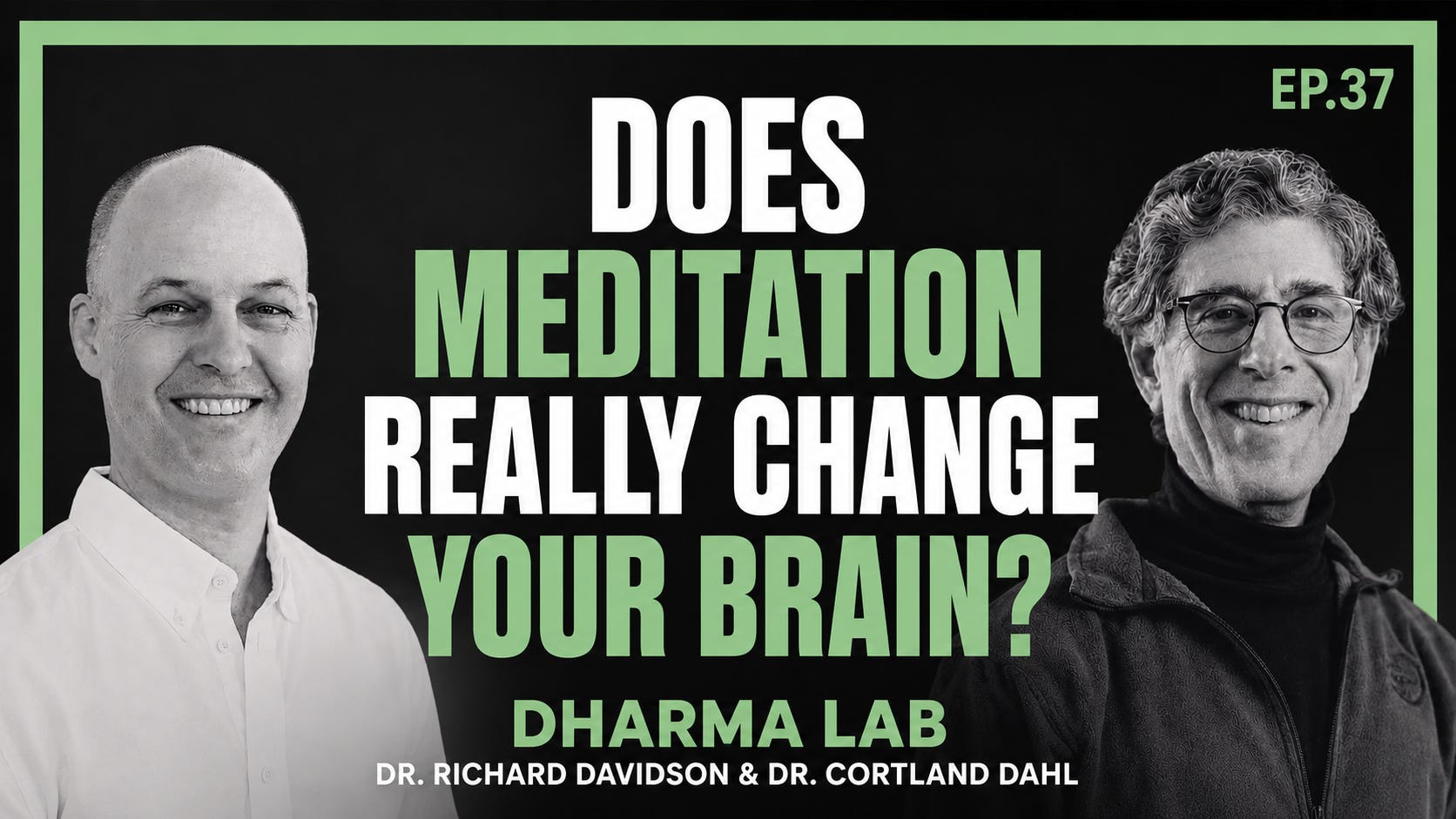
Does Meditation Really Change Your Brain?
2w ago00:27:17Tap to summarizeFor years, headlines claimed that meditation could actually grow parts of the brain. But what if that’s not the most interesting question?As the science has evolved, researchers have shifted their focus. What changes in the brain? Which changes matter most? And why might some structural changes grow, then recede, as expertise develops?In this conversation, Richie and Cort explore what decades of neuroscience have taught us, what scientists have gotten right, what they’ve gotten wrong, and where the research is heading.Enjoy!Watch on YouTube; Listen on Spotify or Apple Podcasts.If these conversations are useful, please consider subscribing to our YouTube channel.Reminder: We have a FREE 1-hour live practice session on Aug 19th, 7pm CT with Richie and Cort discussing how different meditation practices map to the four pillars of well-being (Awareness, Connection, Insight, and Purpose). More details and register here!Episode Companion Flashcards!In This Episode:00:00 Does Meditation Really Change the Brain?03:16 Brain Function vs. Brain Structure05:41 The Gray Matter Studies That Started It All11:45 Why the Gray Matter Evidence Changed15:20 White Matter and Brain Connectivity18:01 What the Research Actually Means21:40 Brain Health, Neuroplasticity, and Human PotentialTranscript for those who prefer to read:Richie Davidson:There’s no question that meditation changes the brain.We’re talking here about both the function and the structure of the brain. There’s no question that meditation changes the brain, and there is overwhelming evidence for that.Structural changes, like increases in gray matter in specific regions of the brain after short amounts of meditation, however, are a different story. The evidence for those findings has really not held up.Even more interesting, some of the effects that have been reported are actually the opposite of what we might expect.Cortland Dahl:Hello everyone. Welcome to another episode of Dharma Lab. I’m Cortland Dahl, and I’m here with Richie Davidson, one of the pioneering neuroscientists who has helped us understand the relationship between the mind, the brain, emotions, and how we can train ourselves to flourish.Today we’re diving into one of the biggest scientific questions in meditation research: does meditation actually change the brain?When I think about my own life, I can point to experiences that feel like a clear before and after.When I started meditating more than thirty years ago, I had a genuine phobia of public speaking. It wasn’t just that I got nervous. I had a severe fear of speaking in front of people.Years later, not only do I no longer get anxious, I actually enjoy it.I’ve even measured my physiology with devices like my Oura Ring. My heart rate and other biometrics actually shift into a deeply relaxed state when I’m speaking in front of a crowd, something that would have been unimaginable twenty or thirty years ago.Whether or not my brain changed, it seems difficult to imagine that such a profound transformation could happen without the brain changing in some way.At the same time, we often see confusing headlines.One day the headline says, “Meditation changes your brain.”The next day another study appears suggesting the opposite.Even the phrase “changes your brain” can mean different things. Are we talking about how the brain functions? Are we talking about the physical wiring of the brain? Are we talking about changes in structure?Richie, you’ve done some of the most important work in this area, and I think this is one of those topics where the headlines often miss the nuance.How should we think about it?Richie Davidson:You set this up beautifully by distinguishing between functional changes in the brain and structural changes.Functional changes refer to differences in how the brain is operating. We can measure those by looking at patterns of activity in different brain regions.Structural changes are different. They refer to the physical characteristics of the brain itself.That includes gray matter, which consists of the cell bodies of neurons, and white matter, which consists of the axons that connect one region of the brain to another.It’s entirely possible for the brain to change functionally without changing structurally.If structural changes occur, they almost always imply changes in function as well.One of the reasons this field became so exciting was that, about twenty years ago, several early studies suggested that people who completed an eight-week Mindfulness-Based Stress Reduction course showed increases in gray matter in regions such as the prefrontal cortex.Those findings generated enormous excitement and headlines claiming that meditation could literally grow your prefrontal cortex.Cortland Dahl:Before we go further, why would someone even want a larger prefrontal cortex?Richie Davidson:The prefrontal cortex is central to what we call the executive network.It’s involved in planning, goal-directed behavior, regulating attention, forming healthy habits, and inhibiting behaviors we want to change.If you’re making a grocery list, planning your route to the store, or intentionally directing your attention toward something important, the prefrontal cortex plays a major role.It also allows us to think about the future and reflect on the past.That’s incredibly useful, but it’s also one of the reasons humans worry so much.As Robert Sapolsky famously described in his book Why Zebras Don’t Get Ulcers, zebras don’t spend time worrying about tomorrow. Humans do, largely because we have this remarkable prefrontal cortex.So it’s an extraordinary gift, but it can also contribute to suffering.Returning to the research, those early studies suggested that relatively short periods of meditation increased gray matter in regions like the prefrontal cortex.Many additional studies followed.Then, in 2023, a meta-analysis concluded that Mindfulness-Based Stress Reduction produced structural brain changes.However, the story didn’t end there.The journal later retracted that meta-analysis because important data had been omitted. When those missing data were included, the reported effects disappeared.Around the same time, our own research published in Science Advances found no structural gray matter differences between people who completed Mindfulness-Based Stress Reduction and carefully designed control groups.So when it comes to gray matter increases after relatively short periods of meditation, the evidence has simply not held up.There’s another finding that’s particularly intriguing.Some studies have examined whether people with more meditation experience show greater structural changes.Interestingly, the relationship appears to go in the opposite direction.The more meditation people have practiced, the smaller the structural differences often become.When you think about expertise, that actually makes sense.If gray matter simply kept increasing forever, eventually we’d have bumps sticking out of our heads.That’s obviously not how biology works.Instead, expertise in many domains appears to involve temporary structural changes that later become more efficient as skills mature.There may be a period where gray matter increases, but as expertise develops, those changes may naturally recede.Cortland Dahl:So the story is much more nuanced than simply saying meditation makes your brain bigger.Richie Davidson:Exactly.And that’s where white matter becomes especially interesting.White matter reflects the connections between different regions of the brain.Across many different kinds of learning, white matter appears to be much more responsive to experience than gray matter.For example, beginning jugglers can show measurable white matter changes after only about an hour and a half of training.Those changes are dynamic.If you stop practicing, they may recede.We’ve found similar results with meditation.In the same study where we found no gray matter changes, we did observe white matter changes in pathways related to self-regulation after roughly twenty to thirty hours of meditation practice.We also have new research, not yet published, suggesting that about five minutes of daily practice for a month is associated with white matter changes.These findings suggest that changes in brain connectivity may occur very early in meditation training and may be especially important.Cortland Dahl:One thing I’m hearing is that we often oversimplify what it means for the brain to change.We hear phrases like “meditation...
Transcribe →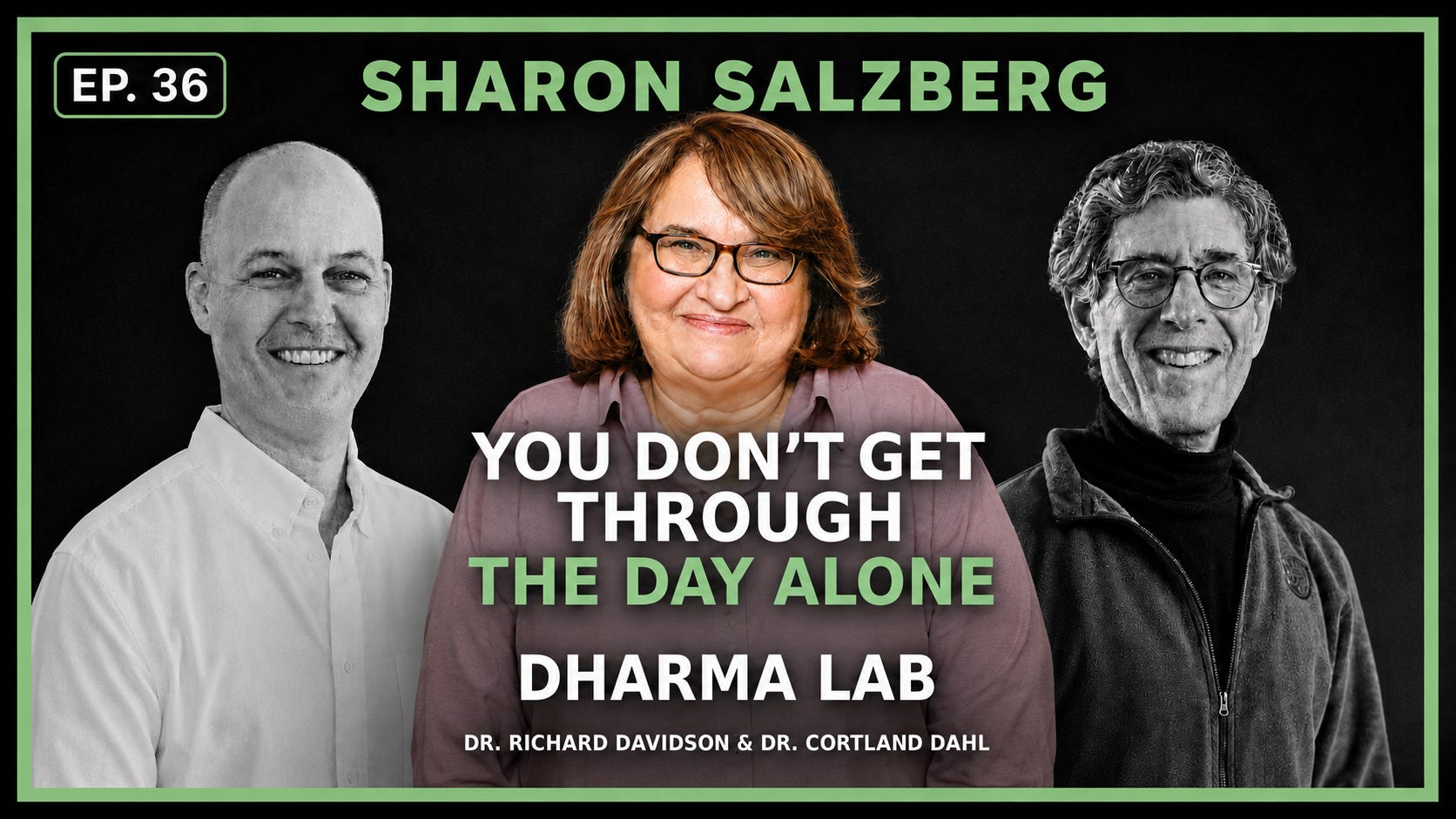
You Don't Get Through The Day Alone - Sharon Salzberg on DL Ep. 36
4w ago00:54:29Tap to summarizeSharon Salzberg joins Richie Davidson and Cortland Dahl for a conversation about loving-kindness, connection, and the quiet ways our lives are supported by others.At a time when many people feel lonely, cut off, or pulled into habits of criticism and competition, Sharon offers a simple experiment: pause, notice who makes your life possible, and see what happens when appreciation becomes part of daily life.Sharon Salzberg is a meditation teacher, New York Times bestselling author, and co-founder of the Insight Meditation Society in Barre, Massachusetts. She has written fifteen books, including Lovingkindness and Real Happiness. Her upcoming workbook, Living Lovingkindness, is available for pre-order and will be released in January 2027.Enjoy!Watch on YouTube; Listen on Spotify or Apple Podcasts.If these conversations are useful, please consider subscribing to our YouTube channel.Episode Companion FlashcardsThe full conversation is below, lightly edited for readability.Chapter List* (00:00) A true icon, and a first story* (03:33) The Dalai Lama and the crutches* (09:35) What actually trips people up* (13:33) Why Sharon prefers the word “connection”* (18:30) A guided reflection* (21:26) Vulnerability, and the neutral person* (28:10) Attention, and what the science shows* (36:26) The obstacles, and where to start* (46:46) Little rituals, and eating as practice* (52:00) Parting thoughtsTry this 2-minute Micro-Practice from Sharon Now(00:00) A true icon, and a first storyCort DahlHello, welcome everyone to another episode of Dharma Lab. I’m very honored and excited to be here with our two guests. Of course, I’m here with Richie Davidson, who many of you already know, one of the most well-known neuroscientists on the planet. And we’re here with a true icon of the world’s meditative tradition, Sharon Salzberg, who’s also a dear friend, and truly one of those people who, when the history books are written about the manifestation of these meditative traditions in the modern world, played an incredibly important role.Just before this started, we were all chatting, and Sharon, you were mentioning that this is the 50th anniversary of the Insight Meditation Society. IMS, as it’s commonly referred to, is certainly one of the first and one of the most important centers for Buddhist practice and meditation in the modern world. Sharon is one of the co-founders of IMS, back in the 1970s. It’s hard to believe it’s been 50 years.She has written some of the most well-known books in the meditation world. Loving-Kindness — she literally wrote the book on loving-kindness, and has been the main proponent of it as one of the main forms of meditation coming out of the Buddhist tradition, traditionally known as metta. She also has a podcast, Metta Hour, which both Richie and I have been on. And she’s written many other books, including her first children’s book, Kind Carl.Richie DavidsonI read it to my six-year-old granddaughter, who loved it, absolutely loved it, and wanted more copies to give to all her friends.Cort DahlAnd many, many other books — Real Life, Real Love, Real Happiness, a whole series. Loving-Kindness, the book I mentioned first, is really a modern classic. It was one of the first books I read back in the nineties when I was starting to meditate. So, Sharon, you’ve been an inspiration to so many of us — through your writing, through co-founding IMS, through your endless teaching all over the world. It’s an honor to have you.I thought we could start with a story I’ve heard a few times and always found moving: His Holiness the Dalai Lama visiting the United States for the first time, and your interactions with him. Let’s start there, and see where the conversation goes.(03:33) The Dalai Lama and the crutchesSharon SalzbergSure. And I’m so happy and honored to be with the two of you, truly. We co-founded the retreat center — Jack Kornfield, Joseph Goldstein and I — in 1976. It’s in Barre, Massachusetts, about 40 minutes from Amherst. In 1979 we heard the Dalai Lama was coming to Amherst, so, being young and bold, we wrote a letter to his private office and said, maybe you’d like to visit us too. And to our amazement, we got a letter back saying, yes, he’ll come.It was an incredibly zooey day. We had sheriffs and people patrolling the roof with guns, the street blockaded. A very intense day. And I’d been in a car accident a few weeks before — I had a broken bone in my foot and was using crutches, which I was not very skilled with. So I was standing way at the back of about a hundred people. His car pulled up, he got out, and he did something I’ve seen him do many times since, but it was the first time. It’s almost like he has a kind of radar for who in a crowd is suffering the most, and that was me. He cut through a hundred people, took my hand, looked me in the eye, and said, what happened?Standing there in the back, I’d been thinking, I’m so stuck back here, this is terrible — I helped start this place, and here I am at th...
Transcribe →
The Superpowers in Your Brain’s Wiring with Dr. Richard Davidson and Dr. Cortland Dahl (DL #35)
Jun 2500:42:18Tap to summarizeDr. Richard Davidson and Dr. Cortland Dahl explore how stable differences in brain activity may shape personality and the ways we engage with the world. They discuss introversion, anxiety, approach and withdrawal styles, what meditation can change without erasing our natural dispositions, and how meta-awareness can help us find the strengths in our own brain style.This is the third part in a series on Brain Asymmetry:Part 1: Your Brain Is A StorytellerPart 2: The Left Brain / Right Brain MythPart 3: The Superpowers in Your Brain's Wiring This is a public episode. If you'd like to discuss this with other subscribers or get access to bonus episodes, visit www.dharmalab.co/subscribe
Transcribe →
Boredom is Where You Meet Your Mind; DL Ep.34 with Dr. Richie Davidson and Dr. Cortland Dahl
Jun 1100:23:49Tap to summarizeWe now live in a world where boredom is almost optional. The moment there is a gap in the day, we can reach for a device and instantly distract ourselves.In this episode of Dharma Lab, Dr. Richard Davidson and Dr. Cortland Dahl explore boredom and restlessness from both a scientific and contemplative perspective. Richie explains why boredom often brings us face to face with the “default mode” of the brain, the self-referential narrative we carry around about who we are. Cort reflects on the physical, restless energy of boredom, and how meditation can turn that discomfort into an object of curiosity. They also offer a simple and powerful tool to bring more awareness into our day: the next time we feel the urge to escape boredom, we can pause, notice the urge, and let that moment become a practice.Watch on YouTube; Listen on Spotify or Apple Podcasts.If these conversations are useful, please consider subscribing to our YouTube channel.Episode Companion Flashcards!In this episode00:00:00 – Have we lost the ability to be bored?00:00:58 – Why boredom matters00:01:21 – “I could not sit still”00:03:34 – Boredom and comfort with our own mind00:04:19 – The default mode network00:05:01 – Why awareness can feel uncomfortable at first00:06:52 – The body’s role in restlessness00:08:36 – Richie’s childhood outlet: the bicycle00:11:12 – Why kids need to move00:12:15 – Meditation as training for boredom00:13:19 – Phones as an escape from discomfort00:14:41 – The everyday practice of not checking your phone00:16:25 – Turning the urge into a cue for awareness00:18:44 – What does boredom actually feel like?00:20:21 – Who is actually bored?00:22:03 – Turning ordinary waiting into practiceWritten transcript for those who prefer to read00:00:00 – Have we lost the ability to be bored?Cortland Dahl:We’re now living in a world where we just have such an easy escape hatch. We carry around these devices, and it’s so easy to distract ourselves that I feel like we’ve almost developed an incapacity to be bored.Richie Davidson:Our response to boredom, our relationship to boredom, has a lot to do with our comfort with our own mind. One of the things about boredom is that we tend to get bored when there’s not stuff for us to do. And when there’s not stuff for us to do, we are confronted inevitably by our own mind.00:00:58 – Why boredom mattersCortland:Hello everyone. Welcome to Dharma Lab. I’m here with my dear friend and colleague, Dr. Richard Davidson, one of the world’s eminent neuroscientists, and I’m Cortland Dahl.Today we’re going to talk about something I think probably everybody experiences, and maybe experiences a lot, which is boredom and restlessness.00:01:21 – “I could not sit still”Cortland:I have such vivid memories of this. If we had a normal distribution of where people fall and how easily bored they are, I’m pretty sure I would have been an outlier. I was so easily bored as a kid. I was one of those kids who just could not sit still.I have vivid memories, especially of summer afternoons, sitting at home and desperately trying to call my friends to see if anybody wanted to hang out. There was nothing on TV. This was back in the days before you could get everything on demand, just boring daytime TV shows.And I remember this feeling of crawling out of my skin. I literally could not sit there. We had no mobile phones. This was long before the iPhone and smartphones. But I would have done anything to have had something like that.Now it’s kind of amazing. After years of meditation, I would say if one thing has changed in my life, it’s my relationship to boredom. I kind of feel like I’m immune to boredom now. There’s a whole long practice history with that.But I thought we could start by talking about boredom because we’re now living in a world where we have such an easy escape hatch. We carry around these devices, and it’s so easy to distract ourselves that I feel like we’ve almost developed an incapacity to be bored, to just sit with that.So maybe we could talk about it from a scientific perspective. We can both share our personal experiences. But let me kick it over to you, Richie, and see if you have any opening thoughts. Then we can dive into it more deeply.00:03:34 – Boredom and comfort with our own mindRichie:I think boredom is an interesting topic.Cortland:It is. That’s the weird thing. It’s strangely interesting. Boredom is not boring.Richie:Yeah, it is strangely interesting.I think it’s a phenomenon that has been deeply impacted by changes in the fabric of our society, by the development of technology and so forth.And I think boredom, our response to boredom, our relationship to boredom, has a lot to do with our comfort with our own mind.One of the things about boredom is that we tend to get bored when there’s not stuff for us to do. And when there’s not stuff for us to do, we are confronted inevitably by our own mind. That is the one thing we can’t get rid of.People try, with drugs and other ways to dull the mind, but under most circumstances we have our minds.00:04:19 – The default mode networkRichie:From a neuroscientific perspective, we know that when a person is not engaged in a demanding activity that really requires their mental resources, what is active is a mode of brain function that we call the default mode.The default mode is mostly associated with self-referential thought. By self-referential thought, we mean the narrative we tell ourselves about who we are and all the things associated with that.And for a lot of people, that’s uncomfortable.00:05:01 – Why awareness can feel uncomfortable at firstRichie:We have data from work we’ve done using our Healthy Minds program with beginning meditators who’ve never meditated before. We often see that after the first week or so of cultivating awareness, they actually become more anxious. They report more anxiety.We think it’s not that they’re actually experiencing more anxiety, but that they’re noticing what’s going on in their mind. And what’s going on in their mind is often quite chaotic.Simply becoming more aware of it makes them more anxious, or they perceive their anxiety more accurately for the first time. And so they report higher scores more accurately.So I think one of the reasons people try to find strategies to get rid of boredom is because the chaotic nature of their own mind is uncomfortable.I actually think this is why people engage in certain kinds of leisure activities that are cognitively demanding, but that don’t serve any other function other than being interesting leisure activities. For example, doing crossword puzzles or Sudoku.There are a lot of people who spend a lot of time doing those things, and people report that they enjoy it. I think they enjoy it because it temporarily blocks the default mode. It temporarily engages other parts of their mind, so they’re not aware of the self-referential activity. They’re not aware of the narrative going on in the background.00:06:52 – The body’s role in restlessnessCortland:I’m curious about one thing I’d love to unpack from a scientific point of view: the relationship between these brain networks, specifically the default mode network that you talked about, and the rest of the nervous system.If I think back to my teenage self sitting on the couch, which to me is the most intensely bored I can remember feeling in my life, I think at that time I was completely oblivious to what was going on in my mind.When I remember that, I don’t remember the thought activity. Now, having meditated, I’m sure it was going on, but I just didn’t know how to attend to what was going on in my mind.But what I do remember is the physicality. There was almost this charge of restless energy. I needed to release the energy, and it just had nowhere to go. You’re kind of just this ball of energy, and yet it’s like you’re trying to constrain a ball of energy that’s trying to get out, but there’s no release for it.I’m imagining there are all sorts of things going on in the brain and the nervous system. It points to the relationship between thought activity, which can be completely subterranean at times. We’re not even really aware of all the thought activity, and yet it can have this bidirectional relationship with emotional experiences and physical experiences.I wonder if you could speak to that a little bit too, because I think the felt experience of boredom is often a very physical experience.00:08:36 – Richie’s childhood outlet: the bicycleRichie:Yeah, that’s so interesting.When I think back to my childhood, during those periods I got on my bicycle.Cortland:That’s what I should have done, probably.Richie:I developed a lifelong habit, which I still have, of riding my bicycle.I grew up in New York City, in Brooklyn, and fo...
Transcribe →
DL Ep. 33: The Left Brain / Right Brain Myth with Dr. Richie Davidson and Dr. Cortland Dahl
May 2800:29:11Tap to summarizeIn this episode, Richie and Cort continue their conversation on brain asymmetry by revisiting one of the most popular neuroscience ideas of the 1990s: the divide between the “left brain” and the “right brain.” Was the right hemisphere really the creative side of the brain, and the left hemisphere the logical one? Richie explains where that idea came from, what it got right, and why it was taken too far. Along the way, he explores language, visual-spatial processing, the 200 million neurons connecting the hemispheres, and why real creativity may depend less on one side of the brain than on the coordination between both.Watch on YouTube; Listen on Spotify or Apple Podcasts.If these conversations are useful, please consider subscribing to our YouTube channel.CHECK OUT EPISODE COMPANION FLASHCARDS below!This is the second part of our conversation on hemispheric specialization with Dr. Richard Davidson and Dr. Cortland Dahl. For the first part, see Your Brain Is a Storyteller, where we explore what split-brain research reveals about consciousness and emotion. For more on the popular science misreadings Richie warns about here, see our recent episode on Why dopamine isn't your problem. Dr. Richard Davidson is the William James and Vilas Research Professor of Psychology and Psychiatry at the University of Wisconsin–Madison and founder of the Center for Healthy Minds and the Healthy Minds App. His new book with Dr. Cortland Dahl, Born to Flourish, was published by Simon & Schuster in March 2026.Podcast Chapter List00:00:00 – Intro clip: Creativity requires both hemispheres00:01:30 – Welcome to Dharma Lab00:02:47 – Left brain/right brain ideas in popular culture00:04:00 – Where did these ideas come from?00:05:11 – Language, handedness, and hemisphere differences00:07:36 – The myth of the creative right brain00:08:50 – The 200 million neurons connecting both hemispheres00:10:38 – Split-brain patients and the corpus callosum00:11:57 – What surprised Richie in the early asymmetry research?00:13:10 – The resting brain data they almost threw away00:15:15 – Stable patterns in the resting brain00:16:04 – From “noise” to emotional style00:18:23 – The prefrontal cortex and emotion00:19:58 – Could you choose to use one side of the brain?00:21:52 – A grain of truth, taken too far00:22:55 – Sequential vs. parallel processing00:23:50 – Why real creativity requires both hemispheres00:24:51 – Interhemispheric coordination and creativity00:26:08 – Tibetan mudras and two-handed movement00:27:31 – Visualization, imagination, and creativity00:28:34 – ClosingEarlier Post on Brain Asymmetry (Part 1)Written transcript for those who prefer to readLightly edited for clarity and readability.Intro clip: Creativity requires both hemispheres00:00Richard Davidson:One of the things that’s true about language, and especially about speech, is that it’s sequential. We can’t say six words at the same time. Just can’t do it.Cortland Dahl:I’m pretty sure my son could when he was really young, but in any case, it’s usually true.Richard Davidson:Usually true. But if you have pictures of those six words — let’s say there are six animals and you present a picture — you can see all six at the same time.That difference is what we call sequential versus parallel processing. There are certain kinds of visual-spatial skills that can be done more in parallel, and other kinds of skills and tasks that require more sequential activity.And of course, real human creativity, I think, requires both.This is why we have this massive fiber bundle that connects the two hemispheres together so they can work in an integrated way. I think it’s really an oversimplification to think that the right hemisphere is creative and the left is not.Every human being has the potential to be creative. When humans are the most creative, we’re harnessing the full capabilities of our brain. It’s not just the right hemisphere or the left hemisphere. It’s both.Welcome to Dharma Lab00:01:30Cortland Dahl:Hello everyone. Welcome back to another episode of Dharma Lab. I’m Cortland Dahl. I’m here with Dr. Richard Davidson, who we all affectionately call Richie, one of the great living neuroscientists on the planet.Today we’re going to continue a discussion we’ve had previously about some of Richie’s most important early work.Richie, I’m excited to ask you about this, partly because I myself have always wanted to geek out and hear more about these things. We always have a million things to talk about, but I never get to talk to you about this.In a previous episode, we talked about your very early research when you were just at Harvard, coming out of grad school, and your early work that showed differences between the different hemispheres of the brain — what is most simply referred to as asymmetry between these different hemispheres.We talked a lot about that, and we can put a link to that previous discussion.Left brain/right brain ideas in popular culture00:02:47This was back in the late seventies and into the eighties. Then something very interesting happened in the nineties.I graduated from high school in 1992 and was just starting college. There was a book at that time, and there was all sorts of stuff in the popular media about asymmetry, although that word probably wasn’t used. I remember a lot of things about the left side and right side of the brain.There was a book that I think was something like Drawing on the Right Side of the Brain. It was pointing, in many ways, to your work, which you were very much at the forefront of and had been for many years at that point.But I imagine, like many things, there was probably a lot of oversimplification and perhaps even misunderstanding about what the science really says and what’s really going on in the brain.So maybe we could start there, going back to this discussion about asymmetry and what your research and other researchers were really finding about the different hemispheres of the brain — and how that relates to things like creativity, being more logical, and all the stuff that was at work in our popular conversations about the brain at that time.Where did these ideas come from?00:04:00Richard Davidson:Thank you for that great introduction. There’s so much to say. Just being primed with that brings back intense memories from that period. I was very much living this.I published more than 100 papers on brain asymmetry in one way or another, and edited two books on brain asymmetry that were published by MIT Press. They were major compendiums at the time, with a scientist in Norway named Kenneth Hugdahl, one of my early collaborators.So yes, there’s so much to say.Let’s begin by asking where these ideas may have come from.In the previous episode of Dharma Lab, where we began to introduce this topic, one of the things we talked about is that the left hemisphere can speak and has language much more so than the right hemisphere — at least in most people.Language, handedness, and hemisphere differences00:05:11I should say that these broad generalizations about the left and right hemisphere are roughly true for right-handed people only. They are not necessarily true for people who write with their left hand.That itself is a whole topic of really interesting conversation, and we’ll bracket it. We can come back to it today briefly. But for now — and I apologize to all you lefties out there — since the majority of people are right-handed, roughly 85%, we’ll just stick with that for now.One of the questions scientists posed is this: if the left hemisphere can speak and really is the primary province of language, what is the right hemisphere doing?It’s presumably not just an appendage. It’s not just there to structurally latch on to the left hemisphere and hold it in place. It has to be doing something.Does it have some specialized role? If the left hemisphere is specialized more for language, is there some set of functions for which the right hemisphere may be better than the left hemisphere?Scientists discovered that there are certain kinds of visual and spatial tasks that the right hemisphere seems to be better at.Now, when we say “better,” what we mean is typically a little bit better. It’s not like there are absolute differences. It’s not like the right hemisphere can do this and the left hemisphere can’t do this.Similarly for language, although for language, the lateralization seems to be more definitive, particularly for speaking. For ri...
Transcribe →
DL Ep.32: Dopamine Isn’t Your Problem with Dr. Richard Davidson and Dr. Cortland Dahl
May 2100:48:53Tap to summarizeIn this episode, Richie Davidson and Cortland Dahl unpack a very misunderstood molecule in popular culture: dopamine. Often blamed for craving, scrolling, distraction, and the endless loop of wanting more, dopamine is not something we can “detox” from or simply turn off. It is essential to motivation, aspiration, learning, and even the desire to practice meditation. Together, Richie and Cort explore what dopamine actually does in the brain, why wanting and liking are not the same thing, how novelty keeps us hooked, and how savoring may help us step out of compulsive loops and reorient toward what is genuinely nourishing. Enjoy!Watch on YouTube; Listen on Spotify or Apple Podcasts. If these conversations are useful, please consider subscribing to our YouTube channel.CHECK OUT EPISODE COMPANION FLASHCARDS!Podcast Chapter List(00:00:00) – Dopamine is not something we can turn off(00:03:46) – What is a neurotransmitter?(00:06:04) – Dopamine as neurotransmitter and neuromodulator(00:08:20) – Why the brain is too complex for simple chemical stories(00:12:02) – The awe and mystery of the brain(00:15:51) – Dopamine, motivation, and the myth of dopamine detox(00:17:04) – Wanting vs. liking(00:19:24) – Doom scrolling and the loop of seeking(00:22:32) – Does dopamine explain why we keep scrolling?(00:24:21) – Experiential fusion and mindless behavior(00:25:42) – Why one molecule is never the whole story(00:26:57) – Novelty and reward prediction error(00:29:00) – The Easter egg example: seeking, finding, and disappointment(00:30:23) – Dopamine in different brain circuits(00:35:37) – What actually helps with compulsive loops?(00:37:47) – Savoring as a way out of wanting(00:39:24) – Meditation, breath, and the practice of savoring(00:43:20) – Letting go of seeking(00:43:56) – Gratitude, bodhicitta, and the sweetness of connection(00:45:28) – Renunciation as reorientation(00:48:00) – ClosingRelated Topics From the Archives:Written transcript for those who prefer to readLightly edited for clarity and readability.Dopamine Is Not Something We Can Turn Off (00:00:00)Richard Davidson:Dopamine is essential for human life.Cortland Dahl:There’s no turning dopamine off.Richard Davidson:No turning dopamine off. And anyone who thinks they’re going on a dopamine detox and really banishing their brain of dopamine, I hate to burst the bubble, but that would not be compatible with life.Dopamine is essential in motivation, desire, seeking, and anything that is goal-directed. It has been described by the neuroscientist Kent Berridge as central to “wanting,” which he contrasts with something that it is often confused with: “liking.”Many times, we like the things we want. But not all the time. Sometimes we get caught up in a wanting cycle that is not necessarily leading to liking. But dopamine also plays an incredibly positive and important role. When I spring out of bed in the morning, go down to have my cup of tea, and have the strong aspiration to meditate, that is inevitably relying on the dopamine system too.Welcome to Dharma Lab (00:01:45)Cortland Dahl:Welcome everyone to another episode of Dharma Lab. I’m Cortland Dahl, and I’m here with my dear friend Richie, Dr. Richard Davidson, who, as I’m sure most of you know, is one of the most eminent neuroscientists on the planet.We’re incredibly fortunate to have him in discussion yet again, and for a topic that he is especially well suited to talk about, which is dopamine.I never thought dopamine would be a hook for a conversation like this, but it has taken on almost mythic status in popular culture. It has almost become the bad boy of the brain, like the amygdala, which is one brain region that always gets a bad rap and is associated with all sorts of negative things.These days, of course, we hear a lot about dopamine. You might have heard of things like a dopamine detox, which makes it sound like dopamine is some toxic thing in the brain that we want to get rid of or shut off or have less of in some way.So we thought we could get into the science of neurotransmitters generally, and then specifically dopamine. What does the science really say? What function does dopamine actually play, not only in our brains but in our ability to thrive and flourish?Richie, maybe we can start by zooming way out. I’m guessing people have heard the word dopamine. Some may have geeked out a little and learned more or even tried something like a dopamine detox. Other people may have heard about serotonin or other neurotransmitters, but my guess is that people’s understanding is still a little fuzzy.Could we start with the idea of a neurotransmitter, and then zoom in and look at dopamine specifically?What Is a Neurotransmitter? (00:03:46)Richard Davidson:Yes. Thank you so much. This is a juicy topic and very appropriate for Dharma Lab.There is a constellation of molecules in the brain that play many different roles. One of those roles is what you mentioned: a neurotransmitter.A neurotransmitter has a very specific role in mediating the interaction between two neurons. When one neuron fires, it sends an electric potential down the axon of that neuron. You can think of the axon as the wire extending from the cell body. The cell body is where the basic machinery is, and the axon extends from the neuron.Those axons can be short, and they can also be very, very long. If I asked you right now to move the big toe in your right foot, all of you should be able to do that. That is actually a neuron that extends all the way from your brain to your big toe.Cortland Dahl:That’s a single neuron? That’s cool. I didn’t know that.Richard Davidson:Yes, it is a single neuron. Neurons have many different lengths.At the end of the axon, there is machinery that releases a little packet of chemical. That packet binds to what is called a receptor on another neuron, and that initiates an electric change in the second neuron.That is how communication works between two or more neurons. That is called a neurotransmitter.Dopamine as Neurotransmitter and Neuromodulator (00:06:04)There are also neurotransmitters and other molecules that act as neuromodulators. A neuromodulator is different from a neurotransmitter. Dopamine, which is the topic of our conversation today, can serve as both a neurotransmitter and a neuromodulator.What is the difference?A neuromodulator alters the threshold for the firing of a neuron. It is not directly involved in cell-to-cell communication in the same way. It is more like the molecular soup in which the neuron resides, and that changes the threshold for the firing of the subsequent neuron.There are many molecules that serve as both neurotransmitters and neuromodulators, and dopamine is one of them.I think most neuroscientists would agree that we have not yet discovered the full range of neuromodulators and neurotransmitters in the human brain. It is a vast number. In the popular press, we’ve heard about dopamine, serotonin, maybe norepinephrine, maybe GABA. But there are hundreds of these molecules playing complicated roles.This is why, in general, it is extremely hazardous to pin a particular mental state on a single molecule. That is almost assuredly excessively simplistic and wrong.To the best of our knowledge, there is no well-defined psychological state that can be pinned to one specific molecule. It is much more complex than that.Why the Brain Is Too Complex for Simple Chemical Stories (00:08:20)Cortland Dahl:Just as a footnote, I think it’s mind-boggling when you hear how complex our brains are. Could you say a little about the estimates of how many neurons there are, and then beyond that, the connections between neurons?Now we’re talking about neurons communicating with each other. It’s an order of magnitude we can’t even comprehend.Richard Davidson:The estimated number of neurons in the human brain is about 85 or 88 billion.Cortland Dahl:That’s a “b,” everyone.Richard Davidson:Yes, billion. And the estimated number of connections among those neurons is in the trillions.Cortland Dahl:That’s in your head, everyone. Trillions of interconnections, and all these little communications, neuromodulators and neurotransmitters. The number of times that is happening right now, as you’re listening, is beyond what we can actually think about.Richard Davidson:That’s very true. I often reflect on this as a humility induction, because it is so complicated and we really understand so little of it at this point in time.If we pause to appreciate the complexity, and if we are honest with ourselves, it really is a humility induction.It also exposes how gross our measures are. We’ve done a lot of research with EEG, including the first paper we published with long-term meditation practitioners. EEG involves pu...
Transcribe →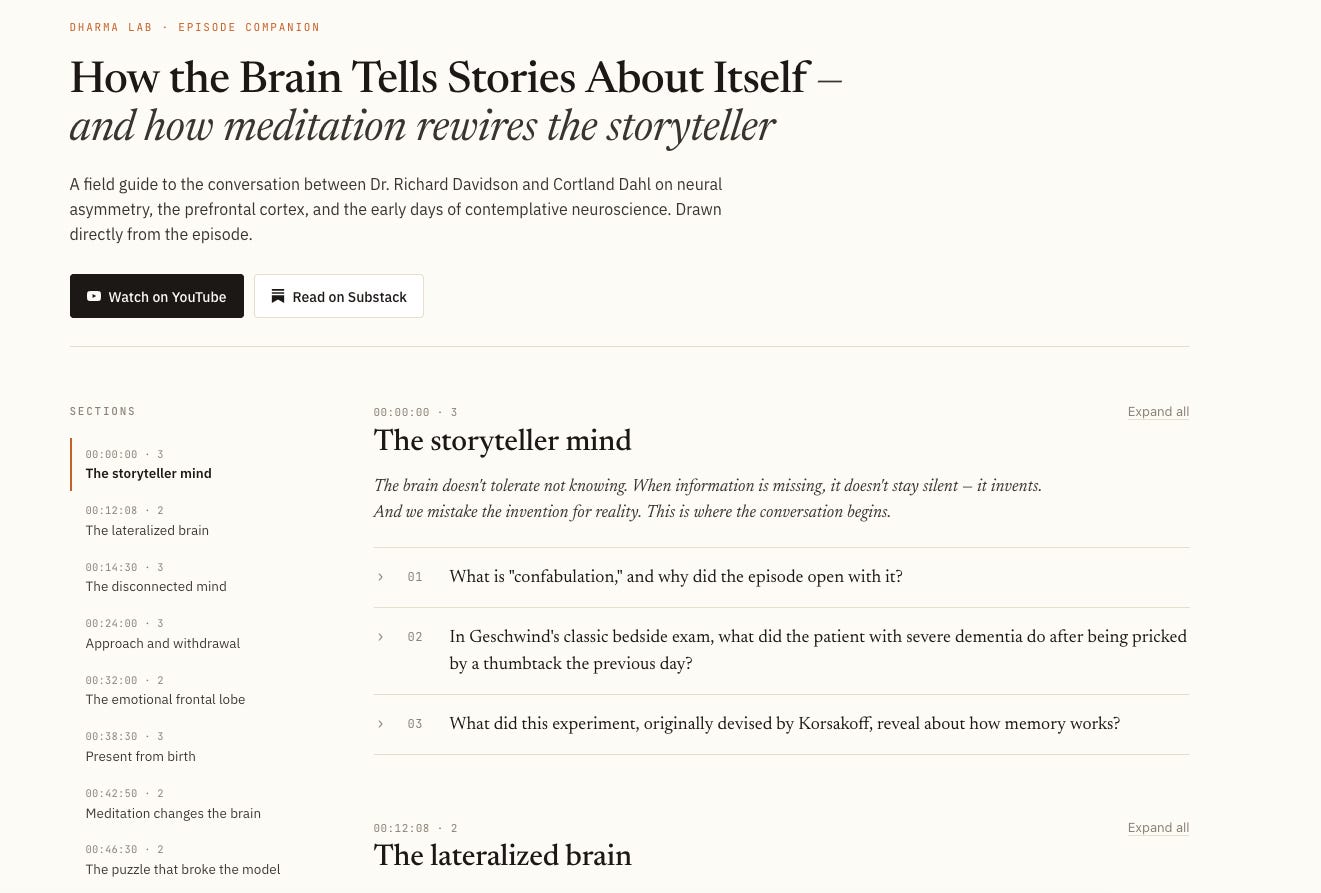
DL Ep. 31: Your Brain Is a Storyteller
May 700:50:42Tap to summarizeIn this episode, Richie Davidson and Cortland Dahl deeply explore the science of the emotional brain: why the mind is a storyteller, what split-brain research reveals about consciousness, how brain asymmetry shapes emotion, why some people approach opportunity with optimism while others withdraw, and what meditation may do to the brain and immune system. Enjoy! See below for FLASHCARDS, Full Transcript BelowWatch on Youtube; Listen on Spotify or Apple Podcasts.FLASHCARDS / EPISODE COMPANION HEREPodcast Chapter List(00:00:00) – The brain is a storyteller(00:01:03) – Welcome to Dharma Lab(00:04:05) – Norman Geschwind and behavioral neurology(00:06:31) – The thumbtack story: emotional memory without conscious memory(00:12:12) – Language, the left hemisphere, and the corpus callosum(00:19:04) – Brain asymmetry and emotion(00:22:54) – Why emotion was so understudied(00:29:26) – Brain asymmetry, attachment, and aversion(00:31:19) – The prefrontal cortex and the old divide between thought and feeling(00:37:07) – Studying emotion in newborn infants(00:42:37) – Meditation, brain asymmetry, and the immune system(00:47:04) – Why “it’s not so simple”Written transcript for those who prefer to readLightly edited for clarity and readability.The Brain Is a Storyteller (00:00:00)Cortland Dahl:The example you gave earlier, with Broca’s area and the split-brain findings, points to something fascinating. Parts of the brain are not always talking to each other. One part of the brain clearly knows something, but the part that communicates doesn’t. And it doesn’t stay silent. It makes something up.That’s the funny thing. In the absence of information, we don’t just stay silent. When we don’t know something, we are not comfortable with not knowing. Some instinctual part of us fills in the blanks almost all the time.Richard Davidson:Exactly. The human mind and brain is a storyteller. This is how we make sense of our world. We create these narratives.Welcome to Dharma Lab (00:01:03)Cortland Dahl:Welcome everyone to another episode of Dharma Lab. I’m Cortland Dahl, and I’m here with Dr. Richard Davidson, who we all lovingly call Richie.As many of you know, Richie is one of the most pioneering and widely studied neuroscientists on the planet. It’s a gift to be in conversation with him.Today we’re going to have a conversation I’ve wanted to have for a long time. I moved to Madison, Wisconsin in 2012 to study with Richie, and over the years I’ve heard many conversations at the Center for Healthy Minds about neuroscience, meditation, and the mind. But one thing that has never really happened, even for those of us who work closely with Richie, is a kind of broad “download” from him about the amazing body of work he has contributed to over the decades.Many people know Richie as a pioneer of contemplative science and contemplative neuroscience, the scientific study of how practices like meditation affect the mind, the brain, and our biology. But he is also a pioneer of affective neuroscience, which you might think of as the neuroscience of emotion.To be a pioneer in one field is extraordinary. To be a pioneer in two is kind of mind-boggling.So today I want to dig into some of those key insights, especially around neural asymmetry, which was a huge part of Richie’s early career and a central theme in affective neuroscience.Norman Geschwind and Behavioral Neurology (00:04:05)Richard Davidson:This topic is near and dear to my heart. It still is something I’m extremely interested in. It really began when I was a graduate student and had the opportunity to study with Norman Geschwind at Harvard Medical School.Geschwind was one of the great towering figures in what we now call behavioral neurology. I took a course with him on functional neuroanatomy, which is basically how different parts of the brain are connected to different behavioral functions.He was a neurologist, so he looked at people’s behavior as an external reflection of what was going on in the brain. He was an extremely keen observer of behavior, and he was also very demanding. He was what we would now call a localizationist, someone who believed in the specific localization of different functions in different parts of the brain.He used to say that if you don’t believe in localization, it’s because you don’t know neuroanatomy well enough. That pushed me to learn neuroanatomy deeply, including doing a human brain dissection.I also went on rounds with him, where he would visit neurological patients in the hospital. He would do these bedside exams that were incredible, using clever ways of interacting with patients to reveal what might be different about their brains.The Thumbtack Story: Emotional Memory Without Conscious Memory (00:06:31)Richard Davidson:One of the most famous demonstrations I saw involved a technique associated with Korsakoff, who described a syndrome of dementia related to alcoholism.Korsakoff showed that there can be a separation between memory for declarative information and memory for emotional information.A person with severe dementia might not recognize you if you came back the day after seeing them. They may have no conscious memory of who you are. But the question was whether the same was true for emotional information.The demonstration was this: a doctor would put a thumbtack in his hand and shake the patient’s hand. The patient would feel the prick and withdraw. The next day, the doctor would return and ask, “Do you know who I am?” The patient would say no. The doctor would identify himself and offer his hand again.But the patient refused to shake his hand.When asked why, the patient confabulated. He said something like, “I think your hand is dirty, and I don’t want to shake your hand.”That’s a beautiful demonstration of the dissociation between declarative memory and emotional memory. The declarative memory was gone. The patient did not recognize the doctor’s face or name and had no conscious memory of having seen him. But the emotional memory remained.Cortland Dahl:That one point has huge implications for life. We often have an interpretation of something and we are completely convinced of it. It seems so real that it doesn’t occur to us that it’s an interpretation.And yet the mind may have limited information, or may not be conscious of something, and it creates a whole story. In some cases, the story is flat-out wrong. But in the moment, it feels like reality.Richard Davidson:Exactly. And this is not just occurring in patients with frank brain damage. This is happening in all of us all the time. This is how our minds work. The mind creates a story about the world, and it’s from that story that we operate.It is not from some veridical perception of things in the world. There is no such thing as that. Our minds are constantly creating these stories.This relates directly to our insight pillar of well-being, which is about the narratives we are constantly creating about ourselves.Language, the Left Hemisphere, and the Corpus Callosum (00:12:12)Richard Davidson:One of Geschwind’s great contributions was his work on language-related lateralization in the human brain.In virtually all right-handed people, which is about 85 to 90 percent of the population, it is the left hemisphere that can speak, while the right hemisphere cannot.There is a key region called Broca’s area, named after Paul Broca. Damage to this area, often through stroke, can impair a person’s ability to speak. What is interesting is that this is one of the most clearly lateralized functions in the human brain. If this area in the left hemisphere is damaged, the corresponding area in the right hemisphere does not simply take over.The two hemispheres of the brain are very similar in many ways, but they have important differences. They are connected by the corpus callosum, a massive bundle of white matter that connects neurons in one hemisphere to corresponding neurons in the other. It is the largest pathway of connection in the human brain.In the past, for some patients with severe epilepsy, surgeons would cut the corpus callosum to prevent seizures from spreading from one hemisphere to the other. This left people with two disconnected hemispheres.When that happens, you can demonstrate strange dissociations. For example, if a split-brain patient is blindfolded and holds a glass in the left hand, the sensory information goes to the right hemisphere. But because the right hemisphere cannot speak, and the information cannot cross to the left hemisphere, the person may not be able to verbally identify the object. If you give them multiple-choice pictures, though, they can point to the glass.Cortland Dahl:That’s the same basic finding. One part of the brain clearly knows something, but the part that communicates doesn’t. And it doesn’t stay silent. It makes something up.Brain Asymmetry and Emotion (00:19:04)Richard Davidson:Most early research on brain asymmetry focused on the back of the brain, where language and some perceptual differences were located. The left hemisphere was specialized ...
Transcribe →
DL Ep.30: The Dharma of Relationships with Devon + Nico Hase
Apr 2400:59:55Tap to summarizeRelationships can be one of the most powerful parts of the spiritual path because they reveal the parts of ourselves we cannot easily see alone. In this episode of Dharma Lab, Cortland Dahl and Richie Davidson are joined by meditation teachers and authors Devin and Nico Hase to explore how Buddhist practice can help us navigate love, conflict, vulnerability, appreciation, and repair. Drawing on their new book, This Messy, Gorgeous Love, they reflect on why relationships are inherently challenging, how they become mirrors for growth, and how simple practices like awareness, check-ins, and appreciation can turn partnership into a path of awakening.Podcast Chapter List0:00 Relationships are rough: using partnership as a spiritual path1:11 Introducing Devin and Nico Hase and This Messy, Gorgeous Love5:36 What can a monastic tradition teach us about relationships?7:05 Devin on translating Buddhist teachings into modern lay life9:53 Nico on bringing Dharma into the gritty reality of family and partnership11:29 Richie on family, feedback, and why Dharma must matter in real life15:23 Retreat, relationship, and why we can’t hide from ourselves18:04 Partners as teachers: what relationships reveal about us19:34 Nico on monastic ideals, friction, and freedom21:29 Richie on being exposed, seen, and changed by relationship22:16 Self-knowledge, co-regulation, and the dance of partnership23:36 Writing the book together and relationship as mirror25:07 Cort on intimacy, fear, and what love uncovered28:40 Relationships are rough: the myth of smooth sailing30:04 Vulnerability, exposure, and becoming resilient together31:21 Dukkha and the “bumpy ride” of partnership34:24 Appreciation, gratitude, and learning to see the good42:42 Conflict styles: volcanoes, diplomats, and dodgers52:19 The trance of nice: kindness, emotion, and authenticity55:12 Practical takeaways: check-ins, fun, and daily connection57:43 Final reflections on relationships, friendship, and the book’s wider relevance This is a public episode. If you'd like to discuss this with other subscribers or get access to bonus episodes, visit www.dharmalab.co/subscribe
Transcribe →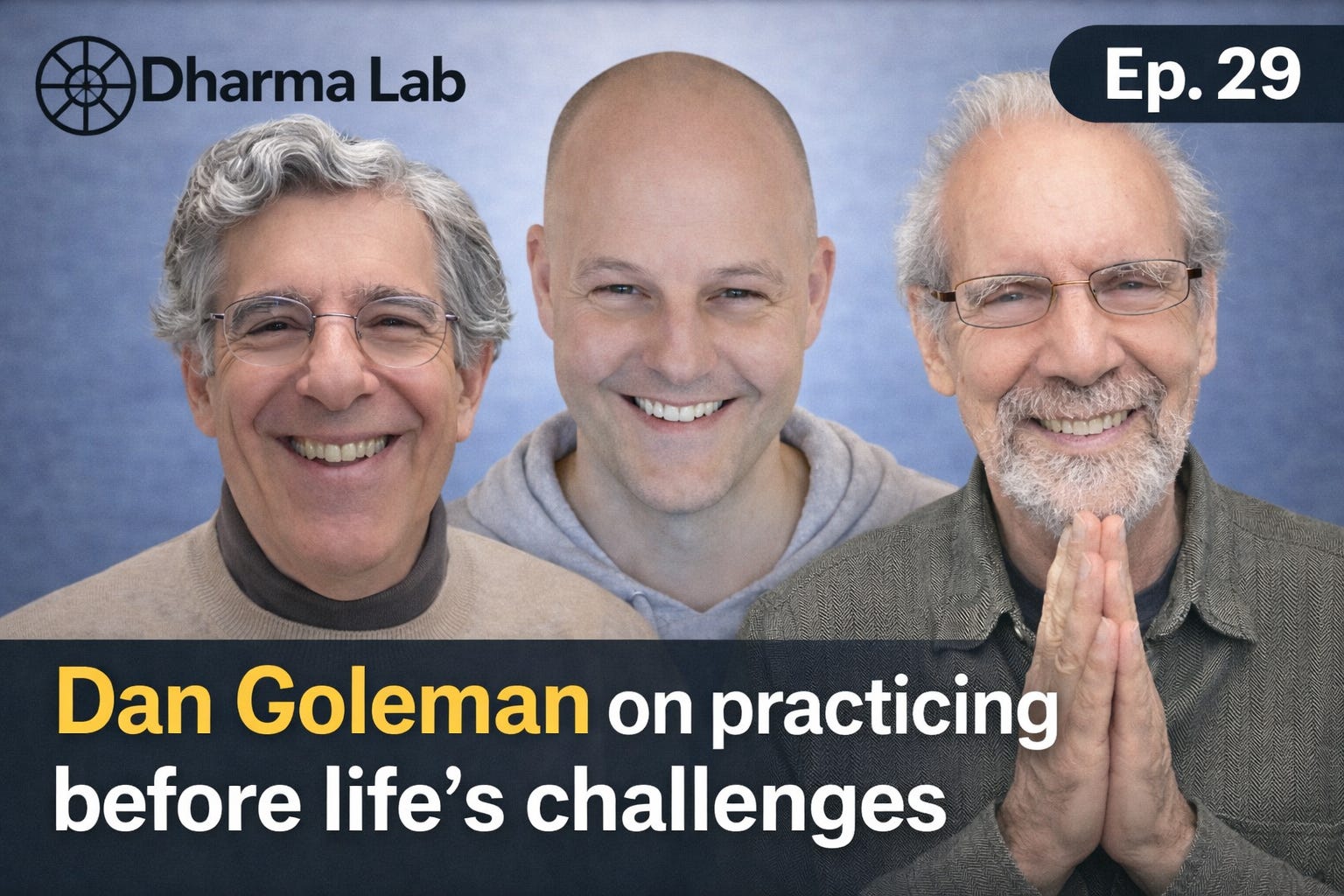
DL Ep.29: Daniel Goleman on Practicing Before Life's Challenges
Mar 2700:52:23Tap to summarizeDr. Richie Richard Davidson, Cortland Dahl, Dan Goleman DiscussionChapter Summary:00:05:51 — Dan Goleman returns from India and meets Richie Davidson at Harvard00:06:38 — Studying meditation in academia when the field dismissed it00:07:11 — Their careers diverge: journalism at the New York Times and neuroscience research00:08:08 — The Mind & Life Institute and first meetings with the Dalai Lama00:09:20 — Paul Ekman’s surprising transformation after meeting the Dalai Lama00:12:03 — Richie’s quiet strategy: exposing scientists to contemplative practice00:13:09 — The birth of a new generation of contemplative scientists00:14:37 — Cort Dahl discovers meditation research in graduate school00:16:10 — Jon Kabat-Zinn teaching yoga in a Harvard Square basement00:17:35 — “The after is the before for the next during” — meditation changes baseline states00:18:43 — The breakthrough 2004 meditation brain study00:20:26 — The Dalai Lama’s lifelong assignment to study and share these practices00:21:47 — Shifting psychology from pathology to human flourishing00:26:09 — Emotional intelligence as a path to well-being00:31:16 — Why practice—not theory—is what actually changes people00:32:37 — Cort Dahl’s experience with social crisis and emotional complexity00:35:31 — The Dalai Lama’s advice on skillfully working with anger00:38:28 — Two contemplative approaches to difficult emotions00:45:24 — “Feel what you are feeling” — a simple practice that changes awareness00:46:11 — Dan Goleman on Vipassana meditation00:47:10 — Scaling well-being beyond formal meditation practice00:50:04 — Mingyur Rinpoche after retreat: “the same, only more so” This is a public episode. If you'd like to discuss this with other subscribers or get access to bonus episodes, visit www.dharmalab.co/subscribe
Transcribe →