Loading summary
Transcript56 lines
- [00:00]
A
I think the tastemakers know when to break the rules and when to push beyond the boundaries of what exists today and when to quiet and to go with the flow. And I think that is actually the like core ability that AI doesn't allow for right now is like knowing that balance. It's like knowing when to go super deep into many different prompts, to really like kind of shape and build something new versus, you know, it's okay to not fight every battle and to say like, not everything needs to be new and like that process of zooming in and out I think is, is what create taste.
- [00:33]
B
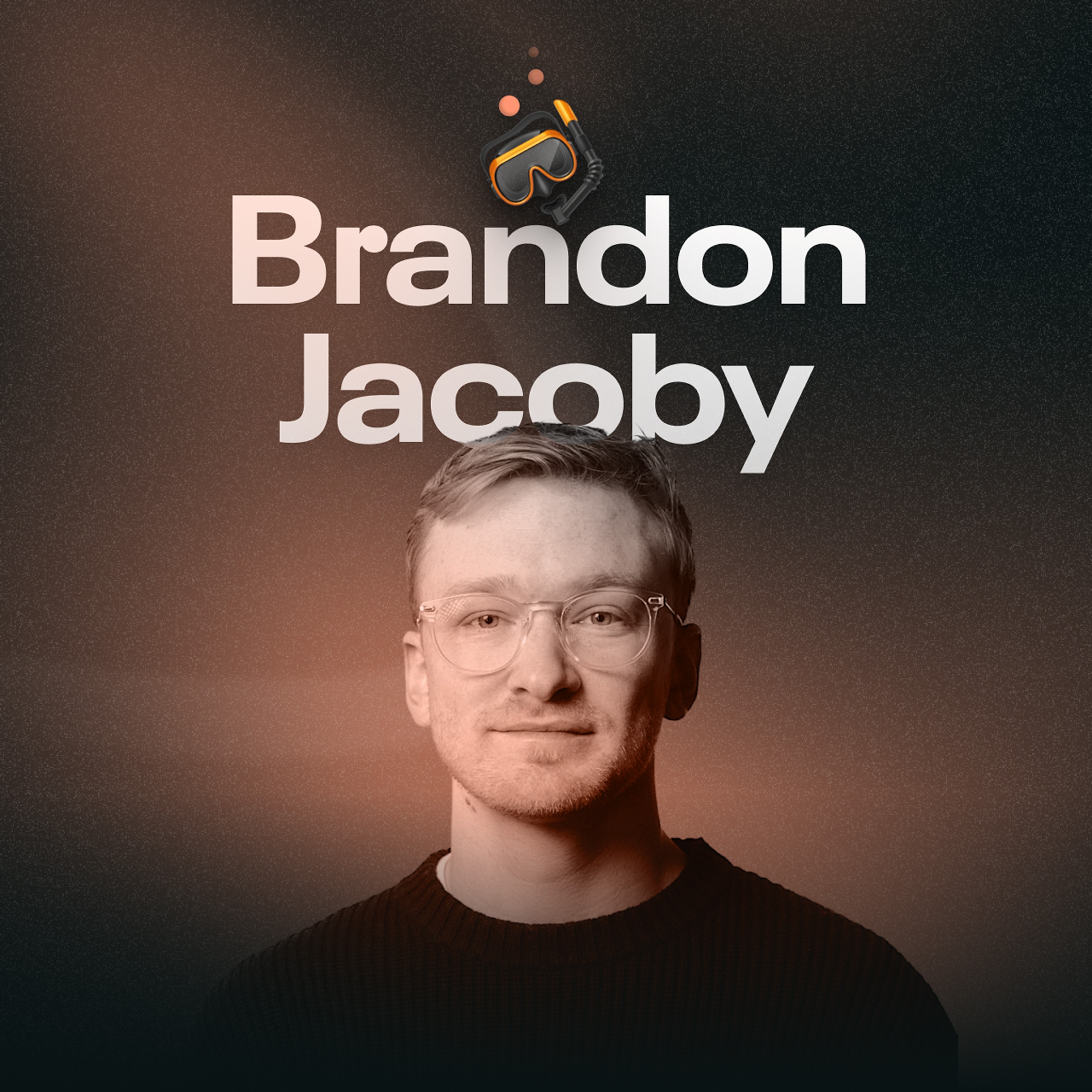
Welcome to Dive Club. My name is Rid. And this is where designers never stop learning. Today's episode is with Brandon Jacoby, who's had some seriously high profile design roles at Early Cash app as the first hire at Capital and most recently at X. But the focus of this conversation is going to be about what Brandon is doing next because he's starting an all new independent practice to help founders push past. Good enough. He shares some really interesting thoughts on taste, what it takes to be creative with AI and how to thrive in a zero to one environment. But before we get into all of that, I had to know what it was like designing at X.
- [01:14]
A
It broke my brain a little bit when I first joined and you know, I knew it was going to be crazy. I knew it was going to be a grind and that was part of the excitement that went into me going there. But it really blew like any expectation that I had out of the water, especially around just questioning everything. A lot of people talk about Elon's methodology and way of working and questioning every requirement and thinking from first principles. And while you like see that and read about it and try to emulate it, if you're a fan of that way of working, like it truly just, you can't wrap your head around it until you've seen it firsthand. And I remember in one of my first ever design reviews with him, we're reviewing a bunch of different things from all different people across the org, across the business. There was something that has been reported on, I think, you know, week over week for probably months, long before I got to the company, A new idea came up. And because of this like long, historical, you know, journey that this thing has been on, this metric was being tracked. There was just like a question of, or an opinion, I should say of. Well, we can't, we can't change it because you know, it's, there's this, this history with it and you know, you, you Become so comfortable with looking at the same metrics, with looking at the same products and iterating it and trying to improve it week over week. And someone question question like why? Why are we even tracking this metric? Like why not look at this other thing that's going to tell the same story but in a completely different way. And it might piss off a lot of users if we change it. It might change the product completely if we change it. But what if we did it? And I remember the response like in any other organization. I've been a big company, small company startup, you know, publicly traded, you know, large design org. The response always would have been well let's get into it. And it's not always, you know, people assume that it's going to be like no in big companies, but it's not always no. Like the, the hardest part about big companies is not like that you can't get anything done. It's just that everything takes a long time to get done or it takes a long time before you find out if it can get done. And at X Twitter it was just instant. Everything happened on a whim. Yeses, no's, there's no committees, there was just decisions. And as crazy, as indisruptive as that is to like my pre existing ways of reality, it's really cool. That's something that again like you I would never be able to learn in a textbook or as much as I could read about Elon, like seeing someone just ruthlessly discern and ruthlessly pay forward on something whether it's in a positive or a negative way. Like you just have to question every requirement and if someone says anything that would get in the way of questioning requirement, why is that a requirement in and of itself? And it's just there's no barriers, there's no walls. And that took a little bit of getting used to. Especially like designing something. I think the design is made up of so many micro decisions. And I found myself designing interfaces like deep in the weeds design work, questioning myself at every second saying well actually like why am I not deciding just to do this crazy thing that I wouldn't normally think about? And designers I think have such a calloused way of working in those micro decisions where constraints are just like these passive things floating around in the back of your mind. And being able to turn that off was like a really big hill to climb. To be able to turn that off and just design without thinking. For the first time in my career
- [04:40]
B
it's actually one of the keywords that I've been paying attention to recently is decisiveness and even just thinking about some of the successful traits in different orgs moving forward. Like in a world where we can get more ideas and create more real estate for these micro decisions to exist. Decisiveness actually is a really, really big deal for this year and beyond. It's interesting to hear like the extent to which that was already happening. Real quick message and then we can jump back into it.
- [05:07]
C
All right, Framer just released two killer AI features that I have to tell you about. The first is Wireframer. You can chat with AI to skip the blank canvas and spark all kinds of ideas. There's no easier way to spin up a responsive page with structure and starter that's ready to edit now. The second feature is Workshop. It's a way to create advanced components using natural language so you can spin up all types of new visual effects, no coding required. It's just another reason why I recommend Framer to absolutely everyone and you can start using these features today. Just head to Dive Club Slash Framer. So Jitter just released image to video and it's a pretty big deal. All you have to do is upload an asset and Jitter will add instantly generate a short video clip from it with the help of AI. It's an easy way to add motion and depth to static backgrounds. Maybe create little clips for brand visuals or just in general make any scene feel more alive with subtle movement. It's super fun to play with and available today. Just head to Dive Club Slash Jitter to try it out.
- [06:15]
B
Now on to the episode. Before we move on from Twitter, there's one other tweet that I literally been wanting to ask you about for months. Nikita had freshly joined as head of product and I think you quote, tweeted it or replied or something and you said that like in his first week he had already taken you to onboarding school. Put us into that room for a second. What did you learn and what was that like?
- [06:38]
A
Yeah, it's funny because it actually really connects to what we were talking about with discernment for kind of some historical context. I would design for the growth team at Cash app for a good chunk of my my early career. Onboarding was a big part of that. You know, it was a big company. There were at the most like 45 million people using product when I was there. We were making micro optimizations. We did big experiments and big changes that would hopefully move the needle in big ways. But we were also doing small A B tests and figuring things out. I've Been around onboarding flows for a long time, which is the most nerdy thing I've ever said as a designer, but I actually can't stand designing onboarding flows. Just as a side note, but have been around them and have designed a lot of onboarding flows for other startups and products consumer B2B. All that to say I felt like I knew onboarding a little bit. I was on a trip, it's actually in Hawaii with my family and Nikita had just joined and ran into the hotel room for a quick meeting because we were working on onboarding for X and we had spent a long time going back and forth on different designs. There are some different directions that were being proposed from different people across the company. And with a product at X's scale, onboarding is something that you don't want to break. It's so precious, you don't want to break the most important flow to the Internet. And Nikita and I hopped on a call and he just like pulled up this doc that was like the inside of Nikita's brain that people know and love from the outside. But seeing the inside of it, it was like a, I don't know, just like a treasure chest in like Pandora's box of just like the onboarding Oracle came down and like opened the veil and it was just, you know, the craziest thing ever. But it was wild because it was all things where I'm like, oh, okay, that completely makes sense. And I wasn't thinking about it and no one else was thinking about it. But like Nikita is good at what he does for a reason. And I left the company shortly after that. Not connected to that, but just, you know, as far as timing goes, a lot of the onboarding stuff that he was looking at is what ended up getting implemented. And it seems to be to be doing well from, from what it seems like from the outside.
- [08:37]
B
I know it's tricky subject sometimes going into the weeds of X, but now that you are working on different products again, I'm curious if that session has shaped the way that you think about onboarding for other products. Like is there some maybe even nugget that you could impart to people listening today that you carried with you from that sess.
- [08:56]
A
The biggest takeaway in my whole career for like growth related things like onboarding and kind of more utilitarian flows in a product are there are patterns that work that show up in 90% of the products out there. Those patterns are there for a reason. And like a lot of designers, and I'm guilty of this myself, reinvent the wheel. And while reinventing the wheel is actually a really good thing, and we can talk more about this, but I think a lot of, like, the issue our industry faces right now is like people trying to stick to the pattern a little bit too much and kind of like revert to the mean a little bit too much. There are such large growth teams and product teams that are hyper focused on optimizing their onboarding flows that there is so much information out there to pull from for something like that, especially for young designers, that it's like, know when to reinvent the wheel, know when to follow patterns. And I think that, like, that skill of knowing when to do either of those is like the number one trait that any especially junior designer could have right now that I think will let them go very far.
- [09:57]
B
Let's move ahead into this next chapter here because you somewhat recently left X and kind of ventured out onto your own. So talk to me a little bit about what that journey has been like, because I know you're now at the point where like, yeah, this is the thing that I want to do. This is what this next part of my career is going to look like. So what about the months after X, do you think highlights, you know, what you bring to the table as a designer and what you kind of wanted to double down on moving forward with your career?
- [10:27]
A
I spent a little bit of time immediately after I left really unsure what I wanted to do coming out of the burnout of X, mixed with the uncertainty of what I wanted to do next. It was like a pretty difficult challenge. And I started helping some friends, startups and started incubating some projects on the side. But very exploratory and very kind of open ended, independent and things with a lot of flexibility. And I did that as a form of exploration. I gave myself three months to do that before kind of really ramping up any actual decisions. And what I found, what I was surprised by was that exploratory phase of life was actually the most fulfilling thing that I had been doing in my career for years prior. Being able to wake up every day and explore different types of roles, different, you know, across design and product design and brand design and creative direction and product stuff that was outside of design entirely. Like being able to just think about all of those different things, even though it was for the purpose of exploring what I wanted to do next in my career, was actually fulfilling in and of itself. What was interesting is like, that was at a time where like the models kind of hit this. I Think like Threshold, where it really started to feel like anyone could build anything whenever they want. And the tools being able to get to a point where I suddenly felt re inspired to just like sit down and hack on an idea that I had was really powerful. And all of that together was kind of the catalyst for this next chapter of leaning into the independent solo practice essentially and saying exploring is a good thing, having autonomy is a good thing. And like AI tools, I think more than ever allow people to be autonomous because it can fill the gaps of what they feel like they can't do and allows them to move quicker and more efficiently, but at the same time focus on what I was good at. So it's like, you know, I was exploring and coding and I've historically been a pretty non technical person, just enough to like piss off engineers that I've worked with in my career in the past. But for the first time I could actually feel like I could build something and take it as far as I could go, but not at the risk of no longer being in figma. I love figma, I use it every day. And I think tinkering and dragging rectangles around is actually still the best form of expression of exploring UI design for me. But being able to build and explore and use AI to supplement what I feel like I'm really good at was the coolest thing ever. And that was, I think, only discovering that was only possible by going through that chapter of not knowing and uncertainty.
- [13:15]
B
I was about to say you probably had the perfect overlap between your own period of discovery and then all of these models just exploding. Like in the whole spectrum of tech history, it was actually kind of flawless.
- [13:28]
A
Yeah. And because the models have gotten to where they're at, there's so much debate around people saying that they're deleting figma and they're only building things and designing things in cloud code. Or some people are the extreme other end of the spectrum and you know, like to stand on the hill and yell how the models aren't good at design. And you know, human taste and the human touch is going to be there forever and super important. And it's kind of like, I don't know, the way I look at that is it doesn't really matter. Like great design has always been great design, agnostic of the tools. And like, sure, the tools that are popular at any given one given time are help guide and shape, especially like esthetics that are kind of in trend at any given moment. But design has always been about decisiveness and judgment. And in a world where suddenly a lot more people are equipped to design and to build, there's still the art of design and the science of design that allow people to say, I'm just going to use whatever tool that I want, and the results are going to be what I get. And I think that's actually, like, another benefit of kind of being in this independent path is like, I have an agent that helps me with, like, logistics and some client and my email. And I wake up every day and I get a little recap of stuff that happened on a project overnight. And I get help from, you know, Figma make and some of the other, like, AI tools to help when I have a creative block. And then I'm building things in cloud code, and it's like I'm using the tools, but I feel like my job hasn't really changed of just, like, being a great designer that's helping mold the world and shape products into something that's really valuable for customers and people that interact with those products.
- [15:08]
B
I kind of want to duck all the way down this rabbit hole now that we're staring down it. So let's, let's jump in. During this period of exploration and tinkering, what did you learn about how you wanted to utilize these different AI tools in actual client work? Especially from somebody who sees a lot of value in being able to sling things around on a canvas. How do you think about when to reach for what tool, for what purpose?
- [15:34]
A
The single biggest way that AI specifically has helped, like, client work is actually the ability to, like, build my own design tools. And I think you've. You've, like, had other guests on there. I've seen, like, kind of a similar note, and I think that, like, that is becoming a trend that I see with, like, the best designers that I know is, like, being able to finally not only have design tools that exist, including AI tools, but using that AI to be able to build our own tools for whatever specific purpose we have is, like, the most creatively empowering feeling that I think I've ever had in my career. There's this old quote by John Lasseter that I absolutely love and long before AI, like, I would come back to it all the time. And John Lasseter said it with regards to the creation of Toy Story, and he said the technology inspired the art, the art challenge, the technology. I think we're at this pivotal moment where the limit of technology to create the tooling that we need to, like, create the things that we see in our head that we think are that are great. That limit's gone. And that, again, has just been the most, like, freeing feeling.
- [16:46]
B
As a creative, I'm smiling for two reasons. One, because I just a complete Pixar nut, especially OG Pixar, like John Lasseter, high regard in my book. But then also, even down to the last, like, 24 hours, that quote has been so representative of my own experience from, like, working on this website. And I kind of have this idea, and I literally have no idea how to make it. I don't even know if it's possible, but I'm kind of like, is this possible? And then, you know, Claude's like, yeah, actually, I think it kind of is. Like, okay, cool. Can we just, like, try it? And you just hit enter and you're just like, okay, what's going to happen? What's going to happen? And it's like, sure enough, I made this really cool, like, particle effect where it assembles into icons for these feature cards. And still I have no clue what the tech is. I have no idea how it works, but it was, like, kind of what was in my brain. And it's beautiful. And I just keep having those moments where I'm like, oh, my gosh, I can do almost anything.
- [17:39]
A
You know, people are leveraging AI enough to, like, get to a certain point, and then they're like, oh, I wish I, like, knew how to use AI to do X, Y, Z thing in
- [17:50]
B
this tool that I'm building.
- [17:51]
A
Like, I wish I knew how to, like, use AI to build this, like, Web GL3D render. And it's just like, I don't know how to, like, I don't even know what questions to ask ask Claude. And, like, I find myself doing that myself. Like, oh, like, I wish I could. You know, I got to a certain point, I'm like, I wish I could figure out how to, like, get an agent to, like, do something. Or rather, I'm forgetting. And I remember sitting back in my chair and being like, oh, I should just ask Claude, like, how to do this. And I figured it out and actually, like, Claude did a lot of it, and I don't really know what. How it worked, but it did. And it's like, it's kind of tying it back to, like, the experience at X of just, like, questioning reality. Like, I feel like AI is, like, kind of challenged a lot of people's reality where it's like, you're no longer bound by anything.
- [18:35]
B
All right, one more question before we move on from AI And I do want to zoom out and Talk a little bit about your practice and how you're thinking about positioning yourself. But we talk a lot about AI as an amplifier. And what I've been thinking about recently is that not everybody has the same level of amplification. There is a spectrum. There are people that are absolutely turning into rocket ships with AI, and then there are people who, you know, maybe get something out of it, but their ceiling is a little capped. And so I'm curious if you have a take on what are some of the dominant variables that dictate where a designer is on that spectrum. Who gets the most amplified with AI today?
- [19:16]
A
It's funny because we were talking about how AI has allowed us to become unbound, and it's removed barriers in a lot of ways that would typically be there in a design process. I've worked with a lot of people that have shown me what that looks like long before AI. I think back to the early Cash app design days. Cash app is in high regard from a design perspective for a reason, because the team there, especially the early team, is so talented. And a lot of that had to do with people just moving forward and blazing trails and running through walls. And if I look at the golden thread between every great person that I've had the pleasure of working with, they all share this common trait of running through walls. Not taking no for an an. Not from, like a being, you know, not from like a character standpoint. But just the Elon thing that I mentioned before of, like, questioning everything, questioning why something is a requirement if they get stuck on something, figuring out a solution going in long before AI, if they couldn't build it themselves. Working with an engineer to build a solution to something that was inventing a new technology that would unlock some new design path. That thing has always existed. AI has made it way easier, way better. And I think that the people that have had a tendency to do that before are, like, you know, on this upward slope of now having even more autonomy, and, like, there's less things that they need to partner with or like, people that they need to partner with to, like, go run through those walls. But the people that were, like, scared to run through those walls, they would externalize blockers that would get stuck. I don't know if AI is suddenly going to. To empower them to. To go do that. You still have to kind of, you know, take the initiative to go, you know, take. Not take no for an answer. The other thing I would say on it is especially from, like, a visual design perspective. Visual design requires creativity, requires taste. Requires feeling and empathy to be able to sit back and say, how? How is someone going to feel when they look at this? And it's like if it's a bunch of text on a page and there's weird alignment and like really basic visual design principles that are broken, it's easy to say that someone's not going to feel at peace when they're using this product. That doesn't mean that going and throwing a soft neutral color palette with earth tones is suddenly going to make them feel peaceful. It's like there are so many visual design fundamentals that change how someone feels when they interact with the product. Those principles are still so true. And vibe coded products are like people that are just jumping to AI to kind of fill the gaps in the visual design. And yeah, I think the active visual design of like knowing how to get someone to feel a certain way through the products that you create.
- [21:59]
B
All right, let's dig into how you're leveraging this, but maybe first to even zoom out for a second to kind of set the stage so you're at the point now where you're going all in on this independent practice. And I guess, you know, given the insanity of today's market, like, how do you think about even positioning a new solo practice? What types of clients do you want to work with? What are your hopes for what this could even become?
- [22:23]
A
Taste is having a moment and people like Greg Brockman are talking about how taste is the new core skill or a new core skill. People that are at the pinnacle of our industry in tech are finally, I think a lot of designers would say, coming around to what they've been beating the drum on, which is design is important and taste is important. But so much of design has become homogenous where designers are designing for other designers and trying to put into words or pictures or designs of like, what this like, taste thing is. And I think a lot of people could like point at like an interface designed by Apple or you know, insert great design company here and say, oh, that's a company with taste because it's minimal and it has a left aligned bold font with like clean typography below that. But like, taste is so much more about the journey of design, much more than the result. And on the like, spectrum of like, you're born with it, it's an innate ability and you have it or you don't to like, it's something that can be learned. I like fall probably closer to the first one, but I think it can be informed and shaped. I don't think it's, like, impossible to learn taste, but I think it's something that you have to foster. It's a muscle. Some people are genetically gifted and born that to be an athlete and. But they still have to go to the gym and train and work very hard to be great at, you know, any sport or to be strong in a gym environment. Taste is the same way. You know, maybe some people are born with a little bit more of a natural ability to be a taste maker and not just see taste, but to create taste. But you still have to foster it. And I think environment has to do with that so much, it's hard to just look at something and copy it. But taste is so much deeper than just something visually that you have to let it sit with, you know, your innermost being.
- [24:18]
C
One thing that dive club has made abundantly clear to me over the last year, Air, is that the practice of design is changing. And the old process of getting feedback just doesn't quite cut it in today's world. That's why I'm excited to announce that Inflight is officially in open beta. It's the feedback tool that I've always wanted, and it's built for a world that moves at the speed of AI. So I can share my prototypes, give context in video walkthroughs. And Inflight makes it easy to get the exact feedback that I need to move forward.
- [24:49]
A
Forward.
- [24:49]
C
Whether it's voting on directions or maybe even getting the green light to ship a new idea. And all of this is available in a single link that I can drop into Slack or maybe even share with power users to test out a new prototype. I use Inflight every day, and it's totally transformed the way that I share work. So I'm excited for you to try the product, and if you ever want to jam about it, just email me at ridinflight Code.
- [25:14]
B
Can we dig into this differentiation between seeing taste and creating taste? Like, what does it require to be able to make that jump? As a designer, I think seeing taste
- [25:24]
A
is the thing that everyone has. It's like you know it when you see it, you know it when you feel it. Maybe you don't. Maybe there's like, some threshold that you need to get to before you. You know, you can tell when you're using something that's beautifully and thoughtfully crafted. But there's another level of, like, being able to recognize. I think what I said before, even, like, when to follow existing patterns, vers when to blaze new trails, knowing what makes sense to fall within this Status quo and when to push the boundaries. Because it's not a hard and fast rule where tastemakers break all the rules and reinvent the wheel. I think the tastemakers know when to break the rules and when to push beyond the boundaries of what exists today and when to quiet and to go with the flow. And I think that is actually the core ability that. That AI doesn't allow for right now is like, knowing that balance. It's like you can. You know, that's still the. The part of AI tools that require human input. It's like knowing when to go super deep into many different prompts to really, like, kind of shape and build something new versus, you know, it's okay to not fight every battle and to say, like, not everything needs to be. Needs to be new. And like that process of zooming in and out, I think is. Is what creates taste.
- [26:40]
B
I like that distinction because we're entering this world or maybe we're already even there, where if you see something that you can kind of replicate it. You know, like, AI is pretty good at replicating things. And so all the time I'll see a design where I'm like, that is good, but maybe I know that it is good because I have a full notion database of things that look like it that I have decided are good. But then every once in a while you see something where like, that is good. And I've never seen anything like it. And it takes a level of creativity to arrive at that. I don't even know if that's necessarily a spike of mine. I'm more of the remixer. You know, I'm. I'm taste by curation and then subtle tweaks. But then I see something like, for some reason, the app told comes to mind right now. I remember the first time where I went through that onboarding flow and use that app, and I was like, this is unbelievable. And it exists so far outside of the box that I draw from as a designer. And I don't know, I think a lot about how to get there, but it's not an easy muscle to grow.
- [27:37]
A
Human creativity is so much bigger than just design. When we talk about taste, it's easy to like, jump into, like, tasteful product design or tasteful brand design. Taste exists so far beyond, like, the work that we do. Like, it's very rare that you meet someone who's like an expert at their craft, who doesn't live that same craft outside of the work that they produce. And I think, like, I don't know, work is just like an extension of who you are as a person. You know, I'm excited in this next chapter of my career. I've always been a really curious person and an exploratory person, and I'm excited to finally have a solo practice and independent way of working where I can work on a bunch of different things and work with really great people. And that might be one group of people one week or one month, and then the next month, that it's an entirely different way of thinking and different set of people and a different problem set. And I think, like, that's like a big part of what makes for a great career step, is like finding something that's very true to who you are.
- [28:42]
B
All right, so talk to me a little bit about your plans to effectively build a business model around selling taste. I know that's a little bit of a crude way to put it, but at the end of the day, that is kind of what it is, right? Like, most people have an idea who have some kind of a product. They don't have this ability that. That separates truly great designers. And so how do you even think about going to market with something like that or how it impacts the type of services you want to offer or the way that you work with clients? Like, let's just get into the weeds on how you want this practice to operate.
- [29:13]
A
There's another podcast I was listening to, and I'm forgetting who said this, so I apologize if that person happens to hear this because I'm going to totally paraphrase it and probably butch it, but they're saying, you know, if the cost of materials and labor for real estate went to zero overnight, assuming regulation is okay with growing a lot of housing, like, if. If that were to happen suddenly, housing would explode, and there, you know, there are infinite more places to. To reside. People would still choose where to live. There would still be a choice that people have to make in where they want to live, where they want to be, how it's going to make them feel when they live there versus somewhere else. And I think software is no different. Like, software is this form of hospitality where you're welcoming a user base into a product, and with AI and where the industry's going, that thing of cost of materials and labor rapidly decreasing, that is happening. But I think the same is going to be true where it's like, in a world where anyone can create anything whenever they want, and everyone's empowered to just build something that solves the need they have, how are we going to choose what to build how are consumers of that product going to be able to choose to build it themselves versus use something else that's already created? How are those models going to know what to build for that specific thing? It still requires human input. Humans aren't just like slaves to the technology that we create. Maybe yet, but, like, you know, we're not there yet. And so in a world where it's like super easy to build, like, good enough, the thing that I'm like, selling is how to be great. And that's not to say that I'm some oracle that can make, you know, I don't have a Midas touch. I wish that were true. I wish I could touch anything and make it great. But I think I have, like, a good amount of experience that I've like, been able to lean on working for big companies and small companies across products and product design and brand design, and working under people like Elon, but also Jack Dorsey and some other, like, great startup leaders to be able to say, in a world where it's really easy to build, like, good enough, like, how do we. How do we build something that's great?
- [31:25]
B
When you reflect on your journey, working at, you know, some of these prolific companies, being early, I mean, I remember when Party Round first, which I guess now is capital, like, Party Round design was so sick, like, when you first rolled that out, I was like, oh my gosh, who is behind this? Turns out it is you. So when you reflect on this set of experiences and different roles that you've been in, I'm curious if there are any moments that really rise to the top in terms of how that set of experiences has shaped who you are as a designer, who you want to be in working with these new companies through the solo practice. Like, what were some of the more formative times that really grew you as a designer?
- [32:01]
A
I feel like I've had, like a really weird, interesting, diverse career. It's like, been mixed with, like some big companies and startups and some venture things in between and companies that are more chaotic like, and companies that are more mellow. Call it. That mix has shaped who I am as a designer more than any one moment that I can point to within any of those experiences. Like, there are people for sure that have impacted me on a level that I can't even describe that. I'm super thankful to work with many people from Cash App, many people from Party Round and Capital, many people from X, many people from, you know, things in between. A mentor of mine who's. He's the head of Business. He's an executive. I forget his exact title, but Owen Jennings at Block taught me so much of what I know outside of design and we partnered super closely for the four years that I was at Cash App. And I think it's easy as a designer to look for mentors and designers that we look up to, but there's so much to be learned as a designer that's outside of our craft. That is actually going to be the thing that propels your career forward so much more than getting a design crit with someone who's at a company that you look up to that hold in high regard. So I think like people like Owen, people like Jordy who is the CEO at Party Round, host of TVPN now another great podcast. People like him who, you know, we were in the trenches together building stuff and I learned a lot that, you know, he let me do what I was great at and I learned a lot from what he was great at.
- [33:40]
B
I would imagine even just building a solo practice stretches you in similar ways where all of a sudden your set of deliverables and the things you have think about aren't confined to whatever product you're working on. But it's actually like, how do I even make this happen as a business, you know?
- [33:53]
A
Yes and no. The nice part about it is like it, like I said before, it feels like I can just like be fully myself. There's way more bullshit that you have to put up with in a big company that's like outside of design and outside of like what I enjoy doing than I'm finding the solo practice. And like sure there's like practical stuff of like time management and project management meant context switching between different things at once and like taxes and accounting. But like I'd much rather have like that be the like annoying side stuff and then go really deep on just like working on things that I'm passionate about that fire me up with great people that are hopefully going to like change the world versus like dealing with the things that you get at not just big companies, but you know, any structured organization in a full time capacity.
- [34:43]
B
Are there any specific projects or clients, like anything that you can talk about that you think highlights the way that you like to insert yourself into these companies.
- [34:51]
A
I've been working with Angellist. I was approached by them and their leadership team to build a pretty net new product project that they were working on and thinking about for I think a pretty long time that now is kind of finally the right time to build it. And it was a project that was at the center of, of my experience between Cash App and Party Round and even a little bit of X. And it was like the most fun project to work on because I feel like I got to pull from all these different experiences. And it was the sum of all of my experience that I could just pour my heart and soul and design and craft into because it allowed me to just fully be myself as a designer and kind of pull from all those different threads. And that's honestly like the dream for me. Right? Like in a solo practice is something that I can feel like, that I can like, like stand on what I've done so far in my career, but also like scratch the curiosity itch at the same time and like apply what I know and be around a bunch of people that are so much smarter than me and like, push me to learn new things that challenge me. But at the same time, you know, aren't just a replication of the same thing over and over again.
- [36:03]
B
When we chatted earlier, you talked about this idea of craft meets consequence. Can you unpack what you mean by that?
- [36:09]
A
Craft meets consequence to me is like a idea where it challenges where a lot of our industry has gone to of designing for other designers. There are many portfolios out there that look fantastic that I think in like a sea of portfolios that hiring managers would be looking at, they. They stand out and they catch the attention of designers for XYZ reason. And as a design industry, we're really good at that. We're really good at like understanding our users and like what users could we understand more than ourselves. So we're really good at understanding other designers and producing work, meaning like a portfolio that looks great to them. And on the other end of the spectrum, you have like teams and roles and people within an organization that sometimes come at conflict with what a lot of newer designers in their career want to do, which is some novel thing and they want to spend a bunch of time on it, which, I mean AI is. Is beautiful because it's kind of allowed some of those things to actually happen more naturally. But historically there's always this toil between a PM and a designer to say, well, we need to ship by this state, but we need to. But as a designer, I really want to ship this novel new area and the PM or the CEO is saying, well, we need to move metrics and it doesn't make sense to work on this thing that's going to distract from this real consequential thing to build. And it's been this back and forth for me, I've always viewed design as my craft for building a business and building products, products that sell and make people's lives better. Craft meets consequence is this idea that like those two things can exist at the same time. They're not mutually exclusive. You can take something that is consequential and shapes the world and changes people's lives. Hopefully for like a business perspective, if it's like a commercial opportunity, like something that makes a lot of money as well, but at the same time of like having really deep and thoughtful craft and intention, I wish like more people would, would understand that like those two things can, can live in harmony and like that's where the best products are created. And like they're, they follow each other, right? Like form follows function but at the same time like craft follows consequence, consequence follows crap. They like, the more they live in harmony together. Like the, I think the, the bigger the better the, the greatest anything can become.
- [38:31]
B
A lot of the things that you're saying about the role of understanding, like actually like the business and what, what moves the right types of need strategy, but also this level of creativity that is very, very difficult to achieve given a lot of constraints. Like I'm kind of bundling a lot of this in my brain into this correlation between the stage at which you are designing too. Because if you're going to join like a late stage giant company, like it's really hard to, to make this type of impact or design this type of way or to come in and be like, I have this totally creative idea for the visual identity. You know, it's like that people are just going to kind of laugh you out of the room a bit. Do you see that type of correlation? Like do you gravitate more early stage?
- [39:13]
A
As a result I find myself gravitating towards new things and sometimes the scale of that new thing looks like a company and world building with just me and a founder in a room where we're designing the company. Not just the product of the company, but what is the company, what is the org design, what is the brand identity? And on a deeper level than the logo of like what what is this thing? And you know, the founder says I have this idea but like I what is a company? Like that's where I like plugging in. And then of course taking that and building the derivatives of that with what is the core mvp. What are like the five hero screens of the product? What are, what is like the core user flow that someone's going to be interacting with. What is the brand Identity. What is that like MVP brand look like? So it's like the, the new thing in that sense is company in like the, the zero to one, you know, world build. But there are big companies as well that are doing new things and you know, Angellist was a good example. I, I also did a stint with Coinbase late last year where there was a really big new thing that was happening, but it was a really small team that was thinking about this new thing and I got to embed with that group and help shape and form what this new thing is going to be. And yeah, whether it's like a big company like, like Coinbase or Angelus or a small startup that that's just getting started and hasn't even raised around to funding yet, it's still the same concept which is building something new and crafting it. I think one of the most beautiful parts about being a designer is the moment that happens that feels like magic. Where you're staring at a blank canvas and you shut your eyes and you're like, what should be on this canvas? And then in the best case scenario it happens and then other people see that canvas and other people interact with it it. And again, whether it's at a big company or a small company, that is like a magical moment that got me wanting to design in the first place and now I get to replicate it over and over and over again with, with a bunch of different great teams and great people with, with really cool ideas in a bunch of different places. And yeah, it feels like a. Feels like magic.
- [41:19]
B
I live for that moment where you kind of get to hit command n and just start from scratch. And it's probably my favorite part about being a designer. So maybe we could go a little bit deeper there for a second and speak to somebody who perhaps hasn't been that situation. Either they're earlier in their career or maybe they've been, you know, working at big companies for the last 10 years. And yeah, they're interested, especially given the state of the market of joining something smaller where you are designing the company and not just designing the interfaces that exist within this product. And you know, you've been in that role so many times, not only with clients, but in, you know, some of these big time roles, I guess. I'm curious to hear you talk a little bit about what it looks like to thrive as a designer in that environment and if there are any specific things that designers who do want to grow these muscles can do to become someone who excels in this zero to one early stage Role.
- [42:13]
A
The number one thing that I would say to that person is find someone who you enjoy working with. Whether it's a super early company and it's like a CEO or a founder that's hiring you, it's just going to be you and them, or there's a small team that's forming around a startup up, finding a team that you enjoy working with. Because the earlier that you go in like a company's age that you're going to be working with, the more important it is to jive well with the team. Outside of design, of course, if you're the only designer, the people you're going to be collaborating with are leadership, CEO, founder, head of engineering, cto, maybe some marketing people, maybe not. Maybe it's just you and a couple other people. And finding great thought partners that will, will bring the best work out of you is like the most important thing, especially for someone who hasn't been in that environment. And I think being able to trust yourself in being a designer in that room is like the other skill I think to really push yourself on is the ability to have confidence in ideas and confidence in your own inspiration. And if you feel like that inspiration comes from looking at other great products and copying them, it's like an okay place to start. And like the, the, the hardest places or the hardest part in a kind of a blank canvas design process is, is where to start. And now, I mean, especially with AI, but even outside of like the specific tools, it's progress is the best possible thing from going from zero to one. And it's like you can sit there and try to like, close your eyes and think of it in your head and then wait for, you know, something to happen. But like, it's never going to happen unless you just do something. Earlier in my career, I think I was like really afraid of being wrong and I was really afraid to just try something. Not even for shipping something and being wrong and like learning the hard way that no one wants to use the product that you're designing. But like, even just for myself, like, I'm staring at this blank canvas, I don't know what to create. It must be shit. I must not be cut out for this. I've grown in my career enough and reflected upon my own work enough to say that, like, I know with 100% certainty, see, that even though I can get to a product that looks like it could be pretty good, at this point, I know that I will design something the first time that looks like absolute garbage. And the first version of Everything that I create is so bad. I now again am confident that I can like get it to a good spot and like it's going to be great. That's the bar that I hold myself to. But starting is not where you finish and doesn't have to be where you finish. And like just creating something that's terrible to get a idea on the paper is what like starts the snowball rolling down the hill. And it's like you're, you're never going to figure out how to like find the best solution and find that like moment that it clicks where you're just like, hell yeah, this is, this is gold. Without trying something first.
- [45:14]
B
Especially just because like what you were saying, you'd be working so closely with a founder who probably has a decent idea of the big picture vision, but especially if they're not a designer, like the details and what they could actually look like in practice sometimes isn't all the way fleshed out. And so I even find that having as many quote, unquote bad ideas or wrong ideas as possible is a good way for them to help them navigate their own mind too. Because they can see something and be like, oh, I didn't realize that I thought this, but I'm looking at this and this is wrong, quote unquote for, you know, XYZ reasons. And now you're, you're almost helping them think. Like the more artifacts you can produce actually accelerates the founders thinking in a way that I think makes a good partner as well.
- [45:56]
A
Well, I think it's like the benefit of hiring a designer instead of just like saying we don't need a designer, we're just going to vodka something ourselves. Because as great as these models are at generating products and if you provide them with the right human input, they can produce pretty good work. But that journey of exploration, the in between moments that you get when you're moving things around on a Figma canvas, that's where the real discovery happens. You can prompt something back and forth and vibe code something and spend another hour prompting it to get to a pretty refined spot. But I feel like you miss out on those moments of when you're just tinkering and to connect this all to the taste thing. I think that taste making comes from tinkering and discovering something new. And when you're in between the prompts essentially being able to discover and it's not just A or B, but it's some weird C thing that you didn't think of originally that like you stumbled upon as like a Happy accident. That's where the magic happens. And like, that's where I feel like I've been able to like produce my best work. And that's the thing that I feel like you get when hiring a designer versus just saying that, you know, we don't need them and we'll do it ourselves.
- [47:11]
B
And you almost always have to cross over the this is probably good enough line in order to get to the some weird C thing that you discover a hundred percent.
- [47:19]
A
And like, you know, the, the sad part is, is like, like for most people, like, good enough will be okay. That's not a bad thing. There is a lot of good enough in the world and like many people just need good enough. But there's always like the ones that push it just a little further. You sometimes have to like break rules to do that. Sometimes you have to run through walls. But for those that aren't comfortable with staying in the good enough, I think that there's like a really fun thing to experience on the other side of that.
- [47:47]
B
Even going back to your architecture analogy from earlier, earlier, it's like, well, good enough is the prefab house or the copy and paste apartment complex that you would see over and over and over. It's the modern farmhouse. You know that it's all over Michigan. They're everywhere. You know, it's like, yeah, I've seen that 90 times in the last few weeks. And yet there are whole successful businesses that have been built around the quality of the interior, whether it's a hotel or a restaurant. And maybe now you're just in the position where you kind of almost have to sell that to companies in a way.
- [48:18]
A
Yeah, there's like a weird element to it where it's like, well, do products that are like, great automatically mean they're like luxury products? Like using your hotel example? Like a lot of the like high taste hotels compared to the things that are copy and pasted everywhere, maybe they're for a specific set of people that are not accessible to everyone. And like, I actually, I don't think that's true. Like, I actually think if you look at Apple, Apple is like the ultimate example of taste and, and high quality products. And whether you like argue about liquid glass or not, like, it's still a great example of like great, thoughtful design, especially on like the hardware front. Two thirds of the world, I think, have an iPhone. And like, you can't deny that a big part of taste is actually figuring out how to like deliver high levels of craft in an accessible way. So that as Many people as possible can experience it if you the copy and paste farmhouse, new development example for real estate. It's like you have to like design something that is so good that people want it and make it affordable enough that when people do have the choice, if they, if they, if it is affordable enough, make the choice. Like how do they choose something that is great versus just the, you know, the modern farmhouse.
- [49:27]
B
Yeah, I think that's a good call out. Like great is not only on an axis of cost and luxury. Great could even come from ruthless simplification beyond anything that you would get out of the box with the models. And that also requires a phenomenal designer to come in and own it.
- [49:43]
A
So many of the great products that have been created in my lifetime were things that were, are typically inaccessible or reserved for a high net worth individual to experience and bringing it to the masses. And that is an act of taste and craft in and of itself of being able to do that. I think of Uber as an example. Uber is probably one of the single biggest inventions that uses a software invention. Obviously the real world is a big part of it. The world of transportation was flipped on its head when anyone could stand on any street corner basically in any city in like most countries in the world and press a button and a car shows up next to them within like 10 minutes. Like, that's something that just most people could never experience until Uber and Lyft and was created. That's taste, like, that's craft. To be able to like say that, like, that's something that people need.
- [50:40]
B
We've covered a lot of ground. Before I let you go, I'm going to give you an opportunity to kind of of close your eyes and imagine what the future could look like for you. So when you think about the potential outcomes for yourself, you know, Travis is able to imagine Uber, you know, what are you imagining kind of thing. What do you think this independent practice could become?
- [50:57]
A
No, I think the world is shifting to be, especially with the design industry, is shifting to be more and more filled with independent people. I, I feel like I could name five people who are like the greatest designers that I know so in the industry right now. And like, it just so happens that they're all independent. There are many great designers that are still full time and it's nothing against that, but I think in a world where a lot more people are independent, where AI and tooling has evolved to like push people even further than they could go before, I think that the future for me looks like a lot like collaboration with great people and not just collaborating with other great designers, but collaborating with founders and, and leaders of products and people that are, that want to start something new and collaborating to bring more taste to fight the slop. If I kind of fast forward a few years down the road, I don't think any of us could predict what the world is going to look like with how fast things are moving and the rate of change that's happening. But the thing that I hope for is that in a world of a lot more software and in a world of abundance and choice, that there's something with, know, my signature on it that can, you know, stand out, that, you know, in a world of a slop and abundance, that there's still something great.
- [52:15]
B
I can't think of a better way to end it than fight the slop. So I'm going to hang it up there. Brandon, this has been amazing. Thanks for coming on and sharing a little bit about your journey and just everything that you're thinking about and exploring. It's been really, really fun. So appreciate you.
- [52:29]
A
Thank you so much for having me. And yeah, was an awesome chat.