Podcast
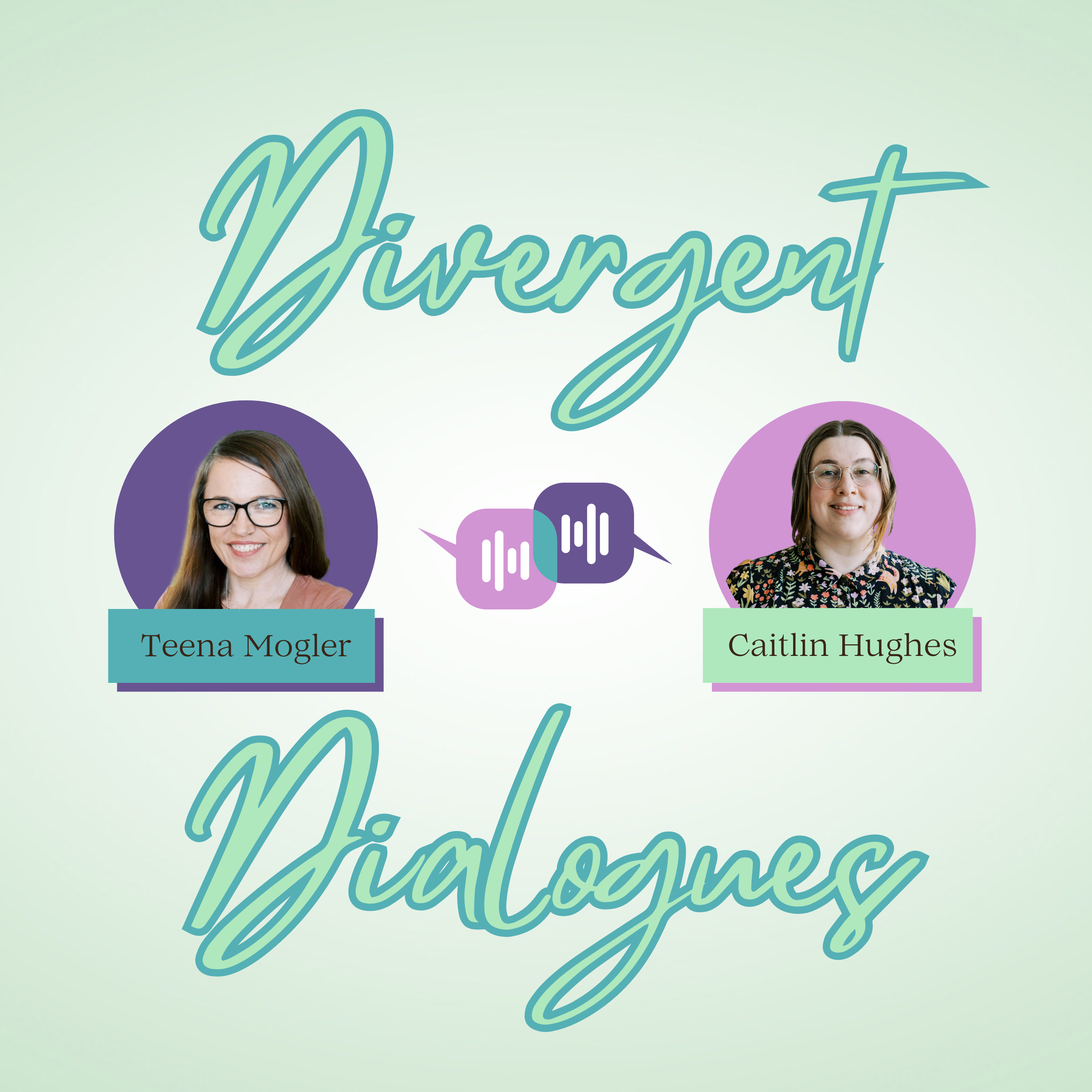
Divergent Dialogues
Hosted by Caitlin Hughes and Teena Mogler · EN
Welcome to "Divergent Dialogues," a podcast where your hosts, Caitlin and Teena—both Accredited Mental Health Social Workers and Neurodivergent-affirming therapists—draw upon their extensive professional expertise and lived experiences. Divergent Dialogues provides quality education from the heart about Neurodivergent life from a practice, research and lived experience lens.
For more information about our podcast hosts check out the links below:
Caitlin Hughes: https://catharticcollaborations.com.au/
Teena Mogler: https://www.balancecentreformentalhealth.com.au/
24episodes
Episodes
Newest firstAll episodes
Episode #48 That’s All, Folks! Our Final Episode
Apr 2800:09:36Tap to summarizeAfter 2.5 years and 51 episodes, we’re wrapping up Divergent Dialogues.This final conversation reflects on how the podcast began, what it has meant to create this space, and why this ending feels right. We share our thoughts on growth, changing commitments, meaningful connections with guests and listeners, and the sense of completion that can come with a good goodbye.What started as regular Zoom chats between two neurodivergent social workers grew into something we’re incredibly proud of. We’re so grateful to everyone who listened, shared episodes, sent messages, and engaged with our work along the way.All episodes will remain available, so you can revisit old favourites or catch up on the ones you missed.Thank you for being part of this community. For more information about our podcast hosts check out the links below:Caitlin HughesCathartic CollaborationsThe Ripple Framework of Neurodivergent Flourishing: Supervision Program Social media: @cathartic.collaborationsTeena MoglerBalance Centre for Mental HealthLivian ConsultingSocial media: @balancecentreformentalhealth
Transcribe →
Episode #47 Curiosity Over Assumptions Conversations on Black Neurodivergent Experiences with Sheldon Gay
Apr 1400:55:19Tap to summarizeIn this episode, we’re joined by Sheldon Gay for a thoughtful conversation about Black neurodivergent experiences, giftedness, identity, and intersectionality.Together, we explore how systems like education and mental health can misunderstand or overlook neurodivergent people, particularly when race and culture intersect with neurodivergence. Sheldon shares reflections from his own journey as a late-identified gifted Black man, including how bias, assumptions, and systemic barriers can shape who gets recognised, supported, or misunderstood.We also talk about:The impact of being misread in school and mental health systemsMasking, code-switching, and navigating safetyWhy curiosity and genuine listening matterThe importance of understanding intersectional lived experiencesSetting boundaries in spaces not designed for your identity or neurotypeThis conversation invites us to slow down, stay curious, and reflect on how we can create spaces where all neurodivergent people are truly seen in their full humanity.Sheldon Gay is an entrepreneur, speaker and host of the “I Must Be BUG’N” podcast. Sheldon is a leading advocate for gifted and neurodivergent people, especially those from melanated and marginalized communities. His lived-experience empowers him to help people become curious about their minds, foster community as well as experience peace and joy through authenticity.Find out more about Sheldon here: sheldongayisbugn.comBooks & Resources MentionedMe and White Supremacy: How to Recognise Your Privilege, Combat Racism and Change the World by Layla F. SaadWe Are Displaced: My Journey and Stories from Refugee Girls Around the World by Malala YousafzaiBlack Disability Politics by Samantha Dawn SchalkShoshin: Beginner's Mind - The Zen Approach To Grow Faster: https://www.youtube.com/watch?v=Nl2_NCY5aik“Love Me In A Gay Way”: https://www.youtube.com/watch?v=HCjeYR7NAJ4For more information about our podcast hosts check out the links below:Caitlin HughesCathartic CollaborationsThe Ripple Framework of Neurodivergent Flourishing: Supervision Program Social media: @cathartic.collaborationsTeena MoglerBalance Centre for Mental HealthLivian ConsultingSocial media: @balancecentreformentalhealth
Transcribe →
Voices at the Margins: Podcasting as Neuroqueer Collaborative Autoethnography and Epistemic Healing
Mar 2701:44:09Tap to summarizeThis conversation forms part of a creative research contribution to Neurodiversity: Towards a Critical Turn in Neurodiversity Studies. It explores podcasting as a neurodivergent way of doing research — one that values voice, connection, and shared meaning. Through dialogue between seven neurodivergent podcasters, we will reflect on how podcasting helps us share knowledge differently: through conversation, emotion, and lived experience rather than traditional academic writing.You can read the journal article here: https://doi.org/10.1177/27546330261437265Caitlin Hughes (she/they) is a queer, nonbinary, multi-exceptional Australian social worker, researcher, educator, and advocate. Late-identified as Autistic, ADHD, Gifted, and PDA, Caitlin co-hosts the Divergent Dialogues podcast and brings a lived experience-led perspective to their work. They are committed to fostering epistemic healing through relational ethics, narrative reclamation, and accessible, lived experience–driven knowledge creation.Sheldon Gay (he/him) is a Black Gifted speaker and podcast host of I Must Be BUG'N (Black Underrepresented/Unidentified Gifted and otherwise Neurodivergent). Sheldon is guided by the belief that learning to deeply and wholly Love oneSelf, cape and kryptonite, is the path to finding, creating, and maintaining Love everywhere we go.Marni Kammersell (she/her) is a American late-identified neurodivergent (Autistic, ADHD, PDA, gifted) parent of neurodivergent children. She is an educator, researcher, writer, and consultant, and co-hosts the PDA: Resistance and Resilience podcast. Marni is dedicated to honoring neurodivergent experience through relational, self-directed, and nervous-system-informed knowledge practices.bee mayhew (she/her) is a multiply neurodivergent (late-identified AuDHD, former gifted kid) writer, narrative collaborator, and communication coordinator for PDN Media. She co-hosts cosmic cheer squad podcast and has a background as a hospitality specialist and business owner. Bee’s work centers on collective narrative-building and neurodivergent storytelling through activist, community-rooted practice.Teena Mogler (she/her) is an Australian AuDHD social worker, researcher, educator, and advocate, as well as co-host of the Divergent Dialogues podcast. As a mother to neurodivergent children, Teena is passionate about amplifying neurodivergent voices and disrupting epistemic injustice through lived experience-led, neuroaffirming, and critically reflexive knowledge practices.Emma Nicholson (she/her) is a neurodivergent Australian Senior Business Analyst, creative and advocate, identifying as gifted, Dyscalculic, with all five overexcitabilities (psychomotor, sensual, intellectual, imaginational, and emotional), as well as bisexual and Heathen. She co-hosts the Positive Disintegration Podcast and serves as Vice President of the Dąbrowski Center. She is driven by an unkillable passion to demystify positive disintegration and share hard-won truths to help others feel seen and supported.Chris Wells (they/them) is a multi-exceptional, nonbinary, and neurodivergent writer, podcaster, and developmental theorist specialising in Dąbrowski’s theory of positive disintegration. They co-host the Positive Disintegration, cosmic cheer squad, and PDA: Resistance and Resilience podcasts, and are the founding president of the Dąbrowski Center and co-creator of the Positive Disintegration Network. Chris brings lived experience and a deep commitment to reframing neurodivergence through a developmental and relational lens.
Transcribe →
Episode #46 Freeing Up Time for What Matters: Reducing the Hidden Load for Neurodivergent Families
Mar 1000:44:43Tap to summarizeCaitlin and Teena are joined by Laetitia Andrac (CEO/co-founder of Understanding Zoe) for a grounded, hope-filled conversation about AI, ethics, and easing the invisible work carried by neurodivergent families.Together, we explore how AI can support scripting, communication, advocacy, and admin, while staying mindful of risks like bias and deficit-based language. Laetitia shares findings the 2025 Making the Invisible Visible report that includes research with data from 1,091 families, including the reality that many parents are carrying an extra 33 hours per week—with around 10 hours often swallowed by admin.We also unpack what “non-negotiables” look like for ethical AI in care spaces: privacy and security, lived experience design, and using AI as an extension of human connection, not a replacement.If AI can take some of the hidden load, families can reclaim time for what matters most: connection.In this episode, we cover:AI as a “second brain” (and why critical thinking still matters)Bias in AI outputs and why neuroaffirming design is essentialThe hidden load of parenting neurodivergent kids (and what the data says)NDIS prep, advocacy, and practical ways AI can supportEthics + privacy: frameworks, data protection, and trustThe emerging “AI gap” and equity in accessA sneak peek at Understanding Zoe’s upcoming app update (including support for adults)Laetitia Andrac is CEO and co-founder of Understanding Zoe, an AI-powered platform providing neuroaffirmative support for families raising neurodivergent children. A neurodivergent woman and mother of two neurodivergent daughters, Laetitia brings over 15 years of experience in strategy and innovation, including her role as former General Manager at Telstra and as a strategy consultant with Monitor-Deloitte. She's a bestselling author, international speaker, and host of The Neurodivergent Pulse Podcast. Understanding Zoe recently completed Australia's largest study on neurodivergent families (1,091 participants), published as the white paper "Making the Invisible Visible" in November 2025. Through her work, Laetitia champions moving from deficit to strength-based models, creating neuroaffirming systems rather than compliance-based solutions.Website: www.understandingzoe.comLinkedIn (personal): https://www.linkedin.com/in/laetitiaandrac/LinkedIn (company): https://www.linkedin.com/company/understandingzoe/Instagram: https://www.instagram.com/understanding.zoe/Email: laetitia@understandingzoe.comFor more information about our podcast hosts check out the links below:Caitlin HughesCathartic CollaborationsThe Ripple Framework of Neurodivergent Flourishing: Supervision Program Social media: @cathartic.collaborationsTeena MoglerBalance Centre for Mental HealthLivian ConsultingSocial media: @balancecentreformentalhealth
Transcribe →
Episode #45 Holding Space for Yourself and Your Kids with Michael Coles
Feb 1000:23:48Tap to summarizeIn this thoughtful and heartfelt conversation, we’re joined by autistic advocate, podcast host and dad, Michael Coles, for a discussion about the lived experience of neurodivergent parenting. Together, we explore the complexities and joys of raising neurodivergent children as neurodivergent adults, especially through the lens of fatherhood.Michael shares how his self-understanding evolved through parenting, the sensory and emotional dynamics of a neurodivergent household, and the ongoing process of self-compassion, co-regulation and community connection.We discuss:The reality of differing neurotypes within the same familyChallenges and wins with school systems and advocacyThe power of support networks and peer connectionThis episode is a gentle yet powerful reminder that neurodivergent parents are doing brave, beautiful work…often while healing themselves. Whether you’re a parent, professional, or simply seeking deeper understanding, there’s wisdom here for all of us.Michael Coles is an autistic advocate, speaker, and host of The Deep Dive Podcast. Drawing on lived experience and professional practice, Michael explores topics including autistic burnout, neurodiversity in the workplace, and inclusive systems that genuinely support neurodivergent people. His work focuses on bridging understanding between autistic and non-autistic communities, with a strong emphasis on safety, dignity, and sustainable participation.Website: http://www.deepdiveau.netLinktree: http://linktr.ee/michaelcolesInstagram & TikTok: @thedeepdiveauYouTube and Facebook: @TheDeepDiveAUThere is a substack that you can subscribe to, but email Michael for the link admin@deepdiveau.netFor more information about our podcast hosts check out the links below:Caitlin HughesCathartic CollaborationsThe Ripple Framework of Neurodivergent Flourishing: Supervision Program Social media: @cathartic.collaborationsTeena MoglerBalance Centre for Mental HealthLivian ConsultingSocial media: @balancecentreformentalhealth
Transcribe →
Episode #44 Unmasking Healing: Navigating Trauma and Neurodivergence
Oct 1901:10:20Tap to summarizeIn this episode, we explore the powerful intersection between trauma, neurodivergence, and healing. Together, we unpack the impact of late identification, the limitations of diagnostic boxes, and the deep relief that comes from finally having language for your experience.We discuss how trauma often presents differently in neurodivergent individuals, why talk therapy isn’t always enough, and how body-based approaches like EMDR and IFS can support authentic, sustainable healing.This is a conversation for anyone who’s ever felt like they didn’t quite fit—and is ready to start where they are.Vera Yeo (she/they) is a Senior Clinical Psychologist and Board-Approved Supervisor based in Sydney, Australia. They work with adults who are survivors of trauma, supporting them through the healing process with a person-centred, culturally sensitive, and neuro-affirming approach. Drawing on trauma-informed modalities such as Internal Family Systems, EMDR, and somatic practices, Vera helps clients reconnect with their inner wisdom and sense of Self. As a late-identified neurodivergent person with lived experience of high-masking, Vera values authenticity and understands the challenges of living at the intersection of multiple identities. Through both their clinical work and personal growth journey, they aim to increase the awareness of trauma healing and the importance of doing "the work" to live a fulfilling life. For more information about Vera check out:https://loapac.org/rap/vera-yeoFor more information about our podcast hosts check out the links below:Caitlin HughesCathartic CollaborationsThe Ripple Framework of Neurodivergent Flourishing: Supervision Program Social media: @cathartic.collaborationsTeena MoglerBalance Centre for Mental HealthLivian ConsultingSocial media: @balancecentreformentalhealth
Transcribe →
Episode #43 Unmasking the Self: Internalised Ableism, Diagnosis, and Embracing Autism with Annie Kotowicz
Sep 2100:40:27Tap to summarizeIn this candid and deeply affirming conversation, we explore the layered experience of internalised ableism and the lifelong journey toward self-acceptance as Autistic individuals. Through personal reflections, shared insights, and the powerful inclusion of an audiobook excerpt by guest author Annie Kotowicz, we unpack how diagnosis, identity, boundaries, and belonging evolve over time. Caitlin and Teena show up with honesty, compassion, and vulnerability—offering a grounded perspective on what it means to live authentically as late-diagnosed Autistic person.Annie Kotowicz is an autistic author on a mission to: Describe the beautiful view from her brain, Help other autistics see the beauty of their own brains, and Show why neurodiversity is a beautiful thing. She studied Art and English at Trinity Western University, which led to various jobs in graphic design, editing, and website development. After an autism diagnosis in 2017, she created the blog Neurobeautiful to process her ongoing discoveries about autism and neurodiversity. Since then, she has become a Chief Technology Officer, Special Education Teacher, and member of Mensa. What I Mean When I Say I’m Autistic is her first book. She has also written articles and poetry for Edutopia, NeuroClastic, and Spaces Literary Journal. Annie is happiest when writing, dancing, practicing parkour, drawing Celtic knots, or organizing her cozy and colorful home near Washington, D.C.Website: https://neurobeautiful.com/book Email: mybrainisbeautiful@gmail.comFor more information about our podcast hosts check out the links below:Caitlin HughesCathartic CollaborationsThe Ripple Framework of Neurodivergent Flourishing: Supervision Program Social media: @cathartic.collaborationsTeena MoglerBalance Centre for Mental HealthLivian ConsultingSocial media: @balancecentreformentalhealth
Transcribe →
Episode #42 Neurodiversity Affirming Practice Research with Cammy Griffin
Sep 700:47:19Tap to summarizeIn this episode, we dive into a conversation with Cammy Griffin, a passionate researcher and organiser of the upcoming Neurodivergent Minds Conference on the Sunshine Coast. Together, we explore the evolving field of neurodiversity-affirming practice, grounded in lived experience, evidence-based research, and a strong commitment to accessibility. Cammy shares insights from her PhD research on speech pathology practices that centre neurodivergent voices, the intersectionality within neurodivergent identities, and the importance of systemic shifts in healthcare and support systems. This episode champions humility, flexibility, and power-sharing in professional practice and highlights how professionals must be willing to adapt, learn, and listen. We’re thrilled to share that Caitlin and Teena will also be attending the Neurodivergent Minds Conference and Caitlin will be presenting!Cammy is a neurodivergent paediatric speech pathologist on the Sunshine Coast. She is undertaking a PhD on Neurodiversity-Affirming Speech Pathology Practice and has a passion for supporting individuals of all neurotypes to achieve their goals and live fulfilling lives.Find out more about Neurodivergent Minds Conference and Cammy here:www.neurodivergentmindsconference.com.au https://www.instagram.com/neurodivergentmindsconfau/ https://www.instagram.com/letstalkneuropositivity/For more information about our podcast hosts check out the links below:Caitlin HughesCathartic CollaborationsThe Ripple Framework of Neurodivergent Flourishing: Supervision Program Social media: @cathartic.collaborationsTeena MoglerBalance Centre for Mental HealthLivian ConsultingSocial media: @balancecentreformentalhealth
Transcribe →
Episode #41 Navigating Divorce & Neurodivergent Parenting Plans with Dr. Margaret Pegi Price
Aug 1700:50:27Tap to summarizeIn this episode, we sit down with Dr. Margaret "Pegi" Price who brings lived experience and legal acumen to the topic of divorce and parenting plans involving neurodivergent children. Drawing from her own journey as a parent of an autistic child and her career in law, Pegi shares the realities families face when the legal system isn't built to accommodate neurodivergent needs. Together, we explore what it means to create supportive, future-focused parenting plans, how to advocate for fair financial contributions, and the long-term impact of unequal caregiving responsibilities. From managing transitions between households to navigating denial of diagnosis, this episode is filled with wisdom for parents, professionals, and allies alike. We also unpack: The risks of "cookie cutter" legal forms for neurodivergent families Why crisis planning is crucial for families with neurodivergent children How to honour neurodivergent children’s autonomy, routines, and emotional safety post-separation The hidden cost of invisible labour and caregiving work Whether you're currently navigating separation or supporting someone who is, this episode offers clarity, compassion, and practical strategies grounded in justice and neuroaffirming support.Dr. Margaret ‘Pegi’ Price is a Professor and Academic Program Director for the Master of Public Administration Program at National University. She has held teaching and department head positions at several colleges and universities in the Midwest. She received a National Teacher of the Year award in 1992. She earned her Juris Doctorate at the University of Florida in Gainesville, Florida, where she was a Senior Editor of the Law Review and inducted into Phi Delta Phi, the legal honors society. She earned the rst perfect score in the history of the University of Florida in the Law Review annual writing competition. She completed her B.A. in History at the University of North Florida in Jacksonville, Florida, where she received multiple academic honors. With over 25 years of experience practicing law—including civil trial work and serving as a prosecutor—Dr. Price has also acted as an expert witness or consultant in more than 75 lawsuits involving special needs, making her a champion for justice and equity.Books authored by Dr. Margaret “Pegi” Price:The Special Needs Child and Divorce: A Practical Guide to Handling and Evaluating CasesDivorce and the Special Needs Child: A Guide for ParentsFor more information about our podcast hosts check out the links below:Caitlin HughesCathartic CollaborationsThe Ripple Framework of Neurodivergent Flourishing: Supervision Program Social media: @cathartic.collaborationsTeena MoglerBalance Centre for Mental HealthLivian ConsultingSocial media: @balancecentreformentalhealth
Transcribe →
Episode #40 Mirroring & Meaning: Embracing Giftedness Through Connection, Safety, and Self with Gordon Smith
Jul 13, 202501:03:44Tap to summarizeIn this deeply resonant conversation, we explore how Gifted identity is shaped through mirroring, the profound importance of safe, attuned relationships, and the nuanced challenges of living as neurodivergent individuals in a world built for sameness. Together, we reflect on the journey of self-acceptance, the role of humour and play as relational tools, and the healing power of co-created spaces that honour difference. We dive into existential perfectionism and the ongoing dance between the pathology paradigm and the neurodiversity paradigm. This episode is a grounded, compassionate invitation to embrace your full self—with curiosity, courage, and community.Key Themes Explored:Authenticity & relational safety: how feeling seen supports nervous system regulation and deeper self-understanding.Self-acceptance journeys: reframing the need for external validation and embracing curiosity when building connections across neurotypes.Emotional safety for gifted folks: unpacking internalised shame and societal expectations, and finding joy in interests.Humour as both shield and bridge: playfulness as a tool for navigating uncertain social terrain.Living biculturally: straddling the pathology paradigm and neurodiversity paradigm as clinicians with lived experience.Gordon’s group work: insight into creative and therapeutic spaces for identity exploration through poetry and connection.Gordon Smith is a Licensed Clinical Mental Health Counselor, Coach, Creative, and work in progress at giftedandgrowing.org. A Clinician in his 25th year of practice, Gordon has centered his practice entirely on gifted adolescents and adults since 2017. Gordon’s mission is to help gifted and otherwise neurodivergent people become fully themselves through self-knowing, self-acceptance, self-care, and self-advocacy. He offers individual counseling and coaching as well as many varied group coaching and creative experiences. He is passionate about community building and the depathologization and decolonization of gifted consciousness. He is a gifted, multiply neurodivergent, multipotentialite living in Asheville, North Carolina, where he has been a community organizer in countless roles. In addition to his individual counseling and coaching services, Gordon leads groups centered in gifted self-development and creative consciousness. He’s also a poet, organizer of the Big Asheville Science Salon, disc golfer, chess player, party planner, fellow at Camp Yunasa, traveler and bon vivant.To learn more about Gordon and his work check out:Gifted and Growing - https://giftedandgrowing.org/Gifted Adults Group Experience - https://giftedandgrowing.org/groups/gifted-adults-group-experience/Turning the Jewel: Story and Self - https://giftedandgrowing.org/groups/age-of-intuition-suite-offering/Magnum Opus - https://giftedandgrowing.org/groups/age-of-intuition-suite-magnum-opus/Decolonizing Therapy by Dr. Jennifer Mullan - https://www.decolonizingtherapy.com/bookLaura Hope-Gill Substack - https://substack.com/@laurahopegillFor more information about our podcast hosts check out the links below:Caitlin HughesCathartic CollaborationsThe Ripple Framework of Neurodivergent Flourishing: Supervision Program Social media: @cathartic.collaborationsTeena MoglerBalance Centre for Mental HealthLivian ConsultingSocial media: @balancecentreformentalhealth
Transcribe →