Podcast
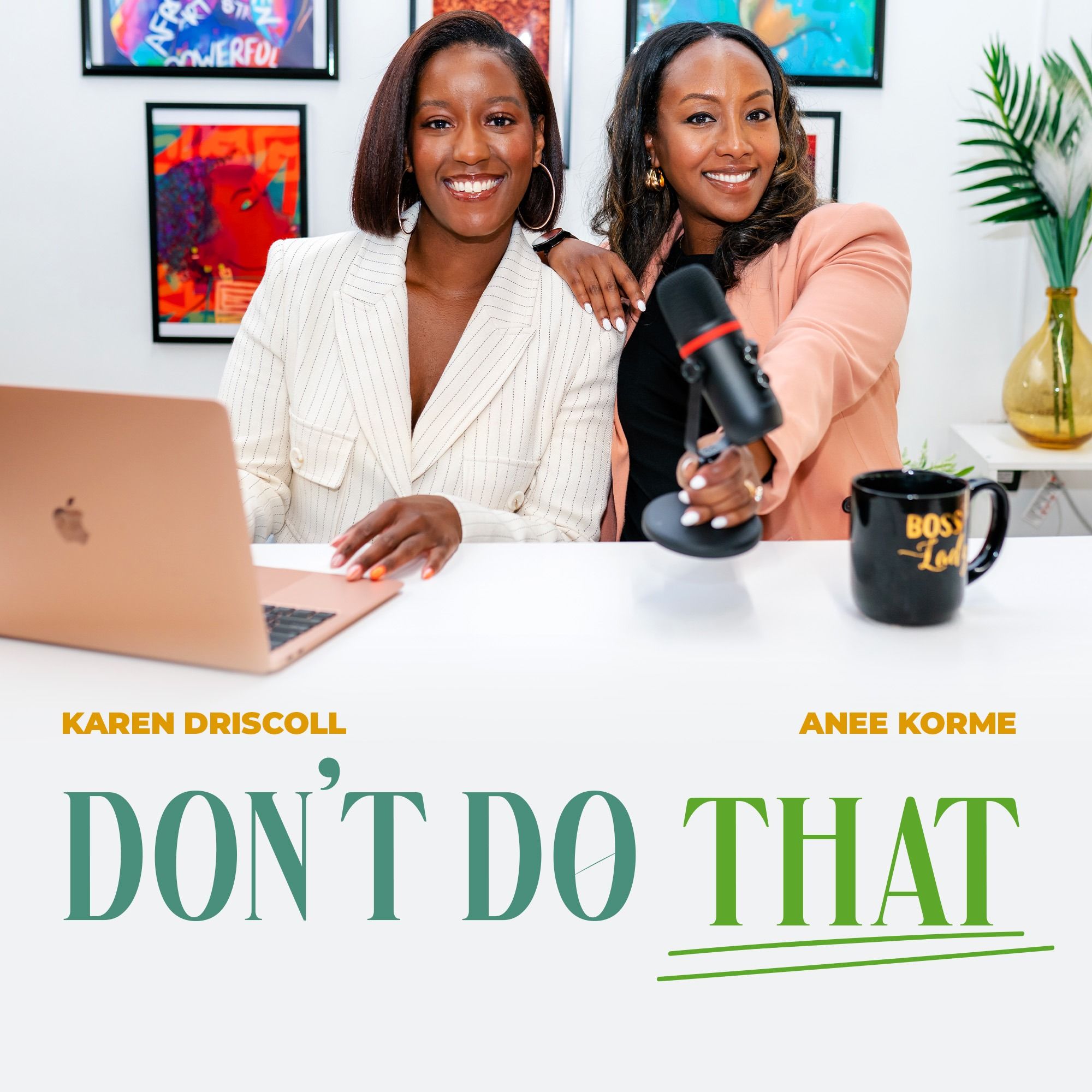
Don't Do That!
Hosted by Anee Korme, Karen Driscoll · EN
Don't Do That! is a podcast to talk about what not to do at work and beyond. Hosts, Karen and Anee, spotlight moments at work that challenge us, frustrate us, and grow us. Each episode will feature honest conversations with leaders who have experienced a “Don’t Do That” moment. Karen and Anee will explore what happened and how to turn a negative experience into a positive.
14episodes
Episodes
Newest firstAll episodes
The People Are NOT Okay
Apr 2200:44:22Tap to summarizeWelcome to another episode of with Karen and Anee. Today we’re talking about something that feels obvious but often goes unspoken: people are not okay. Across the workplace, in our communities, and in the world more broadly, people are carrying more than we can see. You may have noticed it. It shows up as more fatigue, more reactivity, more disengagement, or just a general sense that something feels… off. This isn’t just anecdotal. The data shows rising stress, declining workplace engagement, and ongoing disruption shaping how people experience work. In this episode, we discuss: What’s driving the current state of stress, burnout, and disengagement at work Why this moment is part of a broader, ongoing shift—not a one-time event The gap between what work demands and what people can sustainably give How different communities experience this “load” differently—and why that matters Some key takeaways are: “People are not okay” is not about individual fragility—it’s a signal about the systems we’re operating in Performance and well-being are deeply connected, not competing priorities Leaders build trust when they acknowledge reality and respond thoughtfully—not when they ignore it It’s possible to hold high expectations while also leading with care and awareness Resources (links): Gallup State of the Global Workplace Report (2026) HBR, The Future of Mental Health at Work Is Safety, Community, and a Healthy Organizational Culture” by Bernie Wong and Kelly Greenwood (2023) University College London / Klotz interviews and commentary on post-resignation workforce trends (2026) If you enjoyed this conversation, we’d love to hear from you! 📩 Email us: thedontdothatpod@gmail.com ❤️ Follow: Connect with us on LinkedIn. 🎙 Subscribe: Follow Don’t Do That! on your favorite podcast platform. ⭐ Leave a Review: Your feedback helps boost the show and lets others know what to expect. 📢 Share: If you found today’s discussion insightful, pass it along to colleagues and friends!
Transcribe →Don’t Let the Room Run You
Apr 800:35:18Tap to summarizeWelcome to another episode of Don’t Do That! with Karen and Anee. Today we’re talking about facilitation. Facilitation is probably not a part of most professional’s vocabulary. But you’ve likely encountered this skill set in meetings, at retreats, or training - when the person leading has control of the room, makes everyone feel engaged, and creates great conversation. That’s facilitation! In this episode, we discuss: What facilitation is and what is it NOT The role of a facilitator as a guide, focused on the process of moving a group from point A to point B Some key takeaways are: Facilitation can unlock leadership potential because it leads to better team work and collaboration. It can also improve a leader’s ability to influence others and add value to interactions. Leaders with facilitation skills provide a way for teams to get to solutions without telling them what to do Resources (links): Cindy Hugget: The Facilitator’s Guide to Immersive, Blended, and Hybrid Learning How Facilitation Skills Can Help You Unlock Your Leadership Potential How Great Facilitation Happens: Preparation, Flow And Follow-Through If you enjoyed this conversation, we’d love to hear from you! 📩 Email us: thedontdothatpod@gmail.com ❤️ Follow: Connect with us on LinkedIn. 🎙 Subscribe: Follow Don’t Do That! on your favorite podcast platform. ⭐ Leave a Review: Your feedback helps boost the show and lets others know what to expect. 📢 Share: If you found today’s discussion insightful, pass it along to colleagues and friends!
Transcribe →So now we’re paying for advice? The truth about Executive Coaching
Mar 2500:34:14Tap to summarizeWelcome to another episode of Don’t Do That! Today we’re talking about executive coaching. Is it a powerful leadership tool—or just expensive advice? Executive coaching used to be something mostly reserved for CEOs and senior executives, but now you see everyone from new managers to seasoned leaders working with coaches to think through career decisions, leadership challenges, and big transitions. Some people swear by it. Others think it’s a professional development grift. In this episode, we unpack what coaching actually is, when it can be helpful, and when it might not be worth the investment. In this episode, we discuss: What executive coaching actually looks like in practice Why coaching has become more common in complex and virtual workplaces How to tell if coaching is helping—or just validating bad ideas Red flags that someone hired the wrong coach Some key takeaways are: Coaching works best when leaders are open to reflection and change—not just validation. In fast-moving and distributed workplaces, coaching can create rare space for clear thinking and perspective. Working with a culturally competent coach can broaden your aperture, helping you consider how identity, power, and context shape leadership decisions. Coaching can support leadership growth, but it cannot fix structural problems inside organizations. Resources: 2025 ICF Global Coaching Study https://coachingfederation.org/resource/2025-icf-global-coaching-study-executive-summary/ 2024 HBR Global Leadership Study https://www.harvardbusiness.org/wp-content/uploads/2024/06/CRE5057_CL_TT24_Research-Findings_June24.pdf HBR “What Can Coaches Do for You?” https://hbr.org/2009/01/what-can-coaches-do-for-you If you enjoyed this conversation, we’d love to hear from you! 📩 Email us: thedontdothatpod@gmail.com ❤️ Follow: Connect with us on LinkedIn. 🎙 Subscribe: Follow Don’t Do That! on your favorite podcast platform. ⭐ Leave a Review: Your feedback helps boost the show and lets others know what to expect. 📢 Share: If you found today’s discussion insightful, pass it along to colleagues and friends!
Transcribe →How Banter Builds Culture
Feb 2500:35:18Tap to summarizeWelcome to another episode of Don’t Do That! We're talking about banter - you know, shooting the breeze with your coworkers. Those “water cooler” moments build company culture and boost productivity. Yet, the expectations around social interactions can make some professionals feel left out or excluded. In this episode, we discuss: The benefits of social interaction and banter How employees from diverse backgrounds have various degrees of connections with their coworkers Some key takeaways are: There are watchout for “water cooler” chats and how professionals are expected to engage. If your lived experience is not normalized, it can be difficult to engage and find connections with coworkers. Resources (links): The Surprising Benefits of Water Cooler Talks Gen Z workers feel isolated by tech and crave more in-person interaction If you enjoyed this conversation, we’d love to hear from you! 📩 Email us: thedontdothatpod@gmail.com ❤️ Follow: Connect with us on LinkedIn. 🎙 Subscribe: Follow Don’t Do That! on your favorite podcast platform. ⭐ Leave a Review: Your feedback helps boost the show and lets others know what to expect. 📢 Share: If you found today’s discussion insightful, pass it along to colleagues and friends!
Transcribe →Is that Racist or Nah?
Jan 2800:38:52Tap to summarizeWelcome to another episode of Don’t Do That! with your hosts Karen and Anee! Today, we’re diving into racism at work, specifically for Black professionals. Many Black professionals have had interactions at work that hurt or just feel icky. After the experience, we are left asking ourselves “Was that racist or nah?”In this episode, we discuss:The subtle ways racism and anti-Blackness shows up at workThe interactions that feels racists at workThe ways Black employees can respond to racists or uncomfortable interactions at workSome key takeaways are:Dr. Jean’s SNAPS (strategically navigating anti-black in professional spaces) decision-making model provides practical skills for navigating and responding to anti-Blackness.Black employees should always prioritize self in responding to racist interactions at work.Resources (links):Dr. Pearis Jean website and resourcesCoqual Being Black in Corporate AmericaIf you enjoyed this conversation, we’d love to hear from you!📩 Email us: thedontdothatpod@gmail.com❤️ Follow: Connect with us on LinkedIn.🎙 Subscribe: Follow Don’t Do That! on your favorite podcast platform.⭐ Leave a Review: Your feedback helps boost the show and lets others know what to expect.📢 Share: If you found today’s discussion insightful, pass it along to colleagues and friends!
Transcribe →Paying Dues: Struggle Is Not a Requirement
Jan 1400:40:26Tap to summarizeWelcome to another episode of Don’t Do That! with Karen and Anee. We're talking about success — and the story we’re often told about how it’s earned. That success requires struggle. That you have to “pay your dues” to deserve it. But is that actually true? Have we collectively accepted the idea that success can’t exist without hardship?In this episode, we discuss:The adage of “paying dues” which often means enduring a toxic environment and a lack of transparency and inclusion. Paying dues often leads to burnout and high turnover.How Millennials and Gen Z professionals are pushing back on the outdated mindset of “paying dues”.Some key takeaways are:Challenges and suffering are different. Challenges are about development while suffering erodes your personhood and well-being.Growth and development does not require exploitation. You can be intentional and explicit about learning and growth opportunities, without being unethical.Resources (links):Post from Jasmine McCall on LinkedInArticle: Organizational Culture: Paying Your DuesIf you enjoyed this conversation, we’d love to hear from you!📩 Email us: thedontdothatpod@gmail.com❤️ Follow: Connect with us on LinkedIn.🎙 Subscribe: Follow Don’t Do That! on your favorite podcast platform.⭐ Leave a Review: Your feedback helps boost the show and lets others know what to expect.📢 Share: If you found today’s discussion insightful, pass it along to colleagues and friends!
Transcribe →Hire me, Please!
Dec 300:42:24Tap to summarizeWelcome to another episode of Don’t Do That! with your hosts Karen and Anee! Today, we’re diving into today’s job market and the best strategies to land your next gig. We are joined by executive recruiter, Rory Verrett. In this episode, we discuss:The job marker as we know it has changed. The Trump Administration with the help of DOGE gutted many federal agencies. The government shutdown furloughed many employees, and other sectors are facing shrinking budgets and increased tariffs. Not to mention, AI is threatening to “replace” human workers.Black women have been impacted disproportionately by layoffs with more than 300,000 Black women out of the workforce.Some key takeaways are:Your worth isn’t defined by any organization, role, or title. Your worth is determined by the purpose you create.The career algorithm can help professionals define their values and strengths to be used in a variety of capacities.Reaching Rory Verrett:My Sovereign PathProtege SearchResources (links):300,000 Black Women Have Lost Their JobsBlack Women Are Reclaiming Their Identity Beyond WorkHalf A Million Women Left Their JobsIf you enjoyed this conversation, we’d love to hear from you!📩 Email us: thedontdothatpod@gmail.com❤️ Follow: Connect with us on LinkedIn.🎙 Subscribe: Follow Don’t Do That! on your favorite podcast platform.⭐ Leave a Review: Your feedback helps boost the show and lets others know what to expect.📢 Share: If you found today’s discussion insightful, pass it along to colleagues and friends!
Transcribe →I Don’t Wanna Leave, But I Gotta Go — The Truth About Quitting
Nov 1200:40:36Tap to summarizeWelcome to another episode of Don’t Do That! with Karen and Anee. Today, we’re diving into the complicated reality of quitting — and staying — in today’s workplace.In this episode, we discuss:How workplace loyalty has shifted — the median tenure is now just 3.9 years (BLS 2024)Why 75 % of workers plan to stay put through 2027 (Forbes 2025)What “quiet quitting” really means (Gallup 2024)How social media shapes career expectations (Frontiers in Psychology 2021; LinkedIn 2023)What quitting well looks like — even in a tough economySome key takeaways are:The average employee tenure is now under four years (BLS 2024) — not because people are disloyal, but because the relationship between workers and employers has changed.Job hugging and quiet quitting aren’t laziness; they’re survival strategies in an unpredictable economy.Social media has made work feel public and comparative — it’s easy to question your path when everyone else seems to be “living their dream.”Quitting well starts with honesty — about what you need, what you can give, and what you’re no longer willing to trade for stability.Resources:U.S. Bureau of Labor Statistics (2024), Employee Tenure SummaryGallup State of the Global Workplace Report (2024)Forbes (Oct 2025), “Job Hugging: 75 % of Workers Staying Put Through 2027”Fortune (Aug 2025), “Why Workers Feel Stuck”Schmuck et al. (2021), Frontiers in Psychology, “Social Comparison on Social Media Increases Career Ambitions and Dissatisfaction”LinkedIn Workforce Confidence Index (2023)If you enjoyed this conversation, we’d love to hear from you!📩 Email us: thedontdothatpod@gmail.com❤️ Follow: Connect with us on LinkedIn.🎙 Subscribe: Follow Don’t Do That! on your favorite podcast platform.⭐ Leave a Review: Your feedback helps boost the show and lets others know what to expect.📢 Share: If you found today’s discussion insightful, pass it along to colleagues and friends!
Transcribe →Respectfully… I Don’t Understand: When Corporate Jargon Goes Too Far
Oct 2200:34:07Tap to summarizeWelcome to another episode of Don’t Do That! with your hosts Karen and Anee. Today, we’re talking about the language of work — and how “professional speak” has become its own dialect. You know the one: “Let’s align,” “I’m at capacity,” “Let’s take this offline.”In this episode, we unpack how trendy corporate buzzwords have quietly replaced clear communication — and why that matters. From email urgency bias to garbage language, we look at what all this jargon says about the culture of work, and how we can sound smarter by keeping things simple.In this episode, we discuss:Why businesses lose over $1 trillion a year to poor communicationThe rise of “email urgency bias” and what it’s doing to our brainsHow “corporatese” shapes power, clarity, and belonging at workThe evolution of buzzwords — from “buy-in” to “alignment”What true professionalism sounds like in 2025Key Takeaways:The clearest message is usually the most powerful one.Jargon doesn’t build credibility—clarity does.If you want to sound smart, say it simply.Resources:Grammarly State of Business Communications Report 2024It’s time to streamline how we communicate at work"Per My Last Email" — Can Your Corporate Jargon Be Discouraging Individuality?-Gen Z Slang is Revolutionizing Work JargonIf you enjoyed this conversation, we’d love to hear from you!📩 Email us: thedontdothatpod@gmail.com❤️ Follow: Connect with us on LinkedIn.🎙 Subscribe: Follow Don’t Do That! on your favorite podcast platform.⭐ Leave a Review: Your feedback helps boost the show and lets others know what to expect.📢 Share: If you found today’s discussion insightful, pass it along to colleagues and friends!
Transcribe →Is Work-Life Balance Real? Or a Dream Deferred?
Oct 800:41:58Tap to summarizeWelcome to another episode of Don’t Do That! with your hosts Karen and Anee! Today, we’re diving into the idea of work-life balance. We unpack what aspects of work culture support or prevent work-life balance.In this episode, we discuss:The negative impacts of America’s “always-on” work cultureHow employers can support well-being through flexible work hours, more vacation days, and better benefits.Some key takeaways are:Work-life balance is not one size fits all.Work-life balance is not given to you. You must reclaim it.Resources:Work-Life Balance: Is the American Model Getting a Bad Reputation?Survey: 82% of Employees Expect Employers to Support Work-Life BalanceIf you enjoyed this conversation, we’d love to hear from you!📩 Email us: thedontdothatpod@gmail.com❤️ Follow: Connect with us on LinkedIn.🎙 Subscribe: Follow Don’t Do That! on your favorite podcast platform.⭐ Leave a Review: Your feedback helps boost the show and lets others know what to expect.📢 Share: If you found today’s discussion insightful, pass it along to colleagues and friends!
Transcribe →