Loading summary
Transcript105 lines
- [00:00]
A
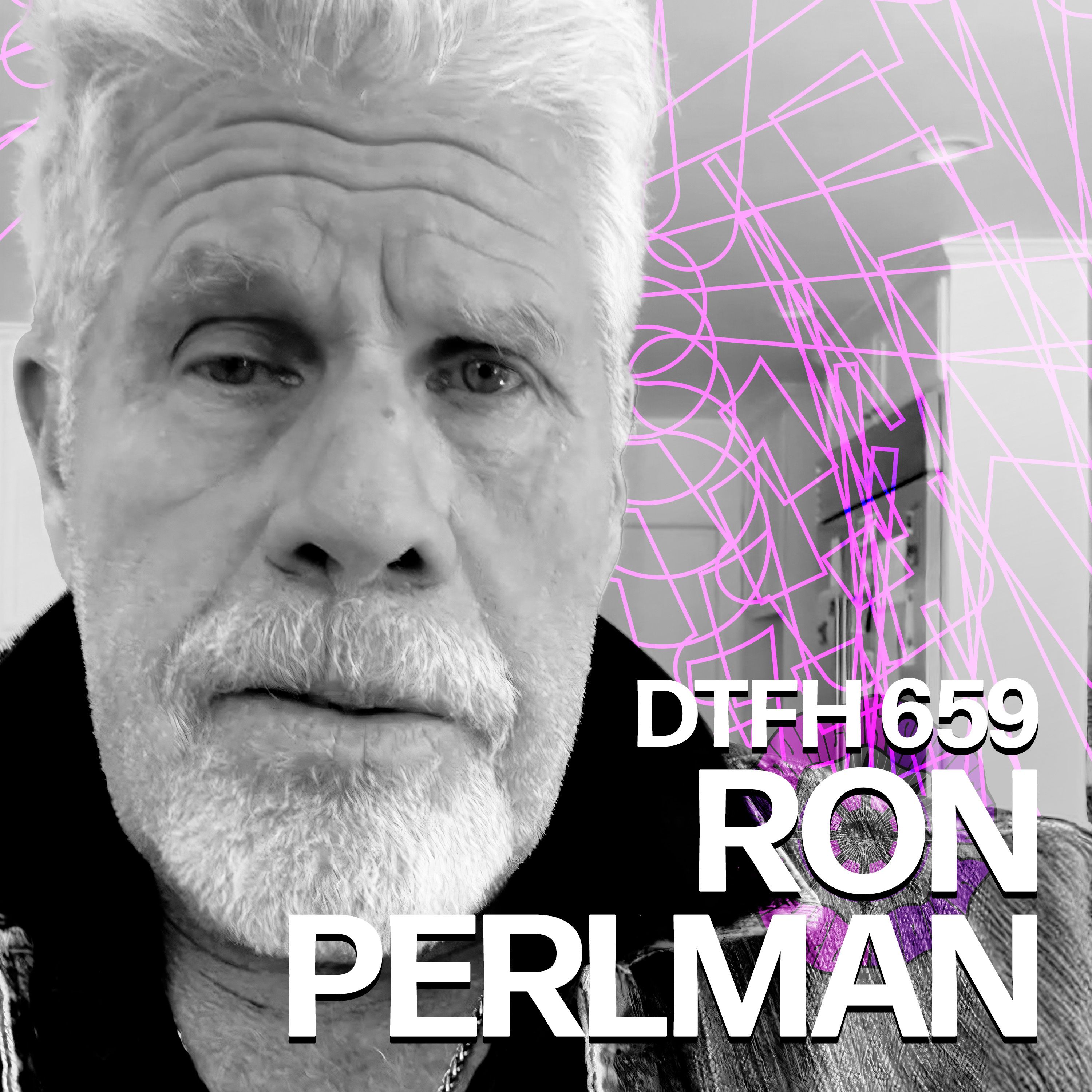
Welcome, my friends, to the dtfh. Before we get going with this sacred episode, I would like to invite you to become a YouTube member that will get you commercial free episodes of this podcast. There are other things I intend to do with memberships, but right now we got commercial free video episodes. Unperturbed, undisturbed, virginal, until you pounce upon them as a member, deflower them, consume them, kiss them to sleep. So join. I don't know how. Somewhere around here there's a button. I'm guessing today's guest is an incredible actor. You know him from Hellboy, you know him from Sons of Anarchy. You know him from any of the other millions of incredible films he's been in. City of Lost Children. Are you freaking kidding me? We got Ron Perlman today and we had a wonderful conversation. It's awesome when you meet an artist you really respect and you find out they're infinitely cooler than you already thought. That is Ron Perlman, a brilliant, disciplined actor who has been working his ass off since high school to offer us his amazing talent. And now you get to hear a conversation with this esteemed guest and your lowly host. So everybody, please welcome to the DTFH the great Ron Perlman. And are you in LA right now?
- [01:30]
B
Yeah, we came out just fine, thanks. We were in the kind of the shadow of the Eaton fire, but the winds on that Tuesday night were epic and apocalyptic, so we were at the mercy of the elements. But we lucked out, came out unscathed. And the only thing I'm dealing with right now is survivor's guilt because so many of my friends were terribly affected.
- [02:03]
A
Yeah, it's terrible. I mean, it's apocalyptic. The videos coming from there are insane. I've never seen anything like that in my life. I lived there for 20 years, and I don't think anyone even understands what's happened yet. I don't think you can.
- [02:21]
B
It's just unprocessable to, you know, just when you think you, you know, understand what the new normal is, the new normal is. Is. Is completely trumped the following year.
- [02:37]
A
Yeah.
- [02:37]
B
By these climate events. And to watch a community like Pacific Palisades just become flattened. There's no anticipation, you know, you can't prepare for that. You can't conceive of that. It's all unprocessable.
- [02:55]
A
Ron, you know, I don't want to waste your time. And, you know, in the history of my podcast, which has been going on for a long time, you are the most esteemed actor I've ever had on the show. And so I hope you'll get around more. Boy, get out of here. No way. I'm sorry. I've loved your work ever since I was a kid and it's rare, I mean, to have someone who has focused on an art form like you have for so many years. When do you ever get to talk to someone like that? So I'm really interested in talking about how this all started. I had a nice long conversation with Chatgpt about you, and I just wanted to start at the beginning, if you don't mind. Tell me about Thieves Carnival.
- [03:51]
B
Thieves Carnival is kind of a French feudau farce which is like very fast paced, 15 things happening all at the same time. Duplicitousness, you know, hypocrisy. All of these things at play kind of define the style of the classic Fayedau Force. To have that be the very first exposure I had to this world that, you know, that. That was the door that opened up my. My stepping into this world of finding the aphrodisiac in acting was. Was trippy because it was. It was. The play was more style than substance. And so I was. It was incredibly seductive introduction to. To not only discovering all of the things one discovers when one is in the rehearsal process and the discovery process, but then putting it up on its feet in front of an audience and being involved in something that is so razzle dazzle and happens so fast, so fast paced that the audience doesn't have time to breathe. All they can do is basically hang on by their knuckles.
- [05:24]
A
This. Who was your. I couldn't find this. Reading about this insane production and imagining this being done at a high school. Who is your drama teacher? I mean, that is insanely ambitious for a drama teacher to choose that as the school play.
- [05:43]
B
It's funny, the two drama teachers from my high school and then college career had both tried their hands in the business and were teachers because things didn't turn out the way they had hoped.
- [06:01]
A
Yeah.
- [06:01]
B
You know, in terms of their professional contribution and their ability to sustain themselves in the profession. So they were coming at it. The two people who had the most influence on me and my, you know, trajectory, which is to throw myself in. To this tripped out world of, you know, dramatic literature and then also, you know, the mounting of it on its feet and participating in creatively inserting oneself into this amazing contribution of existential exploration, which is basically what theater and literature, great literature does. So they had come from very esoteric places where they were earlier in their lives involved in very Experimental stuff. And what they brought to their teaching experiences was a longing and a respect and an admiration for the things that attracted them into wanting to become creative artists. And so we benefited from this incredible esoteric kind of appreciation of really cool stuff.
- [07:37]
A
What cool stuff?
- [07:39]
B
Well, for instance, that was my high school teacher. His name was Ken Goldsberry. And he was as elegant and as sophisticated and as well read a man as I had ever met up to that point. So he was the perfect person to take a kid from a hardscrabble kind of New York tough neighborhood and expose him to things that were really head turning, you know, like things that one doesn't contemplate when one is basically just, you know, walking to school, walking in the schoolyard, playing stickball, playing softball, you know, playing all those street games that one plays in New York. And then all of a sudden you meet a guy like this who's trying to turn you on to a cornucopia of writing and writers and people who are shining lights from all over the world. I mean, Thieves Carnival is a French play.
- [08:40]
A
Yeah.
- [08:41]
B
So here I am, you know, Washington Heights, New York, lower middle class Jewish guy, suddenly exposed to a very sophisticated kind of a French point of view and having to insert myself into all of that. That's transformational.
- [08:57]
A
Yeah.
- [08:58]
B
And it's, and it's trippy enough to make you want more, which is basically why I got so lucky with these first two professors of mine. Yeah, him and then this guy named Ralph Arsemanian who was my college professor, who turned me on to Pinter and Beckett and Pirandello and Ionesco and Edward Albee and then Tennessee Williams and, and you know, so the contemporary writers, but also turned me on to Shakespeare and Moliere and the Greeks, Euripides and Aeschylus and, and, and so my exposure to, to the great thinkers who ultimately took their brilliance and transformed it into a kind of a dramatic exploration of the human condition was like, it was like, you know, this is why people do drugs is to experience what I was experiencing without the use of any drug. The theater was my drug.
- [10:05]
A
What's curious to me about your origin story is that, you know, if we're just going to be like hacky stereotypical lower middle class New Yorkers. What seems sort of off script is your dad, your dad encourages you to get into theater where you are exposed to all these things. And I'm just really curious about that. What an artificial intelligence told me is that it was to build up your confidence. And when I'm thinking of like most dads, I don't know if theater, I would do it for my kids, but I don't know if theater is the first thing you suggest.
- [10:52]
B
Well, you didn't really suggested but one. Once I kind of backed into it. I really backed into being involved in this first production. And then the first production led to a second and a third because it was drug like, it became an addiction for me. By the time my dad saw me do a couple of early productions in college, it wasn't as if he was suggesting a life in the theater. It was as if he was taking a look at what I looked like in that setting and encouraging me to do whatever it took to stick with it. There was a recognition on his part. And this was a guy who grew up during the Depression and was part of this kind of like, baby boomer mentality of like, get the safest job you can get, get an education. Make sure you have a fallback position in life. Don't stay away from anything unpredictable because we know what it's like to be on breadlines.
- [11:56]
A
Yeah.
- [11:56]
B
And. And it ain't cool. And. And so coming from him to be encouraged into perhaps entertaining, the idea of a life as unpredictable as that of any artist, musician, painter, actor, dancer, etc. Was almost profound. And it was him giving me the permission to not feel guilty about enjoying this as much as I was and exploring it as much as I was and letting it see how far it took me, as much as I was getting that encouragement from him was, yeah.
- [12:43]
A
I've got three young kids, and so I'm always looking at good fathering stories. And I'm really curious. This is jumping further ahead than I intended to, but both of your kids, one is a very successful music producer, the other a successful actor. Did this happen spontaneously or. You know, as I'm a comedian and there's a part of me I don't want to, like, be the kind of dad who, you know, even in some subtle way, pushes the child towards this or that. But was this a spontaneous thing or maybe just being around someone who was successful in the most bizarre job out there, they just knew they could do it. Like, what was their path and what impact did you have in encouraging them or not encouraging them? Friends, we have a brand new sponsor for the dtfh. And let me tell you, my mark of approval is great, but my wife's mark of approval, it never happens. Hasn't happened for me yet, but it did happen for today's sacred sponsor, Quince. What's incredible about Quints is that you can refresh your look with quality pieces and stay on budget. Again, this has the Aaron Trussell sacred seal of approval. It doesn't come I'm going to quote my wife here. Yeah, I could have used the offer code but I love my sweet wife so I let her use my offer code. I let her order Quint's items. She got undies and shoes. And to quote my dearest, the organic cotton underwear is so affordable. No BLEEP for my bleep. So that's great. That's great for me, that's great for her, that's great for my family, great for any future children we might be having. And also she ordered clogs that she loves. She loves quints. She's loved quints for a long time. When they reached out to see if they could sponsor the podcast, she was very excited and said do it now. So we did. And I'm glad I did because now my wife doesn't have some kind of horrific, chemically soaked nightmare amalgam of synthetic materials rubbing against the portal to life that is in her pants. Upgrade your closet this year without the upgraded price tag. Go to quints.com duncan for 365 day returns plus free shipping on your order. That's Q U I N C Duncan to get free shipping and 365 day returns. Quints.com Duncan.
- [15:55]
B
We, we bent over backwards to give both my kids as normal and as unexposed a childhood as that we possibly could. Yeah, knowing that they were going to, you know, just by osmosis alone be, you know, be kind of swept up into what mom and dad go off and do during the day. The conversation ensues over dinner. You know, there was going to be some sort of an exposure to it but, but we really, really did everything we could to put them in normal schools around normal kids, as much non showbiz environment as we could find with the knowledge that if they were going to come to us at some point expressing some interest in this, it had to be self generated. It wasn't going to be something that was imposed on them or was encouraged by us toward them. And sure enough, both of them found this joy of creativity that you and I both understand. And once they found it and once they expressed kind of a strong enough commitment to it where they were not going to be talked out of it, then the encouragement began right then. Because you know, I think it it, I, I, I, I, I'm constantly exploring how I up as a parent, you know, oh, of course and one of the ways was I think I maybe indulged my kids too much. Maybe I made my kids lives a little easier than they should have been. My life was really tough, hardscape. And maybe that was part of what made me as hungry as I was and made me fight for everything as much as I was. And I'm looking at my kids generation lot of stuff, and they didn't have to fight as hard as I had to fight. They didn't come from really, really humble beginnings. I don't know, is that a fault? You know, I'm still grappling with all of that.
- [18:09]
A
I don't know. I go back and forth on it myself all the time. I don't know.
- [18:13]
B
But the one thing that I cling on to is, you know, the old cliche, if you do something that you love, you never work a day in your life. So if your kids find out that this is where their sweet spot is, this is their joy is making music or painting or writing or acting or singing or any of these things that are non conventional ways of going through life, then I feel like that's what life is all about, is to find something to do that you love, that you would do for free.
- [18:52]
A
That's it.
- [18:53]
B
And then try to make a living out of it.
- [18:55]
A
That's it. I feel certain that you're like this. If I don't know. An electromagnetic pulse weapon wipes out the power grid, all the power shuts down. We are now on the road. We're in a post apocalyptic society. You would be doing theater for sure. You would be one of the people who still perform no matter what. And I feel like I would still do comedy if I could. And I think that's it, you know, if you would just. If this is. You kind of have to do it. And I think there's something that feels obsessive about it sometimes, something that doesn't feel healthy, sometimes that you have to. It's such an insane kind of life, you know, and full of rejection, full of like big challenges to your ego, you know. And this, by the way, I gotta ask, I mean, so you go to graduate school, you're studying this, you're clearly like, you're completely absorbed in this. And you. How did you meet Tom O'Horgan? How did that happen? Jesus Christ Superstar, one of my favorite musicals. How did you. How did this happen?
- [20:15]
B
Well, there was this publication for young actors in New York called. There were two publications. One was called Backstage and the other was called Showbiz, I think. But they were like, you know, they came out like twice a week and they would tell stories about the cultural scene in New York. And then the last four or five pages were like classifieds for auditions taking place, some of which were paid gigs, you know, like Broadway gigs, some of which were, you know, off Broadway, which was a semi paying gig, and some of which were off off Broadway, which were like the ability, the opportunity to do theater in New York for free.
- [20:57]
A
Right?
- [20:58]
B
And trust me, you know, there was tremendous amount of competition for all of the above, including the for free shit. And I depended on that. I was not what they called when you were coming up in New York, Procter and Gamble. Which meant, you know, there were two ways to make a living in New York. You could either do commercials.
- [21:19]
A
Oh yeah.
- [21:20]
B
Keep a roof over your head. Or you could do soap operas and keep a roof over your head. Occasionally there'd be a TV show shooting in New York and you could, you know, you could have a good enough resume so that you're being sent up by your agent. But I was so uncommercial and so non proctor and gamble. I didn't have an agent for the first five or ten years, five or six years of my career. So I depended on these classified ads to tell me where the auditions were. And there was an open call for a play called the Architect and the Emperor of Assyria, which is written by, by a guy named Fernando Arabell in the late 60s, which was the beginning of experimental, expressionistic, crazy ass theater, the living theater, all, all this really cool stuff that was being done all over the world. Peter Brook, et cetera, et cetera. Those were the cats who were like, you know, on the scene at that point. And Tom O'Hargan was going to direct, be directing the world premiere of this two character play, the American premiere, I should say, of this two character play. And I auditioned for it and I got down to the callbacks and then I got down to, you know, I was down to eight guys. And then they finally hired four of us, two cast to alternate to do this production at La Mama, which was a very important experimental theater in downtown New York in the Village.
- [22:50]
A
Do you remember the. The first? It seems like if that were me, I would. It would be really hard to rein in the nervousness to audition for something like that. You know, I would. It would freak me out knowing there was some possibility to work with that director.
- [23:09]
B
I was very affected by encouragement. I was always really freaked out at the first audition. But if you gave me a call back and let Me know, okay, we liked what you did. We want more of that. We want you to, in fact, double down. That's how I looked at a callback was like, we want you to. We dug what you did enough so that. Let's see what else you can do. And that was an invitation for all the nervousness to go away, to be replaced by, okay, we're on a wavelength here that I can expound upon. And that's what happened when. When I did my first audition for. For the Architect for Tom, and I found out, you know, he wants you to come back later this afternoon for a callback. I was. That was it, man. I was like being tapped on the shoulder and saying, hey, man, you. You know, you're. You know, you made the cut, you know, and, you know, now it's time to really, really show your wares, right? And to play with such a tremendous kind of larger than life, very stylized. It asked for big, big choices and big performances. And so I thought. I felt like it was right in my wheelhouse, and I went for it and ended up getting it. And it was. It's funny that you. You identify that because that's probably the very first thing that happened to me in my, you know, nightmarish beginnings of pounding the pavement in New York. That was not mainstream, but in the stream of where I wanted to head, which is the Tom O'Horgan kind of experimental theater that may lead to, like, okay, now he's doing hair on Broadway and Jesus superstar Lenny and all these other things, but he comes from La Mama and, And. And that's. That's kind of the road I wanted to take.
- [25:16]
A
I mean, it's insane. I mean, you're living in New York. You're. You don't have an agent yet, and you land that gig. That is. I mean, that would. That would feed me for a long time. That's a big, big break. And, yeah, I'm really fascinated. I'm not an. I'm a. You know, I'm a comedian, not an actor. But I love acting. I love great actors. I love watching. I'm fascinated by the art form and knowing my friends who are actors and hearing descriptions of what it's like to shoot a movie to versus theater. Whereas movies are so technical, man. Like, you know, it's like you're shooting these tiny little pieces of this thing over and over and over again, whereas theater, it seems like you're, you know, it reminds me at least more of stand up because you just get to. You go from beginning to end. There's no constant breaks. All the stuff. Actors. I don't think many people realize what a technical job acting for movies is. Not to mention your prosthetics. Hours of prosthetics. And then to shoot, I don't know, a couple of minutes that might end up on the cutting room floor. Do you have a preference between these two ways of acting?
- [26:40]
B
The minute I began to work in front of the camera, I forgot theater. Wow. Really quick. And I was one of these guys, like, I looked at some of the actors when I was a kid in the 60s and 70s who came from the theater and then never went back to the theater. I hated them. How can you be such a sellout, right? And then I did a couple of movies and TV shows and I found out. And what I found out just suited me and my temperament. I have a lot of friends, though, who still feel like theater is it.
- [27:20]
A
Right?
- [27:20]
B
So it depends on who you talk to. The reason why I like acting in front of the camera is because I'm one of these guys, you know, like, maybe it's because I'm an Aries. I mean, you know, I hate to throw the horoscope into this.
- [27:36]
A
April 13th. I'm April 20th.
- [27:39]
B
Yes. But, you know, we're like instant gratification people. And like, if you study our sun sign, once we conquer something, we don't have any desire to go back. It's always, what is the next hill to climb? And when you're doing a play eight times a week and you fucking nail it on a Tuesday night, and then you got two more on Wednesday and you go, why do I have to do that? I just proved to myself and the world that I that. That you can't play this part any better.
- [28:09]
A
Right?
- [28:10]
B
Well, that's why movies is so cool, is because when you're acting for the camera and you're working on one scene at a time, the minute you get to that point in the place where you go, I can't do it any better than that, and the director agrees and everyone on set agrees, you move on and you never have to do that scene again. And it just suits me. It just suits me to, like, once you get it, throw those pages out, what's next? And that's why I love movies.
- [28:41]
A
I'm really curious about how you are capable of summoning up these characters that you play in the midst of the chaos of shooting a movie. I mean, the thing is, like, you know, there's constant breaks, stuff is hanging. What is your method for becoming? You have played so many crazy roles. Quest for Fire. Holy shit, man. I remember when that came out. That was a massively controversial movie. As you'll probably recall from that Hellboy, all your work with Guillermo del Toro, all of these strange creatures. How do you do it, man? To me it just seems like this incredible magic trick. Like I'm imagining that in between takes or going to eat lunch or whatever, you've just been performing these insane scenes. How do you pick it back up? That's what I don't understand. Like, what's your method there?
- [29:49]
B
The question is, how do I do the rest of it? I mean, what you're describing is the easy part for me. You give me a task to do when it comes to, you know, figuring out how to take what a writer wrote. It's one dimensionally on a page and then, and then breathe life into it. But you send me to the store with a list of groceries. I'm a mess. I mean, it's just it, you know, it's everything else in life that I'm a disaster at the only time I'm really kind of functioning in a place where there's some kind of sure footedness and, and, and the kind of peace that one needs in order to get the focus to shut out all that other stuff you're talking about and just get intimate and get private and play the character and just focus on nothing but the people who are around you or if you're alone on screen, like the circumstances around you. That's the easy part for me. Life is a mess for me, bro. I can't. I'm a disaster. I need. I need. I. I need.
- [31:07]
A
Oh, wait. I lost your video. Ron. I'm not sure what happened. Did your camera flip off?
- [31:13]
B
Foreign.
- [31:24]
A
This episode of the DTFH has been brought to you by my dearest friends at AG1. Listen, I'm gonna knock on wood after I say this, so don't worry my superstitious friends out there. I have three children. And when you have three children, it's like living in a medieval village. Near enemies who keep catapulting plague ridden animal carcasses into your well. Diseases spread through the family like wildfires because children are filthy and they get sick by going to school and they bring that sickness home and that sickness spreads. Its tendrils move through your family, they wrap around your lungs, they make you sneeze and cough and can leave you bedridden and potentially unable to go on the road. But I don't know, they didn't want me to say this. I'm not making any claims on their behalf. I just want to say I slurp back that sweet Ag one and I have watched my family get sick over and over again. Ha ha. And I'm fine, baby. And what's the difference? We eat the same organic yogurt. We drink the same organic milk. We use the same organic, organic toilet tissue. But they don't drink AG1. They didn't want me to say that. They're not making any claims. I'm just saying AG1, it supports energy, digestive regularity. That means I'm pooping on schedule, immune support, and even a healthy mood. AG1 will help you be ready to take on what 2025 has in store for you and allow you to secretly gloat because you're not sick because you have an immune system of steel. Again, I'm saying that last part. They do not guarantee that you'll have an immune system of steel. I'm just saying I'm reporting from my own experience slurping this delicious stuff back. You should give it a shot. So this new year, try AG1 for yourself. It's the perfect time to start a new healthy habit. And that's why I've been partnering with AG1 for so long. And AG1 is offering new subscribers a free $76 gift. When you sign up, you'll get a welcome kit, a bottle of D3K2, and five free travel packs in your first box. So make sure to check out drinkag1.com Duncan to get this offer. That's drinkag1.com Duncan to start your new year on a healthier.
- [33:52]
B
No.
- [34:03]
A
You have quoted Carlos Castaneda from the teachings of Don Juan, and you say, just relax and pay attention when it comes to acting. Now, if I'm misquoting you again, I'm blaming it on the AI but this is what it told me. I like. I love Carlos Castaneda, and I'm. But more interesting to me is the concept of identity. So here you are, Ron Perlman, going to the grocery store, and it sucks. And your life as an artist is a little messy. And then you shift into these alternate personalities, and suddenly there's a sense of flow, a feeling of, this is where I belong. I'm just really curious. What is your philosophy of identity? Like? What's the difference between Ron Perlman at Ralph's and Ron Perlman as Hellboy?
- [34:58]
B
There's less and less of a difference. I hope I just plugged my phone, and I hope it's charging, but I Changed locale. So I don't think my hair is looking as good as I did a second ago.
- [35:12]
A
It does look good. And the background suits you. It's cool. The curtains, you could start a pie. And the dog, that's your. You could start a podcast.
- [35:22]
B
Well, I'm proud of the fact that I think I'm the only actor in Hollywood that doesn't have a podcast.
- [35:28]
A
That's the real reason I came to talk to you. You have to.
- [35:32]
B
I had to come on yours in order to truly expose myself, which, let's face it, that's what we're all here to do, is to expose ourselves.
- [35:43]
A
Well, that's your philosophy, right? I mean, vulnerability, you know, ripping yourself open in front of those cameras.
- [35:50]
B
The. I really, really have. I'm 74 years old. You know, I hate to call attention to that, but I'm doing a lot of thinking about the actor I was when I started and the actor that I am now. And clearly when I first started, there was such a discomfort about how I felt about me, that acting was a haven. Acting became a place where I no longer had to be me. I could be other people. And then in the creation of an abstract character, it didn't really exist in real time. But then making him exist, I was able to come as close to perfection as. As I longed to. So acting when I first began was, was. Was purely therapeutic and very self indulgent, kind of an art form, a craft. It was my version of going to the shrink and. But it enabled me to not have to be Ron. Not have to, to. To. To like, you know, I was more alive becoming other people.
- [37:21]
A
Yeah.
- [37:23]
B
And then somewhere around mid to late 40s, I began to sort of have a detente with myself where I was able to accept myself to the point where, okay, maybe I'm starting to even like myself. To the point where, wow, I think I'd rather be alone than around 100 people. Which is what I used to have to be in order to not feel completely lonely. And being, Being me became the easiest thing. But it was a very long slog and it took a long time. It wasn't the result of anything other than just being on the planet long enough to just finally figure out like, holy shit, you know, I'm looking around, maybe I'm not so bad after all, looking around, all the shit around me. But also I'm just becoming more comfortable in my own skin. And that's when you notice, you know, going from Quest of Fire to Name of the Rose to Beauty and the Beast to Hellboy to island of Dr. Moreau. That all ended and it just became Ron is playing a role with no makeup on. And that was because I was just more comfortable in my own skin. I didn't have to put a mask on. I didn't have to put some sort of a barrier between myself and the rest of the world in order to be free enough to be expressive. But I love acting as much now as I did then, but for different reasons. And you asked me the differential of going from Ron to the character.
- [39:14]
A
Yeah.
- [39:15]
B
Now the character is. They're all in there.
- [39:20]
A
See, that's the part that. That's what I love about acting is it demonstrates this multiplicity of personalities that exist theoretically inside of everybody. But you guys can just somehow summon these different facets of yourself on command.
- [39:40]
B
Whereas if a car is about to go over your eight month old baby, you will lift that car off the ground and move it.
- [39:50]
A
Yeah, yeah.
- [39:52]
B
That's not something you're doing, you know, but the ability to have superhuman powers is in there. Under the right circumstances. The ability to live in a world where the injustice is so overwhelming that you are willing to take someone else's life in order to just get justice.
- [40:18]
A
Yeah.
- [40:18]
B
Or to get. To remove somebody who did something unspeakable from the world that's in there. Every single thing that's part of the human condition is in all of us. And the thing about acting is when you're lucky enough to have a craft where you can channel the things that affect you in this life and channel them into, you know, different characters that you're being asked to play, you realize it's all in there. It's just a question of tapping into it. And. And then it comes out in your voice with your mannerisms. But you're seeing somebody who's really different from you. And so the chasm between the vessel that's playing the character and the character gets smaller and smaller and smaller to the point where they're almost unrecognizable.
- [41:19]
A
See, I'm really curious though. What is the source that you're channeling? Is it inside? Is it some kind of archetypical matrix that. In other words, when you are channeling these characters, is it even you? Or have you tapped into some kind of collective mind that is flowing through you? Is it a form of. I mean, it sounds dramatic, but is it a form of possession? Are you. You know, they talk about being mounted by the spirits. Is that what's happening? I mean, maybe this is why some people don't become great actors is because the first. Probably the first encounter with that possibility is a little unnerving.
- [42:01]
B
Well, I'm never going to play somebody I don't understand. I'm never going to play somebody that I don't recognize how to get into that humanity.
- [42:11]
A
Right.
- [42:12]
B
Because I'm just. There's no, there's no point in. In doing something that you just know is not a good fit for you.
- [42:20]
A
Right.
- [42:21]
B
So every time I'm going to take a role, it's because essentially I. I understand what the. What the. What the writer is asking of me.
- [42:28]
A
Right.
- [42:28]
B
I understand enough about this person to have a shot at, you know, solving this puzzle. And I'm intrigued enough about his wiring and his idiosyncrasies and his history that I really want to enthusiastically spend time unraveling that puzzle.
- [42:56]
A
Yeah.
- [42:57]
B
So if you see me in a role, it's, you know, no matter how disparate it seems from the last one I did, it's because there's a recognition that, oh, okay, I know who this guy is. I understand who this guy is. And, and I know that. That some of the shit that he's going through is in there to be tapped.
- [43:21]
A
How much contact did you had with Hellboy before you took on that role? Had you ever seen the comics before? And if you hadn't, how much time did you spend reading the comics to get ready for it?
- [43:36]
B
Well, Guillermo mounted a campaign to get me to play Hellboy that took him seven years.
- [43:41]
A
Wow.
- [43:44]
B
Two studios gave him his walking papers and says, dude, we love you. We want to make the movie, but we're just. We're not prepared to do it with a guy who's not a bona fide movie star. It's not Leonardo DiCaprio or Nicholas Cage, somebody who's a bankable movie star. And so I, I didn't think he was ever going to pull it off. I, you know, I know the way the game is played. I know the kind of collateral one needs in order to. To get a comic book movie franchise green lit. Because it's hundreds of millions of dollars somebody's going to spend. And I refuse to allow myself to look at the comic books or to. Or to. To familiarize myself with Hellboy. Even though Guillermo was telling me about it for seven years, I just refused to become emotionally attached to it because I. I didn't think he was going to pull it off. He did pull it off, and it was, needless to say, a singular event. I've never witnessed anybody being that single minded that they're willing to not make the movie, rather than make it the way they don't want to make it, as Guillermo did with that. And I don't think I'll ever see a gesture like that again, because we're in a business where people will sell their fucking grandmother to get their movie.
- [45:16]
A
Yeah, true.
- [45:18]
B
But he did and he won. And the minute he said, okay, this is the studio that's making it, that you're okay. You're a Hellboy. I read all the comic books. I sat with Mike Mignola. I mean, I steeped myself in every bit of Hellboy as I possibly could, but I did not do it until I knew I had the part. And that was seven years from the moment Guillermo mentioned at one point, we're going to do this together. And I said, yeah, good luck.
- [45:47]
A
That is the craziest story. I mean, that is insane. And I got to ask, how do you mitigate that? Like, if Guillermo del. If someone like that is like, listen, Duncan, we're not making this movie without you. I don't know what. I don't know how I would. I would have to take a lot of acid to, like, wipe my ego back a little bit. How do you deal with it, man? Like, it's gotta be this strange. Do you ever look at your life and think, jesus, maybe this is a simulator. Maybe it's a simulation. Maybe it's a dream. Maybe. Do you?
- [46:25]
B
All the time. All the time. All the time. I mean, I, I, I'm going to plug a memoir that I wrote about 14 years ago called Easy street the Hard Way. You can get it on Amazon or you can go to my Instagram page and it'll send you the link. It's it. The thing that, that I was most obsessed with communicating in the writing of this book was my gratitude and my, my. I can't even sometimes square up how phenomenal my life turned out. And so much of it had nothing to do with me. So much of it had to do with just the way things broke, sort of Acts of God, because there was no other way to explain them. This thing that Guillermo did, the seven year Trek that he made on my behalf to get me that role, which led to a second Hellboy movie, which led to a whole lot of other stuff that's still happening. You know, those are. I spend a lot of time working on projects and working on my life and working on my career, but the really important stuff that's happened to me, I had nothing to do with.
- [47:56]
A
Right? Yeah.
- [47:58]
B
And so that's like all you can do is just figure out a way to be worthy of that and to, you know, and to. And to exude gratitude and the wish for everybody else who longs for the things you long for, to get them, to achieve them, and to help as many people as you can. Because you're one of the lucky ones that, like, you had a set of dreams, but the actual things that happened to you went beyond them.
- [48:41]
A
Yeah.
- [48:42]
B
Yeah, I'm that guy.
- [48:45]
A
It's overwhelming, isn't it? I mean, it's you. You sort of. Oh, my God, this sponsor. I love them so much that when they reached out to sponsor the podcast, I was so happy. Because Factor is the most incredible thing you can do for yourself this year. If you're trying to get healthy and if you're sick of cooking and you don't want to deal with it and you want good food, it's fast. I don't understand it. I don't understand how it works. I don't know why food that you put in the microwave tastes like restaurant food. I don't understand it. I guess I'm gonna explain it to you now. Cause I'll read what they say. Factor as chef made gourmet meals that make eating well easy. They're dietitian approved and ready to heat and eat in two minutes. So you can feel Right. Fuel, right. No matter what life throws at you. Now, listen, I know what you're thinking. It's the same thing I thought. There's no. I know your experience of microwave food has probably been the same as mine. Little bits of it are frozen. Even if you do eat it, and somehow it's not frozen, you will feel like shit after you eat it. It's like filler food. It's not real food. You're gonna eat it. Maybe the hunger will go away. But ultimately you recognize that if you are to participate in a healthy world, that somehow by eating this microwave food, you have not only slapped your ancestors in the face, but potentially your entire species. So I understand any kind of microwave food skepticism. I swear to you. Factor is not. That factor is incredible. I love it. Not only do I love it, all the people at my house, and there's a lot of people in my house right now, they love it. Meaning I don't get to enjoy all the Factor meals that were sent to me. In fact, I got to enjoy two because my family consumed the rest. Lose up to 8 pounds in 8 weeks with factor keto meals based on a randomized controlled clinical trial with Factor Keto results will vary depending on diet and exercise. With 40 options across eight dietary preferences on the menu each week, it's easy to pick meals tailored to your goals. Choose from preferences like Calorie Smart, Protein plus or Keto Factor can help you feel your best all day long. With wholesome smoothies, breakfast grab and go snacks and more add ons. Reach your goals this year with ingredients you can trust and convenience that can't be beat. Again, it's delicious. That's the main thing. You know that thing where like, God, I'm hungry and you realize, like, okay, I'm gonna make something for myself, but I don't know how to cook or I don't wanna take the time to cook, so I guess I'll go eat out somewhere which is insanely expensive right now. But then you have to drive somewhere to eat and your life falls apart. From that moment forward, your karma disintegrates and the next thing you know, we're reborn in some hellish incarnation. The Slug under the sea experiences like a few horrific minutes of icy cold water before being devoured by an as of yet undiscovered poison spitting eel. You don't want that for you Factor. You just go in the fridge, you pull it out, you put it in the microwave and it's good. Eat smart with Factor. Get started@factormeals.com Duncan 50 off and use code Dunkin50OFF to get 50% off your first box plus free shipping. That's code Dunkin50OFF@factormeals.com Dunkin50OFF to get 50 percent off plus free shipping on your first box. I swear to you, in the name of all holy things and angelic beings, I have never tasted microwavable food this good. It's because it's not frozen, it's fresh, it's delicious. God bless you, Factor. Send me more. You guys watch this. Can you send me more? You know, I think like the modern secular mind has a vision of divinity that is really like this kind of repressive, scary thing. But I think what you're describing is maybe another reason that people kind of resist thinking about God, praying, talking about God, not because it's scary, but because it's too beautiful, it's too much. And something in, at least in me. And it seems like in earlier versions of you couldn't deal with that level of love, that level of some kind of transcendent embrace. And, you know, that's a very intense thing. It's a really hot fire. You're having to work with over there.
- [54:05]
B
I couldn't put it better myself, my friend. You. You just kind of like, yeah, it's, it's, it's humbling. It's, it's. I don't even. I don't have the words, but yeah, it's, it's, it is all the things you just described. And, you know, my, my, my. We talk about my dad, and he had. There was no one on this planet who had more of an impact about my aesthetics and the man I turned into than him. But he was an agnostic, he hated organized religion, and he refused to call himself an atheist. But, you know, if you, if you pressed him on that, he probably would come up with an example of why, you know, since you can't, there's no way to prove the existence of God. You know, maybe he would go that way.
- [55:00]
A
Right?
- [55:01]
B
And in the memoir, I talk about this epiphany that happens where you realize that the really great stuff that's happening to you, you truly didn't have anything to do with. It wasn't part of your plan. It wasn't part of the waking up every day and mapping out, okay, here's how I'm going to achieve this, and here's how I'm gonna. It just fucking came out of left field, out of nowhere, and it happened. And you have been the recipient of something that is magnificent. And I said, for lack of a better word, I'm gonna call that God. And some. Somewhere in the middle of my life, around my 40s. I don't ascribe to any organized religion. I don't go to any synagogues or mosques or churches, but I speak to God 40, 50 times a day because I know that some force out there has me in his hand and I owe him and. And I. And I. That's it.
- [56:14]
A
Ah, listen, we only have about six minutes left, and I'd be a complete jerk if we did not talk about your new movie with Liam Nielsen. Can you. Can you tell me? I'm so excited to see it. And in my note, Absolution. Holy shit, man. I'm so excited to see this. Do you mind describing to people what it's about? I don't mean to do like some like, lame late night TV show thing, but, I mean, I'm assuming that's why you're doing podcasts and the movie looks great. I haven't seen it yet.
- [56:45]
B
Well, there's another movie that I'm also. Is out right now. Absolution, I think, came and went a little.
- [56:53]
A
Wow. Wait, let me rephrase it. I'm so sorry. I'm good at talking about spiritual stuff, Ron. I'm not so good at like doing the classic.
- [57:00]
B
No, no, no, I'm happy to talk, I'm happy to talk about absolution because Liam Neeson and I were like two brothers that found each other after 70 years of searching. And I love this man and I love being in his presence and I love being in this movie with him.
- [57:16]
A
You're both terrifying. You're both terrifying people. I saw you at the Beverly Hills Hotel. I wasn't gonna bother you. I was eating there for some reason. I looked over like Jesus Christ. Ron Perlman's terrifying Liam Nielsen terrifying you two together. It would be scary walking down an alley running into U2. I would be.
- [57:34]
B
You're never going to meet a nicer guy than Liam Neeson. Yeah, I mean, you know, whatever, whatever it is he projects onto the screen and that's how much in real humanity he has in life. And yes. So I play head of a crime organization. He's one of my soldiers. He's aging, he's starting to lose his memory a little bit. I'm getting a little worried about him. And then things get a little bit messed up and, and I have to figure out a way to part company with him, which doesn't sit well. That's basically absolution.
- [58:13]
A
Well, that's not what we're here to talk about. I fuck chatgpt. I'll never use it again. And thank you, by the way, for doing the strike. That was badass. I know you probably don't want to talk about your infamous what you tweeted, but you know what, man? AI, It's a double edged sword. But please tell me about your new film in the last few minutes of the conversation.
- [58:34]
B
There's one out right now called Day of the Fight, which is starring Michael Pitt. Joe Pesci is in it, Steve Buscemi is in it, John Magaro is in it, Nicolette Sheridan is in it, and I'm in it. And it was written and directed by a dear friend of mine named Jack Houston, who is the grandson of the great John Huston, and it's his writing and directorial debut. It's, it's a beautiful film. Everyone who's seeing it is, is moved to beyond tears. And, and, and so I want to give a shout out to, if you're able to find Day of the Fight, give it a, give it a look. It's a very special film and it's very feeling full and very, very Human and very, very moving.
- [59:22]
A
Beautiful, Ron, thank you so much for your time. It's a joy to meet you and thanks for all the incredible roles you've played over the years. We love you and Hare Krishna, thanks for the great conversation.
- [59:36]
B
Same back at you, bro.
- [59:37]
A
That was Ron Perlman, everybody. And you better believe this fanboy here is going to be on his ass. Get him to start podcast about acting and philosophy and I will be his co host. He'll probably invite me to come stay in what I imagine is a palatial guest house on his property. We'll become best friends. More than likely. I'll ride on the back of his chopper with him down the pch. It's coming friends. Me and my new best friend, Ron Perlman. So stay tuned for that and also, don't forget to like, subscribe. What this does, it grabs the algorithm. And by grabbing the algorithm, it signal boosts my podcast. My signal boosting the podcast. That gets me more subscribers. By getting more subscribers, it gets me ever closer to achieving victory over Mr. Beast. Yes, though we are moving forward slowly, we are moving forward. Surely every day we get more and more subscribers. And as promised, that brings us one step closer to using all of the income to destroy the great pyramids, to blow them up, and finally, to defeat Mr. Beast in a game of Jenga using the Stonehenge megalithic site. I'm gonna defeat you, Mr. Beast. I have a lot of respect for you and actually my kids would like to meet you. They keep saying that over and over. So maybe we could work something out. Where? I don't know. We'll figure it out. But reach out. Kids want to meet you and I love them, but I'm going to defeat you. And that doesn't mean that we're friends. So thank you everyone, and I'll see you next week. Until then, Hare Krishna.