← Endocrine Feedback Loop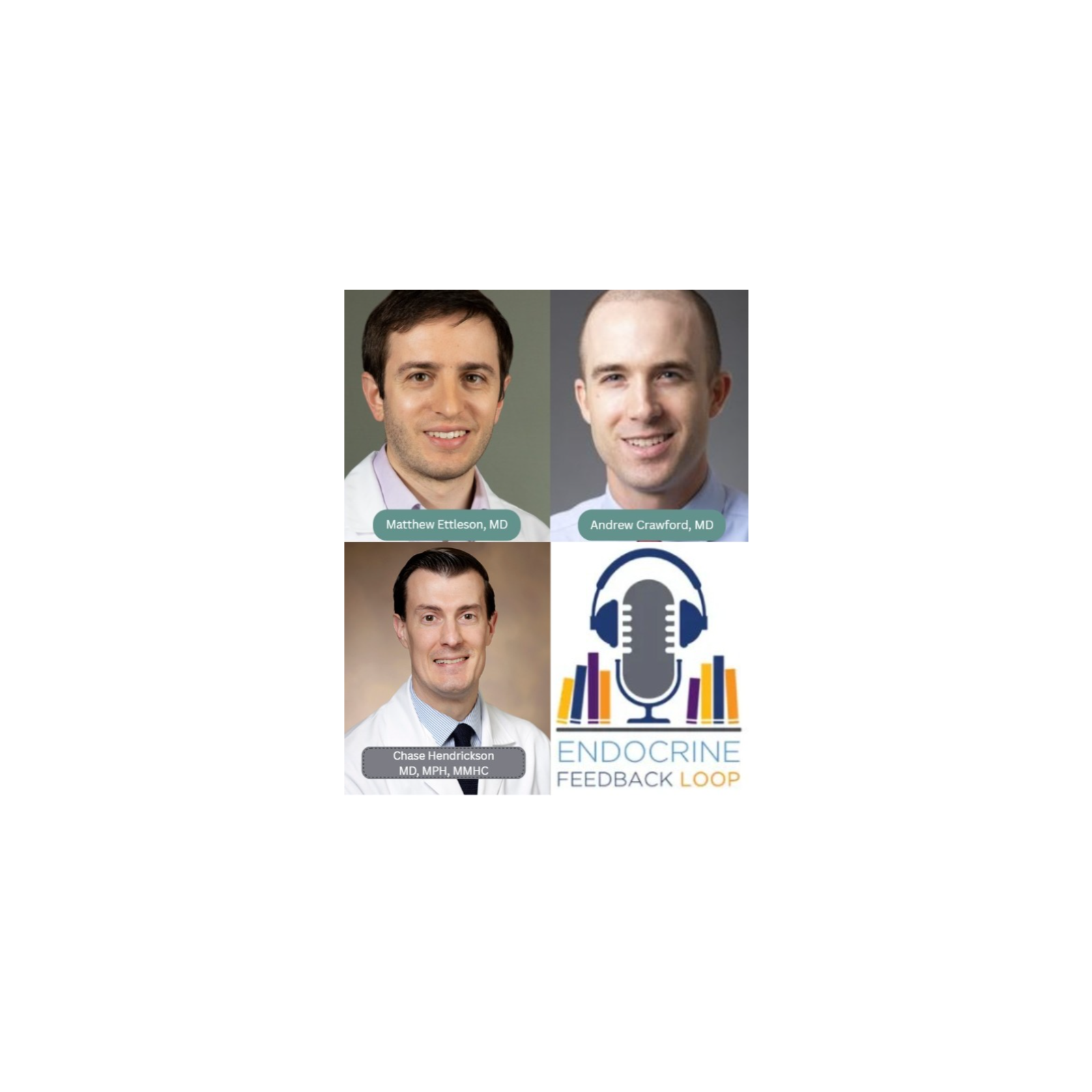
Loading summary
Transcript26 lines
- [00:01]
A
This is endocrine feedback loop. I am your host Chase Hendrickson and welcome you to this Journal Club Podcast series brought to you by the Endocrine Society. Thanks for joining us as we explore an important article recently published in one of the Society's clinical journals. Welcome back to the Endocrine Feedback Loop podcast. For our 74th episode, we are recording here at the Endo 2026 conference in Chicago. For this month's episode of the podcast, we review a recent JCEM study that addresses a very common clinical scenario. Do patients really have to take levothyroxine while fasting? In addition to helping answer this question, this paper contains several other helpful points which led to us thinking that it would be quite worthwhile reviewing on the podcast. The authors use an RCT study design, but that has some caveats that we want unpack as well. By way of brief reminder, I host the Endocrine Feedback Loop and work at Vanderbilt Health in Nashville, Tennessee as a general endocrinologist and medical director. Back as this month's regular contributor is Andy Crawford from the Dartmouth Hitchcock Medical center in Lebanon, New Hampshire. He directs the Endocrinology Fellowship Program there, teaches extensively, and leads quality improvement work in the fellowship. Importantly for our purposes today, his clinical care focuses on thyroid disease. Today's guest expert is Matt Edelson from the University of Chicago. You all, as our listeners, will be familiar with his work in hypothyroidism, with extensive epidemiology and health services research aimed at evaluating the quality of care in hypothyroidism. So as usual, the perfect pair of endocrinologists joins me to discuss a paper on hypothyroidism. As is also always the case, everything we say is our opinions only and not those of our respective institutions or of the Endocrine Society. Today we look at fasting vs non fasting dose adjusted levothyroxine ingestion and Hypothyroidism, a randomized clinical trial which the Journal of Clinical Endocrinology and metabolism published in April 2026. Jurassa Willems from the Zuderland Medical center in the Netherlands served as the first author for this report. I'll now turn the conversation over to Andy. He will go through the author's introduction to highlight key points and also bring Matt into this discussion.
- [02:18]
B
Andy well, thanks so much Chase, and thanks to the Endocrine Society for the invitation to be here. These are always a lot of fun to take part in, so I want to start off just by talking about the current Professional Society guidelines that recommend as the gold standard, and this includes the ATA and the European Thyroid association, that levothyroxine be taken fasting. And really, yeah, that gold standard is about 60 minutes prior to eating breakfast. But this is burdensome to patients and may contribute to non compliance and suboptimal achievement of target TSHs. And this author group in particular has addressed or has assessed the burden of fasting levothyroxine ingestion previously and some really terrific work. And they found that taking levothyroxine fasting was burdensome to a significant proportion of patients, about 50%. And that 1/3 of patients that they surveyed admitted to not adhering to this recommended fasting timing. A significant percentage also reported that fasting led to missed doses with regularity and also skipping breakfast altogether. There was a strong preference in the patients that they surveyed to take levothyroxine with breakfast. The authors also noted in a previous study that the inconvenience of levothyroxine fasting, taking it fasting, may heavily influence the fact that 43% of those patients did not reach their TSH targets. They hypothesize in this current study that an appropriate preemptive dose increase in levothyroxine could overcome the reduction in absorption efficiency that would occur with taking that medication with breakfast and that they'd be able to maintain TSH stability and improve patients quality of life and well being. So Matt, could you take us through some of the existing alternatives to the morning fasting regimen and different formulations that may be effective to take in a non fasting way?
- [04:08]
C
Yeah, sure. So I think there's a bit of literature on this and when I was reviewing it, I think a couple studies stood out. But there's at least a few prospective and retrospective reviews looking at different timing of levothyroxine administration with mixed results. So one relatively clearly this is from Jackie Junklis in 2009 basically was looking at variability of TSH depending on when you took levothyroxine, whether it was at breakfast, whether it was fasting or whether it was at night. And it was pretty clear from their data that fasting in the morning delivered the lowest TSHs in range with the least variability. They favored that other studies have actually shown the opposite. At nighttime, TSH circadian rhythm was preserved and also led to less TSH variability. Another study says taking it at night, several hours after dinner is better. There's also some data in terms of alternatives to just the regular tablets that we think that we prescribe all the time. There are some studies on liquid and gel formulations that are a little bit smaller and maybe not quite as reliable, but they tend to show that maybe there's a little bit of advantage to soft gel and liquid in terms of absorption, in terms of TSH stability. But I think we'll talk a little bit more about that later when the authors sort of comment on that. But there are some alternatives in terms of timing and formulation that are out there.
- [05:33]
B
Terrific. Thank you, Matt. So I'll turn it over at this point to Chase to discuss the study methods. Good.
- [05:38]
A
Thanks. And I think that hopefully illustrates some of the limitations that we have currently in the literature as far as what we know about this topic, despite the fact that many of us, certainly general endocrinologists and thyroidologists think about this all the time when we see patients. And what I want us to do is to walk through the study design here. And the reason for that is the authors describe their study design as an rct. And that's correct. It is that. But often, I think when we see something labeled as an rct, we'll often make assumptions about what that means, what's included, what's not included. So I think it's always helpful, at least helpful for me to remind myself exactly what is meant by each of these things, why we do these things. And then so whenever you don't have one of those components, the impact of that. So the two big problems that show up, particularly in any observational study, are confounding and biases. And confounding is going to be you're studying an intervention, trying to understand the impact of an intervention, but confounding is some other aspect of the patient or the care that they receive that is going to drive an outcome. And so you worry about that if you don't have a way to account for that. And the other one is a variety of biases that can show up. And a bias, I think the easiest way to think about that is somebody being treated differently. Differently because of the group that they're in. And that can be the subjects themselves doing something different. That could be the investigators doing something different, really anybody who's involved in that study. So the reason that RCTs are helpful, first of all, the randomization that happens that balances the confounding. It doesn't get rid of them. Any of those factors are still going to be there. They can still impact the outcome. But if you randomized appropriately, you should balance those. So from a statistical perspective, you could think of them as canceling each other out. When you're trying to deal with biases, the way to deal with that is by blinding. So if you don't want somebody treated differently because of what group they're in, you just make sure that nobody knows what group they're in and then they can't be treated differently. And so in this study, as we'll see shortly, they do randomization, but because of some of their secondary outcomes, they choose to not do blinding. So we're going to have to think about that, why they did that in the impact. Okay, so now getting into this actual study. So this is an open label, meaning it's not blinded, randomized trial. And it's done at the Sunderland Medical center in the Netherlands. The eligibility. So the subject had to be adult, so at least 18 years of age, you had to have a minimum levothyroxine dose of 1 microgram per kilogram. And you have to consume breakfast at least five days a week. And prior to this study starting, you had to have at least two normal TSH values. The idea behind that being we want to show that this is somebody who already has good control. They're not coming in with poorly controlled hypothyroidism. A variety of exclusions, and I don't think they're particularly important for us. Just understanding they're kind of looking at bread and butter. So excluded a bunch of other medical conditions. And as far as how these patients were assigned, so they did a one to one randomization, so equal chance of being in either group. And they remained in that group for the duration of a study. So patients were instructed to keep their breakfast content relatively stable day to day, and they tracked that with a food diary. The fasting group took their levothyroxine 30 to 60 minutes prior to breakfast, just as we try to tell all of our patients the breakfast group. So the group that was going to take their levothyroxine while they were eating, so they took it with breakfast and they had a fish 15% dose increase to account for expected reduction in absorption. Now that that was true if you were on a tablet, if you were on a gel capsule, they did not do that. So, Matt, I think this is already actually getting kind of a practical understanding of this and we're skipping ahead because it maybe affects how we might try to change our own clinical care. But walk us through, where did this 15% come from? It's a fairly specific number. So why are the authors suggesting that, hey, if we're going to take somebody from levothyroxine Fasting, they're going to start doing it with food, with breakfast. They need to bump their dose up by and unpack that for us.
- [09:24]
C
Yeah. So I think the authors make a pretty reasonable empiric increase in the levothyroxine given non fasting conditions. And this is based on something that they cite in the study, which is an isotope study, which was done decades ago, basically attaching an isotope to levothyroxine and essentially measuring how much is being absorbed in healthy people, whether they were taking levothyroxine fasting or not fasting. And they found that absorption in the fasting state is about 80%, which is basically what we think of an endocrinologist is how much levothyroxine is being absorbed and what we expect to be absorbed in our patients versus 60 to 70% depending on conditions in the non fasting states. Simple subtraction 80 -65, about 15%. You think, okay, we'll bump up the folks that were non fasting on tablets, bump up their dose by 15% and that will give us an equivalent absorption of the actual absolute dose. So that's reasonable approach for them. Good.
- [10:25]
A
So back to this study. So the patients remained on the same brand of levothyroxine, whatever they were on before, they stayed on that. Interestingly, several of the subjects who entered into this study were already taking their levothyroxine with breakfast. So for those individuals, if they were randomly assigned to the breakfast group, they didn't have an adjustment in their dose. If they were randomly assigned to the fasting group, then they had a 15% dose reduction. There were no restrictions on breakfast content. A lot of the other things that we will typically tell our patients they were told, so if you're on an interfering medication then you need to separate that out by at least four hours. And then the protocol for this study is that every six weeks the subjects had follow up visits and labs. There was a pre specified adjustment protocol that called for levothyroxine adjustments based on the TSH values. And then at every visit patients were asked about thyroid related symptoms and also other potential interfering factors. And then the study was completed for each subject after when it was completed, there were patient reported outcomes and experience measures related to well being. And they were also asked which levothyroxine regimen did you prefer? And we'll talk a little bit more about that. The patients were followed until TSH levels were within the reference range for two consecutive follow up periods. And again trying to show that this was established some stability, they would follow these individuals up to a max of 24 weeks. And so if you never got this criteria, they were saying you had stability, then these individuals were labeled as a failure, having had a failure to achieve TSH stability. There were standard measurements of TSH free T4, total T3 and those were all used. The same assays were used for all subjects here. Okay, so the primary outcome, and we've alluded to this already, the primary outcome was the proportion of patients who achieved TSH stability. And again, that had to be two consecutive TSH measurements. Also to meet that criteria, you could have had a maximum change of the TSH of 1 from baseline and that's in either direction going up or going down. So we're going to come back to that. I've got some other thoughts about choosing this as a primary outcome and how that affects your study design. But Matt, comment on just using that stability of TSH measurements. Don't want to have a big swing in the TSH value itself. What are your thoughts on that as a primary outcome?
- [12:45]
C
Yeah, I think from a clinical standpoint in viewing this study as a clinician, I think that makes sense. I think as a clinician that's what we would want if we were switching someone from a fasting to a non fasting regimen, that we would want to make sure that we could achieve TSH stability. This is what is essentially stated in the ATA hypothyroidism guidelines is you want to maintain TSH in the normal range as long as possible. And so when you're comparing these two groups, it's sort of an at the end of the day outcome. Is the proportion similar? And with a study that's relatively short in the number of weeks, I think it's reasonable. To have two consecutive TSHs be within range is a practical and reasonable measure of stability. And so comparing those groups at the end of the day in terms of stability makes sense. Okay, good.
- [13:33]
A
Other comment I'd make on the primary outcome, I think this is one of the areas where there was a trade off that the authors made with this being a primary outcome. I think you could actually make an argument to say this really should have been placebo control because who knows what patients are going to do differently because they know you could have potentially had them take a tablet at both times and only one of them actually being levothyroxine. If your primary outcome is can we get TSH stability, which is what they have as their primary outcome, we're going to get to secondary outcomes. The secondary outcomes are why they didn't make this a placebo controlled. But I think that's a potential limitation as they could have considered that. But the reason they didn't want to do this were the secondary outcomes and these were all of the subjective ones. So they asked about self reported well being and reasons for changes in that. They did ask about that preferred ingestion regimen and then the willingness to continue what they had done. They also did a crossover group. So for those who started in the fasting group, they then asked if anybody wanted to try crossing over to a non fasting group as a subsequent an extension of this study. And there were additional assessments and changes of quality in life just for that group there. So again, and this I think introduces another difficulty so you can understand this is a big part of assessing quality of life. The benefit of quality of life was not having to take a pill an hour or so before you eat. And so you couldn't really study that if somebody still had to do a pill no matter what group they were in. So you can understand why they did this as an open label. So that makes sense. But it does introduce the possibility of biased responses. People knew which group they were in, so the subjects in particular may have experienced that. So part of their responses may have been genuinely this was the change that was made led to this. But also knowing what group you're in is going to affect how you think about things. It's almost impossible to tease that out here. I think just a limitation that we have to keep in mind. Last comment on the methodology. Briefly on the statistics, the authors included a power calculation, but later on they do point out that they didn't actually have enough subjects for this to be a non inferiority trial. I thought that was a little bit interesting. The authors don't ever claim that it is a non inferiority trial. It does seem to be set up that way. So a lot of the way they talk about the points they're trying to make, it feels a little bit like they were trying to demonstrate some non inferiority here. So it's not totally clear to me why they didn't try to do that formally and get enough subjects. And the authors didn't comment on that specifically. So I'd say a question that I had that didn't have a clear answer that I saw. But again, the authors were not claiming that this was a non inferiority study. Okay, enough on the methodology. Andy, back to you. Why don't you walk us through the results and everything that the authors found here.
- [16:11]
B
Sure. So the authors identified 102 eligible patients and 43 ultimately were included in the fasting group and 45 were in the breakfast group. So patients were taking their levothyroxine with their breakfast. Patients in the fasting group after the completion of the main study were given the option to cross over and ultimately 20 patients from the fasting group chose to cross over to the breakfast group and they were also given a Thigh Pro 39 survey to evaluate the effect of switching on their quality of life. What the authors found was that the proportion achieving TSH stability between the breakfast and the fasting groups was comparable. The authors note that this finding persisted even when excluding subgroups such as the softgel formulation group and patients taking levothyroxine as part of a block and replace strategy for management of Graves disease. The TSH stability did not differ based on the breakfast content. When this was stratified, the median time to TSH stability, the mean change in TSH free T4 and total T3 levels was comparable between the groups. What was interesting and there was an element highlighted in a letter to the editor about this article in the jcem. So it was shown in the supplemental material that the number of dose changes beyond the 15% empiric increase appeared to be significantly higher in the breakfast group at week six and to a lesser extent week 12 versus the fasting groups. Matt, can you comment on that?
- [17:45]
C
Yeah, I think first of all a good lesson in maybe look at the supplemental material if you're really going to try to dive into a study and understand how it might affect your practice. I know in my perspective as a researcher I'm generally putting stuff in the supplemental material that is maybe not so pertinent, but if there's really close readership that is there for them to see, okay, this is the complete study. Here are all the analyses and subgroups, et cetera, sensitivity analyses that support my final conclusion in this case. I think, and I sort of agree to an extent with the comment and the writing a letter to the editor because I think this is an important point, although it doesn't necessarily impact their final outcome, is that then they clearly they're not trying to hide anything. They're clearly showing that the group where they did the empiric adjustment where levothyroxine dose was increased in the non fasting group there was a lot more adjustment that needed to be made at week six and week 12. So like immediately in that post sort of period of starting the study. And so again it didn't necessarily necessarily impact the final outcome which was not different between the two groups. But it does indicate from a clinical perspective that it might not be the smoothest transition and that 15% might be a reasonable empiric starting point. But we have to expect that on an individual basis for some patients that will be too much and for some patients that will be too little. And that's exactly what they showed in that table in the supplemental material. So for listeners who are interested, I definitely encourage going back and looking at that material. But I think the bottom line is that that we can't take away necessarily from this study that 15% is a 1 size fits all increase. If you're transitioning somebody from fasting to non fasting with levothyroxine tablets, that's my main sort of unpacking and takeaway from that.
- [19:34]
B
Thank you. So as far as patient reported outcomes, around 89% of patients in the breakfast group chose to continue the non fasting regiment after the study. And there was a non significant trend towards improvement in well being in the breakfast group versus the fasting group. So this had a p value of 0.07. And the authors noted that reasons for improvement in well being that patients reported were a more consistent breakfast routine, improved adherence, reduced stomach discomfort and an increased sense of feeling physically fit. So I'd like to turn it back over to Chase to take us through the discussion and conclusion.
- [20:16]
A
All right, thank you. And with all of that, we're going to start with where the authors start, which is to summarize their findings and I'll quote them here where they say 15% dose adjusted levothyroxine ingestion with breakfast achieved a similar TSH stability compared to fasting. Levothyroxine ingestion self reported well being tended to be higher in the breakfast group with 88.9% opting to continue breakfast ingestion after the study. The authors then go on and point out that there really aren't many other studies here. We heard from Matt earlier about what the authors had to pull from, which was decades ago and not even clinical studies to try to compare and come up with a methodology for their approach. They say really no previous studies, but that this 15% preemptive levothyroxine does appear viable and effective. They go back something that we've talked about already. So they do explore to at least mention some alternative approaches to solving this problem acknowledges isn't the only way that you can try to get around the problem of having to take levothyroxine fasting. So they point out there's of course liquid and soft gel prepar. But I think as we're all familiar those are often not reimbursed and so just may not practically speaking be an option for patients. They also point out the approach of using bedtime levothyroxine, but that still actually requires fasting. You're just achieving fasting in a different way there. So Matt, I was curious about your thoughts on the comparison here that those authors made. You've alluded to them already, but what are your thoughts and this as an option and what else exists out there?
- [21:44]
C
There? Yeah, I think I tend to agree with the authors essentially setting us up to think here's potentially a more attractive strategy to get around what might be a more costly approach or a we're still dealing with fasting, we're just changing the timeline and that is just okay. Just essentially what it breaks down to is just we'll just give people, we'll let them not fast, but we'll give them one extra tablet per week, which is essentially a 15% increase. And again I tend to agree with what the authors are saying, but I think it's also still that important caveat that this is not it actually might be simpler in some ways to start out with switching the person's timing. And that's I think generally my clinical approach to start with. If someone is really struggling to maintain tsh, but it seems like this is the right dose or they're having trouble with fasting or taking it in the morning or it's really disruptive with their lifestyle. That I think is my, my first go to is okay, why don't we try at nighttime before bed and see if we can get a little bit better results and that's a little bit less disruptive in your lifestyle. I, I haven't prescribed a ton of soft gels and liquid formulation with the exception of more patients that are perhaps a little bit more complex or don't have the normal oral intake, they're tube fed or they take a number of medications that are definitely known to be interacting with levothyroxine and we can't really like it's just not possible to offer them a fasting sort of approach. But I agree that these are, there's more barriers for sure set up with these medications in terms of our healthcare system where cost could be a factor. So bottom line, I think I understand where the authors are coming from, that this could be a quite easy transition to allow somebody to take their leave off thyroxin and not fasting, which may be their preference.
- [23:33]
A
At the very end, we will come back to clinical practice and you'll hear some thoughts about whether this should change our clinical practice. Before we do that, we're going to talk about some limitations and these are all ones that the authors point out mentioned this earlier. They do say here that this was a small sample size, so this specifically didn't meet the threshold for a non inferiority trial. They also point out that they studied only well controlled patients who are already on treatment. And then finally they say they didn't do a subgroup analysis of any form due to sample size and the short duration of the follow up. Another limitation I thought was helpful, Andy, as we were analyzing this article together, you pointed out a really helpful one about just the population that they studied here and potentially the the type of patient that may have been attractive. Why don't you unpack those thoughts for us? Because I think that's another helpful limitation worth mentioning.
- [24:21]
B
Yeah, and so I, I think it may be hard to extrapolate the results here to your average patient in the endocrine thyroid clinic just because you could probably reasonably make the assumption that people interested in participating in this study were more likely than aver ultimately prefer a non fasting regimen. And also the fact that a significant percentage of patients that were in the fasting group crossed over. Out of 32 patients that achieved stability, 18 of those patients chose to cross over, showing that this was a pretty motivated group to seek out a non fasting regimen.
- [24:55]
A
Yeah, I agree. So some potential limitations around the generalizability of the results here. The authors then conclude and we'll start with their summary. I'll quote them here again where they say a 15% dose adjusted levothyroxine regimen taken with breakfast maintained TSH stability similar to standard dose fasting levothyroxine ingestion in patients with well controlled hypothyroidism. They then go on to say what I would say is an implication and a final quote from them. To enhance medication adherence, the timing of levothyroxine ingestion should be tailored to individual lifestyles, with dose adjusted non fasting ingestion offering a practical alternative. All right, before we get to whether we should start doing something like this, whether this should change our practice, let's just think about the quality of the report overall. Andy, we've heard some of your thoughts already, but give us more of your thoughts just about the quality of this study as the authors reported here.
- [25:46]
B
Yeah, I really like this study a lot. I liked how it was really patient Centered and it addressed an important and common clinical dilemma. What's interesting is that there were 88 patients included in this. So this really makes it the largest trial of its kind to date so far. And I also like the fact that the findings were consistent not only in kind of the main trial, showing that a significant percentage of patients preferred that non fasting regimen, but in that crossover group, 78% of patients, patients that completed the crossover part preferred taking it levothyroxine with breakfast and they were also able to maintain unchanged TSH free T4 and T3 levels.
- [26:26]
A
Matt, you spend most of your day thinking about this sort of thing, quality of life, how we can improve the quality of care that patients with hypothyroidism receive. So given your expert background here, what are your thoughts on this study, the quality of this report?
- [26:40]
C
I think Chase, I think we love an rct. I think that's one of the main takeaways within limitations. I like actually your idea of a strategy for blinding in or creating a placebo group, which is interesting and I agree with Andy too. I think that it's a good setup and I think from the primary outcome standpoint of TSH stability, that's really what I do spend a lot of time thinking about, especially on the, on an order of longer time, actually like years because we know that patients on levothyroxine tend to stay on levothyroxine basically once they get on it forever. And so I'm always favoring a randomized controlled trial. I do like their outcome selection within the limits of a relatively short study. And as you guys have both mentioned, I think the internal validity of the study is really good. I think that we have a good understanding of the patients that they took their subjects. I think we are at the ground truth of understanding that there's not a major difference at the end of the day in their TSH stability if they're fasting or not fasting. Again, in this sort of motivated group, the secondary outcomes where they preferred that, I think that's a little bit of a reflective of the kind of patients that they had. I think the external validity and the generalizability as we've mentioned, is a little bit shaky. And I think I want to just emphasize one point from a clinical standpoint and that this is a group again that they're motivated to be interested maybe in a non fasting regimen, but they also had to meet some clear sort of hurdles in order just to be included in the study. And that is they had to be Stable. And if they weren't stable, they sort of stabilized them in order to get into the study. They gave them an extra lead in time where they did additional adjustments. The group that was not fasting had to be adjusted several times as well. And so I think that it's. And also the patients were relatively straightforward, like they didn't have a ton of serious comorbidity as well. And so if you have patients that are stable on their levothyroxine fasting and motivated, then I think you could look to this study as potentially evidence that we can transition you safely to a non fasting approach. For a lot of our patients that are more complicated or unstable. When we're looking for answers, maybe this isn't quite the same population. And so we just have to understand the applicability here. There may be a little bit of a disconnect with our patients in the clinic who are maybe a little bit more complicated or a little bit more unstable in their TSH maintenance, which is
- [29:10]
A
the perfect segue to ending where we always do, which is to think about should this change our practice. So, Andy, let's start with you again on this. What are your thoughts? You see a lot of patients in this situation. Will you start doing this more? Not convinced yet. Walk us through how you'll think about the care that you provide to your patients.
- [29:26]
B
Yeah, again, I can't emphasize enough. I love this paper just because it was primarily patient centered and the impetus for it to develop this study, as well as their precursor paper that was focused on survey data really comes from an important and common clinical dilemma. And I think reading through this paper, the introduction, the discussion and the previous paper, it really, I think, emphasized again to me how impactful something which seems to be as simple as taking levothyroxine in a certain way. Fasting can really have a dramatic impact on a patient's quality of life. So I think that was one of my main takeaways, was just having a better appreciation when talking to patients how impactful that can be in their life.
- [30:07]
A
All right, Matt, we'll end with you. You've given us some thoughts along the way, but why don't you just comment further? Is this going to change the care that you provide to your patients?
- [30:15]
C
I think this study and others that we talked about at the beginning are. They're a little bit in conflict. But I give a slight nod to this study and I agree with Andy too in sort of a preference for this in that it is randomized. And so there is that a little bit of strength in evidence to give you a little bit more confidence that transitioning someone from fasting to non fasting levothyroxine is safe and you can use that 15% empiric increase as a good starting point. I think clinically it certainly opens up the discussion at this point with this paper and with sort of the body of evidence now, if a patient is stable on their levothyroxine dose and they are coming to you proactively that they're interested in, or they're indirectly, they're saying it really bothers me that I have to do this or they're asking for it. I think it's actually reasonable and I think I would use this one additional tablet per week starting point and say, okay, let's thumbs up, up. We're going to check your TSH closely over the next six weeks and maybe 12 weeks. We anticipate that there may be some adjustments. I think I actually already am starting to open this up. But within saying that it's got to be the right patient who's already stable, who's already adherent, who's already doing all the right things, it's not on a slew of other medications that's going to interrupt their absorption. And so I think honestly my practice is already sort of changing and this is just one knock notch on that ladder to sort of opening this up to to be not so dogmatic about it must be fasting 60 minutes before eating and papers like this are helpful. Just breaking that down a little bit.
- [31:46]
A
And with that, I would like to thank Andy Crawford and Matt Edelson for joining me for this month's edition of Intercom Feedback Loop. I hope that you all learned as much as I did and that you'll join us again next month. And now you're in the loop. This has been Endocrine Feedback Loop. Endocrine Feedback Loop is brought to you by the Endocrine Society with Production Oversight by Brandy Brown. If you like and subscribe, you can find us on Apple, Spotify or wherever you get your podcast. We'd love to hear your feedback on this episode of the podcast itself. Please email us@podcastren.org
- [32:23]
B
Endocrine Feedback Loop is a free service of the Endocrine Society. To learn more or to become a member, visit the society's website at www.endocrine.org.