Podcast
Future of Consumer Marketing
Hosted by The Global Talent Co. · EN
The future of consumer marketing is brought to you by The Global Talent Co.
18episodes
Episodes
Newest firstAll episodes
Pants Science, Physical Catalogs, and the Return of Analog Marketing
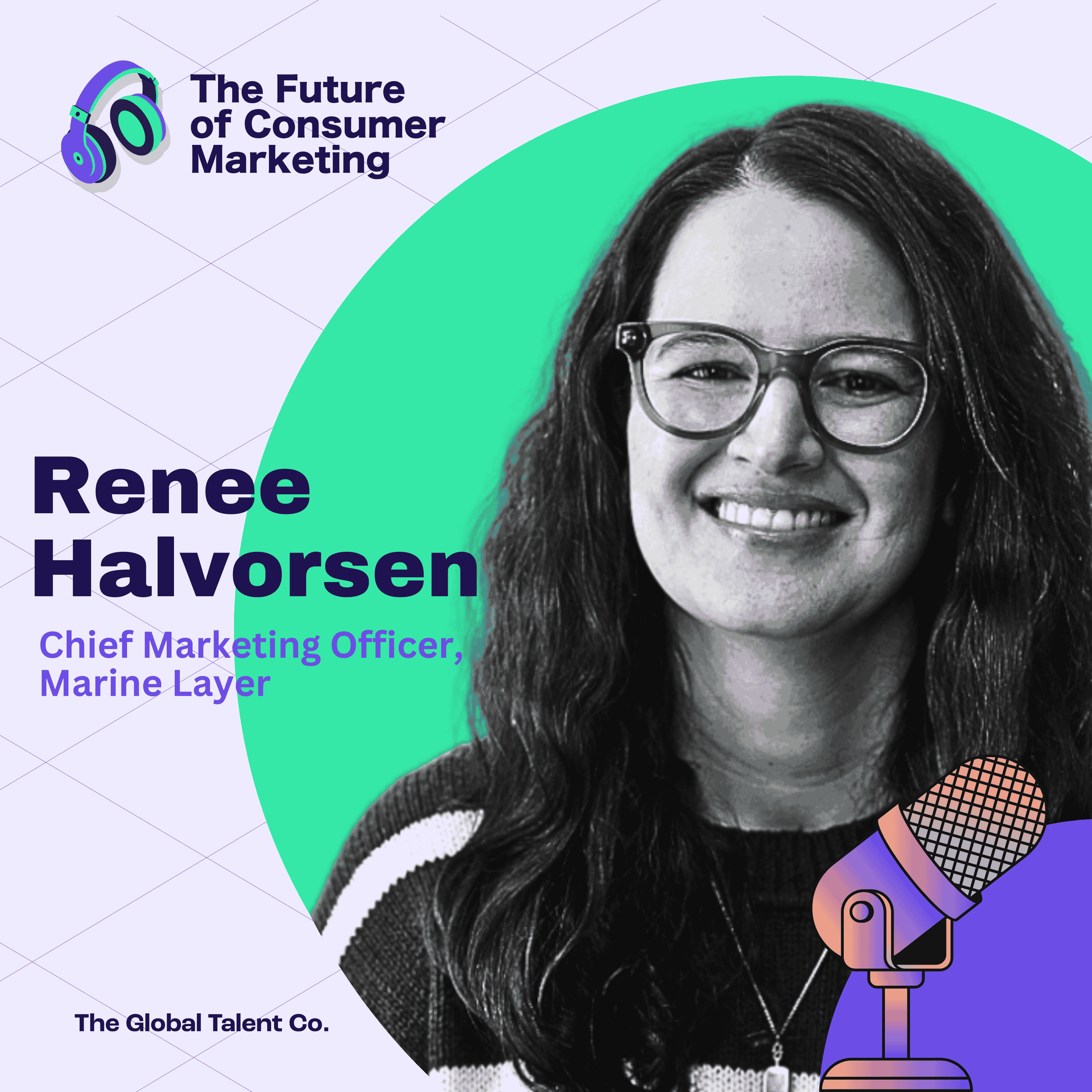
Mar 2000:28:56Tap to summarizeIn this episode of The Future of Consumer Marketing, host Andres Figueira sits down with Renee Halvorsen, CMO of Marine Layer — the San Francisco-based casual apparel brand built on California cool, signature softness, and a marketing philosophy of radical authenticity. Renee pulls back the curtain on how a brand founded on a founder’s obsession with his favorite worn-out T-shirt has grown to 54 stores while leaning hard into analog marketing at a moment when everyone else went digital. She digs into the physical catalog as Marine Layer’s not-so-secret weapon (eight per year, mailed to homes), the anatomy of the “Pants Science” campaign that turned Flex Terry pants into a multi-channel hit, and why their Holiday 2024 personalization pop-up in San Francisco became the #1 traffic location in their entire retail fleet — complete with a line around the corner and an impromptu visit from the city’s mayor. She also outlines Marine Layer’s measured AI strategy: protect human authenticity on the front end (real models, real copy, no faking it) while embracing speed and efficiency on the back end through CRM analytics, SQL acceleration, and Vizcom for internal product visualization. And she makes the case that 2026 is a new frontier — one where in-store traffic is outpacing online, email is losing its grip, and digital saturation is breeding consumer distrust. Her prescription: rethink every channel touchpoint from scratch. Topics Discussed Physical catalog as Marine Layer’s primary growth channel — 8 per year, mailed to homes, enabling longer-form brand storytelling that digital can’t replicate Brand voice engineering: what it takes to make marketing sound like a trusted friend instead of a pitch, across catalog copy, in-store, and digital The “Pants Science” campaign: comedy creators, a branded scientist character, TV, and email used to drive sell-through on Flex Terry pants Creator partnership strategy: lifestyle alignment as the selection filter, then full editorial freedom as the execution model AI in two lanes: protecting front-end human authenticity (real models, real copy) vs. accelerating back-end CRM analytics, SQL analysis, and product visualization via Vizcom The Holiday 2024 SF personalization pop-up: patches and embroidery on Cloud Nine fleece, #1 fleet traffic, organic creator amplification without formal partnerships, unannounced visit from the San Francisco mayor 2026 channel rethink: in-store traffic growing faster than online, email engagement declining, digital saturation creating consumer distrust, and what Marine Layer is doing about it
Transcribe →
Kate Gagnon: Why Organization Is an Operating System, Not an Instagram Moment
Mar 1700:31:18Tap to summarizeKate Gagnon is the VP of Marketing at Neat Method, the largest home organizing brand in the United States. With 15 years of experience as a hybrid marketing leader and startup advisor, Kate leads marketing across two distinct businesses: an in-home organizing service delivered through 100+ franchise owners nationwide, and a direct-to-consumer product line launched six years ago. In this episode, Kate unpacks the brand’s core philosophy — organization as an operating system for your life, not an aesthetic endpoint — and walks through what it means to market the same brand to two fundamentally different audiences. She breaks down the “New Year, Meet Me” January campaign, Neat Method’s counterintuitive channel stack (Pinterest as a silent DTC conversion engine, email as the strongest repeater), and the AI measurement problem that’s still standing between home organizing and a fully AI-assisted customer experience. Topics Discussed Kate’s background: 15 years as a hybrid marketing leader and startup advisor; joined Neat Method just over a year ago; attracted by a company culture that was enthusiastically embracing AI from day one Neat Method at 15 years: the largest home organizing brand in the US, serving clients across the US and Canada; product line launched six years ago after organizers spent time in tens of thousands of homes and identified unmet product needs Two business lines, two very different audiences: (1) in-home organizing service via 100+ franchise owners (2–10 organizers each); (2) D2C e-commerce for DIY customers; corporate team of approximately 18 people The service experience: organizer comes in, scopes the project, delivers a proposal covering organizer time and product, then executes — highly personalized to how the client actually lives (family with kids, single professional, active athlete, etc.) Repeat and concierge model: many clients return for refreshes; Home Concierge option for weekly or monthly maintenance visits (grocery put-away, mail sort, system reset) Marketing philosophy: organization as an ongoing operating system, not a one-time Instagram moment; personalized to each client’s goals and life; framed around systems, routines, and rituals rather than aspirational aesthetics Product design principles: timeless, neutral colorways (metal, natural fibers, interesting textures); multipurpose across rooms and life stages; designed so products purchased for a pantry can migrate to a closet, office, or living room shelf without looking wrong Book launch: Neat Method published a book last year targeted at DIY customers who want to do their own organizing projects The category creation challenge: most people don’t know you can hire a home organizer — service-side marketing must simultaneously build the category and build the brand The “New Year, Meet Me” January campaign: rather than making organization the resolution itself, the 2026 iteration connected organization to other resolution goals — family dinners, morning workouts, marathon training — positioning organization as the enabling system, not the endpoint Problem-aware vs. solution-aware framing: many service prospects know their home is disorganized but don’t know a professional organizer exists; D2C prospects know they want a product but need guidance on what and how; content strategy differs accordingly Channel breakdown: Instagram (largest and most established audience; doubles as franchise recruitment channel); TikTok (fastest growing, most scaling potential); Pinterest (sneakiest best performer — organizing education content is evergreen and compounds over years); Email (strongest channel for D2C repeat purchases) Service-side acquisition is word-of-mouth first: referrals drive most inbound; social and paid support awareness for those who haven’t been referred yet AI use today: marketing research, competitive data synthesis, meeting notes and action items; exploring AI home design tools but the measurement precision required for organizing is not yet replicable — cabinet hinge clearances, exact product dimensions — though Kate believes it’s coming Geographic and growth focus: primarily US and Canada; international demand exists but not currently being pursued; tariff environment creating headwinds for the consumer products business in 2026
Transcribe →
Stop Optimizing for CAC. Start Optimizing for LTV
Mar 1000:26:42Tap to summarizeBryce Winkelman joined Typeform as CRO 14 months ago — a profitable, 150,000-customer form and survey platform with a footprint in 98% of Fortune 500 companies. Before Typeform, he was the 10th employee at Qualtrics, which he helped grow through $700M+ in revenue, an SAP acquisition, and an IPO. In this episode, Bryce unpacks how Typeform is repositioning from world-class form builder into a full flow activation platform, why they’re pivoting marketing investment from paid toward AI-visible organic, and the specific frameworks they use to test and scale new channels — including a LTV-first take on marketing efficiency that flips the conventional CAC optimization model. Topics Discussed Career arc: 10th employee at Qualtrics through $700M+ revenue, SAP acquisition, and IPO — then Quantum Metrics and SeekOut before Typeform Typeform’s two growth engines: PLG self-serve (1-50 employee organizations and solopreneurs) and sales-led enterprise (98% Fortune 500 footprint) Product repositioning: from form builder to “flow activation” — lead routing, nurturing, payment processing, and AI-moderated research via Insight Flow Marketing channel strategy: paid as the primary and most predictable engine, now shifting investment toward SEO, AIO/AEO, UGC, influencer content, and owned community Reddit and third-party communities as non-negotiable infrastructure for AI search visibility The Get Real campaign: surveying 2,000 marketers on AI usage using Typeform itself, publishing a report that generated millions of impressions while demonstrating the product’s video/audio response capabilities AI inside Typeform: Glean deployed across all systems and every employee, full AI chat experience in the product, AI-first brand messaging on the website New channel testing: Uber ads (validated), TikTok (doubling year-over-year), sports sponsorships, ABM, Typeform-hosted events Channel testing framework: define success criteria and hypothesis upfront with FP&A, ring-fence incremental budget, deploy, measure, then scale or shut down The LTV-over-CAC reframe: willing to increase CAC significantly as long as LTV is rising — optimize for revenue and ICP quality, not cost efficiency
Transcribe →
The Brand That Turned Poop Jokes Into a $308M Business
Mar 1000:25:51Tap to summarizeThree roommates in Chicago started using baby wipes as toilet paper in 2011, decided to sell their own, and ended up building one of the fastest-growing CPG brands in America. Joey Thomas joined as VP in late 2021 when Dude Wipes revenue was sub-$60 million — by 2025 the company had hit $308 million, almost entirely bootstrapped. In this episode, Joey breaks down the specific moves behind that trajectory: why TikTok Shop is the biggest channel unlock of the last 18 months, how the stocking stuffer strategy turns November and December into the brand’s highest-volume months, the Bic razor principle behind their male-voiced but whole-household strategy, and why the brands that figure out Reddit seeding for AI-driven shopping now will own the next decade. Topics Discussed The founding story: three Chicago roommates, a bad diet, baby wipes, and the insight that launched a $300M brand How Dude Wipes grew from sub-$60M to $308M in four years, bootstrapped without VC funding Why November and December are the biggest sales months — the stocking stuffer strategy and 60%+ trial-to-repurchase rate Demographics: 60% male buyers, 40% female — and the Bic razor principle behind male-voiced marketing that reaches the whole household TikTok Shop: the mechanics of a creator army (5K+ followers, commission-based), why average TikTok user is 37, and why this is Amazon 2012 Don’t restrict creators: why big CPG’s obsession with message control is the thing holding them back AI at Dude Wipes: data analysis, DM bot outreach for creator recruitment, and Reddit seeding for AI shopping recommendations Brand personality: why being the loudest flushable wipes brand on the internet is a structural advantage that Kimberly-Clark can’t copy Upcoming: Costco rollout, bringing creative fully in-house, building a live TikTok Shop team Sports partnerships: Cleveland Browns, UEFA soccer teams — and why most teams aren’t excited about a butt wipe on their shirt
Transcribe →
If the First Idea Doesn’t Offend You, Push Harder
Mar 1000:33:27Tap to summarizeReese Pozgay spent 10 years at Marc Jacobs building ecommerce from zero to over $100 million and inventing campaigns that used social media as literal entry currency — before Instagram existed. After launching his own 360 marketing agency (with Google as his first client, secured before he even had an LLC) and serving as Head of Digital Transformation at Revlon where he led the first beauty TikTok campaign to hit 2 billion views, he joined Moose Knuckles Canada as VP of Brand and Creative Marketing. In this episode, Reese traces the full arc of his career through one recurring conviction: respect the platform, push the idea until it makes someone uncomfortable, and never mistake audience size for actual community. Topics Discussed Career trajectory: From answering phones at Marc Jacobs under Robert Duffy to VP of Brand and Creative Marketing at Moose Knuckles Canada The Daisy Tweet Shop: the first pop-up ever to use social media as literal entry currency, pre-Instagram, repeated across New York, London, and Asia Street Mark: guerrilla wild postings across 5 US cities that invited the public to remix and deface the brand’s own ads Why every social platform demands its own content strategy — and why the waterfall model destroys brand relevance At Revlon: building the first beauty brand TikTok campaign to hit 2 billion views in two days Building influencer from scratch at Marc Jacobs — and why micro-influencers with real engagement beat macro celebrities every time Moose Knuckles’ brand position: not Montclair, not Canada Goose — “cultural nomads” and metropolitan city explorers The internal creative standard: “If the first idea doesn’t offend me a little bit, we haven’t pushed hard enough” Why your social strategy needs to change every 6 months or you’re dead Where social media is heading next: off-feed, private networks, DMs, and Snapchat broadcast channels
Transcribe →
How Bala Got Kim Kardashian Without Spending a Dollar
Mar 1000:24:34Tap to summarizeMax Kislevitz co-founded Bala after quitting a 12-year advertising career to travel with his then-girlfriend Natalie — and conceived the idea for redesigned wrist and ankle weights on that trip. What started as a $40,000 Kickstarter campaign shipped out of a Brooklyn apartment has grown into a 30+ product design-led fitness brand that has sold over 4 million pairs of Bala Bangles and nearly doubled revenue in 2025. Max unpacks how Bala built a brand without any meaningful paid marketing in its early years, how the Shark Tank deal with Mark Cuban and Maria Sharapova came together, and what it actually looks like to run a 10-person company doing serious volume with a lean-and-mean operating model. Topics Discussed Conceiving Bala on vacation and launching on Kickstarter with $40,000 and no money of their own The design philosophy behind Bala: bringing color and aesthetic to fitness equipment that had never received design attention Why Bala is a female-first brand and what that means for product and marketing Organic celebrity endorsements (Kim Kardashian, Adam Levine) that drove early growth without any paid spend The Shark Tank appearance in 2020 and the deal struck with Mark Cuban and Maria Sharapova The ecosystem approach to marketing — paid social, email, search, retail, and studios working in concert Brand partnerships with Ralph Lauren, Pucci, Spanx, and Dunkin Donuts and the asymmetric value exchange Offline-to-online events: how a 20-person lunch generates outsized brand reach AI at Bala: cautious exploration limited to chatbot, deliberately avoided for customer-facing content 2026 priorities: heavier products (dumbbells, weighted vest), international expansion, continued growth
Transcribe →
How 127 Hotel Rooms Became a Daily Sales Channel
Mar 500:25:38Tap to summarizeIn this episode of The Future of Marketing, host Andres Figueira sits down with Phil Pirkovic, former Director of Brand and Partnerships at Shinola. Phil built the brand's storytelling infrastructure from scratch — shifting Shinola from a product-and-factory narrative into a full lifestyle brand rooted in emotional memory. He shares how he engineered experiential touchpoints across 21 stores, a Detroit hotel, and a small but disciplined marketing team to compete in a $6 billion watch industry without a massive budget. Topics Discussed: Why "experience by few, witnessed by many" is the north star for physical brand activation Turning a hotel into a 127-room-per-night sales and brand discovery channel Shifting Shinola's narrative from "made in America" to emotional memory and milestone moments Managing brand consistency across retail, e-commerce, a factory, and a hotel with a team of 15 The difference between marketing a utility brand (Google) vs. a premium product brand (Shinola) Why analog craft brands should be skeptical of AI adoption — and when it might eventually make sense
Transcribe →
Why Model Performance Beats Features: Collov AI's Growth Playbook
Sep 2Tap to summarizeIn this episode of The Future of Consumer Marketing, host Andres Figueira interviews Xiao Zhang, Co-founder and CEO of Collov AI, a spatial AI platform revolutionizing the real estate and home renovation industry. Zhang's company transforms the traditional staging process from a several-thousand-dollar, multi-day operation into a seconds-long, sub-$1 automated experience. Starting as a Stanford PhD in Applied Physics, Zhang pivoted from human-in-the-loop design services to fully automated AI generation, surviving near-bankruptcy and building a platform now serving over 10,000 real estate agents and hundreds of enterprise clients. His journey illustrates how technical founders can build consumer-facing platforms by maintaining relentless customer focus while leveraging breakthrough AI capabilities. Topics Discussed: Transforming traditional real estate staging from manual to AI-automated processes Building domain-specific AI models versus general-purpose solutions Surviving startup pivots during the pre-ChatGPT era of AI development Scaling customer feedback loops to drive product iteration Balancing automation with human customization in consumer platforms Managing lean teams with AI-savvy talent in the generative AI era
Transcribe →