← Gilbert House Fellowship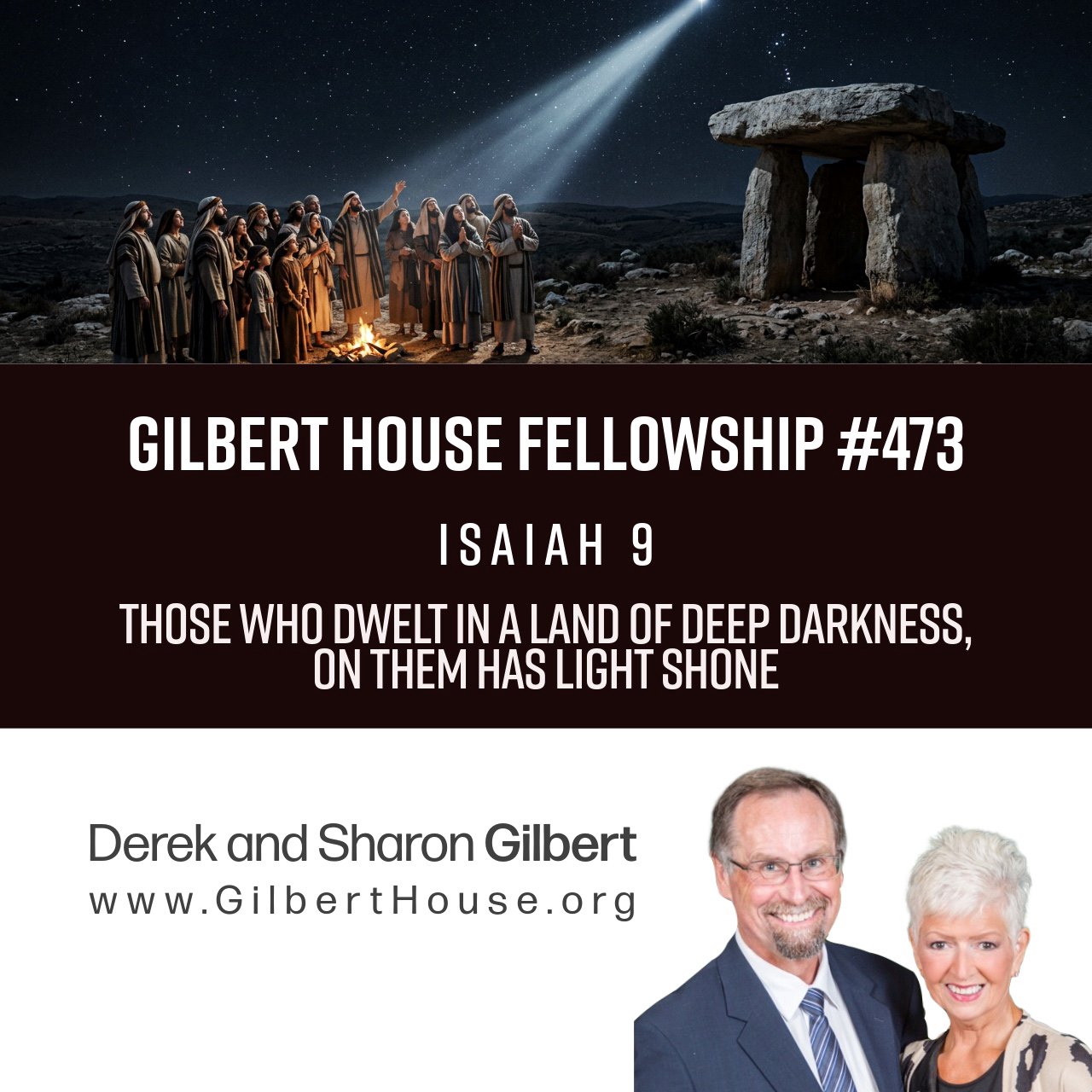
Gilbert House Fellowship
Those Who Dwelt in a Land of Deep Darkness, On Them Has Light Shone
01:33:42
Isaiah 9
Loading summary
Transcript424 lines
- [00:00]
A
Foreign.
- [00:14]
B
From the beautiful Missouri Ozarks. Greetings and welcome to the Gilbert House fellowship for Sunday, March 8, 2026. I'm Derek Gilbert.
- [00:22]
A
I am sleepy Gilbert. Hi. Have had no sleep. So add to that the change of time and I'm sleepy Gilbert.
- [00:33]
B
Yeah.
- [00:34]
A
Welcome to our living room where sleepy Gilbert is on one couch and Derek is in the. The.
- [00:39]
B
His favorite chair, my recliner. And thank you for joining us for our, our Bible study this week. We are back after several weeks away. We will explain why as we get to the end of the program at the end of the study today, the, the OG report, the old geezers report and just kind of go through the events of the last couple of weeks that unexpected. But just one of those things that reminds us that we never know what is going to happen tomorrow. So it is always important, of utmost importance, to make sure that we are right with the Lord because it's. This is just the prelude. The life we're living now is just the prelude to the life that is to come. And in a sense, this life is preparation, it is training, it is, it's school.
- [01:32]
A
Where is school?
- [01:33]
B
It is school to prepare us for what is to come.
- [01:37]
A
Yeah. But while we are in school, it is imperative that we, we do our job, which is pretty simple. Lift up Christ and him crucified, risen and coming again right as our Savior. And you know, the wonderful thing is that the world seems ready to listen.
- [02:02]
B
Yeah. With everything that's been going on since October 7th and I think even more so since September when Charlie Kirk was taken from this earth too soon, which just shocked people into the realization that we never know what is coming tomorrow.
- [02:21]
A
That's true.
- [02:22]
B
And so we can make all the plans in the world. Like as we were discussing the other day, the wealthy man in the parable who was going to build more barns to hold his stuff and didn't know that his life was going to be ended that night, that he was going to be called home that evening.
- [02:41]
A
And that's when you put your trust in riches.
- [02:46]
B
Right.
- [02:47]
A
So the richer you are, the more things you have, the more secure you feel. When in fact the Christian walk often means just trusting the day to day.
- [03:01]
B
Yeah. Yeah. When we feel physically strong and well and mentally on top of our game, we can fool ourselves into thinking, especially those of us who are, as Yogi Bear would say, smarter than the average bear. It's very tempting for us to think that what success we may have in this world is due to our own acumen, our own abilities. And when those props are kicked out from underneath us, then suddenly you realize you've got nothing except the fact that the Lord is carrying you through. I'll talk more about that at the end of our study today because that was a lesson that's come out of the last couple of weeks. And these lessons are why we have been doing these weekly Bible studies and since September of 2014. We are in our 12th year of doing this. Of course, our weekly podcast, PID Radio Peering in the Darkness, began in March.
- [04:11]
A
We just rolled past our 21st year anniversary.
- [04:16]
B
Yeah. And it's very likely the. I think in all probability the longest running podcast on the Internet. And we don't do it because we're trying to get clicks or engagement farming or anything like that.
- [04:29]
A
No. In fact, we don't get a whole lot compared to some.
- [04:31]
B
Oh, no.
- [04:32]
A
But we have a very faithful audience and we love you guys.
- [04:36]
B
And we truly do, because I will tell. Well, again, we'll get to that at the end.
- [04:41]
A
I was going to say let's pray and then get into that.
- [04:43]
B
Yeah. Because this chapter that we're about to get into in Isaiah 9 is one of the pivotal chapters in all of scripture.
- [04:50]
A
It is. And I have one thing to say before we read, but let's pray.
- [04:55]
B
Father, thank you for bringing us together over your word today. And Lord, wherever and whenever we may be gathered in hearing our words, Father, we pray for your spirit to grant us wisdom and discernment. May we understand your Word to the best of our ability. We know we will never understand completely the unsearchable depths of your word. But Lord, we know that every time we read, we are blessed with a new level of understanding. So we pray for your spirit to grant us that as we go through your word today, help us to learn that which you would have us know. And we ask this in Jesus name. Amen.
- [05:35]
A
Amen. What I wanted to mention was I was doing some research yesterday that as research often does, it takes me from one thing to another to another to another. And I discovered something I was unaware of and that it's a pseudepigraphal book called the Ascension of Isaiah.
- [06:02]
B
I had not. I'm not even familiar with that one.
- [06:04]
A
I wasn't either. And so I found a translation. Fetch. R.H. charles did one of the translations. It's one of those texts that has been read and revered by Ethiopians for many centuries. I think there are a number of opinions about it. It's not considered canon by any stretch of the imagination, but it is interesting. It's an Interesting take on the structure of heaven. Isaiah is taken to the seventh heaven by going through one through six first and he is led by a number of sort of difficult to identify angels. And I'll put angels in quote unquote, because in the seventh heaven, one of the things he is told is one of his shepherds, you might say was the angel quote unquote of the Holy Spirit.
- [07:19]
B
Okay, yeah.
- [07:20]
A
So it gets into trinitarianism. It also Sleepy Gilbert is having trouble figuring out. Well, it possibly was written in three different eras by possibly three different authors. Especially if the eras, depending upon the person who is defending that idea, if they are separated by generations, could be as late as the 4th or 5th century. Hard to say, but definitely has a pre Christian text and a post Christian text because Jesus is named.
- [08:10]
B
Yeah.
- [08:10]
A
Now you get Yeshua hints in the Old Testament. Yeah, you get as we're going to find here, you get that his name will be Emmanuel, things like that. But this seems to be more than just the Essenes who had an inkling of where things were going about 50, 60 years before Christ was born. Definitely some post Christian era, post 1st century thought. But it's really interesting. You can find PDFs up of it online if you want to read it. I started reading it yesterday. Just bear in mind that there is a hint of a Gnosticism in there, so be careful. This is not canon. Don't take it just this gives you an idea of what may have been believed at certain eras.
- [09:04]
B
It is in that respect helpful in the same way that, say the book of Jubilees.
- [09:12]
A
Yeah.
- [09:12]
B
Is helpful.
- [09:13]
A
Yeah.
- [09:13]
B
In the book of First Enoch.
- [09:14]
A
Yeah. I, I, well, I think First Enoch is actually more reliable.
- [09:18]
B
Oh, I think so.
- [09:19]
A
Too much more reliable. In fact, the, ironically enough, it was the Council of Laodicea or Laodicea, depending on how you pronounce it. Or Laodicea. I've heard it all. All short swords sorts of ways. Ethiopia didn't get the memo about we're leaving First Enoch out, which is why the Ethiopic text survived, still includes First Enoch. They're still copying it to this day.
- [09:50]
B
And there were some early church fathers like Tertullian who argued that it should have been canon. But there are good reasons for First Enoch, as we've discussed, not to be canon.
- [09:59]
A
Yeah, maybe not so much Ascension of Isaiah and there are probably other texts that Ethiopic scholars and theologians, well, not scribes. Scribes is the word I want. Have been continuing to copy for centuries. But be careful.
- [10:19]
B
Yeah, but we thankful to the Ethiopic Church for preserving First Enoch. Because it wasn't until it was rediscovered in the 19th century amongst the Ethiopic texts that first Enoch began to circulate again among Christians.
- [10:35]
A
And do you know what it was? It was a YouTube video that actually gave me that information. Yeah. And so I started researching it. It was an interview with Mel Gibson.
- [10:48]
B
Mel Gibson, Wow.
- [10:50]
A
Because he was talking about first Enoch being so important.
- [10:54]
B
Wow.
- [10:55]
A
And then the person, you know, the YouTuber who was producing had the interview. I don't know that the YouTuber was interviewing the person. So Mel Gibson so much as referencing interviews with him about his new movie, which is two parts, the Resurrection of Christ. And it's next year in 28, I think of the two first part and second part. But yeah, I think Gibson took a look at hey watchers, Giants, Nephilim.
- [11:31]
B
Yeah.
- [11:32]
A
So who knows, maybe he's going to have another film even after these.
- [11:35]
B
You know, we had been approached a couple of years ago and I'd forgotten about this until you mentioned it. That. About participating in a documentary in the three days between the Crucifixion and the Resurrection. I remember that that's a period that some, mostly in the Roman Catholic Church would call the Harrowing of hell, where Jesus went down and basically proclaim to the spirits in hell.
- [12:02]
A
Yeah, but I'm getting out.
- [12:04]
B
But the text in First Peter, that's referenced there, First Peter 3, beginning of verse 18, where Jesus descended. It's I think more accurate to say he descended to the abyss, to Tartarus rather than to Hades, Sheol. And that didn't come to pass.
- [12:25]
A
That.
- [12:25]
B
But there were hints that some of the funding behind that.
- [12:28]
A
Oh, the documentary didn't come to pass.
- [12:30]
B
The documentary didn't come to pass. But we'd been in touch with the filmmaker and the screenwriter and in fact had seen a layout of the script. I mean, this was pretty far along, but they just needed the funding to do it.
- [12:45]
A
Right.
- [12:46]
B
And it appeared that the funding was coming from
- [12:51]
A
Icon Productions.
- [12:52]
B
Icon Productions, which is Mel Gibson's production company. So anyway, it didn't come to pass, but it looks like he got interested. Yeah, he. He may be incorporating that into the forthcoming film.
- [13:02]
A
Well, good for him.
- [13:04]
B
Anyway, we stuff in Isaiah chapter 9 today that is really intriguing. Especially now if you go back a few weeks from our last study. Of course you can do that just by going into the archives that are mobile app, which is available@gilberthouse.org app or you can of course just go back on the website. Gilberthouse.org where we post all of the study notes.
- [13:30]
A
Sorry, my nose is. I had to get up and get a tissue.
- [13:33]
B
If you're subscribing to us on YouTube, please, if you would. Thank you for clicking the subscribe button. Do also click the bell for notifications so that when we post new Things
- [13:43]
A
to our YouTube channel and if we ever go live. We're working on that.
- [13:47]
B
Yeah, I did some research on that last night, by the way. It looks really, really easy.
- [13:53]
A
Glad.
- [13:54]
B
Really easy.
- [13:54]
A
So, anyway, I'll take your word for it. The going live part. It's the following comments part.
- [14:03]
B
Gotcha.
- [14:04]
A
That. That means that at least one person needs to be taking a look.
- [14:08]
B
That looks really easy, too.
- [14:09]
A
Okay, got it. Sorry, I'm tired.
- [14:12]
B
No worries, sweetheart.
- [14:13]
A
Nothing's easy this morning.
- [14:17]
B
Go back in the archives to our previous study on Isaiah, chapter eight. Because, of course, when these scrolls were written, when Isaiah wrote this down, he did not have chapter and verse numbers.
- [14:29]
A
He did not.
- [14:30]
B
So we concluded with the end of chapter eight. And from verse 19 on, it was a condemnation by Isaiah, which we see again and again through the book of Isaiah, a condemnation of the practice of the Israelites engaging in the cult of the dead. Mediums, necromancers. And in verse 21, they will pass through the land, greatly distressed and hungry. Talking about people who were consulting the dead, that word pass through comes from the same root as the word avarim. Travelers.
- [15:05]
A
Okay, the pronoun goes back to what they.
- [15:10]
B
They. The people. The Israelites. Okay, when they say to you. And going Back to verse 19 again, we'll get a running start at this verse 18. Behold, I and the children whom Yahweh has given me.
- [15:24]
A
That's Hebrews.
- [15:25]
B
Yes, Hebrews quotes that I and the children whom the Lord has given me. This is quoted? Yes, in Hebrews, chapter two. Are signs and portents in Israel. From Yahweh of hosts who dwell on Mount Zion. The people of Israel and the people who. Children. Who. We, the church, are signs and portents in Israel.
- [15:47]
A
Can you read that again? Though?
- [15:50]
B
Behold, I and the children whom Yahweh has given me are signs and portents in Israel. From Yahweh of hosts who. Who dwells on Mount Zion.
- [16:02]
A
Okay. I. That's Jesus. And the children whom Yahweh has given me.
- [16:09]
B
Yes.
- [16:10]
A
Dwell in Mount Zion. Preposition is important.
- [16:16]
B
Okay, so dwells on is in this
- [16:18]
A
translation you just said in.
- [16:20]
B
Well, I'm sorry. It says dwells on.
- [16:22]
A
Sorry.
- [16:23]
B
Okay, my bad.
- [16:24]
A
Well, still a place of position. Yes.
- [16:28]
B
Now, some scholars Will say, I and the children whom Yahweh has given me. He's referring to Isaiah and his children, but because it is quoted in Hebrews as Jesus speaking to the divine council.
- [16:43]
A
Yes,
- [16:46]
B
this is prophetic. That the fact that Israel is back in the land. I and the children whom Yahweh has given me. Jesus speaking about us, then, who've been grafted into that olive tree. Signs and portents, prophetic fulfillment. The Israel of 1948. Then in verse 19, then, he condemns those who are seeking information from the spirit realm. And when they say to you, inquire of the mediums and the necromancers who chirp and mutter, should not a people inquire of their God? Should they inquire of the dead on behalf of the living? And we talked about that in the context of the women coming to the tomb. Why do you seek the living among the dead?
- [17:34]
A
Exactly.
- [17:36]
B
To the teaching and to the testimony. If they will not speak according to this word, it is because they have no dawn, no light. The word there, dawn, is it Shachar?
- [17:49]
A
Probably.
- [17:50]
B
It is, in fact, yes. Halel Ben Shakar. They will pass through the land greatly distressed and hungry, and again, pass through. The reason that the connection between that verb and the verb and the root word behind travelers is because that was the word used of the spirits of the Rephaim, the giants, the Nephilim destroyed in the flood of Noah. Greatly distressed and hungry. The dead, if they were not fed by the living according to their monthly rituals, were believed to starve in the afterlife. And when they are hungry, they will be enraged and will speak contemptuously against their king and their God. Except there, I think, as we discussed last time, King is Molech, not Melech. They will speak. The God of the underworld, Shemyaza, the one responsible for creating the hybrids who became the Rephaim. And turn their faces upward, and they will look to the earth. But behold, distress and darkness, the gloom of anguish. And they will be thrust into thick darkness.
- [18:59]
A
Okay. And they will look to Eretz.
- [19:01]
B
They will look to Aretz.
- [19:02]
A
So it could be the underworld.
- [19:03]
B
They will look to the netherworld. But behold, distress and darkness, the gloom of anguish. In other words, trying to summon spirits from the netherworld, like the medium of Endor, an ancient ritual that goes back thousands of years to the ancient Hurrian people who came from the plains of Ararat.
- [19:22]
A
Okay, is that the last. Did you read the.
- [19:26]
B
That is the final verse of chapter 8.
- [19:28]
A
There's an 822A in the Septuagint oh, and I. I don't have chapter all, all of chapter eight, because when I go to chapter nine in the Septuagint, the very first verse is actually 8.22a.
- [19:48]
B
Okay.
- [19:49]
A
And he that is in anguish shall not be distressed only for a time period.
- [19:56]
B
I know that's very strange because I'm looking at the Septuagint translation here in the Lexham.
- [20:02]
A
I'm looking at the Brenton.
- [20:03]
B
I'm looking at the Brenton.
- [20:04]
A
Oh, you are?
- [20:05]
B
I've got them side by side, Brenton and Lexham. And they shall look on the earth below and behold severe distress and darkness, affliction and anguish. Okay, Yeah, I do see it. And he that is anguish shall not be distressed only for a time.
- [20:18]
A
Yeah. Sometimes it will put it at the end of the chapter as well as the beginning of the next one if it is considered to be part of the next chapter.
- [20:31]
B
So verse, chapter nine. Now verse one. Continuing on from that.
- [20:35]
A
And you're reading in the esv.
- [20:37]
B
Reading in the esv. Right. But there will be no gloom for her who was in anguish. Now we get into some really interesting stuff right here.
- [20:46]
A
Hold on.
- [20:47]
B
I. I know in the Septuagint it
- [20:50]
A
starts out, drink this first.
- [20:51]
B
Drink this first. Yeah.
- [20:53]
A
Like suddenly we're Alice in Wonderland. Yeah, drink this.
- [20:58]
B
Yeah, I know. That was not. And the reason we look at the Septuagint, if you're new to our study, is because that was translated by Jewish religious scholars around the year 200 B.C. give or take. The Masoretic Hebrew text, which is the basis for our English language Old Testament, was completed around 900 AD from much
- [21:21]
A
older, sorry, newer manuscripts, to my knowledge, the manuscripts used by the Septuagint translators who are Jewish scholars translating the Hebrew texts into Greek, I don't know that those texts are even available anymore.
- [21:38]
B
Probably not. The scrolls don't last forever. And the reason we compare and contrast is because the Septuagint was completed in a world without the influence of Christianity. And not only two of our Doug friends have books now on this subject. Doug Woodward, who we've mentioned before, his two volume set, Rebooting the Bible, deals with the tweaks that were made to the Masoretic text by Jewish scholars following the second century. And, you know, going from the second century onward and where you see doesn't
- [22:17]
A
change the basic tenets of the Bible. It was trying to remove the notion that Christians were able to say, hey, you know that second power in heaven in the Old Testament? We know who it is.
- [22:30]
B
Yeah. Angel of the Lord. We know who that is. Doug Van Dorn has just released a book on the same subject called oh, gosh, I'm going to have to look it up. But I think it's something like the war against the Bible. And it's about specifically how rabbis in the second century began to change the text to de supernaturalize it. It's the same thesis as Doug Woodward's. It's more narrowly focused. We did a program on that, on Iron and Myth a couple of months ago. So I encourage you, if you're interested in that, to go back and watch that program. Listen to that program on our app or on our Roku.
- [23:10]
A
Can you put a link to that in the description?
- [23:12]
B
Yes, I'll put a link to that in the description because it's both. Doug's are very scholarly when it comes to their sourcing.
- [23:21]
A
Very.
- [23:22]
B
And they will link to it. Doug Van Dorn really dives deep and cites a lot of secular scholarly sources to support what he's claiming here. And so again, that's why we look at the two side by side. Drink this first. Why did they take that out? Don't know. I'm not even sure what that.
- [23:45]
A
Well, let me read verse one in the Septuagint so you can get an idea. You read yours first and then I'll read mine.
- [23:53]
B
Okay.
- [23:53]
A
ESV says.
- [23:54]
B
Esv, Chapter nine, verse one. But there will be no gloom for her who was in anguish. In the former time he brought into contempt the land of Zebulun in the land of Naphtali, but in the latter time he has made glorious the way of the sea, the land beyond the Jordan, Galilee of the nations.
- [24:17]
A
Similar starts out, of course, with. Drink this first. Act quickly, O land of Zebulun, land of Naftalim, and Interesting. Naftali. And I assume it means those who are of the tribe of Naftali and the rest inhabiting the seacoast and the land beyond the Jordan, Galilee of the gentle Gentiles. Yeah, the land beyond the Transjordinary is what it's talking about. This is the Valley of the Shadow of Death.
- [24:46]
B
Correct. The Way of the Sea is the Via Maris. That's the famous road that led from Egypt through Israel. It came up the coast and then cut over through the Jezreel Valley to roughly the area of the city of Tiberias on the west shore of the Sea of Galilee, and then followed up through that Jordan river valley to the site of ancient Hazor, which is about halfway between the Sea of Galilee and Mount Hermon. And then it cuts off to the northeast towards Damascus. That's the way of the sea. But when you're talking about the land beyond the Jordan, Galilee of the Gentiles, you're talking about that area east of the Jordan river and north of the Sea of Galilee, which is ancient Bashan.
- [25:33]
A
Exactly. It's what you and I believe is referred to as the Valley of the Shadow of Death. Because it's the valley of all of these tombs to the Rephaim.
- [25:44]
B
Yes. So it's interesting, though, the difference between the Septuagint act quickly. O land of Zebulun, land of Naphtali, and the rest inhabiting the sea coast, the way of the sea, that's a little different. And the land beyond the Jordan, Galilee of the Gentiles. In the former time, in the esv, in the former time, he brought into contempt the land of Zebulun. In the land of Naphtali, those were the two northernmost tribes. Asher would have been northern as well, but along the seacoast, but within Israel itself. Naphtali and Zebulun were the two northernmost territories. And they would have been the first ones to become victims of an invasion because the invasions always came down from the north. But in the latter time he is made glorious. The way of the sea, the land beyond the Jordan, Galilee of the nations, or Galilee of the Gentiles. Verse 2. The people who walked in darkness have seen a great light. Those who dwelt in a land of deep darkness, on them a light has shown.
- [26:53]
A
Okay, I love this Verse two in the Septuagint. O people walking in darkness, behold a great light. Ye that dwell in the region and shadow of death.
- [27:06]
B
Yes.
- [27:07]
A
A light shall shine upon you.
- [27:10]
B
Yes. Now, the reason this is so significant is Matthew, the apostle Matthew wrote in chapter four of his Gospel that Jesus fulfilled this. This was prophetic. Jesus begins his ministry Matthew 4, beginning at verse 12. Now, when he heard that John, John the Baptist had been arrested, he withdrew into Galilee. And leaving Nazareth, he went and lived in Capernaum by the sea. That's on the north shore of the Sea of Galilee in the territory of Zebulun and Naphtali, so that what was spoken by the prophet Isaiah might be fulfilled. Verse 15. The land of Zebulun and. And the land of Naphtali. The way of the sea beyond the Jordan, Galilee of the Gentiles. The people dwelling in darkness have seen a great light. And for those dwelling in the region and shadow of death, on them a light has dawned. Jesus was the great light who shone on the people living in the region of the shadow of death.
- [28:18]
A
This is Psalm 23.
- [28:20]
B
Yes.
- [28:21]
A
Where he leads us into the valley of shadow of death. And he does this to show the fallen realm. This is their region where all of those dolmens are. The tombs of the Rephaim, the tombs of the giants, so to speak. He's showing a fallen realm. Hey, look how much I love these guys.
- [28:41]
B
Exactly. And this was a major component of our book, the Gates of Hell, when we connected these dots. And credit to the Lord for showing this to us. Because we're not the first ones to see this.
- [28:58]
A
Oh, no.
- [28:59]
B
But realizing that when you look at John chapter one and see that the first three disciples called were from north of the Sea of Galilee. Andrew, who then ran home to get Philip, or I mean Peter, in their hometown of Bethsaida, which is two miles north of the Sea of Galilee. And Philip, the third disciple called also from Bethsaida, Jesus could not have been baptized down near Jericho, where UNESCO says there's a World Heritage site. Jesus was baptized in Galilee, the nations Galilee of the Gentiles. The region of ancient Bashan, that valley from Mount Hermon to the Sea of Galilee, ringed by these megalithic tombs on either side, or monuments to the cult of the dead, the dolmens.
- [29:54]
A
Yeah. In fact, the area where we think Jesus actually was baptized is just beneath a bank, an embankment that has a big old Gilgal Rephaim kind of structure on it.
- [30:08]
B
Exactly.
- [30:09]
A
A ring structure.
- [30:09]
B
Ring structure. Concentric rings of stone probably dating back almost 6,000 years. If it's in the same time frame
- [30:16]
A
as Gilgal Rafaim around a big tumulus.
- [30:18]
B
Yeah, yeah. So Jesus went right into enemy territory for his baptism when he was carried off into the wilderness directly from there. It had to be ancient Bashan. It wasn't the Judean desert south of Jerusalem, because at the end of that, he was taken to a very high mountain and shown all the kingdoms of the world that had to be Mount Hermon. All of this was taking place in the upper Galilee and Bashan, the land of Zebulun, the land of Naphtali. Jesus becoming the light that shone on the people who had been walking in darkness. He went there to declare his divinity. He went there to declare war on the fallen realm instead of going to, you know, Jerusalem, where the religious hierarchy was based, that he was going to overthrow this. This, to us, is just absolutely phenomenal because, again, this. This chapter. Well, spoilers. We'll get to it here in a few verses. Verse 3, you have multiplied the nation, you have increased its joy. They rejoice before you as with joy at the harvest, as they are glad when they divide the spoil.
- [31:35]
A
Septuagint very similar. The multitude of the people which thou hast brought down in thy joy, they shall even rejoice before thee as they that rejoice in harvest and as they that divide the spoil.
- [31:53]
B
Verse 4. For the yoke of his burden and the staff for his shoulder, the rod of his oppressor you have broken, as on the day of Midian.
- [32:04]
A
I think it's a little clearer in the Septuagint because the yoke that was laid upon them has been taken away and the rod that was on their neck, for he has broken the rod of the exactors, as in the day of Midian.
- [32:19]
B
Yeah, that's a reference to Gideon and his 300. And Jesus likewise, with his 70, going out ahead into the Galilee after his transfiguration of Mount Hermon. Kind of similar. Similar in the. The overwhelming odds for every boot of the tramping warrior in battle tumult and every garment rolled in blood will be burned as fuel for the fire.
- [32:50]
A
This one says. And to me it just seems a little clearer. For they shall compensate for every garment that has been acquired by deceit and all raiment with restitution, and they shall be willing even if they. They were burnt with fire. And, of course, verse six is the.
- [33:11]
B
Oh, yeah, it's the big one. And there's some really interesting stuff in the Septuagint here, too. So this will be another one that's interesting to compare. Verse 6. This is a verse that you've heard. We know you've heard this. For to us a child is born, to us as son. Son is given, and the government shall be upon his shoulder, and his name shall be called Wonderful Counselor, Mighty God, Everlasting Father, Prince of Peace.
- [33:47]
A
The Septuagint in the Brenton, and this is the free translation, it's an older one. For a child is born to us, and a son is given to us whose government is upon his shoulder. And his name is called the messenger of Great Counsel, for I will bring peace upon the princes and health to him.
- [34:16]
B
The Lexham Septuagint translates it slightly differently.
- [34:21]
A
And.
- [34:21]
B
And this is really interesting, because a child was born to us, a son was given to us whose leadership came upon his shoulder, and his name is called messenger of the Great Council.
- [34:36]
A
Yes, that's what this says here.
- [34:37]
B
Cil, not Sel.
- [34:39]
A
Oh, this says Sel, as in Divine Counsel. Yeah, this says messenger of Capital M. Yes. Of Great Counsel.
- [34:47]
B
Yeah.
- [34:47]
A
But in other words, he's the counselor.
- [34:50]
B
Wonderful Counselor. Right. But the Lexum Septuagint translates it messenger of the Great Council.
- [34:57]
A
That's really interesting because those are entirely different words.
- [35:01]
B
Right?
- [35:02]
A
In Greek.
- [35:03]
B
Yeah, it is. Looking at the. At the Greek words for now, it
- [35:13]
A
is possible that they are similar words.
- [35:18]
B
Yeah.
- [35:19]
A
Just like, you know, we have the same sound in English, but different spellings and different meanings.
- [35:25]
B
Yeah.
- [35:27]
A
Counsel is advice. Counsel is a body of individuals.
- [35:35]
B
Exactly. And we're, you know, when we refer to the divine council, we're talking about the. The supernatural entities around the throne of God that we see described in, say, 1 Corinthians 22 or Revelation chapter 4.
- [35:49]
A
You can think of a council, C, I L as lawmakers and. Or judges. You can think of Sel as an advocate or advice given by an advocate. In other words, your lawyer.
- [36:01]
B
Yeah. So Wonderful Counselor is an accurate translation. And according to Brenton, that's how he rendered the Greek, the Messenger of Great Council, Sel, but Messenger of the Great Council.
- [36:15]
A
I know, that's entirely different. That's why I'm kind of confused, because it's both based on. Now, there are a number of texts, all written in Greek, but some come from German, some come from Ethiopic sources, some come from others, texts that have been found summit to Qumran, Finding the Greek versions and deciding which ones you're going to use.
- [36:44]
B
Yeah, yeah.
- [36:45]
A
And then how to translate older Greek.
- [36:49]
B
Exactly. Greek from about the third century B.C.
- [36:52]
A
now, I do want to say one thing, though, and then you can finish, so forgive me, but I want to say it before I forget, you know, I'm tired anyway. The government is upon his shoulder. That cross was on his shoulder.
- [37:08]
B
Yes.
- [37:08]
A
Now, you can say, the government is upon my shoulders, therefore I'm responsible for it. But at the very least, that's how he proved he was the Messiah. Is the Messiah because he carried that cross. Yeah.
- [37:29]
B
Yeah. That's a really good observation. The new English translation, which we also like to look at because they provided their notes explaining why they translated verses the way they did. And that really helps illustrate the difficulty that translators have in trying to render archaic Hebrew, sometimes Aramaic, Greek, Greek, and so forth, sometimes loan words from Egyptian that wind their way in there, or Akkadian, they render this verse this way. For a child has been born to us, a son has been given to us. Very similar. He shoulders responsibility and is called. And again, they explain here why the Hebrew literally translates and dominion was on his shoulders. And he called his name and then they go into a lot of language geek stuff that I won't render here. But instead of Wonderful Counselor, they translate it as Extraordinary Strategist and they explain here translators, notes, which I'll read. Some have seen two titles here, Wonderful and Counselor. However, the pattern of the following three titles, each containing two elements, suggest otherwise. So instead of he's called Wonderful, he's called Counselor. No, they said no Wonderful Counselor, but they render Extraordinary Strategist.
- [38:58]
A
That's similar to the idea of giving counsel to someone.
- [39:01]
B
Yes.
- [39:03]
A
Recommending a strategy. But what I find so interesting is Everlasting Father is not in here in the Septuagint.
- [39:14]
B
Oh, that's true. You're right. Huh.
- [39:18]
A
For I will bring peace upon the princess and health to him. Everlasting Father. Not in there.
- [39:25]
B
Very interesting.
- [39:26]
A
So the question is, why is it in the Masoretic text? Because that's a big deal to talk about a redeemer, a promised one, in this chapter in this book of Isaiah, and to leave Everlasting Father out, or rather to add it in.
- [39:55]
B
Yeah.
- [39:57]
A
Not in the 200 BC text.
- [40:01]
B
Right, right.
- [40:01]
A
Suddenly, about thousand 1200 years later, there it is.
- [40:06]
B
So even though the Septuagint, or rather the Masoretic text translators and scribes were trying to de. Emphasize the evidence Christians were using, you
- [40:17]
A
got it in one. Absolutely. They're saying they're the same entity.
- [40:22]
B
Everlasting Father, right? Yes. Now, Mighty God is an interesting descriptor as well, because in Hebrew it's El Gibor.
- [40:32]
A
Well, that's the mighty one.
- [40:33]
B
Yes.
- [40:34]
A
And that. What. What is so interesting is that's actually the name of Orion in Arabic, right?
- [40:40]
B
The giant. Yeah.
- [40:44]
A
So, no, that's not Jesus up in the sky. A lot of the things in the sky do refer to him.
- [40:52]
B
Yes, Gabor, probably. And I'm reading again the new English translation, the. Net Bible translators notes probably an attributive adjective, mighty God, though one might translate God is a warrior or God is mighty. Scholars have interpreted this title two ways. A number of them have argued that the title portrays the king, this descriptor here, the son, that is given to us as God's representative on the battlefield. Who God empowers in a supernatural way. Well, yeah, exactly. They contend that this sense seems more likely in the original context of the prophecy. They would suggest, and I tapped on it and closed the window, that they would. Having read the New Testament, we might in retrospect interpret this title as indicating the coming king's deity. But it's unlikely Isaiah or his audience would have understood the title in such a bold way. Well, it doesn't matter because it was prophetic whether Isaiah realized it or not. But yeah, they go and they go into some really detailed stuff here discussing the description of Ramses in Egyptian texts and the Hittite king anyway. But yeah, El Gabor, mighty God, everlasting Father. Yeah, they translators notes really go in depth. So if you're really interested in going deep into it, you can find that@netbible.org it's one of the study tools that we've got listed at our website gilberthouse.org look in the left hand column.
- [42:31]
A
It's free.
- [42:32]
B
Yeah, but yeah, amazing, wonderful. Counselor or messenger of the Great Council.
- [42:40]
A
Or messenger of Great messenger of Great Council.
- [42:43]
B
Yes, similar sense. And yes, whether Isaiah realized what he was writing or not, this is how this was fulfilled because certainly that's how things were seen when Jesus came on the scene and fulfilled it. Again, as Matthew said, just moving from Nazareth to Capernaum was the fulfillment of Isaiah, chapter nine, by the way.
- [43:06]
A
Capernaum.
- [43:10]
B
We did a deep dive study on that in our study of the book of Nahum a couple of months back. So verse seven of the increase of his government and of peace there will be no end on the throne of David and over his kingdom to establish it and to uphold it with justice and with righteousness. From this time forth and forevermore. The zeal of Yahweh, of hosts will do this.
- [43:35]
A
You know, it's really interesting and you're going to need to double check this, but in what I'm reading, I'll just start at the beginning of verse 7. His government shall be great, and of his peace there is no end. It shall be upon the throne of David and upon his kingdom, to establish it and to support it with judgment and with righteousness. From henceforth and forever. The seal with an S oh of the Lord of hosts shall perform this.
- [44:12]
B
Okay, now the version I've got here, which again is the Brenton says zeal.
- [44:17]
A
I know it's every once in a while I've noticed on the BibleHub.com version of Septuagint, sometimes it's obvious that they have just mistyped. Yeah, that's why I wanted to find out, because the seal would also work in this context.
- [44:38]
B
Sure. Lexham Septuagint translates that the eagerness of the Lord Sabaoth will do these things. So verse 8, the Lord has sent a word against Jacob. Now we move into a new section of Isaiah.
- [44:53]
A
This says sent death. The Lord has sent death upon Jacob Yeah.
- [45:01]
B
Net Bible sovereign master decreed judgment on Jacob. So that's the word. The Lord Adonai has sent a word against Jacob, and it will fall on Israel, and all the people will know Ephraim and the inhabitants of Samaria who say, in pride is and in arrogance of heart. The bricks have fallen, but we will build with dressed stones. The sycamores have been cut down, but we will put cedars in their place.
- [45:31]
A
This is just not a good thing to say.
- [45:34]
B
It is not. Now, I remember when, after 9 11, Jonathan Cahn looked at this verse and said, the arrogance of American politicians saying, yeah, the towers have come down, the bricks have fallen, and the sycamores. Because there were sycamores on the site of 9 11.
- [45:53]
A
Yeah. And I think there was one sycamore left standing.
- [45:57]
B
Right, Right. But we're going to rebuild. And put in other words, it was the arrogance of not recognizing that God had sent judgment against the people of Israel. This was. In fact, we get to the next verse. But Yahweh raises the adversaries of reason against him. Reason was the king of Aram, the Syrian king in Damascus, and stirs up his enemies. That's Isaiah 9:11.
- [46:26]
A
Yes. Which is really interesting, because Revelation 9:11 is all about the entity coming out of the abyss.
- [46:35]
B
Right. The Syrians on the east and the Philistines on the west devour Israel with open mouth.
- [46:41]
A
What verse are you on?
- [46:42]
B
That's verse 12.
- [46:43]
A
Okay, can you back up and read 11:11.
- [46:47]
B
Yahweh raises the adversaries of reason against him and stirs up his enemies.
- [46:52]
A
Okay. This is why I asked you to read it in the Septuagint. And God shall dash down them that rise up against him on Mount Sion or Zion.
- [47:05]
B
Oh.
- [47:05]
A
And shall scatter his enemies.
- [47:11]
B
Okay, yeah.
- [47:13]
A
Back to 10. The bricks are falling down. But come, let us hew stones and cut down sycamores and cedars, and let us build for ourselves a tower. Well, that sounds familiar. And God shall dash them down that rise up against him on Mount Zion and shall skip. Scatter his enemies. Yeah, even Syria is what it gets into.
- [47:36]
B
Exactly. Because again, we have to go back and remember that reason of Aram and Picah, who was the king of Israel, the northern kingdom of Israel, were conspiring to come against Judah. And so just so you know this.
- [47:51]
A
I'm sorry. Go ahead. Again, I'm really tired. And if I. You know how I am. If I don't see, say it when it comes into my head. So forgive me, those of you who are listening and Trying to. Derek knows me really well. This is not referring to modern day Israel, just so you know. A lot of stuff in Isaiah is prophetic, but this in many ways is actually historic.
- [48:18]
B
It is historic. Right, verse 12 again. The Syrians on the east and the Philistines on the west devour Israel with open mouth.
- [48:26]
A
Oh, that's interesting. Verse 12 in the Septuagint. Even Syria from the rising of the sun and the Greeks from the setting of the sun.
- [48:36]
B
Oh, interesting.
- [48:36]
A
Who devour Israel with open mouth for all this, his anger is not turned away, but still his hand is exalted. Now I find that interesting because DNA studies show that the so called Palestinian people are primarily Greek.
- [48:56]
B
Yeah, they've got that in there. They've also got a lot of Arab in there. The Palestinians.
- [49:02]
A
You've read different studies than I have.
- [49:04]
B
Then they're admixture of Arab and Levantine origin, but also. Yeah, a lot of Greek. The Philistines certainly came from the Aegean.
- [49:15]
A
That's what I'm talking about. The modern Palestinians, Philistines, sort of. Yeah, sorry if I misspoke again. I'm so tired and had literally no sleep.
- [49:27]
B
Yeah, yeah, she was up by midnight.
- [49:29]
A
So I've been awake for about 24 hours.
- [49:31]
B
Yeah, but you're right. And there are the archeological digs at the Philistine sites like Ekron and Gath show that they were certainly engaging in the same sorts of rituals and eating the same sort of food. Food, in other words, non kosher as the Greeks.
- [49:48]
A
Right.
- [49:48]
B
So yeah, for all this, his anger has not turned away and his hand is stretched out still. The people did not turn to him who struck them, nor inquire of Yahweh of hosts. Again, going back to chapter eight, they were inquiring of the mediums and the necromancers. So Yahweh cut off Israel head, cut off from Israel head and tail, palm, branch and reed in one day. The elder and honored man is in the head and the prophet who teaches lies is the tale. Let me say that again. The elder and honored man is the head and the prophet who teaches lies is the tail.
- [50:30]
A
Okay.
- [50:31]
B
For those who guide this people have been leading them astray. And those who are guided by them are swallowed up. Therefore the Lord. And again when I say the Lord, this is Adonai, not Yahweh. Therefore the Lord does not rejoice over their young men and he has no compassion on their fatherless and widows. For everyone is godless and an evildoer and every mouth speaks folly. This says unjustly, for all this, his anger has not turned away and his hand is stretched out still for wickedness burns like a fire. It consumes briars and thorns. It kindles the thickets of the forest and they roll upward in a column of smoke.
- [51:16]
A
Boy, howdy. Because I realize that this is not prophetic of what was in the news this morning, but overnight, if you have missed it, a fuel depot was bombed. A fuel depot that was outside of Tehran. It was bombed. And I tell you, the smoke, the fire, this black smoke that looks like a mushroom cloud went up and it is now raining. Oily, caustic rain.
- [51:50]
B
Yeah.
- [51:50]
A
On everything.
- [51:52]
B
Yeah. I was thinking that very thing when I read this. It is apocalyptic in Tehran right now. And in fact, because the oil tanks burst, flaming rivers of oil were flowing down the streets of Tehran, some of it got into the.
- [52:08]
A
The sewers.
- [52:09]
B
The sewers. And exploded with gases in the sewers. And you can see just a little somebody caught on video just boom, boom, boom, boom. And the manhole covers just flying up into the air. It's not a good time to be in Tehran right now.
- [52:24]
A
No. But this is what war looks like,
- [52:29]
B
and it gives us an idea of what war will look like in the last days. Because when we're talking about, you know, blood and fire and columns of smoke, I mean, you're talking imagery from Joel, from Amos, Revelation. I mean, this is apocalyptic.
- [52:44]
A
Yeah. And if this is the beginning of possibly a wider war in the region because the United. United Arab Emirates attacked Iran.
- [52:56]
B
Yeah.
- [52:57]
A
This morning in local time. So I saw that. Well, I don't know, probably one in the morning or something, our time.
- [53:05]
B
And that's. That's really significant, not only because the UAE has hosted US Bases, but because the UAE has been the one financial center that has allowed Iran access to global trade, access to global banking systems, and the UAE has also cut that off. So Iran right now is really. Well, we could do just a whole hour on how this impacts Ezekiel 38 and 39. Anyway, this is the kind of thing that will happen in the end times. This is the kind of apocalyptic stuff that is coming on the Earth and especially coming on Israel in the last days. Verse 19, though. The wrath of Yahweh of hosts. Excuse me. Through the wrath of Yahweh of hosts. The land is scorched and the people are like fuel for the fire. No one spares another.
- [53:59]
A
In The Septuagint, verse 19, it says, the whole Earth is set on fire because of the fierce anger of the Lord. Now it's probably Yahweh. But in the Bible, Hub translation doesn't do all caps right, so it's hard to tell what it was. And the people shall be as men burnt by fire. No man shall pity his brother.
- [54:25]
B
Yeah.
- [54:25]
A
Possibly because everybody's dealing with desperate.
- [54:28]
B
Yeah. They slice meat on the right but are still hungry. And they devour on the left, but are not satisfied. Each devours the flesh of his own arm.
- [54:40]
A
Yeah.
- [54:42]
B
Manasseh devours Ephraim, and Ephraim devours Manasseh. Together, they are against Judah. For all this, his anger has not turned away, and his hand is stretched out still. This is God's judgment against Israel for the sin of Jeroboam, where he built the golden calves, which we believe are not a representation intended to be a representation of Yahweh. They were a representation of the Father God of the Canaanites, Bul El. And when we get to Hosea, we'll show how a correct translation of Hosea 8, 6 confirms that. But the northern tribes, and this is why Isaiah again at the end of chapter eight, condemning them for turning to mediums and necromancers for answers instead of turning to God, shall they not inquire of their God?
- [55:46]
A
And then laying siege to Judah.
- [55:49]
B
Yeah. So this is why God's judgment has been allowed to fall on Israel. And the Assyrians, in the year 722 B.C. destroyed the northern kingdom, came against and besieged Jerusalem. And we'll get to that later in Isaiah, where God miraculously delivered the southern kingdom. And in fact, there are even hints of it in Assyrian texts that have been preserved to this day. They didn't admit that they were defeated. They just said, okay, I shut up Hezekiah in Jerusalem like a bird in a cage, but I didn't conquer the city.
- [56:30]
A
Yeah, yeah.
- [56:32]
B
So anyway, semantics.
- [56:33]
A
But, you know, backing up, getting back to the government. Sure. Rest upon his shoulders, and the land in darkness shall see a great light. These are promises.
- [56:46]
B
Yes.
- [56:47]
A
When they're sort of hidden in plain sight in this other stuff. It would have been very difficult in the Old Testament era, in the 7th century, 6th century BC to take a look at these things and go, oh, yeah, I know what that's talking about. Yeah, yeah, that. That's a way down the pike. Future fulfillment. But for now, we're all going to be cannibals.
- [57:15]
B
Yeah. I could just imagine Isaiah preaching this message. Probably would not have been very popular back in the day. I mean, you think today, with the way news is presented and the unpopularity of those who may raise their hand and say, yes, but what about. Have you thought through the implications of, I mean, going Back to, say, 2001 and 2003, the invasions of Afghanistan and Iraq? At the time, it was. It was like, yeah, let's get that Taliban. Yeah, let's get that, you know, dirty rotten Saddam. There were some, like Lt. Col. Robert McGinnis, who was outspoken, and I think this is why he retired from the army as a lieutenant colonel and not as a general or at the very
- [58:06]
A
least a full colonel.
- [58:07]
B
Yeah, exactly. Because he's made a very successful career since his retirement as a consultant in the Pentagon. So they clearly respect his judgment, his analysis. But for him to publicly say we should not take out Saddam Hussein, that would be a huge mistake. That was not a popular message. And again, I think that's why he didn't promote. Get promoted. Further, Isaiah was clearly not treated well. Jeremiah, likewise for delivering messages that were not popular to the king.
- [58:42]
A
You know, prophets who speak the truth, who actually speak the Lord's words. True prophets, they're not popular. They are not, for the most part, because they're nuts. The king wants to hear a certain thing. So when you go in and he asks you to tell him what this dream means or what you see coming, be sure to tell him what he wants to hear.
- [59:05]
B
Right. Yeah. You better make sure that your prophecy is patriotic.
- [59:09]
A
Yeah.
- [59:10]
B
Put Judah first. You know, don't. Don't say what God told you to say. Just say what. Say that it's what God told you to say.
- [59:19]
A
Yeah. Sometimes the most dangerous thing you can say is the truth.
- [59:23]
B
Exactly. Yeah. When. Gosh, what is it Coach Dave Daubenmeier says? Truth sounds like hatred to those. And I'm not.
- [59:38]
A
Who love lies.
- [59:39]
B
Yeah. I'm forgetting exactly how he puts it, but he's right. Truth can sound like hatred when you're living in a land that is
- [59:50]
A
where everyone has his or her own truth.
- [59:53]
B
People who are walking in darkness.
- [59:55]
A
Yeah. Capital T. Truth is not political. It is simply, well, what the Lord says. That is capital T. Truth.
- [60:07]
B
Right, Right. Well, God bless Isaiah. We know that he has received many crowns of glory for.
- [60:16]
A
Look forward to meeting you.
- [60:17]
B
Faithful service. Yeah. Because Isaiah. I know it's going to take us quite a long while to get through the book of Isaiah, which is why we're probably. When we get to Isaiah, I think we got Amos coming up here in a couple of. Just some fascinating stuff that we're into now in these prophetic sections of the Old Testament.
- [60:36]
A
Yeah. Because we do things in the order in which they occurred.
- [60:44]
B
Right. Chronological order. And so I think next week's study, if I'm not mistaken, we get into. You didn't Amos. But it is a different way of reading the Bible, but it helps to shed light on what was going on because many of these prophets lived and were concurrent with one another. Yes. We get into Amos next week. And so you see some very interesting juxtapositions of the life of David in, you know, first Samuel, two Samuel and the Psalms that David wrote. But now, you know, we'll be looking at Isaiah and comparing Isaiah with Amos and then Micah and some other prophets who lived in that same period of history. But this is why we are taking so much time going through the Old Testament, because we cannot understand the new without the Old. And it is distressing to see so many churches today and even megachurch pastors saying, we don't need the Old Testament. We are separate and distinct from the. We've got Jesus, we've got the Gospels, we don't need the Old Testament. Like, look, it is through the Jews that the gospel came. Jesus was the consummate Jew.
- [62:09]
A
And if you don't understand, at the very least the book of Genesis, you won't even know why we need a redeemer.
- [62:16]
B
Exactly. Isaiah condemning his people again, back to the end of Isaiah, chapter 8. And we'll see it again as we go through later, Isaiah 14, where he gets into the rephaim, Isaiah 26, where he prophesies their destruction. Those are the spirits that are trying to destroy what God created and called good. This was the supernatural army raised up by the sons of God in Genesis, chapter six. It is a war in the spirit realm. And we, you, dear listener, your family, that's the prize. The enemy wants to claim us for their own as not just prisoners of war, but captives to be destroyed. So, yeah, you cannot understand the Gospel without understanding the Old Testament. Well, get into the OG Report and some upcoming events.
- [63:18]
A
I suppose before we get into the OG Report, as far as your health is concerned, just want to, in case you have not seen Derek's announcement about this, if you've been wondering where 5 and 10 has gone, it's because Derek resigned as of the end of February from Skywatch tv.
- [63:40]
B
Right.
- [63:40]
A
And the only thing he was doing officially for Skywatch TV at that point over the last year, two years, something like that, has just been 5 and 10. So he's been employed technically to do 5 and 10.
- [63:54]
B
Right.
- [63:55]
A
But because his energy hours are getting shorter and shorter.
- [64:00]
B
Right.
- [64:01]
A
Because of what he's going to talk about in a minute. He just finally. We talked about it, he and I, and he talked with Joe about it at length and it was finally decided. Joe said, look, totally understand, man. You go right ahead and do what you need to do. We're still very much part of the Skywatch TV family. Yes, we love the horns and we still sit on the desk, you know, and record programs with them. But. But you will not be. Derek will not be doing Monday through Friday 5 and 10.
- [64:33]
B
Right.
- [64:33]
A
Anymore. But he and I still do PID radio, which is essentially a look at the news through biblical context. We've talked about the possibility of doing a sort of a PID daily, maybe Monday through Friday. We'll see how much. Because I don't want to, you know, burn up energy. You need to do the research and writing, which I think is what called the Lord is calling you to do. You are, and you'll talk about this in a minute. But overall, the Lord has spared your mind and your ability to talk. So those things seem pretty important to me.
- [65:14]
B
And I agree. And we, we had talked about this and prayed about this for several months before. Oh yeah, I had the phone call with Shawn and I talked with him. It was back on January 28th because I wanted to give him a month's lead time. But I formally submitted my resignation in writing in mid February. And it's because the autoimmune issue that we've been talking about here over the past 18 months or so really ramped up after my surgery for the abdominal aneurysm a year ago November.
- [65:46]
A
Been diagnosed now as cidp.
- [65:48]
B
Right, cidp, which is chronic inflammatory demyelinating polyneuropathy, which short form means my immune system is attacking the nerves in my extremities. So my legs, essentially below my knees down to my feet, are progressively numbber as you go down my legs to the point where my feet are probably about 80% numb at this point.
- [66:11]
A
You're. You're pretty much paralyzed.
- [66:14]
B
Paralyzed? Yeah. I mean, I can, I can still walk because my upper legs move and.
- [66:18]
A
Yeah.
- [66:19]
B
And I've got braces my feet that help with the drop foot so I can move around. It's also affecting my hands down to the point where I've lost a lot of fine motor skills. My handwriting looks like I'm like, I'm 95 years old. It's very spidery because I just, I don't have the muscle control button, zippers, snaps, having to wear old guy pants, you know, all pretty sweet yeah, it's pretty sweet. I mean, old men have been hiding this stuff from. It's just what you. Elastic waistbands instead of belts.
- [66:49]
A
Oh, man, it's like wearing denim jammies all day long.
- [66:52]
B
It is. It's sweet. So having to switch over to old man pants. But that's, that's fine. I mean, these are nuisance things. Not life threatening, but it does because my immune system is running in overdrive all the time and the protocols that I'm on are trying to slow that down. It just drains me of energy later in the day. So spending five to seven hours a day doing five and 10 just meant that that was stuff that I time I could not spend on research and writing and getting the first draft in for my forthcoming book, War of the Watchers. Part one was a real slog because by the time I get done with 5 and 10, it was like 2, 3 in the afternoon. And then I'd have maybe one or two hours where I could still be functional. So resigning from 5 and 10 will free up that extra time to write research because I think the second part of this book, and both of them deal with the supernatural war for Israel and the Jews is really important because of the rise of anti Semitism in the church over the last two years. And it's really ramping up lately with certain right wing podcasters that are blaming the Jews and blaming Christian Zionists for all the evils of the world.
- [68:18]
A
Sometimes referred to as the woke. Right, the woke.
- [68:20]
B
Right, yeah. Anyway, so that's the reason for resigning from from 5 and 10. But as Sharon said, it is not in any way a separation from Skywatch tv. In fact, we were on the panel this past week for four upcoming programs with Lt. Col. McGinnis. We'll be on the panel next week for programs with Darren Geisinger and at the end of the month with Wayne Tesh, the founder of Royal Family Kids. So we're looking forward to those Royal Family Kids. Yes. Get that purple cap.
- [68:52]
A
I know.
- [68:53]
B
So we will still be on the main Skywatch TV program and contributing to what Skywatch TV does. We believe 100% in the mission of Skywatch TV, which is to finance the work at Whispering Ponies Ranch. So no separation. There just need more hours than they to write and research the reason we were gone the past few weeks. If you've not followed us on X or Facebook or on YouTube, I posted videos to all of these places explaining why we were gone on February 15th. That was the morning I woke up like at midnight, was just Shivering like crazy now. You'd been dealing with the flu for a couple of days prior to that.
- [69:40]
A
I got through mine pretty quickly, though.
- [69:43]
B
You did? Your immune system.
- [69:44]
A
My immune system is working.
- [69:46]
B
It's more targeted and focused. Yeah, it is. We're not going to attack ourselves here. We're just going to go after these viruses.
- [69:52]
A
That's true.
- [69:54]
B
My immune system is again, it's being suppressed through some of the things I'm taking to try to keep it from attacking the nerves. And my influenza, which resulted in fairly high fever for several days to the point where on Thursday the 19th, Sharon said, you need to go to the ER. And so our good friend Lynn Shepherd, God bless her, came because you had not slept well the night before.
- [70:24]
A
Well, I don't sleep very well lately. I listen for you if you get up to go to the bathroom in the middle of the night, I listen to make sure you haven't fallen. I mean, right. Anyone who is taking care of someone who is not quite himself or herself anymore, it's. It's different. So, yeah, I don't sleep much anymore.
- [70:45]
B
Yeah.
- [70:47]
A
But anyway, because I hadn't slept for three days, I just called Lynn and I said, he needs to go to Springfield this morning.
- [70:55]
B
Right.
- [70:55]
A
As soon as he can get there and I cannot drive him.
- [70:58]
B
Right. So Lynn took us to the er. They did a chest X ray on me. They got me in very quickly. Unlike sometimes you go to the ER and you wait for hours and hours to be seen. They got me in very quickly, got me in, X rayed my chest, said, oh, that's pneumonia all right. And so I was admitted to the hospital and I spent seven days in the hospital. That was a really long slog because the difficulty in breathing, the wheezing. Every time I'd try to lay down flat so I could sleep, I would for the first few nights wind up in a panic attack because I couldn't breathe. So I had to just elevate the back of the hospital bed and try to sleep sitting up. And I just. I know what you're going through when it's, you know, lack of sleep. I went four days. I think I slept maybe two hours total. But by day five, things began to clear. Did have a couple of incidents where my heart rate suddenly escalated from, from 75 to 150 beats a minute.
- [71:56]
A
And I think overall it was probably the electrolytes.
- [72:01]
B
My electrolytes, but also not sleeping well
- [72:03]
A
can affect your heart rate, right?
- [72:05]
B
Yeah, my potassium was too high, my sodium was too low. They were trying to get that balance out. That finally was resolved and spent a day because of the heart incident in cardiac icu, about a day and a half. And that day was uneventful. The full day there in the cardiac icu. So they said, look, the pneumonia is pretty much cleared because I'd been on intravenous antibiotics since getting there. The other benefit was this, which was unexpected.
- [72:37]
A
This is the Lord.
- [72:38]
B
This was the Lord. The frontline treatment for my neurological issues. CIDP is, is something called intravenous immunoglobulin I V I G. The insurance company's been fighting it because it's very expensive. Just the drug alone for the five day course of treatment that my neurologist prescribed is like $40,000 without insurance, which, which we have. So we're covered there. But if the insurance not is going to pay, it's like, yeah, no, we want him to go through several months of powerful steroids first. My neurologist's like, no, let's have a phone, let's have a video consult and I'll explain to you why this isn't going to work. Well, because I was in the hospital, they put me in the neurology wing
- [73:19]
A
and the neurologist was a room that just happened to open up.
- [73:22]
B
Exactly. The neurologist was like, hey, you're dealing with cidp, you need to get on this ivig. So they gave me the first five day course of treatment while I was there in the hospital. And because it was prescribed as part of an emergency hospitalization, the insurance company didn't have anything to say about it. So it's like, praise the Lord. I know now I've not seen any results yet, but from what I've read and from a young friend named Joshua in Phoenix who's been going through this for years now and having to get these infusions every few weeks for years, he said it's usually after the second treatment that you begin to see results. But from What I've read, 40% of the people who go through it, this treatment will actually find themselves in partial or full remission where you regain the functionality that you've lost.
- [74:21]
A
It may not be permanent, but it definitely improves things for many, many people.
- [74:26]
B
Right. So your prayers
- [74:32]
A
were answered because through a not very fun experience, the Lord provided.
- [74:39]
B
Yeah. And got me started on this treatment sooner than the insurance company wanted to allow. And the responses to the video that I posted, I was going through these yesterday and just. It is humbling and very much appreciated. Very much so thank you for your prayers and it's humbling to know that as we've been doing this for more than 20 years and most of the time working from a spare bedroom, that so many have said, hey, through you, the Lord has helped me understand the Bible better. The Lord has shown me that the Word is alive, that we are living this. This is not just the ravings of a bunch of guys who are hallucinating, as skeptics would, would, would claim. And, you know, praise God for that because it's. It's not us and our immense wisdom or scholarship or anything. It's the Holy Spirit. So thank you for your kind words. Anything that we get right, that's the Holy Spirit. It's not us.
- [76:05]
A
Amen to that.
- [76:06]
B
And, but again, it is deeply, deeply
- [76:12]
A
appreciated, you know, And I have to say I also want to send out a big thank you. And I apologize. My phone's charging in the other room, so I don't have your name in front of me and I would never say your entire name anyway. But yesterday, or names yesterday, you and I on PID radio talked, gave this update. And for those of you who are kind enough to stay still, be listening. Thank you very much for hanging in there. Through this video that we. We talked about resigning from Skywatch tv. Well, that was a guaranteed income that we had coming in every week that we no longer have. But we also know the Lord guarantees his provision. He will always take care of us. And he's already shown us. You know, again, I haven't been to sleep. So as soon as I turned on my phone and went into my notifications, I saw that we received a $5,000. Now, I'm not, not bragging. This isn't anything to do with us. This is everything to do with you guys, a donation. And that helps more than you can possibly imagine because our share of medical bills is still our share. We still have to pay bills. We still have to pay in the mortgage. I mean, there are a lot of things that we still have to take care of even though we don't have a steady quote, unquote income. You guys, those of you who have been able to. You are stepping up when the Lord whispers, you have said yes, and you have helped us and you're helping many others, too. I know you guys are. Yes, Joyce, thank you, Joyce. We won't give your last name, but Joyce, thank you so much. And I saw a couple of other donations later on, so thank you, thank you, thank you. We know many of you, if you can give, could give, you would, but you're Praying for us. And I'll tell you those prayers. You know, paying your bill is important, but being undergirded with the prayers of righteous, wonderful friends, that. That's priceless.
- [78:51]
B
It is.
- [78:52]
A
And you guys have made a huge difference. And if you can't donate, don't even think about it. Just please remember us in your prayers.
- [79:02]
B
Amen to that.
- [79:03]
A
And to those of you who do help financially, boy, you just. I wish you knew how much we sometimes just start crying when we see those notifications come in.
- [79:14]
B
Yeah, it's. It's always
- [79:17]
A
when we start thinking, how are we going to make it okay, Lord, we're going to try not to count, you know, eggs. We're just going to, or whatever. We're just going to trust in you. And then boom, you know, just when we need to pay a bill, there it is.
- [79:34]
B
So thank you so much. Joyce, Kenneth, another.
- [79:38]
A
Yep. Many others.
- [79:40]
B
There are many others.
- [79:41]
A
Yeah.
- [79:41]
B
When we received and there's. By the way, if you're interested, there's a place to donate a page@gilberthouse.org Gilberthouse.org donate actually, there are a number of
- [79:53]
A
ways you can do it.
- [79:54]
B
Yeah.
- [79:55]
A
Including actually sending a check.
- [79:57]
B
Yeah. And I used to write thank you notes for all of those that came in.
- [80:01]
A
You've got my handwriting. Very difficult. Mine is really terrible too. I don't have your issues. I just a mold and don't sleep.
- [80:11]
B
But please know whether you're sending a check or using PayPal, Stripe, whatever. We truly, truly appreciate your support.
- [80:18]
A
We do. And we always pray for you guys when we see that come in. Pray for you, pray for your family.
- [80:24]
B
Yeah. And that's why we try to take these studies very seriously. Even though we laugh a lot, we joke a lot, and we blather a lot, we do. We have no bladder control. Yeah. And that's an age thing too, I've noticed. Oh, yeah, that was a milestone I reached in the hospital too. I had to wear adult nappies for a couple of days.
- [80:45]
A
I thought, do I sneak into the Walgreens to get these or sneak them out?
- [80:50]
B
So it's like we may have to get some of those on the way home. Yeah. My GI system was messed up for a while there in the hospital. Anyway, please know that we appreciate all of you and we are truly thankful for all of you and why we take these seriously. Even though we laugh, we joke, we talk. I've noticed someone on YouTube and God bless you for doing this, they actually go through, they've been going through our studies and saying thank you Mr. And Mrs. Gilbert, Deuteronomy 19. Study begins at 10 minutes and 52 seconds.
- [81:22]
A
If you just want to go ahead,
- [81:24]
B
skip past the blather and get right to the beat.
- [81:27]
A
Really appreciate that.
- [81:28]
B
God bless you. Thank you for. For time coding those and sending that.
- [81:32]
A
You guys are wonderful. Thank you so much. We take that seriously. By the way, one other thing you guys can pray for, if you don't mind. Well, a couple of things. One, our daughter's cat is really sick. And a poor little cat. Look, if you have cats or dogs, you know what it's like when a beloved, much loved pet has been diagnosed with cancer.
- [81:57]
B
Yeah.
- [81:58]
A
And that's what's going on with her little kitty. So if you would pray for Booker.
- [82:02]
B
Yeah.
- [82:02]
A
That would really, really be appreciated. And the other thing is that Derek and I, we are blessed to live on the ridge out here. We're one of the highest places on one of the highest places in Stone County. And it's gorgeous.
- [82:18]
B
Yeah.
- [82:19]
A
10 acres we got. You know, it's a modest little manufactured home, but it's well laid out. We've really enjoyed it. Got the big barn. Yeah. But Derek and I are praying about the possibility of selling it. We've got a friend who's a realtor. In fact, she's the one who sold us this house.
- [82:36]
B
Yeah.
- [82:37]
A
She is coming by tomorrow and we're going to talk about it.
- [82:40]
B
Yeah.
- [82:41]
A
So please pray that we make the right decision on that because we live out in the middle of boonies and getting help to you or, you know, if you are really in need of medical care immediately or if something happens to me.
- [82:57]
B
Right.
- [82:57]
A
And you need to figure out what to do. We just want to be where we can get help faster.
- [83:06]
B
Right. So that is something that we are praying about and may.
- [83:11]
A
We don't want to sell it. We just, you know. No, we love living here, especially since you guys help. You know, help to flesh out that barn. The barn is beautiful. And we just wish we could go out there every day and work, but it is very difficult for Derek to walk on some surfaces, especially in the. In the wintertime. Despite that, we. We are trusting in the Lord that if he chooses to keep us here and he. Through the cidp. Sorry, through the ivig. Wouldn't that be wonderful?
- [83:46]
B
That would be wonderful. Would love to stay here if that is possible. But we know that we've got a good option that we are considering that would bring us closer to help. So that if help was needed, it would be just a couple minutes away instead of 30 to 45 minutes away.
- [84:04]
A
Yeah. A much smaller house that's very close to help, by the way, if you are thinking about going to Israel with us. Yes. Derek and I have not canceled that tour for October. We've not postponed that tour for October. If events in the Middle east require that we postpone it just to make sure that we give everybody plenty of lead time, we will do that. But right now we're trusting the Lord will give Derek the strength through whatever means to lead the tour. Now, we went last year, last October, and Derek stayed on the bus sometimes or he got off the bus and then just sat down at some place that was comfortable where we would all go and we'd walk around the really crazy monumental site, archeological site that was too dangerous for Derek to walk on. But. But yeah, he's there to talk on the bus, to give, you know, little presentations in the afternoon or evening. And we, we did it.
- [85:11]
B
Yeah. So it is. It is doable. And we are planning and trusting in the Lord. October 11th through the 23rd are the dates. There's an optional three day extension over to Jordan to go to Petra, which is a. It is mind blowing. That is a bucket list.
- [85:27]
A
And you'll definitely take the little golf cart or whatever.
- [85:30]
B
I will take little golf cart. Yeah. Get, get down there that way. But that is. You've got information. We've got information at our website under upcoming events. Or you can go to the. The mobile app and look under the calendar section for upcoming events.
- [85:44]
A
Yep. And you can hold your spot on the bus for a very modest down payment. I think it's like 300 or something.
- [85:50]
B
$300.
- [85:51]
A
And if for some reason you can't go on the new dates or we just decide that we can't go, then we'll let you know and you can decide whether or not you want to ask for your money back. And they'll give you your money back.
- [86:02]
B
The Lipkin Tours, very honorable people. And they've been very gracious because we've gone through this with the COVID tours.
- [86:11]
A
We had to change the dates three times.
- [86:13]
B
Four times.
- [86:13]
A
Oh, was it fun?
- [86:14]
B
Four times. Yeah. So that is one of the things coming up. We got two conferences we're planning to do this year. The Go There for conference in Ohio. That's Brookville, which is suburban Dayton. Friday, July 24, Saturday, July 25. I think Mike Spalding has put out the list of speakers, but I don't think I have added the.
- [86:33]
A
Well, you can go to Go there for conference.
- [86:35]
B
Go there for conference.com that will help. And remnant rising 2.0, which is from here, the watchman that is August 7th through 9th in Springfield, Missouri. Wonderful facility. The Oasis Hotel and Conference Center. Yeah, we really enjoyed that event last year. And some of the speakers coming this year, Tony Merkel of the Confessionals Podcast, John Pounders, among others. So some new speakers there, but Vicky Joy Anderson will be there, Joe Artis Horn of Skywatch tv, Sharon and me. And so that'll be a wonderful gathering as well. And Springfield is easy enough to get to. Springfield Branson National Airport, accessible from Dallas, Chicago, Atlanta, Denver. Plenty of connecting flights, and it's an easy airport to get from. Plus there's a hotel shuttle, so you can get to the hotel without having to rent a car if you don't want. But if you do, rent a car, Branson just 45 minutes away. And I will say this. Springfield, Missouri, has the best aquarium in the United States. Oh, it's better than the Shedd Aquarium in Chicago.
- [87:41]
A
That's. That's true.
- [87:42]
B
I've seen them both. And the. Was it Worlds of Wonder, I think, which is connected to Bass Pro number one.
- [87:51]
A
Yeah.
- [87:53]
B
So, man, if you want to make a pilgrimage to Bass Pro, come home with a boat. That's the place to. This is the conference for you, but the information is on our website and also on the app. I guess that's it.
- [88:06]
A
I think that's probably. Probably is.
- [88:07]
B
Yeah. I had thought about doing a podcast for tonight. Decided against it, energy levels and all.
- [88:14]
A
I know.
- [88:14]
B
But tonight I will be talking with Dr. Jud Burton, Brian Godella, Doug Van Dorn about Melchizedek. And that'll be next weekend's Iron and Myth.
- [88:24]
A
Okay, so when you say I'm talking with them, you're actually recording it with.
- [88:27]
B
Recording tonight. That'll be for next Sunday.
- [88:29]
A
Next Sunday, yeah.
- [88:30]
B
So in the meanwhile, you know, just. We can just appreciate your prayers. We will close with a word of prayer. In fact, Father, we thank you for bringing us together over your word today. And just marvel at what you showed the prophet Isaiah and the fact that Isaiah was willing to say, here I am. Send me to speak words that were not popular in his day, but showed us, showed his people, that a coming Messiah of the line of David would rise and would reign eternally from his throne on Mount Zion. We await that day, Lord, when you return, landing on the Mount of Olives, crossing the valley of Jehoshaphat through the eastern gate. Until that day, Father, we pray for the strength and the courage to share the hope that we have in you with gentleness and respect, as the Apostle Peter commanded with our family members, our friends, our colleagues, our co workers, may we bring them out of the land of great darkness, the valley of the shadow of death, and into your light, the great light that has shone on the world. Father, we pray for the peace of Jerusalem, for the safety and security of our friends there, for the safety of those engaged in this conflict. Our soldiers, our sailors, our airmen, pray for the safety, the supernatural safety of the Gulf nations. May the Muslims of the Arab nations in the Gulf see the truth of the light of your love. Come to know Messiah personally. May your light, your holy spirit, shine on them and on the people of Iran, the Persian people. May they take this opportunity, Lord, to reclaim their heritage, their future, and to open the doors for the gospel to be proclaimed openly in the streets of Tehran. Father, it is heartbreaking to see that there are those losing their lives in this conflict on both sides. We know that you would wish that none should perish, but that all would have everlasting life. And we know that there are many in Iran who have been led by dreams to accept you, to come to know you personally. But Father, what a blessing it would be to have ministers of the gospel, evangelists proclaiming openly in a land that has been closed to the gospel for nearly 50 years. Father made us be so. We know your will is going to be accomplished. We know prophetically there are days ahead when Persia once again turns against Israel. But Father, may this be a window of opportunity for the gospel of salvation, the Gospel of the kingdom to be proclaimed in lands where it has been forbidden for centuries. Father, we pray for your blessing on those who are boldly speaking truth, especially in those lands where doing so is dangerous. We pray, Father, for your spirit to guide our leaders, to grant them wisdom and discernment. We ask for your blessing, Father, to grant us wisdom. We pray for your blessing, pray for those in need of healing. And we give thanks, Father, for your sacrifice on our behalf, knowing that you have endured more for us than we can ever know. We ask for your blessing in Jesus name. Amen.
- [93:13]
A
Amen.
- [93:15]
B
Until next time. I'm Derek Gilbert.
- [93:17]
A
I'm Sharon Gilbert. We love you guys so much. Bye bye.
- [93:22]
B
Thank you for joining us. We post a new Bible study each Sunday morning, subscribe to the podcast and explore the archives online@gilberthouse.org.