Podcast
Heists, Hustles, and Homicide
Hosted by Steve W · EN
Welcome to Heists, Hustles, and Homicide - the true crime podcast where brains, betrayal, and blood all share the same spotlight.
I'm Steve your host, and each week, I’ll take you into the minds of the boldest criminals, the slickest con artists, and the darkest murderers history has to offer...in story format.
Some of these stories you’ve heard whispers of.
Some have been buried.
And some? They were never supposed to be uncovered at all.
We’ll crack open legendary heists that rewrote the rules…
We’ll follow the hustlers who schemed their way into the high life…
And we’ll revisit chilling homicides that still haunt investigators - and victims’ families - decades later.
But this isn’t just about crime.
It’s about people.
What drives someone to pull off the perfect con - or the perfect murder?
Is it desperation? Greed? Ego? Revenge?
Each episode, we’ll unravel one real-life case - beginning to end.
Some episodes will play out like thrillers.
Others will feel like puzzles missing a single, crucial piece.
And in every one, we’ll ask the same question:
How far would you go?
So whether you're into high-stakes break-ins, twisted lies, or unsolved crimes that keep you up at night - welcome.
You’ve found your new obsession.
This is Heists, Hustles, and Homicide.
Make sure to follow the show, and buckle up.
19episodes
Episodes
Newest firstAll episodes
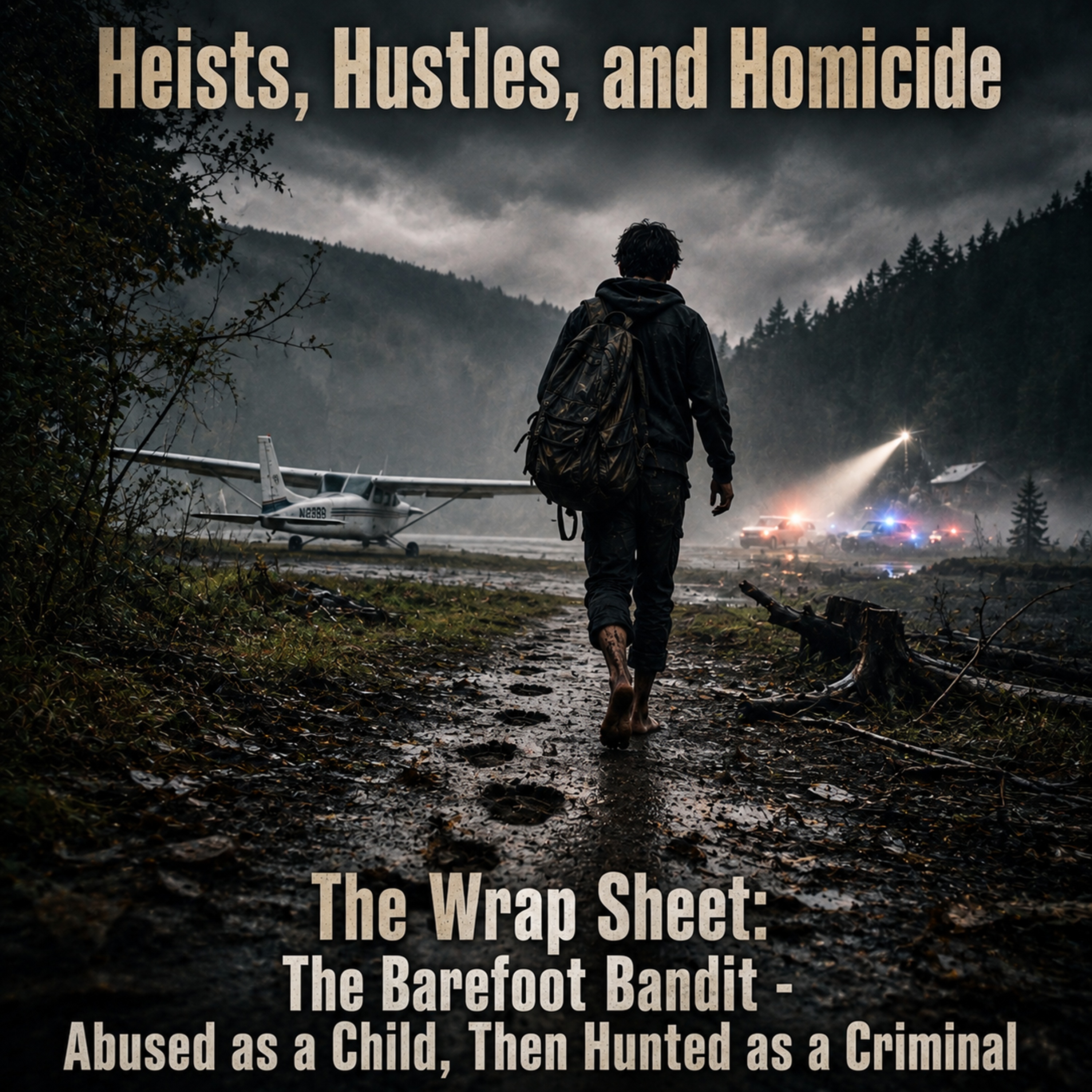
The Wrap Sheet: The Barefoot Bandit - Abused as a Child, Then Hunted as a Criminal
4d ago00:37:28Tap to summarizeColton Harris-Moore became famous for stealing cars, boats, and airplanes, escaping into the forests of the Pacific Northwest, and repeatedly embarrassing the authorities trying to catch him.But long before he was hunted as the Barefoot Bandit, he was a child asking for help.In this Wrap Sheet episode, Steve takes a deeper, sharper, and more entertaining look at the complicated story behind the legend. Colton grew up surrounded by poverty, neglect, instability, and abuse. The woods became his refuge, his classroom, and eventually the perfect place to disappear when law enforcement came looking for him.The same authorities who failed to protect him as a child would later spend years chasing him across multiple states, international borders, remote islands, and eventually the Bahamas.We look at how Colton became a teenage forest ninja, quietly slipping into vacation homes, stealing food, sleeping in empty beds, and somehow staying several steps ahead of agencies that often communicated like they were playing the world’s least organized game of telephone.Then there were the airplanes.With no formal training and apparently very little concern for gravity, aviation regulations, or remaining alive, Colton taught himself enough about flying to steal multiple aircraft. He crashed, nearly died, walked away, and somehow decided the reasonable response was to try it again.And again.His nerve was unbelievable. His survival skills were impressive. His decision-making was the kind usually followed by the phrase, “Do not attempt this at home.”But while fans celebrated the outlaw mythology, real people were left paying the price. Store owners lost money they desperately needed. Homeowners had their privacy violated. Aircraft owners watched expensive machines disappear, crash, or come back looking like they had been used for flight training by a raccoon with confidence issues.To his supporters, Colton was a modern folk hero robbing wealthy vacation homes and making law enforcement look foolish. To his victims, he was not a legend. He was a burglar, a thief, and a threat to everything they had worked to build.This episode explores the uncomfortable space between those two versions of Colton Harris-Moore.Was he a criminal mastermind?A damaged and rebellious kid?A survivalist shaped by neglect?Or a dangerous young man whose tragic childhood explained his actions without excusing them?We also revisit the wild pursuit that carried him across the United States, into the Bahamas, and into one final boat chase that played out like an action movie written by someone who had stopped caring whether the plot sounded realistic.Finally, we look at what happened after the headlines faded, Colton’s release from custody, and the encouraging signs that he may have finally found a way to build a life without stealing the transportation required to get there.This is not another retelling of the Barefoot Bandit story.This is the Wrap Sheet.
Transcribe →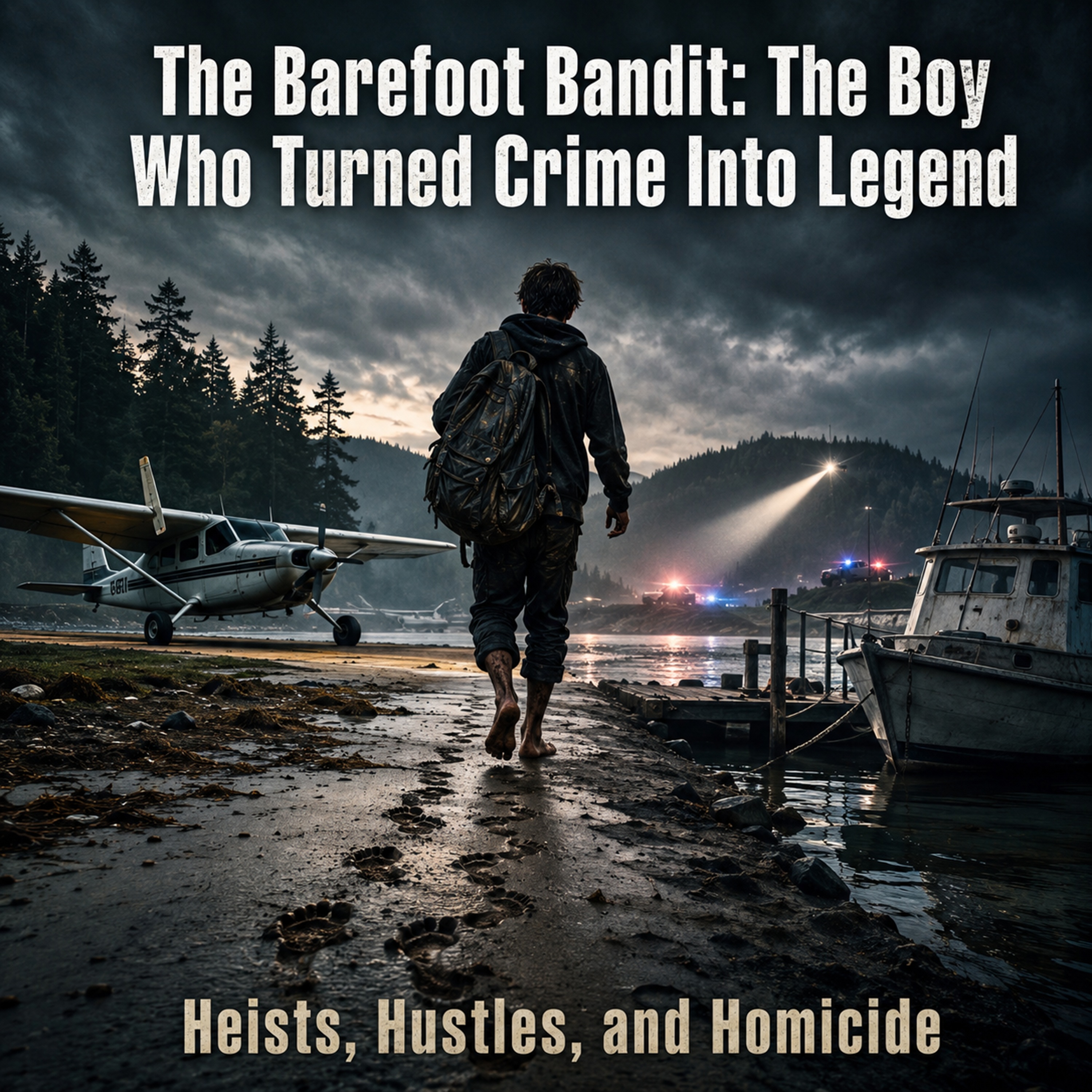
The Barefoot Bandit: The Boy Who Turned Crime Into Legend
1w ago00:45:29Tap to summarizeHe was a troubled teenager from a broken home who dreamed of becoming a pilot.Instead, Colton Harris-Moore became one of the most notorious young fugitives in America.After escaping from a juvenile halfway house, Colton disappeared into the forests and islands of the Pacific Northwest. He survived by breaking into vacation homes, stealing food, sleeping in empty houses, taking cars, boats, electronics, and eventually something almost no one believed possible: airplanes.With no formal flight training, Colton allegedly taught himself to fly using manuals, videos, and stolen information. He then launched a crime spree that stretched across multiple states, crossed international borders, and left police, the FBI, Homeland Security, and entire island communities struggling to catch him.Each time authorities closed in, Colton seemed to vanish.He escaped police raids, slipped through forests, crash-landed stolen aircraft, crossed into Canada, traveled through the American Midwest, and eventually flew more than a thousand miles to the Bahamas in a stolen plane.But behind the headlines, fan pages, T-shirts, and outlaw mythology was a much darker story.Colton’s childhood was marked by poverty, neglect, abuse, instability, and repeated warnings that the system failed to address. To some, he became a modern folk hero who embarrassed law enforcement and refused to be caught. To his victims, he was a destructive burglar who stole livelihoods, endangered lives, and left ordinary people paying the price for his legend.In this episode of Heists, Hustles, and Homicide, we take a deeper look at the incredible true story of the Barefoot Bandit, from his troubled childhood on Camano Island to his first burglaries, daring airplane thefts, international manhunt, dramatic capture in the Bahamas, and the final reckoning that forced the world to separate the myth from the man.Was Colton Harris-Moore a brilliant survivalist, a reckless criminal, a victim of a failed childhood, or somehow all three?This is the unbelievable story of the teenager who stole planes, crossed an ocean, and nearly disappeared into legend.
Transcribe →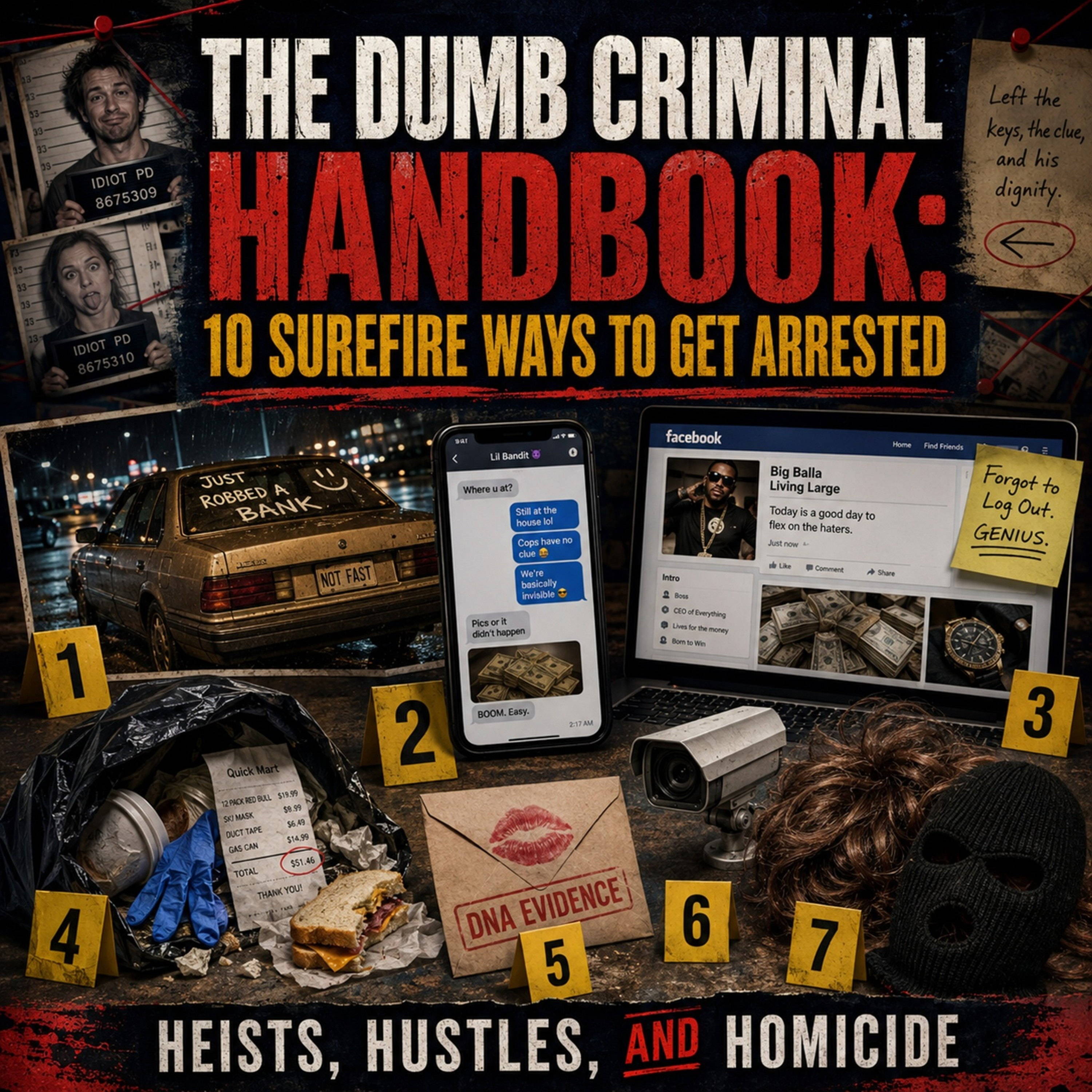
The Dumb Criminal Handbook: 10 Surefire Ways to Get Arrested
2w ago00:24:50Tap to summarizeThe Dumb Criminal Handbook: 10 Surefire Ways to Get ArrestedWelcome back, Crime Crew.Some criminals spend months planning the perfect crime. Others bring their personal cell phone, use their own car, leave their identification behind, post the evidence on social media, and then return to the crime scene to see how the investigation is going.In this sarcastic true crime countdown, Steve presents The Dumb Criminal Handbook, a mock training manual covering ten of the fastest and most ridiculous ways criminals help law enforcement arrest them.From unforgettable disguises and terrible getaway vehicles to suspicious Google searches, ridiculous alibis, sudden spending sprees, and the complete inability to remember that cameras exist everywhere, this episode celebrates the criminals who practically solve their own cases.The episode also includes three dishonorable honorable mentions:The crew member with a nickname like “Stacks” or “Dookie” who was trusted to destroy the evidence but instead left the getaway car outside his side chick’s apartment.The burglar who broke into someone’s home and used the victim’s computer to check Facebook, then forgot to log out.And the suspect who voluntarily contacted law enforcement about an unrelated scam and accidentally handed investigators the DNA they needed to connect him to a much more serious crime.This is not a guide to committing the perfect crime.It is a guide to understanding why the smartest criminal decision is usually not committing one in the first place.Because when your plan involves a personalized getaway vehicle, an open Facebook tab, a half-eaten sandwich covered in DNA, and the least responsible member of the crew handling cleanup, the police investigation may be over before it even begins.
Transcribe →
The Wrap Sheet: The Xerox Credit Union Murder - Bad Wig, Bad Plan, Bad Karma
3w ago00:23:13Tap to summarizeIn this Wrap Sheet episode of Heists, Hustles, and Homicide, we take one more look at the chilling and bizarre Xerox Credit Union Murder - a case involving a fake FBI agent, a bad disguise, a deadly robbery, and one umbrella that may have helped crack the case wide open.On August 12, 2003, a man walked into the Xerox Federal Credit Union in Webster, New York, dressed like an FBI agent and claimed he was there to conduct a security audit. But the “audit” quickly turned into a robbery, and the robbery turned into murder when Raymond Batzel was shot and killed. Joseph Doud was also shot but survived.In this episode, we dig into the stranger details of the case: the terrible wig, the sunglasses, the fake FBI act, the grainy surveillance footage, and the baffling decision to bring - and then leave behind - an umbrella at the crime scene. Was the umbrella part of the disguise? Was it used to avoid cameras? Or was it just one more dumb mistake in a crime filled with bad decisions?We also talk about how this case sat unsolved for over a decade until fresh investigators, public billboards, DNA technology, and one very unlucky envelope lick helped point authorities toward Richard Wilbern, a former Xerox employee. Was it luck, karma, or the universe handing investigators a gift-wrapped break?This is The Wrap Sheet: The Xerox Credit Union Murder - Bad Wig, Bad Plan, Bad Karma, a witty, introspective true crime deep dive into a fake badge, a deadly choice, and the evidence that refused to disappear.
Transcribe →
Badge, Briefcase, and Blood: The Xerox Credit Union Murder
Jun 3000:43:56Tap to summarizeThis week on Heists, Hustles, and Homicide, we’re walking into a quiet credit union on the Xerox campus in Webster, New York...where what looked like an official FBI security audit turned into a deadly robbery, a murder, and a mystery that would haunt investigators for more than a decade.On the morning of August 12, 2003, employees at the Xerox Federal Credit Union were confronted by a man dressed like an FBI agent. He had the look. He had the badge. He had the bulletproof vest. He had the confidence of someone who expected everyone in the room to obey.He told them he was there for an audit.But the briefcase didn’t hold paperwork.It held guns.Within minutes, the fake federal operation became real terror. Xerox machinist Raymond Batzel, who had simply come in to make a car payment, was shot and killed. Joseph Doud was also shot but survived. The gunman escaped with more than $10,000, leaving behind panic, grief, unanswered questions...and one strange piece of evidence: an umbrella.For years, the case went cold. Investigators had images. They had theories. They had possible suspects. But they didn’t have the one thing they needed most: a name.Then, thirteen years later, a tip came in.A concerned citizen remembered seeing a man wearing what looked like an FBI raid jacket before the robbery. That man was Richard Wilbern, a former Xerox employee who had been fired, had a history with the company, and had allegedly lost a lawsuit against Xerox.But the twist that feels almost too wild for a crime documentary?Wilbern later contacted the FBI himself about a completely separate complaint involving a real estate scam. That gave agents the opening they needed. During one of those contacts, investigators obtained DNA from an envelope Wilbern had licked...and matched it to DNA from the umbrella left behind at the crime scene.The prosecution said the odds of that DNA belonging to someone else were astronomical. The defense challenged the testing, arguing the sample was extremely small and raising questions about reliability, handling, and contamination.So this case becomes more than just a robbery.It’s a story about disguise, ego, revenge, forensic science, a 13-year hunt, and one suspect who may have accidentally walked himself right back into the FBI’s hands.Was it a brilliant disguise or a desperate act?Was the Xerox campus chosen because the killer knew the layout?And how did a fake FBI agent walk into a credit union in broad daylight and turn an ordinary errand into a homicide?This is Badge, Briefcase, and Blood: The Xerox Credit Union Murder.Right here on Heists, Hustles, and Homicide.
Transcribe →
The Wrap Sheet: Leonard vs. PepsiCo - The Harrier Jet Hustle
Jun 2300:25:57Tap to summarizeWelcome back to Heists, Hustles, and Homicide, Crime Crew.In this Wrap Sheet episode, Steve dives back into one of the most ridiculous, brilliant, and legally bizarre corporate showdowns of the 1990s: Leonard vs. PepsiCo, better known as the infamous Pepsi Harrier Jet lawsuit.This is the story of a Pepsi commercial that most people saw as a joke, a parody, a goofy marketing stunt, and maybe the most obvious “please don’t actually try this” moment in soda history. But John Leonard saw something different. He saw an opening. He saw fine print. He saw Pepsi Points. And somehow, through a perfect blend of confidence, legal curiosity, and absolutely unhinged commitment to the bit, he turned a soft drink commercial into an actual federal court case.In this episode, Steve breaks down the genius and lunacy of Leonard’s hustle. Because let’s be honest: most of us watched that ad and thought, “Ha, funny jet.” Leonard watched it and thought, “I’m going to need investors.”And that is what makes this case so fascinating. Was it absurd? Completely. Was it bold? Absolutely. Was it maybe one of the most creative legal Hail Marys ever launched from the snack aisle of American capitalism? Crime Crew, you better believe it.Steve walks through how Leonard gathered Pepsi Points, sent in the now-famous order form, included a massive check, and essentially told Pepsi, “Go ahead and send over that military aircraft whenever you’re ready.”Then comes the moment we all wish we could have seen: the Pepsi mailroom opening the envelope.At first, you know somebody laughed. Somebody probably passed it around the office. Somebody probably said, “Can you believe this guy?” But then the laughter slowed down. The room got quiet. Somebody realized Leonard wasn’t kidding. And somewhere deep inside Pepsi headquarters, a corporate lawyer’s soul left his body for approximately three business days.This Wrap Sheet digs into that delicious corporate panic. How did Pepsi go from “obviously this was a joke” to “we need legal strategy immediately”? What was it like when the case actually started moving toward court? And how close did Leonard really get to pulling off one of the strangest promotional hustles in American history?Along the way, Steve explores the big question at the center of the case: when does an advertisement become a real offer? Could a reasonable person really believe Pepsi was offering a military-grade Harrier jet in exchange for soda points? Or was Leonard simply trying to force a billion-dollar corporation to defend its own ridiculous marketing campaign under oath?This episode is funny, weird, legally fascinating, and packed with the kind of “wait, this actually happened?” energy that makes Leonard vs. PepsiCo such a perfect Heists, Hustles, and Homicide story.Because no one was murdered. No bank was robbed. No diamonds disappeared.But one man looked at a Pepsi commercial, saw a fighter jet, and said, “I’ll take one.”
Transcribe →
“The Harrier Jet Hustle: Leonard vs. PepsiCo”
Jun 1700:43:39Tap to summarizeLeonard vs. PepsiCo: Where’s My Harrier Jet?Welcome back to Heists, Hustles, and Homicide, Crime Crew.In this episode, we dive into one of the strangest legal battles in advertising history: Leonard v. PepsiCo, better known as the Harrier Jet case.In the mid-1990s, Pepsi launched its bold “Pepsi Stuff” campaign, where customers could collect Pepsi Points and redeem them for branded merchandise like shirts, sunglasses, and leather jackets. But one commercial pushed the joke to another level when it showed a teenager arriving at school in a military Harrier jet with the price tag: 7,000,000 Pepsi Points.Most people laughed.John Leonard did the math.After discovering Pepsi’s rules allowed customers to buy extra points for ten cents each, Leonard gathered investors, collected a handful of real Pepsi Points, and sent Pepsi a check for more than $700,000 - officially requesting his Harrier jet.Pepsi said it was clearly a joke.Leonard said it looked like an offer.And just like that, a soda commercial became a federal lawsuit.This episode breaks down the wild story behind the commercial, Leonard’s loophole, Pepsi’s response, and the courtroom fight over whether a joke in an advertisement could become a legally binding contract.In this episode:We cover the rise of Pepsi’s 1990s marketing machine, the famous “Pepsi Stuff” commercial, John Leonard’s bold attempt to claim the jet, the legal battle that followed, and why the court ultimately ruled that no reasonable person would believe Pepsi was actually giving away a military aircraft.We also look at why this case still matters today, especially in an era of viral marketing, social media stunts, influencer campaigns, and brands constantly trying to blur the line between joke, hype, and reality.Key themes:Advertising gone too farFine print vs. big promisesThe power of loopholesContract law meets pop cultureCorporate marketing and consumer expectationsThe difference between a joke and an offerBest line from the episode:“Dear Pepsi, I have your points. I have your form. I have your money. Where is my jet?”Listen for:The moment a funny commercial turns into a legal headache, why Leonard’s argument was clever even if it failed, and how Pepsi learned that when you put a number on the screen, somebody out there might just try to redeem it.Next week on Heists, Hustles, and Homicide:We’re heading into a much darker case: the Xerox Credit Union murder, a robbery, a disguise, a cold trail, and a 13-year hunt for justice.Stay sharp, Crime Crew.
Transcribe →
"Bombing of Pan Am Flight 103 (Part Two): The Verdict, the Theories, and the Fallout"
May 1600:29:48Tap to summarizeIn Part 2 of our Pan Am Flight 103 story, we move beyond the explosion and into the decades-long search for answers.This episode digs into the investigation, the forensic evidence, the trial of Abdelbaset al-Megrahi, and the many questions that never fully went away. We look at how a tiny fragment of evidence helped shape the official case, why Libya became the center of the prosecution, and why so many victims’ families and investigators believed the full story was still bigger than one man.We also break down the major conspiracy theories and alternative explanations that have followed Lockerbie for years, including the Iran revenge theory, the PFLP-GC angle, the CIA drug-route allegations, and the claims that Libya may have been framed or only part of a larger plot.This is the part of the story where the wreckage is gone, but the mystery gets deeper.In this episode:The massive international investigation after the bombingThe bomb suitcase, the radio, and the key forensic discoveriesHow Libya became the focus of the caseThe Camp Zeist trial and why the verdict remains controversialThe families who kept pushing for more answersThe later charges that proved the case was still aliveThe conspiracy theories that continue to surround LockerbiePan Am Flight 103 was not just a tragedy. It became one of the most debated terrorism cases in modern history.Thank you for all the love and support, and for listening to Heists, Hustles, and Homicide. If you enjoyed this episode, please share it with your friends and family. That support means everything and helps the podcast keep growing.Stay tuned for next week’s episode, when we dive into one of the strangest legal battles ever: Leonard v. PepsiCo - the fighter jet controversy that made people ask whether Pepsi really owed someone a Harrier jet.#HeistsHustlesAndHomicide #PanAm103 #Lockerbie #TrueCrimePodcast #AviationTerrorism #UnsolvedMysteries #ColdCase #TerrorismCase #PodcastRecommendations #LeonardVsPepsiCo
Transcribe →
"Bombing of Pan Am Flight 103 (Part One): Murder Over Lockerbie"
Apr 1700:40:12Tap to summarizeOn December 21, 1988, Pan Am Flight 103 took off from London bound for New York and never made it across the Atlantic. Less than an hour after takeoff, a bomb hidden inside the plane exploded over Lockerbie, Scotland, killing all 259 people on board and 11 people on the ground.In this episode of Heists, Hustles, and Homicide, Steve dives into the horrifying timeline of the Lockerbie bombing, the chaos that rained down on a quiet town, the massive international investigation that followed, and the theories, twists, and unanswered questions that still surround one of the deadliest terrorist attacks in history.This is the story of a flight destroyed in midair, a case that crossed continents, and a tragedy that still echoes decades later.
Transcribe →
"The Wrap Sheet: The Brinks Diamond Heist - Nap Time, Snacks, and $100 Million Gone"
Mar 2400:16:56Tap to summarizeIn this Wrap Sheet episode of Heists, Hustles, and Homicide, Steve breaks down one of the most unbelievable heists in modern history - the Brinks Truck Jewelry Heist, where tens of millions of dollars in diamonds and luxury jewelry were stolen… because security quite literally fell asleep on the job.This wasn’t Ocean’s Eleven.This wasn’t a high-tech operation.This was a perfect storm of lazy decisions, bad timing, and unbelievable luck.In this episode, Steve dives into:The infamous gas station stop that changed everythingThe moment a Brinks guard decided nap time > securityThe criminals who basically walked into the easiest heist of their livesThe shady possibility that jewelry companies may have undervalued the shipment to save money (and paid the ultimate price)Where the stolen diamonds likely ended up - and why they’re almost impossible to recoverAnd the most unbelievable twist of all…How one of the suspects in the largest jewelry heist in U.S. history somehow left the country due to a breakdown in coordination between agenciesThis episode is equal parts true crime breakdown, dark humor, and “you can’t make this up” insanity.Because sometimes the biggest crimes don’t happen because criminals are brilliant…They happen because everyone else dropped the ball.
Transcribe →