← The Preamble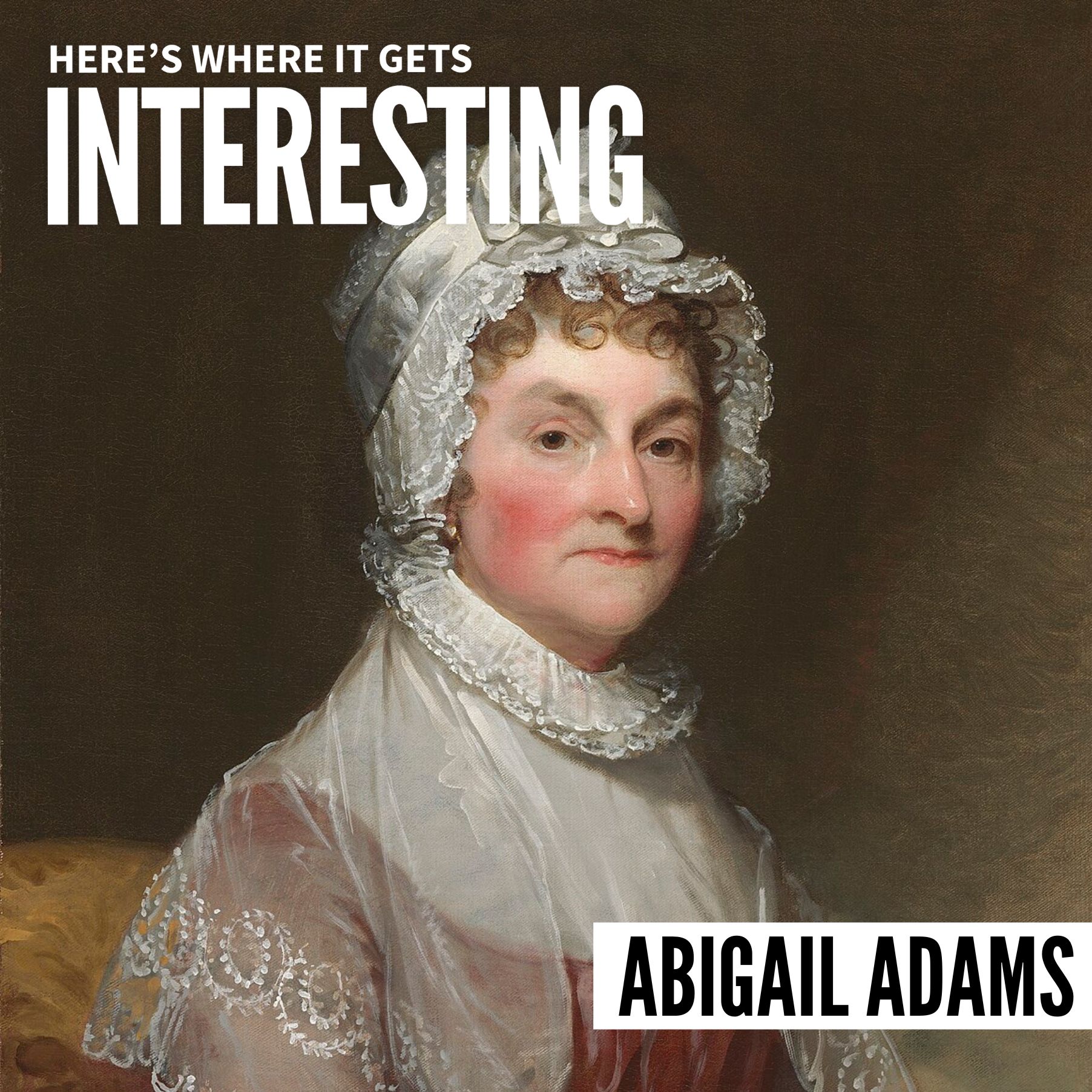
The Preamble
Abigail Adams Abroad
00:30:21
Sharon explores Abigail Adams’ travels across the Atlantic, adventuring in France with her husband, John Adams. The power couple ultimately lands back in Boston only to move again into new roles as President and First Lady of the United States.
Loading summary
Transcript42 lines
- [00:01]
Sharon McMahon
You know that feeling when fall hits and suddenly you want your wardrobe to match the season. Listen, I am there. That is me. And Quince has made it so easy. They have all the elevated essentials for fall like 100% Mongolian cashmere starting at $50, washable silk tops and skirts and perfectly tailored denim that actually fits. I am really loving their wool coats. They look designer level but cost a fraction of the price and honestly the quality is just as impressive. Quint partners directly with ethical top tier factories, cutting out the middlemen so you get luxury quality pieces at half the price of similar brands. For me, a few Quint's pieces, like their cashmere sweaters and silk tops have become some of my favorites in my fall wardrobe. It's stylish, effortless and just makes sense. Keep it classic and cozy this fall with long lasting staples from quint. Go to quince.com Interesting for free shipping on your order and 365 day returns. That's Q-U-I-N-C-E.com Interesting to get free shipping and 365 day returns. Quince.com Interesting.
- [01:15]
Narrator/Host
August 2025 marks 20 years.
- [01:17]
Sharon McMahon
Since Hurricane Katrina, one of the most devastating natural disasters in U.S. history, changed New Orleans forever. There have been countless stories about the storm and their recovery, but there's another story, one that shaped the lives of thousands of children. Where the Schools Went is a new five part podcast series that digs into what happened to New Orleans public schools after the levees broke, ushering in the most radical education experiment in American history. Hosted by Ravi Gupta, a former school principal, where the Schools Went looks back at decades of dysfunction before Katrina and unpacks the high stakes decisions made in the storm's wake. You'll hear from veteran teachers who lost everything, the outsiders who came to rebuild, and the students and families who lived through it all. Whether you're a parent, an educator, or someone who cares about how public systems and communities evolve after crisis, this is a story worth your time. From the branch in partnership with the 74 and Midas touch. Where the Schools Went is out now. Find it wherever you get your podcasts and start listening today.
- [02:23]
Carvana Customer
Foreign.
- [02:29]
Narrator/Host
Welcome. Delighted that you are here today. We're gonna return to the life of one of my favorite first ladies. I just love her because she is such an independent thinker and she was way before her time. I shared a lot of details about her in episode 44 of this podcast, an episode called 1100 Strongly Worded Letters. And so if you haven't listened to it yet you can check that episode out. It will give you a lot of biographical details about Abigail Adams. But today I want to concentrate on one of the times when John and Abigail were together. In particular the years they spent living abroad during the first few years after the American Revolution. So dive in. I'm Sharon McMahon and here's where it gets interesting. Okay, first, let's do a very quick recap of Abigail's early life in case it's been a while since you listened to episode 44. She was born into a very prominent and politically involved Massachusetts family. Her name was Abigail Smith. Before she got married, she was educated at home by her mother, along with her two sisters, Mary and Betsy. She was taught to read and write, something that many girls of her era did not get to experience. And she was given leave to use her father's library and the libraries of her uncles, which meant that she had access to extensive English and French literature libraries. So she developed a reputation for being a very avid reader. And you can see that manifested in the letters that she wrote throughout her life. She often filled filled them with her favorite passages from literature. She met a man named John Adams who was nine years older than her. When she was 15, her parents were not convinced that he was a good match for her. He was a very small time lawyer making not a lot of money and he had what her parents considered farm manners. From his country upbringing, he did not have any level of aristocracy to him. He wasn't refined. But eventually they relented and Abigail and John Adams married in 1764. Unlike the Splendor of the wedding between Martha and George Washington, the Adams wedding was a quiet event. When it was over, Abigail joined John on the back of his horse and they rode off together to his little salt box home on the outskirts of Boston. They literally rode off into the sunset. This, you know, sort of riding off into the sunset romantic moment was really just the beginning of their very eventful story. Together they had six children over a period of 12 years, four of whom made it to adulthood. Their daughter, Abigail Adams, who had the nickname Nabby, was the only surviving girl. And she became her mother's constant companion as she grew up. John Adams expanded his legal practice and became increasingly involved in revolutionary politics. And he moved the family and their servants to Boston in 1768. If you don't know, the Adams's did not believe in enslaving humans. He is the only early President of the United States to not own slaves. Instead, they hired white and free African American workers. And while they didn't practice enslavement. They also were not strongly involved in abolitionist politics. They viewed that the abolition of slavery should be done slowly and with caution. And over the next few years, as his law practiced, prospered, and the violence in Boston began to rise. Remember, this is the epicenter of colonial discontent against the rule and taxation of the British. The Addams family would move several times between their original country home in braintree, Massachusetts, and downtown Boston. By 1774, John was away from home regularly, spending much of his time in Philadelphia, helping the continental congress draft grievances to king George iii, and then during the war, working with congress by sitting on 99. Zero committees, strategizing, drafting plans, and becoming a sort of unofficial secretary of war. A few years later, John Adams, along with his 10 year old son, John Quincy Adams, sailed to France to join Benjamin Franklin and Arthur Lee to negotiate an alliance with France. But by the time John Adams arrived, Benjamin Franklin had already signed a deal. And during that time, John Adams's hostility towards his fellow diplomat grew. John Adams went home, but he did not stay there for very long. The following year, without talking to Abigail first, he accepted congress's offer to return to Europe. And this time he went to France with two of his sons, John Quincy and his younger son Charles. He wrote to Abigail on the east evening of his departure from Boston, and this is what he said. Let me entreat you to keep up your spirits and throw off cares as much as possible. Love to Nabby and Tommy. We shall yet be happy, I hope and pray, and I don't doubt it. I shall have vexations enough as usual. You will have anxiety and tenderness enough as usual. Pray strive not to have too much. I will write by every opportunity I can get. By 1783, John's European duties had separated him from his wife, his daughter, and his youngest son, Thomas, for nearly four years. And when congress started bouncing around the idea of sending John Adams to London to become the U.S. ambassador to Great Britain, and Abigail was, to put it mildly, fretful, she wanted him to come home and not prolong his stay in Europe. Here's a portion of her letter to John in June of 1783. It reads, I do not wish you to accept an embassy to England should you be appointed. This little cottage has more heartfelt satisfaction for you than than the most brilliant court can afford. The pure and undiminished tenderness of wedded love. The filial affection of a daughter who will never act contrary to the advice of a father or give pain to the maternal heart. She was basically saying, like, please come home. We love you. But nevertheless, John Adams ultimately did accept the position. And so Abigail began making preparations to join her husband overseas. The plan was to first arrive in Paris, where he was still situated, and then move to London. In her 39 years of life, Abigail had never left Massachusetts. In fact, she'd rarely even left the coastline around Boston. The city may have been well established, but it really only had a population of about 15,000 people. But Paris was home to 650,000 people. So you can imagine how intimidating the thought of traveling across the ocean to settle in somewhere so different had to be for Abigail. She was nervous about the voyage, which in the 1700s averaged about 30 days at sea. And she was nervous about leaving the comforts of home and the people that she loved. I'm somebody who gets terrible motion sickness and the idea of spending 30 days at sea is an immediate hard nope from me. And another member of the Addams family who did not want to move to Europe was Abigail and John's daughter, who was 18 at the time. Nabby I've always wanted to make sure.
- [11:35]
Sharon McMahon
My dog lives the happiest, healthiest life possible.
- [11:39]
Narrator/Host
But honestly, it's tough to know what's best. That's why I'm so glad I found Ollie.
- [11:45]
Sharon McMahon
The difference at mealtime was instant. My dog does this little happy dance the second I pull out an Ollie meal.
- [11:51]
Narrator/Host
That is the Ollie effect.
- [11:53]
Sharon McMahon
Ollie is made with real human grade ingredients. No fillers, no preservatives, just fresh food crafted in U.S. kitchens and flavors dogs can't resist. But here's what really gave me peace of mind. Ollie's free on demand health screenings. In their app, I've been able to track their digestion, weight, even their skin and coat health and get feedback from real experts. Within a month, I could see and feel the difference. And it's comforting knowing I'm supporting their long term health and not just filling their bowl.
- [12:23]
Narrator/Host
Getting started was simple.
- [12:24]
Sharon McMahon
Just take Ollie's 30 second quiz and they create a personalized meal plan. Your welcome kit comes with two weeks of food, a free storage container and a transition guide to make the switch easy. Dogs deserve the best and that means fresh, healthy food. Head to ollie.com Sharon, tell them all about your dog and use code Sharon to get 60% off your welcome kit when you start. Subscribe today. Plus they offer a happiness guarantee on the first box, so if you're not completely satisfied, you'll get your money back. That's O l l I e.com Sharon and enter code Sharon to get 60% off your first box.
- [13:00]
Lena Dunham
Hello, it's Lena Dunham. I host a podcast called the C Word with my dearest friend and historian of bad behavior, Alyssa Bennett.
- [13:09]
Narrator/Host
What is up?
- [13:10]
Lena Dunham
It's a chat show about women who society is called crazy.
- [13:14]
Sharon McMahon
We're going to be rediscovering the stories.
- [13:16]
Narrator/Host
Of women's society dismissed by calling them.
- [13:19]
Sharon McMahon
Mad, sad or just plain bad.
- [13:22]
Lena Dunham
Listen to and follow the C Word with Lena Dunham and Alyssa Bennett. Available now wherever you get your podcasts.
- [13:31]
Sharon McMahon
Uncertain times call for fresh perspectives and Masterclass brings them directly from the world's most accomplished Experts. With over 200 classes across 13 categories, it's a resource for building skills, expanding knowledge and staying ahead in a fast changing world. Don't fall behind on the latest in science and tech. Learn from experts on emerging technologies such as generative AI and advanced behavioral science techniques used by criminal profilers and the CIA. Every class is broken into shape short, easy to digest lessons, so it's simple to fit learning into even the busiest schedule. Plans start at just $10 a month, billed annually, and memberships include unlimited access, downloadable class guides, and the option to watch offline. 88% of members say Masterclass has made a positive impact on their lives and 83% have applied something they learned. Right now, our listeners get an additional 15% off any annual membership@masterclass.com Sharon that's 15 off@masterclass.com Sharon masterclass.com Sharon.
- [14:45]
Narrator/Host
Nabby had recently become acquainted with a gentleman named Royal Tyler. And Royal Tyler had graduated from Harvard with her brother John Quincy and began boarding with Abigail's sister Mary and her brother in law until he sort of figured out what he wanted to do with his life. But Royal Tyler was not a very serious young man, and Abigail described him in a letter to John as having a sprightly fancy and a warm imagination. But he was rather negligent in pursuing his business and John Adams thought Nabby was too young to be courted. Interestingly enough, of course, he met Abigail when she was 15, but he felt like Nabby was too young when she was 18. He eventually relented and acknowledged their engagement. Nabi was head over heels for Royal Tyler, and the idea of having to move to Europe and being separated from him had to feel terrible. She had to feel like that is a serious bummer. And so when she went with Abigail, she did keep up her correspondence with Royal Tyler for a number of months, but eventually the distance did not make her heart grow fonder. Her feelings Cooled off, and she broke off her engagement, which was actually a big relief to her family, who had come to worry that he was never going to change his lazy ways. And we don't really know if Nabby ended up regretting that decision, but we do know that Royal Tyler eventually did get serious about his work, and he went on to have a very successful career in politics and literature. He ended up getting married to somebody else and moved to Vermont, and. And they had 11 children. And then he became Chief justice of the Vermont Supreme Court and a professor at the University of Vermont. He also wrote a comedy play that was performed for George Washington and a bunch of other essays and poems, published a novel. But Nabbe, on the other hand, did not find luck in marriage. But on the eve of their trip, travel abroad to France, she was still a young woman in love with Royal Tyler. She had not yet broken up with him. And not long before Abigail, Nabi, and Thomas left for Paris In July of 1784, Abigail became acquainted with someone who would become a treasured friend over the next several years. I talked a little bit about this friendship in my past episode about Abigail Adams, but that person was Thomas Jefferson. He had been elected as Minister Plenipotentiary by the Confederation Congress and was also due to set sail for Europe that same month. And we don't really use the term Minister Plenipotentiary anymore. They're not technically an ambassador, but they are a diplomat that acts on a government's behalf, and they have the power to do things like sign treaties and represent other countries at conventions. After Thomas Jefferson met Abigail in Boston, as she was getting ready to leave, he wrote a letter to John Adams and said, I have hastened myself on my journey in hopes of having the pleasure of attending Mrs. Adams to Paris and lessening some of the difficulties to which she may be exposed. But it was way more difficult to coordinate ocean liner schedules in 1784 than it is to call a 1-800-number- change airline tickets today. So he was not able to actually make the trip with Abigail, Nabby, and Thomas. But he left two weeks later. They all arrived in Paris in August of 1784. At first, Abigail had a very difficult time settling into Paris. She was overwhelmed by the size of their house. She'd always lived in modest dwellings. It was way bigger than their farmhouse and braintree. And she had to learn how to run this huge house with it, slew of servants. And then there was a language barrier. But as the months began to pass, she began to enjoy herself. She made Friends, friends. She loved the theater and the opera, and she wrote often to her nieces, describing the architecture, the fashions, and the customs that she observed. While she was in France, she relied on her daughter Nabi for companionship and met the Marquis de Lafayette, of whom she wrote, when I arrived at the door, the Marquis, with the freedom of an old acquaintance and the rapture peculiar to the ladies of this nation, caught me by the hand and gave me a salute upon each cheek. Most heartily rejoiced to see me. She went so far as to compliment French ladies, sort of in general, and said, the dress of the French ladies is like their manners, light and airy and genteel. They're easy in their deportment and eloquent in their speech. And their voices are soft and musical. Their attitudes are pleasing. That's some very high praise, by the way. So it was with some disappointment that Abigail, after nine months in France, had to leave London. Their family was moving in the springtime, and Abigail was not happy about it. She lamented about leaving behind her beautiful Paris gardens right as they were getting ready to blow bloom. And her discontent continued when they arrived in London. There, she filled the role of dutiful wife of the first US minister to the Court of St James. In contrast to Paris, Abigail felt more isolated in London, where she was often given the cold shoulder by polite society. One bright spot in Abigail's life while the family settled into London was her guardianship of Thomas Jefferson's young daughter. Her real name was Maria, but she went by the nickname Polly. And Abigail came to feel a deep and lifelong love for her. Just a little tiny bit of background on how Abigail Adams is, came to be Paulie Jefferson's guardian. While they were in London, Thomas Jefferson's wife died and left him with three young daughters, and one of them named Patsy, he sort of kept with him. She was old enough to be a little bit more independent and to help him out. And the two younger daughters, Polly and Lucy, he sent to live with family while he went off to France. And while he was in France, he got a letter saying that Lucy, who was 2 years old, had died, and he just could not bear the thought of losing another child. He and his wife had lost many children, and his wife had died at a very young age. And so he made arrangements with his family for them to send Paulie to him. He did not want to be apart from her anymore, but Paulie barely remembered her dad. She did not remember her mom, and she did not want to move to France. She was happy with the family that she was staying with. And so in order to get her on the boat, they had to trick her. They brought her down to the harbor and they made it seem like she was just going on a tour of the boat and she played with her little cousins on the boat until she fell asleep and then they snuck off the boat and and she was sailing for London and they did send somebody to accompany her. She was a young girl. The entire crew was mostly adult men. They sent somebody to take care of her while they were crossing the Atlantic and that person was Sally Hemings. Thomas Jefferson's father in law fathered Sally Hemings. And and then of course if you are a student of history, you'd know that Thomas Jefferson and Sally Hemings had multiple children together. But this was before that time. Sally hemings was approximately 15 or 16 years old when she accompanied Polly Jefferson to London.
- [23:36]
Sharon McMahon
Need contract help for those workload peaks and backlogged projects?
- [23:41]
Narrator/Host
You're not alone.
- [23:42]
Sharon McMahon
Robert half found that 67% of companies surveyed said they will increase their use of contract talent. That's why their recruiters leverage their experience and use award winning AI to quickly find the skilled candidates you want. Learn about their specialized talent in finance, accounting, technology, marketing, legal and administrative support at Robert Half. They know talent. Visit roberthalf.com/talent today. You know how every home has that one spot you think about all day? The place where you can finally exhale? For me, it's my bed. Honestly, it's so comfortable that sometimes I have to fight my dog's slash husband for it. And on those mornings when I just cannot get out of bed, it's often because of my cozy Earth bamboo sheets and the bunch Bubble Cuddle blanket.
- [24:35]
Narrator/Host
These sheets are a total game changer.
- [24:37]
Sharon McMahon
Made from viscose from bamboo, they naturally wick away heat and moisture so you can sleep several degrees cooler. Then there's this bubble cuddle blanket. It's this ultra soft textured faux fur blanket that somehow manages to be cozy and stylish at the same time. It's the perfect finishing touch for my retreat space.
- [24:58]
Narrator/Host
And here's the best part.
- [24:59]
Sharon McMahon
You can try them risk free. Cozy Earth gives you a 100 night sleep trial. So if you don't love them, send them back hassle free plus a 10 year warranty. Because once you feel this level of comfort, you're going to want it to last. Head to cozyearth.com and use code Sharon for up to 40% off. And if you get a post purchase survey, make sure to Let them know you heard about Cozy Earth right here. Because your bed should be more than.
- [25:25]
Narrator/Host
A place place to sleep.
- [25:26]
Sharon McMahon
It should be your happy place. Cozy Earth makes that possible.
- [25:31]
Carvana Customer
Buying a car in Carvana was so easy, I was able to finance it through them. I just.
- [25:35]
Narrator/Host
Whoa, wait, you mean finance?
- [25:37]
Carvana Customer
Yeah, finance Got pre qualified for a Carvana auto loan, entered my terms and shot from thousands of great car options, all within my budget.
- [25:43]
Narrator/Host
That's cool. But financing through Carvana was so easy.
- [25:46]
Carvana Customer
Financed, done. And I get to pick up my car from their Carvana vending machine tomorrow.
- [25:50]
Narrator/Host
Financed, right?
- [25:52]
Carvana Customer
That's what I said. You can spend time trying to pronounce financing, or you can actually finance and buy your car today. On car finance financing, subject to credit approval. Additional terms and conditions may apply.
- [26:03]
Narrator/Host
Eventually, Thomas Jefferson sent somebody to pick her up. And Abigail wrote back to Thomas Jefferson and was like, you really should have come yourself. She. He had sent one of his servants who spoke only French. Polly spoke no French. And so to be sent with a stranger who did not speak the language from England to France now to be with a dad that she barely knew, it had to be tremendously upsetting to her. And then once she arrived, Thomas Jefferson enrolled both Polly and Patsy in a convent. And he did continue to see them. It wasn't like a convent where it was like, goodbye, I'll never see you again. He did see them again, but Abigail Adams also wrote him a letter and was like, you should not put them in a convent. But nevertheless, they were his to raise as he saw fit. Abigail Adams actually said, like, I would keep her. I would keep her longer if you want me to. She had a lasting impact on Abigail Adams. So we know that Nabby Adams breaks up with Royal Tyler, and she set her sights on a dashing new man, William Stevens Smith. Smith was the secretary to the American delegation in London, and he worked closely with John Adams. He was the son of a wealthy merchant and a Princeton graduate and a veteran of the Revolutionary War. He'd been on George Washington's staff. On paper, he was perfect. This is the perfect man for our daughter. He checks all of the boxes and they got married while they were living in London in 1786. They eventually came back to New York to settle down, and they had four children, William, John, Thomas and Caroline. Throughout the years, Nabby's husband, William Smith, was appointed to several federal jobs, but he spent more money than he earned much of it on these sort of get rich quick schemes that amounted to nothing but loss for the family. And by 1809. Nabby, William and their children lived modestly on a small farm in central New York. And though Abigail often fretted over the well being of her daughter, their families eventually stopped giving them money and job favors. But in 1810, Nabby discovered a small lump in her breast, which turned out to be breast cancer. And in 1811, she returned to Boston and had a mastectomy without anesthesia. Can you imagine that? Can you imagine the emotional and physical pain of going through a mastectomy as a young woman with no anesthesia and then trying to recover from a major surgery with absolutely. With nothing like even an Advil to help you with the pain? Both Abigail and John held her hands while she sat through the surgery. When she felt well enough, she returned to her home in New York. But the cancer came back, and two years later, Nabby took her last breath in her childhood home and in Braintree, which is now called Quincy, with Abigail by her side. Abigail and John's son, John Quincy. I bet you know what happens to him. He met a woman named Louisa Johnson while he was working in London, and he went to Harvard, became a lawyer. And John, who had been working tirelessly to get Britain to uphold their end of the post war treaty obligations, finally said, listen, you've got to let me go home. I got to go back to Massachusetts. And the family began tying up loose ends and preparing for a long trip back across the Atlantic. Once they were home, they had a few months of peace on their farm before John was elected Vice President of the United States. Serving under George Washington, it was a entirely new role. No one had ever been a vice president before, like anywhere, anytime, ever in the world. And there really was not much for Adams to do in an official capacity. He actually hated being vice president. He wrote letters to Abigail and was like, this is the worst job of all time, said in a much more formal language. But he absolutely hated being the vice president. John Adams was a very smart man, and it was kind of a do nothing role. You're just a placeholder in case George Washington kicks it, you know what I mean? Like, I'm sitting here waiting for nothing to do. Terrible job. And over the next decade, Abigail divided her time between the United States Capitol, which was first in New York and then in Philadelphia, a city that she hated, by the way, and Braintree, where she continued to manage the family farm. John Adams was inaugurated as the second president of the United States on March 4, 1797, in Philadelphia. But Abigail was not there. She was taking care of John's mother, who was very sick and who died shortly afterward. And although Abigail previously swore she would never return to Philadelphia, she joined John in the temporary capital to oversee the duties of First Lady. She began a formal pattern of entertaining in the way Martha Washington before heard had done. She regularly received guests in their home. And In November of 1800, around the same time as the election that celebrated saw John Adams lose a second term as president, Abigail oversaw their move from Philadelphia to the newly constructed Presidential mansion in Washington, D.C. she would become the first first lady to live in the White House, and they only spent about three months in this new presidential residence. But Abigail's letters to family members revealed her displeasure. She found the building to be crudely finished and almost completely unfurnished. And she warned Nabi in her letter to keep her thoughts a secret because she did not want people to think that she was being ungrateful. And on New Year's Day in 1801, she opened up the mansion for the New Year's reception and a tradition that would go on to be enjoyed by diplomats, government officials, military officers, the public, until it ended in 1932, when Herbert Hoover was president. After John Adams lost to Thomas Jefferson, Abigail wrote to her son that she had few regrets about retiring from public life, saying, at my age, with my bodily infirmities, I shall be happier at home. Abigail Adams had what they called at the time, rheumatism. Today, Abigail Adams has the distinction of being one of only two women who were married to one president and mother to another. She shared that honor with Barbara Bush. Thomas Jefferson and John Adams famously parted ways for many, many years until Abigail one day received the news that Thomas Jefferson's daughter Polly died at the young age of 26. Abigail knew what it was like to lose a child and wrote to Thomas Jefferson, offering her condolences and saying, listen, I know what it's like and I'm so sorry you're going through this. And while that wasn't the final reconciliation of their relationship, it did kick a toe in the door. Abigail died in 1818, six years before John Quincy Adams took office. And stay tuned over the next few weeks as we learn more about John Quincy's wife, Louisa, and her unique path to serve as First Lady. I'll see you soon.
- [34:44]
Sharon McMahon
Thank you so much for listening to.
- [34:45]
Narrator/Host
Here's where it gets interesting.
- [34:47]
Sharon McMahon
If you enjoyed today's episode, would you consider sharing or subscribing to this show that helps podcasters out so much? I'm your host and executive producer, Sharon McMahon. Our supervising producer is Melanie Buck. Parks and Our audio producer is Craig Thompson. We'll see you soon.
- [35:06]
Shopify Advertiser
Starting your own business can be intimidating. Suddenly you're wearing all the hats. Designer, marketer, customer support, shipping expert. It's a lot. That's where Shopify comes in. Shopify is the global commerce platform powering millions of businesses around the world and 10% of all e commerce in the US Shopify has your back. With hundreds of ready to use templates, you can launch a beautiful professional online store that looks and feels like you need content. You Shopify's AI tools can help you write product descriptions, headlines, even enhance your product photos. Want to grow your reach easily? Create email and social media campaigns to meet your audience wherever they're scrolling. And with Shopify's world class support, you'll have expert help for everything. Turn your big business idea into With Shopify on your side, sign up for your $1 per month trial and start selling today at shopify.com OdysseyPodcast go to shopify.com OdysseyPodcast shopify.com OdysseyPodcast.