
Podcast
Highlands Current Audio Stories
Hosted by Highlands Current · EN
The Highlands Current is a nonprofit weekly newspaper and daily website that covers Beacon, Cold Spring, Garrison, Nelsonville and Philipstown, New York, in the Hudson Highlands. This podcast includes select stories read aloud.
60episodes
Episodes
Newest firstAll episodes

Former Member Rejoins Beacon City Council
Jan 10, 202500:04:50Tap to summarizeGeorge Mansfield returns but process faces pushback George Mansfield, a 14-year, seven-term veteran of the Beacon City Council who chose not to run for re-election in 2023, was appointed to the council on Monday (Jan. 6) to fill a vacancy created when Dan Aymar-Blair resigned after being elected Dutchess County comptroller. The council's vote to confirm Mansfield was 5-1, with Jeff Domanski of Ward 2 voting "no." Mansfield, a Democrat, will serve the final year of Aymar-Blair's term as the Ward 4 representative. Mansfield said Tuesday that he plans to run in November, but for an at-large council seat, which could set up a Democratic primary if Amber Grant and Paloma Wake, the current at-large representatives, both run again. Beacon's charter gives the mayor the authority to fill a vacancy on the council, and for the second year in a row, Mayor Lee Kyriacou named a former member to fill an empty seat (he previously appointed Amber Grant, who served from 2018 to 2021, after Wren Longno resigned). Kyriacou said he received about "half a dozen" applications for the Ward 4 post after Aymar-Blair announced on Dec. 2 that he would leave at the end of the year. Mansfield told The Current in January 2024 that a break from the council would tie in well with the September 2023 closing of Dogwood, the restaurant and bar he owned on East Main Street. However, he left open the possibility of returning, and this week said he applied to be part of the conversation regarding development at the Metro-North station, the possible rezoning of the Fishkill Avenue corridor and the future of the city's two closed firehouses. After interviewing candidates, the mayor said he chose Mansfield because he's "somebody who knows exactly what they're doing and can come to the table and start right off the bat." Appointing someone who had not previously won a contested election "kind of gives them a free election," Kyriacou said. A year ago, Kyriacou appointed Grant to represent Ward 3. At the same meeting, Pam Wetherbee, a former Ward 3 representative who had been elected in November 2023 as an at-large member, shifted to that seat, and Grant became an at-large member. Grant and Wetherbee were required to run in November to keep their positions. Both ran unopposed and were sworn in on Monday. Kyriacou did not reveal the names of other applicants for Aymar-Blair's seat but acknowledged that council members were likely aware of them. Domanski called the appointment a "missed opportunity" because "there was no consultation or broader conversation that was had to explore the candidates in a more formal way, even in executive session." Before voting, Wake asked if council members had suggestions for amending the charter guidelines. Wetherbee said the value of an experienced "plug-and-play" member outweighed concerns for her because Mansfield will have to run for election in less than a year. Domanski advocated a more collaborative process but made no proposal. To change the city charter, the council must approve a policy and hold a public vote. While the mayor has appointed council members two years in a row, before last year it apparently had not happened since the city went to a "strong mayor" structure in 1991, with ward representatives rather than at-large commissioners. Firehouse broker By a 5-1 vote, the council on Monday selected Gate House Compass Realty to broker the sale of the Mase Hook and Ladder and Beacon Engine Co. fire stations, with Domanski abstaining. City officials issued a request for proposals on Dec. 2 for agencies to facilitate the sale of the century-old stations. The proceeds will be used for the $14.7 million central fire station that opened recently at 1140 Wolcott Ave. City Attorney Nick Ward-Willis said representatives from 10 companies toured the empty stations last month. Gate House, a Beacon agency owned by Charlotte Guernsey, was one of four firms to submit proposals by the Dec. 19 deadline. Of the four, "Gate House was the one...
Transcribe →
Philipstown Farmer Removed from Ag Board
Jan 10, 202500:03:53Tap to summarizeSpoke out against Putnam Legislature decision A Philipstown farmer who spoke out against the Putnam County Legislature's decision not to add five farms to a special district has been removed from the Agriculture & Farmland Protection Board. Jocelyn Apicello, who had been a board member since 2019 and its chair since 2022, was notified of her removal in a Dec. 31 memo from Paul Jonke, a legislator from Southeast who chaired the Legislature last year, to Neal Tomann, a Philipstown resident who is interim manager for the Soil & Water Conservation District. Jonke did not give a reason for the removal and did not respond to a request for comment, but said in the memo, "I believe this to be in the best interest of Putnam County." He cited a section of state law that gives county legislative chairs the power to appoint volunteer Ag Board members, but it does not specifically address their removal. Apicello said on Sunday (Jan. 5) that the decision surprised her. "I didn't expect it," she said. "I don't think it will solve the problem." The applicants had been recommended in a 9-2 vote by the Ag Board, which consists of six farmers and representatives from the Legislature; the Department of Planning, Development and Public Transportation; Real Property Tax Services Agency; Soil and Water Conservation District; and Cornell Cooperative Extension of Putnam County. The benefit of being in the Agricultural District include protecting farms from "unreasonable" local restrictions under a 1971 state law designed to preserve agriculture. Despite the board approval, the applicants - all livestock or horse farms - failed to meet one or more of eight factors that the county determined in 2007 "shall be considered" for inclusion, Tomann told legislators in July. Those factors include an on-site assessment by the board, the absence of local, state or federal violations and adherence to best practices. Tomann said that none of the properties met another factor, despite not growing crops - that each must contain at least 50 percent of "prime farmland and/or statewide important soils" in one of the first six of the state's 10 classifications for soils. During a public hearing before the Legislature's vote, Apicello noted that the application to be included in the Agricultural District does not mention soil types as a criteria, and that the 2007 resolution only directed that the board "consider" the eight factors. In addition to "arbitrarily and capriciously" interpreting those criteria, she said the Ag Board received pushback from the Legislature in 2022 when members proposed creating a one-page information sheet on the Agricultural District that could be distributed to the public and municipal officials. Since then, the board "has been shut out from any sorts of decision-making," she said. Members of the board were not notified about nor involved in crafting a proposal to require more information from applications, including site and stormwater protection plans and a soil analysis, Apicello said. She said she supports updating the application but not "rushing it through" without input. "There's clearly an anti-farming stance among some of the Ag Board members who happen to not be the farmers," she said. Although approved on Dec. 16 by the three legislators on the Physical Services Committee, the proposal was not on the agenda for the Legislature's year-end meeting on Dec. 19. The day of the committee vote, one of the farmers rejected for inclusion, Daniel Honovich of Ridge Ranch in Patterson, sued the county and the Legislature in state court. Honovich's lawsuit alleges that the Legislature relied on a "blatantly incorrect" interpretation of state agricultural law when it rejected the applications. A veterinarian, Honovich runs Ridge Ranch with his wife, Arielle, who has a degree in animal science and teaches special education for the Mahopac school district. The couple raises and breeds Scottish Highland, Brahman Gyr and Zebu cows for sale, along...
Transcribe →
Gov. Hochul to Reveal School Funding in Address
Jan 10, 202500:05:12Tap to summarizeEducators await governor's budget proposal The Rockefeller Institute of Government, a public-policy think tank, fulfilled Gov. Kathy Hochul's request last month by issuing a 314-page analysis of New York's formula for allocating unrestricted funding known as "foundation aid" to nearly 700 public school districts, including Beacon, Haldane and Garrison - a system that many parents and educators believe is flawed. At the same time, Columbia University's Center for Educational Equity and the American Institutes for Research are publishing additional reports with recommendations for a more equitable distribution of educational dollars. The partnership is led by Michael Rebell, an attorney who in 1993 brought the lawsuit that, 14 years later, forced state leaders to begin sending foundation aid to schools. But the million-dollar - or in this case, $25 billion - question is what Hochul will recommend when she presents her 2025-26 budget proposal during the annual State of the State address on Tuesday (Jan. 14) in Albany. This year's budget includes $25 billion in foundation aid, an increase of $934 million over 2023-24, but it almost didn't. Hochul last year raised alarms by proposing a budget that would have seen more than 300 districts, including Beacon and Garrison, receive less aid than the year before. Beacon, the largest of the three districts, would have lost about $1.3 million, or 6 percent, compared to 2023-24. By mid-April, however, the governor and Legislature agreed on a final spending plan that restored Beacon's foundation aid to $21.3 million, the same as the year before. (Districts receive other state aid, but because foundation aid is the largest source and there are no restrictions on how the funds can be spent, it is considered the most critical.) Foundation aid accounts for about 25 percent of Beacon's $84 million budget. By contrast, the Garrison district received $600,000 in 2024-25, or 4.5 percent of its $13.4 million budget. Haldane received $2.9 million, or 10 percent of its $29.2 million budget. The final state budget last year also included $2 million for the Rockefeller Institute to study the foundation aid formula. When it released its report on Dec. 2, after holding five public hearings and parsing 1,800 written comments, the institute largely agreed with critics, saying the state should update poverty measures to better reflect economic distress, update cost-of-living differences, account for the greater instructional needs for new English language learners and change the formula to remove some elements better treated separately. The report also acknowledged that districts face burdens that previous generations did not, such as providing mental health services and the transition to electric buses. The New York State School Boards Association (NYSSBA) called the Rockefeller report "a worthwhile starting point" but noted that, given the quick turnaround, its recommendations "understandably lack the type of detail necessary to know how they will impact individual school districts." NYSSBA also addressed recommendations regarding "hold harmless," or the guarantee that a district won't receive less one year than it did the year before, saying the report proposes formula changes that would likely lead to reductions in foundation aid for many districts. Melinda Person, the president of New York State United Teachers, which represents nearly 700,000 current and retired educators, said in a statement that her organization is concerned about suggestions that "arbitrarily lower the foundation aid amount instead of considering the necessary support for our schools' evolving student populations." Changes to the formula "must prioritize stability and predictability," she said. Since October, the Columbia University and American Institutes for Research coalition (CEE/AIR) has published 10 bulletins and short reports as its study continues. On Dec. 18, the agencies issued their response to the Rockefeller report, in...
Transcribe →
Out There: Time to Focus
Jan 10, 202500:03:26Tap to summarizeThe holidays may be over, but we all received one last gift: the light blanket of snow on Monday. Not enough to cause trouble but enough to make everything look pleasing. I took advantage of the stillness of the day to go for a run near Dennings Point and work on my New Year's motto. I'm done with resolutions. They're too arbitrary and too hard to keep. Instead, I pick a motto. One year, it was: "You have to want to do it." I had been battling chronic procrastination, so I focused on the positive. Mustering up the enthusiasm to clean the kitchen late at night is difficult, so I'd focus on how happy I'd be in the morning to not wake up to a sink full of pots and a cloud of fruit flies. This year's motto comes from everyone's favorite self-help guru, the Nieman Journalism Lab. At the end of each year, it asks journalists and pundits to predict where the industry is headed. One foresees the resurgence of print. I love print. Perhaps you do, too. Perhaps you are reading this in print. If you are, you can luxuriate in the deep sense of calm that comes from knowing that, at no point during our time together here, will we be separated by a pop-up ad. The newspaper you are holding is only trying to be a newspaper, not a phone, weekly digital planner, jukebox, emergency broadcast service and packed dive bar where everyone is screaming at you. Print allows for surprise: You turn the page, see something you know nothing about and become fascinated. An algorithm will never surprise you because it will only show you what you already like. Print means you found it yourself instead of waiting for algorithmic tides to wash it upon your social media shores. If your social media shores are anything like mine, they are increasingly strewn with garbage. They put journalistic institutions on equal footing with influencers and grifters, as if Mark Zuckerberg grabbed your paper and replaced 19 of the 20 pages with memes and AI-generated photos. It may get worse. This week Meta, the company that runs Facebook, Instagram, Threads and WhatsApp, announced it is getting rid of its fact-checking team. If you read something in print, someone almost certainly looked it over before it went to the printer. On social media, well, \_(ツ)_/. In that Nieman poll, Aimee Reinhart, an Associated Press manager, responded: "The coming year will prioritize focus over immediacy." That's my motto. I don't consider myself a pundit, but I feel confident saying a lot is going to happen in 2025. A few people have told me that they plan on tuning out the news for the next few years. I get it, but it only benefits people with terrible intentions. Instead, I'd encourage you to think about ways to engage with the news at a slower pace. Maybe tune out all week and catch up in print on weekends. Maybe it's less social media and more documentaries and long-form journalism. "This isn't about disconnecting from news," said Reinhart. "It's about creating healthier boundaries that let us focus beyond the latest grievance." The motto doesn't just work for news. It will behoove all of us to make sure we are setting aside time on a regular basis to simply think and process. Maybe it's looking out the window on the train instead of your phone. Maybe it's a walk or meditation or just staring at the bird feeder for a few minutes. Or maybe it's the first Monday after the holidays and there's a light snow falling. You go for a run to Dennings Point, without headphones. It's the beginning of the week and there are innumerable tasks that you probably should be doing, but you go out into the cold and the quiet, to the stillness of Fishkill Cove, look out across the water to Storm King ringed with clouds, and stop. The wind softly picks up. Across the cove, a bald eagle spreads its wings and takes off.
Transcribe →
The Breaking Point
Jan 10, 202500:03:35Tap to summarizeBeacon artist examines the shock of parenting Judging by several titles of her experimental photographs - "Bad Dream," "Boiling Point," "Nothing Left to Give" - motherhood challenged Emma McDonald Diamond. For the first time in 10 years, she has assembled a solo show, The Thief, which plumbs the depths of emotion. It opens Saturday (Jan. 11) at Super Secret Projects in Beacon. "There's a lot of joy being a parent, but I lost so many things, like my spontaneity, my individuality and my creativity," says McDonald Diamond, 40. "Now, I've bounced back and found myself again." The artist is upbeat. She and her husband can tap into a full family system to help with their two boys, ages 2 and 4. But early on, she found it difficult to cope. One day, an overtired son could not stop crying or be consoled for "what felt like eternity," she says. "I thought about taking him to the hospital. I didn't know what to do." Eventually, he fell asleep in her arms as they sat in a rocking chair, a gentle breeze sweeping over the porch, "but it was something I've never experienced before, and it shocked me to the core." Most of the imagery in the exhibit is mired in the dire times. With elaborate staging, a Polaroid Lab, multiple manipulations, unorthodox darkroom techniques and a vintage 120mm Rolleiflex camera, McDonald Diamond aimed to create works that were ethereal and haunting. She dislikes self-portraits but trained the camera on herself for several shots, including "Only the Wind," which refers to the breeze that helped calm her son. As she reposes in a bathtub, eyes closed, tilting toward the camera, a big black blotch covers part of her head. McDonald Diamond, or friend and model Alice Graff, also pose covered with a membrane of chiffon as if they're inhabiting a gauzy womb or cocoon, distanced from the world. In "Shell," Graff lies in a fetal position with her back to the camera and covered in black twine, as if tied down. "Boiling Point" "Control" "Nothing Left to Give" "Only the Wind" "Shell" Several photos, taken through a rippled glass plate, generate harrowing, splintering effects. The subject in "GODS" seems to be suffering from a nightmarish migraine as head, face and hands look like they're splitting apart. Beyond art, McDonald Diamond says another aid to her recovery was the Beacon community. After moving from Brooklyn in 2021, McDonald Diamond plunged right in, co-founding the Beacon Photo Club, which meets monthly at Hudson Valley Brewery. The group's first exhibition, Black & White, at Big Mouth Coffee Roasters, 387 Main St., continues through Jan. 30. A couple of images in The Thief hint at McDonald Diamond's turnaround. In "Two Truths," Graff stands seminude, hinting a smile with hands clasped behind her head and elbows sticking out. The image suggests movement, as if she's boogying to a disco beat. Even more revealing is "Don't Look for Me in Person I Was Yesterday," a 5-foot sculpture that strings 624 photos together with trellis netting and looks like scales on a giant fish. From the top, shades progressively fade from inky-dark hues into gray midway, ending at the bottom with bright shots of her smiling children. "The last thing I want is for someone to see this show and think, 'I'll never have kids,'" McDonald Diamond says. "My mother, a pediatric nurse practitioner, always said that if people knew how hard it is to raise a child before becoming parents, there would be fewer people." Super Secret Projects is located at 484 Main St. in Beacon. The Thief opens on Jan. 11 with a reception from 6 to 9 p.m. See supersecretprojects.com. The Beacon Photo Club next meets on Thursday (Jan. 16). See beaconphotoclub.com.
Transcribe →
5 Questions: John Cronin
Jan 10, 202500:03:48Tap to summarizeJohn Cronin (no relation) was recently named head of Pace University's newly created Gale Epstein Center for Technology, Policy and the Environment, funded by Gale Epstein, the co-founder, creative director and president of Hanky Panky, an intimate apparel company. Both Cronin and Epstein live in Philipstown. What is the purpose of the center? I've been doing environmental work for 50 years, and one of the big lessons I've learned is that no matter how hard we fight to prevent and treat pollution, some of it will reach people. For instance, people don't know what's in their drinking water before they drink it. They don't have a guarantee of clean water. The City of Beacon issues an annual water quality report in June, but the data is from the previous calendar year, so it's 18 months old - useless. Let's say there's contamination. Beacon has 24 hours to inform you that the water is dangerous, using press releases, radio announcements, posters and door-to-door messengers. There is no requirement that you be immediately notified by text or email - nothing. No municipality in the country has that requirement. If you had that immediate information, you'd stop drinking your water. But tens of millions of people get sick because they don't have that information in an emergency. If water suppliers have other problems that aren't emergencies, they have 30 days to tell you. This is 2025! We get storm alerts on our phones and Amber Alerts [about missing children]. I get pollen alerts, for God's sake! I can tell you the weather on Mars but nobody knows what's in the water before they drink it. This "right-to-know" concept is at the heart of the Epstein Center. People have a right to know the quality of their environment using the immediate means that we are all accustomed to. Instead of using laboratory analysis to detect what's in water, there will be sensors everywhere that identify pollutants and send out alerts. How will the students be involved? I'm located in the Seidenberg School of Computer Science and Information Systems, and these students are unbelievably talented. They've known what they want to do since they were little. It's hard to be a young practitioner if you're interested in law or business or journalism, but when you're 10 years old, you can be your family's IT officer. These students are so excited to use their skills to protect public health and protect people from environmental threats. We have sensors in our campus pond that deliver real-time water quality information, and one student developed a mobile app so my phone tells me when the oxygen level drops. Another student created an SMS bot: You text the phone number and get a response that tells you the water quality within the last 15 minutes. My students are also interested in policy. Last year, seven of them won UN Millennium fellowships. Based on their research and the work we've done, we're going to present a petition at the United Nations to make right-to-know drinking water quality a fundamental human right. How has climate change threatened drinking water? Increased rainfall, increased storms, increased erosion and sea-level rise mobilize contaminants. When we had Hurricane Sandy [in 2012] and the Beacon Metro-North parking lot was inundated up to the steering wheels, people tried to research all this unexpected water quickly. What was it mobilizing back into the river? All these events, particularly superstorms, mobilize pollutants and pathogens because of the proximity to parking lots, feedlots, agriculture and so on. How would you pitch this to the incoming Trump administration? First, if you provide this information in an immediate form, you're taking a burden off of municipalities and local water supplies. Second, it's a tech industry that could be worth a billion dollars. We can launch it here, but it could have a worldwide application. Third, it's a public health imperative. It doesn't gore anybody's oxen. We're not talking about a crackdown on ...
Transcribe →
Metal in a Blender
Jan 10, 202500:03:20Tap to summarizeLow Fiction brings sonic fury from pits of hell Taking the stage at The Yard in Beacon in October, the metal band Low Fiction flipped the switch from a dirge-like breakdown to a deafening rumble that unleashed a sonic fury conjured from the pits of hell. The spectators, 60 strong, bobbed heads, convulsed bodies and roared their approval during the quartet's 10-song set. They demanded and received an encore. Despite declarations about its alleged death, guitar-driven rock 'n' roll remains a conduit for rebellious youth and older folks who cling to the music of their teen years. "Metal mixes well with other edgy styles," says lyricist, guitarist and lead vocalist Jack Kolodziejski, who lives in Newburgh but retains close ties to Beacon, where his 30-something bandmates are residents. "We take all our influences - punk, hardcore, metal, alt-rock, stoner rock, shoegaze - throw it into a blender and see what comes up." Low Fiction will perform on Friday (Jan. 17) at Denning's Point Distillery in Beacon with King in Yellow. The group, whose name is intended to be a lowbrow antithesis to the term high art, shares a rehearsal space with several other plugged-in hard rockers at the KuBe Art Center. On Bandcamp, they identify as "heavy metal," by now a generic term with a massive tent, although the genre's more commercial acts are often associated with some melody, fast guitar solos, flowing locks of hair and at least semifrequent chord changes in a quasi-pop song format. By contrast, Low Fiction's tunes flow like the lazy Hudson in a hypnotic, rhythmically repetitive but deliberate manner. The songs create an ambient ensemble sound before subtly shifting in mood and intensity. "We're like the Grateful Dead of metal," says Kolodziejski. "We prefer to keep it pretty laid back." Neither he nor Beacon-born guitarist Noah Mandia "shred," slang for running up and down the neck playing lightning-quick licks. At The Yard, they played maybe three subdued solos in their set. The collaborative, riff-based compositions drench the guitar sounds with feedback, overdrive and distortion. Even Brian Caprari's bass blasts with an effects-pedal-driven sonic boom. The lulls provide space for drummer to pummel the skins and cymbals with menace, especially during the song "Dark Ride." "At first, I learned to play the right way, with reading and finesse, but I use none of that technique here," says Scelzo. "The goal is maximum volume and effect." The most toe-tapping song, "Break Your Brain," ended with a breakdown, where bands slow the song's dynamics, then ratchet the tempo and intensity back up or shift into a fast-chord sequence. In this case, the band's sludgy pulse faded to near stasis. Band members jammed around town with other musicians until the quartet congealed in 2022. They released their first albums, Dungeon Demo and Midnight Demon in 2023, and an EP, Vestige, last year. Despite working white-collar day jobs, they celebrate the dark side. Songs unfold like horror flicks, and their artwork features eerie imagery. "That's the stuff we often talk about, slasher movies and other gory things," says Scelzo. "Murder and deceit are primal, and it all goes back thousands of years, but we channel it with loud, pounding rock 'n' roll." Denning's Point Distillery is located at 10 N. Chestnut St. in Beacon. The show begins at 7 p.m. and a $10 donation is suggested. Follow the band at instagram.com/lowfictionhv and download music at lowfictionhv.bandcamp.com.
Transcribe →
2024, Updated
Jan 3, 202500:22:11Tap to summarizeWith the arrival of 2025, our reporters caught up with and updated select stories from the past year JANUARY Garrison's Landing water - Philipstown officials forecast a spring hookup for a new 20-gallon-a-minute well that will serve businesses and homes at Garrison's Landing, with $750,000 from the federal American Rescue Plan to help pay for the connection. Despite the upfront cost, the line will save Philipstown money. Trucking in water in response to inadequate flows from existing wells costs $25,000 to $30,000 a month, said Robert Flaherty, a Town Board member. Update: In June, the Putnam County Legislature approved Philipstown's request to redirect $370,000 in county sales tax revenue to the water district project. The money had been set aside to connect the nearby Garrison Institute. In December, the Town Board approved a $15,489 bid from Claverack Well & Pump Service to install the pump for the well, which the company also dug. Flaherty said last week it should be in service by the end of February. Farming couple retires - For ardent customers of the Cold Spring Farmers' Market, the news felt like an obituary: Jay and Polly Armour would not return. They had been among the market's founding vendors, tending for 35 years to their 24-acre Four Winds Farm near Gardiner. Many especially mourned the loss of the Armours' heirloom tomatoes. Their reason for stepping away was simple. "My body's too old for this," said Jay, 70. Update: Asked this week how retirement was going, Jay said he was "busier than before." The couple leases most of their farmland now but still grows tomato seedlings in the greenhouse for spring sales. Last year, they grew 40 varieties and sold more than 13,000 seedlings. They also sell 26 types of vegetables but, unlike in the past, there is no crew to help out. Jay said he planted a small garden but "had trouble scaling down. I planted 20 tomato plants - way too many. I only need two or three." Avid skiers, the Armours were disappointed with last winter's conditions so, on the spur of the moment, they embarked on what Jay described as a fantastic eight-day trip to Iceland. Tallix Foundry sale - The former Tallix Foundry building in Beacon, a nearly 17,000-square-foot structure that drew international attention in 1999 when it produced a 24-foot bronze horse meant to fulfill Leonardo da Vinci's dying wish, was listed for sale for $1.995 million, or $18,000 per month as a rental. Update: According to Dutchess County records, the site sold for its asking price, $1.995 million, in March to Niche Modern LLC. No information is available on what the company plans to do at the former foundry, and no plans for the site have been submitted to the Planning Board. Beacon evictions - Donald Van Voorhees, a 74-year-old disabled Beacon resident, had until Jan. 31 to leave the studio apartment where he had lived for 23 years after the city's "good-cause" eviction law was overturned by a City Court judge. (Similar laws were also overturned in Newburgh, Poughkeepsie, Kingston and Albany.) Len Warner, a member of the Beacon Planning Board, knew Van Voorhees from their early-morning conversations on Main Street, and tried to help. After searching options for low-income renters in and around Beacon, the situation looked dire. A Main Street apartment opened on Jan. 29 and Nick Page, a Dutchess County legislator whose uncle owns the complex, contacted Warner. Update: After several years of advocacy from housing organizations, Gov. Kathy Hochul in April included a statewide good-cause measure in the 2024-25 budget. In August, the Beacon City Council unanimously opted into the law, which restricts landlords who own more than one unit from evicting tenants except in specific circumstances, including when they have arrears that are not due to "unreasonable" rent increases. Warner said this week that when he last spoke to Van Voorhees, "he was very comfortable and happy" in his new apartment. FEBRUARY Beacon Line payments - A St...
Transcribe →
New Laws for 2025
Jan 3, 202500:03:53Tap to summarizeInclude prenatal, health care benefits Protections for pregnant women, performing artists and disabled tenants living in high-rises and the banning of complimentary personal care products provided by hotels are among the new state laws that took effect on Jan. 1. Minimum wage Employers in Dutchess and Putnam County must pay a minimum of $15.50 per hour, an increase of 50 cents. In New York City, Westchester County and Long Island, the minimum wage increased to $16.50 per hour. Health care expansion Eligibility for the state's Basic Health Program expanded from 200 percent to 250 percent of the federal poverty level, which in 2024 was $15,060 for an individual and $31,200 for a family of four. Pregnant women are also eligible and can remain covered for a year after giving birth. The increase was included in the 2022-23 budget bill for education, labor, housing and family assistance. Prenatal leave Requires employers to provide 20 hours of paid prenatal leave per year. The law was passed as part of the 2024-25 budget bill for state public protection and general government. Wetlands protections The state Department of Environmental Conservation's jurisdiction is no longer limited to areas depicted on the state freshwater wetlands maps but includes new freshwater wetlands, including small wetlands of "unusual importance." The change was included in the 2022-23 budget bill for transportation, economic development and environmental conservation. Ambulance payments New York requires insurance companies to pay for ambulance services that are not preferred providers. Under the previous law, payments for transport by non-preferred providers were sent to patients. According to the bill's sponsor, patients "routinely" neglected to make the payments. Hotel care products Under legislation passed in 2021 to reduce plastic waste, hotels with 50 or more rooms can no longer provide small bottles of shampoo, conditioner, lotion, soap or other personal care products. Hotels will receive a warning for the first violation, a $250 fine if they fail to correct the infraction within 30 days and a $500 fine for subsequent violations in the same calendar year. Hotels with fewer than 50 rooms will have to comply beginning Jan. 1, 2026. Biomarker testing Health insurers must cover biomarker testing. According to the bill's sponsor, the test is "increasingly important" for the treatment of cancer and other diseases and "37 of the 62 oncology drugs launched in the past five years require or recommend biomarker testing before use." Evacuation plans The owners of high-rise buildings must create evacuation plans for disabled residents based on standards developed by the State Fire Prevention and Building Code Council. Hospitals, assisted living residences and adult-care facilities are exempt. Fare evaders The Metropolitan Transportation Authority can issue fines of up to $150 per violation to people who evade fares. The MTA said in August that buses are the biggest problem, with 50 percent of riders failing to pay. The lost revenue totaled $315 million in 2022, according to the agency. Insulin payments Insulin is exempt from insurance deductible, copayment, coinsurance and other cost-sharing requirements. Election ballots Judicial candidates will be pushed to the end of ballots instead of being listed before congressional and state candidates. The bill's sponsor says that voters know little about judicial candidates, and their current position on the ballot makes it likelier that people will overlook congressional candidates. Health insurance enrollment Insurers are prohibited from charging fees or other penalties when pregnant women enroll for health care coverage through New York's State of Health exchange. Digital creations Contracts for the use of a performer's digital voice or likeness are void and unenforceable if the replica replaces work the performer would have otherwise done in person, if the agreement does not have a "reasonably specific descript...
Transcribe →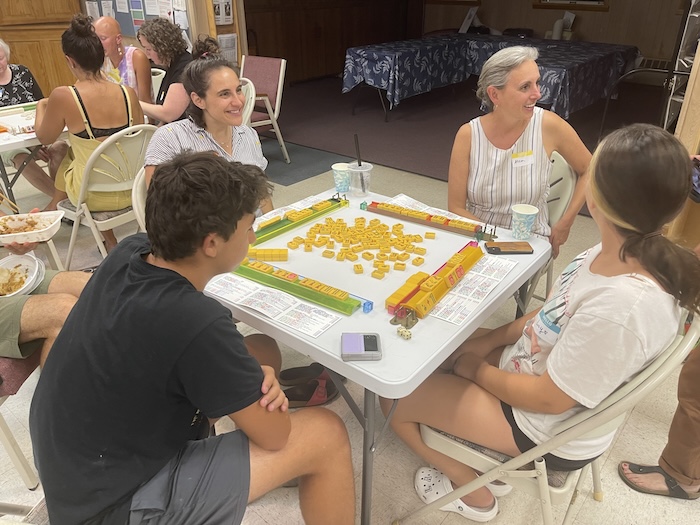
Mahjong, Anyone?
Nov 15, 2024Tap to summarizeA classic game thrives in the Highlands Remember mahjong? That game where Jewish grandmothers push thick ivory tiles etched with exotic characters around a card table? They put down a tile and say something like "one bam," "three crack" or "two dot." There's lots of schmoozing, maybe iced tea and onion dip. The big winner pockets two or three bucks. The game, which dates to mid-19th century China, is undergoing a national renaissance, including in Philipstown and Beacon. Plenty of bubbies still play, but a new generation has discovered the joy of using tiles to form "hands," similar to gin rummy. "It's not all luck, but it's not as intensely cerebral as chess," says Karen Sine, who lives in Beacon and plays at the Beacon Hebrew Alliance. "I like the sensory pleasure of it, the look and feel of the tiles, the colors, the shapes and the sound." The monthly event in the synagogue basement began early last year and draws as many as 16 people, enough for four games, including one for beginners. On a recent evening, one player brought fresh-baked mandel bread for noshing. Sine, who is not Jewish, learned mahjong as an undergraduate at Catholic University in Washington, D.C. After working on theater productions, the crew would head to a Chinese restaurant. "There were these elderly Chinese men off to the side playing mahjong," Sine recalls. "I didn't know what it was, but you could hear the clicking of the tiles." She learned to play but only returned to the game recently after her daughter in Phoenix sent her a set she found at a thrift store. "As soon as I saw those tiles, I wanted to play again," Sine says. The BHA mahjong night was organized by Jessica Dommu of Beacon and Jenny Kaplan of Cold Spring, soon after they met at the synagogue and learned they both love the game. Kaplan grew up playing mahjong at family Passovers in Palm Springs, California. "It's a bonding game," she says. The game is growing nationally, which Annelise Heinz, author of Mahjong: A Chinese Game and the Making of American Culture, attributes to retiring Baby Boomers. "Mahjong has always been a wonderful way to build community in a new place," she says. One of those retirees is Jack Weinstein, 76, a Philipstown resident who learned mahjong as a child at his grandparents' bungalow resort in the Catskills. Weinstein, a former accountant, returned to the game in 2019. During the pandemic, he was able to play online at RealMahJongg.com. "The site was a lifesaver," said his wife, Linda Weinstein, 75, who began teaching the game last year at the Butterfield Library in Cold Spring. The retired bookkeeper began playing 25 years ago. She has taught a dozen people to play at the library. One student is Ginette Voldman, who lives in Cold Spring and says she learned mahjong "for the social aspect, meeting new people." Heinz says movies like Crazy Rich Asians and The Joy Luck Club have helped popularize mahjong among young Asian Americans. Social media also plays a role; the Facebook group, Mah Jongg: That's It, has doubled in size to nearly 90,000 members in three years. Reporter's Notebook: Winning My First Round Heinz said the game's association with Jewish culture began in 1937 when Jewish women in New York City sought to standardize the rules of what is now called "American Mahjong" and formed the National Mah Jongg League, which publishes a card with the winning "hands" for that year. Synagogues still sell the cards to raise money. Synagogues such as the Beacon Hebrew Alliance are introducing the game to Gen Zers like Lucinda Arginsky, 12, of Beacon. "It's just an engaging game," she says. "I also like hanging out with other people."
Transcribe →