← HISTORY This Week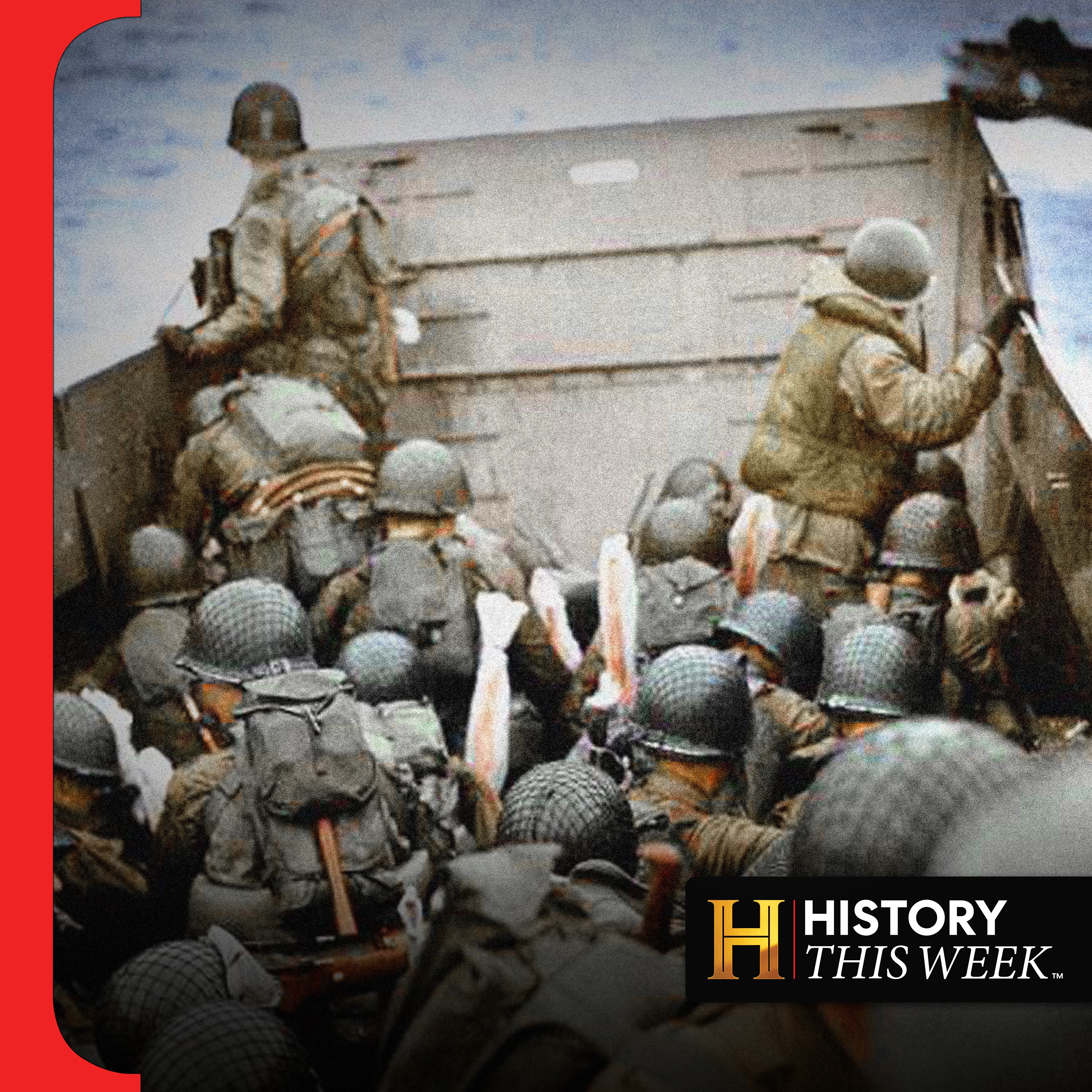
HISTORY This Week
How Higgins and His Boats Won the War
00:30:17
Meet the stubborn New Orleans businessman who bullied his way into the military establishment and changed the course of World War II.
Loading summary
Transcript112 lines
- [00:00]
Sally Helm
Hey everyone, it's Sally here. This week's episode is a deep dive into the boats that made D Day possible and into the life of their inventor. This story is also featured in History's Greatest Machines with Dolph Lundgren, a new History Channel TV series. Machines can rewrite history, and no one knows that better than action legend and chemical engineer graduate Dolph Lundgren. Join him as he uncovers the stories behind history's groundbreaking machines. Check out new episodes of History's Greatest Machines with Dolph Lundgren on the History channel, premiering on June 1, or stream the next day at history.com Carter's has your family covered for every summer first first steps, first swim lesson or first sleepover. Our clothes help kids and parents have their best summer ever. Thanks to comfy design and easy dressing details, generations of families have trusted our must haves for babies, toddlers and kids designed to shine season after season. Visit Carters.com to shop the latest styles or find a Carter's store near you.
- [01:08]
Bob's Discount Furniture Advertiser
When I'm looking for high quality furniture that doesn't break the bank, I don't have to settle for subpar styles because I can find everything I need at Bob's Discount Furniture. At Bob's, I can score everyday low prices on pieces that real customers love, like Consumer Reports recommended mattresses, real marble dining sets, and the best modular Bob's Sectional, which has over 1700 five star reviews. So stock up on five star style and visit Bob's Where America Shops for furniture.
- [01:35]
Dr. John Curatola
The History Channel Original Podcast
- [01:39]
Sally Helm
history this week, June 6th, 1944 I'm Sally Helm. It's three o' clock in the morning. The full moon reflects off the choppy sea. Soldiers begin to climb down the nets draped along the walls of their transport ships. They've been told to keep their guns and equipment loosely strapped to their bodies because if they slip and fall into the English Channel, they'll have to shed their gear or drown. These Allied soldiers are climbing down into smaller boats, boats specifically designed for amphibious assault. They're going to land these boats on the beaches of Normandy. This will be the largest amphibious assault in world history, and the soldiers know how dangerous it is. One officer told a group, look to the right of you and look to the left of you. There's only going to be one of you left after the first week in Normandy, only so many troops can land on the beach at once, so the majority of these boats move to an assembly area out in the water. They're in constant motion, spinning in giant circles. 1 1/2 boat lengths apart so that they can zoom off into action at a moment's notice. The craft themselves are very specific, perfectly designed for this type of assault. Technically they are called LCVPs, Landing Craft Vehicle Personnel. But you may know them as Higgins boats and the insides are incredibly bare bones. Think of a 36 foot long rectangular wooden box with a motor tucked in the back and a hinged metal door at the front. Up to 36 soldiers with all their equipment are crammed inside. Years later, when surviving soldiers are asked about what they remember in this purgatory phase of D day waiting to be deployed, they mention two smells. The first is diesel. Dozens of Higgins boats spinning in a circle creates a huge inescapable cloud of exhaust out on the water. Higgins boats are engineered to speed through any obstacle, pull up on the beach, drop their ramps, let the men off and reverse back into the water to load for the next wave. Fast. So relative to the size of the boats, the engines are big, hence lots of exhaust. And the other smell is vomit. The choppy waters, the spinning boats, the stench of diesel, the likelihood of death. The men get sick and they're stuck in these little spinning craft. One soldier from the US Army's 4th Division says, that guy Higgins ain't got nothing to be proud of inventing this God damned boat. But General Eisenhower will later disagree. He'll say the inventor of these boats is, quote, the man who won the war for us. Today, the story of Andrew Higgins. How does a small time New Orleans boat builder force his way into the military industrial complex? And what exactly is so special about these boxy little Higgins boats? Andrew Higgins was interested in boating from a very young age. This despite the fact that he grew up in Nebraska, a state not known for its bodies of water. But one day, at 12 years old, Andrew Higgins makes a chance discovery.
- [05:22]
Dr. John Curatola
He finds a wrecked sailboat on one of the few lakes that surround there.
- [05:27]
Sally Helm
That is Dr. John Curatola. He's a senior historian at the National World War II Museum in New Orleans. He says the young Andrew Higgins drags this boat back home and restores it himself. He names it Patience. Because he has to put in so
- [05:43]
Dr. John Curatola
much painstaking work and he floats it, but he finds it kind of not satisfying. It's not fast enough for him.
- [05:51]
Sally Helm
Even at 12, Higgins likes to go fast. That winter he builds himself a bobsled. But that is too slow for him too. So he returns to the idea of a boat. But now it's winter in Nebraska, so he decides to build a so called Ice sailing boat, one that can speed across the ice on blades that'll be much faster.
- [06:12]
Dr. John Curatola
He builds his own boat called the Annie O, which is named after his mother. But he doesn't necessarily think the process through because he builds this boat in the basement of his home. And then he realizes, I can't get the boat out of the basement.
- [06:26]
Sally Helm
Higgins waits for his mom to go shopping and makes his move.
- [06:31]
Dr. John Curatola
He removed a wall between two windows in his basement.
- [06:35]
Sally Helm
With some friends help, he demolishes part of the foundation, jacks his family home up on timbers that he finds at
- [06:42]
Dr. John Curatola
a junkyard, moves the boat out, and then rebuilds the wall. And as the lore goes, he did this before his mother returned home from the store.
- [06:52]
Sally Helm
The Annie O ends up hitting 60 miles an hour, sailing on the ice. As you can already tell, Andrew Higgins is highly confident and likes to take matters into his own hands. He's also a bit of a brawler. He gets kicked out of one school for fighting, starts at another, but eventually drops out. It's reportedly too slow for him, too. He joins the National Guard and eventually finds himself in New Orleans, where he starts a business, the Higgins Lumber and Export Company. Then his new job. It's going to require him to do something that he loves. Andrew Higgins is going to have to build a boat. He buys a tract of woods not far away from New Orleans on the water in Mississippi. That's where he's going to get his lumber, and he gets a good deal on it because it is almost impossible to access.
- [07:41]
Dr. John Curatola
You have to get the wood from the bayou in these swampy areas to the marketplace.
- [07:46]
Sally Helm
This, the swamp, and the river going to it contain all kinds of obstacles.
- [07:52]
Dr. John Curatola
You have cattails, you have water hyacinths, you have all kinds of flora and fauna that will impede the movement of the craft.
- [07:59]
Sally Helm
So Andrew Higgins gets to work.
- [08:02]
Dr. John Curatola
You want a craft that has a very low draft, meaning it doesn't sit very low in the water.
- [08:07]
Sally Helm
The more shallow the boat is, the better it can ride over obstacles like cattails and boulders. Higgins designs a shallow boat where the motor is held above the water rather than underneath it. That way it won't hit any bayou debris. He designs a sort of tunnel for it in the back of the hull, and it works. He keeps refining his design over the years, eventually adding a reinforced bow almost like a battering ram, a very robust
- [08:34]
Dr. John Curatola
nose on it that can stand, you know, running into logs or rocks or anything like that, and have a design that help push the plants and the obstacles that are on the surface. Away from the boat itself, this design
- [08:48]
Sally Helm
evolves into what Higgins humbly calls his wonder boat. It's working for him. And he soon realizes other people might need it, too, like big oil companies who are heading into the bayou to look for oil, or something called the Biological Survey Agency of the United States.
- [09:05]
Dr. John Curatola
When they go in there and they survey these lands, the Army Corps of Engineers, as they are building dams and levees, they need access to these areas.
- [09:14]
Sally Helm
Higgins starts developing some contacts within the federal government. He gets a contract with the Coast Guard.
- [09:19]
Dr. John Curatola
Prohibition was the rule of the day, and the Coast Guard's mission was to intercept bootleggers, or rum runners, who are bringing alcohol into the country.
- [09:29]
Sally Helm
Higgins sells them some of his boats for that job, but he doesn't stop there.
- [09:33]
Dr. John Curatola
Then, by the same toke, he goes to the bootleggers and the rum runners, and he tells them, hey, this is what the Coast Guard has as a vessel. I can build you one better. Then he goes back to the Coast Guard to say, hey, this is what the bootleggers are using. I can build you one better. So that tells you a lot about his business acumen, the way he thought.
- [09:57]
Sally Helm
Higgins is building a reputation as a colorful New Orleans character. He's known to drink, swear, and push until he gets what he wants. And soon, he sets his sights on his biggest customer yet, the Navy.
- [10:10]
Dr. John Curatola
He writes letters to the Navy Bureau of Construction and Repair, which basically design boats.
- [10:15]
Sally Helm
Higgins knows he's going to have a tough time competing with huge Northeastern shipbuilders with their lobbyists in Washington. But he's persistent, and by his own description, possibly obnoxious.
- [10:27]
Dr. John Curatola
And they write him a letter back, and they say, hey, it's a nice design, but we're not really interested in this.
- [10:34]
Sally Helm
Nevertheless, Higgins Industries has developed into a very healthy, successful business in New Orleans. But when it comes to his flagship model, the Wonderboat, something is still bothering Andrew Higgins. It is too slow. Remember, the motor is suspended up in the body of the Wonderboat to keep it away from swampy debris. That is kind of the whole point. But as a result, the propeller isn't only moving through water. A lot of air gets sucked in, too, which creates drag. So the question is, how do you stop air from getting into the propeller? One day, Higgins and his engineers are on the factory floor, and one of them makes an error, just happenstance on
- [11:18]
Dr. John Curatola
one of these vessels. And this mistake creates a V section
- [11:23]
Sally Helm
amidship, a V section. The hull accidentally has a downward bulge somewhere between the middle of the boat and the motor. It's a manufacturing defect. Higgins launches into a curse laden tirade at his employees. But he's also a tinkerer at heart and he says, okay, finish the boat anyway. See what happens.
- [11:46]
Dr. John Curatola
What it does is this mistake of building this particular vessel reduces the amount of drag that's going underneath the boat itself.
- [11:56]
Sally Helm
This lump in the hull. It actually pushes the air away before it gets to the motor. Less air, less drag, more speed. In fact, almost double the speed.
- [12:08]
Dr. John Curatola
It's faster, it's safer, it's more efficient in terms of its movement through the water and it's more maneuverable. So there's a whole host of things. This design really kind of revolutionizes this idea of shallow water design and the ability to navigate these kinds of areas.
- [12:26]
Sally Helm
Higgins calls this design, appropriately, the Eureka. Now he is still trying to land his white whale client, the US Navy, and he knows this boat is better than anything they have in this category. A quick, nimble craft that can float over any type of obstacle. It can even go partially onto the shore and then reverse back into the water. What Higgins doesn't know yet is, is that for the military, the Eureka is arriving right on time.
- [13:03]
Bob's Discount Furniture Advertiser
There's never been a better time to
- [13:05]
Sally Helm
get outside and experience the benefits of nature, discover nearby trails and explore the outdoors with alltrails. Download the free app today and find your outside what if everything you learned in history class was only half the story? I'm Dr. Harini Bhatt, host of Hidden History. Every Monday I go where history gets mysterious. Vanished civilizations, doomsday prophecies, paranormal phenomena and events that science still can't fully explain. On Hidden History, I treat these moments like open case files. Not myths, not superstition, just incomplete explanations waiting for a closer look. Listen to and follow Hidden History available now wherever you get your podcasts.
- [13:48]
Bob's Discount Furniture Advertiser
Finding the right furniture for my home can be hard, especially when I'm looking for trendy high quality pieces that won't break the bank. Luckily, at Bob's Discount Furniture I can shop the latest styles and customer favorites with tons of five star reviews. Like Bob's real marble Elm dining set which has over 600 five star reviews. The Copper Radiance mattress which over 400 Bob's customers say will give you five star sleep. The ultra comfy Phantom reclining sofa which boasts over a thousand five star reviews. And the customizable modular Bob sectional which not only costs just 250 per piece but has over 1700 five star reviews. So when you're ready to score five star style for room in your home at everyday low Prices. Listen to the smartest shoppers around and stop in or shop online at Bob's Discount Furniture, where America shops for furniture.
- [14:38]
Sally Helm
Behind the scenes, unbeknownst to the American public, one of the branches of the US Military has been having an identity crisis.
- [14:46]
Dr. John Curatola
There's a strange organization in Northern Virginia called the U.S. marine Corps.
- [14:50]
Sally Helm
In addition to being a historian, John Curatola himself is a Marine Corps veteran. He explains that after World War I, the Marines didn't really have an obvious purpose.
- [15:01]
Dr. John Curatola
The Marine Corps fought as a land army during the First World War. So why do I need a Marine Corps? What is unique about these guys?
- [15:08]
Sally Helm
If the army can fight on land and the Navy fights at sea, the Marines fight on.
- [15:15]
Dr. John Curatola
We don't know where they're looking for a role in a mission. And one of the things that the Marines latch onto during the interwar years is this idea of amphibious assault.
- [15:24]
Sally Helm
Amphibious assault. Attacking from the water and moving onto land. Famously, the Allied powers In World War I try this. Gallipoli in modern day Turkey. This assault is led by the young head of the Royal Navy, Winston Churchill.
- [15:40]
Dr. John Curatola
The Australians, the New Zealanders, and some French and some British troops try to do an amphibious assault. And it's a complete failure.
- [15:47]
Sally Helm
This defeat sticks with Churchill for the rest of his life. It's also a cautionary tale for militaries across the globe on how not to do an amphibious assault. But years later, the Marines reason that if they can figure it out, master this tactic, that can be the thing that justifies their existence. Meanwhile, Andrew Higgins is trying to market his new Eureka boat. He has his son Andrew Jr. Taking people out for demonstrations on Lake Pontchartrain. They're more like thrill rides. He has the Eureka jump over patches of floating logs, make hairpin 180 degree
- [16:29]
Dr. John Curatola
turns, and he actually will take his Eureka boat and he'll drive it ashore, and then he can put it in reverse and take it off the shore
- [16:38]
Sally Helm
at the same time. The Navy has been trying to develop boats on its own to give the Marines the kinds of craft they'll need for these amphibious assaults.
- [16:47]
Dr. John Curatola
The Navy designs its own boats, and of course they're going to want to go with their own design, but their
- [16:54]
Sally Helm
design, it just isn't very good. It's basically a modified fishing boat. It's slow, it's difficult to maneuver, the propellers would get stuck in the sand. And by coincidence, a Navy officer catches one of Higgins high flying demonstrations of the Eureka on Lake Pontchartrain. He makes his recommendation to leadership. Let's give this Higgins guy a shot. They offer him $5,200 to build a Navy specific prototype that is far less than the $12,500 that it costs him in parts and labor. But to Higgins, it is worth the loss to get his hat in the ring. Testing lasts for over a year. They actually do some exercises where they try out the Eureka against some Navy designed boats. And it is clearly better. But the bureaucracy still doesn't budge.
- [17:45]
Dr. John Curatola
We're going to go with a Navy design as opposed to some guy, we don't even know who he is. And they tell him that, you know, you're cute, you know, but, you know, kind of go away. We know what we're doing.
- [17:56]
Sally Helm
But the Marines see the promise here. They know that the Eureka is the right option for amphibious assault. After all, it can drive right up on land and then bolt back right off. So they apply some pressure. Higgins, unsurprisingly, has also never stopped pushing his boat. And the Navy finally concedes on November 18, 1940, a little over a year before Pearl harbor. They place their order. They want 335 Eureka boats to start. And soon after, minesweepers, tank carriers, patrol boats, rocket launching boats. Higgins needs to move fast. He builds eight separate factories, all in New Orleans. The one in City park becomes his main hub.
- [18:45]
Dr. John Curatola
That was the largest boat factory in
- [18:47]
Sally Helm
the world, and he's going to need it because by late 1941, America is at war and the Navy keeps ordering Higgins boats. By the summer of 1942, Higgins is employing 6,000 people. And he is one of very few business owners in New Orleans who is adhering strictly to a recent executive order from President Roosevelt that wartime industry needs to be integrated.
- [19:14]
Dr. John Curatola
He hires African Americans, and they're on those production lines with their white counterparts. And that is something here in the south is kind of unheard of.
- [19:24]
Sally Helm
It's actually one of the first racially integrated workforces in New Orleans history. And Higgins is totally on board. He is a huge fan of FDRs.
- [19:34]
Dr. John Curatola
He also starts to employ women, starts schooling ladies to work in the factories themselves and on the production lines.
- [19:41]
Sally Helm
The operation becomes so huge that Higgins builds employee housing, which he simply calls our town.
- [19:48]
Dr. John Curatola
You see him looking out for them outside of their employment by giving them decent housing at a time when there just wasn't a lot of decent housing around. An average pay is like $58 per week.
- [20:00]
Sally Helm
Higgins reaches near legendary status in New Orleans. He becomes the city's largest employer by far. And his hiring practices help lay the groundwork for future civil rights gains. One of the core arguments of segregation was that black people should be paid less because their labor was inherently less valuable. But when large numbers of black and white workers are working together, it is much harder to maintain that lie.
- [20:25]
Dr. John Curatola
Higgins is a microcosm of this larger progressive movement. Workers saw what happened during the war, and so there's a lasting effect.
- [20:34]
Sally Helm
In late September 1942, Andrew Higgins gets a chance to meet President Franklin Delano Roosevelt himself. FDR decides to come visit the factory. Higgins knows this is a big opportunity. This is how business gets done in New Orleans face to face.
- [20:54]
Dr. John Curatola
He's a character, and he likes to deal with people on a personal level. You see him playing in this political realm, and that's not strange for New Orleans. You know, political patronage, who, you know, able to get good deals on, say, a leasing contract or tax breaks or whatever the case may be. That is still part and parcel of politics at the time.
- [21:15]
Sally Helm
FDR's train pulls right up to the factory entrance. Higgins nephew recalled seeing Roosevelt use crutches to get into a waiting convertible. The factory door had been widened by three feet the night before, so his car would be able to drive right down the factory floor. On their tour, Higgins talks the President's ear off. He explains every step of the production process while workers dressed in all white stare in awe at the President as his motorcade slowly rolls past. At the end, Roosevelt is greeted by the Higgins Company band.
- [21:49]
Dr. John Curatola
Here's the greatest man in the world is how he introduces the President. And of course, you know, they all applause. And then after that, he goes, let's impress the President. Show him how fast we can get back to work. And they whoop. They scrattle back, you know, to their production line.
- [22:05]
Sally Helm
As FDR departs, he says to Higgins, you're the only man I've ever met who has done all the talking. Higgins takes it as a compliment. And he is also right that the FaceTime seems to help his business. Shortly after FDR leaves, he gets a new order, a little strange for 1200 wooden cargo airplanes. Production only continues to grow from there. Higgins workforce swells to over 20,000 people across his factories in New Orleans.
- [22:35]
Dr. John Curatola
In September 1943, the Navy has 14,000 vessels. Of that, 13,000 are Higgins boats.
- [22:43]
Sally Helm
That includes all boats, not just the Eureka model. And it doesn't include battleships or aircraft carriers. But still, the volume is enormous. Higgins can't produce them fast enough. And the Eureka model, now just called the Higgins boat, has become indispensable.
- [23:00]
Dr. John Curatola
It is that vital link. Without those, you don't have that efficient movement of men and material from ship to shore.
- [23:08]
Sally Helm
These boats are crucial and vulnerable. When the US invades North Africa, they lose 40% of all their landing craft. They also suffer losses later invading Italy. And the loss of these boats has leaders anxious.
- [23:24]
Dr. John Curatola
Eisenhower says, if I die, bury me in the coffin that looks like a landing craft because the lack of them is worrying me to death. Unquote.
- [23:33]
Sally Helm
Moving into 1944, Higgins Plants are running around the clock, pumping out an estimated 54 boats a day. He's at max capacity, and everyone, including Andrew Higgins, knows that a larger Allied invasion of the European mainland is somewhere on the horizon. The only question is when?
- [23:59]
Dr. John Curatola
When.
- [23:59]
Bob's Discount Furniture Advertiser
I'm looking for high quality furniture that doesn't break the bank. I don't have to settle for subpar styles because I can find everything I need at Bob's Discount Furniture. At Bob's, I can score everyday low prices on pieces that real customers love, like Consumer Reports recommended mattresses, real marble dining sets, and the best selling modular Bob's Sectional, which has over 1700 five star reviews. So stock up on five star style and visit Bob's where America shops for furniture. If you're the proud parent of a puppy or kitten, you know you can't pet proof your entire life. There simply isn't a sock drawer high enough or a couch cover thick enough. But you can pet proof your wallet with Lemonade Pet insurance. Whether it's an unexpected accident or a routine checkup, Lemonade can cover up to 90% of the bill. Plus they can handle claims in as little as two seconds. So before you turn into a complete helicopter pet parent, get a'@lemonade.com pet what is that?
- [24:55]
Dr. John Curatola
Oh yeah, it's a World cup holder.
- [24:57]
Bob's Discount Furniture Advertiser
Like the soccer tournament World cup holder
- [24:59]
Dr. John Curatola
for the world fits every car, holds every cup.
- [25:02]
Bob's Discount Furniture Advertiser
It has a Carvana logo.
- [25:04]
Dr. John Curatola
Carvana made it. They buy and sell cars.
- [25:06]
Sally Helm
So they made a car cup holder. So, got any good cups lately? Used to.
- [25:12]
Dr. John Curatola
I just couldn't figure out where in
- [25:13]
Bob's Discount Furniture Advertiser
the world to put them.
- [25:14]
Dr. John Curatola
The World Cup Holder brought to you by Carvana. Proud sponsors of the World cup holder, sign up today to win yours@cup-holder2026.com.
- [25:21]
Sally Helm
Not authorized or endorsed by FIFA. Not a real product for parody and
- [25:23]
Dr. John Curatola
fair use purposes only.
- [25:25]
Sally Helm
Back in 1940, the last British soldiers were driven off the European continent. Germany took France. The Allied troops evacuated at Dunkirk. And in the four years since, they've been running through their options, looking at plans for an invasion of France. Winston Churchill wants to move into France from the south through Italy. The Allies also consider invading at an established French port, which would have been the traditional tactic, but they'd already tried this in 1942, attacking the French port at Dieppe. The Germans wipe them out, a more than 50% casualty rate. Still, Hitler thinks they'll try again.
- [26:08]
Dr. John Curatola
The Germans think the Allies are going to come at the Port de Calais at the shortest part in the English Channel.
- [26:14]
Sally Helm
But the Americans are pushing for something else. An amphibious assault, landing not in a city or a port, but on a beach. In part because that has become their specialty, the Marines have achieved their dream. They've mastered the amphibious assault with the help of Andrew Higgins and his boats.
- [26:36]
Dr. John Curatola
Unless you have these vessels, you don't have North Africa, Sicily, Salerno, Anzio, and all those other amphibious operations that occur both in the Atlantic and in the Pacific.
- [26:47]
Sally Helm
And now the rest of the US military is looking to the Marines. For this invasion, codenamed Operation Overlord. The Allies need 1,000 Higgins boats. His classic 36ft long, flat bottomed, mostly made of wood, with a steel drop down ramp at the front. What started as the wonderboat, then the Eureka. Now the Higgins boat is the most produced naval vessel in the war. Higgins boats are flying out of his factories in New Orleans. We asked John Curatola, given the pace of production, does Higgins suspect D Day is coming?
- [27:27]
Dr. John Curatola
He probably doesn't. All he does is get the requirement. I need X amount of boats.
- [27:33]
Sally Helm
June 6, 1944, D Day. Some of the Higgins boats begin to land on the beaches of Normandy. The rest are churning in the water miles out, rotating in circles.
- [27:46]
Dr. John Curatola
You have to go to a holding area and you circle around until your wave is ready to be flown formed and go inland.
- [27:55]
Sally Helm
Kurotola has poured over countless hours of oral histories stored at the National World War II Museum in New Orleans where he works.
- [28:02]
Dr. John Curatola
These guys are on these boats literally for hours before they go ashore. You have sea spray coming over the gunnels, so most of these men are cold, soaked. The seas is, you know, pretty rough that morning. And so a lot of these guys are bailing water out with their helmets, you know, and so you're in this horrible environment and they still gotta go and land. The world's gonna even get worse once they hit the beach.
- [28:33]
Sally Helm
When a given Higgins boat is called into action, it spins out of the circle and heads towards the shore. The boat flies onto the sandbar and drops the ramp down, except exactly as it's designed to do. It's the scene so many Americans already know, famously depicted in Saving Private Ryan. It's a bloodbath. But the Higgins boats perform their job. When the troops are off, the pilot pulls the boat back from the shore and heads back out to sea to get the next wave. The casualties are high. Over 10 Allied soldiers killed, captured or wounded. But the number that land on wave after wave of Higgins boats is staggering. 160,000 soldiers on June 6th alone.
- [29:23]
Dr. John Curatola
One thing that the Germans really have not understood is American production capacity. So you talk to some of those German soldiers, you know that that survived, and they talk about just seeing ship after ship out there and even those pilots flying over it. Or the sailors talk about this vast armada, 7,000 ships out there and landing craft. It had to be awe inspiring to see that much naval presence in the Channel.
- [29:56]
Sally Helm
The D Day invasion is the first step on the Allied march towards Berlin. Months later, in his 1944 Thanksgiving Day address, General Eisenhower says, Let us thank God for Higgins Industries, Management and Labor, which has given us the landing boats with which to conduct our campaign. Andrew Higgins emerges from D Day as a national celebrity. He becomes one of Franklin Roosevelt's biggest home front boosters. And then Truman after him, hosting bond drives, helping on the campaign trail. By the end of the war, he'll have built exactly 20,094 boats, which if you think about where he started annoying the Navy into considering his designs, it's pretty stunning.
- [30:43]
Dr. John Curatola
If it's not for his individual initiative and individual, I'll say, stubbornness and pigheadedness, which in this case is a good attribute, not a bad attribute. If he would take no for an answer, you wouldn't have these vessels to the Second World War.
- [30:58]
Sally Helm
Not everyone treats him as a hero. A year after the end of the war, in 1946, the Department of Justice opens an investigation into Hagens as part of a broad accounting audit into possible wartime profiteering.
- [31:11]
Dr. John Curatola
He goes, this is all prejudicial against me because he feels like he's being singled out probably because he's not part of the establishment. He's not a huge corporation. You know, he's not Consolidated Aircraft, he's not Boeing. He's a small guy down there making these boats. And so, you know, he's probably an easier target than most.
- [31:30]
Sally Helm
A grand jury exonerates him a year later. But Higgins claims that the investigation permanently damages his reputation. His company has a hard time finding its peacetime footing. They do manage to secure some military contracts for the Korean War. And it's during that war, in 1952, that Higgins dies from a stomach ailment in New Orleans. At the age of 65. Now, Higgins Inc. Hasn't operated in New Orleans for almost seven decades, and a lot of New Orleanians don't know the name Andrew Higgins.
- [32:04]
Dr. John Curatola
For the younger generation, the Second World War might as well be the Crusades or ancient Rome.
- [32:11]
Sally Helm
If you know where to look. There are placards throughout the city where Higgins factories once stood, where thousands of New Orleanians of all demographics were employed. But perhaps his most tangible legacy is New Orleans national World War II museum where curatolla works when historian Stephen Ambrose first got the idea to build the museum, he said it would be, quote, to honor Andy Higgins and to preserve the story of the great Allied invasion. The museum now sits at 525 Andrew Higgins Drive. But he is not as prominent in national memory as other figures from that era. Higgins didn't lead a charge on the battlefield. He didn't master a strategic operation. But what Higgins story does represent, Curatola says, is the power of tenacity. Who could have predicted that the kid building a boat in his mom's basement would eventually help defeat Nazi Germany?
- [33:07]
Dr. John Curatola
Higgins is a hard drinking, hard working, problem solving, hard driving individual who won't take no for an answer to to get to his objectives and to find solutions to very difficult problems.
- [33:22]
Sally Helm
That, he says, is the point of the museum.
- [33:26]
Dr. John Curatola
We're here to remind our fellow Americans what we can actually do when we decide to do something.
- [33:46]
Sally Helm
Thanks for listening to History this Week, a Back Pocket Studios production in partnership with the History Channel. To stay updated on all things history this week, sign up@historythisweekpodcast.com and if you have any thoughts or questions, send us an email@historythisweekistory.com Special thanks to our guest, Dr. John Curatola. Samuel Zemuri Stone Zone Senior Historian at the National World War II Museum in New Orleans, Louisiana. His book is Armies how the Development of Amphibious Operations in Europe Helped win World War II. You can find links to that and all the other books. We used to put this episode together at our website, historythisweek.com this episode was produced by Ben Dickstein and by me, Sally Helm. It was sound designed by Dan Rosado for Back Pocket Studios. Our executive producer is Ben Dickstein from the History Channel. Our executive producers are Eli Lehrer and Liv Fiddler. Don't forget to follow rate and review History this week wherever you get your podcasts and we'll see you next week.