Loading summary
Transcript125 lines
- [00:00]
Sally Helm
History this week operates as its own small business. And with that small business comes endless unpredictability, economic volatility, new technologies, political upheaval. It's a lot to worry about and sometimes feels out of our control. But the only real way forward is to keep growing. History this week and the best way to grow is with Constant Contact. Constant Contact's award winning marketing platform is here to make marketing way easier and way more effective for small businesses like yours. The best part? You don't need to know anything about marketing. With their all in one platform, you can create and manage attention grabbing campaigns in just a few clicks. Email, text, social media, events, landing pages, you name it. It's all in one place. No more juggling dozens of different tools. You also get automated sending, real time reporting and tools that actually help drive sales. So you're not just marketing your business, you're growing it. Get a free 30 day trial when you go to constant contact.com try constant contact free for 30 days at constant contact.com constantcontact.com buying a car in Carvana was so easy.
- [01:11]
Unnamed Speaker
I was able to finance it through them. I just.
- [01:12]
Brad Ricka
Whoa, wait, you mean finance? Yeah, finance.
- [01:15]
Unnamed Speaker
Got pre qualified for a Carvana auto loan, entered my terms and shot from thousands of great car options all within my budget.
- [01:21]
Brad Ricka
That's cool. But financing through Carvana was so easy.
- [01:24]
Unnamed Speaker
Financed, done. And I get to pick up my car from their Carvana vending machine tomorrow.
- [01:28]
Brad Ricka
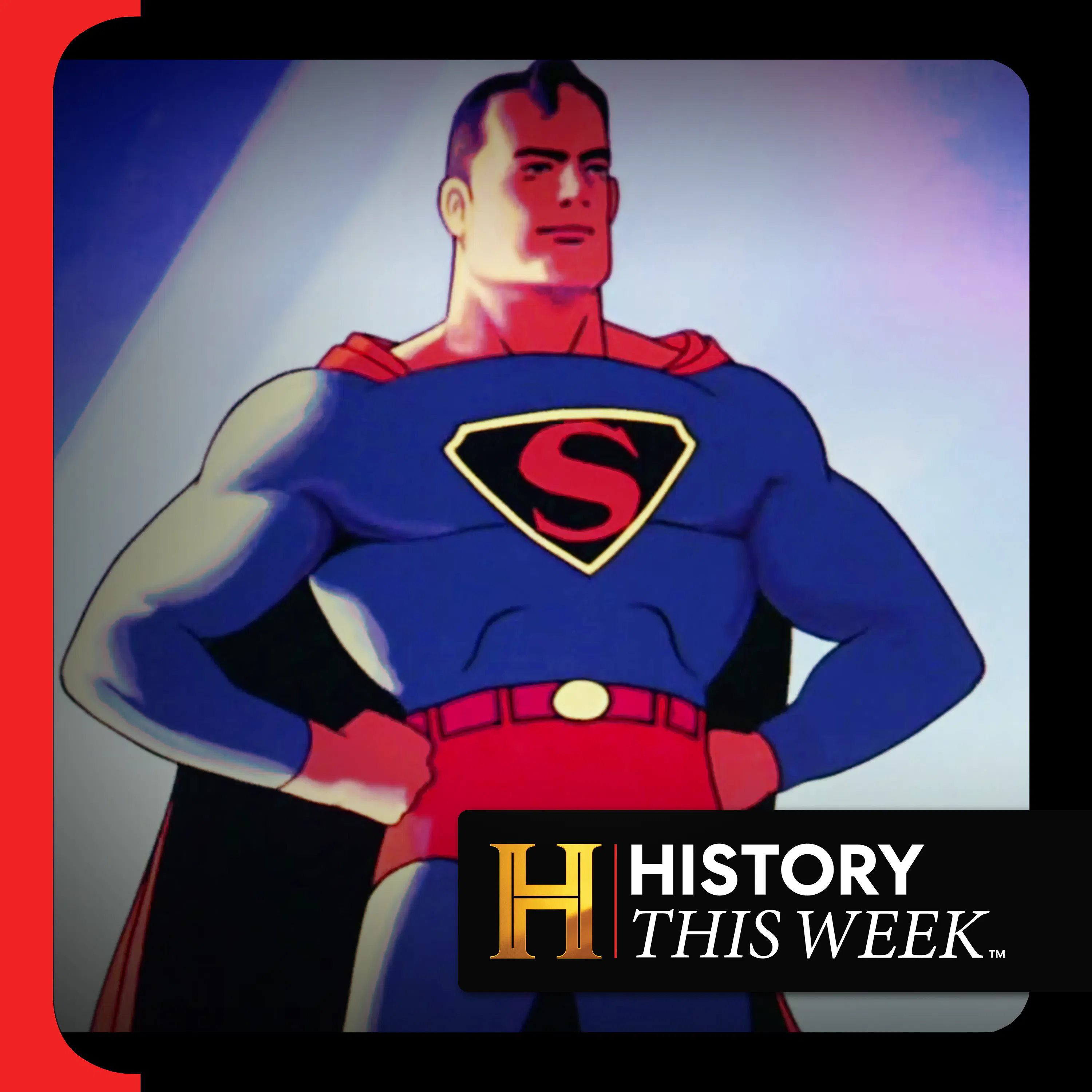
Financing. Right? That's what they said. You can spend time trying to pronounce financing or you can actually finance and buy your car. Today on Carvana financing, subject to credit approval. Additional terms and conditions may apply. The History Channel Original Podcast history this week, July 7, 1938. I'm Sally Helm, Washington, D.C. inside a tall apartment building with big glass windows, two men are deep in conversation. Something is up. The first is a slick lobbyist. Black bowler hat, burgundy suit, a tidy mustache. This is Alex Greer. He's talking to U.S. senator Barrows. More than talking, really bribing. Greer wants the Senator to support a bill, one that will lead the US to war with Europe. And Senator Barrows promises the bill will pass and make them both very, very rich. And then a man appears. He cuts a striking figure, dark hair, bulging muscles. And he's not dressed for Washington D.C. in fact, he is wearing tights and a cape and a skin tight shirt emblazoned with a giant S. He demands to know who Greer is working for. When Greer won't say, Superman grabs him by the foot and whisks him out the window and into the air. All that was in the first ever installment of the story of superman, published earlier in 1938, and now in July 1938. The new installment is here. This is the Superman comic that kids are picking up at newsstands and reading by flashlight in bed or while lounging at the community pool. It picks up right where the first installment left off, With Greer and superman flying through the air. They hit the sidewalk so hard it breaks into pieces, and Greer gives in. His boss is the scheming munitions manufacturer Emil Norvell, who's hell bent on starting a war. Superman has the information he needs. He leaves Greer behind, flies to the top of the Washington monument, and goes in search of Norville. Superman has only had these two appearances in print, but it's already clear bad guys aren't safe when he's around. He is quickly becoming a household name today. The creation of Superman. How did two friends in Cleveland. Cleveland, Ohio, Invent an icon? And how did he slip from their grasp? October 1929. The stock market has just crashed. The whole country is on edge. This is the start of the great depression. But Jerry Siegel has other things on his mind. It's his first year at Glenville high school, and he urgently, desperately wants to find his place. Siegel is short, has a lot of energy. He's the youngest of six kids from a working class Jewish family.
- [05:24]
Unnamed Speaker
I say this with all the respect and power that it deserves. But Jerry was a nerd. That's what he was. And I think that was his power, too.
- [05:35]
Brad Ricka
That's Brad ricka, author of a book about the invention of superman. He told us Jerry Siegel has no interest in sports. He has a major but largely unreciprocated interest in girls. And more than anything, Jerry, like so many of us, just wants to be seen and understood. Also, maybe if he's lucky, he wants to be a little famous. Glenville high could be his big break, if he plays his cards right.
- [06:07]
Unnamed Speaker
For so many kids in the 30s, high school was it. You know, you weren't going to college. So these big high schools kind of became these mini colleges. They had all these clubs and people dressed up and wore ties and dresses.
- [06:20]
Brad Ricka
Glenville high is one of those mini colleges. It has dozens of clubs, One of which in particular catches Jerry Siegel's eye.
- [06:29]
Unnamed Speaker
He really liked the newspaper, which was the Glenville torch.
- [06:35]
Brad Ricka
The torch comes out every week, and Jerry reads every issue. He wants to be a part of it. And one day, he gets his chance. The torch is holding their annual literary contest. The winning story will be printed in the paper. For Siegel, this is perfect, because more than anything in the world, maybe even more than girls, he loves stories.
- [07:02]
Unnamed Speaker
Not even the nice stories that you would read in school, but science fiction stories that you would buy in these magazines that he was probably too young to be reading anyway.
- [07:13]
Brad Ricka
Jerry submits a story to the Torch, a pulpy sci fi tale. And then every day for weeks, he opens the paper with bated breath, waiting for the result. On May 29, 1930, there it is. His name, his story in black and white. He hadn't actually won the contest, but the Torch liked his story enough to print it anyways. This is the beginning of Siegel's extremely prolific career at the Glenville Torch. He writes all sorts of things. Science fiction, detective stories, humor, even the occasional poem for a girl.
- [07:54]
Unnamed Speaker
He just took off. And some of it's really student writing, I think is the nice way to put it. But it's really great too, because you can see him just finding his voice.
- [08:06]
Brad Ricka
Writing becomes Siegel's obsession to the extent that his grades suffer. His teachers worry, but he doesn't care. He's found his calling. And then one day at school, he finds his creative partner. He finds Joe Shuster. Like Jerry Siegel, Joe Shuster is short, Jewish, working class, but most importantly, he is also a nerd.
- [08:36]
Unnamed Speaker
Joe really liked science fiction, and they became friends.
- [08:40]
Brad Ricka
No one else Siegel knew was into the weird science fiction stories that he was. Nerddom at this point was still rare, but now here was Shuster at his high school. It was like a miracle for all they have in common. Shuster is also different from Siegel. He's shy, almost painfully so, self conscious, obsessed with powerlifting and trying to bulk up.
- [09:04]
Unnamed Speaker
And so he would send away for these physical fitness courses and would drink raw eggs and like work out all the time, but it made no difference.
- [09:14]
Brad Ricka
He also isn't into writing. What Joe Shuster likes is drawing.
- [09:21]
Unnamed Speaker
He loved cartoons, and he drew on everything he could find.
- [09:25]
Brad Ricka
He's good, everyone thinks.
- [09:27]
Unnamed Speaker
So he entered cartoon contest, and it went on the front page of the Torch.
- [09:32]
Brad Ricka
And Siegel sees an opportunity.
- [09:35]
Unnamed Speaker
Here's this friend of mine who's drawing and it's really good and people like it. Maybe we should collaborate.
- [09:44]
Brad Ricka
They start with short stories, genre fiction with eye popping illustrations. First for the Torch, then as submissions for the science fiction and detective magazines that they're both into. They're always rejected, which is frustrating, but they love the work. In 1932, when Jerry is 17, tragedy strikes the Siegel family. One evening in June Jerry's father is ending his day at work.
- [10:16]
Unnamed Speaker
He worked in a secondhand clothing store and closing up. One night, two or three men walk in and they try and steal a suit of clothes.
- [10:25]
Brad Ricka
It's raining, storming, really. And Jerry's father is frightened.
- [10:30]
Unnamed Speaker
He thinks there might be a gun.
- [10:32]
Brad Ricka
Still, he tries to stop them, but.
- [10:34]
Unnamed Speaker
He can't because he falls over dead of a heart attack.
- [10:41]
Brad Ricka
Jerry Siegel doesn't talk much about his father's death to Joe Shuster or anyone else. Instead, he writes and writes and writes. His mother hears his typewriter clacking late in the into the night. Siegel's passion is hardening into real ambition. He's now the last man in his household. He wants to become a serious professional. He just needs a great idea. And then one summer night, he has one. The story of Superman's creation is legend, myth, really. Jerry Siegel always tells it like it's a hot night and he can't sleep. He's tossing and turning in his bed. And then he has an epiphany.
- [11:38]
Unnamed Speaker
There's Superman.
- [11:39]
Brad Ricka
All of a sudden, Superman appears to him as if in a vision. He writes all night, and at dawn he runs to Joe's house. Joe opens the door, bleary eyed. Jerry is so excited he can barely get the words out. But when he finally does, Joe gets it. He starts drawing. Right there on a paper tacked to a breadboard in his mother's kitchen, Superman is born. Maybe it really happened exactly like this. Or maybe it didn't. We do know that Siegel and Shuster start refining the story about of this super strong hero who can run fast and lift things and get bad guys, but who lives life as if he's a normal person. The journalist Clark Kent. They draw elements from their environment. Tights from the Powerlifters. Shuster loved. Super speed from Cleveland legend Jesse Owens. Hair seemingly plucked from the head of a local football hero. And then, of course, there's the death of Jerry's dad. Woven into the story. Superman gives Jerry the chance to change the ending. In this world, if the bad guys show up at the secondhand store on a stormy night, they won't get away with it. Superman will be there.
- [12:59]
Unnamed Speaker
This was not a story to be made just for money, just to be famous, just to impress girls. This was autobiography. And if it's autobiography, if you're trying to make a statement about the world through this medium, then it's art.
- [13:16]
Brad Ricka
Siegel and Shuster know that they have something here, so they send it out to all the magazines they love and they're rejected over and over again. Something is missing. They need a girl, a love interest. They need Lois Lane. And very soon they'll meet her in real life. History this Week is now in its sixth season. Kind of crazy and we love bringing you these stories. All of our work is supported by the ads you hear on the show. But if you don't want to hear those ads, we're now introducing history this week plus, available exclusively on Apple Podcasts for just $2.99 per month. You'll get all of our new episodes without any of the ads, and we'll be adding ad free versions of our older episodes too. So subscribe now and get your first week free. History this Week plus exclusively on Apple Podcasts.
- [14:22]
Unnamed Speaker
I've never felt like this before. It's like you just get me. I feel like my true self with you. Does that sound crazy? And it doesn't hurt that you're gorgeous. Okay, that's it. I'm taking you home with me. I mean, you can't find shoes this good just anywhere. Find a shoe for every you from brands you love like Birkenstock, Nike, Adidas and more at your DSW store or.
- [14:50]
Ben Stiller
Dsw.Com hey, I'm Ben Stiller. And I'm Adam Scott and we host a podcast called the Severance Podcast where we used to break down every episode of the TV show Severance.
- [15:01]
Sally Helm
Severance isn't back just yet, but the podcast is.
- [15:04]
Ben Stiller
Each week we'll discuss the movies, TV shows, and ideas that influence the making of Severance.
- [15:09]
Sally Helm
We're going to talk to the incredible.
- [15:11]
Ben Stiller
Artists who inspire us to do what we do. The Severance podcast returns Thursday, June 26th. Follow and listen everywhere you get your podcasts.
- [15:25]
Unnamed Speaker
Out here, we feel things the sore calves that lead to epic views, the cool waterfall mist during a hot hike, and the breeze that hits just right at the summit. But hey, don't just listen to us. Experience it for yourself. Alltrails makes it easy to discover the best of the outdoors. With more than 450,000 trails around the world, points of interest along the trail, and offline maps for always on navigation. Download the free app today and find your next outdoor adventure.
- [15:54]
Brad Ricka
Across town from Joe and Jerry on the west side of Cleveland, there lives a girl named Yolan Kovach. Her family life isn't great, and like Jerry and Jo, she's ambitious.
- [16:06]
Unnamed Speaker
She really wants to get out of Cleveland. She really wants to make something of herself.
- [16:11]
Brad Ricka
So Kovach makes a plan.
- [16:13]
Unnamed Speaker
She puts an ad in the Plain Dealer to be a Model. And she puts it in for one day.
- [16:21]
Brad Ricka
In that one day, she gets a lot of responses. Requests for dates, a few marriage proposals, some truly filthy letters. But one note stands out. It's from a Mr. Schuster asking her to model for his drawings. Kovach likes cartoons. Mr. Schuster seems nice, and Kovach has the rashness of a teenager. So a few weeks later, she finds herself across town knocking at Mr. Schuster's front door.
- [16:52]
Unnamed Speaker
And she was freezing cold, and she's all bundled up and she's totally thinking, I should not be here. And Joe answers the door and he's this kid, and she's like, can I talk to Joe Shuster?
- [17:03]
Brad Ricka
Jo pauses for a moment, blushing, and.
- [17:06]
Unnamed Speaker
He'S like, I am Joe Shuster. And she knew it was going to be fine.
- [17:12]
Brad Ricka
Shuster draws Kovacs for hours under his mother's supervision. And when he's done, there she is, Lois Lane.
- [17:22]
Unnamed Speaker
She shows up in all the comics and looks exactly like those first drawings.
- [17:26]
Brad Ricka
Kovacs and Schuster actually end up dating for a while. But pretty soon, she does what she's always set out to do. She leaves Cleveland. She becomes a model in New York and steps out of Joe and Jerry's life for the moment, at least. In 1935, after years of submissions and rejections, 20 year old Siegel and Shuster finally get their big break. They're actually hired to write comics. It's not Superman, and they aren't paid much. But it's finally happened. They are officially comic book professionals.
- [18:08]
Unnamed Speaker
They thought they were the big time. You know, they were getting checks and, hey, Ma, you know, look, I'm a comics artist now.
- [18:15]
Brad Ricka
But even as Siegel and Shuster settle into their grown up job, they never give up on Superman. They submit him to newspapers and magazines for seven years. And over and over, they're rejected rejection.
- [18:31]
Unnamed Speaker
Letters that are so bad, they're like, this art is immature. Have you considered being a plumber? But they don't change anything because they know it's good.
- [18:42]
Brad Ricka
And then one Monday in January, they get a letter. There's been a shakeup behind the scenes at the company they work for, that company called National. It wants to publish Superman. This is another part of the story that's steeped in myth and legend.
- [19:03]
Unnamed Speaker
So there's like so many stories about how it gets discovered, and the reality is, we don't know why.
- [19:10]
Brad Ricka
Some say it was luck that Superman just finally gets noticed in the slush pile. Brad Ricka thinks it was a calculated play by that company, National. It had just lost the rights to the Lone Ranger. Maybe you know him, a fictional masked ranger who caught outlaws in the Wild West.
- [19:31]
Unnamed Speaker
He was what we would call today a transmedia property. You could make money on the Lone Ranger in radio, in magazines, in short stories, books, you name it.
- [19:44]
Brad Ricka
They were looking for a replacement, something that could be bigger than comics, and they saw that in Superman. But Siegel and Shuster, they're not thinking about franchising. They're just excited. This is the moment they've been waiting for for seven years. And when the contract arrives from national, they sign it just like that. And then they realize they've made a big mistake. Siegel and Shuster's contract with national is now infamous.
- [20:19]
Unnamed Speaker
They were paid $10 a page for 130 bucks.
- [20:23]
Brad Ricka
Not only that, the contract includes this.
- [20:27]
Unnamed Speaker
This is the non legal version. But you will relinquish the rights. You walk away and you own nothing.
- [20:35]
Brad Ricka
National owns Superman, not Jerry and Joe.
- [20:40]
Unnamed Speaker
So the big question is, did they know that was going to happen? I think they didn't know. Which makes it in some ways kind of more difficult to digest.
- [20:50]
Brad Ricka
What we know for sure is that within weeks of Superman's publication, Siegel and Shuster try to get the rights back, but it's too late.
- [20:59]
Unnamed Speaker
It was a contract. And a contract is a contract is a contract.
- [21:04]
Brad Ricka
After almost a decade, Superman is finally flying out into the world. But he's no longer Siegel and Shuster's. He belongs to National. The first issue of Superman comes out in Action Comics 1 on April 18, 1938.
- [21:23]
Unnamed Speaker
And there's other stories in there about, like, cowboys and you name it, but there's only one superhero, and Superman's on.
- [21:31]
Brad Ricka
The COVID That cover is iconic. Shuster draws Superman, lifting up a mangled green card. All around him are grown men running away, terrified. When the comic hits the stands, it's a sensation, a runaway hit. Nobody has ever seen a superhero in a cape and tights before. And kids buy it in droves. So national doubles down. They want as much Superman as Siegel and Shuster can give them. Siegel and Shuster are still furious with the company. But even though they sold the rights for a pittance, they are making decent money to write and draw new issues of the comic. And they do love working on Superman, seeing their childhood dream fulfilled. So they roll up their sleeves and crank out issue after issue. They get office space, they hire more artists.
- [22:25]
Unnamed Speaker
They had their little workshop going, and it seems like really awesome. They bought new houses and they moved to newer suburbs. Jerry got married, Joe bought a car. And they were what I Call Cleveland famous where? They were famous in Cleveland, but nowhere else.
- [22:43]
Brad Ricka
Siegel and Shuster are thriving. But then one December morning, thousands of miles away, Japanese fighter planes appear in the skies over Oahu. Bombs start dropping. Japan attacks Pearl Harbor. Thousands die, and everything changes.
- [23:05]
Unnamed Speaker
Pearl harbor changes everything for everyone living in the country. So, of course, it changes their lives. And it definitely changes Superman's life, too.
- [23:14]
Brad Ricka
Siegel and Shuster sign up to enlist. Joe is rejected from the army. Weak eyes. But Jerry is drafted, sent to Honolulu, and Superman.
- [23:25]
Unnamed Speaker
Superman continues. But it's not really continuing with them as much.
- [23:31]
Brad Ricka
Superman now has a life of his own, a team of writers and illustrators who can conjure him up without Siegel and Shuster. The further Jerry gets from Superman, the more it hurts. And then he sees something that really, really gets him. A new comic from National. Superboy.
- [23:52]
Unnamed Speaker
It was the adventures of Superman as a boy. He had pitched it years ago.
- [23:57]
Brad Ricka
National had rejected it, but now they're.
- [24:00]
Unnamed Speaker
Putting it out, and they didn't ask him. They didn't ask his permission.
- [24:05]
Brad Ricka
Even worse, the artist is Joe Shuster. He'd gone ahead and done it without telling Jerry, and Jerry feels betrayed.
- [24:15]
Unnamed Speaker
It caused, like, a real rift there.
- [24:20]
Brad Ricka
In 1945, the war ends. Jerry Siegel returns to Cleveland.
- [24:27]
Unnamed Speaker
But everything's different, like it was for everybody.
- [24:32]
Brad Ricka
Siegel tries to step back into his old life, but he can't quite. His marriage starts to fall apart. Within a few years, he'll get divorced. Meanwhile, superheroes are bigger than ever. There are comic books, but also radio plays, cartoons shown in movie theaters. None of this would exist without him. But Jerry is on the outside. He and Joe have been patching things up. And In April of 1947, they team up against National. They sue for $5 million and the rights to Superman and Superboy. After weeks in court, the ruling comes down. Siegel and Shuster are awarded the rights to Super Boy.
- [25:22]
Unnamed Speaker
A contract is a contract.
- [25:24]
Brad Ricka
It's Superman they wanted, but he belongs to National.
- [25:29]
Unnamed Speaker
And they were told by the courts, they were told by their lawyers, you know, there's nothing you can do.
- [25:35]
Brad Ricka
And then another blow.
- [25:37]
Unnamed Speaker
When they sued for the rights, they were both fired. And that's like kind of the beginning of the. Kind of lost time for them.
- [25:51]
Brad Ricka
About six months later, in the spring of 1948, Jerry Siegel finds himself in New York at the Waldorf Astoria, attending the Cartoonists Ball.
- [26:01]
Unnamed Speaker
Very famous. It's a masquerade ball, like a costume ball.
- [26:05]
Brad Ricka
It's a very festive event. There are rumors that Marlon Brando is going to appear to judge the costume contest. But Siegel is feeling down. He and Shuster have been trying to get back on their feet.
- [26:19]
Unnamed Speaker
They tried to get the band back together and make a comic named Funnyman, which was like a a kind of comedian. I don't know. I can't get into Funnyman, but I've tried, but it didn't work.
- [26:36]
Brad Ricka
Yeah, Funnyman wears a kind of clownish outfit and catches criminals with juggling pins or an exploding cigar. He really isn't going anywhere. And to make things worse, Superman is more popular than ever. Columbia has just announced a 15 part movie serial movies that Siegel and Shuster won't play a part in and won't get paid a dime for. Then, a finger on his shoulder, he snaps out of his reverie and turns around. There in a ball gown looking like a movie star, is Yolan Kovacs. Lois Lane, only now she's going by Joanne Carter. Carter isn't here by accident. Jo brought her. They dated in high school, remember? And had never fully lost touch. But now she's smiling at Jerry and that's it.
- [27:35]
Unnamed Speaker
She comes with Jo and leaves with Jerry.
- [27:40]
Brad Ricka
Jerry and Joanne date and then marry and Jerry and Joe Shuster drift apart. Maybe it's romantic betrayal. Maybe it's all the stress over Superman. Maybe it's something else. But for a while they aren't really friends. And then things go from bad to worse.
- [28:06]
Unnamed Speaker
This summer, Instacart is bringing back your favorites from 1999 with prices from 1999. That means 90s prices on juice pouches that ought to be respected, 90s prices on box Mac and cheese, and 90s prices on ham, cheese and cracker lunches. Enjoy all those throwbacks and more at throwback prices only through Instacart. $4.72 maximum discount per $10 of eligible items. Limit one offer per order. Expires 95 while supplies last. Discount Based on CPI comparison this episode.
- [28:38]
Is brought to you by Stay Farm. Knowing you could be saving money for the things you really want, like that dream house or ride, is a great feeling. That's why the State Farm Personal Price Plan can help you save when you choose to bundle home and auto bundling. Just another way to save with a personal price plan. Prices are based on rating plans that vary by state. Coverage options are selected by the customer. Availability, amount of discounts and savings and eligibility vary by state.
- [29:04]
If you went on a road trip and you didn't stop for a Big Mac or drop a crispy fry between the car seats, or use your McDonald's bag as a place Placemat. Then that wasn't a road trip. It was just a really long drive.
- [29:17]
Brad Ricka
At participating McDonald's. For the next 20 years, Jerry Siegel and Joe Shuster live in relative obscurity. They both try to make it in comics, but eventually they both have to get other jobs. Jerry moves to California in the late 60s and works at the California Utilities Commission. Jo works as a cashier and a stock boy in New York. They're barely making ends meet. It's a dark time. And then Yolan Kovach, AKA Joanne Carter, now Joanne Siegel, also, AKA the inspiration for Lois Lane. She does something very, very Lois Lane.
- [29:59]
Unnamed Speaker
Like when they're, like, kind of giving up. She does not give up.
- [30:06]
Brad Ricka
Instead, she picks up the phone and she calls. DC national is DC Comics now. And Joanne asks them point blank how it would look if the creator of Superman died of starvation. Her bluntness seems to get the job done. A few weeks later, a man shows up at the Siegel house and hands Joanne a check for $50. So she calls again. Soon the seagulls are getting $100 a week. Joanne feels like she's really figured something out. So once again, she picks up the phone. This time, she calls Joe and tells him to get on the phone with DC himself to fight for his money. Somehow, in that moment, it's like no time has passed at all. The three of them, they're friends again. They're in this together. What the sequels and Shuster don't know is that DC has a movie in the works, a big one. So they don't want any bad press right now from Superman's creators. The film is announced in 1978 in Variety. It's going to star Marlon Brando.
- [31:21]
Unnamed Speaker
And Jerry Siegel is working as a file clerk, just living paycheck to paycheck. And he reads that, and then it says, what? Marlon Brando is going to be paid. And it is a lot of money. And Jerry loses his mind.
- [31:37]
Brad Ricka
Brando is set to make more than $3.7 million to play Superman's father. Siegel decides to do what he does best. He sits down and he writes. Not a comic this time, a press release. Sort of a press release. Slash, curse. Here's what he why am I putting this curse on a movie based on my creation, Superman? Because cartoonist Joe Shuster and I, who co originated Superman together, will not get $0.01 from the Superman super movie deal. Jerry sends this letter to every news outlet he can think of. One picks it up, and then another, and then it's everywhere. It catches the attention of someone Important. Another comic book artist named Neil Adams, famous for his depictions of Batman and the Green Lantern.
- [32:34]
Unnamed Speaker
Neal Adams, who was the biggest comic book artist at the time, an all time great, heard this story and said, we're going to have a press conference.
- [32:43]
Brad Ricka
Siegel and Shuster give their permission, and Adams shares their story. Two great artists getting nothing from their creation while DC gets rich.
- [32:54]
Unnamed Speaker
This is the 70s, and this is the era of inflation and evil corporations. And Jerry Siegel and Joe Shuster all of a sudden are the poster boys for the fight against that.
- [33:07]
Brad Ricka
Siegel and Shuster get booked on talk shows on late night. People love their story, and the public pressure on DC starts to build, which is lucky for Siegel and Shuster, because they've already lost this fight in court.
- [33:22]
Unnamed Speaker
They have no legal let to stand on. There's no reason for Warner Brothers, who owns dc, to give them money. But they have to, because the public outcry is so great.
- [33:33]
Brad Ricka
Neal Adams ends up on the phone with dc and they start negotiating, and.
- [33:38]
Unnamed Speaker
They finally get a deal where they're gonna get a stipend, they're gonna get health insurance, they're gonna pay to help Joe's eyes.
- [33:47]
Brad Ricka
But Adams isn't done.
- [33:49]
Unnamed Speaker
He said, I want one more thing.
- [33:51]
Brad Ricka
The Superman movie comes out in December 1978. It stars Brando, Christopher Reeve, Margot Kidder and Gene Hackman.
- [34:00]
Unnamed Speaker
When it begins, it says, created by Jerry Siegel and Joe Shuster.
- [34:06]
Brad Ricka
This was Adam's surprise.
- [34:09]
Unnamed Speaker
He was the one who made sure that that would be on every property going forward.
- [34:15]
Brad Ricka
After decades of fighting, Siegel and Shuster are getting paid and they're getting credit for what they create. Old wounds die hard, and this doesn't fix everything.
- [34:28]
Unnamed Speaker
They were still, like who they were. Jerry would see a Superman movie and like, oh, that's great, you know, but I could write, you know, a better one.
- [34:36]
Brad Ricka
Still, in their later years, they seem happy. They're surrounded by friends and family.
- [34:42]
Unnamed Speaker
They lived right around the corner from each other, just like they did when they were kids.
- [34:47]
Brad Ricka
Joe shuster dies in 1992. Jerry Siegel follows four years later, then Joanne Siegel in 2011. After their deaths, their families keep on fighting for ownership of Superman. Because Superman is still famous, he still means something. Born out of pain and chaos, the Depression, Siegel's father's death, World War II High School. Superman offers hope. Hope that we can be saved, that good will triumph, and that someday we'll get the chance to be like Clark Kent, taking off his glasses and putting on his cape. We'll finally be seen for who we really are, not who we appear to thanks for listening to History this Week, a Back Pocket Studios production in partnership with the History Channel. To stay updated on all things History this week, sign up@historythisweekpodcast.com and if you have any thoughts or questions, send us an email@historythisweekistory.com Special thanks to our guest, Brad Ricka, author of Superboys, the Amazing Adventures of Jerry Siegel and Joe Shute, the creators of Superman. His newest book is Lincoln's Ghost. This episode was produced by Katherine Isaac. It was sound designed by Dan Rosado and also produced by me, Sally Helm for Back Pocket Studios. Our executive producer is Ben Dickstein from the History Channel. Our executive producers are Eli Lehrer and Liv Fiddler. Don't forget to follow rate and review History this Week, wherever you get your podcasts, and we'll see you next week.