← HISTORY This Week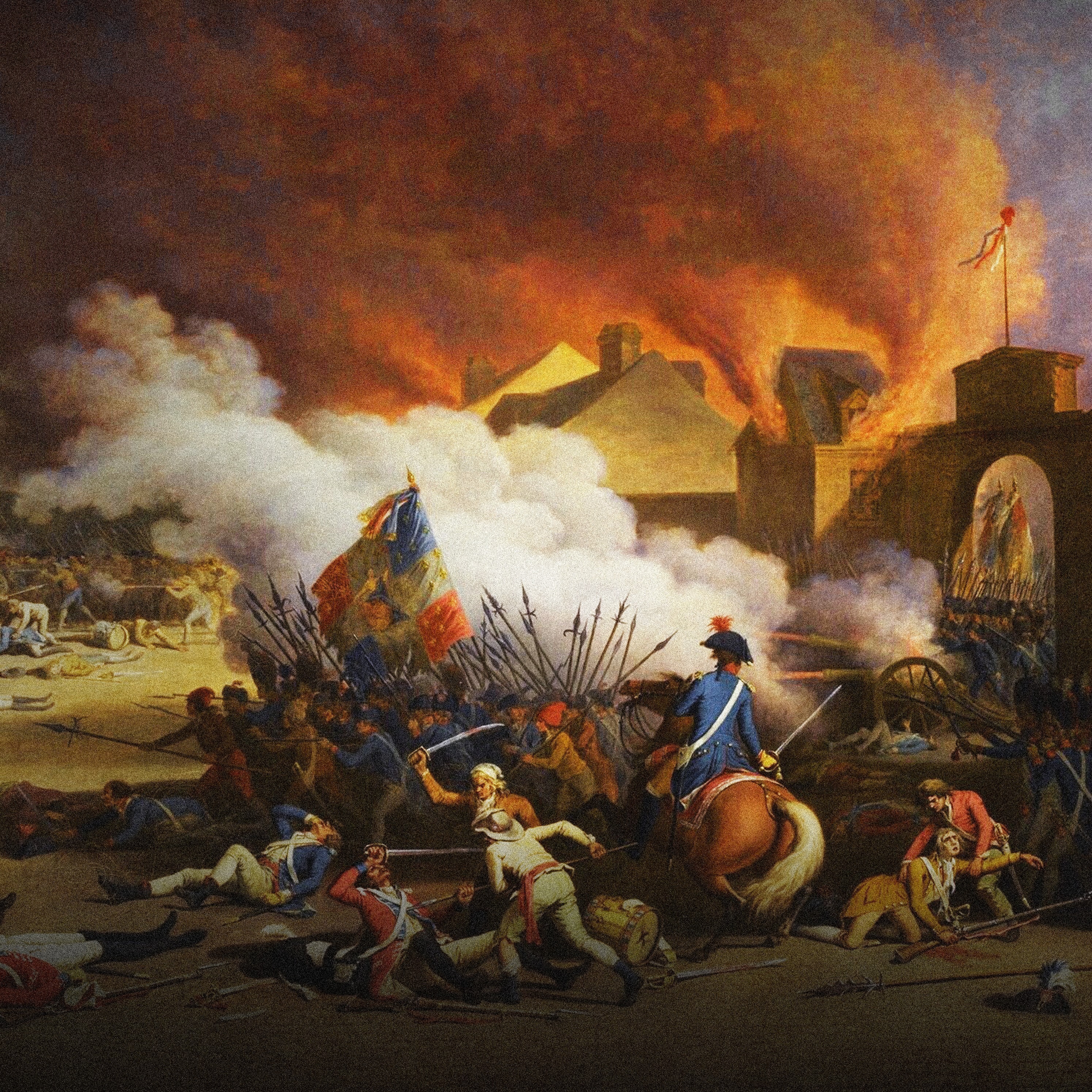
HISTORY This Week
The French Monarchy Falls in a Day
00:34:21
Marie Antoinette, Louis XVI, twenty thousand armed Parisians: the day that ends royal rule in France.
Loading summary
Transcript94 lines
- [00:00]
She's Birdie Advertiser
This episode sponsored by She's Bertie. Every woman knows that feeling, and she's Bertie knows it too. The just in case feeling. Just in case I hear something. Just in case someone tries the door. Just in case I need to wake up fast. It's not fear, it's awareness. And Birdie Box from She's Birdie was made for exactly that. Birdie Box is a portable travel door alarm designed by She's Bertie for hotels, dorms, Airbnbs, and anywhere you're staying away from home. It installs in seconds on the door frame, and if the door is opened, it activates a loud siren and flashing strobe to help draw attention instantly. She's because peace of mind should check in with you. Birdie Box by She's birdie visit she's birdie.com that's S-H-E-S-B-I-R-I-E.com and order your Birdie box before your next day away from home.
- [00:54]
History Channel Announcer
The History Channel Original Podcast
- [00:58]
Sally Helm
history this week, August 10th, 1792. I'm Sally Helm. 12:00am in Paris, a single church bell begins to ring. Then another, and another and another and more. It's not a religious holiday. This isn't part of a mass. It is a call to arms. And for the King of France, it is an ominous sign. King Louis XVI is an ineffectual, unpopular king. He took on massive debt to pay for wars, including supporting the American Revolution. Then he raised taxes on the lower classes to cover it. Add in some years of bad harvest and things have become completely untenable. Many people in the country have barely been able to afford bread by 1789, three years ago, France had basically run out of money altogether, and lower and middle class Frenchmen decided to take matters into their own hands. They elect a democratic institution called the national assembly to challenge the king and the nobility. That assembly began to amass political power and also military power. And there has been this major question seething under the surface of things for Will the monarchy survive? The national assembly has by now morphed into something called the Legislative assembly, and they've been steadily chipping away at the power of the elites. By this point, Louis XVI and his family are essentially living under house arrest at the Tuileries palace in Paris. But the assembly has stopped short of completely overthrowing him. They're taking a more moderate course. Louis still has some power. This is a constitutional monarchy, like like in Great Britain. But a more radical faction of the French revolutionaries has been saying, yeah, that is just not going to work. We need to get rid of the King altogether, create a constitutional republic. The radicals have not been shy about telling that to the Legislative Assembly. In fact, they've set a deadline. If you don't get rid of the King by the end of August 9th, then we will take matters into our own hands. At midnight, as August 9th turns into August 10th, the bells begin to ring, a signal that the revolutionaries are ready to make good on that promise. Today, midnight for the monarchy. How did France, whose kings had once been anointed with holy oil and said to have the power to cure disease by touch, come to loathe Louis XVI so much? And after years of tension, how did the pivotal moment in the fall of the monarchy unfold on one single day? August 10, 1201am the alarm bells can be heard at the Tuileries palace, where Louis has been living with his children and his wife, Marie Antoinette. Guards assemble around it to fight off the revolutionaries if and when they come. About an hour after midnight, the Queen and Elizabeth, the King's sister, lie down on a sofa in a room overlooking the courtyard. They can't sleep. They're talking about what's going to happen to them. A stray musket shot sounds in the courtyard and they bolt up, sure that this signals the beginning of a bloodbath. But it doesn't. Not yet. Advisers come and go throughout the night, and at 4am, the two women come to the window again. The King joins them. He's managed to grab a little bit of sleep. His wig is matted flat on one side. He's bleary and surely terrified. From the window of the Tuileries palace, the three of them watch the dawn. This palace is a stately, imposing building on the banks of the River Seine, right near the Louvre. It's got a beautiful garden and about a million columns on the facade. But it is no Versailles. That is the gorgeous palace just outside of Paris where Louis and his family had been living until a few years ago. October of 1789, revolutionaries besieged Versailles and marched the King and his family back to Paris to install them in the Tuileries. Since then, they have essentially been prisoners in a palace, a palace which, when
- [06:10]
Dr. David Andress
they moved into it, had been locked up for years and was filthy, and they were just being sort of shoved in there and told to make the best of it.
- [06:17]
Sally Helm
Dr. David Andress is a professor of modern history at the University of Portsmouth. He has spent years poring over the records of this time, which give us a vivid sense of what the revolution was like.
- [06:30]
Dr. David Andress
I spent a year in Paris immersed in these wonderfully kind of tactile manuscript records from the early revolution, some of which still smell of smoke because half of them were destroyed. They burned down the building they were in. So the ones that survive literally have the odor of that fire hovering over them.
- [06:50]
Sally Helm
That moment in 1789 when Louis and his family were marched to the Tuileries palace, that really shook the king, who, to be fair, had never been a very solid character to begin with.
- [07:02]
Marisa Linton
I just think he was a very incompetent king. I have to say that he should not have been king king really, you know.
- [07:08]
Sally Helm
Marisa Linton is professor emerita in history at Kingston University in London. And yeah, Louis XVI only ascended to the throne after tuberculosis lopped off whole branches of his family tree. Linton and Andrus both told us he just wasn't built for the job.
- [07:26]
Marisa Linton
He was never much of a leader. He really wasn't. He found it very hard to make decisions. He was nervous, vacillating, didn't get on well with speaking in public, which, you know, in a king is not a good look. Some people are just not cut out to be king, especially king of an absolute monarchy. He was one such person.
- [07:47]
Sally Helm
His own brother once joked that trying to get Louis to make a decision was like trying to hold oil billiard balls together. David Andress said, it's not that Louis is stupid.
- [07:58]
Dr. David Andress
He, he's a man who has these nice kind of little rational hobbies, locksmithing and other things like that. He likes to understand how things work.
- [08:06]
Sally Helm
He's also a religious man. One of the things that he hates most about the revolution is that they're stripping power from the Church. He keeps just hoping that everything is going to go back to the way it was before 1789. And that keeps not happening.
- [08:23]
Dr. David Andress
He sinks into these dark depressions where Marie Antoinette and other people close to him can basically tell him what to do and he just waves things away.
- [08:32]
Sally Helm
Marie Antoinette, the queen Louis wife, is Austrian, a Habsburg, the daughter of an empress and a completely different kind of person.
- [08:43]
Dr. David Andress
Marie Antoinette is a fascinating character, someone who's been absolutely defamed throughout history, but someone who I think shows herself during the revolutionary years as a genuinely strong character of reasonably robust understanding, but also just ferociously right wing attitudes.
- [09:02]
Marisa Linton
The queen, Marie Antoinette, not the brightest button in the box, very much a reactionary in her politics. And she was like, yeah, you know, we've got to be tough, we're going to be tough on this. And Louis I think agrees, but he doesn't know how to do it or what to do.
- [09:18]
Sally Helm
The previous summer, Marie and Louis did try to do something. They tried to escape their house arrest at Tuileries by running away from Paris towards Austria to find more safety, more freedom of movement.
- [09:32]
Marisa Linton
They escape in this coach. It's all a bit shambolic. Marie Antoinette has all her clothes and wigs and God knows what else.
- [09:39]
Sally Helm
They leave later than they'd meant to and travel out into the countryside. The King, the queen and their children.
- [09:46]
Dr. David Andress
They leave on that journey thinking that there's a loyal country out there that will welcome that. Paris appears to have gone mad and become rebellious. But out there in the countryside, the real French people will welcome them, and the real French people do not welcome them. They are seen as fugitives.
- [10:07]
Sally Helm
Immediately, because they left so late, they're intercepted and marched back to Paris.
- [10:15]
Dr. David Andress
On the way back to Paris, they experienced probably tens possible, possibly hundreds of thousands of people coming into their physical presence and demonstrating to them that sending them back to Paris is the right thing to do. And, you know, a couple of outspoken aristocrats who try to say something sympathetic are killed in front of them in the course of this process. So they will have traumatically discovered that actually, no, you can't just get out of Paris and find a better place. Everything is much more complicated from their perspective, much darker
- [10:51]
Sally Helm
now, even at this point, there are many revolutionaries who did not actually want to overthrow the king. Many of them can't imagine France without a king. What they've been pushing for is a constitutional monarchy. So the people have the power, but, you know, the king still exists. Louis's attempted escape, though, it turns some of those people against him.
- [11:18]
Marisa Linton
One of the revolutionaries said afterwards, we wanted him, never wanted us, the king. And so he forfeited a lot of the loyalty that he had previously had.
- [11:28]
Sally Helm
Still, the moderates who want a constitutional monarchy, they actually prevail. They write a new constitution. In September of 1791, they restore Louis to power. And in October, a brand new legislative assembly convenes under this new French constitution. For the moment, the radicals who wanted to get rid of the king, they have lost. But then, in early 1792, a few things changed. One, inflation starts to spiral out of control, Prices for basic goods get even higher, and economic distress is one of the main things driving this revolution. And two, in April, France goes to war with Austria, then Prussia. It is the new legislative assembly that declares this war. They want to clear out the French counter revolutionaries who have fled to these neighboring countries. So the king, who is against the revolution. Even if he technically swore to uphold the Constitution, he's essentially on the other side of the war. Obviously, the Queen is too, and she's even from Austria. And remember, the King and Queen even tried to flee towards Austria just last year. And in late July of 1792, the Duke of. Of Brunswick, who is in charge of the enemy forces, he literally declares that the King and Queen of France must be protected.
- [13:04]
Marisa Linton
The Duke of Brunswick has threatened terrible vengeance on the people of Paris if anything happens to the King and Queen. People are febrile. They're afraid that at any moment Paris might be overrun, and they see the monarchy as responsible for that.
- [13:19]
Sally Helm
The King and Queen are enemies in their midst. All of this means that those more radical forces who wanted to bring down the monarchy completely, they have an even better argument now. This group had a name, the San Culotte. It means without knee britches because they wore the long trousers of working men, not the fine silk breeches of the court. Although in actuality, the members of the San Culat political movement are drawn from a lot of parts of society.
- [13:51]
Dr. David Andress
There are chaps in there making a tremendous noise who've actually got a, you know, a private income, you know, like trust fund kids. There are others who are very successful businessmen, shop owners, you know, everything from butchers to printers, lawyers, you know, it's a real blend of almost middling classes with some kind of genuine wage earners hanging on the edge. But they're all putting forward this idea that Paris, as a city, they, as their local communities and clubs, really are the people. And so when there is trouble, they're entitled to act.
- [14:28]
Sally Helm
And this vow from the Duke of Brunswick to raze the city of Paris, if a King and Queen are harmed, that counts as trouble. Like what, they're just going to stand by while he says that kind of thing?
- [14:41]
Dr. David Andress
They have a choice between cowardly accepting that as their fate or defying it. They choose to defy it. They will march on the Tuileries. They will overthrow the monarchy. And to hell with the counter revolutionaries.
- [14:53]
Sally Helm
The Sans Culotte have already organized themselves into a kind of alternative city government. And on the night of August 9th,
- [15:02]
Dr. David Andress
they take power, declaring to the regular municipality, basically, okay, you know, you guys are off the clock now. This is a revolutionary moment. We're in charge. You know, the rules have been torn up. Here we go.
- [15:21]
History Channel Announcer
Since 1927, Mountain Cement has been building careers in, literally, Wyoming. They're hiring electricians, mechanics, truck drivers, entry level employees and salaried professionals to join their team. Employees Enjoy year round work. Opportunities to grow and unique perks like private elk hunting, access and permits, a stocked fishing pond, Laramie river access, a shooting range and RV and tent sites. Competitive pay day one benefits and relocation packages are available for qualified candidates. Apply today@mountaincement.com or call 307-745-2620.
- [15:52]
Sally Helm
At Fred's Appliance, we know that real life is dishes in the sink. Whether you're on the go or staying at home. As the number one Bosch dealer in the region, we have the largest in stock.
- [16:02]
Dr. David Andress
Get it today.
- [16:02]
Sally Helm
Inventory ready to provide you relief from the sink. We don't do gimmicks, just clean dishes and everyday low prices. With our price match guarantee and friendly customer service, we make it convenient for you to shop appliances. Fred's Appliance, your local appliance expert since 1962. 4:00am as the Royal family watches the dawn from the windows of the Tuileries palace, the new radical government is meeting across the city at the Hotel de Ville. It is not a hotel, it is Paris's City hall. And it is now run by the group of Sans Culottes calling themselves the Insurrectionary Commune. And they are determined to bring down the monarchy today. Leading the attack will be a man named Antoine Santerre.
- [16:59]
Dr. David Andress
Santerre is one of these interesting figures that kind of pops up out of social life and becomes a leader.
- [17:07]
Sally Helm
He's a beer brewer, quite a wealthy one, but he's been involved in major events of the revolution already. He was there at the storming of the Bastille in July of 1789 when revolutionaries were took over a state prison and essentially kicked this whole thing off.
- [17:22]
Dr. David Andress
He kind of comes up towards leadership at battalion level and as the one who's willing to make what happens on 10 August into a, as it were, semi official military operation.
- [17:35]
Sally Helm
Santerre's forces will march on the Tuileries from two directions.
- [17:40]
Dr. David Andress
It's not done by a mob. It's a very specifically kind of political military maneuver by one set of political forces against another one.
- [17:49]
Sally Helm
The Insurrectionary Commune gives itself one very large advantage. Around 4:30am they summon a National Guard commander from the Tuileries Palace, a man called the Marquis de Manda.
- [18:02]
Dr. David Andress
He rather naively had trotted off to the Hotel de Ville in the early hours of the morning to find out what's going on. And they have quite less naively arrested him.
- [18:12]
Sally Helm
The National Guard is already split. Some of them support the King, but some support the revolution. And now the National Guard at the palace has no Commander. There are also hundreds of armed royal bodyguards at the Tuileries. And there is one very strong group of defenders that Santerre and his men will have to contend with. They're not French, they're actually Swiss. The Swiss Guard, they're technically mercenaries, foreigners paid to fight. But they are a long established part of the French army. They're proud, disciplined, elite and ready to fight to the death on Louis behalf.
- [18:56]
Marisa Linton
That is their duty, to stand by the King and to defend him. But of course, they're Swiss, they're not French nationals. So he's in the position of God. He's got foreign nationals to defend him against French people. This is not a good look. And for the French, this is a really, really bad look.
- [19:12]
Sally Helm
5am The Tuileries Palace. Louis disappears into a confessional with his priest.
- [19:19]
Dr. David Andress
Louis is a very straight lice kind of guy. He takes his paternal responsibilities very seriously, literally and metaphorically to the country at large. He is a man that thinks religion should, you know, color all of his decisions. I mean, I think a kind of long, heartfelt conversation with a confessor is exactly the kind of thing you'd expect someone like him to do at a moment of crisis.
- [19:44]
Sally Helm
This man who hates making decisions is going to have to make a lot of them. He and his family are about to come under potentially mortal attack by revolutionaries looking to remake the country into something he and his ancestors would not recognize. He doesn't emerge from the confessional for nearly an hour. 6:00am the king decides that it's time to review his troops.
- [20:10]
Marisa Linton
He feels as a king, he has to make a stand and look at the troops because they're about to fight for him. So he has to go out there outside of his palace.
- [20:18]
Sally Helm
He buckles a sword to his side, though he is unlikely to use it, and he walks down to the courtyard of the palace. He starts with the troops closest to him or yelling out, vive le ra. Long live the King.
- [20:34]
Marisa Linton
He's going along line of the troops to encourage them. The ones who are going to be facing you have the cannon trained or on French people lined up outside. And he goes too far.
- [20:44]
Sally Helm
He passes beyond his own supporters because remember, within his guard are some members of of the National Guard and some of them are with the revolutionaries. They start yelling out, viva la nacion. Long live the nation.
- [21:02]
Dr. David Andress
And there's actually a little bit of a scuffle in which, you know, people have to hasten him back inside the building. So before the big confrontation happens, it's already become clear that you know, not everyone who's there is on his side. Everything is rather unreliable. And this physically rattles him.
- [21:22]
Marisa Linton
I think it's just really quite painful, that moment for him, because for a king to see himself unkinged before the event, that must have been a huge shock for him and he just couldn't cope with it.
- [21:38]
Sally Helm
It's almost 8:00 o'clock AM. Some of the troops protecting the palace begin to desert. The revolutionaries are on their way. And the indecisive king faces a choice. He could stay and die alongside his troops and probably alongside his wife and children, die making a stand in the palace for the monarchy. Or he could flee and put himself in the hands of the Legislative assembly, whose gathering hall is just a few hundred yards away in a narrow building that had once been a royal horse riding academy. A man named Pierre Louis Roederer, a senior official in the Paris government, urges the king to flee. Marie Antoinette says in response that she'd rather be, quote, nailed to the walls of the palace. Roederer is like, okay, then, your children's deaths are your responsibility. And this reality check seems to break through to the king. He says, yes, we will surrender ourselves to the Legislative assembly, essentially giving up the monarchy. But even now, this decision is about as indecisive as a decision can be. He tells himself this is temporary. They'll be back once calm has been restored. He's trying to have it both ways.
- [23:08]
Marisa Linton
You either defend the last man, including yourself, or you lay down your arms because you know you will lose. He did both. I mean, oh my goodness, he did both. So he told them all to defend himself, his family, the dauphin, and then he fled.
- [23:26]
Sally Helm
The soldiers stay behind to defend the palace while the royals take their leave. A courtier's daughter sees their flight from her window and remarks that the entourage looks like a funeral procession. Many people later tell the story that as the family walks the short distance to the Legislative assembly, just on the other edge of the Tuileries gardens, the young Dauphin, the king's son, kicks a pile of leaves.
- [23:51]
Dr. David Andress
The second half of the anecdote is the child is kicking all the leaves around. And then the king says something about everything falling early that this year and it's again, it's supposed to be, you know, oh, metaphor, you know.
- [24:04]
Sally Helm
At around 8.30am, the royal family arrives at the halls of the Legislative Assembly. One observer says that the king looks like a wet hen. God's chosen monarch is now just a man. The family is herded into the press box.
- [24:22]
Dr. David Andress
It's a spice to put Them, which is separate from the floor of the assembly, where they can see what's going on. Keep an eye on them, make sure they haven't run away again, so that they're safe. Most of the people actually in the assembly would. Would. You don't want to see them murdered, particularly not in front of them. That would be horrible.
- [24:40]
Sally Helm
The members of the Legislative assembly are called deputies, and they are now having to face their own indecision. This is the body that is supposed to have been stated steering France, and people have been begging them to act on the revolution's biggest issue. The King now seems like they've done nothing but talk. And over at the Tuileries, the revolution continues without them. 9:00am The Revolutionary army, led by the beer brewer Santerre, converges on the 4th 20. It is a massive force. Some of the units bring a new battle hymn with them, La Marseillaise, which would become the national anthem of France.
- [25:28]
Marisa Linton
It's a jolly marching song if you listen to it. It's all about blood and fighting and may their impure blood fertilize our fields. Yeah, this life or death.
- [25:43]
Sally Helm
Many of these volunteer fighters see themselves as part of the battle to save France from a foreign enemy who is also their own king. Some of the defenders of the Tuileries have already deserted, and the ones who remain are in a bind. Their commanding officer, the Marquis de Manda, has by this point been arrested and killed by by a mob, his body dumped in the Seine. And the King, who can also give the troops orders, has also abandoned them. The revolutionaries outnumber the guards. It is going to be a bloodbath. The normal course of things would be for the revolutionary forces to say you should surrender, and for the forces defending the Tuileries to agree.
- [26:30]
Dr. David Andress
As with standard military practice, when you confront people who have nowhere to go, you summon them to surrender, you know, to spare the effusion of blood, because it would be silly not to.
- [26:42]
Sally Helm
But these men aren't going to surrender on their own without an order. That would be against their code.
- [26:49]
Dr. David Andress
The junior officers and the men of the Swiss Guard are not going to lay down their arms in front of a mob of cosplaying civilians, as they might have described them. They are professional soldiers, they have an honor and a duty and so on and so forth.
- [27:07]
Sally Helm
The Swiss Guard, these elite mercenaries, they famously only surrender their arms with their lives. And so, with no one to tell them to stand down, they face the oncoming force. All it takes is one shot and a full scale battle breaks out.
- [27:28]
Marisa Linton
It was the most violent event that took place within Paris during the whole of the revolution.
- [27:34]
Sally Helm
The Swiss Guard aren't the elite defenders of Europe's aristocracy for nothing. Even without a command structure, they rally and direct a ferocious counterattack. A disciplined bayonet formation that breaks through the insurgents line. Murderous gunfire into the crowd. They're able to clear the revolutionaries out of the courtyard in short order, leaving hundreds seriously injured or dead. But that is about all they have. In the tank, the guards begin running out of ammunition. The revolutionaries start to close in. The royal family, safe in the press box, can hear the fighting at the palace. Gunshots, the roar of the crowd. And at around 10am with the battle raging, someone sprints through the firefight to deliver a message. Louis is ordering his guard to retreat.
- [28:33]
Dr. David Andress
There is this rather half hearted order to withdraw, which by the time it arrives means kind of attempting a fighting with withdrawal and a flight. But there's nowhere to withdraw to.
- [28:45]
Marisa Linton
The Swiss Guards, the great majority were killed on the spot, massacred. Once the people got to them, I
- [28:52]
Dr. David Andress
think over a hundred of them managed to get to the protection of the Legislative Assembly.
- [28:58]
Marisa Linton
Some were captured alive. I think about 300 captured alive.
- [29:02]
Dr. David Andress
The rest of them will be driven into flight and then chased through the city and killed one by one.
- [29:14]
Sally Helm
The Swiss have been slaughtered trying to protect a king who is already safe. Safe at least until the Legislative assembly decides what exactly to do with him.
- [29:29]
History Channel Announcer
Ready to make your next move count? What if your next job came with a better quality of life? Mountain Cement in Laramie, Wyoming has been building careers in store 1927 and is hiring now. Whether you're looking for an hourly position or a salary career, there's an opportunity waiting for you. Enjoy competitive pay day one benefits, relocation assistance for qualified candidates and a community where outdoor recreation is part of everyday life. Hunting, fishing, mountains and room to grow. It all starts at Mountain Cement. Apply at mountaincement.com or call 307-745-2620.
- [29:59]
She's Birdie Advertiser
Every early morning run, every walk across campus at dusk and every ride back after dark. That's why she's Birdie created the Birdy disc, a clip on safety light and personal safety alarm for the student stepping into a whole new level of independence. On sale for bag to school. Buy two get one free. A new campus, a new city, a whole new routine, an exciting life stage, but a vulnerable time for many women. The Birdie disc clips hands free to her backpack strap, sports bra or bike. Three LED modes make her visible to drivers in low light. And unlike an ordinary running light, it has a built in 130db siren. So if something feels wrong, one press brings every eye to her. Get your college girl the Birdie disc during the back to school sale. Buy two get one free visit. She's birdie dot com. That's S-H-E-S-B-I-R-I-E.com Around 10:30am, the stately Tuileries
- [30:59]
Sally Helm
palace is being overrun. After Louis order to retreat, the guards line breaks. The Parisians and National Guardsmen swarm the palace and finish off any remaining defenders. They also kill the domestic servants. And they start to take stuff, valuables, things like jewels, silverware, golden candlesticks. But this isn't really what you'd call
- [31:28]
Dr. David Andress
looting, seizure of things, destruction of property isn't for personal gain. It's a political gesture.
- [31:36]
Sally Helm
The crowd polices itself. They faithfully bring the loot over to the Legislative assembly, which delivers it to the insurrectionary commune. One San Culotte turns over 173 Gold Louis, a fortune.
- [31:52]
Dr. David Andress
These events are, are horribly violent, but politically justified. But what wouldn't be justified is stealing. You know, that makes you a common criminal.
- [32:02]
Sally Helm
What doesn't go to the Commune, they destroy.
- [32:06]
Dr. David Andress
Throwing it through the windows, dragging it together, setting fire to it, making a public bonfire of the symbols of monarchy.
- [32:19]
Sally Helm
Back at the Legislative assembly, the royal family is stuck in the tiny press box and the assembled deputies are debating their fate.
- [32:30]
Dr. David Andress
I mean, the deputies themselves are fairly terrified for their own collective lives.
- [32:36]
Sally Helm
These are the moderates who have failed to take strong action against the King.
- [32:41]
Dr. David Andress
They don't think that this crowd would just do away with them, but in the back of their minds is again, the fact that they have basically faffed around, as we would say in England, done nothing about this great national crisis. They could be held responsible for it. So one of the things they start doing is making very loud speeches about how patriotic they are and how everything that happens now must be handed over to the sovereign people to decide about.
- [33:08]
Sally Helm
The sovereign people may rightly be in charge now, but for the moment, the King is just sitting there.
- [33:17]
Marisa Linton
What are you gonna do with him? They're not gonna put him back on the throne because many people have just died removing him. Could they have ordered him to be kind of taken out into the courtyard and shocked? They're not, they're not ready to do that, but they're not ready to put him back either. And the point about a king is he's the king, he's like on a chessboard. He may be powerless in himself. But he's the figurehead of everything.
- [33:40]
Sally Helm
So they find a procedural loophole. They say this very body was created under the auspices of a constitutional monarchy, so we have no power to end that constitutional monarchy. We'll suspend the King, but we won't go so far as to depose him, even though that's what the radicals have been demanding for weeks. Instead, the assembly says we're going to need to convene a whole brand new elected assembly to decide the King's fate. At 2am on August 11, the royal family is finally moved out of the press box and taken temporarily to an old Parisian monastery. And on the evening of August 13th, they're driven to a grim medieval fortress on the east of the city. It's known as the Temple. Crowds jeer at them as they pass.
- [34:34]
Marisa Linton
Pass.
- [34:34]
Sally Helm
The National Guard, now led by Antoine Santerre, welcomes them inside. As with their time at the Tuileries palace, they're not imprisoned in squalor. They're given a large household staff and the state spends a fortune on their upkeep. Louis, strangely, seems to settle into a routine. He spends his days teaching his son the dauphin Latin and geography, the things that he believes a prince should know. That December, the duly elected National Convention finally makes a decision. They abolish the monarchy. France is now a republic and Louis is officially just a citizen. Louis Capet, awaiting his trial that winter, he's found good guilty of treason and by a narrow margin, condemned to death. On January 21, 1793, a raw, foggy morning. Louis is loaded into a carriage for the slow hour and a half ride to the guillotine. He recites psalms with his confessor along the way. This isn't his country anymore. In the months that he's been locked away, the Revolution has been scrubbing the monarchy out of France, renaming streets, pulling down statues. The carriage stops in a great square where a statue of his grandfather Louis XV once stood. Now there's only an empty pedestal at the scaffold. Louis tries to speak Frenchman. He starts, I die innocent of the crimes of of which I have been accused. But by most accounts, Antoine Santerre, the brewer, the one whose forces depose the king, orders the drums to start to drown out Louis final words. Thanks for listening to History this week, a Back Pocket Studios production in partnership with the History Channel. To stay updated on all things History this week, sign up@historythisweekpodcast.com and if you have any thoughts or questions, send us an email@historythisweekhistory.com Special thanks to our guests David Andress, professor of Modern History at the University of Portsmouth and Marisa Linton, Professor Emerita of History at Kingston University and prize winning novelist. We'll put their books in the description of this episode and on our site historythisweekpodcast.com this episode was produced by Danny Vonone and by me, Sally Helm. It was sound designed and mixed by Tyler Morissette for Back Pocket Studios. Our Executive Producer is Ben Dickstein from the History Channel. Our Executive Producers are Eli Lehrer and Liv Fiddler. Don't forget to follow, rate and review history this week wherever you get your podcasts and we'll see you next week.
- [37:40]
She's Birdie Advertiser
Every early morning run. Every walk across campus at dusk. Every ride back after dark. That's why She's Birdie created the Birdie Disc, a clip on safety light and personal safety alarm for the students stepping into a whole new level of independence. On sale for back to school. Buy two get one free. A new campus, a new city, a whole new routine, an exciting life stage, but a vulnerable time for many women. The Birdy disc clips hands free to her backpack strap, sports bra or bike. Three LED modes make her visible to drivers in low light and unlike an ordinary running light, it has a built in 130db siren. So if something feels wrong, one press brings every eye to her. Get your college girl the Birdie Disc during the back to school sale. Buy two get one free visit. She's birdie.com, that's s h e s B I r D I e com.