← HISTORY This Week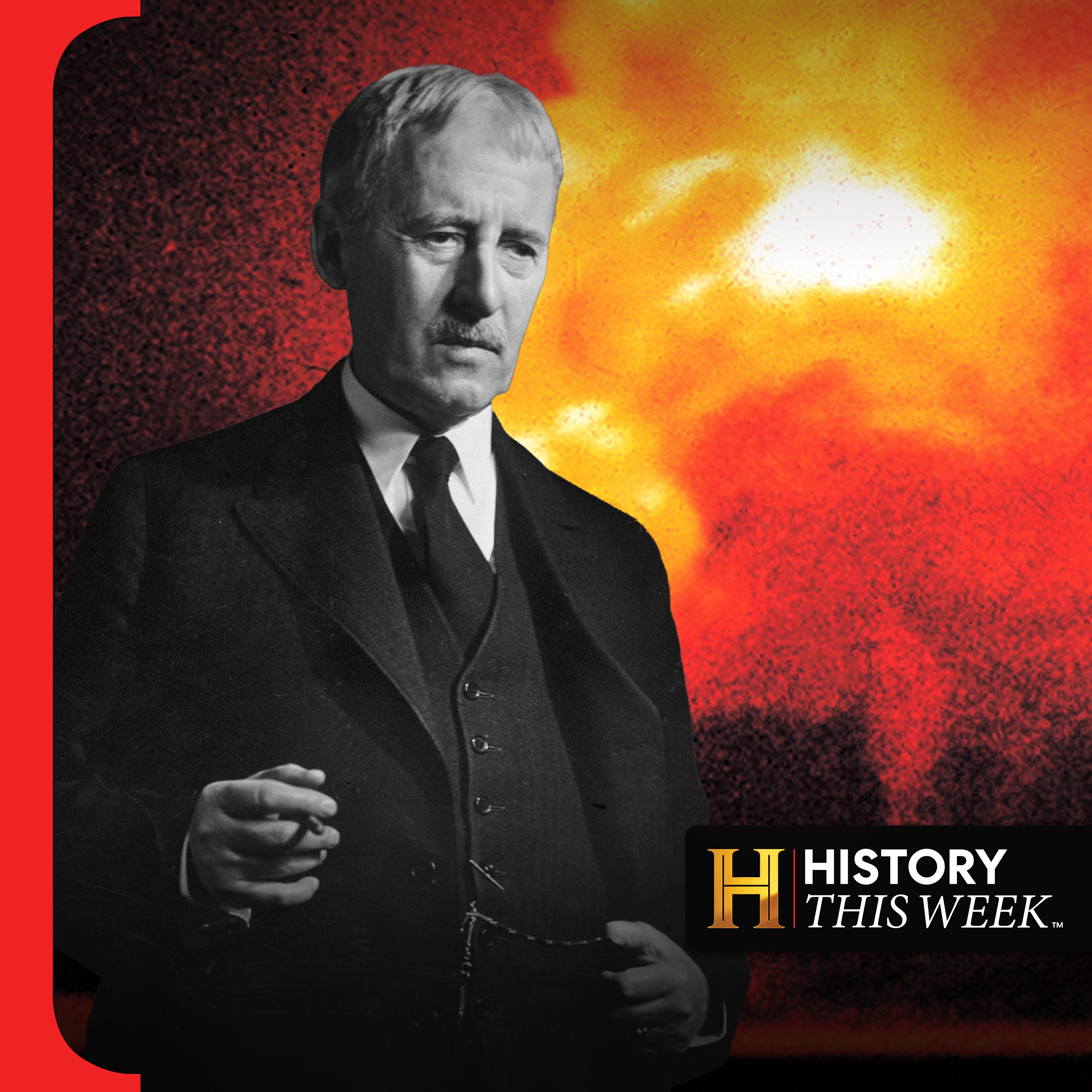
HISTORY This Week
The Secretary of War Who Feared the Bomb
00:34:00
Henry Stimson helped create the atomic bomb. But as WWII nears its end, the Secretary of War finds himself confronting a personal crisis of ethics, faith, and humanity.
Loading summary
Transcript85 lines
- [00:00]
Sally Helm
Hey everyone, it's Sally here. The episode that you're about to hear is a deep dive into America's Secretary of War during World War II and how he struggled to balance his own conscience and his military decisions. This story is one of many explored in World War II with Tom Hanks, a new History Channel series that examines this devastating conflict for a new century. Across 20 hours, the series traces the war's 4 arc from the rise of fascism to Hiroshima, uncovering the decisions, hidden networks, and lasting consequences that continue to shape our world. Premiering Memorial Day. Check out new episodes on the History Channel every Monday, or listen to the show as a podcast. Just search for World War II with Tom Hanks wherever you listen. New podcast episodes drop every Tuesday. Now back to History this week, brought
- [00:55]
Sponsor/Advertiser Voice
to you by Apple Card Apple card users get 2% daily cash back on purchases made in store and online, whether it's for big ticket items or everyday purchases when they use their Apple Card with Apple Pay. Now, that's a benefit that's just too good to pass up. You could be earning 2% daily cash back when you use your Apple Card with Apple Pay to buy Turmeric for your signature curry, 2% back on flights to visit the family in Tucson, and even 2% back on your kid's new tuba. You might even be able to get 2% back on a tuba tutor, not an Apple Card customer. You could apply in the Wallet app on iPhone subject to credit approval. Apple Card issued by Goldman Sachs bank usa, Salt Lake City Branch terms and more at Apple Co Benefits. If you've ever studied history, you know the difference one person can make at exactly the right moment. The right general, the right engineer, the right negotiator. When chaos hits, the wrong hire makes things worse. The right hire changes everything, producing history this week, I've certainly felt that Deadlines piling up, research still coming in, edits not quite landing. That's when I think this is a job for Sponsored Jobs. If I had to hire someone tomorrow, I wouldn't just want can edit audio on a resume. I'd want someone who's worked on narrative podcasts, knows our software, understands pacing, and can jump straight into the chaos. Indeed, Sponsored Jobs boosts your post and search results so you can reach candidates who meet your specific criteria. Skills, experience, location. And you only pay for results. And here's something worth listening to. Sponsored Jobs posted directly on indeed are 95% more likely to report a hire than non Sponsored Jobs. That's the difference between hoping and actually hiring. Indeed, Sponsored Jobs is a boost whenever you need to find quality talent. When workplace chaos hits and you need the right hire, this is a job for Sponsored Jobs. Spend less time searching and more time actually interviewing candidates who check all your boxes. Less stress, less time, more results when you need the right person to cut through the chaos. This is a job for Indeed Sponsored Jobs and listeners of the show will get a $75 sponsored job credit to help get your job the premium status it deserves@indee indeed.com podcast just go to indeed.com podcast right now and support our show by saying you heard about Indeed on history this week. Indeed.com podcast terms and conditions apply. Need to hire? This is a job for Indeed Sponsored Jobs
- [03:34]
the History Channel Original Podcast
- [03:39]
Sally Helm
history this week, May 30, 1945 Sally I'm Sally Helm. 9:20am an unusually crisp morning in Washington, D.C. general Leslie Groves gets a message. The Secretary of War wants to see him right away. Groves probably has an inkling as to what this meeting is about. Just two days before, he had met with the so called Target Committee, the people charged with deciding where the United States will drop the atomic bomb. Which cities will be the targets? For the past three years, General Groves has been in charge of the Manhattan Project, overseeing the scientists building the most powerful weapon that the world has ever seen. Now the they're about to use it at the highest levels of government. Everyone has agreed that they need to shock Japan into surrender. There's basically no talk about not using the bomb. The only question is exactly how. And on that point, General Groves and the Secretary of War do not see eye to eye. Groves arrives at the Secretary's office. Henry Stimson is 77 years old and he looks like he belongs to a different century. His vibe is more English professor on the edge of retirement than leader of a global war machine. And yet he's served under five different presidents, helping to make some of the highest stakes decisions imaginable. He has also often been one of the world's arbiters of life and death, but nothing compares to this. When Stimson first learned about the A bomb, he called it in his diary, the dreadful and the diabolical. Stimson is the Secretary of War, but he's also a deeply religious man, and now he is trying to find a balance that may be impossible to find. He wants to use the most destructive weapon in the history of the world without causing undue destruction. He wants as close as he can get to a targeted military strike, one that will spare Japanese civilians. He recently wrote a memo to President Truman saying as much. The reputation of the United States for fair play and humanitarianism is the world's best, biggest asset for peace in the coming decades. He doesn't want to squander it. But by the time the Secretary of War writes that memo, Leslie Groves, Target Committee is already on a completely different track. And now they have chosen three Japanese cities as targets, cities full of civilians. And they plan to drop the bombs rather than right over the centers of those cities. The bombs aren't totally accurate and they don't want to miss. They've picked as their targets Hiroshima, Niigata, and the cultural heart of Japan, Kyoto. Henry Stimson doesn't know this yet because Groves wants to keep it from him. It's also possible that Stimson has been burying his head in the sand a bit, but today he seems ready to demand answers. General Groves sits down in Stimson's office and the Secretary of War asks directly, have you selected the target? Groves tries to deflect. He says, the report isn't finished. Actually, it's across the river in his office. Stimson isn't buying it. He points to the phone on his desk. I have all day, he says. Call your office and have them bring the report over. So Groves picks up the phone, and then the two men sit briefly in silence, waiting to make a decision about who will live, who will die, and how exactly the United States will launch what is arguably a new era in human history today. Henry Stimson and the diabolical thing he unleashed. How did a man driven by religious morality become one of the founding fathers of the atomic age? And after the bombs fell, how did he reckon with what he'd. In many ways, Henry Stimson is a man living past his era, a relic of a lost world. He has short bangs, parted precisely in the middle. He wears old fashioned suits buttoned all the way to the top. He was born in 1867, just two years after the end of the Civil War, and he carries the stage stiff dignity of that century into the modern age. The writer and journalist Evan Thomas wrote about Stimson in his book Road to Surrender. Actually, Stimson comes up in three of his other 12 books, too. He told us Stimson followed a classic WASP trajectory. Educated at Phillips Academy in Andover, then Yale and finally Harvard Law School.
- [09:28]
Evan Thomas
Message they got at their schools was that partly because they were privileged, the message was, you need to serve your country and your community. And most of the people going to those schools ignored that message and went off and made A lot of money.
- [09:44]
Sally Helm
But Stimson took up the call. He spends his life in public service as a young man. He works as a trust busting prosecutor under Teddy Roosevelt, going after railroads and sugar refineries. Then he serves as Secretary of War under President Taft. He actually volunteers as an artillery officer on the front lines of World War I when he's 50 years old. Then he is a diplomat for Calvin Coolidge, then Secretary of State for Herbert Hoover. This is not a man who is shy about wielding power. He once said that he preferred to use a big gun rather than a small gun and believed in striking hard.
- [10:24]
Evan Thomas
He was a force guy, a power guy, a ruthless pragmatist in a lot of ways, but he saw himself as a Christian gentleman and I think he cared about it. He went to church. I think he would have said to you that he believed in Christ and wanted to live by Christ's maxims. You can make fun of that because here he is a Secretary of War. There's dissonance there obviously, but he believed it and he preyed on.
- [10:50]
Sally Helm
Throughout his career. Stimson tries to balance his far reaching powers with his ideals as a Christian gentleman. He calls for an international ban on the submarine. He says it's too deceptive and violates alike the laws of war and the dictates of humanity. Early on, around 1929, he reportedly says about the prospect of spying on adversaries by intercepting their communities communications. Gentlemen do not read each other's mail. The idea that he can balance the demands of Christian morality with the demands of war might always have been a fantasy. But Stimson does genuinely believe he can do it. And he genuinely tries. As the 1940s dawn though, he will be drawn into something that will force these buried tensions to the surface. November 1941. Henry Stimson is 74 years old and working for a fifth president, Franklin Delano Roosevelt. He wasn't an obvious choice for the job. Politically, Stimson and Roosevelt are not aligned. Stimson was against the New Deal. Evan Thomas said in today's terms he would be a right of center, moderate Republican. Roosevelt chose him in part to balance his cabinet ideologically. He thinks that will help him convince Congress to support the measures that will be necessary to prepare the country for war. And on November 6, about a month before Pearl Harbor, Henry Stimson learns what one of those measures might be. He gets an unexpected visit from the director of the Office of Scientific research and development, Dr. Vannevar Bush. He writes in his diary. Vannevar Bush came in to convey to me an extremely secret statement. It begins with a brief science lesson.
- [12:48]
Evan Thomas
There's this new thing, nuclear energy, that could be turned into a bomb that could destroy whole cities.
- [12:55]
Sally Helm
Stimson may look like a man out of the Victorian era, but he's a quick study. He immediately begins to grasp the implications that very day. He describes the atomic bomb in his diary as a most terrible thing.
- [13:12]
Evan Thomas
Stimson is kind of horrified by this. He would later call it a Frankenstein monster, but in his diary calls it the terrible and the awful and has all sorts of euphemisms because it is terrible and awful. But it may also be the key to winning World War II, and Stipson is practical enough to know that.
- [13:32]
Sally Helm
So the Christian gentleman is now one of the few people in the world who is in the loop as the United States begins to secretly build the bomb.
- [13:55]
Sponsor/Advertiser Voice
Living in a big city, grocery shopping can turn into a whole production. You realize halfway through that you've bought way more than you can actually carry home, and suddenly you're hauling heavy bags down the street onto the subway or up apartment stairs, wondering why you thought this was a good idea. That's one of the reasons I use Instacart all the time. I can open the app, order from stores I already know and like, choose the exact brands and groceries I want, and get delivery through Instacart in as fast as 30 minutes. And I really appreciate the quality side of it, too. You can set preferences for produce, for placements, all those little details that actually matter when someone's selecting your groceries, especially in the summer, it just gives you time back. Instead of losing half a Saturday running errands, I can focus on work, seeing friends, getting outside, whatever I actually want to be doing. And from a historical point perspective, that's kind of crazy. For most of human history, getting food and household essentials consumed a huge part of everyday life. Entire routines revolved around carrying, transporting, preserving, or preparing. Just basic necessities. Anything that makes modern life a little easier, especially in a city I'm grateful for. Instacart brings convenience, quality and ease right to your door so you can focus on what matters most. Download the Instacart Instacart app now and get groceries just how you like.
- [15:17]
Sally Helm
What if everything you learned in history class was only half the story? I'm Dr. Haruni Bhatt, host of Hidden History. Every Monday I go where history gets mysterious. Vanished civilizations, doomsday prophecies, paranormal phenomena, and events that science still can't fully explain. On Hidden history. I treat these men moments like open case files. Not myths, not superstition, just incomplete explanations waiting for a closer look. Listen to and follow hidden history. Available now, wherever you get your podcasts
- [15:46]
Sponsor/Advertiser Voice
as the school year winds down and summer plans start to take shape, it's easy for learning to slip into the background. But it doesn't have to. With ixl, keeping your child's skills sharp is simple and it only takes a few minutes a day. IXL is an award winning online platform that helps kids truly understand what they're learning. Whether they're building confidence in math, strengthening reading and writing skills, or reviewing key science concepts, IXL makes learning clear and engaging. Designed for students from Pre K through 12th grade, IXL uses personalized interactive content that adapts to your child's level and pace so they're always learning exactly what they need. Studies show kids who use IXL score higher on tests proven in all 50 states. It's an easy way to keep learning on track now through the summer and into the next school year with IXL make an impact on your child's learning. Get IXL now and listeners can get an exclusive 20% off IXL membership when they sign up today at ixlearning.com audio Visit ixlearning.com audio to get the most effective learning program out there at the best price.
- [17:00]
Sally Helm
June 1943 the US is fighting the war on two fronts in Europe and the Pacific. And in the shadows, the Manhattan Project is gaining momentum. The government is building massive industrial complexes across the country. Henry Stimson, of course, knows about this whole secret project to build what is known as the S1. And part of his job is making sure that other people don't know about it. Even Congress. But it's hard to spend billions of dollars without people noticing. And soon Congress starts asking questions, especially Missouri Senator Harry S. Truman.
- [17:46]
Evan Thomas
He sees all the spending. Lot of secret spending. I mean hundreds of millions of dollars of secret spending.
- [17:52]
Sally Helm
Truman leads the aptly named Truman Committee investigating profiteering and waste in government. And on June 17th, he calls Stimson.
- [18:01]
Evan Thomas
Initially, I think Stimson is skeptical about Truman. Truman, after all, is in some ways a product of a Kansas City machine. I mean, he's not some high minded Yale man. Stimson is a snob in some ways and kind of looks down on Truman.
- [18:22]
Sally Helm
Truman asks Stimson, where are these millions of dollars going? We have a transcript of this phone call, stimson says. I am one of a group of two or three men in the whole world who know about it it's part of a very important secret development. Truman. Well, all right then. Stimson. And Truman cuts him off. I herewith see the situation, Mr. Secretary, and you won't have to say another word to me. That's all I want to hear. Harry Truman doesn't have to worry about this for now. That is still Henry Stimson's job. And, of course, Stimson is also managing a global war that, for someone born in 1867, is getting out of hand.
- [19:08]
Evan Thomas
As Secretary of War, it's Stimson's job to bring this terrible force to bear. And he's a tough guy. He wants maximum force. But he is also worried that in this world war, this global war, we're not just killing soldiers, we're killing civilians.
- [19:26]
Sally Helm
To Stimson, civilian deaths are a moral crisis. And to mitigate them, he is willing to embrace new technology. In this case, precision bombing. There's something called the Norden bombsight, essentially an analog computer that is supposed to give Allied bombers incredible accuracy, meaning they should be able to avoid civilian deaths by bombing just military targets. But this isn't the reality
- [19:59]
Sponsor/Advertiser Voice
we kept
- [20:00]
Evan Thomas
missing, for one thing, but really, with a crude technology that we have in 1944, 1945, we kind of have to bomb cities to have an impact. We just don't. It's not like today where you have smart weapons and smart bombs and, you know, you can put a bomb through a window.
- [20:16]
Sponsor/Advertiser Voice
They couldn't do it.
- [20:17]
Evan Thomas
This is the early days of strategic bombing.
- [20:20]
Sally Helm
Bombing runs never went exactly as planned. Weather made flying unpredictable. The newly discovered jet stream blew payloads off target. The British had realized early on that precision bombing didn't really work, so they went all in on area bombing. They're also partially driven by revenge. The Germans are bombing their cities, and they want to retaliate. The Americans, meanwhile, continued to cling to the words precision bombing. But area bombing is what they're effectively doing. These strikes do destroy military and industrial targets, but they do also kill civilians. The Allied leaders making these decisions feel that this is the only way.
- [21:03]
Evan Thomas
They want to bomb civilians, not because they're bloodthirsty, but because nothing else works.
- [21:10]
Sally Helm
But they know that Henry Stimson doesn't want to do this, so they keep him in the dark. Actually, more than that. His trusted advisors show him carefully curated photos showing European targets destroyed, while churches and cultural icons remain unscathed. They call the precision bombing marvelous and miraculous, but they can't keep the bomb silent for long.
- [21:38]
Evan Thomas
In February of 1945, British and American bombers create a firestorm in the city of Dresden in Germany and kill a lot of civilians.
- [21:48]
Sally Helm
The firebombing of Dresden kills upwards of 35,000 people. And incredibly, Stimson is kept in the dark, at least in part. He is Secretary of War, but he's not making battlefield decisions. He finds out about the full extent of the destruction of Dresden three weeks later, reading an article in the New York Times, he writes in his diary that night, the bombing was terrible and probably unnecessary. He demands an investigation, but it's a futile gesture. The momentum of the war and his own men have already bulldozed right over his moral qualms.
- [22:29]
Evan Thomas
Well, a month later, the US Air Force in Japan now firebombs Tokyo.
- [22:37]
Sally Helm
Just a few weeks after Dresden, Major Curtis LeMay orders a wing of B29 bombers to head to Tokyo at night. He isn't going to bother discerning between civilian and military targets. And the B29s are carrying a new weapon, Napalm. Lame knows that Tokyo is filled with small industrial factories, but also with buildings made primarily of wood and paper, especially houses. It's his strategy. Japanese neighborhoods will burn so violently that the fires will spread to military and industrial targets. Tokyo attempts to mobilize citizen fire brigades, but their efforts are completely overwhelmed. 16 square miles of the city burn.
- [23:34]
Evan Thomas
Kills 100,000 people in one night. That's the greatest carnage in the history of warfare.
- [23:40]
Sally Helm
Henry Stimson is once again surprised. Evan Thomas said that's in part because he's busy and distracted making so many life and death decisions.
- [23:51]
Evan Thomas
Now remember, there's a war on. Simpson's doing a million things. He's not just focused on this. He's got a lot of issues that he's dealing with.
- [23:58]
Sally Helm
But again, it's also because people are keeping him in the dark.
- [24:02]
Evan Thomas
His own deputies don't want him to think too hard about civilian bombing because they know he's a Christian gentleman and he might recoil from it and stop him from doing it.
- [24:14]
Sally Helm
Evan Thomas did tell us it's possible that at some level, Henry Stimson didn't want to know. But it's hard to be sure. He saw himself as a Christian gentleman, yes, but he was also relentless in his pursuit of the enemy. And By April of 1945, the war looks all but one in Europe. But in the Pacific, despite the incredibly destructive bombing of Tokyo, there's no end in sight. And meanwhile, the Manhattan Project is nearing its conclusion. They're close to testing the bomb. Stimson's anxiety is growing.
- [24:50]
Evan Thomas
In the spring of 1940, 5. He's worried about what's going to happen after we drop the bomb. What's the world going to look like when everybody has nuclear weapons? Or when the United States does and maybe its enemies do. Oh my gosh. Then what?
- [25:05]
Sally Helm
Then in the midst of all this, President Franklin Delano Roosevelt dies suddenly.
- [25:11]
Evan Thomas
Roosevelt is gone and Stimson feels a little exposed, I think.
- [25:17]
Sally Helm
And the man who steps into office is the senator who'd been poking around about military secrets, Harry Truman. Truman had since left the Senate and become Roosevelt's VP and and amazingly he still wasn't told about the bomb, the S1.
- [25:33]
Evan Thomas
Suddenly it's Henry Stimson who brings Truman into the tent and tells him we're building this bomb that Stipson had tried to keep him away from when he was a nosy senator.
- [25:43]
Sally Helm
Now Truman is in charge of decisions about the bomb, at least kind of. General Leslie Groves, who's in charge of day to day operations of the Manhattan Project, describes Truman at this time as a little boy on a toboggan careening downhill. There's a lot of momentum behind the Manhattan Project. Truman has some power to alter the course here, but so does Stimson and so does General Leslie Groves, who is around this time finalizing his target list for the bomb.
- [26:17]
Evan Thomas
I've described Stimson as chairman of the board. The president of the company is General Leslie Groves, and sometimes the chairman of the board doesn't know exactly what the president of the company is doing.
- [26:29]
Sally Helm
Groves wants to keep it that way, but on May 30th he gets that call from Stimson, who demands to know which cities are we planning to target. Groves tries to stall. With all that business about the target list being across the river. He says, shouldn't General Marshall be the one to approve this? But Stimson isn't having it. It he says, nobody's going to tell me what to do on this. On this matter, I am the kingpin. So Groves reveals his plans.
- [27:07]
Evan Thomas
The top of Groves target list is Kyoto, the ancient capital of Japan. Cultural beautiful place. Stimson has been there himself as a diplomat and doesn't want to bomb it. And he says to General Groves, off the list, we're not going to do that.
- [27:24]
Sally Helm
Stimson is appalled. He immediately responds, I don't want Kyoto bombed. Kyoto is the cultural center of Japan. That's partially why Groves wants to bomb it and why Stimson doesn't. He feels that it's clearly not a military target and there are geopolitical considerations. It's Already becoming clear that after the war the US and Russia will be in competition. They may be allies now, but that's not going to last. Stimson thinks that bombing Kyoto would be so unforgivable that Japan would fall right into Russian hands.
- [28:05]
Evan Thomas
He's so steamed up, he actually disallows the entire target list.
- [28:10]
Sally Helm
Not Kyoto, not Niigata and not Hiroshima. The next day, May 31, at 10am Stimson presides over a gathering of something called the Interim Committee. It's a high level group that's advising the President on the use of the atomic bomb. It includes Secretary of State James Burns, Generals Marshall and Groves, and the lead scientist of the project, J. Robert Oppenheimer. Stimson chose the banal sounding name because he knows that eventually everyone's going to find out all about this. And he wants to signal that Congress will get a say in these matters eventually. This top secret group is just for the interim. Stimson has jotted down some notes in preparation for this meeting and they show that he understands the epic stakes of this decision. We don't think it mere new weapon, he writes. Revolutionary discovery of relation of man to universe may destroy or perfect international civilization. Frankenstein or means for world peace. Stimson is already concerned about what will come to be called arms control.
- [29:28]
Evan Thomas
What are we going to do after the war is over to control this thing, you know, should we share the secret of the bomb with the Russians?
- [29:35]
Sally Helm
But there's also the more immediate question of where to drop the so called S1. All the men already know how Stimson feels. Civilians should not be targeted. There's discussion about whether they should just demonstrate the bomb for the Japanese, drop it on some empty island. Oppenheimer says that won't work. A firecracker won't do anything to get them to surrender. They ask him how many people would be killed if they do drop it over a city.
- [30:04]
Evan Thomas
He had never set off an atom bomb before, so they don't know how many people it's going to kill really. And his estimate is 20,000. That it will kill 20,000 people. Well, you know, that's a lot of people, but it's not as many as 100,000 they killed in Tokyo.
- [30:17]
Sally Helm
Oppenheimer's estimate will turn out to be very, very low. He's underestimating his own creation, but that's what he tells them. And in the end, the men settle on some kind of decision.
- [30:30]
Evan Thomas
They put together a kind of mushy bureaucratic the target will be a military site surrounded by Workers homes.
- [30:39]
Sally Helm
A military site surrounded by workers homes. That's the way they frame it to themselves. And for Stimson, that's good enough.
- [30:48]
Evan Thomas
And he backs off. He mostly goes along with, you know, let's threaten the Japanese with their annihilation and then let's drop the bomb.
- [31:01]
Sally Helm
Stimson does prevail on the question of Kyoto. Groves tries two more times to put it on the list. And Stimson finally persuades Truman to remove it once and for all. But Hiroshima will be bombed. It's known as a military city by the Japanese, so the decision makers can tell themselves it's a military target, even though many civilians will die in the end. They also mark the city of Nagasaki for the A bomb. Both are cities that have been relatively less affected by conventional bombs. They're more or less intact. So the power of the atomic blast will be brutally clear. August 6, 1945. Back at his Long island estate, Stimson gets a phone call from General Marshall. At 7:45am the operation against Hiroshima is complete. His journal that night is unusually brief and clinical. A very rainy day. But in the morning, I got the news that the S1 operation was successful. Two days later, he's scheduled to brief President Truman on the bombing. He wakes up at 5am with a pain gripping his chest.
- [32:30]
Evan Thomas
Now, maybe it's a coincidence, but I doubt it. Henry Stipson has a heart attack.
- [32:41]
Sponsor/Advertiser Voice
If you're an experienced pet owner, you already know that having a pet is 25% belly rubs, 25% yelling drop it. And 50% groaning at the bill from every pet visit. Which is why Lemonade pet insurance is tailor made for your pet and can save you up to 90% on vet bills. It can help cover checkups, emergencies, diagnostics, basically all the stuff that makes your bank account get nervous. Claims are filed super easily through the Lemonade app and half get settled instantly. Get a'@lemonade.com pet and they'll help cover the vet bill for whatever your pet swallowed after you yelled drop it.
- [33:13]
You're listening to this podcast, so I know you've got a curious mind. Here's a helpful fact you might not know yet. Drivers who switch and save with progressives save over $900 on average. They make it super simple. Pop over to progressive.com, answer some questions, and you'll get a quick quote with coverage options tailored to your choices. Plus you'll see which discounts you may qualify for, like the online quote discount or savings for paying in full. In fact, 99% of Progressive Auto customers earn at least one discount. See if you could save when you switch to Progressive, you'll feel good about making a savvy choice. Visit progressive.com and see if you can enjoy a little extra cash back. Progressive Casualty Insurance Company and affiliates national average 12 month savings of $946 by new customers surveyed who saved with Progressive between June 2024 and May 2025. Potential savings will vary.
- [34:02]
Sally Helm
There's never been a better time to get outside and experience the benefits of
- [34:07]
Sponsor/Advertiser Voice
nature, discover nearby trails and explore the outdoors with alltrails.
- [34:13]
Sally Helm
Download the free app today and find your outside Henry Stimson has just had a heart attack. It may have been the five years of waging a world war, but it's a relatively minor heart attack and the Secretary of War has a duty to perform. He gets dressed and goes to meet the President in the Oval Office. Stimson opens a folder and spreads the photos across Truman's desk.
- [34:41]
Evan Thomas
What does Hiroshima look like? It looks like the inside of an ashtray. It's four square miles of ash.
- [34:47]
Sally Helm
They show a city that is 60% obliterated. 60 to 80,000 people die instantly, triple or quadruple Oppenheimer's estimate in that meeting in May. By the end of 1945, that number will rise as high as 140,000.
- [35:05]
Evan Thomas
Truman is shocked, starts worrying about women and children he had not been before they dropped the bomb. But when he sees the results now he is worried about women and children and he wants to take control back.
- [35:16]
Sally Helm
Evan Thomas writes in his book that when he looked closely at this period, he found that quote, the word decision does not accurately describe the fraught, inexorable process that they went through.
- [35:30]
Evan Thomas
It was bureaucratic momentum. Harry Truman might have been able to stop it. He's the decider.
- [35:36]
Sally Helm
On August 10, after a second bomb erases Nagasaki, a mission Truman wasn't even aware was in the air, the President finally pulls the brake. He orders that no more atomic bombs be dropped without his express authority. This is an important moment, the President taking control of a weapon of war. It sets a precedent of of presidential control over nuclear weapons that lasts to this day. Henry Stimson's last day in office is September 21, 1945. It's his 78th birthday. The war has been won. After the atomic bombs, the Japanese did surrender. On his final day, Stimson stands before the President's cabinet to deliver a plea for international arms control.
- [36:28]
Evan Thomas
The outlines of the Cold War are clear. I don't think the term has been used yet but you can feel it coming.
- [36:35]
Sally Helm
He argues that the only way to prevent a desperate arms race is to share the atomic secret with the Soviet Union. He returns to a maxim he learned long ago. The only way to make a man trustworthy, he says, is to trust him. And the surest way to make him untrustworthy is to distrust him and show your distrust. December 1946. Henry Stimson is 79 years old. He's struggling to recover from another, bigger heart attack that nearly killed him just a month after he left Washington. But here at his Long island estate, the past is catching up to him. During the war, the American public had largely accepted the atomic bomb as a necessary end to a global nightmare. But a year later, the mood is shifting.
- [37:28]
Evan Thomas
John Hersey of the New Yorker writes a piece about Hiroshima. It's horrific, it's ghastly. And millions of Americans read this, and they're starting to be, you know, what have we done here? And did we really need to drop those bombs?
- [37:47]
Sally Helm
Stimson decides to set the record straight. As he sees it, he's probably not the only author. General Groves likely contributed, but he gets the byline in an article that appears in Harper's, the Decision to Use the Atomic Bomb by Henry Stimson.
- [38:02]
Evan Thomas
Basically, the line is, we dropped the bomb because the Japanese weren't going to surrender. Without it, a regular invasion of Japan would have cost, you know, a million soldiers, and we just couldn't stand that. So we dropped the bomb, and that was the right thing to do.
- [38:16]
Sally Helm
You may not have heard of this article, but it's the root of many debates around the use of the atomic bomb today.
- [38:22]
Evan Thomas
This article has been controversial ever since. There's a whole school of scholarship that says, really, we didn't need to drop the bombs. Japan was ready to surrender. That article's wrong. Stimson's wrong.
- [38:35]
Sally Helm
That's one side of the argument. Evan Thomas is on the other.
- [38:38]
Evan Thomas
I don't believe that. I think the record now shows that we did need to drop the bombs, that Japan was not going to surrender. The Japanese military elite was not ready to surrender. They wanted to fight to the bitter, bitter end. The head of the Japanese military, General Anami, after we've dropped two bombs, after Nagasaki tells the Supreme War Council, let them drop a hundred bombs, wouldn't it be beautiful if Japan was to perish like a cherry blossom? So the bomb, by killing 200,000 people, we saved millions of people. That's horrible math, but that's true math.
- [39:18]
Sally Helm
You could argue that Henry Stimson's life, especially during World War II, is one giant contradiction. He's this Christian gentleman prosecuting a war, the biggest in world history. And that Thomas says is actually a millennia old puzzle.
- [39:36]
Evan Thomas
God has been used to justify a lot of killing, not just in the Christian tradition, but Jewish, Muslim, you name it. A lot of killing is done in the name of your God. So it's confusing that way. Now God is also preaching at the same time, don't kill. It's the greatest. It's a commandment, you know, thou shalt not. And so it's thoroughly confusing to me and I've read a lot of history that so often religion is perverted in the name of know you kill in the name of your God, but at the same time God is telling you not to kill. This is an eternal dilemma that I don't think we're ever going to reconcile.
- [40:17]
Sally Helm
Stimson himself believed that religion was the only way to put the terrible thing back in the bottle, to avert the apocalyptic track of the atomic age.
- [40:28]
Evan Thomas
He wants to have a Christian revival in the United States. He's worried about it's very much like our own struggles with AI right now. He's worried about science. Where is science going to take us? Is science going to outrun human nature? Is human nature capable of controlling science? You know we're going to have this unbelievable weapon. Are human beings capable of controlling that?
- [40:51]
Sally Helm
Henry Stimson didn't know. He dies in 1950 at age 80. Three years later, to honor him, the United States Navy christens the USS Henry Stimson. Fittingly, confusingly, it is a nuclear powered submarine. History this Week is a Back Pocket Studios production in partnership with the History Channel. To stay updated on all things History this week, sign up@historythisweekpodcast.com and follow us on Instagram historythisweekpodcast. If you have any thoughts or questions, send us an email@historythisweekhistory.com Special thanks to our guest, Evan Thomas, journalist and New York Times bestselling author of Road to Three Men and the Countdown to the End of World War II. This episode was produced by Danny Vanone, Ben Dickstein and me, Sally Helm. Our sound designer is Tyler Morissette for Back Pocket Studios. Our executive producer is Ben Dickstein from the History Channel. Our executive producers are Eli Lehrer and Liv Fiddler. Don't forget to follow rate and review History this week, wherever you get your podcasts and we'll see you next week.