
Podcast
In Conversation with David Goa
Hosted by David Goa · EN
In Conversation with David Goa is a regular podcast featuring thoughtful guests seeking to move public and religious discourse beyond the ideological silos that limit public understanding.
10episodes
Episodes
Newest firstAll episodes

32: Love of Learning Desire for God: Victor Carpay
Aug 1901:28:38Tap to summarizeI am joined by Victor Carpay in this podcast. I never had the pleasure of having Victor in one of the classes I was privileged to teach. We talked periodically in the atrium of Newman, and I glimpsed how the study of the great books, the Socratic method, the Newman community, and the liturgical life were at work in nurturing his mind and heart. Victor is likely the most precocious businessman I have ever met. He also began engaging party politics as a young boy, an experience completely foreign to me. You will hear Victor speak about how his Newman education, his professors Drs Topping and Fast, initiated him to reading the great books, taught him to enter the author’s mind, appreciate the questions and problems each author wrestled with. Each of these great books, whether it was the Iliad, Plato and Aristotle, Boethius and Aquinas through to Nietzsche and Marx have touched his mind and prepared him for engaging others including those he may not immediately understand. The Socratic method so finely taught at Newman has reshaped his political understanding. As a young passionate conservative, he has come to realize, as Aristotle taught, that friendship is central to the political life in a civil society. Once you can find something mutually cared for and cared for across party lines politics begins. Welcome to our conversation.
Transcribe →
31: Love of Learning Desire for God: Jacqueline Richard
Jul 21, 202501:08:33Tap to summarizeI am joined by Jacqueline Richard in this podcast. I had a lovely afternoon several years ago reading T.S. Eliot’s Four Quartets with Jacqueline and her now husband Reid. On that occasion she talked about her father’s love of the poem and his visit to Little Gidding, an intentional Anglican community of work and prayer, established in the seventeenth century by Nicholas Ferrar and his mother Mary Ferrar. One of the four quartets is a meditation of Little Gidding. Jacqueline grew up in a home where fine literature flourished, a superb preparation for what unfolded when she entered Newman Theological College. Prior to entering she spent several seasons planting trees and parachuting in to fight forest fires in British Columbia. She was in Litten on June 30th , 2021 when it was destroyed by fire. She came to study at Newman in the shadow of these events. Events preparing her mind and heart for what has unfolded. Welcome to our conversation.
Transcribe →
30: The Love of Learning and the Desire for God: Anna Sidloski
Jun 19, 202501:15:35Tap to summarizeI am joined by Anna Sidloski in this podcast. Anna grew up in Saskatchewan, waslargely home school within an intentional community that formed the love of learningand the desire for God. How this community of learners was shaped is richlydescribed by Anna. Its gifts and the ground superbly prepared her for what unfoldedin her years with the great books at Newman Theological College. The first year, theyear of COVID was not easy and she vowed not to return. But she did and, as youwill hear, the maturing that occurred is at the centre of all that is best in a liberaleducation.Welcome to our conversation.
Transcribe →
29: The Love of Learning and the Desire for God: Andre Boudreau
May 30, 202501:30:48Tap to summarizeI am joined by Andre Boudreau in this podcast. Andre grew up in Calgary and attended the junior seminary of Christ the King for grades 9 through 12. This junior seminary is part of Westminster Abby in Mission British Columbia. The Abby is a Benedictine foundation formed in 1939 from the Abby Mount Angel in Oregon. Andrea entered Saint Joseph’s Seminary under the auspicious of the Bishop of Calgary. Along with his discernment toward the priesthood and the formation in the Seminary community he is completing his degree with studies at Newman.Welcome to our conversation.
Transcribe →
28: The Love of Learning and the Desire for God
May 2, 202500:11:32Tap to summarizeEvery day I met with these students and their collogues was a delight. Every day as Ileft the campus, I marveled at what seemed to be unfolding. Students were dwelling in and with great literature. They were accompanying seminal thinkers from Plato toPope Benedict XVI exploring the good, the true, and the beautiful. Thetransformation taking place in each student was palpable. The love of learning andthe desire for God walked hand in hand at Newman. I would like you to hear how thishas unfolded for each of the student in conversation in this series.
Transcribe →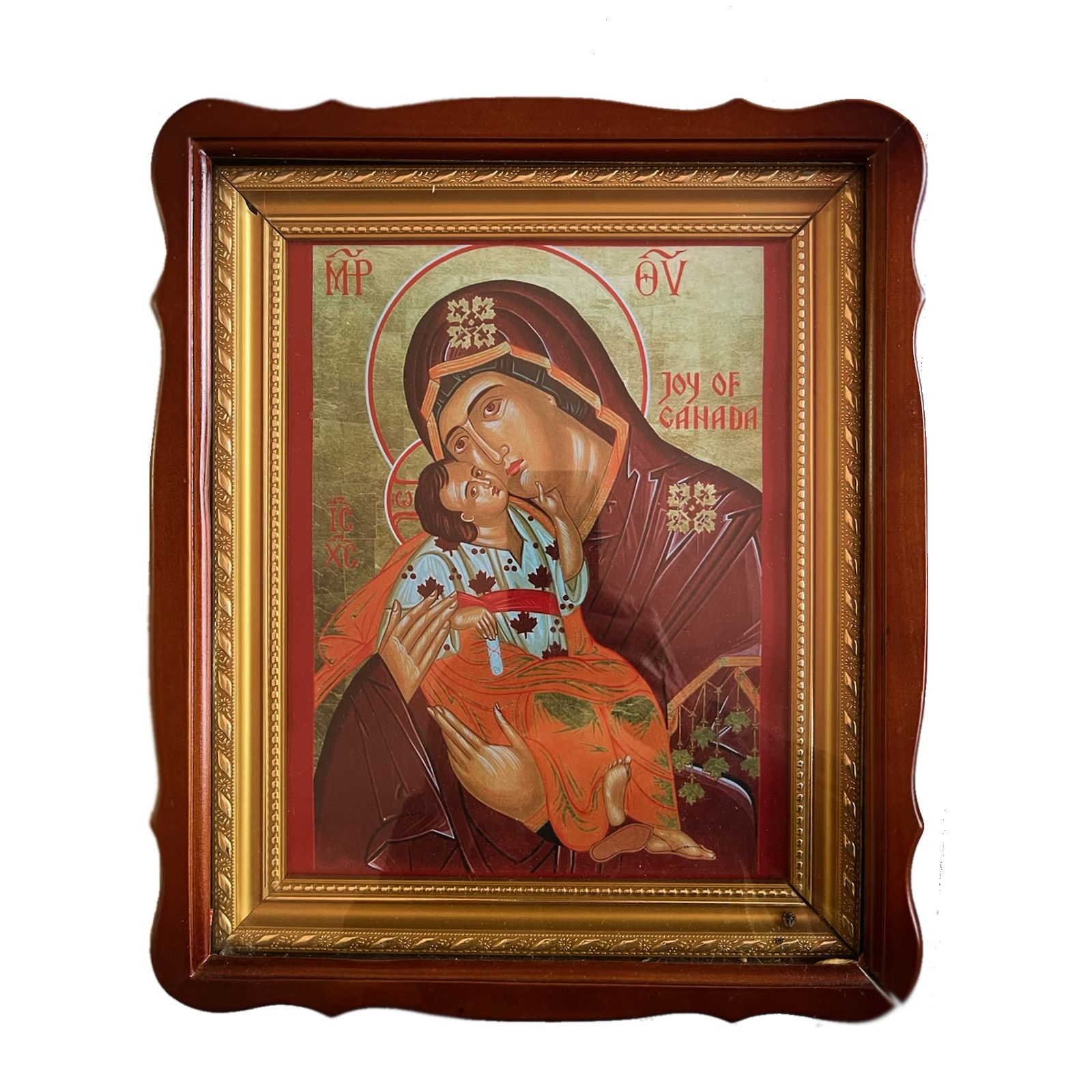
27: The Theotokos Joy of Canada Icon with Archbishop Vladika Lazar
Apr 11, 202500:51:44Tap to summarizeOur conversation begins with the history that led to the commissioning of the icon. We then explore the landscape of meaning associated with such icons in the ancient world, their invocation for the protection of cities, churches and monasteries. We talk about Canada and the way he, through his long ministry, hassought to deepen the presence of Orthodoxy in “our Canadian land and Canadian people” not as a matter of nationalism but of moving the faithful to apprehend the presence of the commonwealth of God is here in Canada as well as in the historical lands that claim Orthodoxy. We touch on the icon of the Theotokos as the icon of the human vocation calling us all to our deepest vocation as birth givers of Divine love in the world. Icons including the Joy of Canada are associate with healing, psychological, physical and spiritual. This last matter, central to the spiritual life, closes out our reflection. Welcome to our conversation.
Transcribe →
26: Rethinking the Ekklesia - with Todd Weibe
Jul 5, 202401:14:46Tap to summarizeAn aspect of Todd’s ministry is embedded in the title of a newsletter he anchors with the provocative title, Evangelically Departed. For the last decade or so, Todd has engaged many and varied evangelicals. Some have departed the church they spent many years attending. Some have raw wounds from their experience in evangelical churches. Many who have sought him out have been seeking to deepen their faith drawing on what is best in evangelicalism and from the deep roots of the Christian tradition.Todd is thoroughly pastoral. His fine mind helps many discover fruitful sources within the fulness of Christian tradition, his spirit one of welcome and engagement, his heart with freedom and purity always touching and calling others into the precincts of grace. Given his relationships and conversations with the Evangelically Departed and those who have found new pathways I wanted to engage his reflections on what is at work within the Evangelical wing of Christianity and glimpse his way of anointing so many with the “oil of gladness.” Welcome to our conversation.
Transcribe →
25: Rethinking the Ekklesia - with Eden Jersak
Apr 25, 202401:29:19Tap to summarizeEden grew up in the bosom of a Mennonite community. Belonging was woveninto her childhood. Her mother and other women were leaders within thechurch. She treasured the piety and pacifism of the church and its politics ofcaring both for its own and for others. She attended Briercrest Bible Collegefrom 1982-1986, met her husband Brad at the College, and, after settling backinto the Frazer Valley of British Columbia and joined by another couple, theyplanted a church called Fresh Winds Christian Fellowship in Abbotsford. Theirexpectation was that it would grow into a church for the Gen X folks whowanted more than their home churches offered. It became a gathering of theworking poor, people with various challenges, and those Eden calls prodigals.For the last few years Eden has co-pastored The Bridge Church a gatheringplace for many who have found “no room in the inn” in the many and variedevangelical churches in the Frazer Valley.
Transcribe →
24: Rethinking the Ekklesia - with Donald Sjoberg
Apr 8, 202401:25:19Tap to summarizeI met Bishop Sjoberg in the late 1970s when he was President of the Western Canada Synod. I was developing the Spiritual Life Sacred Ritual gallery at the Provincial Museum and sought him out for conversation on Lutheran worship. Our conversation ranged widely and I learned about various Lutheran initiatives including work between the ELCIC and the Lutheran Church Canada - Missouri Synod to produce a joint Service Book. Bishop Sjoberg’s childhood formation, his broad ranging experience in Lutheran congregations throughout Canada and internationally and his work as National Bishop has given him a particular vantage point from which to reflect on the church over the last seven decades. It is a blessing to be given the long-view when it comes to the life of the church.
Transcribe →
23: Calum McCracken III
Oct 11, 202300:52:17Tap to summarizeMy conversation with Calum began during his undergraduate studies. We talked about his interests in the political life of a number of countries, on international relations and issues of human rights as both a civil gift and a challenge for some cultural communities. We have also talked about the difficult issues often found in the public square and how we might deepen public understanding across the usual political silos.In this, our third conversation, Calum walks into the origins of Christian Nationalism. Our reflection ranges from the origins of the United States and its puritan and Calvinist patrimony. We explore the legacy of Christian Dominionism under the leadership of R. J. Rushdoony, the seeds of contemporary movements of Christian Nationalism. What are the fears at work surfacing this movement? How does racism and patriarchy figure in how it has unfolded? Why is pluralism anathema to those who claim they want to restore biblical law in the public square? These and other questions shape our conversation together. Welcome to our conversation.
Transcribe →