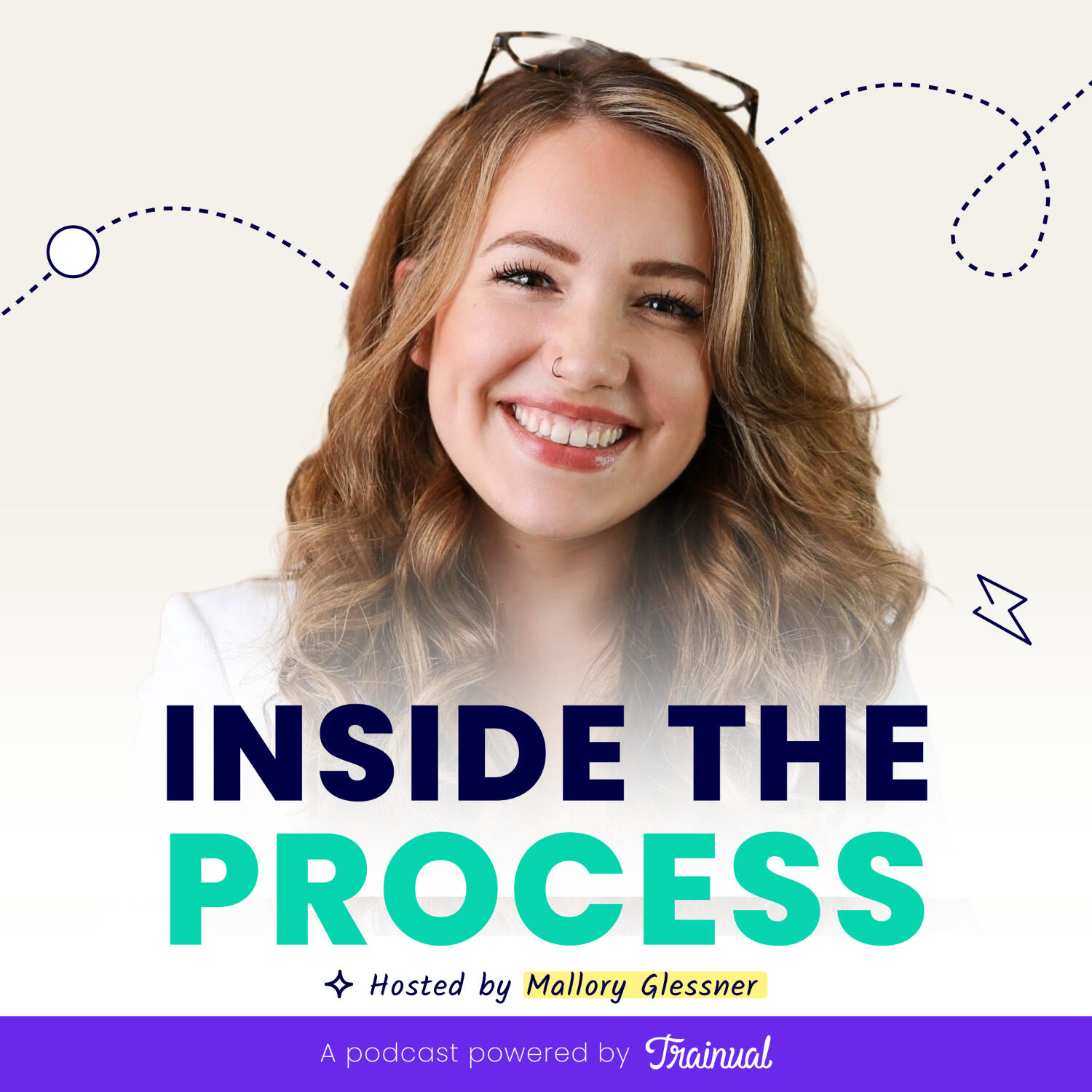
Podcast
Inside The Process
Hosted by Trainual · EN
Inside The Process breaks down the mindset and mechanics behind running a smarter, more efficient business. From solving process headaches and optimizing systems to self-management and leadership growth, this podcast delivers real solutions you can put into action.
Mallory Glessner—a 10-year systems and operations veteran turned marketer at Trainual—sits down with leaders from some of the most innovative, fast-moving companies to uncover how they think and operate. Through their insights, you'll gain strategies to elevate your work and teams.
But Inside The Process isn’t just another business podcast—it’s like having a top-tier consultant in your pocket, minus the hefty fees. Covering everything from business best practices and company culture to leadership tactics and operational efficiency, this show helps you take action and grow your business.
Whether you're a team leader looking for a starting point or a seasoned manager exploring new processes to save time, energy, and money—this podcast is for you.
Hit subscribe to stay updated when the next episode drops!
This is one of several podcasts from Trainual, the software platform that helps businesses build playbooks to train and grow their teams. Check out the rest of our shows here: https://trainual.com/insidetheprocess
20episodes
Episodes
Newest firstAll episodes

Ep. 22: How to get the right people in the right seat w/ Paula Durham
Dec 19, 202400:53:15Tap to summarize"I think to find the right seat for the right person, you need to actually know who they are. You need to understand what they are good at, where they came from, and where they want to go." In this episode of Inside the Process, hosts Mallory and Shawn are joined by Paula Durham, a specialist in transforming creative business operations, to discuss the significance of aligning the right people with the right seats in organizations. Paula shares her insights on identifying strengths and motivations within teams while emphasizing the importance of understanding individuals’ backgrounds and aspirations. Paula explains how the dynamic nature of roles often leads to misalignment and highlights the need for open communication to reassess responsibilities. Paula discusses innovative approaches to fostering a joyful and efficient work environment, such as engaging employees in defining their roles and creating a space for creativity and personal growth. Throughout the episode, Paula underscores that effective leadership requires a balance of transparency, empowerment, and adaptability to ensure both team and individual success. Key Takeaways: Understand individual strengths by engaging team members in discussions to identify their career aspirations and align them with the right goals. Foster transparency by creating a culture of openness with regular check-ins that allow employees to share challenges and reassess their responsibilities.Conduct exercises that enable teams to envision their ideal organizational structure without current constraints.Provide training opportunities that align with both evolving business needs and employee interests to support growth.Celebrate small wins by regularly recognizing and acknowledging individual and team achievements to boost morale and motivation. Chapter Markers: [05:00] The Importance of Alignment [10:00] Meet Paula Durham: Expert in Creative Business Operations [15:00] Understanding Individual Strengths and Aspirations [20:00] The Role of Transparency in Team Dynamics [25:00] Envisioning Ideal Organizational Structures [30:00] Strategies for Effective Communication and Feedback [35:00] Training and Development for Evolving Needs [40:00] Empowering Team Members through Role Reassessment [45:00] Fostering a Culture of Recognition and Celebration [50:00] Conclusion: Continuous Improvement in the Workplace Resources: Want more resources from this episode? We’ve got an episode recap, replay and every template, process, and resource we covered right here: https://trainual.com/insidetheprocess Trainual Inside The Process provides solutions for every aspect of the business — from process headaches and system improvement to self-management and leveling up as a leader. Mallory Glessner and Shawn Jensen sit down with some of the brightest business minds and unpack their specialized insights to help you improve and level up the work you’re doing. This is one of a few podcasts from Trainual, a software platform that helps businesses build playbooks to train and grow their team. You can check out the rest of our shows here: https://trainual.com/insidetheprocess
Transcribe →Ep. 21 How to build career growth paths (that don't always lead to leadership) w/ Barbra Gago
Dec 5, 202400:46:07Tap to summarize"Not everybody wants to be a manager, but the way that we’ve designed these systems is that the way people move up in your organization, the way they’re paid, how far their career track goes, is based on how many levels there are." In this episode of Inside the Process, hosts Mallory and Shawn are joined by Barbara Gago, founder and CEO of Pando, to discuss rethinking career growth, feedback culture, and equitable career development. Barbara shares her experience designing career frameworks that empower individual contributors (ICs) and redefine what it means to grow in a role without the pressure of pursuing traditional leadership paths. Barbara explains how outdated organizational structures and biases have created barriers for ICs, often limiting their growth. She dives into innovative strategies like creating more IC levels, introducing equitable leveling frameworks, and using feedback systems to retain and develop talent. Throughout the episode, Barbara highlights the importance of feedback as a tool for fostering transparency, reducing bias, and building psychologically safe workplaces. Key Takeaways: Develop leveling systems that recognize IC growth without defaulting to management roles. Equitable compensation and clear progression paths are critical.Implement frameworks like “Start, Stop, Continue” or BIC (Behavior, Impact, Question) to provide actionable, unbiased feedback.Embrace flat structures and redefine managerial roles as mentorship-focused, reducing unnecessary layers of hierarchy.Use tools, templates, and regular training to ensure feedback is consistent, constructive, and part of daily processes. Chapter Markers: [1:08] - Meet Barbara Gago: A Leader in Career Growth [2:51] - Creating Growth Tracks: A Framework for ICs [7:45] - Breaking the Myth: Not Everyone Wants Leadership [12:50] - Unbossing: Redefining Management Structures [16:20] - The Peter Principle: Promoting People to Incompetence [21:28] - Career Paths for Individual Contributors (ICs) [28:00] - Tackling Bias in Feedback Systems [32:20] - Continuous Improvement through Constructive Feedback [36:00] - Using feedback as a tool for performance enhancement and retention. Resources: Want more resources from this episode? We’ve got an episode recap, replay and every template, process, and resource we covered right here: https://trainual.com/insidetheprocess Trainual Inside The Process provides solutions for every aspect of the business — from process headaches and system improvement to self-management and leveling up as a leader. Mallory Glessner and Shawn Jensen sit down with some of the brightest business minds and unpack their specialized insights to help you improve and level up the work you’re doing. This is one of a few podcasts from Trainual, a software platform that helps businesses build playbooks to train and grow their team. You can check out the rest of our shows here: https://trainual.com/insidetheprocess
Transcribe →Ep. 20: How to Drive Customer-led Growth (By Getting Inside Their Heads) w/ Georgiana Laudi
Nov 6, 202400:42:20Tap to summarize“The process that we go through is doing customer research to understand that end-to-end customer experience — understanding of customers so that you can identify your biggest opportunities for growth across the customer journey.” In this episode of Inside the Process, hosts Mallory and Shawn chat with Georgiana Laudi, co-founder of Forget the Funnel, about rethinking customer experience through a customer-led growth framework. With decades of experience in SaaS growth, Georgiana breaks down how companies can stop guessing what works for their customers and instead align their strategies to real customer needs, mapping out experiences that drive long-term success. She discusses her approach to understanding customers beyond traditional journey mapping, diving into each phase of the customer experience, and shares how the Jobs to be Done framework helps uncover what customers truly want, creating a foundation for building loyal, satisfied users who champion a brand. Key Takeaways: Break down the customer journey into distinct phases, from pre-acquisition struggles to post-onboarding growth. Identify critical milestones where you can optimize experiences and guide customers to the next step.Instead of focusing solely on demographics, shift your perspective to what customers are trying to achieve with your product. Use this framework to align your messaging and onboarding with the real “jobs” your customers want done.Recognize that customer experience doesn’t end at acquisition — continuously engage customers to deliver ongoing value as they grow with your product. This approach can increase retention and foster a loyal customer base.Rather than relying on generic best practices, tailor your processes to fit the unique needs and behaviors of your ideal customers. Be flexible and data-driven, adjusting your approach based on customer feedback and actual engagement. Chapter Markers: [0:06] Processes vs. Best Practices: Why it matters and how teams misuse them. [0:12] Frameworks That Flex: Adapting frameworks to fit unique customer needs. [2:18] Customer Journey Mapping: Real-world approaches for business growth. [6:02] Struggle Phase: Recognizing when customers need a change and seek solutions. [9:55] Creating Milestones: Key points that drive customer success. [22:06] Breaking Down Silos: Aligning teams for a unified customer experience. [31:00] Using KPIs: Measuring impact through meaningful customer experience indicators. [38:09] Avoiding Best Practice Pitfalls: Why not all best practices serve your team. Resources: Want more resources from this episode? We’ve got an episode recap, replay and every template, process, and resource we covered right here: trainual.com/insidetheprocess Trainual Inside The Process provides solutions for every aspect of the business — from process headaches and system improvement to self-management and leveling up as a leader. Mallory Glessner and Shawn Jensen sit down with some of the brightest business minds and unpack their specialized insights to help you improve and level up the work you’re doing. This is one of a few podcasts from Trainual, a software platform that helps businesses build playbooks to train and grow their team. You can check out the rest of our shows here: trainual.com/insidetheprocess In this episode Mallory and Shawn chat with Georgiana Laudi, co-founder of Forget the Funnel, about rethinking customer experience through a customer-led framework.
Transcribe →Ep. 19: How to Make Training Stick (And not Suck!) w/ Sara Berry
Oct 23, 202401:00:59Tap to summarize“I think anything can be training. Anything can be a learning moment.” In this episode of Inside the Process, hosts Mallory and Shawn are joined by Sara Berry, founder of Out of the Office Learning. With extensive experience across training programs for companies like Nielsen, AT&T, Comcast, and more, Sara shares her insights on how to make workplace learning both effective and fun. Sara discusses the challenges many businesses face when it comes to employee engagement in training and how traditional, boring training methods are no longer effective in today’s fast-paced, media-heavy world. Instead, Sara advocates for creating engaging learning experiences through humor, collaboration, and breaking down complex subjects into digestible, memorable content. By making learning an integral part of daily work and embracing flexibility, organizations can foster more innovative and adaptable teams. Key Takeaways: Incorporate learning into daily tasks and interactions to make it a seamless part of the workday. This creates an ongoing learning culture, rather than relying on one-time training events.Add humor, storytelling, and interactive elements to keep employees engaged during training. Fun and relatable content makes learning more memorable and enjoyable.Break complex topics into small, focused lessons that employees can easily absorb and apply. Short bursts of information help improve retention and save time.Promote knowledge-sharing by encouraging employees to teach and learn from one another. Peer-to-peer learning fosters collaboration and strengthens team dynamics.Customize training to fit different learning styles and generational preferences. Use a variety of formats like videos, podcasts, and user-generated content to meet diverse needs. Resources: Want more resources from this episode? We’ve got an episode recap, replay and every template, process, and resource we covered right here: https://hubs.li/Q02C6rhq0 Got a taste and hungry for more? Join us at Playbook 2024 for three days of game-changing strategies, hands-on workshops, and real-time wins that'll supercharge your business. Get your tickets now! Trainual Inside The Process provides solutions for every aspect of the business — from process headaches and system improvement to self-management and leveling up as a leader. Mallory Glessner and Shawn Jensen sit down with some of the brightest business minds and unpack their specialized insights to help you improve and level up the work you’re doing. This is one of a few podcasts from Trainual, a software platform that helps businesses build playbooks to train and grow their team. You can check out the rest of our shows here: https://trainual.com/category/podcasts
Transcribe →Ep. 18: How to Plan for the (Uncertain) Future of Work w/ Bhushan Sethi
Sep 26, 202400:50:32Tap to summarize"We all wake up every day in our professional lives wanting to solve important problems and be enriched in the jobs we do. We’ve got to tap into the human side of the business a lot more.” In this episode of Inside the Process, hosts Mallory and Shawn sit down with Bhushan Sethi, a leading strategist and partner at PwC. Bhushan shares insights from his extensive experience in guiding organizations through complex changes at the intersection of global strategy, economics, and people. As businesses face increasing uncertainty, Bhushan emphasizes the importance of planning and adaptability. From exploring different business scenarios to preparing for technological shifts like AI, Bhushan explains how organizations can stay agile and resilient in the face of change. Throughout the episode, Bhushan discusses how leaders can engage their teams in planning, manage resistance to change, and foster a culture of experimentation. His advice is not only for large organizations but also for small businesses looking to stay ahead of emerging trends. Key Takeaways: Instead of predicting the future, prepare for various outcomes by exploring different business scenarios, including technology advancements and demographic shifts.Make employees part of the journey by involving them in planning and decision-making processes to foster buy-in and reduce resistance.Encourage experimentation within your organization, whether it’s through AI testing or business process redesign. Allow teams to learn and adapt in a low-risk environment.Understand the long-term implications of demographic changes on your workforce and plan accordingly, from talent acquisition to technology integration.Fear is a natural response to change, but organizations can harness that energy and turn it into excitement for innovation and growth. Chapter Markers: [03:21] The one essential step leaders must take to prepare for uncertainty. [04:30] Why planning for multiple scenarios is crucial for businesses facing uncertain futures. [06:33] Insights on balancing detailed planning with the need for flexible, agile execution. [09:31] Signals that indicate it's time to shift from planning mode to executing strategies. [12:47] Exploring how changes in demographics will affect the future labor force and economy. [22:30] How businesses can use experimentation to reduce risk and embrace new technologies like AI. [27:00] Techniques for addressing anxiety and building excitement around organizational change. [40:03] Addressing trust gaps and polarization in the workplace to unite teams. Resources: Want more resources from this episode? We’ve got an episode recap, replay and every template, process, and resource we covered right here: https://hubs.li/Q02C6rhq0 Got a taste and hungry for more? Join us at Playbook 2024 for three days of game-changing strategies, hands-on workshops, and real-time wins that'll supercharge your business. Get your tickets now! Trainual Inside The Process provides solutions for every aspect of the business — from process headaches and system improvement to self-management and leveling up as a leader. Mallory Glessner and Shawn Jensen sit down with some of the brightest business minds and unpack their specialized insights to help you improve and level up the work you’re doing. This is one of a few podcasts from Trainual, a software platform that helps businesses build playbooks to train and grow their team. You can check out the rest of our shows here: trainual.com/insidetheprocess
Transcribe →Ep. 17: How to Cultivate a Values-Based Culture Through Ethical Leadership w/ Ann Skeet
Sep 16, 202400:52:37Tap to summarize"Leaders in organizations are responsible for other people's careers. If you lead your division or your organization to a significant misstep, you're really harming the future resume value of everyone that comes from that company." In this episode of Inside the Process, Mallory and Shawn dive deep into the ethical challenges and leadership dynamics with Ann Skeet, the Senior Director of Leadership Ethics at the Markkula Center for Applied Ethics. With a wealth of experience ranging from corporate ethics to educational leadership, Ann provides invaluable insights into fostering a healthy organizational culture, the role of ethical decision-making, and the future challenges leaders face. Ann shares her thoughts on the importance of balancing short-term gains with long-term ethical practices. She also discusses the impact of new technologies, particularly AI, on ethical leadership and the necessity to develop robust frameworks to guide responsible technology development. Key Takeaways: Building strong, empathetic relationships within an organization encourages ethical behavior and a sense of mutual obligation among team members. Leaders should focus on creating a sense of community through storytelling, cross-functional collaboration, and regular check-ins, even in remote settings.It’s important to integrate ethical decision-making frameworks into daily business practices. This includes using tools like the six lenses of ethical decision-making and ensuring that company values are not just words on a wall but are actively used in guiding decisions.With the increasing integration of AI in the workplace, leaders must establish clear principles and frameworks for responsible technology use, ensuring that innovation aligns with ethical standards.The foundation of ethical leadership is the leader's character. Self-care, continuous personal development, and the role of mentors are also important in fostering ethical behavior. Chapter Markers: [02:39] How short-term tolerance of unethical behavior can harm long-term success and culture within organizations. [04:03] The framework for a healthy culture, emphasizing fostering empathetic relationships, integrating organizational functions, and developing organizational introspection. [12:26] Advice for leaders on balancing the pressure to grow the business with staying true to core values and ethical practices. [14:03] Taking a long-term view when making decisions to ensure they align with the company’s mission and values. [17:36] The framework for ethical decision-making based on six lenses. [28:22] How leaders can respond to crises in a way that reinforces ethical practices and clarifies company culture. [31:15] Whether ethical behavior can be taught through mentorship and character education. [41:12] The challenges HR and AI present in the business world, especially in balancing ethical considerations with business objectives. [47:45] How leaders can encourage innovation while maintaining ethical standards through storytelling, cross-functional teams, and ethical principles. Resources: Want more resources from this episode? We’ve got an episode recap, replay and every template, process, and resource we covered right here: trainual.com/insidetheprocess Got a taste and hungry for more? Join us at Playbook 2024 for three days of game-changing strategies, hands-on workshops, and real-time wins that'll supercharge your business. Get your tickets now!
Transcribe →Ep. 16: How to Create a “No Fluff” Messaging Strategy with Diane Wiredu
Aug 29, 202400:56:28Tap to summarize"You can have the best product in the entire world, but if you're talking about it in a way that doesn't resonate, that doesn't make sense, your business will die." In this episode of Inside the Process, Mallory and Shawn sit down with Diane Wiredu, the founder of LionWords and an expert in messaging strategy. Diane shares her journey, insights, and actionable advice on how companies can develop a messaging playbook that not only aligns internal teams but also resonates with customers. Diane talks about the significance of clear and effective messaging for businesses. She explains how a well-crafted messaging strategy is essential for aligning internal teams and resonating with customers — as well as the importance of avoiding buzzwords and fluff. Throughout, Diane underscores the critical role that clear and consistent messaging plays in driving business success. Key Takeaways: Understand that messaging is about what you say, while copywriting is about how you say it. Messaging should articulate the most important aspects of your company, product, or service, and why it matters to your audience — strong messaging forms the foundation for effective copy.Build a messaging playbook, AKA a practical guide for your business to create consistency in communication. Foundational elements such as brand positioning, values, buyer personas, and key differentiators are super important.Cut out the buzzwords that dilute your message. Instead, focus on specific, clear language that directly speaks to your audience’s needs and challenges.Regularly engage with your customers to keep your messaging relevant and aligned with their evolving needs. Deep customer research ensures your messaging resonates and achieves message-market fit.Use AI with caution. While AI can be a useful tool for brainstorming and process improvements, it cannot replace the need for human insight and a deep understanding of your audience. Chapter Markers: [03:26] The difference between messaging and copywriting and why clarity in messaging is essential. [05:33] The key elements of a messaging playbook, from brand positioning to value propositions. [07:59] What constitutes "fluffy" messaging and the issues it creates for businesses. [12:11] The concept of "message-market fit" and its importance in ensuring messaging resonates with the audience. [17:59] The Value Proposition Framework for developing compelling value propositions, including the old way, customer pain, product capability, and customer gain. Resources: Want more resources from this episode? We’ve got an episode recap, replay and every template, process, and resource we covered right here: trainual.com/insidetheprocess Got a taste and hungry for more? Join us at Playbook 2024 for three days of game-changing strategies, hands-on workshops, and real-time wins that'll supercharge your business. Get your tickets now!
Transcribe →Ep. 15: How to Manage People Performance with Karen Weeks
Aug 14, 202400:52:07Tap to summarize“High performance is all about understanding what the goals are, how we're going to get there, and what ‘good’ versus ‘great’ looks like.” In this episode of Inside the Process, Mallory and Shawn sit down with Karen Weeks, the Global Chief People Officer at Obviously. Karen shares her journey and insights on defining and nurturing high performance within teams, the importance of understanding individual needs, and the role of feedback in professional development. Karen discusses how to balance being a high performer and a supportive leader, the significance of personality assessments, and the value of mentorship programs. She emphasizes the necessity of personal growth for leaders and provides actionable advice on delivering constructive feedback. Key Takeaways Leadership needs to be tailored. Leaders should align their expectations and development plans with their team's goals and individual needs. For example, focus on individual needs rather than generational stereotypes. Understand each team member's unique motivations and career aspirations.Regular, constructive feedback should be embedded in the company culture. It's crucial to create an environment where feedback is expected, timely, and actionable. Prepare thoroughly for feedback conversations, engage in a dialogue rather than a monologue, and ensure follow-up actions are clear and supportive.Tools like DISC and Myers-Briggs can help understand team dynamics and individual preferences, but should not be used to pigeonhole potential.Implementing mentorship programs fosters a culture of continuous learning and personal growth. Leaders should also invest in their own development and openly share their learning journeys. Chapter Markers [02:00] Discussing the concept of high performance and its varying definitions across teams and companies. [06:00] Exploring how leaders can define high performance and set performance goals aligned with the company's vision. [10:00] The distinction between good and great performance, and how leaders can guide their teams towards excellence. [14:30] Emphasizing the role of regular feedback in employee development and creating a culture of continuous improvement. [19:00] The use of personality tests in understanding team dynamics and their role in promoting development. [24:00] How leaders can adapt their management approach based on the specific needs and goals of different teams. [28:00] The significance of delegation in leadership and how it can serve as a development opportunity for team members. [32:30] Addressing generational differences in the workplace and strategies for managing performance across diverse age groups. [37:00] Encouraging a culture of feedback and learning within the organization, with leaders leading by example. Resources: Want more resources from this episode? We’ve got an episode recap, replay and every template, process, and resource we covered right here: trainual.com/insidetheprocess Got a taste and hungry for more? Join us at Playbook 2024 for three days of game-changing strategies, hands-on workshops, and real-time wins that'll supercharge your business. Get your tickets now!
Transcribe →Ep. 14: How to Master the Art of Clear & Confident Communication w/ Ty Hoesgen
Aug 6, 202400:54:02Tap to summarize“Most people think, ‘I don't want to listen to myself talk,’ but I do feel that that's one of the absolute best ways to get better at communicating because you are your own worst critic in both negative and positive ways.” In this episode of Inside the Process, Mallory and Shawn delve into the intricacies of effective communication with Ty Hoesgen, a renowned communication coach and two-time bestselling author. Ty shares his transformative journey from a shy farm boy to a confident and skilled communicator who has helped thousands of professionals enhance their communication abilities. His story is a testament to the power of perseverance and the impact of mastering communication skills. Ty offers a wealth of practical advice, personal anecdotes, and actionable frameworks designed to help listeners improve their own communication skills. From overcoming anxiety and imposter syndrome to refining the clarity and impact of their messages, Ty's insights are invaluable for anyone looking to connect more effectively with their audience. Whether you're presenting in a boardroom or having a casual conversation, this episode provides the tools you need to communicate with confidence and clarity. Key Takeaways: Use the "Point, Reason, Point" Framework (PRP). Begin your communication with your main point, explain the reasons behind it, and then restate your main point for clarity. This framework ensures that your communication is clear and concise, reducing the risk of rambling.Approach every speaking opportunity as practice rather than a performance. This mindset shift reduces performance pressure, helping you stay relaxed and focused. Remember that each speaking engagement is a chance to practice and improve.To overcome anxiety before speaking, use the SBVS technique: Sit up straight to optimize your body language and improve your state of mind, use the physiological sigh (a double inhale through the nose followed by an extended exhale through the mouth), visualize a positive outcome or something that brings you joy, and smile to release feel-good chemicals and promote relaxation.Understand that feeling like an imposter is a natural part of the process until you have gained extensive experience. Focus on how you can help others with your knowledge and practice extensively to build confidence and reduce anxiety.When practicing active listening, use the phrase "It sounds like..." to paraphrase and confirm your understanding of what the other person is saying. This technique helps ensure clear communication and demonstrates that you are actively listening. Chapter Markers: [2:30] Different interpretations of emojis, highlighting the potential for miscommunication. [8:45] The significance of clear communication and how often people fail to convey their messages effectively. [12:20] The Point-Reason-Point (PRP) Framework and how it helps in organizing thoughts and delivering clear messages. [17:05] Common issues of nervous energy and over-talking in communication, and tips to manage these challenges. [21:30] The importance of recording oneself to evaluate and improve communication skills, and the benefits of self-analysis. [26:00] Seeking feedback selectively from peers and using it effectively to improve communication skills. [29:40] How to manage anxiety before public speaking, including body language optimization, deep breathing, and visualization. [34:10] Tips on active listening, paraphrasing, and providing constructive feedback using structured frameworks like BIC. Resources: Want more resources from this episode? We’ve got an episode recap, replay and every template, process, and resource we covered right here: https://hubs.li/Q02C6rhq0 Got a taste and hungry for more? Join us at Playbook 2024 for three days of game-changing strategies, hands-on workshops, and real-time wins that'll supercharge your business. Get your tickets now!
Transcribe →Ep. 13: How to Implement a Rinse & Repeat Framework for Customer Acquisition w/ Marc Thomas
Jul 5, 202400:42:51Tap to summarize"Make something people will love us for because they love you." In this episode of Inside the Process, Mallory and Shawn chat with Marc Thomas, an experienced marketer specializing in growing B2B SaaS businesses and the mind behind the popular Positive Human blog. Marc shares his innovative "Rinse and Repeat" framework, designed to help businesses attract new customers by breaking free from outdated marketing playbooks and embracing creativity. Marc emphasizes the importance of understanding customers deeply, using a mix of qualitative and quantitative data to build compelling narratives that drive marketing success. He also shares actionable insights on managing risks and creating memorable campaigns, even with limited resources. Highlighting the need for continuous innovation, Marc provides real-world examples and practical advice to help marketers connect with their audiences on a deeper level. Key Takeaways: These days, there are difficulties in performance marketing due to technical and privacy issues, AI, and market saturation. Move away from old marketing playbooks to more innovative approaches, such as sponsoring niche influencers and creating engaging content.The “Rinse and Repeat” framework consists of four steps: Relate, Ideate, Narrate, and Repeat. Relate involves deeply understanding customers; Ideate focuses on creating unique campaigns; Narrate involves building a compelling narrative with qualitative and quantitative data; Repeat emphasizes the iterative nature of this process.The framework is designed to empower creativity within marketing processes. By providing broad steps instead of rigid rules, it encourages marketers to innovate and adapt their strategies to better connect with their audiences.Marketing means getting uncomfortably close to customers and using diverse data sources to understand them deeply. This involves current customer research, product data, surveys, and more.Take calculated risks based on deep customer insights, rather than sticking to safe but ineffective traditional methods. Chapter Markers: [02:15] Overview of the Rinse & Repeat framework for customer acquisition. [04:30] Challenges faced in traditional performance marketing and the need for more innovative approaches. [07:20] Steps of the Rinse & Repeat framework, emphasizing the importance of unique campaigns and narrative-driven ROI. [11:45] The importance of deep customer research is highlighted, with examples of effective customer engagement strategies shared. [16:10] Leveraging niche influencers and success stories from targeted marketing campaigns. [20:30] Embracing calculated risks, innovation, memes, and trending content to drive engagement. [25:00] Overcoming the fear of failure and the balance between innovation and potential downsides. [30:15] Using qualitative and quantitative key metrics and attribution models, and how to build narratives around marketing investments. [34:00] Real-world applications of the Rinse & Repeat framework, with various success stories and case studies. Resources: Want more resources from this episode? We’ve got an episode recap, replay and every template, process, and resource we covered right here: About Trainual Inside The Process is the real-time podcast that is a practical antidote to process headaches. In each monthly episode, we share thousands of dollars worth of free, actionable frameworks to help you take action and grow your business. If you’re a team leader who is wasting time, energy, and money trying to solve a business problem and isn’t sure where to start, this is the show for you. http://trainual.com/insidetheprocess
Transcribe →