Loading summary
Transcript64 lines
- [00:01]
Mary Beard
The spirits came up and gathered round teenagers, girls and boys, the old who suffered for many years, and fresh young brides whom labour destroyed in youth. And many men cut down in battle by bronze spears, still dressed in armour, stained with their blood. From every side they crowded around the pit with eerie cries. Pale fear took hold of me.
- [00:30]
Charlotte Higgins
That's from book 11 of Homer's Odyssey, when the hero Odysseus is conjuring up the shades of the dead. And to be fair, there comes a moment in the life of quite a lot of Greek heroes when a visit to the underworld becomes pretty much inevitable. Odysseus, but also Heracles, Orpheus, Theseus and others make the trip. And not just the boys. Actually, not just the boys. There's at least one. There's Psyche, a human princess who makes the journey to the underworld and comes back alive.
- [01:00]
Mary Beard
In this, which is the second of our Halloween episodes, we are crossing the River Styx and we're taking our own journey to the underworld, guided by the myths of Greece and Rome. We're going to meet some ghosts, of course, but we're also asking, what exactly was the underworld? Is it different to the heaven and hell of modern Christianity? How do you get your way around it? And how do you get out? Again, we've got some good company. We go to meet some muscly heroes who went down to the underworld, but also the God Hades who presided over it, his wife Persephone, and the many headed dog Cerberus, who guarded the part of it. But we'll see. There's a lot more at stake than just the terror of meeting some ghosts.
- [01:57]
Charlotte Higgins
Facing and surviving an encounter with death was seen to be a turning point in a hero's life, the moment where they come to understand themselves and their purpose. From then on, it may not be quite plain sailing, but at least they know broadly where they're going.
- [02:13]
Mary Beard
This is Instant Classics, the podcast that uncovers the ancient space stories that still shape the modern world. I'm Mary Beard.
- [02:22]
Charlotte Higgins
And I'm Charlotte Higgins. Each week we dive into the myths, the dramas and the characters of the classical world to discover what they still mean to us.
- [02:30]
Mary Beard
Now, this episode, A Trip to the Underworld.
- [02:44]
Charlotte Higgins
To some, he is the revolutionary hero
- [02:46]
Mary Beard
who restored China to its rightful place on the global stage.
- [02:50]
Charlotte Higgins
To others, he's a brutal despot accused of presiding over more civilian deaths than either Stalin or Hitler. Mao Zedong has one of the most
- [02:58]
Mary Beard
recognizable faces in the world, yet he
- [03:01]
Charlotte Higgins
started life in a muddy provincial village. A rebel son who hated his father survived a 6,000 mile walk across China and rose to become a figure of titanic proportions From Empire.
- [03:13]
Mary Beard
The Goal Hangar World History Show. I'm Anita Anand.
- [03:17]
Charlotte Higgins
And I'm William Duranpol.
- [03:18]
Mary Beard
In this six part series, we're joined by world renowned expert Rana Mitter to
- [03:24]
Charlotte Higgins
explore the life of the father of
- [03:26]
Mary Beard
Communist China, Mao Zedong.
- [03:28]
Charlotte Higgins
We'll track his rise from a bookstore owner to a guerrilla commander. And we'll witness his ruthless elimination to secure total power. And we'll descend into the dark experiment of the Cultural Revolution, a time when ancient temples were burnt, children denounced their parents and a nation worshipped a mango as a sacred relic.
- [03:49]
Mary Beard
Subscribe to Empire wherever you get your podcasts to listen. Now, where do we start? I mean, I think one place to start is with the simple fact that we're still surrounded by images and reworkings of the ancient underworld. It's still part of our literary tradition, our films on novels.
- [04:13]
Charlotte Higgins
No, absolutely. I mean, you know, I mean a sort of obvious one, although one could hardly call it modern, is Dante's Inferno part of the Divine Comedy? And the whole, the whole idea of Dante's Virgil, Dante's journey to the Land of the Dead, guided by Virgil, who's one of the authors we're going to talk about today, is, you know, it's one of the fundamental moments in European literature and that. And all the way up to one of my favourites, actually. I adore the novels of Philip Pullman and his characters Visit the Dead Lyra and Will Visit the Land of the Dead and that and Philip Pullman's Land of the Dead, I'm sure he would be the first to say, would be absolutely impossible imaginatively, without the classical ideas of the Land of the Dead, without specifically Homer and Virgil.
- [05:07]
Mary Beard
But if you go a bit more pop, you know, there's the West End musical Hades Town and I've just picked up, I haven't really got into it yet, R.F. kuang's novel Katabases Going down, it's kind of fantasy novel where she goes to bring back her academic tutor from the dead so that he can write a reference for her, which she needs, and he's inconveniently died.
- [05:45]
Charlotte Higgins
Seems like a lot of trouble to go to.
- [05:47]
Mary Beard
I think that it's kind of easy to see how the underworld has, you know, weaves its way through our own popular culture and our own highbrow culture. But I mean, I think the question for me is does that modern image that we have of the ancient underworld, Hades crossing the River Styx and all that kind of thing, how far is that like what the real ancient vision of the underworld was, that's trickier. I think what I find amazing is that we do want, we still want to say what was the, the ancient view of the underworld. And I suppose I've fallen into that trap already a bit when we know that the ancients had as many different views about what happens to you after you die as we do. But we've got this kind of image that they all thought this about what happened after you were dead. And people are so sure that, that there is an ancient version to be grasped that what is amazing is that some very well respected academics waste their time actually going through all the different accounts that the different ancient authors give of what a visit to the underworld was like. And then believe it or not, they try to draw a map of it. You know, this is where the river Styx was and this is where the groves were. This is the Elysian Field now. And I think that to some extent before we get any further in this, we, we've got to accept the fact that the underworld is a very fuzzy place. You can't map it. And if you try and you go through these accounts of different heroes going down there, like Aeneas in Virgil's epic poem the Aeneid, if you start to say, well, where did he go next? I'm afraid you end up. Well, it's frankly a bit ridiculous. And you've got this, you have to say, I want to think how they picture this in big terms, not in go to the river Styx and then turn left kind of style, which is, I'm afraid, a lot of what you find.
- [08:10]
Charlotte Higgins
I mean the crucial thing is no one's ever been there because guys, it doesn't actually exist as much as we would like to imagine that it does. But there are sort of common analysis. There are, there is an idea that there's a river that you cross the river Styx. There is an idea that this place is ruled over. It's both called. Hades has different names, this underworld, doesn't it? It's Hades, it's Erebus. It's ruled over by the God Hades, who's the brother of Zeus and his wife Persephone, who has her own elaborate myth about how she got there. Because she did not start out as queen of the underworld. She's sort of enticed there or seized and captured and made to be queen of the underworld. And you know, all the dead end up there. We hear in various accounts that the kind of gory punishments of some of the really, really wicked People and the famous ones are kind of. Tantalus is tantalized by delicious fruits that hang above his head and delicious things that lie at his feet. Water that lies in a pool that lies at his feet. And he can't, every time he tries to a plump fruit or bend down to take a draught of water, these things sort of slide away from him. So he's constantly tantalised. Or Sisyphus, who tries to roll, whose job, whose punishment is to roll a huge boulder up a mountain, but he can never ever, ever get it down the other side. So there are these sort of, we have these sort of like, not exactly fixed points, but I suppose if you say, what's the underworld like? I would definitely think of the river Styx, Hades and Persephone and a couple of these sort of really dreadful punishments and then a whole load of wraith, like ghosts who are the countless numberless dead, as the poets say, like the numberless leaves falling in the autumn from the trees, you know, like the sort of infinite number of ghosts.
- [10:15]
Mary Beard
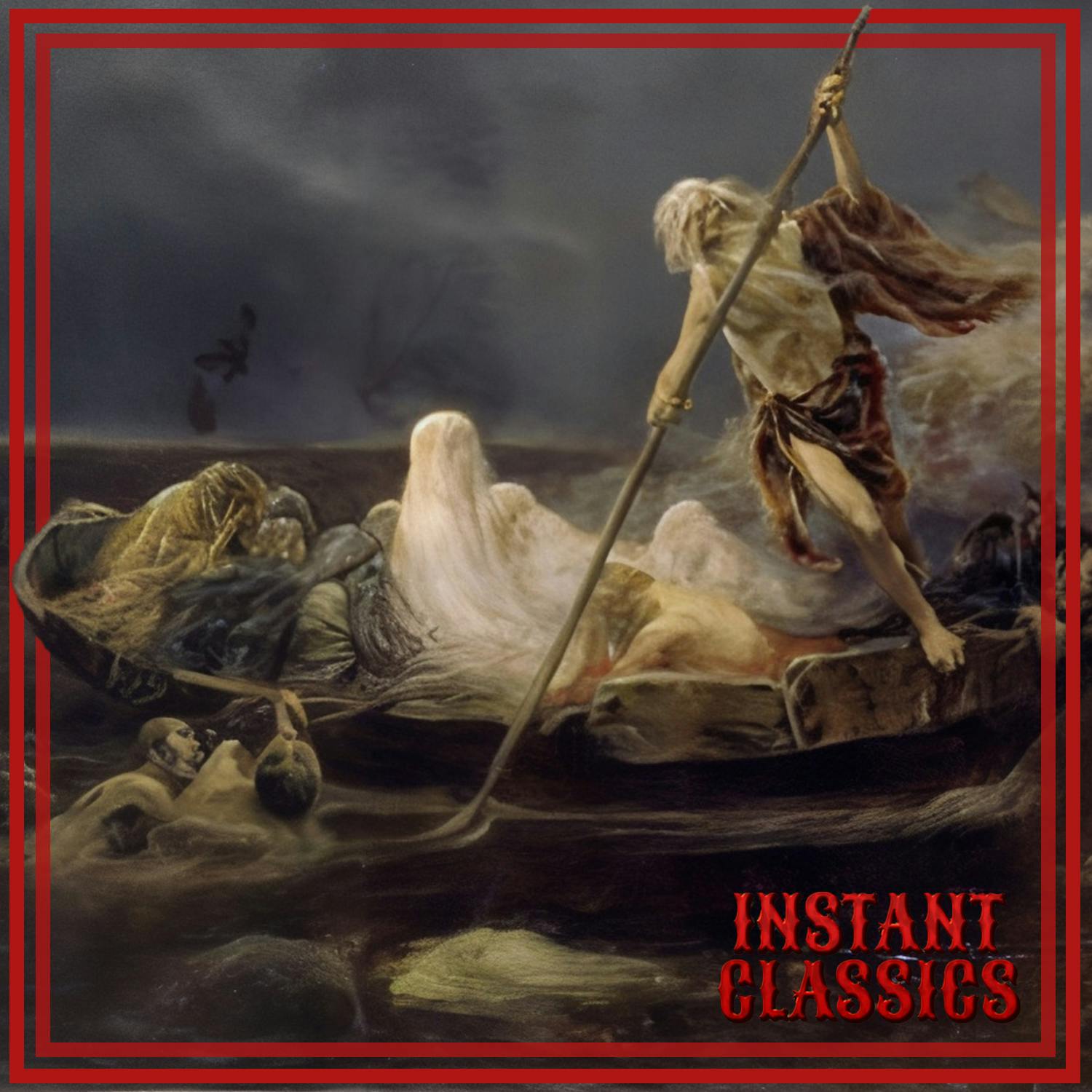
There is a sense that there are, there are sort of rules underlying all this that, you know, you can't get across the River Styx unless you've been properly buried. Quite a lot of the accounts of the underworld in ancient mythology have the, have the unburied dead still waiting a certain length of time before they can be allowed to cross over into the underworld. And you know, I think it's interesting, I mean, I know I've just said that there is no single version of what the underworld is or what you have to do to get there safely when you die. But it is interesting, I think, that outside the realm of stories, and we're going to come on to some of the best ones in a minute, if you are an archaeologist and you're digging up Roman skeletons, you will quite often find in the mouth of the skeleton a coin. And that is put there because of the idea that Charon, the guy who's going to row you across the Styx to get properly into the underworld when you've been buried, he needs a fee. He's a money making enterprise. And I think that what's interesting is that that shows that however far it goes, in whatever different versions there are, there are quite a lot of people in the Roman world who would say, I'm going to put a coin in granny's mouth so she can get across the River Styx, that there is something about these stories which are sort of widely shared if not believed.
- [12:00]
Charlotte Higgins
So let's just think about who went there for a minute. I mean for all these stories of heroes going to the underworld, it's not going down in a way that's the most difficult thing is getting back. It's always getting back and getting back with the thing that you came for as well. I mean suppose the really sad, famous, gorgeous once stories of Orpheus which is told very beautifully in various sources but like in, I'd say perhaps most memorably in Ovid's the Roman Poet, ovid's Metamorphosis, a 1st century CE poem. And Orpheus is absolutely gut wrenched and he's devastated, devastated by the death of his wife Eurydice. And so he goes down to the underworld to try to get her back and he almost succeeds because he plays his musical and his lyre, his plucked musical instrument so beautifully and sings so gorgeously. Then he sort of enchants the rather grim faced, ghastly king of the underworld, Hades and his wife Persephone. And they are persuaded to allow Orpheus to take Eurydice back to the surface, back to the upper world. But on one condition. Orpheus is not allowed to look back. So he gets all there he is playing his musical instrument, climbing up to the sort of place where you could reach the surface of the world again. And he almost, almost gets there and at the very last minute he looks back and to check that Eurydice is behind him and she's. That's it, she's gone, she's pulled back down to the underworld and he'll have to wait till he dies to see her again.
- [13:54]
Mary Beard
I can't resist saying that there's a wonderful riff on that story in a poem by Carol Anne Duffy un who describes evokes Orpheus going down to get Eurydice and the whole condition about how he shouldn't look back. And in Duffy's version Eurydice is heartily relieved when he does look back because she doesn't have to go up back to the real world with the bloke she doesn't much want to be with.
- [14:27]
Charlotte Higgins
That's a fun. That is a fun poem. That is a fun poem. And Heracles, you know, Heracles is the greatest hero of all time. And he goes, you know, not once but twice because he, one of his labors is to capture the many headed terrifying dog Cerberus, which he does. And then on another occasion he goes down to fetch back his mate's wife Alcestis, which is the subject of a beautiful play by Euripides called Alcestis. Theseus goes down, almost gets stuck there Theseus, with his mate Pirithous, is trying to abduct the queen of the underworld. Amazingly enough, that goes really badly and they do not succeed in doing this. But Theseus manages to get back eventually. And then one of my favorites actually is Psyche. This she's a woman and she goes down there. This is in the Golden Ass, a so called novel by Apuleius. It's a story told within this so called novel, ancient novel, and she's trying to find the lover that she's mislaid, Eros or Cupid. And she is set some very, very horrible tasks, a bit like a fairy tale. She's set various tasks and quests by the goddess Aphrodite. And one of them is to go down to the underworld. And she succeeds, she goes down there and she gets back and she's amazing.
- [15:59]
Mary Beard
We love cycling, but I think that we need to get onto the biggies now, because we started by reading out just a few lines are from Homer's account of Odysseus's journey to the underworld at the very middle point of the great epic story, the Odyssey. And this is really the earliest Greek account that we have of how you do a visit to the underworld. And it's totally formative, I think, both of other later ancient versions, although they differ in sometimes significant respects, but it's also formative of how we see the underworld. And I think that the thing we've got to get straight absolutely at the beginning is that there's one thing that Odysseus, when he's visiting the underworld, doesn't do, is that he doesn't go down. I think we've talked about the Katabasis, the going down to the underworld, and that is mostly how it is. It is the underworld, what Odysseus does. And we'll explain in a bit how he gets there. But Odysseus actually goes to the edge of the underworld. He does all sorts of weird rituals and he brings the ghosts up to him. He doesn't go down to them, he conjures them up. So it isn't a going down at all, it's really necromancy. It's close to witchcraft in a way, the way that Odysseus does this. And I think you have to always bear that in mind that this is although the kind of ancestor of these underworld stories. The Odyssey isn't really an underworld story at all.
- [18:01]
Charlotte Higgins
No, it's part of his. It's part of his shipborne adventures. He is advised or he strongly suggested that he should go there by the person he's just been visiting, the witch Circe, because he's supposed to go. She tells him, in order to get home, you need to consult this prophet. Unfortunately, the prophet is dead, Tiresias, so you're going to have to go consult his ghost. And his ghost is to be found, you know, on the edge of the underworld. And the way you get. So this is sort of about how the Odyssey, the poem, thinks of the geography of the world. There's all the stuff we know about, vaguely, like Ithaca and Argos and Troy. In the middle of this map, surrounded by sea. And then at the edge of everything, this is a flat world. At the edge of everything, there's something called the Ocean Stream. And somewhere by the ocean stream, there is the land of the Cimmerians, who live in virtual darkness. And he has to get there. So he sails there. And in this dark and gloomy land, he then has to perform, like you said, Mary, he has to perform these really quite creepy rituals. You know, he has to dig a pit, he has to sacrifice a bunch of sheep. He has to do, you know, he has to pour wine and water into this pit. He has to sprinkle barley over it. And, you know, and then eventually these all. All the ghosts swarm up to him and a terrifying crowd. You know, it's really creepy Halloween stuff. They swarm up to him because they're all eager. They're all eager to be fed blood, which is the thing that is going to make them able to speak. So it's really quite.
- [19:56]
Mary Beard
Yeah, yeah. Homer's version of these dead ghosts is that they can't do anything, really, apart from flit around. Cause they haven't got any blood. So if you want to talk to a ghost, if you want to kind of operationalise a ghost, what you've got to do is you've got to, through the ritual of sacrifice, provide blood for them. And once they've got some blood, then you can have a chat, you can interact with them. But almost the definition of the ghost is it's a person without blood.
- [20:34]
Charlotte Higgins
And it's not a good advert for being dead. I do think one of the things that's so interesting about this encounter with the dead and the Odyssey is that these ghosts are wraiths. They have no life in them. I mean, by definition, but it's. But they're just insubstantial beings that in order to have any sort of vigor to them, they need to have this blood. It's not like you're. It's not. You have to. It's so unlike a kind of Judeo Christian version of if you behave well, you'll go somewhere nice and something nice will happen to you. So Odysseus fends off all these ghosts who want to drink the blood and makes sure he gives the blood to Tiresias first. This prophet who he needs to speak to, he receives the prophecy from Tiresias, which basically tells him how to get home. And then Odysseus, out of pure curiosity and interest, feeds blood to other ghosts so that he can have a chat with them. One of them, by the way, is his mum. And I do think it's incredibly moving because his mother, he does not know, has died. So he's been away fighting and traveling for 20 years and his mother back home has died. So he encounters the ghost of his mother who essentially says, I died of grief because you went away and everything's gone a bit wrong back home. So that's a really. It's a very touching and extremely sad encounter. But he also meets some of his mates who were fighting with him at Troy. And I think, Mary, that one encounter with Achilles, the hero, Achilles, where Achilles says, I would rather be the lowliest farmhand hired hand on a farm than reign over the kingdom of the dead forever. I would rather be the lowliest farmhand for a day than reign over the kingdom of the dead forever. It's so resonant and so sort of part of like the ethos of the Odyssey, which is about life and survival, is not, you know, it's about avoiding death. And this hero is dead and he has nothing good to say about it.
- [22:43]
Mary Beard
No, there is, you know, this isn't the blissful life hereafter at all. This is a kind of a state of semi existence where you can't communicate. And I think what's interesting is that in the case of Odysseus, mom, even when she's had the blood and so has become kind of, in a sense able to relate to Odysseus. She's become a sort of half person again. He wants to hug her and you can't hug a ghost. That's impossible. That, that sort of real. The warmth of human interaction is absolutely off limits when it comes to these ghouls and ghosts. They, they're not part of that world of human love and affection, really, although you can give them enough blood to make them be able to speak.
- [23:44]
Charlotte Higgins
And although, you know, Homer doesn't speak in these terms, the poem doesn't exist in these terms of sort of powerful inward emotion. I think for us reading it, that is a really powerful. It's a really powerful encounter because, you know, it seems so full of the longing to speak to the dead, the longing to encounter the dead, you know, to speak to your mother one last time, but then you cannot. Then you cannot kind of embrace her. You can't touch her. I find it very moving. And that idea of hugging, trying to hug the dead and three times, three times you try and hug your mum and three times she melts away. That is, that beautiful image actually is picked up by the much later Roman poet Virgil when he describes his hero Aeneas descending to the dead. But let's take a break, Mary, before we discuss Virgil. And by the way, guys, if you want to hear more about the Odyssey and how the story leads up to this moment of Odysseus's trip to the underworld, do please think about joining our fabulous Odyssey book club where we are slowly reading the Odyssey together and just having so much fun doing it. Okay, let's take a break.
- [25:21]
Mary Beard
Welcome back, everybody. We're now going to fast Forward more than 700 years to ancient Rome. At the end of the first century BC, it is the reign of the first Roman Emperor Augustus. And Virgil, one of Augustus's court poets, is writing an epic story, the Aeneid, on the foundation of Rome, or the foundation of the Roman race, not the city itself, by Aeneas, who has fled from Troy. There is where he's been defeated by the Greeks and is basically a refugee. And he washes up eventually on the shores of Italy. Now, even with that brief description, you can see that the Aeneid, as it's called, is in many ways a parallel to the Odyssey. The Odyssey takes Odysseus, the victorious Greek home from the Trojan War. The Aeneid takes Aeneas to his new city on the other side of the Mediterranean in Italy. And just like. And clearly mirrored and clearly based on the Odyssey, in the middle of the, of Virgil's great epic of Aeneas, he has his hero Aeneas also visit the dead. This time, in fact, it is in a proper underworld. He has to go down. It is underground, you know, sort of its entrance is through a cavern. It's very mysterious. It's a hugely more elaborate description, what Odysseus gives us. And it's, I think it's one of the descriptions that has, you know, that has misled scholars into wanting to kind of make their map of the underworld. But what is absolutely key is that unlike Odysseus, Aeneas has a guide. He visits the priestess of the God Apollo, a Sibyl. And it is she who gives him the instructions of how he is going to get to the underworld to find out. In this case, it's going to be from his father, who has died, not from a prophet. He's going to find out about his own journey to Italy, the remaining journey, just about there, but also the future of the Roman race. She gives him all kinds of complicated instructions. He has to go and get a special magical branch, a golden bough he has to pluck from a tree. But really interestingly is that the Sibyl comes with him to the underworld. And there are all kinds of things that are similar. There are meetings, there is sadness about the inability to connect. But this is a much grander, more prophetic version of the underworld than what we saw in the Odyssey.
- [28:46]
Charlotte Higgins
Absolutely. It's on the grander scale. It does have a sort of sense of geography. The idea that, you know, and I agree, Mary, like, do not try at home to draw a map of this, but sort of disappearing down into the cavern. There are woods and shady groves. There's the River Styx. I mean, the whole kind of crossing of the River Styx is brilliant in it. It's just a wonderful scene in all kinds of ways, because Charon, the ferryman over the Styx is so wonderfully described. All these, you know, you get this sort of extraordinarily vivid scene of the banks of the river, and then millions and millions and millions of the dead making their way, you know, pouring their way to the shores of the river. Virgil says they are as many as the leaves of the forest in autumn or flocks of migrating birds. So it's this beautiful image. And Charon is like this vigorous old man surrounded by all these insubstantial shades. And then when Aeneas finally gets into the boat, the boat sort of tosses and almost threatens to sink a bit, because Aeneas is a real person with an actual body.
- [30:00]
Mary Beard
What for me, is amazing about this bit of the Aeneid is it's, you know, it's tragic, it's momentous. But Virgil also injects a little bit of humor into it, partly because Charon is this kind of burly guy who actually, you know, is a bit of a commercial enterprise. But the funny thing is that the dead are wraiths. The dead don't weigh very much. They're. They're insubstantial shade. You put Aeneas on the boat to go across the Styx and the whole thing nearly sinks.
- [30:32]
Charlotte Higgins
By the way, what is Charon saving up for? I mean, what the heck is he doing with this money, by the way? He must be proper rich by now. But anyway, no one's. I don't believe anyone answered that question in antiquity, and I don't think we'll
- [30:45]
Mary Beard
ever know Karen's pension pot. But where is he going to spend it?
- [30:50]
Charlotte Higgins
And when is he ever going to retire? Because just the dead keep on dying. It's bloody work. I mean, one of the things that happens is that Aeneas meets actually before he takes the boat across the Styx. He meets his old steersman from his ship, Palinurus, who drowned, and he can't get across the river until he's been properly buried, so he's asking Aeneas for a proper burial. So that also mirrors. That mirrors a scene in the Odyssey where Odysseus also meets his man Elpenor, who is also unburied because he fell off the roof of a house while drunk and nobody noticed.
- [31:36]
Mary Beard
Yes. So message everybody, please go and bury Elpenor and Palinurus, but because that will allow them then to take the trip into the underworld proper instead of being excluded from it. The descriptions differ, but maybe up to a hundred years, maybe forever, who knows? Because you don't get there if you're not buried.
- [32:00]
Charlotte Higgins
And then right across the river there is. There's a sort of zone, zone in this underworld for Aeneas, where people who took their lives, the ghosts who took their lives, have a sort of special area. He therefore meets his ex, his ex lover, Dido, who took her own life using Aeneas's own sword. Freud, go figure. After Aeneas left her in an earlier part of the poem. And I think at that point, I mean, it's an extraordinary encounter between Aeneas and Dido. It is what I think is like the most awkward literary encounter between a pair of exes that I've ever read. Because Aeneas, who was absolutely hopeless at communicating with this poor woman when he was actually with her, now too damn late, is full of apology and I loved you and, you know, I had to do this thing and I didn't mean to hurt you.
- [33:06]
Mary Beard
He cries, doesn't he? I think at this point, finally he
- [33:09]
Charlotte Higgins
shows some blinking emotion.
- [33:10]
Mary Beard
Emotion, after being complete sleazeback when he left her here, meets her in the underworld and the emotion pours out, but happily, I must say, I'm so much on Dido's side here, he's really hoping that Dido is going to say, oh, all forgiven, all's well. It ends well, I'm down here, you know, you know, let bygones be bygones. Dido says absolutely nothing to him, turns around, goes away, and she goes back to the ghost of her first and proper husband.
- [33:46]
Charlotte Higgins
She gives him the blank supreme. It's absolutely brilliant. She gives nothing, nothing back. It's talk to the hand from Dido. It's just the most wonderful, wonderful scene. Very sad for Aeneas, of course, but I'm afraid I'm with Mary here. He deserved that. He behaved absolutely appallingly to this woman.
- [34:08]
Mary Beard
Anyway, I think it's a wonderful for people who are interested in the Aeneid as a sorry bit of a digression, but I've often heard people say, oh, well, it really didn't matter that Aeneas abandoned Dido back in Carthage and that she then killed herself. Sad as it was, he had his mission to go and found Rome. So, you know, he. He had to forsake his love and get back on the boat. I think you can't say that the Romans just thought this was normal behavior. Once you have read this bit, when they meet together in the underworld, we know that what Aeneas had done was not good.
- [34:48]
Charlotte Higgins
He was a love rat. A love rat, no doubt about it. Love rat. So, yeah, he gets his comeuppance there. And then in this weird geography, there's another river, but this one is full of flames, confusingly, and there's some kind of weird fortress behind it that he's not allowed to get into. The Sibyl explains to him this is where the truly evil people are punished. So there's a sort of vision of a kind of grotesque area that they can't get to and don't want to. I mean, it's terrifying. And then they make their way to what I call the VIP area, which is described as the sort of land of joy, the fortunate woods, the homes of the blessed. And that's where Aeneas gets to meet his dad in this VIP area. Mary, tell us about that. Because this is an encounter that is so much more kind of portentous, stately, freighted with destiny than anything Odysseus has.
- [35:50]
Mary Beard
Yeah, I mean, I think that the impression you get from the Odyssey, I mean, not entirely because Odysseus is learning from the prophet, you know, how he's going to get back home. But his encounters are mostly to do with the past. They're about meeting people who he wants to catch up with, meeting his mum, who he hadn't realized had died, and that they're very personal, actually. Now, the main encounter with Anchises, his father, in the Aeneid is about how. It's a prophecy, it's about how Rome is going to be, it's about what kind of race, what master race in a sense, horribly, Aeneas will be establishing in Italy. And in dad goes through the history of Rome leading up to the period in which this epic is being written and the extraordinary control and command and world domination that Rome will have under Aeneas descendant, the first emperor Augustus. And Anchises comes out with all kinds of slightly two edged, sometimes prophecies about how Rome is going to be, how it is going to behave, it is going to spare those who give into it, but it is going to absolutely smash de bellares the superbus, he says, the proud. So it is a lot of what Anchises says has been taken to be pretty jingoistic stuff about Rome's future destiny.
- [37:58]
Charlotte Higgins
Absolutely. And I think what you're saying there, Mary, just reminds me again about how this scene of going to the underworld at the center of the poem, how central this is metaphorically as well as actually about, you know, where it brings together all this stuff about, you know, where, where Aeneas the hero has been and where he's going to go. And not just him, but the whole, the whole sort of future destiny of Rome is centered in this, this descent to the underworld in a way that doesn't really happen in, in the Odyssey. It's a very different kind of flavour.
- [38:36]
Mary Beard
And there are personal bits like the Dido encounter in the Aeneid's version of the underworld, but those are rather overplayed by the grand prophetic national destiny that Aeneas is learning about from his father. We could talk about the Aeneid and finding our way around Aeneas underworld for hours. But I think we need to bring this to a bit of a close by asking full on, why these ancient stories of Hades, the underworld, of crossing the Styx, et cetera, why they have been so absolutely central to all the western literature that's followed really. This isn't just because we've got some grisly bits of ghost stories here though. If you want some grisly ghosts, they're there. But there's something more to this, isn't there? You know, what's driving our interest here?
- [39:49]
Charlotte Higgins
I mean the idea of the encounter with death. It's two things. Maybe the encounter with death, I mean as a concept, as a kind of rich and terrifying concept and also the encounter with the dead. For me those are two things. And then I suppose another thing that I think is almost a purely literary concern in a way is just how vivid, how extraordinary the writing of these passages both in the Odyssey and the Aeneid is. Like, you know, these scenes bring out some of the best writing in these poets. The imaginative, the infernal geography. Although like we say we can't, don't try and draw a map here, but it is so resonant, it's so beautiful. These woods, these rivers, these groves, these kind of terrifying fortresses, the flaming rivers. It's just so memorable. And I think that gets into the bloodstream of poets forevermore. And that's really, really part of it. But, but in a way, Mary, what about this idea of the encounter with death?
- [40:57]
Mary Beard
Well, I suppose, I think that literature is a wonderfully liberating way of thinking about this. I mean, we're free of belief, we're free of religion, we are free of fact. And literature is allowing us to let rip about, let the imagination rip about what it might be like when you're dead. I mean, what human being in the world cannot ask the question what's it like when I'm dead? And we get some of the most exciting answers, even if they're not entirely optimistic answers in certainly in the Odyssey and the Aeneid.
- [41:42]
Charlotte Higgins
But there's also inherent in all these accounts, the idea of conquering death. In a way, isn't there, because our guys by and large come back, they get to see the dead, the realm of the dead, but they come back alive. And is there sort of a wish fulfillment there about the human desire to conquer death?
- [42:02]
Mary Beard
I don't know whether I find that optimistic or not, because I think that the only people who do do this, the only people who go down and come back again, are a hand picked small group of heroes. Not like us. They're not ordinary people like us. We don't go down to the underworld and come back again. We're, you know, one of the millions and millions of shades, you know, who are just waiting for something to happen. So I think it's, you can read it two ways. You can say, look, ultimately this is a glimpse of a version of the world in which we can see what happens after death and we can come back. And in a sense, I mean, I think that's what J.G. fraser, the first anthropologist, both, I think in England and really globally, when he called his great work of anthropology, of world customs, when he called it the Golden Bough, he was picking up the idea of the Golden Bough that the Sibyl had told Aeneas that he had to pluck before he could get down to the underworld. And Fraser's kind of saying that the exploration of other people, other places is a bit like are exploring an underworld from which you can come back. So I think that, I mean, I think you're right, but it can take you two ways.
- [43:42]
Charlotte Higgins
And it's a myth. It's a myth, Eme, as they say, isn't it? The going down to the dead and returning again is absolutely not. It's not particular to the Greeks and the Romans. It's a constant throughout human culture, really. But I tell you what, Mary, the thing that really gets me in the end about these two accounts, that Odyssey and the Aeneid, the accounts of the encounter with death, is actually the encounter with the dead, the idea that we want to see the yearning to see those we have loved again after they have left us and the impossibility actually of reaching them. And, you know, in both those poems, you know, Odysseus tries to reach out and embrace his mum three times. Three times he melts away. Aeneas tries to embrace his father three times he melts away. And for me that is just. It's the most devastating. It's the most devastating image.
- [44:40]
Mary Beard
And, you know, to be slightly more favourable to Aeneas than I have been in his relationship with Dido, it's also saying, what are the things that I always wanted to say to them that I never did and kind of never can that say it really is new.
- [44:56]
Charlotte Higgins
That's it. That's it. I guess. Say the stuff to the people you love right away rather than having to go all the way to the underworld
- [45:07]
Mary Beard
to do so and come back.
- [45:10]
Charlotte Higgins
If you're lucky. One takeaway.
- [45:14]
Mary Beard
Yeah, yeah, yeah. Still means something. It still means something. That's what I think.
- [45:19]
Charlotte Higgins
It really does. As ever, we want to know your thoughts and comments, ideas, questions, and so if you have them, please do send them to us@instantclassicspodmail.com or on our social media nstantclassicspod.
- [45:38]
Mary Beard
Bye bye.
- [45:46]
Charlotte Higgins
You can't reason with the sun. Trust us, we've tried. This summer, it's time to put that angry ball of fire on mute. Columbia's Omnishade technology is engineered to protect you from the sun's harsh rays that can burn and damage your skin. The sun is relentless, but so is our gear. Level up your summer@columbia.com to spend more time outside and less time slathering on aloe lotion. You're welcome, Columbia. Engineered for whatever.