Loading summary
Transcript84 lines
- [00:02]
A
I'm Mary Beard.
- [00:03]
B
And I'm Charlotte Higgins.
- [00:04]
A
Welcome to Exploring the Odyssey.
- [00:09]
B
This is a book club where we really drill down into some of the most exciting bits of Homer's epic poem. Whether it's your first time or whether
- [00:17]
A
you're taking another stab at it, we'll
- [00:19]
B
be here to share our debates, our questions, and our insights. It's just one of the most remarkable things in the poem.
- [00:25]
A
This is a story that captures the
- [00:27]
B
imagination, and you kind of go, ugh.
- [00:29]
A
It's quite a lot of the consumption of human flesh in this part of the Odyssey.
- [00:33]
B
This is a super good bit, absolutely knockout.
- [00:37]
A
We'll give you some background information that you might need to get the most out of the poem.
- [00:42]
B
It's going to be serious reading, but
- [00:44]
A
with a lot of jokes, a lot of fun, and quite a few laughs along the way.
- [00:48]
B
So put the kettle on or pour
- [00:50]
A
yourself a large glass of wine and
- [00:53]
B
read along with us.
- [00:54]
A
To join, go to exploringtheodysy.com watch or listen wherever you get your podcasts.
- [01:05]
B
Christopher Nolan's Odyssey movie is now well and truly out in the world to a massive fanfare with Telemachus and Circe and that nasty man Antinous on the verge of becoming really household names.
- [01:19]
A
In the last episode, we gave you our first reactions to it, fresh from a little bit of stargazing at the premiere.
- [01:28]
B
And now we've had a whole week to ponder it a bit more and to put our really nerdy classical hats on and also to wonder what you made of the film. If you come at it from a classical angle like we do now, we
- [01:43]
A
are going to try to resist really extreme classical pedantry.
- [01:50]
B
Yeah, okay. But I hope we might get at least a tiny bit of classical pedantry, at least from you, Mary.
- [01:56]
A
Yeah, I'm not going to be able to resist it entirely, but I will resist the extremes. I mean, what I mean is that we are not going to, I think, go into the details of Bronze Age weaponry, which actually, I confess, neither Charlotte nor I know very much about.
- [02:14]
B
We are not going to do that. No, I can absolutely 100% guarantee that we're not going to do that. But what we're more interested in is taking a closer look at what Nolan has done with some of the famous incidents in Homer's poem, what kind of adjustments he's made, and maybe what kind of things he's missed out.
- [02:32]
A
We want to zoom in, actually, also on some of the classical details that you might easily miss when you go to see the movie. And we may Reprise a few of the things that we talked about last time.
- [02:46]
B
Yes, Mary, I think you want to talk a bit more about the people of the sea that we talked about a little bit last time, but who are not mentioned in Homer.
- [02:56]
A
This is Instant Classics, the podcast that uncovers the ancient stories still shaping the world today. I'm Mary Beard.
- [03:05]
B
And I'm Charlotte Higgins. Each week, we dive into the myths, the dramas, and the characters of the classical world to discover what they still mean to us. Now, this week, the pedants revolt.
- [03:28]
A
Morning decisions. How about a creamy mocha Frappuccino drink?
- [03:32]
B
Or sweet vanilla smooth caramel, maybe?
- [03:35]
A
Or white chocolate mocha? Whichever you choose, delicious coffee awaits. Find Starbucks Frappuccino drinks wherever you buy your groceries. I think we ought to kind of get a few things clear before we do our deep dives. And we are not for a minute suggesting that we're sitting here, fresh from the text of Homer, kind of trying to go through the movie and point a finger at those places where Nolan has changed something or missed something out or added something in. I mean, look, Nolan is giving you an adaptation of the Odyssey like many people in different media have given you before. And the point of adaptations is that they change things. Right? It's not. We're not expecting him to be able to transcribe the book onto celluloid. That's just impossible. I think, though, that it is worth pondering a bit on where he's made those adaptations, partly just to fit in to the time he's got, what the consequences are, how they change the Odyssey from Homer's text, really, what the pluses and minuses are if you take those changes. How do we evaluate the new Odyssey that he's come up with? And so don't think that we're sitting here with a kind of an exercise book writing down his mistakes. We're just trying to think about what he has done with this text and with what effect and how far successful it's been.
- [05:33]
B
Yeah, I agree. It's. Of course, any adapter makes choices. The whole point is if you put something into a different medium, it's going to have huge effects on the original text. You cannot. You cannot just sort of pop it on screen. But the choices that Nolan has made have consequences, and it's those consequences that we're kind of quite interested in looking at. I mean, I think I'm also interested in thinking about some of the small touches that Nolan has made that I. Some of which I really, really enjoyed. And there are also small touches that Nolan made that I didn't. Some of them I didn't really love, but they're, you know, it's. I think Nolan's Odyssey is a very rich text for exploring kind of against the original Odyssey. I think we can learn a lot about the original Odyssey by kind of comparing it against Nolan's new and very 21st century version. And, you know, honestly, I mean, we said this last time, but honestly, I really enjoyed the film despite. Despite the fact that it's a little bit heartbreaking for me that the aspects of the. Of the poem that I really, really adore are completely absent from the film. So it's a. It's a complicated business.
- [06:51]
A
Yeah, I mean, I think it's quite interesting. At least I've done this in my head. Kind of make a bit of a checklist, not a mark sheet, but a checklist of what Nolan has chosen not to include in the movie. And therefore from that, how that alters it. I mean, I don't want to go back too much to this because we did talk about this quite a lot last time. You know that by missing out the court of the Phaeacians, where in Homer Odysseus tells his story, and that's where you find all the kind of daring do episodes. By missing that location out entirely and having him tell the story to Calypso, I mean, as we said last time, you end up eradicating two of the most interesting female characters in the poem. You don't get Queen Arete and you don't get Princess Nausicaa who. Who kind of is trailed in the. In the book as a potential wife for Odysseus. But I mean, I think there are. There are apparently smaller, totally understandable omissions that also kind of push the. Push the story in a slightly different direction. I mean, one bit we don't have really, in the story of Telemachus and how he's going off to find out what happens to dad. And we see him at the court of Menelaus and Helen. In Homer, he makes a preliminary call at the court of King Nestor. And I can see that Nolan would have thought, you know, Telemachus doesn't need two ports of call here. But something is lost when you don't see him going to King Nestor because Nestor's quite unusual figure in the Odyssey.
- [09:05]
B
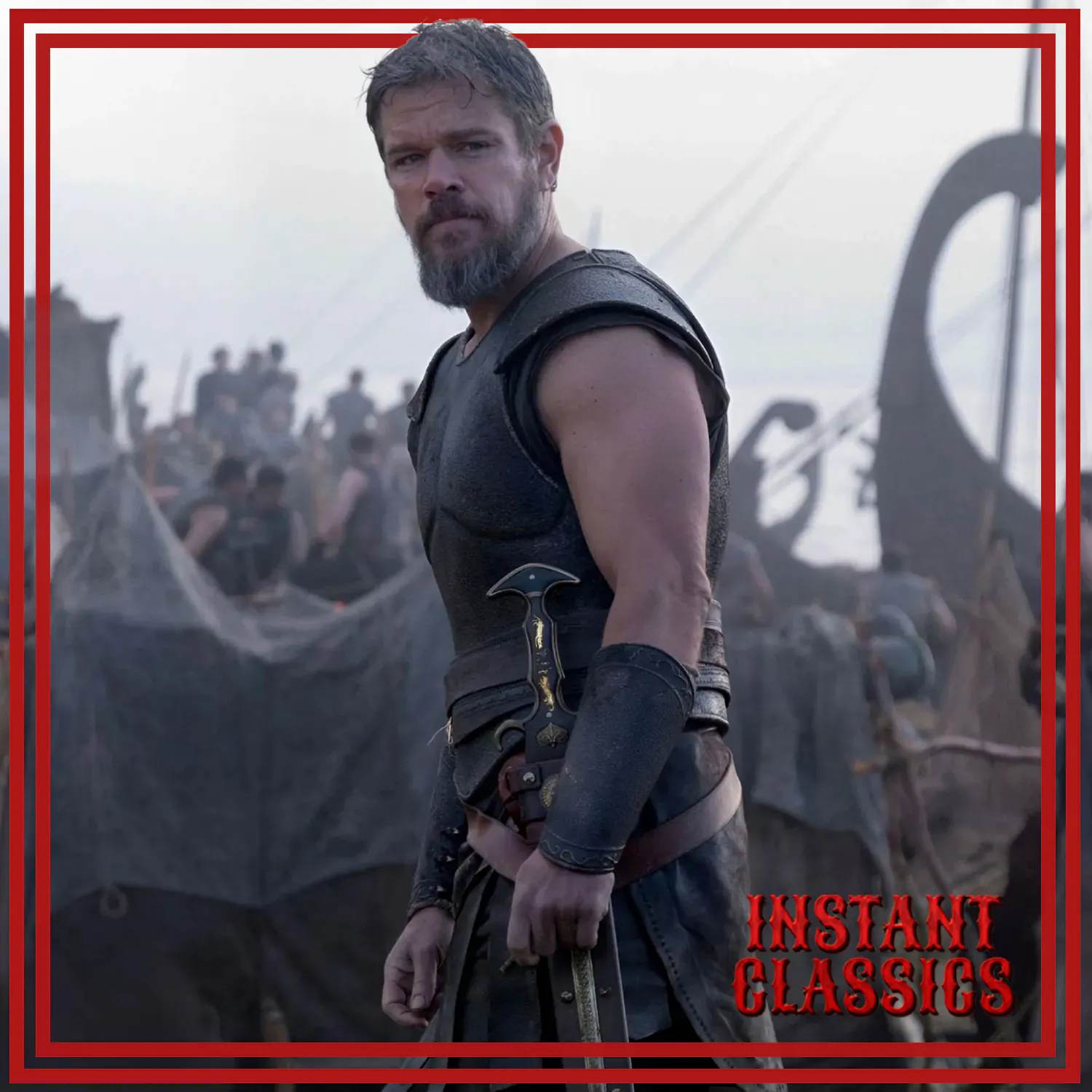
Yeah, I mean, that's right. Mary and I do think this is, of course, it's a totally understandable choice. You've got, you know, the film must be three or so hours. It cannot Be six or so hours. You know, Telemachus makes two stops. The obvious thing is to give him one stop. The problem with missing out King Nestor is that King Nestor, as you, I'm sure, heading towards Mary there was. He's of an older generation. He's even older than Telemachus father. So he's. If you think of the sort of Matt Damon character being in his 50s, you know, Nestor's definitely in his 60s or 70s. He's older, he's an old man, but he has, he fought at Troy and he has many, many memories of Troy. But he also has memories that predate Troy. And in the poem he's this extraordinary link back to a previous and even more magnificent age of heroic action. And he tells stories about the deep, deep past. So. So I think one of the effects of Nestor is that you get the sense that Telemachus by extension, but especially Odysseus is embedded in a very long tradition of warfare, of fighting, of heroic action, which Nolan has taken a very specific decision, I think, to miss out. And that's all part of his. We talked a little bit about this before in the previous episode that Nolan created a kind of quite a modern seeming moral framework in this movie that positions Odysseus as having broken the ultimate law of Zeus by creating the Trojan horse, by creating this sort of act of military trickery, he has brought down horrific destruction on Troy. And for that he is effectively punished. Now that kind of moralizing isn't in the Odyssey. There is no sense that warfare is a wrong thing in the world of Homer. Not in this sort of slightly Judeo Christian sense that we get in. You can take things too far, but it's not like it's a morality free zone. But the act of making warfare itself I think is. Is acceptable. That's sort of kind of what Nestel represents, is this long trajectory that, you know, this is what you're supposed to be doing. Making more is what you're supposed to be doing. That's what your grandfathers did and your great grandfathers. And plus they were better at it and they were even more heroic. And that can't do for Nolan's movie because Nolan wants to sort of position the outer extremes of that at least as morally unacceptable.
- [12:10]
A
It's that kind of slightly Judeo Christian moral dimension that is the real difference, I think. Because you see, I mean, you see particularly in Homer's Iliad, the idea that the violence of war is something that it is uncomfortable to face. I mean, Homer isn't Homer. Whoever he or they were. You know, this is not jingoism. It's not kind of a kind of real commitment to the nasty side of warfare and the nastier, the better. There are problems about that all the way through. But it is, as you say, and the figure of Nestor partly emphasizes this. It is part of the long tradition of what we have to do. Right. That is what man, and I think I'm using man advisedly there. That is what Merny's is on, is in this world to fight right now. There are very uncomfortable sides of that. And the Iliad particularly makes you look at some of those uncomfortable sides and to wonder about what we get into when we get into warfare. But there isn't that moralistic tone that you find in Nolan. And in fact, what you see much more is something that is not, not given a prominent part in the Nolan movie, which is the effect on. The effect of warfare on captives, on women. You know, who gets looted in warfare. And the. The Greek narratives, particularly after Homer, often return to the collateral damage that warfare does in terms of the women who become its victims. If battle is between man and man, in the end, the people who pay the price for that are the women. And if you look at Euripides play, the Trojan Women, written and performed middle of the fifth century B.C. that's, you know, centuries after Homer. You see a playwright really facing up absolute shining a spotlight onto what happens to women in war. Now, it's not that that's entirely absent from Nolan, but they aren't the victims, you know, what happens to the Trojan women, that is not really what he's focusing on.
- [15:03]
B
Yeah, it was really interesting to me and I made a big mark in my notebook when I was watching the film that what is at least implicit and as you say, actually in later classical readings of the story becomes explicit. They're not loading Trojan women onto the ships after they've successfully defeated Troy when they go and sack a small place, which is when you know, Odysseus after he leaves Troyne. This is well done in the sense by Nolan. It's not a famous. It's not one of the episodes you think about when you're thinking about the Odyssey. But one of the first things Odysseus does after leaving Troy is go and sack the city. I mean, it doesn't look like a settlement. The Cicones. He sacks the settlement of the Cicones. It's in the movie. You know, Nolan has chosen to take this quite small and not very glamorous episode and for his own reasons, because he's making a point about the sort of evil consequences of war. But what's weird about that is they don't take the women with them. And they would have, you know, I don't know, it sounds incredibly pedantic, but they kind of would have taken the women with them. You know, when you sacked a city, you killed the men, you took the women. That's kind of how it worked. Yeah, maybe that's just. That's too unpleasant. It's too ghastly to be thought of. I don't know. For some reason, Nolan decided not to have that as a consequence of this violence.
- [16:35]
A
And you do wonder if he's sometimes drawing back from what stands out in the Odyssey as violence against women. Now, the Odyssey has got, as we said before, it's got, you know, it is a very female film, right. And it's, you know, that's why old Samuel butler in the 19th century could think it was written by a woman. And, you know, other people have thought something similar, that there's. So there's so much of a woman's eye here now. But Nolan has not given us the other side of that that you see in the Odyssey, which is the. The violence of men wreaked, particularly on women. And that's partly in the Trojan War. And you get. You get some of that, you know. But I'm thinking about what happens when Odysseus does come back to Ithaca. We're now at the end of the poem and he's coming back and he's reinstating himself as the rightful monarch of Ithaca and getting rid of the louts, the suitors. One of the most troubling bits in the Odyssey, and it's described in horribly observed detail, is when they decide, you know, Telemachus and Odysseus, the. The returners decide that what they're going to do is put to death the enslaved women who have been sleeping with the suitors and serving the suitors in every possible way, and they hang them. It's a horrible scene.
- [18:34]
B
It's a horrible scene. And it's very specifically Telemachus who instigates. Yes, yes, it is. And, you know, again, in the sort of ethical framework that Nolan has created for the movie, he can't have. Telemachus has to be. Telemachus has been created as a new generation who is less embroiled in these kind of. In this sort of wicked, violent acts. And so he can't, you know, the whole treatment of Telemachus at the end of the movie is really fascinating because he. He has to hang back from the fight. Nolan requires him to hang back from the fighting so that he can be created as someone who's. Who's more moral, who's less warlike, you know, a newer age of a better kind of a person, rather than someone who's being led by his father and inducted into the ethics of a kind of Homeric warriordom, which is what happens in the poem.
- [19:37]
A
That scene is so memorable, I think, that when people. I remember it from when I first read it, because Homer focuses on how when they're hanged, you look down and you see their feet still twitching. And it's just this observant but horribly observant moment where you see them dying, you see them in the moments of dying. And that has gone. And I think it's interesting that it's so. So prominent in Homer anyway, because Homer is actually asking us at the same time to see that this is what Telemachus is learning to do as he becomes a man. He's learning to take vengeance. But Homer himself is, of course, slightly, by concentrating on that in a horrible detail, is prompting us to question that, so that the epic itself is ambivalent about that. But as you say, Nolan is so keen that Telemachus should represent a new generation, that those bits of Homer which absolutely say Telemachus is becoming the son of his dad, he's not becoming someone different, he is becoming Odysseus. That has gone.
- [21:03]
B
You say. You remember reading that, I think, for the first time. I mean, I also. You think what is happening here? You know, it's so. It's such a horrific scene. The feet of the maidservant. Maidservants, the female enslaved servants, their feet twitching as they're killed. And, you know, their sin was to sleep with the suitors and to be disloyal to Odysseus. And. And I really wondered how dark Nolan was willing to go. And this is a darkness that he swerved, I guess, because if you put this into a movie in the 21st century, it becomes a horror film. You would lose. You'd lose all sympathy with Odysseus and Telemachus in a kind of modern setting like a movie. Whereas, of course, reading the poem is a very different texture of experience. And, you know, we're there to be with. I think somehow as a reader of poetry, you're there to be disturbed to a much fuller extent than seeing something on the screen of your local cinema.
- [22:13]
A
And I think when you read that bit, Homer prompts you to shy away from it. But I think he also prompts you to think about how guilty they were, that there is a sense that these enslaved servants are being treated as if they were the willing concubines of these nasty guys who've taken. You know, they've taken over Odysseus's house. You know, they were enjoying a bit on the side, and they get killed, actually, you know, play their story another way and they're being raped.
- [22:55]
B
Yeah, they have absolutely no choice, I suppose, within the ethics of the Odyssey. Taken in a very blunt way, the Odyssey as a poem is very, very interested in the reinstatement of the household in its most harmonious and hierarchically correct form. And it has no room, you know, it expels from itself these enslaved women who've been doing the wrong thing. It's not interested the poem, in a sense, this is very clear in Emily Wilson's translation. She pushes this aspect very strongly, is it's interested in property, it's interested in hierarchy, it's interested in running your household. And this is very uncomfortable.
- [23:38]
A
You see that also in another thing, that. That Nolan omits that kind of sense of the genealogy of the household, the restoration of the household, I think, in all kinds of ways. In Nolan's version, Odysseus's journey to the underworld is brilliantly treated. I mean, it is chilling. It isn't a kind of load of sort of happy ghosts that Odysseus is going to meet. He is crossing the final frontier and it is dangerous. He is the first of any number of Western heroes who've been made to go to the world of the dead and then come out again. And it's very important in. In the. The logic of the narrative and that that remains in Nolan and I think brilliantly done. But in Homer's version, one of the most important people now dead that he meets is his mother, and no mother here.
- [24:43]
B
It's another loss because it's another very important female character. It's another very important link to a previous generation. And it has this extraordinary emotional force because she's there saying he doesn't know she's dead. So when he encounters her in the land of the dead, that's news to him. It's like, Mom's here, she's dying, and they talk to each other. She says she tells him that she died of grief because he'd been away for so long. And then comes this extraordinary moment where he tries to embrace her and she just melts away like a ghost. It's one of the most touching episodes in literature. So I can see a few reasons why Nolan would choose not to do it. I think one reason is that he decided to make the Land of the Dead, as it were, the resubstantiation of the war graves that he left behind at Troy. There's an early scene in the movie where you see a kind of sandy wastes, as it were, the beach at Troy covered in war graves, the armor of the fallen men scattered, you know, sort of heaped up as graves. And that kind of. When he visits the Land of the Dead, it's almost as if that's being reprised, but in a kind of darker, creepier, Boggier landscape. And these, his former comrades are sort of pushing up from this soil and reconfiguring themselves. And it's like he's. So it's that he's meeting the shades of his former comrades. There's nothing. All the stuff that happens in Homer where, you know, he also meets his mom, but also he meets. He has a sort of extraordinary tour around the magical monsters that live and also meets dozens of female heroes. I mean, some of whom, you know, to be honest, there is a bit of a list, as we talked about this in book club, when he meets a lot of female characters from the deep past. And some of them are super obscure. So, yeah, I mean, totally forgiven for missing those out. But he's chosen to do something very interesting about Odysseus, encounter with the dead. But it's all about the dead of the war. It's not about the dead of his family.
- [27:11]
A
These are not unreasonable choices to have made. But I think that it's also, I think it's incumbent on us a bit to say, look what the consequence is for the narrative of the original poem. Now, that's up for grabs now. But Nolan has made some very, very specific choices in what he chooses to focus on. And, you know, I, you know, I do feel that overall, I know people say, oh, Mary Beard was bound to say this, but the women of the original Odyssey have not taken the big part that they have in the original poem in the Nolan movie. And I think that perhaps after the break, we might think about Helen, because Helen of Troy comes out in a very strange way actually in the film. This episode is brought to you by State Farm.
- [28:29]
B
Listening to this podcast instead of doom scrolling.
- [28:32]
A
Smart move. Another smart move getting help from one of State Farm's 19,000 local agents when
- [28:38]
B
you choose to bundle home and auto bundling.
- [28:40]
A
Just another way to save with the
- [28:42]
B
personal price plan prices are based on
- [28:44]
A
rating plans that vary by state.
- [28:45]
B
Coverage options are selected by the customer.
- [28:48]
A
Availability, amount of discounts and savings and eligibility vary by state.
- [28:53]
B
And actually Mary, just before we get onto Helen again, I have a theory actually about what it is one of the reasons that Christopher Nolan does that very particular thing that we've just discussed before the break about the land of the dead. And I think that Nolan has allowed for the possibility that all the fantastical monsters and magic aspects of his journeys are a consequence of his kind of drug addled retellings of his doings to Calypso. I think, I think Nolan has left, in other words, Nolan has left open the possibility of us not really buying into them completely that they may be that the sort of distortions and strangenesses of, of them may be a consequence of his troubled soul and drugged memory. You know, you can imagine, did he really meet a witch who turned his men into pigs? Or did he really meet those kind of giant Laestrygonians or were they just very fierce warriors and his memory has turned them into kind of giants?
- [30:08]
A
Nolan does it in a very 21st century way. Have these people been. Is this kind of because he's had been eating too much lotus that he's come up with these stories that's also in Homer, but actually with a very different nuance to it. Because in Homer, because Odysseus is repeatedly shown to us to be a liar, you always, by the time you've seen him really telling his biggest whoppers, which is actually after he's told the story of his travels, you do look back to the stories of the Cyclops and Scylla and all the rest and you say, well how do I know those were true? Now Nolan actually does put that question mark over them, but he makes it the kind of drug addled question, had he been taking too much lotus? So he was on a bit of a trip here.
- [31:08]
B
Yes, it's a bit of a trip. But the crucial thing as I think you're heading towards is that it means that Odysseus isn't exactly a liar.
- [31:16]
A
No, he's not.
- [31:16]
B
He's someone under the influence. And I think that we talked about that last week, that Matt Damon's Odysseus is, you know, he's much more on the Jason Bourne side than the kind of wily, articulate liar. And so I think you've put your finger on it with the Lotus, the whole eating lotus and telling Calypso, it's not that he's lying. Nolan's Odysseus is not a liar. Actually he, well, he lies a bit when he gets back to when he gets back home, but he's not the liar that we know. In Homer's version, Homer's Odysseus is defined
- [31:58]
A
as a trickster, as a liar. And I think in the bit that we've just been reading in the book club, he's been telling, in the Homeric version, he's been telling all these stories about the Cyclops and Circe and whatever at the court of the Phaeacians. They then take him back to Ithaca, he hitches a ride in one of their magical ships and he meets one of the characters who we see in Nolan's movie, the swineherd, the pig herd, Eumus. But when Odysseus introduces himself, he introduces himself with a complete fantasy story, utterly untrue of who he is, where he's from, what his background is. Now as you read that, you think, well, I've just been reading about his encounter with all these monsters. Are they, are they as much lies as what he's now telling his old faithful servant? And that's about Odysseus being a liar, which is another aspect. Well, as you say, it's not entirely, it's not that he tells the truth throughout the whole of Nolan's movie, but he's not defined as that complicated, tricksy, wily guy who you can never believe, right? One thing, if you meet Odysseus, first assumption would be don't believe what he says. And that isn't how he's played in Nolan's version by Matt Damon. But I think we do need to go to Helen because Helen is another of those extraordinary, complicated female characters
- [33:53]
B
in
- [33:54]
A
the Odyssey who does get a bit sidelined in Nolan's version. We talked about Helen last week and we made the point that real surprise you get in the Odyssey that when Telemachus is showing up at the house of the Pallas, I mean of Menelaus, who is now living there having recovered. Helen, you know, the wife that went off with Paris, the person who caused the whole Trojan War and what is, you know, always just such a wonderful kind of shock really is that there they are, they're a middle aged domestic married couple, not kind of really living in deep post adulterous gloom, but actually a kind of, you know, fairly ordinary middle aged life and the person who is really in control of things, who is really the one who's unlike Menelaus, who's a bit dim, frankly, in Homer, it's Helen who controls things. It's Helen who's got the magic potion. It's Helen who knows what to do. Now, that sense of Helen's. Helen's reintegration and actually the sense that she's, you know, she's got a few things over Menelaus, who's constantly getting it wrong, a bit that is absent from. From Nolan. And when I think, or completely inverted with, I think, consequences for how you. You read the whole thing.
- [35:43]
B
Yeah, definitely. And I think Helen is a Helen here with much less agency than she has in Homer's Odyssey. Actually. She has this. I could see why Nolan has made this choice, I think, to suggest that she's been beaten up pretty badly after the end of the Trojan War. She has a scar running down her face. He says sarcastically, the face that launched a thousand ships. Which is not a quote from Homer, my friends, it's a quote from Christopher Marlowe. And then there's another. He kind of jokes, you know, maybe only 500 shits. I think that's the joke if I caught it right. So you get the sense of her as. She's very self conscious about the cause of her having caused the war, that's clear. But at the same time, she's a victim. She's not having a good time now. It's been a very bitter homecoming for them. This is not how it is in the Odyssey. It's a very different take. I also, in relation to Helen, there's simply absent from Nolan's film the sort of bit of the backstory that really is about how the war was caused, which is that Paris of Prince of Troy and Helen got together in ways that are ambiguous. The story is that Paris, this is the short version because there's a backstory even to this. But basically Paris, before the Trojan War, went and visited Helen and Menelaus in their palace in Sparta, fell in love or lust with Helen and spirited Helen away willingly or unwillingly to Troy. And it's getting Helen back that is the cause of the war. Right. But all of that, the idea that the Trojans were in any way accountable for the war is absolutely absent from Nolan's film, which is really interesting. Like, this is the Trojan side of things. The Trojans, complicity in violence, the Trojan, they're purely victims. Again, it's part of this particular 21st century framework that Nolan has decided to build around his version, which is that, you know, that really it's. Matt Damon is the guilty one, that Odysseus is the guilty one, that his ingenuity in creating the Trojan horse was the real thing that broke Zeus's law and brought down destruction on the city. But actually, you know, if anyone broke any rules of Zeus's law of hospitality, it was really Paris in the backstory. By turning up as a guest at Helena Menelaus house and then leaving with his wife, that's breaking Zeus's law. You don't do that.
- [38:48]
A
I think, you know, we talked earlier on in this episode about the idea that there is a sense of militarism to which all these heroes are signed up. You know, but to be a man is to be a warrior. There. There are nasty consequences of that, and which Homer sometimes helps you look in the eye, but that the sense of warriordom goes back. That's what you see with Nestor, goes back, you know, through the generations. Now, it's not only the Greeks who are signed up to that kind of narrative of how the world is. The Trojans are too. And so the. The. The slight implication that because the Trojans are the losers, they were somehow the innocent victims in all this of a kind of imperialist power. That is not what Homer is. Is setting out for you, though it. It is what. It is apparent, I think, in the Noland take.
- [39:58]
B
Yeah, I think the Nolan take hints strongly towards the idea that Agamemnon, the leader of the Greeks, instigated the war, really, in order to disrupt trade routes and to grasp the trade routes, which. I mean, you know, that comes from a long history, I think a perfectly proper history of dousing actual motives or stated motives for war and suspecting that they're generally about resources.
- [40:32]
A
And it comes from a long history of trying to make the Trojan War true, you know, that there was a war. Well, if there was a war, it wouldn't have been about the pinching or the abduction or the elopement of Helen. It would have been about something economic and it would be about great control of the trade routes as we go into Anatolia.
- [40:52]
B
Right, right. Yeah, definitely. Yeah, yeah, yeah, yeah.
- [40:56]
A
And, you know, a bit of that. There's a bit of that in Nolan, a bit of this kind of sense that this might. This might be a true real economic story behind this.
- [41:08]
B
Yeah. The other thing in that part of the movie that I thought was. I thought it was daft. I thought. I don't necessarily. Again, I. Because it alludes to this moral framework that I don't totally buy up to. I don't love it, but I thought it was super deft that Christopher Nolan had imported a character, or at least a character's name from Virgil's Vioneard and planted this character into the Odyssey. That's the character Sinon, played by Elliot Page, who was the person who, in Virgil's much later epic, the Aeneid, which. Which contains the Fall of Troy, contains the story of the Fall of Troy. That the reason the Trojans trust that this Trojan Horse is really a gift and not a trick is because a Greek, a young Greek person called Sinon, who's actually a spy, tells them. He tells them a kind of falsified story about how, you know, the Greeks have gone off and he's been left behind and he's fallen out with them all, and they should definitely trust the horse. Now, that's all in Virgil's Aeneid. And Noland is rather cleverly imported Sinon, but in a slightly, slightly different way. So that Sinon is an unwitting. A, he's related to Odysseus and is one of the Ithacans, and B, he's an unwitting. Like, he doesn't know that he's complicit in a great trick. And that becomes part of all the stuff that Matt Damon's Odysseus feels incredibly guilty about in the rest of the movie.
- [42:53]
A
It's interesting because it's one of the very few cases where, apart from a lot of the backstory about the Trojan War in general, it's a place where Nolan has incorporated a new character into the Odyssey rather than eradicated some of the ones that we might have liked to see. And you're right, it's actually around
- [43:20]
B
the
- [43:20]
A
idea of the guilt, of the introduction of winning the war through the Trojan Horse. But, you know, if you. If you go back then to Helen that we've just been talking about, we got Sinon this, the guy who is that Damon is, you know, I think, interestingly lifted from the Aeneid because, you know, a lot of the. A lot of the story. Stories of the Trojan War that we have, although we tend to think they're Homeric, they come from Virgil, actually. But the. What he doesn't have is he doesn't give Helen this Greek adulteress living in the midst of the city of Troy because she has gone off with the Trojan prince, Paris, when she tells her story in the Odyssey, we find that she's actually had a role, at least in witnessing and it's being half complicit. You never quite know where Helen stands. By the end of the war, she has got her own story about the Trojan Horse because of the way that Nolan has chosen to represent her as Bashtar, resentful, you know, a sort of a very curmudgeonly victim, I think. Not a tragic victim, but a cross victim. We don't see that Helen was there and being quite keen on watching how cleverly the Trojan horse and the warriors. She's aware that there are warriors inside this horse when the other Trojans aren't. She's part of the action of the Trojan Horse. She sure isn't part of the action
- [45:16]
B
in Homer, when the Trojan horse is presented to the Trojans and is being brought into the city, she's there. She imitates the voices of the Greek leader's wives to see if they will shout out and betray themselves. And she tells the story. It's extremely hard to know whose side she's on at this point. And it's deeply fascinating. And it tells you also that she has these kind of preternatural skills, like she can imitate any Greek leader's wife's voice so perfectly that it's indistinguishable from the real thing. It's another part of Helen's quasi magical powers or sort of slightly beyond human presence that Lupita Nyong' o was a very, very humanized, very, almost sort of slightly depressingly too human Helen. And to me, that's sort of part and parcel of Nolan sort of ratcheting down the supernatural elements. Despite the fact that we have all the kind of monsters and giants and witches and things that, you know, we're offered the possibility that those are actually sort of hallucinatory.
- [46:36]
A
I think just to kind of, you know, pull this together. We've been talking in a way about how a sense of punishment, a sense of change, a sense of moral culpability, which is going to initiate a new order and opens Odysseus eyes to his own guilt and complicity in all this. That hovers over this story in a way that it really doesn't in Homer. But that is combined not just, you know, it's not just a kind of the introduction of a Judeo Christian feeling of guilt. There is also an injection of archeology, injection of real life. We just mentioned that, you know, what's the reason for the Trojan War? Well, it's. It isn't Helen going off with Paris. That's very much in the background. It's a question of the microeconomics of the Eastern seaboard of the Mediterranean and Anatolia and the trade routes. But this is where I am going to come back, I'm afraid. To the sea peoples also got the constant predictions which go along with the culpability and the guilt that the Age of Bronze, they may say that explicitly the Age of Bronze is coming to an end. This is the end of one version of civilization. Now, one thing Homer does not talk about is the Bronze Age, right?
- [48:31]
B
Couldn't possibly have done Mary. It was a term invented in the early 19th century by a Danish archaeologist called Christian Jurgensen Thompson, who created the sort of standard division of prehistory into Stone Age, Bronze Age and Iron Age. It really curled my toes to hear someone use the term the Bronze Age. As if anybody would have any kind of self consciousness about either the kind, you know what I mean? I suppose we sometimes say we live in the digital age, but I think in 3,000 years time people are gonna have their own way of understanding and it's not going to be that. And I found it really awkward that they showed a self consciousness that wasn't just about where they stood in history, but also it was borrowed from modern archaeological terminology.
- [49:24]
A
And that's where the sea peoples fit in. I mean, I think, as I said last time, people will be a bit puzzled at these repeated references to the hostile peoples of the sea that are somehow threatening the world of the Homeric hero. Now, nothing of that in Homer, but again, what it is is it's an injection of modern archaeological explanation and it has been lifted from documents largely in Egypt, which is, as I said last time, which puzzlingly refer to the threat of the peoples of the sea. And you know, just like your 19th century Scandinavian, these have been, these references have been picked on by people, modern historians and archaeologists, wondering what on earth it was that eventually caused the collapse of this Bronze Age civilization in Greece. And one of the things they rather desperately, and now I think almost nobody does have kind of fallen on is, ah, you know, in the end the Bronze Age collapsed because of the peoples of the sea came and got them. Now you put all these things together into kind of guilt, a sense of forthcoming ending of archaeological reality. And I suppose what I say to myself is that one of the things that I see when I read the Iliad or the Odyssey is a sense of permanence. It is a. That these are for all their troubles, all their difficulties, for all they're problematizing of their own moral code, which you do find in Homer. Homer is not, as I said before, he's not a kind of jingoistic warmonger. But what is really important is that this is a society which is going to Continue. And the Odyssey is about it, continuing from the generation of Nestor or even before through to the generation of Telemachus and then Telemachus. Kids. It's not a society which is on the precipice of collapse.
- [51:57]
B
The only thing you can say, I think, is that there is a sort of sense that things that people were better a couple of generations back. And I think that's as far as you can go. You're absolutely right. There is simply, simply no sense of imminent collapse. And I think that was very well put, Mary. But I do, before we sign off, I do want to mention a couple of things that I really liked. I mean, we've actually been very, very critical. And again, I mean, I think we both say you should see this movie, but even more importantly, you should absolutely read the poem. Do both. But I want to say that I really liked the handling of the dog. Argos.
- [52:38]
A
Don't miss the dog, folks. Don't miss the dog.
- [52:41]
B
You're not going to miss the dog. You couldn't miss the dog if you tried, because the dog produced an Oscar winning performance. If there was a category for best performance, this dog would be absolutely in line for a prize. By the way, at the Cannes Film Festival, they do give prizes to the dogs. Palm Dog, it's called, and this dog, had this film been at Cannes, I'm sure would have won the Palm Dog.
- [53:06]
A
Tell us, tell us about the dog.
- [53:09]
B
I'm gonna tell you about the dog. Well, the dog is. The dog is the first. When Odysseus comes in the poem, when Odysseus returns to Ithaca, his whole entire return is characterized by a series of recognitions, as we've talked about many times. So he's recognized by eventually his nurse, his wife, his son, his faithful, loyal swineherd, Eumaeus, and then ultimately everybody. But the first entity to recognize him is his very, very old, faithful hunting dog, who has been cast out in his dying, you know, very ancient dog, over 20 by definition, because he's been away for 20 years. The old dog has been cast out to lie on the dung heap in his dying days. And as Odysseus makes his way up to the. Up to his home, up to his palace, this dog revives enough to give him a loving look and then expires and then dies. Dies completely. Yeah, right. Now, Nolan has given a loving treatment to this. The dog did a fantastic job. He's even pulled out the dog episode, made the dog episode, I think, a little bit. The dog has backstory in a way that the dog does not have backstory in the Odyssey. It's really, really elegantly done. And you know, I just, it is a, it's a very, very touching moment. But it's, but it also plays a really important part in the poem for this series of recognitions and it does so very well, does that very well in the movie as well. So hats off. Great dog stuff.
- [54:50]
A
So as we say, go and see it. Go and see it, then read the book.
- [54:56]
B
Yeah, or the other way around. But definitely do not miss it. Do not miss on any account reading the poem because it is just fabulous. As ever, we want to know your thoughts and comments, ideas, questions. And so if you have them, please do send them to us@instantclassicspodmail.com or on our social media @instantclassicspod.
- [55:21]
A
Bye bye.
- [55:29]
B
@blyze.com, it's not just about window treatments. It's about you. Your style, your space, your way. Whether you DIY or want the pros to handle it all, you'll have the confidence of knowing it's done right. From free expert design help to our 100% satisfaction guarantee, everything we do is made to fit your life and your windows. Shop up to 40% off with minimum purchase and a free professional measure right now@blinds.com plus pay at your own pace starting at 0% APR with affirm terms apply.