Loading summary
Transcript64 lines
- [00:00]
Charlotte Higgins
Soon we were baptized into the Christian faith. And then after a few days, we were put in prison. And I was terrified because I'd never been in such a dark place. What a terrible day. It was appallingly hot because of the mass of people altogether. And I was tortured by worry for my little baby.
- [00:22]
Mary Beard
Later, we were suddenly taken off to trial. There the Roman judge said to me, look, don't put your family through this. Just perform a sacrifice for the well being of the Emperor. No, I won't, I said. And the judge said, are you a Christian? And I replied, I am a Christian. And he pronounced us guilty.
- [00:48]
Charlotte Higgins
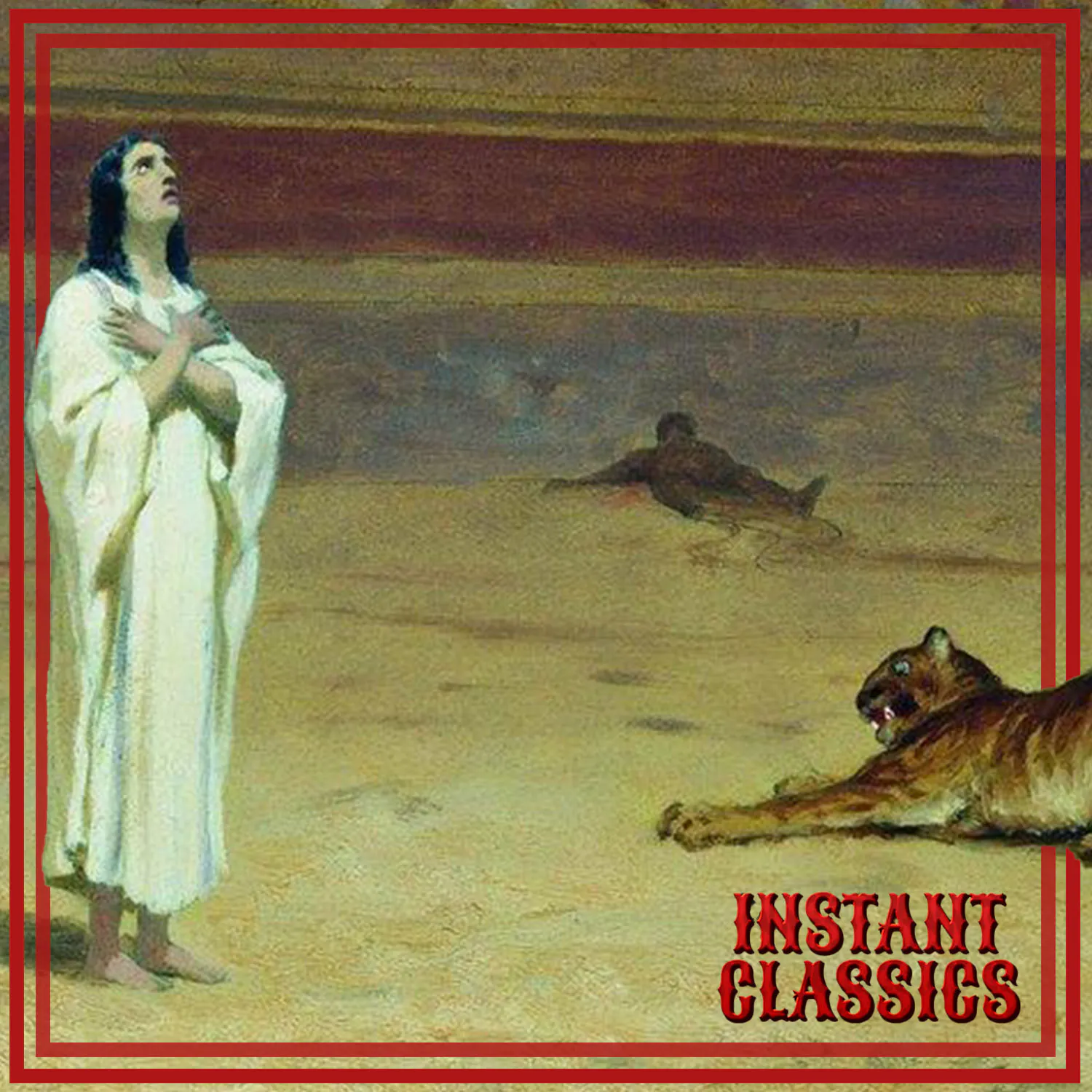
So that is not an extract from a modern work of historical fiction or anything like that. These are the actual words of a young woman called Vibia Perpetua from a town near Carthage in North Africa from the early third century ce. She was the victim of one of the Roman campaigns of persecution of the Christians. And after this guilty verdict, she was put to death, gored by animals in the amphitheater in Carthage.
- [01:22]
Mary Beard
What's amazing is that her own account of how she stood up to the authority of the state still survives. Not just of the trial and the conditions in prison, but even of the dreams that she had on the nights before her death. It's nothing short of the kind of first person narrative from the ancient world that we always hope to discover. And here it gives a shocking insight into what it was actually like to face death as a Christian martyr 2000 years ago.
- [02:01]
Charlotte Higgins
Do you know, you might even say she was like a real life Antigone, the character that we talked about last week. But in this episode, we're going to recount Perpetua's last days. And in doing so, we're going to get a foam fascinating glimpse of how an early Christian martyr really thought and spoke. And we're also asking, how much can we really trust this extraordinary account?
- [02:26]
Mary Beard
And why?
- [02:28]
Charlotte Higgins
Why isn't it better known?
- [02:30]
Mary Beard
This is Instant Classics, the podcast that uncovers the ancient stories still shaping the world today. I'm Mary Beard.
- [02:38]
Charlotte Higgins
And I'm Charlotte Higgins. Each week we dive into the myths and the dramas and the characters of the classical world to discover what they still mean to us. Now. This week, Perpetua, a martyr in her own words.
- [03:04]
Mary Beard
To some, he is the revolutionary hero who restored China to its rightful place on the global stage.
- [03:10]
Charlotte Higgins
To others, he's a brutal despot, a accused of presiding over more civilian deaths
- [03:14]
Mary Beard
than either Stalin or Hitler. Mao Zedong has one of the most recognizable faces in the world, yet he started life in a muddy provincial village.
- [03:23]
Charlotte Higgins
A rebel son who hated his father survived a 6,000 mile walk across China and rose to become a figure of titanic proportions.
- [03:32]
Mary Beard
From Empire the Goal Hanger World History Show. I'm Anita Anand. And I'm William Duranpool. In this six part series, we're joined by world renowned expert Rana Mitter to explore the life of the father of Communist China, Mao Zedong. We'll track his rise from a bookstore
- [03:51]
Charlotte Higgins
owner to a guerrilla commander. And we'll witness his ruthless elimination to secure total power. And we'll descend into the dark experiment of the Cultural Revolution, a time when ancient temples were burnt, children denounced their parents, and a nation worshipped a mango
- [04:08]
Mary Beard
as a sacred relic. Subscribe to Empire wherever you get your podcasts to listen now. Okay, the. The basic storyline here is, is pretty simple as well as pretty horrible. We're in Carthage town in what is now Tunisia, on the coast of North Africa. And it's 203 CE. We're in the reign of the Roman emperor Septimius Severus. And the background is that a small group of Christians are arrested. There's three men and two young women. There's Vibia Perpetua, who's our focus, who's a young mother, she's 22 and she's nursing a baby. And there's also Felicitas Felicity, who's a pregnant slave girl who actually gives birth just before the martyrdom. And they're all put on trial, they're found guilty of being Christians and they are sent to their death in the local amphitheater, gored by beasts. That's. That's it. Basically.
- [05:28]
Charlotte Higgins
It's a pretty, a pretty awful story. But. And we know about this from early Christian documents, the kind of documents or texts that recount the details of the trials and torments of martyrs. I mean, these were circulated in order to promote the bravery of early Christian martyrs and the truth of the, of the new religion. The, the text that we're thinking about today, the one that contains Perpetua and Felicitas story, this text has survived in a bunch actually of different versions. But the important thing to say here is that within a framing narrative written by a man telling the story of Perpetua and Flicitas, it also contains, it frames Perpetua's actual diary that she herself kept during this period of her arrest and her trial and her imprisonment before she was actually sentenced to death. And even, as we said in the introduction, it even includes these dreams or visions, but you know, they're dreams that she had in the few nights sort of leading up to her death. And honestly, I had never come across this text before. And it was Mary. Mary, it was you who introduced it to me. And. And it is. I have to say I was completely blown away that this autobiographical text by a woman in the early third century CE exists. And it's so. I mean, we'll come to this, but, you know, it's so personal. It's so sort of straightforward. It's incredibly intimate. It really feels like a voice hitting you from, you know, 2,000 years ago. Absolutely clear as a bell. And it's a woman. And it's completely extraordinary.
- [07:19]
Mary Beard
It would be easy to miss because we have to imagine that there is this early Christian man, presumably, who's writing the account of the martyrdom of these people, but particularly Perpetua and Felicity. And, you know, what he's doing is giving you an introduction, say how important this is for the Christian faith. And his voice, of course, I'm afraid, has to take up the end bit, because Perpetua does not describe her own martyrdom. Obviously, he describes what happens in the amphitheater, but somehow he seems to have got hold of her prison notebook, her prison diary. And it is absolutely amazing. And, you know, I was brought up with the. You know, when I was, you know, a young student of classics, I was brought up with the idea that this was exactly the kind of stuff that didn't ever survive. We did not have the voice of ancient women in their own words. Here in this account of. Of the martyrdom of Perpetua, we've got, well, 1500 of her words describing what she went through up to the moment she was taken off to the amphitheatre. I mean, that is amazing. And it is, you know, as we kind of said, this is a bit like Antigone in her own words. In the last episode, we were looking at the fictional character of Antigone and wondering about the very nature of what it was she was standing up for and how we were to evaluate her. But that's in myth and fiction. This is the words of a kind of real life Antigone standing up for her religion and morality in the face of the Roman state. It's quite straightforward. This is not a flowery, rhetorically formed account. This is pretty basic, simple account of what happened.
- [09:37]
Charlotte Higgins
It's so intimate and straightforward in its tone. Like you say, unlitery in a sense. Not sort of flowery or highfaluting to the extent, Mary, that when I read the translation, I almost couldn't believe that the Latin could be that sort of down the line, intimate. I went back to the Latin, I mean, as one should always do, of course, if one can. Which I can. Went back to the Latin and thought, actually, no, this is a very good translation of this. Straightforward, but very conversational. I mean, it really feels like she's speaking to you. And that's quite an extraordinary and quite a creepy feeling. I mean, in a way, but also. I mean, we'll come to this. But also the fact that I could have gone through, you know, 40 years of being obsessed with classics and not come across this text until you introduced me to it. I think there's quite a lot going on there. It's been an absolute revelation to read just this. 1500 words straight from the mouth, from the pen of a young Roman woman. Absolutely amazing.
- [10:42]
Mary Beard
And almost inevitably, it raises all kinds of bigger, important issues. I mean, I've always been very struck by how she starts out in her account, because she explains that she was a Christian and that she was under surveillance by the authorities in Carthage, and that her father, who didn't want to see her coming into any danger, her father, tries to persuade her to give up Christianity, right? She's got a little baby. She's still breastfeeding. He doesn't want her to go into the amphitheater and die. And so the narrative opens with him saying, oh, come on, give it up. And she says, no, I would not. I refused. And at this point, what she does is she points in her argument with her dad, she points to a jar and she says to him, dad, could you call that jar by any other name than jar? Right? You couldn't call it anything else, Right? Okay, well, you can't then call me by any other name than Christian. I'm as much a Christian as that jar is a jar. And she kind of thinks that she's won that bit of. That bit of the argument. But that's only the beginning of the story because she's then formally baptized at this point into the Christian church. Now, that's not unusual, that baptism often comes quite late in a Christian journey in the ancient world, not as an infant. And she gets arrested and she is taken off to this horrible, dark prison, which she says is terrifying because it's so dark and stuffy. The family are absolutely distraught. She, meanwhile, has been separated from the baby, and she's worried about not being able to feed the baby. But eventually they persuade the authorities that she can have the baby with her in prison and feed it.
- [13:10]
Charlotte Higgins
Yeah. She gets given a slightly better Some of her Christian friends arrange for her to get a slightly better lodging. In the prison lodging cell or whatever it might be. I mean, it's very, very vivid. But you get. You get, don't you, this sort of strong sense that you do often get in early Christianity. That she's standing against her own family. Her family, her father particularly as opposed to her beliefs. I mean, for me, actually, I feel terribly sorry for the dad. Because he just. He doesn't want to see his daughter die. And that seems like a reasonable position. You can see, like the narrative she's telling it. The Christians around her become her sort of real family. Her chosen family. And her blood family sort of are backgrounded at this point. You know, she's being absorbed into the Christian family, the family of God.
- [14:06]
Mary Beard
I have to say that I ought to feel sorry for dad. Because when you put it like that, you know, he doesn't want to see his daughter put to death. But I suppose I've been seduced by Perpetua's narrative. To think that it's dad that is standing in the way of Perpetua. Doing what her inner self tells her to do.
- [14:27]
Charlotte Higgins
I think the narrative is really interesting on the relationship with dad. Because dad is going to appear again. And try and plead again. That she doesn't go down this road. The way she talks about her dad, she also feels sorry for him. So she does sort of describe him as a kind of what a miserable. What a wretched old man he's become in the course of this pleading. So I think she's caught. I think you can detect her sadness for him. I mean, she's completely intransigent. But, yeah, I definitely. I'm sorry. I do feel. I do feel for dad. Who's doing everything he can to persuade her out of this course of action. But she's not. She's not. She's. She's completely signed up. She's resolute, absolutely resolute.
- [15:15]
Mary Beard
And you get hints of that Christian family versus blood family in the narrative. Kind of more generally. I mean, we know she's got a baby. But she goes to her death having handed the baby back. You know, she was very worried about it in prison. She was worried about feeding it. But she gets rid of it. She just gives it back to the family. And she says, you know, her milk miraculously dried up. You know, she stopped being a mother when she went to her death. And the one person or one of the people we know nothing about in this story is the husband. Presumably they're, you know, Perpetua had her husband who was involved in it.
- [16:04]
Charlotte Higgins
So weird. It's totally, totally absent. There's literally no mention, you know, as I was reading, I'm thinking, where is he? Is he. Is he dead? I mean, you know, simply the father of this child is not mentioned at all. Whereas, you know, dad is definitely. It's all about Perpetua and her dad in terms of the conflict of the person who's trying to kind of hold her back. But there's no mention of husband even being, you know, fellow Christian or anything like that. He's. Yeah, he might as well be dead because he's completely, completely unmentioned in this.
- [16:38]
Mary Beard
I think it's interesting also that Felicity Felicitas, the slave girl who is put to death with Perpetua, she's also in the late stages of pregnancy. And the hurrah of the story of the martyrdom is that she gives birth, gets rid of the baby and goes into the amphithea to be killed after having given up the absolutely newborn baby that she'd just given birth to. And it says in her case, she goes in with dripping breasts into the amphitheater. So, you know, again, we see, I think, women being set against their roles as mothers. Mothers and nurturers.
- [17:30]
Charlotte Higgins
And the birth pangs of philicitas are described vividly, let's say. And there's a whole thing about people saying, gosh, if you can't put up with the pains of childbirth, heaven help you when you go into the amphitheatre to be killed. I mean, it's quite horrible.
- [17:50]
Mary Beard
There's also a quite moving account really of the trial, because they're in the prison, but they're taken off for a formal trial in front of the Roman official, a man called Hilarianus. He doesn't come across as a sort of bloodthirsty, vengeful Roman wanting to scoop up every Christian and put them to death. What he tries to do, you get this from Perpetua's own account, is he tries to get her to renounce Christianity. And you can almost, in her words, sense his frustration that she won't. Because he says, look, kind of just have pity on your dad. All you've got to do is sacrifice. And his word is for the well being of pro salute, for the well being of the Emperor. And then you can just go back to your baby, you can go back to your family. You know, there's not going to be any long term consequences. Now, I think that's really interesting for all kinds of reasons. First, I think just in a bit of technicality, what the Governor is asking her to do, Hilarionus, is he's not asking her to sacrifice to the Emperor as if he was a God. And that's what we're often told Christians are asked to do. They're not, they're asked to sacrifice to the traditional gods for the well being of the Emperor. And he understandably thinks that, you know, that should be very easy, shouldn't it? You know, you're just being asked, you know, cross your fingers, conduct a sacrifice to the gods of the state for the Emperor and go back home.
- [19:44]
Charlotte Higgins
Yeah. And he's significantly not asking her to believe in the gods. I mean, there's a whole, there's a mismatch between what these different religions are asking their adherents to do. I mean, in the background, I mean, it's not said in so many words, but we know from Christianity, you know, the idea is that you personally believe in and accept Jesus Christ and so on and so forth. If you're a Roman doing Roman pagan things, it's much more about doing than having an inner relationship with those gods. He's sort of allowing her inner world to be whatever it wants to be and just, and suggesting that she simply does this act of making a sacrifice to the gods. Now, of course for Christians those two positions are incompatible. For the Romans, they're not necessarily incompatible. Actually, you know, as long as you do the thing, what goes on inside your soul and your head is nobody's business. We get a very similar picture actually a century or so earlier in the letters of this guy called Pliny, who we have mentioned, we have mentioned various episodes back when we talked about ghosts, the ancient world. But this guy, Pliny the Younger, as he's known, who wrote an account of his own encounter with Christians as the governor of a Roman province. And he wrote to the Emperor Trajan asking for advice on how to deal with intransigent Christians in his province of Bithynia, which is sort of on the Black Sea. And he had a, it really lines up with this, this guy Hilarionus, you know, he doesn't, he's not, he's not desperate to send these people to their deaths. So, you know, the advice is from Trajan to, to just sort of give them the chance to, to, to, to sacrifice to the gods and if they do, that's the end of it.
- [21:51]
Mary Beard
And don't seek them out. Right. You know, this is, you know, you get the feeling that it's horrible and awful, but sending Christians to their death seems to be the kind of the last option that you have. You know, ideally, you want them to do the sacrifice and go away and not be, you know, not be any trouble.
- [22:14]
Charlotte Higgins
Trouble us no more.
- [22:16]
Mary Beard
Trouble us no more. And all you've got to do. All you got to do is do a sacrifice. And then you won't hear anything more from us. But of course, that, as you say, it goes absolutely against that sense of personal commitment that these Christians have. And so that is where the clash and the martyrdoms happen, really, as we said, we of course don't get the account of the martyrdom in Perpetua's own words. We get. Get an account of the run up to the death and about what it was like in prison and how her milk dries up and so forth. But when it comes to the actual moment in the amphitheater, the narrator takes over. And it's the narrator who describes the martyrdom itself in the arena with the wild beasts. And this is horrible, actually.
- [23:24]
Charlotte Higgins
Yeah, there's something. There's something. I mean, it's clearly. To me, there's two levels of horrible, right? Level one horrible is whatever happens, you know. However this is particularly described, the fact is that these women, Perpetua and Flicitas, were killed in the arena in front of the public. That's already. The bare facts are horrible. But sort of level two of the horror is actually the way this is all described. Which really amps up the volume on the really horrific details. So, you know, they. They basically. The women are naked. There are all sorts of horrible details of what happens when this. The animal of choice that is supposed to gore them and kill them is a heifer, is a cow. I mean, it seems really weird, but I think the point is that they are to be killed by a female animal. Obviously, somehow this is a vicious animal. And Perpetua is sort of knocked down and she's knocked out.
- [24:41]
Mary Beard
This first bit of the martyrdom doesn't work. And you've got these two young women, they're naked. And you. The narrator says some quite extraordinary things because they. They get taken out of the arena for a bit because it hasn't worked. And they do get tunics put on them. They get. They get clothed because this has been actually a bit too much. And then he says, Perpetua fixed her hair. Her hair had got all in a mess. And you think what fixed her hair? And the narrator's explanation for this is that her hair had got so wild. It was like being a woman in mourning who Kind of let pull on their hair. And Perpetua did not want to go to meet her glory, which is what martyrdom is. Looking as if she was in mourning. She wants to go looking as if she's in celebratory triumph. So she fixes her hair and they're dressed, hairs fixed and they come back out into the arena again. And in the end, the kill is done by a kind of inexperienced gladiator.
- [25:57]
Charlotte Higgins
And he does it wrong first time. So he sort of makes her. He makes her sort of. He hits her collarbone or something. She, according to the narrator, has to guide the sword to a better place. I mean, this is all horrible, but sort of strangely believable, actually. I can totally, you know, I can totally believe the idea of a young guy in the arena being faced with. To kill a 22 year old woman and kind of getting it wrong first time. It's horrible.
- [26:29]
Mary Beard
It really is. It's quite hard to read this account as it's quite hard to read the accounts of quite a lot of the other Christian martyrs. The accounts do not spare the lurid detail. And I think that one of the points of accounts like this, I mean, they were produced within the early church and they were produced precisely to show how. How horrible martyrdom is, but also how the brave, faithful Christian transcends that. This, these martyr, these, these martyr accounts, these martyr acts, as they're sometimes called, or passions that they are then they're, in a way, they're Christian propaganda. They're read out in the early church to say this is what the martyrs did for their faith. And actually the more horrible they are, the better. And I think one argument that's been made quite recently about these is that they are absolutely awful. Most early Christians don't go through this. Most early Christians are not martyrs. But the martyrs are kept sort of center stage by these accounts of what these few nice phrase, overachieving martyrs did. There's a reason for the narrator to up the ante about how horrible it was, and he certainly does that.
- [28:05]
Charlotte Higgins
So I have a question which is, given that, you know, these, this text and text like this were produced to make a point and had a kind of propagandistic function within the early church, let's say, how far can we trust it as a document of the actual event? And I suppose crucially and critically, although I suppose I have a view on this just from reading it, how far can we trust the, the diary part of it, the part of it that is said to be by the own hand, but by perpetua's own hand.
- [28:45]
Mary Beard
There's been a lot of discussion about this. And, you know, at this point, I know what people are going to be expecting me to say. I'm going to be the skeptical cynic here. And I'm going. I'm likely to say, oh, I think this diary was perhaps a bit of a forgery, a bit of a fake, that we've got this guy writing an account of the martyrdom of Perpetua and Philochitas. And what does he do, you know, to spice it up a bit? He sort of invents her own diary that he includes with all these details of the clash with dad and the trial and so forth. And there are people who've said that. I think that the strong balance of opinion now amongst people who've looked carefully at these texts is that it isn't a fake. And there's kind of various reasons for that. I mean, some are pretty technical and I won't bother to go into them. But there's some very dubious bits of theology, I'm told, in Perpetua's diary, which, if you were a good orthodox martyr writer, you wouldn't have included. You know. But that's a bit above my level, I think. For me, it's the sheer kind of unusualness, the uniqueness of it. Because when you get people faking things as they do in the ancient world and as they do in early Christianity, the temptation of the faker is to make it look very believable, make it look very standard, very pious.
- [30:30]
Charlotte Higgins
Right.
- [30:31]
Mary Beard
This doesn't look like what you would invent to be the words and the description of her final days of a saint. It's all to kind of rough at the edges in some way that I admit.
- [30:49]
Charlotte Higgins
Mary was my initial response. Again, coming to this completely fresh thinking, I actually thought. My sort of straightforward thought was, no man could have written this. Do you remember when the novels of Eleanor Ferrante, Italian novelist, who nobody knows who she really is, were regarded as being potentially written by a man because nobody knew who she really was. And there was this whole theory, like, maybe the author is a man. Look, I'm sorry, but no man could have written. Could really have written that. I had the same feeling about this. Perpetua's diary. It's too involved in what's going on with her baby. It's too embodied. She talks about her aching breasts, she says all the stuff about breastfeeding. And there's something like you say, it's not quite holy enough. In a curious way. It's kind of straightforward. And I do feel that sort of sense of. Of, you know, guilt and resolution, the sort of pity she has for her father. I don't know. I want to believe, as I say in the X Files. And I mean, I feel kind of happy and relieved that scholarship also has. You know, sometimes things in a way feel too good to be true, but they are true. And I think in this case, it really does have the. It has the texture of. Of believability and reality. And I definitely want to think that this is really a woman. I mean, we have to believe that she was writing it in prison. So that, I mean, that's the sort of layer that, you know what, she had a tablet and some writing materials.
- [32:34]
Mary Beard
I mean, you can understand why people have wanted to be a bit skeptical about this. But every recent analysis, from whatever perspective on this, whether it's the style, whether it's what she says, whether it's the theology, et cetera, every recent scholarly analysis has come down on the side that this, the, this diary is what it claims to be. It's, it's Perpetua's own account. Now, there's also in it, and this is something else which sort of backs that up. And we'll come to after the break because the icing on the cake, in a way, is not just these descriptions of the physicality of Israel. What we get also in the diary is her account of. Of the actual dreams that she had in the days or nights leading up to her death in the Umphrey Theatre. And those really add to this picture. And we'll have a look at them after the break. Hello, lovely listeners, if you're not yet part of our Instant Classics book club, well, now is the perfect time to join because we are making our way through one of the most exciting works of literature ever. That's Homer's Odyssey.
- [34:20]
Charlotte Higgins
We would love you to join our book club, which we absolutely adore. So please do join now to give you all the access to our previous episodes and loads of other perks like being able to join our online community and getting early booking access to our live events.
- [34:39]
Mary Beard
All details are on our website, instant classicspod.com
- [34:47]
Charlotte Higgins
so, Mary, there are lots of dreams in antiquity, right? Like if you, if you open, I don't know, you could open Homer's. You could open, I don't know, Virgil's Aeneid, and you'd find accounts of dreams. Or you could, you could open the Histories by Herodotus and find accounts of the dreams of kings. But I guess what we don't have so often is somebody recounting their own dreams. And this is what we have in Perpetua's diary. Right.
- [35:18]
Mary Beard
That is what is extraordinary. Dream accounts are a big deal in ancient literature, but they're not usually
- [35:29]
Charlotte Higgins
the
- [35:29]
Mary Beard
sort of eyewitness dream account that we get here. There are a few of those. There's an extraordinary second century hypochondriac called Elius Aristeides, who's having very odd dreams that he writes down. But Perpetuus, I think they're the only dreams recounted certainly by a woman. And, you know, obviously there are all kinds of caveats here because, you know, we know that there is inevitably a big difference even in our own dreams. If you get up in the morning, you've had a dream, and you try to write it down, the writing down of the dream sure changes it. There's a gap between my account of my dream and what I experienced. All the same, this is something really, really rare. Something in terms of it being a woman. Something absolutely unique.
- [36:36]
Charlotte Higgins
Yeah, it's a real peek behind the curtain. It kind of. Yeah, a peek behind the curtain into the unconscious, I suppose. And I'm sure that. I'm sure a thousand Freudians have, have looked at these dreams and analyzed them in that style. But they kind of also. They merge a little bit into the Christian vision, don't they? There's, you know, dream vision. I was unsure where those two divided or met or merged. And they do seem to be very narrative. They seem to be very coherent stories, let's say, in a way that my dreams rarely are.
- [37:13]
Mary Beard
Your dreams become coherent, I think, when you write them down or try to explain them. And obviously you add to it here. You're right. I think that, I mean, they're often called, you know, they're called visions. Not, not dreams. But, you know, they're happening at night. You know, we, I, I think we can take them as dreams. And there's quite a few of them. I mean, Perpetua has. Altogether she has. She describes four dreams, dreams. The first one's early in her imprisonment when she dreams that she's climbing a very narrow ladder, but there's stakes and daggers all around her. And she's climbing up to some paradise garden. There's then two dreams after the trial where she's dreaming about. This is the only family member we know of her who's actually named. She's dreaming about her dead brother called Dinocrates, who'd died years before. He'd been only seven. And he'd had some terrible, disfiguring facial cancer and she. She dreams about him. And then she has another dream later where the. His face has been cured, where he's no longer got the facial cancer. And the other dream she has is actually apparently on the. The E. The very night before her death in the arena, where she's dreaming about fighting in the amphitheater, but she's not fighting a beast, but she's fighting a vast, hunking Egyptian man. And she wins. So those are her four dreams. I ought to say that there is an additional dream that shouldn't leave the men out of this entirely. There is an account added onto that of the dream of one of her male martyr companions about how he's taken up to heaven by angels after the martyrdom. And it doesn't have that vividness that perpetuous dreams have. I'm very struck by these dreams about her brother and those and the final combat one with the Egyptian, because it's. It's very hard in them not to recognize things that we kind of are half familiar with from our own dreams. And it's also very hard, particularly in the case of Dinocrates the brother, I think, not to. It's very hard to resist our own amateur bits of psychoanalysis on Perpetua, I
- [39:49]
Charlotte Higgins
think that's right, yeah. Yeah. I mean, this. She dreams. She dreams about her lost brother and, you know, his sort of miraculous. You know, he sort of is. He's fine. He becomes fine in the second dream. It's hard not to connect that, isn't it, to the fact that she's had to give her own baby up and this child is sort of restored to her in a way. I mean, also in the first dream, when she climbs up the ladder to the Paradise Garden, there is a bearded, you know, a bearded patriarch is up there welcoming everybody and, you know, it sort of feels like that's God the father, but it's also, in a way, it's dad, because this has happened sort of soon after her sort of tearful encounter with her poor, poor father.
- [40:34]
Mary Beard
So it looks as if the kind of. What we were talking about before is the sort of the conflict of the Christian woman with her blood family when she makes the choice to. To go with the Christian family. It looks as if these dreams are somehow representing the anxiety about that, that, you know, there is, you know, this isn't a straightforward case of I am rejecting my blood family and choosing my Christian family. There's a lot of uncertainty, a lot of difficulty and it's Very tempting to say that difficulty is coming out in the dreams that she recants.
- [41:23]
Charlotte Higgins
It's fascinating. Do you know when we did the graffiti episode and we ended that episode by saying it was just. It was like eavesdropping on the Romans when they think we're not looking at them, or when they think we're not looking at them. There's something of this in this dream, these dream accounts where, I mean, she wrote them down so that they could be remembered. But on the other hand, there's something so intimate about a dream, but there's
- [41:50]
Mary Beard
also something, you know, maybe one's over familiarizing this, but there is something in some of the little details of these dream accounts that kind of feels recognizable from our own dreams. Because when she's first sees her brother Dinocrates in these dreams, he's trying to reach a bowl of water, but he can't reach it. And Perpetuus says that she is trying to reach him, but she can't quite get to him. Now, one of the most familiar aspects of the modern dream, my dreams, is that, Ahmed, I nearly can reach something, but I can't quite catch up. I can't quite get the thing. He's in my sights, but I can't make it. And I'm running as hard as I can or reaching out as far as I can. And that kind of sense of the kind of recognizability of those dream cliches,
- [42:58]
Charlotte Higgins
this is the one that is even more than that one, the one where she's fighting the Egyptian. She dreams that she's on her way to the amphitheater, which is where she's going to be going the next day. For real. She's on her way to the amphitheatre with one of the church deacons and they're going to be late, which absolute classic. I mean, this is like me dreaming of doing my wretched finals exam, which I still do, and I can't find my way to them or I'm going to be late.
- [43:31]
Mary Beard
That's right. And in this case, well, they're not going to be late for their final exams, they're going to be late for the death scene. But it's just rings so many bells. There's something also kind of very, very strange in the last dream, because where she's fighting the Egyptian and winning, actually, rather than fighting the beasts. And again, it's kind of harking back, I think, to some of the kind of gender politics we might have sensed here. She says that just before the fight with The Egyptian, she is turned into a man. So we've got this young mother, 22 year old Perpetua, and she says, facta sum masculus, I made, I became a man. And you know, it's another of those cases when you said it's very hard to imagine this kind of stuff being made up by a man. It's kind of hard to imagine that. That sense of the woman's questioning of her own gender, her own identity, wandering about her position as a woman in this very male world. You think there's a. This is a woman's dream and it's a woman speaking?
- [45:01]
Charlotte Higgins
Absolutely. It's almost too peculiar to be invented. It's quite wonderful and quite strange, that switch of gender, switch of sex in that moment. Yeah, it's another of those places.
- [45:17]
Mary Beard
I mean, you said, we talked about kind of catching the Romans out in Pompeii when they were least expecting us. I mean, this is similar to that, but it's also, it's a different way into that big question of how like the Romans were, are we? Or how like us were the Romans. And this sense, you know, one question that we don't, you know, we don't usually stop to ask is, do Romans dream like us? You know, and you know, because one of the things that defines our sense of who we are is our dreaming. And the fact that we can sort of, with all the kind of slightly kind of, you know, fictitious narrativizing, we can sort of recognize other people's dreams as being dreams. When somebody says, I had this really weird dream last night, you know, and I couldn't, you know, I was going off just like you said. I was trying to get to the exams and I was rushing, I didn't know where the room was and I thought it was going to be late. We recognize that as a kind of almost a cliche of modern dreaming. And then you find it in perpetuous accounts of her dreams and you think this is one of those moments of recognizability. Perhaps this is one of those cases where the human psyche looks to be a bit like our own, even back 2,000 years. I mean, it's unsettling because of its bits of familiarity, of course, you know, it goes back to the old conundrum. It's all. They're also deeply unfamiliar. But we can recognise ourselves a bit here, I think.
- [47:17]
Charlotte Higgins
I think that's just. It's exactly one of the ways in which this is a completely extraordinary piece of writing to me. It's that it's the Directness. It's the conversational nature of the Latin, the fact that it really seems there's no gap between you and the text. Somehow it comes straight at you. There's no rhetorical flourish. It's conversational, the sort of sense of her existence inside her own body. There's a body that's given birth. It's a body that's got aching breasts. It's a body that's living in a horrific, hot prison. It's a body that knows it's going on to its death. It's completely. I cannot tell you how extraordinary I found it. And I want to know why I'd never come across it before or why no one had ever pressed it into my hand. You know, studying four years classics at university and being interested in classics all my life, I feel amazed that. Well, in one sense, I feel amazed that I've never read it before. In another sense, I kind of know why I've never read it before. And it's because it exists. It lives in the world of early Christian texts. And funnily enough, those. That boundary is quite a high one in terms of who gets to think about what.
- [48:38]
Mary Beard
I think that's right. I mean, you know, I'm not going to brag, but I did used. I did used to teach it, when.
- [48:44]
Charlotte Higgins
I'm sure you did, Mary.
- [48:46]
Mary Beard
Partly, partly. In fact, it's great to teach beginners Latin because the Latin, you know, perpetuous Latin, is very, very easy. So, you know, it's a good thing to use for beginners. But also, I mean, I think recently there have been several books, scholarly books about her. So within the academy itself, Perpetua's. You know, Perpetua's moment has perhaps come. But you're right, you know, she hasn't broken out yet. She hasn't broken into popular consciousness. And it. I think it must be, as you hint, something to do with the fact that this is a Christian account of a martyrdom, because in the way that academic disciplines divide themselves up, they put some pretty kind of artificial boundaries down. And one of the artificial boundaries is the division between people who study classics and who study pagans. They sort of are not supposed to study Christians, and people who study Christians are people in the theology department. That seems terribly, terribly, kind of crude, but there really is an element of truth in that. I mean, I remember when I was a graduate student, there were some good ancient historians then saying, look, why do we never study the Acts of the Apostles? Why do we Roman historians not study the New Testament? The New Testament is an absolutely fantastic eyewitness document from a Roman province, right, Full of information about life in the first century ce. We never touch it now. Up to a point, people now do touch it and things like the Acts of the Apostles do come into ancient history courses and you know, let's hope the martyrdom St. Perpetua, you know, and there's plenty of other Christian martyrdoms that we, perhaps not quite as extraordinary as this one, but it's still extremely revealing that they might be brought into because, you know, you want to say how can you study Antigone without studying Perpetua? You know, they're a pair. So I think to some extent it's a question of breaking down the barriers between pagan texts and classical texts. You know, Christianity, one thing we know about it is it starts as a religion of the Roman Empire and that is one way in which it, it should be understood. And when we're studying the Roman Empire we shouldn't forget the Christian texts incredibly well known.
- [51:43]
Charlotte Higgins
If you're in the theology department, probably, I mean, when I'm saying, gosh, no one's ever heard of it, that's really not true. I mean, I'm sure, you know, theologians out there will be, you know, kind of tutting at my ignorance. But I think the fact is if you're brought up in the world of Homer and Virgil and Catullus and Ovid, it doesn't sort of cross over, which is such a shame because this is an extraordinary first hand account of the few days in the life of an, of an extraordinary Roman woman. Yes, as ever, we want to know your thoughts and comments, ideas, questions and so if you have them, please do send them them to us at instantclassicspod@gmail.com or on our social media @instantclassicspod.
- [52:36]
Mary Beard
Bye bye.