Loading summary
Transcript80 lines
- [00:01]
Charlotte Higgins
In January 1934, First lady of the United States Eleanor Roosevelt held a Roman themed party for her husband Franklin D. Roosevelt's 52nd birthday.
- [00:13]
Mary Beard
And there's one photograph where you see him sitting there, arms folded, wearing something that looks a bit like a toga and a laurel wreath on his head. Now, this isn't necessarily the first modern toga party, but it certainly is the most prestigious and glamorous version.
- [00:33]
Charlotte Higgins
Toga parties definitely became a thing. The plot of The Extraordinary Cult 1970s campus comedy Animal House hinges around a toga party. And the Guinness Book of Records even documents the world's largest toga party featuring 3,700 stories students at the University of Queensland, Australia in 2012, which seems incredibly recent to me for a toga party.
- [01:00]
Mary Beard
Now, I don't want to be a classical kill droid, but I have got to point out that I'm not sure that these bed sheet togas are really much like the real thing.
- [01:11]
Charlotte Higgins
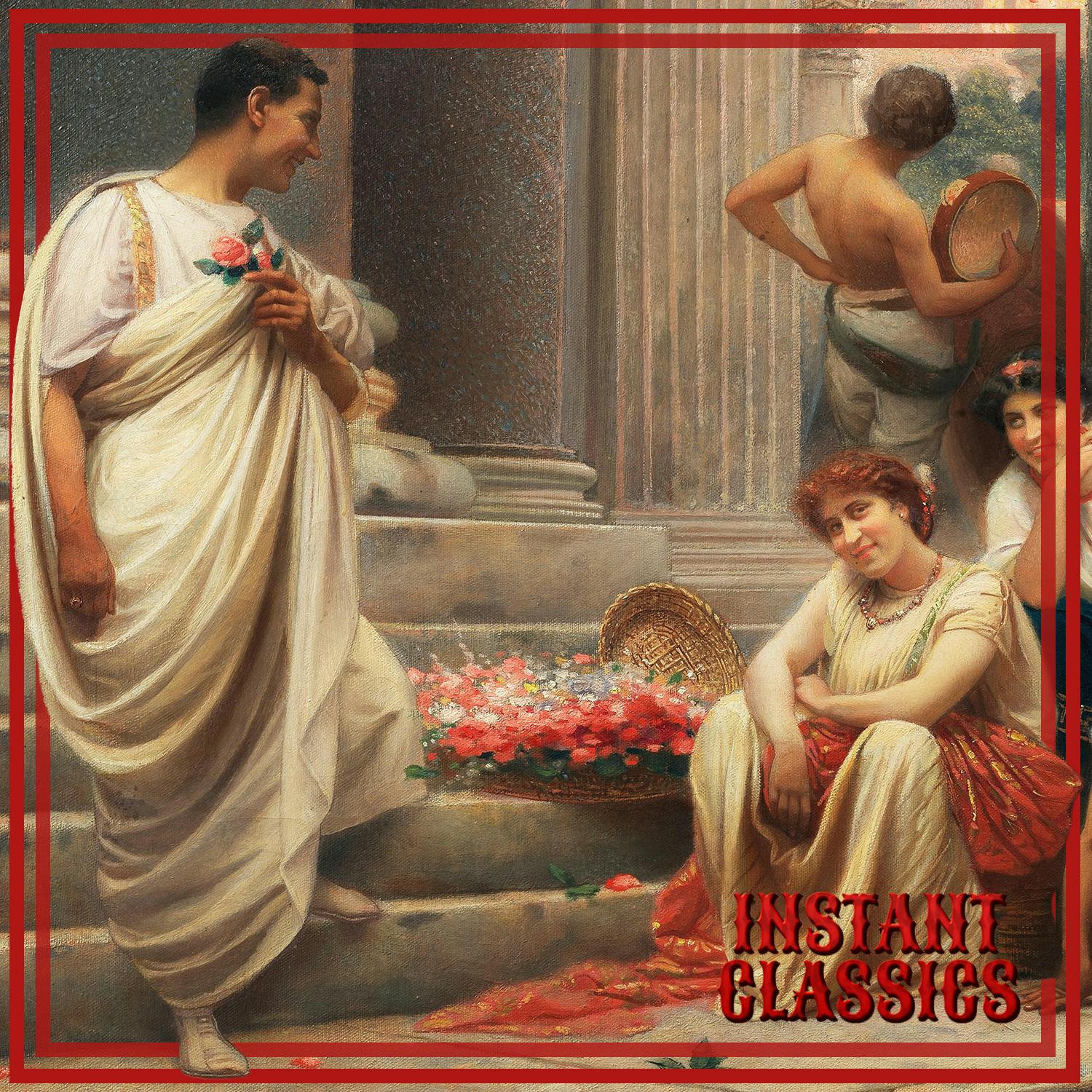
So in this episode we're going to try and set the record straight. Although not our togas, which are always as a proper Roman should be wearing, are always beautifully draped and layered. But we're going to ask, like, what is a toga? How did you make one? Who wore them? And what kind of occasion would call for one?
- [01:31]
Mary Beard
A toga isn't just an article of clothing. It gets right to the heart of what it meant to be Roman. This is instant classics.
- [01:41]
Charlotte Higgins
Each week we dive into the myths that dramas and characters of the classical world to discover what they still mean to us.
- [01:49]
Mary Beard
Now, I'm Mary Beard.
- [01:50]
Charlotte Higgins
And I'm Charlotte Higgins.
- [01:52]
Mary Beard
And this episode is Underneath the Toga.
- [02:08]
Bloomberg Announcer
Some follow the noise. Bloomberg follows the money. Because behind every headline is a bottom. Whether it's the funds fueling AI or Crypto's trillion dollar swings, there's a money side to every story. And when you see the money side, you understand what others miss. Get the money side of the story. Subscribe now@bloomberg.com
- [02:35]
Charlotte Higgins
Mary have you ever been to a toga party?
- [02:39]
Mary Beard
I've been racking my brains about this and I think I must have been when I was a student. I'm pretty certain that I did do a toga party, but I have kind of obscured it from my memory, rather. What about you?
- [02:52]
Charlotte Higgins
I honestly don't. I mean, I really don't think I have been to a toga party, but I have this terrible fear that somebody's going to, you know, send me a message and say, you were at a toga party in 1991.
- [03:03]
Mary Beard
Higgins.
- [03:04]
Charlotte Higgins
But I really don't think I have been. I don't move in those circles. Despite being a nerdy classicist, I do not. It's, it's not an ambition. I'm not about to throw one, put
- [03:15]
Mary Beard
it that way, right? I've certainly never thrown one. I can promise, I can promise I'm
- [03:19]
Charlotte Higgins
gonna be clear about that.
- [03:20]
Mary Beard
But I have got, I have got more and more interested in the toga, partly because, you know, you go around museums and there are all these statues of blokes and they're wearing this elaborate Roman dress and you, you can't help but thinking, what was that? You know, how did they put it on, how did they, how did they make it and how do we know about it? It is a real classical jigsaw puzzle because you're just picking up casual references. It's like kind of, we don't have a treatise now on, you know, what are trousers. But you could pick up quite a lot about trousers from reading modern literature. And the same's true in Rome. And some of them are funny. I mean, there's a lovely bit when somebody says, oh, the great orator Marcus Tullius Cicero of the first century bce, quite a sort of very serious character. He liked his toga because he used it to conceal his baraccus veins. And you think, ah, right, so how long was Cicero's toga? And I think the important thing though
- [04:29]
Charlotte Higgins
is
- [04:32]
Mary Beard
we have this notion that kind of, if we went back to ancient Rome, we walked around, what would people be wearing? Well, the blokes would be wearing togas, of course. Well, I think that's the first myth we've got to bust, honestly, because the toga was not everyday wear. Absolutely not. It wasn't exactly like a kind of tuxedo or dinner jacket. It wasn't necessarily posh wear, but it was what you wore if you were a man when you were doing the business that you did as a Roman citizen. So you, you wear one, you compelled to wear one. When you go to the Coliseum to watch gladiators, for example, men have to wear togas if they're Roman citizens. Anybody who turns up at the Colosseum in a little tunic has to go up to the back row seating.
- [05:27]
Charlotte Higgins
It's like being given a tie at the, at some kind of London club. But not because it's. Because it's political, Right. It's in order to do certain things as a Roman. The toga is what you have to put on.
- [05:38]
Mary Beard
That's right. And so, and you can see there are, there are attempts to be stricter or less strict about this. I mean, the Emperor Augustus is quite a kind of a cool line in togas because he tries to insist that if you just go into the Forum, the main marketplace at Rome, political but also business center of Rome, you can only go into the Forum if you're wearing a toga. The idea that he had bounces on the entrance to the Forum, kind of chucking out anybody who wasn't properly dressed seems remarkably unlikely. But what he's trying to do is to. To say when you're acting as a citizen, you act in the proper way. And he interestingly, himself, his biographer, Suetonius, the second century biographer of the first Roman emperors, I think his hymn tells us that Augustus, in his kind of sitting room, as it were, had a little cupboard in which he kept a toga all the time. So that if somebody came to him unexpectedly wanting to do state business, he could quickly put his toga on and act official. So it's that kind of thing, I think.
- [06:51]
Charlotte Higgins
Yeah, yeah. Like the politician being quickly handed a tie and a suit, but still not quite that, I think. And actually that anecdote in Suetonius about being. About Augustus trying to make everybody wear a toga in the Forum, I strongly suggest that everybody was not wearing a toga in the Forum. He was obsessed by traditional values and everybody doing being properly Roman and properly old fashioned in their Romanness, making Rome great again vibe. So it's kind of, yeah, interesting. It's. Yeah, people weren't wearing togas properly in
- [07:25]
Mary Beard
the Forum and there is a kind of a bit of uncertainty about what counts as official citizenly business because there's an anecdote we're told, I think, about the much later Emperor Septimius Severus. His original home was in Roman Africa and there's a story about him turning up at an imperial banquet and he hasn't come in his toga and actually he goes in and everybody else is wearing a toga. But luckily, and this really is like the London club of the posh London club handing you a tie when you arrive, if you've not got one, there's a flunky who gives him a toga to wear at the dinner, thus saving his embarrassment.
- [08:09]
Charlotte Higgins
Let's talk about exactly what this toga business was, right? Because I mean, for one thing, a toga was absolutely enormous. The evidence for this is beautiful statues depicting imperial personages in Rome and they tend to be seeming to be wearing very heavily draped layered togas and that might not have been used Know, strictly the case all of the time. That might have been just the very top end, posh royal family kind of toga. But, but certainly, you know, if you look at those, they are absolutely enormous. You know, you're looking at something that is over 4 meters by, by nearly 5 meters and vast. And it's not a rectangle, it's a semicircle.
- [08:49]
Mary Beard
That's, you know, one of the reasons why our toga parties get it completely wrong, isn't it? Because even a large king size double bed sheet isn't the right shape and it's not big enough.
- [09:01]
Charlotte Higgins
There are lots and lots of layers and drapes and huge amounts of material. One of the things that I'm really interested in is, I mean, I'm kind of obsessed by like the, the extraordinary labor it would have taken. Right. To make one of these things. Because, you know, it is a. It is a case of first shear your sheep. You know, in the ancient world, making textiles was incredibly time consuming and incredibly labor intensive. It's really hard to remember that because we live in a post industrial age where these processes are so fast and they're so industrialized and they're also so invisible because they take place in industrial settings. But you know, before the industrial revolution, all this stuff was incredibly visible, actually, because a lot of this stuff happened in the home. And so it was in the ancient world. Yeah. To make a toga of that size 4.2 by 4.8 meters, you needed, according to the research of an incredible classicist called Mary Harlow, 40 km. 40 km of woolen thread. Right. And all of that thread would have been spun by hand with a drop spindle that is like a distaff with wool and a weighted wool which you would sort of twizzle and the wool would drop down. And, you know, that's a lot. Yeah, it's very slow, but it's the sort of thing that you can carry around with you and do all day. And clearly a lot of people, probably a lot of women would have been spending a lot of time doing all day.
- [10:40]
Mary Beard
It begins to hint at the end. Enormous effort and labor that went behind this garment that said Roman citizen. It is enormously time consuming and it's not often precious material. Sometimes there are variants which are very precious, but usually it's. This is bog standard wool.
- [11:04]
Charlotte Higgins
Right.
- [11:05]
Mary Beard
But enormous quantities of it.
- [11:07]
Charlotte Higgins
Enormous quantities of it. Then set up your loom.
- [11:09]
Mary Beard
Oh, right.
- [11:10]
Charlotte Higgins
And you know, these things were woven in one piece. Right. So that means a loom. So 4.2 by 4.8 meters. For this big, this big bastard that's on that you might see draped over a Roman emperor in one piece. That means your loom is about 5 meters wide. Your loom needs to be wider than your fabric. That's the crucial thing. And each thread is woven individually. You can't probably. It's going to take more than one person to do that. You're having to sort of press each thread into place. Mary Harlow has calculated that to do all of this, to spin your 40km of thread and do your weaving, it would take 120 days if you were doing it 10 hours a day. Now, there are probably lots of slaves involved and you know, this is not the work of one, one, you know, wife of a Roman senator. Even though the Romans, I think, do try and persuade us, don't they Mary, that virtuous wives are weaving and making togas for their husbands.
- [12:21]
Mary Beard
There's a story about the Emperor Augustus's wife Livia. You know, Augustus, very invested, as we've seen, in the toga, but also in the proper production of the toga. So his very elegant wife Livia certainly kind of has a bit of a show from time to time of making it look as if she is making Augustus's toga for him.
- [12:43]
Charlotte Higgins
Absolutely. And there's another bit in Suetonius's biography of Augustus where it says that he only wore clothes or he wore clothes that were made by his children, his wife, his children, his grandchildren. One does wonder how true that was.
- [12:58]
Mary Beard
And also there must be some kind of commercial production of these things because as you said, you need a five meter loom. Well, you know, if you're a rich Roman, you've got a house you can fit a five meter loom in. There's quite a lot of Roman citizens who might need sometimes to wear a toga, like when they go to the Colosseum, they haven't got a place at home for a five meter loom. So there's a kind of commercial production and go and hire one from Moss Bros. The ancient equivalent, I guess.
- [13:27]
Charlotte Higgins
Yeah. Again, we're sort of inferring this, aren't we, Maru? Because we don't have. It's not like there are ancient togas that have survived from antiquity. I mean, textiles just don't survive in that way. So this is all about people researching it through experiment and study and analysis of statues and texts. I mean, the other thing is it's so vast, it's very difficult to put on yourself. I mean, it was all pretty much impossible to put on yourself. I'D say, yeah. So you need a couple of enslaved persons or helpers of some kind. So how, because it's draped twice around you, it's not held in place with any kind of brooches or fastenings. You sort of take a lot of weight of fabric on your left arm and your right arm is left free so that you can, you know, gesture magnificently as you make a speech. I don't know. Or sign documents.
- [14:22]
Mary Beard
Yeah, it is. I mean, the first thing that strikes me is that it's very cumbersome to wear and it, you need your left arm in order to hold it in place. There's a rather dull, actually handbook to how to make a speech by a guy writing in the late first century ce. And he explains how it's terribly important to keep one hold on your toga with your left elbow, and then you've got your right arm free to gesture to your audience. So it's right hand only. But I think kind of more than that, it was when I realized that, as you've just said, the toga is a garment you could never dress yourself in. You cannot put it on on your own. And suddenly it's one of those ways where the realities of mass slavery sort of really hits home, because this is not just about exploitation, ownership and cruelty, but it's also about the way that the whole of elite society operates on the assumption that there are people who will do that kind of thing for you. You will be dressed, you will not dress yourself. You will be dressed by your slaves. And I think that's a very sharp vision of what it is to, to live in a slave society.
- [15:49]
Charlotte Higgins
Absolutely, yeah. One other thing I like about the toga as it's, as it is, as one dresses in it, is that you could make a. There's a sort of internal fold towards the sort of top that you could sort of puff out a bit and make into a pocket so that you could put your bits and bobs in it. So it has a sort of internalized pocket, but without any, you know, it's just part of the drapery, which is kind of fun. And what did you wear under your toga? Which I do think, you know, this is a crucial, obviously key question. The answer is really quite boring. Right. You wore a tunic under your toga. You wore a tunic under your toga. What did you wear under your tunic? I don't know. Nothing.
- [16:30]
Mary Beard
Right. Probably nothing.
- [16:32]
Charlotte Higgins
Other Roman. Other. Do we have Roman y fronts Licas.
- [16:35]
Mary Beard
Do we. I don't know. I, I. This is where I've got a terrible confession, which will probably get a lot of people very angry, but sometimes when I was interviewing students for places to read Classics at Cambridge, I would occasionally say, what do you think Romans would wear under their togus? And, you know, in some ways, it's one of those awful university admissions questions, but it was wonderfully revealing in all kinds of ways, because actually, it's a perfect example of thinking through on first principles, how this would work. Right, yeah. You've got a toga. What's underneath? What's underneath that? And seeing candidates, the best ones were really good. Seeing candidates going through the options, just like you've gone through Charlotte, you get in. Do you think they had pants?
- [17:24]
Charlotte Higgins
I've never seen a pair of pants in a museum. But doesn't mean.
- [17:29]
Mary Beard
But as you say, there's lots of things you don't see in a museum from ancient Rome, particularly if they're made of fabric. You know that old joke, what the Romans wear under their toe? Because that. It's more than a joke. The other kind of myth that needs busting is that, oh, look, all tokers are much the same. No, no, there's. There is the Roman toga. Now, what we know about what people wear is that it's very often very carefully graded into different statuses, different kind of social ideologies, if you like to put it a bit pompously. So there's not just one toga, there is a whole range on what kind of toga you were wearing really made a difference to how people treated you. So, I mean, one of the things that's, I suppose, best known is that if you were a serving official, a serving magistrate or a serving priest, you would have a toga with a purple stripe around it. Now, other people would have purple stripes, by the way, on their tunics, but a purple stripe on your toga meant that you were literally in office. And the other kind of nice bit of real folklore is actually that if you were standing for election, you wore a toga that was not just kind of dull wool colour, which is basically, I think, what comes off your loom. Something sort of a bit beigey, really. If you were standing for office, I wanted to cut a dash, you would wear a toga that had been specially whitened. Now, we still have that, we still recognize that, because as classicists are always very keen to tell people at election time, the word for why in Latin is candidos. And our word candida, as in election candidate, comes directly from the candidata toga. A candidate for A Roman election would wear. So, you know, we're still the heirs of.
- [19:52]
Charlotte Higgins
To the whitened toga.
- [19:54]
Mary Beard
White and toga, that is what candidates. That's what candidates wear. But that's only. I mean, kind of the start of it, honestly. I mean, mourning. You wear dark, darker togas. If you're a priest, you pull it over your head so that when you're doing religious ritual, you kind of. How you do this, God only knows. You take a bit of the sort of loose stuff and there's a lot
- [20:18]
Charlotte Higgins
of fabric to play with. As I would say, there are different.
- [20:22]
Mary Beard
Other variations of different colors so that emperors are allowed to wear purple togas. And if you're a successful general having a triumphal victory parade through the city, you not only wear a purple cloak with silver stars on it. Really kind of amazing, but you wear a purple toga underneath, which is sort
- [20:47]
Charlotte Higgins
of amazing because producing purple in the ancient world was such a staggeringly expensive and extraordinary process. Because producing purple dye, I mean, there was no synthetic purple dye until the 19th century, but until then, purple was produced by crushing up tiny seashells, murex shellfish, and creating a very smelly purple dye. But it took huge numbers of these shellfish to make the dye. And. And so that's why the purple toga, it's so precious, it's so rare, it's so expensive. But I like all this stuff about who wore it better. There's so much stuff about Julius Caesar wore his toga in a way that showed that he was a bit effeminate and liked men. I mean, tell me more about that one.
- [21:37]
Mary Beard
Well, it is like in the way that. How fashion and clothing mean something in a culture that you take for granted and very often don't bother to explain. You know, we know. I'm going to give a misogynistic example now. We know what people mean when they say, her skirt's a bit short. Right. Well, just that kind of jibe was being made all the time in, say, Roman oratory, Roman speech making. You know, here's a guy where you couldn't trust him because it's. It's all a bit kind of. His toga's a bit too full. I don't know what that means. And you mentioned Julius Caesar, and there's some joke about Julius Caesar was if you looked at the way he dressed, either way he wore his toga, you'd never imagine that he would have gone on to conquer the world.
- [22:27]
Charlotte Higgins
Yeah, he looked a bit too bitsy, sort of effete. Oh, yeah, I've got it here in my trusty copy of Suetonia's, that there's a sort of complimentary thing about how Augustus wore his toga just right. Neither too tight nor too full. The purple stripe was neither too narrow nor too broad, but brilliant detail. He wore platform shoes to make himself look taller whilst wearing this toga.
- [22:53]
Mary Beard
There we are. I think Suetonius also tells us that when he's keeping a toga in a cupboard, just in case he needs it, I think he also keeps his special footwear in the cupboard too, so he can quickly become official emperor from being just putting his feet up at home. So this idea that the toga came, it was a risk. Wearing the toga was a risk because people might always say, bit skimpy, you
- [23:21]
Charlotte Higgins
know, a bit, you know, a bit
- [23:23]
Mary Beard
too elaborate, a bit too full. And what. How you appeared in the world at Rome was very, very important about how you were judged. And for Roman citizens, how you wore the toga, whether you got it right or whether you didn't was terribly important. Now it's really hard for us to work out precisely what it meant to get it right. And of course, none of those rules are rules in a very strict sense. But you can see that togas mean something in the public life of Rome. They're not just those really stupid articles of clothing that you have to wear.
- [24:04]
Charlotte Higgins
Yes, you do end up with a bit of a dead end, trying to map this onto contemporary, because it is so different. But when we do scrutinize, you know, the media does scrutinize the suits that politicians wear. I mean, God help us if you're a female politician, of course, that is absolutely magnified to an insane degree. The newsprint on the suits of Angela Merkel, I mean, that's sort of behind us a bit now, whether the former leader of the British Labour Party, Jeremy Corbyn, was or wasn't going to be wearing a suit, all of that stuff, you cannot be a politician without some kind of analysis of your clothing. It's not exactly like that, but it's not totally.
- [24:47]
Mary Beard
It's one of the reasons why, when you think about it, you realize how we could never be at home in Rome. I mean, you think, you know, people talk about time travel. Would you like to go back to Rome, ancient Rome, for a day? They say to me, and partly, I think, no, thank you, unless I got a very guaranteed return trip. But one of the reasons is that we would be completely excluded from those systems of meaning that go along with the Absolutely everyday sense of what people were or were not wearing. So I think it's a really serious subject. I mean you can go into it in a great, in a very light hearted way. You know, toga parties can be, I think I am told, can be fun. But there is something about the toga that does take us right into, you know, what, how Roman culture thinks about itself and how, and it's surprising because I think the other thing that we forget is it's not just men.
- [25:49]
Charlotte Higgins
Right. I was going to ask you about this, Mary. Could we, could we wear a toga if we went to Rome?
- [25:55]
Mary Beard
I think, Charlotte Higgins, I have to say that if you saw a grown woman in the street at Rome wearing a toga, you would assume she was a prostitute. Oh, so it might be a high risk article of clothing for you, I think, to wear. And again, it's very hard to piece
- [26:24]
Charlotte Higgins
the evidence for this together.
- [26:26]
Mary Beard
There's a very interesting Roman female poet in the first century bc, a woman called Sulpicia. And in her poetry we get that very strong sense that what some prostitutes wore in Rome, some female prostitutes, they wore a male toga.
- [26:47]
Charlotte Higgins
It's, that's, I mean that is mind blowing in a way when you think about what we've already said about this, this item of clothing, that it's for Romans doing Roman men, doing Roman business in a Roman way in Roman places, in the forum, in the law courts, presumably in the Senate, I can only assume as emperor, performing all these sort of offices of administration and legal and legislative and business. And then you're telling me that prostitutes wore togas. It's fascinating and strange, very hard to understand.
- [27:24]
Mary Beard
The usual explanation that people bring out when that question is asked, and I'm not sure how convincing it is really is that there is a kind of parallel dress for the Roman marriage woman, respectable marriage woman, it's called a dollar.
- [27:42]
Charlotte Higgins
Right.
- [27:42]
Mary Beard
And it also involves quite a lot of cloth, not quite so much and is quite complicated. One argument that's brought out is that this, what this is saying is that you are, this is a woman who is not wearing the stola. And the way you most clearly make the point that you're not a respectable married woman is you put on the toga. And there's some hints too that women divorced for adultery also can be made sometimes to wear a toga. So when it's on women, it's about transgression, it's about not playing by the rules. Romans also kind of wondered a bit about the history and I think they had no better idea than we do, honestly, of what the early history of the toga was. But one of their ideas was that once upon a time everybody had formed the toga. You know, grown men, grown women, as long as they were citizens, children, everybody. And then it kind of got parceled out. So the Duke became the garment of one section only. We have no idea that's true.
- [28:56]
Charlotte Higgins
I mean, I guess what I think is so fascinating about the toga is that just how Roman it is. You know, it's not Greek, it's not, as far as we know, it's really specific to Rome, and the Romans think it's really specific to Rome. It doesn't operate quite like national dress, as we would think of it. It's not quite. It's not like, say, a kilt in Scotland, because it has this extra political dimension. It's more the poet Virgil, 1st century BCE, who wrote the extraordinary epic poem the Aeneid, which is the great sort of national epic of Rome, which tells the origin myth of Rome, the origin of the Roman people. It's got. And it's, you know, it's a wonderful, wonderful poem. There's a famous line in it where the goddess Juno is prophesying the future of the Roman people to its founder, this hero, Aeneas. And there's a line in there about the gens togata, which means the toga wearing race. And it's about the ropes. So this idea that like the Romans are by definition the people who wear the toga, and the toga, I suppose, is by definition the item of clothing that belongs to the Romans.
- [30:20]
Mary Beard
No, that's. That's absolutely right. So you've got this kind of convergence between political citizenship, but also Roman ness as you face the outside world.
- [30:33]
Charlotte Higgins
And that's beautifully exemplified, I think, as well in, in the first century ce, historian Tacitus, who wrote a biography of his father in law, Agricola, who was the governor of the province of Britain, he writes this sort of wonderful passage about how the elite of the sort of local British people found themselves becoming Roman. And he says it in a sort of a tone of lament almost that these people are sort of giving in to giving in to the pull of Romanness. And all the defining things about that sort of becoming Roman are going to the baths, speaking Latin, having dinner parties and wearing the toga. So it's sort of part of a suite of attributes that actually, as a provincial, obviously as an elite provincial, even on the very fringes of empire, you know, you can adopt and you can in some sense, become Roman through the toga, as well as all these other things.
- [31:43]
Mary Beard
At this point, we're going to have to add in another garment, I'm afraid, because when Romans are talking about this distinction between proper Romans who wear the toga and particularly Greek, eastern Mediterranean foreigners, they say Romans wear the toga, but the Greek dress is something called the pallium. Now, at this point, I don't want to over complicate it, but it's absolutely fascinating because to us, if you see statues of people that very, very careful costume historians have identified as wearing the pallium, it looks exactly the same as a toga, frankly. I mean, it's. To the. To the modern eye, you can't really tell the difference between a pallium and a toga, except that the pallium is made from a rectangular bit of cloth, whereas the toga is made from a semicircular bit of plot. But it is hugely, hugely kind of significant in, in, in Roman culture, because if you wear the pallium, it means that you're Greek, you're not Roman. You might be a philosopher, it's the classic dress of the philosopher. Or you might just be having a really good time, you know, off official business. So when Tiberius, the Emperor Tiberius kind of goes to the island of Capri to do all the awful things he does there, one of the things we're told is that he wore the pallium when he was there.
- [33:25]
Charlotte Higgins
Not. It's more your kind of athleisure, it's a bit more relaxed.
- [33:29]
Mary Beard
It is. It is more relaxed, but. But it's clearly absolutely centrally important because there's an extraordinary case under the Emperor Claudius in the first century ce, when there is a trial going on about someone who. Where the issue is whether he is a Roman citizen or not, and the issue is what is he going to wear at his trial on the question of whether he is or is not a Roman citizen? And, you know, should he wear a toga? Should he wear a pallium? You can see that Claudius, who gave the ruling, has got a terrible time here. What did finally decides is that when this character is defending his right to be a Roman citizen, he will give evidence in a toga. When the prosecution is attacking him for not being a Roman citizen, he will have to wear a pallium. Wow, talk about precision legal argument there. But my God, goodness me, you know, it's showing that a whole lot rests on it. You know, you couldn't be attacked for not being a Roman citizen if you were wearing absolute Roman dress.
- [34:50]
Charlotte Higgins
There is so much more to the toga than I have to say, I've learned a lot this episode. I did not know that. And at the risk of sounding very Miranda Priestley, it just shows you how incredibly important clothing is also. I just can't think of any modern equivalent, actually. I mean, we can talk about. Of course, all clothing is significant. All clothing sends a message. Everything that we wear has a kind of set of. A set of symbols attached to it. And clothing is political. I mean, I spend lots of time in Ukraine. Wearing a traditional embroidered shirt in Ukraine is a huge political national statement. And it's saying, I am not Russian and I'm Ukrainian and there's a lot of clothing that operates on that level. I think also of the beautiful feathered cloaks of New Zealand that, you know, when Jacinda Ardern, when she was Prime Minister, turned up to meet the Queen wearing a beautiful feather cloak, that was a huge symbol of her relationship with her country, with the indigenous heritage. And it's a symbol of how, of respect. And the Queen had one as well, apparently, as sort of head of the Commonwealth. You know, this is very heightened symbology relating to clothing, but to me, there's nothing quite like the toga.
- [36:13]
Mary Beard
I'm afraid I want to finish by going back to the toga party, because we said at the beginning a bit sniffy, and we said, look, the togas weren't really like this and it's all frapped boister. Well, fine, so it may be. But I think that I'm going to start a bit of a campaign for renaming the toga party.
- [36:33]
Charlotte Higgins
How are you?
- [36:34]
Mary Beard
Because for two reasons, I'm going to call it the Pallium Party, because the togas that we adopt, that is bedsheets, they are rectangular like the pallium, they're not semicircular like the toga. And like the pallium, they signify being off duty, perhaps being a bit leisured, you know, having a bit of fun. So I think that we're going to. I'm going to go along next time I'm going to go to a pallium party and I'd feel quite at home, I think.
- [37:06]
Charlotte Higgins
Okay, Mary, if you invite me to a pallium party, I will come. And that is saying a lot, because I do not drape myself in sheets for anybody, not just anybody.
- [37:19]
Mary Beard
If anybody would like to send some pictures in of what they look like in their pallium bedsheet, we'd love to see them.
- [37:29]
Charlotte Higgins
As ever, we want to know your thoughts and comments, ideas, questions, and so if you have them, please do send them to us@instantclassicspodmail.com or on our social media at Instant Classics Pod.
- [37:46]
Mary Beard
Bye Bye.
- [37:55]
Sweetgreen Announcer
There's a new way to sweetgreen Meat Wraps Handheld, hearty and made for life on the move. With bold, chef crafted flavors, fresh ingredients and over 40 grams of protein, they're built to satisfy without slowing you down. Try wraps today in the app or@order.sweetgreen.com available at all participating locations.