Loading summary
Transcript101 lines
- [00:00]
Mary Beard
If you Visit downtown Washington D.C. today, you'll find it full of columns, lookalike Roman temples full of classical pediments and sculptures. It's a very Roman sort of place,
- [00:14]
Charlotte Higgins
except that all of this stuff is actually 19th and 20th century replica Roman. You don't see real ancient things on display in the museums there unless you look incredibly hard. I mean, Washington is probably the museum capital of the world. It's got a hundred, at least 100 museums in it. But you really have to search to find any real classical antiquities.
- [00:42]
Mary Beard
There are a few ancient sculptures in the National Gallery, and there are some great late Roman Byzantine works of art in the Dumbarton Oaks Museum. But bizarrely, your best bet for finding Roman things might be to visit the Museum of the Bible.
- [01:00]
Charlotte Higgins
But all is not quite as it seems. The fact is that there is plenty of real ancient stuff in dc, although most of it, including a really good collection of ancient Greek pottery, is tucked away in museum storage or lurking in even more surprising places.
- [01:18]
Mary Beard
Next time in this series on America and Rome, we'll be looking at some of Washington's replica Roman architecture, what you can already see, and even more of it that's controversially planned. But in this episode, we'll be shining a spotlight on two ancient objects hidden away in D.C. that even many Washingtonians themselves know nothing about.
- [01:48]
Charlotte Higgins
One of these is a block from the most famous ancient Greek temple in the world. And yes, we are talking about the Parthenon, and who knew that there was any bit of it in America?
- [01:59]
Mary Beard
The other is a huge marble Roman coffin that was very nearly reused as the last resting place of an early American president.
- [02:14]
Charlotte Higgins
There are extraordinary stories here of how ancient objects travel willingly and unwillingly and on their way, pick up new meanings. But on the theme of this mini series, there's important American politics involved. We'll be going back to the no Kings theme that we touched on in
- [02:36]
Mary Beard
our last episode, because this is Instant Classics, the podcast that uncovers the ancient stories still shaping the world today. And I'm Mary Beard.
- [02:47]
Charlotte Higgins
And I'm Charlotte Higgins. Each week we dive into the myths, the dramas and the characters of the classical world to discover what they still mean to us. Now, this week, a tomb unfit for a president.
- [03:12]
Commercial Announcer
You have one new message. Translating Disney and Pixar's Hoppers is now available on Disney.
- [03:21]
Charlotte Higgins
You could say that again.
- [03:23]
Commercial Announcer
Critics are calling it Pixar's funniest movie ever. And a wildly entertaining ride. Blizzard Potato. It's certified fresh and verified hot.
- [03:31]
Charlotte Higgins
Now we party.
- [03:33]
Mary Beard
This is incredible.
- [03:35]
Commercial Announcer
Wow.
- [03:36]
Mary Beard
I am Clearing the rest of the day.
- [03:37]
Commercial Announcer
Disney and Pixar's Hoppers, now available on Disney. Rated pg.
- [03:43]
Charlotte Higgins
Okay, Mary, so the stuff that we're mostly going to talk about today, the stories that we're mostly going to uncover today, this is really down to your research, I think. Well, I know it's down to your research, Mary, but you were in America for quite a chunk of last year, weren't you, on the fellowship? And I think I have a suspicion that you started looking for classical stuff because you're such a nerd that you missed your. Your bits of Roman masonry and Greek pottery.
- [04:15]
Mary Beard
No, you're absolutely right. And I mean, I think research is putting it a bit strong, but I think there I was nine months in Washington, D.C. looking at this, you know, being in a very Roman environment, and I did think there must be more real Roman stuff here than, you know, you see on the average museum visit. And so I did, you know, I made inquiries and I started looking a bit harder and I found some truly extraordinary stories. And those are the ones we get to tell in part today and their stories. And I think this is the payoff, really. It's not just, oh, I happen to find a Greek pot somewhere, it's that these are stories that really relate to our theme of American politics, American culture and the classical world. But they've been almost completely forgotten.
- [05:21]
Charlotte Higgins
So let's just set the scene because, you know, here we are in Washington, hundreds of extraordinary museums. You can see Asian art, you can see African art, you can see 20th century airplanes, you can see whatever you want. You can see one of obviously extraordinary American art. But unlike the Louvre or the Hermitage in St Petersburg, should anyone be going there right now, which I strongly think they're not, or the British Museum, what I'm talking about is these great national museums at the centre of empire tend to have Greek and Roman antiquities in them. And that is not true, not quite true of the great Smithsonian museums, the national museums of the us.
- [06:12]
Mary Beard
The way that real antiquity is built into these museums in Washington is quite different from what you go to New York. You went to New York, you'd go to the Metropolitan Museum and it's oozing,
- [06:27]
Charlotte Higgins
swimming, swimming in amazing Greek and Roman antiquities.
- [06:32]
Mary Beard
Yeah, that what you've got in D.C. is more surprising, more hidden away and actually more political. And the thing I came across first, and it sort of made me think there's more to look on here, but also there's a point to look was when I started, or someone actually said to me, gave me a Hint. Look at that great obelisk that was put up in the 19th century over many decades because they kept not having enough money for it and kind of stopping and starting. That great obelisk that stands at one end of the great Mall in the center of Washington D.C. put up to as in honour of the first precedent called the Washington Monument.
- [07:25]
Charlotte Higgins
I remember the first time I saw it, I actually said to my friend, what's that obelisk? I didn't know what it looked like, I didn't know what it was. Absolutely shocking. But of course, Mary, correct me if I'm wrong, but the reason this obelisk shape was chosen is clearly because of Cleopatra's needle and all the obelisks in Rome which were themselves imported, let's put it politely, from ancient Egypt. After the conquest of Egypt, the West
- [07:54]
Mary Beard
has always wanted to show its power by putting up an Egyptian obelisk. And Washington D.C. was no different from London, you know, Paris and other places. What's interesting about this one, and I have to say I haven't looked, I haven't looked as carefully at these other modern obelisks as I have done in the Washington one. But actually it is hollow on the inside. And of course it's hollow because you do it with less stone if you make a hollow obelisk. And of course, because it's a 19th century monument, it's always been a tourist attraction. And you can go up the inside of it and you can still do this, you can go up in an elevator left and you can go up and you can look out the top. Now, what is harder to see when you do this lift journey, there are stairs, but nobody with any sense would take the stairs. Embedded on the inside of the obelisk are commemorative plaques and bits of stone, 200 of them, given by all kinds of different people. I mean, many American states gave their stone to be incorporated in Washington's monument. And most of them fought very much at the same time. This is the state of Maine. This is the state whatever. And this is in honor of, in the memory of our great president. The one that I didn't expect was one written in Greek, given by the Greek government. This was. There's no looting going on here. This was a gift by the Greek government saying that it is. What, what we've got here is a block, a building block that came from the Parthenon and it was given from. This is quite predictable, isn't it? It was given by the founders of democracy in the descendants of the founders of democracy in Athens. And Pericles to the new democracy of the United States.
- [10:17]
Charlotte Higgins
How fascinating. But this is obviously after Greek independence.
- [10:20]
Mary Beard
So, yes, this is in the middle of the 19th century, and it's a proud kind of attempt to do something slightly different from what we were looking at last time. This is not Rome and Roman republican virtue. This is a real push for America enacted, as it were, in the gift buy from the people of Athens, the people of Greece. America is the inheritor of Greek political traditions. And there it is. It's kind of written into, absolutely embedded in the fabric of the memorial to Washington, this idea of, ah, there's a bit of the Parthenon here. Now, I have to say that I had never ever known that there was any bit of the Parthenon taken, not looted or taken in difficult circumstances or, you know, controversially, but given as a gift.
- [11:28]
Charlotte Higgins
And it's a plain object. It's not kind of carved. It's not. It hasn't got. There's not a beautiful horse's head or a, I don't know, a kind of a processional maiden from the Parthenonfries.
- [11:41]
Mary Beard
Don't get too excited. It's not a bit of sculpture. It's a bit of plain building block, which is. But it's saying the building block of the Parthenon is now become the building block of. Of this monument to a founder of American democracy.
- [12:01]
Charlotte Higgins
So it's handing democracy from the past to the present and asserting a kind of continuity of equality and, you know, freedom.
- [12:12]
Mary Beard
You know what I thought, though, when I saw pictures of this, I have to confess, I mean, I must have passed it, but I've never actually looked on it knowingly, eyeball to eyeball inside the Washington Monument. I did think, you know, going back to the theme of American Rome, well, where's Rome then? You know, so we've got. Here we are mid 19th century and we are, we are, you know, proud America building into our monument, proud Athens. Where's the tradition of the Roman Republic? Because certainly there is. There is no building, Roman building block, no bit of Roman sculpture inside the Washington Monument. Then I discovered a story which I have no doubt is partly true. You know, some of the embellishments might be urban myth, but actually the plan was to have not only Greece, but also Rome built into the monument. And the Pope, in this case, because the Pope was then mid 19th century, still controlled and owned effectively most of the. The major monuments of the central city of Rome. The Pope sent a building block from the famous temple of Castor, which is one of the great monuments of the Roman forum put up in the imperial period, but going back to the great days, the glory days of the Republic. And so the Pope shift off for the monument, he shift off a block of the Temple of Custer. But the story's end is really sad, I suppose, because as I mentioned before, the Washington Monument was taking ages to put up because they kept disputing and running out of money and all the rest. All the usual reasons, the usual stuff.
- [14:12]
Narrator
Yeah.
- [14:13]
Mary Beard
And this block from the Temple of Custer was in the yard, the builder's yard there, waiting for the time when it could be put into.
- [14:23]
Charlotte Higgins
Oh, gosh, I don't like where this is going.
- [14:26]
Mary Beard
Yeah, well, you know, it was nicked. It was nicked. The story is, and this is where it comes a bit harder to pin down, the story isn't that it was nicked by a load of thugs who thought they'd have a good time and you know, and rip off something that was waiting to be in the monument that it was. It was nicked by a well known group of anti papists who couldn't bear the idea that a gift from the Pope was going to be in Washington's monument. So what they did, and this again, this is the story certain, you know, I think there are fuzzy edges to it. What they did was they nicked this building block from the Temple of Castor and they threw it in the river Potomac, the river Washington river. And it has never been found.
- [15:20]
Charlotte Higgins
Mary, I think you and I should go diving on the Potomac for it.
- [15:25]
Mary Beard
And people don't, you know, we said people in Washington don't themselves don't know about this. Like I gave a speech at Georgetown University, which, you know, a great University in Washington D.C. from which you can actually see, if you get high enough, you can actually see the Washington Monument. And you know, I said basically, how many people know about the story of the Roman building block that was going to go here? And no one did, unless they were being too modest to confess. And there was great hilarity, I have to say, at the idea that it had ended up in the River Potomac.
- [16:07]
Charlotte Higgins
There were several arenas at play. I mean, obviously this block itself had zero to do with, with Catholicism. And also since it's an imperial building block, it's very much in the single person rule era. It's not a kind of, it's not an artifact of republican rule as such,
- [16:32]
Mary Beard
Republican glory and republican virtue. No, it was one of the rebuildings of the Temple of Castor done by nasty autocrats that of course the new American government wanted to have nothing to do with. But I suppose what it did for me is it kind of made me think, right, okay, let me look a bit harder. Maybe there's more stories here and maybe sometimes there is slightly off piste as that one was. And what I soon found, thanks to, to colleagues in the National Gallery where I was, who had heard word of this, I found something actually hugely, hugely significant. Wrongly forgotten. And you know, if you like, with a message for American politics now, not just a story of the 19th century.
- [17:35]
Charlotte Higgins
Talk about it, Mary. Cause this is, we're now going on to the story that we hinted at in the introduction, which is the story of the Roman marble coffin. So tell us about that. I mean, it's not something you can see readily anymore, is it? But until fairly recently, till, you know,
- [17:55]
Mary Beard
living memory, in living memory you could see this. And we'll talk about how it was displayed in a bit. But it's a coffin with a real anti monarchy message attached to it, turns out. And so really important for a time in D.C. because what it is, is actually one of a pair of, let's say third century ce, highly decorated marble coffins or sarcophagi that were brought back from Lebanon. It was found in Lebanon, brought back by an American naval commander. Now, the circumstances are a bit murky of how he got hold of these two coffins. It is usually said that he bought them. You know, he was patrolling in the Eastern Mediterranean with the American ship, the American SS Constitution, big, you know, big member of the fleet, the American Navy. And while he was there, there he bought this pair of coffins and he loaded them up on the Constitution to bring them back to the United States.
- [19:35]
Charlotte Higgins
And he was very clear about what he thought they were, wasn't he?
- [19:38]
Mary Beard
He had wonderful fantasies about what he thought they were because he convinced himself that they were the coffins in which once had rested the early third century emperor of whom not many people have heard, Alexander Severus and his mum, Julia Mamaya. Now, and he constantly, this guy, Jesse Elliot is his name, he constantly talked about them in those terms. He assumed they were. Now he had one reason for thinking that, and that was on one of the sarcophagi, one of the coffins, there was a name and an aegis of its occupant, who was called Julia Mamaya. Now you can see that when Jesse Elliott saw this, he thought, wow, you know, this is the Julia Mamire now.
- [20:42]
Charlotte Higgins
But there was a slight problem, wasn't there? Because it said that she was 30 years old. It was clearly inscribed that she was 30 years old. So on those grounds alone, she couldn't really have been the mom of an adult murdered emperor.
- [20:57]
Mary Beard
Yeah. If it really was the coffin of the Emperor Alexander Severus, you know, I have to say, a relatively goody of the early third century.
- [21:07]
Charlotte Higgins
Yeah. Wasn't he the successor of my old friend who in episode one of our podcast, I couldn't pronounce the name of. Elagabalus. Elagabalus, yes.
- [21:16]
Mary Beard
Yeah, he was a successor and a cousin, I think, of Elagabalus. And he reigned from 208 to 235. And he's written up quite well. And his mum all part of the same Syrian Elagabalan family because the coffin says she died age 30. You know, as you say, Charlotte, she would have had to have had Alexander Severus when she was three if she really was his mum. But there are many other reasons why it can't be. I mean, Julia Mamire is a very common name in the Eastern Roman Empire. Alexander Severus and Julia Mamaya were both murdered. They did come to a sticky end. But hundreds more than a thousand miles away, possibly in Britain, possibly in Germany, it's almost certain that they were taken back to Rome to be buried. That there's, as some people, even Jesse Elliot's kind of crew members started to say, this doesn't quite add up.
- [22:19]
Charlotte Higgins
They're quite magnificent objects. We'll put a link to an image in the show notes. But they do look fit for Roman emperors in the sense that they, they are enormous. They are highly carved with kind of swags of foliage and kind of. They look like cherubs. They're not really cherubs. Cause that's a sort of. But sort of kind of winged creatures. They've got sort of lids, like roofs with pitched roof lids. They're mighty, mighty objects.
- [22:53]
Mary Beard
They are absolutely wonderful and you can see why Elliot was very keen. You know, he's there, he's got some ready cash. Let's suppose it's no more than ready cash. And he is using, as naval officers have done for decades at that point, he's using his convenient transport ship to bring them back to the United States as grey objects. He believed Imperial Roman emperors objects. But what is interesting is that one thing he didn't want to do was put them in a museum. That was off the agenda.
- [23:39]
Charlotte Higgins
Let's find out what he did do with them. After the break, Mary.
- [23:49]
Advertisement Voice
Study and play come together on a Windows 11 PC and for a limited time. College students get the best of both worlds. Get the unreal college deal everything you need to study, study and play with select Windows 11 PCs. Eligible students get a year of Microsoft 365 Premium and a year of Xbox game Pass ultimate with a custom color Xbox wireless controller. Learn more@windows.com studentoffer while supplies last ends June 30th terms at aka mscollegepc.
- [24:19]
Mary Beard
Hello lovely listeners. If you're not yet part of our Instant Classics book club, well, now is the perfect time to join because we are making our way through one of the most exciting works of literature ever. That's Homer's Odyssey.
- [24:39]
Charlotte Higgins
We would love you to join our book club, which we absolutely adore. So please do join now to give you all the access to our previous episodes and loads of other perks like being able to join our online community and getting early booking access to our live events.
- [24:58]
Mary Beard
All details are on our website, instantclassicspod.com
- [25:06]
Charlotte Higgins
so this guy, Jesse Elliot, sails back to the United States with these two vast Roman sarcophagi on board ship. And what happens then?
- [25:15]
Mary Beard
MARY well, the idea isn't to put them in a museum. The idea, Elliot's idea is he wanted to reuse them to bury a couple of modern celebrities. That was the plan. And it's at this point, never mind the wrong identification of these sarcophagi, it's at this point that the complications set in and the politics set in. Let's dispose of the Julia Mamire sarcophagus first, because that's got a fairly simple story. He has an idea that he could use this sarcophagus, even though it was a woman's, he could reuse it in which to inter the mortal remains of a philanthropist from Philadelphia by the name of Stephen Girard. Now, that's fine, except he was happily interred somewhere else and there was no, there was no real idea that what they should do is dig up Girard and then rebury him in the Julia Mamire's misidentified sarcophagus. So what actually happened was that the sarcophagus went to rather posh high school that Girard, Girard College, that Girard had founded, where I think so far as I've been able to discover, the young lads at the college used to play around with it, muck around with the sarcophagus, until I think in the 50s, the people of Girard College said, look, maybe we could find a better home for this. And it went off to Bryn Mawr College University. Bryn Mawr Liberal arts college in Philadelphia. And it was put. It's a woman's college. And the idea that it was Julia Momaya's sarcophagus was kind of hugely appropriate. It was put in the quadrangle of Bryn Mawr. And that's where it still is. It's been quite, you know, it has a fairly simple story. Not used for Girard. Stays a bit in Girard College, mucked around with by the lads, put into safekeeping in Bryn Mawr, where actually it's currently being worked on from an archaeological point of view, you know, in a way, a happy ending. The trickier one was with the sarcophagus that Eliot believed was Alexander Severus is the Empress. And his first plan, because we're now, you know, we're now in the 1840s by the time he's got this home. He picks it up really in the 1830s, but, you know, it's by the 1840s that he's actually back waiting for its reuse. And his first plan was to put into it the remains of James Smithson, who had been the founder of this great Smithsonian Institution, which we now see in all its 21 museums in Washington,
- [28:43]
Charlotte Higgins
D.C. he was a British guy who had founded.
- [28:51]
Mary Beard
Illegitimate aristocrat of a British family, I think. But the trouble was, like Girard, he'd also been buried elsewhere. He was dead and happily buried.
- [29:02]
Charlotte Higgins
Too late. Too late, man.
- [29:03]
Mary Beard
No. At this point, Elliot decides to give this great sarcophagus to the state, but with the sort of instruction. And you can see that Elliot has by now seen that you need to have somebody living because it's no good trying to find a dead person to go into the sarcophagus, because you'll never get them disintermed. Heard.
- [29:29]
Charlotte Higgins
He
- [29:31]
Mary Beard
strongly suggests that it should be used to bury President Andrew Jackson, an early 19th century American president. He assumes a presidency in, I think, 1829, and he does two terms. Jackson at this point is mortally ill. So you can see that Elliot is a great admirer of Andrew Jackson, and he sees that he will get Jackson. He might be able to get Jackson's body into this sarcophagus. Charlotte knows quite a bit about Andrew Jackson, actually.
- [30:12]
Charlotte Higgins
Actually, that's a complete. That's so untrue. I know a small amount about Andrew Jackson from having mucked him up because American history is not my forte. But I mean, he is obviously. I mean, what I did know, I think everyone knows really about Andrew Jackson, is that he's a hugely divisive figure and his reputation has swiveled from being greatly admired to being pretty besmirched by some of the events that he presided over. Or I mean, he, Andrew Jackson was a man, and this is, I guess, less for our lovely American listeners. I feel slightly ashamed about doing this brief sketch to our American listeners who will know this anyway, but we have lots of non American listeners, so here goes. He was a man from a much humbler background than the usual than the previous run of presidents since Independence who had either been sort of Virginia planters or Harvard educated lawyers. Quite grand. Andrew Jackson was not grand. He was from a fairly modest background. He fought in the War of Independence and then with great distinction, I suppose he did incredibly well in the 1812 war against the British. So he emerges from that war as a heroic figure. He was beaten up by the British during the War of Independence, actually, and harbored a great loathing for the British. And when he comes into politics, it is with the idea of standing for the common man and as it were, draining the swamp of Washington. I mean, I think Donald Trump did move a portrait of him into the Oval Office in his first term. So there are a few resemblances in the sense that Jackson figured himself as anti elite. Part of the controversy of Jackson is that he was a slave owning plantation holder and even more kind of seriously ordered or effectively forced a large number of indigenous Americans, Native Americans, to sign treaties that forced them off their traditional lands and moved them to the other side of the Mississippi in this horrendous kind of deportation, effectively deportation of many, many people, very unhappy incidents known as the Trail of Tears. So there's a huge amount, there's a huge amount going on with Andrew Jackson. But I think for the purposes of what we're talking about today, there is this, there's a sort of dichotomy as far as I understand it, between his desire to stand for the ordinary man, this anti elite strain of thinking in him, which stands slightly, paradoxically with the way he actually used his powers. So he used the power of veto a huge amount. He exerted his personal authority in a way that had not quite in unprecedented ways. He got rid of people he didn't like. He clung onto appointees that he did like. He was very invested in ideas of personal loyalty. And for this reason he did get deeply criticized and there were cartoons floating around in his lifetime saying things like king Andrew I. So he gets figured as someone who's edging towards the precise thing that the American War of Independence had been fought to eradicate. So it's A really fascinating mix.
- [34:13]
Mary Beard
And he's compared to a Caesar. So again, he's compared to all the things that the founders of America were standing against. He was much admired by Elliot. He brought these sarcophagi back, What Eliot does, having formally given it to the state, but with some, you know, he's still pulling the strings. He writes to Jackson, who's very close to death, and says, basically, you know, I've got a coffin for you, mate. Would you like to be buried in the coffin of Alexander Severus, which I've just bought back from Lebanon? Right. Now, this is where the real politics kicks in and where Andrew Jackson, who, I think we have to see that even on his deathbed, saw that for an American president to be buried in the coffin that was wrongly identified as the coffin of a Roman emperor was, at the very least, a vast PR disaster, you know.
- [35:22]
Charlotte Higgins
Yeah. And bearing in mind we're talking about a situation in which, I guess many. Even though you say that some people were very skeptical about this identification, a lot of people would have bought into it, you know, for the purposes of this kind of discussion. It was the coffin of a Roman emperor.
- [35:40]
Mary Beard
Yes. No, that's exactly right. I mean, and for many people now, it still is, actually, when we come to find out where it is, they still think it's a coffin of an emperor. And so Jackson's got this offer, and his answer is an instant no.
- [35:55]
Narrator
Right.
- [35:56]
Mary Beard
And he writes, and I will read you what he says in his letter back. I mean, after saying how very flattered he is that Eliot has thought about him, because it absolutely lays down the politics of this object, which clings to the object ever after. He says, I cannot consent that my mortal body shall be laid in a repository prepared for an emperor or king. My republican feelings and principles forbid it. The simplicity of our system of government forbids it. Every monument erected to perpetuate the memory of our heroes and statesmen ought to bear evidence of the economy and simplicity of our republican institutions and the plainness of our republican citizens. I cannot permit my remains to be the first in these United States to be deposited in a sarcophagus made for an emperor or king. So whatever the rumors, whatever the criticisms of Jackson, whatever his behavior, when he's offered what he believes to be the coffin of a Roman emperor to be buried in himself, he comes straight out with the absolute stereotypical version of the founder's ideology of the United States, which is, yeah, don't go near an emperor.
- [37:37]
Charlotte Higgins
It's so I was very keen that you Read the whole thing, Mary, because it's so good, isn't it? And to me it almost could be Cato or Cicero had they been in a similar position. So even though Andrew Jackson was not super educated in the way that his predecessors were super educated, but he did have some educ. But you can feel that all the unconscious of all the stuff that we were talking about with Joy Connolly in the first episode of this miniseries is sort of palpitating through this letter and it really does feel incredibly republic. All that stuff about we have to be simple, we have simple virtues, plain, the plainness of our republican citizens and we don't do, we don't do this appalling luxury. I mean of course there are so many tensions there because the Romans were so incredibly fond of saying that kind of thing themselves whilst absolutely swimming in ill gotten gains. And it obviously will go a little bit that way. America is going to become a hugely wealthy country and there's a little bit of that going on. But it's a sort of beautiful. For all Andrew Jackson's. The problems with Andrew Jackson, it's kind of a splendid statement of republican principles.
- [39:05]
Mary Beard
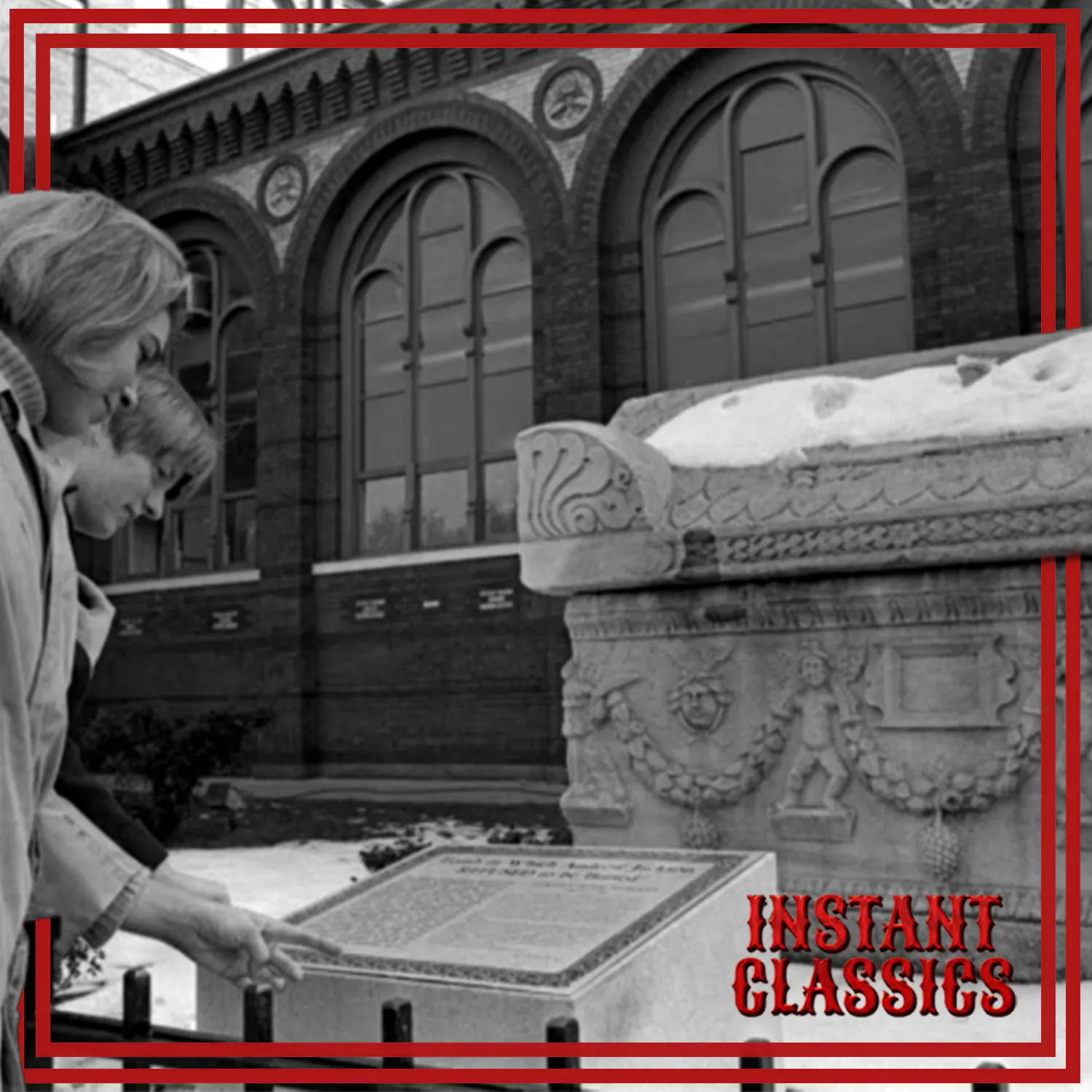
He can really talk the talk, you know, when he's confronted with this sarcophagus it crystallizes for him what being an American Republican is. And I think what's in a sense even more interesting is that this object now it's, I have to say, forgotten. We'll find out where it is at the very end, but becomes that kind of the holder of those republican principles because after they've received the unfortunate refusal by Jackson it moves around a bit, but it then gets displayed first of all at the entrance way of one of the Smithsonian buildings. And then it is actually put out on the mile outside one of the. On the grass outside one of the main buildings of the Smithsonian museums. And it becomes a place that people go to visit for exactly the reason that Jackson refused. And it has a label attached. Certainly you can see this label in the 50s and 60s and it goes back before that. I think what the label does is it reprints the letter that Jackson refused it. So it's got the text of Jackson's letter saying an American president shouldn't be buried in this. And it has a heading which says the tomb in which Andrew Jackson, capital letters refused to be buried.
- [40:51]
Charlotte Higgins
It's kind of mind blowing, isn't it? Because it's like a sort of negative artifact. It's an artifact showing absence rather than presence. It's an artifact showing what we avoid rather than what we did. It's such a peculiar. It's such a peculiar thing to display as something that was turned away from and rejected.
- [41:14]
Mary Beard
It is quite extraordinary. And for decades it was a little bit of a sort of pilgrimage site to this kind of negative monument of, you know, don't be no kings. It's a no kings monument. And there are wonderful photographs that you can see of people, of visitors coming and reading the text of Jackson's letter. So here I was. I mean, I suppose for me, here I was looking desperately for the Roman. The Roman objects or the ancient objects in Washington D.C. and then I found this one that was not just Roman and quite important sarcophagus. I mean, it's a kind of important work of art in some ways, but it was also. It kept. It was the bearer of that American ideology.
- [42:10]
Charlotte Higgins
But, Mary, you didn't see it in the mall in Washington D.C. cause it's not there anymore. So please tell me.
- [42:17]
Mary Beard
I'm afraid it's a kind of sad story because probably in the 80s, and I haven't entirely pinned this down, it was removed from its outdoor location on the Mall. Now, it could well have been that there was good motivation behind that, that somebody said, look, this is not a good way of conserving this important monument. You know, out here in the snow and in the heat, for whatever reason, it was taken away. But the sad thing is it wasn't put back on public display inside in the Smithsonian Museum. It was taken to an ex army base in Suckland, Maryland, which functions as a storage facility for the Smithsonian. And it's so big that it was put in the section which includes things, horses and traps. And also, wonderfully, the motorbike that was used in the film Easy Rider. Right.
- [43:31]
Charlotte Higgins
So some kind of outsized baggage area of the Smithsonian storage.
- [43:36]
Mary Beard
It's in a transport section, basically, because
- [43:39]
Charlotte Higgins
it kind of, I guess in a way they would. It's a sort of form of transportation to the other world.
- [43:45]
Mary Beard
It is. That's what I thought when I went. But what's interesting is that its label saying the tomb in which Andrew Jackson refused to be buried was brought along with it. So when I did go to see it, and they were very, you know, they were very nice in letting me go and see it. You see it just as it was with its pilgrimage label. And the extremely nice guy who takes care of it in Suitland, Maryland, said, this is the tomb of a Roman emperor. So that misidentification still remains and the myth has got buried, but it's there very much to be uncovered. And I had a very sadly failed ambition when I was in D.C. that I really, really, really wanted to get this wonderful sarcophagus, plus its own label, plus its bit of American history, plus its Republican ideology. I just wanted people to be able to see it. But I'm afraid I think it's consigned to spe the rest of eternity with motorbikes and ponies and trap in Suitland, Maryland.
- [45:08]
Charlotte Higgins
This is such a shame. I mean, you'd have thought it could be a fit for the Museum of American History. Yes, because it is a part of American history.
- [45:16]
Mary Beard
I wrote to them.
- [45:17]
Charlotte Higgins
Oh, okay. Yeah, right. Great minds think alike.
- [45:20]
Mary Beard
I made that point. You know, I mean, I'm afraid I have to say, you know, and I think we have to be careful about what we imagine for its future. But, you know, there is just the possibility that maybe Jesse Elliott's ambition for it could one day become true.
- [45:39]
Charlotte Higgins
I mean, we're going off into this is a slight fantasy land, but I had this idea that somebody in the public eye in America connected to power, really likes kind of classically themed things. If you look at the inside of Donald Trump's houses, there's a lot of gilded Corinthian pillars and bits and bobs. I thought you could gild this sarcophagus and it would look really, really, really, really fancy.
- [46:11]
Mary Beard
And although I find that in some ways a horrific idea, I think it's almost less horrific than this object of such importance, such kind of, you know, a quintessential encapsulation in just one Roman thing of the American ideology. The idea that it is never going to be seen by anybody. I find that very sad.
- [46:41]
Charlotte Higgins
It is sad. It is sad. And there's something, because you've written. We'll put this in the show notes, but you wrote a great article about this object for the Wall Street Journal. And there's a thing you wrote in that article about, you know, who was this. Who would have commissioned this coffin or been buried in this coffin originally. And you wrote that scholars now believe that the sarcophagus was a pretty typical product of the Eastern Roman Empire. And it's the sort of thing that if you were really rich and there was a huge amount of wealth in the Eastern part of the Roman Empire, if you were just super rich, you could commission that for your. You know, you could commission that for your loved one or for yourself or whatever, you know, in other words, it's nothing special. It's something that. It's something for the super rich. Not Necessarily for the super noble or the super powerful or the super imperial. It's just cash. And in a funny way that is quite American, the sense that, you know, you can have all these extraordinary things, you just need the money. But you know, there's kind of weird egalitarianism to that. You know, you don't have to be born to the purple. You can, you can, you can, you can sort of, you can get this. If you rise up and make enough money, you can have the gilded, you can have the sarcophagus.
- [48:07]
Mary Beard
This is the Great Gatsby world for America. Yeah, but it's still for me it's those kind of words of Andrew Jackson, you know, all his terrible faults, the idea that he talked that talk, you know, and I think, you know, they're worth listening to. They're worth listening to what, you know, to why and how he refused this and why Rome mattered to him. You know, the idea of a Roman sarcophagus meant something to Andrew Jackson and I think that's really important.
- [48:43]
Charlotte Higgins
I completely agree, Mary. And I do think that, you know, for all the things that one can, you know, be incredibly upset about Andrew Jackson for this rolling statement of republican values is admirable. And I mean it was a great idea for him not to be buried in this Roman sarcophagus and it should
- [49:08]
Mary Beard
be, be better known.
- [49:11]
Charlotte Higgins
Yes. Get it into that Smithsonian museum right
- [49:14]
Mary Beard
now, get it out on the mole. You know, next time we'll look at some of that 19th century stuff we've been talking about. But meanwhile let's, let's raise a glass to Andrew Jackson.
- [49:26]
Charlotte Higgins
Absolutely. As ever, we want to know your thoughts and comments, ideas, questions and so if you have them, please do, do send them to us@instantclassicspodmail.com or on our social media stclassicspod. Bye bye.
- [49:52]
Narrator
To some he is the revolutionary hero who restored China to its rightful place on the global stage.
- [49:58]
Co-host
To others, he's a brutal despot accused of presiding over more civilian deaths than either Stalin or Hitler.
- [50:04]
Narrator
Mao Zedong has one of the most recognizable faces in the world. Yet he started life in a muddy provincial village.
- [50:11]
Co-host
A rebel son who hated his father, survived a 6,000 mile walk across China and rose to become a figure of titanic proportions from Empire.
- [50:21]
Narrator
The Goal Hanger World History Show.
- [50:23]
Co-host
I'm Anita Anand and I'm willing to William Durample.
- [50:26]
Narrator
In this six part series we're joined by world renowned expert Rana Mitter to explore the life of the father of Communist China, Mao Zedong.
- [50:36]
Co-host
We'll track his rise from a bookstore owner to a guerrilla commander, and we'll witness his ruthless elimination to secure total power. And we'll descend into the dark experiment of the Cultural Revolution, a time when ancient temples were bird, children denounced their parents, and a nation worshipped a mango as a sacred relic.
- [50:57]
Narrator
Subscribe to Empire wherever you get your podcasts to listen now.