
Podcast
Jordan Supercast
Hosted by Jordan Supercast · EN
The Jordan School District Podcast Starring Superintendent Anthony Godfrey
43episodes
Episodes
Newest firstAll episodes
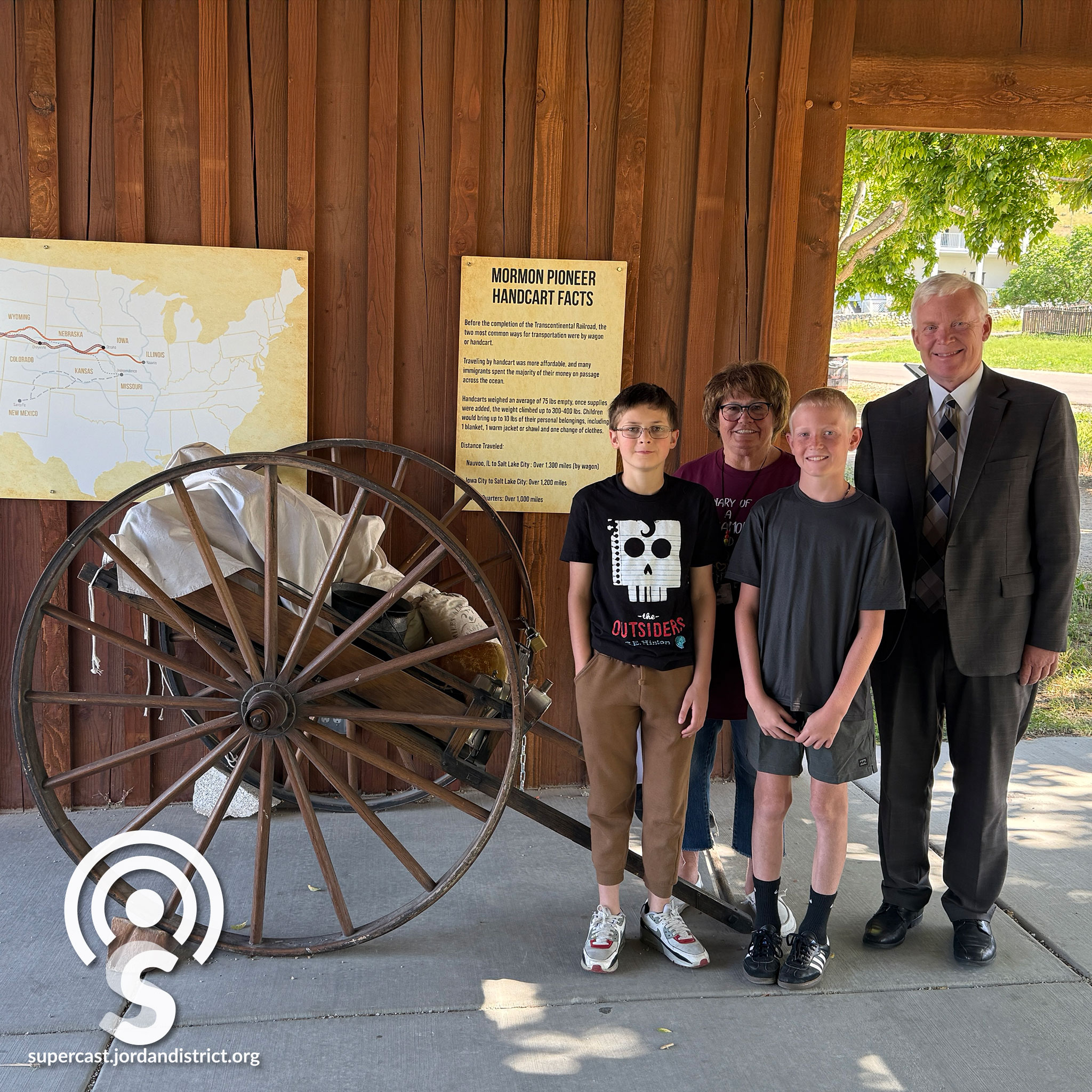
Episode 307: Students Take a Step Back in Time as Utahn’s Celebrate Pioneer Day
Jul 23, 202500:15:45Tap to summarizeAs thousands of Utahns enjoy parades, rodeos, fireworks, and other festivities to celebrate Pioneer Day, it’s time to pack up and take a field trip for a hands-on lesson in history for some Jordan School District elementary school students. On this episode of the Supercast, we follow teachers and their students to “This is the Place Heritage Park” where the life and times of Utah’s early settlers come alive. It is a live history lesson you won’t want to miss. Audio Transcription Ms. Crane: It brings it to life for the students. And it doesn't matter what they see here, they go away with an appreciation of what the pioneers went through. Anthony Godfrey: So you're just steering from behind right now. These are some big ruts you're dealing with. Student: Is this what they have to do, the whole thousand miles? Anthony Godfrey: Well, on the bad patches, I suspect it was. [MUSIC] Anthony Godfrey: Hello and welcome to the Supercast. I'm your host, Superintendent Anthony Godfrey. As thousands of Utahns enjoy parades, rodeos, fireworks, and other festivities to celebrate Pioneer Day, it's time to pack up and take a field trip for a hands-on lesson in history for some Jordan School District Elementary School students. On this episode of the Supercast, we follow teachers and their students to This Is The Place Heritage Park, where the lives and times of Utah's early settlers come alive. It is a live history lesson you won't want to miss. [MUSIC] Anthony Godfrey: We're talking with Ms. Crane at This Is The Place Heritage Park. You have a bunch of students here today, tell us about that. Ms. Crane: They're so excited we've been talking about pioneers and finally they get to finally experience the stuff that we've been talking about. The hand carts and school, they're going to be able to go to a pioneer school and see what it was like. Anthony Godfrey: Yeah. Oh wow. Ms. Crane: And we get to ride the train, which is exciting for them, and go to the saddle shop, so just different things that the pioneers experienced. These guys get to see and do, and some of them will never make it up here, so this is a fun field trip for them to experience that. Anthony Godfrey: Well, I have to admit, I've never been to this park myself, so I'm glad that you got me here as well. Ms. Crane: Yay. Anthony Godfrey: And this makes the learning that you've been doing in class very real. You've been doing this for a number of years. Tell me about the impact that this field trip has on students. Ms. Crane: It brings it to life for the students. And it doesn't matter what they see here. They go away with an appreciation of what the pioneers went through and a knowledge of stuff that we've been talking about, hands-on experience. So it brings you up to the kids. Anthony Godfrey: Well, today this is the place because it's beautiful. It's the end of May. We're going to be playing this in July, or posting it in July, but the foothills are bright green. It looks beautiful up here. This is a great way to spend an afternoon in May with your fourth graders. So I see that they're already lined up on some of the hand carts over there, some students are. Tell me about some of the experiences they have while they're here. Ms. Crane: They'll get to pull the hand carts, push. At one point they'll be pushing and then they'll switch and they'll be pulling the hand cart. So they see how hard it was going, because they make it really rocky and hilly out there for them. So they experience that. When they go to the school, they will learn that they used to have to line up boys' line and the girls' line. And they had to curtsy and bow to the teacher. Anthony Godfrey: Yeah, okay. Ms. Crane: So then they- Anthony Godfrey: Did you put curtsying and bowing to the teacher into your regular rotation? Ms. Crane: I tried that. They just laugh at me. And then they learn the Deseret alphabet of what the pioneer children were learning. Anthony Godfrey: Yes, the Deseret alphabet. Ms. Crane: Way back then. And then today we go to the saddle shop. I haven't been to the saddle shop for a while. And so they'll learn how they used to do the saddles, what kind of materials that they need, where they get their materials. So that's kind of interesting. Anthony Godfrey: I grew up in Indiana, not Utah, so I did not get to go to any of these places. I also didn't have a Utah history class, so it's good to gain a little extra knowledge here today about Utah history. How many years have you been bringing students up here, and has it changed over time? Ms. Crane: I've been doing this about 30 years. Anthony Godfrey: Wow. Ms. Crane: And it's changed a lot. It's very different than it used to be. They've brought in more buildings. They've refined the experience a little better. So the kids get to ride on the train, which is a new thing. Anthony Godfrey: Do the kids get pretty excited like they have to? They know it's coming. They're in third grade, and they know next year we get to go to This Is The Place Heritage Park. Ms. Crane: They're excited. One year, a couple of years ago, the water main broke the day that we were coming up, and it just devastated the fourth graders, cuz we didn't get to come. Cuz they had big problems up here that day, and I was really sad. Anthony Godfrey: That's too bad. Ms. Crane: Cuz we've been waiting for the whole year. Anthony Godfrey: They've been looking forward to it, okay. Ms. Crane: Yes, it has changed a lot. They've really made it more enjoyable. It was always enjoyable, but they just honed in and made it so much fun. Anthony Godfrey: Well, it's really engaging even just walking in here. There was a lot to see, a lot that I hated to pass up as I caught up with you guys. Ms. Crane: One of the nice things about bringing them here is a lot of times the kids will bring their parents back in the summer to see some of the stuff that they weren't able to see before. So they'll get to come up here and experience with their families. Anthony Godfrey: Yeah. Ms. Crane: That's part of them coming up here and experiencing that. Anthony Godfrey: I love that involvement. Ms. Crane: And the fun thing about doing Utah history with the kids in fourth grade is they have more of an appreciation when they hit seventh grade. Anthony Godfrey: Yeah. Ms. Crane: And really dig into it more than I get a chance to do that now. Anthony Godfrey: Yeah. Ms. Crane: So. Anthony Godfrey: Is Utah history one of your favorite things to teach? Ms. Crane: Yes, I love teaching Utah history. I just don't have enough time to get everything in that I want to get in. Anthony Godfrey: What are some of your favorite things to teach? Ms. Crane: The mountain men. Anthony Godfrey: I saw there's an event in June with the mountain men up here. Ms. Crane: Yeah. Anthony Godfrey: Tell us more about that. Ms. Crane: One of our teachers just went to an event last weekend, Memorial weekend in Ogden. I'd never heard about it, but they have this big rendezvous in Ogden. And she went up to the rendezvous and was able to get some stuff to share with the kids. Anthony Godfrey: Yeah. Ms. Crane: So that was kind of exciting. I loved when the pioneers came across from Nauvoo and the trek that they took. I like to put them in wagons. And then they draw cards every day to see what kind of conditions they're experiencing that day. They might have lost all their water. They might have had an animal die. It was great weather they get to go 15 miles ahead. So they're trying to reach Salt Lake. Anthony Godfrey: So that random factor gets thrown into the mix. Ms. Crane: Yes. So that's kind of a fun thing to do with them is have them experience that. Anthony Godfrey: Very cool. That's great. Well, there's nothing like being right here in the setting that can really provide that hands-on experience. There's a lot of participation and a lot of attention being paid here. They're into it. Ms. Crane: Yeah, some of them have never been here and this is exciting for them. Anthony Godfrey: There's the train in the background. There they go. Ms. Crane: One of our groups. Anthony Godfrey: Yeah. So, speaking of other groups, you were on the podcast earlier because one of your former students is teaching. But there are others in the District that you taught who are now teachers. Ms. Crane: Yes, I taught Emily Crane. She's at Elk Meadows. And Kristen Clegg. I don't know exactly what school she's at right now, but they're former students of mine. Anthony Godfrey: Yeah. Ms. Crane: I actually taught with Emily at Elk Meadows. Anthony Godfrey: Is Emily a relation? Ms. Crane: Nope, no relation. Anthony Godfrey: No relation? Ms. Crane: No relation to me. Except a year of teaching. I had Emily when I taught a third fourth split at Riverton Elementary. And I taught Kristen Riverton Elementary also. So it's nice to see some of my former students come on to be. They're amazing teachers. Anthony Godfrey: I bet they are. They had a good start. You start learning by watching your own teachers. Ms. Crane: They're amazing. Anthony G...
Transcribe →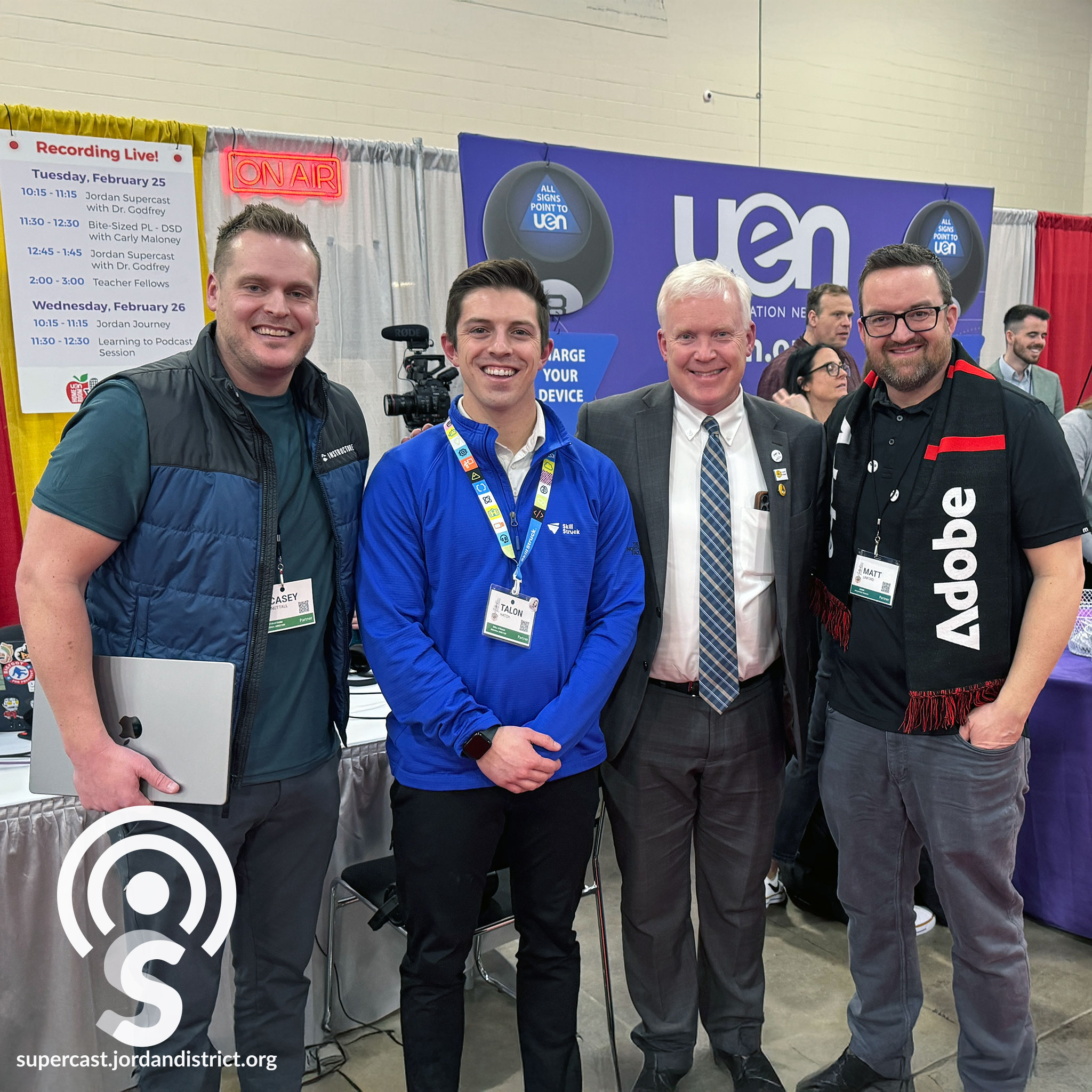
Episode 306: Unlocking Student Potential with Technology
Jul 17, 202500:20:45Tap to summarizeIt is giving every student an opportunity to learn at higher levels in ways some never imagined. On this episode of the Supercast, we talk with companies igniting curiosity in the classroom with the use of technology, technology which is bringing better education opportunities for students, enhancing what teachers teach, and impacting education in some incredible ways. Audio Transcription Talon Hatch: Even some of these younger kiddos as young as third grade, they're already building websites with HTML. Matt Linford: It creates this environment where tools like Skill Struck, tools like Adobe, can all come into one course of a kid and the kid can engage with these various content and curricular resources in one space. Casey Nuttall: Getting them in as early as possible on some of these tools to prepare them for the future. [Music] Anthony Godfrey: Hello and welcome to the Supercast. I'm your host, Superintendent Anthony Godfrey. They are giving every student an opportunity to learn at higher levels in ways many never imagined. On this episode of the Supercast, we talk with companies igniting curiosity in the classroom with the use of technology; technology which is bringing better education opportunities for students, enhancing what teachers teach, and impacting education in some incredible ways. [Music] Anthony Godfrey: We're talking with Jared Covili, the grand poohbah, the grand marshal of UCET, but also the administrator over Digital Teaching and Learning in Jordan School District. It is always a great way to mark this time of year by coming to talk with you at UCET, Jared. Jared Covili: It's the end of winter. We're moving into spring, so what better time to talk Ed Tech? Anthony Godfrey: You can smell hope in the air. There's sunshine out there. It's a beautiful day. Jared Covili: It could be power cords and things. Anthony Godfrey: That's right. We're going to have three guests on that are partners with Jordan School District. Talk with us about those three. Jared Covili: Yeah, so today you're going to be listening to three different partners that work with us in the Ed Tech department. You've got Skill Struck, who represents a group that works primarily with our K-6 computer science group. Each of our elementaries has a computer science leader that works with the kids, helping them integrate not only computer science projects, but also computational thinking. So, Talon Hatch will be here from Skill Struck with us. And then we've got Casey Nuttall from Instructure, and our District is kind of an Instructure district. We use a lot of different products from them, but primarily most of you in the audience will know them as Canvas. So that's our learning management system that we use to connect students to their homework and to turn in assignments and do assessments. For us on the back end, it is the way that we do a lot of our grading and a lot of our assessment of students and what they're learning. So that's Instructure. And then our third partner that we're going to hear from today is Matt Linford from Adobe. Probably a lot of you have driven past the Adobe office on I-15 but wondered kind of what's going on up there. Well, they're a great educational partner of ours, and they provided all of their software to all of our students and teachers from K through 12. So that's a big part of what we do. And they're a great partner that we work with, not only at UCET, but throughout the year. Anthony Godfrey: Again, thank you for making this opportunity available to so many and for being the mascot mayor, grand poohbah, and grand marshal of UCET. Long may you reign. [music] Anthony Godfrey: So, let's start by talking with each of you. Just introduce yourself. Tell us who the company you're working with and generally your connection with education. Matt Linford: So, my name is Matt Linford. I'm with Adobe and I am actually the engagement manager that covers the state of Utah including a lot of what we do within the Create Utah program. So my role is just to really support districts and make sure that they have what they need. Casey Nuttall: Yep, and then I'm Casey Nuttall. I'm with Instructure. I'm a regional sales director for Instructure. So kind of like Matt, I work with the state of Utah in every LEA in Utah on how they utilize Instructure platform tools to engage student learning, to increase student outcomes, and really to be a tool to use to facilitate the education for Jordan School District. Talon Hatch: And I'm Talon Hatch. I'm part of Skill Struck, a Utah-based company. We work with the school district on computer science education. So, we work particularly with a focus on the elementary schools and how they're utilizing computer science to enhance learning and increase computational thinking for all your students. So, we really enjoy that and I'm just a regional partnership. I work with all the different partners throughout the state of Utah and helping districts do what Jordan's doing so well. Anthony Godfrey: For it for those parents who are listening, most of you probably did not benefit from the work of these three folks because in the last ten years there's been a lot of progress, a lot of movement forward, and education changes rapidly in the right direction, giving more personalized learning opportunities for students and different levels of support for teachers. I mean it's really exciting the level of creativity that's possible because of the support that your three companies give us. So let's talk about Skill Struck's connection with computer science at the elementary level, which for some people just sounds kind of crazy that we start that early. But that's exactly when we ought to be starting. Talk to us about what that looks like. Talon Hatch: Yeah, yeah, it's a great question. So, we love working with the District on that part. The larger part of what it stemmed from is about four and a half, five years ago, the state created the Utah Computer Science Master Plan. Obviously, with the growth of tech in our state and the legislation, the USBE came together and said, "Hey, we need to support our schools in making sure that every kid K through 12 is getting access to high-quality computer science curriculum, resources, and professional development for teachers." And so they actually created a grant program where districts could collaborate with other partners like Skill Struck and throughout the state in creating a plan of “this is what computer science is going to look like in our district,” to make sure that every kid has access. So, we really love working with Jared and Tracy in your district and seeing what does that vertical alignment look like at each school, across each grade level, so you can ensure that even as long as, like you said, as kindergarteners, they're engaging with the standards from the state and really getting that technology foundation that is so critical in the digital world that we live in. Anthony Godfrey: It's a very hands-on, very concrete STEM education from a very young age and really it comes down to problem-solving. Talon Hatch: Exactly. Anthony Godfrey: And I also think there's customer service and empathy built into that because you are programming for an end user, and if you can't put yourself in their place, you aren't going to be an effective programmer. Talon Hatch: Exactly, and the beauty of what the District's doing is throughout this curriculum is they're doing computer science with computational thinking, those problem-solving skills, the basics of coding. But beyond that digital literacy, digital citizenship, keeping all within one platform so these students can really be strong stewards of technology regardless of what path that they end up taking. The nice part is they're getting a really strong foundation in the elementary already where we work with a number of the junior highs in the District as well, and the teachers are coming to us and saying, “hey, these kids are knowing way more than they did a few years ago,” and they're having to level up their game. That was the whole plan of the master plan is we would need to level up what we were doing with technology in the classroom. Anthony Godfrey: Kids are pretty amazing and teachers are amazing and when you put great tools in front of them, you really can be blown away by the results. Talon Hatch: Oh, I mean I was just talking with one of your teachers. A shout out to Colleen Pepper over at Falcon Ridge. She's one of the teachers, the STEM teachers, that takes and teaches Skill Struck weekly across all grade levels of the school. So she's seen every class, every student, are coming to her once a week for about, you know, 45-50 minutes. She was just sharing with me even some of these younger kiddos as young as third grade, they're already building websites with HTML. They're already learning text-based coding with JavaScript. A lot of teachers are always saying, “those third graders can't do it that young,” and they're always shocked when they start excelling and they go fast and go way beyond what we give them credit for. It's exciting. Anthony Godfrey: Well, thanks for your support and making that possible. Stay with us. When we come back, we’ll talk with Instructure and Adobe about how they are impacting the student and teacher experience in Jordan School District. Male voice: Never miss an episode of the Supercast by liking and subscribing on your favorite podcasting platform. Find transcripts for this episode and others at supercast.jordandistrict.org. Sandy Riesgraf: Hello, I'm Sandy Riesgra...
Transcribe →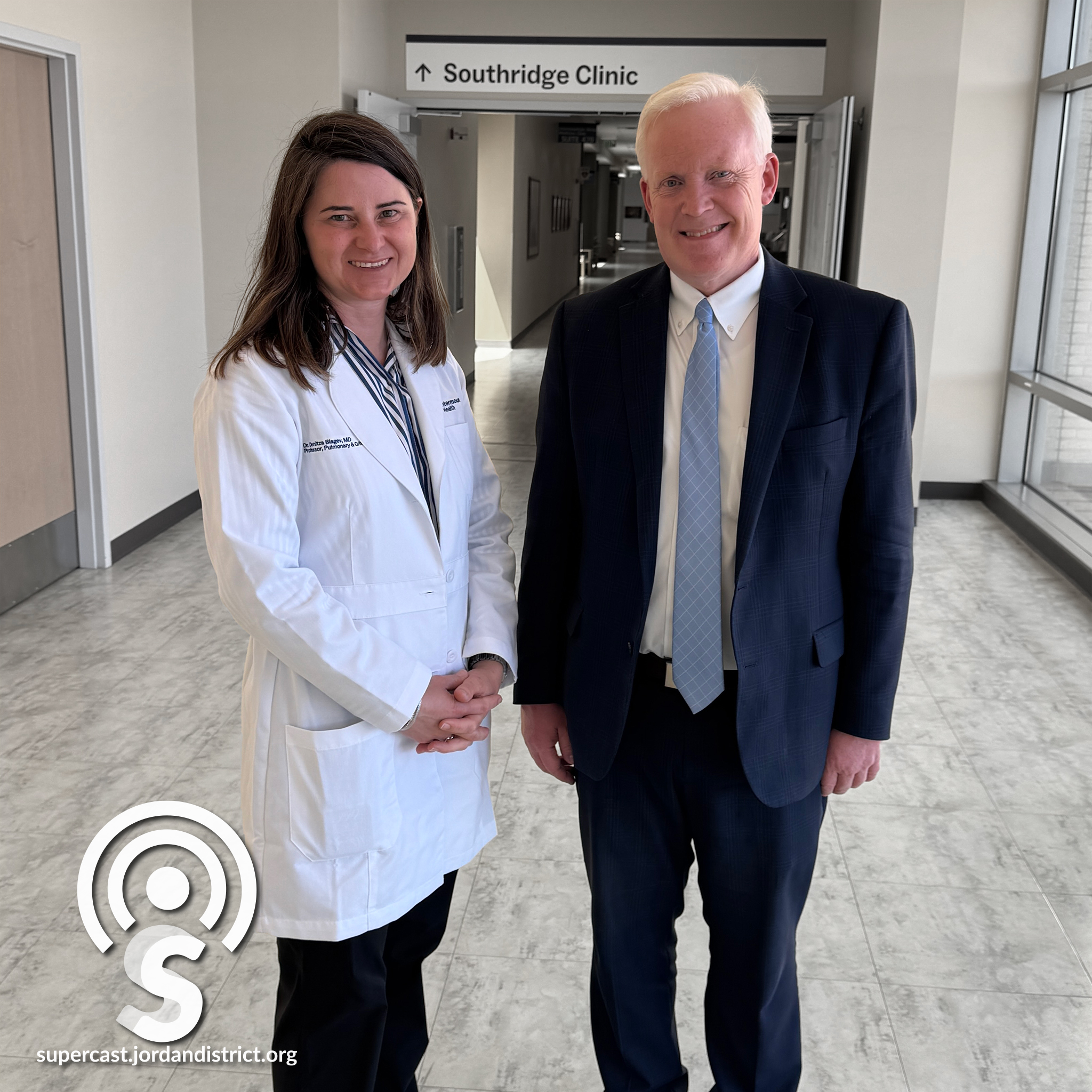
Episode 304: A Doctor Talks About the Dangers of Teen Vaping
Jul 3, 2025Tap to summarizeDo you know the signs to watch for if you suspect your young teen might be vaping? Do you want to talk to your teen about it, but don’t know where to begin? On this episode of the Supercast, we sit down with a doctor from Intermountain Health Riverton Hospital, who gives us some strategies for approaching the subject of vaping. Find out why it’s a conversation that could save your teen from some serious health complications now and in the future, due to what doctors say are the real dangers of vaping. Audio Transcription Anthony Godfrey: What are the negative impacts that you see, especially in youth, as a result of vaping? Dr. Blagev: The analogy was smoking. It took decades for us to be able to understand kind of the longer term COPD, lung cancer, heart disease risk. The other category I worry about is the lifelong addiction. [Music] Anthony Godfrey: Hello and welcome to the Supercast. I'm your host, Superintendent Anthony Godfrey. Do you know the signs to watch for if you suspect your teen may be vaping? Do you want to talk with your teen about vaping but don't know where to begin? On this episode of the Supercast, we sit down with a physician from Intermountain Health Riverton Hospital, who gives us some strategies for approaching the subject of vaping. Find out why it's a conversation that could save your teen from serious health complications now and in the future due to what doctors say are the real dangers of vaping. [Music] Anthony Godfrey: We're here with Dr. Blagev, the chief medical officer at Riverton Hospital, to talk about vaping. Thanks very much for taking time. Dr. Blagev: Thanks so much for inviting me. Anthony Godfrey: Tell me, what are the negative impacts that you see, especially in youth, as a result of vaping? Dr. Blagev: You know, one point overall for negative impact is that we're still learning about them. So if you think about the analogy with smoking, it took decades for us to be able to understand kind of the longer term COPD, lung cancer, heart disease risks. So I would say that we're still learning about these longer term effects. In terms of the more immediate effects, we do know, we know that there's a range of kind of immediate severe effects and that would be where e-valley, so e-cigarette or vaping associated lung injury, would be in that category. That was in the news a few years ago where young people otherwise healthy vape, and then have really devastating lung disease and even might die from that. And that's one big concern because of the severity. Not the most common concern actually, but quite severe. The other category I worry about is the lifelong addiction. And that's really when you think about a broad population getting children hooked on this and more than even the nicotine or the THC per se, it's also teaching them kind of coping skills for life with this thing. And that's the thing that makes it sort of lifelong for them. You know, we did a study of people who had lung disease, you know, e-valley, right? Like the most severe consequence of vaping, the most immediate, you're not talking about lung cancer in 20 years, life changing, right? Like in an ICU, super sick, directly linked to vaping. And when we followed these people out a year or two later, you know, only about 40% were able to quit all vaping and smoking. So you think about how ingrained that is for them and how challenging it is to quit. That's kind of what they've reached for or how they've learned to cope or to deal with anxiety or with life. And I think that's sort of the big question, is how do you address those underlying issues to help people not pick it up? Anthony Godfrey: And that is what we focus on as district is trying to help connect families and students to resources that can help address the underlying issues that drive a student to vape. And it's chilling what you've pointed out that once a student starts, once a child starts to vape, there can be severe medical impact. And despite that very clear evidence that vaping is damaging their lungs, making their quality of life go down, stepping away from vaping is just very difficult. And Jordan School District has actually been involved in a class-action lawsuit and was successful in receiving a settlement, as many other districts did nationwide, in fighting the advertising and marketing to teens that had happened with Juul and other and other manufacturers. So we've been actively working against that. The interesting thing is we do have some detectors out there, but they're, like you said, it's so new that there aren't even reliable detectors. But we really do try to identify the students who suffer from that addiction and really try to address not just that issue, but the underlying issues and the access, where are the access points, how are they able to get this. Now some parents listening may not know the varieties that are available or all the ways that vaping is made enticing to teens. Can you describe how flavors and devices and all of that factor into the allure? Dr. Blagev: Yeah, you know it's so interesting because if you look at the uptick of vaping, it really follows kind of the blueprint for how smoking cigarettes was made into a thing, right? Like down to the, it's sexy to be smoking. So now, you know, there's regulations around cigarettes and movies and social media and advertising and really vaping exploited the lack of regulation. So you would have social media influencers and others where people are vaping. It's the cool, hip, new thing. It's for young people. I think one of the things about vaping is it often gets sold as this kind of harm reduction intervention. So you have someone who's, you know, they've started smoking when they were nine buying cigarettes for their dad and now they're 70 and they've been smoking their entire life and it's so hard to quit smoking. The vaping is this harm reduction we can switch to. And that's fine if it's effective and it depends where you are and what the nicotine content is and the context on whether or not it's effective. But that's not their big market. The big market is getting a bunch of young people to start vaping because it's hip, it's cool, their friends are doing it, celebrities are doing it, it looks modern, it has all kinds of appealing flavors and that's the thing that drives it, right? And it's high-tech, right? It's not this old thing. It looks, you know, like USB ports or technology. Anthony Godfrey: Paper is not involved. Dr. Blagev: Yeah. So it's really, and it's not this, you know, it's kind of like the cartoon characters that were selling cigarettes in the old days, right? It's not this accidental thing where adults are making a rational choice. It's really pretty targeted, effective advertising to children. Like that's when people start and build these habits that make their life love. Dr. Blagev: And we're better at impacting behavior than we've ever been. There are more methods of doing that, more points of access through social media and just through the internet. Yeah, and you referenced if you can get someone started when they're young, then you have a lifelong customer and the advertising has been pretty targeted at teens or it was before more regulation came into place. Anthoy Godfrey: Stay with us when we come back. More information about vaping from Intermountain Healthcare. [Music] Male voice: Never miss an episode of The Supercast by liking and subscribing on your favorite podcasting platform. Find transcripts for this episode and others at supercast.jordandistrict.org. [Music] Female voice: In Jordan School District, we like to support students in and outside the classroom along with their families. That's where the Jordan Family Education Center comes in, offering support services and a wide variety of classes for students and their families free of charge. You can take a class called Blues Busters for children feeling sad or worried. Just Breathe is a class that helps students reduce stress. Or how about a class that supports parents in helping their children make and keep good friends. There are also support groups and free counseling, all provided by Jordan School District school psychologists and counselors. To find out how you can benefit from free family support services offered by the Jordan Family Education Center, call 801-565-7442 or visit guidance.jordandistrict.org. [Music] Anthony Godfrey: What are the trends you're seeing lately as a medical professional? Dr. Blagev: Yeah, and I'll specify, you know, I'm an adult pulmonary critical care physician and so we are certainly seeing people who vape who come into the intensive care unit. And we certainly know that vaping increases your risk for pneumonia, bronchitis and other kind of lung problems. We are not seeing the levels of kind of acute lung injury related to vaping that we were seeing back in 2019. So that's positive. Anthony Godfrey: Good. That's good. Dr. Blagev: So that's great. We still see it occasionally, so it's still a thing. It's not, you know, it's not that vaping is safe. And then, you know, some of the surveys out there are coming out that maybe indicate that kids are not continuing to go up enough in terms of vaping. But I think it's hard to know what the data is really telling us whether we had less reporting with COVID and what the, you know, whether that's kind of validated. But I don't know, what are you seeing in schools? Is there a sense that there's fewer kids vaping or is there a sense that it's still increasing? Anthony Godfrey: It depends on where you are. And it also is difficult to get good data on that. Like you said, they're always get...
Transcribe →