Podcast
Just Listen To Me!
Hosted by Julia Shay · EN
The podcast that talks about all things relationships: couples counselling, attachment theory, gendered conditioning, trauma and mental health, affairs, family issues and much much more!
Julia is a couples counsellor specialising in working with couples using Emotionally Focussed Couples Therapy (EFCT). EFCT is an effective evidence based couples therapy which recognises that emotions play a big part in your relationship. They show you when you feel your boundaries have been crossed, and when you feel hurt or unloved.
They also show you when you feel appreciated, valued and supported. Julia uses EFCT to help you focus on your core emotions so you can make sense of repeating negative cycles and patterns in your relationship. Julia also use attachment science to help you understand how the love you did or didn't receive in childhood affects your adult relationships.
EFCT is a powerful tool and can help you to gain a better understanding of yourself, your partner and how you relate to each other. Through EFCT, Julia can teach you how to communicate your needs with your partner so you can both feel respected, supported, trusted, valued, loved and deeply connected.
6episodes
Episodes
Newest firstAll episodes
Episode 6: RELATIONSHIPS AS A MIRROR: A PATHWAY TO HEALING AND PERSONAL GROWTH with Julia Shay
May 21, 202501:03:43Tap to summarizeABOUT JULIA: Counsellor and Social Worker — Speaker Julia is an accredited social worker with over 15 years of experience, having worked in diverse settings such as non-profit organizations and Employee Assistance Programs. She has addressed a broad range of issues, including complex mental health concerns, drug and alcohol addiction, suicide prevention, and family violence. She holds a Bachelor of Arts with a major in Gender Studies, a Graduate Diploma in Community Counselling, and a Master's in Social Work. Julia has also completed specialized training in Integrative Couples Therapy through Relationships Australia, as well as Emotionally Focused Couples Therapy (EFCT) and Gottman Method Couples Therapy Level 1 and 2. As an attachment-focused counsellor, Julia has a deep understanding of core issues and childhood trauma, providing genuine engagement and presence to help clients navigate challenges that affect all areas of their lives. Using EFCT, Julia helps clients identify and break free from negative cycles and relational patterns. She teaches clients how to communicate their needs effectively, fostering relationships in which both partners feel respected, supported, trusted, valued, loved, and deeply connected. To learn more about Julia Shay and her work, please visit: https://www.flourishrelationship.com/ Unlock your potential by subscribing to Fit for Joy for inspiring messages, podcasts, and coaching on healing, well-being, and spiritual growth to foster positive change. https://www.youtube.com/@FitforJoy/?sub_confirmation=1 Stay Connected With Me. Facebook: https://www.facebook.com/thefitforjoylife/ Instagram: https://www.instagram.com/aquestforwellbeing/ Linkedin: https://www.linkedin.com/in/valeriateles/ Website: https://fitforjoy.org/ For Business Inquiries: info@fitforjoy.org ============================= Recommended Playlists ANIMATED TIMELESS WISDOM https://www.youtube.com/playlist?list=PLqbBy5nhLH4F_OvkYy_GJVuB9iAG7BJBl Fit for Joy Spirituality - Motivation - Self-Help https://www.youtube.com/playlist?list=PLqbBy5nhLH4EydgcH-Omq7ggq1jvAYx8W WATCH MY OTHER VIDEOS: Womens' Well-Being and Pelvic Floor Care https://www.youtube.com/watch?v=dJVc2dayljc RIDING THE BRAIN WAVES: A SEA CHANGE with Kristi Magraw https://www.youtube.com/watch?v=v7RhxwCKXAE ESOTERIC HIDDEN ANCIENT KNOWLEDGE FOR PERSONAL ASCENSION with Bonnie Barness https://www.youtube.com/watch?v=UPRi7GfI-Lo TRANSFORMATION THROUGH MIND, BODY AND SPIRIT with Samantha Taylor https://www.youtube.com/watch?v=lvD5O7HMkjE AWAKENING THE MASTER HEALER WITHIN YOU with Trinn Hatch https://www.youtube.com/watch?v=qN2P8BdevII ============================= ✅ About Fit for Joy. Fit for Joy is a healing platform inspired by love. It offers books, podcasts, courses, and coaching services focused on physical, mental, and spiritual health. It fosters a community of open-hearted individuals who embrace our interconnectedness. The platform aspires to awaken new ways of thinking and living, promote spiritual awareness, and inspire healthy changes. I speak, coach, write, and have conversations to inspire healing and the realization that we are sacred, complete, and whole. I share healing wisdom from direct experience and empowering practices. I am the author of Fit for Joy, Love Awareness, and Inner Peace and Clarity. Much love to you! For Collaboration and Business inquiries, please use the contact information below: Email: info@fitforjoy.org Subscribe to Fit for Joy for transformative content on healing, well-being, and spirituality that inspires positive changes and self-growth. https://www.youtube.com/@FitforJoy/?sub_confirmation=1 ================================= #podcast #personalgrowth #wellbeing #healing ⚠️ Disclaimer: I do not accept any liability for any loss or damage incurred from you acting or not acting as a result of watching any of my publications. You acknowledge that you use the information I provide at your own risk. Do your research. Copyright Notice: This video and my YouTube channel contain dialogue, music, and images that are the property of Fit for Joy. You are authorized to share the video link and channel and embed this video in your website or others as long as a link back to my YouTube channel is provided. © Fit for Joy
Transcribe →
Episode 5: What issues aren't suitable for couples counselling?
Jul 31, 202400:14:59Tap to summarizeToday I want to discuss a very important topic - the kinds of issues that are not suitable for couples counselling.. The reason I want to cover this is because I feel like there is a bit of misunderstanding around what couples counselling can do versus what it can't do. Unfortunately there are situations and issues that are present in some relationships that make it very difficult to work with in an effective and ethical way in the counselling room. I have referred to couples counselling with several of my clients as being the “cross fit of counselling” because it can be really confronting and difficult, especially when there is a lot of deep pain for one or both partners that has never been addressed or dealt with. Couples counselling does tend to “rock the boat” and the counsellor does intentionally look for and bring up all those areas of relationship that are problematic and are creating distress for the couple. If there are certain painful experiences from your past which you are trying to push down and not think about, couples counselling will definitely highlight them.. Listen to the end of the episode to find out more! For further resources on abusive relationships and how to identify abuse, I highly recommend the following resources: See What You Made Me Do - Jess Hill What Gaslighting Means and How To Recognise It
Transcribe →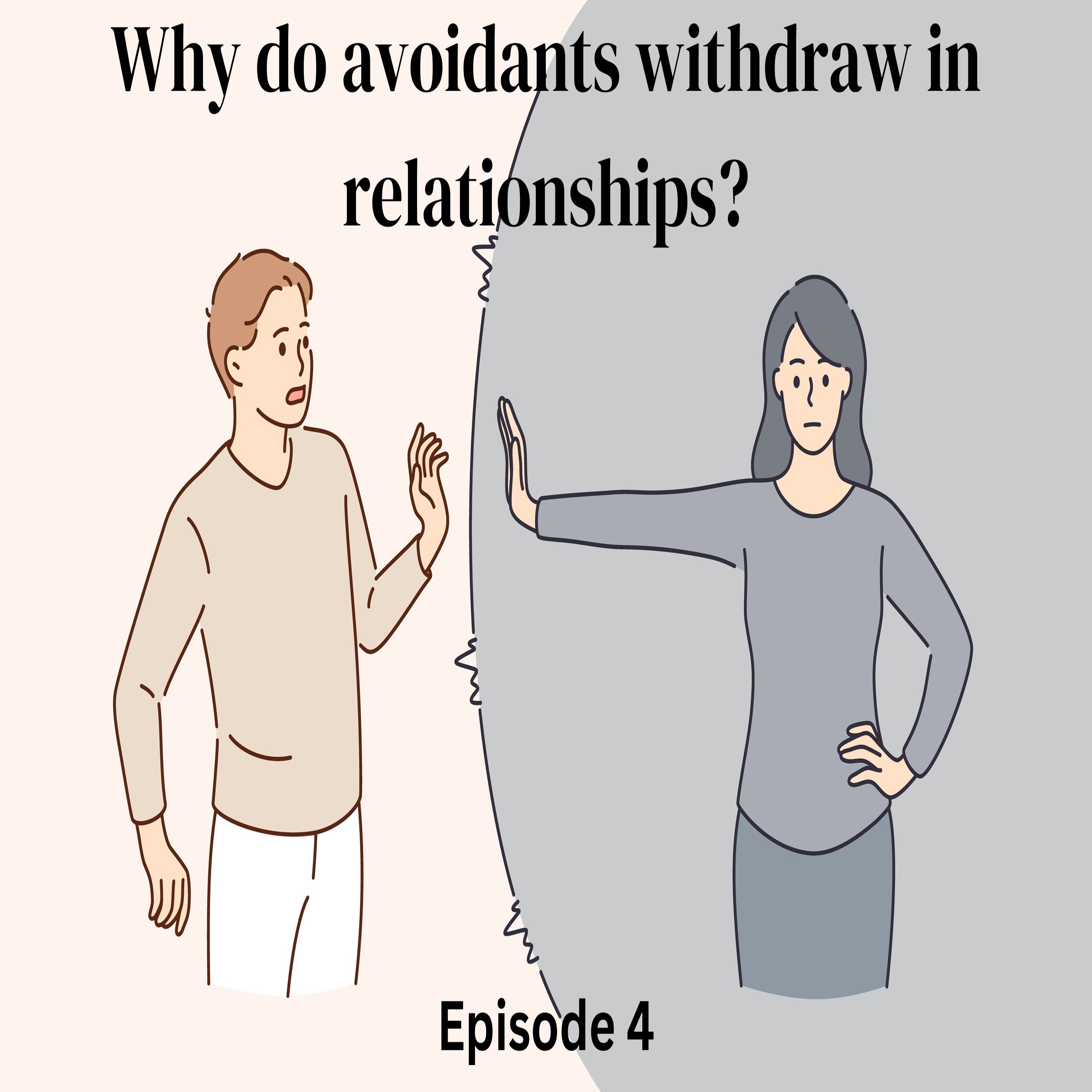
Episode 4: Why do avoidant people withdraw in relationships?
Jul 25, 202400:13:20Tap to summarizeSo where does the tendency to withdraw come from? It is different for everyone but it usually goes back to childhood and the relationship with primary caregivers- mum, dad or whoever raised us. Someone with a tendency to withdraw will usually have come from a family in which their needs were dismissed or ignored, and they were encouraged or forced to look after themselves both physically and emotionally. For example, a young boy who grew up in a family with an overbearing father who taught him that feelings are for weak people, and to be strong you need to hide your emotions rather than express them. If that boy also had a mother who had the same values, or he wasn't close to his mother, there's a fairly high chance that he will develop an avoidant attachment style as a means of protecting himself from those very emotion that he was taught makes him weak. If you were taught that expressing emotions makes you weak, or you simply weren't encouraged to express your emotions, chances are high that anyone expressing strong emotion would likely make you feel very uncomfortable, or overwhelmed. As usual, this episode is based on assumed prior knowledge of attachment theory, so if you're unfamiliar with it, here are some resources: Attached: How to Find (And Keep Love)
Transcribe →
Episode 3: Situationships, casual sex and attachment
Jul 10, 202400:12:05Tap to summarizeI think it's fairly safe to assume that most people are aware of the term casual sex and what it entails or it's closely related cousin, friends with benefits. However, the situationship is a relatively new term used to describe intimate relationships that are sexual and even romantic in nature. They tend to have almost all the elements of a fully committed relationship, but the main difference is that situation ships tend not to have an official label attached to them. This is often because one or both people in the situationship doesn't want to label the arrangement, often because they don't feel comfortable doing so, or because they want the freedom of being able to see other people and not be tied down to one person. Unfortunately what often does tend to happen in these arrangements is that one person does at some point end up wanting a fully committed relationship, but the other person is happy with the arrangement as it is. Yep, you guessed it, messy.. Similar to the last episode, this episode assumes prior knowledge of attachment theory so if you're not very familiar with it, here are some resources to help get you acquainted: https://www.iamreddi.com/post/counterfeit-connection-how-to-recognise-that-you-re-actually-in-a-situationship https://www.amazon.com.au/Attached-Science-Adult-Attachment-YouFind/dp/1585429139
Transcribe →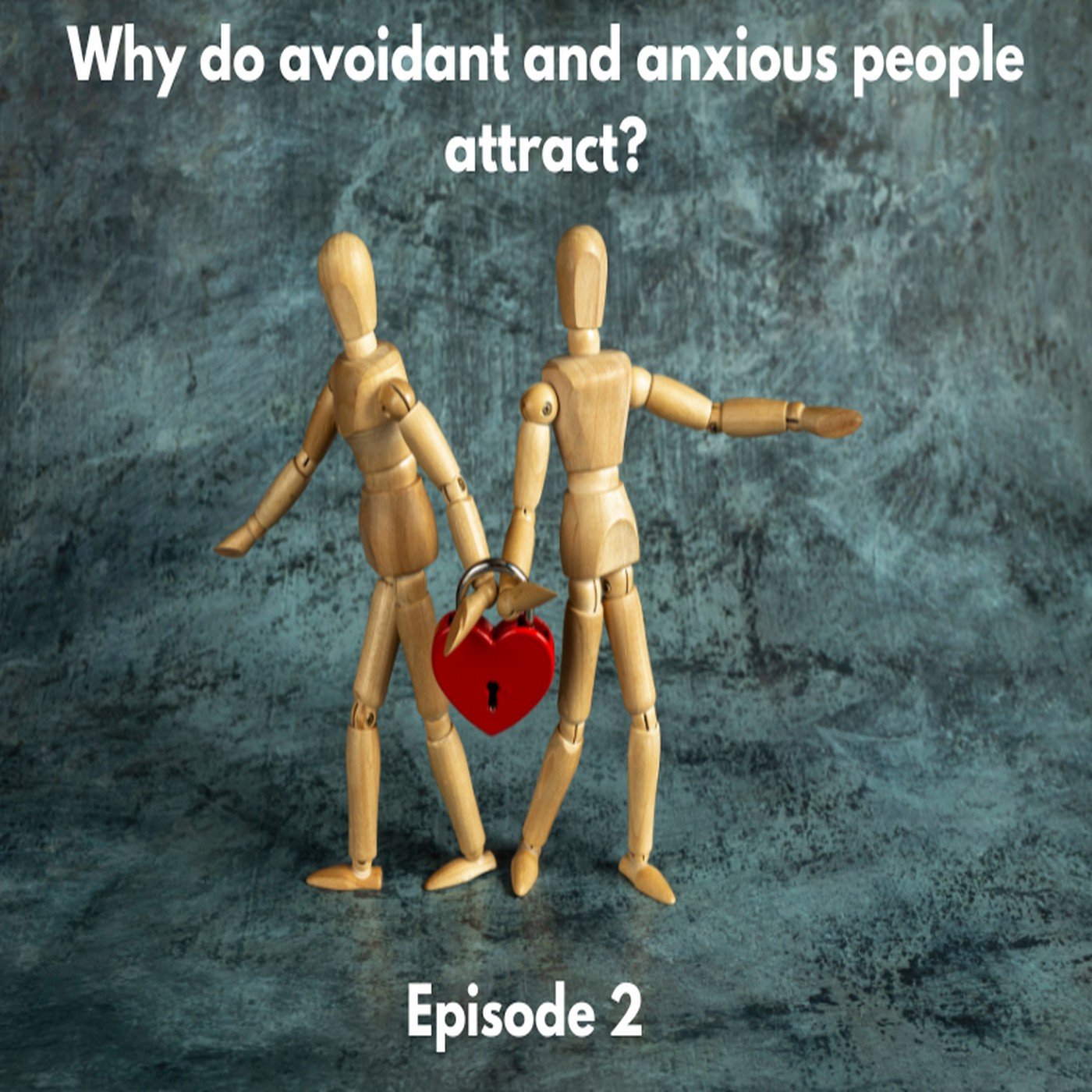
Episode 2: Why do anxious and avoidant people attract?
Jul 3, 202400:13:06Tap to summarizeOne of the biggest underlying reasons that couples come to counselling is because one partner has anxious attachment and the other has avoidant attachment which results in what is called a distancer/pursuer dynamic in the relationship. This is something that they may not be aware of, and they likely won't talk about it in those terms (unless they have already done a lot of counselling in the past, or a lot of reading on attachment theory). As you can probably guess, the distancer in this dynamic is the avoidant partner, and the pursuer in the anxious partner. It basically means that the anxious partner often fears feeling distant from their partner, and is constantly trying to get closer to the avoidant partner in a variety of different ways, while the avoidant partner feels very uncomfortable with a lot of closeness, and therefore creates distance in the relationship with what they call deactivating strategies. This episode will focus a lot on attachment theory, so if you're unfamiliar with it, there are a lot of great resources out there. Here are a few to get you started: Why Anxious and Avoidant Attachment Attract Each Other Attached: The New Science of Adult Attachment and How it Can Help You Find (And Keep) Love by Amir Levine and Rachel Heller Listen to the end of the episode to find out more!
Transcribe →
Episode 1: What are the most common issues in couples therapy?
Jun 26, 202400:21:24Tap to summarizeWelcome to 'Just Listen to Me!' The Show that is all about relationships. I'm Julia Shay a couples counsellor practising here in Australia. I am often asked what are the main issues couples present with in couples counselling are, so I thought I would make an episode about it! Some of the most common issues include: communication, difficulties, issues around trust, big life changes, feeling resentful/disconnected, affairs and more. The biggest theme is often the repeated negative cycle of interaction that never goes away, no matter how many times a couple tries to talk it through - it keeps happening! Couples counselling helps couples understand their negative cycles so they can work on their triggers and communicate their needs in a way that can be heard. Watch to the end of the video to find out more! Information on couples counselling approaches: Emotionally focussed couples therapy: https://www.eftresourcecenter.com/emotionally-focused-therapy-eft Gottman method couples therapy: https://www.gottman.com/about/the-gottman-method/
Transcribe →