
Podcast
Lost Prophets
Hosted by Elias Crim & Pete Davis · EN
A podcast about the the lost prophets of solidarity — the voices we need to hear again.
www.lostprophets.org
www.lostprophets.org
23episodes
Episodes
Newest firstAll episodes
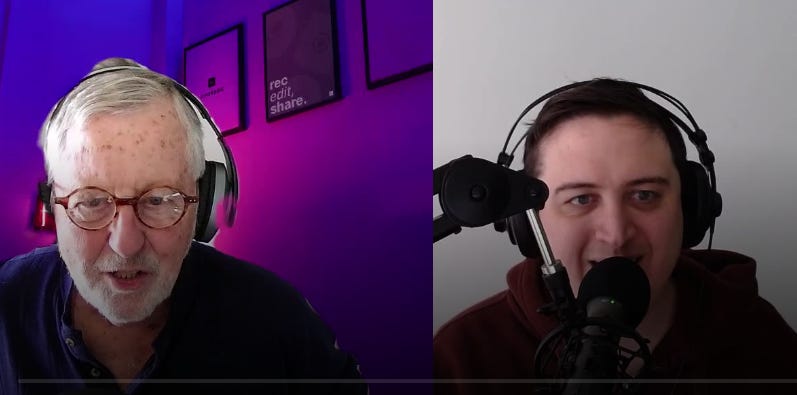
#13. A Pause to Reflect
Apr 3, 202500:41:00Tap to summarizeWe now have an even dozen episodes of Lost Prophets under our belts. Time to stop, we thought, sit down by the side of the road, and look back down the mountain at the distance we’ve come. Some key points that came up:* We want to do archaeology of the future, not just forecasts of the past (Russell Jacoby).* The counterculture at its most serious was a protest against nuclear weapons, technocracy’s essential criminality. (Theodore Roszak)* The lost revolutions of these lost prophets didn't end because they were irrelevant — they ended because they were either beaten down or went quiet for some other reason. They're still very, very relevant. (Pete)* Nazi resister Franz Jägerstätter's dream of the silver train. (Elias)* The importance of having a sangha (spiritual community) if you want to stay strong. (Elias)* Most of our prophets came from “thick communities” that give them the stability and confidence to be counterculture. (Pete)* One common thread here: A deep faith in ordinary people. (Elias)* Gandhi’s notion of soul force. (Elias)* Love is the most important form of revolutionary labor — and growing our souls is a revolutionary act, a kind of freedom project (Grace Lee Boggs).* Our need to recover communal—not just individual—spirituality (Gustavo Gutierrez).* “My name is Pete Davis and I was addicted to blueprints and plans!”* “Find the others.” (Douglass Rushkoff)* Door knocking for peace and often hearing: “I’m secretly with you—just don’t tell my neighbors.” (Gar Alperovitz, retold here)* Writing something about reality forces you towards being empirical, getting out in the world to see for yourself. (Pete, channeling Ralph Nader.)* Ending with W.H. Auden’s “September 1, 1939”: “as the clever hopes expire/Of a low dishonest decade.” (Taken as a title of a George Scialabba essay collection.)More Lost Prophets coming shortly: Thích Nhất Hạnh, Daniel Berrigan, and more!Many thanks to the great band NOBLE DUST, who provides the music for Lost Prophets. Their latest album, A Picture for a Frame, is here.Many thanks to our editor, the great Dan Thorn.LOST PROPHETS is a podcast about the mid-century voices of solidarity we need to hear again. To listen on your podcast player, our Spotify link is here, Apple Podcasts link is here, and RSS link is here. Get full access to The Lost Prophets Podcast at www.lostprophets.org/subscribe
Transcribe →
#12. Colette Shade on The Y2K Era
Mar 5, 202500:44:06Tap to summarizeTo understand the accumulating fractures of our time, it’s important to look back at key earlier periods and try to discern: What were we thinking? Colette Shade — who has written for The New Republic, The Baffler, Interview Magazine, The Nation, and Gawker — reminds us that during the “dream state,” the years between 1997 and 2008, we were thinking things like the following:* It’s the end of history—there’s no longer a need for politics!* The internet has arrived—we’re about to enjoy life without limits!* Gotta love butterfly clips, Lindsay Lohan, The Sopranos, bling, Smash Mouth, and the Hummer H2In sparkling prose, Shade digs through pop anthropology to offer a quite serious sociopolitical critique of the deadly undercurrents of this time, such as the triumph of neoliberalism, the full arrival of the California ideology (tech bros ascendant), and the substitution of nostalgia for genuine politics.Demonstrating that our podcast is not hung up on the 1960s, fellow millennials Colette and Pete have a great time comparing their childhood journeys as the world descends from the maximalist futurism of iMacs and body glitter to the reality check of the Great Recession. Timestamps* Introducing guest Colette Shade and how her book happily connects with our midcentury "Lost Prophets" theme: How the 2000s fit into the broader narrative of modernity, technology, and social change.* 03:06 Looking back at 1991 and the fall of the Soviet Union: The shift in political and economic ideology shaping the Y2K era* 06:19 The "Long 2000s": Defining this era’s influence as actually from 1997 to the 2008 financial crisis.* 09:54 The culture of excess: Dot-com wealth, no limits pop culture, and the promise of an ever-expanding future.* 12:34 The anti-politics of the 2000s: How post-Cold War confidence led to cultural shallowness and reactionary media* 18:30 The triumph of the California Ideology, a fusion of countercultural freedom and libertarian tech capitalism.* 29:40 The limits of the ideology: How Silicon Valley’s utopian vision overlooked systemic labor and social issues.* 31:55 Gen X vs. Millennial left: How 1999 activism (WTO protests, anti-globalization) evolved into post-2008 political movements.* 40:35 Certain 1999 movies as prophecy: The Matrix, Fight Club, American Beauty—all revealing the underlying cracks in the system.Recommended* Y2K: How the 2000s Became Everything by Colette Shade (Colette’s new book)* Elon Musk Has Always Been Like This. So Has Silicon Valley (Colette’s article on Musk and where he came from ideologically.)* When the Clock Broke: Confronting the Limits of the American Left by John Ganz (discussion of early 1990s political malaise)* From Counterculture to Cyberculture: Stewart Brand, the Whole Earth Network, and the Rise of Digital Utopianism by Fred Turner (History of the tech movement’s countercultural roots)* Palo Alto: A History of California, Capitalism, and the World by Malcolm Harris (Silicon Valley’s ideological and economic evolution)* The Making of Global Capitalism: The Political Economy of American Empire by Leo Panitch and Sam Gindin (Economic and political history of globalization)* The California Ideology by Richard Barbrook & Andy Cameron (1995 essay defining Silicon Valley’s libertarian-tech utopianism)* No Logo: Taking Aim at the Brand Bullies by Naomi Klein (Anti-consumerist and corporate critique of the late 1990s)Many thanks to the great band NOBLE DUST, who provides the music for Lost Prophets. Their latest album, A Picture for a Frame, is here.Many thanks to our editor, the great Dan Thorn.LOST PROPHETS is a podcast about the mid-century voices of solidarity we need to hear again. To listen on your podcast player, our Spotify link is here, Apple Podcasts link is here, and RSS link is here. Get full access to The Lost Prophets Podcast at www.lostprophets.org/subscribe
Transcribe →
#11. Paul Goodman (ft. Gregory W. Knapp)
Feb 13, 202502:25:00Tap to summarizeIt is slightly jarring to find the radically-minded Paul Goodman a welcome guest on the September 12, 1966 episode of William F. Buckley’s Firing Line television show. The topic was “Are Public Schools Necessary?”, to which Goodman responds in the negative—or at least with an alternative vision of small, decentralized schools that emphasized experience in the real life of the neighborhood over stultifying curricula in quarantined classrooms. By this time, Goodman was at the height of his fame as an oracle of the New Left and the 60s student movement, a speaker so popular that students at San Francisco State raised a year’s salary for him to come teach there. He was also in his mid-fifties.Beginning in the Depression years, Goodman had poured forth novels, short stories, poetry and essays with great elan, despite a peripatetic existence caused by periodic sexual indiscretions. (Some of these incidents were just the result of the era’s bigotry, as Goodman was an unapologetic bisexual; other incidents would still be considered quite problematic today.)A radical Freudian at first, Goodman became increasingly interested in the work of Fritz and Laura Perls, even co-authoring with them the first text on Gestalt therapy in 1951. His unpopular pacifist stance during the Second World War complicated his career and by the late 1950s, Goodman was continuously struggling to support a wife and two small children.Then came an offer to write a book giving his solutions to the issue of the day, juvenile delinquency, as it was then quaintly called. His Growing Up Absurd (1960) was a cultural phenomenon, not least because Goodman blamed society itself, not young people, for the latter’s widespread sense of alienation. Published early in a moment of growing social upheaval—the rising Civil Rights movement, deepening involvement in Vietnam, the Free Speech Movement at UC Berkeley—the book became an omnipresent bible of student rebellion, selling hundreds of thousands of copies.And despite the famous catchphrase of the times, “never trust anyone over thirty” (which Goodman certainly was), the more radical students on campuses across the country not only trusted him—practically alone among adults in these years—but flocked to hear his every word. One of those students—who actually met and spoke with Goodman—was our guest for this episode, Gregory W. Knapp, now a professor emeritus at the University of Texas at Austin. Greg received his BA from the University of California, Berkeley, in Mathematics and Economics, and his PhD in Geography from the University of Wisconsin. His research has focused on themes in cultural and regional geography. We were intrigued by Greg’s article, “Kenneth Rexroth and Paul Goodman: Poets, Writers, Anarchists and Political Ecologists” which inspired us to invite him on the show.Some key takeaways from our conversation:* A jack of all trades, Susan Sontag compared Goodman to Emerson, describing him as “a connoisseur of freedom.” A novelist, poet, lay psychiatrist, social scientist, urbanist, and practitioner of the now-lost art of being a “man of letters”* Goodman was perhaps the best writer on the theme that launched the 1960s counterculture: our social world in its current arrangements is not worth “adjusting” yourself to. (This made Goodman a “reverse Don Quixote”, as one of his reviewers remarked, the only sane man amidst a crazy world.)* He was an exponent of a kind of “revolutionary hope” which all but vanished after the Vietnam War.* Goodman knew conforming was madness but that fully dropping out was also mad—he wanted a sane alternative. As critic George Steiner put it, Goodman was “trying to hack out elbow room for the imagination”—our lost genius for imagining bold solutions to problems.* Life over theory and any ideas that reify Society: Against the jargon-ridden state of most academic writing, Goodman deliberately wrote to reach the largest possible educated audience.* Goodman was an early reader of Peter Kropotkin, which led to a lifelong love affair with community anarchism in an anti-Marxist frame—but he cared about “citizenliness.”* Like his good friend Ivan Illich, Goodman was a deep critic of education as merely “learning the code,” a way of keeping the young safely out of the labor market for 16 years.* Goodman told Studs Terkel: “I might seem to have a number of divergent interests…but they are all one concern: how to make it possible to grow up as a human being into a culture without losing nature. I simply refuse to acknowledge that a sensible and honorable community does not exist.”* In his 1967 Massey Lectures, he said: “The question is whether or not our beautiful libertarian, pluralist, and populist experiment is viable in modern conditions. If it’s not, I don’t know any other acceptable politics, and I’m a man without a country.” Timestamps:* [02:30] Pete describes discovering Goodman, a true public intellectual who worked across multiple disciplines, through the documentary Paul Goodman Changed My Life.* [11:00] Discussion of Goodman's early life in New York City and how the city itself strongly influenced his worldview* [14:00] Goodmans’s time at City College of New York, where he developed his commitment to community anarchism through reading Kropotkin; his early career as a writer and intellectual* [31:30] Goodman’s anarchist philosophy, which focused on drawing lines to keep society's conforming impulses at bay and create free spaces for natural instincts and authentic living* [41:00] Reflections on Goodman’s breakthrough book Growing Up Absurd (1960) and its critique of how modern society fails to provide meaningful opportunities and worthwhile goals for young people to grow into* [52:30] Goodman’s work in psychology and as a co-founder of Gestalt therapy, which focused on helping people live authentically rather than adjusting to society's demands* [1:14:30] How Goodman became alienated from the militant radicals of the late 1960s as he critiqued their growing cynicism while maintaining his faith in humanism* [1:41:00] Interview with Gregory W. Knapp, who met Goodman at Berkeley in the 1960s and provides firsthand accounts of Goodman's interactions with students and his impact on the counterculture* [2:19:00] Final reflections on Goodman's legacy: how some of his ideas about authenticity and personal freedom became mainstream while his vision of participatory democracy and community remains unfulfilledRecommended:* Paul Goodman Changed My Life (2011 documentary)* Communitas (1947)* The Empire City (1959)* Growing Up Absurd (1960)* Compulsory Miseducation (1964)* “Are Public Schools Necessary?”, Goodman as guest on William F. Buckley’s Firing Line (Sept. 12, 1966)* Like a Conquered Province—Massey Lectures (1967)* New Reformation (1970)* Kenneth Rexroth and Paul Goodman: Poets, Writers, Anarchists and Political Ecologists, Gregory W. Knapp (2021)* On Paul Goodman, Susan Sontag in The New York Review (1972)Many thanks to the great band NOBLE DUST, who provides the music for Lost Prophets. Their latest album, A Picture for a Frame, is here.Many thanks to our editor, the great Dan Thorn.LOST PROPHETS is a podcast about the mid-century voices of solidarity we need to hear again. To listen on your podcast player, our Spotify link is here, Apple Podcasts link is here, and...
Transcribe →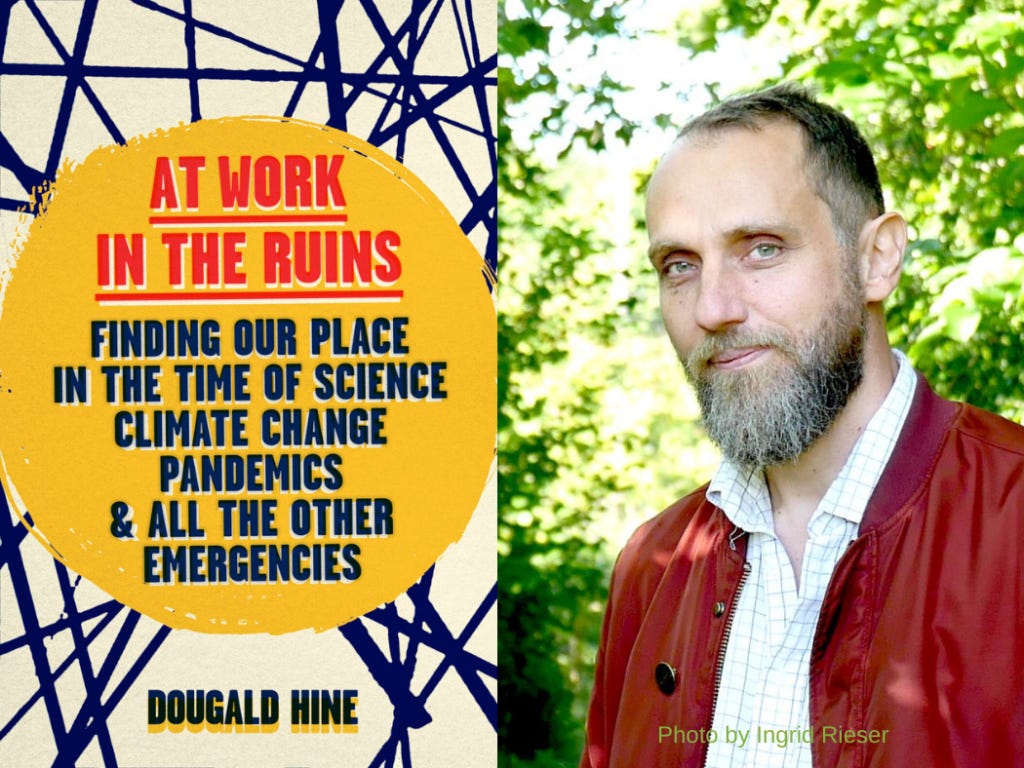
#9. Dougald Hine on Work in the Ruins
Dec 18, 202400:59:55Tap to summarizeWe first encountered Dougald Hine about a year ago through the wide mycelium-like network of Ivan Illich fans—and we were glad we did. His new book was just out and we heard he was doing a book tour of the U.S. quite a few years after his first visit here. Our meetup in D.C. for Dougald a few weeks ago was a rich and delightful occasion — a time when we learned what T.S. Eliot might have meant when he wrote: “wait without hope, for hope would be hope for the wrong thing.”One of the U.K.’s most influential voices in the climate debate, Dougald is the co-founder (with Paul Kingsnorth) of the Dark Mountain Project (an effort to “walk away from the stories that our societies like to tell themselves, the stories that prevent us seeing clearly the extent of the ecological, social and cultural unravelling that is now underway”) and the founder of the School of Everything (a startup inspired “by Ivan Illich’s Deschooling Society and the educational experiments of the 1960s”). His early career included a stint working for the BBC. He lives today in a small town in central Sweden where he and his partner, Anna Bjorkman, are creating “a school called HOME”—“a gathering place and a learning community for those who are drawn to the work of regrowing a living culture”. He has worked with the Riksteatern, Sweden’s national theatre, and is an associate of the Center for Environment and Development Studies at Uppsala University.His ideas, as he explains in the book and in our conversation, come out of the question he asked himself some years ago: what if our ways of talking about climate change (and the world in general)—in technocratic terms and with an overreliance on a scientific lens—is making everything worse.In a time of despair, Dougald suggests, we can talk about how we might take up (or continue) the work that is worth doing in the ruins. This work means: (1) salvaging the good that may be taken with us, (2) mourning the good that cannot be taken with us, (3) discerning those things that were never as good as we told ourselves they were, and (4) looking for the dropped threads—the lost moments earlier in the story that might have something to tell us now.Timestamps:* Introducing Dougald and two of his provocative claims: "The end of the world as we know it is not the end of the world" and "The end of the world as we know it is also the end of a way of knowing the world."* 3:00 Dougald discusses his experiences at Oxford, describing them as "one half of a shamanic initiation" where students' existing knowledge was deconstructed without guidance on reconstruction.* 6:00 Dougald’s time at BBC as a radio journalist, describing news as an "extractive industry" mining people's painful experiences* 8:00 We talk about the origins of the Dark Mountain Project, co-founded with Paul Kingsnorth in 2009, emerging from their shared critiques of environmental journalism and activism* 17:30 Dark Mountain as a "journey to the far side of despair" and its role in providing space for people whose existing stories no longer made sense* 21:00 Exploration of how Dark Mountain connected to decolonial thinking and theological perspectives on "uncivilization"* 34:30 The experience of joining Ivan Illich's circle of collaborators five years after his death — and the hospitable tradition of keeping an extra seat at the table for strangers* 43:30 Illich's Jewish background and its influence on his thinking about modernity and Christianity.* 52:30 Dougald talks about his recent book tour in North America, including observations on America's "lost literacy of lament".* 57:00 Experiences at Sand River Community Farm and the gift economy vs. modern economic frameworksFurther Reading:* Dark Mountain Project* At Work in the Ruins, Dougald Hine* Hospicing Modernity: Facing Humanity's Wrongs and the Implications for Social Activism, Vanessa Machada de Oliveira* Bayo Akomolafe* Gustavo Esteva* In the Vineyard of the Text, Ivan Illich* The Remains of the Day, Kazuo Ishiguro* First Reformed, Paul Shrader* Soil and Soul, Alistair McIntosh* The Gift, Lewis Hyde* Spell of the Sensuous, David Abram* Rivers North of the Future, David Cayley* Dominion: How the Christian Revolution Remade the World, Tom Holland* Gender, Ivan Illich Get full access to The Lost Prophets Podcast at www.lostprophets.org/subscribe
Transcribe →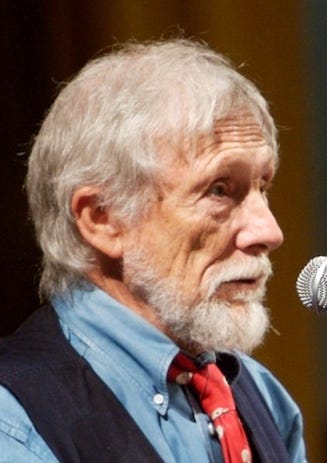
#8. Gary Snyder (ft. Peter Coyote)
Dec 3, 202402:28:27Tap to summarizeHe’s been called a poet of quiet revolution: a revolution staged to heal the rift between humanity and the natural world around us. Gary Snyder’s distinctive spirituality combines Eastern traditions like Zen Buddhism, Western concerns with deep ecology, and Native American wisdom.Over his 94 years, Snyder’s career ranges from his early friendship with Jack Kerouac and the Beats, through his years in Japan studying Buddhism and Asian culture, followed by his acclaim as a kind of shaman of the counterculture and environmental movement.Not a primitivist but a thinking poet, Snyder redefines humanism to include the nonhuman. By reconnecting with wilderness and practicing “reinhabitation,” we remember what Snyder notes was the role of the poet/shaman: to sing the voice of corn, the voice of the Pleiades, the voice of bison, the voice of antelope.Some takeaways from our conversation:* A statement Snyder once wrote describing his work: “As a poet, I hold the most archaic values on earth. They go back to the late Paleolithic: the fertility of the soil, the magic of animals, the power-vision in solitude, the terrifying initiation and rebirth; the love and ecstasy of the dance, the common work of the tribe. I try to hold both history and wilderness in mind, that my poems may approach the true measure of things and stand against the unbalance and ignorance of our times.”* As the champion of an ethnopoetics which aims to recapture the primitive and give it voice, Gary Snyder models for us solidarity with a bioregion, with (as he put it) the classes Marx overlooked—the animals, rivers, and grasses.* His emphasis on the Buddhist notion of right livelihood and his appreciation of manual work: “A regular job ties you down and leaves you no time. Better to live simply, be poor, and have the time to wander and write and dig (meaning to penetrate and absorb and enjoy) what was going on in the world.”* Snyder does not belong to any particular poetic school but he can be said to come out of the modernist tradition of Ezra Pound and Charles Olson. This is poetry in a free form but also engaged with culture in a particular way. It was Pound’s translations from the Chinese which Snyder said inspired him to look into these poets. * His very local sense of bioregionalism: “Stewardship means, for most of us, find your place on the planet, dig in, and take responsibility from there—the tiresome but tangible work of school boards, county supervisors, local foresters—local politics.”* On his idea of “the practice of the wild”: “Off the trail is another name for the Way, and sauntering off the trail is the practice of the wild. That is also where—paradoxically—we do our best work. But we need paths and trails and will always be maintaining them. You first must be on the path, before you can turn and walk into the wild.”Timestamps:* Intro clip: Gary Snyder reads a short poem about climbing the Sierra Matterhorn with Jack Kerouac.* 00:45 Introduction of Snyder as a "poet of quiet revolution" bridging Eastern traditions and Western environmentalism* 2:31 Pete and Elias discuss Gary Snyder as their first artistic prophet.* 6:34 Early biographical details: Snyder's birth in San Francisco and childhood on a subsistence farm in Washington state* 13:24 Snyder's early mountaineering experiences and spiritual connection to nature* 21:24 Snyder’s involvement with the Beat movement and the historic San Francisco poetry renaissance* 39:00 The relationship between Buddhist teachings and environmental consciousness in Snyder's work* 42:39 Snyder's travels to Japan and deepening engagement with Zen Buddhism* 49:00 Emergence of the environmental movement and Snyder's role in deep ecology* 54:00 A reading of Snyder's influential "Smokey the Bear Sutra"* 1:14:00 Snyder's concept of "re-inhabitation" and connection to place* 1:22:00 Pete and Elias’ “field trip” to view one of the Chinese landscape scrolls that inspired Snyder at the Freer Gallery* 1:35:00 Snyder's concepts of bioregionalism and deep ecology* 1:42:39 Our guest, actor and author Peter Coyote, joins us to discuss his personal relationship with Snyder.* 2:14:00 On the counterculture movement's successes and failures* 2:17:14 Coyote's final thoughts on Snyder's legacy as a disciplined seeker of truth* 2:25:30 Pete and Elias's final reflections on Snyder's Americanness and the unfinished project of the countercultureRecommended:* Earth House Hold (1969)—prose selections, mostly related to “…the coming revolution [which] will close the circle and link us in many ways with the most creative aspects of our archaic past.” (Contains the essay “Buddhism and the Coming Revolution.”)* Turtle Island (1974)—a collection of poetry and prose which won the Pulitzer Prize for Poetry in 1975. Themes of rediscovery of the land and becoming native to it once again.* Practice of the Wild (1990)—perhaps Snyder’s most important essays on deep ecology and wilderness* Mountain and Rivers Without End (1996)—a long poem written over four decades, combining many themes from his work through the frame device of a Chinese handscroll* Distant Neighbors (2014)—Some 240 letters exchanged between Snyder and his friend from the 1960s, Wendell Berry* Dharma Bums (1958)—Jack Kerouac’s fanboy portrait of the young Gary Snyder, including their climb together up the Matterhorn mountain in the Sierras. The bubbling tone of their friendship, a crazy mix of proto-hippie freedom and Zen/Vedanta lingo, is kept up by Kerouac’s bebop prose style.* Sleeping Where I Fall: A Chronicle (1998, 2015)—Peter Coyote’s memoir of his epic days with the San Francisco Mime Troupe, the Diggers and the rising counter-culture * The Rainman’s Third Cure: An Irregular Education (2015)—Coyote’s second memoir, a collection of profiles of his mentors, including a Mafia consiglieri and poet Gary Snyder who introduced him to the practice of Zen* <a...
Transcribe →
#7. Marc Ellis on the Prophetic Diaspora
Nov 16, 202401:44:24Tap to summarizeMarc H. Ellis (1952-2024) saw the prophet today as in a condition of exile, refusing to compromise with injustice, perhaps doomed, without protection, even without destination.It was while first reading Jewish theologian Marc Ellis’ writing that we realized the waters of the prophetic ran much deeper than we had first thought.We excitedly tore through several of his books on the prophetic in anticipation of our Lost Prophets interview with Marc, back in January. When we connected, he seemed a little frail but still ardent and eloquent. (He told us he got a kick out of the title of our podcast.) Near the end of our almost two-hour exchange, he offhandedly mentioned his health struggles. We traded a couple of emails in the weeks following and then saw the notices that Marc had died on June 8th.The prophetic was surely the great theme of Marc’s work, beginning in 1974, when an encounter with Dorothy Day in Tallahassee convinced him to spend a year living at the main Catholic Worker house in New York. He next moved to graduate school at Marquette University in Milwaukee. For his thesis he chose to write on the co-founder of the Catholic Worker movement, Peter Maurin. Marc was also affiliated for a time with the Maryknoll School of Theology, a home of liberation theology, where he said he discovered the prophetic.Amidst the catastrophic 20th century, Marc claimed to see a revival of prophecy in figures such as Martin Luther King, Simone Weil, Gandhi, Albert Camus, and others. “It should not surprise us that a century so dark has also given birth to men and women who have had prophetic thoughts and lived prophetic lives,” he wrote. “And so in the century of the dead the question of the prophet is reborn.”He was struck by the way prophetic figures typically become exiles in their own communities, as Marc himself had done, due to his uncompromising belief that Jewish liberation had to include Palestinian liberation.In addition to his biography of Peter Maurin, he wrote one of the few books proposing a Jewish liberation theology, with introductions by Gustavo Gutierrez and Desmond Tutu. He wrote several books on Israel and Palestine, as well as essays on notable Jewish thinkers (Wiesel, Buber, Heschel, Arendt, Levinas), Holocaust theology, and the wonderful interfaith reflections in Revolutionary Forgiveness.Some takeaways from our conversation:* The prophets do not celebrate progress, despite the way modernity itself has become a religion, enabled partly by the old religions. Everything we enjoy in modernity has a dark side.* The Catholic Worker experience: spending a year among the poor and their spirituality. “There was something beautiful about it which became foundational in my life.”* Prophets become closer to each other across traditions than they are to many within their own traditions. The ecumenism of our times is not one of faith and dogma but rather of solidarity. None of us can make it alone or in our particular communities. We have a different community—the prophetic diaspora.* The New Diaspora of exiles worldwide—the Catholic Worker house in New York had posters of Gandhi, Buber, etc.* Simone Weil—”she was a one-off.” Her idea of the new saintliness, which both connected to the old traditions while abandoning parts of them. She insisted on the freedom to think and to act. A practical mystic—something like Bob Dylan, the itinerant Jewish prophet (and fan of Marc Ellis’ work!).* It’s difficult to define the prophetic—it’s a kind of mystical encounter. The prophetic is set apart but we don’t know how or why that happens. It comes from somewhere else.* And it’s not just political. The prophetic is the embodiment of the possibility, the gamble, of meaning (and God) in history and in our lives. You can see it, feel it—as in the aura several witnesses have asserted MLK possessed.* The prophetic is a perilous vocation—your own community probably can’t protect you. There’s no reward, even from God. There is, in Marc’s words, a “solitude and a solidarity” in this way of living.Timestamps01:30 We introduce Ellis as a Jewish theologian who deeply studied prophecy, noting this was one of their last conversations with him.02:45 How we discovered Ellis's work while researching prophetic figures.03:40 We consider how the mid-20th century reawakened prophetic thinking in response to modernity's challenges and failures.07:35 About Ellis's early background, from his Orthodox Jewish upbringing to his time at Florida State University.19:30 Ellis’s concept of a "prophetic diaspora" and how prophets often become exiles from their traditions.22:50 Ellis's writings on how mass death in the 20th century led to a revival of prophetic thinking30:55 How people like Dorothy Day and Martin Buber found themselves closer to prophetic figures of other faiths than to their own traditions. Prophecy as the “wild card” in the deck—we never know when it will turn up. The “hidden circle” of prophets, the “light gatherers.”43:30 Guest Marc Ellis joins the discussion, sharing his personal journey discovering the prophetic as indigenous to Jewish tradition and his encounters with Holocaust theologian Richard Rubenstein (“Where is God? We need power”). The promise of modernity amidst the growing “nation of the dead.” The “new diaspora” of prophets.52:00 Ellis reflects on how the major religions became enablers of modernity, even as they became more traditional in some respects. His time at Maryknoll and his discovery of liberation theology. Meeting Daniel Berrigan in 1974. The impossibility of defining the prophetic, a kind of unpredictable mystical encounter. A story about why Martin Luther King Jr. had an “aura” that set him apart, as do all prophets. The prophetic is about the possibility of meaning in history—“it’s a gamble”. And “a perilous vocation.” Simone Weil—a “one-off” and a mystic “in practical terms like Bob Dylan.”1:03:45 Ellis's encounter with Bob Dylan. His year at the Catholic Worker with the elderly Dorothy Day. Two deeply opposed views of the Holocaust and the U.S. Holocaust Museum (Richard Rubenstein vs. Elie Wiesel).1:11:20 Ellis’s understanding of "covenantal vocation" and the heritage of prophecy in Judaism.1:21:28 The nature of "Revolutionary Forgiveness" and its role in Israeli-Palestinian relations. After many centuries, the Christian embrace of Jewish history.1:26:00 Ellis's thoughts on the future of prophetic movements and why prophets shouldn't focus too much on outcomes. Despite the famous song’s Christian hope, he suggests “We’re not going to overcome.”1:31:30 Ellis’s new book “First Light” about his friendship with Edward Said, as well as his current practice of daily journaling and painting during wartime.1:35:00 The "Ice Age" which has come over prophetic thinking in recent decades. Theologians no longer write and speak to po...
Transcribe →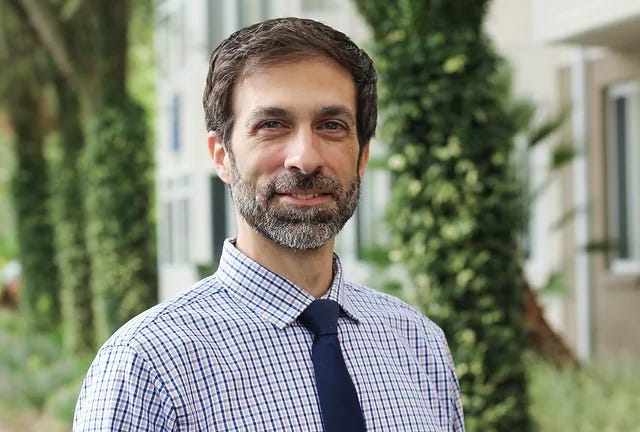
#6. L.M. Sacasas on Ivan Illich, Technopoly, and Human Flourishing
Oct 24, 202400:50:35Tap to summarizeHere at Lost Prophets, we are interested not only in the seminal mid-century figures we feature, but also in those contemporaries who have imbibed their ideas and are extending them today. So we were happy to speak recently with one today’s great theorists of technology, L.M. Sacasas.A few years ago L.M. posted on his blog 41 (!) thoughtful and provocative questions we should ask of the technologies we use — not just our computers and AI and Zoom, but also tables and alarm clocks and ovens. That inspired the New York Times’ Ezra Klein, one of L.M.’s enthusiastic readers, to contact him for an interview, which you can read here.L.M. extends a tradition of technology’s skeptical questioners, joining figures such as Marshall McLuhan, Jacques Ellul, and Neil Postman. In an homage to Ivan Illich’s Tools for Conviviality (1973), L.M. even named his Substack, launched in 2018, the Convivial Society.In this conversation with L.M., we talk about discovering Illich, the importance of starting from the vision we want (not from the tools), what the Amish have figured out, the “post-human future”, why our embodied condition matters, and where we see signs of hope. Recommended:* Tools for Conviviality, Ivan Illich (1973)* The Technological Society, Jacques Ellul (1964)* Technopoly, Neil Postman (1993)* The Religion of Technology, David Noble (1999)* American Technological Sublime, David Nye (1996)* The Frailest Thing: Ten Years of Thinking About the Meaning of Technology, L.M. Sacasas (2019) Get full access to The Lost Prophets Podcast at www.lostprophets.org/subscribe
Transcribe →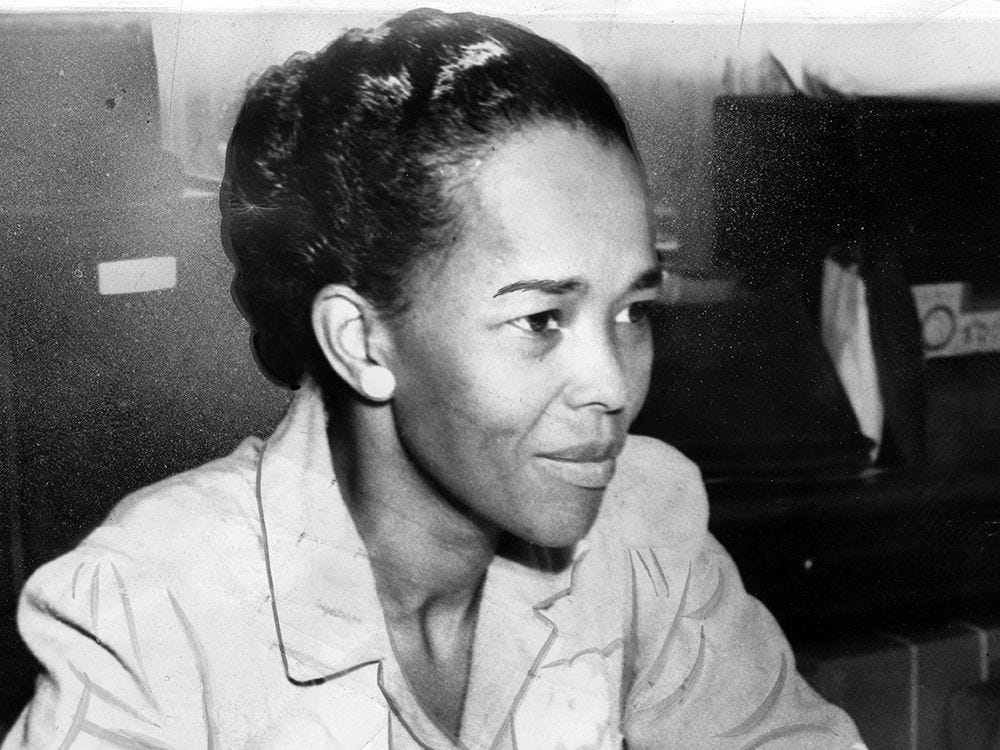
#5. Ella Baker, Septima Clark, and The Highlander Folk School (ft. Stephen Lazar and Daniel Marshall)
Oct 9, 202402:39:00Tap to summarizeThis episode takes us into the long history of the Civil Rights Movement as we talk about the methods and legacies of two long-distance runners, Ella Baker (1903-1986) and Septima Clark (1898-1987).Baker was a legendary organizer who espoused a group-centered form of leadership and insisted that deep change required the long-haul “spadework” of community organizing. Clark, known as “the teacher of the Civil Right movement,” built a network of Southern Citizenship Schools, which were crucial to the emergence of Black voting power in the early 1960s.We also discuss the influence of the famous Highlander Folk School (today the Highlander Research and Education Center) in New Market, TN—and the role of its workshops as a seedbed of activism since the labor struggles over coal mining in the 1930s.For this conversation, we invited two guests whose work has been inspired by the organizing culture of Highlander and the Civil Rights Movement:* Stephen Lazar is a National Board Certified Social Studies teacher, who is typically teaching students Social Studies and English at Harvest Collegiate High School in NYC, which he helped to start. His writing on policy and practice has been published on the New York Times, Washington Post, Education Week, Chalkbeat, and Albert Shanker Institute websites.* Daniel Marshall is the founder and director of the Sand Mountain Cooperative Education Center (in Gunstersville, AL), whose Highlander-inspired mission is to house and support programs that facilitate freedom, community centered-development, and cooperative education in the South.Recommended:* Ella Baker and the Black Freedom Movement (2005), Barbara Ransby* Freedom’s Teacher: The Life of Septima Clark (2012), Katherine Mellen Charron* I’ve Got the Light of Freedom (2007), Charles Payne* The Long Haul: An Autobiography (1991), Myles Horton, with Judith Kohl and Herbert Kohl* Starting with People Where They Are: Ella Baker’s Theory of Political Organizing (2022), Mie Inouye* Ella Baker and the Origins of “Participatory Democracy” (2004), Carol Mueller* Fundi: The Story of Ella Baker (1981), documentary about Ella Baker* You’ve Got To Move: Stories of Change in the South (1985), documentary about the Highlander Folk School Get full access to The Lost Prophets Podcast at www.lostprophets.org/subscribe
Transcribe →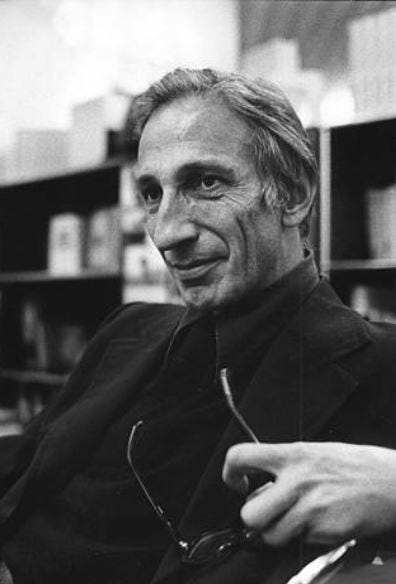
#4. Ivan Illich (ft. David Cayley)
Sep 24, 202402:26:05Tap to summarizeIvan Illich (1926-2002) emerged in the late 1960s as a radical public intellectual. Many of his most radical insights have today become conventional wisdom. The wonderful essayist George Scialabba once entitled an otherwise generally sympathetic piece on Ivan Illich “Against Everything.” That was surely because Ivan Illich’s critique of modernity runs deeper than that of almost any other thinker of his time. His books attacked the unquestioned sacred cows of the age, including schooling, institutional medicine, cars, and economic development, charging them with “terminal counter-productivity”.And yet Illich was neither a reactionary nor a Luddite. In the 1960s, his countercultural open seminar in Cuernavaca, Mexico—CIDOC—was partly a seedbed for what became liberation theology (although Illich later found the movement too ideological). His writings about “the war on subsistence,” as he called it, laid the groundwork for today’s global movements around the commons, decentralization, and degrowth. After his remarkable but controversial Gender appeared in 1982, causing a firestorm around what Illich felt was a misreading of the book by its feminist critics, he pulled back from public speaking and concentrated on less volatile subjects. In a series of interviews with his friend and biographer David Cayley—who is our guest for this episode—Illich gradually sketched out his somewhat startling theory of modernity as an extension of Church history. The “corruption of Christianity” was the theme he first shared in conversation with Cayley, who went on to transcribe and publish Illich’s account of how so many modern institutions arose out of misplaced ambitions to make Christian charity into permanent institutions of society.Our conversation in this episode is grounded in Cayley’s Ivan Illich: An Intellectual Journey, a work which not only presents its subject’s ideas but wonderfully extends them, an achievement we surely owe to Cayley’s personal friendship with Illich, especially in his last years.Some takeaways from our conversation:The key modern assumption in Illich’s view: that human beings are made up of needs and society is organized to fulfill them. Moreover, modern institutions, as they grow ever larger, tend to defeat their own purposes: they weaken communal self-reliance by creating needs to be serviced by technical professionals; they threaten our ability to enjoy and bear the human condition; and they undermine the arts of suffering and our ability to die our own deaths.Illich’s idea of subsistence (which is not poverty but simply sustainable living) as the way the global South might continue to avoid the tragedies of industrialization and modernity.In the mid-1980s, a kind of catastrophic breakdown in the old (tool-based) way of seeing things, replaced by a new dimensionless cybernetic space, discontinuous with the past and the certainties with which people once lived.“Risk awareness”: to Illich, this was the most important religiously celebrated ideology today. The vocation of the friend: to Illich, our only hope for a new society, through “little acts of foolish renunciation”. TimestampsIntroduction to Ivan Illich [00:00:00]Illich's background and early life [02:08]Illich's time in New York and Puerto Rico [05:00]Founding of CIDOC in Cuernavaca, Mexico [10:00]Illich's critique of modern notions of “development” [15:00]Illich's "Deschooling Society" and radical monopolies [21:30]"Tools for Conviviality" and the critique of tools [35:00]"Medical Nemesis" and its attack on the medical establishment [43:52]"Gender" and its controversial reception [49:56]Illich's later works on language and literacy [54:30]Illich’s theory of “the corruption of Christianity” in the institutions of modernity [1:00:00]Interview with David Cayley begins, his first encounter with Illich [1:15:08]Illich's ideas on the incarnation and institutions [1:26:02]Illich's influence on social movements including the one for the commons [1:41:48]Cayley's reflections on Illich as a teacher and friend [1:57:30]The hosts offer final thoughts on Illich's legacy [2:11:15]Recommended:Deschooling Society (1971), Ivan IllichTools for Conviviality (1973), Ivan IllichMedical Nemesis (1975), Ivan IllichShadow Work (1981), Ivan IllichGender, (1983), Ivan IllichIn the Vineyard of the Text (1993), Ivan IllichABC: Alphabetization of the Popular Mind (1989), Ivan Illich and Barry SandersIvan Illich in Conversation (1992), David CayleyRivers North of the Future: The Testament of Ivan Illich (2005), David Cayley<a target="_blank" href="https://www.amazon.com/Ivan-Illich-Intellectual-21st-Century-Perspectives/dp/0271098953/ref=sr_1_5?crid=E2C65TEWO3PL&dib=eyJ2IjoiMSJ9.e_ptff1kfRTXea70cA_GnAqce_u_OQboHp03DcBGEbmesK...
Transcribe →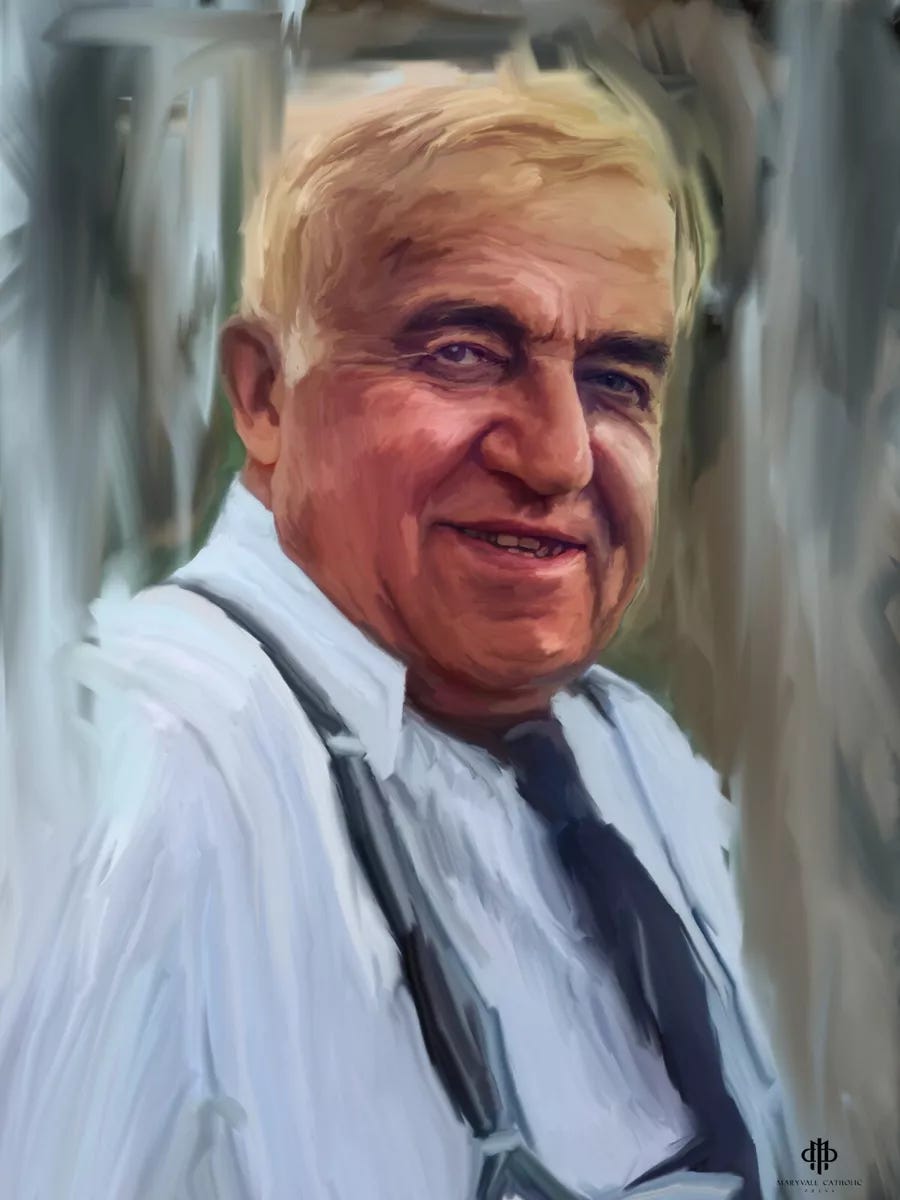
#3. Peter Maurin (ft. Kelly Johnson)
Sep 17, 202401:48:05Tap to summarizePeter Maurin (1877-1949) was Dorothy Day’s great teacher and collaborator in establishing the Catholic Worker movement. He saw Catholic social teachings as the still-unexploded “dynamite of the Church.” If Dorothy Day is better known today than her close colleague, Peter Maurin, it is not for lack of praise from Dorothy herself. She never ceased to emphasize Peter’s influence and his role, noting that there would not have been a Catholic Worker movement but for Peter. “Peter gave me more than instruction”, she liked to repeat. “He gave me a way of life.”That way of life, a radical path of voluntary poverty and service to the poor, grew out of Peter’s early life, having been born into a large French family which farmed the same land in the Languedoc region for centuries. His peripatetic life experiences doing all kinds of day labor to support himself as an independent intellectual and Catholic street preacher served to keep him close to the poor. “He believed in poverty,” Dorothy once noted, “and loved it and felt it as a liberating force.”Despite his Chaplinesque, shabby appearance, Maurin’s mental universe was immensely rich, stocked with a mix of Catholic theology, history, and literature which he happily shared with any and all he encountered. He opposed both communism and industrial capitalism, favoring his own notion of a “green revolution” in a three-point program of roundtable discussions, houses of hospitality, and farming communes that blended religion, politics, and ecology — or, as he put it, “cult, culture, and cultivation.” These ideas became the program of the Catholic Worker movement during Peter’s lifetime.Our guest for this episode is Kelly Johnson, associate professor of religious studies at the University of Dayton and author of The Fear of Beggars: Stewardship and Poverty in Christian Ethics (2007).Some takeaways from our conversation:* Peter as a paragon of a radical, Franciscan Christianity in which piety and social justice are fused in a gentle personalism.* Peter’s life as the outsider, the pilgrim, the mendicant beggar at times. By 1934, he had given up everything—home, status, financial security and his personal life to become “a fool for Christ” (cf. I Corinthians 1:10).* Peter’s “troubadour method” of reciting his Easy Essays on street corners to crowds. Once asked what university he had graduated from, he answered, “Union Square.”* Peter taught Dorothy his philosophies of distributism and anarchy, as well as his opposition to usury—a shared goal of a society in which “it would be easier for people to be good.”* Peter’s opposition to the New Deal and to the wage-only focus of unions, as neither solution goes to the roots. Only the land movement, he felt, was a cure for unemployment.* Peter’s vision of “cells of good living” over trying to seize power at the top.* Peter’s love of language and word-play: “The aim of the Catholic Worker is to make an impression on the Depression through expression.”* Peter’s contrast between machine civilization and handicraft civilization (agriculture and crafts). His idea that scholars must become farmers and farmers must become scholars, part of his vision of restoring a truly Catholic culture—reclaiming the dignity of manual labor.* In the 1940s, Peter defended the Jewish people from slanders and appealed for the U.S. to accept more refugees.* Peter was one of the first Catholics to seriously entertain dialogue with Marxists.* Peter and the Catholic Worker movement influenced Michael Harrington, Thomas Merton, Daniel Berrigan, and E.F. Schumacher, among many others.Timestamps* Introduction to Peter Maurin and the Catholic Worker Movement, brief overview of Peter's background and significance. [00:00:00]* Peter's early life in France, his upbringing and family background. [00:05:29]* Peter’s travels and experiences in North America, journey through Canada and the United States, various jobs and encounters. [00:08:00]* Peter’s "Easy Essays." Discussion of his unique writing style and method of communicating ideas. [00:13:00]* Peter’s personalist philosophy, and an exploration of his views on the centrality of the human person and its relation to community. [00:20:02]* The Green Revolution and Peter’s agrarian vision, a precursor of our notions of sustainability. [00:25:30]* Peter's critique of industrial capitalism and alternative economic ideas. Discussion of distributism, cooperatives, and his vision for a new social order. [00:35:00]* Peter’s approach to popular education through the practice of "roundtable discussions" about social issues and solutions, as well as Peter’s ideas about integrating manual labor, intellectual pursuits, and social action. [00:45:00]* Interview with Kelly Johnson (University of Dayton), and her first encounter with Peter Maurin. [00:58:42]* Peter’s practice of voluntary poverty — his way of embodying his own ideas, not merely talking about them. Plus, an introduction to “viator economics.” [01:10:00]* The historic partnership between Peter and Dorothy Day. Analysis of their complementary roles in founding the Catholic Worker Movement. [01:20:08]* Peter's way of empowering those with whom he spoke—a sign of a great teacher. His notable blind spot: the impact of slavery. This missed moment for lay Catholic theology—not informing the life of the Church? Hope as a thing you do, not a thing you feel. [01:30:00]* Concluding thoughts and reflections from the hosts — and a mention of possible topics for some future episodes. [01:43:29]Recommended:* The Forgotten Radical Peter Maurin: Easy Essays from the Catholic Worker, edited by Lincoln Rice (2020)* Peter Maurin: Apostle to the World, Dorothy Day with Francis J. Sicius (2004)* The Long Loneliness: The Autobiography of the Legendary Catholic Social Activist, Dorothy Day (1952, 2009)* Peter Maurin: Prophet in the Twentieth Century, Marc H. Ellis (2010)* The Fear of Beggars: Stewardship and Poverty in Christian Ethics, Kelly Johnson (2007).Many thanks to the great band NOBLE DUST, who provides the music for Lost Prophets. Their latest album A Picture for a Frame is here.This is the third episode of LOST PROPHETS, a podcast about the mid-century voices of solidarity we need to hear again. To listen on your podcast player, our Spotify link is here, Apple Podcasts link is here, and RSS link is here. Get full access to The Lost Prophets Podcast at www.lostprophets.org/subscribe
Transcribe →