← Mind Pump: Raw Fitness Truth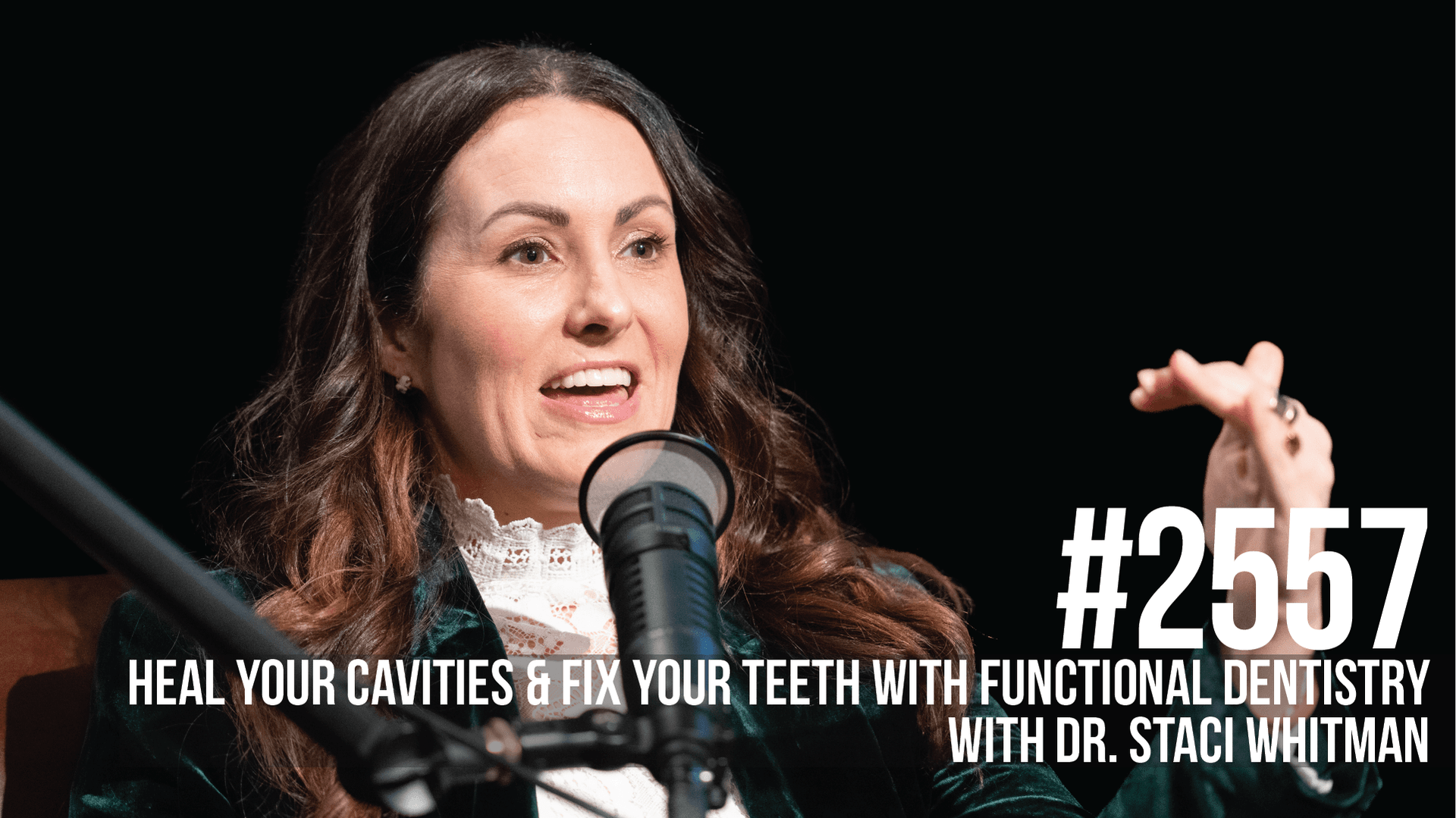
Mind Pump: Raw Fitness Truth
2557: Heal Your Cavities & Fix Your Teeth With Functional Dentistry: Dr. Staci Whitman
01:33:18
Heal Your Cavities & Fix Your Teeth with Functional Dentistry Dr. Staci Whitman Functional vs. Conventional dentistry. (1:48) Can you change the microbiome to be more positive for oral health? (5:26) Are cavities reversible? (11:59) Is...
Loading summary
Transcript376 lines
- [00:00]
Sal Destefano
Hey, prime members, are you tired of ads interfering with your favorite podcasts? Good news. With Amazon Music, you have access to the largest catalog of ad free top podcasts included with your prime membership. To start listening, download the Amazon Music app for free or go to Amazon.com ADFreePodcasts that's Amazon.com ADFreeP Podcasts to catch up on the latest episodes without the ads. If you want to pump your body and expand your mind, there's only one place to go. Mind Pump. Mind Pump. With your hosts, Sal Destefano, Adam Schafer.
- [00:38]
Justin Andrews
And Justin Andrews, you just found the.
- [00:40]
Adam Schafer
Most downloaded fitness, health and entertainment podcast. This is Mind Pump. Today's episode is awesome. We have Dr. Stacy Whitman on She's a functional Dentist. Today's episode, she talks about how you can heal your cavities, your teeth can actually heal their cavities, and you can fix your mouth and change your teeth without many of the modern methods. Now, by the way, she's a real dentist, but she's one of the few dentists that also does functional dentistry. This episode blew my mind. I have completely different view on oral health and techniques now because of this. One of my favorite interviews. You're going to love this. By the way, she has a line of mouth care products called Feed you'd good guys. It's an oral microbiome supportive oral healthcare line. You can find them@fygg.com use the code mindpump20. You'll get 20% off. You can also find Dr. Stacy@drstacy.com Stacy is spelled S T A C I. You can also find her on Instagram rstacy S T A C I. By the way, this episode is brought to you by some sponsors. Seed, the world's best probiotic. We love them as a probiotic. It's the best one. It's the only one I take every single day. Go to our link seed.com mindpump use the code 25mindpump. That'll give you 25% off your first month's order of seeds. Daily Symbiotic. We also have a sale this month, Maps Performance and Maps Performance Advanced, both 50% off. You can find them both at Maps FitnessProducts.com, but you have to use the code MARCH50 for the discount. All right, here comes the show.
- [02:15]
Dr. Stacy Whitman
Dr. Stacy Whitman, thanks for coming on.
- [02:17]
Justin Andrews
Hello.
- [02:18]
Dr. Stacy Whitman
We met you at the functional medicine event by Dr. Cabral.
- [02:22]
Unknown
Dr. Cabral's event. Yeah.
- [02:23]
Dr. Stacy Whitman
And Justin was sitting at your table.
- [02:26]
Justin Andrews
Yes.
- [02:26]
Dr. Stacy Whitman
And Justin is typically not the one of us that's like, we got to get this person on the show. Sometimes he is, but not usually. It's. It's either Adam or he's like, we need. You need to meet this woman. And I'd never heard of a. I didn't know that there was functional dentistry. I know functional medicine. And when he said, she does functional dentistry, I was like, so unique.
- [02:47]
Unknown
Yeah.
- [02:48]
Dr. Stacy Whitman
And I was like, oh, of course. Because you have functional medicine, why not functional? So can you explain functional dentistry to our audience? Like, what's the difference between that and, like, conventional dentistry?
- [02:58]
Justin Andrews
Yeah, great question. Thank you, Justin. That was fun, by the way. You're great. So it's unfortunate that the mouth has been separated from the body. I mean, it should just be functional medicine all inclusively. But dentistry went this way, medicine went that way. That's a whole separate story. But like functional medicine, functional dentistry looks at root causes. So why do you have oral disease? Why do you have imbalances in your mouth? Traditional dentistry, you know, you go in, they look at the X rays and they tell you who have gum disease, come back for cleaning, or you have cavities, come back for filling. So it's dealing with end stage disease. I like to think of conventional dentistry a little more surgical. You're fixing the issue. Something that's kind of a full blown fire. But functional dentistry wants to know the why. So why do you have oral dysbiosis or imbalances in your bacteria? Why do you have bleeding gums? Why do you keep getting cavities? And it's not just your diet and hygiene. We know there's a lot of intricacies from the oral systemic connection. So the mouth is the gateway into the body. So we can see nutritional deficiencies. There's gene snaps, how you're breathing. We do a lot more lab work. We test the oral microbiome. So just like you test the gut microbiome, you can test the oral microbiome. Vitamin D deficiency, micronutrient deficiencies, gluten sensitivity, celiac, all of these things can be tied back to oral health. And so we want to help prevent. It's essentially preventative medicine. We want to help prevent oral disease because most oral disease is treated truly preventable. However, we've normalized it because it's so common.
- [04:36]
Dr. Stacy Whitman
Wow. Okay, so let's, let's talk.
- [04:38]
Unknown
How far back does the origin go? Like, when did we make this decision that someone needs to intervene and create some sort of functional dentistry? When we were heading that, like, when did that happen?
- [04:49]
Justin Andrews
When did functional dentistry happen? Yeah, gosh, that's a great question. Functional medicine came about in the 1990s. Dr. Jeffrey Bland was the pioneer there. We've heard of Dr. Mark Hyman, of course, and there's the Institute for Functional Dentistry. But I'd say it's been evolution since then, since that became kind of a normal term. But it's. Most people still haven't heard of it. Right. So it's kind of still up and coming. It's more prevalent on social media, but there aren't many of us out there looking at oral health this way.
- [05:20]
Dr. Stacy Whitman
Yeah.
- [05:21]
Justin Andrews
And I have actually co founded the Institute for Functional Dentistry, which is launching this summer. And it work. We're affiliate partners with the Institute for Functional Medicine. Because what the issue is, anyone can call themselves anything, but there's no standardized training right now or certification. And so unfortunately for the consumer, for patients, you think you're going to someone that's thinking differently or practicing differently, but maybe they're not really, because they're just no standardization. So we're trying to work on that to correct that, but I'd say it's fairly new, you know.
- [05:52]
Dr. Stacy Whitman
Yeah, let's talk about cavities for a second. Because that's one of the more common things that people are familiar with. So as a personal example, my parents couldn't be any more different with how their teeth, I guess, react or respond to their environment. My mom very cavity prone. My father, he grew up very poor Sicilian, didn't even have a toothbrush growing up. When he came to this country, dentists did not believe that he'd never been to a dentist and couldn't believe that he never got braced, never had a cavity. And then you have me and my siblings where I am not cavity prone whatsoever. And my sister was getting cavities left and right. We ate the same diet. I'm assuming that has to do with the microbiome of our mouth more than anything. Okay, what's going on there and how do you change that? Or what are the things you can do to change the microbiome to be, I guess, more positive for oral health?
- [06:46]
Justin Andrews
Yeah, there could be a few things at play. So the quality of your enamel matters. How mineralized are your teeth? We are seeing an uptick in undermineralized teeth in children. Now. It's something called hypoplastic enamel. And that essentially is if it's dealing with baby teeth, that usually happens in utero. And if it's adult permanent teeth, that's usually in the first formative years. Kind of 0 through 8 years old or 10. Theories are it can be due to environmental toxins or exposures. But we're very mineral deficient, we're vitamin D deficient, our soils depleted. So this is epigenetic generation after generation after generation. So we are seeing alterations in the actual enamel integrity. It can be from mold exposure, it can be from a high fever. Were you on antibiotics? You know, was there some sort of event that affected enamel formation? Microplastics are now being linked to issues with enamel formation because amelogenesis, or enamel formation, it has to, it's, it's hormone driven. So, you know, endocrine disruption. Microbiome does make a difference too. When I hear that, though, this sibling does this, this sibling does that, one gets cavities, one doesn't. The first thing I think of is mouth breathing. So, and this is an important thing that we can get into. But airway health and how you're breathing significantly impacts your oral health. So if you are a mouth breather, your mouth will dry out. Your saliva is very protective of your teeth. It contains nutrients, enzymes, immune cells, hydroxyapatite, calcium, phosphorus, things that are needed to neutralize and buffer and restore your enamel health. And also the PH drop. So your mouth is constantly acidic. If you breathe through your mouth so often, I wonder, are you a mouth breather? Do you have sleep disordered breathing? Do you have sleep apnea? Okay. And those can have profound downstream effects for the systemic health also. But, but yes, the oral microbiome could be at play as well. Um, if you mouth breathe, your oral microbiome will also be different. It'll be more prone to pathogens. Pathogenic bacteria love acid. Healthy bacteria love more of a neutral salivary content or even alkaline. Um, but the only way to know, really is to test. So there is salivary analysis or oral microbiome testing. Um, it could also be gut health imbalances. If you have intestinal permeability, you're not going to be absorbing nutrients appropriately. Are you dehydrate, hydrated? So there's a lot that can go into it, and this is part of functional dentistry, is that we would do a workup in the patient to try to say, well, why does your sister get cavities all the time and you don't when you have similar diets and hygiene practices. The other thing too is many people think they're eating similarly, but they're actually not. And it's not only foods that we eat, but it's eating frequency. This is something many people don't realize, but anytime you eat or put anything in your mouth aside from water, arguably your mouth ph and microbiome will shift and change. So we want to make sure that we're timing things appropriately. So we tend to be a society where we snack and graze and sip all day. So just like we need to be giving our gut a rest, you know, we're supposed to not be eating all the time. You're supposed to be giving your mouth a rest, too. And so eating more on a schedule is very important because if you're constantly sipping and stacking, your mouth is constantly acidic. So the acidity helps with food degradation. So it's part of the digestive process. You know, enzymes are released to break food down. This is normal. But if we wait, our saliva will naturally buffer and raise the ph of our mouth again. So we do. We are supposed to take pauses between eating. And this is where the sipping on the frappuccino or, you know, snacking on those goldfish crackers, it really can make a big difference. So I'd be curious about eating frequency, too.
- [10:51]
Dr. Stacy Whitman
How long of a break do you typically recommend?
- [10:53]
Justin Andrews
Every two hours is ideal. That can be hard with kids. But this is where protein comes in. You know, we really want a very high protein breakfast to start the day off late for blood sugar regulation. That's important with our children, too. So many of our kids, and, you know, we're marketed to as busy parents. The goldfish crackers, the Cheerios, they're fermentable carbohydrates. That's trashing their oral microbiome, their pH, but also their blood sugar too. So.
- [11:18]
Dr. Stacy Whitman
So there's truth to the whole. Like grains and sugar can cause cavities.
- [11:22]
Justin Andrews
Yes. Flour is sugar in the mouth. So I think goldfish crackers are one of the worst things for teeth and is one of the top reasons that our kids have so many cavities.
- [11:31]
Unknown
Oh, wow.
- [11:31]
Justin Andrews
Cavities are the number one chronic disease globally in the world, and it's almost entirely preventable. But we've normalized it so 90% of people can raise their hand up in a room and say, I've had a cavity before. Think about if that was for any other disease, maybe like floored. But we're like, it's a cavity, you know. But our teeth aren't meant to degrade ancestral humans. If you look back 10, 12,000 years ago, which wasn't that long ago, we. We didn't really suffer from cavities. If you go to the natural history museum, you look at Skulls, the teeth are pretty pristine now in areas where there maybe was higher fruit, access to fruit, maybe honey. Yeah, you might have seen a couple cavities, but not the rampant decay that we see. Right. They estimate 100,000 or 150,000 children undergo general anesthesia, have their teeth fixed a year in the United States.
- [12:25]
Unknown
Now, is cavities. Are they reversible in terms of them being able to heal? Or is this practice of getting drilled and then going through that even necessary? Or is it like, at what point do you have to intervene? Or would you say is probably a good idea?
- [12:42]
Justin Andrews
Yeah, great question. Cavities are reversible if caught early. So generally. So our mouth is constantly in a state of demineralization and remineralization, and that has to do with that acidity. Okay. So anytime we put anything into our mouth, our teeth will become demineralized, but then if we allow a break in the saliva to do its thing, we will naturally remineralize. So if you catch a cavity still in the enamel, um, when it hasn't created an actual cavitation or a hole, you can fill that back in with minerals, specifically hydroxyapatite, or some people choose to use fluoride, which. Our teeth don't have fluoride in them naturally. And we can get to this later, but that's where remineralization can come in. Now, if the cavities are a little bit deeper through the enamel into the next layer of the tooth, which is called the dentin, it's a lot harder to reverse. But sometimes you can arrest it, which means just freeze it in time. And this is a great strategy for kids because pediatric teeth fall out. They are important. I don't wanna, you know, say we can ignore them, but to me, putting kids, 150,000 children under anesthesia a year for teeth that do eventually fall out, with the risks of anesthesia, and we're learning more and more about the potential risk to brain health, you know, and. And also, there are negative outcomes. You know, anesthesia generally is very safe, but I think we need more research about what it's doing to the brain, the developing brain. We just normalize just putting children under sedation. So these are great strategies, in my opinion, to try to just delay, you know, kick the can until these teeth eventually fall out.
- [14:25]
Unknown
I've been dying to have someone like you to explain. And I know you guys. Do you remember the story I told of. So I made a big.
- [14:32]
Dr. Stacy Whitman
That's why I was trying to bring that up.
- [14:32]
Unknown
I know some years Ago I made a big statement think on the podcast that I believe that dentistry is a big scam. And I told the story.
- [14:39]
He said the same thing about chiropractors.
- [14:41]
That's a true story. Is a true story. This happened to me and I feel like you can explain this. Like I'll. So growing up we were very lucky if we got to see a dentist once every few years. Okay. And I went to the dentist. I'm. Yeah, at this time I'm probably 12 years old or so, give or take. Go to the dentist. Dennis tells my mom that I have seven cavities. We don't have the funds to pay for that time. So mom says, well, that sucks to be you deal with the type of deal. Two years goes by, I don't see a dentist or anything like that as far as I know. I don't know what potentially happened in my diet or what happened in the next two years, but I go see a dentist two years later and I have zero cavities. So that was the moment. All of a sudden all this disbelief come in that this must be some sort of a scam because I know I didn't go try and fix anything. I just went about my life and two years later I eliminated seven cavities. How is that possible?
- [15:36]
Justin Andrews
Yeah, lots of unpack there. I am not offended with your comments about dentistry. So I will say, you know, dentists I believe overall are a great profession. Well intentioned, but even I think my own profession could be a bit of a scam too. I think we very much over treatment plan and part of this is our training. I don't blame the dentist, I. I blame the teaching institutions and the way we're educated because we're educated to only deal with end stage disease. You need a cleaning, you need a filling, you need a root canal, you need an extraction. But what about all these metrics upstream to help the patient, you know, learn what happened, what went sideways, how can I heal this without you? Now I will say part of my practice is I get a lot of second, third and fourth plus opinions. And I will make a generalization that I think a lot of dentists over treatment plan, especially in kids. So there are cavities that are really small, we call them incipient. And we could watch those, we could try to remineralize those. We could talk about changes in diet, hydration, eating frequency, breathing. You know, I see cavities heal all of the time and remineralize in my practice. So also I wonder if you truly had seven Cavities. That would be my argument. You may not have. And very often I have. I mean, this is true. I have patients come in with a treatment plan. I see the actual physical, printed out treatment plan, and it's eight crowns. This is baby teeth. Eight crowns in the baby teeth. You know, they need crowns in the front or extractions. The child needs anesthesia. And there have been times I look at the X rays and I look at the sheet and I look back and forth and I ask my assistant, are you seeing what I'm seeing? And there's maybe a couple watches.
- [17:24]
Dr. Stacy Whitman
Oh, God.
- [17:25]
Unknown
So this is how I felt because I remember my mom at that time. I think if I was in pain or complaining, she would have done something about it. But I remember telling her, like, I feel fine, I don't notice anything, I don't feel anything. So it just seemed odd, right?
- [17:37]
Justin Andrews
And I, I, we, I think we take ourselves a little too seriously. I mean, there is a difference too, with adult teeth. I think we, we need to prioritize adult teeth. If there is a cavity into the root canal system, you know, if you get an abscess in adult tooth, that can lead to facial cel hospitalization, potentially death. But we're talking about baby teeth. I have never seen any of that, nor have there been case reports. You know, and we have to think how many kids are walking this planet without access to care. I mean, think about in Southeast Asia and Africa, all these places that just don't have routine dentistry like we do here in the United States. These kids probably, they're eating a western diet. I'm sure they have cavities, but they eventually do fall out. So you have, it's time and place. You know, if a child's in pain, if it's infecting, if it's affecting other things downstream, yeah, we should treat that. But I also believe we should be giving patients an option. And this is where dentistry fails. Also, you know, you're supposed to present treatment options, get informed consent. So treatment option one, no treatment. I don't recommend that, but that is an option. Treatment two, we can take this conservative approach. We could try to arrest and remineralize. We could try to make shifts in hygiene, nutrition, etc. Treatment option three, we could just do fillings. The fillings may fail, but, you know, do you want to try them? Three crowns? You know, like there should be tears so a parent can decide or a patient if it's an adult. But dentistry tends to be like, you have to do this. You need a Root canal. You need this, you know, So I do believe, too, if you see 10 different dentists, you'll get about 10 different opinions.
- [19:17]
Unknown
Yeah, that's crazy.
- [19:18]
Justin Andrews
And not to be cynical, but there. There is a lot of insurance fraud out there. I mean, there is. I've worked at offices where it's been going on. And. And that's not to say every dentist is practicing this way. It's. Those are outliers. However, you know, trust your instincts, and there's a lot of wonderful providers out there. So if you just feel uneasy, you know, trust your gut. Go get a second opinion somewhere.
- [19:43]
Unknown
So I had another thing that happened to me, which, again, led to this, like, attitude that I had towards dentistry, which was, I. This was. And this was in my adulthood. This wasn't even that long ago. I was drinking two rock stars a day in the morning when I was training these boot camp classes back in the day. This was like, 10, 15 years ago, about 15 years ago now. And. And I actually. It started to get enough of a cavity where I could see the whole, like, burrowing down. Went in, saw. Saw the dentist. Dennis said, yep, absolutely, you have that. And I said, okay, well, you know, what are. What could be some of the things causing it. And then I told her what I was doing. She's like, oh, yeah, you probably should lay off the rock stars. So I said, okay, well, I'll come back, we'll fill this. I don't want to do it right now. It's not bothering me yet. And again, I'm still skeptical. So I thought, you know, what happens if I just cut these out? Really start flushing my mouth with water and stuff like that and avoid it for a while. And sure as I did that, and they healed themselves, I didn't have any problems anymore.
- [20:36]
Justin Andrews
Yeah, it probably was still in the enamel.
- [20:38]
Unknown
Okay, so that's a case where it hasn't penetrated deep enough.
- [20:42]
Justin Andrews
You took away. So Rockstar is extremely acidic. This is what we forget. We think it's just soda sugar, but it's acidity. Like, even sparkling water has a lower ph. So just being mindful of these things, drinking with a straw can really help.
- [20:57]
Unknown
I know that was actually her suggestion. If I couldn't break the habit, she's all, if you go back to it, at least use it. Use a strawberry.
- [21:03]
Justin Andrews
Yeah, it's not, like, super tough to walk through. However, I avoided it.
- [21:08]
Unknown
I didn't do that for a while. Just so you know, it will help.
- [21:11]
Justin Andrews
With erosion, you know, dental acid erosion.
- [21:15]
Unknown
She also recommended, like, let's Say if I was still doing it, she goes to drink, I think, a ph balanced water in between and like flush, you.
- [21:23]
Justin Andrews
Could rinse with alkaline water or just baking soda and water.
- [21:26]
Unknown
Okay.
- [21:26]
Dr. Stacy Whitman
Cheap. So I remember, so I, as a kid, I would say I was a teenager, they recommended that I pull out my wisdom teeth. Now as a kid, I'm just naturally rebellious. And so I remember thinking, this doesn't make any sense. Why is everybody getting these teeth pulled out? How the hell did we do this before we pulled out wisdom? So I never got my wisdom teeth pulled out. Which, by the way, didn't bother me. I'm totally fine. What's the deal with that? Is it necessary? And if it is necessary, what happened to our mouth where wisdom teeth have become a problem? We've had them since, well, forever.
- [22:01]
Justin Andrews
That's right. Great question. So this is part of functional dentistry too, is focusing on growth and development, facial development and airway. Okay, so you were right. Ancestrally, we had wisdom teeth in our jaws. They look great. If you go to that natural history museum, look, count the teeth, you'll see wisdom teeth in there. They're perfect. This helped with mastication. You know, we were hunting and gathering and foraging. We needed to be able to chew properly with these big, strong, wide jaws. So what has happened in the past 12 to 10,000 years? Well, the agricultural revolution happened, so we started farming corn and soy and wheat. Okay, and then so we moved away from hunter gatherer to agrarian. And then the industrial revolution happened where we started milling and processing foods and adding sugar and adding flour. So this has so many health issues, you know, including cavities, oral microbiome changes, but we stop chewing. So we used to chew, we estimate about four hours a day, and now we chew four minutes a day. So Gogurt Slurpees, rock star, you know, just mushy. Dramatic of a difference over 12,000 to now, this is what the anthropologists estimate.
- [23:20]
Unknown
Holy smokes. That's a big difference.
- [23:21]
Justin Andrews
So chewing it strengthens the jaws. It's a. It creates lateralized forces outwards. The same with breastfeeding. And so it grows the face, it grows the palate, grows the midface. It grows jaws wider. So form follows function. Okay. In a battle between muscle and bone, muscle always wins. All right, so we're not chewing. And this isn't just our generation. This has been epigenetic. Okay? So our jaws are shrinking. This is why we have so much crowding. This is why we have so many airway issues. So if the jaws are small, just Surface area. The teeth can't come in. They come in all crowded and rotated. Your wisdom teeth have no room to come in because your jaws are small. So to answer your question, do wisdom teeth need to come out or not? It really depends on the individual. Do you still have optimized facial development and jaw development, or do you not? Now, part of functional dentistry is to catch this early in kids. I can tell as young as one year old that they're probably going to have jaw discrepancy issues. And we intervene early. There's a phrase now fixed by sex. We want to start growing the face. We only have one opportunity to grow a face. And so if you intervene early, generally with retainer therapy, sometimes myofunctional therapy, which is like physical therapy for the face, the mouth, the muscles of mastication, breathing, you can course correct and you can get these kids optimized to technically how they should have been ancestrally. And so maybe they still won't have room for their wisdom teeth, but it's the best shot, you know. And so the problem with wisdom teeth, you know, if they come in horizontally or impacted, they can get infected. They can cause resorption of the adjacent teeth. And sometimes if you're really stubborn and you're like, I'm never going to get my wisdom teeth out, they can take out the tooth next to it too. So just make sure you're seeing someone you trust. And this is a case to get a second opinion, you know, maybe work with a functional dentist or someone who looks at things different.
- [25:21]
Dr. Stacy Whitman
So my wife was really big, so she's really big in functional health. And with our two little ones, you know, with kids with babies, you're constantly encouraged to give them mashed up food. Never let them chew.
- [25:33]
Justin Andrews
Yeah.
- [25:33]
Dr. Stacy Whitman
And my wife's like, no, no, they need to chew on things because it's good for their, their jaws. So she would give and she's. I mean, my kids are a little older now, 2 and 4. But even when they were younger, she'd give my son or my daughter like a lamb, lamb chop.
- [25:48]
Justin Andrews
Good for her.
- [25:48]
Dr. Stacy Whitman
And they would just chew on it. And I'd freak out. Cause I'm like, you're gonna choke. What if they, she's like, they're not gonna pull anything off. And they would just chew on it. So that's essentially what you're trying to do right through that process, is allow the give some resistance so that it could grow properly.
- [26:02]
Unknown
Well, imagine what we know about the human body and muscle and skeletal system. What we know. Imagine Something that was four hours a day, going down to four minutes, how much that would atrophy. Any other part of your body that familiar with. If you reduced exercise and movement from four hours to four to four minutes, that is.
- [26:22]
Justin Andrews
Forget it.
- [26:22]
Unknown
Yeah.
- [26:23]
Dr. Stacy Whitman
So she had the right strategy with this.
- [26:25]
Justin Andrews
Oh, she's right. She's spot on. Thumbs up. I totally approve that message. So this, there's something called baby led weaning. And that's when you mostly are introducing whole foods to your babies. Instead of purees. Some people do a blend. I'm not in one camp or the other, but, you know, you want to make sure you're not presenting things that could be choking hazards. There's all kinds of books and blogs and things on this. But yes, I mean, introducing whole real foods, getting away from the rice puffs and the gogurts and the, you know, squeezy pouches can make a big difference. But unfortunately, we are battling generations of this. So you can throw everything you want to add it, and your child may still have crowding and need interventive orthodontics early, but at least you're trying to optimize it as best as possible.
- [27:13]
Dr. Stacy Whitman
Is this also the cause of braces?
- [27:15]
Justin Andrews
That. Okay, but the difference with braces, time and place for braces. But a lot of cases, and this is definitely contentious. So there's kind of functional or orthodontics now and then conventional functional orthodontics. I mean, we want to start treating kids while they're still growing. Okay. So we can manipulate and change the way they grow. And that's often again with retainer therapy, if you wait too late. Most facial development is done around the age of 10, 11, 12. Well, traditional orthodontics, you usually wait. You wait for all the baby teeth to fall out. It's adult teeth. You're not going to change the face or the jaws. You're just moving teeth around to make them Hollywood esthetic. And this is where you hear of people having to have their permanent teeth like premolars extracted. They call it four on the floor, four. And that makes a small jaw smaller. So while the teeth, yes, they line up and fit, the architecture of the jaws are even smaller. So we really want to try to find a dentist or an airway focused dentist that's helping your kids grow and start early. And it's very controversial at our dental conferences. But I will tell you, the kids, my own included both of them, we started really early, around 4 or 5 with retainer therapy, you can see it in their face. They just, they have more of that Hollywood aesthetic, the chiseled jaw, if you will, because we grew their face wider and their jaws wider, their teeth all fit. They're not getting any braces. They're 9 and 11. So early intervention, you know, again, upstream, this is functional.
- [28:47]
Dr. Stacy Whitman
Is, is. So I, the first time I ever heard of anything like this was reading Dr. West.
- [28:53]
Justin Andrews
Yes, absolutely.
- [28:55]
Dr. Stacy Whitman
His observations. Now he talked more about diet. Yeah, but so, so he definitely contributed to some of this, his findings. He would go to these third world countries and he just noticed like such strong, straight teeth and he's like, what's going on here? They don't have dentists.
- [29:10]
Justin Andrews
And no decay.
- [29:11]
Dr. Stacy Whitman
And it was all about the diet.
- [29:12]
Justin Andrews
Yes. Okay, so fat soluble vitamins, so adk, which we're all deficient in because of our ultra processed food diet. You know, minerals, magnesium, trace minerals, organs, you know, organ blends, micronutrients, we're just, we're deficient in all of this now because our food, it's big food. You know, big food dentistry would be dead if big food changed. It is not a lack of flossing, it's not a lack of fluoride. I would argue, you know, it is so much about diet, everything, you know, and we need to be addressing it. And that's the other thing. It's really easy to blame the toothpaste or the fact that your patient's not brushing properly. But if you change the diet, if you eat a more ancestral diet, paleo, whatever, carnivore, whatever you want it to be, less ultra processed foods, your decay rate, it almost becomes zero. Truly. Because pathogenic bacteria feed on fermentable carbohydrates, that's sugar and flour. They don't feed on meat, dairy, vegetables. You could argue maybe a little bit of fruit, but I'm not going to villainize fruit. But are healthy bacteria like prebiotic fiber, just like the gut. So if you're feeding it those things, you're going to have a very healthy, robust oral microbiome. If you're feeding it more pathogenic Lee, like with ultra processed foods, flour, sugars, that acidity preservatives the food dyes. What are all those things doing at the oral microbiome? You know, they're shifting it. Absolutely. And so I wish dentistry focused more on nutrition. But just like medicine, we don't get any nutritional training and it's a nutritionally driven disease, essentially. And I'd say airway health too. Yeah.
- [30:59]
Dr. Stacy Whitman
You mentioned fluoride. We just recently found out that fluoride in water looks like it lowers iq.
- [31:04]
Unknown
Lowers iq?
- [31:04]
Justin Andrews
Yeah.
- [31:05]
Dr. Stacy Whitman
And you mentioned fluoride along with hydroxyapatite for remineralizing.
- [31:10]
Justin Andrews
Yes.
- [31:11]
Dr. Stacy Whitman
What's the difference? Is one better? Should we avoid fluoride? What's the deal?
- [31:15]
Justin Andrews
Okay, buckle up. Yeah. Okay, so I'm gonna go back. I was trained traditionally, every dentist is trained. Fluoride, fluoride, fluoride. You get fluoride, you get fluoride. Don't even question it.
- [31:27]
Unknown
Everybody gets fluoride.
- [31:28]
Justin Andrews
Everyone gets fluoride.
- [31:29]
Unknown
Put it in their water.
- [31:29]
Justin Andrews
Put it in the water. Put it in the toothpaste, put it in the rinses, varnishes. You need it. You need so much of it. Supplements. And I used to practice that way. And I live in Portland, Oregon, where we do not fluoridate our water. In about 12. Gosh, it was almost 15 years ago now. I was involved in the campaign that was pro water fluoridation. Picketing and like handing out flyers and buttons. And I admittedly had not picked up any journals, never questioned it. It was just fed to me in school. And it just, it was the bible to me. Fluoride. I'm a total hypocrite because I wasn't using it personally because I had read that it's a neurotoxin, potentially can affect my microbiome, my thyroid health. So I wasn't using fluoride toothpaste and I was filtering my water when I lived in other communities. What a hypocrite. So anyway, I sat in a debate, pro versus anti fluoride, okay? And I was sitting on the pro side and I was looking at the anti groups like Tin Hat Brigade, Woo Woo Caucus, you know, pseudoscientists. And I actually listened to them, and I was floored. I had never heard of the connections with potential systemic issues, that fluoride is extremely electronegative, it's very reactive, it can compete with iodine and the thyroid, cause endocrine issues even then. This was almost 15 years ago. I mean, they've been talking about this for decades. The controversy, what it does to brain health, et cetera. So I was felt shamed and I went home and I did my due diligence. And it didn't take long to go through some of the research to say, oh, my gosh, we need to take a closer look at this. Okay? So I've been speaking out against water fluoridation now for quite a while. And you need to separate topical fluoride from systemic fluoride, right?
- [33:25]
Dr. Stacy Whitman
One you drink, you swallow, the other one you just put on your teeth.
- [33:27]
Justin Andrews
Correct. And fluoride really has been shown to work more topically anyway. It's more efficient that way. It doesn't have to go through the gut bypass system, et cetera, but it really works topically. You just need to put it on your teeth, spit it out. Okay. But systemic fluoride, so it's really become popularized now. Finally, mainstream media is talking about it because of all the political association, which is really frustrating because we're ignoring the science. So back last fall, the National Toxicology Report came out. We've been waiting for this for almost seven years. And that's. That was a report under the Division of Health and Human Services. And it said increased levels of fluoride. Absolutely. Systemic fluoride. Absolutely. Can lead to neurocognitive issues. Okay. At that same time, there was a federal trial going on. It was the people versus the epa. It's called the TASCA trial. And there's a great website from the Fluoride Action Network which will break down the entire trial. And this trial also had been going on for years. And they were. It was the first time a judge said, I don't want to hear from you dentists. I know you guys love fluoride for the teeth. I want to find out what it's doing to the rest of the body. Okay. Because dentists tried to be so zeroed in on the tooth. Because dentistry is here and medicine's here, but it's. The mouth's a gateway to the body is all interconnected. It's still part of the human system. So endocrinologists, epidemiologists, neuroscientists, et cetera, testified, and they're very powerful. There's over 70 studies that show some sort of link to neurocognitive issues. Some of them are not great studies, but when you decipher it down, there's at least 18 really high quality studies, which to me, I think you only need one or two to question this. And so the judge saw the NTP report and then finally made his verdict after seven years of deliberation and testimonies, and said, there's an unreasonable risk to our current water fluoridation practices. Epa, you're responsible for regulating this better. The American Dental Association, a lot of dentists are still saying, well, those. Those articles aren't high quality. That's only an extreme excess of fluoride. But right now, we fluoridate our water in the United States at 0.7 milligrams per liter. But there are studies that show even at that amount, there are concerns. And the IQ concerns are on par with lead. It's a five point IQ reduction. Yeah. The other thing people don't speak about is fluoride is antimicrobial. So if you're drinking it and ingesting it, what is it doing to the gut microbiome? The other issue is the halo effect. So, yes, okay, let's say it's at 0.7 milligrams per liter, but that's per liter. So are you only drinking 1 liter of water a day? Pregnant women are supposed to drink 3 liters of water a day. So are we regulating what pregnant women are consuming? And the most vulnerable are pregnant women and young infants and infants who are getting formula mixed with fluoridated water. So that's where we're seeing the biggest issue. So the other thing is it's a medical consent issue. And so many don't realize that 97% of the world doesn't fluoridate anymore. This is a very United States centric issue. And they've removed it from their water. They either never put it in their water or they removed it from their water due to medical consent issues. You know, we're not getting. We're mass medicating without consent or concerns with health. Okay. The other downstream effects of water fluoridation, but the halo effect is. So it's not only how much water are you drinking, are you cooking with it, are you boiling your pasta with it, are you making your soup with it? Ultra processed foods, you know, your rock star was made with water. It wasn't filtered. They're not using reverse osmosis in these factories. So it probably had fluoride in it. Ultra processed foods have fluoride. Many pharmaceuticals now have fluoride, especially SSRIs. Antidepressants have fluoride in them. Many natural food, you know, we find it in trace amounts of natural foods. Black tea, green tea. And I'm not saying don't drink those things, but just know it. Compounds like, how are you, how are you calculating it, how are you titrating it, how are you really dosing it based on body weight too? And how do you metabolize things? And different people will have different vulnerabilities as well. So I think we're just oversimplifying it. And the other issue is we don't have cavities due to lack of fluoride. You know, fluoride's not an essential nutrient. No body, no system in the body depends on it. We are getting Cavities because of our diet, you know, so we're masking the issue. To me, it's like I get a headache every day, so I take ibuprofen. Well, fluoride may topically make your teeth more acid resistant and lower your cavity risk. But if it was really working as well as it says we think it is, why are cavities still the number one chronic disease globally? And the United States, a majority of people are exposed to fluoride too. So I just think it should be removed from the water. It's also a risk thing. Like, I'm a low cavity risk. Why should I be forced to drink fluoridated water when someone else is a high risk? And maybe they do need more fluoride. And I'll get to hydroxyapetate in a moment. But, you know, and people that some dentists will say, well, people can just filter their water or buy bottled water. Well, many people can't afford reverse osmosis systems. And now we're talking about microplastics and bottled water. You know, like, it just should be a choice.
- [39:09]
Dr. Stacy Whitman
Is any of it absorbed through the skin through showers? You need to be worried about that. Like baths and showers.
- [39:14]
Justin Andrews
I, I do. I haven't seen any solid science on that. But I mean, of course, it's just. What is the cumulative effect? We don't know. But I would like to see more studies on this and I'd like to see more studies on the microbiome too. What is it doing to the gut microbiome particularly? So I think it should just be a choice. If you want to use fluoride, go to the store, buy fluoride toothpaste, use it on your teeth. But this is what they do in Japan. Japan has one of the lowest cavity rates in the world. They don't fluoridate their water, but they do a lot of oral rinsing with fluoridated mouth rinses.
- [39:45]
Unknown
Aren't they one of the highest protein consumption too?
- [39:48]
Dr. Stacy Whitman
Hong Kong?
- [39:48]
Unknown
Oh, well.
- [39:50]
Justin Andrews
And they also have a very clean diet. They do, you know, so that matters. So hydroxy appetite on. Hydroxy appetite has been around since the 1970s. It was actually NASA that first developed it because when in this, in this space program, they realized when astronauts went out anti gravity, they lost minerals. So they, their teeth became mineral deficient. So they were like, well, let's create this hydroxyapatite compound. Japan came in, actually scooped it up, patented it. And so hydroxyapatite, which is calcium and phosphorus, has been used in Japanese toothpaste since the early 80s. So your enamel is composed of hydroxyapatite, about 90% hydroxy appetite crystals. Our bone is about 60% just so this is a naturally occurring, you know, compound in the body. And it now is becoming more popularized in the United States. So it's been used in Japan, South Korea, Italy, many European countries for decades. But it's kind of newer on the US scene and everybody's very skeptical of it. But I will tell you, my patients who use it, I've seen such tremendous improvements in their oral health. And I think not only is it more biomimetic mimicking nature, but it doesn't have that antimicrobial component to it too. So. But we all, we're all different, you know, and you might do better with fluoride, you might do better with hydroxyapatite. There's micro hydroxyapatite, there's nano hydroxyapatite, and it's. But it's not just that. When you look at oral healthcare products, what are the other ingredients? So just like you need to read labels for your food, you know, there's oral microbiome disruptors in a lot of oral healthcare products. There's emulsifier, surfactants, foaming agents, essential oils, which we think are good, but they're antimicrobial. So we're so used to carpet bombing the mouth, you know, kills 99.9% of germs. That's not a good way to be behaving. You know, we want to nourish and preserve our microbiome. So less is more. So you really want to be mindful of the products that you're using, just like you are with we now with our makeup and our shampoo and our deodorant, it's the same.
- [42:01]
Dr. Stacy Whitman
I saw they were putting triclosan in toothpaste. It's like an antibiotic.
- [42:05]
Unknown
How bad is mouthwash?
- [42:08]
Justin Andrews
Good question. It depends on the type of mouthwash. But traditional conventional mouthwash, like your Listerine, your alcohols, your astringents, you should not be using it. Chlorhexidine, it's banned in many countries in Europe, but it's still used here. It's just carpet bombs the mouth. And it's, it's because of the alcohols, the astringents, they're not selective. And there are studies now that show people who use chronically, repetitively use these alcohol astringent based mouthwashes have high blood pressure, cardiovascular issues. Why is that? Nitric oxide. So there's bacteria on the Dorsum of our tongue that are responsible for the nitrate reducing pathway and help contribute to nitric oxide formation. So if you're carpet bombing the mouth, you can be impacting nitric oxide formation too.
- [42:56]
Dr. Stacy Whitman
So you're not gonna have worse pumps.
- [42:58]
Unknown
That's the first thing I did.
- [42:59]
Justin Andrews
No, it's true.
- [42:59]
Unknown
That's the first thing I did. Ruin my pumps.
- [43:01]
Justin Andrews
Yeah, it's actually sexual health, like all kinds of things that comes from the mouth. And interesting paranasal sinuses. When you breathe through your nose, nitric oxide is created there too. So mouth breathers tend to have more cardiovascular issues, more erectile dysfunction. A lot of that is just how you're breathing. So it's microbiome.
- [43:18]
Dr. Stacy Whitman
Are there any applications. What was that one you mentioned? Cyclo something compounds in mouthwash.
- [43:23]
Justin Andrews
Chlorhexidine.
- [43:24]
Dr. Stacy Whitman
Yeah. Are there any applications for that where you. You might want to use it?
- [43:27]
Justin Andrews
Yeah, great question. Yeah. I would say if you have active periodontal disease, I mean, work with your doctor. But let's say you have really virulent pathogens. And this is where oral microbiome testing comes in. And we should speak to this. You may want to have some more heavy hitters, whether it's antibiotics or stronger, you know, agents, but temporary, like just for a few weeks until you see stability. Not repetitively. I think of these mouthwashes as like deodorant or perfume. Like, it's just masking the issue. So if you find you always need mints or gum or you always have bad breath, there's something else going on. You are not in balance, you know, so you probably have dry mouth or oral dysbiosis of some sort. It could be coming from the gut, too.
- [44:16]
Dr. Stacy Whitman
Plaque built plaque and tartar and stuff that you talk, you know, oh, you got to. These help remove that and you go to the dentist. Is that a normal thing that should happen or is that caused by microbiome like plaque buildup?
- [44:28]
Justin Andrews
So that's the biofilm. It depends on your diet. So if you eat more paleo vegetables and meat, you really won't get much plaque accumulation. You'll have some. But when I see kids come in and they just eat Takis and Doritos and things, their plaque is so thick because they've just been feeding those pathogens all day, every day. And then you add maybe not the best hygiene on top of it. So going in regularly to your dentist, getting cleanings is very important. That's what toothbrushing and flossing is. It's removing the biofilm. That's all you're doing. You're shaking the rug, it comes back, it sticks. And the longer it sticks there, that bacteria can release acid. Okay. It's the acid that's leaching minerals out of your teeth, eventually to the point where it can cause a hole or a cavitation. So what you're doing is just getting that sticky biofilm the plaque off so it doesn't sit there long enough to create that acid attack that can leach minerals out. The bummer is it comes back. And how quickly it comes back and how thick it comes back all depends on your diet and how you're breathing.
- [45:33]
Dr. Stacy Whitman
Things that are good for the teeth that you mentioned, are those also good for the gums? Like, what about people who are like, I don't have cavities, but I have gum issues or bleeding gums when I brush my teeth? Is it all the same kind of.
- [45:43]
Justin Andrews
Causes or different bacteria? Yeah. Great. I'm glad we're talking about this. So gum disease, about 80% of the population has some form of gum disease. 80% mild, moderate, or severe.
- [45:55]
Adam Schafer
Wow.
- [45:56]
Justin Andrews
And that can be not only from hygiene and diet or our breathing, but also nutritional deficiency. So vitamin C deficiency. Think scurvy zinc B vitamins can impact our gums. There's some genetic predisposition as well. But if your gums bleed, that's a sign of inflammation. Okay? Inflammation doesn't just stay in the mouth. And if your gums bleed, now that's a vector. That's a way for bacteria in your mouth to get into the circulatory system. And this is where the oral systemic connection comes in. So these bad bacteria in our mouth can end up in our brain, can end up in our heart, in our uterus. It can affect fertility.
- [46:35]
Dr. Stacy Whitman
They just connected it to Alzheimer's.
- [46:37]
Justin Andrews
Yes, yes, yes. So P. Gingivalis is the bacteria responsible for that. So not only can it travel to your brain, but also these bacteria can release toxins, specifically gingapans, for the brain that can create inflammation. And the ginger pans are these enzymes that can create neuron degradation and brain tissue degradation, actually. So they did a study where they tested the brains of patients who had passed from Alzheimer's, and 96% of them had P. Gingivalis and gingipans in their brains, and compared to people who had passed for other reasons without Alzheimer's and dementia, had none. Now, the concern, the question with some of these studies as well. Oral hygiene tends to drop when you have Alzheimer's and dementia. But, I mean, it's worth exploring, whether, you know, it's correlation or causation. Yeah, yeah. What would be the.
- [47:30]
Dr. Stacy Whitman
What would be the. I guess the route of action for someone who's listening, like, oh, my gums bleed. What should I do?
- [47:37]
Justin Andrews
Yes. So I would ask about your hygiene practices. So I think flossing is more important than brushing for this reason.
- [47:44]
Dr. Stacy Whitman
I've heard that.
- [47:45]
Justin Andrews
And I'm not saying don't brush people. Please don't misinterpret that. However, a lot of people brush their teeth, but not many floss. So keep flossing. You know, I compare it to when kids go to the playground for the first time in the spring and you get calluses or you start lifting weights, your hands are tender. But you guys don't have that problem now, right? It's the same with your gums. You need to work them out, you need to strengthen them, make them tough. So give it some time. Like, is it that right?
- [48:12]
Unknown
I was gonna say, I feel like every time I've ever been inconsistent with flossing, when the first time you come back, they bleed. And then a couple times, that's common.
- [48:19]
Dr. Stacy Whitman
But some people are like, it's happening.
- [48:21]
Justin Andrews
Bleeds all the time, and people normalize it. But imagine if you. Your arm just bled every time you touched it, Right? So people normalize that. We call it pink in the sink. It's. It's a. It's a definite marker red flag that you have inflammation and gum disease. So if that gum disease you keep, it stays with you, and it becomes chronic, that can lead to periodontal disease. That's when you start having collagen breakdown, ligament breakdown, and bone breakdown. That's when teeth can get loose. You know, you go the dentist, and they're like, three, four, three. They probing. They're. They're text testing your periodontal health. How is the attachment health? And it's the periodontal pathogens that are gnarly, and so they can impact fertility. So, you know, these pathogens can impact sperm mobility, sperm motility. Women who have gum disease can take two months longer to conceive. So if you're having fertility issues, one of the first things I say is, what's your oral health like? Let's do some oral microbiome testing. The cool thing with oral microbiome testing, just like gut mapping, you may say, well, my mouth's perfectly healthy. And this happened to me, actually, personally, a few years ago, I did a salivary analysis, and I was really high with f. Nucleatum. And that Is a bacteria that's now associated with breast cancer, colon cancer and pancreatic cancer. It was through the roof. I have no idea how I have it, why I have it, but I did a very targeted approach to reduce it. And it involved antibiotics and some stronger rinses and things like that. And then I retested three months later and it was. It wasn't zero, but it was less than a normal range.
- [49:57]
Dr. Stacy Whitman
Wow.
- [49:57]
Justin Andrews
Yeah. So it's important.
- [49:58]
Dr. Stacy Whitman
So the truth would be flossing often and changing your diet and.
- [50:03]
Justin Andrews
Yeah, I would. If you keep getting bleeding gums, you know, there can be certain gene snips that make you more prone. But I would be interested in your nutritional status. So doing like a full workup, ideally probably with a functional medicine provider who's going to test what is your micronutrient status, your vitamin C status. Vitamin D can impact gum health too, if you're deficient.
- [50:23]
Dr. Stacy Whitman
Do we see benefit of taking a probiotic, like traditional probiotic pill with. With oral health?
- [50:29]
Justin Andrews
Yes, absolutely. There are probiotics targeted to the oral bacteria. So a really nice protocol is I like tongue scraping us to get some of the bacteria off the dorsum or the surface of your tongue. Floss, brush, probiotic in the mouth that.
- [50:48]
Dr. Stacy Whitman
You keep the probiotic or do you just swallow it?
- [50:49]
Justin Andrews
Yeah. Yep. It's just a little. Usually they're minced. There's some are drops.
- [50:53]
Dr. Stacy Whitman
I didn't know that. Yeah. Wow.
- [50:54]
Justin Andrews
Yeah. So they're targeted to the species of bacteria, the healthy bacteria in the mouth.
- [51:00]
Dr. Stacy Whitman
Oh, interesting.
- [51:01]
Justin Andrews
It's a separate than the gut. Now I really believe you can't have a healthy mouth without a healthy gut and vice versa.
- [51:07]
Dr. Stacy Whitman
You gotta work them together because the.
- [51:08]
Unknown
Mouth feeds it right back.
- [51:09]
Justin Andrews
The mouth is the gut.
- [51:10]
Unknown
Yeah.
- [51:10]
Justin Andrews
It's all one tube and we swallow 2,000 times a day. So if you have pathogens, you're swallowing that bacteria. And some of it can survive the stomach acid and cause problems downstream. And this is maybe why we're seeing colorectal cancer with certain species and things of that nature too.
- [51:26]
Unknown
I have to ask you too, I know there's so much to cover with the mouth in general, but also too like grinding. And this has been a chronic thing for me that I've been trying to figure out. And I heard somebody had tied it in with parasites. There's some connection there. And is there any other connections? And what have you found with people who grind their teeth?
- [51:48]
Dr. Stacy Whitman
We just think it's unresolved anger that.
- [51:49]
Justin Andrews
You have all the tension. So let's most likely. So grinding is hard therapy. And okay, so the first thing I think is potentially an airway issue. Okay. So when you get into deeper stages of sleep, if your tongue falls back into the, your pharynx, essentially, what are you doing with grinding? You're moving your mandible forward to try like think of cpr, you're opening the airway or like this. Okay. So it could be an airway issue. You got evaluated. It can be a sign of nutritional deficiencies, so mineral deficiencies, magnesium. So a lot of patients report when they up that become more optimized. Again, in functional medicine ranges, not conventional medicine ranges, they see an improvement. There is a genetic component to it too. So it can run in families. It can be absolutely stress, stress induced anger management issues, as your colleagues are saying. But parasites. Yeah. So they don't fully understand the mechanism. But parasitic activity does increase during the night, nocturnally. And we do see an uptick, especially in kids who are grinding. They test, they do stool tests and they can show really high for parasites too. And you clean up the parasites and then the grinding does happen.
- [53:11]
Dr. Stacy Whitman
It's pimples, right? Wasn't that the one?
- [53:12]
Justin Andrews
I think pinworms is common. Yeah. And it's really common in kids. Think how often kids are putting things in their mouths and yeah, my youngest.
- [53:19]
Unknown
Has it too and I, I see a little bit of a genetic link there. My mom had it and my brother has it and so. But yeah, I mean, I'm going to explore all those options because it's just been this chronic issue.
- [53:30]
Dr. Stacy Whitman
Are you using now? Because now we see the world of peptides really exploding, especially peptides. There's peptides for gut health like BPC and, and I can, I would imagine they would probably help with, with mouth health too, or gum health as well.
- [53:46]
Justin Andrews
It's, it's just blowing up right now. So there are remineralizing products that have peptides in them too to help boost with cavity arrest modulation. So there's some brands that are out that the dentist has to apply though, you know, so that comes with cost. They're being used now in root canals to regenerate pulpal tissue. Just help with gum health, things of that nature too. So this is a conversation I'll, I'll have a lot more to share probably in a year or two. But for sure, dentistry is exploring peptides. Absolutely.
- [54:22]
Unknown
Interesting.
- [54:23]
Dr. Stacy Whitman
Yeah.
- [54:24]
Unknown
Tell me now we can get to why it's such a bad idea for me to be doing TOMS this whole time that I thought I was doing good by my mouth there. So what's. What's the deal with Toms that's marketed as, like, healthy good toothpaste.
- [54:37]
Justin Andrews
Yeah.
- [54:37]
Unknown
What's.
- [54:38]
Justin Andrews
I mean, the enemy of good is perfect. Perfect is good. You know that phrase? So.
- [54:44]
Unknown
So it's better than Aquafresh, you know?
- [54:47]
Justin Andrews
Yeah.
- [54:48]
Dr. Stacy Whitman
Better than my strawberries.
- [54:49]
Unknown
Colgate.
- [54:50]
Justin Andrews
What's so interesting, I grew up in Maine, and so I remember going to farmer's markets and seeing Tom's and Main at booths. Like, it was teeny, teeny, teeny mom and pop. And it was pretty legit then. But then Colgate bought it out.
- [55:01]
Unknown
I didn't know that.
- [55:02]
Justin Andrews
I can't remember the year 2008, 2010. I don't know.
- [55:05]
Unknown
And they definitely changed the formulations.
- [55:07]
Justin Andrews
Yeah, they added ye. They did. So Tom still has sodium lauryl sulfate, which is a foaming agent. It basically is a derivative of, like, a floor cleaner. So your toothpaste really shouldn't foam or burn. And this is a mindset show.
- [55:23]
Dr. Stacy Whitman
That's so funny.
- [55:23]
Unknown
We all like that.
- [55:24]
Justin Andrews
Everybody's like, burns. I know. Because you feel clean, and some people can't get past it, and that's fine, but it really shouldn't because it's carpet bombing your mouth. That's why I don't love essential oils in toothpaste. It sounds good, but we want to be mindful of what we're doing to our healthy bacteria. So the foaming, too, it's. It can disrupt the mucosal integrity. It's just like we now aren't using shampoos and things that foam. You know, it's the same for your mouth. So I also. Oh, gosh. I'd have to look at the ingredients. I. They might.
- [55:55]
Unknown
I have Doug pulling it up right now. 2006, they bought them, and it was from Maine. Tom's of Maine is where it originated.
- [56:02]
Dr. Stacy Whitman
Wow. For $100 million.
- [56:03]
Unknown
Yeah.
- [56:04]
Justin Andrews
In 2006, by the way. Well done.
- [56:09]
Dr. Stacy Whitman
You did a good job. What about brushing your teeth? Like baking soda or activated charcoal?
- [56:15]
Justin Andrews
Yes, on baking soda. No on charcoal. Okay, so baking. So there's something called the relative dental abrasivity index. Rda.
- [56:23]
Dr. Stacy Whitman
Oh.
- [56:24]
Justin Andrews
So how abrasive is it to your enamel? Charcoal will trash your enamel. It's going to do the opposite. So it's going to wear down. Yes, it's going to wear down your enamel. The layer. The dentin layer underneath your enamel tends to be more yellow. And so if you're wearing down the nice white enamel, you'll have the opposite of impact. It can make your Teeth over time, more discolored, but also sensitivity. So I give a thumbs down to charcoal. But I love baking soda. I really do, because it will neutralize and buffer. It actually raises the ph and it has a low RDA too. And it's essentially no cost. Low cost thing that people can use.
- [57:05]
Dr. Stacy Whitman
What about oil pulling? That was a thing for us for a while.
- [57:08]
Justin Andrews
Yeah, I still like oil pulling. I think people think it, you know, fixes everything. I'll do it occasionally. It feels good. It. What it's doing is disrupting the biofilm, you know. And then coconut oil does have some really nice properties for balancing the oral microbiome.
- [57:25]
Dr. Stacy Whitman
Capricylic acid.
- [57:25]
Justin Andrews
Is that what's in there? Yeah, and linoleic. And it can, but it is antimicrobial, so I wouldn't overdo it. It's very mild. But again, if you want to be a purist here, I just think less is more.
- [57:36]
Unknown
So xylitol is. That's probably what's the best. What's bad in here?
- [57:39]
Justin Andrews
I love xylitol.
- [57:40]
Unknown
Oh, okay. So there's, there's the, there's the ingredients.
- [57:44]
Justin Andrews
Carrageenan.
- [57:45]
Unknown
What?
- [57:46]
Justin Andrews
Carrageenan.
- [57:47]
Dr. Stacy Whitman
Oh, that's not good.
- [57:48]
Justin Andrews
That is the best.
- [57:50]
Unknown
Okay.
- [57:51]
Dr. Stacy Whitman
And then peppermint oil.
- [57:52]
Justin Andrews
Peppermint. Yeah. Okay. So if I'm gonna be. I would just say the SLS and the peppermint oil, but it, again, it could be worse.
- [57:58]
Unknown
Okay. I just say. So it's. It's better than, you know, brushing your teeth.
- [58:02]
Justin Andrews
But I would be interested.
- [58:03]
Unknown
No, with like, CRE or like any of the other ones that are, like, the main.
- [58:07]
Justin Andrews
That are gross. I can't even put those in my mouth anymore. They, like, hurt. They physically hurt.
- [58:11]
Unknown
Yeah. I haven't had that kind of toothpaste in forever.
- [58:14]
Justin Andrews
But I be. You try this over here and just see if, you know, I can't wait in a couple weeks.
- [58:18]
Unknown
No, no, I'm super excited to try that. And I mean, I get questions all the time and like, I don't have. I've never had the best brand that I've been recommended before. I thought was Tom.
- [58:26]
Dr. Stacy Whitman
So how, how, how developed is this field of, of functional dentistry? Because I remember functional medicine. So I, I had a wellness studio a long time ago. I sold it about maybe 10 years ago. But I remember 15, 18 years ago, I had somebody in there. She was ahead of everybody, and she talked about functional medicine. And then I remember us trying to find a functional medicine practitioner, and it was very difficult. Now you can find them all over the place?
- [58:52]
Justin Andrews
Sure.
- [58:52]
Dr. Stacy Whitman
Is it like that with functional dentistry? Like, someone's listening and they're like, cool, I'm gonna go find a functional dentist. Are they, like, very difficult to find?
- [58:58]
Justin Andrews
So we are where that was supposed to go. We're creating that right now. I mean, if you're on social media, it will seem like there's a lot, which is great. People are talking about it, and I get messages, DMs from Dennis saying, I want to practice differently. I hate dentistry because it's so. It really is. It's a challenging career. If you think bigger, if you think outside of the box, if you want to look at the oral systemic connection, traditional dentistry, it's really hard to go in every day when you're just feeling like you're not moving the needle at all, just, you know, putting out fires. But people don't know where to get trained. How did you get trained? And so how did I get trained? I flew all over the place. I spent tens of thousands of dollars on courses. I read books. You know, I extrapolated all of this information. I looked at Western price, I looked at other colleagues who are paving the way, but it's just a handful. So we really need a standardized training program.
- [59:53]
Unknown
Have you considered building a course?
- [59:55]
Justin Andrews
Well, the Institute for Functional Dentistry is a core, so we're launching this summer. And so the concern I have is that we need to get the mouth back into the body. And so dental curriculum is really focused on, really, oral health. We focus on the teeth, how to fix the hole, how to do the root canal, very little in medicine and nutrition. And the oral systemic connection. What's missing from dental curriculum is medicine, you know, hormone pathways and, you know, immune function, the oral systemic connection, the oral microbiome, environmental toxins. And so our program, they will get functional medicine training, which is foundational, to then build up to their functional dental training. So we're very excited for that, and I'm hoping it helps. There are, you know, databases out there where you can find functional dentists. I just argue you don't know what you're going to get because there's just no certification, there's no standardization. You could say, oh, I screen for airway health, or I don't use mercury. I'm a functional dentist. And I'm like, you're different. You're looking at things differently. But it's very involved.
- [61:04]
Unknown
Now. You will have to be a dentist already to then go through this process.
- [61:08]
Justin Andrews
Dentist and hygienists will be able to, too, because the hygienists are very important for all of this as well.
- [61:13]
Dr. Stacy Whitman
So typically when I talk to someone like you, there was some crisis that motivated them to move outside of their. Where they were. I mean, you were already a dentist, you were practicing, you were picketing for fluoride. Was it the fluoride, by the way?
- [61:26]
Unknown
You gotta use that as like a picture in your speeches. I feel like you should start with that.
- [61:29]
Justin Andrews
I wish I had this on the other side.
- [61:31]
Unknown
Cause that would be a great.
- [61:32]
Justin Andrews
I need AI to help create a photo for me. I don't have any photos of it.
- [61:36]
Dr. Stacy Whitman
What was it that motivated you to move outside of your, you know, what you were doing? Because you were already dentists, you were practicing.
- [61:41]
Justin Andrews
Yeah, well, that's such a great question. It's so layered. So I lost both my parents very young to preventable disease, cancer, lifestyle factors. So that's when I personally shifted into doubling down on longevity and health. Even from my teen years, though, prior to their passing, I just was really interested in nutrition science and human optimization, but I just never applied it to my career because no one was doing that. You know, this. It's like I lived two lives almost. But then I got out. I actually was a general dentist for many years and I hated it. I was going to move to like, Costa Rica and surf for like New Zealand and snowboard. I couldn't stand it. I hated it because it just. It's disease, disease, disease that comes in and you don't. The way the system's set up right now, you don't have time to educate your patients on true prevention, do nutritional counseling, run labs, like, let me help you. It's really turn and burn. Which is why dentistry, I think, deserves to be the brunt of the joke sometimes. I mean, we're just putting out fires, right? So I was really dissatisfied. So I thought, gosh, I'm going to get more upstream. How do I get more upstream, kids, right? Education. So then I went back and got board certified in pediatrics. And then I got out and I realized, oh, it's the exact same thing, except now it's even more turn and burn. Because pediatrics is faster. You know, you see more patients a day. And I just said, there has to be a different way. And I thought I was practicing differently. I wasn't doing mercury fillings. I was not judgmental if parents came in not wanting to use fluoride. I was trying to talk more about the oral systemic connection, but I didn't have enough training. And this dad came in and called me out one day and he was like, you're not a holistic. At the time it was like holistic dentistry. You're not a holistic dentist. Do you know who Western Western Price is? I was like, I don't. You know, again, this was like 12, 13 years ago. And so I went and read more about Dr. Price's work. And then Dr. Steven Lin is a dentist out of Australia. He modernized Price's work with the book called the Dental Diet. And I just noticed, gosh, if I just spend a little more time with my patients and talk about nutrition and show them how to brush and floss and why it's important and talk about the microbiome, when they come back to see me, they're healthier, they don't have these repeat offenders like cavities keep coming in, their gum disease improves. And I was like, this is so subtle and really easy, but it just takes a mindset shift. And they just kept building upon it. So it was really coming from dissatisfaction in my career, you know.
- [64:19]
Dr. Stacy Whitman
So strengthening bone in the body, strength training really helps with that. Is there anything that we could do with the mouth? Like you've seen people come out with like jaws are size. Yes, like chewing gum. Like we don't chew. Is there anything we do exercise wise for our mouths to strengthen our teeth and our jaws and all that?
- [64:37]
Justin Andrews
Yeah. So out of the gate, if you can breastfeed, that's the best, the best thing to optimize the airway in your child is to breastfeed. If you can. Not every woman can or does it resonate? But if you can, baby led weenie cha on, chew on lamb bones and you know, bam, bam type of stuff. Introduce real foods, crunchy foods, carrots, apples, meat through childhood, less processed foods as much as possible. There's something called a myo munchie. It's a myofunctional appliance. It's medical grade silicone that you can chew on. I actually have one of those jar size things. It I, it hurts like I don't feel the angle is right. And I think it could cause a lot of templomandibular joint issues. But yeah, in theory these are muscles, you know, and our tongue is a muscle and that's where myofunctional therapy comes in. So there are different exercises. You can use that myo munchie. With our kids we talk about doing clicks, pops. There are things that you can do to strengthen the muscles too. But just having a whole food diet and chewing, we tend to inhale Our food, like actually chew because that's gonna help with digestion and just have profound benefits too.
- [65:57]
Dr. Stacy Whitman
This might be a weird question, but do notice any differences in languages and their effect on. You're talking about moving the mouth. And I know different languages require different mouth movements. Is there any data to show?
- [66:10]
Justin Andrews
I don't know. That's a great question. Yeah, like, especially there's a connection to.
- [66:15]
Unknown
Healthier teeth with people that talk a.
- [66:16]
Dr. Stacy Whitman
Certain way just learning different languages. Exercise your mouth. I mean, I grew up in a.
- [66:21]
Justin Andrews
Or.
- [66:21]
Unknown
Oh, you mean being like bilingual or something? I thought you meant like different languages. Like they have better teachers teeth because they speak.
- [66:28]
Dr. Stacy Whitman
They speak Russian or just exercising the mouth. Like, you know, I grew up in an Italian household and Italian words, they use different parts of the mouth pronounced and English words.
- [66:38]
Justin Andrews
And I'm sure I understand what you're saying.
- [66:40]
Dr. Stacy Whitman
Okay.
- [66:40]
Justin Andrews
I think that'd be fascinating. Yeah. I don't know, but it would make sense because it is, you know, speech is a red flag. Delayed or challenges with speech is a red flag in kids if they have a myofunctional imbalance. We usually don't make that call. Call. And I'm not a speech language pathologist by any means, but generally they make the call between 6, 7, 8 years old with certain sounds. So that'd be interesting. I'll dig into that for you.
- [67:06]
Unknown
Well, since we're asking weird questions, I was waiting for an opportunity to ask this question because it's so in left field, but it didn't feel right anywhere. Do you remember when I talked on the podcast about my roommate that had the chronic bad breath?
- [67:17]
Dr. Stacy Whitman
Yeah. Oh, yeah.
- [67:18]
Unknown
So what is the connection between somebody who does cocaine and chronic breath? Breath?
- [67:23]
Dr. Stacy Whitman
Yeah.
- [67:25]
Justin Andrews
Probably their sinuses, like post nasal drip. And they probably just have pathogenic sinuses, you know, that can just read. That was put a hole in your septum. I mean, they might have infection up there. I bet they have signed chronic sinus.
- [67:42]
Unknown
Okay. That's when you were starting to talk about the sinus. I was like, I bet it has something to do with that. Yeah, like it was the worst breath I'd ever smell. And I remember it was so bad that this is before I knew he had this habit. I didn't find out about his habit till after he was no longer my roommate. And I found all the paraphernalia. And I remember we'd get in the car together, go to work, and his breath was so bad, would stink up the whole car. So bad that I remember I gotta see if he's brushing his teeth that I remember the next morning, like watching him scrub his teeth, going like, this dude's brushing his teeth. How is it possible his breath could be that bad?
- [68:13]
Justin Andrews
Okay, I have theories now. I'm thinking about it.
- [68:14]
Unknown
Okay.
- [68:15]
Justin Andrews
Okay. So he, there's probably a few things he probably is chronic sinus infections. He also has dry mouth. Yeah, because that's what cocaine does.
- [68:24]
Unknown
Yeah.
- [68:24]
Justin Andrews
Okay, so think of methamphetamine addicts too. Their teeth are just jacked.
- [68:28]
Dr. Stacy Whitman
Right.
- [68:29]
Justin Andrews
Part of that is from losing the integrity of your saliva. It is dietary choices too, when you're on these drugs. But also mouth breathing. So if you have chronic sinus inflammation because he's snorting it up there, it's all stuffy. He's mouth breathing.
- [68:42]
Dr. Stacy Whitman
Yeah.
- [68:42]
Justin Andrews
So that's going to change his microbiome, drop the ph, he'll lose his saliva. He probably has like tonsillar inflammation. You know, you're swallowing pain, it's messing up your gut microbiome. So yeah, he's probably not flossing.
- [68:56]
Dr. Stacy Whitman
Poor guy. If you ever listens to our podcast.
- [68:58]
Unknown
Sorry, I'm okay with shaming this dude.
- [69:01]
Dr. Stacy Whitman
There was.
- [69:02]
Unknown
I found razor blade marks on my window seal and half straws all over the place.
- [69:06]
That's kind of fair game.
- [69:07]
So I should have known. I mean, I was a young. I was in my 20s, so I was still a little naive and you know, didn't connect the dots of the guy playing video games till 4 o'clock in the morning with his jaw.
- [69:16]
Justin Andrews
Like, talk about working on your jaw.
- [69:18]
Dr. Stacy Whitman
So my. So what about with parents when they give their kids juice all the time? My wife has a younger brother who when they were little, they would give him in his bottle apple juice all the time.
- [69:29]
Unknown
A lot of people do that.
- [69:29]
Dr. Stacy Whitman
And all his baby teeth rotted out. They all got totally. So that's terrible.
- [69:33]
Justin Andrews
That's terrible.
- [69:33]
Unknown
Well, you ever seen apple juice compared to like soda? It's like damn near the same amount of sugar.
- [69:38]
Justin Andrews
So yes. And I mean this has to do with blood sugar too. So how many apples does it take to make 6 to 8 ounces of apple juice?
- [69:46]
Unknown
It's a lot.
- [69:46]
Justin Andrews
It's way more than you could eat physically with a lap with fiber. Yeah, I'm not a fan of juice. I mean my patient population, I'm lucky. I just don't see a lot of juice drinkers, but I know it's still a thing. It's the fastest way to destroy teeth. Think of it like soda. So if you're go. If your child Needs juice. Let's say they're constipated or your pediatrician wants. That's a whole other conversation. But if your pediatrician wants one juice, just dilute it. Just try to give a little bit every day. Dilute it in water. But our kids just get too much sugar. I mean, we need to. They need to learn to love water.
- [70:22]
Unknown
The beautiful part is if you actually, as a parent, and this is for the parent that has a kid on the way, if you discipline yourself not to do it. I mean, my kid's five now, and you couldn't get him to drink juice.
- [70:32]
Justin Andrews
I know.
- [70:32]
Unknown
You don't even like the taste.
- [70:33]
Justin Andrews
Mine are the same.
- [70:34]
Unknown
Yeah, he just. He wants water.
- [70:36]
Justin Andrews
If you're expecting or gonna be a parent out there listening, be super strict. In those first formative years, it pays off in spades. My girls are 9 and 11. They're starting. I'm starting to lose control. They go over to friends houses and they're after soccer games. They're getting exposed to this food that I normally. I would never bring into the house. And they're usually just not interested in it, you know, and they're very adventurous eaters. And you may feel weird at first and, you know, say, oh, we're good with the goldfish, or we just eat, you know, seaweed snacks or fruit and veggies and meat and cheese. But it will pay off.
- [71:13]
Unknown
I always feel bad for the parents that are trying to reverse this after five, seven, eight years. But if you're new and you're just starting, like, I can't stress enough how by not introducing it, they won't know any better. And then when it's inevitable, it gets introduced to them, they don't like it.
- [71:29]
Dr. Stacy Whitman
I had adult clients that thought they would say that. And I used to get. I had a few of these. It happened more than once where they'd say, I don't like the taste of water. You know, it's because they were. They were so used to drinking.
- [71:40]
Unknown
Conditioned.
- [71:41]
Dr. Stacy Whitman
Yeah. Something with flavor. And you developed that as a child. You developed.
- [71:44]
Justin Andrews
Well, if you form the palace first thousand days, those first three years of life are so important for microbiome development. Oral and gut, but also palate. You know, you're shaping the palate. And so if they're getting sugar, sugar, sugar. You know, children are drawn to sugar. This goes back ancestrally too, because in the forest, foods that were sweet, mother's milk or berries were safe foods that were bitter poison. Okay, so this is. There's a reason for this. But you need to control it. So I do say, I agree with you. Give water, your kids don't need juice, they don't need soda at the party. That's one thing. We're hard. No soda at my family because it's acidic. It's sugar. I just don't want my kids developing that palate, you know.
- [72:32]
Dr. Stacy Whitman
But do you see any connection between any non nutritive sweeteners, artificial sweeteners, or stevia with, with any oral health issues?
- [72:40]
Justin Andrews
There's some research on some of them with gut microbiome dysbiosis and there's some studies maybe, you know, xylitol I really like for in toothpaste because it will modulate the microbiome, it reduces plaque formation, it can act as a anti inflammatory agent. It's like a prebiotic too, but swallowing a lot of these things. Baking with it, cooking with it. But drinking drinks with these things, it can affect gut microbiome, maybe increase uric acid. There's some studies on that too. So just be cautious, you know, and milk is milk.
- [73:19]
Dr. Stacy Whitman
When we, you know, we grew up in the 80s, milk was, you know, good for your bones. Is that still true?
- [73:24]
Justin Andrews
Are we gonna do the raw milk conversation right now?
- [73:28]
Dr. Stacy Whitman
That's what we give my kids. My kids drink. My daughter, I should say, my son can't tolerate dairy like me, but my daughter can.
- [73:33]
Justin Andrews
Yeah.
- [73:34]
Dr. Stacy Whitman
And we only give her raw milk. So why? Why raw milk?
- [73:37]
Justin Andrews
Less processed.
- [73:39]
Dr. Stacy Whitman
Yeah.
- [73:39]
Justin Andrews
You know, higher in nutrient density. This gets controversial. Totally. I can't even get it in Oregon. I have to like mafia it in. Yeah, I'm serious. I have patients that like come from Washington state and they'll bring me raw milk.
- [73:52]
Dr. Stacy Whitman
Have you seen the videos of like the agents going in and like some big drug?
- [73:58]
Justin Andrews
Well, I mean, the Amish were apparently incredibly impactful in this election because of what was happening to their milk. I read that somewhere.
- [74:07]
Unknown
Oh, I didn't know that.
- [74:08]
Justin Andrews
Which makes sense, right? Like they came out in droves voting because they want to be able to supply raw milk anyway. Yeah, milk is great. It has vitamin D and healthy fats. And as long as you can tolerate it, I think quality dairy is very important. Calcium, phosphorus. I'm, I'm very pro. I tend to lean more towards the least processing of things as possible. Yeah.
- [74:33]
Dr. Stacy Whitman
Okay, awesome. What's the biggest pushback you get from your community talking about this? I can't imagine too much, but. Oh, oh, there's a lot.
- [74:40]
Unknown
Yeah, there's gonna be some dentists.
- [74:42]
Justin Andrews
Gnarly, gnarly messages.
- [74:44]
Dr. Stacy Whitman
Really?
- [74:45]
Justin Andrews
Yeah.
- [74:45]
Dr. Stacy Whitman
What is it? Is it the fluoride?
- [74:46]
Unknown
Disrupting the industry, dude. Disrupting injury industry, livelihood, money. And. And that's always going to be.
- [74:52]
Justin Andrews
What's the biggest one, my tell all about dental dentistry. My book coming out. Oh, I'm just joking. It's on my list of things to do. No, most everyone's very supportive. And if they spend this time talking to me, they realize I have really good intentions. We're all on the same page. We want healthier patients, we're trying to help our patients. But from the outside, it is that I think people feel threatened. I. It's hard to say what I say without attacking the individual. I'm not saying dentists are bad again, it's the institutions that need to change. I think it's a mindset, Chef. But I would say the number one thing is my stance on fluoride. You're always a fluoride.
- [75:31]
Unknown
You're the type of person who's a great person, though, to do it because you admittedly were on the other side of the fence.
- [75:36]
Justin Andrews
Thank gosh, I have that story. It is.
- [75:37]
Unknown
It's a great. It's a great story because, you know, I feel sometimes you people are very skeptical of these charlatans that come in and decide they're going to create this space. And it's like, no, I was. I was on the other side advocating for this, and then I woke up and realized what was going on.
- [75:50]
Justin Andrews
And so, yeah, I just want to touch on that again. So, you know, the argument is, well, fluoride helps teeth. And I'm. I think most of us, we're not arguing that even topically, like, systemic's different, but what is it doing to the rest of the body? Like, why are we only focused on teeth? And that's the difference. The pro water fluoridation group, in my opinion, has the same intention than I do. We care about patient health care. We want to optimize our, you know, the, the health of our. Our brothers and sisters, but they're just focused on teeth and cavities. Yeah. What about the brain? What about the thyroid? What about the skeletal system and the gut? Because it is all interconnected. So. But I would say water fluoridation, I. It's not frequent, but when I get it, it's nasty. It is really nasty. And it's usually very misogynistic and. Yeah, it's crazy. Oh, it goes. They go wild. And one in particular who trolls.
- [76:44]
Dr. Stacy Whitman
I don't know. How can you be misogynistic?
- [76:46]
Justin Andrews
Because I'm. I'M the fluoride. Fluoride action or. It works, Darlene. And they just put me up there. They just put me up there for like candy, whatever. It's just so dumb. And he, he'll say things like, it's fear porn. He likes to say porn all the time in emails he sent me. This guy is on, on the, on the board of the floor. Well, he in particular, there's a lot. But there's one guy in particular, he won't leave me alone. I block and block and block and block him. I, I'll share more details off, offline of who this gentleman is, but there's a reason that he, I think, is so upset.
- [77:20]
Dr. Stacy Whitman
Is there any truth to the part of the fluoride? Like, you know, just all the information. Is there any. Was there any truth that, that it was a, an expedient way for companies to get rid of fluoride was to dump it in our water? So it was like a cheap way to get rid of this, this chemical byproduct.
- [77:36]
Justin Andrews
There is, yeah. So it is a byproduct of the phosphate fertilizer industry. So back in the day, okay, so the history of water fluoridation. So in the early 1900s in Colorado Springs, there was a dentist there, Charles McKay, I believe was his name, and he noticed his patients all had fluorosis, which was mottling of the teeth, which is the first time sign of too much fluoride. Okay. And they estimate up to 40% of teenagers now have dental fluorosis.
- [78:08]
Dr. Stacy Whitman
What's mottling? What do you mean by that?
- [78:09]
Justin Andrews
Like white brown spots in the teeth. Okay, maybe we can show it up there.
- [78:14]
Dr. Stacy Whitman
Yeah, so.
- [78:15]
Justin Andrews
Oh, look at you. Yeah, that's. That's my institution. So he made an observation that he felt maybe their enamel was more acid resistant, they were getting less cavities. And so some people did some very preliminary research on this and basically kind of went wild with it. And they put it in the water in Grand Rapids, Michigan in the mid-40s without any long term safety data and not really much substantial efficacy data. So the phosphate fertilizer industry to get rid of this fluoride was very expensive. It had to be shipped out. It was considered a biohazard. But. But what they did instead is they packaged it up and sold it to municipalities to put into the water. And so if you look. And this all sounds like conspiracy theory until you really start learning about it and realize, well, it's actually true. You know, if you look at how does fluoride come. It Comes in like cement bags. It's hydrofluorosilic acid. So it's acid skull and crossbones on the front.
- [79:14]
Dr. Stacy Whitman
Oh wow.
- [79:14]
Justin Andrews
And you have to wear a hazmat suit to pour. And I've spoken to the people working at these water plants that are doing this and if you speak, speak to most people that work at these water plants, they are absolutely opposed to water fluoridation and they're the ones putting it in the water. The other thing too, it's very important. So we keep saying 0.7 milligrams per liter is perfectly safe. That's assuming you just drink 1 liter of water and don't get it from any other sources. But if you test different municipalities, you'll see it's not always exactly 0.7 milligrams per liter. It's really hard to keep it at that level. And so I've worked on campaigns where we've tested water and I've seen it as high as 2.2 milligrams per liter, which is that is shown in the data to be too much. So again, I just think it's antiquated. I think it was well intentioned at the time with the science we had at the time. This was before evidence based medicine and.
- [80:09]
Dr. Stacy Whitman
It just conveniently was a cheap way to get rid of this chemical byproduct.
- [80:12]
Justin Andrews
They thought they were helping the cavity epidemic.
- [80:14]
Unknown
So you guys can take your tinfoil health hats off. It's not trying to make the society dumber. That was not the intent of it.
- [80:21]
Justin Andrews
There are people that say that there's absolutely.
- [80:23]
Unknown
That's the conspiracy theorist is like this was all intended to make us dumber and more controllable.
- [80:28]
That and he had lead and all these things happening at the same time.
- [80:30]
Justin Andrews
I think it was well intentioned, but when you know better, you do better. And again, it should be a choice. If people want to use it, use it in toothpaste. But we, I just think it's very antiquated and you know, we need to minimize risk. Our kids are getting sicker. Like this is not up for debate. Fact. So let's get rid of some easy low hanging environmental toxins or not even, you know, things that we're adding acid.
- [80:58]
Unknown
Let's start with that.
- [80:59]
Justin Andrews
Can we create programs to educate on nutrition and diet? Like let's get our pediatricians on board. Let's get OBGYNs talking about how moms can optimize themselves during pregnancy so their kids teeth come in healthier, you know, vitamin D optimization and movement and sunlight. I mean I could go on and on.
- [81:16]
Dr. Stacy Whitman
By the way, Adam, it's 2025. Conspiracy theorists are like 10 and 0.
- [81:21]
Unknown
They are winning right now. There's still some crazy ones out there.
- [81:27]
Justin Andrews
And I do find them because, because I speak about this. They come to me.
- [81:31]
Unknown
I'm sure.
- [81:31]
Justin Andrews
Whoa, wait a minute.
- [81:34]
Dr. Stacy Whitman
You think the lizard people are putting.
- [81:35]
Justin Andrews
You have to be science back stuff?
- [81:37]
Unknown
I mean, I, I'm with you. I think generally speaking, I'm not saying all at all that I think most stuff is well intended. And then I think what happens a lot of times is there becomes the well intentioned ends up being a huge industry of money and then, then it's hard to reverse. Well, yes, somebody's buying millions of dollars worth of those bags.
- [81:57]
Justin Andrews
Yes.
- [81:57]
Unknown
To put it in that. And there's a business out of that. And they certainly don't want it to go away.
- [82:01]
Justin Andrews
Absolutely. You know, you're right. And also it's important in a late, you know, the American Dental association, the American Academy of Pediatrics, these can be pretty pay to play organizations. You know, the ADA does take money from three M. Henry Schein, Colgate, Palmolive. Those companies all make fluoride products. Like half of their product line is heavily fluoridated.
- [82:24]
Dr. Stacy Whitman
Speaking of which, it's always four to five dentists. I want to know who that other dentist is. That number three. So are you, are you hopeful with. Because you're somewhat involved with this kind of movement that we're seeing with making America healthy Again. You spoke. Are you somewhat hopeful for the direction? I mean from my perspective, I've never been hopeful with government policy on. It's always been the opposite of healthy. But for the first time ever I'm hearing things and going, oh, maybe we're moving in the right direction.
- [82:55]
Justin Andrews
Yeah. I was involved with the Kellogg's rally where we went and petitioned. There were 400,000 petitions. It was with Vani Hari, the food babe to talk about getting food dyes and BHD preservative out of our kids cereals. And people say, well that won't move the needle, but it has to start somewhere. And it's just, it's the movement. Why I'm so hopeful is people are talking about it. And also people are talking about water fluoridation. Do you know what a dream it is to have that on like the front page of the Washington Post or the New York Times? For me, me, who's been reading these studies and just thinking I'm crazy because no one else is talking about this My colleagues blinders are up and they just go with what the ADA says and into their defense. We're so busy. Medical, dental providers are so busy. It's really hard to dig into the science and the literature. It's also really hard to go against the grain. Like, I took a lot of. I lost referrals. I still get hate mails and hate emails because of how I feel about water fluoridation, for example, or just practicing dentistry a little differently because people do get offensive. They feel, they're defensive about it and offended. But I'm hopeful. I am hopeful. I just. We need to clean up our food system. We need to fix the chronic healthcare crisis that's happening. Figuring out the whys, you know, and these come with just conversations. And I think we're at a point, it's just contentious because change, that's what happens in change. There's a lot of turmoil right now and people are butting heads. What's a bummer is that it's become political, which maybe you could argue it had to. I don't know.
- [84:38]
Unknown
Everything has to be these days. What are the top five holistic approach? I've even heard things like brushing our teeth is a new thing. If your diet and your water intake was right, we probably wouldn't even have to brush our teeth that much. So if you were to list like number one, number two, number three, number four, holistic approaches to having a healthy mouth, healthy teeth, what would you rank? One, then two. Like, how would you do that?
- [85:06]
Justin Andrews
Yeah, I mean, I, I see this online with some influencers. They'll say I'm carnivore, so I don't brush and floss. And in theory, they're right. However, I don't recommend that because no one is really eating that way. It's, it's such a rare percentage.
- [85:23]
Unknown
But based off that, wouldn't that make.
- [85:24]
Justin Andrews
Diet become so I would say diet is number one.
- [85:27]
Unknown
Okay, number one.
- [85:27]
Justin Andrews
Absolutely. Diet. Eat a rainbow. Whole foods, high quality protein sources, hydration, you know, that what put what you put on your fork matters tremendously. Number two is airway. How are you breathing? And those are a little interchangeable, I think. But, but how you breathe, you know, kids with, with sleep disorder, breathing or airway issues, there's a, there's a link to adhd. Okay, so if your kid has adhd, has anyone screened for their airway health? And you would say, I'm going on a tangent here, but why is that? If you're not getting into deep restorative sleep, you're Also very likely not having a proper hormone release. And hormone can be very regulating. You might be in fight or flight, constantly sympathetically overdriven. You're also not getting enough oxygen. The brain is actively developing in childhood, so when you breathe through your mouth, you get 20% less oxygen. So breathing is really important not only for behavior, mood, growth. Growth hormone is released in deep stages of sleep, but also oral health too, which we spoke about earlier. So I'd say nutrition, airway. I'd say, you know, hygiene practices matter, particularly flossing. So again, most people aren't. A lot of people brush, but people aren't floss. Flossing.
- [86:42]
Unknown
So you'd even put flossing over brushing?
- [86:44]
Dr. Stacy Whitman
Yeah.
- [86:45]
Justin Andrews
Oh, yeah.
- [86:45]
Unknown
Oh, okay. Let's see. That's good to know.
- [86:46]
Justin Andrews
I would even maybe not even have brush it in the top five. Only because if you're eating a clean diet, your tongue does clean the outside surfaces of your teeth a lot. But I'll just say oral hygiene. So flossing, brushing.
- [87:01]
Unknown
How problematic is it to be like a hard brusher?
- [87:06]
Is there anything you do soft, bro?
- [87:08]
Everybody tells me they do.
- [87:09]
Can you calm down?
- [87:10]
Like, you know how they have the bristles?
- [87:13]
It's all like this.
- [87:14]
Adam Schafer
Yeah.
- [87:15]
Unknown
Why is Justin's toothbrush like this after.
- [87:17]
Two times normally brushing?
- [87:18]
Justin Andrews
Very, very light. Like Bob Ross, like paint lightly. Well, baby trees too hard because you're wearing your enamel.
- [87:26]
Unknown
Yeah, I've heard like, so the electric ones are good for that. So it regulates.
- [87:31]
Justin Andrews
Yeah. And like just lighten your grip up a little bit. I'm just being honest, dude.
- [87:36]
Unknown
I'm so glad you because you're not the. I'm sure you're not the only one.
- [87:39]
I know for of fact, I'm sure.
- [87:40]
You'Re not the only guy out there that does everything hard.
- [87:43]
I can't help it.
- [87:44]
Justin Andrews
A lot of people brush too hard. They do, they really do. And they wear their animal and they have sensitive.
- [87:48]
Unknown
So just floss. I'm going to move over floss.
- [87:50]
Justin Andrews
Yeah. And if you can't floss, water picking is a. Is a decent substitute too. So water flossers. Okay. Number four, oral micro. I say supplementation. Oral microbiome and just nutritional supplementation. But test, don't guess. Ideally, but most of us are vitamin D deficient or vitamin K2 deficient, Western price stuff and mineral magnesium deficient. So when the kids come in, I kind of just like everyone on a vitamin D3K2 and a magnesium blend. And I know the purists out there, like we should be able to get this all from our food and sun. But we're in modern society. We're inside. We're not optimized. So be open to it. I would just say why just be optimal. Number five. And prebiotics, probiotics with that too. I guess I'd say hydration.
- [88:40]
Unknown
I was just gonna ask you, were you including in the.
- [88:43]
Justin Andrews
Yeah, I'm gonna throw it back. I mean hydration. I mean these are interchangeable a little bit. But if you have dry mouth, you will be more prone to cavities and the quality of your saliva too. So is it mineral optimized? Do you have enough calcium and phosphorus in the diet? Your saliva, it's this golden elixir of your body. It protects your teeth, but it is what helps with the remineralization exchange.
- [89:03]
Dr. Stacy Whitman
I just thought of something.
- [89:04]
Unknown
Love it.
- [89:05]
Dr. Stacy Whitman
Can you catch cavities? In that case, can you make out with someone?
- [89:07]
Justin Andrews
Yes. So yay. I'm glad you brought this up. Cavities, yes. Bacteria is transmissible.
- [89:12]
Unknown
Especially if you make a. Especially if you make out French style. Do it really hard too.
- [89:19]
Justin Andrews
There's a study that says you need to kiss chicks dig it 11 times a day to like exchange enough so it sticks.
- [89:27]
Dr. Stacy Whitman
Okay.
- [89:27]
Justin Andrews
So anytime you. You kiss, let's say you have a first date or one night stand, there will be an exchange. But it's transient. But bacteria is transmissible. So most babies are born with pretty neutral oral microbiomes. They get it from their moms, but it's someone. It's a caregiver that inoculates them with either strep mut, but also Candida is really, really well documented now to influence early childhood cavities too. So you'll find families tend to have the same microbiome. So let's say you have terrible periodontal disease and you have F. Nucleatum, which is linked to cancer. We should test your spouse. I bet she has it too, right? Even though she's asymptomatic. So we usually need to treat both people together.
- [90:10]
Dr. Stacy Whitman
Otherwise you're getting one.
- [90:11]
Justin Andrews
Exactly. Because you're just going to get it again because she's going to reinoculate you. So.
- [90:15]
Unknown
Yeah, I didn't need to know that.
- [90:17]
Dr. Stacy Whitman
Anytime you put your. Well, this has been incredible.
- [90:22]
Justin Andrews
Who would have thought?
- [90:23]
Dr. Stacy Whitman
So good. This is so great. I wish people like you were easier to find.
- [90:28]
Unknown
Oh, tell us where everybody can find your toothpaste. I know I haven't tried it yet, but I already. I'm a believer.
- [90:33]
Your difference in toothpaste. Yeah.
- [90:35]
Justin Andrews
So Because I look at things differently. I just couldn't find the toothpaste I really loved. There were some good ones out there, but I still felt so many of them were disruptive to the oral microbiome. So I partnered with Dr. Mark Burhenna, who's on social media as well, and we founded fig, which stands for feed your good guys. Yeah. So it's oral microbiome. That's the premise of it. So we took out all the emulsifiers, the surfactants, the essential oils, the disruptors, and we added in prebiotics and amino acids that target oral microbiome modulation and it can affect plaque accumulation too.
- [91:14]
Dr. Stacy Whitman
So what's in their organine?
- [91:16]
Justin Andrews
Yep, yep. All our arginine and prebiotics. And then we have nano hydroxyapatite for revitalization. And we have some pretty cool products launching later this year too, that will be one of a kind.
- [91:28]
Dr. Stacy Whitman
For more Oral probiotic. I never heard of that before.
- [91:31]
Justin Andrews
Yeah, we have one. So we've part. We partnered with Bristle, like toothbrush bristle, which is the oral microbiome test. So they're the salivary analysis, which is direct to consumer. So you can go on Bristles website, I think it's bristlehealth.com, and order an oral microbiome test. You spit, you mail it out, two weeks later you get your results. Now the problem is, what do you do with the results? They are pretty good about giving you guidelines and protocols, but this is where we need more functional hygienists and dentists to help patients. But this is how I found out I had F Nucleatum through the roof. Roof, and that's cancer prevention. Or if you have P Gingivalis through the roof, that's going to be Alzheimer's prevention. So I think we should be testing our oral microbiomes just like we do blood work. But Bristle has a oral probiotic and the founders of Bristle, they're oral microbiome researchers. So they're in it, they're in the lab, like studying these microbes and they created a probiotic and so we've partnered so you can get it on our website too. Fig.com yeah.
- [92:31]
Dr. Stacy Whitman
Awesome.
- [92:32]
Unknown
That was great.
- [92:32]
Dr. Stacy Whitman
Thank you so much for coming on the show.
- [92:34]
Unknown
Thank you.
- [92:34]
Justin Andrews
Thanks for having me, you guys. Appreciate it.
- [92:36]
Sal Destefano
Thank you for listening to Mind Pump. If your goal is to build and shape your body dramatically, improve your health and energy and maximize your overall performance, check out our discounted RGB Super Bundle at mindpumpmedia.com the RGB Super Bundle includes Maps, Anabolic Maps, Performance and maps aesthetic non 9 months of phased expert exercise programming designed by Sal, Adam and Justin to systematically transform the way your body looks, feels and performs. With detailed workout blueprints and over 200 videos. The RGB Super Bundle is like having Sal, Adam and Justin as your own personal trainers, but at a fraction of the price. The RGB Super Bundle has a full 30 day money back guarantee and you can get it now. Plus other valuable free resources@mindpumpmedia.com if you enjoy this show, please share the love by leaving us a five star rating and review on itunes and by introducing Mind Pump to your friends and family. We thank you for your support and until next time, this is Mind Pump.