← Mind Pump: Raw Fitness Truth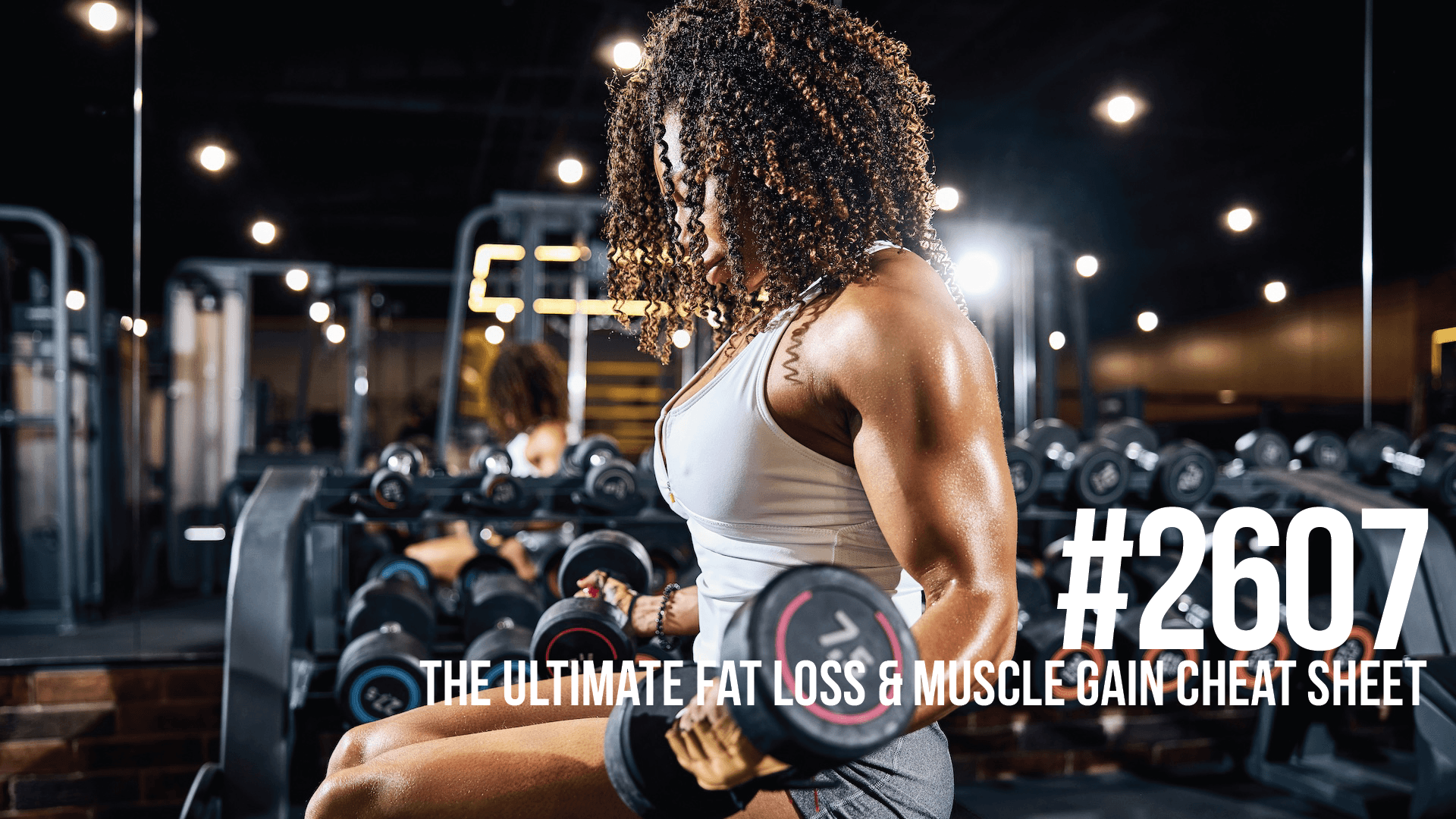
Mind Pump: Raw Fitness Truth
2607: The Ultimate Fat Loss and Muscle Gain Cheat Sheet
00:41:04
The Ultimate Fat Loss and Muscle Gain Cheat Sheet They have a lot more in common than people think. (1:04) The Ultimate Fat Loss and Muscle Gain Cheat Sheet #1 - Caloric deficit/surplus. (2:36) #2 – Lifting Weights. (12:57) #3 – Sleep....
Loading summary
Transcript109 lines
- [00:00]
Sal Destefano
If you want to pump your body and expand your mind, there's only one place to go.
- [00:06]
Adam Schaefer
Mind pump. Mind Pump.
- [00:08]
Sal Destefano
With your hosts, Sal Destefano, Adam Schaefer.
- [00:12]
Adam Schaefer
And Justin Andrews, you just found the most downloaded fitness, health and entertainment podcast. This is Mind Pump. Today's episode. We talk about fat loss and muscle gain. They have a lot more in common than you think. We're only going to talk about the stuff that matters. By the way, we are doing two groups right now with coaching. We have a fat loss group, 50 people. That's it. And a muscle gain group, 50 people. That's It. They are being coached by our trainers. And because of this episode, we're going to give away a scholarship to a fat loss individual and a muscle gain individual. In other words, you can get in there for free and get coached by our trainers and coaches for free. If you want to apply, it's mindpumpgroupcoaching.com for forward/ scholarship. Go there, apply, and you can possibly get coached by our trainers. Mind pump trainers for free. Again, it's for fat loss or muscle gain. Go check it out. This is the ultimate fat loss and muscle gain cheat sheet. We're only going to talk about what really matters for fat loss and muscle gain and nothing else. Let's do this.
- [01:15]
Justin Andrews
Yeah.
- [01:16]
Adam Schaefer
All right. The two most popular things to talk about in fitness obviously are fat loss and muscle gain. Yep. And yes, they are. They can be complex, mostly because people are complex. That's what makes this so challenging. It's not the. Necessarily the steps, although I'll be like, I'll. I'll be clear. There's a lot of misinformation that's out there. There's a lot of bad information that will move you in the wrong direction. So we're going to clear that up.
- [01:42]
Justin Andrews
Well, is the idea for us to highlight the, the similarities in the two of these? Because I think that they have a.
- [01:47]
Adam Schaefer
Lot more in common than people realize.
- [01:48]
Justin Andrews
Yeah, I think that's. I think that's the, the. I don't know. The more interesting part of this conversation is the average person would think that a fat loss journey versus a muscle building journey are very different.
- [02:01]
Unknown
Drastically different.
- [02:02]
Adam Schaefer
Yeah.
- [02:02]
Justin Andrews
And they really are not. They're very, very similar in, in many ways. And I think that if people understood that, I think they'd have more success with both pursuits.
- [02:11]
Adam Schaefer
100%. 100%. So we're going to talk about those things and what are the things that they have in common? What are the. The most important things to Focus on to get yourself to either goal. And again, both have a lot in common. As Adam was saying, whether you're trying to gain muscle or lose body fat, the strategies are incredibly similar, which is really interesting as we get into it. So let's talk first about food. With fat loss and muscle gain, you have to eat right. Both of them require to eat right. But one of them requires you to eat in what's called a calorie deficit, and the other one, any calorie surplus. Essentially what that means is if you want to lose weight or body fat, you have to eat less calories than you burn. And what this does is it forces your body to tap into its stored energy reserves, AKA body fat. So if you eat less calories than you burn, this is going to put you in a situation where ideally you lose body fat when you're trying to build or gain tissue, gain muscle, you have to have more energy than you're burning, otherwise you'll have nothing left to build with. And so that's really the big difference between the two. But when we dive into the diet, there's a lot of crazy similarities and there are some different strategies. One of them you're, you know, you're challenged with maybe not overeating. The other one, maybe you're challenged with not undereating. So we'll talk about those. But both of them require you to eat essentially healthy, and both of them benefit a high protein diet.
- [03:48]
Justin Andrews
Yeah. Well, I think it's interesting to talk about how both these clients, right. So if they were two unique people that had two separate goals, the same, I'd give the same advice around what types of foods they would eat, which would be high protein meals and not processed foods.
- [04:06]
Adam Schaefer
That's right.
- [04:06]
Justin Andrews
So even though they have totally different goals and one of them requires eating a surplus, one of them requires eating in a deficit. But the advice stays the same here of avoiding heavily processed foods and eating high, high protein meals, because they're. It's essential to the success of both these people.
- [04:23]
Adam Schaefer
Yeah, so.
- [04:24]
Justin Andrews
So for different reasons though, right?
- [04:25]
Adam Schaefer
They are right. So processed foods, heavily processed foods make you overeat. This is why it's super important for people who are trying to burn body fat. The studies on this are really, really good and really clear. A diet that is predominantly heavily processed foods. Like most people's diets, the average American, about 70% of the calories come from heavily processed foods. This will typically result in 5 to 600 calories of additional consumption. In other words, if you just avoid heavily processed foods, and eat until you're satisfied, your calories tend to drop naturally. This is beneficial for. Especially beneficial for fat loss. Now, for muscle gain, it's a little bit different. Processed foods are still important to avoid. It's not as important, but it's still important to avoid. Because processed foods tend to be lower in quality protein. Now, yes, there are bars out there and shakes that you can eat. Those are still processed foods technically. But people typically aren't, you know, going, you know, 70% of people's calories aren't coming from those kinds of processed foods. Processed foods tend to be high in the nutrients that don't lend themselves well to building muscle. Yes, they just. And they also tend to cause digestive distress. Right. Which if you're trying to gain muscle and you're eating in a calorie surplus, this becomes a big challenge where you feel bloated or stuffed or whatever.
- [05:44]
Unknown
Yeah. I mean, it's already pretty much a chore for people to go outside what they would normally be inclined to eat and add on top of that. It's always funny because it seems like such a better situation until, you know, you actually have to deliberately exceed that amount of calories and consume more food. And now to do that, when you have, like any kind of digestive type of feedback that's negative, that makes it even extra challenging to keep doing it.
- [06:14]
Adam Schaefer
Yeah.
- [06:15]
Justin Andrews
I want to be clear. Gaining weight is really easy. Gaining muscle hard, much more difficult.
- [06:21]
Adam Schaefer
That's right.
- [06:21]
Justin Andrews
And so this is. I mean, I remember being a young, skinny kid who wanted to build muscle really bad. And I understood the calories in, calories out thing. And so it was just at all cost, eat calories. And I would put some weight on the scale, but it wasn't good weight. It wasn't lean tissue. It was just extra body fat and bloat. And bloat because I added a lot of those junk calories. And when you're trying to build lean tissue, you need good quality calories. You need high protein. And if you're eating. And what ended up happening when I started counting macros, I realized I was eating high calorie but low protein. So it was mostly carbs and saturated fat is what put the calories up there. But then I was missing on the protein. And so that's why the advice stays the same whether you're trying to build lean tissue or burn body fat. I still want you on a very, very low process diet with high protein because it's going to be essential to you hitting your targets.
- [07:19]
Adam Schaefer
Yeah. Now, now now, speaking of protein, you know the st, the studies on protein intake and muscle gain are very clear, right? If you eat now, there's essential protein intake, which most people hit. Most people are not deficient in protein, but most people don't get anywhere near what the studies show to be the optimal amount of protein for muscle gain. And this, depending on what study you look at, is right around 1 gram of protein per pound of body weight. Okay, so that's a lot of protein. You're 160 pound guy, that's 160 grams of protein. You're 120 pound girl, that's 120 grams of protein. That's a lot of protein. But that's where we start to see the upper limits of benefit when it comes to muscle gain from protein intake. Now when it comes to fat loss, it's even more interesting. A high protein diet with the calories being the same. In other words, you take two groups of people, same calories, both calorie deficit, both losing body fat. One, one group eats that 1 gram of protein per pound of body weight, the other group doesn't. They're getting more carbs and fats. What you see is more fat loss and more muscle preservation, in some cases little muscle gain. In other words, if you lose 15 pounds of body fat on a high protein diet, it's much more likely to be all body fat, right? It's most likely to be body fat and not just body weight. Whereas in a calorie deficit without that high protein intake, sometimes or oftentimes you see muscle loss. So protein is very, very important in both cases, crucial. Although, you know, gaining muscle. I typically don't have to convince people to eat high protein when they want to gain muscle, although they often miss it because they do what you just said, Adam? Yes, they're just eating a lot of calories. And you know, you have like I was the same way, 160 pounds, eating a ton, 4,000 calories. Looked at my protein, 120 grams. I wasn't even hitting my, my body weight in grams of protein until I went to whole natural foods, ate the chicken, ate the steak, the ground beef, and then it made a huge difference. And then with muscle gain, same calorie diets, both calorie surplus, one high protein, one not. You're going to gain more muscle and less body fat. So in both cases, high protein is extremely important. The difference is one is in a calorie deficit, one of them, you have to eat less calories in your burning, the other One, you eat more calories than you're burning, depending on your goal.
- [09:33]
Justin Andrews
Yeah, I would actually say that people that don't hit the high, high protein and exercise, they also tend to over train under, eat and miss protein. And so more often than not, they don't just lose weight on the scale, they mostly lose muscle. I don't know how many times I, I had got somebody who hired me who this was. The challenge was Adam. I don't understand. I, I did my body fat test. I lost 10, 15 pounds and it actually said that I stayed the same or some, in some cases I went up in body fat percentage. Make that make sense to me. Yeah, I'm, I'm following the whole law of thermody. Eating less, I'm exercising more. Why is this not adding up to me? And the reason why is because they're either too low and, or overactivity and, or undereating on protein and the, and many times all three of those.
- [10:19]
Unknown
And it's like the type of exercises they're doing aren't conducive to building muscle.
- [10:23]
Adam Schaefer
Totally.
- [10:24]
Justin Andrews
So not only do you need to be doing, yeah, I know we'll get to the lifting weight parts, but you gotta have the protein intake up there. Otherwise if you're just in a calorie deficit, it. You're going to end up losing as much muscle as you lose as you lose fat.
- [10:36]
Adam Schaefer
Now with carbohydrates, carbohydrates are not essential, but they are valuable, especially when it comes to performance. And I would say for muscle gain, carbs can be cut more for fat loss. And then some people just respond really well to lower carbohydrates. Muscle gain. You can gain muscle on a low carbohydrate diet. You can't. It's just way harder. It's just way harder. So carbohydrates become more important than fat. Fat, you know, fat is essential as well for the, for fat loss. I'll say this, for people with fat loss, don't go too low on fat. When you go too low on fat, you, and you start to, you know, toe the line of essential fat. You can see hormonal issues and problems and you can get stubborn fat loss that doesn't want to happen because your fat is too low. I've had this with clients where I bump their fat and then boom, we start to see fat loss, muscle gain. I think you're probably okay if you're getting high protein and you're trying to gain, you're not eating super lean cuts of meat, you're probably getting adequate fat intake. Now, the, the one area where I'd say they, you know, I think muscle gain might have an advantage is with, with protein shakes. And what I mean by that is protein shakes are more valuable for muscle gain. I don't think they're as valuable for fat loss. And here's why. Protein shakes don't satiate you like protein from food does. So if you're trying to be in a calorie deficit, you're probably going to struggle with appetite throughout this fat loss journey. A protein shake, you know, 50 grams and a protein shake isn't going to suppress appetite or satiate you like 50 grams of protein for food. So I like shakes more for muscle gain. And then on the other side of the coin there sometimes people have trouble eating in a calorie surplus and a shake. The same reason why it was difficult for fat loss now makes it valuable for muscle gain. You can have a shake and it's easy to get that extra 50 grams of protein if you're already full from.
- [12:26]
Justin Andrews
Eating a lot of food. Yeah, you can make the case for either one. I mean, the irony of this is still, it's another example of how they're similar is that both, both situations, a. I mean, we're always, regardless of if you're trying to build muscle or lose body fat, always trying to get the client to do it through all whole foods. The reality is there is an argument on both sides, both fat loss and building muscle, where you can make the case where the shake is advantageous, where it makes sense and it's helpful towards the process. It's just they're both, they're both ideal to not do it without that and.
- [12:57]
Adam Schaefer
Just do whole foods right now. Next up, lifting weights. Lifting weights or strength training or resistance training is the ideal. If you have to pick one form of exercise that's going to help with fat loss or muscle gain, it's going to be strength training. So strength training is the best form of exercise for both. I'll start with the easy one, gaining muscle. I don't need to make this case. I think everybody understands by now if you want to build muscle, well, you should strength train. No form of exercise is going to build muscle like strength training. Not even come close. It's the muscle building form of exercise of all the forms of exercise. All right, what about fat loss? Why is strength training so effective for fat loss? It doesn't burn many calories. Traditional strength training doesn't burn a ton of calories. It really doesn't in comparison to like running or swimming or cycling, it burns a fraction of the calories. And yet, when people use strength training as a primary form of exercise, you see more pure fat loss. Why is that muscle preserving it. It stops what your body tries to do every time you cut your calories. When you cut your calories below maintenance, your body automatically tries to adapt to the lower calories by reducing its metabolic demands. And one of the best ways it does this, one of the most effective ways, is by paring muscle down. Strength training sends a direct opposite signal that says, no, halt right there. We need this muscle. So if you go into a calorie deficit and you strength train, then you're far more likely to lose all body fat and no muscle. And here's the other even more important part about it. Your metabolism won't slow like it will if you don't strength training, or in many cases, you may actually find yourself with a faster metabolism from the strength training. So that this is the ultimate form of exercise.
- [14:37]
Justin Andrews
Regardless of what I thought you, I thought you were going to be even more specific to how you strength train. I would make the case that I would strength train the same way. Both the, the goal is to get stronger, lift heavy, get strong.
- [14:49]
Adam Schaefer
You're trying to build muscle on both.
- [14:50]
Justin Andrews
Because here's the mistake that some people make that are in the fat loss group is they think that they're going to lift weights, circuit style or high repetitions, low rest periods. And they want this key again, trying to burn the calories in their workout.
- [15:03]
Adam Schaefer
Huge mistake.
- [15:03]
Justin Andrews
And it is a huge mistake, especially when you're in calorie deficit. What you want to do is send a signal to the body to your point, to hang on to as much muscle as possible. Because you're in a calorie deficit, one of the best ways to do that is lift heavy, get strong. And so which is also one of the best ways for you to build muscle when you're trying to gain muscle is lift heavy and get strong.
- [15:21]
Unknown
That's the pursuit. But psychologically, obviously it's difficult because you aren't going to feel strong, you're not going to have that kind of energy in your workouts. But producing that same type of effort, we'll be able to maintain that muscle mass.
- [15:36]
Adam Schaefer
Yeah. And just because you are, you're using weights or machines does not mean your strength training. Strength training is organized in a way to build strength. What that looks like is a set and then rest, and then a set and then rest, and the rest period is on the short end, about a minute, but usually about two to three minutes is what it should be. You're not trying to build stamina and endurance.
- [15:59]
Unknown
Super important. And overlooked continuously.
- [16:01]
Adam Schaefer
If you don't rest and you use circuits with weights, you're doing cardio.
- [16:04]
Justin Andrews
Yes.
- [16:05]
Adam Schaefer
You might as well get on a bike. It's almost identical in terms of what it's doing for the body and it will not preserve muscle like traditional strength training. Now, when it comes to building muscle, I don't. Again, I don't need to make this argument. Lift weights get stronger in both cases, by the way, if you're getting stronger while losing weight or getting stronger while gaining weight, both cases, this is a great sign. On the building muscle side, if I'm getting stronger, I'm building muscle. On the fat loss side, if I'm getting stronger while, while I'm losing body fat, I'm not losing any muscle and I may actually be gaining.
- [16:39]
Justin Andrews
Yeah, that's, that's a very, I mean, to Justin's point.
- [16:42]
Unknown
Unicorn.
- [16:42]
Justin Andrews
Yeah, this, to Justin's point earlier, that it's, it's common that you're going to lift to be strong but you'll feel weaker, which is totally normal. It's very normal to be in a calorie deficit and see weights go down a little bit. But the pursuit or the goal while you lift is to try and lift heavy is to try and be strong. And occasionally you do see examples of somebody. This tends to be with people that are newer. Right. Newer into lifting. And so they're getting the benefits of a new adaptation, the novelty of lifting weights while also being in caloric deficit. So sometimes you get that kind of unicorn or that what we call the Goldilocks phase, where you are losing body fat but simultaneously building muscle. It's possible, but I always tell a client that's in fat loss in that in a calorie deficit, that don't expect us to gain muscle or gain strength while we're in this. Although if you do, it's an incredible sign.
- [17:30]
Adam Schaefer
Now here's one of the. The just the most magical parts of strength training is it optimizes your hormones better than any other form of exercise. So to be clear, all forms of exercise, when done properly, if they improve your health. So you're doing, you're using the right form of exercise. You're not overdoing it. You're, you're not over training, not under training. It's the right amount and your health gets better. Typically your hormone profile improves a little bit, but Strength training sends a direct signal to the body that optimizes your hormones in a different way. Number one, building muscle or getting stronger increases androgen receptor density. These are the receptors that testosterone attaches to. Okay, so if you have more androgen receptors, your testosterone becomes more testosterone. Like, what does that mean? That means you're going to burn more body fat, you're going to build more muscle from the same testosterone because you have more androgen receptor density. Strength training does this. This is important for fat loss as well. More androgen receptor. Let me put it this way. If someone was trying to lose 50 pounds of body fat and I doubled their androgen receptor density, they'd lose body fat faster, they'd lose more body fat, and they would lose no muscle because of the androgen receptor density. So that's number one. Number two, insulin sensitivity. Let's talk about fat loss for a second. Being more sensitive to insulin means that when your body does release insulin, you are taking those calories you're shuttling into muscle. You're not in this fat storage mode. Like, in fact, when you see people with insulin resistance, what typically goes along with that is obesity. Okay? Being insulin sensitive is healthy and it optimizes insulin for muscle gain, not for fat gain, which is what can happen with insulin resistance type stuff. And then for muscle gain, insulin sensitivity is great. Like I said, it's an anabolic hormone. When it comes to building muscle, growth hormone is another one. You have more optimized levels of growth hormone through the muscle building process. Growth hormone aids in fat loss, aids in muscle gain as well. And then cortisol strength training can balance out cortisol so that it's the way it's supposed to be. A little higher in the morning and lower at night. And then in women, when you improve insulin sensitivity, what you tend to also see is a balancing of estrogen and progesterone. In fact, hormone imbalances in women oftentimes can be connected to insulin resistance. So that building muscle process or the strength training process, it actually takes your hormone profile, turns it into a more youthful hormone profile, which is, if you remember what it was like being in your teens, it's pro muscle, anti fat. It positions you to be in a better position for fat loss and muscle gain. Again, something they both have in common.
- [20:09]
Justin Andrews
This is something that I think is also a great strategy for anybody who's about to pursue one of these journeys, is to actually get your blood work done before and then test it as you've gone down. It's a great indicator if you're moving in the right direction. How many times have you guys had clients that have maybe big long term goals to lose a lot of weight or we got to build a bunch of muscle, but they're just a wreck hormonally. They haven't ever dieted correctly, they haven't exercised. And sometimes it takes a little while before you really show those people a lot of muscle or a lot of body fat coming off. But one of the first things you start to see is you start to see these hormones start to organize themselves in a, in a healthier way. And so getting your blood work done when you first start a journey like this and then testing that, say a couple months down the road, this is one of the first things that you'll start to, you'll see when you're moving in the right direction. And, or this is also a great sign if you're not. Because sometimes people do cut too hard and do use exercises almost like abuse. And then what you'll see is those hor. That hormone profile will get even worse. So it's a great way to use that as a gauge is am I doing the right thing?
- [21:10]
Adam Schaefer
That's right. All right, next up we have sleep. Both fat loss and muscle gain need good, adequate, quality sleep. Now we'll start with fat loss. In the studies on fat loss, when they take two group, when they take groups of people and the only controllable that they change is sleep. One group has good sleep, one group has bad sleep, they put them both in a calorie deficit. The bad sleep group loses twice as much muscle and half as much body fat.
- [21:37]
Justin Andrews
Crazy.
- [21:38]
Adam Schaefer
Which is wild. They're both in a deficit, everything's controlled. They're both doing the same thing. The only difference is bad sleep, good sleep, the bad sleep group loses twice as much muscle, half as much body fat. Now when it comes to muscle gain, oh boy, this is huge. I'm going to be even more pointed about this. If you have poor sleep, you're not going to build muscle. Good luck. Impossible. You go into calorie surplus, you'll lift weights. Terrible sleep is going to result in fat gain.
- [22:06]
Unknown
That's it.
- [22:06]
Adam Schaefer
You're not going to gain any muscle. Poor sleep, in fact, is the number one risk factor for injury while exercising. When they compare bad form, poor, warm up all kinds of different things.
- [22:17]
Unknown
Poor sleep, so many detriments to it, man.
- [22:20]
Adam Schaefer
Dramatically increases your risk of injury. And then back to the fat loss. When your sleep is poor, your cravings for hyper palatable foods goes through the Roof. Simultaneously, your ability to resist eating those foods goes down. You actually start to become less inhib. You become uninhibited. So you go uninhibited. High cravings. Good luck trying to eat healthy with poor sleep.
- [22:43]
Justin Andrews
Now all this is interconnected to the point you just made before that, right? Hormones. I mean, really, when you disrupt your sleep, you, that's, well, that's a big part of it. You're going to disrupt your hormones and it's going to make losing body fat or building muscle near impossible.
- [22:58]
Adam Schaefer
One night of poor sleep, you'll see a measurable drop in testosterone. One night of poor sleep and you see a measurable change in insulin sensitivity.
- [23:06]
Unknown
It's a massive signal to the body. I mean, you're, you're not recovering. So now we have to go into survival. And that's really like your body's on reserve. I have to like, store energy.
- [23:16]
Adam Schaefer
That's right.
- [23:17]
Unknown
I have to keep you alive.
- [23:18]
Adam Schaefer
That's right. Now, ideal sleep is about eight hours. I know what the studies say seven to eight, but I found with clients, eight was again, there's like, what's enough and what's optimal. Eight hours is, in my experience, the best. This means you need to go to bed eight and a half hours before you're going to wake up. Why? 30 minutes to fall asleep. This is where people make a mistake, by the way. They'll look at the seven to eight, they'll go to bed seven hours before, really, they get six and a half. It takes them 30 minutes to fall asleep.
- [23:42]
Justin Andrews
This is also another area where the bodybuilding community really figured this out. I felt like they did. I mean, not only did they on focus, focus on their night of sleep, they even did naps in the middle of the day to get optimal sleep. I mean, this is an area where it was very obvious that you could build more muscle when you're, you're better rested, you know.
- [23:58]
Adam Schaefer
Yes. And again, this is how, how big of a deal it is. You can measurably reduce your strength performance, dramatically increase your risk of injury, measurably reduce testosterone and, and make your insulin sensitivity go down with one, one night of suboptimal sleep. Now, I don't want everybody to freak out, but my point is when we talk about sleep, I think people don't realize how important it is. They think training and diet are important. And sleep. Yeah, yeah, that's kind of important, but I'll put that down here. No, no, no. Sleep is so important that if that a good night of sleep Is more valuable than exercising is if you have to trade the two. It's true. If you get a bad night of sleep, you're better off skipping the workout so you can sleep in a little bit.
- [24:43]
Unknown
Changes your whole priorities.
- [24:45]
Adam Schaefer
That's right.
- [24:45]
Unknown
Yeah. Once you figure that out.
- [24:47]
Justin Andrews
Well, a bad night of sleep if you know you have a client. I don't know how many times this has happened to me too where you have a client who is just so adapted to getting bad sleep all the time, but they're doing everything else and they're at this hard plateau that one or two nights of bad sleep every week is enough to cancel all the other good work they're doing. That's how important and impactful it is. Is many times that client is better off reducing the training volume and focusing on just getting a good night's rest than they are trying to add another day of training in the day. So it's that powerful.
- [25:16]
Adam Schaefer
I've had when I figured this out as a trainer, I figured this out way down the line. I mean I was a good 13, 14 years into my career when I realized how impactful this was. And I, I mean I had clients where they plateaued real hard and we're doing everything right and everything looks good and I'm modifying intensity. We're seeing some progress, but it's really slow. And I literally made a concentrated effort with the client and they agreed. Of course they have to go along with it to improve their sleep. And all we did was improve their sleep. That's all we did. And their results. Turbocharged. It was like a brand new person when it came to both muscle gain and fat loss just from that. So some tips. Go to bed eight and a half hours before you need to wake up. Go to bed at the same time and wake up at the same time every day. Here's what can happen. We go to bed late Friday nights trying to sleep in Saturday, same thing Saturday night, sleeping Sunday morning. Monday comes around. We've already shifted our circadian rhythm. Now we're jet lagged on Monday as if we had just traveled. And we end up jet lagging ourselves every single week. Don't be on electronics before you go to bed. This literally tells your body that the sun is out. So you just close your eyes, ready to go to bed. It takes a second for your body to process. The sun is down and that's valuable time. You could be getting into sleep. It reduces melatonin production, which also affects your growth hormone. So don't be on electronics and don't eat right before bed. Go to bed same time, wake up same time every day and prioritize this. This will make a dramatic impact on your fat loss and muscle g huge.
- [26:45]
Justin Andrews
The other thing it does too is it really keeps the cravings in check if you get poor sleep. That was one of the things that took me a long time to connect those dots of realizing, like every time I had these weird, ravenous cravings for weird things that I didn't think I ate on a regular basis, like, why do I want that? It was always connected to a rough night of sleep. And I don't care if you're trying to build muscle or lose body fat, nothing will deter you from your plan than eating some crap that doesn't benefit you either way.
- [27:14]
Adam Schaefer
Well, like I said earlier too, that's incom. And I have to say this again because I want people to really get this. It's not just that it increases your cravings for food that are not going to serve you. It also reduces your willpower. This is a. By the way, this isn't like, I'm not just saying this, like I've seen this, because I have, but this is like a number one way that, you know, foreign countries would take prisoners of war and break them down. If you wanted somebody to give up the nuclear codes or whatever, you're going to deprive them of sleep. It destroys your willpower. So if you're on this journey of staying consistent, being disciplined, whether it's making it to the gym, eating the right foods, hitting your protein intake or whatever, being sleep deprived, that willpower, you can say goodbye to it. It crushes all of it. So you're more likely to do things that are not going to help you and you're less likely to stay disciplined and consistent with your. Your goals.
- [28:04]
Unknown
This is funny. When you're talking about weird cravings, like weird food just popped in my head. Remember Bugles?
- [28:11]
Justin Andrews
I do remember Bugles. The red box.
- [28:14]
Unknown
So random. But like, I mean, you never know.
- [28:15]
Adam Schaefer
Like, what, did you put them on your fingers and make a fingernail?
- [28:18]
Justin Andrews
Yeah.
- [28:20]
Adam Schaefer
No sponsorship.
- [28:21]
Justin Andrews
Do they. Do they still exist? No nutrients are there at all. They are still. Oh, wow. I haven't even. I haven't seen. I haven't gone down that aisle in a hot minute. That aisle is normally.
- [28:31]
Unknown
Apparently I'm having cravings. Yeah, I had bad sleep.
- [28:35]
Justin Andrews
Yeah, it's. Hey, I tell you what, I. I don't want to just skim over this lightly. It's a big hack to be even just being aware of that is a big deal. I remember how much that person.
- [28:46]
Adam Schaefer
Yeah, you're right. Like, oh, I'm going to go into.
- [28:48]
Justin Andrews
Yes, I remember. Just. And there's something about when you, when you know that it's coming in, it's for that reason it's easier to say no to it than if it was just, I'm tired, exhausted, expect it. Yeah. So when you expect, like, okay, I had a rough night's sleep, I'm going to, at some point today, I'm going to want something, plan ahead of it. Yes. And you just, just you being aware of it makes it easier to resist that versus blindly going in and just craving these foods and not realizing what it is. So I can't stress this enough to the average person that's listening to this. Like, man, when you're on your journey and you have a night of a bad night of sleep, be prepared because you're probably going to crave that day and have a really hard time resisting it.
- [29:26]
Adam Schaefer
I'll tell you just a few real easy ways to help your sleep. You can wear blue light blocking glasses at night if you don't want to come off electronics. Wear an eye mask when you go to sleep. I know it sounds dumb, but studies will show even, what do they call it, like a little bit of light pollution in your room because your light switch has a little light on.
- [29:44]
Unknown
It affects me, man.
- [29:45]
Adam Schaefer
It actually does. So an eye mask actually makes a difference. And then like I said, bed and wake at the same time. That will take away that jet lag that actually gives you terrible. Even if you go to bed on time on Sunday night, it's harder to fall asleep because you've already reset your circadian with them and then wake. This is why everybody hates Mondays, is they're totally jet lagged. All right, next up is water. Now there's. Most people in modern societies are, they're not gonna, they're not dehydrated. I know what people say about water. And you gotta drink more water. Your body's dehydrated. No, you're not dehydrated. You're probably. If you're, if you're drinking when you're thirsty, you're drinking adequate water, but that's not the same as optimal. Okay? Just like protein. Most people in modern societies are not deficient in protein. We don't have people being hospitalized because they have too little protein. People are not going to the hospital, you know, except for maybe when they go to like, like, you know, festivals or something where they're, you know, heat stroke, for the most part, everybody's getting enough water in modern societies. That's great, but optimal is more than that. And optimal water for most people in my experience is about a half a gallon to a gallon of water a day. Now what this does is it dramatically improves recovery in the gym. You have better performance, better connection to the muscles. Your muscles are 70% water, by the way.
- [31:03]
Justin Andrews
Way better pumps.
- [31:04]
Adam Schaefer
So way better pumps, way better connection. You're doing those exercises, you can feel the muscles squeezing and contracting, which actually lends itself to better quality workout, better technique and form. It reduces cravings. That's one of the most dramatic things people will notice is it'll reduce cravings, reduces inflammation. A lot of people don't realize this, but some of their aches and pains can be gone by simply drinking optimal amounts of water. This I noticed especially true for my middle aged and older clients.
- [31:36]
Unknown
Yeah, ligaments and the dry factor to that.
- [31:39]
Adam Schaefer
Oh, it's crazy.
- [31:40]
Unknown
Definitely contributed.
- [31:41]
Adam Schaefer
And digestion, it's better for digestion, especially constipation. There's. I can't tell you how many times I had clients with digestive issues. We bumped their water, fixed it, it fixed it simply because they weren't drinking enough water.
- [31:54]
Justin Andrews
I would make the case. Energy too. I've had clients who under consume water, then they start drinking optimal water and they notice a difference in energy levels just, just by starting the day off with it. They would go all the way till midday before their first glass of water. And me just simply giving the advice of, hey, let's just start every day with like two glasses of water. And man, just oh my God, I notice energy. So you'll even notice that from it. So it seems like again like sleep, like these things that seem so basic and simple but really can make a big difference if you're consistent with it.
- [32:23]
Adam Schaefer
I think one of the ways that one of the best ways to do this for people to get used to is get yourself a container that is either a quarter of a gallon or one fifth of a gallon, whatever that number is, Figure that out, know how many you need to drink throughout the day and then pace yourself. Okay, I'm gonna have this one before this time, this one before that time. Before you know it, you'll get used to drinking that much water and it won't be a problem. But initially track it and it makes a huge difference. You'll again, you'll see more fat loss probably through better digestion, less cravings, better energy, more movement. And then when it comes to muscle gain, and pumps like this is, I.
- [32:59]
Unknown
Mean your whole body just operates better. You're with like mostly water.
- [33:02]
Justin Andrews
Water. Yeah.
- [33:03]
Unknown
It's like you're depriving yourself of what you mostly are.
- [33:05]
Adam Schaefer
Yeah, that's right.
- [33:06]
Justin Andrews
I know we've, I know we've teased the, the bros for carrying the gallon around, but I see tremendous value in just say whatever the target may be then. The only drawback I feel of the ones that you have to drink three, four or five is people lose track. Whereas if I have this gallon or half gallon, whatever it is going to be that I. Yeah. And it really brings awareness to how little you. I mean it did for me. I remember the first time that I.
- [33:28]
Adam Schaefer
Saw you get to 2pm and you barely had.
- [33:30]
Justin Andrews
Yeah. And I'm looking, I'm like, damn, I thought I drink a lot of water. I don't drink a lot of water. And it's hard to realize that if you're doing it by the glass, you think, oh yeah, I had a lot. And then you actually measure it or have the full gallon and you look at it, you go, oh wow, I was nowhere near that. So I always recommend to someone who hasn't done this before to at least do that for a little while to get an idea of where you probably.
- [33:49]
Adam Schaefer
By the way, some, some side notes with water, I said poor sleep is the greatest risk for injury. The second greatest is dehydration or not having enough water. Very much more common to have muscle pulls and tears and strains when you don't have enough water. So that's another one that you need to focus on. And then when it comes for fat loss, you know, drinking a lot of water means you're probably going to drink less of other potential calories. And so you end up finding like, oh, I got to drink my water, I'm going to have less of these.
- [34:17]
Unknown
Other things that may drink your calories.
- [34:19]
Adam Schaefer
Yes, that may have calories or may spike my appetite as a lot of sweetened zero calorie beverages can do for some people to actually make them crave more food. Lastly, supplements, and this is last because it's the least important. But there are two supplements that we recommend to everybody regardless of their goal. I'll start with the easy one, which is a multivitamin. Multivitamin is important because nutrient deficiencies are far more common than people realize. If you added up all the common nutrient deficiencies from vitamin D to magnesium to B vitamins to maybe iron for women, all that stuff, if you add that all up, you're probably looking at 50 to 60% of everybody could definitely benefit from supplementing with the multivitamin. They're also very inexpensive. Now a multivitamin is not magic. However, if it fills a nutrient deficiency, it will feel like magic. Having a nutrient deficiency is literally like your car not having oil or something essential. It will, it can, you can have increased rates of pain, you can have depression, anxiety, neurological, weird weirdness, muscle twitches, fatigue, all these kind of like weird odd symptoms that you're like. I guess I just, you know, I have a headache. Maybe that's just because I get headaches or you know, I get a little bit of pain here, you know, not knowing that might be a vitamin D deficiency, for example, a multivitamin fills all that. And the data on this is pretty clear. People that take multivitamins far less likely to have nutrient deficiencies, obviously, but they tend to have better cognitive performance, less depression, less anxiety. And again, it's an inexpensive supplement to.
- [35:52]
Justin Andrews
Well, I think it's just kind of a blanket covers most of all your essentials. Right where I definitely think regardless if you're trying build muscle or lose body fat, there's tremendous value in finding out where you might be. That's the, that's ideal because most people are lacking in two or three different things. And over any fat loss, muscle building supplement that's out there, nothing is better than getting what your body needs to be opt. Run optimal regardless of the goal. So figure that out, whatever that is. Multivitamin kind of is a nice blanket covers a majority of the most common ones. But I think there's some value in you testing and finding out what you're.
- [36:29]
Adam Schaefer
Good luck trying to build muscle or burn body fat with a nutrient deficiency. Good luck. I mean you have a magnesium deficiency unless it's severe, in which case you're sick. But even if it's just a little deficiency, you're anxious, your sleep is poor, you're not as strong, you just don't know why you don't feel so good. It's kind of vague.
- [36:49]
Unknown
Downstream effect.
- [36:50]
Adam Schaefer
Yeah, it's like, okay, I don't know why I'm not feeling like myself. Or maybe it's been so long that this is how you think you're supposed to feel, right? Vitamin D. Good luck trying to build muscle or burn body fat with a vitamin D deficiency. Immune system is not optimal. Your hormones are going to be affected. Depression and anxiety are much higher with a vitamin D deficiency, and those are just some of the common ones. So a multivitamin kind of covers all of the basics. And again, it's inexpensive. And then next up, the one supplement that would be both muscle building and fat burning, which is creatine. Creatine aids in the muscle building process. It's good for your brain, it's good for your organs. And because it's good for muscle building, it's also good indirectly for fat loss, because if you can build muscle or preserve muscle, you're more likely to maintain your metabolism. And one of the most challenging things for anybody on a fat loss journey is the dreaded plateau where they were losing weight on X amount of calories. Suddenly they stopped losing weight because their metabolism learned to adapt. And then they're stuck with this. I got to cut my calories more, I got to move even more. I still have 30 pounds to lose. What am I going to do? Creatine can help offset that because of its muscle building effects and without getting too deep into it, creatine increases the amount of available energy for every cell of your body. It literally. And the studies on this are amazing. It is the ultimate. It used to be labeled just a muscle building supplement, but now what we're seeing is it is the best supplement for overall health, aside from filling nutrient deficiencies. Now, I'm going to be real clear here with what we're talking about. Yes, we just gave you all the basics, but it can be a challenge. It is a journey. It is a journey about learning about yourself. What if my body hits a plateau? What about these foods right here? They're not working for me. Am I training properly? Is this workout effective? This is where coaching can be tremendously valuable. The greatest success that you see in all the data when it comes to fat loss or muscle gain is when people work with a good trainer. Notice I said good because there's a lot of trainers out there, but there's not a lot of good ones. A good trainer can do this for you. What we're going to do because of this episode is we're going to offer a free group coaching scholarship to one of the listeners. So we offer group coaching. It's very limited. We have two groups, in fact, that we're going to be running here very soon. One is for fat loss, one is for muscle gain. It isn't inexpensive because it is very valuable and it works. But if you go to mindpumpgroupcoaching.com scholarship, you can apply and we're going to give one away for free. For each group?
- [39:22]
Justin Andrews
Yeah, for each group.
- [39:22]
Adam Schaefer
For each group. So one fat loss person is going to be in group coaching for free. One muscle gain individual is going to be in there for free and it's three months. It's only 50 people that are going to be in each group and it's taught by our trainers and our coaches. So you go to mindpumpgroupcoaching.com scholarship, put your name in there, you have a good chance of winning. We do get a ton people that that apply for that and again hopefully you get in there for free. Look, if you like the show come find us on Instagram. Justin is at Mind Pump Justin I'm at Mind Pump. Distefano Adams at mindpump thank you for.
- [39:56]
Sal Destefano
Listening to Mind Pump. If your goal is to build and shape your business body, dramatically improve your health and energy and maximize your overall performance, check out our discounted RGB super bundle@mindpumpmedia.com the RGB Super Bundle includes Maps, Anabolic Maps, Performance and Maps Aesthetic nine months of phased expert exercise programming designed by Sal, Adam and Justin to systematically transform the way your body looks, feels and performs with detailed workout blueprints and over 200 videos. The RGB Super Bundle is like having Sal, Adam and Justin as your own personal trainers, but at a fraction of the price. The RGB Super Bundle has a full 30 day money back guarantee and you can get it now. Plus other valuable free resources@mindpumpmedia.com if you enjoy this show, please share the love by leaving a A5 star rating and review on itunes and by introducing Mind Pump to your friends and family. We thank you for your support and until next time, this is Mind Pump.