← Mind Pump: Raw Fitness Truth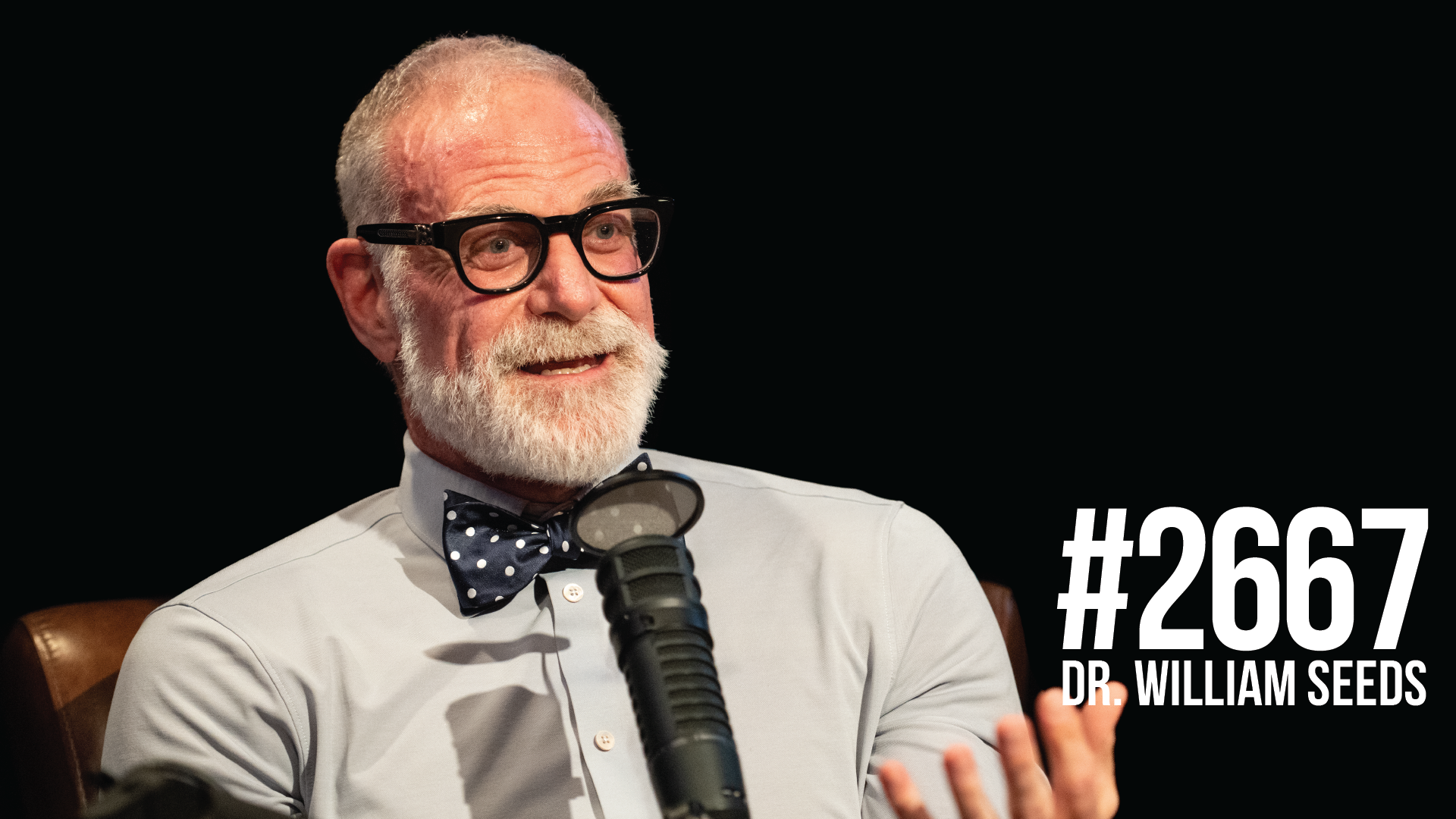
Mind Pump: Raw Fitness Truth
2667: The Truth About New "Magical" Muscle Building Drugs & More With Dr. William Seeds
01:32:37
Dr. Williams Seeds Shifting culture. (1:27) Why is the medical field ignoring this movement? (5:03) What is happening on a cellular level that is making working out more effective than seeing a therapist? (11:46) Why creatine is the MOST...
Loading summary
Transcript452 lines
- [00:00]
A
Back to school is better. With family freedom. From T Mobile, we'll pay off four phones up to $3200 and give you four free phones, all on America's largest 5G network. Visit your local T Mobile location or learn more@t mobile.com familyfreedom. Up to $800 per line via virtual prepaid card typically takes 15 days. Free phones via 24 monthly bill credits with finance agreement eg Apple iPhone 16, 128 gigabyte 8, $2009.99 eligible trade in eg iPhone 11 Pro for well qualified credits end and balance due. If you pay off earlier, cancel contact T Mobile.
- [00:29]
B
If you want to pump your body.
- [00:32]
A
Your mind, there's only one place to go.
- [00:35]
B
Mind Pump. Mind Pump.
- [00:37]
A
With your hosts, Sal Destefano, Adam Schaefer.
- [00:41]
B
And Justin Andrews, you just found the most downloaded fitness, health and entertainment podcast. This is Mind Pump. We brought back Dr. Seeds on the podcast. He is one of the world's leading researchers and authorities on peptide science. Peptides, they do some amazing things in the body. In fact, today in this episode, we cover a lot of them. What they do, what they don't do. We also talk about these magical compounds that we've been hearing studies on that cause your body to build muscle like crazy. Literally, like crazy. Are they too good to be true? He talks all about it. We know you're gonna love this episode. Now, this episode is brought to you by some sponsors. The First1 is mphormones.com if you're interested in peptide therapy, go there, talk to the doctors there. See if peptide therapy or and or hormone therapy is right for you. This episode is also brought to you by Vuoriclothing. Vuoriclothing is the best athleisure wear you'll find anywhere. And if you go through our link, you'll get 20% off. Go to vuoriclothing.com that's V U O R I clothing.com mindpump. That link will give you the discount. We also have a sale this month. Maps 15 minutes half off. Head over to maps 1.5minutes.com. Use the code Muscle50 to get the discount. Here comes the show. Welcome back, Dr. Seeds.
- [01:59]
A
Good to be back, guys.
- [02:01]
B
Always a pleasure. I'm gonna open right away with the controversial.
- [02:06]
A
Wait, wait, wait. How'd you guys like Vegas?
- [02:09]
C
Oh, God, the event was incredible. I mean, off air, we were talking about just.
- [02:14]
A
It.
- [02:14]
C
It blows my mind, the size of it. Like, I just. I don't know. But the fact that this is. I think this is My space. I think the fitness world is really what we've been into for 25 plus years. To see that many people in the peptide scene is. Is wild because we. Those are all professionals. These aren't consumers. I was telling you. So to see thousands of professionals that are privy to it and wanting to learn and like really cool to see. And to see the growth of it because I know you've been doing it forever. There was a time, I know you joke about when you couldn't get 10 people to listen to you. And to see now you on this stage with thousands of professionals tuning in all over the world, it's just wild.
- [02:53]
B
It's my. In my strong opinion, and I don't. I don't think this is even an opinion anymore. I think it's fact. But I think peptide use and science and application is it. It's one of the most disrupting medical interventions that we've seen in a very long time.
- [03:10]
A
Absolutely.
- [03:11]
B
I think it's up there with the birth control pill and antibiotics. I think that it's. That disrupting.
- [03:17]
A
You mean because of the results or the. Just the, the wild west of it.
- [03:22]
B
Oh, I think because of the results.
- [03:23]
A
Yeah, absolutely.
- [03:24]
B
And it's disrupting because.
- [03:26]
A
Because it works.
- [03:27]
B
Yeah. And it's different.
- [03:29]
A
It's totally different.
- [03:30]
B
And it's culture shifting. So I, I mentioned antibiotics and birth control on purpose because both of those shifted culture in many good ways. In some ways unpredicted and, you know, unpredictable.
- [03:41]
A
Yeah.
- [03:42]
B
But peptides, you were saying earlier, treat root cause.
- [03:46]
A
Yes.
- [03:47]
B
Dysfunction. Last time I had you on the show, I asked you the difference between a peptide and a pharmaceutical drug. And correct me if I'm wrong, but your body already uses peptides, knows what to do with them. Pharmaceuticals are drugs that we kind of try to shoehorn into a receptor to force something to happen. And then we figure out the side effects along the way.
- [04:07]
A
And they're more focused to treating a symptom than. Than to the reason.
- [04:12]
B
Yeah, yeah, the reason. So the. So an example would be, you know, mitochondrial dysfunction or not so healthy. Got a lot of fatigue.
- [04:21]
A
Sure.
- [04:21]
B
Let me take a pharmaceutical that gives me energy. So maybe they give me, I don't know, Adderall or something like that.
- [04:28]
A
Yeah.
- [04:29]
B
Versus metabolic. You know, I have mitochondrial dysfunction. I have no energy. Let me try Mot C or SS31, which actually improves mitochondrial function. So that would be the difference.
- [04:41]
A
Sure.
- [04:41]
B
Is that, Is that accurate?
- [04:43]
A
Accurate. I like the thoughts. There's always timing in all of this. There's always. But you're Right. It's the demand now from people wanting to know more, wanting their healthcare providers to know more about what's really working out there and to know how it works. And it's shows like what you guys are doing that are really educating the public on, on being better consumers and asking questions. And that gets to the more questions you ask, I think you get to a better place in being able to help people take care of root cause problems instead of just treating a symptom.
- [05:32]
B
Yes, yes.
- [05:33]
C
What percentage of the medical professionals you think are now starting to adopt this? And is there still a large percent?
- [05:40]
A
5%. Wow.
- [05:42]
C
It's that low still?
- [05:43]
A
Absolutely.
- [05:43]
C
Because obviously when we're in, in a situation like that, I feel like, oh my God, everybody. It feels like because there's so many people there, but you're saying it's still like less than 5% of like.
- [05:53]
A
Wow.
- [05:54]
C
And is that just like big companies like the Kaisers and so that. Is that because they're so resistant and have so much red tape around everything, like what, what, what's causing them to pharmaceutical industries. That's what's doing it. I mean, what's.
- [06:07]
A
I, I think the, it really goes back to as I was trying to, as I was into indicating before, you know, peptides are really, to understand the use of peptides and, and, and their purpose, you've got to know a lot more about the cell and you've got to know a lot, know a lot more about the molecular pathways and the cellular biology and the quantum physics of a cell. And, and those are things that originally in medical school you initiate some learning, just like nutrition. Everybody thinks that physicians learn about nutrition. They don't learn shit about nutrition.
- [06:45]
B
No.
- [06:46]
A
And that's the essence of really, you gotta know what's happening in the cell. You've got to know these molecular pathways to take advantage of then utilizing cell signaling agents that can really help change phenotypes of people's disease states or whatever.
- [07:08]
B
Okay, so would this be a fair way to explain that typically in medical school you learn symptoms, treatments. The treatments typically involve what we've been using for a long time, which would say our pharmaceuticals.
- [07:22]
A
Yes.
- [07:23]
B
But in order to know how to use which peptides and when.
- [07:27]
A
Yes.
- [07:27]
B
You'd have to understand molecular pathways.
- [07:29]
A
Absolutely.
- [07:30]
B
And then what dysfunctions in molecular pathways causing this?
- [07:34]
A
You got to think so.
- [07:36]
B
And it's just a big ship, right? Like, like it's so standardized, for better or worse. It's such a big ship to try to turn that big ship. I mean, it takes A while, yes. And we used to fight less than 5%, but 10, 15 years ago, it was probably less than 0.1%, I would imagine.
- [07:54]
A
Absolutely true. It was like, what is even a peptide? I told you that first. I think we talked about this before, but one of the first lectures I ever gave, I asked the audience of doctors, which was probably five people. But even I kept asking as the group got bigger and bigger, how many guys use peptides? And nobody raised their hand. And I'd say, well, you guys don't use insulin. And then everybody's like, oh, insulin's a peptide. And you know what? And then oxytocin. And, you know, it was the beginning. I realized then that I had a big job ahead of me that I had to. It was. You really had to get into the. To get people motivated to want to be educated. And actually, you know, in the medical field, I think what got things started were the physicians that were disenchanted with the medical systems where they had their own ailments and things weren't getting better. And a lot of my audience at the beginning were doctors that just didn't have answers and needed help. And that started the. I think the, you know, getting results. This wouldn't be anywhere, right. If it. If we weren't helping people, it wouldn't be close to where it's at. And interestingly, I think the medical field has ignored this way too long. And now that's why you see the wild west out there of people promoting or claiming to be experts and promoting these products that aren't real, or maybe part real, whatever the, the medical. The medical part or the traditional medicine lost its timing to be in on understanding how important this movement was going to be. And, and more so in the Southern medicine side of understanding, hey, we got to take charge of this. And, and so that's what you're seeing now. That's what you saw. Hopefully you felt the energy and the people there that were just so excited to be, hey, this is starting to make sense. Now I know why I need to do this. I know why I have to keep learning.
- [10:13]
B
Well, here, what got me, what gets me excited about the growth of this, besides the stuff that you're saying, which is incredibly exciting, is that this is the second time I've spoke at your event.
- [10:24]
A
Yes.
- [10:25]
B
These are medical professionals who are using peptides for health, longevity, for treating people. I am not an expert in peptides. I didn't speak about peptides at all.
- [10:36]
A
Correct.
- [10:36]
B
I. I spoke about my expertise, which is exercise, nutrition, and how you apply it to help people. And they were very interested in what I had to say.
- [10:46]
A
Absolutely.
- [10:47]
B
Which shows me that because if I ever get a doctor interested in what I have to say, it's typically for themselves. Oh, how do I get fit?
- [10:55]
A
Right.
- [10:55]
B
But they were interested for their patients and they were asking me questions for their patients. Which goes to show that these are people who are wellness minded, for lack of a better term, or holistic minded, for lack of a better term. I know it's a bastardized, you know, word, but these are people who are interested in the health of their patients as a whole. That's why they're interested in what I had to say.
- [11:20]
A
Well, they under. So, so you're. I like what you're saying and I hope you understand that it's part of the master program of, of getting, you know, in cellular medicine and with Peptides, our focus has always been on the three pillars. Sleep, exercise and diet. Right. And if we don't keep coming back to that, then we're failing. And we've already proven in the world of resistance training and cardio and some mix of cardio and so forth that we can really change lives with, with people who are interested. Right. It's a, it's a tough place to get to for people who have no desire or don't even know that this is really what improves their health. But, but once you get them there, everything changes.
- [12:16]
B
Along those lines, I'd like to ask you this because I just. Yesterday we recorded an episode and I brought up a study that I believe was just published in the British Journal of Medicine, if I'm not mistaken. And it was on thousands of individuals. Long study on thousand. It was a well made study.
- [12:32]
C
It was 150. Over 150,000.
- [12:33]
B
It was a lot. It was a big, big sample size. And the study was looking at the impact of exercise and depression.
- [12:43]
A
Yes.
- [12:44]
B
In comparison to cognitive behavioral therapy.
- [12:47]
A
Yes.
- [12:48]
B
And. Or pharmaceutical intervention, SSRIs, enzyolytics. Here's what the study found. Going to the gym was one and a half times more effective than talking about your feelings with a therapist, you know, and better. And one and a half times better than taking an SSRI or enziolytic. Of course, just going to the gym. What's happening there from a mental health standpoint? I can talk about the behaviors which I think also contribute. But what's happening on a cellular level that is making working out so much more effective than seeing a therapist and a psychiatrist?
- [13:27]
A
Well, it goes all into what happens when People get into these states that there's a true imbalance in some of these molecular pathways. AMPK, MTOR, NFR2, NFR1, which are the signaling of antioxidants. And then there's the control of the inflammatory aspects of when a cell becomes inflamed. And so exercise, there's so many aspects of exercise. Number one, it's a way to start balancing AMBK and mtor, which is so important in metabolic flexibility and efficiency of the mitochondria, but the cell itself and, and that has to do with the brain, with the neuron, has to do with the astrocyte, has to do with the microglial cell. Because metabolism is very important in regulating not just how the neurons work, but controlling the immune system in the brain also. And so you know, everything the brain needs energy, it needs efficiency. It is the most demanding besides the kidney. It's the most demanding for ATP and NAD and appropriate ratios of that in the nucleus, the mitochondria, the peroxisome. So all of these things come into play where all you're doing is by exercising you're resetting the environment of balancing, starting to balancing these molecular pathways. Well, even more significant is I've always said, and I used to catch a lot of shit from endocrinologists on this, that muscle is your biggest endocrine gland. And it's because of the exokines and myokines that muscle produces. It produces over 500 that we know of and we only really know maybe 60 to 70 of them right now. And you know, for instance, brain derived neurotropic factor is produced by muscle and that crosses the blood brain barrier. Brain derived neurotropic factor we've related to anxiety, depression, we've re, you know, all of these things that we used to think were causing disease states. Well, it's related to brain derived neurotropic factor and not produce, losing the capability of producing it to the efficiencies that are needed for the brain. And that's all about synaptic connectivity, improving SIRT gene activation in the brain, improving mitochondrial function in the neurons. I mean there's so many stages and steps and like I'm doing a, I have a neuro mastermind coming up that I could spend two days just talking about muscle and what it does, but you can't, you know, you got to be, got to divide it up and talk about everything. But to what you were saying, Sal, we were talking about that 10 years ago again 15 years ago, but, but now it's so Interesting to hear that they're trying, they're. That all these studies are now coming together. Right. Of, of we would have told you through the molecular pathways. Like we don't need that study. We already know that.
- [16:58]
B
We already knew what would happen.
- [16:59]
A
Yeah.
- [17:00]
B
I mean, is it safe to say? Because I think people don't consider in many ways the brain as a part of the body. What I mean by that is we know what a healthy heart does, we know what a healthy liver does, healthy kidneys do. We also know what a sick liver or a sick heart or sick kidneys do. If our mental state, our well being, motivation, depression, happiness, focus. I mean, that comes from an organ called the brain. Is it safe to say healthy brain produces good feelings, sick brain can produce bad feelings?
- [17:41]
A
That's pretty straight on. I mean, that's exactly what happens.
- [17:44]
B
Is this why we see. You mentioned energy for the brain. Is this why we see creatine? I saw a study on postmenopausal women and how creatine reduced depression or how ketones can help with depression in some individuals. Those are just helping with energy production of the brain. Is that why we're, we're seeing some of that?
- [18:06]
A
Yeah. Well, I mean, ketones themselves are just, they're like the ultimate metabolic substrate for the mitochondria. So there's something that gets right to. So in any disease state of the brain, you've got mitochondrial dysfunction in the neuron, period. Done deal.
- [18:28]
B
Okay.
- [18:29]
A
So the better you do. And that's also like in the microglial cell too, which is an immune cell in the brain and the astrocyte to some degree. But the mitochondria has, if you can meet some demands very quickly for the mitochondria to improve what's called oxidative phosphorylation that makes ATP, because the brain needs a lot of ATP. And I can run through this. We know the mechanisms of. If you want to hear it. I don't know if you want to hear it. You do?
- [19:03]
B
Yeah, of course. We always do.
- [19:05]
A
Yeah. This is fun. Where it can go anywhere. It's so funny because. Well, I won't even bring it up. So, okay. If the brain's job is to make. It's to meet the energy needs. The mitochondria is to meet the energy needs of the neuron and microglial cell. If, let's say depression or anxiety, let's say, let's talk about anxiety, which is probably the most common, one of the most common issues that people deal with. And, and anxiety has to do with too much glutamate that is in the.
- [19:49]
B
Synaptic cleft and too much of that's an excitotoxin, right?
- [19:52]
A
So you have the pre synapse postsynapse and in the cleft you've just got all this glutamate that just isn't getting recycled and you're like, so it's like. So you want to know. Well, if I'm treating somebody for a problem where I know there's glutamate excitability, because that glutamate, what it's doing is it's working on these NMDA receptors that are the postsynaptic, that start the postsynaptic process of the neuron. And that has to be really. The efficiencies of that process have to be tightly controlled. Well, you've got this glutamate that's sitting in this cleft and, and the only way glutamate gets recycled is through these essential amino acid transporters that are in the astrocyte, which is right there, that pulls the glutamate in and then helps convert it back to glycine and that goes back in the neuron and then it cycles. Well, to do that, that essential amino acid transporter, it needs what it needs ATP. And so if you're having a problem with production of ATP and you can't meet the needs of pulling that glutamate out into the astrocyte, then it's backing up. Well, if you're also having problems with the mitochondria, so there's stages to this, right? That's the astrocyte. Then you've got this microglial cell that is involved in always cleaning the house, keeping things under control. In the brain, it's like the air conditioner. And if mitochondria is not efficient and becomes inefficient, you start to build reactive oxygen species and you're just, it can't control the signaling enough and the energy deprivation creates reactive oxygen species. Does that make sense?
- [21:46]
B
Yes. So what happens is waste byproduct, essentially.
- [21:49]
A
Well, that mitochondria actually produces then cytokines and chemokines and proteases that affect that amino acid transporter and also affect the glutamate buildup. So it's a combination of the immune system metabolism and they feed on each other. And so if you know that, and you know the pathways will start working on improving mitochondrial function. For instance, ketone esters, which are taken up by mitochondria very efficiently without, you know, to make energy Whether it's glucose, protein or fatty acid, you've got to use a little bit of energy to make energy.
- [22:31]
B
It's a process.
- [22:32]
A
Yeah. And the most efficient is, are ketones. Which makes sense. Right. It's because if you're getting into, you make ketones when you're starving and you're, you make them for your brain and for your heart and to keep whatever you can going. And it's an evolutionary process. Well, if you can give an exogenous ketone to someone who has some inefficiencies of the mitochondria, depending on what's happening, whether it's some, it could be a post viral process or whatever. Could be after head trauma, anxiety. Yeah, it could be anything. You can see some profound changes with just giving a substrate like ketone that goes to the brain to be utilized to help start changing things for more ATP to be produced, more NAD to be produced. Because NAD is then converted into something called nadph, which is this master regulator of the antioxidant system. So you've got these things that start working in making better antioxidants to cool that air conditioner down right. In the microglial cell to stop the cytokines, chemokines and proteases that are being produced. You're making more ATP for that essential amino acid transport to pull the glutamate out. So you're starting to get things working better. And then in the neuron, the mitochondria, you know, if the mitochondria are working better, they're doing a better job with the NMDA receptors and their job in sending impulses and synapse communication in the brain. And that's where brain derived neurotrophic factor comes into play, all that stuff.
- [24:33]
B
So. And you know when you have that pre and post.
- [24:35]
A
But thanks for letting me go down that.
- [24:37]
C
Yeah, no, I know. I have so many questions like.
- [24:39]
A
So nobody likes do that.
- [24:41]
C
Would it be a, would it be a. I'm listening. I have crippling anxiety and you're selling me on this idea of how beneficial building muscle and exercise is.
- [24:50]
A
Yeah, yeah.
- [24:50]
C
But I mean I want to kick start it. So if I'm hearing you correctly, a decent strategy to get this going right. Would be to take some exogenous ketones and go get a workout in.
- [25:00]
B
I mean that's maybe for some acute relief.
- [25:03]
A
Yeah.
- [25:03]
B
Like help and then start working on the health of the brain through exercise.
- [25:08]
C
Is that a smart, would that be a smart strategy for me?
- [25:12]
A
Yeah, absolutely. Okay. It can be a, it can Be a great strategy. But it's, it's. It's kind of like you go in stages with these things because some of these people, you know, that we're talking about with anxiety and depression, it's very hard to get them into the. The gym and to get him even started. Right. So what I like about the ketone or a specific peptide, to work on this process, you make some changes where they notice, oh, my gosh, something's happening. And when you start to get some changes and people are feeling those changes, they start asking the questions. Right. And that's how you. That's. Those are the next steps of how you get them into the gym.
- [26:05]
B
I love how you communicate this because you talk like a coach. And what I mean by that is you talk like someone who's worked with people through this process. Not just all the science, not just.
- [26:15]
A
Yeah, you know, here's what I've made all the mistakes. I mean, I used to want to do all these things and get people like, hey, you need to go to the. Go to the gym and you need to do this right before. And I would never happen that way. And I'd learn from my patients. Like, I don't know if you heard me, Dr. Seeds, but I fucking hate my life right now.
- [26:38]
B
And you're telling me to work out.
- [26:39]
A
And I don't want to go around where there are a lot of people because I'm very anxious, Dr. Seeds. And it's like, oh, my gosh, you're not listening to your patient.
- [26:48]
B
You know, when you're. When you were talking about the pre and post synapse system in the brain, this affects the cycling and production of things like serotonin, dopamine.
- [27:01]
A
Absolutely.
- [27:02]
B
And the standard, I guess of care right now around those things is, hey, let's increase serotonin, let's reduce its reuptake. So you have more serotonin in the brain. But really what that seems like it's doing is it's kind of numbing.
- [27:18]
A
Yeah.
- [27:18]
B
The dysfunction a bit.
- [27:21]
A
Because it's a tool. If you. So people just want to give that and just let them stay on it forever. It's a tool to get, maybe to get some things going for people to get them feeling better while you're working behind the scenes to do other things.
- [27:36]
B
Right.
- [27:38]
A
There's a lot behind that, but it's a symptom you're treating.
- [27:44]
B
Yes.
- [27:44]
A
The serotonin, the dopamine, the norepinephrine, that's.
- [27:48]
B
Downstream of what's happening.
- [27:50]
A
Yeah. If you're Working upstream, you're going to fix all those problems. And what we haven't talked about is, as all of this stuff is happening, there's structural problems that happen too in the cell walls. Phospholipids, fatty acids, plasmologens, all these things start changing. And so you lose validity, you lose the fluid state of the cell membrane.
- [28:15]
B
Which, that means that you can't get things in and out of a cell very well.
- [28:20]
A
Yeah. And receptors don't work as well.
- [28:23]
B
Wow.
- [28:24]
A
But exercise increases, like the production of plasmologens. It's just, it's just interesting that exercise. You go back to exercise and it does all of these things to work in, to have everything work in concert. And like you said, like, you brought up creatine. Creatine is the most misunderstood supplement, I think, that's out there that is so valuable. Oh, yeah, because it's a, it's a real buffer. It's a, it's a metabolic buffer that, you know, creatine is basically making. You're, you're taking, you're taking creatine to build up your phosphocreatine so that your phosphocreatine is like the battery waiting to be used. Because that phosphocreatine can be broken down into creatine. Right. I mean, into a. Can be broken. You can transfer that phosphate group to an ADP to produce ATP. So it's a, it's a really quick way when, when dysfunctions happening. You know why? You can, you can build up your ATP reserves real fast when you need them. And it's an essential thing that you have to have built up and available to be used. And that's something people don't understand. And I don't think they understand that in states of issues with the brain, that may be where. That is an area where you want to use higher levels of creatine. When, when. Because you're going to be having bigger demands for it.
- [30:06]
B
Right.
- [30:06]
A
Because of the ATP changes and you, you can go up significantly. But the other thing people don't understand is the importance of creatine and methylation. And that's the, so your body, is.
- [30:20]
B
It a methyl donor or is it just reduce the amount of methylation that needs to happen?
- [30:24]
A
Because it's, it's, it's not a methyl donor. So, so creatine, when you make creatine in your body, you make usually like 1 to 2 grams a day of creatine.
- [30:36]
B
Just from amino acid.
- [30:38]
A
Yeah. From arginine and glycine. You make creatine.
- [30:43]
B
Right.
- [30:44]
A
And so when you're making creatine in the body, you make it through the kidney and the liver. And to do that, that takes up half of your methylation possibilities. You use up half of your methylation to make creatine.
- [31:03]
B
So when you supplement, you've got all this methyl, all this available for other.
- [31:07]
A
Available. Exactly. To use for your neurotransmitters. Interesting. For your detoxification.
- [31:15]
C
This is why all the brain benefits you hear about now, especially for people.
- [31:19]
B
With the MT FHR gene variant. I think I'm saying it right. Is that right? MT8. Okay, so I have that.
- [31:29]
A
Well, it doesn't necessarily mean so. So that's the other thing. When people say they have a mutation. Yeah, it, it's very. It. It's only when you're met, when you're in a bad state that it may be a problem.
- [31:42]
B
Got it.
- [31:43]
A
It's like everybody says, well, you all need to be methylated. You need to take all these things. You don't need to do that. It's a very small percentage, but it is there. And you have to recognize that in people that. Let's say you were metabolically challenged or you had some viral infection or you got a head injury or something like that. Yeah. Well, then you gotta pay attention to it because it could be affected. So could you do some things to make methylation better, to protect yourself? Yes.
- [32:17]
B
Yeah. It's funny because I've been taking creatine nonstop since I was 16. Not for the longevity benefits.
- [32:22]
A
I was gonna say. I thought you were like.
- [32:24]
B
No, no, no. 16 year old Sal was not thinking about longevity. He was just thinking about getting big.
- [32:31]
A
It has that aspect for muscle, for energy, right?
- [32:35]
B
Yeah.
- [32:35]
A
But it also is an osmotic player as far as it, it pulls water into the cell and makes the cell more swollen where it's more, more effective.
- [32:48]
B
Yeah, yeah, yeah, yeah.
- [32:48]
A
That's a big thing.
- [32:49]
B
Yeah. So I have a question with peptides that I've been thinking about for a little while because we produce and make a lot of these peptides. Now I know what happens with a lot of things that the body naturally makes. If you were to supplement or use exogenously, you tend to have a negative feedback loop. Right. If, if I take testosterone, my body produces less testosterone.
- [33:13]
A
Correct.
- [33:13]
B
If I take thyroid, increase less thyroid.
- [33:15]
A
Correct.
- [33:16]
B
Is there that risk with peptides? If I take bpc, will my body stop making its own bpc? And am I okay? No, there is no.
- [33:25]
A
Wow. No, there's no negative feedback from There the only thing there potentially can be are receptor desensitization.
- [33:33]
B
Okay, so downregulation of receptors.
- [33:35]
A
Yeah. With certain, with certain peptides. But no, that doesn't, that's, that's one of the issues. The body's going to use it or it isn't if it needs it.
- [33:42]
B
Got it.
- [33:43]
A
It's like okay, good, I've got the signaling. The cell's going to decide how much do I need to take to get back to what. It's that cellular intelligence of homeostasis, the yin and yang. That's the beauty of peptides.
- [34:01]
B
Is there a difference in your opinion then from either the naturally. Between the naturally occurring peptide and then what we do sometimes which is we take a fragment of it and I guess you would call it a synthetic peptide. The, the. An example I would give would be like thymus and beta versus TB500. TB500 being a fraction of the whole thymus and beta peptide. Is there a difference? Is one better than the other or is it just based off of application what I need it for?
- [34:32]
A
I don't know where to start with that because one of my. How do I say an old friend made that name up TV 500. Yeah.
- [34:45]
B
You know the guy that made it up. Yeah.
- [34:48]
A
And then you know everybody and then gave it to a fragment so that it could be. It was first used in horses and then.
- [34:55]
B
Oh well then of course we're going to use it.
- [34:57]
A
Yeah, it's. But so the fragments of Thymus and Beta 4, there's a couple of them. They don't have the same effect as the true peptide itself. The full sequence like Thymus and beta 4. So it may be more. And it's an immune metabolism type of peptide. Thymus and beta 4. That's why it's so effective.
- [35:23]
B
Yeah.
- [35:26]
A
Has many. It's why a peptide's effective is because of. It has many pathways. Now by taking a fragment of it that may be more anti inflammatory have nothing to do with modulating the immune system.
- [35:42]
B
Got it. So you get less of the effects.
- [35:44]
A
Well that's the, that's not the purpose of what Thymus and Beta 4 was for. It's to make them work together.
- [35:52]
B
So.
- [35:52]
A
That you can control more of the tissue healing or the appropriate. The appropriate laying down of collagen in a parallel fashion and not fibro, you know, not in a parallel fashion with a cross bridging that you needed to have interesting appropriately to. To mimic anatomical, you know, collagen in tendons and ligaments. So you're really. You're not. And the other question is how well do these fragments work? You know, and I'm not going to be careful with what I say, but thymus and beta 4 is the. Is the real deal.
- [36:42]
B
Okay, so, personal question. I've used. I've used the combination of BPC 157 and Thymus and Beta many times.
- [36:53]
A
Yes.
- [36:54]
B
In the. In the. In the muscle building space. They call it the wolverine stack. A great way to sell it.
- [36:59]
A
Oh, my God.
- [37:00]
B
I know. You know, here's what I noticed, though. I got. This is what I was gonna ask you.
- [37:03]
A
Yes.
- [37:03]
B
I expected, you know, better healing, maybe faster recovery, gut health improvements. I expected all that. But what I also saw was I got leaner. It felt like, and this is a bodybuilding term, muscle quality looked different. I had this, like this grainier, harder look to my muscles and a little bit leaner. Is this because of a upregulation of growth hormone receptors? Is it because I'm recovering faster from my workouts, or am I just imagining this?
- [37:41]
A
No, there's many. There's synergistic effects of both of those. But Remember, Thymus and Beta 4 is also an immune modulator, too, as I mentioned, and it's also a senomodulator, meaning we have senescent cells that build up and all of us. And depending on how you're. And especially after injury, you need senescence to stop inflammation when it needs to stop. But if you have too much inflammation or if you have too much senescence, then it alters how muscle can rebuild after training and so forth.
- [38:21]
B
I see.
- [38:21]
A
And so Thymosin beta 4 plays a really great role in how it works on modulating senescence and the inflammatory type of responses. The interleukin 1 beta, the tumor necrosis factor alpha and some other. Some MCP1 and some other signaling agents that work against. That everybody has, but work against appropriate muscle building and satellite cell activation. And so by understanding why you knew or you were using it for senescence and for all these other things you were producing, you were responding better to your training.
- [39:09]
B
That's right. Okay.
- [39:10]
A
And there's some other epigenetic issues that you're going through that have a. And that do have an effect on methylation, on histone and DNA methylation and demethylation. But that's. That's a lot further. It goes further down.
- [39:32]
B
Yeah, no, that's my. That's one of my favorite peptide combinations for just athletic performance. It's amazing. All right, I want to bring up the monkey study.
- [39:42]
A
My God. We're going all over.
- [39:44]
B
I gotta bring this up because this exploded.
- [39:47]
C
We only get you every once in a while.
- [39:48]
A
You know what I'm saying?
- [39:48]
C
This is all built up for us.
- [39:49]
B
This exploded on the fitness scene. So I'll go over the kind of. What they did in the study. They took four. Four groups of monkeys. I think they were chimpanzees. And they. The first group was natural nothing. The second group, they put on some aglutide, a brain N. Ozempic for people who aren't familiar. The third group went on Ozempic plus a myostatin inhibitor. And the fourth group went on Ozempic plus a myostatin and activin A inhibitor. And here's what they found. All of them in a calorie deficit.
- [40:20]
A
Sure.
- [40:21]
B
The first group lost 400 grams of fat, but also 15 grams of muscle expected. Right. The metabolic adaptation is your.
- [40:27]
A
Yeah.
- [40:27]
B
In a calorie deficit, your body will pair some muscle down.
- [40:29]
A
Yeah.
- [40:30]
B
The second group that just took The Ozempic lost 700 grams of fat. So more than. So almost double fat, but also lost 100 grams of muscle. Now, of course, they're measuring lean body mass, so there could be some fluid loss with that, but lost a lot more fat. The third group. This is where it starts to get weird.
- [40:47]
A
Yeah.
- [40:48]
B
Ozempic plus myostatin inhibitor, 1300 grams of fat.
- [40:52]
A
Yeah.
- [40:53]
B
So more than three times as much as the natural group gained. No. Only lost 15 grams of muscle. So they only lost as much muscle as that first group. Here's where it gets really weird. The fourth group lost 1400 grams of fat. So a little more fat. Gained 400 grams of muscle.
- [41:12]
A
Sure.
- [41:12]
B
And none of these monkeys were lifting weights, so they.
- [41:14]
A
Right.
- [41:15]
B
The fourth group.
- [41:16]
C
And in a deficit.
- [41:17]
B
All in a deficit. So they put them on this. They put them on semaglutide, myostatin blocker, active MA blocker. And they literally lost the most fat. But simultaneously, which is almost impossible to do, gained a tremendous amount of muscle. This is measured in grams. But this is huge, considering the study. Is this the miracle drug combination? Is this the fitness in a pill? Or is there more to this? Is there something that we need to be careful for around.
- [41:51]
A
You put me on the spot. These are major. I mean, those are amazing changes.
- [41:58]
B
Those.
- [41:58]
A
Those are. You know, to me, just hearing that, I'd say if I didn't maybe know some of the things I know, I'd say that really is. That. That's groundbreaking. And there's so many other places that could go right. It's not only in that. The world of retaining muscle, but with. With people who want to just improve muscle instead of, you know, using steroids, things like that. And so I could see how that could be very compelling. But I don't want to be the bearer of bad news. I just want to give people maybe some other things to think about. How could I approach it that way?
- [42:38]
B
Yeah.
- [42:40]
A
So we have to be careful. We've been studying myostatin inhibitors for a long time.
- [42:49]
B
Yeah.
- [42:49]
A
At least 20 years for more focused on disease states like muscular dystrophy and things that we really need to. We're trying to help. And what we've. I think first you have to understand, you know, myostatin is something that over time we lose the control of. As we age, we have less ability to inhibit it. Like the way we can inhibit myostatin right now is with exercise.
- [43:25]
B
Right.
- [43:26]
A
That inhibits myostatin. It's a controlled way. It's. It's a way to intermittently turn off myostatin and, and have effects on active in A. And, and what it does to the active in A actually works on a. What is it? It works on an activin. Activin type receptor. Receptor type 2B is what it works on. And so there's kind of two ways to go about really inhibiting the effects of what you think myostatin does. There's two ways to go. That's why that increase was so significant because they use two different compounds. Right. They were probably monoclonal antibodies or something directed towards that. But so I guess the point I want to get to is, is maybe the easiest way to think about this too, is to make people who are unfamiliar with these. This myostatin thing. I, I think everybody's seen those, those Belgian cattle that are. They call them the double muscle cattle.
- [44:53]
B
Belgian blue bull, I think. Is it.
- [44:54]
A
What's it called?
- [44:55]
B
I think it's a blue bull. Belgian blue bull.
- [44:57]
A
Belgian blue, yeah.
- [44:58]
B
And if you haven't seen me, for people who haven't seen the pictures of them, it looks like a bowl on. It looks like a pro bodybuilder bull.
- [45:03]
A
Well, they have. So those, those cattle have a. They have a mutation in their myostatin gene.
- [45:12]
B
Yeah. Genetic mutations. This. Through breeding or whatever. We've done this.
- [45:16]
A
And the only reason that they're still around is because we are helping. We're actually. Man has gotten involved in keeping them alive and letting them continue to evolve, or else they probably wouldn't be around because of this. There's so Many problems associated with that type of muscle.
- [45:38]
B
God. What do you mean by that? Because obviously we're making them because they're making more meat.
- [45:43]
A
Exactly.
- [45:44]
B
So say, oh, cool, here's a bowl with twice as much meat.
- [45:46]
A
So imagine. Well, so this is. Let's. Let's just start with. This is muscle that is inefficient. This is muscle that is made. That is, you're making so much muscle that. Let's say you build muscle up. I think you could. You could go back and look. Statistically, I think it's like a 20 to 40% increase in muscle mass. But what you don't see is you don't see a 20 to 40% increase in strength or efficiency of the muscle. Meaning you'd expect more muscle mass. You'd expect to have that same increase in strength, just like you would build.
- [46:29]
C
In metabolism and other things too, right?
- [46:31]
A
Absolutely.
- [46:32]
B
Let me add to that real quick. I'm just going to just real quick insert this. The data on strength and its relationship to longevity or mortality. Like a grip strength test. Whenever we connect muscle to health, what we're really looking at is function, because strength is actually a stronger correlate, not muscle, not how much muscle you have.
- [46:53]
A
Correct.
- [46:53]
B
But strength. So when we see more muscle, the reason why that typically relates to better health is because it means more function.
- [47:00]
A
Correct.
- [47:01]
B
Yes. So in other words, this is just more but not the same. It's like dumb muscle. It's like weight.
- [47:09]
A
So what it's doing is. So when you. This. Do you want me to get technical? Go for it. Yeah.
- [47:15]
B
I'll stop you if it gets too weird.
- [47:16]
A
All right. There's so many places to go. So if you're losing. If you're. If you're all of a sudden adding muscle without any mechanical stress or load, and it's just. It's just becomes muscle. You've lost the evolutionary aspects of how we build muscle. So what is that all about? Well, that's about how you have to also improve mitochondrial function. You have to increase. You have to increase mitochondrial biogenesis. You have to have. Oh, no, you have to have mitochondria that correlate with increased muscle. That's why. That's why working out is so important, because we're improving mitochondrial biogenesis, we're improving cytochrome function of the mitochondria. We're improving ATP production for that added muscle. So imagine you're putting in all this muscle, but you're not producing the energy that muscle should be producing.
- [48:21]
B
Is this going to produce bigger, more Muscular people who have more symptoms and ailments closer related to obesity.
- [48:31]
A
Absolutely.
- [48:32]
C
Of course, the way we started this conversation was talking about things like anxiety health and how much exercise helps. Imagine you give people the ability to put the muscle which is most. What people are going, they're looking for.
- [48:44]
B
The side effect of the.
- [48:45]
A
Right.
- [48:46]
C
But they're not going to get any, reap any of the benefits of all those things that we started this conversation.
- [48:50]
B
30 pounds of muscle this way, it's like you're 30 pounds of obesity. In essence.
- [48:54]
A
It's a, it's, it's a, that's a great way to look at it. And it's, it's absolutely nice looking fat. Well, it looks good and it's supposed to be good, but it's actually not good. And it's actually, it's putting demands now on the body that it didn't have before that it has to meet in.
- [49:14]
C
Your body didn't adapt to without more efficiency.
- [49:17]
A
It's just, well what happens. So you have two muscle types. You have type one muscle, which is the endurance muscle, that has a lot of mitochondria. Well, when you actually inhibit myostatin and chronically inhibit it, because that's what you're doing with these studies is you're chronically inhibiting myostatin, you're actually also affecting even that type one muscle, you're decreasing its oxidative ability.
- [49:48]
B
Wow.
- [49:49]
A
Absolutely. It's already been proven. Aspects of this is all cellular medicine. That's already known. Okay. So number one, that's occurring. Number two, the only thing you're really doing is you're building more type 2B and type 2X type of fast twitch muscle, which is more glycolytic. So you're producing more glycolytic muscle when, when. What do we want with mitochondrial efficiencies and what do we want with real good training? We want more aerobic type of muscle that is using, that isn't glycolytic, meaning it's only using glucose and producing lactate and producing more, you know, increasing lactate production because that's all it's going to be utilizing. It's not going to use oxidative phosphorylation. So you're not getting fatty oxidation of fat, beta oxidation of fat. You're not getting efficient efficiencies that training does. That real strength training builds more of that type 2A fiber. You're converting type. The key to efficiency and training is converting type 2B to type 2A where you get more mitochondria you get more endurance, you get more, less. You get more resilience, you get less fatigue. So this type of muscle you're making is less resilient, more fatigue creating. It doesn't produce as much ATP because it's got this inefficient way of. It can only use glucose, it can't use oxidative phosphorylation. So you've built this inefficient muscle that's working against you. That creates what it leads to insulin resistance. It leads to all these.
- [51:43]
B
We're going to have obese muscular people.
- [51:45]
A
Well, we already know it. It's, it's, it's what's going to happen if, if you're.
- [51:50]
B
This is so crazy.
- [51:51]
A
Well, it's, these are not, these are pathways. These are things I don't have to. You don't have to speculate. This is real stuff. I mean, this is real science. It's so, so you got to really start thinking about. Here's the other thing. Oh, my gosh, we should bring this up. So myostatin, you know, you, you. The question should be, well, how do they make muscle? So how do they make this muscle so fast and, and so much? It's because it, it activates the satellite cells, like massively to go in and start, you know, which you have. The only way you can activate your satellite cells is between the sarcolemma and the basal lamina in the, in the muscle fiber, you know, to, to then transform into new myotubules or myofiber fibers. Right?
- [52:43]
B
Yeah.
- [52:43]
A
So myostatin inhibition causes this massive release of satellite cells which you do, you utilize every time you train. Right? And so imagine, imagine with this massive release, you're depleting yourself of these satellite cells because you only got so many. Okay, so you're depleting yourself. So moving on from that, continuing to train or injury, more so injuries, you're going to have a blunted response because you're not going to have that satellite cell activation that you need to have.
- [53:28]
C
The downstream effects of. This is going to be.
- [53:31]
B
Well, the, the, the, the example I'll give is when you look at. Because we've had Belgian Blue Bulls for a while, we bred them this way. We didn't know what was happening. We just bred them this way. Belgian Blue bowls are not stronger and they're not used for work because they fatigue faster. This is a fact. You can look it up. If they, if they were telling you the basics, if Belgian Blue bowls with that much muscle were so much stronger with more Work, we would use them for those jobs. Instead what we do is we just use them for meat.
- [53:55]
A
Correct.
- [53:56]
B
Because it's like I said, more muscle.
- [53:58]
A
But we're keeping them around because evolutionary they wouldn't, they would just go, wow. And, and, but the satellite thing, I just thinking about this, the satellite cell stuff is really significant because you need that. So satellite cells are very important in also self, self renewing. Okay. They need to be quiescent, meaning in a, they need to be in a metabolically, if really good state. And they, and that's how, then they can replenish. When you work out, you, you have some that go and make more muscle and then you have some that replenish. So you're replenishing. When you're on a myostatin inhibitor, you're not renewing satellite cells. Doesn't happen. That's significant. That would be in my mind, it would be like, okay, how does this make sense that I'm doing something, that I'm depleting myself of these satellite cells that eventually as I get injured or I'm still working. Let's say we're talking about people that aren't even training right now. Let's say you go into training, watch out because you're gonna get hurt, you're gonna have lots of problems, and that's what happens.
- [55:14]
B
Well, I was just gonna ask you because I'm trying to put myself in the mind, which isn't hard for me, of the meathead listening right now, and is like, I just want to get bigger. I just want to get bigger. Now you're saying all this.
- [55:25]
A
Sure. Here's my response, and I understand that.
- [55:27]
B
Here's my response to you. Okay, well then what if I took them and then worked out that way I could train that new muscle and make it healthy. Would that offset what we're talking about?
- [55:37]
A
And that's a, that's a great question. And the answer is absolutely not.
- [55:40]
B
Wow. No way around it.
- [55:42]
A
You can't get around it. You can't, you can't. Let's say, let's say I, let's say I even wanted to use power peptides to. So let's back up with that and just understand this is even a worse problem than. As I start thinking about it and we start talking more, I, I think further and thinking, look, look at the people that are going to be utilizing these, this combination of whatever and, or people that are. Most people already have some compromise of the mitochondria to some degree as they're aging and as they're Especially if you're trying to use that to build muscle in older people or. But even people that are younger that are going to use these, let's say they have some compromise somewhere. You're in a worse state already with the mitochondria and you're going to put it into another. You're going to put it into a worse state with that now. But can you make the mitochondria better and then be ready for this? The answer is you can't.
- [56:50]
B
Wow. So it's like, okay, I'm in this compromised state. I've got extra weight on my body that is muscle, but it's not really. Now I'm going to go stress it with exercise to try to offset it. But the problem is my body can't adapt to the stress very well now.
- [57:06]
A
Correct. Because you've got something that's so phenotypically strong. I mean, you've just changed the dynamics of the satellite cell that you're not going to change back. You've. You've lost the ability to produce things like PGC1 Alpha efficiently and you've lost. You've lost the ability also to, to. To bring back that homeostasis of AMPK and mtor. You're gonna stay in this MTOR dominant state that you don't want to be in. You want to. You want it to be pulsed.
- [57:44]
B
Could this be. If there's. Because MTOR is an interesting, Interesting signaler.
- [57:50]
A
Yeah.
- [57:51]
B
It's often more pro cancer. Yeah. I was just gonna say it's implicated in cancer. A lot of people misunderstand it. Right. Done healthy raising mtor3x but in an.
- [57:59]
C
Artificial way like this, I would think it would put you in a more.
- [58:02]
B
Would this increase of cancer Potentially.
- [58:06]
A
So anytime you have an offset of AMPK and more mtor, the answer is absolutely it can. Doesn't mean it's going to happen. But can it happen? Absolutely it can. Depending on. You can have mutations of certain genes, so. Oh, no. This brings up something really important actually. Good. Let me back up a little again. What this also does is what myostatin inhibitors do is they increase the P53, P16, is it P21, which are cell cycle controllers that will force a cell into senescence. So actually myostatin inhibitors, they force more cells to be senescent cells. Oh, yes, absolutely.
- [59:01]
B
So cancer risk goes up.
- [59:03]
A
Well, yeah. So you can get. So senescence can lead to oncogenic senescence. So that can be there. But you can get muscle cells. So you can get muscle cells and satellite cells that turn into senescent cells in muscle. I mean, it's endless here. If we go down all these pathways, if I keep talking to you guys, you're going to keep bringing us.
- [59:23]
B
It makes me think of like, I'm just thinking of a future where it looks like people are wearing muscle suits. Like if you put on a fake muscle suit that looks real, it's like, oh, you look jacked in reality. No, you're just walking around with 30 pounds of extra dead weight. Except worse. This is actually again, probably making you unhealthy. Probably going to be more like obesity than it is having more muscle as a result. Purely cosmetic.
- [59:48]
A
It just doesn't make sense. It's a.
- [59:52]
C
The reason why, though, I was so excited to talk to you about this today is because a lot of the things you're talking about is going to take time for it to unfold in people's books.
- [60:03]
A
Oh my God. So the group, you know, the studies you're talking about right now are probably going. There's probably some in clinical studies right now, I'm sure there are, that have looked. I can't recall the data there. I try to stay up with it, but I kind of, when I saw that, I just ignored it and said this can't go very far because they're going to figure this out. But it hasn't. It's actually escalated. And I think, I think, you know, and I mean I'm, I'll listen to anybody if they, if they can explain to me why I'm wrong. And I don't think, I just don't think that's possible with what we understand. And if you just take the example of those double muscled Belgian cattle, they're just perfect example of what's happening with myostatin inhibition. And then if you. So what I don't like what you said is that super powerful is when you take an activin A inhibitor and a myostatin inhibitor together, well, that just raises the game.
- [61:15]
B
You've just taken the brakes off completely.
- [61:17]
A
Oh my gosh. You're blunting injury repair. You're creating a mitochondrial dysfunction beyond that you're never going to get away from. I mean, these are all.
- [61:30]
B
Now the interest in these compounds has exploded because you're right, we've known about. I remember first reading about myostatin inhibitors in bodybuilding magazines 20 years ago. The interest has exploded recently because of the, just the amount of investment that has gone into GLP1s.
- [61:50]
A
Yeah.
- [61:50]
B
Because of what they do for things with like obesity in particular, one of the side effects being obviously, if you don't eat a lot of protein, if you don't lift weights, you're going to see muscle loss. And so of course predictable. They're like, well, how do we fix this other symptom of using a GLP1. Now you're seeing lots of interest in these myostatin inhibitors. I think that's probably why there's so much interest now or maybe money being invested.
- [62:12]
A
Yeah. And I think they've jumped a little ahead of themselves because you got to be. I think they got to. I mean I've got. I'd have so many questions for them that you'd have to. No matter how good you make that look at the beginning, there's just so many things that aren't that don't make sense. I mean, I don't want. You know, another thing people don't realize that on a GLP1 muscle, the first muscle you lose anyways is inefficient muscle. I mean that. That's something people don't realize.
- [62:44]
B
Interesting.
- [62:45]
A
That's. So sometimes that's a good thing. Like to get rid of that inefficient muscle. And, and remember you can. You. You're making, you're working on metabolism, you're working on efficiency, you're working of. And flexibility of the cell. You're making that cell better at making muscle eventually. And so some of it you may lose, which is inefficient. And then. But it's the approach you take. That's why I've always said, I mean, I. People just haven't really utilized this, this, this peptide. Right. In how you can actually keep people. You can do a pretty damn good job in maintaining pretty good muscle mass and still building muscle.
- [63:38]
B
Yeah. And this is why again you talk about inefficient muscle. This is why strength.
- [63:43]
A
Yes.
- [63:44]
B
Is so much of a stronger correlate to longevity than just muscle.
- [63:47]
A
Well, what if I told you this too? That on a myostatin inhibitor, I just. This is not a. This is also fact. Your VO2 max is going to be lower. So what are the two things? Strength VO2 max that predict health span. Right.
- [64:02]
B
Yeah. Now you've got less efficient muscle. Not. Not stronger and less in more demands. Less.
- [64:07]
A
So I've just given you two of the big things everybody talks about and I've said. Now does this make sense?
- [64:13]
B
Yeah. It's like a fake engine in a car.
- [64:15]
C
It's wild that it's gotten even this far with the. I mean we had a Few ideas of the downstream effects of how bad this could be. But listening to you, it's like it's endless of all the bad. So it's weird that it would even.
- [64:26]
A
Get me enough time. I could write a book.
- [64:28]
C
Yeah, maybe that's what it sounds like.
- [64:30]
B
Are there also risks of. Because when I look at some of these studies in the animals, I'm speculating, but they're like low calorie. Is there a risk? And they're building muscle. Right. And we know that building muscle in a low calorie environment under normal circumstances, very difficult.
- [64:46]
A
Sure.
- [64:46]
B
Is there a risk of when you knock out myostatin activin A, that you're also potentially robbing other organs of nutrients because everything's being driven toward building this other tissue.
- [65:02]
A
Are you robbing the body of other.
- [65:05]
B
Yes. So under normal circumstances, I would need to be in somewhat of a calorie surplus to build muscle. But in this. These are in deficits in the. They're building muscle. Is your body like. Yeah, we're just going to take these nutrients, these calories, put it towards building muscle when they might need to go to other functions of the body.
- [65:22]
A
Well, so that's another thing. So that's something else we haven't talked about too, that I'd have to think more about, but myostatin. So just imagine that it's going to make it more difficult the muscle to be. You're not going to get that AMBK response where you translocate the GLUT4 receptors to pull in more glucose. You're actually going to have a harder job of getting glucose into the cell over time, for sure.
- [65:53]
B
And there's insulin resistance right there.
- [65:55]
A
Yeah. And you're going to be producing more insulin to try to get that pulled in. And it's not working. And even exercise, it's going to be. Exercise can overcome strength training can overcome most. You know, type 2 diabetes can overcome things to get that glute 4 to transfer, but you've actually got this myostatin inhibitor that's working against that glute four. So I don't know where that goes with that, but that's just something to keep in mind.
- [66:25]
B
Something that you have said a few times now during this podcast is you use the word modulate with peptides when you say modulate just for listeners. Basically what you mean is, including, correct me if I'm wrong, is you can look at a function of a cell and increase it or decrease it, and modulating essentially means you're just going to make it go in a better place sometimes that means, for example, for the immune system. You want the immune system to not be so vigilant. Other times we need to boost the immune system too much immune system, autoimmune issues too low infections and disease modulation just means these peptides are putting it in the right place.
- [67:08]
A
Correct.
- [67:09]
B
Whereas pharmaceuticals are either trying to bump it or depress it.
- [67:12]
A
And that brings. I'm sorry, I keep adding things. No, I didn't even get into the immune system with myostatin inhibitors. It influences your immune system. It will decrease its ability to be effective because you're affecting metabolism. That's a real statement. So there's. And imagine, I mean, so imagine this muscle that you put on like that too. I just, I have some questions in my mind. Always when I used to see these things about myostatin is you put on this muscle mass that actually then even though it's not as strong, it's more muscle mass. It puts some more demands on like joints. It puts.
- [67:59]
B
You're obese, but you look muscular essentially.
- [68:02]
A
Well, I think you're setting yourself up for more, more joint injuries. More, you know, more, more auto. We'll get into the aspects. I'll just call it degenerative arthritis. Over time, I think you're going to get into those type of things. I, I think it could just go on if I, if I could keep thinking about it.
- [68:21]
B
Back to GLP1s. We still saw semaglutide. Tirzepatide was the next. You know, we have a.
- [68:28]
A
We are jumping around.
- [68:29]
B
Yes, we are. Well, you got my brain going. You have your single agonist, your double agonist tirzepatide. Now there's retatutride. Did I say that right? Ratatrutide retatutride, which is a triple agonist.
- [68:40]
A
Yes.
- [68:42]
B
Better. Worse. Much better.
- [68:45]
A
Why better? Because it adds. So it's a GLP one, it's a GIP and it's a. And it has glucagon, which is another peptide. And what's really, what I love about this combination is now you have glucagon's. Anabolic glucagon is. It's that extra step that I think can help so many people stay away from more significant muscle waste and thing number right off the bat. And, And I, I know that it. You.
- [69:20]
B
That's gonna work like it's a muscle building GLP1.
- [69:24]
A
I wouldn't call it a muscle. I, I'd say it's a more efficient. Okay way of, of cell efficiency flexibility, which means Absolutely. Building more muscle, better at. Imagine if you have. So glucagon works in a way of being there on demand when it's needed. So you can train. You know how people train sometimes with some of these GLP1s and they may say they're getting hypoglycemic, but they're probably not. It's just there's a lot of things that are happening. But you've got glucagon now that can meet certain energy demands when you're training. That's what I really like about that with a GLP1 and the fact that you don't. It, it's the, the. I think what you're going to see just my, it's, my prediction is that you're not going to need as much of that GLP1 triple agonist to utilize its function in helping with being more, you know, improving metabolism and using even smaller doses, like we like to say, microdoses and stuff. But it's always been when you work with smaller doses that can be effective in achieving the result you're looking for. Yeah. Or just. Yeah, yeah, yeah.
- [70:51]
B
Can I tell you, can I share with you what's happening in the bodybuilding world with these things? Because the thing I love about the bodybuilding space is these are like the cosmonauts of, you know, all this stuff. They're the first ones to experiment and use stuff. Can I tell you what they're saying about retatutride? Because this is what they're using now pre contest and they've experienced tirzepatide and semaglutide. Here's what they're saying. Typically when bodybuilders diet, they'll go, they'll do what's called carb cycling. They'll go real low carb and then bump the carbs. And when you bump the carbs, you get some water retention. You feel a little lethargic.
- [71:27]
A
Yeah, yeah.
- [71:27]
B
I need this many carbs to fill up my muscle bellies.
- [71:30]
A
This gives you energy.
- [71:31]
B
This is what they're saying. Yeah, I, I can eat more carbs, hold less water and get fuller muscles and I feel better while taking this. Besides the appetite suppressing effects, which of course what they were originally looking for, they're like, oh, this feels like it's a little anabolic.
- [71:50]
A
That's the addition of glucagon. Wow. Wow.
- [71:52]
B
Yeah, wow. I was just talking to a friend of mine. I'm not gonna say too much, I want to write him out, but he's, he's in pre contest. He's a pro and he's telling me all about it and he's like, yeah, dude. He goes, I'm not using as much T3 and clenbuterol and all this stuff I was using before. He's like, I'm sleeping at night normally pre contest I'm having a tough time sleep so I can sleep like a baby. It's like well, he. Big difference.
- [72:15]
A
Yeah. And the. And they're also. He's. He's. He or who. Whoever are. Are utilizing them. They're doing things that are more metabolically are better for their cells because they're doing other things that aren't good for them to do that.
- [72:35]
B
A lot of things.
- [72:36]
A
This is something that is. Is actually making their training more effective.
- [72:41]
B
That's what, that's what they're saying.
- [72:43]
A
And. Wow. Yeah. Yeah. We could go into depth on that actually. But it's. That's interesting. I, I didn't know that that that's where it was with the.
- [72:53]
B
Oh yeah, yeah. If you ever want to see how people experiment with these things, they do crazy stuff.
- [72:58]
A
Well, I would tell. I would tell them also that they don't need to do significant dosing of it either. I mean especially.
- [73:05]
B
I think he said he was using 1 milligram three days a week or something like that. I may be wrong.
- [73:13]
A
That very possible.
- [73:14]
B
Okay.
- [73:14]
A
Absolutely. Very possible.
- [73:16]
B
Okay.
- [73:16]
A
Yeah.
- [73:16]
B
All right. I want to ask you about a. Since we're talking about peptides, a category of peptides I guess that I've been reading a lot about based off of a Russian scientists studies. The. The scientists I think believe this was Soviet era studies where he was trying to look at making soldiers more effective.
- [73:40]
A
Would have been kevinison probably.
- [73:42]
B
I think it starts with a V if I'm not mistaken. His last name maybe. Maybe that's who it is. Kevin isn't bioregulators. Like what are they? Are they just hype? Are they good to work with? I see you smiling, so I'm assuming you have something juicy to tell us about these.
- [73:59]
A
No, I can't. I put myself in. So. Wow. My opinion is it's a big marketing ploy really to make your piss more expensive. That's all I would say. But I think it's. So keviniston was one of the originators. So he based it off of first starting with epitalon, which is something that can be used orally but you got to use a lot of it and. And then tried to veer off into making all of these. These are what you're Talking about are oral peptides.
- [74:39]
B
Yeah. So it's Vladimir Kavis. Yeah, you're right. Okay, good.
- [74:42]
A
Was that right?
- [74:42]
B
Yeah. You are 100%.
- [74:44]
A
Yeah. We had differences of opinions, but he was a smart dude. I mean, that guy really. He really knew his stuff.
- [74:53]
B
Did you know him?
- [74:54]
A
I've talked to him.
- [74:55]
B
Okay.
- [74:56]
A
He was kind enough to. I've had a few conversations.
- [75:01]
B
Okay.
- [75:03]
A
I was. I'm that American guy. But he's. He. He's not around anymore, but he is. So he started that. Those bioregulators that ended up. It didn't work. It didn't go anywhere because they're just. There are only certain peptides that can actually can. With. Can. Can handle the peptidases and the, the proteases and things that are going to eventually just break down anything oral and make it useless.
- [75:39]
B
Right. Turn it into.
- [75:40]
C
Oh, wait a second. I thought I, I saw last time. People are already talking about, like, strips of like, BPC157 that you can use.
- [75:46]
A
So BPC157 is one of the few.
- [75:49]
C
Okay, that does.
- [75:50]
A
Because it's. It's made in the gut.
- [75:51]
B
Yeah. You can take it.
- [75:53]
A
So it's got the resilience of. You can take it.
- [75:56]
C
So that would be one of the exceptions that actually oral would work.
- [75:59]
A
Okay. Two of them, three of them, BBC157, KPV and Lorazatide are pretty much the three that can tolerate the harshness of the gastric going through the stomach and into the intestine and so forth. But.
- [76:19]
B
Going through the liver, the whole deal.
- [76:20]
A
So the. But getting to the bioregulators. I mean, it was brilliant at the beginning to try to do this, or it made sense where he was going with it, but it just. It just didn't work. And. And there it was like this deal. And so then some marketing group or some group bought the whole rights to it and just. They've been around for like a long time.
- [76:44]
B
Decades.
- [76:45]
A
Yeah. Long time. So if they really did anything, you. We would have known about this back 20 years ago.
- [76:52]
B
Because you can find his research, but it's only his.
- [76:55]
A
Yes.
- [76:56]
B
It hasn't been replicated. You can't find any research outside of. Of that that shows any efficacy.
- [77:02]
A
They don't work.
- [77:04]
B
Okay.
- [77:05]
A
They're there. Anybody says they're an expert on bioregulators, I want to talk to them.
- [77:10]
B
Okay.
- [77:10]
A
I mean, I see it. I see. See that stuff, and it drives me insane. And it's like. And they'll give you anecdotal. Well, I had this with a patient I had. And it's like, that's not how science works. It's just not. It's a placebo effect then. That's what I'm going to tell you. But I think it's a big. This is my opinion. Right. It's a big marketing deal that's been now brought over to the U.S. it's. They made the rounds in Europe. They're now here in the US With a bigger budget of marketing. And then that's what you're going to see. I mean, and you're going to. And then you're going to see some people that are going to fall into that fray and be their expert. Right. And I always say be wary of an expert who's trying to sell you something.
- [78:07]
B
Is it. Could it be because some people will use certain peptides and get this profound effect and other people will use it and go. I don't know if I noticed much.
- [78:16]
A
Yeah.
- [78:16]
B
I'll use the example of MOT C. Sure. I used MOT C and I felt great.
- [78:23]
A
Sure.
- [78:23]
B
I mean, I really could tell that I was taking something. I felt good. I had great energy.
- [78:28]
A
Yeah.
- [78:29]
B
I know other people that have taken it, like, I don't notice anything.
- [78:32]
A
Sure.
- [78:33]
B
Is it the case with peptides that some people need that peptide and other people maybe not so much and that may be why you might get more of an effect than someone else.
- [78:42]
A
I would tell you that it has to do with, again, efficiencies of the cell.
- [78:49]
B
Okay.
- [78:49]
A
And I consider Mott SC and the mitochondrial peptides as C second stage, third stage processes of where you don't start there to make the mitochondria better. That means you got a lot of. If MOT C is working for you, it means you got a lot of things working pretty well.
- [79:11]
B
Oh, I see.
- [79:12]
A
And it means your oxidative phosphorylation is good. It means your proton motive force is good. And you're just taking advantage of now kind of working more to up, not to upgrade but to, to enhance the, the mitochondria to some degree or so. So let me, let me go back again and just say in. I don't. I don't even think about those peptides with most people until I've built a foundation of where I know I've improved. Oxidative phosphorylation, beta oxidation of fat.
- [79:53]
B
Got it.
- [79:53]
A
Then they're way more effective.
- [79:56]
B
You know, it's so a healthy person. Fit Motsi Great.
- [79:59]
A
It could be.
- [80:00]
B
Could be.
- [80:00]
A
I mean, there are a lot of People who think they're healthy and in great shape and they're not. I mean, I see it all the time. I see people like people who over train. Oh, yeah, that's a very. You guys probably you see that all the time. The people who aren't responding right, you're just like. And even you think they may, you know, this, this guy is in great shape. And, and then maybe you got to sit down, you go, you know what? This guy, we're doing too much or way too much. You know, it. It's super common. Yeah, it's over training. It's not going to help you much. You got to get. It's why peptides are great tools, but you have to know how to use them and you have to know when to use them, why you're using them. For some people, you can't. You know, going after metabolism may be the right step, but maybe, maybe before you do that, you have to get their immune modulation better.
- [80:59]
B
This is why you said at the beginning of the podcast, doctors need to learn these processes in the cells in the body. Because if you don't know that 100%, then you could have all these peptides not use them. Right. Not know how to apply it, which in what order or which one. The person may need or understand why.
- [81:20]
C
That application isn't working.
- [81:21]
B
It's like somebody who says, yeah, you need to strength train, but they don't know exercise technique, form programming. They don't know the right application of intensity.
- [81:28]
A
It's just the biggest problem I see. Yeah, and I see really smart people. Like, I see them in my, in my groups where I do, I do these things called grand rounds, where we have people bring their cases in because I want to hear how they think. I want to hear.
- [81:45]
B
Interesting.
- [81:47]
A
We bring them in with the context of, hey, I'm not going to tell you how to do something. I'm just going to tell you how I think through it. And you take out of this what's valuable or not. And I see what I see are really smart people who are thinking right, but they got way too many peptides, people taking too much shit together. It's like, whoa, what are you working? You got to start thinking first of all. And their intention is correct because, oh, well, this does recovery and repair and this improves oxidative, this improves mitochondrial function, and this improves BDNF production. Or we could just go on and on. But it's interesting to hear how people want to go at everything. You can't do that. Why you gotta. It's just.
- [82:46]
B
You're wasting time.
- [82:47]
A
Yeah, you're wasting time.
- [82:48]
C
I mean, it's funny, it's very similar to how we approach people getting in shape and fitness too. You try to throw the whole kitchen sink at it at one time.
- [82:54]
A
You know you can't do it.
- [82:55]
B
So you're telling me if I take a lot of peptides, I'm wasting my time. Crack your seeds.
- [83:00]
A
It all depends on how you work up to it.
- [83:03]
B
Okay?
- [83:04]
A
You got to build a foundation first. You got to work on whatever that patient's seeing you for. You. You got to meet the. You've got to get some traction of improving either metabolism or the immune aspects or improving senescence or whatever you're. You've got to get some things that are right without. Even though, you know the microbiome's involved or you know the immune and metabolism are involved. You can't go after everything. You got it. You got it.
- [83:36]
B
Order of operation.
- [83:37]
A
Yeah. You got to hit pieces. So you're building momentum and you're building, you're building a cell that wants to be responsive because it's not going to want to get all of these signals and go, what the fuck is happening? It's like if you threw somebody into training just like you said, you're, you're gonna, they're gonna lose that. Oh, I just thought of another thought here. You're gonna lose that neuroadaption, right. You're gonna over sympathetically stimulate them and they're done. Right? They're burnt.
- [84:09]
B
Yeah, right.
- [84:11]
A
One other thing I just thought of with myostatin inhibitors and this muscle, the one thing we know about that is the neuroadaption also that you're not getting that neurodegeneration motor neuron unit.
- [84:23]
B
Oh, yeah, Dumb muscle.
- [84:25]
A
Yes. Yeah.
- [84:27]
B
Wow.
- [84:27]
A
Yeah, that's another one. I could. If I keep talking here, I'll keep coming up with.
- [84:31]
B
We are going to get. What you're going to see are heavily muscled people that resemble or more closely resemble obese people. From a function and health standpoint, it just looks different. That's scary. You know why that's scary to me?
- [84:45]
C
Because people will do it.
- [84:46]
B
People don't care.
- [84:47]
C
People will sign up for it.
- [84:48]
B
They don't care. Like I look better. So here we go. And it's going to be weird. It's also going to be weird seeing jacked dudes that are weak, which is what you're going to also see. This is going to be wild.
- [85:02]
A
Yeah. I've had some people that have gone. So this goes into other Types of these type of therapies that are actually out there. I'm going to talk a little bit more about it because I have a little more knowledge of some things that are going out on outside of the country where there are different programs of, of exact, of using some different technologies to achieve the same thing. And, and they're older people going looking for longevity. And I've, I've had a few of my patients that have all the resources in the world and, and they get caught in that, that frenzy of something new and somebody that's doing something that is phenomenal. Right. And, and this was, these are some things that I, I, I should have spent more time on discussing, like the, the, these, these aspects of what we're just talking about right now. I, I just didn't think they'd do it because they were my patient. I said, don't pay attention to that. Yeah, I was wrong. They went and did it and didn't get far with it. But it's just interesting to that I think the, the social media aspect of all of this is hard to fight.
- [86:28]
B
Yeah, absolutely. Do you have an education course? Do you, do you have an actual course that doctors and practitioners can take to learn stuff about these processes and how to use peptides?
- [86:41]
A
That's, oh, my gosh. Yeah. That's what you were at that event, the ssrp. That's my.
- [86:45]
B
Are there digital education courses? Okay, good. So someone listening.
- [86:49]
A
Right now we have the most robust education in this area than anywhere in the world. And in fact, we're doing some. Really, I can't, I can't say it now, but we're on the verge of partnering with some significant academic institutions and some other people in other areas of the world where we're putting our stamp on people being educated and understanding what they're doing if they really want to go down this road.
- [87:23]
B
I think this is great mainly because as a consumer, if I'm listening to this, I'm like, where do I, how do I know the person I'm talking to is going to know this stuff, like Dr. Seeds and I'll be able to ask them, are you certified in his courses or have you taken.
- [87:42]
A
Correct.
- [87:42]
B
Wonderful.
- [87:43]
A
And gosh, you got to have me back when this is official. We will, because I'll blow it. I'm going to blow the, I'm going to.
- [87:50]
C
It's good that you're doing that. You do want to do this, because I actually was going to bring up today that I've seen recently, and it's becoming a trend because of peptides being so popular, of just random Instagram people and trainers creating their own peptide courses, which probably have this much depth of knowledge around it, but obviously know the opportunity to sell people on that.
- [88:12]
A
What a bunch of. I know. It's popping up all over right now. It is. And it's, it's. I guess you can look at it a couple ways. I mean, look at all the attention it's getting, which I think is awesome. And eventually everybody gets like. Like we're that top tier. Everybody gets to us eventually. That's right.
- [88:32]
C
The cream rises to the top, I think.
- [88:34]
A
So it's like I don't want the people that want to. Just a protocol. It's like if you want a protocol, then go. You're gonna go nowhere with that. But if you really want to understand it. And in fact, we're trying to meet those needs of education for not just the physician, not just the np, just not the pa, but also for the trainers, strength trainers and trainers too. We're trying to do that type of education at every level. So we're, we're trying to be responsive to what people want. And it's a big. It's. It's a big task. But I, I want people to want to know it. Right. You know, because I, I think the con. The, the. I think anybody can know if they have the desire, you know? You know, you can know these molecular pathways, you can know this information. You can read the studies and you can be just as smart. Smart as me. It's just because I have a doctor behind my name doesn't mean shit. It means that I got a degree to be a physician, to take care of people, and hopefully I've got the right ethics to do what's appropriate for people. And I'm going to continue to learn. It doesn't mean anybody else can't learn what I've learned. And that's what we're trying to do with. That's why you see, why you guys, why have you there presenting and you did a wonderful job. And physicians want to listen to that because they have no training in that. They have no understanding of physical exercise and the importance and the role it plays. And so you bring a real dynamic to learning what we all should be learning. And that's everything. Right? So why can't it be both sides?
- [90:29]
B
Excellent. Well, God bless you. I'm glad you're doing this. Really glad. You're one of my favorite, favorite people to talk to.
- [90:34]
C
Always enjoy talking.
- [90:35]
B
Yeah. So. And I appreciate you.
- [90:37]
A
You got me in trouble probably.
- [90:39]
C
I feel like I always learn something every time we sit down.
- [90:42]
B
We have to get ahead of this. We have to get ahead of this, get the right information out. And so I learned a lot. I hope our audience, I know our audience did. And I hope this episode goes viral so people don't get so excited about this, you know, muscle in a bottle, fat loss in a bottle combination type deal.
- [90:58]
A
So I, I think they're in. It's a great thought and it's a great idea, but you got to look at the this, you know, there's a reason some of this didn't go anywhere and really become on its own. Something because of the issues that we just discussed. And, and to think, you know, I think one other thing that people may think, well, okay, wait, I'm going to combine this with a GLP1 because the GLP1 is going to do what it's truly work on metabolic efficiency and flexibility of the cell. So if I'm doing that part that's going to offset set the part of the milestone. It doesn't work that way. It doesn't work that way at all.
- [91:39]
B
Yeah. Excellent. Well, thank you so much for coming on.
- [91:41]
C
Always a great time.
- [91:41]
B
Appreciate you.
- [91:42]
A
Thank you guys. Look forward to. We'll, we're, we'll. I'm really excited if I know this is all happening. I just can't say it. But when you guys hear this, I think you'll be really excited where this is going.
- [91:55]
B
We'll have you back on for sure.
- [91:56]
C
For sure.
- [91:56]
B
Thank you.
- [91:57]
C
Awesome.
- [91:57]
A
All right, thank you. Thank you for listening to Mind Pump.
- [92:00]
B
If your goal is to build and.
- [92:01]
A
Shape your your body dramatically, improve your health and energy and maximize your overall performance, check out our discounted RGB super bundle@mindpumpmedia.com the RGB Super Bundle includes maps, anabolic maps, performance and maps aesthetic. Nine months of phased expert exercise programming designed by Sal, Adam and Justin to systematically transform the way your body looks, feels and and performs. With detailed workout blueprints and over 200 videos, the RGB Super Bundle is like having Sal, Adam and Justin as your own personal trainers, but at a fraction of the price. The RGB Super Bundle has a full 30 day money back guarantee and you can get it now. Plus other valuable free resources@mindpumpmedia.com if you enjoy this show, please share the love of by leaving us a five star rating and review on itunes and by introducing Mind Pump to your friends and family. We thank you for your support and until next time, this is Mind Pump.
- [93:06]
B
This summer. Instacart is bringing back your favorites from 1999 with prices from 1999. That means 90s prices on juice pouches that ought to be respected, 90s prices on boxed Mac and cheese, and 90s prices on ham, cheese and cracker lunches. Enjoy all those throwbacks and more at throwback prices only through Instacart. $4.72 maximum discount per $10 of eligible items. Limit 3 offers per order expiration September.
- [93:38]
A
5Th while supplies last. Discount based on CPI comparison. Hi, I'm Chris Gethard and I'm very excited to tell you about Beautiful Anonymous, a podcast where I talk to random people on the phone. Phone. I tweet out a phone number. Thousands of people try to call. Talk to one of them. They stay anonymous. I can't hang up. That's all the rules. I never know what's going to happen. We get serious ones. I've talked with meth dealers on their way to prison. I've talked to people who survived mass shootings. Crazy, funny ones. I talked to a guy with a goose laugh, somebody who dresses up as a pirate on the weekends. I never know what's going to happen. It's a great show. Subscribe today. Beautiful Anonymous.