← Mind Pump: Raw Fitness Truth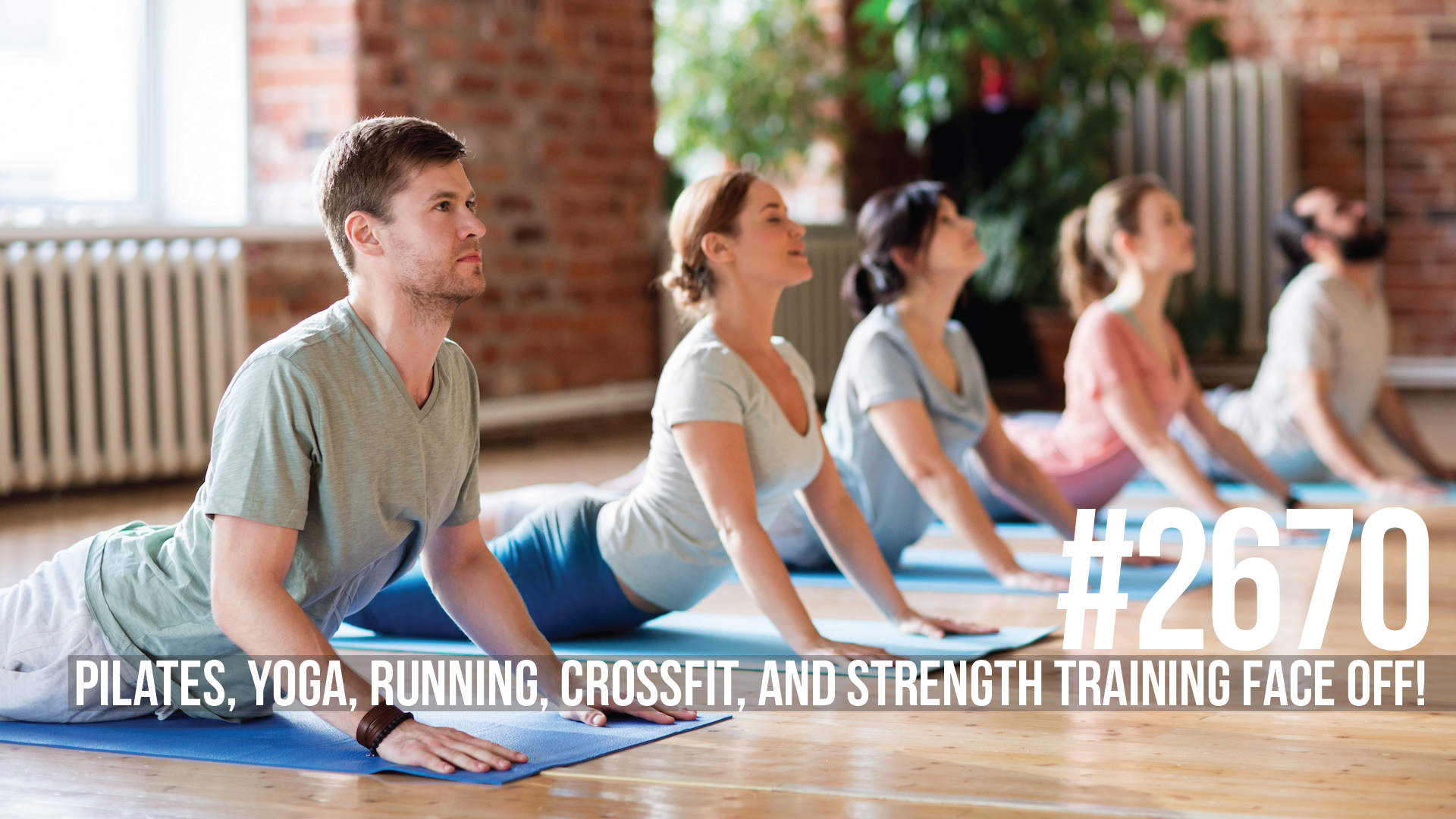
Mind Pump: Raw Fitness Truth
2670: Pilates, Yoga, Running, CrossFit, & Strength Training Face Off!
00:36:33
2670: Pilates, Yoga, Running, CrossFit, and Strength Training Face Off! Breaking down the most popular forms of exercise, so you can figure out what is RIGHT for you. History, demographics, and the pros and cons. (1:15) Pilates (3:23) Yoga (11:55) ...
Loading summary
Transcript245 lines
- [00:00]
Sal DeStefano
Back to school is better.
- [00:02]
Chris Gethard
With family freedom From T Mobile, we'll.
- [00:04]
Sal DeStefano
Pay off four phones up to $3200 and give you four free phones, all on America's largest 5G network. Visit your local T Mobile location or learn more@t mobile.com familyfreedom. Up to $800 per line via virtual prepaid card typically takes 15 days. Free phones via 24 monthly bill credits with finance agreement eg Apple iPhone 16128 gigabyte 8 $2009.99 eligible trade in eg iPhone 11 Pro for well qualified credits end and balance due. If you pay off earlier, cancel contact T Mobile.
- [00:29]
Podcast Announcer
If you want to pump your body, your mind, there's only one place to go.
- [00:35]
Sal DeStefano
Mind Pump. Mind Pump.
- [00:37]
Podcast Announcer
With your hosts, Sal Destefano, Adam Schaefer and Justin Andrews, you just found the.
- [00:43]
Sal DeStefano
Most downloaded fitness, health and entertainment podcast in history. This is Mind Pump. Today's episode. We go through the most popular forms of exercise. We break them down so you can figure out what is right for you. Now this episode is brought to you by a sponsor, Legion Supplements. They make the best supplements for athletic performance. Fat loss, muscle building, lots of integrity. What the bag says or the bottle says is in their third party testing. One of my favorite products is their egg protein powder. I can't have dairy, so I go with their egg protein. Super high quality protein. If you go to bylegion.com that's B-Y-L-E-G-I-O-N.com mindpump. Use the code mindpump. You can buy one, get one 50% off if you're a new customer and 20% cash back for returning customers. Go check it out. We also have a sale this month. Maps. 15 minutes is 50% off. Head over to maps1fiveminutes.com. Use the code Muscle50 for the discount. Here comes the show. All right, here's what we did. We took the most popular forms of exercise and we break them down and we compare them so you can decide which one's best for you. What are they? Pilates, yoga, running, CrossFit and strength training. We're going to talk about the history, the demographics, the pros and the cons. We're going to break it down for you so you can decide what's best for you.
- [02:07]
Justin Andrews
No Jazzercise.
- [02:08]
Adam Schafer
Is this really top five? Yeah, it is.
- [02:10]
Sal DeStefano
Yes, it is interesting. These are the top ones. And I want to open by saying this and this is just true. Okay. The one that you're most likely to do Consistently, the one that you enjoy the most is the best form of exercise. So regardless of what we say, what I don't want to do is I don't want to discourage anybody. I don't want you to, like, you love yoga or you love play. Been doing it forever. It's consistent. And then you listen to this, and we tell you the cons, you're like.
- [02:34]
Justin Andrews
Okay, I'm not trying to talk them out of it.
- [02:36]
Sal DeStefano
No, no, no, no. Being active, so long as it's appropriate, right? So long as it's not overdone or it's hurting you, is great. That's like 90 of it. Now, the other 10 is the pros and cons. And if you're indifferent, if, like, a lot of people where you're not really a fitness fanatic, you don't have a huge love for exercise, you're just like, hey, I just want to know which one to pick that's going to give me the best results for what I'm looking for. Then this episode will be, listen to the benefits. So. So in other words, I'm not turning. I don't want to turn this into, like a.
- [03:03]
Justin Andrews
We're not bashing.
- [03:04]
Sal DeStefano
Yeah, we have our favorites, but that's based off of, you know, ROI and all that stuff. But again, if you love it and you're doing it and you're not hurting yourself and it's appropriate, like, go for it and continue doing it.
- [03:14]
Adam Schafer
And it's a great way to set the table for this conversation, because anytime we do anything like this, where we talk about different modalities, you inevitably piss off somebody who's so bought into that. And I think that's such a great point that. Listen, if you. And I always would tell someone like this, I don't care. Name the modality. If you love it, you've been doing it for years. I'm not trying to discourage you from doing it. But if you ask me a question of what's the best? This or what you know, and you ask something like that, and I'm going to.
- [03:42]
Sal DeStefano
For a specific result.
- [03:43]
Adam Schafer
Right?
- [03:43]
Sal DeStefano
We have an answer.
- [03:44]
Adam Schafer
So I do think this is great. This is really, then geared towards people that are looking to get started at maybe one of these. Want to know what we think is the best?
- [03:52]
Sal DeStefano
That's right. That's right. So we'll start with Pilates. Now, Pilates exploded in recent times. This. This really got popular, I would say probably the last 20 years. I don't remember it being really a form of exercise. A lot of people did where?
- [04:06]
Justin Andrews
Like la or where do you think?
- [04:07]
Sal DeStefano
The organ. Yeah. So let's go. The history. It's actually an old form of exercise. It was actually originated in the early 1900s. There was a guy named Joseph. What was his name? Joseph Pilates. That was his last name. And he was a frail child. He had asthma, rickets. He was kind of. By the way, a lot of the origins of exercise methodology start with somebody who had to, like, solve their own health problems. And this was one of them. And his physical foundation, or philosophical foundation. I mean, he believed in good posture. He talked about strengthening the powerhouse, which was the core, which is kind of cool. Like, you know, back in the early 1990s, he was talking about the core musculature and how important it was when. You know, that didn't start happening in mainstream fitness for a long time. It wasn't until the 90s, people even.
- [04:55]
Justin Andrews
Said, oh, yeah, I was going to say 80s, but, yeah, probably 90s.
- [04:58]
Sal DeStefano
Yeah. He was inspired by Greek statues. He liked balance. And so he. He developed this form of exercise and it was actually used. He actually used it to rehabilitate people, soldiers in particular, World War I. So he was interned in England as a German national. And this is when he started using it to help people strengthen their bodies. And he would use bed springs as a. So he understood resistance training. Yeah, he just used bed springs as a way to strengthen.
- [05:27]
Adam Schafer
As a way to load or.
- [05:28]
Sal DeStefano
Yes.
- [05:29]
Adam Schafer
How would you use the springs to load?
- [05:30]
Sal DeStefano
Because they're this way. That's right. Not lifting them, but rather using them like a resistance band.
- [05:37]
Adam Schafer
Okay.
- [05:37]
Sal DeStefano
In essence, it didn't start taking off till later. This was when his studios were near dance studios and dancers really took to Pilates. So if you're familiar with Pilates and the movements, it does mirror the movements and the lines you'll see in a lot of dance.
- [05:55]
Adam Schafer
I mean, it makes sense because core and posture are at the foundation of why he did this.
- [06:01]
Sal DeStefano
And long lines. Right. Pointing your toes and doing certain positions, like dance is very technical. It's not just strength. You have to have the technique. And so Pilates just. It was like a perfect segue into this space. And that's really how it got popular.
- [06:15]
Adam Schafer
Yeah. Also, I would make the case too, that especially, you know, 30, 20, 30 years ago, that look was a look that a lot of women wanted too. Like you. In fact, I remember getting clients. I like the dancer look, you know, the long muscle bellies, lean, tall. I think that was like someone who would describe that as a look they wanted to aspire to. So it makes sense that it was rooted in core posture, it attracted dancers, and that dancer look was a look that for many years or even decades, women would aspire to look like.
- [06:50]
Sal DeStefano
I'm so glad you said that. So we're gonna dispel a myth right now. When you look at top performers or athletes in any given field, what you're looking at is a person who's genetically built to do well at that sport plus their training. So in other words, you look at top swimmers, what you always see are shorter legs, broad backs, wide shoulders, flatter rib cage. Now that doesn't mean swimming will make you look like that. It just means at that level, what you're going to find at that level.
- [07:21]
Justin Andrews
What's their body type best?
- [07:22]
Sal DeStefano
That's right. So training with Pilates isn't going to make you look like a Russian ballerina. It's not going to create long muscle bellies. That's all genetic.
- [07:31]
Adam Schafer
No different than crossfittings and not make you look like the top crossfitter or the best runner or said modality. So this applies to even bodybuilding.
- [07:40]
Sal DeStefano
Right. You can train like a pro bodybuilder. You're probably not going to look like a pro bodybuilder because they were born to look a particular way and then they, they enhanced it.
- [07:47]
Adam Schafer
Right.
- [07:47]
Sal DeStefano
With training. Now, the demographics of Pilates, as you would probably guess about 60 to 75% female.
- [07:54]
Adam Schafer
I actually would have guessed even higher.
- [07:55]
Justin Andrews
I know, I would too.
- [07:56]
Adam Schafer
If you made me guess. I would have said.
- [07:58]
Sal DeStefano
I would have thought higher too.
- [07:59]
Adam Schafer
Interesting.
- [08:00]
Sal DeStefano
I, I haven't, I've, I haven't known. I don't think I've known a single guy, maybe one who did some Pilates, but not consistently. But when I looked up the demographics on and I looked it up online and what they report, about 60 to 75%.
- [08:13]
Adam Schafer
Interesting.
- [08:14]
Sal DeStefano
I was 65. I would say probably 75%. Yeah. I don't know. And I've gone to some Pilates studios. I had a couple trainers that worked for me that also taught it and they invited me to classes and I was like the only guy.
- [08:26]
Justin Andrews
Yeah. I'm not as familiar. I know. So did Bar come after that? Is, is because of, it's like a combination of that with dance?
- [08:34]
Adam Schafer
No Bar came out as far as I know.
- [08:35]
Sal DeStefano
Bar came after, but yeah, I believe so. Yeah. And I know they're similar.
- [08:39]
Justin Andrews
They're similar. But yeah, just.
- [08:41]
Sal DeStefano
Now the other demographics, they're kind of.
- [08:43]
Adam Schafer
Not dance posing, kind of very different.
- [08:45]
Sal DeStefano
Similar in the way they advertise themselves.
- [08:46]
Adam Schafer
Okay, okay, maybe advertising wise, but they're the, the, the training is, is way different. Yeah. Pilates use a reformer and reformer, although.
- [08:54]
Sal DeStefano
You have map plotties. You know, there's Pilates that's done on a mat without a reformer. Now the other demographics, about 40% are between 30 to 50, 35% over 50. It's an actually older demographic. That makes sense too than old than other forms.
- [09:09]
Adam Schafer
Especially again, going back to core posture focused. I mean, remember training a lot of advanced age clients. Most clients, not all, but most clients in advanced age care more about posture and chronic pain and how they feel opposed to how they look.
- [09:27]
Sal DeStefano
That's right.
- [09:28]
Adam Schafer
So they're aware that getting into this may not be the best form to build a bunch of muscle. But you know, if it makes them feel a lot better, then so that.
- [09:37]
Sal DeStefano
Makes a lot of sense and we'll get there because there's, I think there's some reasons why it's a higher income demographic. Pilates classes, especially reform classes.
- [09:44]
Adam Schafer
Expensive.
- [09:45]
Sal DeStefano
Expensive.
- [09:45]
Adam Schafer
Okay.
- [09:46]
Sal DeStefano
Yeah. So it's higher income. Now here's why I think you, you, you see the older demographic, you know, go towards Pilates. One of the pros of Pilates is it tends to not be an over intensified form of low risk.
- [10:00]
Adam Schafer
Very low risk.
- [10:01]
Sal DeStefano
It's low risk. And although Pilates can be intense. So I know people, Pilates instructors like you come take classes.
- [10:06]
Adam Schafer
Yeah, yeah. Don't, don't miss. Don't misrepresent what I said. Low risk as an easy. I didn't say that. You know, low risk is a good thing. It means that it's less likely to injure somebody.
- [10:17]
Sal DeStefano
Doing something like that in an intense Pilates class tends to be less stressful than an intense run or intense. Definitely less than intense. CrossFit. Right. It tends to produce less stress in the body. So people in that age group, you know, 30 to 50, this is like the most stressful time of your life. Kids, you got mortgage and it's not going to beat the crap out of you like other forms of exercise might actually promote. It is good for joint stability because of the shortened movements, the lengthened position. So it is good at creating stability around a joint. Now the cons, it's not a great athletic performance builder. Doesn't really build a lot of muscle and strength. I know Pilates will advertise as building strength. The strength that you build from it is pretty specific to the movements and you don't get a lot of carryover like you would with other forms of exercise.
- [11:11]
Adam Schafer
Well, Especially when you are comparing it to the other modalities that we're going to talk to.
- [11:15]
Sal DeStefano
That's right.
- [11:16]
Adam Schafer
Or talk about, I mean aside from running and yoga, it's probably ranked at the low. In fact, if you were to rank those. Did you do that? Did you rank like we could talk.
- [11:24]
Sal DeStefano
About that as well.
- [11:25]
Adam Schafer
Yeah, I think we should as we go through, since you bring it. Because obviously building muscle and performance is a, is a, a key goal for most people. Right.
- [11:33]
Sal DeStefano
Even if you want fat loss, muscle building is great for fat loss. Right. So. And it's, it's not a great fat loss form of exercise. But I will say this, most forms of exercise, if not all of them are not great, quote unquote fat loss. It's typically diet that plays the biggest role. So even, even the best form of exercise for fat loss, which we'll get to, which is strength training, if you don't really work with your diet, it's going to be difficult to lose a lot of body fat because diet plays the biggest role. It's got good group support. You'll find this with all the group classes. A lot of people thrive on that, that social component. I'm not one of those people. But for a lot of people show up. That's right. Is the group. It's the, there's just people in there. And then we said core stability. But when it comes to muscle building, athletic performance, stamina, it's pretty limited in that sense. So I would say that's, those are the biggest cons. Then we get to yoga. Now yoga is interesting. It's a very old practice. Very, very old practice. It was originally designed as a form of exercise and movement to help people meditate longer. So people did yoga because that was.
- [12:44]
Adam Schafer
The origin of it.
- [12:44]
Sal DeStefano
The origin was can I sit in this, you know, meditative position or posture for hours and hours and hours and hours at a time. And yoga was designed to be able to, to be able to do that for people. So I think really the origin of it, it didn't become a form of like workout or exercise where it was separated from the, the yoga, you know, the spiritual practice of yoga that was connected to meditation until a much later this got popular probably. I remember hearing about it in the 90s when we were training and then it really started to take off.
- [13:23]
Adam Schafer
Yeah, well, you would say after that even. Huh.
- [13:25]
Sal DeStefano
I remember being popular.
- [13:27]
Adam Schafer
Wasn't it in the 80s or 90s when the popular yogi guy that got really like famous.
- [13:33]
Sal DeStefano
Oh, that was like the cult leader.
- [13:35]
Adam Schafer
Yes, yes.
- [13:35]
Justin Andrews
Yeah, well, I just, I remember so even like the Beatles made their travel to India and then had this whole experience. And I think, you know, I have to feel like some of the culture from that in the 70s kind of maybe brought it over and then started.
- [13:52]
Sal DeStefano
To kind of again, that was really. That was less yoga, more spiritual. Yes. That was about meditation and the kind of the spiritual aspect. In fact, if you go to yoga classes today, they often will include that still where you're, you know, there's an intention and so there's still that spiritual kind of practice. Now yoga has gotten very westernized. You have power yoga strength. Yoga. Yeah. Yoga with weights. Because yoga. Yeah. And that's what the fitness industry does. It'll take something popular and then turn it into something completely piyo.
- [14:26]
Adam Schafer
They'll combine the last.
- [14:27]
Sal DeStefano
Yeah, that's another yoga. Yeah.
- [14:29]
Justin Andrews
Puppy yoga. I'd be up for that.
- [14:32]
Sal DeStefano
Yeah. The demographic, 70% female. This is mostly female. 55% 18 to 34 years old. It is a higher income. Yoga studios are expensive.
- [14:43]
Adam Schafer
That's 18 to 34 year olds.
- [14:45]
Sal DeStefano
It's a majority. You have a wide range, but a majority are between 18 to 34.
- [14:49]
Adam Schafer
It's younger than I would anticipate.
- [14:51]
Sal DeStefano
Yeah, so did I. I thought it might have been a little bit older. Yeah. But it's, it's in that, you know, age group. And it brought us, I mean, here's how popular yoga is. Yoga brought us an entire category of workout clothes.
- [15:05]
Adam Schafer
I know.
- [15:06]
Sal DeStefano
Yoga pants. Oh, yeah. I mean, you know, Lululemon was connected to yoga and then it became like a thing. Now this is like a clothing, you know, a piece of clothing people wear all the time.
- [15:15]
Adam Schafer
So I'm, generally speaking, I'm a big fan of clients doing. In fact, clients that I had that were already doing it. I complimented strength training so.
- [15:25]
Sal DeStefano
Well, yes, it's a great form of exercise to compliment others.
- [15:28]
Adam Schafer
Yes. And so I never, anytime I had a client doing it, I always encourage them to continue doing it. And this is even before my knowledge around mobility practices and things. Corrective work that we started to do later in our career and understand which I would. Which I would argue is just a more specific type of yoga. Right. Where you're doing very specific movements to that client based off of their needs and. Or their. Their issues. Right. So but it does such a good general stroke of movements that mo. And I think this is why it does so well is most people will go to it and benefit from it. They'll do it and go, oh my God, I feel amazing.
- [16:04]
Justin Andrews
It addresses what I saw as a trainer. Like, come in. One of the biggest problems I saw is, like, a lot of people just aren't in their own body. And, you know, it really, like, builds that body awareness and that intrinsic control. And so to be able to have control, to hold poses, to understand, you know, all these ranges of motion you don't express and, like, how important they are, I think it's great.
- [16:26]
Adam Schafer
That's such a good point, Justin. You're taking me back to remembering, like, new clients that I would get that were, like, big into yoga. Like, I actually had a much easier time teaching exercises and movements to clients that had a yoga background.
- [16:38]
Justin Andrews
They have great queuing.
- [16:39]
Adam Schafer
Yes. Because they queued really well.
- [16:41]
Sal DeStefano
Very good.
- [16:41]
Adam Schafer
They understand core really well. And stability, like. And those are all. Those are foundations to strength training principles.
- [16:49]
Sal DeStefano
Yep.
- [16:49]
Adam Schafer
So if you have good, strong core, you have good. You have good mobility, good range of motion, good connectivity. That translates really well. And good queuing. Right. It translates really well.
- [16:58]
Sal DeStefano
And we're talking to traditional, like Vinyasa flow, maybe even yin yoga, but more, more, more that Vinyasa flow. And Justin, what you said was so right. Like a good yoga instructor. It's not stretching. Some people who've never done yoga think, oh, you're just stretching. No, no, no. You are intentional. And the instructors cue you in a particular way. But the cues they'll use, we'll say things like, draw your energy out against the mat or pull this in here or tuck here. And so you're right. It really does. And that's good for flexibility. Obviously. Here's the biggest pro with yoga. It tends to be recuperative, at least the traditional forms.
- [17:33]
Adam Schafer
Yeah.
- [17:33]
Sal DeStefano
Now you can go do power yoga, which I don't consider yoga. That's just. You're trying to make it something else.
- [17:38]
Adam Schafer
You know, that's a. That's probably a good argument, Sal, for also why it gained its popularity when it gained its pop.
- [17:42]
Sal DeStefano
Totally.
- [17:43]
Adam Schafer
Here we are on the rise of stress technology, all these things like that.
- [17:46]
Sal DeStefano
Whereas other forms of exercise glorify beating the crap out of yourself. They'd go to yoga and they'd feel good.
- [17:51]
Adam Schafer
What a good point. Probably a big reason why it had such. Such a rise in the last couple decades.
- [17:58]
Sal DeStefano
And it's the form of exercise I would recommend. My clients who wanted to do more activity, but who also I identified were just. The stress is too high.
- [18:08]
Adam Schafer
Yeah.
- [18:08]
Sal DeStefano
It's too high to have you go do.
- [18:09]
Adam Schafer
Which was super common for all of us in the Silicon Valley.
- [18:11]
Sal DeStefano
That's right.
- [18:11]
Adam Schafer
Being in the Silicon Valley, you got a lot of, you know, men and women that grind high stress type jobs. Yoga seemed to be a really good answer to totally.
- [18:20]
Sal DeStefano
And it's not uncommon. And I know this, my wife was a yoga instructor and I did it for a little, for a little while. Like you go in these classes, it's not uncommon to see people get emotional in a yoga class because they're in their body. These are people who push everything out all the time at work, stress, go, go, go. And then they're in there and they're focusing on their breath, feeling everything slowing down. And you see people crying next to you.
- [18:43]
Adam Schafer
The interesting point to be made here is that it's still 70% female. I would make the case that far more men would benefit from this.
- [18:50]
Sal DeStefano
Totally.
- [18:51]
Justin Andrews
Yeah.
- [18:51]
Sal DeStefano
You know, Totally.
- [18:53]
Adam Schafer
I think that, I think that this isn't a thing that it's, it's flipped on who's attracted to it. In fact, I would like to naturally good at it.
- [19:01]
Justin Andrews
Men are.
- [19:02]
Adam Schafer
I would make the case that a large portion of my yoga females would benefit from moving a little bit away and more strength and exercises that stress the body a little bit differently. And more of my men that totally would probably benefit from that.
- [19:18]
Sal DeStefano
Now. It's not a great way to build muscle. It's not a great way to build athletic performance. You get some strength, stamina, a little bit. And if you do yoga a lot, A lot, a lot, a lot. And you don't combine it with strength training, you can actually in some areas cause instability because of the positions that you're holding for a long period of time. I've had yoga instructors who've had hip issues that hired me to do strength training with them to solve some of those hip issues. Next up is running, probably the most popular form of exercise for decades. Yeah, okay. Still is. Yes. And the history of running the ready, set, go.
- [19:54]
Justin Andrews
I'm going to get in shape.
- [19:55]
Sal DeStefano
That's it. The history of running. I mean, I don't know, how far back can you go? This is like, this is. Running is interesting because it's the one physical activity that humans actually outperform almost any other animal. That's okay. So if you were to look at humans, physically we're pretty weak. Like, you put us out in the wild and you have us compete against other animals, we're gonna get our butt kicked. One thing that we do better than most is run for distance.
- [20:20]
Justin Andrews
Run for distance and throw in.
- [20:22]
Sal DeStefano
Throw. That's the other one. Right. But running for distance is. We're actually Built. You can argue we're built to run. We have these big knee joints, these huge glute muscles. You look at other primates have these tiny little glutes. We have these big glutes. We're on two legs. Evolutionary scientists would say it was because we evolved to become apex predators. That's so we could throw and out trek or outrun animals. There is an old race. I don't know if they do it anymore, but there was a race where a human would race a horse for distance, and 50% of the time, the human would win, which is pretty wild when you think about that, because of our ability. And we sweat so we could really let off heat really well, this is a 50, 50 male female. It's really, really spit split with the demographic. 60% are between 30 to 49. Definitely that older. Older, huh? Yeah. Yeah. I think. You know why I think this is? I think it's because there's a myth with running, and I just. In fact, I just sold the myth a little bit by saying we were built to run. There's a myth that it's a very simple, basic. You don't need a lot of technique. Just go run.
- [21:25]
Adam Schafer
I think the age thing speaks more to the. The famous book in the 70s that probably.
- [21:31]
Sal DeStefano
That's the running revolution.
- [21:32]
Adam Schafer
Yeah. I mean, that was the 70s, mid-70s or late-70s when that was Doug.
- [21:36]
Sal DeStefano
Yeah.
- [21:36]
Adam Schafer
Somewhere. Somewhere in that time. So that would put most these people in their, you know, 40s that would probably be. Have read this book. Maybe some of them in their 30s now.
- [21:45]
Sal DeStefano
Complete.
- [21:46]
Podcast Announcer
Complete Book of Running, 1977.
- [21:48]
Adam Schafer
77. Yeah.
- [21:49]
Sal DeStefano
Yeah, it was that.
- [21:51]
Adam Schafer
That was a huge moment in time. Right. Because prior to that, you wouldn't just see people running on the street.
- [21:55]
Sal DeStefano
No. Unless you were in like LA or something. Like. And then suddenly everybody started running. Running shoes exploded. Rocky came out, by the way, that was another movie that really pushed, you know, running to the forefront. Yeah. So you're probably right. But again, I think the other reason is people look at running. They stopped running when they were kids. Then they become 44 or 38, and they're like, oh, I need to lose weight. I think I'll just go work out and I'll just go run. And there's a myth because around that, because although our bodies, our are built to run, if you stop running for a long time, you don't know how to run. Yeah.
- [22:28]
Justin Andrews
So the technique.
- [22:29]
Sal DeStefano
Yeah, dude. So it's great for endurance, great for stamina. One of the biggest cons, it's the Highest injury risk.
- [22:35]
Justin Andrews
Well, it also, it also competitive stress.
- [22:37]
Adam Schafer
I think another point to be made is, and you have it up there is, it's middle income, so it's low barrier. I mean, the moment you decide I need to make a change, I need to make a change, I need to get in shape, I need to lose fat. Say insert goal. Like you literally can lace up your shoes and go outside and start doing it. Which I imagine is a huge factor that plays a role. Because how many people said they were going to go to the gym or said they're going to sign up for Pilates and never showed up? Yeah, you know, because they had to go find a class, they had to go pay.
- [23:07]
Sal DeStefano
This is like, I'll just run whenever.
- [23:08]
Adam Schafer
Yeah. It's just like I need to change. I'm like, I go. Literally how many people just thought about it and then went and actually just did it right away?
- [23:14]
Sal DeStefano
Yes. Yes. Again, great. One of the bet if you want that steady state endurance running is at the top. I mean, any sport that requires endurance incorporates some form of running. Okay. As part of their training. That the problem is, is it's technical. If you don't have good technique and you go run to fatigue, first off, your technique already is terrible. Then when you get tired, technique gets even worse. And the injury risk on running is the highest. It's actually the highest injury risk of all traditional forms of exercise. You'd have to go to extreme sports to find higher injury risk. It also promotes muscle loss if you run a lot, especially combined with a calorie deficit because you're trying to lose weight. Your body tries to become a better endurance machine. So it pares down this expensive calorie burning, you know, tissue called muscle. So you end up, you can end up with this kind of skinny, fat type of body that has a lot of stamina and endurance.
- [24:08]
Justin Andrews
Your joints just take a beating.
- [24:09]
Sal DeStefano
Yes. And it's, it's also a stressful.
- [24:11]
Adam Schafer
Yes on the body.
- [24:12]
Sal DeStefano
Yes.
- [24:12]
Adam Schafer
We're not talking about walking right now. This, like running ends up being a very high, high stress on the body.
- [24:19]
Sal DeStefano
It was the form of that. Unless a client loved running and then hired me. If I had a client, it's like, hey, I want to also start running. I almost always discourage them. No, no, don't add running to what we're doing right now. It's going to add too much stress to your body and it's not going to, it's not going to be good. It's not going to be good. Next up, we have CrossFit CrossFit's interesting. This is a newer form of exercise. We were around when it really took off. It was 2001 and it was here when it was. Exception.
- [24:49]
Justin Andrews
Yeah, right in my backyard.
- [24:51]
Adam Schafer
Justin's backyard.
- [24:52]
Sal DeStefano
That's right. Greg Glassman, who was a gymnast and had understood strength training, a bunch of things. He wanted to create a form of exercise that was multidisciplinary, that kind of gave you everything. And so, you know, he came up with this idea of CrossFit. It's about 60% female, which I find interesting. I thought it would be.
- [25:11]
Adam Schafer
I didn't know that.
- [25:12]
Sal DeStefano
Yeah, that's what it said.
- [25:13]
Adam Schafer
I didn't know that.
- [25:13]
Sal DeStefano
Yeah. A little bit more.
- [25:14]
Adam Schafer
I would have guessed more meat male recently or.
- [25:17]
Sal DeStefano
Yeah. Did that swing? That's years. Yeah, that's recent. 40%. The biggest age group that does CrossFit, 25 to 35. Although you have kind of a broad range higher income. CrossFit boxes are expensive. Here's what's interesting about CrossFit. It went from being essentially invented to becoming one of the most influential popular forms of exercise in a very, like in a decade, probably the fastest. It was so influential. Look, we've been in gyms forever. It influenced all strength training. Yeah, all CrossFit made people squat and deadlift. It made weightlifting a normal thing.
- [25:56]
Justin Andrews
Do you remember Jim Jones?
- [25:57]
Adam Schafer
Yeah, yeah.
- [25:58]
Justin Andrews
That was even before Cross.
- [25:59]
Adam Schafer
Yeah, yeah, it was. So that's what they were, they were using, they used for Spartan Movie.
- [26:03]
Justin Andrews
Oh, yeah.
- [26:04]
Adam Schafer
So the original Spartan Movie trained Jim Jones, which was like pretty cross.
- [26:09]
Sal DeStefano
Really?
- [26:09]
Justin Andrews
Yeah, that was back.
- [26:10]
Sal DeStefano
Yeah.
- [26:11]
Justin Andrews
When they just started doing the warehouse thing in like low tech, high effect kind of stuff.
- [26:15]
Sal DeStefano
Yeah, with.
- [26:16]
Justin Andrews
Yeah. So it's like, it was interesting because I was very much immersed in all of that in terms of unconventional training and also using like tires and you know, real old school method stuff.
- [26:29]
Sal DeStefano
And then.
- [26:30]
Justin Andrews
Yeah, the CrossFit. Just put it all together in one.
- [26:32]
Sal DeStefano
I mean, one modality.
- [26:34]
Adam Schafer
Back to your point about how much it changed the industry. I mean, it changed the, the, the blueprint and the, the layout of every gym.
- [26:41]
Sal DeStefano
That's right.
- [26:41]
Adam Schafer
Like, I mean, even if you were a commercial gym, that had nothing to do with CrossFit, you changed your gym because it got that pop, squat racks.
- [26:49]
Sal DeStefano
Everywhere, all of a sudden, bumper plates everywhere.
- [26:52]
Adam Schafer
Everybody has artificial turf now in their CrossFit.
- [26:54]
Sal DeStefano
Yeah, now, now you might be thinking if you're, if you're, you're listening to this, like, well, it's because it was so effective. That's not why Crossfit took over the CrossFit took that community.
- [27:04]
Adam Schafer
They did the best community.
- [27:05]
Sal DeStefano
They. And this is what people back. Yes. This is what gym owners need to understand is that if you want to do great, most important thing you can do is culture. It's more important than your equipment. It's more important anything. It's the culture. And CrossFit nailed it with culture.
- [27:18]
Justin Andrews
And they strongest one out there.
- [27:20]
Adam Schafer
They prove that. They proved they could do a concrete dungeon with no AC with people show up, minimal equipment if they built a good culture. And they did a great job.
- [27:30]
Sal DeStefano
Incredible culture.
- [27:31]
Adam Schafer
And, and, and credit where it's due. Like effective exercises. Yes, there was a lot of effective exercise. When you talk about. And I know you're not there yet get ahead of you, but, you know, you talk about building muscle, burning body fat, things that are metabolically. I mean, they win this category so far. So far, what we've talked about. They did the best exercise building, building the ultimate physique, both metabolically, physically, they win right here.
- [27:57]
Sal DeStefano
Yeah.
- [27:57]
Adam Schafer
And they did a great job of that.
- [27:58]
Sal DeStefano
They did. Now, what are the cons? It is just inappropriate for most people.
- [28:02]
Adam Schafer
Well, there's a reason why the this of all the categories goes 25 to 35.
- [28:06]
Sal DeStefano
Yeah. Because by about 35, you go like.
- [28:09]
Adam Schafer
I can't do this forever.
- [28:12]
Justin Andrews
Feeling good.
- [28:13]
Sal DeStefano
The culture. As great as the culture is. The one flaw with the culture is its intensity. Celebrating. It's like, beat yourself.
- [28:21]
Adam Schafer
Go drive to the point that their mascot was a rabdo clown.
- [28:25]
Sal DeStefano
It was a clown throwing. They. They try to hide that. You know that, right? Of course that was bad for pub. Dude.
- [28:30]
Adam Schafer
It was real bad for pub. Later on. It was cool.
- [28:32]
Justin Andrews
It was a badge of honor thing. And it's, it's funny because it appealed to a lot of ex athletes, military, you know, people that.
- [28:39]
Sal DeStefano
Hardcore people.
- [28:39]
Justin Andrews
Yeah, hardcore and crazy. And so it was like, you know, they, they just wore it as a badge of honor. But yeah, in terms of sustainability and all that. Yeah, I would definitely on there.
- [28:50]
Sal DeStefano
I almost always. Unless you love it, it's your favorite thing or whatever. I almost always discourage people from, from doing CrossFit as a form of exercise. And people know that we talk about all the time. Just. It's just. It's just about beating the crap out of yourself. And yeah, they got great exercises, great culture. Now there's a lot of CrossFit boxes now that try to move away from that. Yeah.
- [29:09]
Adam Schafer
But that just proves your point right there. Even more. It's like, it's, it's a Lot of times when we, in any time we mention that, we always get somebody who DMS and pushbacks. Well, mine's different. It's like. Yeah, well, it's getting less crossfit. That's why.
- [29:21]
Sal DeStefano
Yeah.
- [29:21]
Justin Andrews
Like hierarchy.
- [29:22]
Sal DeStefano
Yeah.
- [29:22]
Justin Andrews
The light version.
- [29:23]
Adam Schafer
Yeah. They've just, they, over time, I think they've. They've listened and they've seen and so they, you know, you have. And then kudos to the owners that are modifying and changing it to make it better. You know what I'm saying? It still does just, you know, for the listener. It does not equal a superior way of strength training. Not by any means, stretch of the means at all. And there's a reason why it's. It's attracted to the young man and woman's game because you. You're a little more resilient at that age and you can handle that beating at that high of a level. So it's not ideal. That'd be the cons is it's just inappropriate for most people.
- [29:58]
Sal DeStefano
Right.
- [29:58]
Adam Schafer
Just almost every client. And I remember going through this long before it became trendy. And everybody else, you know, Justin, guys like me were in our gym doing this before it was popular. And I mean, and that was in my 20s. And so I thought it was fun and cool, but I never took that and went, like, I'm going to train my clients this way. I'd already trained enough people to know, like, oh, like, I can't train.
- [30:19]
Sal DeStefano
I don't have a single client.
- [30:20]
Adam Schafer
Yeah.
- [30:20]
Justin Andrews
It didn't make sense. General pop.
- [30:22]
Adam Schafer
No, it didn't. It didn't at all.
- [30:24]
Sal DeStefano
All.
- [30:24]
Adam Schafer
I was just like, this is, this is. When I looked at my client list, I'm like, yeah, no, Karen is not going to do that. I was like, she'll never come back.
- [30:31]
Sal DeStefano
If I do that to her. It's not going to work. Yeah. Last we have strength training. The history of strength training goes back really far. There's evidence of gladiators using resistance to build their bodies up. It didn't turn into, like, the kind of strength training that we know until the, like, like late, you know, early 1900s when you saw the kind of. The Golden Bronze era. Yeah. Where they made barbells and dumbbells and. And kettlebells. So strength training's been around for a little while. It's about 50, 50 male, female. Which is awesome.
- [31:03]
Adam Schafer
Which is cool, because that was not. It was like 80, 20 when we were trainers.
- [31:07]
Sal DeStefano
Yes. In the 90s, you go in a freeway area and it was like 80.
- [31:10]
Adam Schafer
20, 90, 10 easy. It was easily that.
- [31:12]
Sal DeStefano
Super easy.
- [31:13]
Adam Schafer
So that's a really cool stat to.
- [31:14]
Sal DeStefano
See that hunger, huge swing, 50% between 18 to 34, which is also cool too.
- [31:20]
Adam Schafer
So two big stats I saw when you wrote that up there that I thought was really interesting because I hadn't looked at this in a long time. The fact that it's a 50, 50 split between male and female is so awesome because that was a definitely major flip flop or like 80, 20 or 9010 men when we first started, and then even as young as 18. So 50% are 18 to 34. So this is the youngest, which is a really cool sign and does sound like the message is getting out.
- [31:46]
Sal DeStefano
It is. Now the pros, I mean, for roi, right? Return on investment. What I mean by that is the time spent with the results you're going to get. If the results you're looking for are health, longevity, body composition, change, strength, metabolic, nothing changed. Nothing beats strength training. Nothing. And one of the reasons why is it's the most individualizable form of exercise of all the ones we talked about. CrossFit is a style. Yoga is a style. Pilates is a style. Running strength training is so modifiable, it's used in rehab with people who had terrible injuries or deconditioned. You can do it for athletic performance, with super athletes. You could do it for bodybuilding. It's incredibly individualizable. And it's funny because when you look at the age demographics of all the forms of exercise, it's the most appropriate for every age group. Yeah. If you were to give me a child and tell me, you know, I would do a form of strength training, if you were to give me an really old person, it would be a form of strength training. Yeah. Strength training is so individualizable. It's, it's great for muscle and fat loss, for aesthetic change. You want to change the way your body looks. It's as close you can as you can get to being a sculptor.
- [33:00]
Adam Schafer
Well, I think that's such an important point to, to really nail home too, because at least in my experience, most of the clients that, that hired me or came to me wanted to, to sculpt their physique. Whether they said it that way or not, that's what they were trying to do. When someone comes in and says, I want to lose as much body fat as I can and build a body or I have these body parts they are not happy with, they want to look a certain way. That's sculpting.
- [33:24]
Sal DeStefano
Right.
- [33:24]
Adam Schafer
That's what that's what sculpting is to take a body part you're unhappy with and develop it or lose body fat in areas or not look a different way. All the above. Like that is. That's strength training.
- [33:36]
Sal DeStefano
That's right.
- [33:36]
Adam Schafer
I mean that's true strength training.
- [33:37]
Justin Andrews
Right. I think what really, you know, it leaped beyond just like what people used to think of it mainly as like bodybuilding or like an athletic pursuit where now people are realizing for just everyday average person and their health concerns this addresses it better than all the rest of them because two, you know, building muscle. We realize like we're. The fact that we're under muscled is contributing to a lot of these ailments that we see.
- [34:02]
Sal DeStefano
If you were to do one hour of exercise a week and you wanted the biggest return for health and longevity, nothing comes close to stranger. Just for health and longevity. Not bodybuilding, not powerlifting, but just for longevity. That's what the data shows us.
- [34:16]
Adam Schafer
Now the, the biggest con of this. Of all the ones we've listed, this is the one that you, you probably want a trainer that's right to teach you and go through because all the rest you could lace up your. And even though you probably shouldn't lace up your shoes, go for a run, but you even a CrossFit you go to a class, there's instruction and other people where with strength training you be. And some people make the mistake just like lacing up their shoes and going running of just going to the gym and start doing a bunch of exercises. But this one, you want to probably have someone professionally put something together for you to reap the most benefits because.
- [34:51]
Sal DeStefano
It'S so, so the, the pro of it being so individualizable, so modifiable is a con. Right. It also requires workout programming. I mean there are. If I were to list every strength training exercise or every exercise that could be used for strength training, I mean it'd be a list that would be thousands of exercises long. Each one can be performed differently depending on what you're looking for.
- [35:13]
Adam Schafer
Each one can be regressed or progressed.
- [35:15]
Sal DeStefano
Then there's programming that includes reps and sets. And then you look at the week and rest periods and it's just like, what do I do with all this? So the con is it requires the most instruction. But I will say this, and this is why the number one form of exercise used by trainers is strength training. It's because it's so effective, but also because that's where you need a trainer. Yeah. So if this is what you're interested in, invest in a coach or a trainer for a short period of time. Couple months, few months and get those basics down. And then the ROI is just absolutely.
- [35:48]
Justin Andrews
Just keep building from there.
- [35:49]
Sal DeStefano
That's it. Look, if you like our podcast, come find us on Instagram Mind Pump Media. We'll see you there.
- [35:54]
Podcast Announcer
Thank you for listening to Mind Pump. If your goal is to build and shape your business body, dramatically improve your health and energy and maximize your overall performance, check out our discounted RGB super bundle@mindpumpmedia.com the RGB Super Bundle includes Maps, Anabolic Maps, Performance and Maps Aesthetic. Nine months of phased expert exercise programming designed by Sal, Adam and Justin to systematically transform the way your body looks, feels and performs. With detailed workout blueprints and over 200 videos. The RGB Super Bundle is like having Sal, Adam and Justin as your own personal trainers, but at a fraction of the price. The RGB Super Bundle has a full 30 day money back guarantee and you can get it now. Plus other valuable free resources@mindpumpmedia.com if you enjoy this show, please share the love by leaving us a five star rating and review on itunes and by introducing Mind Pump to your friends and family. We thank you for your support and until next time, this is Mind Pump.
- [37:02]
Chris Gethard
Hi, I'm Chris Gethard and I'm very excited to tell you about Beautiful Anonymous, a podcast where I talk to random people on the phone. I tweet out a phone number. Thousands of people try to call you talk to one of them. They stay anonymous. I can't hang up. That's all the rules. I never know where what's going to happen. We get serious ones. I've talked with meth dealers on their way to prison. I've talked to people who survived mass shootings, crazy funny ones. I talked to a guy with a goose laugh, somebody who dresses up as a pirate on the weekends. I never know what's going to happen. It's a great show. Subscribe today. Beautiful Anonymous.