← Nat Theo Nature Lessons Rooted in the Bible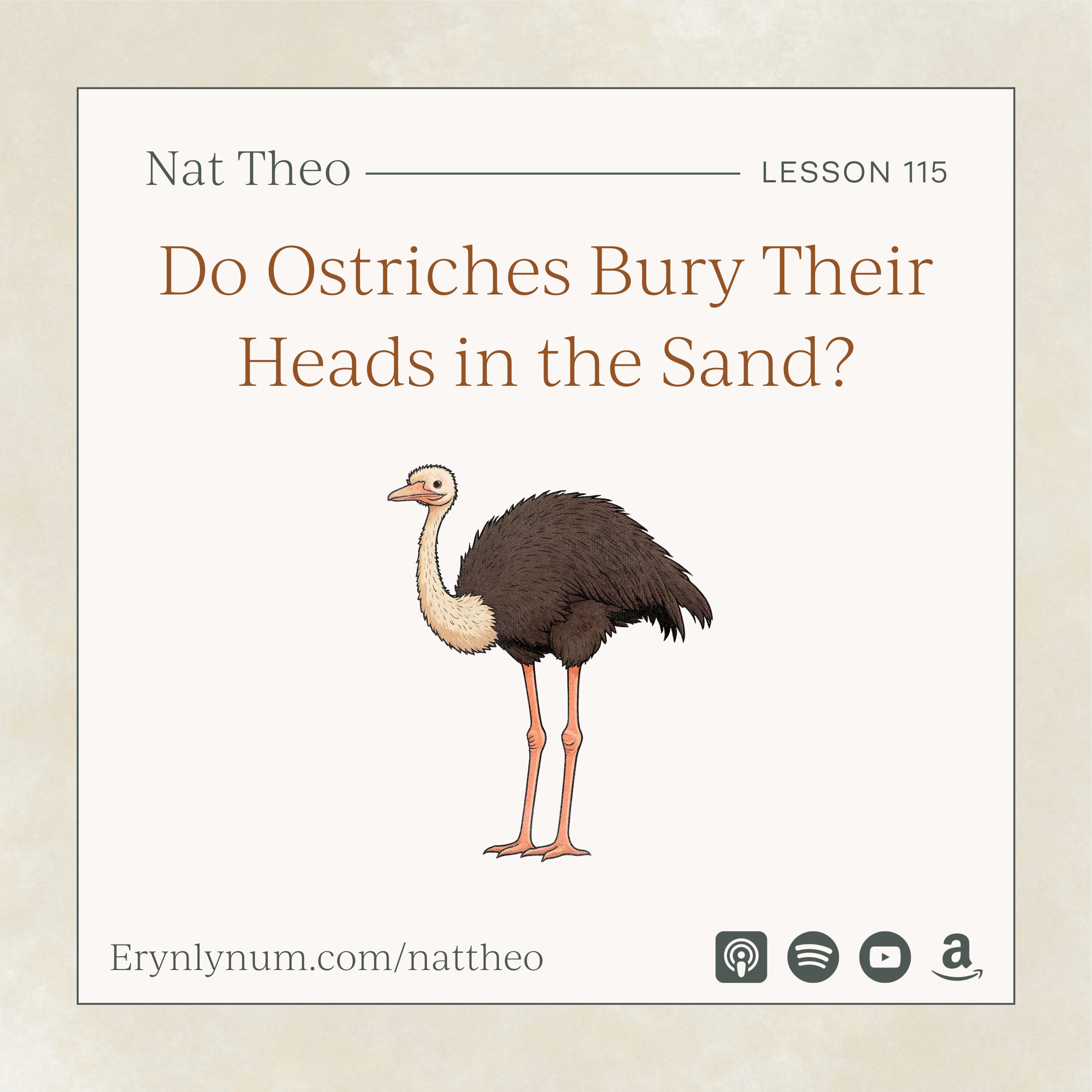
Nat Theo Nature Lessons Rooted in the Bible
Do Ostriches Bury Their Heads in the Sand? Lesson 115
00:27:37
Loading summary
Transcript1 lines
- [00:00]
A
Have you downloaded the free coloring sheet for this lesson? Click the link in our Show Notes to print and color along as you listen. And join the Nat Theo Club at the link in our Show Notes to receive a full lesson and activity guide and a bonus video of content every single week so you can dive deeper into every lesson. Explore God's wild and wonderful world in the Nat Theo club@aaron lyneum.com club or at the link in our Show Notes. Hello world. Wake me up to another good Good morning. Time to go. Are you ready to explore God's wild and wonderful world? Welcome to the naptheo Podcast. I'm your host Erin Lyneum. I'm a certified master naturalist, Bible teacher and author and I am so excited to dive into God's written word, the Bible and His created world with. What is the most interesting bird you can think of. God designed so many kinds of birds in all sorts of styles and colors. There are over 11,000 different kinds of birds across the world. That is a lot of creative designs. When we think about unique birds, a parrot might come to mind, or maybe a penguin or a peacock or a flamingo. But what about the ostrich? Ostriches can be funny to watch and they are certainly unique. Today we are diving into how God designed these flightless, massive birds. Here is our trail map. Are you ready? We are going to learn why don't ostriches fly? How is an ostrich like a pogo stick? Do ostriches bury their heads in the sand? And how can we face our fears before we hit the trail? Let's thank our sponsors who helped make this lesson possible, including Sherwood Kids. Kids, do you love great stories, parents and caregivers? Are you looking for living stories that build faith and don't have a sneaky agenda? Then you will love Sherwood Kids as much as our family does. When we discovered Sherwood Kids, it quickly became a trusted and much loved resource in our home. Sherwood Kids is an audio app for kids with a rich and fun library of over 5,000 audiobooks, eBooks, podcasts and read aloud books that share everything lovely, good and true. Our kids began listening right away and I know I never have to worry about what they click. Play on. Sherwood Kids is offering Natio listeners 20% off and a free speaker with an annual membership using the code NAT20NAT20@SherwoodKids.com NAT20 or at the link in our Show Notes Speaking of great stories, Master Books creates and publishes unique books from a biblical worldview that share the wonders of God's creation with vivid imagery. We love their Wonders of Creation book, Marvels of Creation series and their dinosaur books for kids. Master Books also offers science, math, history, geography, language arts and apologetics curriculum for homeschool families, all taught from a biblical worldview. What I love about Master Books is that their books and curriculum are truly unique and so well done. Their resources reflect the excellence of our Creator God while helping families grow in faith, wonder and wisdom. Explore Master Books full library@masterbooks.com or at the link in our show Notes. It's time for our trivia question. How large is an ostrich egg? A the size of a golf ball b a baseball, c a cantaloupe or d a soccer ball? Again, how large is an ostrich egg? A the size of a golf ball b a baseball, c a cantaloupe or d a soccer ball? Take a guess and we will find out at the end of today's lesson. And Nat Theo Club members make sure after this lesson to click over to our bonus video. We will be learning all about ostrich robotics, I.e. robot designs inspired by God's smart designs in ostriches. You can find that bonus video in your Nat Theo Club dashboard or at the link in our show Notes listeners, you can dive deeper into every wild and wonderful lesson with bonus video footage and full lesson guides when you join the Nat Theo Club at the link in our show. Not Notes all right, let's hit the trail. One thing that makes an ostrich so unique is that they don't fly. Ostriches are land bound. One reason is their size. We often think of birds as pretty small. Some, like hummingbirds, hardly weigh anything at all. But ostriches are different. They are big. Ostriches are the tallest and heaviest birds on earth. But how tall and heavy are they? If you are in a place where you can stand up, go ahead and stand. Pretend there is a full grown adult ostrich standing next to you. I want you to place your hand where you think the ostrich's head would come up to. Have you made your guess as to how tall an adult ostrich is? All right, let's see how close you are. Male ostriches are larger than females and when they are standing, their head can be 9ft tall or almost 3 meters tall. So if you were standing up, you couldn't even reach high enough to pet a male ostrich on the top of its head. Females are a bit shorter, but still very tall, around 6ft or almost 2 meters tall. That means ostriches are taller than adult humans or especially the male ostriches. That is a big bird. But how heavy are they? Adult ostriches can weigh between 200 and 300 pounds. That's about 90 to 136 kilograms. That's around how much a full size refrigerator can weigh. That is a heavy bird. So ostriches are very tall, very large and very heavy, which is one reason why they don't fly. Another reason is because ostriches have a different body shape than other birds. You see, ostriches do not have a keel bone. A keel bone is a special bone God designed many birds with that allows them to fly. It is a tall ridge on a bird's breastbone where the big flight muscles attach. It works kind of like a boat's keel, giving a strong place for wing muscles to push from so birds can flap and fly. God designed the ostrich without a keel bone, so it is not able to take off in flight. Its wings are also too small to keep its large, heavy body up in the air. So put simply, God designed the ostrich to stay on land with its feet flat, firmly planted on the ground. Although an ostrich doesn't fly in the air, it does fly in another way as it runs speedily across the African savanna where it is native to. Ostriches are built for speed. They are the fastest two legged animal on Earth. Ostriches can run at around 30 to 37 miles per hour. That's 48 to 59 kilometers per hour. They can even sprint faster at around 45 miles per hour or around 72 kilometers per hour. How does this compare to other animals? Let's play a game of ostrich races. We will play a few rounds where I will name another creature and we will pretend that that creature is racing an ostrich. And I want you to guess whether that creature or the ostrich would win the race. Are you ready? Okay. In our first round, the ostrich racer is up against a red fox. Do you think the ostrich or the red fox will win? The ostrich wins. A red fox runs at around 30 miles per hour, while an ostrich can run up to 37 miles per hour or sprint as fast as 45 miles per hour. Okay, it's time for our second round. And this time the ostrich is up against a running cheetah. Who do you think will win this round? The cheetah wins this round. A cheetah can run around twice as fast as an ostrich. With a top speed of 78-80 mph. However, if this was a long distance race, the ostrich would win. If the cheetah goes out of the gate at full speed, it will need to stop to rest after 30 seconds or so while the ostrich could keep on running. Okay, are you ready for round three? This time, the ostrich is racing against a Labrador dog. Maybe you or someone you know has a black, yellow or brown lab and have seen it running fast to go get a toy. But could a Labrador beat an ostrich in a race? Nope. The ostrich wins because Labradors run at about 20-30 mph. All right, last round, and now the ostrich is up against a galloping horse. Who do you think will win? The ostrich wins again. Galloping horses are very fast, running at around 30 miles per hour, and elite horses can reach speeds of 40 miles per hour. But in most cases, the ostrich still takes the medal. So although it might seem strange that an ostrich is a bird that cannot fly, God has given the ostrich a unique and powerful ability with its super speed. And their flightless wings help them while they are running. An ostrich uses its wings, kind of like arms, to stay balanced. When it runs fast. It can spread a wing to steer like a rudder, hold out their wings to stay steady, or use them to slow down. This helps the ostrich make quick, sharp turns to avoid predators on the savanna, along with wings for steering and making swift turns. God designed ostriches with other special features for fast running, including their legs and toes. Let's start with an ostrich's legs. God built ostrich legs kind of like pogo sticks. Inside the leg are tough tendons. Tendons connect muscles to bones. They are kind of like elastic cords made from a material called collagen. When the ostrich's foot hits the ground, those tendons inside its legs stretch a little bit. This stores energy the way a spring or rubber band stores energy when you pull it back. A moment later, as the bird pushes off, the tendon snaps back to its normal length and releases that stored energy, giving the ostrich a free boost forward. Because the tendons do a lot of this springy work, the muscles don't have to work as hard as they take steps. That means the ostrich can run fast for a long time, using less energy, bouncing along like a super efficient pogo stick across the savannah. What about an ostrich's? Well Designed feet. How are their feet engineered to help them run fast over long distances? Have you ever looked closely at a bird's foot and counted how many toes they have? Most birds have four toes on each foot, three toes pointing forward and one toe pointing backward. But yet again, God designed ostriches differently with only two toes on each foot. And the two toes on each foot are designed just right for running at super fast speeds. Each foot has a larger toe with a big hoof like claw that digs into the ground, giving an ostrich traction so they can grip and push off the ground with each stride. The other toe is a smaller outer toe that gives the ostrich stability and helps it balance while it's running. If we walked and ran like an ostrich, it would be like we would always be up on our tiptoes and mainly walking around on our one big toe. Can you imagine running at 45 miles per hour faster than a galloping horse on your tiptoes? That is an incredible design. On the bottom of an ostrich's unique toes are big fatty cushions that help an ostrich absorb impact as their large heavy bodies run. Ostrich legs and feet are such an incredible example of engineering in nature that scientists and inventors have created robots inspired by fast, efficient ostrich legs. We don't have time in this lesson to dive deeper into ostrich robotics, but you can learn all about it in our bonus video for Nat theo club members at the link in our show notes. So with their pogo stick legs and two toed cushioned feet, ostriches are top speed runners across the savannah. But what about when they stop? Ostriches use their super speed to dart away from predators, but sometimes they will use a hiding strategy instead. Ostriches will lay low on the ground and lay their long necks down flat on the ground to blend in with their surroundings or hide in the brush. You might have heard that when ostriches are scared, they will bury their heads in the sand to not see a scary thing and to feel like they are safe. But is this true? No. Ostriches do not bury their heads in the sand. This myth might have come from people seeing ostriches lay their head on the ground to hide, or seeing ostriches lower their heads to the ground to turn their eggs in a nest to keep them evenly warmed. But ostriches do not bury their heads in the sand when they sense danger. Instead, they run rapidly away or lay down low to the ground to hide. While it's a Myth that ostriches bury their heads in the sand. They do encounter a lot of sand. How do you think they keep from getting sand or dirt in their eyes when they're running across the African savanna? When humans go fast in cars, windshields keep insects, dirt, or anything else from flying into their eyes. Motorcyclists are also supposed to wear eye protection as they motor around at high speeds. Even when I'm just riding around on my bicycle, I usually wear sunglasses to keep insects out of my eyes. So how do ostriches keep their eyes clear of sand or insects? Well, God designed their eyes just right for this. Ostriches have big feathery eyelashes that act kind of like dusters to keep sand or anything else from flying into their eyes. Ostriches also have something that's kind of like a windshield wiper to help keep their eyes clean. Ostriches, along with most birds, have a nicotating membrane. A nicotating membrane is like a third eyelid, only instead of moving up and down like our eyelids do, it moves side to side. It is a thin, clear or milky eyelid that slides sideways across the eye, kind of like a tiny windshield wiper. It helps clean and protect the eye and keep it wet while still allowing the ostrich to see. So even though they don't bury their heads in the sand, ostriches do need to keep their eyes, sand and insect free when they are running. And God designed their eyes just right for the job. We learned that it is a myth that ostriches bury their heads in the sand when they are afraid. But sometimes when we are scared, we might be tempted to bury our heads in the sand. Not literally, of course. I don't want to get sand in my eyes. Ouch. But we might want to pretend that hard or scary things around us are not happening. But listener, we do not need to hide from our fears. Instead, we can face our fears knowing that we have an all powerful and all loving God who is on our side. Isaiah 41:10 says, so don't worry because I am with you. Don't be afraid because I am your God. I will make you strong and will help you. I will support you with my right hand that saves you. Does this verse say that scary or hard things will never happen? No, it does not say that. But what does it say? It says we don't have to live in fear because God is with us. He will give us strength and help us. Over the past few months in my life, I have faced some pretty hard and scary things. One of those big hard things was losing my dad unexpectedly and at times I wanted to bury my head in the sand and pretend that these hard things were not happening. But listener, do you know what God met me in those moments? He wasn't angry at me for being sad or scared or even mad at times. Instead, he has been patient with me. He helped me to look up and even right at these hard circumstances and to see his light, goodness, truth and love. In Joshua 1:9, God spoke powerful words to Joshua who was facing very big and small scary circumstances. Israel's leader Moses had died. Joshua and the Israelites were grieving and at that sad, scary time, Joshua became their new leader. This was no small group of people. It was hundreds of thousands of people. Some scholars estimate it was a few million people. Can you imagine how scared Joshua could have felt in those moments? Do you think at times he wanted to bury his head in the sand? And yet listen to what God told Joshua in Joshua 1:9. Remember that I commanded you to be strong and brave. Don't be afraid because the Lord your God will be with you everywhere you go. God gives us the same promise. He is with us wherever we go. So we don't need to bury our heads in the sand or hide from fear. Instead, we can be strong and brave because God is on our side. This does not mean that we will never be afraid. But God is not angry or upset with us when we are scared. Instead, he graciously meets us right in our fear and he wants to turn our fearful thoughts to his powerful promises. When you are afraid, you can remember and perhaps even memorize Psalm chapter 4, which says, I asked the Lord for help and he answered me. He saved me from all that I feared. It's time to answer a question from one of our listeners. But before we do, I have something for you parents or caregivers. Are you looking for practical parenting advice from a biblical perspective? Would you love to see your children obey out of a genuine love for God rather than a fear of punishment? Do you sometimes feel like your children have trained you more than you've trained them? Then check out the Parenting with Ginger Hubbard podcast. Ginger is the best selling author of Don't Make Me Count to Three Wise Words for Moms and I can't believe you just said that. The Parenting with Ginger Hubbard podcast equips parents to reach beyond outward behavior, address the issues of the heart, and point their children to the transformational power of Christ. Learn how to move past the frustrations of not knowing how to handle issues of disobedience and defiance and into a confident, well balanced and biblical approach to raising your children. Subscribe to the Parenting with Ginger Hubbard podcast wherever you listen to podcasts for practical encouragement that's rooted in God's Word. Here is today's question. My name is Elle, I'm five, we live in New Jersey and my question is why do foxes eat meat? Thank you for the great question, Elle. Why do foxes eat meat? Before Adam and Eve disobeyed God, all animals ate plants. But because our world today is cursed by sin, many animals hunt each other for food, including foxes. Foxes eat both meat and plants, although their diet is mostly made of meat. God created foxes to need protein and certain nutrients to survive. One of the nutrients that a fox needs is a lot of taurine. Taurine helps support the brain, heart and muscles. Humans need taurine to keep our bodies functioning well too. Taurine is found in foods like eggs and meat. Foxes sometimes prey on farm animals like chickens and will steal eggs from chicken coops, which has given them a bad reputation. But foxes killing our farm animals is an effect of a fallen world. And one day, when our world is restored to its original perfect state, we won't have to worry about animals killing each other anymore. If you would like to learn more about God's design and amazing foxes, listen to lesson 36 why are foxes so Sneaky? Thanks for your great question, Elle. Stay curious about God's wild and wonderful world and Naphthio Club members. Remember to click over after this lesson to the bonus video to learn all about robots inspired by ostriches. Find that bonus video in your Natteo Club dashboard or the link in our show notes. All right, it's time to answer our trivia question. How large is an ostrich egg? A the size of a golf ball b a baseball, c a cantaloupe or d a soccer ball? The answer is C the size of a cantaloupe or about 6 inches long. Egg yolks are a single cell and the ostrich egg yolk is one of the largest single cells in nature. Now it's your turn to explore. Learn about another flightless bird. Use books or with permission, an online resource to learn about the emu or penguins or another bird that does not fly. Can you find one way that God made that bird unique for its grounded life? As you learn, you can marvel at the many ways God designed over 11,000 different kinds of birds in our world. Thank you so much for listening. If you enjoyed this lesson on the ostrich, please take a moment to send it to a friend and subscribe. Rate and review Nat Theo wherever you listen. Until next time. Keep exploring God's wild and and wonderful world.