← Nat Theo Nature Lessons Rooted in the Bible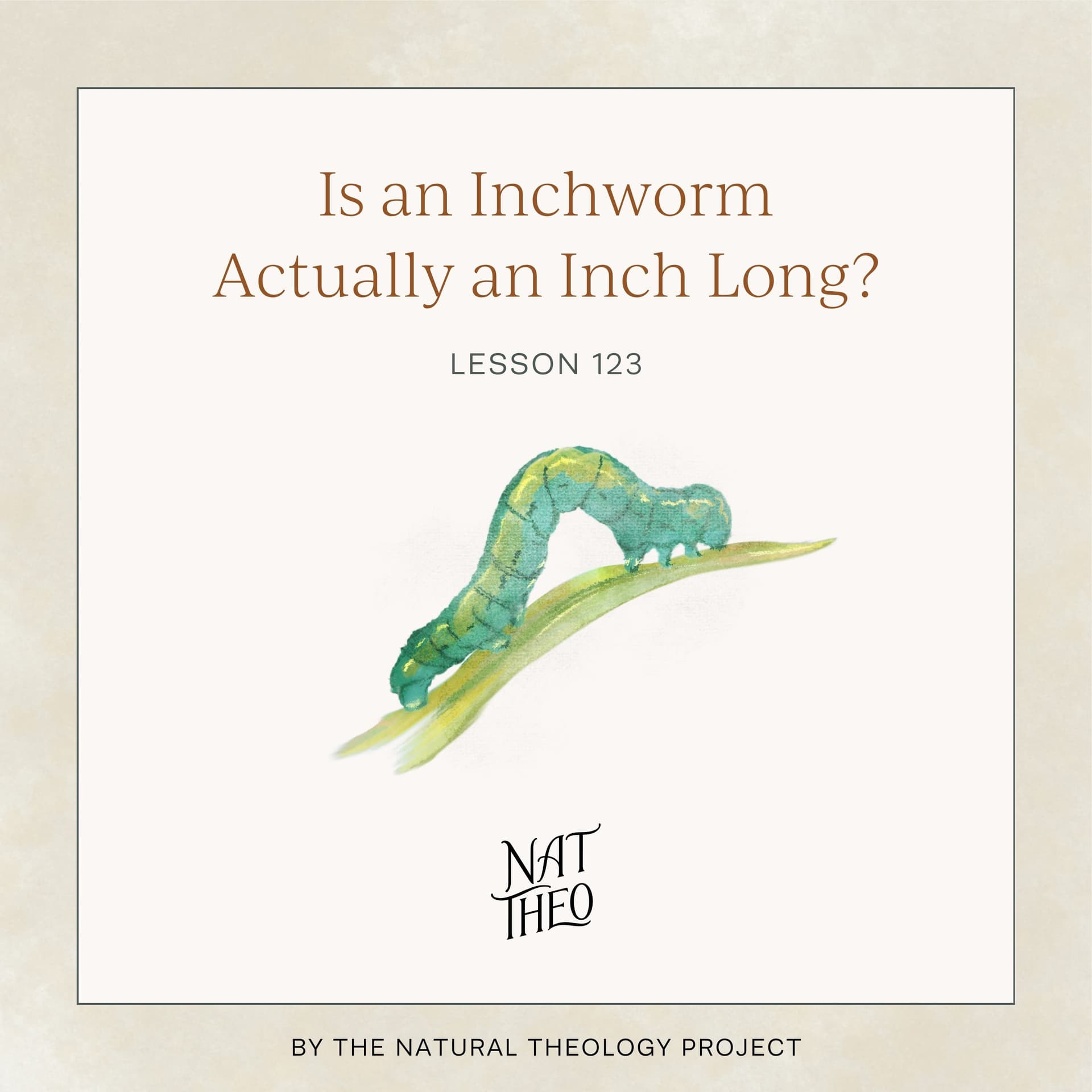
Loading summary
Transcript1 lines
- [00:00]
A
Hello world. Wake me up to another good Good morning. Time to go. Are you ready to explore God's wild and wonderful world? Welcome to the naptheo Podcast. I'm your host, Erin Lyneum. I'm a certified master naturalist, Bible teacher and author and I am so excited to dive into God's written word, the Bible and His created world with. Have you ever seen a small worm like creature inching itself across a stick or perhaps dangling from a tree branch using a thin thread of silk that's almost invisible? These creatures, often called inchworms, are very fun to find in the wild and today we are exploring God's magnificent designs in these insects. Here is our trail map. Are you ready? We are going to learn Is an inchworm a worm or a caterpillar? Why do inchworms hang from trees? Is an inchworm actually an inch long? And how does God measure His creation? Before we hit the trail, let's thank our sponsors who help make this lesson possible, including CTC Math. CTC Math has blessed our family in a big way as our kids have stepped out of math frustrations and come to a new understanding of and appreciation for math. We love that the lessons are simple, straightforward and short, so our kids are mastering math skills. Skills with plenty of time left to read, create and explore outside. Step by step. Tutorial videos and practice questions guide them in mastering math skills at their own pace and on a math course that makes sense with skills building upon each other. CTC Math believes in their product and so does our family. Try it risk free with a free trial and a 12 month money back guarantee at ctcmath.com or at the link in our Show Notes. Today we are learning about a fascinating insect that God designed. Kids, if you are interested in insects and curious about bugs, you will want to grab a copy of Bugs Big and Small. God Made Them all by Master Books. Discover God's purpose for creating insects and begin to see them as evidence of his brilliant creativity. Learn the secrets of bees, how treehoppers point us to the Gospel and the secret of the massive elephant mosquito in this adventure in entomology or insect study for kids. Pick up a copy of Big and Small God Made Them all and explore all of Master Book's curriculum and books for all ages from a biblical worldview@masterbooks.com or at the link in our Show Notes. It's time for our trivia question. What do most inchworms eat? A Leaves b Dirt c Nectar or d Other insects. Again, what do most inchworms eat? A Leaves b dirt c nectar or d Other insects. Take a guess and we will find out at the end of today's lesson. Annethio Club members, after this lesson, click over to the Bonus Video I'm going to show you a video I took last summer of a very interesting inchworm. I found an inchworm that looks like it has horns and learn why inchworms are very important in God's creation. Click over to that bonus video in the show notes or in your Nat Theo Club Dashboard. Here's a recent review from one of our listeners, Emmy, who says, I love Nat Theo so much because I learned new things about animals and God. My favorite episodes are the episodes about axolotls. Thank you Emmy. I am so glad that you are enjoying learning about axolotls and all of God's creation. Listeners, please take a moment today to leave a rating and written review on Apple Podcasts. All right, let's hit the trail. Have you ever been outside playing on a summer's day and felt a slight tickle on your arm or leg? Maybe you looked down and found a small, bright green creature. In inching along your skin, the back and front of its body come together as it pushes its back up, making its long body look kind of like the shape of a rainbow before it slides its front feet forward, lowers its back and becomes long and straight again. If you have seen this, whether yourself or in a picture or a video, you have seen an inchworm. But what exactly is an inchworm? Is it actually a worm? It looks quite different from the wriggling worms that you might find when you are playing and digging in the dirt. Many types of inchworms have bright bodies, making them look more like a caterpillar, which is what they are. That's right, inchworms are not worms at all. They are caterpillars. You might have noticed that I said many types of inchworms have bright bodies, and that's because an inchworm is not a single type of caterpillar, not just one bright green caterpillar. Instead, it refers to caterpillars in a special family or category of inchworms called geometridae. There are over 23,000 kinds of inchworms in this family. Some estimates say that that number is closer to 35,000 types, and each kind grows into a geometer moth. So inchworm is a nickname for caterpillars in the geometridae family. Known for getting around by inching along, Inchworms live in many places across the world and on every continent except Antarctica. You might have heard inchworms called by a different nickname. They are sometimes called loopers because their body looks like a loop when they are scrunched up. They can also be called spanners and earth measurers. These fascinating caterpillars go by several different nicknames and refer to 23,000 to 35,000 different types of caterpillars. But what do they share in common with each other? Why are they called inchworms in the first place? Is an inchworm actually an inch long? It is true that many inchworms are around 1 inch or 2 and a half centimeters long, although some can be shorter and some can be as long as 4 inches. So inchworm doesn't really refer to how long they are inches. Instead, an inchworm's nickname comes more from the unique way they move and get around. Inchworms appear to inch along a tree branch as they move in this unique way, bunching up and then stretching out their bodies. They look kind of like measuring tape, almost as if they are measuring the earth, which is where their name comes from. You might remember that one nickname for an inchworm is earth measurer. That comes right from their scientific name, Geometridae. Geometridae. This family of inchworms and moths gets its name from the ancient Greek language from two Greek words that mean to measure the earth. Why do inchworms move in such a different way than other caterpillars do? It all comes down to their feet. If you have ever seen an inchworm up close, you might have noticed that it does not have any legs at the center of its body. Most caterpillars have leg like stubs all along their body, helping them move their long body across sticks, rocks, the ground or a picnic table. Not all of a caterpillar's legs are true legs. Most caterpillars have three sets of true legs at the front of their bodies. These six true legs have tiny claws at the ends. So most caterpillars have six true legs, which makes sense because they are insects and all insects have six legs. These true legs are what are changed into the true legs of the moth when the caterpillar goes through metamorphosis. But what about all of those other legs on a caterpillar? Those are not actually legs, but instead something called prolegs, which are stubs that help the caterpillar move along. They are unsegmented, which means they don't bend like a leg with a knee and an ankle can bend. Instead, they are simple stubs that help the caterpillar move. The proleg stubs are absorbed kind of like they disappear during metamorphosis, so they are not part of the adult moth. All right, back to inchworms. Inchworms have the six true legs at the front of their body. They also have those proleg stubs at the back of their body. But unlike most caterpillars, they do not have proleg stumps at the center of their body. Because of this, inchworms don't move along in a smooth motion like most caterpillars do. Instead, they pull the back of their body with its proleg stumps toward the front of their body. When they do this, it makes the center of their body bridge up, looking like the shape of a rainbow or a loop. Then they move the front of their body with true legs forward, making their body stretch out again. And then repeat, repeat, repeat. As they inch along. As the inchworm moves like this, scrunching up and then stretching out over and over, it looks like they are inching forward a bit, like a measuring tape measuring the earth. I'm curious if you have ever seen an inchworm when you're out exploring in nature. When I was a kid, I remember being so excited every time I would find an inchworm. It was like finding a little living treasure. And they are so fun to watch. Sometimes the inchworms I found were not inching along a rock or a branch, but dangling from a tree, and I nearly walked right into them. That's because inchworms will dangle from a tree branch using a thin, almost invisible thread. I would be walking along through a pot park or through the forest when suddenly, at the last moment, I'd see an inchworm dangling right in front of my face. Have you ever nearly ran into an inchworm that was dangling in midair? The thin silk thread that they hang from is very hard to see, so it can look like they are hanging from nothing. Kind of like just floating in the air. Why do inchworms lower themselves from a tree branch and hang from silk? It is mostly to stay safe. If an inchworm is up on a tree branch, snacking away on leaves, and they feel movement on the branch, perhaps from a bird that might have inchworms on its lunch menu, the inchworm will escape by lowering itself down off the branch and waiting for the danger to pass until they head back up the silk thread to eat. Another reason an inchworm might lower itself down on a thread is if it's time to grow into a geometer moth. Inchworms lower themselves down to the ground and make a silk covered cocoon in the soil. Or in leaf litter in which they will grow into a moth. Does it surprise you that inchworms make silk? When we think about animals that create silk, we often picture spiders silver spinning their silky, sticky webs. But almost all species of caterpillars, including inchworms, make silk. In fact, most of the silk that humans use in things like clothes, bedding and other textiles comes from caterpillars, mostly from caterpillars called silkworms. So how do inchworms and other caterpillars make their silk? They make it in a similar way to how spiders create silky threads. God gave caterpillars a very useful organ or a body part with an important job to do called a spinneret. The spinneret is a tube shaped organ on or near the bottom of their mouth. Silk comes out of the spinneret. It begins inside the caterpillar's body as a liquid made from proteins. As soon as that liquid comes out of the spinneret and touches the air, it hardens into a silky thread. That is very helpful for a caterpillar. I have watched the caterpillars of butterflies do this and use this handy silk to attach themselves to branches or the top of a glass container as they hang upside down and get ready to create a chrysalis. And for the caterpillars of moths, including inchworms, it's very helpful for lowering themselves down from trees to escape danger or find a safe spot on the ground to create a cocoon. Do you remember some of the other nicknames for an inchworm? They can be called loopers, spanners, or earth measurers. Do you remember why inchworms are called earth measurers? This nickname comes from their scientific name, geometridae, which comes from two Greek words meaning to measure the earth. Can you imagine how long it might take an inchworm to inch around the entire earth, Measuring it one inch by another? That would be impossible. For one, inchworms are not known for their speed. Well, perhaps they are, but not for their fast speed. They have a reputation for moving slowly. And inchworms only stay inchworms for around two to four weeks. Then it's time to grow into a moth. Two to four weeks of inching around is simply not enough time to measure the whole earth. But do you know who does measure the entire earth? God, the creator of the cosmos, who spoke the entire universe into place. He knows every corner of his creation, and the Bible says he knows its measurements. Listen to what Isaiah 40:12 proclaims about God, who has measured the oceans in the palm of his hand, who has used his hand to measure the sky, who has used a bowl to measure all the dust of the earth and scales to weigh the mountains and hills here in Colorado. Our family lives very close to the Rocky Mountains. We see them every day, the massive Rocky Mountains. And I cannot imagine weighing them on a scale. But God knows the measurements of the oceans, skies, dust and mountains because he made them. Think about the little inchworm and listen to job 38, 45. Where were you when I made the earth's foundation? Tell me if you understand, who marked off how big it should be. Surely you know who stretched a ruler across it. The same God who created the amazing little inchworm, able to spin something silk, created the entire world and knows every inch of it. Listener, I love learning about nature and science because there is always more to discover. Every corner of the universe, from the highest mountaintops to the depths of the ocean to the spiraling galaxies, is bursting with the mysteries of what God has made, waiting for us to discover them. And think about this. God already knows the answer to all of our nature questions. He made the earth, and he knows everything about his creation, including you. Matthew 10:30 says, God even knows how many hairs are on your head. The same God who measures, understands, and holds all things in the universe together knows all about you, and he cares about every part of you. You are not ever lost or alone in this big world. Instead, God created everything, and then he created humans with you in mind. And he calls you. Very good. Do you know how many people live on Earth? It's around 8.3 billion. That's a lot of people. Only God knows the exact number at every moment, as some people pass away and others are born. But you are never lost in the numbers. God sees you. He knows you, and he loves you. You see, God doesn't only know the numbers, how many inches the Earth is around, how many. How many people are alive on Earth right now, or how many hairs are on your head. His knowledge is much deeper than just the facts. He knows you. He sees your days, your thoughts, your joys, your worries. You are deeply known and deeply loved. If you ever feel lost in the numbers, remember Ephesians 3, 18, 19, and that God's love for you is beyond measure. This passage says, and may you have the power to understand, as all God's people should know, how wide, how long, how high, and how deep his love is. May you experience the love of Christ, though it is too great to understand fully. Then you will be made complete with all the fullness of life and power that comes from God. It's time to answer a question from one of our listeners. Here is today's question. Hello, my name is Doyle. I'm 8 years old and I live in Michigan. I want to know the difference between antelope and deer. What a great question, Doyle. What is the difference between antelope and deer? Antelope and deer have many similarities, but God gave them unique features. First off, it might surprise you to learn that antelope and deer are in different families. Antelope are part of the Bovidae family. Other members of this family include sheep, goats and cattle. Deer, on the other hand, are part of the Cervidae family, which also includes elk, caribou and moose. Besides their taxonomy or classification, a main difference between antelope and deer is the fancy headgear that they wear. Antelope have horns and deer have antlers. What's the difference? Horns are permanently attached to the animal's head and they grow throughout the animal's entire life. Animals with antlers grow and shed their antlers each year. Both deer and antelope were designed by God with exactly what they need to survive and thrive. Thank you for your great question, Doyle. Stay curious about God's wild and wonderful world and at Theo Club members. After listening, remember to click over to the bonus video. I'm going to show you a really cool inchworm that I found last summer that looks like it has horns and we will learn the important job that inchworms have in in God's creation. Click over to that bonus video in your Nat Theo Club Dashboard or in the Show Notes. It's time to answer our trivia question. What do most inchworms eat? A leaves B dirt C Nectar or D other insects? The answer is A. Like other caterpillars, inchworms eat leaves and a lot of leaves. They have to eat and eat and eat and grow and grow and grow as they get ready to grow into a butterfly or moth. Now it's your turn to explore. Go on a nature walk and find an inchworm or another caterpillar. Look beneath leaves, on trees and on plant stems. Look closely as God designed many caterpillars to blend in with their surroundings. What might look like a stem or a twig might actually be a creeping caterpillar. Thank you so much for listening. If you enjoyed this lesson on the inchworm, please take a moment to send it to a friend and subscribe. Rate and review Nat Theo wherever you listen. Until next time, keep exploring God's wild and wonderful world. Imagine exploring the wonders of creation while growing in faith. Inside the Nat Theo Club, families are Discover God's creation through kid friendly science, devotional content, nature journaling, hands on activities, bonus videos, and more, all rooted in Biblical truth with flexible options for ages 4 to 14. Your children can explore birds, insects, reptiles, plants and other wonders of God's creation at their own pace with new content added every week. Celebrate each discovery with certificates of completion in our brand new Bible and Nature unit Studies. The Nat Theo Club is a meaningful, wonder filled way to help your family reconnect the dots between creation and creator. Visit natheo.comclub to learn more.