← Nat Theo Nature Lessons Rooted in the Bible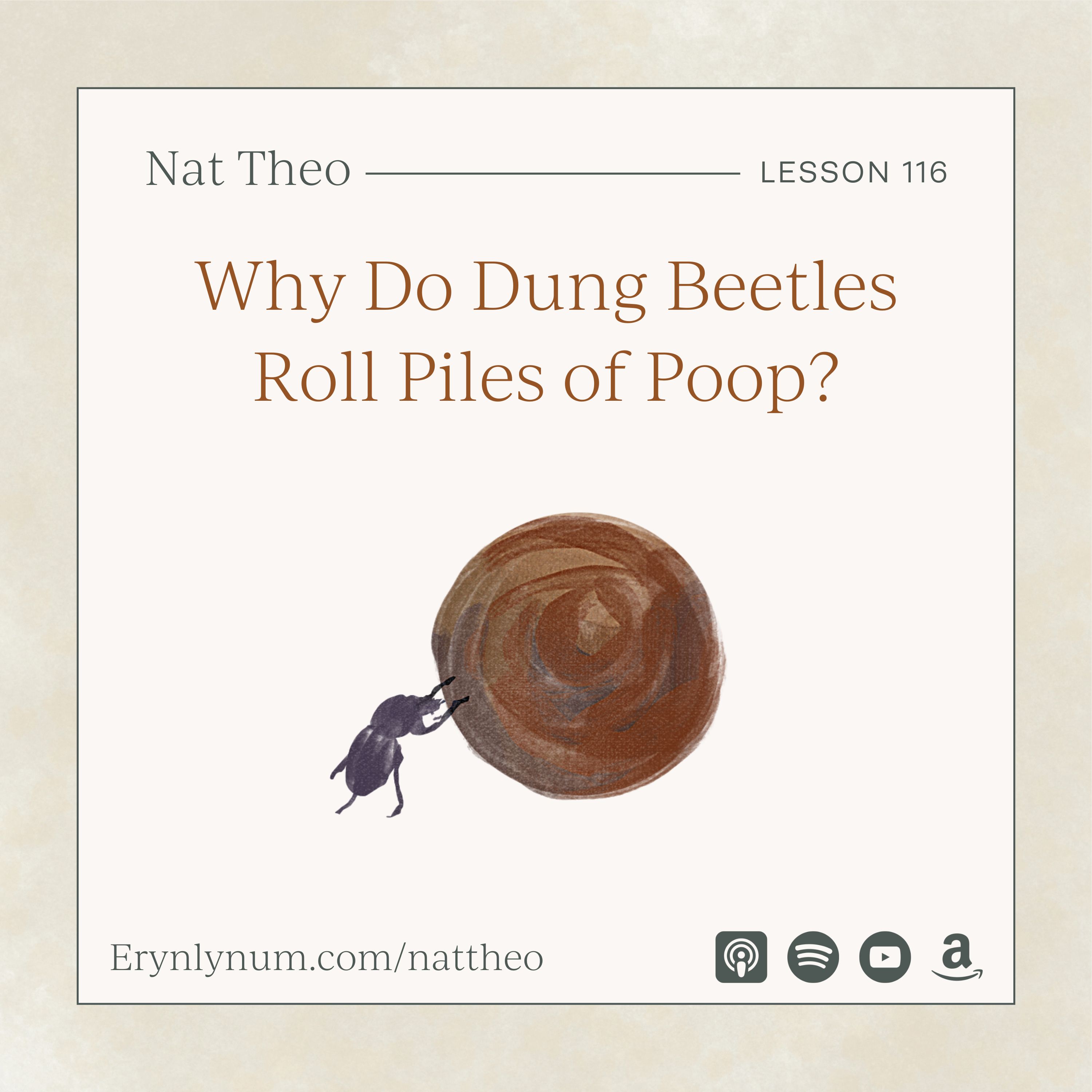
Nat Theo Nature Lessons Rooted in the Bible
Why Do Dung Beetles Roll Piles of Poop? Lesson 116
00:30:25
Loading summary
Transcript7 lines
- [00:00]
A
Have you downloaded the free coloring sheet for this lesson? Click the link in our Show Notes to print and color along as you listen. And join the Nat Theo Club at the link in our Show Notes to receive a full lesson and activity guide and a bonus video of content every single week so you can dive deeper into every lesson. Explore God's Wild and wonderful World in the Nat Theo club@aaron lyneum.com club or at the link in our Show Notes. Hello world. Wake me up to another good Good morning. Time to go. Are you ready to explore God's wild and wonderful world? Welcome to the naptheo Podcast. I'm your host Erin Lyneum. I'm a certified Master naturalist, Bible teacher and author and I am so excited to dive into God's written Word, the Bible and His created world with. Listeners. I am so excited for today's lesson. Our team had so much fun researching and learning about today's creature because this creature is full of surprises. But first, let me ask you this question. Have you ever built a snowman? How do you begin making a snowman? You probably begin by making a snowball and rolling it along the ground in the snow. As the snowball rolls, it collects more snow and gets bigger and heavier to roll. Eventually you have a very large snowball which you use for the bottom of the snowman. Then you might repeat the process to make a medium sized snowball for the middle and a smaller snowball for the head. Rolling snowballs and making snowmen is fun. Today we are learning about a creature that rolls up balls of not snow, but poop. We are looking at God's design in dung beetles. Here is our trail map.
- [02:25]
B
Are you ready?
- [02:27]
A
We are going to learn why do dung beetles roll piles of poop? Why do dung beetles collect dung? How is a dung beetle like a tiny beetle Astronomer and how can we use God's Word to find our way? Before we hit the trail, let's thank our sponsors who help make this lesson possible, including Master Books. Master Books is more than a homeschool curriculum. It is a journey of discovery, discipleship and growth as a family Listeners where do we find wisdom? God's Word? Where do we find hope? God's Word? Where do we find truth? God's Word? This is why Master Books is dedicated to rooting all of their books, curriculum and resources in the Bible. I never have to worry about hidden agendas or weird ideas when my kids are reading books by Master Books. Instead, I know they are growing in faith, wonder and Wisdom. Explore Master Book's full library at MasterBooks.com or at the link in our show Notes. And if you kids love listening to great stories, you will love the Sherwood Kids I Audio app. Sherwood has a one of a kind Library with over 5,000 audiobooks, eBooks, podcasts and read alongs that families can trust with no hidden agendas. And listen to this Sherwood kids is offering Natttheo listeners 20% off and a free speaker with an annual membership using the code NAT20. NAT20 with classic literature, missionary stories, nature stories, biographies and wholesome novels, your kids can grow in imagination, vocabulary and attention while they are enjoying the Sherwood Kids audio app. Save 20% and get a free speaker using the code NAT20 at the link in our show notes or at sherwoodkids.com NAT20 it's time for our Trivia Question. How big is the largest species of dung beetle? A about the size of a jelly bean b about the size of a ping pong ball c about the size of a chicken egg or d about the size of a pencil eraser. Again, how big is the largest species of dung beetle? A About the size of a jelly bean b a ping pong ball c a chicken egg or d a pencil eraser? Take a guess and we will find out at the end of today's lesson and Nat Theo Club members. After this lesson, click over to the bonus video where we will discover how dung beetles are like farmers and gardeners in God's creation. You can find that bonus video in your Nat Theo Club dashboard or the link in our show notes. Here's a recent review from one of our listeners. We are the McKee sisters. We love this podcast. You guys do an amazing job with it. We also appreciate the work that goes into it and are wondering if you can make a cat and dog episode. God bless you and your family. Thank you McKee sisters and a dog and cat episode Sounds fun. We appreciate your encouragement and the great idea. Listeners, please take a moment to leave a written review and rating on Apple Podcast today. All right, let's hit the trail. There are around 9,500 different types of dung beetles across the world. That is a lot of dung beetle designs. Dung beetles live in most places around the world and on every continent except Antarctica. I do wonder who were the scientists sitting on the ground waiting for beetles to interact with scat or poop and identifying species of dung beetles. That sounds like an interesting job. Dung beetles are sorted into three main tunnelers, dwellers and rollers. Tunnelers land on a pile of scat left by an animal. They dig into the pile and then tunnel beneath it into the ground, burying some of the scat or dung for later use. Dwellers simply dwell or stay on the pile of poop, laying their eggs on top. And rollers carve out a ball of dung from the pile and roll it away. Today we are looking closely at this third category, the rollers. Have you ever made a round ball out of play doh or clay? How do you make one? You probably place a chunk of play doh in between your hands and move your hands in a circular motion. As you do this, the chunk becomes rounder and a ball is formed. A ball rolls best when it is a perfect sphere. Do you know what a sphere is? A sphere is a perfectly round, solid shape, like a ball, orange or marble. It has no corners and no edges. Every point on a sphere is the same distance from the center, so it looks the same from every side. What if you were to make a sphere, a perfect ball shape out of clay, but the ball was much larger than you are? Do you think that would be easy or hard? That would be much harder because you don't just roll this ball between your hands if it's much larger than you are. But this is exactly what a dung beetle does. They find a fresh pile of animal dung or poop, and carve out and then compact it into a perfect ball of poop that is often much bigger than they are. The dung beetles need to move the poop away from the pile so that they can store it safely away to use in the future. So, of course, the ball cannot be lumpy or have edges. So they create a nearly perfect sphere and then roll it away from the dung pile. These dung or poop balls can weigh around 50 times more than the dung beetle does, and even more in some species. That would be like you creating and then pushing a ball that weighs around the same as a female hippopotamus. That is some super strength for a small beetle. But how exactly do the dung beetles create these great balls of poop? They are expert sculpture artists. Have you ever seen someone carve or sculpt something? I have watched people make carvings in the shape of animals out of tree stumps. And I've also seen people carving and sculpting using blocks of ice. Dung beetles do something similar. First, they need to find material, which, of course, is dung or poop. God designed dung beetles with super sensors for finding animal poop. Like other insects, dung beetles have two antennae extending from their heads to help them sense the world around them. But God gave dung beetles something Extra special on their antenna called chemoreceptors. Chemoreceptors are sensory organs on a dung beetle's antenna that allow it to sense animal scat from far away. These special organs are highly sensitive, helping a dung beetle find its much loved material, poop even in the dark. Once a dung beetle finds a dung pile, it's time to get to work. The dung beetle has three sets of legs built for carving, sculpting and rolling. The dung beetle uses its front set of legs to carve and grab poop from the pile an animal has left and then presses it or compacts it into a ball. The middle and hind legs help hold the ball as the front legs build and shape it. The middle and hind legs will then be put to work to roll the dung ball away. But why do you think they roll it away? They need to take it to a safe place for later use. You see, poop is in high demand for dung beetles and there is a lot of competition. They need to quickly roll away their dung pile and then they often bury it underground or take it into an underground burrow for safekeeping. But why exactly do dung beetles collect and store piles of poop? What do they use it for? Dung might seem like a strange thing to collect, but it is very important for dung beetles. They need it to live. This brings up a great question from one of our listeners.
- [12:11]
B
Hi, my name is Chase and I'm five years old and I live in Tasmania. I want to know two Dart beetles eat poop.
- [12:25]
A
That is a great question, Sage. And guess what? Yes, dung beetles eat poop, or rather the stuff inside poop. Dung might seem like a strange thing to collect, but it is very important for dung beetles. They need it to live. Adult dung beetles slurp the nutritious liquids from inside wet dung. Yes, it sounds gross to us, but it's how dung beetles get what they need. Dung beetles don't only use dung for food, they may also use it as nests and food for their babies. Some dung beetles roll a dung ball called a brood ball, which a mother dung beetle usually lays a single egg inside, Then, depending on the species, buries the brood ball. The egg hatches inside the brood ball. And fortunate for the baby dung beetle, they hatch right into a pile of food. The larva or baby dung beetle has plenty of food and nutrition that it needs to begin growing. That is what I would call breakfast in bed. While it may seem gross to us to search for, carve, roll up and collect poop, dung beetles were designed for the task so they have just what they need to eat, create nests, and provide food for their young. And as dung beetles go about all of these stinky tasks, they are also doing important work in God's creation. Dung beetles are detritivores. Detritivores are creatures that eat dead or decaying things and even animal waste, and then mix it into the soil. Then tiny decomposers like bacteria and fungi finish breaking it down into nutrients. In this way, dung beetles are both a cleanup crew and recyclers. They clean up piles of scat left by animals and recycle the poop into the soil, where it becomes helpful plant food. We learned how dung beetles find dung, carve it and sculpt it into balls and then roll it away. But how do dung beetles know where to take their piles of dung? This question brings us to one of my favorite facts about dung beetles, and that is how they navigate or find their way. It's very important for dung beetles to know where they are rolling their ball of dung, because remember, they are pushing it backwards and it's round and often much bigger or heavier than they are. They are often rolling it across uneven ground with bumps that would want to change their direction. It would be easy to get mixed up and start rolling their ball of dung in circles, getting nowhere fast and wasting a lot of important energy. Do you think the dung beetle has a GPS or a smartphone to help them find their way? Of course not. They don't even have a map, at least not like a paper map that we might use. But they do, in a way, use a map, a map of the night sky. Dung beetles use a special part in their eye called a dorsal rim and area, or DRA to see the night sky. The DRA is like a special compass area of their eye designed to see patterns in the night sky. Think of it like tiny, built in sunglasses that can see invisible patterns in the sky's light. Even when the sun is down and it's just moonlight, the sky still has a faint, organized pattern made by scattered blue and UV light. The beetle's compass zone can read that pattern, like seeing arrows painted across the sky, so it knows which way to roll its dung ball in a straight line. The DRA is located on the top of the beetle's eye facing toward the sky. Back at creation, God was designing dung beetles and some other insects with this special D R A eye compass to help them find their way. That is a very thoughtful creator. All right, are you ready to hear something funny? After a dung beetle rolls up a Ball of poop. It climbs up on top of it and stares into the night sky. It does a little dance in a circle as it inspects the sky above, like a tiny beetle astronomer studying the night sky. The beetle finds a landmark in the sky and then uses that landmark to make sure it keeps rolling its dung ball in the right direction and in a straight line. But what landmark is it using? Throughout history, many people used the night sky to find their way. Can you think of a story in the Bible when people did this? The wise men followed the star of Bethlehem to find young Jesus. But unlike people that followed specific stars like maps, dung beetles likely cannot see specific stars. They do not have sharp vision to see details like we do. So if they don't use the stars to find their way, what do they use? Two scientists in particular, Eric Warrent and his colleague Marie Dack, went on a mission to find out exactly how dung beetles use the night sky to find their way. The moon seems like an obvious landmark to use from Earth. It looks much bigger and brighter than the stars. But as you have probably noticed, we see the moon differently throughout each month. Sometimes it looks like a tiny fingernail, and other times it is a big, bright, round full moon. Sometimes it cannot even be seen seen in the night sky. So that would not be a great landmark for dung beetles to use every night. The two scientists studying dung beetles were in for a big surprise one night when they saw dung beetles creating piles of dung and rolling them away in a straight line before the moon came up into the sky and before the beetles could use the moon or, or its polarized light for navigation. So what were they using as their map? What other big source of light was in the night sky? The Milky Way galaxy with its billions of stars. Could the Beatles be using the Milky Way as their landmark? The two scientists had to put this idea to the test. How do you think they did that? By making tiny cardboard hats for the Beatles to wear. Of course. That's right, tiny cardboard beetle hats. But this was no beetle fashion show. It was a smart and creative science experiment. When the scientists placed the cardboard hats on the Beatles, the Beatles could no longer see the night sky above them. And they had a much harder time steering their dung balls in a straight line, proving that they were indeed using the night sky as a map. The scientists wanted to be sure of their finding. They wanted to make sure the beetles were not just set off balance or confused because this was their first time wearing a hat. So they replaced the cardboard hats with plastic see through hats. This time the beetles could steer in straight lines again because they could see through the plastic hats and use the night sky. Now it was time to move this experiment to a planetarium, which is a special room with a large domed roof and a screen showing the night sky on the ceiling. The scientists watched how the beetles navigated and pushed their dung balls when the starry sky was with a long streak imitating the Milky Way was projected on the ceiling. And they did well. The dung beetles performed about the same as when they were outside and had the moon in the real night sky. Next, they removed the starry sky from the ceiling and they left only the light streak of the Milky Way. When they had only the Milky Way, the Beatles performed just about as well. But then the scientists again changed the conditions of the experiment. This time they projected a starry night sky, but without the bright streak of the Milky Way. And guess what? The dung beetles had a much harder time finding their way without the Milky Way. This showed that the dung beetles were probably not using individuals stars to find their way because with only a starry sky they became a bit lost and had a hard time knowing where to roll their dung pile. Instead, it seemed clear that they were using both the moon and the Milky Way, big bright lights in the sky as their landmarks. This was the first documented finding of a creature using the Milky Way for navigation. Isn't that incredible? Can you imagine having that job, watching dung beetles, making tiny hats for them and playing in a planetarium to find out exactly how God designed these beetles to find their way so they can stay alive and have more beetles. That sounds like a fun day at work. God designed dung beetles with a special DRA compass in their eyes so they can use the night sky to find their way. Did you know that God has also given us a built in compass and a map to find our way? Our built in compass is not a special part in our eye. Instead it's something special in our soul. The Holy Spirit. If you follow Jesus as your Savior, then God's Holy Spirit is inside of you. And the Holy Spirit is like a compass guiding us into God's truth and in following God's ways, John 16:13 says, but when he, the Spirit of Truth comes, he will guide you into all truth. He will not speak on his own. He will speak only what he hears and he will tell you what is yet to come. So the Holy Spirit is like our compassion. And what is our map? Not the moon or the Milky Way, but God's word, the Bible. Just as the light of the Milky Way helps guide dung beetles. The light of God's Word leads us. Psalm 119:105 says, Your word is like a lamp for my feet and a light for my path. Listener, we don't have to go through life feeling lost or confused. We don't need to spin in circles, unsure of where to go next. Instead, we can follow God's Holy Spirit and His Word, the Bible every morning. We can pray Dear God, lead me today. Help me to sense and follow your spirit and understand and follow your Word, the Bible. Of course, we cannot understand or follow the Bible if we are not reading it. So listener, here is my challenge to you today. If you are not already doing this, begin a habit of reading God's Word every day. If you're not sure where to begin, perhaps start by reading the Book of John to learn about Jesus when He was on Earth. If you're not yet reading, no worries. Ask an adult to read to you or use an audio Bible app. Read or listen to God's Word every day and watch for how his light leads you to great things. It's time to answer a question from one of our listeners. But before we do, parents and caregivers, I have something to share with you. Are you looking for practical parenting advice from a biblical perspective? Would you love to see your children obey out of a genuine love for God rather than a fear of punishment? Do you sometimes feel like your children have trained you more than you've trained them? Then check out the Parenting with Ginger Hubbard podcast. Ginger is the bestselling author of Don't Make Me Count itself, three wise words for Moms, and I can't believe you just said that. The Parenting with Ginger Hubbard podcast equips parents to reach beyond outward behavior, address the issues of the heart, and point their children to the transformational power of Christ. Learn how to move past the frustrations of not knowing how to handle issues of disobedience and defiance and into a confident, well balanced and biblical approach to raising your children. Subscribe to the Parenting with Ginger Hubbard podcast wherever you listen to podcasts. For practical encouragement that's rooted in God's word, here is today's question.
- [26:37]
B
Hi, my name is Luke and I am six years old. I want to learn how salamanders are born in water and then grow up to be animals.
- [26:46]
A
Thanks for your great question, Luca. How are salamanders born in water and then grow up to live on land? Many species of salamanders are born in water and grow up to be on land because God designed them to go through a very special process called metamorphosis. Metamorphosis is when an animal undergoes a change in its physical form. Salamanders hatch out of jelly like eggs into larvae or tadpoles. In the tadpole stage, most species of salamanders have gills and live completely underwater. As they grow, salamander tadpoles develop their limbs and lungs. In their juvenile and later adult stage, Salamanders have fully developed limbs and lungs and they can breathe air up on land. As adults, they live on land, but most species still spend part of their time in the water. The life cycle continues when adult salamanders lay their eggs in the water. God designed a truly fascinating life cycle for salamanders. If you want to learn more about salamanders and this special metamorphosis process, including a special type of salamander, the Axolotl listen to lesson 106 why do axolotls never grow up? Thanks for your great question, Luca. Stay curious about God's wild and wonderful world and Nat Theo Club members. Remember to click over to our bonus video where we will discover how dung beetles are like little farmers and gardeners in God's creation. Find that bonus video in your Nat Theo Club dashboard or the link in our show notes. It's time to answer our trivia question. How big is the largest species of dung beetle? A about the size of a jellybean, b about the size of a ping pong ball, c about the size of a chicken egg or d about the size of a pencil eraser? The answer is c about the size of a chicken egg. The largest dung beetle is likely the elephant dung beetle, which can grow to be over 2 inches long. As you might guess from its name and size, it is often found feasting on piles of dung left from large animals like elephants. We can be thankful for their job as an elephant cleanup crew. Now it's your turn to explore. Go look at the night sky this coming week like a dung beetle skin scanning the sky for a landmark. Look for an extra bright star, a constellation or the moon. If you were trying to find your way in the night, what might you use as a landmark? Thank God for creating the night sky so wonderfully and a creature as interesting as a dung beetle to use the night sky as a map. Thank you so much for the listening. If you enjoyed this lesson on the dung beetle, please take a moment to send it to a friend and subscribe. Rate and review Nat Theo wherever you listen. Until next time, keep exploring God's wild and wonderful world. For adventure.