
Podcast
No Guilt Mom | Overcoming Mom Guilt, Parenting Tips, & Self Care for Moms
Hosted by JoAnn Crohn | Parenting Coach & Mom Guilt Support · EN
Tired of yelling at your kids and drowning in mom guilt? You're not broken — you're just missing the right tools.
No Guilt Mom is the parenting podcast for moms who want to stop losing their temper, manage mom overwhelm, and actually enjoy motherhood without the shame spiral. Twice a week, author and parenting coach JoAnn Crohn, M.Ed. brings you real conversations with experts on strong-willed kids, working mom burnout, mental load, ADHD parenting, self-compassion, and the gap between the mom you want to be and how you're actually showing up.
New episodes every Tuesday and Thursday, plus a monthly bonus episode.
No perfect parenting advice. No guilt trips. Just practical tools that work in real life — and permission to be a happy mom, not just a good one.
New here? Search "No Guilt Mom Start Here" to find the best episodes for exactly where you are right now.
Follow or subscribe so you never miss an episode. 🎙
"The best mom is a happy mom. Take care of you."
23episodes
Episodes
Newest firstAll episodes

Why You Spiral When Someone Calls You Disrespectful (And What Their Words Really Mean)
4d ago00:34:31Tap to summarizeNew here? Start with our Start Here playlist — five episodes that will change how you think about motherhood. Has someone ever told you that you made them feel disrespected or small, and your stomach just dropped? Maybe you replayed every conversation trying to find the moment you did it. Today JoAnn walks you through three actionable steps to work through that moment, rooted in the psychology of why accusations like this happen, especially between the people closest to you. In this episode, you'll learn: How to check your own intentions after being accused of something, without spiraling into shame Why an accusation from someone close to you is often a report on their own identity, not a fact about your behavior The research on why confidence and success from women gets read differently than the same behavior from men Three steps to decide how you want to respond, including when it's okay to take space Resources mentioned in this episode: The Tallest Poppy Survey (2023) The "Acting Wife" study on women and self-silencing in MBA programs Amanda's story about setting boundaries with in-laws The Best Mom is a Happy Mom by JoAnn Crohn The Happy Mom Reset, free class Ready to stop carrying guilt that was never yours to hold? Join The Happy Mom Reset free class and get your plan to feel lighter this week. Learn more about your ad choices. Visit podcastchoices.com/adchoices
Transcribe →
Why You Can't Just 'Be More Consistent' with Monica Packer
6d ago00:38:10Tap to summarizeNew here? Start with our Start Here playlist — five episodes that will change how you think about motherhood. You've tried the habit trackers, the 21 day challenges, and every "just be consistent" article out there, and none of it sticks for more than a week. Certified habit coach Monica Packer joins JoAnn to explain why most habit advice was never built for moms in the first place, and what actually works when your day never goes as planned. In this episode, you'll learn: Why the habit advice you've been given fails women's actual lives, and it's not a discipline problem How to build a baseline version of any habit so one hard day doesn't wreck your progress Why consistency and flexibility work together instead of competing against each other The three step sticky habit formula for making any new habit actually stick How invisible labor and mental load make typical productivity advice unworkable for moms Resources mentioned in this episode: Follow Monica Packer on Instagram Sticky Habits by Monica Packer, out in September with pre-order bonuses available now Happy Mom Reset Free Class Ready to stop over apologizing and start setting boundaries that actually stick? Join the free Happy Mom Reset class. Learn more about your ad choices. Visit podcastchoices.com/adchoices
Transcribe →
Why You Can't Relax After Doing Something Good for Yourself
1w ago00:31:45Tap to summarizeYou did something good for yourself, a massage, an hour off, a class you have always wanted to take, and then the guilt showed up like you had done something wrong. In this solo episode, JoAnn names exactly what is happening (she calls it the guilt slide) and walks you through how to catch it and step off before it takes down your day or your relationships. In this episode, you'll learn: How to spot the "guilt slide," the moment a good thing you did for yourself turns into proof you did something wrong Why that guilt is a sign something is new for you, not a sign you are selfish or broken The one move that protects your closest relationships when the guilt hits, and why it is not asking "are you mad at me?" Three self-compassion steps to wait out the discomfort instead of projecting it onto everyone around you A simple way to redirect your brain so the feeling passes faster Resources mentioned in this episode: "This Isn't a Sketchbook, its an Art Class" drawing workbook Podcast Episode: Why the ADHD Parenting Advice Doesn't Work (the RSD episode) The Happy Mom Reset, JoAnn's free class New here? Start with The Happy Mom Reset, JoAnn's free class, at https://learn.noguiltmom.com/happy-mom-reset. Learn more about your ad choices. Visit podcastchoices.com/adchoices
Transcribe →
Why Your Reward Charts Keep Backfiring (It's Not Your Fault)
2w ago00:40:55Tap to summarizeRewards feel like good parenting. A sticker chart here, screen time for finished homework there, and suddenly your kid won't do anything without asking what they get. In this episode, JoAnn sits down with Dr. Özgür Bolat, author of The Reward Trap, to unpack why rewards quietly backfire and what actually builds the motivation you want. In this episode, you'll learn: Why your reward systems stop working, even when you set them up perfectly The hidden message every reward sends your child, and why it lands like a threat The one situation where a reward genuinely helps, and how to use it without getting stuck A small shift you can try tonight that beats any sticker chart How rewards and praise quietly feed your own mom guilt, and what to do instead Resources mentioned in this episode: The Reward Trap by Dr. Özgür Bolat Dr. Özgür Bolat on Instagram The Happy Mom Reset free class Ready to feel less behind and more like yourself? Save your seat for The Happy Mom Reset free class. Learn more about your ad choices. Visit podcastchoices.com/adchoices
Transcribe →
Why You Stop Having Fun The Second Your Kid Is Miserable
3w ago00:31:18Tap to summarizeYou're at the party, the pool, the vacation you planned, and the second one of your kids gets miserable, your fun switches off like someone hit a light. In this episode, JoAnn breaks down the moment she caught herself doing exactly this at her nephew's birthday party, and the one question that snapped her out of it. If your kids' emotions are costing you your own, this one is going to hit home. In this episode, you'll learn: The rushing cue: how to catch yourself before mild stress turns into full dysregulation The difference between consideration and responsibility for your kids' feelings, and why one is loving while the other is exhausting you both Exactly what to say when your kid says "I'm bored" (and how to spot the one situation where that script won't work) Why letting your kid sit in mild discomfort is some of the best parenting you can do The honest question to ask yourself when you rush to fix your kid's mood Resources mentioned in this episode: JoAnn's interview with Jenna Free on recognizing dysregulation The Happy Mom Reset (free class) Ready to stop running on guilt? Join JoAnn's free class, The Happy Mom Reset. Learn more about your ad choices. Visit podcastchoices.com/adchoices
Transcribe →
Why You Can't Relax Even When You Finally Have Time To with Emily Jones and Julie Dobbs
3w ago00:36:57Tap to summarizeNew here? Start with our Start Here playlist — five episodes that will change how you think about motherhood. Have you ever caught yourself thinking, in the middle of an especially relentless week, that a minor car accident might actually be a relief — if it meant a doctor's note to lie in bed for two days? No serious injuries, just... permission to stop? Yeah. Emily and Julie get it. JoAnn sits down with Emily Jones and Julie Dobbs, hosts of the Mom Game podcast, for an honest, unfiltered conversation about what it's actually like to be a high-achieving mom who cannot turn her brain off. They talk about the badge of honor we've attached to being busy, the two kinds of mental load (logistical and emotional — and why the emotional one never stops), hormones, perimenopause, the mom volunteer spiral, and what has genuinely helped each of them find moments of real relaxation in the middle of all of it. In this episode: The "minor car accident" fantasy — and why even joking about it should be a warning sign Why high-achieving moms struggle to turn their brains off even when they technically have downtime The difference between the logistical mental load and the emotional mental load (and why the emotional one follows you everywhere) Why you're only as happy as your saddest kid — and what to do with that How hormones and perimenopause are contributing to the overwhelm nobody talked about until now The mom volunteer spiral: who's creating it, who's perpetuating it, and why moms are sometimes part of the problem Why normalizing imperfection — including being open about your kid's ADHD diagnosis — actually helps everyone What's genuinely helped each of them relax: girlfriends, court sports, a good group chat, and improv comedy How to know when you need an outlet before you explode (and why you never want to wait until you do) This one feels like sitting around with friends who get it. No solutions required — just a conversation that makes you feel a little less alone in all of it. Find Emily and Julie on the Mom Game podcast wherever you listen to podcasts. If you're listening on Spotify, hit the Follow button right now — it's the best way to make sure you never miss an episode and it helps me reach more moms like you. Remember: the best mom is a happy mom. Take care of you. Learn more about your ad choices. Visit podcastchoices.com/adchoices
Transcribe →
Why Rejection Hits You So Hard (And How to Stop Letting It Run Your Life)
4w ago00:36:40Tap to summarizeNew here? Start with our Start Here playlist — five episodes that will change how you think about motherhood. Have you ever gotten a rejection — or even just an eye roll from someone — and felt it for days? Like actually felt it, physically, in a way that seemed way out of proportion to what happened? There's a reason for that. And it's not that you're too sensitive or too fragile. It might be exactly how your nervous system is wired. In this episode, JoAnn gets personal about Rejection Sensitive Dysphoria (RSD), why it's strongly associated with ADHD brains, and why understanding it changed everything about how she deals with rejection. She shares the story of her first job out of college — working in the mailroom at Endeavor talent agency in Beverly Hills — and what happened when she dropped calls on an agent's desk for the first time. And then she walks through three tools that have genuinely helped her stop letting rejection run her life. In this episode: What Rejection Sensitive Dysphoria actually is — and why rejection can feel like physical pain for some nervous systems Why rumination doesn't process rejection — it rehearses it (and what to do instead) The NLP tool of association vs. disassociation — how watching yourself like a movie gives you access to compassion you can't find from inside the spiral How disassociation helps you find the "why" of the other person — which makes the rejection feel a whole lot less personal Why JoAnn's new goal is to collect as many no's as possible (and why that's not self-punishment — it's strategy) The national board certification story: why the second rejection always hurts less than the first Why failure is literally the fastest path to learning — and why being mistake-free makes you deeply unrelatable The improv comedy lesson that reframes every stage fright into evidence you're growing Whether or not you have ADHD, if rejection hits you harder than it seems to hit other people — if one critical comment can undo a week of confidence — this episode is for you. Episodes mentioned: Guy Winch on rumination — When Work Stress Hijacks Your Home: Stop Ruminating Dr. Josh Davis on updating your beliefs — The Beliefs Fueling Your Mom Guilt (And How to Update Them) If you're listening on Spotify, hit the Follow button right now — it's the best way to make sure you never miss an episode and it helps me reach more moms like you. Remember: the best mom is a happy mom. Take care of you. Learn more about your ad choices. Visit podcastchoices.com/adchoices
Transcribe →
Why You Feel Responsible for Everyone Else's Emotions (And How to Finally Stop) with Hailey Magee
4w ago00:37:32Tap to summarizeNew here? Start with our Start Here playlist — five episodes that will change how you think about motherhood. If you've ever said yes when you meant no, stayed silent when something bothered you, or felt guilty the moment you tried to set a limit — this episode is going to name exactly what's been going on. And more importantly, it's going to give you a way out. JoAnn sits down with Hailey Magee, people-pleasing coach and author of Stop People Pleasing and Find Your Power, to dig into why so many women become people pleasers in the first place, what's actually happening when boundaries feel impossible, and the small, practical shifts that make it easier to start standing up for your own needs — without feeling like the villain. In this episode: Why people-pleasing is a safety mechanism, not a personality flaw — and the three kinds of safety it's trying to protect Why neurodivergent women and women from marginalized groups are especially likely to develop people-pleasing as a survival skill The crucial difference between a boundary and a request — and why your "boundaries" might not be working because they're actually requests Why boundary guilt is almost universal — and the reframe that makes it survivable The "meaning vacuum": what happens to your identity when a major life chapter ends and the new one hasn't started yet How to tell when you have an unmet need before you even know what it is (Hailey's need signpost tool) Why feeling "too sensitive" or "too demanding" when you set a boundary is actually a sign you're doing it right The post-boundary self-care plan — why you need one and what it looks like in practice One small shift to start rebuilding self-trust: track what drains you vs. what energizes you JoAnn also shares the real dinner table moment that prompted a boundary conversation with her family, and the first time she ever redirected a draining professional relationship by email — and how it felt on the other side. Find Hailey and her book Stop People Pleasing and Find Your Power at haileymagee.com. If you're listening on Spotify, hit the Follow button right now — it's the best way to make sure you never miss an episode and it helps me reach more moms like you. Remember: the best mom is a happy mom. Take care of you. Learn more about your ad choices. Visit podcastchoices.com/adchoices
Transcribe →
Why You Care So Much What Other People Think (And How to Finally Stop)
Jul 200:34:57Tap to summarizeNew here? Start with our Start Here playlist — five episodes that will change how you think about motherhood. You know you shouldn't care what other people think. You've probably told yourself that a hundred times. And yet — you still rearrange your behavior for people whose opinions you don't even fully respect. You do the laundry because of some imaginary judge. You say yes when you mean no. You replay comments for days. You hold back your real opinion in a room full of people. Today, JoAnn gets into why this happens, what you can actually do about it, and shares a very personal story about a professional decision she was terrified to make — and what the response taught her about who she does and doesn't want in her life. In this episode: The thought distortion that's behind almost every fear of judgment — and how to catch yourself doing it Why "people will judge me" is a generalization, and the one question that breaks it open How to name the actual person you're afraid of — and then ask whether you even respect their opinion What happened when JoAnn canceled an interview she knew wasn't right for her listeners (and the response that confirmed she made the right call) Why walking on eggshells in relationships quietly erodes your confidence — and what happens when you stop First, second, and third person perspective: a simple framework for separating what actually happened from the story you're telling yourself about it Why not being liked is not your failure — it's a mismatch, and the difference matters How to find your actual people by being yourself clearly enough that the wrong ones self-select out You're going to finish this episode knowing exactly who you've been trying to impress — and whether they've actually earned that kind of real estate in your head. If you're listening on Spotify, hit the Follow button right now — it's the best way to make sure you never miss an episode and it helps me reach more moms like you. Remember: the best mom is a happy mom. Take care of you. Learn more about your ad choices. Visit podcastchoices.com/adchoices
Transcribe →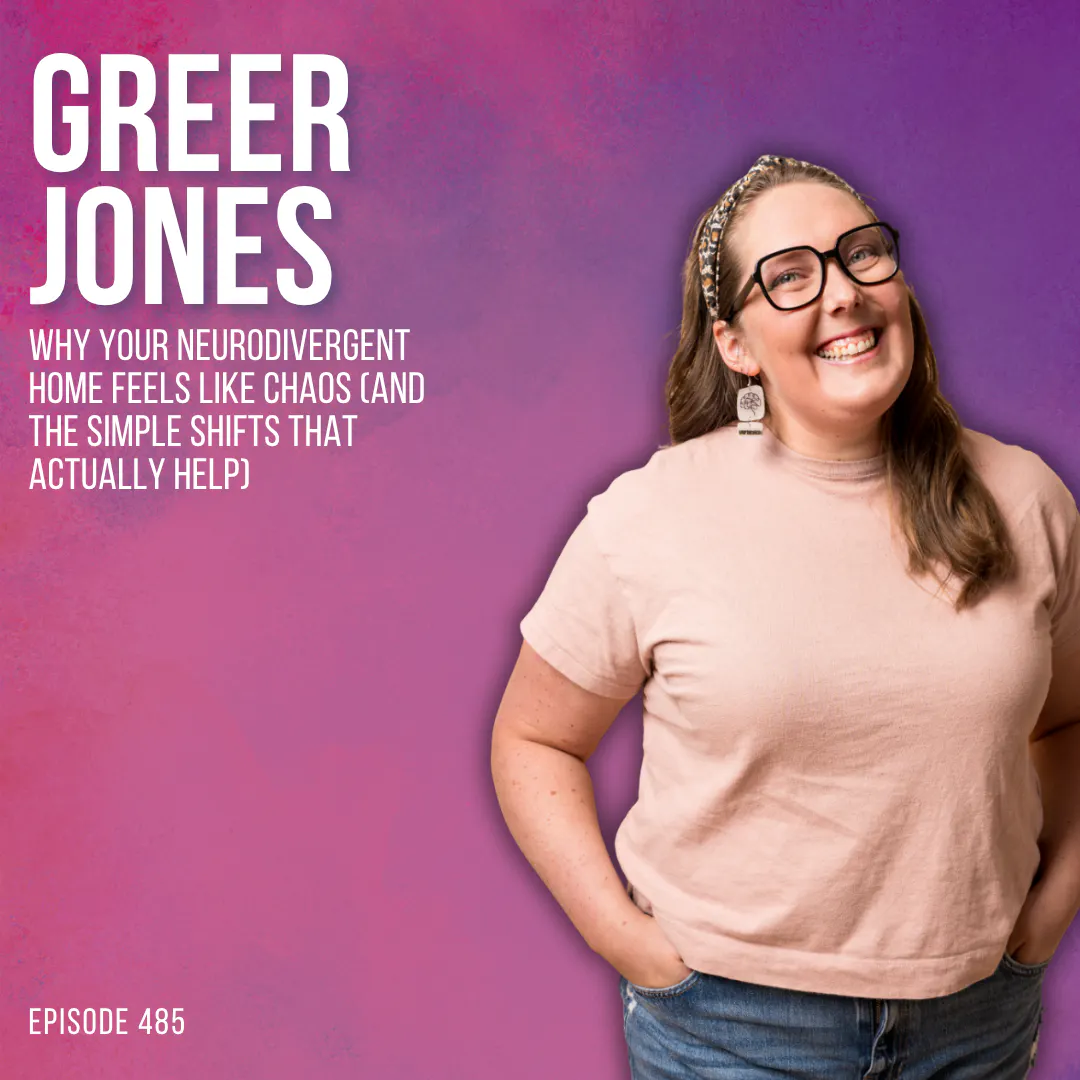
Why Your Neurodivergent Home Feels Like Chaos (And the Simple Shifts That Actually Help) with Greer Jones
Jun 3000:36:21Tap to summarizeNew here? Start with our Start Here playlist — five episodes that will change how you think about motherhood. If your home feels like constant chaos — the yelling, the rushing, the dinners that nobody sits through, the mornings that derail everything — this episode is going to feel like someone finally gets it. JoAnn sits down with Greer Jones, host of the Neurodivergent Conversations podcast and a mom who has navigated her own ADHD diagnosis, her husband's autism, and her son's ADHD and autism diagnosis — all at the same time. What she found is that the chaos wasn't a parenting failure. It was what happens when a neurodivergent family tries to force themselves into systems built for a completely different kind of brain. Greer shares the specific, practical shifts that took her family from loud, exhausting chaos to a home where everyone's nervous system can actually exhale. In this episode: What it looks like when multiple family members are diagnosed with neurodivergence at the same time — and how Greer figured out it wasn't just her kid Why burnout in a neurodivergent mom costs her family an estimated $1,200 more per month (yes, really) The counterintuitive first step Greer took to fix the chaos: she started with what SHE wanted How to work backwards from the morning you want — and find the actual pain points causing the rush Why getting up 45 minutes earlier is not the answer (and what to do instead) The 300-seconds trick that works on ADHD brains even when you know it's coming Brain breaks at dinner: how Greer's son went from not eating to sitting for seven minutes — by being allowed to run around first The "freeze" method for resetting a chaotic moment in real time Why modeling calm is the single most powerful thing you can do for a neurodivergent child How to start teaching your kids to advocate for their own needs — even at age seven If you've been trying to force your family into routines that weren't built for your brains, this conversation is your permission to stop — and build something that actually works. Find Greer and the Neurodivergent Conversations podcast wherever you listen to podcasts. If you're listening on Spotify, hit the Follow button right now — it's the best way to make sure you never miss an episode and it helps me reach more moms like you. Remember: the best mom is a happy mom. Take care of you. Learn more about your ad choices. Visit podcastchoices.com/adchoices
Transcribe →