Podcast
NXTLVL Experience Design
Hosted by David Kepron · EN
NXTLVL Experience Design will bring you daring and different dialogues about “DATA: Design, Architecture, Technology and the Arts.”
You’ll hear from provocateurs for whom disruption and transformation are a way of engaging in work and play everyday.
My guests will include thought leaders who are driven by a passion to create the ‘new possible’ and promote new paradigms of experience into the mainstream.
Designers from all disciplines.
Architects who are changing the landscape of the built world.
Techno-philes – visionaries who make deeply sensory-based but digitally-mediated experiences.
And I’ll explore the transformative process of creativity with artists of all sorts.
24episodes
Episodes
Newest firstAll episodes
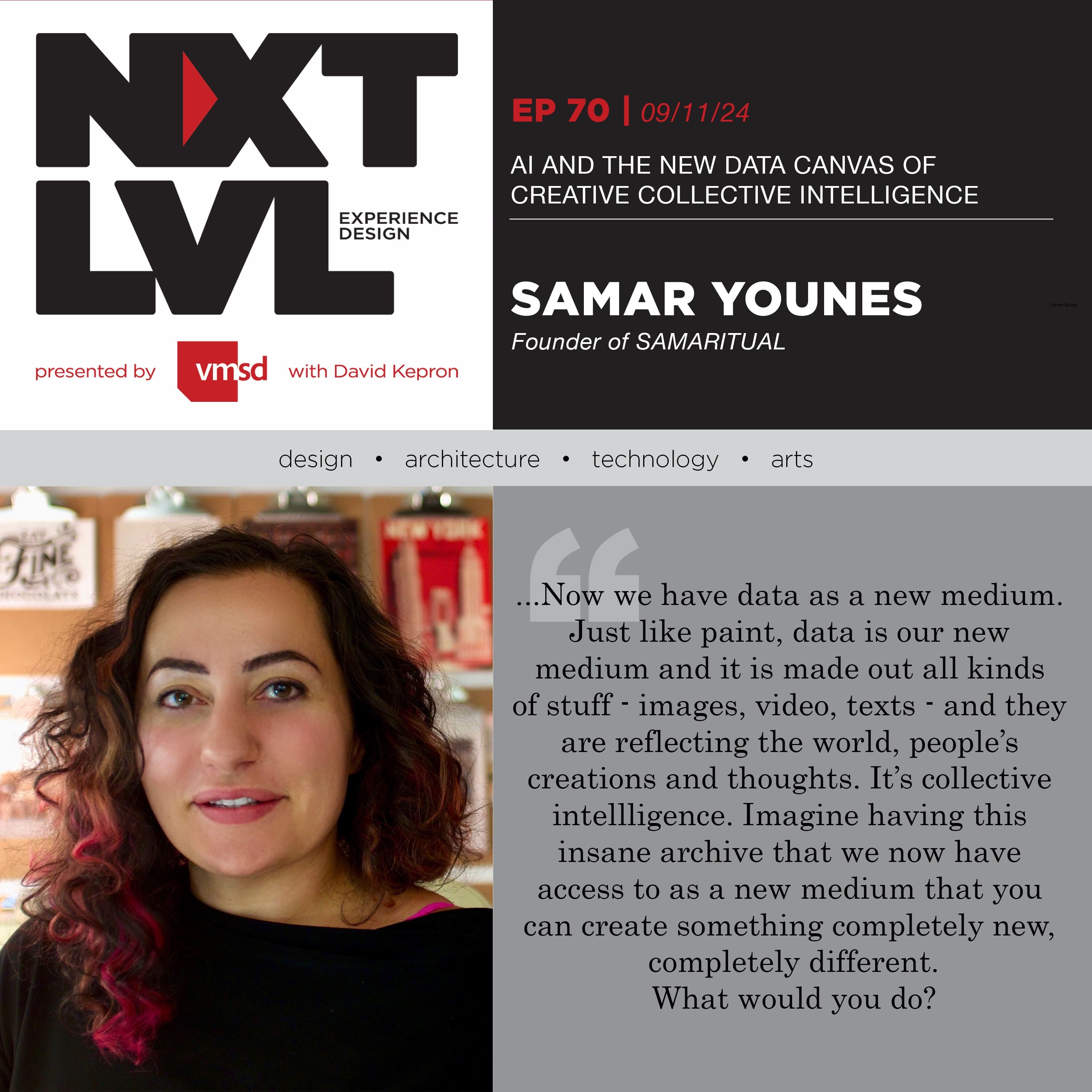
EP. 70 AI AND THE NEW DATA CANVAS OF CREATIVE COLLECTIVE INTELLIGENCE with Samar Younes, Founder SAMARITUAL
Sep 11, 202401:30:21Tap to summarizeABOUT SAMAR YOUNES:LinkedIn Profile: https://www.linkedin.com/in/samaryounes/Websites:bio.site/samaritualwww.samaritual.comBio:Samar Younes is a Beirut-born hybrid artist, futurist, and creative catalyst whose work embodies a transcultural approach. As the visionary behind SAMARITUAL, a multidisciplinary creative studio, she weaves multidimensional narratives at the intersection of humanity, technology, and nature. With over 20 years of experience as an artistic director and brand strategist, Samar blends generative AI with artisanal craftsmanship and ancestral wisdom to create immersive experiences that challenge stereotypes and envision nuanced futures.A Central Saint Martins alumna, Samar's work explores global south futures, otherworldly narratives, and interspecies harmonies through three interconnected spheres: Creator, Catalyst, and Cultivator. As a Creator, she crafts visionary artworks and installations that blur the lines between art, fashion, and architecture. In her Catalyst role, she provides strategic foresight and cultural alchemy for organizations navigating our evolving world. As a Cultivator, she nurtures future creativity through her Imaginalogy hybrid future edu lab, empowering individuals with tools and perspectives to thrive in an ever-changing creative landscape in the age of AI.Samar's transcultural perspective allows her to seamlessly integrate diverse cultural influences, creating a unique aesthetic and transcultural language symbiotic to her diasporic and third culture experience. Using a neuroaesthetic lens, she celebrates kaleidoscopic identities that resist binary categorizations. Through SAMARITUAL, Samar fosters interconnectedness, radical imagination, and visionary world-building, inviting us to participate in crafting inclusive, sustainable narratives that bridge ancestral wisdom with speculative futures. SHOW INTRO:Welcome to the NXTLVL Experience Design podcast.Well here we are…SEASON 6…our 70th episode. And we’ve had some great interactions in the first 69. This season will be no less engaging.In the coming weeks we’ll have artists, architects, authors and educators. We dig into tech issues with people who make crafting a digital future their lives work. Scientists who will expand our understand of the way we work and how the environments around us work on us. These dynamic dialogues based on our acronym DATA - design, architecture, technology, and the arts crosses over disciplines but maintains a common thread of people who are passionate about the world we live in and human’s influence on it, the ways we craft the built environment to maximize human experience, increasing our understanding of human behavior and searching for the New Possible. The NXTLVL Experience Design podcast is presented by VMSD Magazine part of the Smartwork Media family of brands.VMSD brings us, in the brand experience world, the International Retail Design Conference. The IRDC is one of the best retail design conferences that there is bringing together the world of retailers, brands and experience place makers every year for two days of engaging conversations and pushing the discourse forward on what makes retailing relevant. You will find the archive of the NXTLVL Experience Design podcast on VMSD.com.Thanks also goes to Shop Association the only global retail trade association dedicated to elevating the in-store experience. SHOP Association represents companies and affiliates from 25 countries and brings value to their members through research, networking, education, events and awards. Check then out on SHOPAssociation.orgIn this 70th episode I talk with Samar Younes is a Beirut-born hybrid artist, futurist, and creative catalyst whose work embodies a transcultural approach. Samar blends generative AI with artisanal craftsmanship and ancestral wisdom to create immersive experiences that challenge stereotypes and envision nuanced futures.First though, a few thoughts… * * *At the core of this podcast is the idea of fostering “dynamic dialogues on data DATA” an acronym to include Architecture, Design, Technology and the Arts. Of course, the idea of talking about DATA is that it's a double entendre that allows me to dive into subjects about the impact that a data-driven society has on a myriad aspects of our human experience. Since writing my book “Retail Revolution: Why creating right brain stores will shape the future of shopping in a digitally driven world,” I've had a persistent interest in studying how technological advances are reshaping the way we interact with each other and the world around us. The impact on various industries - commercial enterprises like the retail and hospitality worlds where I have built a 30 year career. And I've often chosen to discuss how artists and creators of all kinds can wield this amazing tool of data as a new medium for the creation of places where we can interact and connect in relevant ways. At both a city level or small footprint retail store level, I've looked at how digital technologies have grown beyond touch screen interfaces and wayfinding devices to fully immersive environments that deeply affect the way we experience a brand, a product assortment, entertainment venues, a night out for dinner a hotel museums or libraries…the list could go on.In many of my discussions with guests in previous seasons, when we've talked about the emergence of digital technologies, there have been the obvious concerns about how AI and super intelligence could begin to replace humankind.While I don't discount the possibility of those dystopian views being possible, I've tended to land on the side of thinking about technology and its extraordinary capacity for creating and making - or for ‘making right,’ some of the things that design, even though some of the things that we have designed into the world have been extremely successful in supporting human advancement, have resulted in other challenges that we now face like the global climate crisis. We've looked at how technologies have been used for pure entertainment as well as applying technology to new approaches in farming. We’ve had guests with whom I have talked about how technological advancements in neuroscience have allowed us to understand more about how the human brain's capacity to spontaneously create, as in a jazz improvisation, and how that is even possible. Across the 70 episodes that we've published we've intentionally cut across a wide range of subjects. That has been intentional because I happen to believe that everything is connected to everything - that we live in a world of intricate interdependencies where nothing exists in a vacuum and everything in some way either directly, physically, or energetically impacts everything else.And so, when we talk about things like artificial intelligence, we don't do that in a vacuum either. My guests tend to understand the interrelationship of these extraordinary advances in technologies and that they are derived from a human hand or a human brain.This idea of the touch of a hand is important to me because I've always believed that there's something magical in making.That one of the clear defining features of humankind is that we are makers - that we make things that make other things.I've said this often before - birds make nests and so do the great apes but they don't make nests that create other nests on their own.I think that when we look at AI, there's often this idea that artificial intelligence is this deep dark cold entity. Perhaps we tend to paint it that way in dystopian movies the capture our imagination and our strange propensity for thinking about destroying ourselves - but I'd rather talk about how artificial intelligence and the hand of the artisan can collaborate to make things that have never existed before and how that collaboration is a critical component to envisioning the new possible.If you begin to interact with things like ChatGPT and Dall E or Mid Journey, creating visualizations of things that you initially write as prompts, you begin to see what is possible from machines hallucinating but the even those outputs don't exist entirely on their own. They require a human to start the ball rolling. Sitting a the keyboard, I need to be able to initially imagine something and then write a text-based prompt that will effectively give instructions to the AI upon which it builds an imaginary reality.And so, it's not exactly true that there is some robotic process at work entirely devoid of emotion and feeling when using Ai tools as way to generate inspiration. We can introduce emotion - one of our foundational human qualities - into Ai created content and see what emerges from the machine when asked to represent the emotional experience of a place or things. Ask Mid Journey to create a light blue box and it will do a spectacular job. Ask the ai to create a visual representation of the emotions felt when opening a gift from Tiffany and that‘s an entirely different output.We can infuse the prompts with emotional content and when we do, the output can be really fascinating. I think we've often turned to art and in its many forms as expressions of emotion. Sometimes the things that we can't put into words are somehow better expressed through dance, music, painting or other graphic visualizations. And yet when we think about places of human experience it seems that art is often consider...
Transcribe →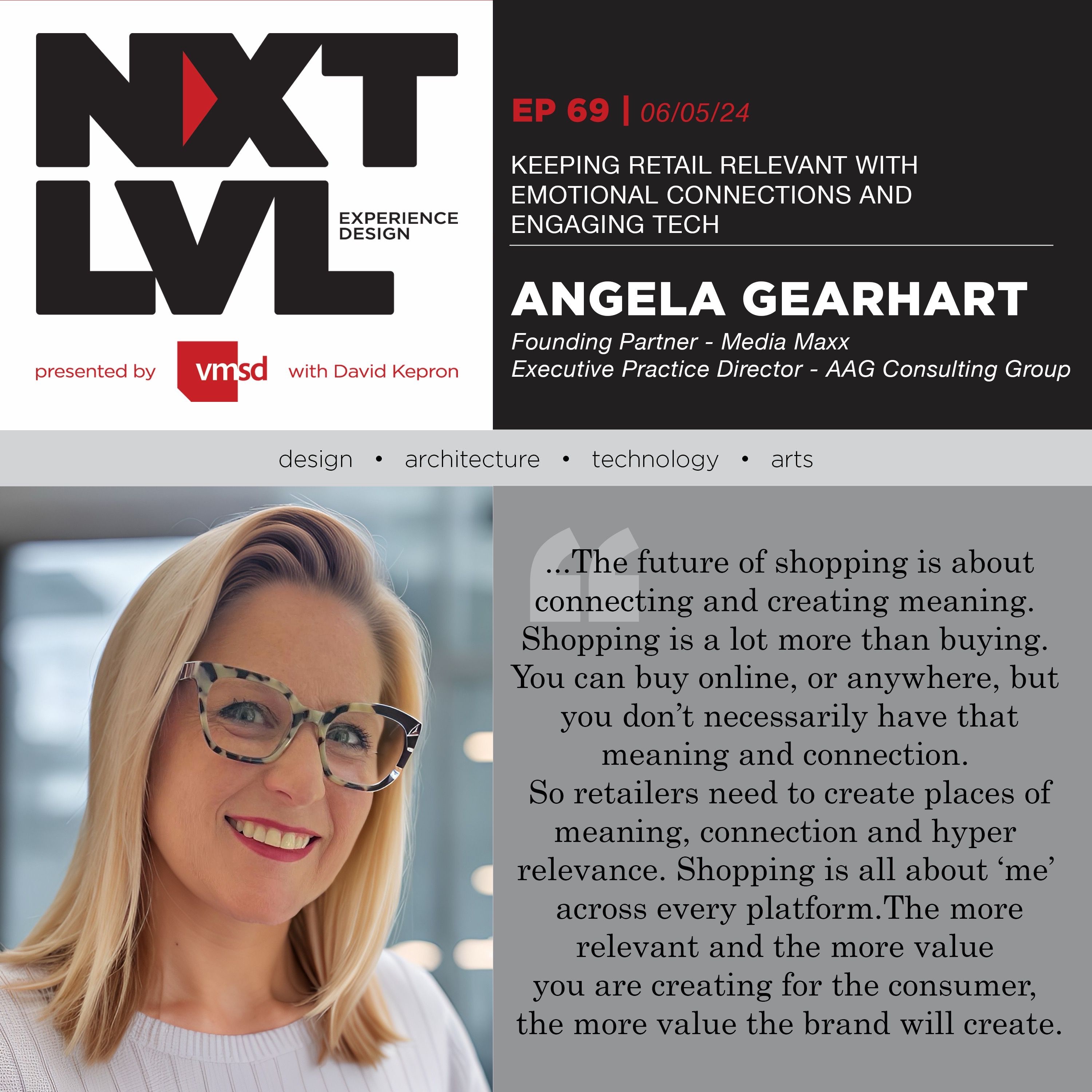
EP.69 Keeping Retail Relevant with Emotional Connections and Engaging Tech with Angela Gearhart, Founding Partner - Media Maxx Executive Practice Director - AAG Consulting Group
Jun 6, 202401:27:28Tap to summarizeAbout Angela Gearhart:Angela’s Profile: linkedin.com/in/angela-gearhart2024Websitesangelagearhart.com/ (Portfolio)mediamaxxcom.net (Company)greendogbotanics.com (Company)ANGELA'S BIO:Angela Gearhart, known for creating transformational brand experiences, tackles mission-critical challenges facing brands today. Where there is a gap between brands and their customers, they risk both revenue and relevance. Angela's deep understanding of consumer behavior and her ability to harness the synergy between marketing, sales, and technology, allow her to develop strategies that bridge the gap, igniting growth and fostering brand loyalty.By optimizing the human-physical-digital experience, she enables brands to disrupt and connect across consumer touchpoints. During her tenure as VP of Connected Brand Experience at Sleep Number, disrupted the mattress category, driving the company's growth from $300M to over $2B, with her team earning over 30 retail design, innovation, and technology awards.As a trusted advisor and influencer in the retail industry, Angela has earned accolades including recognition as a CSA Top Woman in Retail, Remodista Women2Watch in Business Disruption, Retail Innovator by Retail Touchpoints, and Design Influencer by design:retail Magazine.Angela is a Founding Partner at Media Maxx, which specializes in accelerating brand growth through ecommerce partnership marketing and retail strategies. Additionally, she serves as Executive Practice Director at AAG Consulting Group, where Angela leverages her insights into buyer dynamics and retail technology landscapes to deliver effective positioning strategies for B2B retail tech firms. She also contributes her expertise to advisory boards for Retail Touchpoints, Goldstein Museum of Design, IRISCX, and Digital Signage Experience.SHOW INTRO:Welcome to the NXTLVL Experience Design podcast.These dynamic dialogues based on our acronym DATA - design, architecture, technology, and the arts crosses over disciplines but maintains a common thread of people who are passionate about the world we live in and human’s influence on it, the ways we craft the built environment to maximize human experience, increasing our understanding of human behavior and searching for the New Possible. The NXTLVL Experience Design podcast is presented by VMSD Magazine part of the Smartwork Media family of brands.VMSD brings us, in the brand experience world, the International Retail Design Conference. The IRDC is one of the best retail design conferences that there is bringing together the world of retailers, brands and experience place makers every year for two days of engaging conversations and pushing the discourse forward on what makes retailing relevant. You will find the archive of the NXTLVL Experience Design podcast on VMSD.com.Thanks also goes to Shop Association the only global retail trade association dedicated to elevating the in-store experience. SHOP Association represents companies and affiliates from 25 countries and brings value to their members through research, networking, education, events and awards. Check then out on SHOPAssociation.orgIn this episode I talk with Angela Gearhart a retail industry leader who spent 20 years at Sleep Number Corporation as the VP of Connected Brand Experience changing the way co nsumes shopped for beds by integrating relevant technologies to enhance the shopping experience and foster deeper relationships between the brand and its customers.First though, a few thoughts… * * *Off the top of our discussion, this is the sentiment that my guest Angela Gearhart expressed as we dug into a conversation about the nature of retail what it is really about.No doubt, when you think about retail there is indeed buying involved, but it is so much more than that. In the exchange of goods and services there is an intangible factor to long-term customer life-time value… a relationship. Shopping is less about stuff than a deep interpersonal connection built on our need to be in social groups. The sense of belonging and that the relationship establishes context and meaning to our lives is key.Is that too much to put on the back of a retail experience? I don’t think so. For millennia, shopping has been connected to the sharing of ideas as well as the exchange between parties, you give me something and I in return I give you something. Shopping is ultimately more than getting stuff. While I think it's certainly true that factors like price point and overwhelming product assortments and some logical sequence of getting people into the store moving them through departments exposing them to products and getting them to buy has been a prominent way to think about, retail I think that it's ultimately more than that. In a world where shoppers don't have to go to the store because of the modern emergence of digital technologies allowing for convenience shopping from any place anytime from the palm of your hand, the question becomes what is it that drives people to go to the store?I don't think it would be that just price or having lots of it whatever it is I want would be the only motivator.I think what customers really want will be for their products and services to be imbued with both utility and significance.The design of entire experiences will become a critical factor in making shopping places relevant in a world where you have ubiquitous access and abundant choice. But beyond providing products, services and experiences that are beautiful and maybe even transcendent, I think shoppers will desire, as they have for centuries, the feeling of connection, a relationship, being valued and that they can find meaning in the shopping aisles as well as the dry goods and sundries.In the end we are social beings bound to an innate need to come together in community to cooperate, to share and to use our imaginations to create. Over millennia, these parts of us really haven't changed but the ways we satisfy these needs have been in continuous evolution. Advances in technology have modified the speed of change moving it from a generational evolution and incremental steps to something more akin to revolution - something that happens very quickly. The pace of change these days is exponential.So, the way we see technologies and its relationship to interaction and engagement in retail places will be a fundamental driver to how we now expect experiences to unfold. We have these devices in the palm of our hand and we will likely continue to expect that what we do from the power of our palm - which gives us a sense of agency and control over a developing customer journey narrative - will be something that we also want to do while I'm in the store.Emerging customers want to interact with technology in a way that is relevant to them - to engage in a way that changes the experiences so that it's focused on them. Personalization and customization will be key drivers to how we end up creating meaningful retail places in the near future.This is super important to understand because an entire generation of emerging shoppers who are digitally enabled and very savvy are interested in creating brand relationships that reflect their own personal ideologies.It won't just be whether or not the things they can get will be inexpensive or easy to access. Ease and convenience will simply be table stakes.Shopping or the idea of trade and commerce have been simply embedded in our evolution. Over twisting trade routes across continents, through sprawling bazaars, across the counter at a general store, through the mail or making a purchase with your smartphone on a street corner, shopping has always given us away to make meaning of who we are, how we interact and how we live. So yeah, I think shopping experiences have always been more than simply getting stuff. Shopping has at its core is an exchange forging trusting relationships and connecting to the world beyond us.Shopping whether it was in the intersections of silk trade route, the Greek Agora or in today's mega shopping malls has given us a way to connect to our families, our communities, our nations and the world and in doing so we add ourselves to that intricate weaving of our personal and cultural human tapestry. Shopping is part of our cultural orientation.I think we can look at places like the Greek agora as an ancient version of a social networking site.When you were going down to the market to get eggs and bread you were likely passing people on the way and overhearing conversations about what was happening in your community. The town crier did not stand out in the middle of a field some distance from the city he was there on the proverbial soapbox informing people of the important information of the day in the town square - in the cultural epicenter of the town surrounded by…shopping.Great retailers have it embedded in their corporate DNA that people drive their business and that their business is equally promote ideas and ideals. I think more so than ever before it's become critical to understand that for brand to remain relevant it's not just about what...
Transcribe →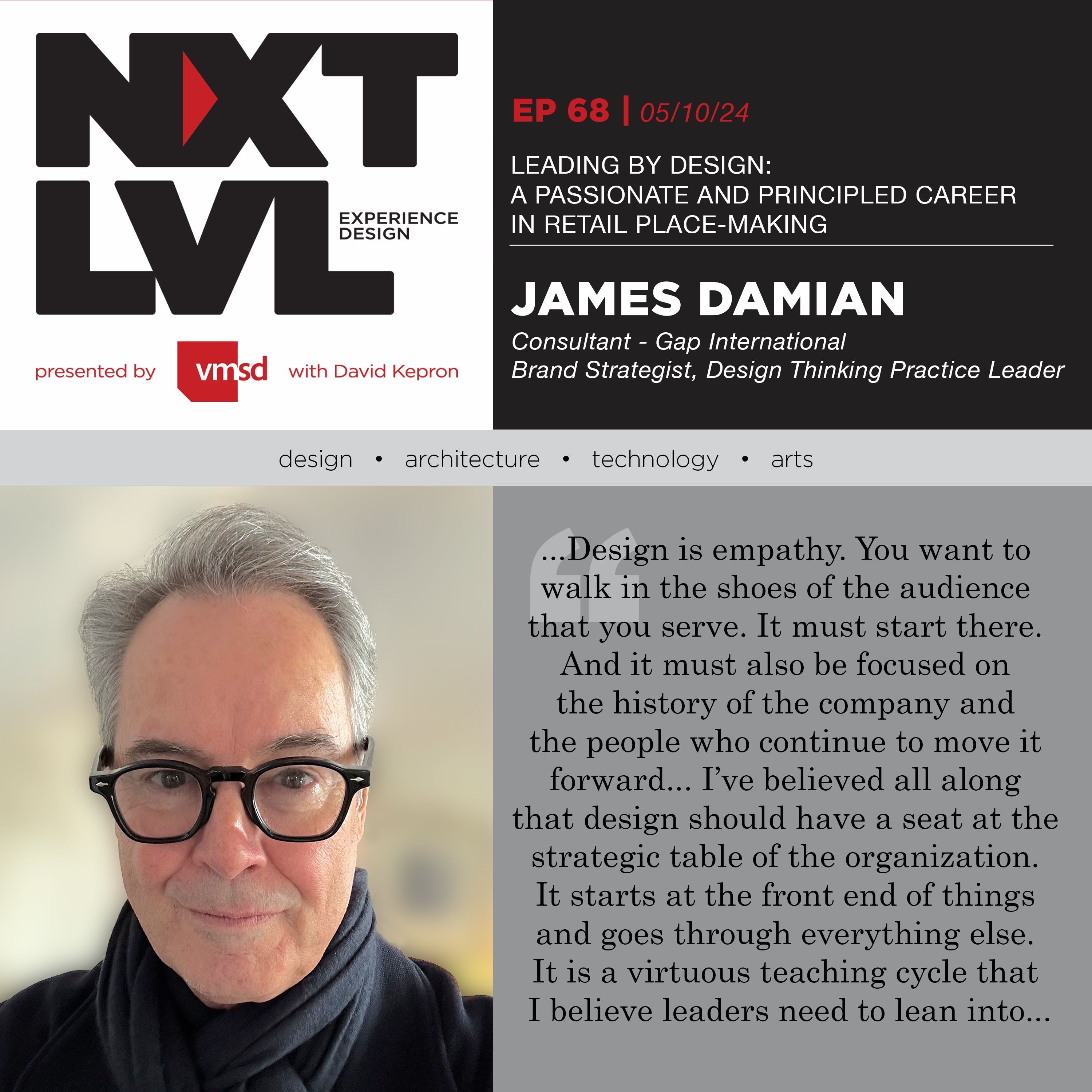
Ep. 68 Leading By Design: A Passionate And Principled Career in Retail Placemaking with James Damian - Consultant - Gap International Brand Strategist, Design Thinking Practice Leader
May 10, 202402:03:23Tap to summarizeAbout James Damian:James’ Profile: linkedin.com/in/james-damian-3a54956Website: james-damian.com (Company)Email: james@james-damian.comJAMES' BIO:Senior Executive and Consummate Business Leader who drove major change across the consumer retail industry by leveraging the power of design thinking as a strategic advantage, delivering economic success. Trusted advisor committed to creating purpose, achieving profit through performance for sustainable growth. While at Best Buy James and his group led innovation and new concept stores making them the most profitable in the history of the company to date. During his time the Store count went to 1400 from 275 and the stock soared from $7 a share to $110.James is a Design Thinking practitioner, Creative Strategist and Motivational Speaker at International CEO Summits, illustrating how to create a Customer Centric Culture through Design Thinking where Culture precedes Strategy, creating growth through an integrated, collaborative, interdisciplinary process.BOARD LEADERSHIPAs Chairman of the Board for Buffalo Wild Wings from 2008 to 2017, helped to shift corporate focus to an employee and customer-centric culture with the goal to become the ultimate social experience for sports and gaming fans. This strategic shift accomplished through alignment of the board with management enabled an extraordinary run of top quartile performance delivering an 850% return to shareholders.STRATEGIC LEADERSHIP THROUGH CREATIVITYDrove culture of innovation within Best Buy and consequently transformed the 'Big Box' consumer electronics retail format. Pioneered company’s “new store” experience by integrating creative visual merchandising and design into the overall corporate vision. Instrumental in expanding BestBuy from 275 to 2,500 stores. This experience based strategy was instrumental in driving revenue from 8 billion to 50 billion in a 12 year period, attaining status as a Fortune 50 company.SHOW INTRO:Welcome to the NXTLVL Experience Design podcast.These dynamic dialogues based on our acronym DATA - design, architecture, technology, and the arts crosses over disciplines but maintains a common thread of people who are passionate about the world we live in and human’s influence on it, the ways we craft the built environment to maximize human experience, increasing our understanding of human behavior and searching for the New Possible. The NXTLVL Experience Design podcast is presented by VMSD Magazine part of the Smartwork Media family of brands.VMSD brings us, in the brand experience world, the International Retail Design Conference. The IRDC is one of the best retail design conferences that there is bringing together the world of retailers, brands and experience place makers every year for two days of engaging conversations and pushing the discourse forward on what makes retailing relevant.You will find the archive of the NXTLVL Experience Design podcast on VMSD.com.Thanks also goes to Shop Association the only global retail trade association dedicated to elevating the in-store experience. SHOP Association represents companies and affiliates from 25 countries and brings value to their members through research, networking, education, events and awards. Check then out on SHOPAssociation.orgIn this episode I talk with James Damian a retail industry leader who was mentored in the fine art of visual merchandising and display by one of retail’s icons, Gene Moore of Tiffanys. James has had a brilliant career leading major transformations at Best Buy where he was SVP and Chief Design Officer of Experience Design Group, the Chairman of the Board of Buffalo Wild Wings and now shares his experience and passion for retail as a consultant with GAP international.First though, a few thoughts… * * *In 1994 I was working in my hometown of Montréal as an architect and at the same time teaching was the director of the interior design program at College Interdec at LaSalle college. One day my friend and colleague Monique Piroth invited me out to lunch across the street from the school for a sandwich we talked about the world of visual merchandising, the program that she was the director of and where our careers would take us.She explained that the college wanted her to go to Singapore to step into the role of the director of the visual merchandising program at La Salle international Fashion School in Singapore, an affiliate of LaSalle College, because our friend and colleague Guy Lapointe had to return to Montréal to tend to his ailing father. She effectively said that she didn't want to go and I immediately offered up the option that I would instead. This was one of a series of fateful moments of serendipity that would shape my career for the next 30 years. I never planned to be in retail... It just happened. I wasn't out looking for it, but it somehow found me. And so, after that somewhat joking, off the cuff remark, I was on a plane for Singapore not much more than two weeks later. At that point, my life shifted and instead of practicing architecture in the way that I thought that I would, I shifted into the world of visual merchandising and store design. While running the Visual Merchandising program at LaSalle International Fashion School, I was asked to do a presentation on visual merchandising trends at a Retail Asia conference.To be honest, I had very little insight what trends were shaping the retail world since the whole thing was new to me. I was reading everything I could in retail design magazines and trying to learn about who the voices were in the industry and what they were talking about. I scoured the magazines trying to determine who were the thought leaders in the industry and compiled a short list of people who I thought had great insights and sent out invitations, by fax, for them to provide some insight on what they considered to be major trends in the industry. One of those individuals was a gentleman named Tom Beebe who at the time was the visual merchandising director for a men's fashion store in New York called Paul Stewart.Tom was an enthusiastic participant and when at the end of my one-year tenure in Singapore I arrived in New York I made sure to make a point of connecting with Tom.Tom was gracious and enthusiastically set up meetings for me to meet people in Manhattan so that I could start off on the right foot in a new city and upon a path of the new career. One of those individuals was Gene Moore. Gene was the visual merchandising maven that shaped the visual display direction not just for Tiffany's, where he was the master of storytelling in the small windows on 5th Avenue, but he influenced an entire generation of what were then called window trimmers later being called visual merchandising and display people.Genes work elevated the making of stories in store windows into an art form. I was lucky enough to be invited to spend an afternoon with Gene Moore in the Tiffany display studio on 5th Avenue. It was truly a memorable moment of my career but I confess that at the time, I had very little idea about who Gene Moore was and why I might have otherwise treated him with extraordinary reverence. I think the few hours that I spent there were kind of like when you meet someone who's famous but you actually have no idea who they are and so the conversation is casual and unpretentious, and you don't spend time worrying about what you're saying or trying to play to their preferences. Gene didn’t have to take the meeting. But he did and shared his delight and passion for his profession with a total newbie with nothing but questions and awe for making magic in retail stores.What an honor…Another of the introductions that Tom Beebe made for me was to the late great Peter Glenn.Peter invited me into his home on Sniffin Court on 36th St. east of Madison where he talked about the world of retail stores and customer experience – his specialty - over a freshly brewed pot of English tea.I look back now at how fortunate that I was to meet these two luminaries in the most early days of my retail career and grateful I am to have had an industry friend like Tom Beebe who, out of the goodness of his heart and genuine love of retail and visual merchandising, shared his passion for the industry as well as his connections to some of the great influencers of the day.Over the years my path has crossed with Tom.His passion hasn’t waned neither for the world of creating compelling retail places with stunning and cleaver visuals nor his love of one of his mentors Gene Moore. Tom gave a compelling and impassioned retrospective presentation on Gene Moore, with another industry friend and colleague Eric Feigenbaum, at the International Retail Design Conference in 2023.Both of them aficionados and ombudsmen for the world of visual presentation – Eric being the New York Editor for VMSD magazine and a standout writer and educator in the field.In New York I settled in as the resident architect at a small 3-4 person consulting firm called New Vision Studios lead by another industry icon Joe Weishar. Another strange serendipitous occurrence since I had read Joes book “Design for Effective Selling Space’ while in Singapore and had canvassed Joe for a trends report for the Singapore presentation but… he was a non-responder. Ironically I end up working for him.Joe...
Transcribe →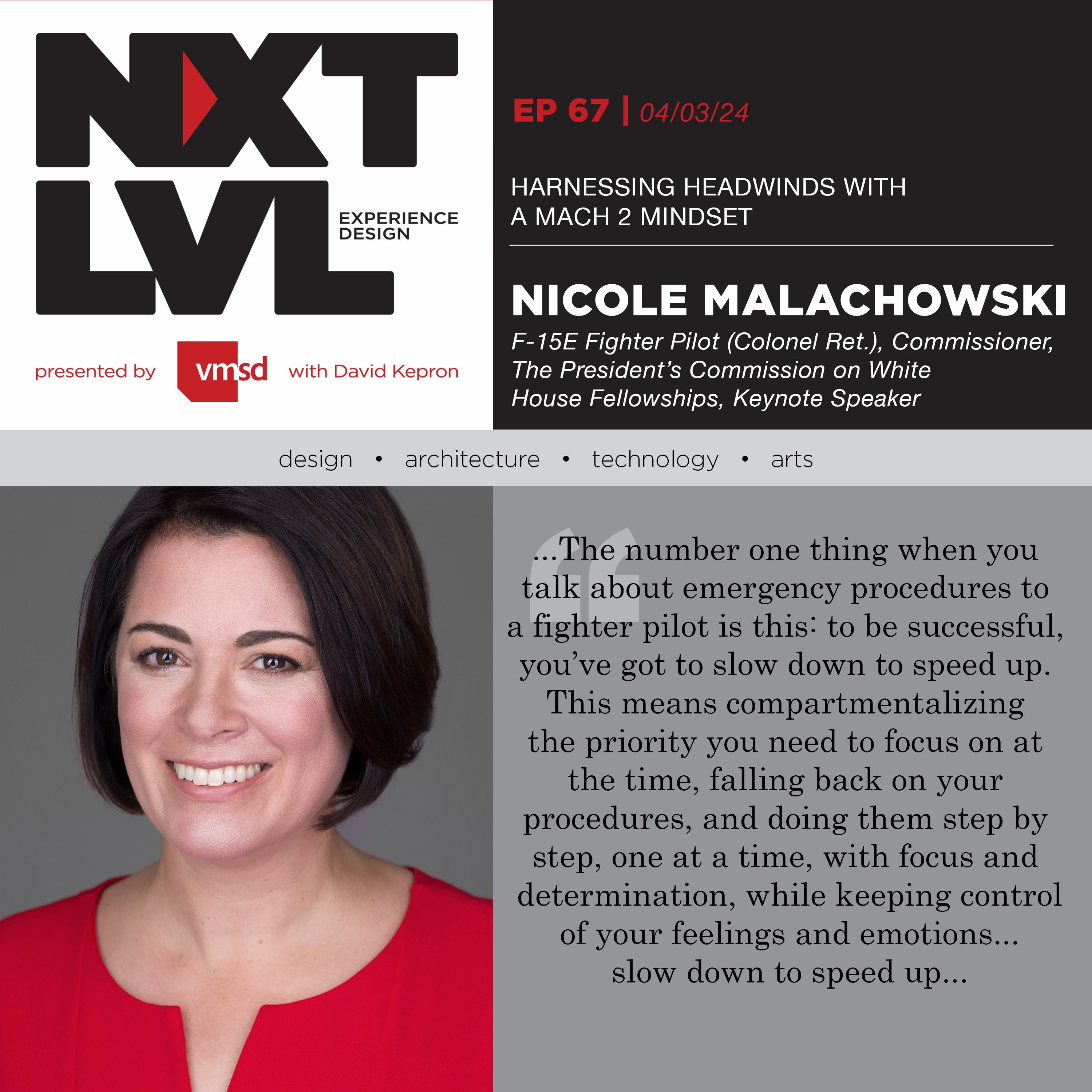
EP.67 Harnessing Headwinds With a Mach 2 Mindset with Nicole Malachowski, F-15E Fighter Pilot (Colonel Ret.), The President’s Commission on White House Fellowships, Keynote Speaker
Apr 3, 202401:39:48Tap to summarizeAbout NICOLE MALACHOWSKI:Nicole’s Profile: linkedin.com/in/realmalachowskiWebsites:linktr.ee/realmalachowski (Company)damelionetwork.com (Other)NICOLE'S BIO:A 2019 National Women's Hall of Fame inductee and recent Presidential appointee, Colonel Nicole M. E. Malachowski (USAF, Ret.) has over 21 years of experience as an officer, leader, and fighter pilot in the United States Air Force. Upon her commission into the military, she was competitively selected to fly combat aircraft and embarked on an adventure among the first group of women to fly modern fighter jets. Nicole served as a mission ready fighter pilot in three operational F-15E squadrons and accumulated over 2,300 flight hours, including 188 hours in combat. She has had the honor of commanding a fighter squadron, flying as a USAF Thunderbird pilot, serving as a White House Fellow and as an advisor to the First Lady of the United States. Nicole has forged a successful path through immense cultural changes in the military as well as significant adversity in her personal life. Following her medical retirement from the Air Force due to the severe impacts of late-stage Tick Borne Illness, Nicole reinvented herself as a highly successful entrepreneur, professional speaker, and leadership consultant. She’s been happily married to her husband Paul, an Air Force veteran, for over 22 years. When not hurriedly chasing their thirteen-year-old twins around, she finds immense meaning in traveling and advocating for those impacted by Tick Borne Illnesses. (©️2024 Nicole Malachowski & Associates, LLC-All Rights Reserved). SHOW INTRO:Welcome to the NXTLVL Experience Design podcast.These dynamic dialogues based on our acronym DATA - design, architecture, technology, and the arts crosses over disciplines but maintains a common thread of people who are passionate about the world we live in and human’s influence on it, the ways we craft the built environment to maximize human experience, increasing our understanding of human behavior and searching for the New Possible. The NXTLVL Experience Design podcast is presented by VMSD Magazine part of the Smartwork Media family of brands.VMSD brings us, in the brand experience world, the International Retail Design Conference. The IRDC is one of the best retail design conferences that there is bringing together the world of retailers, brands and experience place makers every year for two days of engaging conversations and pushing the discourse forward on what makes retailing relevant.You will find the archive of the NXTLVL Experience Design podcast on VMSD.com.Thanks also goes to Shop Association the only global retail trade association dedicated to elevating the in-store experience. SHOP Association represents companies and affiliates from 25 countries and brings value to their members through research, networking, education, events and awards. Check then out on SHOPAssociation.orgIn this episode I talk with Nicole Malachowski a retired Colonel of the United States Air Force, an F-15E fighter pilot, who commanded a fighter squadron, flew as a USAF Thunderbird pilot, serves as a White House Fellow and as was an advisor to the First Lady of the United States Michelle Obama.First though, a few thoughts… * * *It seems that I talk a lot about speed…Its’ sort of a fascination……the pace of change and what it likely means for emerging markets, changing guest expectations, how we address new needs, how we transition through moments of uncertainty and ambiguity and how leaders shift their orientation from current, or past paradigms, that are no longer relevant or adaptable to the fast-paced world we are now living and working in …and turn their attention to growing companies and workforces into flexible structures that are deeply embedded with the idea of change as a given - something not to be feared but seen as an emergent space of possibility.And I gotta tell you, this change thing isn't easy. It takes a persistence of thought and a modicum of courage to keep on looking into the void, unable to predict the distant future and maybe rely on shorter term gains in the near future. Yeah, it's not easy. Especially when you've spent most of your life believing that there was a path that you were supposed to follow. Something that was laid out and that you could rely on as being consistent. And predictable.But it seems as though life keeps having its way of throwing a monkey wrench in that ideal and reminding me that very little is in our control.And there is that old, I believe Hebrew, saying that “man made plans and God just laughed.”Now I'm not sure who's exactly laughing at whom here but one fact remains… that uncertainty is a certainty. I think based on the speed at which our technology and societies are changing that uncertainty will be the name of the game for the future.Of course, there are some inherent challenges in taking that position in leadership because generally speaking, no one wants a leader who seems to be uncertain about where to go next. My hunch is though, that leaders who are able to say that they're not exactly sure where things will lead might likely be not only more realistic about possible future outcomes but more endearing to an emerging cohort of customers or employees.This may seem to go totally counter to the idea that we like our structures and the paradigms that we build our emotional and business selves around……but it seems to me that we’re increasingly in need of strategic positions that plan for things being upended.It's almost like having a ‘continuous contingency plan’ in place - if this then that and then if this then that and so on and so on.Recently I took on a role advising a group of students who were given the design challenge in a competition to build the hotel of the future... For opening sometime in 2050.It seemed to me that I was having trouble predicting the next five years rather than the next 25 years and I mused out loud that I don't know how they could predict anything that was that far ahead. The strange thing is, that it's not actually that far ahead.It is very much in front of us - right now - if you consider that we'll be moving towards that time much more quickly it than we'll have ever moved before.And so, with the group of students, I suggested that maybe what we needed was to consider that we engage in scenario mapping - planning a strategic platform within which many potential options could play out. In this exercise it seemed to me that what we needed to do was to be able to provide for all sorts of contingency plans while at the same time having a structure to allow for various outcomes to emerge based on a host of changing circumstances.There are a couple of ideas here that I frequently find myself thinking about:One would be……that if ‘you know where you're going, you've already gone’ as the saying goes and the delta between now and then is simply about production. There is a certain comfort in the knowing… I know where we are going.. the end point is predetermined, it is predictable and I feel reassured in knowing the end game.In this case, I think that the joy of discovery that you have when taking the ‘road less traveled’ is diminished, or disappears, and the work becomes transactional and geared towards efficiently getting to the outputs. Discovery falls away in preference for getting it done. I think that way about design as well… that it is often more process than product. It is during the making of something where a lot of the magic happens.My hope is that in those moments we have the collision of memories, emotions, ideas, the challenges of solving programmatic requirements, meeting the needs of end users, etc., etc. Design is a journey where all these things come together in a process where discovery leads us to a place of awe and reverence for the creative act so that we stand back from the things we have made in bewilderment that we are even able to do these things.There should be a moment where you stand back from the thing that you created and revel in how it was that you even got there.The second thing that also occurs to me about navigating into the unknown is that, at a brain level, we may have a certain level of being ill-at-ease about the unknown, we actually love the idea of novelty. I know I've talked about this before but, these moments of novelty and discovery where experience doesn't align with our expectations - or the predetermined schemas for how things should be - that we have in our in our brains are where, in a sense, our brains wake up and pay attention.We have predicted something to be a certain way and it doesn't happen and so things emerge from unconscious awareness into our consciousness – into a front row center level of awareness…… the new experience releases dopamine and other neurochemicals that make these experiences both desirable as well as potentially being full of trepidation. This is a neurobiological imperative that has been embedded in our neurophysiology for millions of years. Seeing and being able to determine the novel in our environments was a crucial factor to our very survival.In a way, this makes me think about how we might try to operate in a fast paced, changing world where every ...
Transcribe →